Reading view

It Might Feel Like We’ve Been Here Before, But We Haven’t

As artificial intelligence (AI) adoption surges and organisations move from the ‘should we?’ phase to the ‘how do we?’ phase, it’s natural to evaluate the likelihood of positive returns on AI investments. That’s always been the case with the onset of each new technology paradigm: C-suite executives, guided by their boards and aided by technical and business teams, remain keenly focused on traditional metrics such as return on investment, shareholder equity, developing and extending competitive advantage, and ensuring superior customer relationships.

This time is different, however. I recently experienced that firsthand when I went to visit a major customer. My contact, a senior decision maker, gave me a pointed piece of advice about how to talk about AI with his boss, the CEO: “Please don’t say anything negative about AI.” The subtext was clear: The company was fully committed to AI and didn’t want any cognitive dissonance to dissuade them from their mission.

It's hard to imagine a CEO taking such an absolutist stance on previous technology waves, such as cloud, bring your own device, or the internet of things. CEOs, board members, and technical leaders would be pragmatic in evaluating the benefits of investments and put mileposts in place to gauge progress – and to determine if and how to proceed.

AI is certainly a different kind of paradigm, though. While no one is casting aside careful evaluation and monitoring of AI investments, the underlying assumption is that we’re stepping on the accelerator. We’re all enthused not only by its potential for transformation and innovation, but also by how this technology can be leveraged for remarkable societal good.

However, while the accelerating momentum toward AI and agentic systems is undeniable, it is vitally important to set aside the fervour around AI and take a sober look at how to deliver safe, secure, and tightly governed systems at enterprise scale. 

Many organisations are underestimating the challenges of AI governance, in large part because they think they’ve been here before. They already have many experiences of ensuring robust cybersecurity and strict governance for new technologies, as they’ve done for remote systems, cloud computing, the internet of things, and more. They already have a corporate commitment to doing governance correctly and a sound governance model. 

But this new era of AI and agentic systems is different. New challenges abound, and AI strategy, build-out, and governance must be in alignment from the start to ensure proper operational, ethical, and regulatory outcomes. 

Our intention with this Peer Insights guide is to raise what we believe are existential issues around governance for this powerful, complex, and unprecedented technology wave. Few technologies have merited the often overused phrase ‘inflection point’ more than AI. The speed of AI adoption is nothing short of breathtaking; however, today’s runaway embrace of AI is far stronger than our current ability to govern it. That’s because AI represents a fundamental shift in how organisations do their business, interact with customers, make vital decisions, and execute their plans. This isn’t just a technology play: It’s a strategy for success and survival for entire industries and our global economy. The stakes have never been higher.

CEOs care so passionately about AI because they see it changing nearly everything we’ve learned and believed to be true about organisational success and failure. CEOs are in their positions for one purpose: to grow the business. AI can do that by transforming their processes and sparking new ideas. When that customer representative forewarned me, I really wasn’t surprised to hear his CEO felt so strongly about AI: Research from BCG indicates that more than 94% of CEOs say they still plan to deploy AI irrespective of demonstrated business value, even if there is a lack of tangible ROI or financial benefits from the start. 

Which brings us to the central role of AI governance. As we all know, there are many fundamental elements to any governance strategy, starting with robust, scalable, and intelligent cybersecurity. Cybersecurity - the foundation of governance - also includes the twin imperatives of accountability (‘rogue AI’ being a real thing, after all) and regulatory compliance.

But good AI governance has to go even further. Operational integrity is key to good governance because so much sensitive and even proprietary data is poured into AI models and accessed through powerful agentic AI systems. Now more than ever, organisations have to be transparent with customers and trading partners about how their AI systems operate, what kind of data is accessed, and how it is protected. And that doesn’t just mean being upfront with customers by telling them when they are interacting with an AI agent. Let’s take a typical retail use case: Imagine you’re on a website looking at clothing, and the agent recommends specific styles of clothing in specific colours. True operational integrity would allow you to discover why and when the agent made those recommendations. Was it based on your prior purchasing history, or on your browsing patterns on a recent web session? AI and agentic governance take the guesswork out of the equation for those interacting with the system and help breed greater confidence and trust.

It's critically important for decision makers to view AI governance holistically, rather than through a series of narrow lenses. For instance, even though cybersecurity is the foundation of good AI governance, it’s a mistake to treat AI governance primarily as a cybersecurity problem. If asked about ownership of AI governance, CEOs cannot and should not reply, “Oh yeah, the CISO has that covered.”

AI governance is fundamentally an enterprise risk problem, which means everyone must be involved in creating, deploying, managing, evaluating, and adjusting AI governance guardrails on a real-time basis. Again, AI is a different kind of risk environment than any we’ve previously encountered. For the most part, organisations are simply not adequately prepared to apply the right level and right type of governance to AI and agentic systems. I’ve spent much of the past 15 years of my career building governance frameworks, and while it has never been easy, we have had the advantage of being able to control many of the variables – such as infrastructure and network access – impacting governance decisions. With AI and agentic, we no longer have that advantage.

To explore the critical and complex issues of AI governance, we’ve enlisted five leading voices to bring their real-world experience to the discussion. Together, our five authors help lay out the new rules of the road for governing AI and agentic systems at scale.

Just as my customer gave me a heads up about the realities of speaking with his boss about AI, I’d like to offer you a heads up about the realities of AI governance challenges before you read this Peer Insights guide

  1. Visibility is paramount for successful AI governance. As we learned during the growth of trends such as cloud, bring your own device, and remote work, our employees will push the envelope with a do-it-yourself mindset. These tech-savvy and resourceful users are already making rogue AI a reality, so organisations need more visibility than ever into where AI ‘science projects’ and sandboxes are operating without anyone’s knowledge.
  2. AI governance must reflect the stunning velocity of change in AI development and deployment. Not only does AI have its own never-imagined rate of change, but the technology is changing everything else faster – product development, supply chains, marketing programmes, and more. AI governance has to evolve just as rapidly. Governance in the AI world must be a living system, constantly evolving with new technology use cases.
  3. Trust boundaries are incredibly different and difficult to manage in AI governance. AI represents a new class of identity that simply didn’t exist before. That means AI doesn’t fit neatly into your existing identity management framework, making things like application whitelists and zero trust network access less effective.

Unfortunately, many CEOs, board members, and business executives simply don’t understand the profound importance and complexity of these issues. They may have been heartened by how they integrated generative AI into their technology frameworks and their business processes, but GenAI was pretty familiar territory for CIOs, CTOs, and CISOs. Agentic AI is different for several reasons, including its automation and self-learning capabilities. Don’t be lulled into a false sense of security: Agentic AI is not simply a refresh of GenAI.

As you get ready to dive into the following chapters, rethink how you define governance when applying it to AI systems and agentic AI. Most traditional governance models are imagined, constructed, and deployed as gates, preventing people from doing things or going places they shouldn’t. Instead, think of AI governance as a guardrail to guide and direct people to get the most out of AI without creating problems. With so much excitement and investment around AI, organisations – and their employees – want to get the most out of their AI and agentic systems. We all know people don’t want to hear “no, you can’t do that”, so an effective governance system should use guardrails to drive proper, responsible, and safe usage of the technology.

Finally, as complex as AI and agentic governance are and will continue to be, don’t overthink things in hopes of creating the perfect model – it doesn’t exist. My advice is to start now, even if the model and framework are imperfect, and then bring the business along with you.

We at Palo Alto Networks are excited to give you insights, ideas, and actions you can take away from the chapters of this guide. We encourage you to share what you learn with your colleagues, peers, and team members – and to take prudent steps to build an AI governance model that rewards innovation without allowing your organisation to drift into dangerous waters.


Haider Pasha is VP & Chief Security Officer, EMEA, Palo Alto Networks

The post It Might Feel Like We’ve Been Here Before, But We Haven’t appeared first on Palo Alto Networks Blog.

  •  

New Executive Order Accelerates Post-Quantum Readiness Amid the Cryptographic Reset

The White House Executive Order on securing the nation against advanced cryptographic attacks accelerates the mandatory timeline for post-quantum readiness.

For years, post-quantum cryptography has been discussed as an important, yet abstract future technical migration. Because of the uncertain timeline for quantum computing, it has been difficult for most organizations to prioritize quantum readiness against more immediate security demands.

That is changing.

Signed on June 22, 2026, the Executive Order mandates the transition of federal information systems to post-quantum cryptography and establishes a national policy to migrate them to NIST-approved standards. It also extends the urgency beyond government by directing support for critical infrastructure owners and operators, advancing requirements for federal contractors, and calling for cryptographic bill of materials guidance.

The order directly addresses harvest now, decrypt later risk and sets transition milestones for federal high-value assets and high-impact systems: 2030 for key establishment and 2031 for digital signatures.

While the order directly applies to U.S. Federal civilian agencies, it should be seen as a signal of broader policy and procurement momentum. Organizations that do business with the government, support critical infrastructure, or operate in regulated industries such as energy, financial services, and healthcare should expect post-quantum readiness expectations to accelerate.

Quantum risk has shifted from a long-term research concern to a national cybersecurity priority tied to sensitive data, critical infrastructure, federal systems, procurement, and the broader digital economy. For security teams, the challenge now is turning that urgency into an operational plan.

Operationalizing the quantum mandate

As quantum computing advances, widely used public-key cryptography will become vulnerable to future attacks. Even before a cryptographically relevant quantum computer exists, adversaries can capture encrypted data now with the goal of decrypting it later.

This “harvest now, decrypt later” risk is especially concerning for organizations that protect sensitive information with a long shelf life. The response cannot wait until the threat fully materializes.

The broader ripple effect matters because compliance alone will not equal readiness. As requirements flow into federal acquisition rules and contractor obligations, the vendor ecosystem will be pushed to support quantum-safe capabilities in the products and services that enterprises, critical infrastructure organizations, and regulated industries rely on.

Adding support for post-quantum algorithms is not the same as safely migrating to them. Support means a system can use new algorithms. Readiness means the organization knows where cryptography exists, which systems are exposed, which dependencies matter most, and how to execute changes without creating disruption or new risk.

That matters because post-quantum migration can affect more than cryptographic libraries. Larger cryptographic objects, new protocol behaviors, hybrid modes, hardware acceleration requirements, interoperability constraints, and legacy system limitations can create real performance, availability, and compatibility challenges if changes are made blindly.

This is why cryptographic visibility must lead to actionable migration planning.

Security teams cannot migrate what they cannot see. But visibility by itself is not enough. They also need to classify exposure, prioritize high-value systems and long-lived data, understand operational dependencies, and plan changes in a way that avoids disruption, downgrade risk, or incomplete migration.

Cryptographic bill of materials guidance will be an important step toward mapping cryptographic assets. But a CBOM should be the starting point, not the finish line. An inventory can show where cryptography exists, but readiness requires understanding business impact, migration complexity, interoperability risk, ownership, and the order in which changes should happen.

Post-quantum readiness is not just an algorithm swap. It is an operating model for managing cryptographic change at scale.

Five actions for post-quantum readiness

The path forward starts with five practical actions.

  • First, see cryptographic exposure. Organizations must gain visibility into cryptographic usage across all environments to mitigate the risks associated with undocumented encryption.
  • Second, prioritize what matters most. Cryptographic exposure varies in urgency. Organizations should prioritize protecting authentication, high-value assets, and long-lived sensitive data based on risk and business impact.
  • Third, modernize trust infrastructure. Existing systems rely on fixed cryptographic assumptions. Post-quantum readiness demands flexible infrastructure and trust services that support evolving standards.
  • Fourth, automate cryptographic change. Manual tracking with spreadsheets provides an incomplete, point-in-time snapshot that quickly becomes outdated and is insufficient for the coming changes. Automation allows organizations to manage cryptographic updates and trust operations in a consistent, controlled manner.
  • Fifth, govern readiness over time. Post-quantum migration requires continuous governance to track progress, align ownership, and adapt to evolving threats and standards.

These actions help security leaders move from awareness to readiness.

What this means for cybersecurity now

The Cryptographic Reset is already underway, driven by post-quantum risk, shorter certificate lifecycles, machine identity growth, fragmented cryptographic ownership, CA distrust events, and expanding digital infrastructure.

The organizations that move first will not simply be the ones that adopt new algorithms the fastest. They will be the ones that build the visibility, operating model, and governance needed to manage cryptographic change continuously.

Take the next step

Read the guide: The Post-Quantum Readiness Race Is On: Five Actions Security Leaders Can Take to Accelerate Crypto Agility.

More resources

The post New Executive Order Accelerates Post-Quantum Readiness Amid the Cryptographic Reset appeared first on Palo Alto Networks Blog.

  •  

Built to Last: What Stonehenge Teaches us About IT Architecture & Cyber Resilience

Anyone who has seen the impressive frame of Stonehenge against the morning’s sunrise cannot help but be struck by its resilience, how it has withstood time and the unpredictable impact of nature and humans. And partly because of this, a recent conversation I had with the CIO of a large healthcare technology company made me realize that it was a fitting metaphor for cybersecurity.

As our conversation wove through familiar topics — the challenges and breakthroughs in enterprise IT architecture — we recognised and discussed a recurring pattern throughout most EMEA and multinational enterprises. Those organisations have gradually but surely evolved into a mosaic of vendor fragmentation, ‘micro-platforms’ across vendor-specific technologies, and rapidly developing data silos that no single IT architecture can solve on its own. 

The increased heterogeneity of hardware, operating systems, and cloud architectures now comes with a dizzying mix of cybersecurity tools and services, often optimised for Vendor X’s platform. This has led to the situation that a large organisation typically has more than 30 cybersecurity point solutions in place to protect their digital assets. And now that we have thrown AI into that mix, designing the right cybersecurity solution is as confusing as it is imperative.

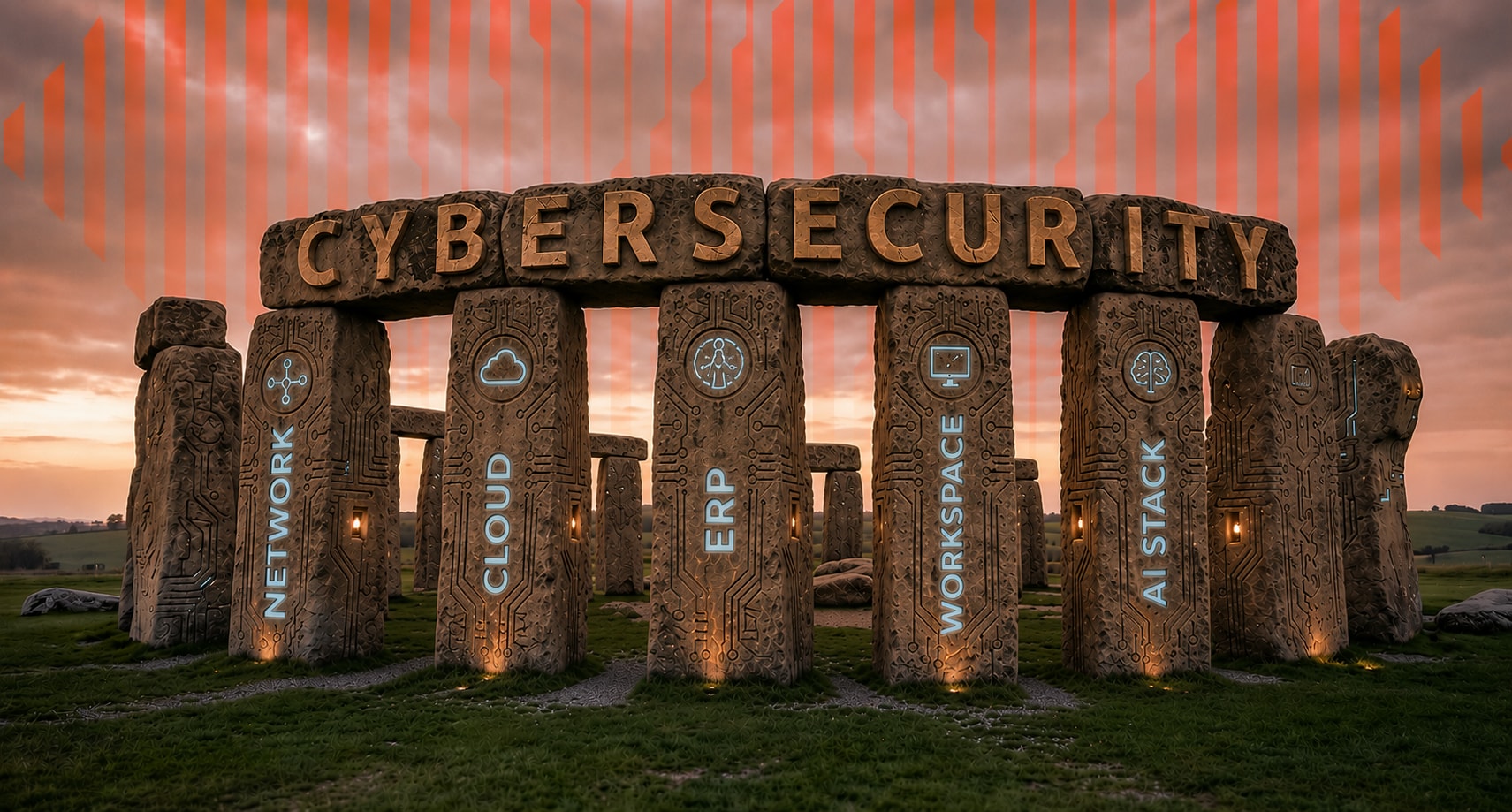
That’s when I was reminded of Stonehenge. Its lintel-and-joinery design is strikingly simple and elegant, and it stands as a brilliant monument to long-term resilience. Just as Stonehenge has endured against natural and human threats, so organisations must build a cybersecurity architecture that endures a revolutionary rate of change and threat diversity, including geopolitical turbulence and AI entering the value chain. 

For CISOs, CIOs, board members, C-suite executives and line-of-business leaders concerned with operational resilience, cybersecurity architecture matters—deeply. 

And we should not forget that cybersecurity is a data problem. The more telemetry data you have, the more effectively you can execute security algorithms and protect your digital essentials across all your enterprise IT pillars, i.e., IT, OT, Clouds, Networks, Workplace, Endpoints, etc. We at Palo Alto Networks are able to combine relevant telemetry data from networks, firewalls, clouds, browsers, endpoints and the internet. 

Stonehenge was built from massive, self-reinforcing pillars and platforms of stone. The lintels and joinery help hold together the overall structure as a cohesive unit, and they have striking similarities to how IT architects are now thinking about cybersecurity. In today’s technology architecture, Stonehenge’s vertical pillars are an IT organisation’s specialised, vendor-specific IT domains—sometimes with its own security tools and capabilities rather than as a strategically integrated zero-trust cybersecurity framework across your enterprise IT pillars.

Now, Stonehenge’s with its unique resilience, can also serve in its own construction as a model for modern cybersecurity architecture. Like our evolution towards modular platformisation evolved deliberately and assuredly over time and it spans all key domains of cybersecurity, ie network, cloud, AI,  identity security and all key building blocks for an AI-driven SOC, the last line of defense that has to be real-time. In other words, it is the linchpin of our strategy for enterprise security built upon such key areas as Identity, the Autonomous SOC, and Network Security. 

Stonehenge’s lintel is analogous to cybersecurity platformization, a growing trend rapidly replacing the now-outdated best-of-breed point solution mindset. This employs a modular approach that gives flexibility and control to the security architect looking to add security domain capabilities as needs evolve. The mortise-and-tenon joinery of Stonehenge works because the parts fit together rather than being stacked as an afterthought, in much the same way modern cybersecurity frameworks are built upon the concept of embedded functionality rather than being bolted on. 

An important example here is Palo Alto Networks’ decision to power the cybersecurity platform core with Precision AI, rather than its technology being added as a separate tool. This approach enables Precision AI to power data, analytics, and workflows, making it an omnipresent resource for smarter and faster prevention, detection and response.

Another important element of any enduring architecture is its ability to provide stability to the overall framework. In cybersecurity architecture, this is the all-important cyber data layer across an integrated zero trust framework. As organisations continue to struggle with data silos across networks, cloud environments, security operations centres, and edge systems, the cybersecurity data lake takes on a heightened role of importance for the resilience of the entire cyber framework. Again, let’s not forget, cybersecurity is a data problem, a domain in its own right across all vertical IT pillars.

Now, Stonehenge with its unique resilience, can also serve in its own construction as a model for modern cybersecurity architecture. Like our evolution towards modular platformization evolved deliberately and assuredly over time and it spans all key domains of cybersecurity, i.e.  network, cloud, AI, endpoints, identity security and all key building blocks for an AI-driven SOC, the last line of defense that has to be real-time. In other words, it is the linchpin of our strategy for enterprise security built upon such key areas as Identity, the Autonomous SOC, and Network Security/SASE. 

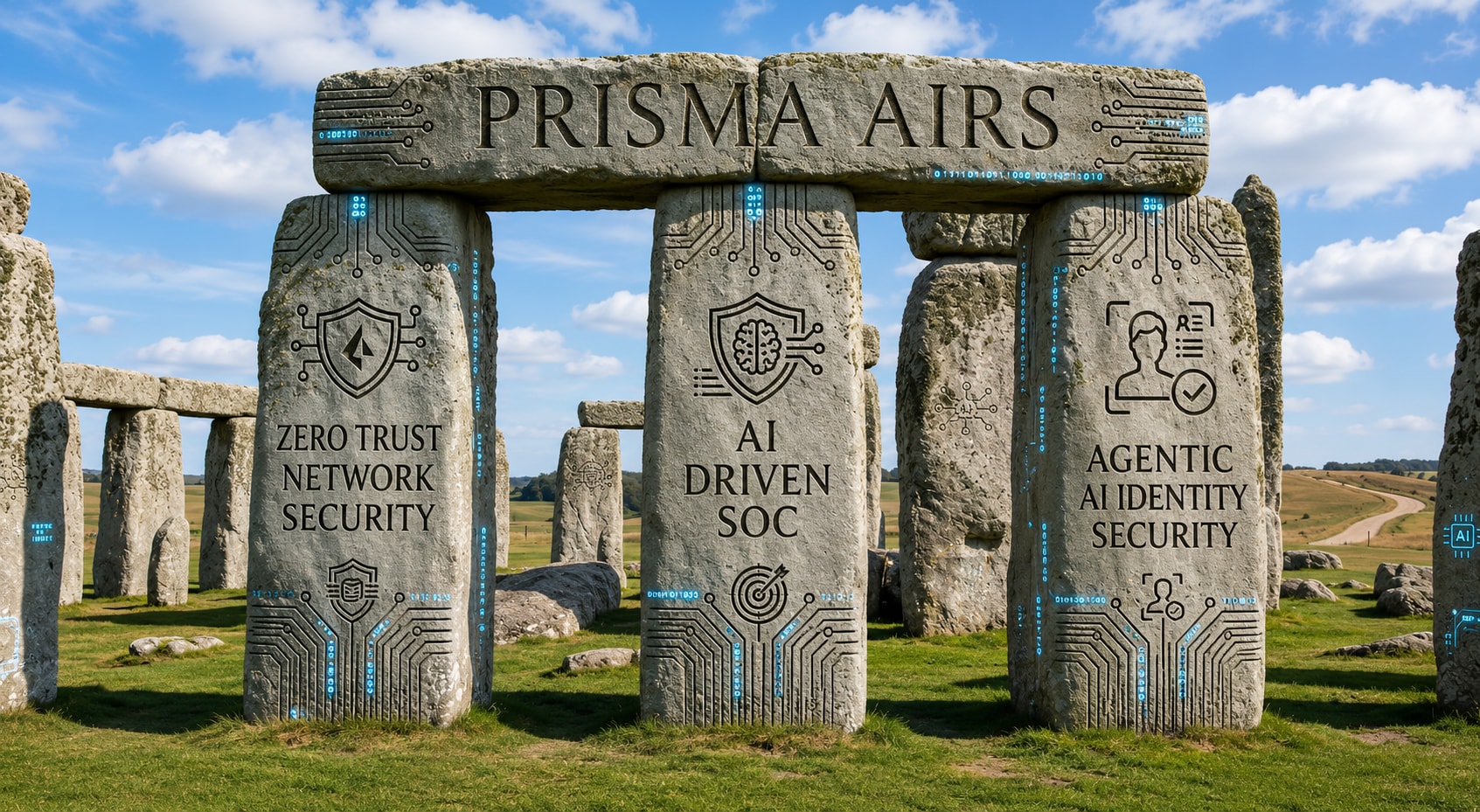
Another critical element of the cyber platform is something even Stonehenge hasn't had to face: securing AI itself, especially the opportunity and threat represented by agentic AI. AI security must become part of the platform design and implementation, as we have done with our Prisma AIRS (AI Runtime Security) platform for enabling an organisation's growing AI portfolio to remain a vital asset and not an inviting attack vector. Agents now are not just another non-human identity; they are an entirely new class of identity, with a striking mismatch in speed between agent decision-making and human governance. The inside-out attack paths taken by hackers' ill-intentioned agents represent a major threat to under-protected AI supply chains. The same pressure now also comes from geopolitics and from AI moving into the value chain itself, such as in the case of the Factory of the Future.

Similarly, our recent acquisition of CyberArk gives us what we believe is the industry’s strongest identity security platform, Idira, positioning it as yet another vertical pillar connected to the overall cybersecurity platform lintel. Cortex XSIAM and its security data lake are deliberately open — ingesting and correlating third-party telemetry alongside our own, over 17 petabytes of telemetry data each day — to form a secure data layer that is accessible to users based on policy management and credentials validation. Palo Alto Networks leverages this mountain of data, along with around-the-clock scanning of more than 5 billion daily security events, to feed Precision AI in order to detect and block potentially devastating attacks. Currently, we detect about 9,6m new attacks per day that have not been there the day before. The use of automated AI in attack vectors has been accelerating the time of exfiltration of data from the compromise of an organization. This delay was 9 days about 3 years ago, now data is exfiltrated in most cases in less than a day, sometimes already within less than one hour!

In this context, it's also important to highlight the importance of an Autonomous SOC pillar, particularly since compliance reporting windows are continuously contracting from days to mere hours calling for real-time, highly automated defence. Today, mean-time-to-detect and mean-time-to-respond are board-level imperatives commanding more conversation and attention at an organisation’s highest levels. The Autonomous SOC pillar is a vital element in helping enterprises achieve even faster detection and remediation, ideally down into single minutes. If it also integrates the historic enterprise SIEM you can further simplify your SOC operations and gain solid financial benefits by platformization of your security relevant data.

Finally, keep in mind the use of supply chains to build the actual platform. For Stonehenge, that was an impressive physical supply chain: The bluestones used in the structure were hauled about 250 kilometers from Wales without the benefit of air, rail, or truck transport. For Palo Alto Networks’ cybersecurity platform, the supply chain was no less impressive, but more virtual than physical, often faced with attacks on third-party interdependencies such as SaaS applications, APIs and in times of Frontier AI models, the Open Source components. 

Like the pyramids, the Great Wall of China, and the Roman road system, the most remarkable aspect to Stonehenge isn’t just its engineering elegance, but its ability to withstand changing conditions and threats over time. Whether you’re a CEO, board member, CIO, CISO or security engineer, the decisions you make about cybersecurity carry significant impact and implications. In order to achieve Stonehenge-like resiliency, technical and business leaders should commit to an architectural model designed not only for today’s needs, but for what those needs are likely to be over the long term. 

Therefore, cybersecurity should be architected as a horizontal, dedicated platform across all your IT domains and businesses. With this you are able to provide real-time and platformized cybersecurity for tomorrow. And tomorrow is going to be a more and more AI-driven business world. 


Helmut Reisinger is CEO for Europe, Middle East, and Africa at Palo Alto Networks.

The post Built to Last: What Stonehenge Teaches us About IT Architecture & Cyber Resilience appeared first on Palo Alto Networks Blog.
  •  

The Invisible CEO of Crisis: Breaking the Cycle of CISO Burnout

When a major cyber incident hits, all eyes are on the CISO.

They become the invisible CEO of crisis, steering the entire enterprise through the storm, managing stakeholders and making major decisions under immense pressure. The clock is ticking. Every minute can mean more systems affected, more data exposed, greater operational disruption and a growing risk to customer trust and corporate reputation.

And this on top of an already expanded day-to-day role, where they are expected to make decisions with incomplete information, brief the board, support legal and communications teams, manage technical response and reassure the business, all while knowing that any delay could increase the damage.

But a troubling pattern often emerges once the smoke clears. The CISO may find themselves held responsible for the incident that just happened, and in some cases personally liable, while still being expected to prevent the next one. Yet, at the same time, their influence over the strategic decisions that shape cyber risk can quickly diminish. 

This cycle takes a toll. Across EMEA, we are seeing the personal and organisational impact of that pressure, from burnout and leadership turnover to growing concerns about long-term resilience.

That pressure often comes at a demanding stage of life too. Many security leaders reach the CISO role when career responsibility is peaking at the same time as responsibilities outside work, from ageing parents and family commitments to their own health.

With an average CISO tenure now reduced to between 18 and 26 months, and nine out ten reporting feeling moderate to high stress, a more sustainable model is needed for structural and personal resilience.

Cybersecurity is far more complex than it was a decade ago. AI-powered attacks and autonomous agents are increasing the speed and scale of threats. At the same time, the CISO has never had more potential influence over business strategy. The challenge is ensuring the support around the role evolves as quickly as the threat landscape.

That is why it’s time to stop treating cybersecurity as a technical function alone and recognise the CISO as a strategic business leader.

Structural equity - breaking the cycle of isolation

The burden of cyber resilience should not rest on one individual. Yet too often, organisations place responsibility on the CISO without providing the support, influence or measures of success needed to help them thrive.

Part of the problem is how the role is measured. CISOs are judged by whether incidents happen, rather than by the quality of preparation, resilience planning, risk reduction and secure business enablement.

And preparation can really help reduce the pressure. Regular red teaming, tabletop exercises and incident simulations mean the CISO is not carrying the crisis alone when a breach happens. The organisation has rehearsed its roles, decision points and escalation paths before the stakes are at their highest. 

But after a crisis, organisations also often fall back into day-to-day survival mode, undoing the progress made when security was treated as a critical part of business planning rather than a technical function. Strong resilience requires the CISO to have a permanent seat at the table for all strategic decisions, from M&A to digital transformation.

That influence only comes with strong foundations. This includes visibility of critical assets and risks, security controls that are fit for purpose and the operational discipline to maintain them over time.

  • Invest in leadership as much as certifications: The modern CISO needs diplomacy, judgement and the ability to translate risk into business terms. Different backgrounds can strengthen that role, bringing fresh perspective when solving problems that are no longer purely technical
  • The ‘Shared CISO’ model: Cyber resilience should not rest on one pair of shoulders. The most resilient organisations embed responsibility for cybersecurity across the business, while creating stronger support structures around the CISO through deputies, shared ownership of cyber risk and clear succession planning. This reduces pressure on individual leaders and helps ensure resilience is built into the organisation itself

Strategic diplomacy - aligning people and purpose

Cyber resilience depends on people as much as technology, and a CISO’s success depends on building alliances across the business. The strategic diplomat CISO focuses on moving the conversation from ‘no’ to ‘how?’ by building deep relationships with other leaders, every team and every department across the organisation.

By understanding the business’ growth drivers, the CISO can align security goals with the board’s priorities. That means agreeing meaningful measures of risk and readiness, preparing for difficult questions and giving the business a clear view of where it is exposed. 

Security and growth must be seen as a single strategic fabric. Integrating security into the development of internal AI tools and customer-facing products helps ensure innovation is secure by design, rather than being a hurdle to overcome later.

The post The Invisible CEO of Crisis: Breaking the Cycle of CISO Burnout appeared first on Palo Alto Networks Blog.
  •  
❌