 Login
Login
Flock Cameras Are Being Used for Stalking
There are over a dozen cases around the country where police officers are using the Flock surveillance camera system to obsessively and illegally stalk people.

There are over a dozen cases around the country where police officers are using the Flock surveillance camera system to obsessively and illegally stalk people.
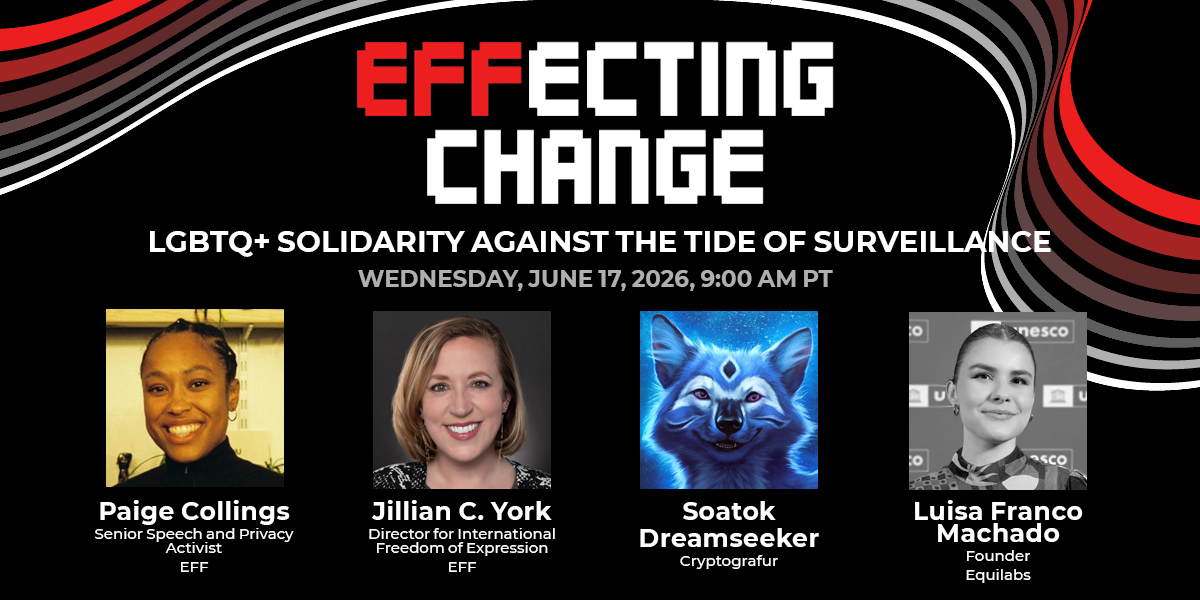
LGBTQ+ communities are facing an escalating wave of censorship and targeted surveillance, but we can push back through mutual solidarity. Join us live to learn how safer virtual spaces get built, how platform policies and government pressure are reshaping the digital landscape, and what platform accountability actually looks like. Our panel will share ideas for direct action and concrete strategies you can bring back to your community. Whether you’re an activist, an ally, or just paying attention, this conversation is for you. Join the livestream online followed by live Q&A.

This event is LIVE and FREE!
Paige Collings
As a lawyer, digital policy activist and community organizer, Paige works to dismantle systems of oppression and advance collective liberation. Her work focuses on highlighting how state surveillance and corporate restrictions stifle marginalized communities and perpetuate historic injustices and harm. She has worked with activists across the globe to facilitate systemic change by speaking truth to power and creating spaces for alternative imaginations; and her writing on digital justice has been featured in Wired, Politico, Teen Vogue, the Daily Beast and more.
Jillian C. York
Jillian is EFF's Director for International Freedom of Expression, based in London. Her work examines state and corporate censorship and its impact on culture and human rights, with a focus on historically marginalized communities. At EFF, she organizes coalitions, writes about and researches topics related to freedom of expression, leads the Speaking Freely interview series, and contributes to various other areas of the organization's work. Jillian is the author of Silicon Values: The Future of Free Speech Under Surveillance Capitalism (Verso, 2021), a contributor to several academic volumes, and has written for MIT Technology Review, The Guardian, and WIRED, among others. She is also a visiting professor at the College of Europe Natolin in Warsaw, and a regular speaker at global events.
Soatok Dreamseeker
Soatok Dreamseeker is a gay furry security engineer. He blogs about applied cryptography on his blog, Dhole Moments, and is developing key transparency to enable end-to-end encryption on the Fediverse. His puns are 100% whole groan.
Luísa Franco Machado
Luísa Franco Machado is an award-winning international expert in digital rights and data justice. She has also been a technical advisor in data governance and AI ethics for governments, NGOs, and international organizations worldwide, including the UN, OECD.AI, GIZ, and others. Luísa has carried on policy research at the London School of Economics and Political Science (LSE) and Sciences Po Paris on the intersection between technology and socio-economic development. In 2022, the United Nations recognized them as a global Young Leader for the Sustainable Development Goals (SDGs) among more than 6,500 advocates. In 2025 she was featured in Apolitical's Government AI 100 list as a rising star.
A proposed FCC rule would kill burner phones: phones whose accounts are not attached to a particular person.
The FCC plans to do this by legally forcing the country’s telecoms to store a wealth of personal information about essentially all phone customers, including a government issued identification number and their physical address, alarming privacy advocates and civil rights activists who compare the measures to those from authoritarian countries where it can be difficult to buy a mobile phone plan without giving up your identity.
The proposed change would drastically shake up how people obtain phone plans in the U.S., and have all sorts of privacy and cybersecurity knock-on effects. The FCC is proposing the data collection partly as a way to combat scammers, with telecoms being required to collect other information on business and foreign customers like the intended use case of their bulk phone plan purchase and their IP address. But the changes would mean telecoms collect data on all new and renewing customers, and the FCC provides a long list of other things that the collected data could help authorities with.
The surveillance company Leonardo wants more data:
A surveillance company plans to add sensors to automatic license plate readers (ALPRs) that would mean the devices, as well as capture the license plate of passing vehicles, would also sweep up unique identifiers of mobile phones, wearables, and other Bluetooth-enabled devices in those cars, potentially letting law enforcement identify specific drivers or passengers.
The technology, called SignalTrace, would turn ALPR cameras from devices focused on tracking cars to ones that can more readily track the location of particular people. ALPR cameras have become a commonly deployed technology all across the U.S.; SignalTrace would make some of those cameras capable of collecting much more data.
Yes, it’s bad that more companies are collecting this level of surveillance data. But all of this pales in comparison to the type and quantity of data our smartphones already collect about us.
Alternate link.
Just days after a damning WIRED report exposed that Meta had quietly embedded facial recognition technology (FRT) code into millions of phones, the tech giant has quietly acquiesced in demands to reverse course.
Last week, researchers identified code in Meta AI, a companion app for its line of smart glasses, that could convert images of faces into unique biometric signatures to identify strangers in public. EFF’s Threat Lab verified these findings through static analysis, and reminded consumers to think twice before buying or using Meta’s surveillance glasses.
Just as quietly as Meta embedded this code, the app’s June 5th app update appears to have quietly removed all those features and systems. Gone is the face-recognition technology, the code meant to trigger “Person recognized” alerts, and the machine learning models and databases designed to detect, digitize, and store the biometric signatures of people users engage with.
When WIRED broke the news last week, Meta’s executives immediately went on the defensive. Yet, their actions speak louder than their tweets: less than 48 hours after the public caught wind of their plans, Meta quietly launched an update to scrub nearly all traces of the FRT system from their app.
But this quiet deletion of code does not equal a permanent change of heart. Meta previously used face recognition, and stopped only after it faced the legal and financial consequences. Now the company has refused to answer WIRED’s inquiries on whether it plans to bring the NameTag system back in the future, or what they did with any data they may have already collected during internal testing.
There are billions of reasons not to turn Meta’s customers into a distributed surveillance machine. This whiplash behavior proves exactly why we cannot rely on the "good will" of Big Tech to protect our digital rights. We need robust, enforceable consumer privacy laws, complete with a private right of action that allows everyday people to sue companies that violate their biometric privacy.
While we won this round, Meta's FRT ambitions probably aren't going away. EFF will keep watching.

