 Login
Login
Leak confirms OpenAI is testing a ChatGPT for Science subscription
OpenAI appears to be testing a new subscription and experience for science use cases, but it's unclear if it'll be available to everyone regardless of their background. [...]

The ability to access publicly available information using automated tools is a central value and benefit of a free and open internet. Automated access—often called crawling or scraping—powers important, useful tools for locating, preserving, and analyzing online information. For example, crawling and scraping helps journalists, researchers, and watchdog organizations report the news, find security flaws, and investigate discrimination. Crawling the web allows non-profits like the Internet Archive to preserve historical copies of websites. Tools for automated comparison shopping allow consumers to find the best deals on items they want to buy. And so on.
Yet the open internet access is increasingly under threat from publishers and Big Tech companies alike. Fearing lost advertising and licensing revenues, website operators increasingly claim that they need to lock down their sites from bots that crawl public web content to train or operate AI models. Some companies are even trying to embed their business models into internet standards by changing Internet Engineering Task Force (IETF) technical standards that shape much of the internet.
Many of their economic anxieties are understandable. AI bots can strain websites’ infrastructure, in some cases, degrading site performance or taking them offline altogether. Upgrading systems costs money that some sites may not have. And AI is likely to disrupt the business models many publishers adopted in response to the rise of the internet, if users rely on AI overviews instead of visiting source websites.
However reasonable these fears may be, the answer is not to change the IETF standards from neutral protocols that encourage openness to restrictive requirements designed to monetize internet access.
The worst of these proposed standards would give websites far greater ability to automatically block legitimate, lawful scraping and crawling. For example, the AI Preferences working group is working on proposals to give publishers a way to express “preference signals” against crawling web data for AI-related purposes, including to train models, generate outputs, and help users search the web. These preference signals would be expressed through robots.txt and could potentially become legally binding in some jurisdictions.
Another working group, called Web Bot Auth, is pursuing efforts to protect sites from overly-aggressive bots that strain website resources—a positive goal that could meaningfully improve the internet in the AI era. But Web Bot Auth is simultaneously pursuing a much more dangerous path as well: standards changes that would enable sites to cryptographically identify bots so that they can more easily block anyone they wish—not just “bad” actors, but competitors, dissidents, or anyone who hasn’t paid for the right to access sites using automated tools. If sites restrict crawling to a preapproved list of cryptographically authenticated bots, they could require licensing payments from those wishing to crawl their sites. This would close off the open web to researchers, archivists, and startups without the ability to pay for automated access.
Websites may have legitimate reasons to worry about AI’s impacts on their traffic and advertising revenue, but those reasons must be weighed against the benefits of the open web. These proposals would effectively give website operators veto power over a wide range of important uses—from the investigations and archival works described above to accessibility tools for people with disabilities, to research efforts aimed at holding governments accountable.
That is why we are fighting back against these threats to open access. EFF and our allies in the open internet community have successfully resisted some of the most dangerous IETF proposals thus far—and won’t stop working to protect the open web from efforts to manipulate internet standards to undermine the right to freely access the internet in any legal way, including with automated tools.


What we built, Fusion AI, runs at about a third the cost of a traditional external pentest, a human tester still signs off on every finding, and it is not here to replace anybody.
We have been hearing that one a lot. So when Melisa from our Business Capture team sat down with Brian Fehrman and me for this episode of AI Security Ops, she started with, “What is this thing you built, and is it the same hype everyone else is selling?”
The post Everyone’s Selling AI That Kills Pentesting. We Built One That Doesn’t. appeared first on Black Hills Information Security, Inc..
Tenet aims to detect and stop dangerous AI agentic behavior in real time.
The post Tenet Security Emerges From Stealth With $6 Million Seed Funding appeared first on SecurityWeek.

AI security is getting attention because AI has stopped being a side experiment. It is now part of how work gets done. Employees use copilots to write, research, code, and analyze. Product teams are adding AI into customer experiences. Developers are building applications on top of foundation models. Business teams are experimenting with agents that can read email, summarize documents, query data, and trigger workflows. That is a very different world from the one many AI review processes were designed for. An AI system can pass a benchmark and still fail in production. It can behave safely in a clean test environment and then encounter real […]
The post AI Red Teaming Makes the Unknowns Known appeared first on Check Point Blog.
This week on the Lock and Code podcast…
If you weren’t taking deepfakes seriously before, it’s too late now to ignore them.
According to new research from Malwarebytes, one in three people who use AI every day said it’s okay to generate pornography of people without their consent.
Nearly 10 years ago, “deepfake” technology provided hobbyists and film editors with artificial intelligence (AI) tools to swap the face of one person onto the body of another. In its infancy, this technology brought silly film experiments like swapping Tom Cruise in Mission Impossible with Keanu Reeves. Today, this same technology produces something far more harmful—fake nude images of teenagers.
On the Lock and Code podcast today with host David Ruiz, we are re-visiting an interview from 2024, in which we spoke with a lawyer named David Chiu about his lawsuit against 16 deepfake nude generation websites.
The websites named in that lawsuit often needed just one image of a person to generate fake pornography. And while nearly everyone has at least one image of themselves online, even if they had hundreds, the path towards deletion is somewhat understood—start by deactivating and deleting popular social media accounts. But for teenagers today, raised mostly online, and who share images directly with friends and boyfriends and girlfriends and exes, it’s likely impossible to remove every visual trace of themselves. Also, they shouldn’t have to face this problem alone.
The Lock and Code podcast frequently discusses structural problems that require individual management. You have to skirt corporate data collection. You have to find the automated license plate readers in your hometown. You have to review every single message you get with a certain antagonism, to guard yourself against scams.
So, it’s rare to encounter a solution that benefits more than one person.
Chiu serves as the City Attorney for San Francisco, which means his department can file a lawsuit on behalf of not just the people of San Francisco, but also California, and that’s what his team did in going after the deepfake websites.
Since then, Chiu’s department has shut down 10 deepfake nude websites, and it received a settlement agreement from a company called Briver LLC to no longer operate any website that creates nonconsensual deepfake pornography.
And, as California goes, so goes the nation.
In May of last year, the Take It Down Act became effective as law in the United States, which criminalizes “revenge porn” and AI-generated nonconsensual intimate imagery. The law is not perfect but so far it is being used as intended. Last month, two men in the US were among the first to be charged with violating the Take It Down act for allegedly creating deepfake nudes that, according to the AP, “included both celebrities as well as private women, including recent high school graduates.”
Today, we revisit our conversation with San Francisco City Attorney David Chiu about the important fight against deepfake porn and the clear threat that his department found against the public.
“At least one of these websites specifically promotes the non-consensual nature of this. So, and I’ll just quote, ‘Imagine wasting time taking her out on dates when you can just use website X to get her nudes.'”
Tune in today to listen to the full conversation.
Show notes and credits:
Intro Music: “Spellbound” by Kevin MacLeod (incompetech.com)
Licensed under Creative Commons: By Attribution 4.0 License
http://creativecommons.org/licenses/by/4.0/
Outro Music: “Good God” by Wowa (unminus.com)
Listen up—Malwarebytes doesn’t just talk cybersecurity, we provide it.
Protect yourself from online attacks that threaten your identity, your files, your system, and your financial well-being with our exclusive offer for Malwarebytes Premium Security for Lock and Code listeners.
This week on the Lock and Code podcast…
If you weren’t taking deepfakes seriously before, it’s too late now to ignore them.
According to new research from Malwarebytes, one in three people who use AI every day said it’s okay to generate pornography of people without their consent.
Nearly 10 years ago, “deepfake” technology provided hobbyists and film editors with artificial intelligence (AI) tools to swap the face of one person onto the body of another. In its infancy, this technology brought silly film experiments like swapping Tom Cruise in Mission Impossible with Keanu Reeves. Today, this same technology produces something far more harmful—fake nude images of teenagers.
On the Lock and Code podcast today with host David Ruiz, we are re-visiting an interview from 2024, in which we spoke with a lawyer named David Chiu about his lawsuit against 16 deepfake nude generation websites.
The websites named in that lawsuit often needed just one image of a person to generate fake pornography. And while nearly everyone has at least one image of themselves online, even if they had hundreds, the path towards deletion is somewhat understood—start by deactivating and deleting popular social media accounts. But for teenagers today, raised mostly online, and who share images directly with friends and boyfriends and girlfriends and exes, it’s likely impossible to remove every visual trace of themselves. Also, they shouldn’t have to face this problem alone.
The Lock and Code podcast frequently discusses structural problems that require individual management. You have to skirt corporate data collection. You have to find the automated license plate readers in your hometown. You have to review every single message you get with a certain antagonism, to guard yourself against scams.
So, it’s rare to encounter a solution that benefits more than one person.
Chiu serves as the City Attorney for San Francisco, which means his department can file a lawsuit on behalf of not just the people of San Francisco, but also California, and that’s what his team did in going after the deepfake websites.
Since then, Chiu’s department has shut down 10 deepfake nude websites, and it received a settlement agreement from a company called Briver LLC to no longer operate any website that creates nonconsensual deepfake pornography.
And, as California goes, so goes the nation.
In May of last year, the Take It Down Act became effective as law in the United States, which criminalizes “revenge porn” and AI-generated nonconsensual intimate imagery. The law is not perfect but so far it is being used as intended. Last month, two men in the US were among the first to be charged with violating the Take It Down act for allegedly creating deepfake nudes that, according to the AP, “included both celebrities as well as private women, including recent high school graduates.”
Today, we revisit our conversation with San Francisco City Attorney David Chiu about the important fight against deepfake porn and the clear threat that his department found against the public.
“At least one of these websites specifically promotes the non-consensual nature of this. So, and I’ll just quote, ‘Imagine wasting time taking her out on dates when you can just use website X to get her nudes.'”
Tune in today to listen to the full conversation.
Show notes and credits:
Intro Music: “Spellbound” by Kevin MacLeod (incompetech.com)
Licensed under Creative Commons: By Attribution 4.0 License
http://creativecommons.org/licenses/by/4.0/
Outro Music: “Good God” by Wowa (unminus.com)
Listen up—Malwarebytes doesn’t just talk cybersecurity, we provide it.
Protect yourself from online attacks that threaten your identity, your files, your system, and your financial well-being with our exclusive offer for Malwarebytes Premium Security for Lock and Code listeners.
What do EFF staffers Sarah Chen, Javier Morales, Caitlin Chin, Emma Rodriguez, and Mikko Kopponen have in common?
For one thing, they don’t exist.
For another, all have been quoted as EFF experts in articles published in the past two months on a site called News-USA Today, which describes itself as “an independent news publisher focused on clear, accurate, and useful journalism.”
Uh…
(Please don’t confuse this site with USA Today, in which real EFF experts are accurately quoted on a regular basis.)
News-USA Today is hardly the only slagheap that’s hallucinating or fabricating EFF personnel and quotes; as we wrote last September, media companies large and small are using AI to generate news content because it’s cheaper than paying for journalists’ salaries, but that savings can come at the cost of the outlets’ reputations— assuming they care about reputation at all.
But this many fake EFF sources in two months? That’s making a play for the championship title of bogus news content.
News-USA Today’s site proclaims, “Our goal is simple: give readers the facts and the context they need to make informed decisions.” It then defines its mission:
Attempts to reach contacts listed on the site went unanswered. In fact, after we reached out to them, they published a story on June 9 with quotes from Electronic Frontier Foundation Executive Director Jared Cohen — who also doesn’t exist.
As we noted last year, EFF is all about having our words spread far and wide. Per our copyright policy, any and all original material on the EFF website may be freely distributed at will under the Creative Commons Attribution 4.0 International License (CC-BY), unless otherwise noted.
However, we don't want disreputable sites making up words (or false identities!) for us, whether or not they’re using AI. False quotations that misstate our positions damage the trust that the public and reputable media outlets have in us.
The best thing a news consumer can do is invest a little time and energy to learn how to discern the real from the fake. It’s unfortunate that it's the public’s burden to put in this much effort, but while we're adjusting to new tools and a new normal, a little effort now can go a long way.
As we’ve noted before in the context of election misinformation, the nonprofit journalism organization ProPublica has published a handy guide about how to tell if what you’re reading is accurate or “fake news,” as has FactCheck.org.
The model behind a security workflow shapes how fast a threat is caught, how accurately an incident is investigated, and how much a defender can trust the result. We treat that choice with care. Today we’re taking a clear step forward: Check Point has joined OpenAI’s Daybreak initiative through its Trusted Access for Cyber (TAC) program. These are real steps in how we bring AI into our defensive operations, and in the security we deliver to our customers. What Trusted Access for Cyber Gives Us Trusted Access for Cyber is OpenAI’s program for vetted security organizations that need its most […]
The post Check Point Joins OpenAI’s Trusted Access for Cyber Program and Daybreak Initiative appeared first on Check Point Blog.
By Yarden Porat
AI agents need memory. Frameworks like LangGraph provide it through checkpointers – persistence layers that store execution state. But what happens when that persistence layer isn’t locked down?
get_state_history() with a user-controlled filter. LangChain’s managed cloud service, LangSmith Deployment (formerly LangGraph Platform), runs PostgreSQL and is not vulnerable.langgraph-checkpoint-sqlite 3.0.1+, langgraph 1.0.10+, and langgraph-checkpoint-redis 1.0.2+.LangGraph is an open-source framework for building stateful, multi-agent AI systems with built-in persistence. It’s an extension of LangChain, with over 50 million monthly downloads according to PyPI stats.
Checkpointers are LangGraph’s persistence layer that stores execution state at each step. LangGraph supports two checkpointer implementations: SQLite and PostgreSQL.
The SQLite Checkpointer Database Schema:
The SQLite checkpointer uses an internal table called checkpoints with the following structure:
CREATE TABLE checkpoints (
    thread_id TEXT NOT NULL,
    checkpoint_ns TEXT NOT NULL DEFAULT '',
    checkpoint_id TEXT NOT NULL,
    parent_checkpoint_id TEXT,
    type TEXT,
    checkpoint BLOB,
    metadata BLOB,
    PRIMARY KEY (thread_id, checkpoint_ns, checkpoint_id)
);
The metadata column stores additional contextual information about each checkpoint in JSON format. For example:
{
  "user_id": "alice",
  "step": 1,
  "source": "input"
}
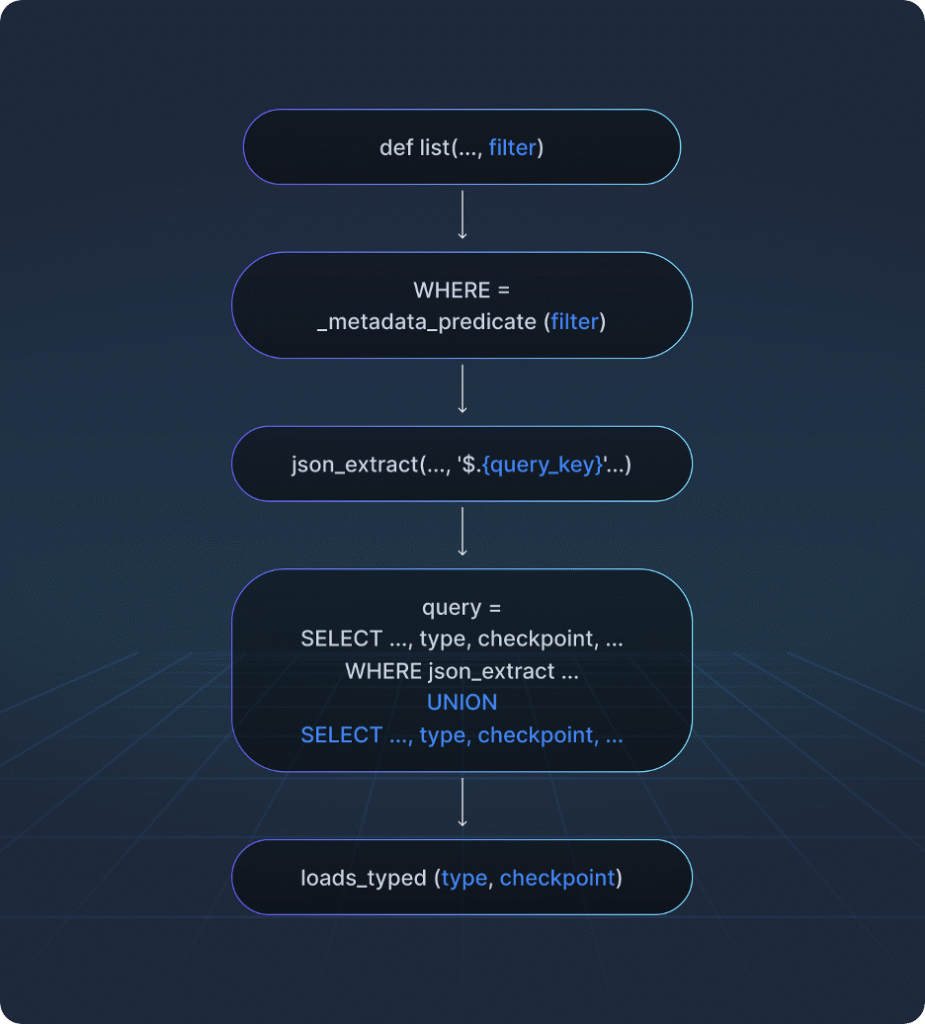
When calling the list() function on sqliteSaver (the checkpointer), the filter parameter is used to query checkpoints based on their metadata:
def list(
    self,
    config: RunnableConfig | None,
    *,
    filter: dict[str, Any] | None = None,  # Used to filter by metadata
    before: RunnableConfig | None = None,
    limit: int | None = None,
) -> Iterator[CheckpointTuple]:
The filter parameter is passed to an internal function called _metadata_predicate, which constructs the SQL WHERE clause to query checkpoints by their metadata fields.
# process metadata query
    for query_key, query_value in filter.items():
        operator, param_value = _where_value(query_value)
        predicates.append(
            f"json_extract(CAST(metadata AS TEXT), '$.{query_key}') {operator}"
        )
        param_values.append(param_value)

    return (predicates, param_values)
The vulnerability exists in how _metadata_predicate handles the query_key from the filter dictionary.
Notice this critical line:
f"json_extract(CAST(metadata AS TEXT), '$.{query_key}') {operator}"
An attacker-controlled filter could provide a query_key with a ' character that will escape the JSON path string and inject arbitrary SQL code.
To understand how SQL injection leads to arbitrary deserialization, we need to see the complete picture.
Here’s the SQL query that gets executed in list():
query = f"""SELECT thread_id, checkpoint_ns, checkpoint_id, parent_checkpoint_id, type, checkpoint, metadata
FROM checkpoints
{where}
ORDER BY checkpoint_id DESC"""
This query retrieves checkpoint data from the database, including the checkpoint’s BLOB column.
The results are then processed:
async for (
    thread_id,
    checkpoint_ns,
    checkpoint_id,
    parent_checkpoint_id,
    type,
    checkpoint,  # ← This comes directly from the SQL query results
    metadata,
) in cur:  # ← cur contains the query results
    # ...
    yield CheckpointTuple(
        # ...
        self.serde.loads_typed((type, checkpoint)),  # ← Deserialization
        # ...
    )
The checkpoint contains serialized data, and when fetched gets deserialized.
Using SQL injection in the WHERE clause, an attacker can inject a UNION SELECT that adds their own row to the query results:
SELECT thread_id, checkpoint_ns, checkpoint_id, parent_checkpoint_id, type, checkpoint, metadata
FROM checkpoints
WHERE ... (injected: ') UNION SELECT 'thread1', 'ns', 'checkpoint1', NULL, 'msgpack', X'', '{}' -- )
ORDER BY checkpoint_id DESC
The injected UNION SELECT returns a fake checkpoint row where the checkpoint column contains attacker-controlled serialized data. When the code loops through the query results, it deserializes this malicious checkpoint’s BLOB, giving the attacker arbitrary deserialization
Now let’s examine what happens during deserialization. The self.serde.loads_typed() function that deserializes checkpoint data looks like this:
def loads_typed(self, data: tuple[str, bytes]) -> Any:
    type_, data_ = data
    if type_ == "null":
        return None
    elif type_ == "bytes":
        return data_
    elif type_ == "bytearray":
        return bytearray(data_)
    elif type_ == "json":
        return json.loads(data_, object_hook=self._reviver)
    elif type_ == "msgpack":
        return ormsgpack.unpackb(
            data_, ext_hook=self._unpack_ext_hook, option=ormsgpack.OPT_NON_STR_KEYS
        )
    elif self.pickle_fallback and type_ == "pickle":
        return pickle.loads(data_)
    else:
        raise NotImplementedError(f"Unknown serialization type: {type_}")
json.loads() with object_hook was discussed in our LangGrinch research, but does not lead to code executionMessagePack (msgpack) is a binary serialization format designed to be faster and more compact than JSON. LangGraph uses ormsgpack, a Rust-based implementation with Python bindings.
MessagePack allows developers to define custom extension types to handle additional data types beyond its built-in primitives. LangGraph implemented its own extension handler to support serialization of custom Python objects.
When the type_ is msgpack, the code calls:
ormsgpack.unpackb(data_, ext_hook=self._unpack_ext_hook, option=ormsgpack.OPT_NON_STR_KEYS)
```
The `ext_hook` parameter points to LangGraph's custom implementation: `_msgpack_ext_hook`.

```python
def _msgpack_ext_hook(code: int, data: bytes) -> Any:
    if code == EXT_CONSTRUCTOR_SINGLE_ARG:
        try:
            tup = ormsgpack.unpackb(
                data, ext_hook=_msgpack_ext_hook, option=ormsgpack.OPT_NON_STR_KEYS
            )
            # module, name, arg
            return getattr(importlib.import_module(tup[0]), tup[1])(tup[2])
        except Exception:
            return
When an attacker controls the serialized data, they control both the extension code and the data bytes.
If we pass a msgpack with EXT_CONSTRUCTOR_SINGLE_ARG code, and the tuple:
When this line executes:
return getattr(importlib.import_module(tup[0]), tup[1])(tup[2])
It will:
1. Import the os module
2. Get the system function from it
3. Call os.system("echo PWN > /tmp/pwned.txt")
This gives an attacker arbitrary code execution – by calling os.system() with attacker-controlled commands, they can execute any shell command on the server.
Now let’s walk through how an attacker chains these two vulnerabilities together to achieve remote code execution.
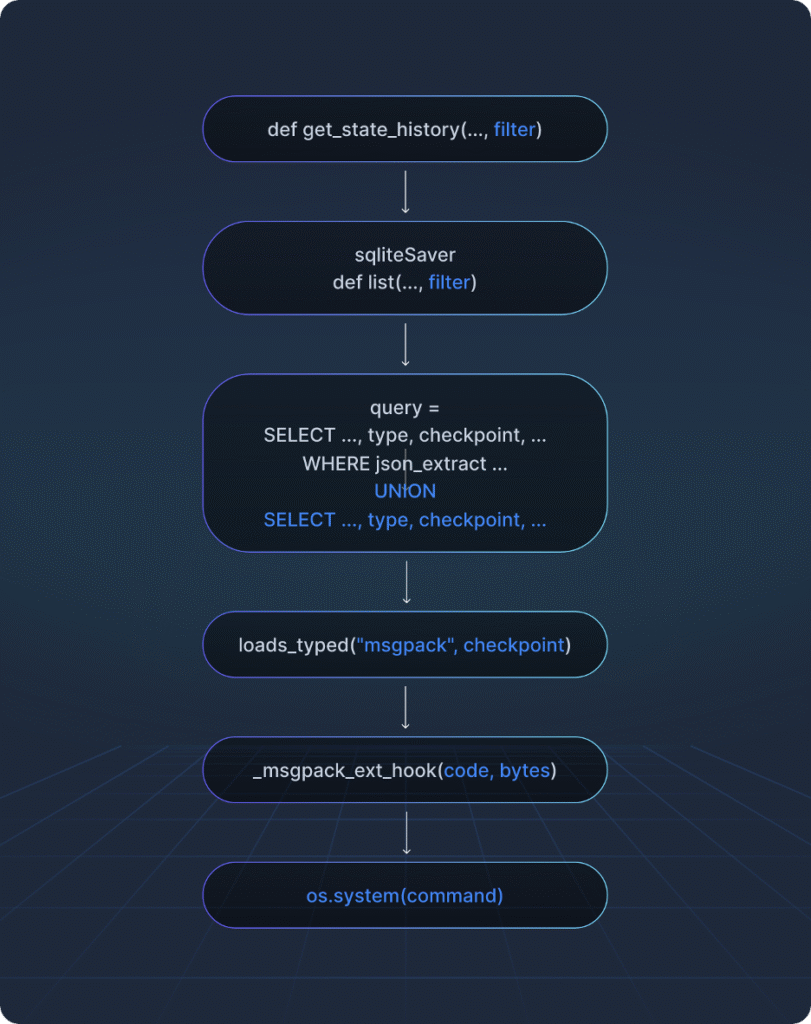
The Entry Point: When a developer exposes get_state_history(), it internally calls the checkpointer’s list() method to retrieve historical checkpoints:
def get_state_history(
    self,
    config: RunnableConfig,
    *,
    filter: Optional[Dict[str, Any]] = None,
    before: Optional[RunnableConfig] = None,
    limit: Optional[int] = None,
) -> Iterator[StateSnapshot]:
    # ...
    for checkpoint_tuple in self.checkpointer.list(config, filter=filter, before=before, limit=limit):
        # Process and return checkpoint data
If the filter parameter comes from user input without sanitization, an attacker controls the dictionary keys passed to the SQL injection vulnerability.
The Attack Flow
1. Craft Malicious Payload: The attacker prepares a msgpack payload containing instructions to execute arbitrary code (e.g., run a shell command).
2. Exploit SQL Injection: The attacker sends a malicious filter parameter that exploits the SQL injection vulnerability. This injection adds a fake checkpoint row to the database query results, where the checkpoint column contains their malicious msgpack payload.
3. Trigger Deserialization: When the application processes the query results, it encounters the injected fake checkpoint and deserializes the malicious msgpack data.
4. Code Execution: The unsafe deserialization executes the attacker’s payload, giving them remote code execution on the server.
The same injection class affects langgraph-checkpoint-redis: user-controlled keys in the filter dictionary are interpolated directly into the query instead of bound as parameters. Preconditions match CVE-2025-67644 (the application exposes get_state_history() with a user-controlled filter and uses the Redis checkpointer). Patched in langgraph-checkpoint-redis 1.0.2.
Beyond the primary SQL injection in the filter parameter, we identified additional defense-in-depth SQL injection issues in both the SQLite and PostgreSQL checkpointers. These involved direct concatenation of integer values (such as LIMIT and ttl parameters) into SQL queries instead of using parameterized bindings.
Since Python doesn’t enforce type hints at runtime, these parameters could still accept malicious string input. We worked with the LangChain team during disclosure to remediate these issues using parameterized queries.
2025-11-19: CVE-2025-67644 (SQL injection), CVE-2026-28227 (msgpack deserialization) And CVE-2026-27022 (Redis injection) disclosed to LangChain team
2025-12-10: CVE-2025-67644 fixed and publicly released in langgraph-checkpoint-sqlite 3.0.1
2026-02-20: CVE-2026-27022 fixed and publicly released in langgraph-checkpoint-redis 1.0.2
2026-03-05: CVE-2026-28277 fixed and publicly released in langgraph-checkpoint 4.0.1
The LangChain team responded quickly to fix the critical SQL injection vulnerability, which effectively breaks the attack chain described in this research. They continue to work methodically on additional remediation efforts, including the msgpack deserialization issue.
There was significant community research into LangGraph security during November and December 2025. Other security researchers independently discovered CVE-2025-67644 and CVE-2026-28277. Full credits can be found in LangChain’s security advisories.
The post From SQLi to RCE – Exploiting LangGraph’s Checkpointer appeared first on Check Point Research.
