โŒ

Reading view

A New Era of Security: Frontier AI Defense

For the last several months, we have had early, unbounded access to the latest frontier AI models. What weโ€™ve seen from that vantage point has made it clear that the window for organizations to get ahead of whatโ€™s coming is shorter than most leaders realize.

We have moved past the era of incremental AI improvements into a threat landscape shift. Our testing has revealed a step-change in capability that demonstrates an intuitive understanding of software vulnerabilities. This is more than faster code generation, it is a shift from AI as an assistant to AI as an autonomous agent capable of discovering and chaining flaws at a scale that most defenders arenโ€™t prepared for.

These capabilities will not stay confined to controlled environments for long. When Mythos first launched, we predicted a six-month window before attackers gained access. We now believe that timeline has accelerated significantly.

To meet this inflection point, defense must operate at the speed of the adversary. That is why Palo Alto Networks has introduced Frontier AI Defense. This initiative unites our AI-native security platforms with Unit 42ยฎ consulting and threat expertise with strategic partners to deliver continuous protection, prioritized risk mitigation and autonomous remediation.

What the Threat Looks Like Now

The latest frontier models, including OpenAIโ€™s GPT-5.5-Cyber, Anthropicโ€™s Mythos and Claude Opus 4.7, and the specialized variants emerging across major labs, represent roughly a 50% improvement in coding efficiency over their predecessors. That number sounds incremental, but in practice, itโ€™s the threshold at which AI crosses from a helpful assistant into an autonomous operator.

Based on our testing and review, we found four key developments that, taken together, redefine the modern threat landscape:

  • Vulnerability Discovery at Scale: Frontier AI is exceptionally effective at identifying vulnerabilities across massive, complex codebases. In our testing, three weeks of model-assisted analysis matched a full year of manual penetration testing, with broader coverage.
  • Exploit Chaining & Synthesis: What is more consequential than individual discovery is the modelsโ€™ ability to think like an attacker. They link multiple lower-severity issues into single, critical exploit paths, seeing full-stack logic, including SaaS and public-facing surfaces, in ways traditional scanners cannot.
  • Attack Cycle Compression: In AI-assisted scenarios, the time from initial access to exfiltration has collapsed to as little as 25 minutes. Detection and response measured in hours is no longer a viable standard; single-digit MTTR (Mean Time to Respond) is the new floor.
  • The Unsupervised Attack Surface: Rapid AI development and decentralized innovation are creating a massive, unsupervised attack surface in real-time. As local AI agents become commonplace, every desktop is now effectively a server, yet most organizations lack visibility into the code their own employees are generating and deploying.

Our Approach

These emerging threats form the foundation of how we have architected our platform response for the agentic era โ€“ Frontier AI Defense. Our approach moves beyond traditional, reactive defense to provide a comprehensive framework built to outpace frontier-AI-enabled attackers. This initiative is defined by:

  • Advanced Access: We leverage early access to frontier AI models to harden defenses and simulate attacks before they reach the mainstream.
  • Intelligence-Led Resilience: Unit 42 experts leverage frontier AI to fast-track discovery and remediation of exposures at machine speed through our Unit 42 Frontier AI Defense service.
  • Unified Global Ecosystem: We provide the scale required for global protection through our Frontier AI Alliance of elite partners, including Accenture, Armadin, Deloitte, IBM, NTT DATA, and PwC.
  • Machine Speed Security: By natively integrating Frontier AI across our platforms, we deliver the automated, real-time defense necessary to counter autonomous threats.

The Window Is Open. It Wonโ€™t Be for Long.

The capabilities we tested under early-access conditions are expected to become widely available over the next several months. Success in this new environment requires adapting your cybersecurity stack before these tools are in the hands of every adversary.

The threat has never been more sophisticated. The window to prepare for this shift is closing. And we're here to help secure your future at the edge of the frontier.

Visit Palo Alto Networks Frontier AI Defenseย to learn more.

The post A New Era of Security: Frontier AI Defense appeared first on Palo Alto Networks Blog.
  •  

The Dangerous Momentum of Autodownload Phishing

Modern phishing campaigns are no longer trying to convince users. They are trying to outrun them. By forcing an automatic progression from click to download, attackers eliminate the moment of hesitation entirely by forcing files to download instantly using trusted cloud platforms like Dropbox and Google Drive.

Detecting when these legitimate SaaS auto-download features are being weaponized is an immense challenge for traditional defenses. This is exactly where Cortexยฎ Email Security steps in. By combining deep static analysis with advanced behavioral intelligence, the module can distinguish in this attack between a benign file share and a malicious, forced-momentum trigger.

This technical detection is vital because while the autodownload method is the primary cause of infection, its effectiveness relies on a clever strategy, using a wide range of changing social engineering lures. By alternating between lures like 'Invoices' or 'Quotes,' attackers rotate their themes to catch a wider variety of victims. This strategy allows attackers to convert trusted email links into rapid, dangerous file executions that effectively evade standard security measures.

How Forced Momentum Drives Auto-Downloads

The core of this attack leverages the infrastructure of real SaaS providers to eliminate the user's preview buffer. Typically, cloud sharing directs users to a webpage for file examination. In this campaign, however, forced-download parameters (such as ?dl=1 on Dropbox) are used instead. To ensure the victim executes the file once it lands on their machine, attackers hide the danger behind "visual anchors." By using double extensions like PDF and .EXE, the threat actor exploits default settings in certain operating systems that hide known extensions. The user's eyes stop at the familiar ".PDF" or ".ZIP," leading them to believe the file is a harmless document rather than a malicious executable.

When the targeted victim clicks the link in the email, it triggers an immediate file download in the browser, effectively bypassing any intermediary steps.

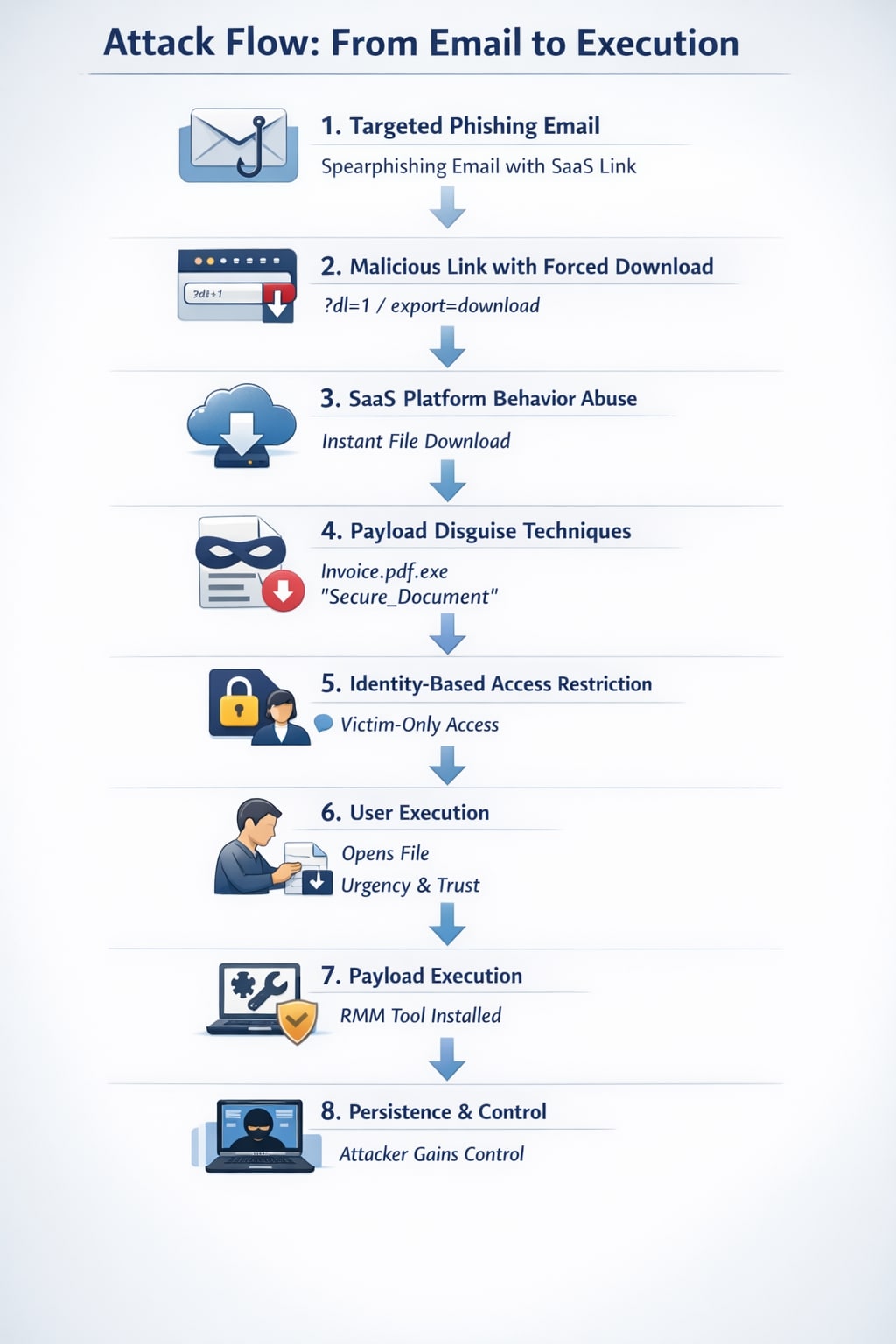
Attack Flow: From Email to Execution

  • The Bait: A highly personalized email arrives, using a trusted cloud link (like Dropbox) to lower the victim's guard.
  • The Trap: Clicking the link skips the usual "preview" screen and instantly drops a file onto the victim's computer.
  • The Disguise: The file is cleverly named to look like a safe PDF or document, hiding its true identity as a harmful program.
  • The Lock: In many cases, the attacker ensures only the intended victim can open the file, preventing security tools from scanning it first.
  • The Takeover: Once the victim opens the file, the attacker gains remote access to the system.
Attack flow chart, from email to execution.
Multi-step attack flow, starting from targeted phishing email, to bypass security and establish persistence.

The Library of Lures Strategy

To fuel the autodownload machine, attackers employ a flexible strategy by switching between various social engineering themes. This spear phishing campaign targets specific inboxes, such as "Orders," to exploit professional routines. Some common lures found in this campaign include:

  • Financial Urgency โ€“ Fake "Invoices" or "Receipts" that induce anxiety. These often set close-day payment deadlines, pressuring recipients to click quickly.
  • Business Operations โ€“ "Quote Requests" or "Purchase Orders" that exploit professional habits.
  • Deceptive Naming โ€“ Concealing the download as a safe document, using display text like "invoice.pdf" in the email body to hide the underlying Dropbox URL.

Government Domain Impersonation

Attackers often leverage high-authority lures designed to paralyze a user's critical thinking. In one sophisticated wave, we observed threats impersonating a government entity by exploiting the high-reputation, official government domain. By borrowing the reputational authority associated with official infrastructure, the attacker successfully maneuvered an "Unidentified Payment Notice" past standard "Untrusted Sender" filters. To the recipient, the email carries the weight of a sanctioned document. Fearing legal or financial ramifications, they feel a heightened sense of urgency to click "View Invoice" to resolve the issue immediately.

Employee Impersonation

When government authority isnโ€™t the angle, attackers shift to impersonating internal staff. In one case, the senderโ€™s display name was spoofed to match a real employee in the target organization. Attackers rely on a โ€œMomentum of Trustโ€ tied to familiar names to overwhelm user judgment. Even when a generic Gmail address is used, users, especially those on mobile devices, rarely pause to check the underlying headers.

Internal Trust Amplification ("Human Relay")

The most effective aspect of this campaign occurs through Internal Laundering, where the threat shifts from external suspicion to a trusted internal message. This was observed when a Finance Department employee received a "Quote Analysis" file and, believing it to be a valid inquiry, mistakenly forwarded the link to the Procurement department.

At that stage, the attack no longer depended on deception, it propagated through trusted human workflows. These various tactics illustrate the sophistication and adaptability of phishing campaigns and highlight the importance of vigilance in email security.

How We Uncovered a Single Threat Actor

Although the lures appeared diverse, a deeper technical analysis revealed that they were all orchestrated by a single, coordinated threat actor.

By mapping the campaign, we uncovered a significant pattern: Each autodownload link pointed to a different file hash to evade signature detection, but all unique executables were ultimately associated with the same parent installer hash.

The file was identified as a specific Remote Monitoring and Management (RMM) executable, an administrative software used to manage computers remotely. Because RMM tools are legitimate, they often trigger fewer alerts than traditional Trojans. This allows the attacker to maintain persistent access under the guise of โ€œauthorizedโ€ system activity.

How Cortex Email Security Addresses the Threat

To defend against a campaign that emphasizes speed and rotation, behavioral analysis is essential.

The Cortexยฎ Email Security Module addresses this threat:

  • Advanced URL Analysis โ€“ Detection of forced-download parameters, combined with delivery of high-risk files via URLs.
  • Deep Metadata Correlation โ€“ Correlating sender identity with behavioral anomalies to flag threats that traditional scanners might overlook.
  • LLM-Based Intent Analysis โ€“ Classifying phishing themes (invoice, payment, quote) despite variation.

The security engine triggers an alert by synthesizing LLM analysis with real-time email telemetry, global threat intelligence and behavioral signals.

Securing the Click

The combination of autodownload links and rotating lures is crafted to exploit user momentum and the "psychology of trust."

This campaign represents a shift from deception to acceleration. Attackers no longer need perfect lures, they only need to remove friction. Defenders must evolve accordingly, focusing not only on what a link is, but on what it forces a user to do.

Palo Alto Networks Cortex Advanced Email Security was built for this evolution. By moving beyond static file analysis to identify the behavioral "red flags" of autodownloads and forced-momentum URLs, we provide the visibility needed to stop these attacks before they reach the device.

The module examines email metadata, content, and behavior to uncover hidden malicious intent and sophisticated impersonation, including AI-crafted threats. By assigning precise risk scores to every detection, the system filters out the noise, allowing analysts to move past alert fatigue and focus on the most critical threats first.

Indicators of compromise discovered during this research are detailed on Unit 42โ€™s GitHib instance.


FAQs

  1. Why is the "Auto-Download" parameter so effective? It removes the "moment of doubt." By bypassing the preview page, the attacker forces the file onto the computer instantly, prompting the user to "Open" it out of habit.
  2. How does the use of rotating lures benefit the attacker? It maximizes both psychological and technical success. People have different "blind spots" (e.g., finance professionals are likely to click on invoices), and variety increases the chances of finding a template that can bypass specific customers' security filters.
  3. Why might a sandbox fail to catch the malicious file? Because the link was "Identity-Bound." To the scanner, the link appeared to lead to a harmless error page (cloaking), resulting in a false negative.

Cloaking involves showing different content to security scanners than what is presented to the victim. By using Identity-Bound access, the file only reveals itself to the intended target.

The post The Dangerous Momentum of Autodownload Phishing appeared first on Palo Alto Networks Blog.
  •  

AI Threat Readiness: Defending Against Attacks Powered by Frontier AI Models

A new generation of frontier AI models is fundamentally changing how cyber attacks are created and executed, introducing a level of speed, scale, and accessibility the industry has not faced before. Early testing of advanced models, including Claudeโ€™s Mythos model, shows that they can identify vulnerabilities in code, connect them into viable attack paths, and generate working exploits with minimal effort. What once required deep expertise and significant time can now be executed rapidly, and at scale, across a wide range of environments. These are not simply AI-assisted attacks, they are attacks powered by frontier AI models. The new models [โ€ฆ]

The post AI Threat Readiness: Defending Against Attacks Powered by Frontier AI Models appeared first on Check Point Blog.

  •  

Unit 42 Expands Frontier AI Defense with Armadin Partnership

Frontier AI is changing what is possible for attackers. To meet this escalating threat, Palo Alto Networks is teaming up with Armadin, the new offensive security company founded by Kevin Mandia. This partnership expands our newly introduced Unit 42 Frontier AI Defense service, scaling our ability to identify and remediate AI-driven exposures, and accelerating protection across the enterprise.

Over the past few weeks, weโ€™ve spoken with hundreds of CISOs who universally feel the urgency on the frontlines. Security leaders need to know exactly where they stand against the AI-driven attacks happening right now, and the ones coming in the next six months.

Expanding Frontier AI Defense โ€” The External AI Hyperattack Assessment

For organizations seeking to actively pressure-test their perimeter, this partnership introduces an autonomous, AI-driven offensive assessment of your external attack surface.

This added layer identifies real attack paths and proves exploitability across internet-facing assets. The platform begins with passive discovery, validating publicly exposed assets, cloud resources and secrets. Next, Armadin deploys a coordinated swarm of autonomous AI attack agents, operating at machine speed across your external footprint.

These agents execute active reconnaissance, launch attacks and exploit vulnerabilities in parallel, using over 50,000 templates. Upon initial access, the swarm simulates post-exploitation behavior to demonstrate impact, logging every attack chain as decision-grade evidence of exploitable risk.

Decision-Grade Proof of Exploitable Risk

With this added layer of autonomous simulation, Unit 42 Frontier AI Defense provides an even more rigorous, pressure-tested view of an organization's external attack surface. This allows our experts to accurately simulate the tradecraft of the most capable, AI-equipped threat actors, compressing complex attack lifecycles from days into minutes.

AI may change what is possible for attackers, but in the hands of defenders, it becomes a decisive advantage. This partnership is another important step in making sure that advantage stays with the defenders.

A member of Project Glasswing and OpenAIโ€™s Trusted Access for Cyber (TAC) program, Palo Alto Networks remains the only company equipped to deliver this strategic level of partnership through Unit 42 Frontier AI Defense and the Frontier AI Alliance, driven to integrate cutting-edge technologies into our products and services.

Get started with Unit 42 Frontier AI Defense today.

The post Unit 42 Expands Frontier AI Defense with Armadin Partnership appeared first on Palo Alto Networks Blog.

  •  
โŒ