Reading view

A New Era of Security: Frontier AI Defense

For the last several months, we have had early, unbounded access to the latest frontier AI models. What we’ve seen from that vantage point has made it clear that the window for organizations to get ahead of what’s coming is shorter than most leaders realize.

We have moved past the era of incremental AI improvements into a threat landscape shift. Our testing has revealed a step-change in capability that demonstrates an intuitive understanding of software vulnerabilities. This is more than faster code generation, it is a shift from AI as an assistant to AI as an autonomous agent capable of discovering and chaining flaws at a scale that most defenders aren’t prepared for.

These capabilities will not stay confined to controlled environments for long. When Mythos first launched, we predicted a six-month window before attackers gained access. We now believe that timeline has accelerated significantly.

To meet this inflection point, defense must operate at the speed of the adversary. That is why Palo Alto Networks has introduced Frontier AI Defense. This initiative unites our AI-native security platforms with Unit 42® consulting and threat expertise with strategic partners to deliver continuous protection, prioritized risk mitigation and autonomous remediation.

What the Threat Looks Like Now

The latest frontier models, including OpenAI’s GPT-5.5-Cyber, Anthropic’s Mythos and Claude Opus 4.7, and the specialized variants emerging across major labs, represent roughly a 50% improvement in coding efficiency over their predecessors. That number sounds incremental, but in practice, it’s the threshold at which AI crosses from a helpful assistant into an autonomous operator.

Based on our testing and review, we found four key developments that, taken together, redefine the modern threat landscape:

  • Vulnerability Discovery at Scale: Frontier AI is exceptionally effective at identifying vulnerabilities across massive, complex codebases. In our testing, three weeks of model-assisted analysis matched a full year of manual penetration testing, with broader coverage.
  • Exploit Chaining & Synthesis: What is more consequential than individual discovery is the models’ ability to think like an attacker. They link multiple lower-severity issues into single, critical exploit paths, seeing full-stack logic, including SaaS and public-facing surfaces, in ways traditional scanners cannot.
  • Attack Cycle Compression: In AI-assisted scenarios, the time from initial access to exfiltration has collapsed to as little as 25 minutes. Detection and response measured in hours is no longer a viable standard; single-digit MTTR (Mean Time to Respond) is the new floor.
  • The Unsupervised Attack Surface: Rapid AI development and decentralized innovation are creating a massive, unsupervised attack surface in real-time. As local AI agents become commonplace, every desktop is now effectively a server, yet most organizations lack visibility into the code their own employees are generating and deploying.

Our Approach

These emerging threats form the foundation of how we have architected our platform response for the agentic era – Frontier AI Defense. Our approach moves beyond traditional, reactive defense to provide a comprehensive framework built to outpace frontier-AI-enabled attackers. This initiative is defined by:

  • Advanced Access: We leverage early access to frontier AI models to harden defenses and simulate attacks before they reach the mainstream.
  • Intelligence-Led Resilience: Unit 42 experts leverage frontier AI to fast-track discovery and remediation of exposures at machine speed through our Unit 42 Frontier AI Defense service.
  • Unified Global Ecosystem: We provide the scale required for global protection through our Frontier AI Alliance of elite partners, including Accenture, Armadin, Deloitte, IBM, NTT DATA, and PwC.
  • Machine Speed Security: By natively integrating Frontier AI across our platforms, we deliver the automated, real-time defense necessary to counter autonomous threats.

The Window Is Open. It Won’t Be for Long.

The capabilities we tested under early-access conditions are expected to become widely available over the next several months. Success in this new environment requires adapting your cybersecurity stack before these tools are in the hands of every adversary.

The threat has never been more sophisticated. The window to prepare for this shift is closing. And we're here to help secure your future at the edge of the frontier.

Visit Palo Alto Networks Frontier AI Defense to learn more.

The post A New Era of Security: Frontier AI Defense appeared first on Palo Alto Networks Blog.
  •  

Nutanix and Palo Alto Networks Integrate for Robust Model Trust

Elevating AI Security

Every AI system you deploy is a potential attack surface. Models and agents can carry embedded backdoors, malicious operators or compromised dependencies. Once running, these artifacts can exfiltrate sensitive data or execute unauthorized code, creating persistent vulnerabilities within the enterprise perimeter. Organizations running AI workloads on Nutanix need security that catches these threats before they reach production.

Nutanix and Palo Alto Networks are excited to announce a purpose-built integration between the Nutanix Enterprise AI and Palo Alto Networks Prisma AIRS® advanced security capabilities, specifically focusing on AI Model Security and AI Red Teaming. This partnership directly addresses the critical need for a secure-by-design approach to AI development, giving customers the confidence to accelerate their AI journey.

Seamless Security Integration on the Nutanix Enterprise AI Platform

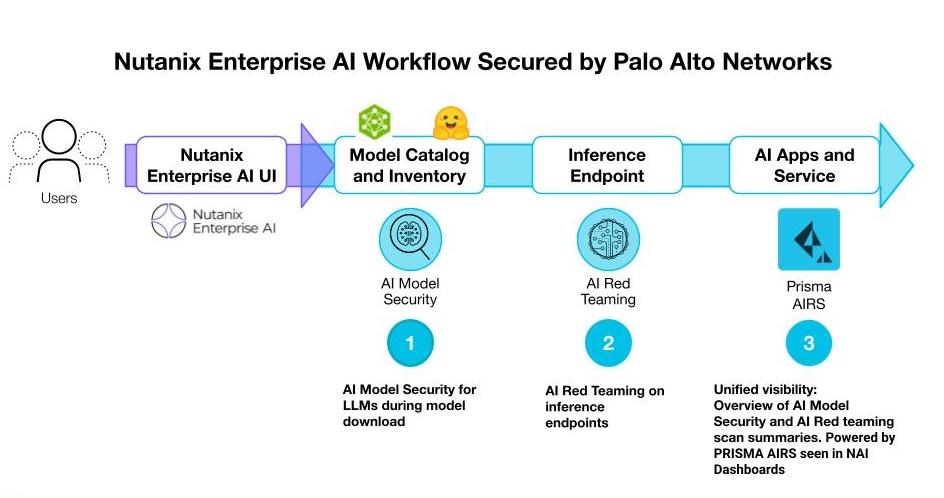
The Nutanix Enterprise AI platform provides a unified, scalable and secure foundation for the entire AI lifecycle: from data preparation and model fine-tuning to deployment and management. By integrating cutting-edge AI security tools by Palo Alto Networks directly into this workflow, we enable security checks to become an intrinsic part of the AIOps pipeline.

Nutanix Enterprise AI workflow secured by Palo Alto Networks.
Prisma AIRS integration user flow.

Scanning AI Models for Comprehensive Vulnerability Detection

The Prisma AIRS AI Model Security solution introduces sophisticated model scanning capabilities that are essential for preemptively identifying and mitigating risks.

  • Prisma AIRS Model Security Integration: Automatically scans AI models (e.g., during check-in to a model registry on the Nutanix Enterprise AI platform) for inherent vulnerabilities, policy violations and malicious code. This provides Proactive Risk Mitigation by detecting malicious or vulnerable model artifacts before deployment, helping prevent zero-day exploits and potential data leakage caused by compromised models.
  • Dependency Analysis: Examines all open-source libraries and dependencies used in the model environment for known vulnerabilities and license compliance issues. This enables Supply Chain Security, eliminating risks introduced by third-party components throughout the entire AI deployment lifecycle.
  • Model Supply Chain Threats: The system addresses malicious model artifacts, including deserialization exploits, embedded backdoors, unsafe file formats, unauthorized code execution, untrusted sources and noncompliant licenses. This enables Model Integrity and Governance by validating model safety, provenance, approved formats, license compliance and detecting hidden execution paths before deployment.

AI Red Teaming Your AI Systems for Adversarial Resilience

AI Model Security addresses known issues, but the malicious actors of tomorrow are developing new ways to exploit AI systems. This is where the power of Prisma AIRS AI Red Teaming by Palo Alto Networks comes into play, creating a crucial layer of proactive testing against adversarial attempts. AI Red Teaming involves simulating sophisticated attacks against the AI application’s behavior to test its resilience under attack.

  • Continuous AI assessment: Onboard an LLM model, application and agent, then start scanning in less than 10 minutes. Use documented APIs to integrate into CI/CD pipelines to trigger automated red teaming whenever versions are updated. Connect AI endpoints securely via an outbound web socket channel to eliminate the need for routing changes, while maintaining the option for IP allowlisting, if preferred. Your team controls access. This reduces technical setup overheads and empowers you to keep your assessment current.
  • Contextual Vulnerability Insights: Prisma AIRS profiles your LLM model, application or agent and informs the Red Teaming Agent to design relevant attack objectives. The Red Teaming Agent is trained on over 50 techniques and simulates attack prompts to achieve those objectives. This reduces noise and lets you focus on actual business relevant risk.
  • Comprehensive Threat Coverage: Prisma AIRS uses a library of over 750 attacks to evaluate your defensibility. Both the library and the red teaming agent are updated and trained on a constant basis to keep up with the AI threat landscape. This stress tests your AI system thoroughly, so your system is defensible to known and unknown threats.
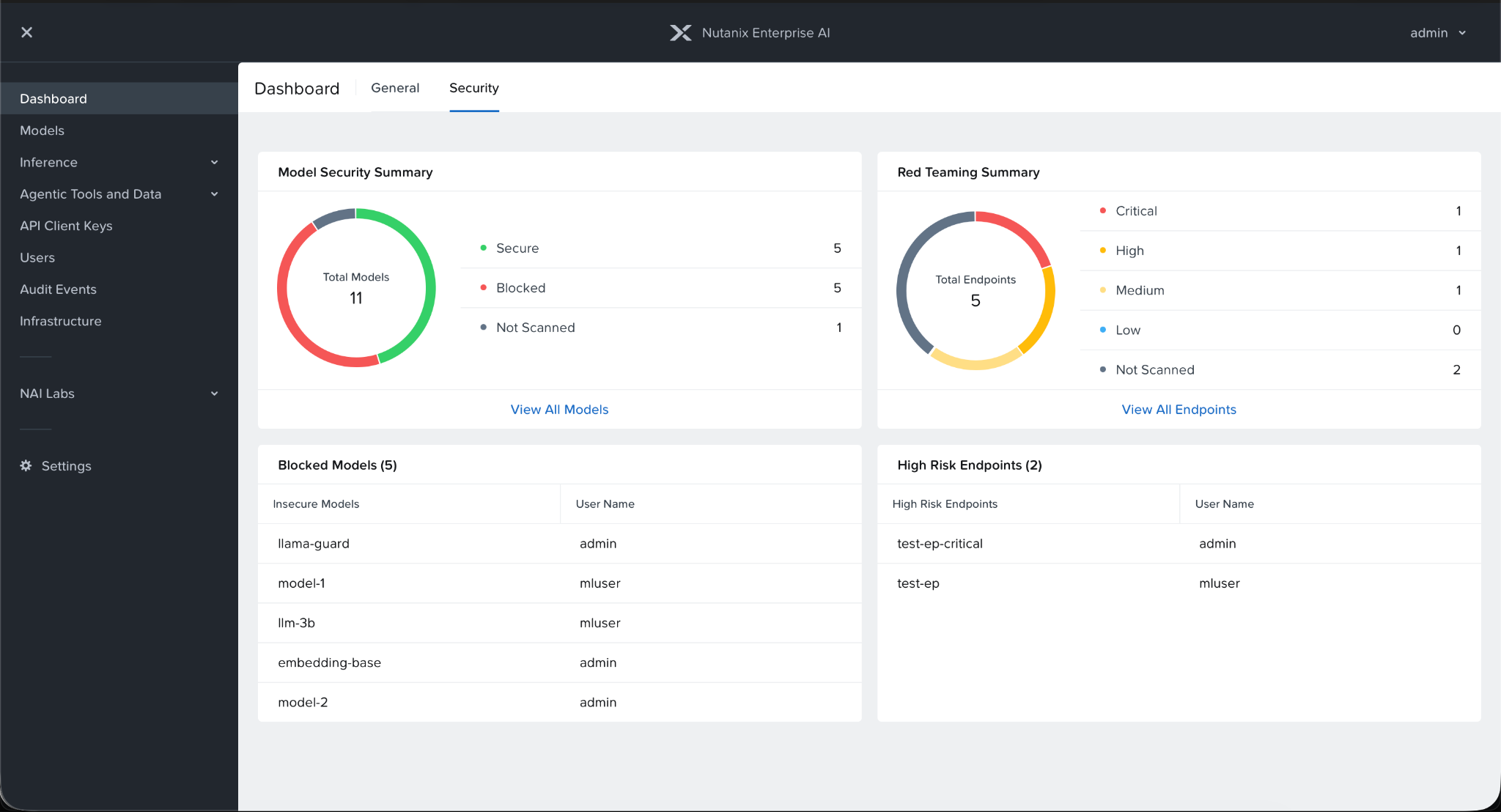
Nutanix Enterprise AI dashboard preview.
Unified Security Dashboard for AI Model Security and AI Red Teaming being made available in Nutanix Enterprise AI.

Securing the Future of Enterprise AI — The Nutanix and Palo Alto Networks Integration

This integration between the scalable, high-performing Nutanix Enterprise AI platform and the advanced security intelligence of Palo Alto Networks offers measurable value to AI-driven organizations:

  1. Accelerated Time-to-Trust – By automating critical security checks as part of the MLOps process on the Nutanix Enterprise AI platform, teams can deploy models faster, knowing they have been rigorously vetted by a leading security partner.
  2. Simplified Compliance and Governance – The joint solution provides a verifiable record of security testing (scanning and red teaming), making it simpler to demonstrate adherence to internal governance standards and external regulatory mandates.
  3. End-to-End AI Security Posture – Customers gain a holistic view of security, from the unified AI infrastructure layer managed by Nutanix, to the network security enforced by Palo Alto Networks. This visibility now extends critically into the AI models themselves, completing the security posture by unlocking controlled access to vendor models, so protection is enforced seamlessly.
  4. Cost and Resource Efficiency – Integrating security tools within the existing AI platform streamlines workflows. Data Scientists and ML Engineers can trigger red teaming simulations and scanning directly within their familiar Nutanix environments, reducing the need for dedicated, siloed security teams to manually test every model.

The partnership between Nutanix and Palo Alto Networks is a commitment to building a more secure future for enterprise AI. With this integration, you can bring LLM models into your environment without fear. Malicious code and hidden backdoors are blocked before they ever reach you. Your endpoints stay continuously protected, with coverage across over 50 attack techniques and the contextual risks that come with agentic AI. When you're evaluating a model or an endpoint, the risk picture is right there inside NAI – no context-switching, no guesswork. And a custom security dashboard gives you a single place to see where you stand. The result is AI you can actually trust at the core of your lifecycle, so your teams can build faster without trading off security for speed.

Key Takeaways

A "Secure-by-Design" AI Pipeline: The partnership between Nutanix and Palo Alto Networks is a commitment to building a more secure future for enterprise AI. The integration enables advanced level AI security in AIOps workflow. By embedding Prisma AIRS directly into the Nutanix Enterprise AI platform, organizations can automate model scanning and vulnerability detection during the initial check-in phase, authorizing only validated, secure models to reach production.

Proactive Defense via AI Model Security and AI Red Teaming: The solution provides a dual-layer defense: AI Model Security preemptively blocks hidden backdoors, malicious code and supply chain threats in third-party artifacts, while AI Red Teaming uses autonomous agents for contextual discovery to generate new attack scenarios and have over 750 sophisticated adversarial attack scenarios. This enables resilience against both known vulnerabilities and emerging zero-day AI exploits.

Unified Governance and Operational Efficiency: The partnership consolidates security and visibility into a single custom dashboard within the Nutanix environment. This unified view allows Security and AI teams to manage risk while having continuous assessments and compliance records significantly accelerating the time to trust.

Next Steps

For more information, visit the Palo Alto Networks partner directory or contact your local sales representatives to learn more about a trial run.

The post Nutanix and Palo Alto Networks Integrate for Robust Model Trust appeared first on Palo Alto Networks Blog.
  •  

Enhancing AI-Driven Defense with Anthropic’s Claude Opus 4.7

As Frontier AI crosses new thresholds, the landscape for both attackers and defenders is shifting. At Palo Alto Networks, we are committed to ensuring defenders maintain the advantage.

To deliver this critical edge, our Unit 42 Frontier AI Defense will now leverage Anthropic’s Claude Security, powered by Opus 4.7. By integrating one of the world’s most advanced AI models, we are empowering our customers to outpace automated threats. Through Frontier AI Defense, organizations can rapidly assess their security posture, remediate vulnerabilities and harden their infrastructure against next-generation, AI-driven attacks.

We are utilizing Claude Security’s deep technical reasoning to enable our customers to find and fix vulnerabilities with unprecedented speed. This includes:

  1. AI-Driven Exposure Analysis – Identifying complex exploit chains that turn minor findings into critical risks.
  2. Scalable Application Analysis – Performing deep-stack code reviews at a scale and depth previously unavailable.
  3. Agentic Defense – Powering autonomous workflows that detect and remediate threats at machine speed, backed by human oversight.

Palo Alto Networks is also participating in Anthropic's Cyber Verification Program, which credentials security teams for legitimate defensive use of frontier models.

The threat timeline is accelerating. Within months, AI-driven attack capabilities will become a standard fixture of the threat landscape. Palo Alto Networks is dedicated to ensuring our global customers are equipped with the modern frontier AI models necessary to stay secure both today and tomorrow.

The post Enhancing AI-Driven Defense with Anthropic’s Claude Opus 4.7 appeared first on Palo Alto Networks Blog.
  •  

Unit 42 Expands Frontier AI Defense with Armadin Partnership

Frontier AI is changing what is possible for attackers. To meet this escalating threat, Palo Alto Networks is teaming up with Armadin, the new offensive security company founded by Kevin Mandia. This partnership expands our newly introduced Unit 42 Frontier AI Defense service, scaling our ability to identify and remediate AI-driven exposures, and accelerating protection across the enterprise.

Over the past few weeks, we’ve spoken with hundreds of CISOs who universally feel the urgency on the frontlines. Security leaders need to know exactly where they stand against the AI-driven attacks happening right now, and the ones coming in the next six months.

Expanding Frontier AI Defense — The External AI Hyperattack Assessment

For organizations seeking to actively pressure-test their perimeter, this partnership introduces an autonomous, AI-driven offensive assessment of your external attack surface.

This added layer identifies real attack paths and proves exploitability across internet-facing assets. The platform begins with passive discovery, validating publicly exposed assets, cloud resources and secrets. Next, Armadin deploys a coordinated swarm of autonomous AI attack agents, operating at machine speed across your external footprint.

These agents execute active reconnaissance, launch attacks and exploit vulnerabilities in parallel, using over 50,000 templates. Upon initial access, the swarm simulates post-exploitation behavior to demonstrate impact, logging every attack chain as decision-grade evidence of exploitable risk.

Decision-Grade Proof of Exploitable Risk

With this added layer of autonomous simulation, Unit 42 Frontier AI Defense provides an even more rigorous, pressure-tested view of an organization's external attack surface. This allows our experts to accurately simulate the tradecraft of the most capable, AI-equipped threat actors, compressing complex attack lifecycles from days into minutes.

AI may change what is possible for attackers, but in the hands of defenders, it becomes a decisive advantage. This partnership is another important step in making sure that advantage stays with the defenders.

A member of Project Glasswing and OpenAI’s Trusted Access for Cyber (TAC) program, Palo Alto Networks remains the only company equipped to deliver this strategic level of partnership through Unit 42 Frontier AI Defense and the Frontier AI Alliance, driven to integrate cutting-edge technologies into our products and services.

Get started with Unit 42 Frontier AI Defense today.

The post Unit 42 Expands Frontier AI Defense with Armadin Partnership appeared first on Palo Alto Networks Blog.

  •  

Securing and Governing AI Agents At Scale Through A Unified AI Gateway

Palo Alto Networks Completes Acquisition of Portkey

We are pleased to announce that Palo Alto Networks has officially completed the acquisition of Portkey. 

We are moving from vision to reality by integrating Portkey’s pioneering AI Gateway directly into the fabric of the Palo Alto Networks product portfolio. Prisma AIRS AI Gateway will provide a unified vantage point to secure and govern AI agents at scale, offering a mission-critical control plane to identify, authenticate and authorize every agentic interaction in real time.  

We are delivering the industry’s most comprehensive security and unified control framework for the agentic enterprise, enabling our customers to scale autonomous AI workloads with complete confidence.

The era of the AI Enterprise has arrived. Today, 81% of enterprises are piloting the use of AI agents or have fully implemented AI agent solutions. We aren't just talking about smart chatbots. We are talking about autonomous agents that execute.

By leveraging APIs and MCP servers, these agents navigate complex workflows, access sensitive data and make real-time, business-critical decisions. The question is no longer if companies will adopt AI agents, but how to securely operationalize them without putting the brakes on innovation. 

The Challenge: Expanding Attack Surfaces

AI agents are creating a new and largely invisible attack surface. The risk is not just their independence, but the lack of visibility and accountability. Without a centralized enforcement layer for operational and security controls, every team that deploys an agent may unintentionally expose the enterprise to unauthorized data access and heightened security risks.

To solve this, Palo Alto Networks is redefining security for the agentic era. We recently introduced Prisma AIRS™ 3.0, the industry’s first platform to secure the entire agentic AI lifecycle. Portkey's acquisition accelerates that momentum.

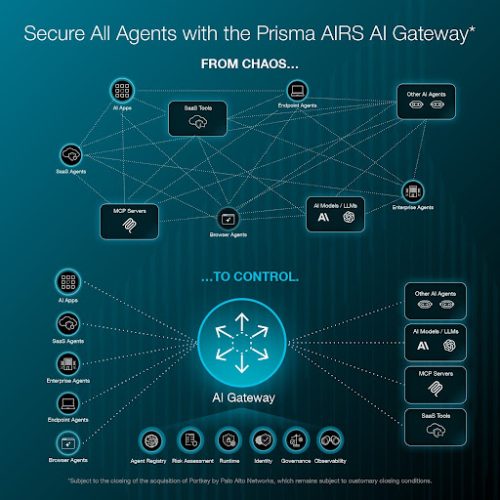
The Prisma AIRS AI Gateway: From Chaos to Control 

Portkey's AI Gateway will be integrated into Prisma AIRS to deliver the unified control plane that enterprises need to operationalise and secure AI apps and agents at scale.

Moving from “chaos to control” requires a centralized approach to governance. Currently, many AI initiatives are hindered by fragmented security and a lack of oversight. The AI Gateway solves this by providing a unified vantage point where organizations can enforce consistent policies across all models and agents, ensuring every interaction is identified, authenticated and authorized in real time within a single governing framework.

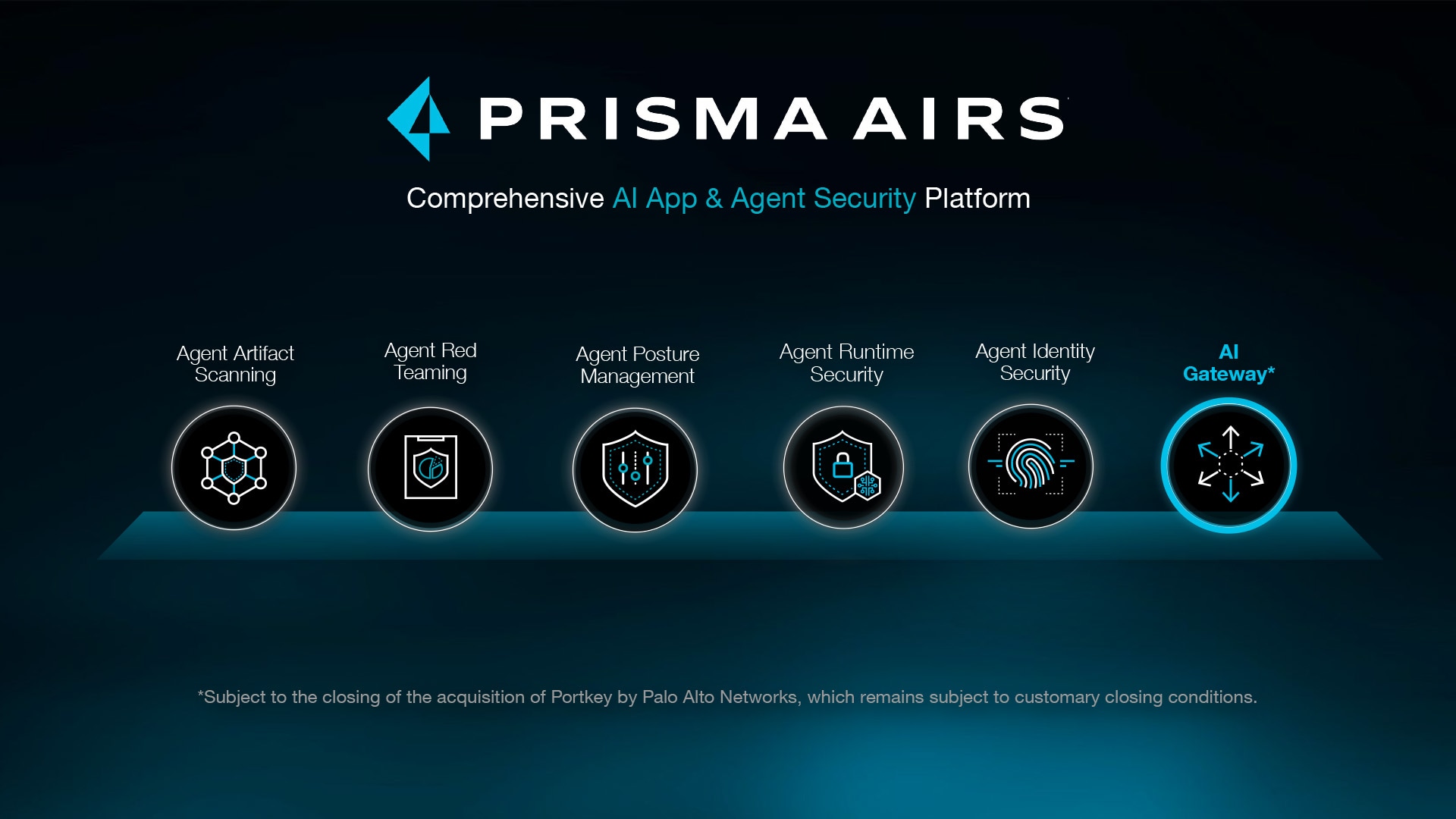
The Prisma AIRS AI Gateway will establish a mission-critical control plane for the agentic enterprise, enabling teams to move autonomous workloads from development into at-scale production with confidence. With operational features like a unified API to LLMs, an agent registry, semantic routing and caching, the AI Gateway equips enterprises with complete control in one platform. By serving as a centralized enforcement point at the center of Prisma AIRS for all agent traffic, the AI Gateway will provide critical security functions, including Agent Artifact scanning, automated Red Teaming and Runtime Security needed to monitor behavior, route requests and mitigate risks in real time. Crucially, the AI Gateway will reinforce Agent Identity Security via Idira (formerly CyberArk), applying strict protocols to ensure every autonomous action is authenticated and governed by least-privilege controls.

Our vision is for the Prisma AIRS AI Gateway to serve as the industry blueprint for enterprises in the agentic era. By making security a foundational component of the operational lifecycle, we are empowering enterprises to build and govern an AI ecosystem that is secure by design.


Secure All Agents with the Prisma AIRS AI Gateway


Why Portkey? The Pioneer in AI Gateways

  • Battle-Tested: Portkey’s AI Gateway is already supporting the demands of the modern enterprise, at scale, with several Fortune 500 customers, processing trillions of tokens per month with the low latency that is required for agent-to-agent communication. This ensures that agentic security does not come at the cost of developer speed or application performance. 
  • Architectural Simplicity: Portkey offers plug-and-play capabilities with just three lines of code required to implement the AI Gateway. The AI Gateway, powered by unified APIs, also provides secure access to over 3,000 LLMs, MCP servers and agents, giving enterprises a flying start to building and executing with AI agents.
  • Better Together: Palo Alto Networks and Portkey’s joint vision is to make Prisma AIRS the most ubiquitous platform for AI security. With exceptional AI security by Palo Alto Networks combined with Portkey’s AI Gateway, we will offer a comprehensive AI Security platform.

Prisma AIRS comprehensive AI App and agent security platform.

What’s Next?

The era of AI Enterprises is here. We’re making sure it is secure by design. The complexity of managing agents and securing them has long created friction in enterprises. With the integration of Portkey into Prisma AIRS, we will remove the trade-off between agent autonomy and authority. We are ensuring that as businesses accelerate into the era of autonomous agents, the security architecture isn’t just keeping up, it is setting the pace. 

Learn more about Prisma AIRS - the world’s most comprehensive AI security platform.

Forward-Looking Statements

This blog contains forward-looking statements that involve risks, uncertainties, and assumptions, including, but not limited to, statements regarding the anticipated benefits and impact of the acquisition of Portkey on Palo Alto Networks, Portkey and their customers. There are a significant number of factors that could cause actual results to differ materially from statements made in this blog, including, but not limited to: risks related to disruption of management time from ongoing business operations due to the acquisition and the integration of Portkey and other recent acquisitions; our ability to effectively operate Portkey's operations and business, integrate Portkey’s business and products into our products, and realize the anticipated synergies in the transaction in a timely manner or at all; changes in the fair value of our contingent consideration liability associated with acquisitions; developments and changes in general market, political, economic and business conditions; failure of our platformization product offerings; risks associated with managing our growth; risks associated with new product, subscription and support offerings; shifts in priorities or delays in the development or release of new product or subscription or other offerings or the failure to timely develop and achieve market acceptance of new products and subscriptions, as well as existing products, subscriptions and support offerings; failure of our product offerings or business strategies in general; defects, errors, or vulnerabilities in our products, subscriptions or support offerings; our customers’ purchasing decisions and the length of sales cycles; our ability to attract and retain new customers; developments and changes in general market, political, economic, and business conditions; our competition; our ability to acquire and integrate other companies, products, or technologies in a successful manner; our debt repayment obligations; and our share repurchase program, which may not be fully consummated or enhance shareholder value, and any share repurchases which could affect the price of our common stock.

Additional risks and uncertainties that could affect our financial results are included under the captions "Risk Factors" and "Management's Discussion and Analysis of Financial Condition and Results of Operations" in our Quarterly Report on Form 10-Q filed with the SEC on February 18, 2026, which is available on our website at investors.paloaltonetworks.com and on the SEC's website at www.sec.gov. Additional information will also be set forth in other filings that we make with the SEC from time to time. All forward-looking statements in this blog are based on information available to us as of the date hereof, and we do not assume any obligation to update the forward-looking statements provided to reflect events that occur or circumstances that exist after the date on which they were made.

The post Securing and Governing AI Agents At Scale Through A Unified AI Gateway appeared first on Palo Alto Networks Blog.

  •  
❌