Version 3.0.7 of the Securly Chrome Extension contains multiple vulnerabilities involving insecure data transmission, weak cryptography, and improper access control. These issues may expose sensitive filtering rules, enable the manipulation of downloaded configuration files, and allow unauthenticated access to protected resources. An attacker could exploit these weakness to steal configuration information, induce a Denial of Service (DoS), or modify content blocking rules for student users.
Description
The Securly Chrome Extension is a browser add-on commonly used in K–12 school-managed Chromebooks to enforce internet safety policies, filter or block websites, and provide activity monitoring for students. It is an element of the Securly classroom management platform, which helps schools comply with web filtering requirements and safely manage student online access.
CVE-2026-8874
Version 3.0.7 of the Securly Chrome Extension downloads JSON files containing crisis alert keywords and filtering rules over unencrypted HTTP via the Fetch API. Other endpoints in the same extension correctly fetch Internet Watch Foundation (IWF) and Children's Internet Protection Act (CIPA) data over HTTPS, demonstrating an inconsistent implementation of TLS.
CVE-2026-8876
The Securly Chrome Extension contains hardcoded, plaintext AES passphrases in securly.min.js. These keys decrypt crisis alert keyword data and intervention site data.
CVE-2026-8878
The Securly Chrome Extension exposes multiple publicly accessible endpoints that allow unauthenticated access to sensitive data. The exposed information consists of SHA-1 hashes that are inadequately obfuscated using a simple Caesar cipher, which can be easily reversed to recover the original hash values and access the protected data.
CVE-2026-8879
The Securly Chrome Extension dynamically registers content13.min.js as a content script via chrome.scripting.registerContentScripts() at runtime. This script is NOT declared in manifest.json and bypasses Chrome Web Store static security review. It runs on all URLs and immediately hides all page content, creates a full-page overlay, pauses all videos, and only restores content when the service worker confirms the page passes filtering. If Securly's servers are unreachable, pages remain indefinitely hidden.
CVE-2026-8881
The Securly Chrome Extension uses EVP_BytesToKey key derivation with MD5 and a single iteration for AES encryption. MD5 has been broken since 2004 and a single iteration provides no key stretching. This weak derivation method significantly reduces the effective security of the encryption, making the protected data vulnerable to efficient offline cracking.
CVE-2026-8888
The Securly Chrome Extension downloads config.json over HTTP and compiles server-provided patterns as JavaScript regular expressions via new RegExp() without complexity validation. An on-path attacker can inject specific patterns to cause catastrophic backtracking, resulting in denial of service on all browsing.
CVE-2026-8889
The Securly Chrome Extension uses deprecated SHA-1 hashing for IWF CSAM URL matching (25,020 hashes) and CIPA blocklist matching (12,352 hashes).
Impact
These vulnerabilities collectively enable multiple attack paths and threaten the security and privacy of student users, for which the extension may be academically mandatory. The HTTP configuration downloads (CVE‑2026‑8874, CVE‑2026‑8888) and weak cryptographic primitives (CVE‑2026‑8876, CVE‑2026‑8881, CVE‑2026‑8889) allow a network‑adjacent attacker to intercept, modify, or decrypt data related to keyword filtering. The presence of unauthenticated, publicly accessible endpoints with trivially reversible obfuscation (CVE‑2026‑8878) further exposes internal keyword lists, blocklists, and rule definitions. These weaknesses enable the reconstruction and manipulation of the extension’s filtering logic. For student users, this could result in exposure to content that the filtering system is intended to block, or the inappropriate blocking of legitimate educational resources. Additionally, the undeclared, dynamically‑registered content script (CVE‑2026‑8879) can be abused to fully obscure web pages, leading to DoS conditions for end users.
Solution
Unfortunately, Securly could not be reached for coordination of these vulnerabilities. Until a patch is available, administrators can lower their potential exposure by restricting usage of the extension on untrusted or public networks, installing school-managed VPNs on the underlying devices, and monitoring for unexpected or abnormal filtering behavior.
Acknowledgements
Thanks to the reporter Santh for discovering and researching these vulnerabilities. This document was written by Molly Jaconski.
Vendor Information
One or more vendors are listed for this advisory. Please reference the full report for more information.
VoLTE deployments on Verizon’s IMS network have operated without negotiated SIP integrity protection. In observed test conditions, SIP signaling—including registration, call setup, and messaging—traveled without IPsec ESP encapsulation and without SIP Security Agreement headers, exposing it to interception and modification by on-path attackers.
Recent carrier configuration updates, including Apple’s iOS 26.5 carrier bundle released on May 11, 2026, include IMS IPsec–related settings. However, such configuration entries do not confirm active deployment, successful negotiation, or functional protection in production.
Description
CVE-2026-10629
Verizon IMS deployments were observed transmitting SIP signaling without integrity protection. REGISTER exchanges lacked Security-Client, Security-Server, and Security-Verify headers, and no ESP-encapsulated SIP traffic was detected during subsequent signaling such as INVITE, MESSAGE, BYE, and UPDATE. This pattern persisted across devices, operating systems, and network conditions, indicating a deliberate network configuration rather than a transient issue.
Per 3GPP TS 33.203 and GSMA IR.92, SIP signaling between the UE and P-CSCF must be protected using IPsec ESP following IMS AKA authentication, with negotiation occurring during registration. The absence of this protection allows attackers to manipulate SIP signaling undetected, enabling call hijacking, spoofing, denial-of-service, and misrouting of emergency calls.
Verizon initially acknowledged the issue and stated that integrity support would be available upon request and extended broadly later in the year. However, the company has since ceased participation in coordination, including follow-up discussions and draft review, and has not provided verifiable evidence of mitigation. As remediation remains unconfirmed, this disclosure proceeds to inform users of an ongoing security exposure.
Independent verification would require observation of successful SIP security negotiation, ESP-protected traffic, or official confirmation from Verizon.
Impact
Without integrity protection, on-path attackers can intercept, replay, or alter SIP messages with no risk of detection. This undermines core VoLTE security assumptions and enables signaling spoofing, call disruption, and manipulation of emergency routing.
Although recent configuration changes suggest potential progress, their operational status remains unverified. Until protections are confirmed, the risk persists.
Solution
Remediation requires coordinated network and device-side changes. Verizon must enable and enforce SIP security negotiation and ESP protection in its IMS core infrastructure, and devices must receive and apply correct carrier configuration to support IPsec.
Verification should confirm successful SIP security negotiation and ESP-protected signaling, either through observed headers, traffic capture, or operator confirmation.
Until then, organizations relying on high-assurance VoLTE should treat signaling as untrusted
Acknowledgements
The authors thank DongWon Lee, Jeongmin Choi, and CheolJun Park from Kyung Hee University for their technical analysis, coordination efforts, and identification of the iOS 26.5 configuration updates. Their work has advanced understanding of this issue and ensured disclosures remain grounded in observable evidence.
This report was prepared by Timur Snoke, with AI-assisted drafting to support clarity and accuracy.
Vendor Information
One or more vendors are listed for this advisory. Please reference the full report for more information.
A stored cross-site scripting (XSS) vulnerability has been discovered in Appsmith, specifically in the CodeMirror based SQL query editor’s autocomplete renderer. CVE-2026-7299 has been assigned to track the vulnerability. An attacker with developer level access to a shared PostgreSQL datasource can inject arbitrary JavaScript by creating malicious database objects whose names contain XSS payloads. Successful exploitation leads to arbitrary JavaScript execution in the browser of any workspace member who triggers SQL autocomplete, enabling session hijacking, privilege escalation, or credential theft. Version 2.1 of Appsmith fixes CVE-2026-7299.
Description
Appsmith is an open source, low code platform intended to allow developers to build internal tools, dashboards, and applications using a UI builder, database and API integrations, and JavaScript customization. Appsmith can also be deployable either self-hosted or via the cloud. A vulnerability, tracked as CVE-2026-7299, has been discovered, allowing for XSS within the SQL query editors autocomplete function.
The vulnerability description is below.
CVE-2026-7299
Appsmith’s SQL query editor’s autocomplete functionality fails to sanitize database object names before rendering them in innerHTML, allowing an authenticated Developer to inject persistent XSS by a malicious table or column names triggering arbitrary code execution in the sessions of other workspace members when they interact with the same datasource.
This vulnerability requires an account with developer access. A developer Appsmith account is an account designed to create, edit, and delete apps within a workspace they are assigned to. When an administrator opens the SQL editor and triggers autocomplete (e.g., by typing SELECT * FROM), the malicious table name executes their stored payload, which can allow for privesc.
Impact
Successful exploitation of CVE-2026-7299 leads to arbitrary code execution in the browser of any workspace member who triggers SQL autocomplete, enabling session hijacking, privilege escalation, or credential theft.
Solution
Version 2.1 of Appsmith fixes this vulnerability. Users should update their installations as soon as possible.
Acknowledgements
Thanks to the reporter, Stuart Beck. This document was written by Christopher Cullen.vrf26-04-DQBSN_exploit.py
Vendor Information
One or more vendors are listed for this advisory. Please reference the full report for more information.
The Collibra Platform Agent contains vulnerabilities that can be chained by a remote, unauthenticated attacker to achieve remote code execution. An attacker can exploit these issues by uploading a crafted ZIP archive that writes attacker-controlled files to arbitrary locations on the server once extracted, resulting in code execution.
Description
Collibra Platform (CP) and Collibra Platform Self-Hosted (CPSH), an enterprise grade, cloud-based platform designed to help organizations locate, understand, trust, and manage their data assets. The Collibra Agent of CP and CPSH that is installed on the host system is an independent service that listens on different port than the web interface and have the following vulnerabilities.
CVE-2026-10622 Privileged REST endpoints exposed under /rest/* do not properly enforce authentication or authorization. This allows a remote, unauthenticated attacker to interact with sensitive application functionality and gather information useful for further exploitation, including identifying suitable filesystem locations or application paths.
Additionally, the web services hosting the vulnerable REST endpoint was observed to bind to all available network interfaces regardless of the setting passed to the installer script. This behavior may increase exposure in deployments where administrators believe access is restricted to specific interfaces or trusted networks.
CVE-2026-10621 A Zip Slip vulnerability during extraction is exposed through POST/rest/restore and enables path traversal. When a ZIP archive is processed, file paths contained within the archive are not properly validated or canonicalized before extraction.
A remote attacker can supply a crafted ZIP archive containing directory traversal sequences, such as ../, to write files outside of the intended extraction directory. This may allow attackers to write custom files to arbitrary locations on the underlying host.
In an observed exploitation path, this arbitrary file write can be used to place a malicious JSP file into a web-accessible directory, enabling remote code execution when the file is subsequently requested over HTTP.
Impact
A remote, unauthenticated attacker can chain these vulnerabilities to achieve remote code execution on the affected system. An attacker who successfully exploits these issues may be able to:
- install a persistent web shell
- read, modify, or delete application data
- disrupt system availability
- potentially pivot further into surrounding environment
Because exploitation does not require authentication, deployments reachable across public internet may be at significant risk.
Solution
Collibra has released the following versions to address these vulnerabilities.
Users are strongly encouraged to update to the fixed release as soon as possible. Refer to Collibra documentation and release notes for patching and deployment guidance.
Administrators should ensure that interfaces exposing REST endpoints are not exposed to untrusted networks and should restrict access to management interfaces wherever possible.
Acknowledgements
Thanks to the reporter who wishes to remain anonymous. This document was written by Michael Bragg.
VU#873170.2
Path traversal in restore handler in Collibra Agent, allows an attacker to write arbitrary files via a crafted ZIP archive. Collibra Agent fails to properly validate and canonicalize file path during ZIP extraction, this can allow an attacker to write files outside the intended extraction directory.
VU#873170.1
Improper Authentication in REST API in Collibra Agent, allows a remote unauthenticated attacker to access privileged functionality via exposed /rest/* endpoints.
Vendor Information
One or more vendors are listed for this advisory. Please reference the full report for more information.
The PCTCore64.sys Windows kernel driver from PC Tools Internet Security exposes its \\.\PCTCoreDriver device interface with no access control, allowing any user-mode process to interact with the driver and invoke privileged IOCTL (I/O Control) commands. In a Bring Your Own Vulnerable Driver (BYOVD) scenario, a local attacker with the ability to load a Windows driver can exploit the exposed interface to perform sensitive low-level operations on the target device.
Description
PCTCore64.sys is a Windows kernel driver that implements system monitoring and protection functionality on local Windows systems. The driver creates a Windows Driver Model (WDM) device object \\.\PCTCoreDriver via IoCreateDevice and provides user-mode access through a DOS device symbolic link via IoCreateSymbolicLink.
The driver exposes privileged functionality intended for administrative or security operations; however, the device object is created without a restrictive security descriptor. Specifically, the driver does not apply security best practices using either Security Descriptor Definition Language (SDDL) or the IoCreateDeviceSecure API, allowing unprivileged user-mode processes to open handles to the device and issue privileged IOCTL requests.
As a result, an attacker may invoke IOCTL handlers capable of performing sensitive low-level operations, including:
System-wide handle enumeration
Cross-process handle manipulation
Credential extraction from lsass.exe
Forced termination of arbitrary processes, including Protected Process Light (PPL)-protected processes
Although the original PC Tools Internet Security product line was discontinued in 2013 and is no longer maintained, the driver remains signed and can still be abused in BYOVD attacks. An attacker may load the vulnerable driver on a target system and leverage the exposed IOCTL interface to access privileged kernel functionality.
One vulnerable IOCTL permits the acquisition of a PROCESS_ALL_ACCESS handle to sensitive processes such as lsass.exe, enabling credential theft operations including extraction of NTLM hashes and Kerberos authentication material. Additional IOCTL handlers permit the termination of arbitrary processes regardless of PPL protections, enabling attackers to disable security software such as Microsoft Defender and other critical system services. Other exposed interfaces enable arbitrary handle operations against external processes, potentially resulting in process instability, crashes, or undefined behavior. Collectively, these vulnerabilities can be exploited to provide a practical attack path for credential theft, defense evasion, privilege escalation, and broader system compromise.
CVE-2026-8501 Improper access control in the PCTCore64.sys Windows kernel driver from PC Tools Internet Security allows user-mode processes to access the PCTCoreDriver WDM device interface and invoke privileged IOCTL handlers. A local attacker with the ability to access or load the affected driver can exploit this vulnerability to perform sensitive and privileged operations on the target system.
Impact
A local attacker with the ability to load a Windows kernel driver may exploit the vulnerable PCTCore64.sys driver to access sensitive processes such as lsass.exe and other PPL-protected services. Successful exploitation can enable credential theft, arbitrary process termination, denial-of-service (DoS) conditions, and broader system compromise through privileged kernel-level operations.
Solution
The PC Tools Internet Security product line and its PCTCore64.sys driver are no longer actively maintained and should not be used in production environments. Organizations should remove and block the vulnerable driver where possible and implement mitigations designed to reduce exposure to BYOVD attacks, including restricting administrative privileges, enforcing Microsoft recommended driver block rules, and enabling protections such as Hypervisor-Protected Code Integrity (HVCI), Windows Defender Application Control (WDAC), and Credential Guard.
Acknowledgements
Thanks to Tzachi Hazan for researching and reporting this vulnerability. This document was written by Molly Jaconski.
Vendor Information
One or more vendors are listed for this advisory. Please reference the full report for more information.
Casdoor versions 2.362.0 and earlier contain several identity and access management vulnerabilities that enable broad authentication bypass and privilege escalation. These flaws relate to Casdoor’s Security Assertion Markup Language (SAML) processing, account binding, and token exchange mechanisms. An attacker able to interact with Casdoor’s authentication interface may impersonate users, bypass multifactor authentication (MFA), forge and replay assertions, and achieve persistent unauthorized access.
Description
Casdoor is an open-source identity and access management (IAM) platform and Model Context Protocol (MCP) gateway that provides authentication, single sign-on, and multi-protocol identity services. It is designed to centralize and streamline access control, allowing organizations to manage user identities and permissions across multiple applications and environments.
CVE-2026-9090
Casdoor versions 2.362.0 and earlier contain a vulnerability that allows an attacker to bypass authentication by supplying an arbitrary signing certificate. The buildSpCertificateStore function extracts the X.509 certificate directly from the incoming SAMLResponse instead of using the trusted pre-configured Identity Provider certificate, allowing an attacker to forge assertions signed with an attacker-controlled key.
CVE-2026-9091
A logic flaw in Casdoor's social‑login binding flow allows users to bypass configured MFA requirements. The binding‑rule code path in controllers/auth.go calls HandleLoggedIn directly without invoking checkMfaEnable. Any user authenticating via this path is logged in without MFA enforcement.
CVE-2026-9092
Casdoor contains a vulnerability involving unverified email binding that may enable account takeover. The getExistUserByBindingRule function matches users by email address without checking the email_verified claim returned from upstream providers, and the idp.UserInfo struct does not include a EmailVerified field. Therefore, an attacker can supply an unverified email claim from an upstream provider to take over accounts that use the same email address.
CVE-2026-9093
Casdoor's SAML service provider implementation does not validate the AudienceRestriction element in SAML assertions. Casdoor never sets the AudienceURI field to specify which service provider the assertion is intended for, and does not check for audience mismatch warnings alerted by WarningInfo.NotInAudience. As a result, Casdoor may improperly accept assertions that were issued for a different service provider.
CVE-2026-9094
Casdoor contains a vulnerability that enables cross-organization token exchange. The GetTokenExchangeToken function in object/token_oauth.go validates JWT signatures but does not verify that the token's user belongs to the same organization as the target application. This can result in privilege escalation across organizational boundaries.
CVE-2026-9095
Casdoor maps SAML assertions to user sessions without replay protection. The ParseSamlResponse() function in object/saml_sp.go calls sp.RetrieveAssertionInfo() and immediately maps the result to a user session. There is no assertion ID cache, OneTimeUse condition enforcement, or replay detection anywhere in the SAML SP code path. As a result, an attacker can replay a previously captured SAML assertion to obtain an authenticated session for the assertion’s subject, including administrator accounts, without needing the user’s password or MFA credentials.
CVE-2026-9096
Casdoor does not enforce SAML assertion time bounds. The gosaml2 library reports all time-validation results, including NotOnOrAfter and NotBefore, in the assertionInfo.WarningInfo field. However, ParseSamlResponse() never reads this field, meaning that time bounds are computed by the library but silently discarded before the user session is issued.
CVE-2026-9097
Casdoor does not verify that a JWT used for token exchange is still active. The GetTokenExchangeToken() function in object/token_oauth.go validates the JWT signature and parses its claims, but never queries the Token table to verify whether the subject token has been revoked or invalidated. Because the revocation check is entirely absent, administrators are unable to terminate active sessions or revoke compromised tokens.
CVE-2026-9098
The SAML callback handler in controllers/auth.go accepts any well-formed SAMLResponse sent to /api/acs without verifying that it corresponds to an AuthnRequest previously issued by Casdoor. Additionally, if an administrator disables or deletes an identity provider (IdP) after a SAML flow has started, the handler still processes the response using the provider snapshot loaded at the start of the request. As a result, an attacker controlling a registered upstream IdP can send unsolicited SAML responses, or replay a legitimately captured response in a different session or after the original flow has ended. In both cases, Casdoor accepts the response and issues a session, enabling persistent unauthorized access.
Impact
Exploitation of these vulnerabilities can allow attackers to impersonate users, bypass authentication controls, and escalate privileges across Casdoor deployments.
CVE‑2026‑9090, CVE‑2026‑9093, CVE‑2026‑9095, CVE‑2026‑9096, CVE‑2026‑9098:
Multiple flaws in SAML processing allow assertion forgery or replay, misuse of assertions across sessions, and the processing of expired or unsolicited SAML responses. Because certificate trust is not enforced, time bounds and audience restrictions are ignored, and responses are not correlated to prior AuthnRequests, attackers can submit malicious or previously-captured assertions to obtain authenticated sessions for arbitrary users, including administrators.
CVE‑2026‑9091, CVE‑2026‑9092:
Weaknesses in MFA protection and binding logic further contribute to the risk of account compromise, enabling attackers to bypass MFA and potentially take over other accounts via unverified email claims. An attacker can exploit these flaws to gain persistent unauthorized access by bypassing configured authentication requirements or security controls.
CVE‑2026‑9094, CVE‑2026‑9097:
The discovered token-exchange flaws enable cross‑organization privilege escalation and prevent administrators from reliably revoking tokens. Because user‑organization membership is not validated and token revocation status is not checked, compromised or malicious tokens may be exchanged for elevated privileges in other organizations, and administrators cannot reliably terminate active sessions.
Solution
Unfortunately, we were unable to reach the Casdoor team to coordinate this vulnerability, and a patch is not yet available. Users are advised to implement stricter identity governance controls and utilize external validation tools to better enforce application boundaries. Restrict identity provider (IdP) usage only to trusted providers, reinforce high-privilege accounts with additional authentication paths such as downstream MFA, and monitor logs for any unusual SAML or token activity to reduce the exploitability of these issues.
Acknowledgements
We extend our thanks to Zixu (Jason) Zhou (University of Toronto, PhD student), David Lie (University of Toronto, Professor), Ilya Grishchenko (University of Toronto, Postdoc), and Xiangyu Guo (University of Toronto, PhD student) for researching and reporting these vulnerabilities. This document was written by Molly Jaconski.
Vendor Information
One or more vendors are listed for this advisory. Please reference the full report for more information.
Imagine handing your smartphone over for repair. A couple of days later, you pick it up — and great, it’s working again! But you won’t even realize that your device has been injected with malicious code, allowing attackers to access your smartphone even when it’s locked.
This is the beginning of the story shared by Kaspersky ICS CERT researchers, Alexander Kozlov and Sergey Anufrienko, at the Black Hat Asia 2026 conference. They managed to uncover a vulnerability that flips conventional assumptions about smartphone and IoT security on their head. Its core lies at the very heart of Qualcomm chips.
What is BootROM?
To grasp the severity of this discovery, we first need to look at how a modern device powered by a Qualcomm chip boots up. Think of it as a fortress with multiple layers of security. Each subsequent layer verifies the pass issued by the previous one. The bedrock foundation — the most trusted layer of them all — is the BootROM, a read-only memory baked directly into the silicon that can’t be modified once it comes off the fab.
The BootROM is the very first thing to run when a device powers on. It verifies the signature of the next bootloader, which in turn verifies the next, building a chain of trust all the way up to the operating system. If an attacker can compromise this chain at the BootROM level, it’s game over: the malicious code will execute before the main operating system even has a chance to load.
This is exactly what attackers can do by exploiting the CVE-2026-25262 vulnerability discovered by Kaspersky ICS CERT researchers.
Emergency Download Mode as an entry point
The research began with a protocol called Sahara. This is a component of Emergency Download Mode (EDL). Manufacturers and service centers use it to revive bricked devices: the phone is connected to a computer via USB, and a special utility program signed by the manufacturer (in this case, Qualcomm) is uploaded to it.
Sahara is implemented directly within the ARM PBL (Primary Boot Loader) — the BootROM itself. This means the protocol runs before any operating system boots, before any user access privileges are checked, and before any security controls are activated. The device simply waits for a USB connection, ready to accept data.
The communication scheme looks simple: the device sends a handshake (HELLO) to the computer, the computer selects the mode, a cycle begins to upload the utility program in chunks, and finally, the device executes the uploaded code. And it was within the verification logic of these very file chunks that the vulnerability was identified.
Write-what-where: the core of the vulnerability
In technical terms, the bug introduced by the developers is classified as CWE-123: Write-What-Where Condition. This is about as bad as it gets when it comes to flaws in low-level programming. An attacker can write arbitrary data to an arbitrary address in the device memory.
Without diving too deep into the technical weeds, suffice it to say that by exploiting the discovered vulnerability, attackers can gain access to any data on the device, including user-entered passwords, files, contacts, geolocation data, as well as the hardware sensors like the camera and microphone. In certain scenarios, complete control over the device is possible. Just a few minutes of physical access to the device via a cable connection, and the gadget has been compromised. This creates a risk if you hand your smartphone over to a repair shop, pass it to someone else to set up and install apps on, or just leave it unattended.
Which devices are affected
The CVE-2026-25262 vulnerability affects the following Qualcomm chip series: MDM9x07, MDM9x45, MDM9x65, MSM8909, MSM8916, MSM8952, and SDX50 — every single version released to date, until the vulnerability is patched by the manufacturer.
These are no obsolete museum pieces. The MDM9207, which we used for the bulk of our research, is integrated into modem modules for the internet of things (IoT), industrial equipment, smart home devices, healthcare monitoring systems, logistics trackers, and banking terminals. The MSM8916 powers many budget smartphones, while the SDX50 is used in automotive control units.
How vulnerable devices get attacked
The catch is that the attacker needs physical access to the device to pull this off. In the real world, this translates to:
Smartphone repairs at third-party repair shops, where the phone is left for several hours
Customs checkpoints in certain countries, where devices are withheld, inspected, and then returned
Lost and found scams, where your phone is stolen, tampered with, and then mysteriously found
Corporate espionage via an insider or a rogue employee
With just a few minutes of physical access to the device an attacker can plant a backdoor so deep inside that standard research tools won’t even detect it in most cases.
Why there’s no patch — and what to do
Qualcomm was notified of the discovery in March 2025 and confirmed the vulnerability in its chips. To identify it, the vendor reserved CVE-2026-25262, and on April 20, 2026, Kaspersky ICS CERT published technical information on the vulnerability and recommendations for users.
Qualcomm included this vulnerability in its May security bulletin. While fixing already-made devices is fundamentally impossible, the company promised to make all future chips without this vulnerability.
If you currently own a device with an affected chip, use our recommendations below to help mitigate the risk of infection.
Enforce strict physical control: don’t leave your devices unattended, especially when traveling or on business trips.
Choose only authorized service centers for repairs and maintenance.
Regularly update your firmware — this won’t patch the BootROM vulnerability, but it can eliminate many related vulnerabilities at higher levels.
Use a Kaspersky for Android on your device. This will safeguard your gadget from other threats that, combined with this vulnerability, could lead to unpredictable consequences.
If you notice that your gadget with a vulnerable Qualcomm chip starts acting up — overheating when idle, reporting unexpected spikes in network traffic, or exhibiting strange app behavior — you may have fallen victim to this vulnerability. You can wipe the malicious code and reset your device to its baseline state simply by completely cutting its power. This means either pulling the battery or letting it drain all the way to zero until the gadget shuts down entirely. In this case, the malicious code will most likely not persist on the device — during our research, we were unable to confirm that it could achieve persistence in non-volatile memory.
Want to learn more about severe vulnerabilities in Android phones? Check out these posts:
A privilege escalation vulnerability, nicknamed "Dirty Frag," has been discovered in the Linux kernel versions 4.10 and later. This vulnerability is a result of chaining together two previously discovered vulnerabilities, xfrm-ESP Page-Cache Write CVE-2026-43284 and the RxRPC Page-Cache Write CVE-2026-43500. This vulnerability was publicly disclosed on May 07, 2026.
Description
Dirty Frag is a Linux kernel vulnerability affecting the IPv4/IPv6 fragmentation and reassembly subsystem. The issue stems from improper handling of overlapping or malformed fragment offsets during the reassembly process. An attacker capable of sending crafted network packets to a vulnerable host can exploit the flaw to trigger memory corruption conditions.
The publicly documented proof of concept demonstrates that fragmentation logic can be manipulated such that the kernel processes inconsistent fragment states, enabling a controlled write out-of-bounds scenario. When successfully exploited, this can result in local or remote denial of service (kernel panic) and, depending on configuration and kernel build options, may create a primitive for more advanced memory manipulation.
The vulnerability arises from insufficient validation of fragment metadata during reassembly, specifically around:
Incorrect or incomplete enforcement of fragment boundary checks
Acceptance of overlapping fragments in unsafe sequences
Inadequate cleanup when transitions occur between valid and invalid fragment states
The fragment queue logic in affected kernels does not fully verify that fragment offsets, sizes, and overlap conditions remain consistent throughout reassembly. This allows malformed sequences to be processed without proper rejection.
Impact
The primary security concern is potential privilege escalation, similar in nature to the previously disclosed VU#260001 ("Copy Fail") vulnerability.
Depending on system configuration, kernel hardening features, and network exposure, successful exploitation may result in:
Local or remote denial of service through kernel panic
Memory corruption within the Linux networking stack
Privilege escalation
Container escape in certain containerized environments
Additional exploit primitives when chained with other vulnerabilities
Solution
Update Linux distribution
Update your distribution’s kernel package as soon as vendor patches become available. Most major Linux distributions are expected to release fixes through their standard update channels.
Workarounds (if patching is not immediately possible):
1) Disable at-risk modules (if loaded and loadable):
Use the following command to remove the modules in which the vulnerabilities occur and clear the page cache. sh -c "printf 'install esp4 /bin/false\ninstall esp6 /bin/false\ninstall rxrpc /bin/false\n' > /etc/modprobe.d/dirtyfrag.conf; rmmod esp4 esp6 rxrpc 2>/dev/null; echo 3 > /proc/sys/vm/drop_caches; true"
Note: you can verify if a module is currently being used using lsmod and the Used field or reviewing refcnt data in /sys/module/<module_name>/refcnt for e.g., cat /sys/module/esp4/refcnt
2) If affected modules esp4, esp6, rxrpc are compiled into the kernel (not a dynamic module), the following parameter can be added to grub, systemd-boot, or grubby, depending on your boot configuration: initcall_blacklist=esp4,esp6,rxrpc
This prevents the module from initializing at boot time. A system reboot is required for this change to take effect.
Mitigation for Containers
For containerized environments, where this vulnerability may be leveraged for container escape, consider applying one or more of the following mitigations:
Secure computing (seccomp) filtering: Restrict or deny system calls that create sockets using the AF_ALG address family (protocol 38) and AF_RXRPC (protocol 33) .
AppArmor policies: Use AppArmor to block creation of AF_ALG sockets and AF_RXRPC via the network alg rule.
eBPF-based enforcement: Deploy BPF-based controls to deny socket creation with address family AF_ALG (38) and AF_RXRPC (33).
Acknowledgements
This vulnerability was disclosed by Hyunwoo Kim. This document was written by Bob Kemerer.
Vendor Information
One or more vendors are listed for this advisory. Please reference the full report for more information.
Three vulnerabilities have been discovered in the SGLang project, two enabling remote code execution (RCE), and one regarding a path traversal vulnerability. In order for an attacker to exploit these vulnerabilities, the multimodal generation mode must be enabled, and an attacker must have network access to the SGLang service. No patch is available at this time, and no response was obtained from the project maintainers during coordination.
Description
SGLang is an open-source framework for serving large language models (LLMs) and multimodal AI models, supporting models such as Qwen, DeepSeek, Mistral, and Skywork, and is compatible with OpenAI APIs. Three vulnerabilities have been discovered within the tool and are tracked as follows:
CVE-2026-7301
The multimodal generation runtime scheduler's ROUTER socket contains a sink that calls pickle.loads() on incoming messages, enabling RCE when exposed to the internet.
This vulnerability is distinct from CVE-2026-3060 and CVE-2026-3059, which would be open to the Internet via the ZMQ broker, which automatically binded to all network interfaces without user awareness. CVE-2026-7301 is exposed to the internet by default through the scheduler host, which binds to 0.0.0.0 by default.
CVE-2026-7302
The multimodal generation runtime is vulnerable to an unauthenticated path traversal vulnerability, allowing an attacker to write arbitrary files anywhere the server process has write access, by including ../ sequences in the upload filename when sent to specific endpoints.
CVE-2026-7304
The multimodal generation runtime is vulnerable to unauthenticated remote code execution when the --enable-custom-logit-processor option is enabled, as Python objects loaded via dill.loads() will be deserialized without validation.
Impact
If exploited, these vulnerabilities could allow an unauthenticated attacker to achieve remote code execution or arbitrary file writes on the host running SGLang. Deployments that expose the affected interface to untrusted networks are at the highest risk of exploitation.
Solution
Until a patch is available, affected users should consider the following mitigations:
Mitigation
Restrict access to the service interfaces and ensure they are not exposed to untrusted networks.
Implement network segmentation and access controls to prevent unauthorized interaction with the vulnerable endpoints.
Acknowledgements
Thanks to the reporter, Alon Shakevsky. This document was written by Christopher Cullen.
Vendor Information
One or more vendors are listed for this advisory. Please reference the full report for more information.
dnsmasq is affected by multiple memory safety and input validation vulnerabilities, including heap buffer overflows, heap corruption, and code execution flaws. Collectively, these vulnerabilities enable attackers to poison cached DNS records, bypass security controls, crash the dnsmasq process, or under certain conditions, achieve local privilege escalation. dnsmasq has released version 2.92rel2 to fix the vulnerabilities.
Description
dnsmasq is an open-source networking tool that provides DNS forwarding, DHCP, and network boot services for small-to-medium sized networks and home routing devices. It can also function as a DNS resolver, which is the primary exploitation use case for several of the vulnerabilities described below, tracked collectively as CVE-2026-2291, CVE-2026-4890, CVE-2026-4891, CVE-2026-4892, CVE-2026-4893, and CVE-2026-5172.
CVE-2026-2291
dnsmasq's extract_name() function can be abused to cause a heap buffer overflow, enabling an attacker to inject false DNS cache entries. This could cause DNS queries to be redirected to attacker-controlled IP addresses or result in a Denial of Service (DoS).
CVE-2026-4890
An infinite-loop flaw in the DNSSEC validation of dnsmasq allows remote attackers to cause Denial of Service (DoS) conditions via a crafted DNS packet.
CVE-2026-4891
A heap-based out-of-bounds read vulnerability in the DNSSEC validation of dnsmasq allows remote attackers to leak memory information via a crafted DNS packet.
CVE-2026-4892
A heap-based out-of-bounds write vulnerability in the DHCPv6 implementation of dnsmasq allows local attackers to execute arbitrary code with root privileges via a crafted DHCPv6 packet.
CVE-2026-4893
An information disclosure vulnerability in dnsmasq allows remote attackers to bypass source checks via a crafted DNS packet containing RFC 7871 client-subnet information.
CVE-2026-5172
A buffer overflow vulnerability in dnsmasq’s extract_addresses() function allows attackers to trigger a heap out-of-bounds read and crash dnsmasq by exploiting a malformed DNS response.
Impact
These vulnerabilities collectively pose various risks:
DoS (CVE-2026-2291, CVE-2026-4890, CVE-2026-5172) — dnsmasq may crash or become unresponsive, terminating DNS resolution and affecting dependent services.
Cache Poisoning / Redirection (CVE-2026-2291, CVE-2026-4893) — Attackers may overwrite cache entries or manipulate response routing, enabling the silent redirection of users to malicious domains.
Information Disclosure (CVE-2026-4891, CVE-2026-4893) — Internal memory and network information may be inadvertently exposed.
Local Privilege Escalation (CVE-2026-4892) — A local attacker may execute arbitrary code as root via DHCPv6 manipulation.
Solution
dnsmasq has released version 2.92rel2 to fix the above vulnerabilities, and various vendors have published patches to address individual remediations. A full list of affected vendors and vendor patches can be found in the References section below. This note, as well as the CVE listings, will be updated as additional patches become available.
Acknowledgements
Thank you to the reporters for discovering these vulnerabilities:
* Hugo Martinez (hugomray@gmail.com) - CVE-2026-5172, CVE-2026-2291
* Andrew Fasano (NIST) - CVE-2026-2291
* Royce M (royce@xchglabs.com) - CVE-2026-4893, CVE-2026-4892, CVE-2026-4891, CVE-2026-4890, CVE-2026-2291
* Asim Viladi Oglu Manizada - CVE-2026-4892
* Mattia Ricciardi (mindless) - CVE-2026-2291
This document was written by Christopher Cullen and Molly Jaconski. Special thanks to Simon Kelly of dnsmasq and all participating vendors for their prompt engagement and coordination efforts.
Vendor Information
One or more vendors are listed for this advisory. Please reference the full report for more information.
Casdoor contains an arbitrary file write vulnerability in the implementation of its "Local File System" storage provider. Due to insufficient sanitization of user-supplied paths, an authenticated user with file upload permissions can escape the intended storage directory and write files elsewhere on the target filesystem. The vulnerability allows attackers to bypass Casdoor’s storage sandbox and perform unauthorized actions with the privileges of the Casdoor runtime user.
Description
Casdoor is an open-source identity and access management (IAM) platform and Model Context Protocol (MCP) gateway that provides authentication, single sign-on, and multi-protocol identity services for applications. Internally, it uses its Local File System storage provider to save files to a dedicated $CASDOOR/files/ directory.
During a file upload via the /api/upload-resource endpoint, the Casdoor application determines the target storage filepath by concatenating the user-supplied parameters pathPrefix and fullFilePath. However, values provided for pathPrefix are not properly sanitized, so directory traversal sequences such as ../../ are accepted without any integrity or permission checks beyond those of the OS user running the Casdoor process. The application does not verify that the destination filepath remains inside the dedicated storage directory, and it will create or overwrite any file that the Casdoor process has permission to modify.
CVE-2026-6815 An arbitrary file write vulnerability exists in Casdoor's Local File System storage provider. Due to insufficient path sanitization, an authenticated attacker with file upload privileges can perform a path traversal attack to create or overwrite arbitrary files elsewhere on the host filesystem, bypassing the application's intended storage sandbox.
Impact
Successful exploitation enables arbitrary file creation and modification on the host system, which can be used by an attacker to:
* Overwrite any file that is accessible to the Casdoor process.
* Establish persistence by creating scheduled tasks or cron jobs through the filesystem as the Casdoor user.
* Overwrite Casdoor’s backend database file casdoor.db, causing authentication services to fail and locking out all users and dependent applications.
Exploitation of this vulnerability requires the attacker to possess an authenticated session with sufficient permissions to manage storage providers and interact with the resource upload API. Depending on the privileges of the Casdoor service account, this vulnerability may allow escalation from application-level access to full host compromise.
Solution
A pull request has been submitted to the Casdoor repository that implements proper validation of storage paths, available here: https://github.com/casdoor/casdoor/pull/5458 . Otherwise, deployments should limit administrative access and restrict the filesystem permissions of the Casdoor service account. Administrators should avoid using the Local File System provider or disable this service in multi-user or exposed environments.
Acknowledgements
Thanks to Danilo Dell'Orco for researching and reporting this vulnerability. This document was written by Molly Jaconski.
Vendor Information
One or more vendors are listed for this advisory. Please reference the full report for more information.
A privilege escalation vulnerability has been discovered in Linux kernel versions version 4.17 (released 2017) and later. Many popular distributions and Linux-based containers are affected. This vulnerability was publicly disclosed on April 29, 2026, has been assigned CVE ID CVE-2026-31431, and is commonly referred to as "Copy Fail."
Description
The Linux kernel, since version 4.17, includes the algif_aead module, which provides user space access to authenticated encryption with associated data (AEAD) operations via the AF_ALG interface. This module may be available as a loadable kernel module or compiled directly into the kernel, depending on the Linux distribution or the custom built Linux install.
An unprivileged local user can write 4 controlled bytes into the page cache of any readable file on a Linux system, and use that to gain root.
The vulnerability is caused by a logic flaw in the Linux kernel’s algif_aead (AF_ALG) implementation. An unprivileged local user can reliably perform a controlled 4-byte write into the page cache of any readable file without race conditions or timing dependencies.
Critically, the corrupted page is not marked dirty, so the modified contents are never written back to disk. The underlying file remains unchanged, allowing the in-memory corruption to bypass checksum and file integrity verification mechanisms. Because subsequent reads are served from the page cache, an attacker can target a setuid binary and modify its in-memory contents to achieve local privilege escalation to root.
A 732-byte proof-of-concept Python script demonstrates exploitation by modifying a setuid binary to obtain root privileges on many Linux distributions released since 2017. This vulnerability was discovered by Taeyang Lee of Theori, with assistance from their AI-based static application security testing (SAST) tool, Xint Code, during analysis of the Linux kernel cryptographic subsystem.
Impact
This vulnerability allows an unprivileged local user to modify the in-memory contents of a setuid binary and escalate privileges to root. Public proof-of-concept (PoC) exploit code is available, therefore increasing the likelihood of exploitation.
Solution
Patch the Kernel
Apply the upstream kernel patch that addresses the issue by reverting AF_ALG AEAD to an out-of-place operation.
Update Linux distribution
Update your distribution’s kernel package as soon as vendor patches become available. Most major Linux distributions are expected to release fixes through their standard update channels.
Workarounds (if patching is not immediately possible):
Disable the algif_aead module (if loadable): echo "install algif_aead /bin/false" > /etc/modprobe.d/disable-algif-aead.conf rmmod algif_aead 2>/dev/null
This prevents the module from being loaded and removes it if already active.
If algif_aead is compiled into the kernel (not a dynamic module), the following parameter can be added to grub or systemd-boot or grubby depending on your boot configuration: initcall_blacklist=algif_aead_init
This prevents the module from initializing at boot time. A system reboot is required for this change to take effect.
Note: These workarounds may impact applications that rely on AF_ALG cryptographic interfaces.
Mitigation for containers
For containerized environments, where this vulnerability may be leveraged for container escape, consider applying one or more of the following mitigations:
Secure computing (seccomp) filtering: Restrict or deny system calls that create sockets using the AF_ALG address family (protocol 38).
AppArmor policies: Use AppArmor to block creation of AF_ALG sockets via the network alg rule.
eBPF-based enforcement: Deploy BPF-based controls to deny socket creation with address family AF_ALG (38).
While the internal kernel within a virtual machine (VM) or MicroVM is susceptible to this vulnerability, standard virtualization provides hardware-enforced memory isolation. This bug cannot be directly leveraged to facilitate a virtualization escape from a guest to the host. Virtualization and micro-virtualization technologies effectively contain the impact to the individual VM instance, protecting the host kernel and neighboring tenants from guest-originated attacks.
Acknowledgements
This vulnerability was disclosed by Theori.io research group. This document was written by Bob Kemerer and Vijay Sarvepalli.
Vendor Information
One or more vendors are listed for this advisory. Please reference the full report for more information.
A security flaw exists in the configuration management endpoint of the DRC INSIGHT software, allowing an unauthenticated user with access to the same network as the server to modify the server’s configuration file. This could enable data exfiltration, traffic redirection, or service disruption. DRC has acknowledged this vulnerability, tracked as CVE-2026-5756, and resolved it in Version 9.2, which is now available to clients. The patch will be included and deployed automatically with subsequent releases.
Description
Data Recognition Corporation (DRC) provides software for test proctoring, including the web-based DRC INSIGHT platform. A component of this platform, Central Office Services (COS), is typically deployed on a school or district local area network to host and distribute testing content to student devices.
COS uses a unified API router that serves both public content functions, such as exam delivery, and administrative functions, without meaningful separation between content-serving APIs and management APIs. The /v0/configuration administrative endpoint is accessible to systems on the same network as the COS server without authentication or origin validation. Any unauthenticated user or compromised device with network access to the server may submit requests that modify the server’s configuration file. The endpoint accepts and persists user-supplied JSON payloads without validating content, checking authorization, or verifying the safety of requested configuration changes. DRC has confirmed this issue and addressed it in Version 9.2.
Impact
Exploitation could allow an attacker to exfiltrate student data by overwriting storage configuration values or credentials so that test artifacts, responses, or audio recordings are sent to attacker-controlled external services instead of intended DRC-managed destinations. An attacker could also intercept or manipulate outbound traffic by inserting a malicious httpsProxy setting, causing HTTPS communications with DRC validation or content services to pass through an attacker-controlled proxy. In addition, malformed JSON, invalid port bindings, or incorrect service endpoints could disrupt operations by preventing the server from starting or interfering with active assessments.
Mitigations
Coordination with the vendor was unsuccessful prior to resolution, and no patch was available at the time of initial disclosure. Organizations that have not yet upgraded should restrict network access to the COS server by placing it on a dedicated, isolated network segment accessible only to trusted administrative systems. Student and guest networks should not be permitted to reach the server. Host-based or network firewalls should be used to restrict access to the /v0/configuration endpoint, ideally limiting access to localhost or specifically authorized administrative IP addresses. Outbound network traffic should be restricted to approved destinations, such as DRC infrastructure, and monitored for unexpected connections to unknown storage services or proxy endpoints. Administrators should enable logging and monitoring capable of detecting requests to the /v0/configuration endpoint, unauthorized configuration changes, and unusual outbound traffic patterns. Services should run with least privilege, with write access to configuration files limited wherever possible. Signed backups of configuration files should be maintained and their integrity verified before restoration or redeployment.
With the release of Version 9.2, the recommended action is immediate upgrade. Clients currently running affected versions should coordinate with DRC support to apply the patch without delay.
Acknowledgments
Thanks to Caen Jones for responsibly disclosing this vulnerability.
Document prepared by Timur Snoke with the assistance of AI.
Vendor Information
One or more vendors are listed for this advisory. Please reference the full report for more information.
Ollama’s model quantization engine contains a vulnerability that allows an attacker with access to the model upload interface to read and potentially exfiltrate heap memory from the server. This issue may lead to unintended behavior, including unauthorized access to sensitive data and, in some cases, broader system compromise.
Description
Ollama is an open-source tool designed to run large language models (LLMs) locally on personal systems, including macOS, Windows, and Linux. Ollama supports model quantization, an optimization technique that reduces the numerical precision used in models to improve performance and efficiency.
An out-of-bounds heap read/write vulnerability has been identified in Ollama’s model processing engine. By uploading a specially crafted GPT-Generated Unified Format (GGUF) file and triggering the quantization process, an attacker can cause the server to read beyond intended memory boundaries and write the leaked data into a new model layer.
CVE-2026-5757: Unauthenticated remote information disclosure vulnerability in Ollama's model quantization engine allows an attacker to read and exfiltrate the server's heap memory, potentially leading to sensitive data exposure, further compromise, and stealthy persistence.
The vulnerability is caused by three combined factors:
No Bounds Checking: The quantization engine trusts tensor metadata (like element count) from the user-supplied GGUF file header without verifying it against the actual size of the provided data.
Unsafe Memory Access: Go's unsafe.Slice is used to create a memory slice based on the attacker-controlled element count, which can extend far beyond the legitimate data buffer and into the application's heap.
Data Exfiltration Path: The out-of-bounds heap data is inadvertently processed and written into a new model layer. Ollama's registry API can then be used to "push" this layer to an attacker-controlled server, effectively exfiltrating the leaked memory.
Impact
An attacker with access to the model upload interface can exploit this vulnerability to read from or write to heap memory. This may result in exposure of sensitive data, data exfiltration, and potentially full system compromise.
Solution
Unfortunately, we were unable to reach the vendor to coordinate this vulnerability, and a patch is not yet available to address this vulnerability. The underlying issue should be addressed by implementing proper bounds checking to ensure that tensor metadata is validated against the actual size of the provided data before any memory operations are performed.
As an interim mitigation, access to the model upload functionality should be restricted or disabled, particularly in environments exposed to untrusted users or networks. Deployments should be limited to local or otherwise trusted network environments where possible. If model uploads are required for operational reasons, only models from trusted and verifiable sources should be accepted, and appropriate validation controls should be applied to reduce risk.
Acknowledgements
Thanks to the reporter Jeremy Brown, who detected the vulnerability through AI-assisted vulnerability research. This document was written by Timur Snoke.
Vendor Information
One or more vendors are listed for this advisory. Please reference the full report for more information.
Radware Alteon has a reflected Cross-Site Scripting (XSS) vulnerability in the parameter ReturnTo of the route /protected/login. This vulnerability allows an attacker to execute JavaScript in the host browser.
Description
CVE-2026-5754: Reflected Cross-Site Scripting (XSS) vulnerability in Radware Alteon 34.5.4.0 vADC load-balancer allows an attacker to inject malicious scripts into the website, potentially leading to unauthorized actions, data theft, or other malicious activities.
A reflected Cross-Site Scripting (XSS) vulnerability exists in the ReturnTo parameter of the /protected/login route in Radware Alteon version 34.5.4.0. The vulnerability arises from the lack of user input sanitization, allowing an attacker to inject malicious scripts. Specifically, when a user requests a resource that redirects to a Microsoft SAML login page, the load-balancer redirects the user to the login page with a ReturnTo parameter that fails to sanitize user input. An attacker can exploit this by injecting a malicious payload in the ReturnTo parameter, which will be executed in the victim's browser.
An example attack flow is below:
Attacker creates link with XSS payload in ReturnTo parameter.
Victim clicks malicious link, redirecting to login page.
Attacker performs JavaScript code execution in the victim's browser.
Impact
The impact of this vulnerability is significant, as it allows an attacker to execute arbitrary JavaScript code in a victim’s browser. Doing so enables a range of harmful activities, including the following: stealing session cookies and sensitive data; performing unauthorized actions on behalf of the victim; tricking users into falling for phishing attacks; and damaging a website’s reputation and user trust.
Solution
Unfortunately, we were unable to reach the vendor to coordinate this vulnerability. The vendor, Radware, has acknowledged the vulnerability in their customer portal and plans to patch it in the next version, 34.5.7.0. This version was expected to be released on March 31st, 2026, based upon the release notes, but it is unclear if this release occurred and included a fix. In the meantime, users are advised to take precautions to prevent exploitation, such as validating and encoding user input.
Acknowledgements
Thanks to the reporter, Loinaz Merino Cerrajeria, for bringing this vulnerability to our attention.This document was written by Timur Snoke.
Vendor Information
One or more vendors are listed for this advisory. Please reference the full report for more information.
Terrarium is a sandbox-based code execution platform that enables users to run and execute code in a controlled environment, providing a secure way to test and validate code. However, a vulnerability has been discovered in Terrarium that allows arbitrary code execution with root privileges on the host Node.js process. This vulnerability is caused by a JavaScript prototype chain traversal in the Pyodide WebAssembly environment.
Description
The root cause of the vulnerability lies in the configuration of jsglobals objects in service.ts. Specifically, the mock document object is created using a standard JavaScript object literal, which inherits properties from Object.prototype. This inheritance chain allows sandbox code to traverse up to the function constructor, create a function that returns globalThis, and from there access Node.js internals, including require(). As a result, an attacker can escape the sandbox and execute arbitrary system commands as root within the container.
CVE-2026-5752
Sandbox Escape Vulnerability in Terrarium allows arbitrary code execution with root privileges on a host process via JavaScript prototype chain traversal.
Impact
Applications that use Terrarium for sandboxed code execution may be compromised, allowing an attacker to:
Execute arbitrary commands as root inside the container
Access and modify sensitive files, including /etc/passwd and environment variables
Reach other services on the container's network, including databases and internal APIs
Potentially escape the container and escalate privileges further
Mitigation
The vendor has published a patch as v1.0.1 of cohere-terrarium and this version has been identified as the final release. If you are unable to patch your implementation, several mitigation strategies can be employed to reduce the risk of exploitation. Users should consider implementing the following measures if upgrading is not an option:
Disable unnecessary features: Disable any features that allow users to submit code to the sandbox, if possible.
Implement network segmentation: Segment the network to limit the attack surface and prevent lateral movement.
Use a Web Application Firewall (WAF): Deploy a WAF to detect and block suspicious traffic, including attempts to exploit the vulnerability.
Monitor container activity: Regularly monitor container activity for signs of suspicious behavior.
Implement access controls: Limit access to the container and its resources to authorized personnel only.
Use a secure container orchestration tool: Utilize a secure container orchestration tool to manage and secure containers.
Regularly update and patch dependencies: Ensure that dependencies are up-to-date and patched.
Acknowledgments
The vulnerability was discovered by Jeremy Brown, who used AI-assisted vulnerability research to identify the issue. This document was written by Timur Snoke with assistance from AI.
Vendor Information
One or more vendors are listed for this advisory. Please reference the full report for more information.
A remote code execution vulnerability has been discovered in the SGLang project, specifically in the reranking endpoint (/v1/rerank). A CVE has been assigned to track the vulnerability; CVE-2026-5760. An attacker can create a malicious model for SGLang to achieve RCE. Successful exploitation could allow arbitrary code execution in the context of the SGLang service, potentially leading to host compromise, lateral movement, data exfiltration, or denial-of-service (DoS) attacks. No response was obtained from the project maintainers during coordination.
Description
SGLang is an open-source framework for serving large language models (LLMs) and multimodal AI models, supporting models such as Qwen, DeepSeek, Mistral, and Skywork, and is compatible with OpenAI APIs. A vulnerability, tracked as CVE-2026-5760, has been discovered within the reranking endpoints. Using a cross-encoder model, the reranking endpoint reranks documents based on their relevance to a query.
An attacker exploits this vulnerability by creating a malicious GPT Generated Unified Format (GGUF) model file with a crafted tokenizer.chat_template parameter that contains a Jinja2 server-side template injection (SSTI) payload with a trigger phrase to activate the vulnerable code path. A tokenizer.chat_template is a metadata field that defines how text is structured before being processed. The victim then downloads and loads the model in SGLang, and when a request hits the /v1/rerank endpoint, the malicious template is rendered, executing the attacker's arbitrary Python code on the server. This sequence of events enables the attacker to achieve remote code execution (RCE) on the SGLang server.
The vulnerability arises from the use of jinja2.Environment() without sandboxing in the getjinjaenv() function. This function sets up the environment for rendering Jinja2 templates, but since it lacks proper sandboxing, it fails to restrict the execution of arbitrary Python code. Consequently, when the reranking endpoint is accessed and a malicious model file containing a crafted tokenizer.chattemplate is loaded, the model can execute arbitrary commands on the server.
Impact
An attacker can create a malicious model for SGLang to achieve RCE. Successful exploitation could allow arbitrary code execution in the context of the SGLang service, potentially leading to host compromise, lateral movement, data exfiltration, or denial-of-service (DoS) attacks. Deployments that expose the affected interface to untrusted networks are at the highest risk of exploitation.
Solution
To mitigate this vulnerability, it is recommended to use ImmutableSandboxedEnvironment instead of jinja2.Environment() to render the chat templates. This will prevent the execution of arbitrary Python code on the server. No response or patch was obtained during the coordination process.
Acknowledgements
Thanks to the reporter, Stuart Beck. This document was written by Christopher Cullen.
Vendor Information
One or more vendors are listed for this advisory. Please reference the full report for more information.
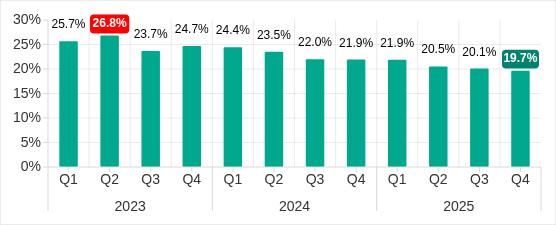
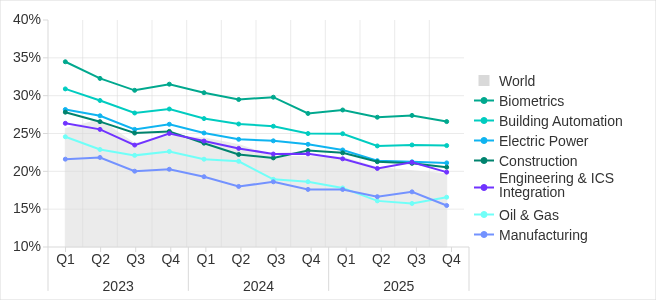
The percentage of ICS computers on which malicious objects were blocked has been decreasing since the beginning of 2024. In Q4 2025, it was 19.7%. Over the past three years, the percentage has decreased by 1.36 times, and by 1.25 times since Q4 2023.
Percentage of ICS computers on which malicious objects were blocked, Q1 2023–Q4 2025
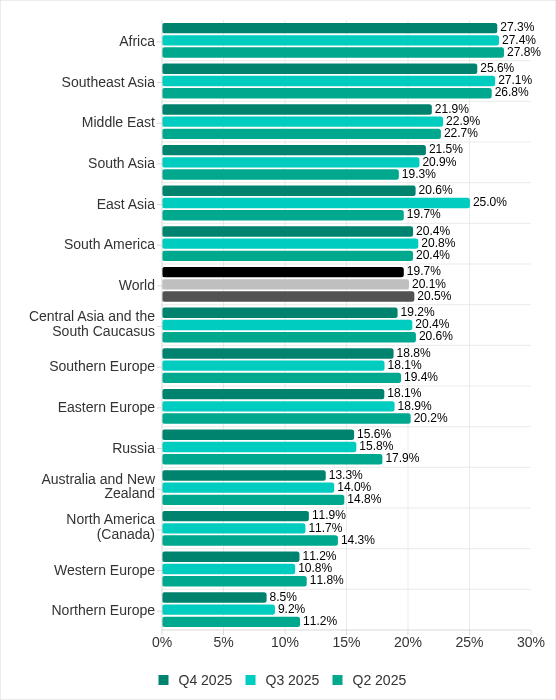
Regionally, in Q4 2025, the percentage of ICS computers on which malicious objects were blocked ranged from 8.5% in Northern Europe to 27.3% in Africa.
Regions ranked by percentage of ICS computers on which malicious objects were blocked
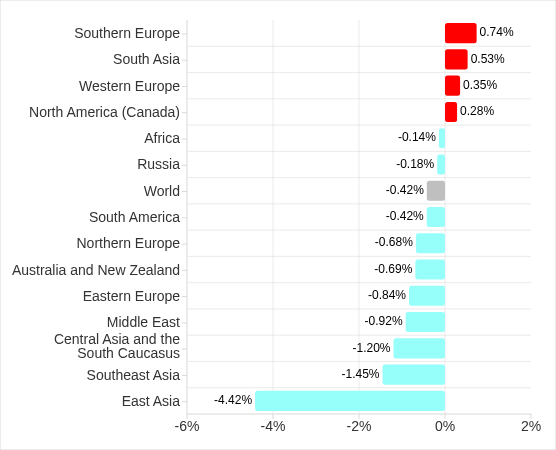
Four regions saw an increase in the percentage of ICS computers on which malicious objects were blocked. The most notable increases occurred in Southern Europe and South Asia. In Q3 2025, East Asia experienced a sharp increase triggered by the local spread of malicious scripts, but the figure has since returned to normal.
Changes in percentage of ICS computers on which malicious objects were blocked, Q4 2025
Feature of the quarter: worms in email
In Q4 2025, the percentage of ICS computers on which wormsinemailattachments were blocked increasedinallregions of the world.
Many of the blocked threats were related to the worm Backdoor.MSIL.XWorm. This malware is designed to persist on the system and then remotely control it.
Interestingly, this threat was not detected on ICS computers in the previous quarter, yet it appeared in all regions in Q4 2025.
A study found that the active spread of Backdoor.MSIL.XWorm via phishing emails was likely linked to the use by hackers of another malware obfuscation technique that was actively used during massive phishing campaigns in Q4 2025. These campaigns have been known since 2024 as “Curriculum-vitae-catalina”.
The attackers distributed phishing emails to HR managers, recruiters, and employees responsible for hiring. The messages were disguised as responses from job applicants with subjects such as “Resume” or “Attached Resume” and contained a malicious executable file under the guise of a curriculum vitae. Typically, the file was named Curriculum Vitae-Catalina.exe. When executed, it infected the system.
In Q4 2025, the threat spread across regions in two waves — one in October and another in November. Russia, Western Europe, South America, and North America (Canada) were attacked in October. A spike in Backdoor.MSIL.XWorm blocking was observed in other regions in November. The attack subsided in all regions in December.
The highest percentage of ICS computers on which Backdoor.MSIL.XWorm was blocked was observed in regions where threats from email clients had been historically blocked at high rates on ICS computers: Southern Europe, South America, and the Middle East.
At the same time, in Africa, where USB storage media are still actively used, the threat was also detected when removable devices were connected to ICS computers.
Selected industries
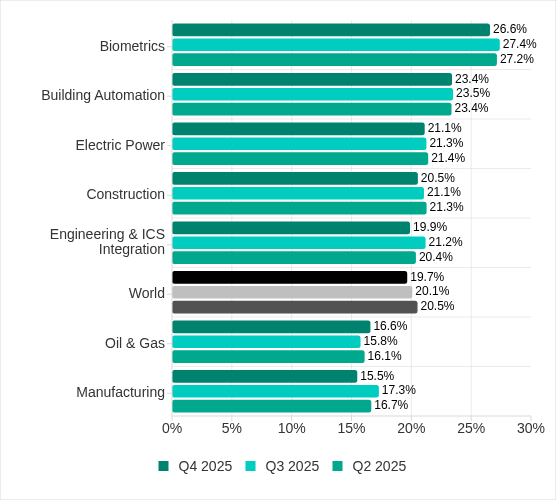
The biometrics sector has historically led the rankings of industries and OT infrastructures surveyed in this report in terms of the percentage of ICS computers on which malicious objects were blocked.
These systems are characterized by accessibility to and from the internet, as well as minimal cybersecurity controls by the consumer organization.
Rankings of industries and OT infrastructure by percentage of ICS computers on which malicious objects were blocked
In Q4 2025, the percentage of ICS computers on which malicious objects were blocked increased only in one sector: oil and gas. The corresponding figures increased in two regions: Russia, and Central Asia and the South Caucasus.
However, if we look at a broader time span, there is a downward trend in all the surveyed industries.
Percentage of ICS computers on which malicious objects were blocked in selected industries
Diversity of detected malicious objects
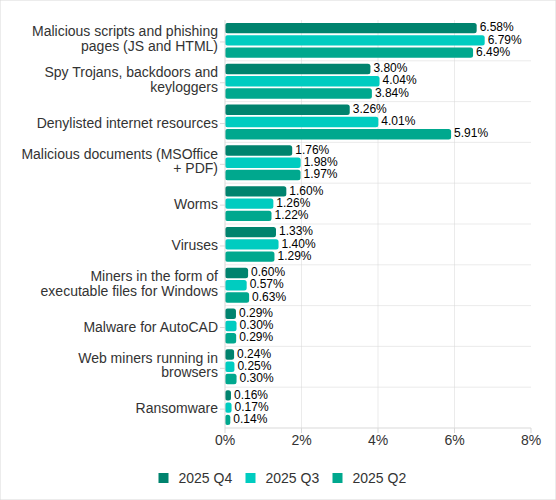
In Q4 2025, Kaspersky protection solutions blocked malware from 10,142 different malware families of various categories on industrial automation systems.
Percentage of ICS computers on which the activity of malicious objects from various categories was blocked
In Q4 2025, there was an increase in the percentage of ICS computers on which worms, and miners in the form of executable files for Windows were blocked. These were the only categories that exhibited an increase.
Main threat sources
Depending on the threat detection and blocking scenario, it is not always possible to reliably identify the source. The circumstantial evidence for a specific source can be the blocked threat’s type (category).
The internet (visiting malicious or compromised internet resources; malicious content distributed via messengers; cloud data storage and processing services and CDNs), email clients (phishing emails), and removable storage devices remain the primary sources of threats to computers in an organization’s technology infrastructure.
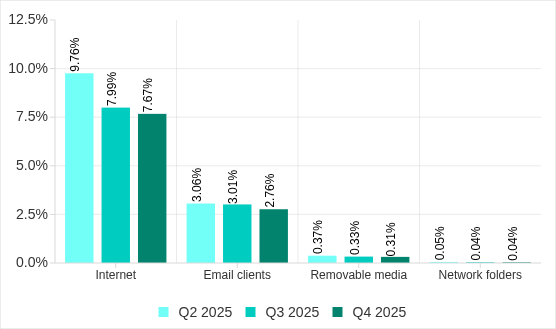
In Q4 2025, the percentage of ICS computers on which malicious objects from various sources were blocked decreased. All sources except email clients saw their lowest levels in three years.
Percentage of ICS computers on which malicious objects from various sources were blocked
The same computer can be attacked by several categories of malware from the same source during a quarter. That computer is counted when calculating the percentage of attacked computers for each threat category, but is only counted once for the threat source (we count unique attacked computers). In addition, it is not always possible to accurately determine the initial infection attempt. Therefore, the total percentage of ICS computers on which various categories of threats from a certain source were blocked can exceed the percentage of computers affected by the source itself.
In Q4 2025, the percentage of ICS computers on which threats from the internet were blocked decreased to 7.67% and reached its lowest level since the beginning of 2023. The main categories of internet threats are malicious scripts and phishing pages, and denylisted internet resources. The percentage ranged from 3.96% in Northern Europe to 11.33% in South Asia.
The main categories of threats from email clients blocked on ICS computers were malicious scripts and phishing pages, spyware, and malicious documents. Most of the spyware detected in phishing emails was delivered as a password archive or a multi-layered script embedded in office document files. The percentage of ICS computers on which threats from email clients were blocked ranged from 0.64% in Northern Europe to 6.34% in Southern Europe.
The main categories of threats that were blocked when removable media was connected to ICS computers were worms, viruses, and spyware. The percentage of ICS computers on which threats from removable media were blocked ranged from 0.05% in Australia and New Zealand to 1.41% in Africa.
The main categories of threats that spread through network folders in Q4 2025 were viruses, AutoCAD malware, worms, and spyware. The percentage of ICS computers on which threats from network folders were blocked ranged from 0.01% in Northern Europe to 0.18% in East Asia.
Threat categories
Typical attacks blocked within an OT network are multi-step sequences of malicious activities, where each subsequent step of the attackers is aimed at increasing privileges and/or gaining access to other systems by exploiting the security problems of industrial enterprises, including OT infrastructures.
Malicious objects used for initial infection
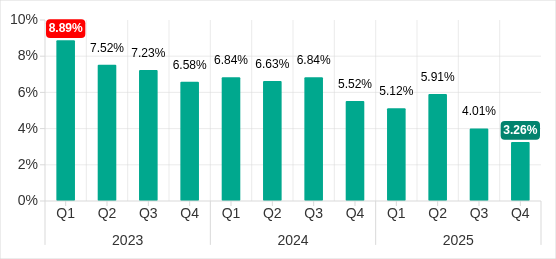
In Q4 2025, the percentage of ICS computers on which denylisted internet resources were blocked decreased to 3.26%. This is the lowest quarterly figure since the beginning of 2022, and it has decreased by 1.8 times since Q2 2025.
Percentage of ICS computers on which denylisted internet resources were blocked, Q1 2023–Q4 2025
Regionally, the percentage of ICS computers on which denylisted internet resources were blocked ranged from 1.74% in Northern Europe to 3.93% in Southeast Asia, which displaced Africa from first place. Russia rounded out the top three regions for this indicator.
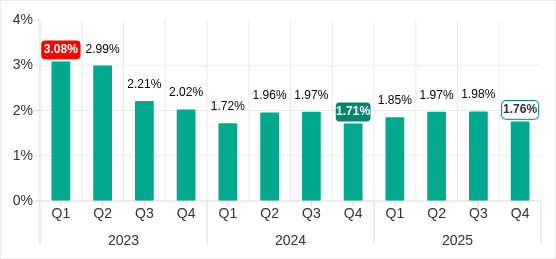
The percentage of ICS computers on which malicious documents were blocked increased for three consecutive quarters. However, in Q4 2025 it decreased by 0.22 pp to 1.76%.
Percentage of ICS computers on which malicious documents were blocked, Q1 2023–Q4 2025
Regionally, the percentage ranged from 0.46% in Northern Europe to 3.82% in Southern Europe. In Q4 2025, the indicator increased in Eastern Europe, Russia, and Western Europe.
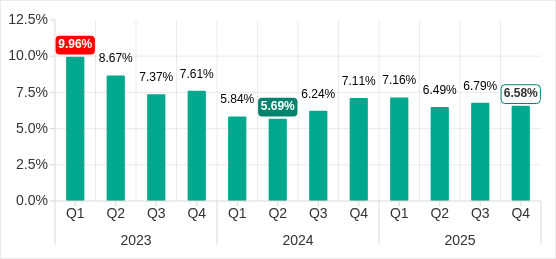
The percentage of ICS computers on which malicious scripts and phishing pages were blocked decreased to 6.58%. Despite the decline, this category led the rankings of threat categories in terms of the percentage of ICS computers on which they were blocked.
Percentage of ICS computers on which malicious scripts and phishing pages were blocked, Q1 2023–Q4 2025
Regionally, the percentage ranged from 2.52% in Northern Europe to 10.50% in South Asia. The indicator increased in South Asia, South America, Southern Europe, and Africa. South Asia saw the most notable increase, at 3.47 pp.
Next-stage malware
Malicious objects used to initially infect computers deliver next-stage malware — spyware, ransomware, and miners — to victims’ computers. As a rule, the higher the percentage of ICS computers on which the initial infection malware is blocked, the higher the percentage for next-stage malware.
In Q4 2025, the percentage of ICS computers on which spyware, ransomware and web miners were blocked decreased. The rates were:
Spyware: 3.80% (down 0.24 pp). For the second quarter in a row, spyware took second place in the rankings of threat categories in terms of the percentage of ICS computers on which it was blocked.
Ransomware: 0.16% (down 0.01 pp).
Web miners: 0.24% (down 0.01 pp), this is the lowest level observed thus far in the period under review.
The percentage of ICS computers on which miners in the form of executable files for Windows were blocked increased to 0.60% (up 0.03 pp).
Self-propagating malware
Self-propagating malware (worms and viruses) is a category unto itself. Worms and virus-infected files were originally used for initial infection, but as botnet functionality evolved, they took on next-stage characteristics.
To spread across ICS networks, viruses and worms rely on removable media and network folders and are distributed in the form of infected files, such as archives with backups, office documents, pirated games and hacked applications. In rarer and more dangerous cases, web pages with network equipment settings, as well as files stored in internal document management systems, product lifecycle management (PLM) systems, resource management (ERP) systems and other web services are infected.
In Q4 2025, the percentage of ICS computers on which worms were blocked increased by 1.6 times to 1.60%. As mentioned above, this increase is related to a global phishing attack that spread the Backdoor.MSIL.XWorm backdoor worm across all regions of the world. The percentage increased in all regions. The biggest increase (up by 2.16 times) was in Southern Europe. The malware was primary distributed through email clients, and Southern Europe led the way in terms of the percentage of ICS computers on which threats from email clients were blocked.
The percentage of ICS computers on which viruses were blocked decreased to 1.33%.
AutoCAD malware
This category of malware can spread in a variety of ways, so it does not belong to a specific group.
After an increase in the previous quarter, the percentage of ICS computers on which AutoCAD malware was blocked decreased to 0.29% in Q4 2025.
The percentage of ICS computers on which malicious objects were blocked has been decreasing since the beginning of 2024. In Q4 2025, it was 19.7%. Over the past three years, the percentage has decreased by 1.36 times, and by 1.25 times since Q4 2023.
Percentage of ICS computers on which malicious objects were blocked, Q1 2023–Q4 2025
Regionally, in Q4 2025, the percentage of ICS computers on which malicious objects were blocked ranged from 8.5% in Northern Europe to 27.3% in Africa.
Regions ranked by percentage of ICS computers on which malicious objects were blocked
Four regions saw an increase in the percentage of ICS computers on which malicious objects were blocked. The most notable increases occurred in Southern Europe and South Asia. In Q3 2025, East Asia experienced a sharp increase triggered by the local spread of malicious scripts, but the figure has since returned to normal.
Changes in percentage of ICS computers on which malicious objects were blocked, Q4 2025
Feature of the quarter: worms in email
In Q4 2025, the percentage of ICS computers on which wormsinemailattachments were blocked increasedinallregions of the world.
Many of the blocked threats were related to the worm Backdoor.MSIL.XWorm. This malware is designed to persist on the system and then remotely control it.
Interestingly, this threat was not detected on ICS computers in the previous quarter, yet it appeared in all regions in Q4 2025.
A study found that the active spread of Backdoor.MSIL.XWorm via phishing emails was likely linked to the use by hackers of another malware obfuscation technique that was actively used during massive phishing campaigns in Q4 2025. These campaigns have been known since 2024 as “Curriculum-vitae-catalina”.
The attackers distributed phishing emails to HR managers, recruiters, and employees responsible for hiring. The messages were disguised as responses from job applicants with subjects such as “Resume” or “Attached Resume” and contained a malicious executable file under the guise of a curriculum vitae. Typically, the file was named Curriculum Vitae-Catalina.exe. When executed, it infected the system.
In Q4 2025, the threat spread across regions in two waves — one in October and another in November. Russia, Western Europe, South America, and North America (Canada) were attacked in October. A spike in Backdoor.MSIL.XWorm blocking was observed in other regions in November. The attack subsided in all regions in December.
The highest percentage of ICS computers on which Backdoor.MSIL.XWorm was blocked was observed in regions where threats from email clients had been historically blocked at high rates on ICS computers: Southern Europe, South America, and the Middle East.
At the same time, in Africa, where USB storage media are still actively used, the threat was also detected when removable devices were connected to ICS computers.
Selected industries
The biometrics sector has historically led the rankings of industries and OT infrastructures surveyed in this report in terms of the percentage of ICS computers on which malicious objects were blocked.
These systems are characterized by accessibility to and from the internet, as well as minimal cybersecurity controls by the consumer organization.
Rankings of industries and OT infrastructure by percentage of ICS computers on which malicious objects were blocked
In Q4 2025, the percentage of ICS computers on which malicious objects were blocked increased only in one sector: oil and gas. The corresponding figures increased in two regions: Russia, and Central Asia and the South Caucasus.
However, if we look at a broader time span, there is a downward trend in all the surveyed industries.
Percentage of ICS computers on which malicious objects were blocked in selected industries
Diversity of detected malicious objects
In Q4 2025, Kaspersky protection solutions blocked malware from 10,142 different malware families of various categories on industrial automation systems.
Percentage of ICS computers on which the activity of malicious objects from various categories was blocked
In Q4 2025, there was an increase in the percentage of ICS computers on which worms, and miners in the form of executable files for Windows were blocked. These were the only categories that exhibited an increase.
Main threat sources
Depending on the threat detection and blocking scenario, it is not always possible to reliably identify the source. The circumstantial evidence for a specific source can be the blocked threat’s type (category).
The internet (visiting malicious or compromised internet resources; malicious content distributed via messengers; cloud data storage and processing services and CDNs), email clients (phishing emails), and removable storage devices remain the primary sources of threats to computers in an organization’s technology infrastructure.
In Q4 2025, the percentage of ICS computers on which malicious objects from various sources were blocked decreased. All sources except email clients saw their lowest levels in three years.
Percentage of ICS computers on which malicious objects from various sources were blocked
The same computer can be attacked by several categories of malware from the same source during a quarter. That computer is counted when calculating the percentage of attacked computers for each threat category, but is only counted once for the threat source (we count unique attacked computers). In addition, it is not always possible to accurately determine the initial infection attempt. Therefore, the total percentage of ICS computers on which various categories of threats from a certain source were blocked can exceed the percentage of computers affected by the source itself.
In Q4 2025, the percentage of ICS computers on which threats from the internet were blocked decreased to 7.67% and reached its lowest level since the beginning of 2023. The main categories of internet threats are malicious scripts and phishing pages, and denylisted internet resources. The percentage ranged from 3.96% in Northern Europe to 11.33% in South Asia.
The main categories of threats from email clients blocked on ICS computers were malicious scripts and phishing pages, spyware, and malicious documents. Most of the spyware detected in phishing emails was delivered as a password archive or a multi-layered script embedded in office document files. The percentage of ICS computers on which threats from email clients were blocked ranged from 0.64% in Northern Europe to 6.34% in Southern Europe.
The main categories of threats that were blocked when removable media was connected to ICS computers were worms, viruses, and spyware. The percentage of ICS computers on which threats from removable media were blocked ranged from 0.05% in Australia and New Zealand to 1.41% in Africa.
The main categories of threats that spread through network folders in Q4 2025 were viruses, AutoCAD malware, worms, and spyware. The percentage of ICS computers on which threats from network folders were blocked ranged from 0.01% in Northern Europe to 0.18% in East Asia.
Threat categories
Typical attacks blocked within an OT network are multi-step sequences of malicious activities, where each subsequent step of the attackers is aimed at increasing privileges and/or gaining access to other systems by exploiting the security problems of industrial enterprises, including OT infrastructures.
Malicious objects used for initial infection
In Q4 2025, the percentage of ICS computers on which denylisted internet resources were blocked decreased to 3.26%. This is the lowest quarterly figure since the beginning of 2022, and it has decreased by 1.8 times since Q2 2025.
Percentage of ICS computers on which denylisted internet resources were blocked, Q1 2023–Q4 2025
Regionally, the percentage of ICS computers on which denylisted internet resources were blocked ranged from 1.74% in Northern Europe to 3.93% in Southeast Asia, which displaced Africa from first place. Russia rounded out the top three regions for this indicator.
The percentage of ICS computers on which malicious documents were blocked increased for three consecutive quarters. However, in Q4 2025 it decreased by 0.22 pp to 1.76%.
Percentage of ICS computers on which malicious documents were blocked, Q1 2023–Q4 2025
Regionally, the percentage ranged from 0.46% in Northern Europe to 3.82% in Southern Europe. In Q4 2025, the indicator increased in Eastern Europe, Russia, and Western Europe.
The percentage of ICS computers on which malicious scripts and phishing pages were blocked decreased to 6.58%. Despite the decline, this category led the rankings of threat categories in terms of the percentage of ICS computers on which they were blocked.
Percentage of ICS computers on which malicious scripts and phishing pages were blocked, Q1 2023–Q4 2025
Regionally, the percentage ranged from 2.52% in Northern Europe to 10.50% in South Asia. The indicator increased in South Asia, South America, Southern Europe, and Africa. South Asia saw the most notable increase, at 3.47 pp.
Next-stage malware
Malicious objects used to initially infect computers deliver next-stage malware — spyware, ransomware, and miners — to victims’ computers. As a rule, the higher the percentage of ICS computers on which the initial infection malware is blocked, the higher the percentage for next-stage malware.
In Q4 2025, the percentage of ICS computers on which spyware, ransomware and web miners were blocked decreased. The rates were:
Spyware: 3.80% (down 0.24 pp). For the second quarter in a row, spyware took second place in the rankings of threat categories in terms of the percentage of ICS computers on which it was blocked.
Ransomware: 0.16% (down 0.01 pp).
Web miners: 0.24% (down 0.01 pp), this is the lowest level observed thus far in the period under review.
The percentage of ICS computers on which miners in the form of executable files for Windows were blocked increased to 0.60% (up 0.03 pp).
Self-propagating malware
Self-propagating malware (worms and viruses) is a category unto itself. Worms and virus-infected files were originally used for initial infection, but as botnet functionality evolved, they took on next-stage characteristics.
To spread across ICS networks, viruses and worms rely on removable media and network folders and are distributed in the form of infected files, such as archives with backups, office documents, pirated games and hacked applications. In rarer and more dangerous cases, web pages with network equipment settings, as well as files stored in internal document management systems, product lifecycle management (PLM) systems, resource management (ERP) systems and other web services are infected.
In Q4 2025, the percentage of ICS computers on which worms were blocked increased by 1.6 times to 1.60%. As mentioned above, this increase is related to a global phishing attack that spread the Backdoor.MSIL.XWorm backdoor worm across all regions of the world. The percentage increased in all regions. The biggest increase (up by 2.16 times) was in Southern Europe. The malware was primary distributed through email clients, and Southern Europe led the way in terms of the percentage of ICS computers on which threats from email clients were blocked.
The percentage of ICS computers on which viruses were blocked decreased to 1.33%.
AutoCAD malware
This category of malware can spread in a variety of ways, so it does not belong to a specific group.
After an increase in the previous quarter, the percentage of ICS computers on which AutoCAD malware was blocked decreased to 0.29% in Q4 2025.
Multiple vulnerabilities have been identified in Orthanc DICOM Server version, 1.12.10 and earlier, that affect image decoding and HTTP request handling components. These vulnerabilities include heap buffer overflows, out-of-bounds reads, and resource exhaustion vulnerabilities that may allow attackers to crash the server, leak memory contents, or potentially execute arbitrary code.
Description
Orthanc is an open-source lightweight Digital Imaging and Communications in Medicine (DICOM) server used to store, process, and retrieve medical imaging data in healthcare environments. The following nine vulnerabilities identified in Orthanc primarily stem from unsafe arithmetic operations, missing bounds checks, and insufficient validation of attacker-controlled metadata in DICOM files and HTTP requests.
CVE-2026-5437 An out-of-bounds read vulnerability exists in DicomStreamReader during DICOM meta-header parsing. When processing malformed metadata structures, the parser may read beyond the bounds of the allocated metadata buffer. Although this issue does not typically crash the server or expose data directly to the attacker, it reflects insufficient input validation in the parsing logic.
CVE-2026-5438 A gzip decompression bomb vulnerability exists when Orthanc processes an HTTP request with Content-Encoding: gzip. The server does not enforce limits on decompressed size and allocates memory based on attacker-controlled compression metadata. A specially crafted gzip payload can trigger excessive memory allocation and exhaust system memory.
CVE-2026-5439 A memory exhaustion vulnerability exists in ZIP archive processing. Orthanc automatically extracts ZIP archives uploaded to certain endpoints and trusts metadata fields describing the uncompressed size of archived files. An attacker can craft a small ZIP archive containing a forged size value, causing the server to allocate extremely large buffers during extraction.
CVE-2026-5440 A memory exhaustion vulnerability exists in the HTTP server due to unbounded use of the Content-Length header. The server allocates memory directly based on the attacker-supplied header value without enforcing an upper limit. A crafted HTTP request containing an extremely large Content-Length value, such as approximately 4 GB, can trigger excessive memory allocation and server termination, even without sending a request body.
CVE-2026-5441 An out-of-bounds read vulnerability exists in the DecodePsmctRle1 function of DicomImageDecoder.cpp. The PMSCT_RLE1 decompression routine, which decodes the proprietary Philips Compression format, does not properly validate escape markers placed near the end of the compressed data stream. A crafted sequence at the end of the buffer can cause the decoder to read beyond the allocated memory region and leak heap data into the rendered image output.
CVE-2026-5442 A heap buffer overflow vulnerability exists in the DICOM image decoder. Dimension fields are encoded using Value Representation (VR) Unsigned Long (UL), instead of the expected VR Unsigned Short (US), which allows extremely large dimensions to be processed. This causes an integer overflow during frame size calculation and results in out-of-bounds memory access during image decoding.
CVE-2026-5443 A heap buffer overflow vulnerability exists during the decoding of PALETTE COLOR DICOM images. Pixel length validation uses 32-bit multiplication for width and height calculations. If these values overflow, the validation check incorrectly succeeds, allowing the decoder to read and write to memory beyond allocated buffers.
CVE-2026-5444 A heap buffer overflow vulnerability exists in the PAM ( https://netpbm.sourceforge.net/doc/pam.html) image parsing logic. When Orthanc processes a crafted PAM image embedded in a DICOM file, image dimensions are multiplied using 32-bit unsigned arithmetic. Specially chosen values can cause an integer overflow during buffer size calculation, resulting in the allocation of a small buffer followed by a much larger write operation during pixel processing.
CVE-2026-5445 An out-of-bounds read vulnerability exists in the DecodeLookupTable function within DicomImageDecoder.cpp. The lookup-table decoding logic used for PALETTE COLOR images does not validate pixel indices against the lookup table size. Crafted images containing indices larger than the palette size cause the decoder to read beyond allocated lookup table memory and expose heap contents in the output image.
Impact
The vulnerabilities in Orthan DICOM Server 1.20.10 allow attackers to trigger heap memory corruption, out-of-bounds read, information disclosure, and denial-of-service conditions through crafted DICOM files and HTTP requests. The most severe issues are heap-based buffer overflows in image parsing and decoding logic, which can crash the Orthanc process and may, under certain conditions, provide a pathway to remote code execution (RCE). Several additional flaws permit out-of-bounds reads that can expose heap-resident data, including allocator metadata, internal identifiers, points, and portions of adjacent DICOM content through rendered image output.
In addition, multiple vulnerabilities allow resource exhaustion by causing Orthanc to allocate excessive amounts of memory based on attacker-controlled metadata such as Content-Length, ZIP archive size fields, and gzip decompression size values. These conditions can reliably result in process termination and denial of service, often with only a small, crafted payload. Some of the affected code paths may also allow malicious DICOM content to be stored and later re-triggered during normal processing, increasing the persistence and operational impact of exploitation.
Solution
Orthanc has released version 1.12.11 to address these vulnerabilities, and users are strongly encouraged to upgrade as soon as possible. Administrators should review deployment configurations to limit exposure of upload and image processing functionality to trusted users and networks wherever possible. Refer to Orthanc documentation and release notes for patching and deployment guidance.
Acknowledgements
Thanks to Dr. Simon Weber and Volker Schönefeld of Machine Spirits UG (https://machinespirits.com) for the disclosure of these vulnerabilities. This document was written by Michael Bragg.
Vendor Information
One or more vendors are listed for this advisory. Please reference the full report for more information.
References
Heap Buffer Overflow in PAM Image Buffer Allocation: https://www.machinespirits.com/advisory/b7ced5/
Heap Buffer Overflow in DICOM Image Decoder via VR UL Dimensions: https://www.machinespirits.com/advisory/615070/
Heap Buffer Overflow in DICOM Image Decoder (Palette Color Decode): https://www.machinespirits.com/advisory/553dfa/
Out-of-Bounds Read in DicomImageDecoder (PMSCT_RLE1 Decompression): https://www.machinespirits.com/advisory/4bcfdc/
Out-of-Bounds Read in DicomImageDecoder (DecodeLookupTable): https://www.machinespirits.com/advisory/33488c/
Memory Exhaustion via Unbounded Content-Length: https://www.machinespirits.com/advisory/1f0f72/
Memory Exhaustion via Forged ZIP Metadata: https://www.machinespirits.com/advisory/735e61/
Gzip Decompression Bomb via Content-Encoding Header: https://www.machinespirits.com/advisory/faca4b/
Out-of-Bounds Read in DicomStreamReader: https://www.machinespirits.com/advisory/126f96/

 Login
Login