Three vulnerabilities have been discovered in the SGLang project, two enabling remote code execution (RCE), and one regarding a path traversal vulnerability. In order for an attacker to exploit these vulnerabilities, the multimodal generation mode must be enabled, and an attacker must have network access to the SGLang service. No patch is available at this time, and no response was obtained from the project maintainers during coordination.
Description
SGLang is an open-source framework for serving large language models (LLMs) and multimodal AI models, supporting models such as Qwen, DeepSeek, Mistral, and Skywork, and is compatible with OpenAI APIs. Three vulnerabilities have been discovered within the tool and are tracked as follows:
CVE-2026-7301
The multimodal generation runtime scheduler's ROUTER socket contains a sink that calls pickle.loads() on incoming messages, enabling RCE when exposed to the internet.
This vulnerability is distinct from CVE-2026-3060 and CVE-2026-3059, which would be open to the Internet via the ZMQ broker, which automatically binded to all network interfaces without user awareness. CVE-2026-7301 is exposed to the internet by default through the scheduler host, which binds to 0.0.0.0 by default.
CVE-2026-7302
The multimodal generation runtime is vulnerable to an unauthenticated path traversal vulnerability, allowing an attacker to write arbitrary files anywhere the server process has write access, by including ../ sequences in the upload filename when sent to specific endpoints.
CVE-2026-7304
The multimodal generation runtime is vulnerable to unauthenticated remote code execution when the --enable-custom-logit-processor option is enabled, as Python objects loaded via dill.loads() will be deserialized without validation.
Impact
If exploited, these vulnerabilities could allow an unauthenticated attacker to achieve remote code execution or arbitrary file writes on the host running SGLang. Deployments that expose the affected interface to untrusted networks are at the highest risk of exploitation.
Solution
Until a patch is available, affected users should consider the following mitigations:
Mitigation
Restrict access to the service interfaces and ensure they are not exposed to untrusted networks.
Implement network segmentation and access controls to prevent unauthorized interaction with the vulnerable endpoints.
Acknowledgements
Thanks to the reporter, Alon Shakevsky. This document was written by Christopher Cullen.
Vendor Information
One or more vendors are listed for this advisory. Please reference the full report for more information.
dnsmasq is affected by multiple memory safety and input validation vulnerabilities, including heap buffer overflows, heap corruption, and code execution flaws. Collectively, these vulnerabilities enable attackers to poison cached DNS records, bypass security controls, crash the dnsmasq process, or under certain conditions, achieve local privilege escalation. dnsmasq has released version 2.92rel2 to fix the vulnerabilities.
Description
dnsmasq is an open-source networking tool that provides DNS forwarding, DHCP, and network boot services for small-to-medium sized networks and home routing devices. It can also function as a DNS resolver, which is the primary exploitation use case for several of the vulnerabilities described below, tracked collectively as CVE-2026-2291, CVE-2026-4890, CVE-2026-4891, CVE-2026-4892, CVE-2026-4893, and CVE-2026-5172.
CVE-2026-2291
dnsmasq's extract_name() function can be abused to cause a heap buffer overflow, enabling an attacker to inject false DNS cache entries. This could cause DNS queries to be redirected to attacker-controlled IP addresses or result in a Denial of Service (DoS).
CVE-2026-4890
An infinite-loop flaw in the DNSSEC validation of dnsmasq allows remote attackers to cause Denial of Service (DoS) conditions via a crafted DNS packet.
CVE-2026-4891
A heap-based out-of-bounds read vulnerability in the DNSSEC validation of dnsmasq allows remote attackers to leak memory information via a crafted DNS packet.
CVE-2026-4892
A heap-based out-of-bounds write vulnerability in the DHCPv6 implementation of dnsmasq allows local attackers to execute arbitrary code with root privileges via a crafted DHCPv6 packet.
CVE-2026-4893
An information disclosure vulnerability in dnsmasq allows remote attackers to bypass source checks via a crafted DNS packet containing RFC 7871 client-subnet information.
CVE-2026-5172
A buffer overflow vulnerability in dnsmasq’s extract_addresses() function allows attackers to trigger a heap out-of-bounds read and crash dnsmasq by exploiting a malformed DNS response.
Impact
These vulnerabilities collectively pose various risks:
DoS (CVE-2026-2291, CVE-2026-4890, CVE-2026-5172) — dnsmasq may crash or become unresponsive, terminating DNS resolution and affecting dependent services.
Cache Poisoning / Redirection (CVE-2026-2291, CVE-2026-4893) — Attackers may overwrite cache entries or manipulate response routing, enabling the silent redirection of users to malicious domains.
Information Disclosure (CVE-2026-4891, CVE-2026-4893) — Internal memory and network information may be inadvertently exposed.
Local Privilege Escalation (CVE-2026-4892) — A local attacker may execute arbitrary code as root via DHCPv6 manipulation.
Solution
dnsmasq has released version 2.92rel2 to fix the above vulnerabilities, and various vendors have published patches to address individual remediations. A full list of affected vendors and vendor patches can be found in the References section below. This note, as well as the CVE listings, will be updated as additional patches become available.
Acknowledgements
Thank you to the reporters for discovering these vulnerabilities:
* Hugo Martinez (hugomray@gmail.com) - CVE-2026-5172, CVE-2026-2291
* Andrew Fasano (NIST) - CVE-2026-2291
* Royce M (royce@xchglabs.com) - CVE-2026-4893, CVE-2026-4892, CVE-2026-4891, CVE-2026-4890, CVE-2026-2291
* Asim Viladi Oglu Manizada - CVE-2026-4892
* Mattia Ricciardi (mindless) - CVE-2026-2291
This document was written by Christopher Cullen and Molly Jaconski. Special thanks to Simon Kelly of dnsmasq and all participating vendors for their prompt engagement and coordination efforts.
Vendor Information
One or more vendors are listed for this advisory. Please reference the full report for more information.
Casdoor contains an arbitrary file write vulnerability in the implementation of its "Local File System" storage provider. Due to insufficient sanitization of user-supplied paths, an authenticated user with file upload permissions can escape the intended storage directory and write files elsewhere on the target filesystem. The vulnerability allows attackers to bypass Casdoor’s storage sandbox and perform unauthorized actions with the privileges of the Casdoor runtime user.
Description
Casdoor is an open-source identity and access management (IAM) platform and Model Context Protocol (MCP) gateway that provides authentication, single sign-on, and multi-protocol identity services for applications. Internally, it uses its Local File System storage provider to save files to a dedicated $CASDOOR/files/ directory.
During a file upload via the /api/upload-resource endpoint, the Casdoor application determines the target storage filepath by concatenating the user-supplied parameters pathPrefix and fullFilePath. However, values provided for pathPrefix are not properly sanitized, so directory traversal sequences such as ../../ are accepted without any integrity or permission checks beyond those of the OS user running the Casdoor process. The application does not verify that the destination filepath remains inside the dedicated storage directory, and it will create or overwrite any file that the Casdoor process has permission to modify.
CVE-2026-6815 An arbitrary file write vulnerability exists in Casdoor's Local File System storage provider. Due to insufficient path sanitization, an authenticated attacker with file upload privileges can perform a path traversal attack to create or overwrite arbitrary files elsewhere on the host filesystem, bypassing the application's intended storage sandbox.
Impact
Successful exploitation enables arbitrary file creation and modification on the host system, which can be used by an attacker to:
* Overwrite any file that is accessible to the Casdoor process.
* Establish persistence by creating scheduled tasks or cron jobs through the filesystem as the Casdoor user.
* Overwrite Casdoor’s backend database file casdoor.db, causing authentication services to fail and locking out all users and dependent applications.
Exploitation of this vulnerability requires the attacker to possess an authenticated session with sufficient permissions to manage storage providers and interact with the resource upload API. Depending on the privileges of the Casdoor service account, this vulnerability may allow escalation from application-level access to full host compromise.
Solution
A pull request has been submitted to the Casdoor repository that implements proper validation of storage paths, available here: https://github.com/casdoor/casdoor/pull/5458 . Otherwise, deployments should limit administrative access and restrict the filesystem permissions of the Casdoor service account. Administrators should avoid using the Local File System provider or disable this service in multi-user or exposed environments.
Acknowledgements
Thanks to Danilo Dell'Orco for researching and reporting this vulnerability. This document was written by Molly Jaconski.
Vendor Information
One or more vendors are listed for this advisory. Please reference the full report for more information.
A privilege escalation vulnerability has been discovered in Linux kernel versions version 4.17 (released 2017) and later. Many popular distributions and Linux-based containers are affected. This vulnerability was publicly disclosed on April 29, 2026, has been assigned CVE ID CVE-2026-31431, and is commonly referred to as "Copy Fail."
Description
The Linux kernel, since version 4.17, includes the algif_aead module, which provides user space access to authenticated encryption with associated data (AEAD) operations via the AF_ALG interface. This module may be available as a loadable kernel module or compiled directly into the kernel, depending on the Linux distribution or the custom built Linux install.
An unprivileged local user can write 4 controlled bytes into the page cache of any readable file on a Linux system, and use that to gain root.
The vulnerability is caused by a logic flaw in the Linux kernel’s algif_aead (AF_ALG) implementation. An unprivileged local user can reliably perform a controlled 4-byte write into the page cache of any readable file without race conditions or timing dependencies.
Critically, the corrupted page is not marked dirty, so the modified contents are never written back to disk. The underlying file remains unchanged, allowing the in-memory corruption to bypass checksum and file integrity verification mechanisms. Because subsequent reads are served from the page cache, an attacker can target a setuid binary and modify its in-memory contents to achieve local privilege escalation to root.
A 732-byte proof-of-concept Python script demonstrates exploitation by modifying a setuid binary to obtain root privileges on many Linux distributions released since 2017. This vulnerability was discovered by Taeyang Lee of Theori, with assistance from their AI-based static application security testing (SAST) tool, Xint Code, during analysis of the Linux kernel cryptographic subsystem.
Impact
This vulnerability allows an unprivileged local user to modify the in-memory contents of a setuid binary and escalate privileges to root. Public proof-of-concept (PoC) exploit code is available, therefore increasing the likelihood of exploitation.
Solution
Patch the Kernel
Apply the upstream kernel patch that addresses the issue by reverting AF_ALG AEAD to an out-of-place operation.
Update Linux distribution
Update your distribution’s kernel package as soon as vendor patches become available. Most major Linux distributions are expected to release fixes through their standard update channels.
Workarounds (if patching is not immediately possible):
Disable the algif_aead module (if loadable): echo "install algif_aead /bin/false" > /etc/modprobe.d/disable-algif-aead.conf rmmod algif_aead 2>/dev/null
This prevents the module from being loaded and removes it if already active.
If algif_aead is compiled into the kernel (not a dynamic module), the following parameter can be added to grub or systemd-boot or grubby depending on your boot configuration: initcall_blacklist=algif_aead_init
This prevents the module from initializing at boot time. A system reboot is required for this change to take effect.
Note: These workarounds may impact applications that rely on AF_ALG cryptographic interfaces.
Mitigation for containers
For containerized environments, where this vulnerability may be leveraged for container escape, consider applying one or more of the following mitigations:
Secure computing (seccomp) filtering: Restrict or deny system calls that create sockets using the AF_ALG address family (protocol 38).
AppArmor policies: Use AppArmor to block creation of AF_ALG sockets via the network alg rule.
eBPF-based enforcement: Deploy BPF-based controls to deny socket creation with address family AF_ALG (38).
While the internal kernel within a virtual machine (VM) or MicroVM is susceptible to this vulnerability, standard virtualization provides hardware-enforced memory isolation. This bug cannot be directly leveraged to facilitate a virtualization escape from a guest to the host. Virtualization and micro-virtualization technologies effectively contain the impact to the individual VM instance, protecting the host kernel and neighboring tenants from guest-originated attacks.
Acknowledgements
This vulnerability was disclosed by Theori.io research group. This document was written by Bob Kemerer and Vijay Sarvepalli.
Vendor Information
One or more vendors are listed for this advisory. Please reference the full report for more information.
A security flaw exists in the configuration management endpoint of the DRC INSIGHT software, allowing an unauthenticated user with access to the same network as the server to modify the server’s configuration file. This could enable data exfiltration, traffic redirection, or service disruption. DRC has acknowledged this vulnerability, tracked as CVE-2026-5756, and resolved it in Version 9.2, which is now available to clients. The patch will be included and deployed automatically with subsequent releases.
Description
Data Recognition Corporation (DRC) provides software for test proctoring, including the web-based DRC INSIGHT platform. A component of this platform, Central Office Services (COS), is typically deployed on a school or district local area network to host and distribute testing content to student devices.
COS uses a unified API router that serves both public content functions, such as exam delivery, and administrative functions, without meaningful separation between content-serving APIs and management APIs. The /v0/configuration administrative endpoint is accessible to systems on the same network as the COS server without authentication or origin validation. Any unauthenticated user or compromised device with network access to the server may submit requests that modify the server’s configuration file. The endpoint accepts and persists user-supplied JSON payloads without validating content, checking authorization, or verifying the safety of requested configuration changes. DRC has confirmed this issue and addressed it in Version 9.2.
Impact
Exploitation could allow an attacker to exfiltrate student data by overwriting storage configuration values or credentials so that test artifacts, responses, or audio recordings are sent to attacker-controlled external services instead of intended DRC-managed destinations. An attacker could also intercept or manipulate outbound traffic by inserting a malicious httpsProxy setting, causing HTTPS communications with DRC validation or content services to pass through an attacker-controlled proxy. In addition, malformed JSON, invalid port bindings, or incorrect service endpoints could disrupt operations by preventing the server from starting or interfering with active assessments.
Mitigations
Coordination with the vendor was unsuccessful prior to resolution, and no patch was available at the time of initial disclosure. Organizations that have not yet upgraded should restrict network access to the COS server by placing it on a dedicated, isolated network segment accessible only to trusted administrative systems. Student and guest networks should not be permitted to reach the server. Host-based or network firewalls should be used to restrict access to the /v0/configuration endpoint, ideally limiting access to localhost or specifically authorized administrative IP addresses. Outbound network traffic should be restricted to approved destinations, such as DRC infrastructure, and monitored for unexpected connections to unknown storage services or proxy endpoints. Administrators should enable logging and monitoring capable of detecting requests to the /v0/configuration endpoint, unauthorized configuration changes, and unusual outbound traffic patterns. Services should run with least privilege, with write access to configuration files limited wherever possible. Signed backups of configuration files should be maintained and their integrity verified before restoration or redeployment.
With the release of Version 9.2, the recommended action is immediate upgrade. Clients currently running affected versions should coordinate with DRC support to apply the patch without delay.
Acknowledgments
Thanks to Caen Jones for responsibly disclosing this vulnerability.
Document prepared by Timur Snoke with the assistance of AI.
Vendor Information
One or more vendors are listed for this advisory. Please reference the full report for more information.
Ollama’s model quantization engine contains a vulnerability that allows an attacker with access to the model upload interface to read and potentially exfiltrate heap memory from the server. This issue may lead to unintended behavior, including unauthorized access to sensitive data and, in some cases, broader system compromise.
Description
Ollama is an open-source tool designed to run large language models (LLMs) locally on personal systems, including macOS, Windows, and Linux. Ollama supports model quantization, an optimization technique that reduces the numerical precision used in models to improve performance and efficiency.
An out-of-bounds heap read/write vulnerability has been identified in Ollama’s model processing engine. By uploading a specially crafted GPT-Generated Unified Format (GGUF) file and triggering the quantization process, an attacker can cause the server to read beyond intended memory boundaries and write the leaked data into a new model layer.
CVE-2026-5757: Unauthenticated remote information disclosure vulnerability in Ollama's model quantization engine allows an attacker to read and exfiltrate the server's heap memory, potentially leading to sensitive data exposure, further compromise, and stealthy persistence.
The vulnerability is caused by three combined factors:
No Bounds Checking: The quantization engine trusts tensor metadata (like element count) from the user-supplied GGUF file header without verifying it against the actual size of the provided data.
Unsafe Memory Access: Go's unsafe.Slice is used to create a memory slice based on the attacker-controlled element count, which can extend far beyond the legitimate data buffer and into the application's heap.
Data Exfiltration Path: The out-of-bounds heap data is inadvertently processed and written into a new model layer. Ollama's registry API can then be used to "push" this layer to an attacker-controlled server, effectively exfiltrating the leaked memory.
Impact
An attacker with access to the model upload interface can exploit this vulnerability to read from or write to heap memory. This may result in exposure of sensitive data, data exfiltration, and potentially full system compromise.
Solution
Unfortunately, we were unable to reach the vendor to coordinate this vulnerability, and a patch is not yet available to address this vulnerability. The underlying issue should be addressed by implementing proper bounds checking to ensure that tensor metadata is validated against the actual size of the provided data before any memory operations are performed.
As an interim mitigation, access to the model upload functionality should be restricted or disabled, particularly in environments exposed to untrusted users or networks. Deployments should be limited to local or otherwise trusted network environments where possible. If model uploads are required for operational reasons, only models from trusted and verifiable sources should be accepted, and appropriate validation controls should be applied to reduce risk.
Acknowledgements
Thanks to the reporter Jeremy Brown, who detected the vulnerability through AI-assisted vulnerability research. This document was written by Timur Snoke.
Vendor Information
One or more vendors are listed for this advisory. Please reference the full report for more information.
Radware Alteon has a reflected Cross-Site Scripting (XSS) vulnerability in the parameter ReturnTo of the route /protected/login. This vulnerability allows an attacker to execute JavaScript in the host browser.
Description
CVE-2026-5754: Reflected Cross-Site Scripting (XSS) vulnerability in Radware Alteon 34.5.4.0 vADC load-balancer allows an attacker to inject malicious scripts into the website, potentially leading to unauthorized actions, data theft, or other malicious activities.
A reflected Cross-Site Scripting (XSS) vulnerability exists in the ReturnTo parameter of the /protected/login route in Radware Alteon version 34.5.4.0. The vulnerability arises from the lack of user input sanitization, allowing an attacker to inject malicious scripts. Specifically, when a user requests a resource that redirects to a Microsoft SAML login page, the load-balancer redirects the user to the login page with a ReturnTo parameter that fails to sanitize user input. An attacker can exploit this by injecting a malicious payload in the ReturnTo parameter, which will be executed in the victim's browser.
An example attack flow is below:
Attacker creates link with XSS payload in ReturnTo parameter.
Victim clicks malicious link, redirecting to login page.
Attacker performs JavaScript code execution in the victim's browser.
Impact
The impact of this vulnerability is significant, as it allows an attacker to execute arbitrary JavaScript code in a victim’s browser. Doing so enables a range of harmful activities, including the following: stealing session cookies and sensitive data; performing unauthorized actions on behalf of the victim; tricking users into falling for phishing attacks; and damaging a website’s reputation and user trust.
Solution
Unfortunately, we were unable to reach the vendor to coordinate this vulnerability. The vendor, Radware, has acknowledged the vulnerability in their customer portal and plans to patch it in the next version, 34.5.7.0. This version was expected to be released on March 31st, 2026, based upon the release notes, but it is unclear if this release occurred and included a fix. In the meantime, users are advised to take precautions to prevent exploitation, such as validating and encoding user input.
Acknowledgements
Thanks to the reporter, Loinaz Merino Cerrajeria, for bringing this vulnerability to our attention.This document was written by Timur Snoke.
Vendor Information
One or more vendors are listed for this advisory. Please reference the full report for more information.
Terrarium is a sandbox-based code execution platform that enables users to run and execute code in a controlled environment, providing a secure way to test and validate code. However, a vulnerability has been discovered in Terrarium that allows arbitrary code execution with root privileges on the host Node.js process. This vulnerability is caused by a JavaScript prototype chain traversal in the Pyodide WebAssembly environment.
Description
The root cause of the vulnerability lies in the configuration of jsglobals objects in service.ts. Specifically, the mock document object is created using a standard JavaScript object literal, which inherits properties from Object.prototype. This inheritance chain allows sandbox code to traverse up to the function constructor, create a function that returns globalThis, and from there access Node.js internals, including require(). As a result, an attacker can escape the sandbox and execute arbitrary system commands as root within the container.
CVE-2026-5752
Sandbox Escape Vulnerability in Terrarium allows arbitrary code execution with root privileges on a host process via JavaScript prototype chain traversal.
Impact
Applications that use Terrarium for sandboxed code execution may be compromised, allowing an attacker to:
Execute arbitrary commands as root inside the container
Access and modify sensitive files, including /etc/passwd and environment variables
Reach other services on the container's network, including databases and internal APIs
Potentially escape the container and escalate privileges further
Mitigation
The vendor has published a patch as v1.0.1 of cohere-terrarium and this version has been identified as the final release. If you are unable to patch your implementation, several mitigation strategies can be employed to reduce the risk of exploitation. Users should consider implementing the following measures if upgrading is not an option:
Disable unnecessary features: Disable any features that allow users to submit code to the sandbox, if possible.
Implement network segmentation: Segment the network to limit the attack surface and prevent lateral movement.
Use a Web Application Firewall (WAF): Deploy a WAF to detect and block suspicious traffic, including attempts to exploit the vulnerability.
Monitor container activity: Regularly monitor container activity for signs of suspicious behavior.
Implement access controls: Limit access to the container and its resources to authorized personnel only.
Use a secure container orchestration tool: Utilize a secure container orchestration tool to manage and secure containers.
Regularly update and patch dependencies: Ensure that dependencies are up-to-date and patched.
Acknowledgments
The vulnerability was discovered by Jeremy Brown, who used AI-assisted vulnerability research to identify the issue. This document was written by Timur Snoke with assistance from AI.
Vendor Information
One or more vendors are listed for this advisory. Please reference the full report for more information.
A remote code execution vulnerability has been discovered in the SGLang project, specifically in the reranking endpoint (/v1/rerank). A CVE has been assigned to track the vulnerability; CVE-2026-5760. An attacker can create a malicious model for SGLang to achieve RCE. Successful exploitation could allow arbitrary code execution in the context of the SGLang service, potentially leading to host compromise, lateral movement, data exfiltration, or denial-of-service (DoS) attacks. No response was obtained from the project maintainers during coordination.
Description
SGLang is an open-source framework for serving large language models (LLMs) and multimodal AI models, supporting models such as Qwen, DeepSeek, Mistral, and Skywork, and is compatible with OpenAI APIs. A vulnerability, tracked as CVE-2026-5760, has been discovered within the reranking endpoints. Using a cross-encoder model, the reranking endpoint reranks documents based on their relevance to a query.
An attacker exploits this vulnerability by creating a malicious GPT Generated Unified Format (GGUF) model file with a crafted tokenizer.chat_template parameter that contains a Jinja2 server-side template injection (SSTI) payload with a trigger phrase to activate the vulnerable code path. A tokenizer.chat_template is a metadata field that defines how text is structured before being processed. The victim then downloads and loads the model in SGLang, and when a request hits the /v1/rerank endpoint, the malicious template is rendered, executing the attacker's arbitrary Python code on the server. This sequence of events enables the attacker to achieve remote code execution (RCE) on the SGLang server.
The vulnerability arises from the use of jinja2.Environment() without sandboxing in the getjinjaenv() function. This function sets up the environment for rendering Jinja2 templates, but since it lacks proper sandboxing, it fails to restrict the execution of arbitrary Python code. Consequently, when the reranking endpoint is accessed and a malicious model file containing a crafted tokenizer.chattemplate is loaded, the model can execute arbitrary commands on the server.
Impact
An attacker can create a malicious model for SGLang to achieve RCE. Successful exploitation could allow arbitrary code execution in the context of the SGLang service, potentially leading to host compromise, lateral movement, data exfiltration, or denial-of-service (DoS) attacks. Deployments that expose the affected interface to untrusted networks are at the highest risk of exploitation.
Solution
To mitigate this vulnerability, it is recommended to use ImmutableSandboxedEnvironment instead of jinja2.Environment() to render the chat templates. This will prevent the execution of arbitrary Python code on the server. No response or patch was obtained during the coordination process.
Acknowledgements
Thanks to the reporter, Stuart Beck. This document was written by Christopher Cullen.
Vendor Information
One or more vendors are listed for this advisory. Please reference the full report for more information.
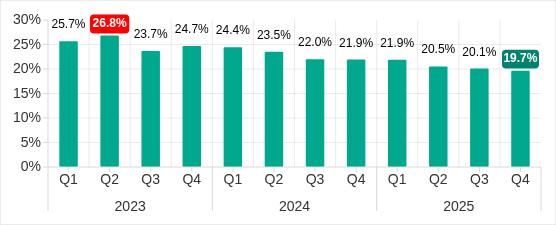
The percentage of ICS computers on which malicious objects were blocked has been decreasing since the beginning of 2024. In Q4 2025, it was 19.7%. Over the past three years, the percentage has decreased by 1.36 times, and by 1.25 times since Q4 2023.
Percentage of ICS computers on which malicious objects were blocked, Q1 2023–Q4 2025
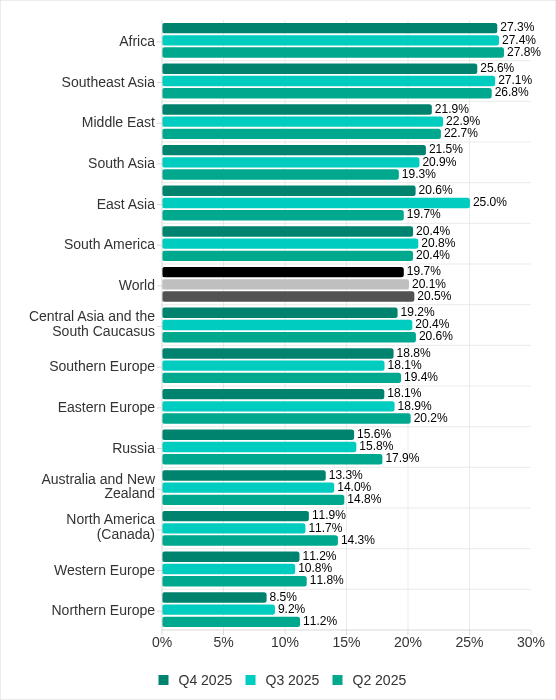
Regionally, in Q4 2025, the percentage of ICS computers on which malicious objects were blocked ranged from 8.5% in Northern Europe to 27.3% in Africa.
Regions ranked by percentage of ICS computers on which malicious objects were blocked
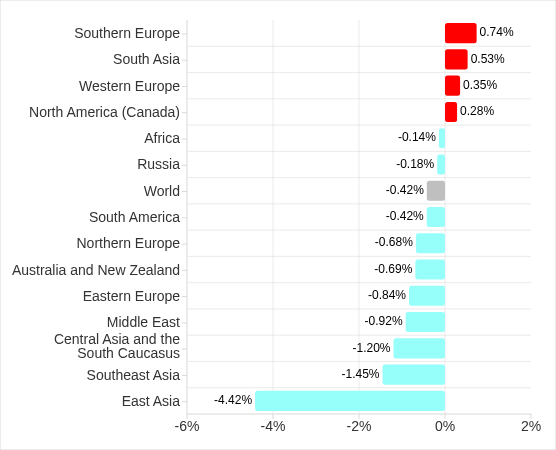
Four regions saw an increase in the percentage of ICS computers on which malicious objects were blocked. The most notable increases occurred in Southern Europe and South Asia. In Q3 2025, East Asia experienced a sharp increase triggered by the local spread of malicious scripts, but the figure has since returned to normal.
Changes in percentage of ICS computers on which malicious objects were blocked, Q4 2025
Feature of the quarter: worms in email
In Q4 2025, the percentage of ICS computers on which wormsinemailattachments were blocked increasedinallregions of the world.
Many of the blocked threats were related to the worm Backdoor.MSIL.XWorm. This malware is designed to persist on the system and then remotely control it.
Interestingly, this threat was not detected on ICS computers in the previous quarter, yet it appeared in all regions in Q4 2025.
A study found that the active spread of Backdoor.MSIL.XWorm via phishing emails was likely linked to the use by hackers of another malware obfuscation technique that was actively used during massive phishing campaigns in Q4 2025. These campaigns have been known since 2024 as “Curriculum-vitae-catalina”.
The attackers distributed phishing emails to HR managers, recruiters, and employees responsible for hiring. The messages were disguised as responses from job applicants with subjects such as “Resume” or “Attached Resume” and contained a malicious executable file under the guise of a curriculum vitae. Typically, the file was named Curriculum Vitae-Catalina.exe. When executed, it infected the system.
In Q4 2025, the threat spread across regions in two waves — one in October and another in November. Russia, Western Europe, South America, and North America (Canada) were attacked in October. A spike in Backdoor.MSIL.XWorm blocking was observed in other regions in November. The attack subsided in all regions in December.
The highest percentage of ICS computers on which Backdoor.MSIL.XWorm was blocked was observed in regions where threats from email clients had been historically blocked at high rates on ICS computers: Southern Europe, South America, and the Middle East.
At the same time, in Africa, where USB storage media are still actively used, the threat was also detected when removable devices were connected to ICS computers.
Selected industries
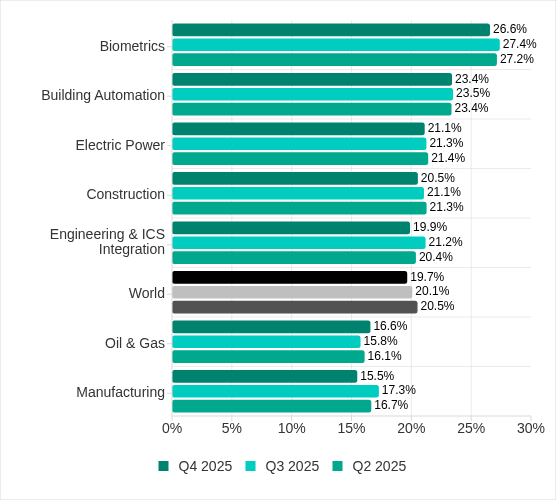
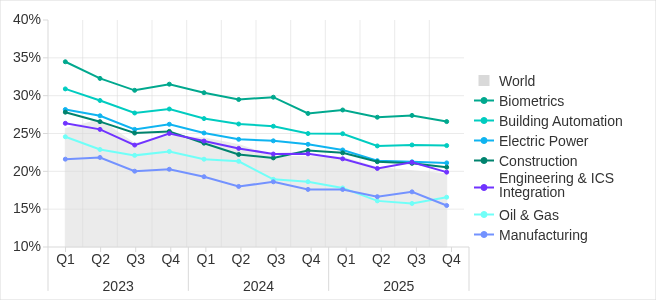
The biometrics sector has historically led the rankings of industries and OT infrastructures surveyed in this report in terms of the percentage of ICS computers on which malicious objects were blocked.
These systems are characterized by accessibility to and from the internet, as well as minimal cybersecurity controls by the consumer organization.
Rankings of industries and OT infrastructure by percentage of ICS computers on which malicious objects were blocked
In Q4 2025, the percentage of ICS computers on which malicious objects were blocked increased only in one sector: oil and gas. The corresponding figures increased in two regions: Russia, and Central Asia and the South Caucasus.
However, if we look at a broader time span, there is a downward trend in all the surveyed industries.
Percentage of ICS computers on which malicious objects were blocked in selected industries
Diversity of detected malicious objects
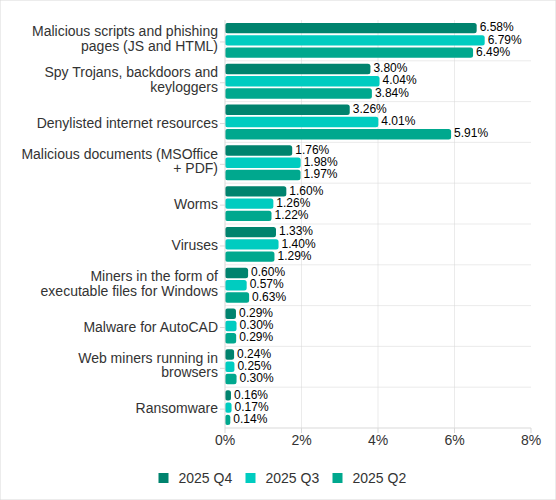
In Q4 2025, Kaspersky protection solutions blocked malware from 10,142 different malware families of various categories on industrial automation systems.
Percentage of ICS computers on which the activity of malicious objects from various categories was blocked
In Q4 2025, there was an increase in the percentage of ICS computers on which worms, and miners in the form of executable files for Windows were blocked. These were the only categories that exhibited an increase.
Main threat sources
Depending on the threat detection and blocking scenario, it is not always possible to reliably identify the source. The circumstantial evidence for a specific source can be the blocked threat’s type (category).
The internet (visiting malicious or compromised internet resources; malicious content distributed via messengers; cloud data storage and processing services and CDNs), email clients (phishing emails), and removable storage devices remain the primary sources of threats to computers in an organization’s technology infrastructure.
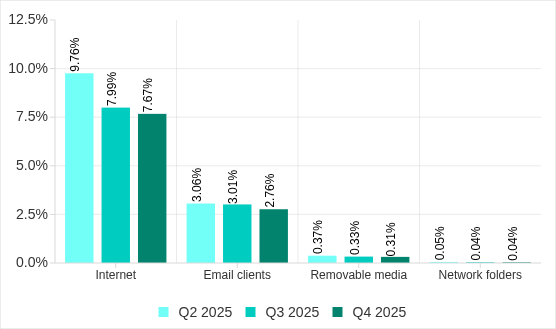
In Q4 2025, the percentage of ICS computers on which malicious objects from various sources were blocked decreased. All sources except email clients saw their lowest levels in three years.
Percentage of ICS computers on which malicious objects from various sources were blocked
The same computer can be attacked by several categories of malware from the same source during a quarter. That computer is counted when calculating the percentage of attacked computers for each threat category, but is only counted once for the threat source (we count unique attacked computers). In addition, it is not always possible to accurately determine the initial infection attempt. Therefore, the total percentage of ICS computers on which various categories of threats from a certain source were blocked can exceed the percentage of computers affected by the source itself.
In Q4 2025, the percentage of ICS computers on which threats from the internet were blocked decreased to 7.67% and reached its lowest level since the beginning of 2023. The main categories of internet threats are malicious scripts and phishing pages, and denylisted internet resources. The percentage ranged from 3.96% in Northern Europe to 11.33% in South Asia.
The main categories of threats from email clients blocked on ICS computers were malicious scripts and phishing pages, spyware, and malicious documents. Most of the spyware detected in phishing emails was delivered as a password archive or a multi-layered script embedded in office document files. The percentage of ICS computers on which threats from email clients were blocked ranged from 0.64% in Northern Europe to 6.34% in Southern Europe.
The main categories of threats that were blocked when removable media was connected to ICS computers were worms, viruses, and spyware. The percentage of ICS computers on which threats from removable media were blocked ranged from 0.05% in Australia and New Zealand to 1.41% in Africa.
The main categories of threats that spread through network folders in Q4 2025 were viruses, AutoCAD malware, worms, and spyware. The percentage of ICS computers on which threats from network folders were blocked ranged from 0.01% in Northern Europe to 0.18% in East Asia.
Threat categories
Typical attacks blocked within an OT network are multi-step sequences of malicious activities, where each subsequent step of the attackers is aimed at increasing privileges and/or gaining access to other systems by exploiting the security problems of industrial enterprises, including OT infrastructures.
Malicious objects used for initial infection
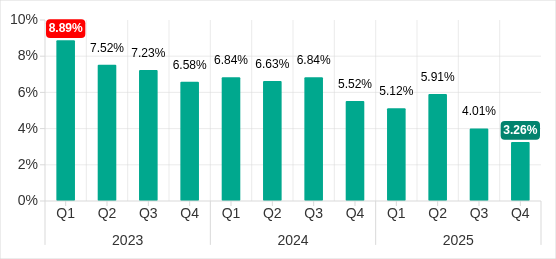
In Q4 2025, the percentage of ICS computers on which denylisted internet resources were blocked decreased to 3.26%. This is the lowest quarterly figure since the beginning of 2022, and it has decreased by 1.8 times since Q2 2025.
Percentage of ICS computers on which denylisted internet resources were blocked, Q1 2023–Q4 2025
Regionally, the percentage of ICS computers on which denylisted internet resources were blocked ranged from 1.74% in Northern Europe to 3.93% in Southeast Asia, which displaced Africa from first place. Russia rounded out the top three regions for this indicator.
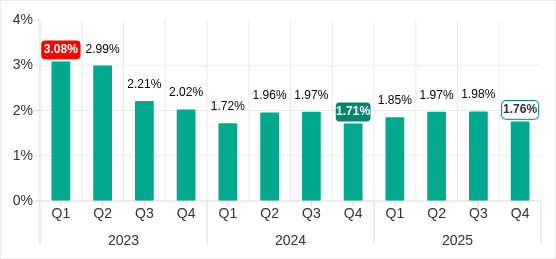
The percentage of ICS computers on which malicious documents were blocked increased for three consecutive quarters. However, in Q4 2025 it decreased by 0.22 pp to 1.76%.
Percentage of ICS computers on which malicious documents were blocked, Q1 2023–Q4 2025
Regionally, the percentage ranged from 0.46% in Northern Europe to 3.82% in Southern Europe. In Q4 2025, the indicator increased in Eastern Europe, Russia, and Western Europe.
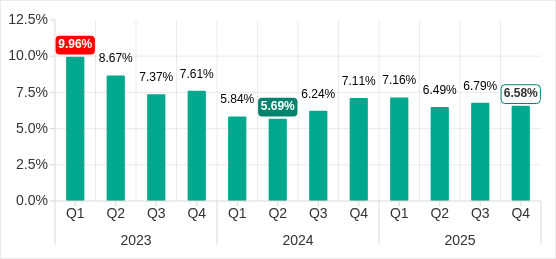
The percentage of ICS computers on which malicious scripts and phishing pages were blocked decreased to 6.58%. Despite the decline, this category led the rankings of threat categories in terms of the percentage of ICS computers on which they were blocked.
Percentage of ICS computers on which malicious scripts and phishing pages were blocked, Q1 2023–Q4 2025
Regionally, the percentage ranged from 2.52% in Northern Europe to 10.50% in South Asia. The indicator increased in South Asia, South America, Southern Europe, and Africa. South Asia saw the most notable increase, at 3.47 pp.
Next-stage malware
Malicious objects used to initially infect computers deliver next-stage malware — spyware, ransomware, and miners — to victims’ computers. As a rule, the higher the percentage of ICS computers on which the initial infection malware is blocked, the higher the percentage for next-stage malware.
In Q4 2025, the percentage of ICS computers on which spyware, ransomware and web miners were blocked decreased. The rates were:
Spyware: 3.80% (down 0.24 pp). For the second quarter in a row, spyware took second place in the rankings of threat categories in terms of the percentage of ICS computers on which it was blocked.
Ransomware: 0.16% (down 0.01 pp).
Web miners: 0.24% (down 0.01 pp), this is the lowest level observed thus far in the period under review.
The percentage of ICS computers on which miners in the form of executable files for Windows were blocked increased to 0.60% (up 0.03 pp).
Self-propagating malware
Self-propagating malware (worms and viruses) is a category unto itself. Worms and virus-infected files were originally used for initial infection, but as botnet functionality evolved, they took on next-stage characteristics.
To spread across ICS networks, viruses and worms rely on removable media and network folders and are distributed in the form of infected files, such as archives with backups, office documents, pirated games and hacked applications. In rarer and more dangerous cases, web pages with network equipment settings, as well as files stored in internal document management systems, product lifecycle management (PLM) systems, resource management (ERP) systems and other web services are infected.
In Q4 2025, the percentage of ICS computers on which worms were blocked increased by 1.6 times to 1.60%. As mentioned above, this increase is related to a global phishing attack that spread the Backdoor.MSIL.XWorm backdoor worm across all regions of the world. The percentage increased in all regions. The biggest increase (up by 2.16 times) was in Southern Europe. The malware was primary distributed through email clients, and Southern Europe led the way in terms of the percentage of ICS computers on which threats from email clients were blocked.
The percentage of ICS computers on which viruses were blocked decreased to 1.33%.
AutoCAD malware
This category of malware can spread in a variety of ways, so it does not belong to a specific group.
After an increase in the previous quarter, the percentage of ICS computers on which AutoCAD malware was blocked decreased to 0.29% in Q4 2025.
The percentage of ICS computers on which malicious objects were blocked has been decreasing since the beginning of 2024. In Q4 2025, it was 19.7%. Over the past three years, the percentage has decreased by 1.36 times, and by 1.25 times since Q4 2023.
Percentage of ICS computers on which malicious objects were blocked, Q1 2023–Q4 2025
Regionally, in Q4 2025, the percentage of ICS computers on which malicious objects were blocked ranged from 8.5% in Northern Europe to 27.3% in Africa.
Regions ranked by percentage of ICS computers on which malicious objects were blocked
Four regions saw an increase in the percentage of ICS computers on which malicious objects were blocked. The most notable increases occurred in Southern Europe and South Asia. In Q3 2025, East Asia experienced a sharp increase triggered by the local spread of malicious scripts, but the figure has since returned to normal.
Changes in percentage of ICS computers on which malicious objects were blocked, Q4 2025
Feature of the quarter: worms in email
In Q4 2025, the percentage of ICS computers on which wormsinemailattachments were blocked increasedinallregions of the world.
Many of the blocked threats were related to the worm Backdoor.MSIL.XWorm. This malware is designed to persist on the system and then remotely control it.
Interestingly, this threat was not detected on ICS computers in the previous quarter, yet it appeared in all regions in Q4 2025.
A study found that the active spread of Backdoor.MSIL.XWorm via phishing emails was likely linked to the use by hackers of another malware obfuscation technique that was actively used during massive phishing campaigns in Q4 2025. These campaigns have been known since 2024 as “Curriculum-vitae-catalina”.
The attackers distributed phishing emails to HR managers, recruiters, and employees responsible for hiring. The messages were disguised as responses from job applicants with subjects such as “Resume” or “Attached Resume” and contained a malicious executable file under the guise of a curriculum vitae. Typically, the file was named Curriculum Vitae-Catalina.exe. When executed, it infected the system.
In Q4 2025, the threat spread across regions in two waves — one in October and another in November. Russia, Western Europe, South America, and North America (Canada) were attacked in October. A spike in Backdoor.MSIL.XWorm blocking was observed in other regions in November. The attack subsided in all regions in December.
The highest percentage of ICS computers on which Backdoor.MSIL.XWorm was blocked was observed in regions where threats from email clients had been historically blocked at high rates on ICS computers: Southern Europe, South America, and the Middle East.
At the same time, in Africa, where USB storage media are still actively used, the threat was also detected when removable devices were connected to ICS computers.
Selected industries
The biometrics sector has historically led the rankings of industries and OT infrastructures surveyed in this report in terms of the percentage of ICS computers on which malicious objects were blocked.
These systems are characterized by accessibility to and from the internet, as well as minimal cybersecurity controls by the consumer organization.
Rankings of industries and OT infrastructure by percentage of ICS computers on which malicious objects were blocked
In Q4 2025, the percentage of ICS computers on which malicious objects were blocked increased only in one sector: oil and gas. The corresponding figures increased in two regions: Russia, and Central Asia and the South Caucasus.
However, if we look at a broader time span, there is a downward trend in all the surveyed industries.
Percentage of ICS computers on which malicious objects were blocked in selected industries
Diversity of detected malicious objects
In Q4 2025, Kaspersky protection solutions blocked malware from 10,142 different malware families of various categories on industrial automation systems.
Percentage of ICS computers on which the activity of malicious objects from various categories was blocked
In Q4 2025, there was an increase in the percentage of ICS computers on which worms, and miners in the form of executable files for Windows were blocked. These were the only categories that exhibited an increase.
Main threat sources
Depending on the threat detection and blocking scenario, it is not always possible to reliably identify the source. The circumstantial evidence for a specific source can be the blocked threat’s type (category).
The internet (visiting malicious or compromised internet resources; malicious content distributed via messengers; cloud data storage and processing services and CDNs), email clients (phishing emails), and removable storage devices remain the primary sources of threats to computers in an organization’s technology infrastructure.
In Q4 2025, the percentage of ICS computers on which malicious objects from various sources were blocked decreased. All sources except email clients saw their lowest levels in three years.
Percentage of ICS computers on which malicious objects from various sources were blocked
The same computer can be attacked by several categories of malware from the same source during a quarter. That computer is counted when calculating the percentage of attacked computers for each threat category, but is only counted once for the threat source (we count unique attacked computers). In addition, it is not always possible to accurately determine the initial infection attempt. Therefore, the total percentage of ICS computers on which various categories of threats from a certain source were blocked can exceed the percentage of computers affected by the source itself.
In Q4 2025, the percentage of ICS computers on which threats from the internet were blocked decreased to 7.67% and reached its lowest level since the beginning of 2023. The main categories of internet threats are malicious scripts and phishing pages, and denylisted internet resources. The percentage ranged from 3.96% in Northern Europe to 11.33% in South Asia.
The main categories of threats from email clients blocked on ICS computers were malicious scripts and phishing pages, spyware, and malicious documents. Most of the spyware detected in phishing emails was delivered as a password archive or a multi-layered script embedded in office document files. The percentage of ICS computers on which threats from email clients were blocked ranged from 0.64% in Northern Europe to 6.34% in Southern Europe.
The main categories of threats that were blocked when removable media was connected to ICS computers were worms, viruses, and spyware. The percentage of ICS computers on which threats from removable media were blocked ranged from 0.05% in Australia and New Zealand to 1.41% in Africa.
The main categories of threats that spread through network folders in Q4 2025 were viruses, AutoCAD malware, worms, and spyware. The percentage of ICS computers on which threats from network folders were blocked ranged from 0.01% in Northern Europe to 0.18% in East Asia.
Threat categories
Typical attacks blocked within an OT network are multi-step sequences of malicious activities, where each subsequent step of the attackers is aimed at increasing privileges and/or gaining access to other systems by exploiting the security problems of industrial enterprises, including OT infrastructures.
Malicious objects used for initial infection
In Q4 2025, the percentage of ICS computers on which denylisted internet resources were blocked decreased to 3.26%. This is the lowest quarterly figure since the beginning of 2022, and it has decreased by 1.8 times since Q2 2025.
Percentage of ICS computers on which denylisted internet resources were blocked, Q1 2023–Q4 2025
Regionally, the percentage of ICS computers on which denylisted internet resources were blocked ranged from 1.74% in Northern Europe to 3.93% in Southeast Asia, which displaced Africa from first place. Russia rounded out the top three regions for this indicator.
The percentage of ICS computers on which malicious documents were blocked increased for three consecutive quarters. However, in Q4 2025 it decreased by 0.22 pp to 1.76%.
Percentage of ICS computers on which malicious documents were blocked, Q1 2023–Q4 2025
Regionally, the percentage ranged from 0.46% in Northern Europe to 3.82% in Southern Europe. In Q4 2025, the indicator increased in Eastern Europe, Russia, and Western Europe.
The percentage of ICS computers on which malicious scripts and phishing pages were blocked decreased to 6.58%. Despite the decline, this category led the rankings of threat categories in terms of the percentage of ICS computers on which they were blocked.
Percentage of ICS computers on which malicious scripts and phishing pages were blocked, Q1 2023–Q4 2025
Regionally, the percentage ranged from 2.52% in Northern Europe to 10.50% in South Asia. The indicator increased in South Asia, South America, Southern Europe, and Africa. South Asia saw the most notable increase, at 3.47 pp.
Next-stage malware
Malicious objects used to initially infect computers deliver next-stage malware — spyware, ransomware, and miners — to victims’ computers. As a rule, the higher the percentage of ICS computers on which the initial infection malware is blocked, the higher the percentage for next-stage malware.
In Q4 2025, the percentage of ICS computers on which spyware, ransomware and web miners were blocked decreased. The rates were:
Spyware: 3.80% (down 0.24 pp). For the second quarter in a row, spyware took second place in the rankings of threat categories in terms of the percentage of ICS computers on which it was blocked.
Ransomware: 0.16% (down 0.01 pp).
Web miners: 0.24% (down 0.01 pp), this is the lowest level observed thus far in the period under review.
The percentage of ICS computers on which miners in the form of executable files for Windows were blocked increased to 0.60% (up 0.03 pp).
Self-propagating malware
Self-propagating malware (worms and viruses) is a category unto itself. Worms and virus-infected files were originally used for initial infection, but as botnet functionality evolved, they took on next-stage characteristics.
To spread across ICS networks, viruses and worms rely on removable media and network folders and are distributed in the form of infected files, such as archives with backups, office documents, pirated games and hacked applications. In rarer and more dangerous cases, web pages with network equipment settings, as well as files stored in internal document management systems, product lifecycle management (PLM) systems, resource management (ERP) systems and other web services are infected.
In Q4 2025, the percentage of ICS computers on which worms were blocked increased by 1.6 times to 1.60%. As mentioned above, this increase is related to a global phishing attack that spread the Backdoor.MSIL.XWorm backdoor worm across all regions of the world. The percentage increased in all regions. The biggest increase (up by 2.16 times) was in Southern Europe. The malware was primary distributed through email clients, and Southern Europe led the way in terms of the percentage of ICS computers on which threats from email clients were blocked.
The percentage of ICS computers on which viruses were blocked decreased to 1.33%.
AutoCAD malware
This category of malware can spread in a variety of ways, so it does not belong to a specific group.
After an increase in the previous quarter, the percentage of ICS computers on which AutoCAD malware was blocked decreased to 0.29% in Q4 2025.
Multiple vulnerabilities have been identified in Orthanc DICOM Server version, 1.12.10 and earlier, that affect image decoding and HTTP request handling components. These vulnerabilities include heap buffer overflows, out-of-bounds reads, and resource exhaustion vulnerabilities that may allow attackers to crash the server, leak memory contents, or potentially execute arbitrary code.
Description
Orthanc is an open-source lightweight Digital Imaging and Communications in Medicine (DICOM) server used to store, process, and retrieve medical imaging data in healthcare environments. The following nine vulnerabilities identified in Orthanc primarily stem from unsafe arithmetic operations, missing bounds checks, and insufficient validation of attacker-controlled metadata in DICOM files and HTTP requests.
CVE-2026-5437 An out-of-bounds read vulnerability exists in DicomStreamReader during DICOM meta-header parsing. When processing malformed metadata structures, the parser may read beyond the bounds of the allocated metadata buffer. Although this issue does not typically crash the server or expose data directly to the attacker, it reflects insufficient input validation in the parsing logic.
CVE-2026-5438 A gzip decompression bomb vulnerability exists when Orthanc processes an HTTP request with Content-Encoding: gzip. The server does not enforce limits on decompressed size and allocates memory based on attacker-controlled compression metadata. A specially crafted gzip payload can trigger excessive memory allocation and exhaust system memory.
CVE-2026-5439 A memory exhaustion vulnerability exists in ZIP archive processing. Orthanc automatically extracts ZIP archives uploaded to certain endpoints and trusts metadata fields describing the uncompressed size of archived files. An attacker can craft a small ZIP archive containing a forged size value, causing the server to allocate extremely large buffers during extraction.
CVE-2026-5440 A memory exhaustion vulnerability exists in the HTTP server due to unbounded use of the Content-Length header. The server allocates memory directly based on the attacker-supplied header value without enforcing an upper limit. A crafted HTTP request containing an extremely large Content-Length value, such as approximately 4 GB, can trigger excessive memory allocation and server termination, even without sending a request body.
CVE-2026-5441 An out-of-bounds read vulnerability exists in the DecodePsmctRle1 function of DicomImageDecoder.cpp. The PMSCT_RLE1 decompression routine, which decodes the proprietary Philips Compression format, does not properly validate escape markers placed near the end of the compressed data stream. A crafted sequence at the end of the buffer can cause the decoder to read beyond the allocated memory region and leak heap data into the rendered image output.
CVE-2026-5442 A heap buffer overflow vulnerability exists in the DICOM image decoder. Dimension fields are encoded using Value Representation (VR) Unsigned Long (UL), instead of the expected VR Unsigned Short (US), which allows extremely large dimensions to be processed. This causes an integer overflow during frame size calculation and results in out-of-bounds memory access during image decoding.
CVE-2026-5443 A heap buffer overflow vulnerability exists during the decoding of PALETTE COLOR DICOM images. Pixel length validation uses 32-bit multiplication for width and height calculations. If these values overflow, the validation check incorrectly succeeds, allowing the decoder to read and write to memory beyond allocated buffers.
CVE-2026-5444 A heap buffer overflow vulnerability exists in the PAM ( https://netpbm.sourceforge.net/doc/pam.html) image parsing logic. When Orthanc processes a crafted PAM image embedded in a DICOM file, image dimensions are multiplied using 32-bit unsigned arithmetic. Specially chosen values can cause an integer overflow during buffer size calculation, resulting in the allocation of a small buffer followed by a much larger write operation during pixel processing.
CVE-2026-5445 An out-of-bounds read vulnerability exists in the DecodeLookupTable function within DicomImageDecoder.cpp. The lookup-table decoding logic used for PALETTE COLOR images does not validate pixel indices against the lookup table size. Crafted images containing indices larger than the palette size cause the decoder to read beyond allocated lookup table memory and expose heap contents in the output image.
Impact
The vulnerabilities in Orthan DICOM Server 1.20.10 allow attackers to trigger heap memory corruption, out-of-bounds read, information disclosure, and denial-of-service conditions through crafted DICOM files and HTTP requests. The most severe issues are heap-based buffer overflows in image parsing and decoding logic, which can crash the Orthanc process and may, under certain conditions, provide a pathway to remote code execution (RCE). Several additional flaws permit out-of-bounds reads that can expose heap-resident data, including allocator metadata, internal identifiers, points, and portions of adjacent DICOM content through rendered image output.
In addition, multiple vulnerabilities allow resource exhaustion by causing Orthanc to allocate excessive amounts of memory based on attacker-controlled metadata such as Content-Length, ZIP archive size fields, and gzip decompression size values. These conditions can reliably result in process termination and denial of service, often with only a small, crafted payload. Some of the affected code paths may also allow malicious DICOM content to be stored and later re-triggered during normal processing, increasing the persistence and operational impact of exploitation.
Solution
Orthanc has released version 1.12.11 to address these vulnerabilities, and users are strongly encouraged to upgrade as soon as possible. Administrators should review deployment configurations to limit exposure of upload and image processing functionality to trusted users and networks wherever possible. Refer to Orthanc documentation and release notes for patching and deployment guidance.
Acknowledgements
Thanks to Dr. Simon Weber and Volker Schönefeld of Machine Spirits UG (https://machinespirits.com) for the disclosure of these vulnerabilities. This document was written by Michael Bragg.
Vendor Information
One or more vendors are listed for this advisory. Please reference the full report for more information.
References
Heap Buffer Overflow in PAM Image Buffer Allocation: https://www.machinespirits.com/advisory/b7ced5/
Heap Buffer Overflow in DICOM Image Decoder via VR UL Dimensions: https://www.machinespirits.com/advisory/615070/
Heap Buffer Overflow in DICOM Image Decoder (Palette Color Decode): https://www.machinespirits.com/advisory/553dfa/
Out-of-Bounds Read in DicomImageDecoder (PMSCT_RLE1 Decompression): https://www.machinespirits.com/advisory/4bcfdc/
Out-of-Bounds Read in DicomImageDecoder (DecodeLookupTable): https://www.machinespirits.com/advisory/33488c/
Memory Exhaustion via Unbounded Content-Length: https://www.machinespirits.com/advisory/1f0f72/
Memory Exhaustion via Forged ZIP Metadata: https://www.machinespirits.com/advisory/735e61/
Gzip Decompression Bomb via Content-Encoding Header: https://www.machinespirits.com/advisory/faca4b/
Out-of-Bounds Read in DicomStreamReader: https://www.machinespirits.com/advisory/126f96/
Artifex's MuPDF contains an integer overflow vulnerability, CVE-2026-3308, in versions up to and including 1.27.0. Using a specially crafted PDF, an attacker can trigger an integer overflow resulting in out-of-bounds heap writes. This heap corruption typically causes the application to crash, but in some cases could be exploited to enable arbitrary code execution.
Description
Artifex MuPDF is a lightweight framework for viewing and converting PDF, XPS, and e-book files. A vulnerability exists in pdf_load_image_imp, which is responsible for preparing image data for decoding.
The function processes image parameters including w (width), h (height), and bpc (bits per component), which are used to determine the amount of memory allocated during image decoding. The current implementation validates these parameters against SIZE_MAX rather than INT_MAX, but because stride calculations use integer-sized values, this check does not sufficiently protect against integer overflow when exceedingly large values are supplied.
When the overflow occurs, the resulting corrupted values are passed into the fz_unpack_stream function, which expands packed image samples into a destination buffer during image decoding. Because this too-small overflow value is used to calculate the size of the destination buffer, not enough memory is allocated for the actual size of the image. This causes fz_unpack_stream to write beyond the bounds of the allocated heap buffer, resulting in a heap out-of-bounds write.
Impact
Successful exploitation results in a heap out-of-bounds write during PDF image decoding. This condition may cause application crashes and memory corruption, or could potentially allow arbitrary code execution within the context of the application rendering the PDF.
Since this vulnerability is triggered during standard PDF parsing operations, any system that automatically processes or renders untrusted PDF files using MuPDF may be affected.
Solution
Unfortunately, the vendor was unreachable to coordinate this vulnerability. Until a complete fix is available, users should avoid processing untrusted PDF files with affected MuPDF-based applications where possible. Applications that rely on MuPDF should isolate document rendering in a sandboxed or low-privilege process and disable automatic rendering or conversion of untrusted files if feasible. A Pull Request (PR) was with the fix is available at: https://github.com/ArtifexSoftware/mupdf/pull/87
Acknowledgements
Thanks toYarden Porat from Cyata for reporting this vulnerability. This document was written by Michael Bragg.
CVE-2026-3308
An integer overflow vulnerability in 'pdf-image.c' in Artifex's MuPDF version 1.27.0 allows an attacker to maliciously craft a PDF that can trigger an integer overflow within the 'pdf_load_image_imp' function. This allows a heap out-of-bounds write that could be exploited for arbitrary code execution.
Vendor Information
One or more vendors are listed for this advisory. Please reference the full report for more information.
Kyverno, versions 1.16.0 to present, contains an SSRF vulnerability in its CEL-based HTTP functions, which lack URL validation or namespace scoping and allow namespaced policies to trigger arbitrary internal HTTP requests. An attacker with only namespace-level permissions can exploit this to access sensitive internal services via the highly privileged Kyverno admission controller.
Description
Kyverno is an open-source, Kubernetes-native policy engine that functions as a dynamic admission controller for the Kubernetes API. It is designed to manage the lifecycle of cluster resources by validating, mutating, and generating configurations based on YAML-defined policies. Within a security context, the engine is frequently utilized to enforce Pod Security Standards, verify image signatures via Cosign, and audit resource configurations for compliance. Because Kyverno operates with high-level permissions to intercept and modify API requests, it represents a critical component of the cluster's security posture and trust boundary.
A server-side request forgery vulnerability exists in Kyverno’s CEL-based HTTP functions (Get and Post) used by namespaced policy types in the policies.kyverno.io API group. Unlike Kyverno’s resource library, which enforces namespace boundaries, the HTTP library at pkg/cel/libs/http/http.go performs no URL validation or scoping; i.e., there are no blocklists, namespace restrictions, or destination checks. As a result, these policies can issue arbitrary HTTP requests from the Kyverno admission controller pod.
Impact
An authenticated attacker with only namespace-scoped permissions can create a malicious namespaced policy that sends an internal http.Get() request, captures the response in a CEL variable, and exfiltrates it via the policy’s messageExpression field returned in the admission denial. Because requests originate from the Kyverno admission controller, which often has privileged network reachability across internal cluster services and cloud metadata APIs, this enables cross-namespace data access and potential exposure of sensitive metadata or service responses, effectively breaking Kyverno’s intended security boundaries through SSRF.
Solution
Unfortunately, we were unable to reach the vendor to coordinate this vulnerability. Since a patch is unavailable, we can only offer mitigation strategies.
Mitigation should include implementing strict URL validation and destination controls within Kyverno’s CEL HTTP library to ensure parity with the namespace-scoped restrictions enforced by the resource library. Recommended safeguards include blocking access to link-local and cloud metadata address ranges, limiting outbound requests to approved in-cluster services, and providing administrators with configurable allowlists. Additionally, applying default deny network policies to the Kyverno admission controller pod can reduce residual risk by preventing unauthorized egress in the event of future validation gaps.
Acknowledgements
Thanks to Igor Stepansky from Orca Security Research Pod for responsibly disclosing this vulnerability. This document was written by Dr. Elke Drennan, CISSP.
Vendor Information
One or more vendors are listed for this advisory. Please reference the full report for more information.
Four vulnerabilities have been identified in CrewAI, including remote code execution (RCE), arbitrary local file read, and server-side request forgery (SSRF). CVE-2026-2275 is directly caused by the Code Interpreter Tool. The other three vulnerabilities result from improper default configuration settings within the main CrewAI agent and associated Docker images. An attacker who can interact with a CrewAI agent that has the Code Interpreter Tool enabled may exploit these issues through prompt injection, ultimately chaining the vulnerabilities together. The vendor has provided a statement addressing some, but not all, of the reported vulnerabilities.
Description
CrewAI is a tool for building and orchestrating multi-agent AI systems. These agents are intended to work together to complete tasks, and developers define those tasks and workflows. CrewAI supports various tools, including one called the "Code Interpreter Tool", intended for execution of Python code within a secure Docker container.
CVE-2026-2275 origintates from the Code Interpreter tool itself. The remaining vulnerabilities stem from insecure fallback behaviors and configuration issues in the CrewAI agent and Docker environment. Exploitation of CVE-2026-2275 may enable attackers to trigger the additional vulnerabilities.
The vulnerabilities are listed below:
CVE-2026-2275
The CrewAI CodeInterpreter tool falls back to SandboxPython when it cannot reach Docker, which can enable code execution through arbitrary C function calls. This vulnerability can be triggered if: allow_code_execution=True is enabled in the agent configuration, or if the Code Interpreter Tool is manually added to the agent by the developer.
CVE-2026-2286
CrewAI contains a server-side request forgery (SSRF) vulnerability that enables content acquisition from internal and cloud services, facilitated by the RAG search tools not properly validating URLs provided at runtime.
CVE-2026-2287
CrewAI does not properly check that Docker is still running during runtime, and will fall back to a sandbox setting that allows for RCE exploitation.
CVE-2026-2285
CrewAI contains a arbitrary local file read vulnerability in the JSON loader tool that reads files without path validation, enabling access to files on the server.
Impact
An attacker with the ability to influence a CrewAI agent using the Code Interpreter Tool through either direct or indirect prompt injection can use the four vulnerabilities discovered to perform arbitrary file read, RCE, and server side request forgery. The results of the attacks can vary, as the attacker will achieve sandbox bypass and RCE/file read if the host machine is using Docker, or full RCE if the host machine is in configuration mode or unsafe mode. An attacker can use the arbitrary file read and SSRF vulnerabilities to perform credential theft, or the RCE vulnerabilities to perform further leveraging of the compromised device.
Solution
During coordinated disclosure, the vendor provided a statement addressing CVE-2026-2275 and CVE-2026-2287.
The vendor has indicated plans to take the following actions to improve security of CrewAI framework:
Add ctypes and related modules to BLOCKED_MODULES in an upcoming release
Evaluate configuration changes to fail closed rather than fall back to sandbox mode
Provide clearer runtime warnings when sandbox mode is active
Improve security-related documentation
At the time of writing, no complete patch is available for all disclosed vulnerabilities. Until fixes are released, users should:
Remove or restrict or disable the Code Interpreter Tool wherever possible
The IDrive Cloud Backup Client for Windows, versions 7.0.0.63 and earlier, contains a privilege escalation vulnerability that allows any authenticated user to run arbitrary executables with NT AUTHORITY\SYSTEM permissions.
Description
IDrive is a cloud backup service that allows users to encrypt, sync, and store data from multiple devices such as PCs, Macs, iPhones, and Androids in one cloud-based account. IDrive provides a Windows client for both desktop and server editions, which acts as both a thick client and a thin client with a web interface to manage cloud backups.
CVE-2026-1995 The IDrive Windows client utility id_service.exe runs as a process with elevated SYSTEM privileges and regularly reads from several files located under C:\ProgramData\IDrive. The UTF16-LE encoded contents of these files are used by the service as arguments for starting processes. Because of weak permission configurations, these files can be edited by any standard user logged into the system. An authenticated, low-privilege attacker can overwrite or add a new file that specifies a path to an arbitrary script or .exe, which will then be executed by the id_service.exe process with SYSTEM privileges.
Impact
This vulnerability enables an authenticated local user, or any user with access to the affected directory, to execute arbitrary code as SYSTEM on the target Windows device. A local attacker could exploit this vulnerability to escalate privileges and gain full control over the target machine, potentially enabling data theft, system modification, or arbitrary script execution.
Solution
IDrive has reported that a patch for this vulnerability is currently in development. Users should monitor IDrive releases and update their software to the latest version as soon as it becomes available. In the meantime, users are advised to restrict write permissions for the affected directory and employ additional controls such as EDR monitoring and Group Policies to detect and prevent unauthorized file modifications.
Acknowledgements
Thanks to Matthew Owens and FRSecure for discovering and reporting this vulnerability. This document was written by Molly Jaconski.
Vendor Information
One or more vendors are listed for this advisory. Please reference the full report for more information.
GoHarbor's Harbor default admin password presents a security risk because it does not require change upon initial deployment.
Description
GoHarbor's Harbor is an open-source OCI-compliant container registry project that stores, signs, and manages container images. Harbor initializes with a default administrator account (admin) and password (Harbor12345), configured through the harbor_admin_password parameter in the harbor.yml.
While operators are expected to change these credentials during or after deployment, Harbor does not enforce a password change during setup or upon first login. If the default credentials remain unchanged, a remote attacker can authenticate using the publicly known password to gain full administrative access.
Impact
An attacker who gains administrative access can fully compromise the Harbor registry and all managed artifacts. This includes the ability to overwrite or inject malicious container images, enabling supply-chain attacks that may lead to remote code execution in downstream continuous integration and continuous development (CI/CD) pipelines and Kubernetes environments. The attacker can establish persistent access by creating new users, robot accounts, or API tokens, and can weaken or disable security controls such as vulnerability scanning, signature enforcement, and role-based access controls.
Additionally, sensitive images can be exfiltrated by configuring replication to external registries or downloading artifacts directly. Administrative privileges also allow destructive actions such as deleting repositories or corrupting artifacts, resulting in service disruption and loss of system integrity.
Solution
Operators should change the default administrative password either before or immediately after deployment. This can be done through the Harbor web interface or by specifying a unique value for harbor_admin_password in harbor.yml during installation.
A fix has been proposed to address the hardcoded default password by removing or randomizing default credentials during installation. See the Harbor pull request:
https://github.com/goharbor/harbor/pull/19188https://github.com/goharbor/harbor/pull/19188
Acknowledgements
Thanks to notnotnotveg (notnotnotveg@gmail.com) who reported this vulnerability. This document was written by Michael Bragg.
Vendor Information
One or more vendors are listed for this advisory. Please reference the full report for more information.
A log-injection vulnerability in the LibreChat RAG API, version 0.7.0, is caused by improper sanitization of user-supplied input written to system logs. An authenticated attacker can forge or manipulate log entries by inserting CRLF characters, compromising the integrity of audit records. This flaw may further enable downstream attacks if the tampered logs are processed or displayed by insecure log-management tools.
Description
LibreChat’s retrieval-augmented generation (RAG) application programming interface (API) is a specialized, asynchronous backend service developed with Python FastAPI and LangChain that facilitates document-based RAG through a file-level, ID-based indexing system. It operates by extracting and chunking text from user-uploaded files, generating high-dimensional embeddings via providers like OpenAI or local Ollama instances, and storing them in a PostgreSQL database equipped with the pgvector extension for efficient semantic search.
A log-injection vulnerability occurs when an application fails to properly sanitize or validate untrusted user input before including it in system log files, allowing an attacker to manipulate the integrity of the audit trail. By inserting line-feed or carriage-return (CRLF) characters in a POST request, specifically in the file_id parameter of the form data, an authenticated attacker can forge fake log entries.
Impact
By exploiting this vulnerability, an authenticated attacker can obfuscate malicious activity, misdirect forensic investigations, or impersonate other users. Furthermore, if the logs are later viewed through a web-based administrative console or an unsecure log-management tool, this vulnerability can escalate into secondary attacks such as cross-site scripting (XSS) or remote command execution.
Solution
Unfortunately, we were unable to reach the vendor to coordinate this vulnerability. Since a patch is unavailable, we can only offer mitigation strategies.
The following workarounds can help mitigate this vulnerability's impact on the targeted environment:
Sanitize input logs with a filter in the RAG ingest to prevent malicious data.
Disable the pgvector extension in PostgreSQL, if not in use.
Validate RAG output before passing it to other tools to prevent relaying of data that could lead to indirect prompt injection.
These recommendations are not mutually exclusive and can be implemented in combination to provide layered protection. By taking these steps, organizations can reduce their risk exposure until the vendor addresses the underlying vulnerabilities.
Acknowledgements
Thanks to Caio Bittencourt for coordinating the disclosure of this vulnerability. This document was written by Dr. Elke Drennan, CISSP.
Vendor Information
One or more vendors are listed for this advisory. Please reference the full report for more information.
Version 1.6.1 of the Flash Payments package graphql-upload-minimal is vulnerable to prototype pollution. This vulnerability, located in the processRequest() function, allows an attacker to inject special property names into the operations.variables object and pollute global object prototypes, ultimately impacting the entire Node.js process.
Description
graphql-upload-minimal is a lightweight Node.js middleware package that implements the GraphQL multipart request specification, enabling file uploads in GraphQL servers. It parses multipart/form-data requests and maps uploaded files into the GraphQL operations object, making them accessible to resolvers.
The vulnerability exists in the processRequest() function, which handles multipart file upload requests. It processes a user-supplied map parameter that determines where uploaded files should be placed within the GraphQL operations.variables object.
The issue occurs because user-supplied property paths are not validated before being resolved and written into the target object. Special JavaScript property names such as __proto__, __constructor__, and prototype are not restricted, allowing crafted paths to traverse the prototype chain and modify Object.prototype.
Because Object.prototype is the base prototype from which most JavaScript objects inherit, altering it results in global prototype pollution across the Node.js process. Once polluted, manipulated properties may be inherited by all subsequently created objects for the lifetime of the process.
Impact
Because Object.prototype is the foundational prototype for most JavaScript objects, modifying it can affect the behavior of all Node.js processes. Since the impact extends across the entire Node.js process and persists until the service is restarted, it can potentially result in logic corruption, denial of service, or unintended privilege escalation.
Solution
Users should upgrade to graphql-upload-minimal version 1.6.3 or later, which can be found at https://github.com/flash-oss/graphql-upload-minimal/tree/master . The patched release introduces safeguards to prevent unsafe prototype-chain property assignments during multipart file upload processing.
Acknowledgements
Thanks to Maor Caplan from Alma Security for reporting this vulnerability. This document was written by Michael Bragg.
Vendor Information
One or more vendors are listed for this advisory. Please reference the full report for more information.
Two unsafe pickle deserialization vulnerabilities have been discovered in the SGLang open-source project, one within the tool's multimodal generation module and another within the Encoder Parallel Disaggregation system. SGLang is a serving framework for large language models (LLMs) and multimodal models. These vulnerabilities, tracked as CVE-2026-3059 and CVE-2026-3060, allow an attacker to provide a malicious pickle file to a device using SGLang's multimodal generation system or the encoder parallel disaggregation system, enabling code execution. CVE-2026-3989 allows an attacker to provide a malicious pickle file that, when attempted to be replayed with the replay_request_dump.py script, will result in code execution. Version 0.5.10 addresses the vulnerabilities. It is recommended that project maintainers avoid implementing Pickle functions due to the inherent security risks.
Description
SGLang is a framework for serving various large language models (LLMs) and multimodal AI models, supporting models such as Qwen, DeepSeek, Mistral, and Skywork, and is compatible with OpenAI APIs. Two unsafe pickle deserialization vulnerabilities have been identified in the project, tracked as CVE-2026-3059 and CVE-2026-3060.
CVE-2026-3059
SGLangs multimodal generation module is vulnerable to unauthenticated remote code execution through the ZMQ broker, which deserializes untrusted data using pickle.loads() without authentication.
CVE-2026-3060
SGLangs encoder parallel disaggregation system is vulnerable to unauthenticated remote code execution through the disaggregation module, which deserializes untrusted data using pickle.loads() without authentication.
SGLang is vulnerable to CVE-2026-3059 when the multimodal generation system is enabled, and to CVE-2026-3060 when the encoder parallel disaggregation system is enabled. If either condition is met and an attacker knows the TCP port on which the ZMQ broker is listening and can send requests to the server, they can exploit the vulnerability by sending a malicious pickle file to the broker, which will then deserialize it.
CVE-2026-3989
SGLangs replay_request_dump.py contains an insecure pickle.load() without validation and proper deserialization. An attacker can take advantage of this by providing a malicious .pkl file, which will execute the attackers code on the device running the script.
The SGLang project's replay_request_dump.py script uses pickle.load() without trust validation, allowing for arbitrary code execution if an attacker can control the pickle file contents. This vulnerability has low applicability but high impact, and can be exploited if an attacker can provide a malicious pickle file or write to the crash dump directory, potentially through social engineering or by compromising a directory where crash dump information is automatically saved. The script, intended to replay crash dump information, poses a risk if an attacker can manipulate the input files or directories used by the script.
The use of Pickle is strongly discouraged due to its inherent security risks. Deserializing a pickle file with pickle.loads() can lead to Remote Code Execution (RCE) if an attacker can provide a malicious file. This is because the pickle file format stores not only data but also instructions on how to reconstruct the object, which are executed during deserialization. As a result, an attacker can potentially execute arbitrary Python code.
To mitigate these risks, projects should consider implementing safer serialization formats, such as JSON or XML, or using tools like msgpack to perform more data-driven serialization and deserialization instead of open-ended capabilities such as pickle. This can help prevent RCE attacks and ensure the secure exchange of data.
Impact
An attacker who can send crafted messages to the ZeroMQ interface may trigger unsafe pickle deserialization in SGLang when certain features are enabled, potentially leading to remote code execution. Additionally, an attacker who can provide a malicious pickle file in the context of a crash dump may also exploit CVE-2026-3989. Successful exploitation could allow arbitrary code execution in the context of the SGLang service, potentially leading to host compromise, lateral movement, data exfiltration, or denial-of-service (DoS) attacks. Deployments that expose the affected interface to untrusted networks are at the highest risk of exploitation.
Solution
Users of SGLang should restrict access to the service interfaces and ensure they are not exposed to untrusted networks. Proper network segmentation and access controls should be implemented to prevent unauthorized interaction with the ZeroMQ endpoints. Version 0.5.10 addresses the vulnerabilities.
Acknowledgements
Thanks to the reporter, Igor Stepansky. Thank you to Gregory Bowers for additional research assistance during coordination.This document was written by Christopher Cullen.
Vendor Information
One or more vendors are listed for this advisory. Please reference the full report for more information.

 Login
Login