Reading view

Admiring Our Heroes for International Women’s Day: Celebrating Women Who Have Received EFF Awards 

For the last hundred years, women have had pivotal and far too often unsung roles in building and shaping the technology that we now use every day. Many have heard of Ada Lovelace’s contributions to computer programming, but far fewer know Mary Allen Wilkes, a prominent modern programmer who wrote much of the software for the LINC, one of the world’s first interactive personal computers (it could fit in a single office and cost $40,000, but it was the 60’s). Decades earlier, when the first all-electronic, digital Eniac computer was built in the 40’s, the “software” for it was written by women: Kathleen McNulty, Jean Jennings, Betty Snyder, Marlyn Wescoff, Frances Bilas and Ruth Lichterman. 

It’s thankfully become more common knowledge that actor and inventor Hedy Lamarr co-created the concept of "frequency-hopping" that became a basis for radio systems from cell phones to wireless networking systems. But too few know Laila Ohlgren, who in the 1970’s solved a major problem with the development of mobile networks and phones by recognizing that dialed numbers could be stored and sent all at once with a “call button,” rather than sent one number at a time, which created connection issues before a call was even made. 

Women in tech deserve more and brighter spotlights. At EFF, we’ve had the honor of celebrating some of our heroes at our annual EFF Awards, including many women who are leading the digital rights community. For International Women’s Day, we’re highlighting the contributions of just a few of these recipients from the last decade, whose work to protect privacy, speech, and creativity online has had a global impact.

Carolina Botero (EFF Award Winner, 2024) 

Carolina Botero is a leader in the fight for digital rights in Latin America. For over a decade, she led the Colombia-based Karisma Foundation and cultivated its regional and international impact. Botero and Karisma helped connect indigenous peoples to the internet and made it possible to contribute content to Wikipedia in their native language, expanding access to both history and modern information. They built alliances to combat disinformation, pushed for legal tools to protect cultural and heritage institutions from digital blackholes, and were, and remain, a necessary voice speaking for human rights in the online world. EFF worked closely with Karisma and Botero to help free Colombian graduate student Diego Gomez, who shared another student’s Master’s thesis with colleagues over the internet. Diego’s story demonstrates what can go wrong when nations enact severe penalties for copyright infringement, and thanks to work from Karisma, many partners, and many EFF supporters, he was cleared of the criminal charges that he faced for this harmless act of sharing scholarly research.

Carolina Botero receiving her EFF Award

Botero stepped down from the role in 2024, opening the door for a new generation. While her work continues—she’s currently on the advisory board of CELE, the Centro de Estudios en Libertad de Expresión—her EFF Award was well-deserved based on her strong and inspiring legacy for those in Latin America and beyond who advocate for a digital world that enhances rights and empowers the powerless. Learn more about Botero on her EFF Awards page and the recap of the 2024 event

Chelsea Manning (EFF Award Winner, 2017)

Chelsea Manning became famous as a whistleblower: In 2010, she disclosed classified Iraq War documents, including a video of the killings of Iraqi civilians and two Reuters reporters by U.S. troops. These documents exposed aspects of U.S. operations in Iraq and Afghanistan that infuriated the public and embarrassed the government. But she is also a transparency and transgender rights advocate, network security expert, author, and former U.S. Army intelligence analyst. 

Manning joined the military in 2007. Her role as an intelligence analyst to an Army unit in Iraq in 2009 gave her access to classified databases, but more importantly, it gave her a uniquely comprehensive view of the war in Iraq, and she became increasingly disillusioned and frustrated by what she saw, versus what was being shared. In 2010, she approached major news outlets hoping to give information to them that would reveal a new side of the war to the public. Ultimately, she shared the documents with Wikileaks. 

Manning’s bravery did not end there. When she was arrested a few months later, she endured "cruel, inhuman and degrading" treatment, according to the UN Special Rapporteur on torture. She was locked up alone for 23 hours a day over an 11-month period, before her trial. The mistreatment resulted in public outcry and advocacy by organizations like Amnesty International. Even a State Department spokesperson, Philip Crowley, criticized the treatment as "ridiculous, counterproductive, and stupid," and resigned. She was moved to a medium-security facility in April 2011. 

The government’s charges against Manning were outrageous, but in 2013 she was convicted of 19 of 22 counts as a result of her whistleblowing activities. She became one of fewerthan a dozen people prosecuted for espionage in the entire history of the United States, and she was sentenced to the longest punishment ever imposed on a whistleblower. Then, the day after her conviction, isolated from her community and in all likelihood expecting to remain in prison for years if not decades, she courageously issued a statement identifying herself as a trans woman, which she’d wanted to reveal for years. 

Over the next several years, while imprisoned, she became an advocate both for government transparency and for transgender rights. Her conviction and sentence pointed to the need for legal reform of both the Computer Fraud and Abuse Act (CFAA) and the Espionage Act.  EFF filed an amicus brief to the U.S. Army Court of Criminal Appeals arguing that the CFAA was never meant to criminalize violations of private policies like those of government systems, and EFF also pushed, and continues to fight for, narrower interpretations of the Espionage Act and stronger protections for whistleblowers, particularly to take into account both the motivation of individuals who pass on documents and the disclosure’s ramifications. 

Even after President Obama commuted her sentence in 2017, and EFF celebrated her work and her release with an EFF award in September, 2017, her fight wasn’t over. She was imprisoned again twice in 2019 and ultimately fined $256,000 for refusing to testify before grand juries investigating WikiLeaks founder Julian Assange. The U.N. Special Rapporteur on torture again criticized Manning’s treatment, writing that "the practice of coercive detention appears to be incompatible with the international human rights obligations of the United States." 

Manning was released in 2020 after having spent almost a decade in total imprisoned for her courage. She wrote a memoir, README.txt, in 2022, to take back control over her story.

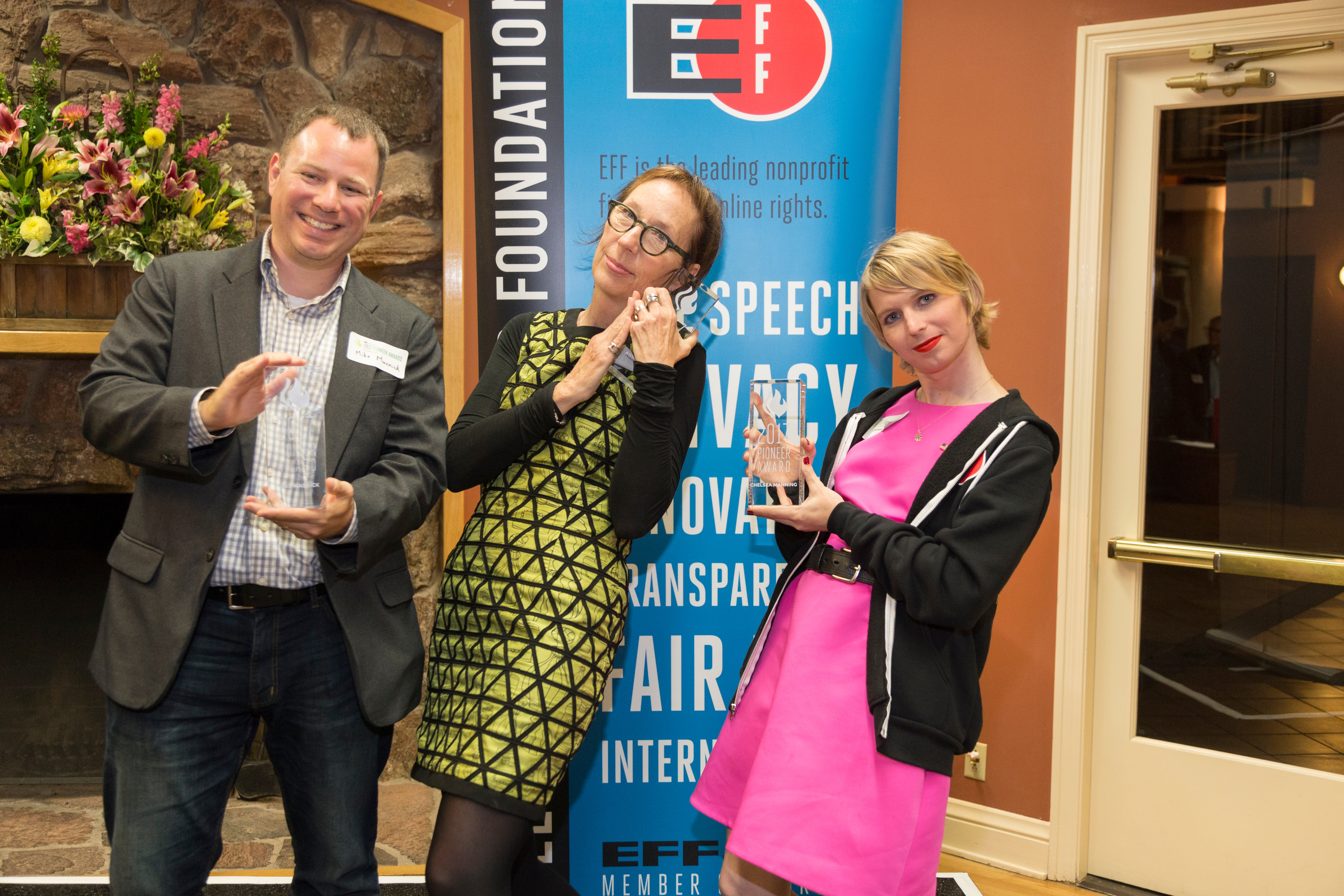
EFF Award Winners Mike Masnick, Annie Game, and Chelsea Manning
Annie Game (EFF Award Winner, 2017)

Annie Game spent over 16 years as the Executive Director of IFEX, a global network of journalism and civil liberties organizations working together to defend freedom of expression.  IFEX (formerly International Freedom of Expression Exchange) began in the 1990s, when a group of organizations and the Canadian Committee to Protect Journalists came together to consider how to respond as a single voice to free-expression violations around the world. IFEX now is a global hub for the protection of free speech and journalism. 

Game recognized early on that digital rights and freedom of expression groups needed one another. Under her leadership, IFEX paired more traditional free-expression organizations with their more digital counterparts, with a focus on building organizational security capacities. IFEX Initiatives under Game’s leadership have been expansive. For example, the International Day to End Impunity for Crimes against Journalists, November 2, has been an annual wake-up call and reminder for UN member states to live up to their commitments to protecting journalists. UNESCO observed more than 1,700 journalists were killed globally between 2006 and 2024, and nearly 90% of these cases went unsolved in the courts. 

Game and IFEX have also focused on high-profile cases of journalists threatened by governments for their work, such as Bahey eldin Hassan in Egypt. Bahey is the director of the Cairo Institute for Human Rights Studies (CIHRS) and has advocated for freedom of expression and the basic human rights of Egyptians, but has lived in exile since 2014. The charges against him, of “disseminating false information” and “insulting the judiciary,” are common tactics of intimidation and harassment. Bahey’s supposed crimes were sharing social media posts criticising the Egyptian judiciary’s lack of independence, and speaking about the killing in Egypt of Italian researcher Giulio Regeni. Bahey—an IFEX member—is just one of many reporters and human rights workers in danger when they speak. But when journalists and those defending their rights online speak out as one voice, as IFEX helps them do, it makes a difference. 

Another initiative has been the Faces of Free Expression project, a partnership between IFEX and the International Free Expression Project. If you’re looking for more heroes, this project details the stories of “risk-takers and change-makers – individuals who put their careers, their freedom, their safety, and sometimes even their lives on the line,” while reporting, or defending free expression and the right to information. 

Wherever authoritarianism and repression of speech have been on the rise, Game has unapologetically called out injustices and made it safer for journalists to do their work, while ensuring accountability when crimes are committed. The work is more critical now than ever, and since leaving IFEX in 2022, she’s remained an activist while focusing increasingly on environmental protection. 

Twelve More Heroes 

EFF has honored many more women with awards over the years—from Anita Borg and Hedy Lamarr to Amy Goodman and Beth Givens. This blog from 2012 looks back and acknowledges the important contributions from twelve more EFF Award winners. 

We’ve also asked five women at EFF about women in digital rights, freedom of expression, technology, and tech activism who have inspired us. You can read that here.

Donate to Support EFF's Work

Your donations empower EFF to do even more.
  •  

Admiring Our Heroes for International Women’s Day: Five Women In Tech That EFF Admires

In honor of International Women’s Day, we asked five women at EFF about women in digital rights, freedom of expression, technology, and tech activism who have inspired us.  

Anna Politkovskaya 

Jillian York, Activist 
This International Women’s Day, I want to honor the memory of Anna Politkovskaya, the Russian investigative journalist who relentlessly exposed political and social abuses, endured harassment and violence for her work, and was ultimately killed for telling the truth. I had just started my career when I learned of her death, and it forced me to confront that freedom of expression isn’t an abstract principle but rather something people risk—and sometimes lose—their lives for. 

Her story reminds me that journalism at its best is an act of moral courage, not just a profession. In the face of threats, poison, and relentless pressure to stay silent, she chose to continue writing about what she saw, insisting that ordinary people’s lives were worth the world’s attention. She refused to compromise with power, even when she knew it could cost her life. To me, defending freedom of expression means defending those like Anna who bear witness to injustice, prioritize truth, and hold power to account for those whose voices are silenced.  

Cindy Cohn 

Corynne McSherry, Legal Director 
There are so many women who have shaped tech history—most of whom are still unsung heroes—that it’s hard to single out just one. But it’s easier this year because it’s a chance to celebrate my boss, Cindy Cohn, before she leaves EFF for her next adventure.  

Cindy has been fighting for our digital rights for 30 years, leading EFF’s legal work and eventually the whole organization. She helped courts understand that code is speech deserving of constitutional protections at a time when many judges weren’t entirely sure what code even was. She led the fight against NSA spying, and even though outdated and ill-fitting doctrines like the state secrets privilege prevented courts from ruling on the obvious unconstitutionality of the NSA’s mass surveillance program, the fight itself led to real reforms that have expanded over time.   

I’ve worked closely with her for much of her EFF career, starting in 2005 when we sued Sony for installing spyware in millions of computers, and I’ve seen firsthand her work as a visionary lawyer, outstanding writer, and tireless champion for user privacy, free expression, and innovation. She’s also warm and funny, with the biggest heart in the world, and I’m proud to call her a friend as well as a mentor.  

Donate to Support EFF's Work

Your donations empower EFF to do even more.

Jane

Sarah Hamid, Activist 
When talking about women in tech, we usually mean founders, engineers, and executives. But just as important are the women who quietly built the practices that underpin today’s movement security culture. 

For as long as social movements have organized in the shadow of state surveillance, women have been designing the protocols, mutual aid networks, and information flows that keep people alive. Those threats feel ever-escalating: fusion‑center monitoring of protests, federal agencies infiltrating and subpoenaing encrypted Signal and social media chats, prosecutors mining search histories.  

In the late 1960s and early 1970s, the underground Jane abortion counseling service—formally the Abortion Counseling Service of Women’s Liberation—built what we would now recognize as a feminist infosec project for abortion access. Jane connected an estimated 11,000 people with safer abortions before Roe v. Wade, using a single public phone number—Call Jane—paired with code names, compartmentalized roles, and minimal records so no one person held the full story of who needed care, who was providing it, and where. When Chicago police raided the collective in 1972, members destroyed their index‑card files rather than let them become a ready‑made map of patients and helpers—an analog secure‑deletion choice that should feel familiar to anyone who has ever wiped a phone or locked down a shared drive. 

The lesson we should take from Jane is a set of principles that still hold in our encrypted‑but‑insecure present: Collect less, separate what you do collect, and be ready to burn the file box. When a search query, a location ping, or a solidarity post can become evidence, treating information as both lifeline and liability is not paranoia—it is care work.  

Ebele Okobi

Babette Ngene, Director of Public Interest Technology 
In the winter of 2013, I had just landed my first job at the intersection of tech and human rights, working for a prominent nonprofit and I was encouraged to attend regular tech and policy events around town. One such event on internet governance was happening at George Washington University,  focusing on multi-stakeholder engagement on internet policy and governance issues, with companies, nonprofits, and government representatives in attendance. I was inexperienced with these topics, and I’ll admit I was a bit intimidated. 

Then I saw her. She was the only woman on the opening panel, an African woman, an accomplished woman. Not only was she a respected lawyer at Yahoo at the time, but her impressive background, presence, and confident speaking style immediately inspired me. She made me feel like I, too, belonged in that room and could become a powerful voice. 

Ebele Okobi would go on to become one of the most powerful and respected voices in the tech and human rights space, known for her advocacy for digital rights and responsible innovation across Africa and the broader global majority during her tenure at Facebook. Beyond her corporate advocacy, Ebele has consistently championed ethical technology and social justice. She embodies the leadership qualities I value most: empathy, speaking truth to power, integrity, and authenticity. 

I remain in the tech and human rights space because I saw her, because seeing her made me feel seen. Representation truly does matter.  

Ada Lovelace 

Allison Morris, Chief Development Director 
I’m not a lawyer, activist, or technologist; I’m a fundraiser and a lover of stories. And what storyteller at EFF couldn’t help but love Ada Lovelace? The daughter of Lord Byron—the human embodiment of Romanticism—Ada was an innovator in math and science and, ultimately, the writer of the first computer program.  

Lovelace saw the potential in Charles Babbage’s theoretical General Purpose Computer (which was never actually built) and created the foundations of modern computing long before the digital age. In creating the first computer code, Lovelace took Babbage’s concept of a machine that could perform mathematical calculations and realized that it could manipulate symbols as well as numbers. 

Given the expectations of women in her time and the controversy of what work should be attributed to Lovelace as opposed to the man she often worked with, I can’t help but be inspired by her story.  

Women in tech deserve more and brighter spotlights. At EFF, we’ve had the honor of celebrating some of our heroes at our annual EFF Awards, including many women who are leading the digital rights community. For International Women’s Day, we also highlighted the contributions of just a few of these recipients from the last decade, whose work to protect privacy, speech, and creativity online has had a global impact.

  •  

EFF Joins Internet Advocates Calling on the Iranian Government to Restore Full Internet Connectivity

Earlier this month, Iran’s internet connectivity faced one of its most severe disruptions in recent years with a near-total shutdown from the global internet and major restrictions on mobile access.

EFF joined architects, operators, and stewards of the global internet infrastructure in calling upon authorities in Iran to immediately restore full and unfiltered internet access. We further call upon the international technical community to remain vigilant in monitoring connectivity and to support efforts that ensure the internet remains open, interoperable, and accessible to all.

This is not the first time the people in Iran have been forced to experience this, with the government suppressing internet access in the country for many years. In the past three years in particular, people of Iran have suffered repeated internet and social media blackouts following an activist movement that blossomed after the death of Mahsa Amini, a woman murdered in police custody for refusing to wear a hijab. The movement gained global attention and in response, the Iranian government rushed to control both the public narrative and organizing efforts by banning social media and sometimes cutting off internet access altogether. 

EFF has long maintained that governments and occupying powers must not disrupt internet or telecommunication access. Cutting off telecommunications and internet access is a violation of basic human rights and a direct attack on people's ability to access information and communicate with one another. 

Our joint statement continues:

“We assert the following principles:

  1. Connectivity is a Fundamental Enabler of Human Rights: In the 21st century, the right to assemble, the right to speak, and the right to access information are inextricably linked to internet access.
  2. Protecting the Global Internet Commons: National-scale shutdowns fragment the global network, undermining the stability and trust required for the internet to function as a global commons.
  3. Transparency: The technical community condemns the use of BGP manipulation and infrastructure filtering to obscure events on the ground.”

Read the letter in full here

  •  

EU's New Digital Package Proposal Promises Red Tape Cuts but Guts GDPR Privacy Rights

The European Commission (EC) is considering a “Digital Omnibus” package that would substantially rewrite EU privacy law, particularly the landmark General Data Protection Regulation (GDPR). It’s not a done deal, and it shouldn’t be.

The GDPR is the most comprehensive model for privacy legislation around the world. While it is far from perfect and suffers from uneven enforcement, complexities and certain administrative burdens, the omnibus package is full of bad and confusing ideas that, on balance, will significantly weaken privacy protections for users in the name of cutting red tape.

It contains at least one good idea: improving consent rules so users can automatically set consent preferences that will apply across all sites. But much as we love limiting cookie fatigue, it’s not worth the price users will pay if the rest of the proposal is adopted. The EC needs to go back to the drawing board if it wants to achieve the goal of simplifying EU regulations without gutting user privacy.

Let’s break it down. 

 Changing What Constitutes Personal Data 

 The digital package is part of a larger Simplification Agenda to reduce compliance costs and administrative burdens for businesses, echoing the Draghi Report’s call to boost productivity and support innovation. Businesses have been complaining about GDPR red tape since its inception, and new rules are supposed to make compliance easier and turbocharge the development of AI in the EU. Simplification is framed as a precondition for firms to scale up in the EU, ironically targeting laws that were also argued to promote innovation in Europe. It might also stave off tariffs the U.S. has threatened to levy, thanks in part to heavy lobbying from Meta and tech lobbying groups.  

 The most striking proposal seeks to narrow the definition of personal data, the very basis of the GDPR. Today, information counts as personal data if someone can reasonably identify a person from it, whether directly or by combining it with other information.  

 The proposal jettisons this relatively simple test in favor of a variable one: whether data is “personal” depends on what a specific entity says it can reasonably do or is likely to do with it. This selectively restates part of a recent ruling by the EU Court of Justice but ignores the multiple other cases that have considered the issue. 

 This structural move toward entity specific standards will create massive legal and practical confusion, as the same data could be treated as personal for some actors but not for others. It also creates a path for companies to avoid established GDPR obligations via operational restructuring to separate identifiers from other information—a change in paperwork rather than in actual identifiability. What’s more, it will be up to the Commission, a political executive body, to define what counts as unidentifiable pseudonymized data for certain entities.

Privileging AI 

In the name of facilitating AI innovation, which often relies on large datasets in which sensitive data may residually appear, the digital package treats AI development as a “legitimate interest,” which gives AI companies a broad legal basis to process personal data, unless individuals actively object. The proposals gesture towards organisational and technical safeguards but leave companies broad discretion.  

 Another amendment would create a new exemption that allows even sensitive personal data to be used for AI systems under some circumstances. This is not a blanket permission:  “organisational and technical measures” must be taken to avoid collecting or processing such data, and proportionate efforts must be taken to remove them from AI models or training sets where they appear. However, it is unclear what will count as an appropriate or proportionate measures.

Taken together with the new personal data test, these AI privileges mean that core data protection rights, which are meant to apply uniformly, are likely to vary in practice depending on a company’s technological and commercial goals.  

And it means that AI systems may be allowed to process sensitive data even though non-AI systems that could pose equal or lower risks are not allowed to handle it

A Broad Reform Beyond the GDPR

There are additional adjustments, many of them troubling, such as changes to rules on automated-decision making (making it easier for companies to claim it’s needed for a service or contract), reduced transparency requirements (less explanation about how users’ data are used), and revised data access rights (supposed to tackle abusive requests). An extensive analysis by NGO noyb can be found here 

Moreover, the digital package reaches well beyond the GDPR, aiming to streamline Europe’s digital regulatory rulebook, including the e-Privacy Directive, cybersecurity rules, the AI Act and the Data Act. The Commission also launched “reality checks” of other core legislation, which suggests it is eyeing other mandates.

Browser Signals and Cookie Fatigue

There is one proposal in the Digital Omnibus that actually could simplify something important to users: requiring online interfaces to respect automated consent signals, allowing users to automatically reject consent across all websites instead of clicking through cookie popups on each. Cookie popups are often designed with “dark patterns” that make rejecting data sharing harder than accepting it. Automated signals can address cookie banner fatigue and make it easier for people to exercise their privacy rights. 

While this proposal is a step forward, the devil is in the details: First, the exact format of the automated consent signal will be determined by technical standards organizations where Big Tech companies have historically lobbied for standards that work in their favor. The amendments should therefore define minimum protections that cannot be weakened later. 

Second, the provision takes the important step of requiring web browsers to make it easy for users sending this automated consent signal, so they can opt-out without installing a browser add-on. 

However, mobile operating systems are excluded from this latter requirement, which is a significant oversight. People deserve the same privacy rights on websites and mobile apps. 

Finally, exempting media service providers altogether creates a loophole that lets them keep using tedious or deceptive banners to get consent for data sharing. A media service’s harvesting of user information on its website to track its customers is distinct from news gathering, which should be protected. 

A Muddled Legal Landscape

The Commission’s use of the "Omnibus" process is meant to streamline lawmaking by bundling multiple changes. An earlier proposal kept the GDPR intact, focusing on easing the record-keeping obligation for smaller businesses—a far less contentious measure. The new digital package instead moves forward with thinner evidence than a substantive structural reform would require, violating basic Better Regulation principles, such as coherence and proportionality.

The result is the opposite of  “simple.” The proposed delay of the high-risk requirements under the AI Act to late 2027—part of the omnibus package—illustrates this: Businesses will face a muddled legal landscape as they must comply with rules that may soon be paused and later revived again. This sounds like "complification” rather than simplification.

The Digital Package Is Not a Done Deal

Evaluating existing legislation is part of a sensible legislative cycle and clarifying and simplifying complex process and practices is not a bad idea. Unfortunately, the digital package misses the mark by making processes even more complex, at the expense of personal data protection. 

Simplification doesn't require tossing out digital rights. The EC should keep that in mind as it launches its reality check of core legislation such as the Digital Services Act and Digital Markets Act, where tidying up can too easily drift into a verschlimmbessern, the kind of well-meant fix that ends up resembling the infamous ecce homo restoration. 

  •  
❌