Reading view

Securing the Agentic AI Frontier: Palo Alto Networks and Databricks Deliver a New Standard for AI Security

The rise of Agentic AI is rapidly reshaping the enterprise, yet its deployment opens a complex new frontier for cyber threats.  As organizations race to harness the power of enterprise agents, the "Data Estate" has become the new perimeter. CISOs today face a high-stakes trade-off: enabling developers to build at the speed of AI while keeping proprietary data visible, governed, and secure across the entire AI lifecycle. This requires meticulously checking user inputs, agent outputs, and tool calls for threats like prompt injections, sensitive data loss, and malicious code, while simultaneously preventing autonomous agents from performing destructive actions.

Securing the AI-driven enterprise requires a fundamental shift from reactive measures to proactive runtime protection. Palo Alto Networks and Databricks are delivering on that vision. Our partnership will integrate the Prisma AIRS API with Databricks Unity AI Gateway, embedding seamless security at runtime. This collaboration will enable organizations to innovate with AI agents, applications, models and MCP Servers at scale while maintaining a robust, policy-driven security posture. By combining the centralized AI governance and control capabilities of the Databricks platform with the runtime security protections of Palo Alto Networks, organizations can scale AI innovation without sacrificing visibility, compliance, or security.


The Context: Why AI Security is Different

AI security represents a fundamental departure from traditional defense. Legacy tools are designed for structured threats, leaving them incapable of parsing the intent behind complex, conversational attacks. Furthermore, the integration of Retrieval-Augmented Generation (RAG) and autonomous workflows creates a dynamic attack surface that goes far beyond traditional data loss. Without AI-native oversight, organizations can face severe risks from prompt injections, custom topics, and toxic content manipulating model logic, to tool misuse, malware execution, and malicious URLs hijacking agent actions.

Modern AI development requires more than just a perimeter; it requires contextual intelligence. By integrating Prisma AIRS directly into Databricks Unity AI Gateway, we will evolve security from a reactive layer into a native pillar of the AI architecture.


The Joint Solution: Centralized Security at the Gateway

The most effective way to secure an entire AI environment is at the governance layer. Our integration focuses on Databricks Unity AI Gateway, which serves as the centralized interface for all AI activity within the Databricks environment. Unity AI Gateway is designed for managing, governing, and monitoring access to all models, agents and MCP Servers—whether they are open-source models deployed within Databricks or external proprietary models. As organizations deploy more agents, applications, and models, centralized governance becomes critical. Unity AI Gateway provides a single control plane for AI usage, enabling teams to apply consistent policies, monitor activity, and manage access across AI workloads.

Through this integration, Unity AI Gateway will make real-time calls to the Prisma AIRS Runtime Security API for security inspection. Instead of managing fragmented security policies across dozens of individual applications, SecOps teams will be able to enforce consistent guardrails across the entire Agentic AI estate from one location, providing a single, unified enforcement point for all AI workloads.
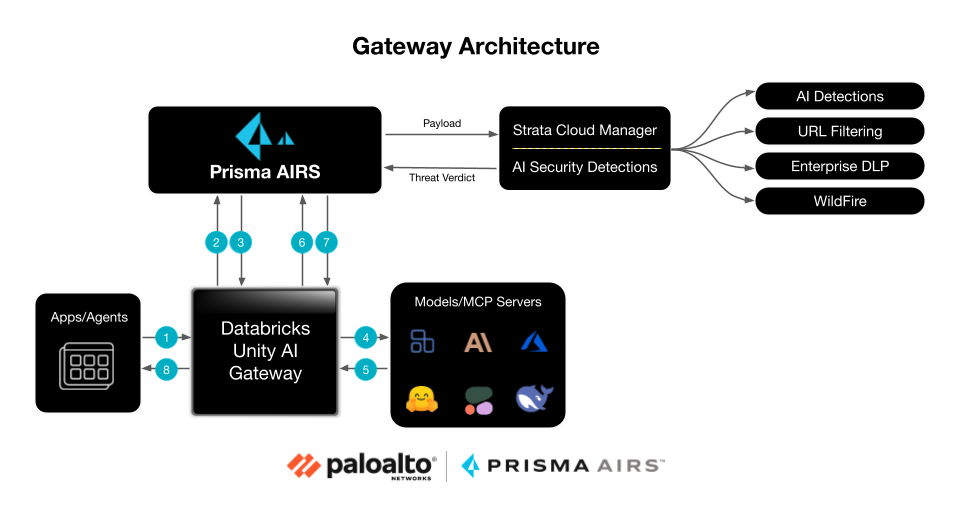
Figure 1: Centralized AIRS guardrail configuration delivers instant protection across all applications, agents and MCP Servers without requiring client-side code refactoring


Mechanism: API Intercept for AI Runtime Security

Prisma AIRS operates as an advanced inspection layer, leveraging its API Intercept capability to provide real-time security embedded directly into the application flow. By embedding Prisma AIRS directly into the workflow, we offer a seamless 'Security-as-Code' experience that unifies development and defense. Prisma AIRS intercepts AI prompts, responses, and MCP calls—inspecting them in real time to enforce security policies with an immediate Go/No-Go verdict or by sanitizing the data in transit. Prisma AIRS uses deep learning classifiers to detect data exfiltration risks, such as the presence of PII (Personally Identifiable Information), PHI, or PCI data. If sensitive data is found, it can be dynamically redacted or blocked based on corporate policy.


Key Benefits for the Enterprise

This integration isn't just about blocking threats—it’s about accelerating your AI roadmap. By removing the "security friction" that often slows down production deployments, we enable teams to move faster with confidence. Key benefits include:

  • Zero-Friction Governance: Developers continue working within their familiar Databricks environment. Security is enforced via the Unity AI Gateway API, meaning there are no bulky agents to install and no complex architectural re-wiring required.
  • Prevention of Data Leakage: Leverage Prisma AIRS’s data classifiers to automatically protect sensitive intellectual property, preventing data leaks to public models and unauthorized users.
  • Resilience Against AI-Specific Attacks: Protect your Unity AI Gateway deployments from emerging threats that standard network security tools cannot see, including prompt injection, toxic content, custom topics, malware detection and malicious URL detection.


Key Takeaway

  • Ease of use and unified Policy Management: Enable runtime security through the Unity AI Gateway to gain centralized control over security enforcement.
  • Audit-Ready Compliance: Every transaction mediated by the Unity AI Gateway is logged with detailed security metadata, delivering enriched insights in Strata Cloud Manager. This provides the forensic trail required for regulatory compliance in highly governed industries like finance and healthcare.
  • Protection for Agentic Workflows: Future-proof your multi-step AI agents against sophisticated Agentic Threats by inspecting function and tool calls within the runtime.


Looking Ahead

As agentic workflows and multi-step model interactions become the standard, a 'fail-closed' runtime security posture is no longer optional; it is foundational. The integration of Prisma AIRS API and Databricks Unity AI Gateway marks a definitive shift toward a future where enterprise AI is secure by default.  By integrating Prisma AIRS API with the Databricks platform through Unity AI Gateway, organizations can centrally govern AI across models, agents, applications, and MCP servers while enforcing consistent runtime security policies. Together, Databricks and Palo Alto Networks are helping customers scale AI innovation with the control, visibility, and protection required for the agentic era.

Are you ready to secure your AI workloads and agentic applications?
check out the latest Databricks blog and stay tuned for technical deep-dive sessions coming soon.


Forward-Looking Statements

This blog contains forward-looking statements that involve risks, uncertainties and assumptions, including, without limitation, statements regarding the benefits, impact, or performance or potential benefits, impact or performance of our products and technologies or future products and technologies. These forward-looking statements are not guarantees of future performance, and there are a significant number of factors that could cause actual results to differ materially from statements made in this blog. We identify certain important risks and uncertainties that could affect our results and performance in our most recent Annual Report on Form 10-K, our most recent Quarterly Report on Form 10-Q, and our other filings with the U.S. Securities and Exchange Commission from time-to-time, each of which are available on our website at investors.paloaltonetworks.com and on the SEC's website at www.sec.gov.  All forward-looking statements in this blog are based on information available to us as of the date hereof, and we do not assume any obligation to update the forward-looking statements provided to reflect events that occur or circumstances that exist after the date on which they were made.

The post Securing the Agentic AI Frontier: Palo Alto Networks and Databricks Deliver a New Standard for AI Security appeared first on Palo Alto Networks Blog.

  •  

Reinventing Security for the Agentic NVIDIA AI Factory

Building on the momentum of NVIDIA GTC Taipei at COMPUTEX  2026, the conversation has moved beyond AI experimentation to the industrialization of intelligence. Organizations are rapidly deploying AI Factories – high-performance, purpose-built computing infrastructures designed to manufacture intelligence at an unprecedented scale. AI’s next phase is agentic. Autonomous AI agents are reshaping enterprise operations—and demand security architectures that can keep pace with the speed and scale of innovation.  We are proud to announce the integration of Palo Alto Networks Cortex XSIAM with the NVIDIA DOCA Argus framework, a breakthrough that brings real-time, AI-powered security operations directly into the heart of the NVIDIA AI factory. 

By operating on the NVIDIA BlueField data processor, DOCA Argus provides situational awareness through real-time memory analysis at the silicon level. This allows Cortex XSIAM to detect kernel-level rootkits and "living-off-the-land" attacks without installing security agents on the host system.

This innovation builds upon our proven foundation with Palo Alto Networks Prisma AIRS, where AI Runtime Security is deployed natively on NVIDIA BlueField, and powered by NVIDIA DOCA, bringing defense in depth. This integration enables offload , isolation and acceleration of security in AI factories.  

Purpose-Built Observability for the AI Factory

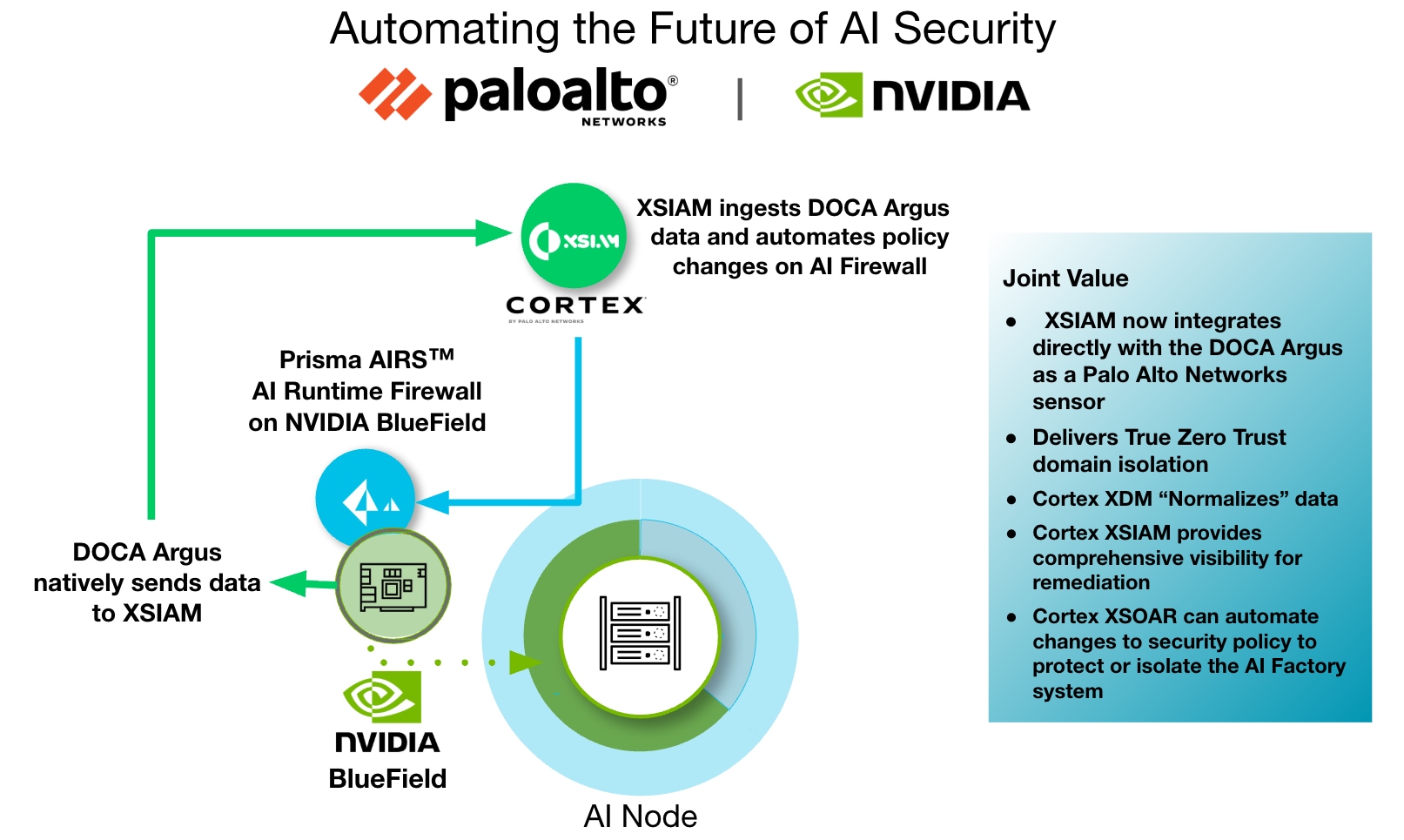
Deployed consistently across the AI factory, DOCA Argus monitors and correlates AI application processes, network telemetry, and data access to detect sophisticated anomalies that traditional tools miss. With this integration, Cortex XSIAM recognizes the high-fidelity data from DOCA Argus as a native Palo Alto Networks sensor, allowing for better decisions with the new intelligence gathered directly from the host.

By integrating Cortex XSIAM with the NVIDIA DOCA Argus framework, we leverage the innovations of two industry leaders to deliver a seamless, high-performance SecOps ecosystem for your most valuable AI assets.

Why This Integration Is a Game-Changer for SecOps

  • Process Introspection: Residing on NVIDIA BlueField, DOCA Argus has the unique ability to correlate network telemetry with deep process inspection.
  • Anomaly Detection: By analyzing traffic and host behavior simultaneously, XSIAM can detect sophisticated anomalies (e.g., lateral movement or data exfiltration) that traditional tools miss.
  • Unified Intelligence: Cortex XSIAM recognizes the security and alert information in this high-fidelity data, providing security teams with end-to-end visibility and dedicated security dashboards specifically for their AI infrastructure.


Native integration of DOCA Argus with XSIAM


Palo Alto Networks Prisma AIRS Across the NVIDIA AI Factory

The inclusion of Prisma AIRS in NVIDIA AI Factory validated design delivers a unified security platform, providing proactive, defense-in-depth security across critical layers of the AI ecosystem. 

Serving as the network enforcement engine for this architecture, Prisma AIRS secures the infrastructure of the modern AI Factory. By unifying protection and visibility into a single automated fabric, it eliminates the traditional trade-off between security and agility, allowing organizations to innovate at machine speed without compromising performance or governance. 

Beyond enforcement, the broader Prisma AIRS platform acts as the security blueprint for the entire enterprise AI ecosystem—consolidating fragmented point-tools to slash total cost of ownership while providing end-to-end observability from the data plane to the model layer. The platform scales dynamically alongside your AI clusters to safeguard raw datasets, build Layer 7 micro-perimeters around autonomous agents, and protect proprietary model weights from external threats—all without throttling mission-critical performance.

By deploying the AI Runtime Firewall directly on NVIDIA BlueField, we establish a foundational network security layer that is fully offloaded, isolated, and accelerated. This provides pervasive protection across the Enterprise AI Factory without sacrificing critical compute resources.

Securing the NVIDIA AI factory requires the entire Prisma AIRS suite, which secures the AI lifecycle through five specialized pillars:

  • AI Model Security: Protects against model tampering, malicious scripts and data exfiltration attacks before deployment.
  • AI Red Teaming: Advanced threat simulation and vulnerability discovery to enable the safety, security and integrity of your AI and Agents deployments.
  • AI Runtime Security Firewall: Protects against prompt injection, data leakage, abuse and AI-specific runtime threats across distributed inference flows.
  • AI Agent Gateway acts as the control plane for the AI enterprise – governing tool calls, model access and external connections. Every agent interaction is enforced through centralized policies.
  • Agent Identity Security assigns each agent a governed identity with precise permissions and full traceability, ensuring actions are attributable and enforceable.


A Forward-Looking Architecture: Embracing Vera NVIDIA BlueField-4 STX

Looking ahead to the next frontier of enterprise-scale agentic AI, Palo Alto Networks is closely aligning its platform approach with the NVIDIA Vera BlueField-4 STX architecture, extending protections to AI data storage infrastructure. As AI data demands surge, high-throughput, large-scale environments require a move toward hardware-isolated, performance-neutral protection to support the rapid growth of critical AI applications.

Operating within an isolated trust domain on future BlueField-4 silicon, our inline security capabilities will maintain strict, policy-driven controls independently of the host operating system and storage systems. This co-design enables critical forward-looking innovations for data, agents, and context memory, ensuring security is offloaded, isolated and accelerated to support the next generation of the AI Factory.


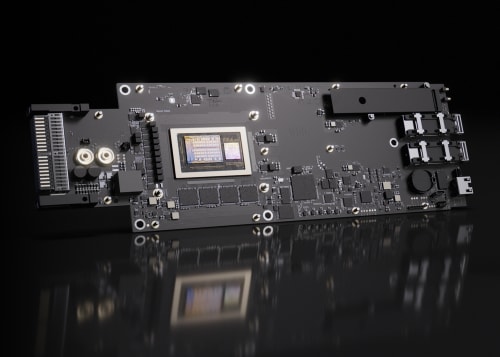
NVIDIA BlueField-4


Key Takeaways

Our ongoing collaboration with NVIDIA focuses on these essential pillars for reimagining AI security:

  • Deliver the industry-leading security platform reinvented for the unique demands of the AI factory. High-throughput, large-scale environments require a move toward hardware-isolated and performance-neutral protection to support the rapid growth of critical AI applications. By offloading AI Runtime Firewall directly to the NVIDIA BlueField, we enable zero-latency protection and strict data governance that neutralizes threats (like model theft) while maintaining peak performance and the integrity of your proprietary models.This architecture embeds security directly into the infrastructure, out of the way of app developers.
  • Transform the SOC and achieve deep visibility across AI environments by leveraging Cortex XSIAM to provide real-time detections and automated response. By connecting infrastructure protection with this centralized intelligence, you can secure the AI journey, from development in the factory to operations at the secure industrial edge.
  • Zero-Trust for AI Infrastructure: This helps ensure that as your operations scale toward multi-agent architectures, your security footprint is fully offloaded, isolated, and accelerated to protect advanced inference flows, autonomous agents, and data pipelines without throttling performance.
  • Unified Platform Architecture: Beyond standalone point tools, the Prisma AIRS platform serves as a unified security fabric that spans the entire AI lifecycle—from safeguarding raw data to autonomous agents.

Deploy Bravely

The Palo Alto Networks platform approach delivers a comprehensive solution to secure an enterprise's entire AI ecosystem. By integrating Cortex XSIAM with the NVIDIA DOCA Argus framework, we are extending this comprehensive, deep visibility and protection to the very heart of the AI Factory. With this integration, security teams can leverage an agentless approach via DOCA Argus to gain deep visibility into AI systems hosts by simply downloading the content pack from the Cortex Marketplace.

The Palo Alto Networks platform secures the entire AI journey, protecting the infrastructure, intelligent applications, agents and data it produces. With the inclusion of Prisma AIRS in NVIDIA Enterprise AI Factory Validated Design, we have delivered the blueprint for secure AI. 

Palo Alto Networks and NVIDIA are redefining security for the AI factory. Together, we are ensuring your security architecture is as fast, scalable and innovative as the intelligence it protects, empowering you to scale AI production with reduced latency and stronger governance.

Discover more through the Palo Alto Networks partner directory, or read the official press release from NVIDIA for more details.

The post Reinventing Security for the Agentic NVIDIA AI Factory appeared first on Palo Alto Networks Blog.
  •  

Nutanix and Palo Alto Networks Integrate for Robust Model Trust

Elevating AI Security

Every AI system you deploy is a potential attack surface. Models and agents can carry embedded backdoors, malicious operators or compromised dependencies. Once running, these artifacts can exfiltrate sensitive data or execute unauthorized code, creating persistent vulnerabilities within the enterprise perimeter. Organizations running AI workloads on Nutanix need security that catches these threats before they reach production.

Nutanix and Palo Alto Networks are excited to announce a purpose-built integration between the Nutanix Enterprise AI and Palo Alto Networks Prisma AIRS® advanced security capabilities, specifically focusing on AI Model Security and AI Red Teaming. This partnership directly addresses the critical need for a secure-by-design approach to AI development, giving customers the confidence to accelerate their AI journey.

Seamless Security Integration on the Nutanix Enterprise AI Platform

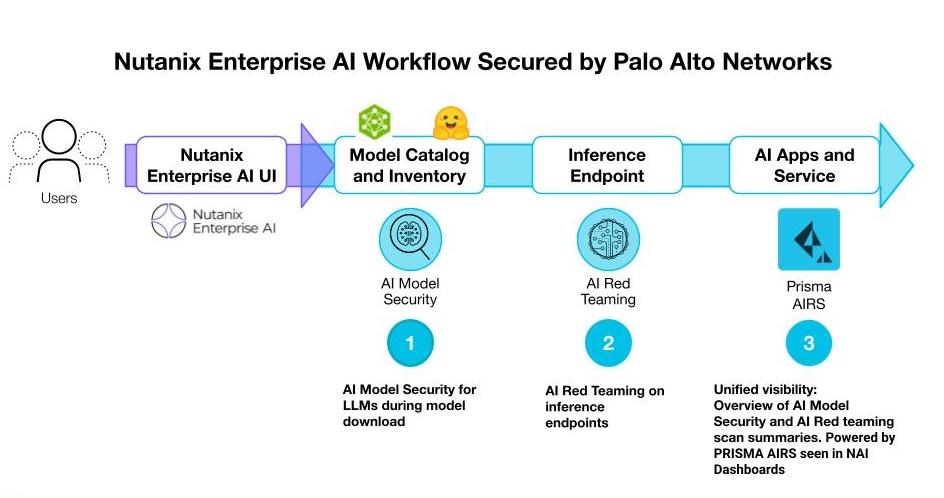
The Nutanix Enterprise AI platform provides a unified, scalable and secure foundation for the entire AI lifecycle: from data preparation and model fine-tuning to deployment and management. By integrating cutting-edge AI security tools by Palo Alto Networks directly into this workflow, we enable security checks to become an intrinsic part of the AIOps pipeline.

Nutanix Enterprise AI workflow secured by Palo Alto Networks.
Prisma AIRS integration user flow.

Scanning AI Models for Comprehensive Vulnerability Detection

The Prisma AIRS AI Model Security solution introduces sophisticated model scanning capabilities that are essential for preemptively identifying and mitigating risks.

  • Prisma AIRS Model Security Integration: Automatically scans AI models (e.g., during check-in to a model registry on the Nutanix Enterprise AI platform) for inherent vulnerabilities, policy violations and malicious code. This provides Proactive Risk Mitigation by detecting malicious or vulnerable model artifacts before deployment, helping prevent zero-day exploits and potential data leakage caused by compromised models.
  • Dependency Analysis: Examines all open-source libraries and dependencies used in the model environment for known vulnerabilities and license compliance issues. This enables Supply Chain Security, eliminating risks introduced by third-party components throughout the entire AI deployment lifecycle.
  • Model Supply Chain Threats: The system addresses malicious model artifacts, including deserialization exploits, embedded backdoors, unsafe file formats, unauthorized code execution, untrusted sources and noncompliant licenses. This enables Model Integrity and Governance by validating model safety, provenance, approved formats, license compliance and detecting hidden execution paths before deployment.

AI Red Teaming Your AI Systems for Adversarial Resilience

AI Model Security addresses known issues, but the malicious actors of tomorrow are developing new ways to exploit AI systems. This is where the power of Prisma AIRS AI Red Teaming by Palo Alto Networks comes into play, creating a crucial layer of proactive testing against adversarial attempts. AI Red Teaming involves simulating sophisticated attacks against the AI application’s behavior to test its resilience under attack.

  • Continuous AI assessment: Onboard an LLM model, application and agent, then start scanning in less than 10 minutes. Use documented APIs to integrate into CI/CD pipelines to trigger automated red teaming whenever versions are updated. Connect AI endpoints securely via an outbound web socket channel to eliminate the need for routing changes, while maintaining the option for IP allowlisting, if preferred. Your team controls access. This reduces technical setup overheads and empowers you to keep your assessment current.
  • Contextual Vulnerability Insights: Prisma AIRS profiles your LLM model, application or agent and informs the Red Teaming Agent to design relevant attack objectives. The Red Teaming Agent is trained on over 50 techniques and simulates attack prompts to achieve those objectives. This reduces noise and lets you focus on actual business relevant risk.
  • Comprehensive Threat Coverage: Prisma AIRS uses a library of over 750 attacks to evaluate your defensibility. Both the library and the red teaming agent are updated and trained on a constant basis to keep up with the AI threat landscape. This stress tests your AI system thoroughly, so your system is defensible to known and unknown threats.
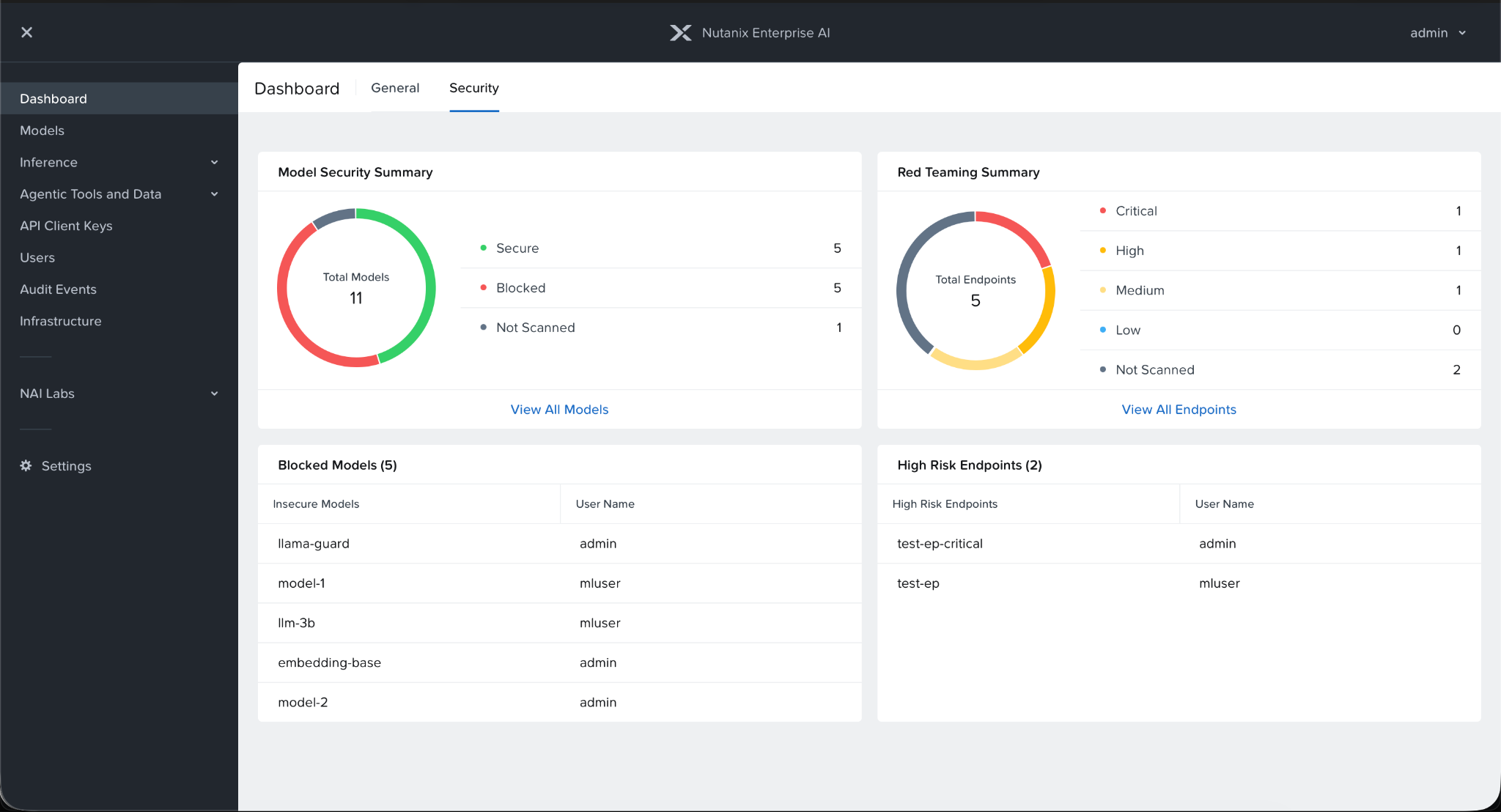
Nutanix Enterprise AI dashboard preview.
Unified Security Dashboard for AI Model Security and AI Red Teaming being made available in Nutanix Enterprise AI.

Securing the Future of Enterprise AI — The Nutanix and Palo Alto Networks Integration

This integration between the scalable, high-performing Nutanix Enterprise AI platform and the advanced security intelligence of Palo Alto Networks offers measurable value to AI-driven organizations:

  1. Accelerated Time-to-Trust – By automating critical security checks as part of the MLOps process on the Nutanix Enterprise AI platform, teams can deploy models faster, knowing they have been rigorously vetted by a leading security partner.
  2. Simplified Compliance and Governance – The joint solution provides a verifiable record of security testing (scanning and red teaming), making it simpler to demonstrate adherence to internal governance standards and external regulatory mandates.
  3. End-to-End AI Security Posture – Customers gain a holistic view of security, from the unified AI infrastructure layer managed by Nutanix, to the network security enforced by Palo Alto Networks. This visibility now extends critically into the AI models themselves, completing the security posture by unlocking controlled access to vendor models, so protection is enforced seamlessly.
  4. Cost and Resource Efficiency – Integrating security tools within the existing AI platform streamlines workflows. Data Scientists and ML Engineers can trigger red teaming simulations and scanning directly within their familiar Nutanix environments, reducing the need for dedicated, siloed security teams to manually test every model.

The partnership between Nutanix and Palo Alto Networks is a commitment to building a more secure future for enterprise AI. With this integration, you can bring LLM models into your environment without fear. Malicious code and hidden backdoors are blocked before they ever reach you. Your endpoints stay continuously protected, with coverage across over 50 attack techniques and the contextual risks that come with agentic AI. When you're evaluating a model or an endpoint, the risk picture is right there inside NAI – no context-switching, no guesswork. And a custom security dashboard gives you a single place to see where you stand. The result is AI you can actually trust at the core of your lifecycle, so your teams can build faster without trading off security for speed.

Key Takeaways

A "Secure-by-Design" AI Pipeline: The partnership between Nutanix and Palo Alto Networks is a commitment to building a more secure future for enterprise AI. The integration enables advanced level AI security in AIOps workflow. By embedding Prisma AIRS directly into the Nutanix Enterprise AI platform, organizations can automate model scanning and vulnerability detection during the initial check-in phase, authorizing only validated, secure models to reach production.

Proactive Defense via AI Model Security and AI Red Teaming: The solution provides a dual-layer defense: AI Model Security preemptively blocks hidden backdoors, malicious code and supply chain threats in third-party artifacts, while AI Red Teaming uses autonomous agents for contextual discovery to generate new attack scenarios and have over 750 sophisticated adversarial attack scenarios. This enables resilience against both known vulnerabilities and emerging zero-day AI exploits.

Unified Governance and Operational Efficiency: The partnership consolidates security and visibility into a single custom dashboard within the Nutanix environment. This unified view allows Security and AI teams to manage risk while having continuous assessments and compliance records significantly accelerating the time to trust.

Next Steps

For more information, visit the Palo Alto Networks partner directory or contact your local sales representatives to learn more about a trial run.

The post Nutanix and Palo Alto Networks Integrate for Robust Model Trust appeared first on Palo Alto Networks Blog.

  •  
❌