❌

Reading view

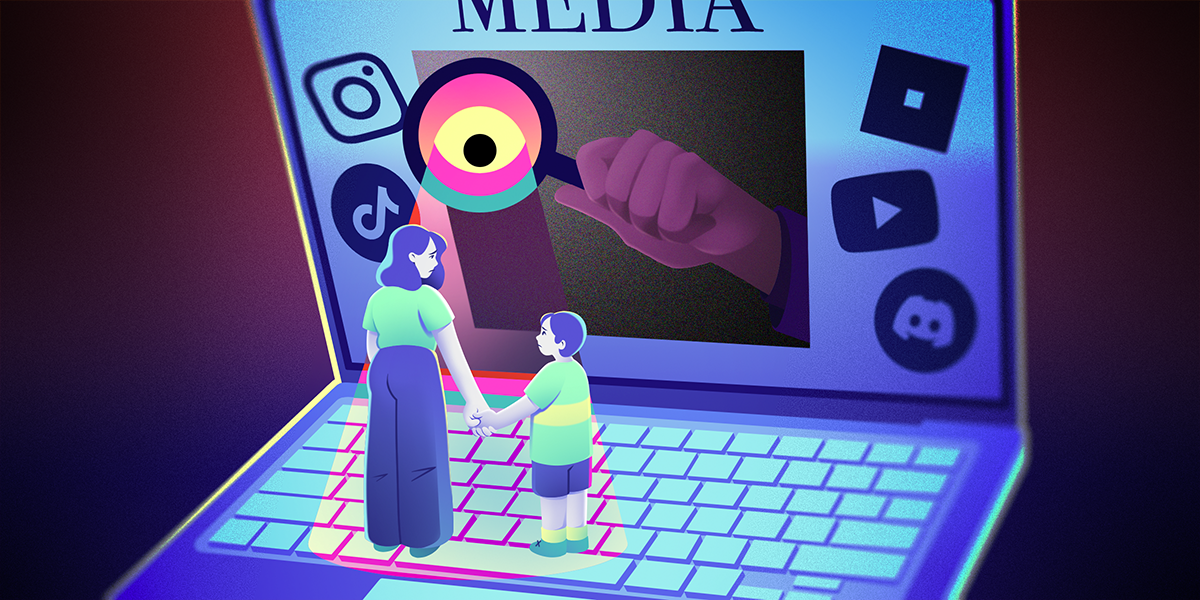
Tech Tips for Parents this Digital Parenting Week

In today’s digital world, the internet is an essential resource for young people to access information, explore community, and find themselves. But we know that this often comes alongside fears of experiencing online harms like doxxing, grooming, or bullying.

Trying to protect your family from everything all the time is impractical and exhausting, but some thoughtful planning can help families devise a workable plan that meets their needs and addresses their concerns.

That’s why this Digital Parent Week, we’re sharing easy tips on how parents and their children can work together to co-curate a digital safety plan that helps all members of the family enjoy the benefits of technology while protecting their online privacy and safety. 

Start with Open Conversations

Online safety begins with communication, not just restrictions. Talk with a young person about how they use the internet: their favourite apps, games, and social media platforms for example. Creating a supportive environment helps young people feel comfortable asking for help if something goes wrong online.

Together, you can think about:

  1. What do we want to protect? e.g., I want to protect a young person’s privacy and mental health when they’re playing Roblox. They love Roblox and use it to communicate and hang out with their best friend, so we’d like to find a way to make it as safe as possible.
  2. Who do we want to protect it from? e.g., messages from strangers, staying up too late playing, wasting money on pointless digital junk in games.
  3. How bad are the consequences if we fail? e.g, losing some money on a scam or having creepy conversations with strangers that could escalate into something more nefarious or dangerous.
  4. How likely is it that we will need to protect it? e.g., I don’t know the likelihood of a stranger messaging you on Roblox because I’m not sure how communication works on the platform, but I’ve heard from their friends that strangers message them all the time in some games.
  5. How much trouble are we willing to go through to try to prevent potential consequences? e.g., I’m willing to learn from my child how the game works, play the game with my child, and learn how to work the parental controls. 
  6. Who are our allies? e.g., my partner, our parents, as well as a young person’s best friends and their parents.

It's easy to think of a young person's experience on the internet as being totally disconnected and different from your own. But now is a great time to also interrogate your own internet habits, like the sorts of sites you engage with, tools you use, and privacy settings you've set. These questions are as valuable to help you as a parent as they are just an internet user.

Sometimes even just figuring out what conversations are worth having can take some effort, we've put together some ideas to get you started in our guide.

Make Privacy a Family Priority

Digital security training can feel overwhelming but this is why a community-oriented approach helps. In speaking with your family and friends, you can build out digital security practices that work for you. This makes it more likely that your privacy practices will become second nature to you and your loved ones.

Use secure messaging services for every communication: Choosing a secure service ensures that your privacy is protected from government and corporate surveillance. If you can convince your family to get on board, options like Signal provide the most extensive privacy protections out of the box through its use of end-to-end encryption and limited data collection. But we understand that sometimes it's easier to stick with whatever the family already uses for a group chat, like WhatsApp, Apple's iMessage, or Google Messages, so take the time to familiarize yourself with the limits of WhatsApp and RCS encryption.

Consider the content posted online: It's easy to accidentally share personal information through photos, messages, and other content. Children and adults may unknowingly share personal information through photos, messages, location settings and app permissions. Take time together to review privacy settings, check which apps can access the camera or location, and discuss why personal details should be shared carefully. Make sure you have family agreement about when and where to post photos of each other or your home.

Create incident response plans: Developing a plan for if or when something bad happens is a good practice for anyone, but especially with younger people. It’s important to strategize with your family around what to do in the event of such things happening, and doing so before an incident occurs is much easier than when you’re presently facing a crisis.

Alongside this, simple steps like using strong and unique passwords on all devices, including those that are shared in the family, can make a real difference. Regardless of age, there’s no time like the present to get started on good security hygiene, and for many that starts with a password manager and two-factor authentication.

How to Think About Parental Controls

Many sites permit parents to control features such as personalization, algorithmic feed, autoplay, endless scroll, reactions, notifications, and time limits. Talk as a family about which features are important and useful and which are problematic. The conversations above around boundaries and digital literacy are a more effective way to prepare youth for accessing the internet. To develop true autonomy, young people need the privacy to discover the world for themselves without their parents monitoring the contents of every conversation they have.

Explore new apps together and revisit family rules as they grow. These decision points where you’re exploring with a young person what you’re both comfortable with can be good moments to “find your way to a yes” for whatever feature or tool or game they’re asking about. The questions they ask, along with your responses, provide a road map for what to look for in privacy controls that can get you to a place where everyone is comfortable engaging with that technology. 

Small Steps = Big Difference

There is no one size fits all to the tech questions and concerns a parent will face, and keeping young people safe online is not about removing every risk and monitoring every click. This Digital Parenting Week, you can start to focus on what’s important for your family and how to best achieve those goals. 

If you're still not sure where to start, installing EFF’s Privacy Badger on every computer in your household is a great starting point to protecting everyone's privacy.

For more detailed information on all these tips and more, visit EFF’s Online Privacy Guide for Parents and Youth.
  •  

How the Meta Settlement Silences Youth Activism

Since its integration into our digital world, social media has played a pivotal role in youth organizing and social mobilization. Yet, people’s access to these platforms is increasingly coming under threat from courts and legislatures under the guise of protecting young people online—presenting a significant hindrance to youth organizing.  

In a major recent example, Meta settled in a lawsuit with 52 states and territories regarding the use of Instagram and Facebook by young people. The settlement will require Meta, and pressure other non-Meta owned platforms like TikTok and YouTube, to embed age gating practices into every product while also requiring restrictions on the accounts of people under-18, such as a two-hour daily time limit and content restrictions.   

Youth Power on Social Media 

Young people have been using social media for political advocacy and community organizing for more than a decade. From organizing protests speaking out against police brutality, to organizing nationwide school walkouts demanding safety in schools from gun violence, and striking to demand lawmakers take action to protect the climate, social media has become an instrumental tool for youth to both speak out and connect with other young activists.  

Instagram has become especially useful for activism online by young people. The features on the app make it a helpful tool for being able to efficiently and quickly spread awareness, which is especially important when people need to share real-time information. For example, 17-year-old Darnella Frazier’s video on Facebook showed the world the murder of George Floyd. 

The impact of youth activism online is also evident on non-Meta owned platforms, with services like TikTok and YouTube being particularly prevalent spaces for young people to share their stories, build movements, and amplify collective engagement.

However, in a digital world operating under the settlement’s new guidelines, young people risk not being able to read crucial news due to the content being labeled as “age-inappropriate,” which has already happened for teenagers in Australia under its social media ban.  

A two-hour daily time limit and a block on Meta’s apps between midnight and 6am leaves little room for young activists to organize rapid response efforts. Being unable to see likes on a post will make it difficult to gauge the effectiveness of their campaigns.   

Add to this what we already know about Meta’s content policies which claim to “protect children” and keep sites “family-friendly” but instead label content like LGBTQ+ content as “adult” or “harmful,” youth will be left with no choice in what content they see once the ‘age-appropriate’ content filter is turned on by default. One recent report noted that Meta had hidden posts that reference LGBTQ+ hashtags like #lesbian, #bisexual, #gay, #trans, and #queer for users with the sensitive content filter on. This would specifically curtail the efforts of young activists doing work on comprehensive sex education.   

Global Trends 

Measures like this are being discussed across the globe, but not all courts have taken such a short-sighted approach. In August, the French Constitutional Council got a lot right in its decision to strike down the country’s legislation banning under-15s from social media for infringing free expression and communication for everyone online, not just young people.  

The French Court also called attention to its infringement on privacy as the legislation would have forced people of all ages to hand over government IDs, face scans, and other sensitive information to prove their age and access online content.  

Requiring this much data from users puts activists in danger of even more surveillance. Meta has already previously complied with demands from law enforcement to hand over the messages of users. The amount of personal information that will be logged and that could be demanded via a warrant from police to stifle or investigate activists’ actions or plans could cause a chilling effect, forcing advocates to pause or terminate their work.  

This is egregious because these systems misidentify or lock out people of color, people with disabilities, and trans or gender-nonconforming individuals whose IDs may not match their chosen name or align with what the system expects them to look like upon verification. And it’s often these communities that benefit from online organizing the most, especially for marginalized youth as social media can often be the only place to organize and build community. 

What Young People Deserve 

The settlement generates headlines, but it will not solve the core problem. Instead of tackling Meta’s surveillance capitalism business model that turns all online content into potential profit and centers lining the company’s pockets over protecting the speech and privacy of users, this settlement gives the tech giant an opportunity to carve out a new digital world that prioritizes its own needs, not those of young people.  

As we’ve been calling attention to in other contexts, this will force young people into digital isolation—curtailing vital access to news and resources for health and development. It also completely ignores the calls of youths themselves who favor digital literacy and education over surveillance and government control.   

Young people deserve a better internet than one regulated through panic. They deserve better than the government or Big Tech getting to decide how they use social media and what they can or cannot be exposed to or learn about. They deserve better than having their right to free expression minimized. This must not be lost in the pursuit of building a better and safer online ecosystem and environment.   

  •  

LGBT Q&A: What’s One Thing I Can Do Today to Improve My Safety and Security Online as an LGBTQ+ Person?

This post is adapted from a video recorded by EFF and the Trevor Project. Head over to our TikTok or Instagram to watch! 

EFF answers all the queer digital rights questions you submit to us through our LGBT Q&A. You asked us: What’s one thing I can do today to improve my safety and security online as an LGBTQ+ person? 

And for this question, we’ve brought in our friends from the Trevor Project to answer together:

Hi, I’m Tommy from the Trevor Project! The Trevor Project’s mission is to end suicide among lesbian, gay, bisexual, transgender, queer, and questioning (LGBTQ+) young people. Our vision is to create a world where all LGBTQ+ young people see a bright future for themselves.

EFF and the Trevor Project know that digital security and online safety can feel overwhelming, especially because we all have different levels of concern for different parts of our online lives. Some might be focused on the dangers of doxxing, another might only want to ensure they're not outed. And queer people can be particularly vulnerable to these kinds of online threats. 

This might seem like a big task, but the one way you can do today to protect yourself is to revise the information you’ve shared with services and platforms to ensure you’re as in control of your information and data as possible:

Protect Your Personal Information

Be cautious about sharing sensitive details like your full name, address, school, phone number, and personal photos as it might expose identifying information you want to keep private. Consider using an avatar as your profile picture to avoid sharing your personal photos if that makes you more comfortable. Keep it lowkey when talking about work stuff or sharing details about where you’re studying.

If you do share personal photos, don’t accompany them with information that identifies your location or frequent whereabouts, and make sure EXIF data in photos is turned off (which could inadvertently include your location); the easiest way to do this is to take a screenshot of the photo and share that instead. Don’t post pictures with obvious spots in the background, like your front door or porch. 

Understand the Importance of Login Information

When you create an account on websites and platforms, you can often use your phone number or a third party account, such as Facebook, Google, or Apple. These external accounts might share data with the apps you're logging into, but they can be helpful if you struggle with managing a lot of logins. Deciding if that trade-off is worth it is up to you but, when you can, use strong, unique passwords for your accounts, and be sure to enable two-factor authentication when offered. 

Review Permissions with Social Media Apps

Review which apps have access to things like your location and camera roll, and possibly change those permissions in line with what information you would like to keep private. Location is particularly important. For example, some apps might need some location information to function. But you can typically at least deny access to your device's "precise location" or enter in a city or zip code manually.

Consider What You Share When Speaking with Others Online

It’s important to be mindful of what you share with others when you post online or speak with people. Avoid disclosing sensitive information like financial details, and trust your gut if something feels off. It’s also useful to review your profile’s privacy settings and information now and again to make sure you’re still comfortable sharing what you’ve listed there.

Good privacy decisions begin with proper knowledge about your situation and a community-oriented approach. To dig in deeper, read EFF’s blog post on Building a Community Privacy Plan and the Trevor Project’s Guide to Online Safety for LGBTQ+ Young People.

  •  

French Top Court Gets It Right, Strikes Down Social Media Ban For Youths

Earlier this month, France’s top court struck down the country’s legislation that banned social media use for people under 15 years old, which had been scheduled to take effect in January 2027. This is a welcome win for free expression, as we face a wave of countries and U.S. states seeking to pass similar laws banning young people from social media. 

In particular, the Constitutional Council’s decision focused on two components:

Infringement on Free Expression

The Council ruled that the legislation banning under-15s from social media infringed on freedom of expression and communication in a manner that is not appropriate, necessary, or proportionate, which is required by Article 34 of the French Constitution. In particular, it stressed that the ban did not distinguish between different types of online services, and ignored the circumstances of individual users, such as their exact age, level of maturity, and family situation.

The evidence is clear: these are reckless and harmful laws that negatively impact all people, not just those under 15. These measures chill all users’ exercise of the right to free speech and expression online by imposing obstacles on sites or by wrongfully blocking people’s access outright.

By forcing young people into digital isolation, these bans curtail vital access to news and resources for health and development; especially for LGBTQ+ and marginalized youth as social media can often be the only place to find community, explore their identity, or access life-saving resources. They also completely ignore the calls of young people themselves who favor digital literacy and education over surveillance and government control. 

These bans also destroy the right to online anonymity—a cornerstone of our right to free expression that in particular protects whistleblowers, journalists, activists, and immigrants.

Infringement on the Right to Private Life 

The Council’s second objection noted that the law requiring every person, even adults, to prove their age before accessing social media platforms impedes the right to private life, and thus infringes on Article 2 of the Déclaration de 1789.

The French Council gets a lot right in this decision: it highlights that bans like this impact not just young people, but everyone online. They force people of all ages to hand over government IDs, face scans, and other sensitive information into a growing surveillance ecosystem. Further, when parental consent is required, companies must collect even more verification data on the parents.

We know that when people are forced to hand over this information, age verification systems frequently misidentify or lock out people of color, people with disabilities, and trans or gender-nonconforming individuals whose IDs may not match their appearance; adding to the privacy concerns around these bans.

Next Steps 

As all bills in France are subject to scrutiny by the Constitutional Council to ensure compliance with the French Constitution, French President Emmanuel Macron has tasked Prime Minister Sébastien Lecornu to re-work the legislation with a goal to adopt a ‘legally robust’ version of the social media ban. 

Public policy must be effective, proportionate, and respectful of fundamental rights; and the ruling by the Constitutional Council has ramifications beyond France. It sends a message of caution to Brussels, where the EU Commission is working on an EU-wide bill on access restrictions. These legal restrictions would likely require problematic age verification of users. The prominent EU digital identity wallet and the “mini” age verification app, presented as privacy-robust options, instead raise serious privacy and security concerns.

Young people deserve better than a policy built on panic, and all internet users deserve a safe and free internet that includes measures to empower all people with the knowledge they need to navigate online spaces safely. A social media ban generates headlines, but it will not solve the problem. 

  •  

EFF and Civil Society Groups Call on Nottinghamshire Police to Halt Live Face Recognition

This week, EFF, along with Big Brother Watch, Defend Digital Me, Liberty, Open Rights Group, Race Equality First, Statewatch, and Stopwatch, wrote to Nottinghamshire Police Force in the UK raising concern about the proposed roll-out of live facial recognition technology (LFR), and called for its immediate halt.

In particular, the letter highlights six concerns:

LFR Is Not "Just Another Tool"

Nottinghamshire Police has stated that “facial recognition is just another tool to fight crime.” But LFR used in public spaces is an incredibly intrusive biometric mass surveillance technology that scans the faces of everyone who walks past the camera and takes biometric face prints. This is not just another tool, but a major escalation of surveillance that treats everyone as a suspect by default.

People Having "Nothing to Worry About" Does Not Hold to Scrutiny 

According to Nottinghamshire Police, “if you aren’t entering the city or county to commit crime then you have nothing to worry about.” However, many people have legitimate concerns about the normalisation of invasive technologies. So a public that cannot move around their towns and cities without being subjected to a biometric identity check may be less willing to seek medical care or legal advice, speak with journalists, act in a union, vote, protest, or express their gender, sexual or religious identity. 

Disproportionate Targeting With LFR

We are particularly concerned to learn that Nottinghamshire Police could deploy LFR to tackle low level crimes, such as youth behavior deemed anti-social, as part of Operation View. Reporting suggests that the force already possesses “a watchlist of young people believed to be causing the most problems,” including children as young as 11 years old. It would be highly disproportionate to deploy live facial recognition to tackle this behaviour. Many of these children are reportedly known to the police, and it is highly likely that there are more proportionate means for locating them. 

LFR Could Increase Social Problems

We are also concerned that Nottinghamshire Police has not adequately examined the distinct risks of using LFR to target children, including negative impacts on their behaviour and outcomes, risk of recidivism, and relationship with the police. Use of LFR could exacerbate behavioural problems in children and create an adversarial, rather than trusting, relationship with the police from a young age. 

Lack of Public Support 

Recent polling commissioned by Liberty indicated that 48% of people oppose scanning the faces of those walking on high streets when there is no suspected imminent threat. Furthermore, Opinium found that the majority of people oppose the use of facial recognition in schools. Likewise, a report by the London Policing Ethics Panel found that Londoners aged 16-24 were most likely to find the Metropolitan Police Service’s use of LFR unacceptable and most likely to stay away from events where LFR was in use.

On these grounds, Nottinghamshire Police must immediately halt their plans to use live facial recognition surveillance any further.

Read our full letter here. 

  •  

LGBT Q&A: How Can I Wipe Online Data That Points To My Queer Identity?

This Pride, we’re answering all your digital rights questions in season two of our initiative, LGBT Q&A. 

You Asked: Is there a way for me to wipe data about me online that could point to my queer identity?

EFF’s Answer: You cannot protect everything all the time, but there are ways to wipe information about yourself online. 

Most information available about you online will typically be found in two places:

  1. The site where you voluntarily posted the data, such as your pictures and videos on social media, comments in user reviews and forums, and even classified postings for items you’ve sold.
  2. A data broker. These companies collect personal information, repackage it, and sell it to the highest bidders. This information often includes your address, phone number, details about your family members, and more. 

So you might not want this information out there, especially if it points to your queer identity. 

The best time to take steps to protect yourself is before anything bad happens, because once this information is in the hands of bad actors you have fewer options.

To see what information people might find about you online, you can look for it for yourself. This is as simple as opening up a search engine and entering your name, nickname, handle, avatar and seeing what comes up. It can also be worth searching for your address, phone number, and email addresses to check what's out there.

Do this in a private browsing window or a separate browser than the one you normally use to ensure you’re not logged into any accounts that might skew the results, like a Google account. 

It’s also best to try to make a lot of your information hard to find in the first place—and we’ve got you covered on how to do this. 

  1. Establish a strong security baseline: use unique passwords (a password manager helps simplify this) and set up two-factor authentication for your online accounts to add an extra layer of protection when logging into your accounts.
  2. Add our install-and-forget tracker blocking tool, Privacy Badger, which lets you browse in peace and stops the sorts of web trackers that compile information about your habits for advertising purposes and for data brokers.
  3. Remove your advertising ID on your phone to help prevent some tracking there, too (directions for Android or iPhone). This way less information about you is available for purchase, making it harder for corporations to profit from your online activities.
  4. Ask data brokers to delete your personal data. You might spend the time doing it yourself. If you’re in California, you can use the Privacy Protection Agency’s tool for this. You also might use professional services like EasyOptOuts and Optery to help minimize the information available about you online from data brokers and similar sources.
  5. You can remove yourself from Google results by heading to the “Results about you” page, then entering your information. Once set up, you’ll get notifications if some new types of information about you appear in Google Search. Just remember that this will not remove the information from the internet, it just won’t show up in Google’s search.

You also should consider auditing your digital footprint on public-facing social media and forums. Different people have different tolerance for risk when it comes to announcing who we are and what we are doing in these online spaces. You can make a list of every social media or forum account you’ve had over the years, and review the public-facing content about you, including your name, contact information like email addresses or phone numbers, and pictures that might show your home or workplace. You can also review the account settings to ensure you’re comfortable with the privacy options and that you’ve got strong login credentials.

For more in depth advice check out our Surveillance Self Defense guide on managing your digital footprint.

  •  

LGBT Q&A: What Data Are Companies in the UK Collecting When Verifying My Age?

This Pride, we’re answering all your digital rights questions in season two of our initiative, LGBT Q&A. 

You Asked: I live in the UK, and we have age verification now on a bunch of websites (including Reddit) and now on iPhones. Can you explain what sort of data companies are actually collecting when they check for age and whether there are any real threats to my safety? 

EFF’s Answer: Age verification is a process where a website or service checks your age to determine whether a user is over a certain age, in the UK this age is 18. 

As of July 2025, all platforms in the UK that host content considered by the UK government and the country’s telecommunications regulator Ofcom to be harmful are legally obligated to check that their users are over the age of 18. If not, users cannot access the content. 

There are various privacy implications for data sharing with age verification. Unfortunately, because services may use different methods to verify users’ ages, you’ll usually have to do a little digging to learn how each provider you have verifies their users, and consider what information might be harmful to your personal safety: 

  • The data itself: What info does each method require users to disclose?
  • Access: Who can see the data during the course of the verification process? Does anything other than the age result leave your phone or device? Is the provider told your date of birth, or just if you’re over 18? Which third party services see the information you send?
  • Retention: Who will hold onto that data after the verification process, and for how long? Sometimes it’s deleted immediately. Sometimes it hangs around forever, waiting for a data breach.
  • Audits: How sure are we that the provider’s stated claims around data access and retention will happen in practice? For example, are there external audits confirming that data is not accidentally leaked to another site along the way? Ideally these will be in-depth, security-focused audits by specialized auditors like NCC Group or Trail of Bits, instead of audits that merely certify adherence to standards. 
  • Visibility: Who will be aware that you’re attempting to verify your age, and will a third party provider know which platform you’re trying to verify for? Will they hang onto that data to build a profile of you?

Last year, Ofcom outlined a number of methods for online services and platforms to check users' ages. Let's look at some methods in more detail. 

Facial Age Estimation 

First up we have facial age estimation, where you show your face via photo or video, and a technology provided by a company like Yoti or Persona analyses it to estimate your age. Most of these third-party verification services upload your photo to their servers during this process. Yoti claims that “as soon as an age has been estimated, the facial image is immediately and permanently deleted.” 

You might not want to use facial age estimation if you’re worried about a current picture of your face accidentally leaking—for example, if elements in the background of your selfie might reveal your current location. Some services like k-ID and Private ID will analyse your face directly on the device, so only the age result will leave your phone. 

If you do choose (or are forced to) use the face check system, be sure to snap your selfie without anything in the background that you'd be concerned with identifying your location or embarrassing you, in case the image leaks. 

Photo-ID Matching

Photo-ID matching checks whether your photo matches a document that confirms your identity, such as a driving license or passport. This is usually considered the most sensitive, since your ID has quite a bit of information on you. For example, if you upload an image of a document that shows your face and age, and an image of yourself at the same time, these are compared to confirm they match. Like with facial age estimation services, you’ll usually be sent to a third-party provider, such as Yoti or Incode. You’d hope that they’d delete the data immediately, but that’s not always the case. Incode for example doesn’t automatically delete the data you give it once the process is complete; though if you’re reaching them through TikTok, TikTok does claim to “start the process to delete the information you submitted,” which should include telling Incode to delete your data once the process is done. 

If you want to be sure, you can ask Incode to delete that data yourself. But you’re relying on a service you don’t generally have a choice about doing the right thing, and we’ve already seen how that can fail. A previous system that Discord used to verify age had you send a picture to their general help forum, where all of the IDs sat around forever, until they got exposed in a massive data breach. Discord no longer uses that system to verify users’ ages. So, it might be fine, but unless you look into the exact company and all their practices, it’s hard to know. You can check out EFF’s guide for a few of the major platforms. 

Open Banking

Next is open banking, where you give permission for the age-check service to securely access information from your bank about whether you are over 18. The age-check service then confirms this with the online service. The user's full date of birth is not shared. Credit card age checks are also used for pornography services, where you provide your credit card details and a payment processor checks if the card is valid. As you must be over 18 to obtain a credit card in the UK, this shows you are over 18 and can therefore access a service.

Email Verification 

Email-based age estimation is also quite prevalent, where users provide an email address, and a third party technology analyses other online services where it has been used—such as banking or utility providers—to estimate your age. That third party will aggregate some data on you in the process, but the only new information they’ll find out is that you want to verify your age using a particular email address.  

Mobile Operator Checks

Mobile network operator age checks give your permission for an age-check service to confirm whether or not your mobile phone number has age filters applied to it. If there are no restrictions, this confirms you are over 18. 

There is no perfect, privacy protecting verification service

Unfortunately, none of these verification options are perfect in terms of protecting information, especially when this is compounded by the additional risks that LGBTQ+ people face with data sharing. The data can reveal someone’s sexual orientation, gender identity, or HIV status that can be used by employers, governments, family members, scammers, or bad actors to inflict harassment, discrimination, arrest, or violence. 

There is still no widely available way to verify age online without compromising privacy—but even if there were, broad restrictions on social media will inevitably limit access to lawful speech, and valuable online communities, and arts and culture. These are just a few of the reasons that EFF is against age-gating mandates and is working to stop and overturn them in the UK and around the world.

  •  

EFF to Grindr: This Pride Month, Put Safety and Privacy Over Profits

This Pride month, we’re calling on the dating app Grindr to prioritize LGBTQ+ user safety by making privacy the default across its platform. That means no more sharing personal data with advertisers or training AI on private information without users’ opt-in consent.

Grindr is a dating app for the LGBTQ+ community; and for queer people, privacy violations can have life-altering consequences. Information that reveals someone’s sexual orientation, gender identity, or HIV status can be used by employers, governments, family members, scammers, or bad actors to inflict harassment, discrimination, arrest, or violence. For example, data from Grindr and other gay dating apps was sold by data brokers and used to 'out' (the act of disclosing someone's sexual orientation without permission) a gay priest in 2021. 

Despite being the world's most popular gay dating app, Grindr has repeatedly mishandled users' sensitive data. Grindr has been caught sharing users' HIV status and precise location with advertisers without obtaining valid consent, resulting in reprimands and fines in several countries. Its former Chief Privacy Officer even sued, alleging the company fired him for raising concerns about Grindr prioritizing “profit over privacy."

Grindr ended several of its most egregious data sharing practices after they were exposed. But more changes are needed if Grindr wants to earn back trust and prove its commitment to users’ privacy and safety. This Pride month, we’re calling on Grindr to make privacy the default and ensure the immediate implementation of two changes to better protect its users:

Opt Users Out of Behavioral Advertising by Default

Grindr currently allows users to opt out of behavioral advertising, but that protection is not enabled automatically (except in some unspecified regions). As we’ve long warned, behavioral advertising relies on the collection and sharing of personal data across a vast network of advertisers, intermediaries, and data brokers. Once information enters this ecosystem, users have little control over where it goes or how it is used: people’s most private and intimate information can be aggregated, sold, and combined with information from other sources to create detailed personal profiles.

By default, Grindr appears to share data with numerous advertising and tracking companies. Using TrackerControl, an app developed by privacy researcher Konrad Kollnig, we recorded Grindr contacting 20 third-party tracking domains during 15 minutes of app activity (see Grindr_TrackerControl_06-23-2026.csv for exported results). TrackerControl observed Grindr contacting Big Tech companies and ad-tech intermediaries, many of which have faced significant legal scrutiny for privacy violations. Several of these companies auction off ad space through a process called “real-time bidding,” which can expose user data to hundreds of additional companies and be exploited by data brokers. 

The dangers of Grindr’s default settings exposing users’ personal data to this ecosystem are not hypothetical. Between approximately 2017 to 2020, a location data broker collected the precise movements of millions of Grindr users from digital advertising networks and made them available for sale. The commercially available data was allegedly so detailed that, in some cases, it could be used to infer romantic encounters between specific Grindr users. 

Although Grindr has stated that it no longer shares precise location data or profile information with advertisers, it acknowledges sharing other personal data, including mobile advertising identifiers (MAIDs)—unique, persistent device IDs that allow advertising companies and data brokers to connect data about the same individual across different sources. MAIDs are not anonymous, and an entire industry exists to link them to more directly identifying information, like emails and phone numbers. According to Grindr’s privacy policy, companies receiving users’ MAIDs “are aware that such data is being transmitted from Grindr,” which could expose a users’ sexuality to the advertising and data broker ecosystem.

Opt Users Out of AI Training on Personal Data by Default

Grindr should stop training its AI models on users’ personal data without opt-in consent. 

Grindr has been investing heavily in AI features as its CEO strives to make Grindr an “AI-first business.” New AI features include a wingman chatbot, profile recommendations based on users’ inferred “type”, summaries of previous interactions with other users, and AI-generated insights about other profiles (like responsiveness, typical online hours, and engagement patterns). By default, Grindr uses its users’ personal data to train the AI models behind these features.

Grindr claims to never use sensitive health information for AI training and requires users to opt-in to AI training on “special-category” data, which includes chat content and precise location. But Grindr automatically enrolls users in AI training on other private information, including profile photos, age, taps, and display names. Users must navigate several levels of Grindr settings to prevent these personal details from being used to train Grindr’s AI.

AI systems trained on personal data create new privacy risks, including the possibility that personal information may be retained, reproduced, or exposed in unexpected ways. For example, researchers have been able to extract training data from AI systems like ChatGPT.

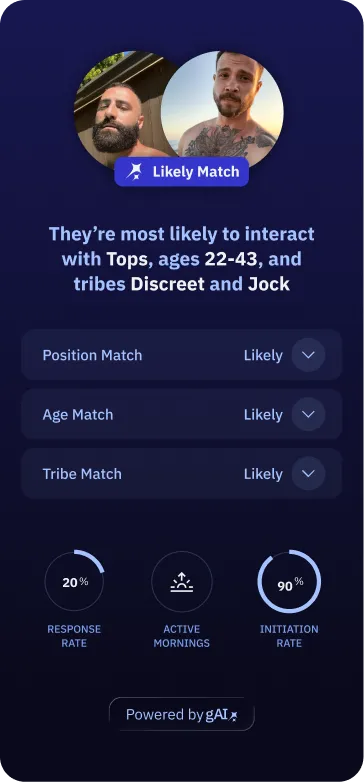
Beyond AI training, Grindr enables AI-powered features by default and allows both “special-category” data and other personal information to be processed by those features. Even users without access to premium-subscription AI features could have their data automatically used to power those features for other users. “Behavior-based profile insights” (pictured below) could expose information that users would never choose to share publicly, like the types of people they interact with on Grindr, their typical online hours, and how often they initiate conversation with other users.

AI-powered profile insight stating that a Grindr user is "most likely to interact with Tops, ages 22-43, and tribes Discreet and Jock." Insight also displays the user's response rate, initiation rate, and when they're most active on Grindr.

Image of the “Profile Insights” feature from a Grindr blogpost promoting its premium, AI-first subscription

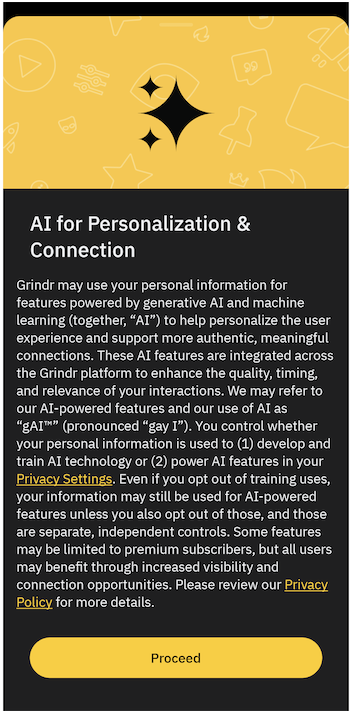
Regardless of whether new AI features leak private information, users deserve meaningful control over how their personal data is used and by whom. Grindr notifies users that their personal information may be used to train AI and that they can opt out on a separate settings page, but this notice does not specify the type of data used (i.e. profile photos, taps) and it is unlikely that people carefully read or understand it. Closing the notice or clicking its only button (which is “Proceed”) maintains Grindr’s default of using personal information for AI training. To respect users’ autonomy, Grindr should require opt-in consent before training AI models on personal data.

Notice entitled "AI for Personalization & Connection" describes the use of personal data for AI features. The only prominent button is "Proceed"

Notice displayed in the Grindr app about the use of personal data for new AI features

Celebrate Pride by Demanding Better Privacy

Grindr must immediately stop prioritizing profits over users’ safety. The ability to opt-out is not an acceptable substitute for opt-in consent, especially given the added risks of data sharing for LGBTQ+ users. Defaults matter—studies show that most people cannot or do not change the default settings of technologies they use.

If Grindr wants to back up its claim that it “takes user privacy very seriously,” it should make privacy the default across its platform, rather than something users need to go through complicated processes to opt in to. 

  •  

The UK’s New Under-16 Social Media Ban Will Cause More Harm Than It Prevents

This week, politicians in the UK pushed forward with plans to eviscerate privacy and free speech on the internet by announcing a ban on social media for users under 16 that is set to take effect in Spring 2027. 

The UK government continues to falsely characterize this policy as a necessary response to growing concerns about online harms for young people. In reality, much like the Online Safety Act, it will cause more harm than it will prevent. 

Users of all ages are burdened with proving their age before accessing content, with social media platforms such as Snapchat, TikTok, YouTube, Instagram, Facebook, and X included in the ban. There remains no reliable, privacy-preserving method of verifying the age of every internet user and methods vary from one platform to the next.

Young people will not simply be protected from being contacted by adults or endlessly scrolling—they’ll also lose access to educational videos on YouTube, local events on Facebook, and potentially cut off from distant friends and family. 

Public policy must be effective, proportionate and respectful of fundamental rights. Young people deserve better than a policy built on panic, and all internet users deserve a safe and free internet. A social media ban generates headlines, but it will not solve the problem. 

A Brief History of Age-Gating in the UK

Age restriction proposals in the UK date back to a decade ago, when the proposed Digital Economy Bill was put forth to (among other things) restrict young people from accessing pornographic websites. While the Digital Economy Act of 2017 passed without age-based restrictions, it laid the groundwork for later age verification measures.

Over the next few years, age checks for porn websites were announced then delayed several times. But it wasn’t until a consultation under the 2016-2019 May government and the 2020 publication of the Online Harms Whitepaper that age verification became a broader idea.

In 2023, the UK passed the controversial Online Safety Act, establishing powers that could weaken privacy protections and freedom of expression for internet users worldwide. In July 2025, the government implemented age assurance measures on sites hosting “harmful” content. 

And despite politicians affirming repeatedly that the Online Safety Act would solve all of the problems with online safety, this year they decided it in fact did not go far enough. American social psychologist and The Anxious Generation author Jonathan Haidt—who has called for age-related social media bans around the world, despite significant scientific doubt about his research—met with the UK Health Secretary in February to push for the ban.

In March, politicians introduced plans for a social media ban into the Children’s Wellbeing and Schools Bill to “prevent children under the age of 16 from becoming or being users” of “all regulated user-to-user services,” to be implemented by “highly-effective age assurance measures”—effectively banning under-16s from social media. 

When this proposal came before the House of Commons, MPs defeated and proposed their own amendment: enabling the Secretary of State to introduce provisions “requiring providers of specified internet services” to prevent access by children, under age 18 rather than 16, to specified internet services or to specified features; and to restrict access by children to specified internet services which ministers provide. 

But the social media ban does not stop there. The provision also requires internet service providers to limit the time kids spend online, and has rules about who can contact them online. These extreme rules will take decisions about using technology away from families and put them in the hands of government regulators. 

The history of this proposal shows that the UK government has repeatedly returned to the same flawed idea: restricting access to online services by requiring age checks for everyone. But the fundamental problems have not changed. There is still no widely available way to verify age online without compromising privacy—but even if there were, broad restrictions on social media will inevitably limit access to lawful speech, and valuable online communities, and arts and culture.

  •  

LGBT Q&A: We’re Back With Season 2! 

Last June during Pride, we launched a new initiative—LGBT Q&A—where we answered your most pressing queer-related digital rights questions on EFF’s Instagram and TikTok accounts. No question was too big or too small! You asked us things like what pictures to use on dating apps; how to remove your name from internet searches; why homophobic content doesn't get removed after you report it; and how to stay safe at Pride marches.

And this year, we’re doing it all again. 

Both online and offline, LGBTQ+ individuals and the fight for queer liberation are under threat; and the need for guidance and protection from prying eyes and oppressive structures is increasingly pertinent. This is particularly true for those of us who face consequences when intimate details around gender or sexual identities are revealed without consent. 

But we know that it can feel overwhelming to even start thinking about how you can protect yourself online in the face of these issues. That's why this Pride, we’re answering all your digital rights questions. 

How to submit your questions?

  • If you would like to remain anonymous and away from social platforms, you can submit questions via this secure link. 
  • Head to EFF’s Reddit or the r/LGBTQ subreddit and submit your questions underneath the posts. 
  • Your questions can also be submitted under the linked posts on EFF’s Instagram and TikTok, as well as on our stories where you can submit questions directly. 
  • If you prefer Mastodon and Bluesky, comment your questions under the linked posts. 

As always, we will not engage with comments that discriminate against marginalized groups, including the LGBTQ+ community.

We’re here to help build an online space where you get to decide what aspects of yourself you share with others, how you present to the world, and what things you keep private. Join us to make the internet private, safe, and full of pride.

  •  

Internet Age Gates Are a Growing Global Threat

The internet is an essential resource for young people and adults to access information, explore community, and find themselves—both inside countries and across continents. Yet governments around the world continue to introduce and implement legislation requiring all online users to verify their ages before accessing the digital space. In some cases, politicians are going further, putting forth proposals to ban social media for younger users.  

In late 2025, Australia’s government rolled out the first complete ban on users under 16 from having social media accounts. In this sweeping regime, platforms are required to introduce age assurance tools to block under-16s, demonstrate that they have taken “reasonable steps” to deactivate accounts used by under-16s, and prevent any new accounts being created, or face fines of up to 49.5 million Australian dollars ($32 million USD). The 10 banned platforms—Instagram, Facebook, Threads, Snapchat, YouTube, TikTok, Kick, Reddit, Twitch, and X—have each said they’ll comply with the legislation, which led to young people losing access to their accounts overnight. Reddit is currently challenging the law in Australian courts on constitutional grounds. Recent research notes how the ban is preventing teenagers from accessing news in the country. 

In the United Kingdom, rules took effect in mid-2025 under the Online Safety Act that require all online services available in the country to assess whether they host content considered harmful to children; if so, these services must introduce age checks to prevent children from accessing such content. Online services are also required to change their algorithms and moderation systems to ensure that content defined as harmful, like violent imagery, is not shown to young people. 

This approach is reckless, short-sighted, and we’ve already seen it introduce more harm to the young people that it is trying to protect. The UK’s scramble to find an effective age verification method shows us that there isn't one, and we’ve spent years urging UK politicians to abandon any measures that require platforms to collect data or remove privacy protections around users’ identities. 

Earlier this year, Indonesia’s Communications and Digital Affairs Minister, Meutya Hafid, announced that users under 16 would have their accounts on “high risk” platforms deactivated from 28 March. The platforms subject to this ban are YouTube, TikTok, Facebook, Instagram, Threads, X, Bigo Live, and Roblox; with Hafid noting how this policy would make Indonesia “the first non-Western country to delay children's access to digital spaces according to age.”

Similarly, the Malaysian government has recently pushed forward with plans to ban users under 16 from having accounts on social media platforms with at least 8 million users in Malaysia, including Facebook, Instagram, TikTok, and YouTube. Users under the age of 16 are being told to download or transfer their data from these platforms in one month before the restrictions are applied. Platforms failing to comply with the ban may face penalties of up to $2.5 million USD.

In Latin America, Brazil approved a new law in 2025 establishing that providers of information technology products and services directed to children and teenagers, or likely to be accessed by them, must conduct age checks when their products and services offer risks to underage users. Regulation requires age assurance for products and services that are not allowed for children and adolescents in accordance with Brazilian legislation. App stores and operating systems are required to provide age signals for other providers. 

While the law is already in force, full compliance with its obligations is expected for early 2027, after the approval of further regulations and a transition period, and the authority responsible for enforcing the law is the Brazilian National Data Protection Agency. The list of concerns regarding the implementation of the law include: the wide scope of products and services that may fall within age-check obligations, how these obligations can affect non-proprietary operating systems and free software projects, and how effective the law's crucial data protection safeguards will be in a context of likely widespread age checks for accessing content online.

Similarly, the European Union has taken large steps towards mandatory age verification that could undermine privacy, expression, and participation rights for everyone. Politicians are promoting an EU-wide approach to age verification through its age verification “app,” which will be fully interoperable with the Digital Identity Wallet. While this mini-app has been announced as technically ready to be rolled out “for citizens to use,” it comes with its own realm of potential privacy and security concerns, such as long-term identifiers (which could result in tracking) and over-exposure of personal information. 

The European Commission also supports age verification in various legislative initiatives, from proposals that would allow or mandate companies to scan our communication (“Chat Control”) to non-binding guidelines of existing laws, such as the Digital Services Act. The EU Parliament, too, has proposed an EU digital minimum age of 16 for access to social media, a move that aligns with EU Commission’s president Ursula von der Leyen’s recent public support for measures inspired by Australia’s model. To all these initiatives EFF has provided one consistent response: mandatory age verification measures are not the right way to protect young people. 

These proposals restrict the fundamental rights of young people to speak to each other and to access information. They also force all internet users, not just those under a certain age, to upload private data—like a face scan or passport—in order to access a website or service. In considering the vast scope of privacy issues pertaining to the collection, storage, and sharing of this personal information, the problems of age verification in restricting free speech are compounded by these reckless and harmful approaches to verification. 

The problem of censorship and surveillance goes far beyond the borders of the internet. EFF continues to explore support for legislative and litigation challenges that recognize how these laws harm everyone’s rights to privacy, free expression and due process.

  •  

LGBT Q&A Season 1 Recap: Staying Safer Online

Last year during LGBTQ+ Pride month, we launched an LGBT Q&A where we answered your most pressing digital rights questions on EFF’s Instagram and TikTok  accounts. 

Ahead of LGBT Q&A Season 2 launching next week, we’re posting a recap with some of the questions we answered. Check them out below.

  1. You wanted to know: How to stay safe when dating online.
  2. You asked: I'm a 17 year old trans woman and my address is public on the Internet. What steps can I take to mitigate this risk? 
  3. You wondered about: Tips for staying safe at Budapest Pride.
  4. You questioned: Why does homophobic content I report on social media not get removed?  
  5. You asked: What pictures are safe to use on dating apps?
  6. You wanted to know: Is it safe to have gay, trans, and Palestinian flags in my bio? 

We’re here to help build an online space where you get to decide what aspects of yourself you share with others, how you present to the world, and what things you keep private. Join us to make the internet private, safe, and full of pride.

  •  

EFF Submission to UK Consultation on Digital ID

Last September, the United Kingdom’s Prime Minister Keir Starmer announced plans to introduce a new digital ID scheme in the country. The scheme aims to make it easier for people to prove their identities by creating a virtual ID on personal devices with information like names, date of birth, nationality or residency status, and a photo to verify their right to live and work in the country. 

Since then, EFF has joined UK-based civil society organizations in urging the government to reconsider this proposal. In one joint letter from December, ahead of Parliament’s debate around a petition signed by 2.9 million people calling for an end to the government’s plans to roll out a national digital ID, EFF and 12 other civil society organizations wrote to politicians in the country urging MPs to reject the Labour government’s proposal.

Nevertheless, politicians have continued to explore ways to build out a digital ID system in the country, often fluctuating between different ideas and conceptualisations for such a scheme. In their search for clarity, the government launched a consultation, ‘Making public services work for you with your digital identity,’ seeking views on a proposed national digital ID system in the UK. 

EFF submitted comments to this consultation, focusing on six interconnected issues:

  1. Mission creep
  2. Infringements on privacy rights 
  3. Serious security risks
  4. Reliance on inaccurate and unproven technologies
  5. Discrimination and exclusion
  6. The deepening of entrenched power imbalances between the state and the public.

Even the strongest recommended safeguards cannot resolve these issues, and the fundamental core problem that a mandatory digital ID scheme that shifts power dramatically away from individuals and toward the state. They are pursued as a technological solution to offline problems but instead allow the state to determine what you can access, not just verify who you are, by functioning as a key to opening—or closing—doors to essential services and experiences. 

No one should be coerced—technically or socially—into a digital system in order to participate fully in public life. It is essential that the UK government listen to people in the country and say no to digital ID. 

Read our submission in full here.

  •  

EFF Submission to UN Report on the Role of Media in the Context of Israel’s Policies Toward Palestinians

The UN Special Rapporteur on the situation of human rights in the Palestinian territories occupied since 1967 recently announced a study addressing the killings and attacks against Palestinian journalists and media workers, the destruction of media infrastructure in Gaza, and the production and dissemination of narratives that may enable, justify, or incite international crimes. 

As part of this consultation, EFF contributed a submission that identifies a significant deterioration of press freedom and free expression in the period since October 2023, including an increase in censorship and wave of killings of journalists; adding to an already pervasive censorship and surveillance regime for Palestinians. 

In particular, concerns raised in our submission relate to:

  1. Government takedown requests 
  2. Disinformation and content moderation
  3. Attacks on internet infrastructure

The concerns about censorship in Palestine are ever increasing, and include multiple international forums. Ending the deliberate digital isolation of the Palestinian people is critical to protecting fundamental human rights.

Read the briefing in full here.

  •  

UK Politicians Continue to Miss the Point in Latest Social Media Ban Proposal

The UK is moving forward with its efforts to ban social media for young people. Ahead of this week’s House of Lords debate on the topic, we’re getting you situated with a primer on what’s been happening and what it all means.

What was the last vote about? 

On 9 March, the House of Commons discussed amendments tabled by the House of Lords in the government’s flagship legislation, the Children’s Wellbeing and Schools Bill. 

The House of Lords previously tabled an amendment to “prevent children under the age of 16 from becoming or being users” of “all regulated user-to-user services,” to be implemented by “highly-effective age assurance measures,” which effectively banned under-16s from social media. When this proposal came before the House of Commons, MPs defeated it by 307 votes to 173. 

Instead, the Commons proposed its own amendment: enabling the Secretary of State to introduce provisions “requiring providers of specified internet services” to prevent access by children, under age 18 rather than 16, to specified internet services or to specified features; and to restrict access by children to specified internet services which ministers provide. 

Who does this give powers to?

The Commons proposal redirects power from the UK Parliament and the UK’s independent telecom regulator Ofcom to the Secretary of State for Science, Innovation and Technology, currently Liz Kendall, who will be able to restrict internet access for young people and determine what content is considered harmful…just because she can. The amendment also empowers the Secretary of State to limit VPN use for under 18s, as well as restrict access to addictive features and change the age of digital consent in the country; for example, preventing under-18s from playing games online after a certain time.  

Why is this a problem? 

This process is devoid of checks or accountability mechanisms as ministers will not be required to demonstrate specific harms to young people, which essentially unravels years-long efforts by Ofcom to assess online services according to their risks. And given the moment the UK is currently in, such as refusing to protect trans and LGBTQ+ communities and flaming hostile and racist discourses, it is not unlikely that we’ll see ministers start restricting content that they ideologically or morally feel opposed to, rather than because the content is harmful based, as established by evidence and assessed pursuant to established human rights principles. 

We know from other jurisdictions like the United States that legislation seeking to protect young people typically sweeps up a slew of broadly-defined topics. Some block access to websites that contain some “sexual material harmful to minors,” which has historically meant explicit sexual content. But some states are now defining the term more broadly so that “sexual material harmful to minors” could encompass anything like sex education; others simply list a variety of vaguely-defined harms. In either instance, this bill would enable ministers to target LGBTQ+ content online by pushing this behind an under-18s age gate, and this risk is especially clear given what we already know about platform content policies. 

How will this impact young people? 

The internet is an essential resource for young people (and adults) to access information, explore community, and find themselves. Beyond being spaces where people can share funny videos and engage with enjoyable content, social media enables young people to engage with the world in a way that transcends their in-person realm, as well as find information they may not feel safe to access offline, such as about family abuse or their sexuality. In severing this connection to people and information by banning social media, politicians are forcing millions of young people into a dark and censored world. 

How did each party vote? 

The initial push to ban under-16s from social media came from the Conservative Party, who have since accused the UK’s Prime Minister Keir Starmer of “dither and delay” for not committing to the ban. The Liberal Democrats have also called this “not good enough.” The Labour Party itself is split, with 107 Labour Party MPs abstaining in the vote on the House of Lords amendment. 

But we know that the issue of young people’s online safety is a polarizing topic that politicians have—and will continue to—weaponize for public support, regardless of their actual intentions. This is why we will continue to urge policymakers and regulators to protect people’s rights and freedoms online at all moments, and not just take the easy route for a quick boost in the polls.

How does this bill connect to the Online Safety Act?

The draft Children’s Wellbeing and Schools Bill that came from the Lords provided that any regulation pertaining to the well-being of young people on social media “must be treated as an enforceable requirement” with the Online Safety Act. The Commons amendment, however, starts out by inserting a new clause that amends the Online Safety Act. 

For more than six years, we’ve been calling on the UK government to pass better legislation around regulating the internet, and when the Online Safety Act passed we continued to advocate for the rights of people on the internet—including young people—as Ofcom implemented the legislation. This has been a protracted effort by civil society groups, technologists, tech companies, and others participating in Ofcom's consultation process and urging the regulator to protect internet users in the UK.

The MPs amendment essentially rips this up. Technology Secretary Liz Kendall recently said that ministers intended to go further than the existing Online Safety Act because it was “never meant to be the end point, and we know parents still have serious concerns. That is why I am prepared to take further action.” But when this further action is empowering herself to make arbitrary decisions on content and access, and banning under-18s from social media, this causes much more harm than it solves. 

Is the UK alone in pushing legislation like this? 

Sadly, no. Calls to ban social media access for young people have gained traction since Australia became the first country in the world to enforce one back in December. On 5 March, Indonesia announced a ban on social media and other “high-risk” online platforms for users under 16. A few days later, new measures came into effect in Brazil that restricts social media access for under-16s, who must now have their accounts linked to a legal guardian. Other countries like Spain and the Philippines have this year announced plans to ban social media for under-16s, with legislation currently pending to implement this.

What are the next steps?

The Children's Wellbeing and Schools Bill returns to the House of Lords on 25 March for consideration of the new Commons amendments. The bill will only become law if both Houses agree to the final draft. 

We will continue to stand up against these proposals—not only to young people’ free expression rights, but also to safeguard the free flow of information that is vital to a democratic society. The issue of online safety is not solved through technology alone, especially not through a ban, and young people deserve a more intentional approach to protecting their safety and privacy online, not this lazy strategy that causes more harm than it solves. 

We encourage politicians in the UK to look into what is best, not what is easy, and explore less invasive approaches to protect all people from online harms. 

  •  

EFF Joins Internet Advocates Calling on the Iranian Government to Restore Full Internet Connectivity

Earlier this month, Iran’s internet connectivity faced one of its most severe disruptions in recent years with a near-total shutdown from the global internet and major restrictions on mobile access.

EFF joined architects, operators, and stewards of the global internet infrastructure in calling upon authorities in Iran to immediately restore full and unfiltered internet access. We further call upon the international technical community to remain vigilant in monitoring connectivity and to support efforts that ensure the internet remains open, interoperable, and accessible to all.

This is not the first time the people in Iran have been forced to experience this, with the government suppressing internet access in the country for many years. In the past three years in particular, people of Iran have suffered repeated internet and social media blackouts following an activist movement that blossomed after the death of Mahsa Amini, a woman murdered in police custody for refusing to wear a hijab. The movement gained global attention and in response, the Iranian government rushed to control both the public narrative and organizing efforts by banning social media and sometimes cutting off internet access altogether. 

EFF has long maintained that governments and occupying powers must not disrupt internet or telecommunication access. Cutting off telecommunications and internet access is a violation of basic human rights and a direct attack on people's ability to access information and communicate with one another. 

Our joint statement continues:

“We assert the following principles:

  1. Connectivity is a Fundamental Enabler of Human Rights: In the 21st century, the right to assemble, the right to speak, and the right to access information are inextricably linked to internet access.
  2. Protecting the Global Internet Commons: National-scale shutdowns fragment the global network, undermining the stability and trust required for the internet to function as a global commons.
  3. Transparency: The technical community condemns the use of BGP manipulation and infrastructure filtering to obscure events on the ground.”

Read the letter in full here. 

  •  

Age Verification Threats Across the Globe: 2025 in Review

Age verification mandates won't magically keep young people safer online, but that has not stopped governments around the world spending this year implementing or attempting to introduce legislation requiring all online users to verify their ages before accessing the digital space. 

The UK’s misguided approach to protecting young people online took many headlines due to the reckless and chaotic rollout of the country’s Online Safety Act, but they were not alone: courts in France ruled that porn websites can check users’ ages; the European Commission pushed forward with plans to test its age-verification app; and Australia’s ban on under-16s accessing social media was recently implemented. 

Through this wave of age verification bills, politicians are burdening internet users and forcing them to sacrifice their anonymity, privacy, and security simply to access lawful speech. For adults, this is true even if that speech constitutes sexual or explicit content. These laws are censorship laws, and rules banning sexual content usually hurt marginalized communities and groups that serve them the most.

In response, we’ve spent this year urging governments to pause these legislative initiatives and instead protect everyone’s right to speak and access information online. Here are three ways we pushed back [against these bills] in 2025:

Social Media Bans for Young People

Banning a certain user group changes nothing about a platform’s problematic privacy practices, insufficient content moderation, or business models based on the exploitation of people’s attention and data. And assuming that young people will always find ways to circumvent age restrictions, the ones that do will be left without any protections or age-appropriate experiences.

Yet Australia’s government recently decided to ignore these dangers by rolling out a sweeping regime built around age verification that bans users under 16 from having social media accounts. In this world-first ban, platforms are required to introduce age assurance tools to block under-16s, demonstrate that they have taken “reasonable steps” to deactivate accounts used by under-16s, and prevent any new accounts being created or face fines of up to 49.5 million Australian dollars ($32 million USD). The 10 banned platforms—Instagram, Facebook, Threads, Snapchat, YouTube, TikTok, Kick, Reddit, Twitch and X—have each said they’ll comply with the legislation, leading to young people losing access to their accounts overnight. 

Similarly, the European Commission this year took a first step towards mandatory age verification that could undermine privacy, expression, and participation rights for young people—rights that have been fully enshrined in international human rights law through its guidelines under Article 28 of the Digital Services Act. EFF submitted feedback to the Commission’s consultation on the guidelines, emphasizing a critical point: Mandatory age verification measures are not the right way to protect minors, and any online safety measure for young people must also safeguard their privacy and security. Unfortunately, the EU Parliament already went a step further, proposing an EU digital minimum age of 16 for access to social media, a move that aligns with EU Commission’s president Ursula von der Leyen’s recent public support for measures inspired by Australia’s model.

Push for Age Assurance on All Users 

This year, the UK had a moment—and not a good one. In late July, new rules took effect under the Online Safety Act that now require all online services available in the UK to assess whether they host content considered harmful to children, and if so, these services must introduce age checks to prevent children from accessing such content. Online services are also required to change their algorithms and moderation systems to ensure that content defined as harmful, like violent imagery, is not shown to young people.

The UK’s scramble to find an effective age verification method shows us that there isn't one, and it’s high time for politicians to take that seriously. As we argued throughout this year, and during the passage of the Online Safety Act, any attempt to protect young people online should not include measures that require platforms to collect data or remove privacy protections around users’ identities. The approach that UK politicians have taken with the Online Safety Act is reckless, short-sighted, and will introduce more harm to the very young people that it is trying to protect.

We’re seeing these narratives and regulatory initiatives replicated from the UK to U.S. states and other global jurisdictions, and we’ll continue urging politicians not to follow the UK’s lead in passing similar legislation—and to instead explore more holistic approaches to protecting all users online.

Rushed Age Assurance through the EU Digital Wallet

There is not yet a legal obligation to verify users’ ages at the EU level, but policymakers and regulators are already embracing harmful age verification and age assessment measures in the name of reducing online harms.

These demands steer the debate toward identity-based solutions, such as the EU Digital Identity Wallet, which will become available in 2026. This has come with its own realm of privacy and security concerns, such as long-term identifiers (which could result in tracking) and over-exposure of personal information. Even more concerning is, instead of waiting for the full launch of the EU DID Wallet, the Commission rushed a “mini AV” app out this year ahead of schedule, citing an urgent need to address concerns about children and the harms that may come to them online. 

However, this proposed solution directly tied national ID to an age verification method. This also comes with potential mission creep of what other types of verification could be done in EU member states once this is fully deployed—while the focus of the “mini AV” app is for now on verifying age, its release to the public means that the infrastructure to expand ID checks to other purposes is in place, should the government mandate that expansion in the future.  

Without the proper safeguards, this infrastructure could be leveraged inappropriately—all the more reason why lawmakers should explore more holistic approaches to children's safety. 

Ways Forward

The internet is an essential resource for young people and adults to access information, explore community, and find themselves. The issue of online safety is not solved through technology alone, and young people deserve a more intentional approach to protecting their safety and privacy online—not this lazy strategy that causes more harm that it solves. 

Rather than weakening rights for already vulnerable communities online, politicians must acknowledge these shortcomings and explore less invasive approaches to protect all people from online harms. We encourage politicians to look into what is best, and not what is easy; and in the meantime, we’ll continue fighting for the rights of all users on the internet in 2026.

This article is part of our Year in Review series. Read other articles about the fight for digital rights in 2025.

  •  

EFF, Open Rights Group, Big Brother Watch, and Index on Censorship Call on UK Government to Reform or Repeal Online Safety Act

Since the Online Safety Act took effect in late July, UK internet users have made it very clear to their politicians that they do not want anything to do with this censorship regime. Just days after age checks came into effect, VPN apps became the most downloaded on Apple's App Store in the UK, and a petition calling for the repeal of the Online Safety Act (OSA) hit over 400,000 signatures. 

In the months since, more than 550,000 people have petitioned Parliament to repeal or reform the Online Safety Act, making it one of the largest public expressions of concern about a UK digital law in recent history. The OSA has galvanized swathes of the UK population, and it’s high time for politicians to take that seriously. 

Last week, EFF joined Open Rights Group, Big Brother Watch, and Index on Censorship in sending a briefing to UK politicians urging them to listen to their constituents and reform or repeal the Online Safety Act ahead of this week’s Parliamentary petition debate on 15 December.

The legislation is a threat to user privacy, restricts free expression by arbitrating speech online, exposes users to algorithmic discrimination through face checks, and effectively blocks millions of people without a personal device or form of ID from accessing the internet. The briefing highlights how, in the months since the OSA came into effect, we have seen the legislation:

  1. Make it harder for not-for-profits and community groups to run their own websites. 
  2. Result in the wrong types of content being taken down.
  3. Lead to age-assurance being applied widely to all sorts of content.

Our briefing continues:

“Those raising concerns about the Online Safety Act are not opposing child safety. They are asking for a law that does both: protects children and respects fundamental rights, including children’s own freedom of expression rights.”

The petition shows that hundreds of thousands of people feel the current Act tilts too far, creating unnecessary risks for free expression and ordinary online life. With sensible adjustments, Parliament can restore confidence that online safety and freedom of expression rights can coexist.

If the UK really wants to achieve its goal of being the safest place in the world to go online, it must lead the way in introducing policies that actually protect all users—including children—rather than pushing the enforcement of legislation that harms the very people it was meant to protect.

Read the briefing in full here.

Update, 17 Dec 2025: this article was edited to include the word reform alongside repeal. 

  •  

EFF and 12 Organizations Urge UK Politicians to Drop Digital ID Scheme Ahead of Parliamentary Petition Debate

The UK Parliament convened earlier this week to debate a petition signed by 2.9 million people calling for an end to the government’s plans to roll out a national digital ID. Ahead of that debate, EFF and 12 other civil society organizations wrote to politicians in the country urging MPs to reject the Labour government’s newly announced digital ID proposal.

The UK’s Prime Minister Keir Starmer pitched the scheme as a way to “cut the faff” in proving people’s identities by creating a virtual ID on personal devices with information like names, date of birth, nationality, photo, and residency status to verify their right to live and work in the country. 

But the case for digital identification has not been made. 

As we detail in our joint briefing, the proposal follows a troubling global trend: governments introducing expansive digital identity systems that are structurally incompatible with a rights-respecting democracy. The UK’s plan raises six interconnected concerns:

  1. Mission creep
  2. Infringements on privacy rights
  3. Serious security risks
  4. Reliance on inaccurate and unproven technologies
  5. Discrimination and exclusion
  6. The deepening of entrenched power imbalances between the state and the public.

Digital ID schemes don’t simply verify who you are—they redefine who can access services and what those services look like. They become a gatekeeper to essential societal infrastructure, enabling governments and state agencies to close doors as easily as they open them. And they disproportionately harm those already at society’s margins, including people seeking asylum and undocumented communities, who already face heightened surveillance and risk.

Even the strongest recommended safeguards cannot resolve the core problem: a mandatory digital ID scheme that shifts power dramatically away from individuals and toward the state. No one should be coerced—technically or socially—into a digital system in order to participate fully in public life. And at a time when almost 3 million people in the UK have called on politicians to reject this proposal, the government must listen to people and say no to digital ID.

Read our civil society briefing in full here.

  •  
❌