Login
Login
The Clock Is Already Ticking: Why Post-Quantum Cryptography Can’t Wait
There is a question I have been hearing more and more from CISOs, compliance officers, and security architects over the past year. It does not start with “we had a breach” or “we failed an audit.” It starts with something that sounds almost philosophical:
“Are we quantum-safe?”
A year ago, that question came from the most forward-thinking 5% of our customer base. Today, it is coming from everyone. And that shift, from curiosity to urgency, tells you everything you need to know about where the security industry is headed.
Post-Quantum Cryptography is not a future problem anymore. It is a right now problem. And the customers asking us about it are not being paranoid. They are being smart.
What is post-quantum cryptography? Post-quantum cryptography (PQC) is a new generation of public-key algorithms designed to remain secure against attacks from both classical and large-scale quantum computers. Unlike RSA and elliptic-curve cryptography, which rely on math that a sufficiently powerful quantum computer can break, PQC algorithms are based on mathematical problems that are believed to be hard for quantum machines as well -protecting the data your organization encrypts today from being decrypted in the future.
The “Harvest Now, Decrypt Later” Threat Is Already in Motion
Let us be direct about the threat model, because it is one that does not get nearly enough attention in mainstream security conversations.
You do not need a quantum computer to exist today for your encrypted data to already be at risk.
Sophisticated nation-state adversaries are actively collecting encrypted TLS traffic right now, including your transactions, your authentication sessions, and your sensitive data in transit, with the explicit intention of decrypting it later once quantum computing reaches sufficient capability. This strategy has a name: “Harvest Now, Decrypt Later.” And it is not theoretical. It is happening.
The implication is sobering: the security decisions you make today about encryption determine the confidentiality of data that will still be sensitive in five, ten, or fifteen years. Healthcare records. Financial transactions. Government communications. Intellectual property. Any data with long-term value is already a target for harvesting.
Classical TLS, the encryption backbone of the modern internet, was not built to withstand quantum-scale attacks. The mathematical problems that make RSA and ECC hard to break today become tractable for sufficiently powerful quantum computers. When that threshold is crossed, the encryption protecting decades of harvested data becomes transparent.
This is not a hypothetical edge case. It is a strategic, long-horizon attack that demands a strategic, long-horizon defense.
Our Customers Are Already Asking. We Already Have the Answer.
Here is something I want to be transparent about, because I think it matters.
At Thales, we have been getting questions about PQC readiness from customers consistently and with increasing frequency. These are not fringe inquiries from academic researchers or early adopters chasing the next shiny thing. These are enterprise security teams, regulated industry customers in finance, healthcare, and defense, and compliance officers who are watching the regulatory horizon and doing the math.
They are thinking about it. And they deserve a vendor who is already ahead of it.
That is exactly why I am proud to share what we have built. Thales’ Imperva platform now supports hybrid TLS handshakes combining X25519 and MLKEM768, a pairing of classical elliptic curve cryptography with a quantum-safe Key Encapsulation Mechanism aligned directly with NIST PQC standards. This hybrid approach protects connections between clients and Imperva Points of Presence with both classical and quantum-safe algorithms running simultaneously, ensuring security regardless of which threat model materializes first.
And we did not just build the capability for customers. We completed the migration of all Imperva sites ourselves. We validated it in production before asking anyone else to trust it.
That is what proactive security looks like.
What Hybrid TLS Actually Looks Like in Practice
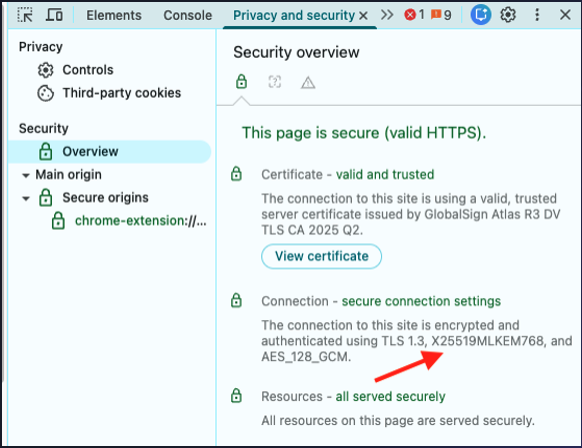
I know “hybrid TLS handshake” can sound abstract, so let me ground it in something concrete.
When a client connects to a Thales Imperva-protected application today, that TLS 1.3 session is authenticated using X25519MLKEM768, a combined algorithm that you can actually observe directly if you inspect the connection in Chrome’s security panel. You will see exactly what the screenshot above shows: “The connection to this site is encrypted and authenticated using TLS 1.3, X25519MLKEM768, and AES_128_GCM.”
That is not marketing language. That is your browser’s own security panel confirming quantum-safe encryption is active.
What this means practically:
- A classical adversary cannot break the X25519 component
- A quantum-capable adversary cannot break the MLKEM768 component
- Both would need to be broken simultaneously, which represents an effectively impossible bar with current and near-future capabilities
The hybrid model is deliberate and important. Pure PQC algorithms, while mathematically quantum-resistant, are newer and have had significantly less real-world cryptanalysis time than their classical counterparts. The hybrid approach ensures we are not trading one risk for another. We are stacking defenses. This is defense-in-depth applied to cryptography itself.
Zero Performance Trade-off. No Traffic Impact. Full Protection.
Here is the objection I hear almost every time PQC comes up in a customer conversation: “That sounds computationally expensive. What does it do to latency?”
The answer, which genuinely surprises most people: nothing measurable.
Our PQC implementation introduces no performance trade-off and no traffic impact. This matters enormously because one of the most common reasons organizations delay critical security upgrades is the perceived performance cost. Security teams propose the upgrade. Engineering teams push back on latency. The initiative stalls.
With Thales’s PQC implementation, that objection is gone.
Quantum-safe encryption that slows your applications down is not a real solution. It is a compliance checkbox that creates new operational problems while solving a cryptographic one. We were not willing to ship that. The implementation delivers genuine quantum-safe security without the operational tax, and that is the only version of this capability worth deploying at enterprise scale.
The Compliance Horizon Is Closer Than You Think
If the threat model alone is not enough to create urgency in your organization, and for some organizations it is not, that is an honest reality, then the regulatory and compliance landscape should be.
Governments and standards bodies have moved decisively and fast:
- NIST finalized its first PQC standards in 2024: FIPS 203 (ML-KEM), FIPS 204 (ML-DSA), and FIPS 205 (SLH-DSA). These are no longer drafts. They are published standards.
- The S. White House issued NSM-10 directing federal agencies to inventory cryptographic systems and prioritize PQC migration timelines
- CNSA 2.0 mandates PQC adoption for national security systems with defined timelines
- Financial services regulators in the EU and UK are actively publishing PQC readiness guidance for institutions
- DORA and NIS2 in Europe are tightening cryptographic resilience requirements across critical infrastructure sectors
The direction is unambiguous. Regulated industries, including finance, defense, and healthcare, are going to face PQC compliance requirements. The organizations that begin migration now will meet those requirements ahead of schedule, with time to test, validate, and optimize. The ones that wait will be scrambling to meet deadlines under pressure.
Thales’s PQC support is directly aligned with enterprise and regulated sector expectations today. When your auditor, your regulator, or your enterprise customer asks whether your traffic is quantum-safe, the answer should already be yes.
This Is a Security Evolution, Not a Cryptographic Revolution
I want to address something directly, because the way PQC gets discussed in the media can make it sound like a complete overhaul that requires ripping out and replacing your entire security infrastructure overnight.
That framing is not helpful. And it is not accurate.
PQC is a security evolution. The underlying architecture of TLS, certificates, and encrypted communications does not change. The mathematical primitives powering key exchange and authentication do. For most organizations, particularly those working with a security partner like Imperva that has already done the migration work, the path forward is far more manageable than the “quantum apocalypse” narrative suggests.
The hybrid approach makes this especially true. You do not abandon classical cryptography overnight. You layer quantum-safe algorithms alongside proven ones, maintain backward compatibility where needed, and progressively increase quantum-safe coverage as the ecosystem matures and client-side support expands.
Supporting our customers to be PQC compliant at the start of the year was just one step in that evolution. It is a step we took proactively, before our customers needed to ask twice, because that is what it means to be a security partner rather than just a security vendor.
What You Should Do Right Now
If you are a CISO, a security architect, or a compliance officer reading this, here is where I would focus your energy:
- Inventory your cryptographic exposure.
Understand which systems handle data with long-term sensitivity. Those are your highest-priority migration targets. Build cryptographic agility, the ability to swap algorithms without architectural overhaul, into your design principles going forward. - Ask your vendors the question.
“Are you quantum-safe?” is now a legitimate and necessary vendor evaluation criterion. Any security vendor without a PQC roadmap, let alone a GA capability in production, should be on notice. - Do not wait for regulatory mandates to force your hand.
The organizations that will navigate PQC transitions smoothly are the ones building the capability now. The ones scrambling to meet a 2027 or 2028 compliance deadline will pay for the delay in both cost and risk. - Understand why the hybrid model is the right posture.
Pure PQC is not the immediate goal for most enterprise environments. Hybrid classical plus quantum-safe is the right posture for 2026. Demand that from your vendors and your internal security teams. - Talk to Thales.
We have done this. Our sites are migrated, our customer sites are migrated. Our PoPs support hybrid TLS with MLKEM768 today. We can help you understand what your path looks like and what questions you should be asking across your vendor portfolio.
The Bottom Line
The harvest is already happening. The standards are finalized. The regulatory expectations are forming. And the technology to protect yourself, without performance trade-offs, without ripping out your stack, is available right now.
Our customers are asking about PQC readiness because they understand the stakes. They are thinking about long-horizon risk in a way that their boards and regulators are increasingly demanding. And they deserve a security partner who is not just thinking about it alongside them but has already built, tested, and deployed the answer.
Post-Quantum Cryptography is not a problem for the security teams of 2030. It is a problem for the security teams of today, being solved by the tools available today.
Thales is quantum-ready.
The question is: are you?
Thales Imperva’s Post-Quantum Cryptography support, hybrid TLS with X25519 plus MLKEM768 for Client to Imperva connections, reached General Availability at the start of 2026. To learn more about Imperva’s PQC readiness and what it means for your organization, contact us or explore our Cloud WAF capabilities.
Post-Quantum Cryptography FAQ
What is post-quantum cryptography (PQC)?
Post-quantum cryptography is a set of public-key algorithms designed to remain secure against attacks from large-scale quantum computers. It replaces or augments classical algorithms like RSA and elliptic-curve cryptography, whose underlying math a sufficiently powerful quantum computer could break.
What is a “harvest now, decrypt later” attack?
“Harvest now, decrypt later” is a strategy in which adversaries collect and store encrypted traffic today so they can decrypt it once quantum computers become powerful enough to break classical public-key cryptography. Any data that will still be sensitive in five to fifteen years—healthcare records, financial transactions, intellectual property—is already a target.
What is ML-KEM (FIPS 203)?
ML-KEM (Module-Lattice-based Key-Encapsulation Mechanism) is the NIST-standardized post-quantum key exchange specified in FIPS 203, published August 13, 2024. Imperva pairs ML-KEM-768 with the classical X25519 key exchange to form a hybrid TLS handshake—giving every connection both classical and quantum-safe protection.
Why pair a quantum-safe algorithm with a classical one (hybrid TLS)?
Pure PQC algorithms are mathematically quantum-resistant but have had far less real-world cryptanalysis than RSA or elliptic-curve cryptography. A hybrid handshake runs both classical and PQC key exchange together: an attacker would have to break both to compromise the session. It is defense-in-depth for cryptography itself, and it’s the recommended posture for 2026.
Is Imperva quantum-safe today?
Yes. Thales Imperva’s PQC support, hybrid TLS combining X25519 and ML-KEM-768 for client-to-Imperva connections, reached general availability at the start of 2026. All Imperva sites have already been migrated. For setup details and current handshake scenarios, see the Imperva PQC support documentation.
The post The Clock Is Already Ticking: Why Post-Quantum Cryptography Can’t Wait appeared first on Blog.