❌

Reading view

EFF to Court: Trump's Use of Truth Social's Pay-To-See-Posts-First Scheme Violates Americans' 1st Amendment Equal Access Rights

EFF legal intern Simar Kaur also contributed to this article.

Americans’ First Amendment right to equal access to official government statements is violated by the Trump administration’s use of Truth Social’s preferential treatment scheme, which blocks people who won’t pay Trump’s company up to $100,000 a month for early access to government news, EFF told a federal court.

The First Amendment guarantees that members of the public have equal access to public officials’ public comments, we reminded the court.

EFF filed an amicus brief in support of a motion for a preliminary injunction in the lawsuit filed by The Intercept Media and the Freedom of the Press Foundation against President Trump and other administration officials. The lawsuit challenges their use of Truth Social as their primary social media method of making official announcements when that platform provides people who pay a fee for early access to such posts. 

Trump uses his Truth Social account as his primary means of communicating with the public, including to announce military operations and ceasefires, foreign and domestic policy, and the removal and appointment of heads of federal agencies. Earlier in the year, Trump Media, which owns Truth Social, announced “Truth API,” a service that provides investors early access to “market-moving” messages from the president and other high-ranking officials for a fee of up to $100,000 per month.

The plaintiffs, the Freedom of the Press Foundation and The Intercept, contend that the president and other officials’ preferred use of Truth Social with this service violates the First and Fifth Amendments of the Constitution. The plaintiffs are asking the court to immediately prevent the president from posting on Truth Social in a manner that allows him to profit from selling early access to government information.

EFF’s amicus makes two main points.

First, the brief establishes that social media is pervasively used by government officials and agencies as a medium for official communication with the public, including to disseminate critical public safety information and make official announcements.

Second, the brief explains that the challenged practice violates the First Amendment, which guarantees a right to access public officials’ public comments on equal terms with other members of the press and public. Giving some people preferential access must at a minimum be reasonably justified to satisfy First Amendment scrutiny, a test the administration does not meet.

Lining the president and his company's pockets is not a legitimate government interest for restricting timely access to the government's statements. Further, the fact that the public could ultimately access the information from other, less direct channels does not eliminate the need for First Amendment scrutiny; mere delays in timely access still trigger First Amendment scrutiny.

EFF has been advancing the First Amendment right of equal access to government’s public social media posts since at least 2018. We’ve argued that the right of equal access, which is well established in offline contexts, must apply to official government social media posts as well. This case presents an excellent opportunity for a court to directly adopt that position. 

  •  

Meta's $17 Billion Settlement is a Bad Deal for Teens and All Social Media Users

Meta’s settlement with 52 state attorneys general is a bad deal for all internet users, and especially for teens. That’s what we said the day the settlement was announced.

In this post, we go through the Settlement’s provisions in detail and explain why that is so, including how:

  • The Settlement embeds age assurance technology and age-gates into Meta’s social media products and requires all users—minors and adults—to undergo a rights-threatening age estimation process
  • The Settlement places severe restrictions on Teens that can largely only be modified by the Teens’ parents and only then in exchange for giving their parents a ton of information about their online community and usage;
  • The Settlement seems to empower the attorneys general to enforce Meta’s content restriction on “age inappropriate content,” categories that Meta itself has had trouble administering without excluding information about sexuality, sexual and reproductive healthcare, and abortion medication;
  • The Settlement actually requires Meta to collect, analyze, and retain more information about its Teen users—when the pressure should have been on Meta to diminish its surveillance capitalism. And the Settlement in no way limits the attorneys general from seeking the user information for their own law enforcement purposes.

Note: A chunk of the settlement addresses unauthorized users under age 13, and Meta’s obligations to comply with the Children’s Online Privacy Protection Act. Meta policy has banned users under 13 since the company opened to the public in 2006. Aside from the age assurance frameworks that support both those and the other parts of the Settlement, the under-13 provisions are not addressed in this post. Those provisions essentially require Meta to detect and delete all under-13 accounts.

Further note: All U.S. states are parties to the Settlement except Florida, New Mexico, and Texas. The Settlement includes D.C., American Samoa, Guam, Northern Mariana Islands, and Puerto Rico.

Age Gates Reinforced By Age Estimation Technology

In the Settlement, Meta agrees to age-gate Instagram and Facebook, thus making age gates a legal mandate. And further, Meta will now enforce these age gates with age assurance technology, ditching its previous practice where the person signing up for the services self-attests to their birthdate. This concession firmly embeds deeply flawed age estimation technology into the online experience of millions of people around the world. First and foremost, the age verification setup seriously threatens online anonymity and privacy for everyone, as we’ve said before. The technology also just adds a layer of creepiness into the use of any service. In the Settlement, Meta pledges to, within one year, apply one or more age assurance methods to each Instagram or Facebook user in the states and territories that joined the Settlement. [P. 10, §II.A.1]

1. Age Assurance Framework. Within one (1) year of the Effective Date, Meta will adopt an age assurance framework (“Age Assurance Framework”), wherein it will apply one or more age assurance methods developed by a third party and licensed to customers (“Commercially Available Age Assurance Methods”) or age assurance methods developed by Meta (“Proprietary Age Assurance Methods”) (collectively, “Age Assurance Methods”) to each Meta SMP user in the Settling States. For the purposes of this Section II.A, an age assurance method developed or acquired by Meta that uses the same or functionally identical technology and methodology to a Commercially Available Age Assurance Method shall be treated as a Commercially Available Age Assurance Method. The Age Assurance Framework must include Age Assurance Methods to evaluate whether a Meta SMP user is a Teen User or U13, as described in Section II.A.6. New users of Meta SMPs who have not yet had their age assessed by an Age Assurance Method pursuant to Meta’s Age Assurance Framework shall receive the Default Protections pursuant to Section II.A.10 of this Agreement.

Those methods might include commercially available products, as well as proprietary age estimation process Meta might have or develop. Meta also pledges to consider age signals from Google and Apple operating systems and app stores. [§II.A.5] Meta has previously advocated for age assurance requirements to fall on Google and Apple rather than on individual services.

This age assessment essentially dumps users into one of three age-range buckets: 18+, 13-17, and under-13. Users under 13 have long been barred from Meta products, but this Settlement creates new obligations to search for and detect users who may have said they were older.

For those estimated to be over-18, the Settlement guarantees no direct benefit to you: no privacy protections, no greater user controls for your own accounts, no dent in Meta’s surveillance capitalism.

Those estimated to be 13-17 years old will be limited to Teen User accounts.

Those estimated to be under-13 will lose their accounts altogether.

Those who open new accounts will have two weeks to submit to age estimation, and if they decline to do so, Meta is now required to treat them as a Teen User by default, even if they self-identify as being 18 and older. [P. 18, §II.A.10.b]

(b) Fourteen (14) days or more after creating a Meta SMP account, Meta SMP users who have not yet had their age assessed by an Age Assurance Method pursuant to the Age Assurance Framework shall be treated as Teen Users for the purposes of this Agreement regardless of their stated age, except that Meta SMP users with a stated age of 18 years old or older shall receive the protections described in Section II.A.10.a.ii.

What about people with existing accounts, who are well past that two-week period to submit to age estimation? Will they also be defaulted to Teen User status if they decline age estimation? It seems so—the AGs would likely not have accepted a settlement that did not require Meta to take action against existing teen users who choose to forgo the age assurance process. Perhaps Meta will use its existing store of information about its current users as a type of permitted proprietary age assurance process? Thus, perhaps, an adult user whose Facebook account is itself older than 18 will be assessed as being over-18? Or a user who is identified as the spouse of a user who has been age-assured? But Meta can only rely on a proprietary process if it meets the accuracy standards set out in the Settlement Agreement, and that seems to require a formal assessment of accuracy.

How accurate does the age assurance process need to be?

The Settlement sets maximum false-positive rates for both commercially available and proprietary age assurance methods [Pages 12-13, §II.A.6]. Within two years, each shall be no more than 10% for ages 16-17 and no more than 3% for ages 13-15. 

6. Age Assurance Standards.
(a) U18 False Positive Rate Thresholds.
(i) Any Commercially Available Age Assurance Methods deployed by Meta for any new and existing users in the Settling States shall
meet or fall below the following U18 False Positive Rates excluding method circumvention within one year of the Effective Date: 10% for minors aged 16-17 and 3% for minors aged 13-15.
(ii) Any Proprietary Age Assurance Methods deployed by Meta for any new and existing users in the Settling States shall meet or fall below the following U18 False Positive Rates excluding method circumvention within 1 and 2 years of the Effective Date: 
(A) Year 1: Within one year of the Effective Date: 14% for minors aged 16-17 and 7% for minors aged 13-15.
(B) Year 2: Within two years of the Effective Date, 10% for minors aged 16-17 and 5% for minors aged 13-15.

Notably, there is no limit indicated in the error rate for false negatives, when the process wrongly identifies an adult as being under 18. The Settlement generally shows little concern for those falsely placed in its Teen User category. The Settlement only requires Meta to maintain an appeal process for users whose age range is wrongly assessed. [P. 17, §II.A.9]

9. Appeals Process. Users claiming to have been mis-identified as minors must be offered a Clear and Conspicuous means to appeal the decision. Decisions on all user appeals must be made in a timely manner and communicated to the user along with a basis for the decision.

Meta must also employ measures to discourage age estimation circumvention, including placing limits on the number of attempts any user might make. [P. 16, §II.A.7] As part of this, Meta agrees to proactively monitor adult accounts to determine whether a user needs to undergo additional age estimation. [P. 16, §II.A.7.c] This is just one of the ways the Settlement embeds Meta’s active surveillance of its users for the next ten years (see below for more).

(c) Incorporating a proactive monitoring system that requires users to undergo an additional Age Assurance Method where a user is determined, including based on their conduct on Meta SMPs, to have likely circumvented the Age Assurance Method and is: (A) likely a Teen User after having been previously assessed as 18 or older; or (B) likely U13 after having been previously assessed as 13 or older. Users Meta determines are likely Teen Users after having been previously assessed as at least eighteen may choose not to undergo additional age assurance but then will be treated as Teen Users; and 

Any age assurance process Meta uses must be tested annually.

Data minimization

The Settlement does have data minimization requirements for the data collected during the age assurance process. [§II.A.8] But there are numerous holes. The Settlement requires that all information obtained and retained as part of the age assurance processes thereafter be “immediately enqueued for deletion, after which it shall be deleted after a reasonable period of time.” The “reasonable period of time” is not defined. And the Settlement defines a category of “Retainable Data” that may be retained for 90 days. This includes “metadata about the age assurance method used by the user information ... where required to ensure the ongoing integrity of age assurance systems, including but not limited to the ability to identify circumvention and related patterns over time, and only for as long as it is required for those purposes.” The Settlement requires that all data collected by Meta or its vendor be stored according to industry-standard data security measures,” a standard that unfortunately does not eliminate the risk of a data breach.

8. Data minimization and security.
(a) Except as set forth herein, all data collected by Meta from users of Meta SMPs in the Settling States for the sole purpose of conducting age assurance, all data maintained from known U13s, and all data collected by a vendor for use in a Commercially Available Age Assurance Method shall be held for the minimum period required to determine a user’s age status and thereafter immediately enqueued for deletion, after which it shall be deleted in a reasonable period of time. Meta may retain (1) U13 data only to the extent required for purposes of developing, training, testing, and measuring the performance of the U13 Age Model (“U13 Data”), provided that any U13 data that constitutes Personally Identifiable Information as defined by 16 C.F.R. Part 312.2 will be protected using Meta’s highest data privacy and security standards, and (2) metadata about the age assurance method used by the user information (“Retainable Data”) only where required to ensure the ongoing integrity of age assurance systems, including but not limited to the ability to identify circumvention and related patterns over time, and only for as long as it is required for those purposes. For the avoidance of doubt, U13 Data cannot be used for purposes such as ads targeting and delivery, marketing, or algorithmic optimization efforts. Any U13 Data and Retainable Data shall be maintained at the coarsest viable granularity and cannot be used for any other purpose unless legally required. Any Retainable Data that is no longer required for the purposes set forth herein shall be deleted within 90 days. The terms above shall not pertain to the user’s stated date of birth, stated age, nor the outcome of the Age Assurance Method (e.g., “teen or adult” classification).
(b) Data collected by Meta or a vendor, or transmitted by a vendor, must be collected and stored using industry-standard data security measures and as required by law, including encryption in transit and at rest.
(c) The Parties agree to discuss in good faith potential modifications to this provision as necessary to permit Meta to improve the efficacy of its Age Assurance Framework while preserving the principles of data minimization and security set forth in this Section.

Restrictions For Teens (And Anyone Who Opts Out of Age-Gating)

Teen User Accounts are subject to time, feature, and content restrictions. These will be applied to those estimated to be 13-17 as well as any new user who declines to submit to the age assurance process and to existing users who decline to submit to age estimation and for whom Meta cannot ascertain that they are older than 17.

Time restrictions

Teen Users will be subject to the following time restrictions (§II.B). These measures seem to assume that most of teen’s social media use is frivolous and unserious (not that those are in and of themselves bad; the right to play is among young people’s human rights), ignoring the fact that teens use social media for school and personal research, conducting activism campaigns, and other endeavors that might naturally not fit within these time limits, and that some teens may need to work at the restricted times to support their families and themselves:

  • Night Access Mode – no access (except messaging) to Instagram and Facebook from Midnight to 6 AM, and no push notifications from 10 PM – 7 AM.
  • School mode – no push notifications from 8 AM – 3 PM Monday-Friday from Aug 15-June 15.
  • Daily cumulative time limit of 2 hours per day across Instagram and Facebook, resetting at midnight, excluding video and audio content at least 22 minutes long, absent artificial prolongation, defined by the Settlement as “longform content.”
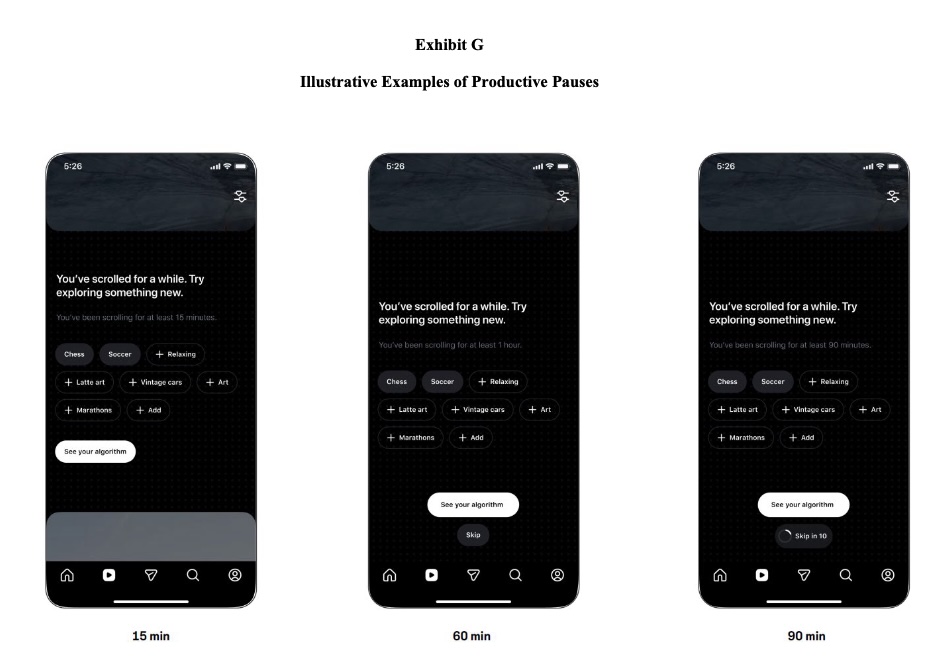
  • “Productive pauses and notices” designed to “reduce or prevent excessive, mindless, or unintended teen usage.” This means that a teen’s usage will be momentarily paused after 60 and 90 minutes of daily cumulative use with notices sent every 15 minutes of continuous use. According to the Settlement, these productive pauses and notices will look like this:

To be clear, the ability to set time limits, blackout times, and scheduled pauses are all useful features that should be available and easy to implement for users of all ages. Such tools would have allowed teens, and all users, the ability to design their own safe experience, customized to their own needs, online. Such user controls would have recognized that teens have human rights, agency, and autonomy.

But that’s not what these restrictions are. They are not tools that give the teen users control. Rather, they are imposed, top-down, on teens and anyone else who declines to submit to Meta’s age assurance process.

Feature restrictions (§II.C-D)

Within four months of the effective date of the Settlement, Meta must offer teens an option for a non-personalized feed, which is defined as a feed of chronologically ordered posts from friends and follows. Teens will also be able to disable autoplay as part of an “optional protective settings” package. Each of these settings must be “viewable within three user gestures and clearly labeled, easy to notice, viewable without scrolling, and discoverable in an intuitive location within” the service. 

Again, these would be useful user controls that should be offered to users of all ages. And while a Teen User potentially has control over these features, they cede that control to their parent once they enroll in Parental Supervision, part of the Parental Supervision Tradeoff discussed below.

Also, by default, teens will not see the number of likes or other reactions to their posts.

Teens will also not have access to what the Settlement calls “Cosmetic Procedure Filters,” that is, “any digital filter or augmented reality effect that distorts, sculpts, redefines, or idealizes a user’s face in a way that cannot be achieved without cosmetic surgery or extreme make-up techniques.”

X. “Cosmetic Procedure Filter” shall mean any digital filter or augmented reality (AR) effect that distorts, sculpts, redefines, or idealizes a user’s face in a way that cannot be achieved without cosmetic surgery or extreme makeup techniques. For the avoidance of doubt, “Cosmetic Procedure Filter” does not include: (1) Fantasy/Character Effects: Filters that change a user’s facial structure for the purpose of turning the user into a non-human or fictional character (e.g., an elf or cartoon) or an animal (e.g., a dragon or puppy); (2) Makeup/Smoothing Effects: Filters that smooth skin or alter appearance in ways that can be achieved by ordinary makeup techniques without altering the appearance of underlying physical facial structure or meaningfully changing skin tone; or (3) Parody and Exaggeration Effects: Effects that entertain users by distorting their appearance through parody, satire, or exaggerated forms (e.g., extreme visual distortions outside the scope of normal cosmetic procedures). To help operationalize this definition, the Settling States will provide Meta illustrative examples and guidance of AR effects that are Cosmetic Procedure Filters and AR effects that are not Cosmetic Procedure Filters in a letter to be sent within two (2) months of the Effective Date.

Meta has had rules about cosmetic effects directed at teens since 2019. But the Settlement will give the states a major role in helping Meta identify what features are and are not Cosmetic Procedure Filters. 

Content restrictions (P.1, §II.E, as defined by §I.C, E, F)

For content, Meta is basically pledging to continue its existing practices limiting Teen Users to age-appropriate content and accounts, to default Teen Users to age-appropriate experiences. This includes limiting access to accounts that “regularly share content that is inappropriate for teens” such as content from the following Meta community standards categories: Adult Nudity & Sexual Activity, Restricted Goods & Services, Suicide, Self-Harm or Eating Disorders.

C. “Age Appropriate Experiences” refers to content that is appropriate for Teen Users based on input from experts, parents, and teens. For the purposes of this Agreement, Age Appropriate Experiences shall mean content captured in Meta’s applicable Ages 13+ content setting, which is tied to policies inspired by movie ratings for ages 13+ and parent feedback.
D. “Age Assurance Methods” shall have the meaning set forth in Section II.
E. “Age Inappropriate Accounts” refers to accounts that regularly share content that is inappropriate for teens or that have account information that otherwise suggests the account is inappropriate for Teen Users. For the purposes of this Agreement, Age Inappropriate Accounts shall mean accounts that: (1) regularly share Age Inappropriate Content in the following categories: Adult Nudity & Sexual Activity, Restricted Goods & Services, Suicide, Self-Harm or Eating Disorders, or (2) have account names or profile photos or bios that suggest the account is otherwise inappropriate for minors, based on Meta’s policies for the following categories: Adult Nudity & Sexual Activity, Restricted Goods & Services, Suicide, Self-Harm or Eating Disorders.
F. “Age Inappropriate Content” refers to content that is generally perceived by U.S. parents, youth experts, and teens as not being appropriate for Teen Users. For the purposes of this Agreement, Age Inappropriate Content shall mean content prohibited by Meta’s Community Standards concerning bullying and harassment; nudity and sexual activity; child sexual exploitation, abuse, and nudity; sexually explicit language; suicide, self-harm and eating disorders; graphic violence and incitements to violence; gambling; and restricted substances or goods (including illegal drug use), as well as policies specifically focused on protections for Teen Users, including those regarding high-risk viral challenges and risky stunts.

The issue here is that some of these categories are problematic. For example, the Restricted Goods & Services standard has been used by Meta to justify removing information about abortion medication, as we detailed in our Stop Censoring Abortion campaign, and in our comment to the Meta Oversight Board. And under the Adult Nudity & Sexual Activity standard, Meta blocks teens from “real world art of visible genitalia ... where the nudity is the focus of the image” and has a history of applying the standard inconsistently, including with respect to representations of indigenous women, breast cancer awareness posts,  educational posts about ovulation, and posts about testicular and breast self-exams. And it has disproportionately applied the standard negatively to gay and lesbian content as compared to straight content.  

And even more worrisome, even though this is just Meta continuing its existing practices, the Settlement empowers the states to enforce its provisions. [P. 40, §IV.C.1.i; §VII.C] That means that over the next ten years, the duration of the Settlement, Meta will face the threat that a state attorney general will pursue legal action against it because it disagrees with how Meta interprets these categories of community standards, and pressures Meta to eliminate Teen User access to posts about sexuality and reproductive and sexual health. And Meta will now lack the hard-earned First Amendment defenses to make its own curatorial decisions. 

C. Notwithstanding anything in Sections VIII.A-B above, a Settling State may take any action, including but not limited to legal action to enforce compliance with the Agreement, without delay if the Settling State believes that a threat to the health or safety of the public requires immediate action.

The Parental Supervision Tradeoff 

All of these Teen User restrictions can be modified – but only if the Teen User enrolls in Parental Supervision that links their account to a parent’s or guardian’s account. Once their accounts are linked, parents can modify the Teen User settings to make them less restrictive (they need the teen’s permission if they want to make them more restrictive).

Parental Supervision comes with huge tradeoffs. There is a huge privacy tradeoff: in exchange for designating someone as their Parent, the Parent gets a lot of information about the Teen’s use: the usernames of all of the teen’s connections, reports on how much time the Teen User spends on a Meta service, the time spent watching longform content, usernames of all those messaging with the Teen User, and any evidence Meta has about suspected secondary accounts. The Supervising Parent also gets notices of the teen’s repeated searches related to suicide, self-harm and eating disorders. [P. 28, §II.G] And there are huge autonomy tradeoffs: once enrolled in Parental Supervision, the ability to control features like recommendations and autoplay, discussed above, transfer from the Teen user over to their parent.

Parental Supervision
1. Meta agrees to provide Supervising Parents with information concerning the amount of time their Teen User is spending on Meta SMPs, including separately for time on the Meta SMP, time using the Meta SMP’s messaging features, time viewing Longform Content (to the extent excluded from the calculation of daily limits pursuant to Section II.B.3.a.i), and the usernames of the Teen User’s social connections and individuals messaging the Teen User, and usernames of any user reported by a Teen User. In addition, Instagram will notify Supervising Parents should their Teen User engage in repeated searches for terms related to suicide, self-harm, or eating disorders, and Facebook will notify Supervising Parents should their Teen User engage in repeated searches for terms related to suicide, self-harm, or eating disorders.
2. For Teen Users, Supervising Parents will be notified on a daily basis when the Teen User communicates directly with each adult user for the first time with the Teen User and shall provide a link to the adult user’s profile to provide information such as their stated hometown or city or mutual connections, to the extent the information is publicly available.
3. Upon a Teen User enrolling Parental Supervision, Meta SMPs shall prompt the Supervising Parent to review their Teen User’s settings to consider making updates to support how their Teen User spends their time on Meta SMPs. Meta shall not preselect, recommend, or encourage settings to Supervising Parents that are less restrictive than the default settings in this Agreement.
4. Meta SMPs will periodically suggest checkups for Supervising Parents to do with their Teen Users to evaluate their settings and usage.
5. Meta SMPs agree to continue to take steps designed to encourage enrollment in their Parental Supervision tools.
6. If a Teen User is enrolled in Parental Supervision, Meta shall notify the Supervising Parent if the Teen User creates or explicitly links a new secondary Meta SMP account within their Accounts Center or has been linked to a Soft Matched Account through Meta SMPs, including a link to the secondary account’s profile. Meta SMPs shall automatically apply the Supervising Parent’s approved time management settings in Section II.B and content restrictions to all explicitly linked Meta SMP accounts and all Supervised Accounts for a Teen User belonging to the same Meta SMP.

Unfortunately, Meta doesn’t have a great way to learn whether there exists a genuine parent-Teen User relationship. But it will try to get it right. [§II.G.8] 

This may be ultimately workable for young people with healthy and safe relationships with their parent or guardian. But obviously it is not good at all for a Teen User lacking such a safe relationship. 

More Surveillance, Not Less

Moreover, rather than pushing Meta away from the collection, analysis, and retention of user data, the Settlement requires Meta to do more of it for the next ten years. Several provisions of the Settlement require Meta to carefully track its users' use of Instagram and Facebook for the purposes of determining whether its age assurance framework and Teen User restrictions are working as intended.  

For example: 

  • Meta promises to review detected U13 users’ friend networks to identify other possible U13 users. [§II.A.6.(b).(i).(D)] 
  • Meta will incorporate a “proactive monitoring system” to identify possible Teen Users among those who were initially determined to be older than 17 by its age assurance process. [§II.7.(c)] 
  • Meta pledges to utilize and improve its existing “soft matching models” that track signals such as “device IDs, phone numbers, and email addresses” to identify duplicate accounts. [§II.B.6.(a)] 
  • Meta will continue to monitor Teen Users’ activity to “regularly evaluate the prevalence of Teen User exposure to Age Inappropriate Content, and Teen User exposure to experiences that are not Age Appropriate Experiences,” [§II.E.3] and also to “regularly evaluate the prevalence of Teen User exposure to Harmful Experiences on Meta SMPs.” [§II.F.3] 
  • Monitor Teen Users’ messaging to identify message threads with potentially suspicious accounts. [§II.F.4] 
  • The Settlement also requires Meta to actively monitor use of its services so that it can supply data to the Independent Auditor that will now monitor its compliance with the Settlement. “The Independent Auditor is entitled to access the non-privileged information, personnel, systems, and records that are reasonably relevant and sufficient to evaluate Meta’s implementation of the Injunctive Relief Terms, including, but not limited to, access to raw data; aggregated data; information; internal documents and communications” plus information from its age assurance processes, data regarding Teen User responses to the Productive Pauses, data regarding its models for soft matching of secondary accounts, data regarding the prevalence of Teen User exposure to Age Inappropriate Content and Harmful Experiences, and to experiences that are not Age Appropriate Experiences. [§III.E] 

Moreover, one of the chief threats of Meta’s surveillance is the honeypot of data it creates that may be accessible to governments for law enforcement and other investigations. Nowhere in the Settlement do the 52 attorneys general pledge to not try to access all of the data the Settlement requires Meta to collect and retain. 

Meta Has To Pay The States And Pays To Establish Norms Beyond Meta

The Settlement also includes annual payments from Meta to the states, apparently proportionate to the size of each state’s teen user base. Over the ten-year life of the Settlement, these annual payments will total over $11 billion. And the states then get an additional $5 billion if Meta competitors adopt the same measures. 

This quirk of the Settlement incentivizes the States to pursue similar age assurance processes and at-least-as-restrictive teen user measures for Meta’s chief existing competitors for teen use, YouTube, TikTok, and Snap, and for any new service that may gain widespread teen use over the life of the Settlement Agreement. If the states are able to get Meta’s competitors to adopt the same measures, then the states will get the additional $5 billion in annual payments. That’s quite the incentive for the states to pursue litigation and regulatory measures against those companies. All of this will further entrench age assurance, age-gating, and the ceding of teen autonomy as the norm across online services. 

1. In the event the Contingent Monetary Payment Trigger has occurred in a Settling State, Meta shall be obligated to pay to such Settling State ten equal installments in the amount as set out in Exhibit B (each, a “Contingency Installment Payment”).

2. Following the date the Contingent Monetary Payment Trigger has occurred, the Contingency Installment Payments shall be made to the Settling State on January 15 in each subsequent calendar year of the Agreement Term as follows:

(a) At the next scheduled payment date, the Settling State shall be paid the Contingency Installment Payment for that payment date and all prior payment dates.
(b) For each of the remaining payment dates, the Settling State will be paid the Contingency Installment Payment for that payment date.

3. If a Settling State fails to achieve the Contingent Monetary Payment Trigger during the Agreement Term, the Contingency Installment Payments shall be permanently forfeited by such Settling State and retained by Meta. For the avoidance of doubt, no Settling State will have an obligation to repay the Contingency Payment

The Settlement is thus a bad deal for all users of Facebook and Instagram. It normalizes age gating and age assurance for millions of internet users. It denies teens the tools to create their own safe experiences online and places their social media experience firmly under the control of either Meta or their parents. And rather than addressing Meta’s collection, analysis, and retention of data about teens’ use of Instagram and Facebook, it binds Meta to continued surveillance, and does nothing to protect access to such data by the states. 

  •  

EFF Statement on Meta Settlement

Under this settlement, young users will now have less access to Meta products, and a lesser ability to exercise their rights to speak, access information and art and culture, associate and form communities, and play. The settlement also embeds age assurance into every product, mandating the collection of even more personal information from users of all ages; this enshrines Meta's harmful surveillance into law, and it will compromise users' privacy and anonymity while increasing their exposure to data breaches and government data requests. And the data minimization and security measures don’t keep states from using data collected under the agreement for other law enforcement purposes – which could include things like criminal investigations of abortions or gender-affirming care. 

  •  

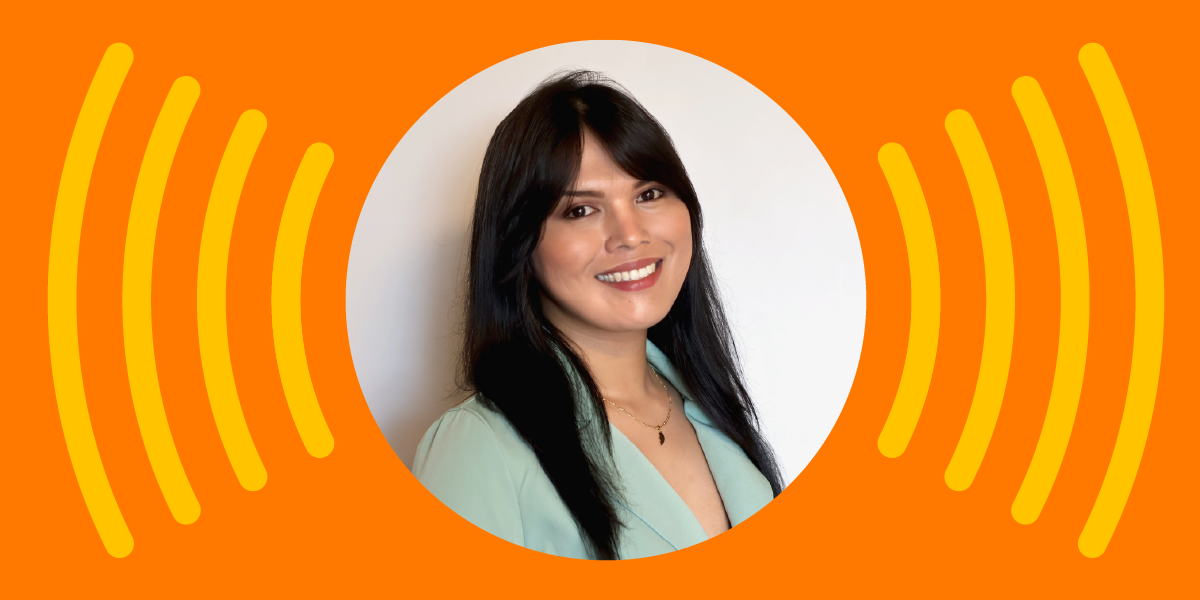
Speaking Freely: Dr. Jean Linis-Dinco

Dr. Jean Linis-Dinco is an activist-researcher working at the intersection of human rights and technology. Born in the Philippines and shaped by firsthand experience with inequality and state violence, Jean has spent her life pushing back against systems that profit from oppression. She refuses to accept a world where tech is just another tool for corporate gain. Instead, she fights for technologies and policies that put people before profit and justice before convenience. Jean earned her PhD in Cybersecurity from the University of New South Wales, Canberra, where she exposed how governments weaponized propaganda and disinformation during the Rohingya crisis in Myanmar. She currently serves as the Digital Rights Advisor for the Manushya Foundation.

David Greene: Welcome. To get started can you just introduce yourself to folks?

Jean Linis-Dinco: I'm not very good at introducing myself and I rarely do so within the context of work because I always believe that people are more than their jobs.

But first, I would like to thank you for this opportunity to share my thoughts. I've learned this kind of introduction from Kumu Vicky Holt Takamine in Hawai’i. She taught me how to introduce myself beyond titles.

So, my name is Jean, my waters are the West Philippine Sea, and I was born and raised in the land of resistance, one of the original eight provinces that revolted against Spain as they are represented by the eight rays of the sun on the Philippine flag. My ancestors fought for the freedom of the Filipino people against Spanish colonial rule, before we became subjugated once again, this time under the United States for another 48 years. The impacts of that history continue to reverberate through the domestic and international policies that ultimately pushed me out of my own country as an overseas Filipino worker.

DG: Can you tell us a bit about Manushya Foundation?

JLD: Absolutely. Manushya Foundation is a women-led organization that works with activists and human rights defenders who are targeted, who face harassment and transnational repression for their work. My work with them is on the policy and advocacy side in relation to their digital rights portfolio. It involves challenging laws and policies that criminalize freedom of expression or freedom of speech online.

It also means confronting the role of private corporations and private platforms. Because that power is rarely transparent. Big tech power is often unaccountable, as we've seen in recent years. Working in a civil society organization like Manushya, you get involved with the work on the ground and take part in grassroot-led advocacy confronting corporate abuse.

In my work, I have met people from all sorts of backgrounds. And across those encounters, I've noticed some troubling trends in some civil society organizations. There are heaps of civil society leaders who are very keen to have a seat at the table with big tech companies. It’s often hidden behind the language of ‘stakeholder engagement’. We refuse to do that at Manushya Foundation. We don’t want to be used as a rubber stamp for decisions that have already been made behind NDAs or decisions where communities most affected by these technologies were never even in the room to begin with.

I think civil society organizations should not allow themselves to be drawn into that orbit. That is very contentious in this era, because I feel like civil society bought the story that big tech could be partners in progress. We walked into their boardrooms, signing NDAs as if proximity to power meant that we were shaping it. And we've seen how in the end we're actually just giving them legitimacy. They turn our critiques and our statements to endorsements. I don't think there is any progressive form of collaboration with big tech companies that is not extractive, because the uncomfortable truth is that not everyone who wants a seat at the table is there to change what is being served.

DG: I, as someone who participates in multi-stakeholder things all the time, I completely hear that criticism. One of the things I've said is, multi-stakeholder engagement as a member of civil society takes a few forms. One, you're in the room, but you don't have a seat at the table. Two, you have a seat at the table, but you don't have a microphone. And three, they give you a microphone, but they leave the room when you talk. When we as civil society do engage, we have to be very, very intentional about ensuring it’s effective engagement. We've left many things that were “multi-stakeholder” because it was actually just NGO-washing. You know, it was only so they could say that we were sort of invited to the cocktail party afterwards.

 I've heard from you before that Manushya has a bit of a regional focus. Would you say it has a feminist focus or is it broader in terms of marginalized communities?

JLD: At its core, Manushya is a decolonial intersectional feminist organization. What that means is that we are fundamentally concerned with systems of power. In our work, we always ask who holds the power? Who is crushed by it? And who has been deliberately kept from it?

Personally, I am critical of lean-in feminism, which was popularized by a certain Meta executive. I do not agree with that kind of feminism, because it tells us women that if we just work harder, speak louder within existing power structures, we will be free. But free to do what, exactly? To participate in the same system that exploits people? The women who can afford to lean in are women who already occupy a certain class position that makes them legible to power. And most of them are white women who already have the capacity or already have a standing in society to be listened to.

I cannot lean in. Because lean-in feminism was never designed for women like me.

And then there is girl boss feminism, which I am also very, very critical of. Because more often than not, the women who call themselves girl bosses or self-made are not actually self-made. Behind every ‘self-made’ woman is a hidden economy of invisible labor. Often, they have maids. And often, those maids are Filipino women, women like my mother. Girl boss feminism is about one woman’s liberation built on another woman's bondage. I think it is absurd to call it feminism when it is basically just class warfare with better branding.

So, yes. It gets very personal.

DG: Why don’t you tell us what freedom of expression and free speech mean to you?

 JLD: Well, there is this concept of freedom of speech and freedom of expression, and it is viewed as something abstract because we cannot see speech. It is intangible. We can hear it, but we cannot see it. It's not something that we hold. It is not like food, water or housing. That is precisely the problem. Because at its core freedom of expression must be understood through material conditions.

What that means is that it dies in the structures that govern who gets heard, who gets punished, who gets killed, who is made disappeared, whose voices are treated as disposable. I would say freedom of expression must be understood as inseparable from justice because I do not believe anyone can claim to defend freedom of expression while tolerating systems that silence through fear, that silence through poverty, that silence through surveillance. Because a person working two jobs to make ends meet, a person targeted by the state, a person whose community is over-policed, I don't think they stand on equal ground with a media mogul or a political elite.

The definition of free expression must move beyond the question of whether speech is allowed. The real foundation of freedom of expression and freedom of speech is who can speak without consequences and who pays the price for doing so. It demands responsibility and it's not a shield for domination, because when speech is used to dehumanize or to incite violence or to reinforce structures of oppression, the imperialism of domination, then that participates in harm.

A serious commitment to freedom requires us to confront that harm and not hide behind languages of rights while ignoring the realities of power.

DG: How do you see that? What's the example of how that plays out, for instance in the digital rights realm now?

JLD: Well, there is, as you know—one could say it's even more evident in the United States—the “freedom of speech absolutist” as we’ve seen through Elon Musk. I don’t think he actually believes in freedom of speech at all. Because from what it appears, what he only cares about is maintaining the conditions under which people who look like him get to speak.

Speech does not exist in a vacuum. It is always in service of something.

The question is what kind of society are we actually building? I want a society where people can speak truthfully about the conditions and be heard, where dissent is not criminalized and where expression becomes a force for transformation rather than a tool for control. Free speech is a collective condition and not an individual right. It is inseparable from the question of what kind of society we are building. Because you cannot suddenly say that you are for freedom of expression while owning the platform that decides whose speech is amplified and whose is buried by an algorithm designed to serve capital. Building that society requires dismantling the structures that have always decided who gets to speak and who gets disappeared for saying the wrong thing to the wrong people.

DG: It always bothers me when I hear someone like Musk being called like a free speech absolutist, because, first of all, he’s certainly not an absolutist. I actually don't know anyone who is an absolutist. But also, I don't even think he cares about free speech that much. I think that's what we see in the US a lot now, people for whom it's not a sincere belief, but they get to speak as part of their privilege. There are also other people who think they deserve the privilege to speak because, societally, they've never been subjected to controls. When they see their community of people, who historically have been able to speak, and if it's not like that, that strikes them as the most horrible infringement on freedom of speech because it disturbs their view of privilege and who speaks. And when they see marginalized voices get silenced, it doesn't bother them because that's their norm. That's how I see it.

JLD: I'm here on a fellowship in the UK and my main study is on the American conquest of the Philippines through national language processing. And it's really interesting. I said during my talk that the United States no longer needs to use Nazi Germany as a metaphor to describe their contemporary politics. You know, American people just need to read history books not written by white men.

DG: Okay, let's dive into the age verification stuff. I think that age verification and age mandates and age regulations trying to age gate the internet are really interesting examples of the interplay between freedom of speech and a broader repression of rights. I met you at Digital Rights in Asia Pacific Assembly (DRAPAC) 2025, and I want to just give you a platform here to share your views on age verification. I was really moved by your statement at DRAPAC and what you all published on your website.

JLD: I wrote that piece at a time when Australia was pushing through that legislation. And now, we are now seeing a lot of Southeast Asian countries following that route. It always just takes one domino to fall for everyone to follow, doesn’t it?

But, what surprised me is how there’s also a lot of defeatism among some civil society organizations. I feel like they already accepted the logic of the state. There’s always this preemptive surrendering the ground on which the struggle should be taking place. And I realized the same thing is happening again.

I was on a call recently with a group of civil society organizations and someone floated the idea of supporting identity verification on social media in the Philippines as a way to counter disinformation. She came from a different understanding of the political economy, but the moment I heard it, I was disappointed. The argument is dangerous and it plays with fire because it assumes that anonymity is the problem. It assumes that the solution is to hand the state and the corporations even more power, more information, more control, and give them even more ability to track and discipline people.

I feel like this is the same trend we see with age-gating, because the claim with identity verification in the context of the Philippines, that it can be used responsibly if there are guardrails. That’s gambling with people’s lives. There has never been a single historical precedent where the state doesn't expand monitoring powers when it can once the door is open to surveillance. I don't think any guardrails will ever hold.

Civil society groups who entertain the idea of breaking anonymity to solve misinformation are rehearsing a dangerous illusion because anonymity is not a luxury. And it feels like it is being framed that way. Anonymity is a response to the political conditions where speaking freely can cost you your life. It exists because the risks are there and they are not imagined.

DG: I do think there are some people who look at age-gating from a good place. Would you say you see age verification mandates as just inevitably being tools of oppression for marginalized young people?

JLD: Above everything, it shifts the Overton window toward the broader acceptance of surveillance. In political science, when we say we're shifting the Overton window, we mean the space of political debate in public discourse is being narrowed. And now we are seeing it move towards the same old thing of, ‘if you have nothing to hide, you have nothing to worry about.’ And when you shift the Overton window towards the broader acceptance of surveillance, we're doing something very simple and very dangerous. And it turns intrusive monitoring into a normal routine of everyday life. It starts with policies that redefine surveillance as safety. Then age-gating will be established through technical infrastructure that of course can be repurposed later.

Any system capable of verifying age is also capable of verifying identity, tracking behavior, matching accounts to real people, and storing data that can be accessed by literally anyone. These policies teach people to internalize the idea that anonymity is suspicious. I think that is the most dangerous part of it--how that cultural shift is getting more and more powerful, because it moves us, the public, towards believing that only those with nothing to hide deserve rights. Then what comes next after that? Surveillance becomes a default condition for digital participation. If you cannot enter a platform without proving who you are, then surveillance becomes a prerequisite for basic communication.

Then, of course, the most powerful shift is the desensitization of younger generations to being monitored. We are raising children in a system where every login requires identity checks, they will grow into adults who assume that constant tracking is normal. Then this is what shifting the Overton window looks like in practice, because once you accept that premise, you have already surrendered the most important ground. The fight is no longer about whether surveillance should exist, but how much of it you're willing to tolerate. And we know the people who pay the price are not men in suits.

DG: Then who does pay the price?

JLD: It is always the working class children and working class families. The homeless youth who rely on social media to find food, to find a place to shower. The homeless youth who rely on social media to find community and get jobs. Then we have queer young people who are also getting locked out of spaces where they could find community. And we're locking them out of those spaces because it's ‘for their safety.’

DG: So even if there was magic tech that could solve the verification part in a completely privacy protective way, you still can't get around the infringement on the rights of young people. That seems to be the goal of the law.

JLD: Yeah, absolutely. Because why do you need to age-gate social media if it's not for control? We always frame things like this as protection under the guise of paternalism. But deep inside, we see how it is a tool to control a young population who are just now getting very politically active. And I feel like--as I'm now a geriatric millennial--people of my age and older generation have betrayed the younger generation for doing this at this precarious time, where there is a genocide happening, where there are countries being bombed. We are in a time of conflicts started by rich men, amid an ecological collapse, and our concern is children being online? Let’s not rob the children of today of their future. Age gating punishes the young for crises they did not create, whilst protecting those truly responsible from accountability.

The reality outside of social media will not go away even if kids are shut off from it. We need to confront the truth that the conditions that ruin childhood are not on social media. They are bombs, poverty, divisive politics. They're due to how we’re killing public funding and putting it through private corporations, lining the pockets of billionaires in the name of what? That is the main problem of our society, but we're not addressing that. We're just locking kids out of social media, because it's easier to do that than to address the fact that society needs an overhaul.

DG: And I think what we've seen with Australia is a lot of talk about how kids can evade the protections, whether they're using VPNs or somehow faking the ID and so all age-gating is doing is adding friction to the process. And that tends to have highly discriminatory effects also, right?

JLD: Friction might be a minor obstacle for a wealthy child with supportive parents, but friction keeps a different child off the internet. A wealthy child might have the technical means to buy a workaround to allow them to have access. There was a story in the news about an influencer family who just moved out of the country because of the age-restricted social media ban. This is the reality—people who have the means to move will move. And those who have no means to move, those who are struggling just to put food on the table—will just stay. This is anti-poor. Age gating is anti-poor.

DG: Okay, switching gears just a little bit. Was there any sort of personal experience you've had with freedom of expression that has informed how you think about the issue? Was there any kind of formative experience where you felt censored or witnessed censorship happening to someone else that really informs how you think about it now or made you care about the issue deeply?

JLD: I don't think there's one specific personal experience, per se, that has shaped how I feel about freedom and liberty in general. Growing up in the Philippines, you're forced to care, especially if you're in a working-class neighborhood like where I grew up. At an early age you realize how unfair the world is. And at first, you think that it is just unfair that the other children in my classroom families can afford a pencil case and we cannot.

It was also very difficult to fit in in the Philippines. I was labeled a troublemaker as a child. And I think some of that is actually still reminiscent of what I am today. I remember my sixth-grade history teacher approached me after reading an essay I wrote about the Philippines. She said that I should tone down my language because it will get me in trouble later in life. And I didn't understand what she meant by that. I didn't listen to her, clearly.

But that instinct stayed with me and I think it followed me through life. It followed me here—you know, the idea that you should say it, but not like that. Speak, but don't disrupt. Critique, but don't offend. And I think this is where my relationship with liberty and freedom or, specifically, freedom of expression kind of took place. It was not one defining moment, but it's in a series of small friction, as you called it. Because over time, you realize that the pressure to soften your voice never disappears. And I don't think it ever will. And I chose not to then, and I choose not to now. And there’s a lot of consequences that come with that. I don't think I will be invited to a lot of panels or keynotes. But it's a hill I'm willing to die on.

This is also the same pattern we see at a larger scale in the Philippines. You see communities speak out about land or about labor and then suddenly they are surveilled, they're either disappeared or dead. I realized quickly that freedom of expression exists on paper, but in practice it depends on who you are.

DG: Do you think there are situations where it might be appropriate for governments, or even companies, to limit freedom of expression? And if the answer is yes, what might those be?

JLD: Freedom of speech should always demand a responsibility. It has always existed within structures of power that determine whose speech is protected. So when we ask whether speech should be limited, we have to first ask. limited by whom, and in whose interest?

But I don't think the government or corporations can do that. Corporations’ end goal is always profit. And governments have historically used the language of limitation to silence the very people who dare to challenge their authority.

I believe in community-based understanding of how we actually could solve this problem, because, in the end, our relationship with our community is the core of our identity. And through those moments of interactions, we can see the freedom of speech is collective. It is always tied to building a society where people can speak truthfully, and dissent is not criminalized. It’s a matter of making sure that we understand that freedom and liberty is not an individual issue, but it’s something that affects the whole community.

DG: You’re saying this is more about community norms or our broader social compact.

JLD: When I say the community must decide, I am not offering you a utopia. I am offering you a different site of struggle. One that centers the people who have always known, in their bodies, what dehumanizing language does before it becomes dehumanizing violence. We have seen this dynamic in the way hate speech fuels violence back home in the Philippines, against indigenous communities, queer people, Muslims in Mindanao and the urban poor. Because language becomes permission that activates the system of policing and militarization already pointed at the most vulnerable. The main boundaries must be rooted in the politics of liberation, not the politics of control. Speech that punches up, that reveals injustice, that challenges power, that speech must be protected. But speech that punches down, that facilitates state violence, that dehumanizes people, I think that must be confronted, if not challenged or destroyed. We have to stop pretending that those two forms of speech are morally equivalent.

 DG: Okay, last question, one that we like to ask everyone. Who's your free speech hero? And why?

JLD: This is actually a really tough question for me because I don't actually think I have one, to be honest. I want to push back on the idea of having a single hero. Because, freedom of speech—any freedom or liberty that we have today—has never been secured by one individual alone. It has been fought for by movements. The eight-hour workday, unions, women's suffrage, despite that it was just white women who were first able to vote, and so on and so forth. It was fought for by movements, by working class people, whose names we often forget. Because a lot of movements in history, the public memory of a movement narrows it down to a single figure, often male. Movement starts from the people, because the movement would not be sustained without the drive of the working people who dedicated free, unpaid labor for it to succeed. Because without them, I don't think there would be any movement to speak of. Without them there's no platform from which any of these figures could actually emerge. 

  •  

Weakening Speech Protections Will Punish All of Us—Not Just Meta

Recently, a California Superior Court jury found that Meta and YouTube harmed a user through some of the features they offered. And a New Mexico jury concluded that Meta deceived young users into thinking its platforms were safe from predation. 

It’s clear that many people are frustrated by big tech companies and perhaps Meta in particular. We, too, have been highly critical of them and have pushed for years to end their harmful corporate surveillance. So it’s not surprising that a jury felt like Mark Zuckerberg and his company, along with YouTube, needed to be held accountable. 

While it would be easy to claim that these cases set a legal precedent that should make social media companies fearful, that’s not exactly true. And that’s actually a good thing for the internet and its users. 

These jury trials were just an early step in a long road through the court system. These cases will now go up on appeal, where the courts’ rulings about the First Amendment and immunity under Section 230 will likely get reconsidered. 

As we have argued many times before, the First Amendment protects both user speech and the choices platforms make on how to deliver that speech (in the same way it protects newspapers' right to curate their editorial pages as they see fit). Features on social media sites that are designed to connect users cannot be separated from the users’ speech, which is why courts have repeatedly held that these features are indeed protected. 

So while it may be tempting to celebrate these juries’ decisions as a "win" against big tech, in fact the ramifications of lowering First Amendment and immunity standards on other speakers—ones that members of the public actually like, and do not want to punish—are bad. We can’t create less protective speech rules for Meta and Google alone just because we want them held accountable for something else.

As we have often said, much of the anger against these companies arises from people rightfully feeling that these companies harvest and exploit their data, and monetize their lives for crass economic reasons. We therefore continue to urge Congress to pass a comprehensive national privacy law with a private right of action to address these core concerns.

  •  

FCC Chair Carr’s Threats to Punish Broadcasters Are Unconstitutional

EFF joined other digital rights and civil liberties organizations in calling out the unconstitutionality of Federal Communications Commission chair Brendan Carr’s recent threats to punish broadcasters for airing statements he disagrees with. 

Carr’s recent threats, like his past threats, are unconstitutional efforts to coerce news coverage that favors President Donald Trump. He wrongly claims that the FCC’s “public interest” standard allows him and the commission to revoke the licenses of broadcasters who publish news that is unflattering to the government is anathema to our country’s core constitutional values. 

The First Amendment constrains the FCC’s authority to force broadcasters to toe the government’s line, even though broadcast licensees are required to operate in the “public interest, convenience, and necessity.” Imposing restrictions on licensees’ speech, especially viewpoint-based limitations, are still subject to First Amendment scrutiny even if, in some circumstances, that scrutiny differs somewhat from that applied to non-broadcast media. And the “public interest” requirement, as it were, has never been interpreted to allow the type of viewpoint-based punishment that Carr has threatened here.  

Everyone agrees that news reporting should strive for accuracy, but Carr’s threats have little do with that. Instead, his allegations of "falsity" are a proxy for retaliation based on (1) Carr’s subjective policy disagreements; (2) any criticism of Trump and the administration broadly; (3) treatment of anything that is not the official US government line about the Iran War as “false.” 

We join the call for Carr to withdraw these threats.


  •  

Speaking Freely: Shin Yang

*This interview has been edited for length and clarity.

David Greene: Shin, please introduce yourself to the Speaking Freely community.

 Shin Yang: My name is Shin Yang. I am a queer writer with a legal background and experience in product management. I am the steward of Lezismore, an independent, self-hosted, open-source community for sexual minorities in Taiwan. For the past decade, I have focused on platform governance as infrastructure, with a particular emphasis on anonymity, minimal data collection, and behavior-based accountability, so that people can speak about intimacy and identity without fear of extraction or exposure. I am a community architect and builder, not an influencer. I’ve spent most of the past decade working anonymously building systems, designing governance protocols, and holding space for others to speak while keeping myself in the background.

 DG: Great. And so let’s talk about how that work intersects with freedom of expression as a principle, and your own personal feelings about freedom of expression. And so with that in mind, let me just start with a basic question, what does freedom of expression mean to you?

 SHIN: For me, free expression is about possibility, and possibility always contains both and even multiple ends, the beautiful ones and the brutal in equal measure. Maybe not that equal, but you cannot just speak about the beautiful or good things. I think it's not about pushing discomfort out of the room. If we refuse all discomfort, we end up in echo chambers, which is safe, predictable; but dead. What matters to me is the equipment and principles: Who carries through that discomfort, self-discipline, mutual support, and the infrastructure and governance that can let people grow over time. Keeps a workable gray space open: room to make mistakes, learn, repair, and keep speaking.

 DG: How does that resonate with you personally? Why are you passionate about that?

 SHIN: Around 2013 in Taiwan's context, when Facebook started to take over the digital ecosystem in Taiwan, many local independent bulletin boards (BBS) that had been formed for sexual minorities were shut down because they had no income from advertisements, and people were pushed into mainstream platforms—like Facebook, Instagram, Meta, whatever, Twitter now X—where sexual expression was usually reported or flagged, and where I watched sharp intra-community exclusionary voices saying “bisexual and trans people were not pure enough”, or that talking openly about sex would harm our image, or that it was inappropriate to children, or it would invite harassment. Those oppressions are even fiercer within the queer community itself, which is self-censoring in order to gain approval from mainstream society.

 So, the community itself says that the best way to do it is don't talk about it. Never talk about it. Never mention a single thing about it. It was a wakeup call for me, because I think it's not right. And also, there's another more private story for me, it's a story I heard from our sexual minority community. I once heard about a butch student who was sexually assaulted by a group of men because she dated a beautiful classmate, a beautiful woman in the class.

 And when I learned what happened to her, that story changed my focus. Because, you know, when people hear this kind of story, they always focus on punishing those men, punishing those criminals—but what matters for me most is building conditions where someone like her could someday still have a chance at intimacy on her own terms, and finally be free from fear. That's more important for me. I may never meet her, but I know who I am and what I'm here to build. I have been building an infrastructure –– not just “safe space” as a slogan, but an “ecospace” designed to make survival and growth possible. So that's why I believe that a well-governed space is what matters for communities now.

 DG: Why is it so important for sexual minorities to have forums where they can communicate in that way? When it was just the bulletin boards, before social media, what worked really well and what didn’t work well?

 SHIN: That’s a wonderful question. Okay, the bulletin boards I used before, the registration process doesn't require a lot of information. You just need email.

 What I miss about bulletin boards is the sense of structure. You didn’t enter a personalized feed—you entered a place with visible rooms and topics. Even in the spaces you visited daily, you’d encounter views you didn’t like, and you had to live with that—and learn how to argue, or leave, or build something parallel. In some boards, moderators were community-chosen, which created a practical kind of participation—not perfect democracy, but civic practice.

 You have to provide the information of which school you are in, because it's based on school. But it's not that difficult to use that. And also they have some kinds of logistics, like you log into different boards with different topics, and you can see that there are huge topics along with several small topics. So when you log into that, you can sense and feel the whole structure of that community. It's not a personal feed bombing you with everything you like. So you know, even in the board you’re most likely to visit every day, you will definitely encounter some speech you don't like, and you argue with them, you fight with them, or build something parallel, that's the civic foundation of democracy. You experience the everyday practice of civic democracy. People can vote for moderators or even recall them.

 DG: You mean, the community can ask them to leave the bulletin boards?

 SHIN: No, they don't actually leave the bulletin board. It's more that the moderator no longer has the right to perform administrative tasks, but they can still be part of the community, and ordinary users can vote in the election for this.

 DG: Okay, and then what were the shortcomings of the bulletin boards?

 SHIN: Yeah, it’s brutal. Really brutal. And I’ve seen people literally organize to push others out. I didn’t expect this to turn into story time, but I actually love this. So—back in Taiwan, we had this big BBS forum called PTT. There was a board called the ‘Sex’ board, where people could talk about sexual topics and share sexual health info. But around 2010, the space was dominated by mainstream straight cis men. And whenever a woman or a sexual minority posted anything, they often got harassed or attacked. So, women created another board inside the forum—basically a separate space—called ‘Feminine Sex.’ And from then on, the original Sex board and the Feminine Sex board were in conflict all the time. And honestly, if this happened today on Facebook, Threads, or X… we’d just block each other. Easy. Clean. Done.

But the problem is: when blocking becomes the default, we don’t really learn how to argue well, how to organize our reasons, or even how to sit with discomfort and understand why the other side thinks the way they do. We lose that practice—because it’s just so easy to delete people from our world now. I’m not saying blocking is always wrong. But there’s a trade-off.

 DG: I get that. Then when Facebook and the other social media platforms that followed came along and the users migrated over to the commercial services, what was lost? 

 SHIN: What was lost? I think our behavior got shaped—personal branding became the default setting for joining an online community. If you don't do it, like me, you basically don't exist.  Influence can be shaped by the number of social media followers; people define each other based on this. Choosing not to obey the logic of mainstream platforms means being unseen, and being unseen means having no influence.

And sure, personal branding can be useful—but I don’t believe it’s the only way to express yourself or connect with a community. The problem is, on mainstream platforms, the whole system is built for visibility. So clout becomes the game. Look at what they push: stories, reels, short-form visuals. And as a former product manager, I can tell you—this is not accidental. It’s designed. It’s designed around human nature: to avoid friction as much as possible. So they keep you scrolling, to make reacting effortless. One tap and you’ve sent a smiley face. Engagement becomes easier… but also cheaper.

And the scary part is, people start thinking that’s the whole internet. It’s not. But the more we get trained by these interfaces, the harder it becomes to even imagine other ways of building community. It is becoming more difficult for people to imagine that the "right" amount of friction can actually help us to grow, and coexist with the diversity.

 DG: So did you find that there were certain things you couldn't talk about on Facebook or on the other social media platforms because they were sexual, because sexual speech was not as welcome as it was earlier?

 SHIN: Yes, when I first started building my community, I knew nothing about technology. Like everyone else, I just created a fan page on Facebook, which was then flagged and deleted. This happened. I think it still happens to this day. At first, I was so angry about it. I felt it was unjust. But every time I wrote to Facebook, they just said that I had violated the user terms. At first I was furious. But I don’t stop at anger. I dig deeper. I thought, “Why do you say I violated the user terms?”

I read the terms, compared policies across platforms and applications, and realized the pattern: All of the terms of use forbid adult or erotic content in fine print. Because these are profit-driven systems optimized to minimize legal and business risk. So, I don’t frame it as “evil platforms.” I frame it as incentives. Once I understood this, I realized that we should not only protest and ask those big tech platforms to “give” us a voice –– that's a good approach, but it shouldn't be the only one. I believe we should build our own community. That's why I started researching open-source software and building my own self-hosted community.

 DG: Please talk a little bit more about what you're building, and how what you're building is consistent with your view of free expression.

 SHIN: Sure. It’s a long process but the reason why I use open-source software is, for a person knowing nothing about technology, I can come to the open-source community and ask questions about it. It’s more reliable than building it myself.

 And the second example is about how I designed Lezismore’s registration and community access, mostly through trial and error.

 We don’t require any real-name or ID verification. In fact, you can register with just an email. But instead of “verifying people,” we redesigned the "space".

 Lezismore is built as a two-layer structure. The main website is searchable, but it looks almost… boring on purpose—advocacy articles, writers’ posts, slow content. The truly active community space is inside that main site, and the entry point is not something you casually discover through search. Most people learn how to get in through word of mouth. We also block search engines, bots, and crawlers from the community area. So from day one, we gave up visibility on purpose—we traded reach for resilience.

 Then there’s the onboarding. New users go through an “apprenticeship” period. You can’t immediately post, comment, or DM people. You first have to read, observe, and understand how the community works. We don’t even tell you exactly how long it takes—you just have to be patient. In the fast-content era, people constantly complain that this is “annoying” or “hard to use.” And yes, it is friction indeed.

 But that friction buys something valuable: a space that can stay anonymous, inclusive, and high-trust—without being instantly overwhelmed by harassment or bad-faith users. It also means we don’t need to depend on Big Tech’s third-party verification APIs. With relatively low technical cost, we’re using governance design—not data collection—to balance inclusion and protection.

And honestly, as a platform owner, I have to be real about what users “actually” need. If this was truly “just terrible UX,” the site wouldn’t survive in today’s hyper-competitive platform environment. But Lezismore has been running for over a decade, and we still have tens of thousands of people quietly reading and interacting every month. This is one of the biggest tradeoffs in my governance design. In an attention economy, choosing low visibility is a bold decision, and maintaining it has a real cost.

 On top of that, we rely on human, context-based moderation. We use posts, replies, and Q&A threads to actively teach community norms—why diversity and conflict exist, how to handle risk, and how to protect yourself. Users also share practical safety tips and real interaction experiences with each other. There are many more small mechanisms built into the system, but that’s the core logic.

 And there’s one more layer: the legal environment. In Taiwan, the legal climate around sex and speech can create chilling effects for smaller platforms. Platform owners can be criminally liable in certain scenarios. That’s exactly why governance design matters—it’s how we keep lawful expression possible without over-collecting data.

 DG: Ah, so you need to be careful. I’m curious whether you’ve had any examples of offline repression. Do you have any experiences with censorship or feeling like you didn’t have your full freedom of expression in your offline experiences? Any experiences that might inform what an ideal online community might look like?

 SHIN: Yes—actually, most of my earliest experiences with repression were offline, and they shaped how I later understood the internet as an escape route.

 Back when I was a high school student, I was already involved in student movements and gender-related advocacy. One very concrete example was dress codes. The school restricted what female students could wear, and students organized to push for change. At one point we even had a vote—something like 98% of students supported revising the policy. But when the issue entered the “official” system, the administration simply ignored it. They bypassed procedure, dismissed the consensus, and used authority to shut it down completely.

That was my first clear lesson about repression: it’s not always someone telling you “you’re forbidden to speak.” Sometimes it’s a system designed so that even if students, women, or sexual minorities spend enormous effort building agreement, once our voices enter the institution, they can be treated as if they don’t exist.

That’s why, in the early 2010s, online space became my breakthrough. This was still the blog era, before social platforms fully standardized everything, and even before “share” mechanisms were built into everyday activism. I started experimenting with things like blog-based petitions, and a lot of students joined. The internet became a way to bypass institutional gatekeeping.

In college, I saw another layer. There was serious sexism from people in authority—military-style discipline officers, some teachers, and administrators. When gender-related controversies happened on campus, the media sometimes showed up and reported in ways that were harmful: exposing people, sensationalizing stories, and ignoring the realities of sexual minority students. Meanwhile, the administration would shut down student demands with authority, and at the same time use incentives and pressure behind the scenes, especially around housing or “benefits”—so some student representatives were afraid to speak honestly in meetings.

And this was before livestreaming was a normal tool. But even then, I was already using audio-based live channels to connect students across campuses. Online networks became a lifeline for young advocates, especially those of us who didn’t “fit” the institution and needed each other to survive.

I came from a literature background. I had zero technical training at the beginning. But I’ve always been the kind of person who loves trying new technology. And I was lucky, because I was born in that strange window when the internet was rapidly expanding, but not yet fully swallowed by Big Tech. So, I grew up in this tension between nostalgia and innovation, and I kept pushing, resisting, and experimenting. I’ve experienced both sides of speech: how beautiful freedom can be, and how terrifying it can become. 

 DG: Going back to Lezismore, I’m curious: When you ask people to observe before they post, what are you hoping they learn about the community before they more actively participate in it?

 SHIN: I hope people understand that this is a community rather than a dating app focused on results. The community needs people to support and nurture each other. Some people see us as a dating app and expect a frictionless experience; naturally, they are disappointed. If you're only looking for a fast-food relationship, that's fine. Here, however, it is a community that offers more than just hooking up. The design focuses on words and a person’s behavioral history rather than just a photo. Dopamine bombing is not how we do things here.

 We’ve also built a library of community safety notes, FAQs, and governance reminders over time. Some written by the team, some contributed by members. Not everyone reads them, and that’s fine. But the design makes it easier for people who want a slower, more intentional space to stay—and for people who want something frictionless to self-select out.

 SHIN: I run the platform anonymously by design. People may know that there’s an admin called “Shin”, but I don’t associate a face or personal brand with the role because I don’t want the community to depend on my visibility for their trust.

 We maintain a clear distinction between work and private life. Admin power is never a shortcut to social capital. In a sex-positive space, this boundary is a matter of ethics. The moment a founder’s identity becomes central, the space starts to orbit that person, and expectations, fan-service dynamics and power asymmetries creep in. Then speech becomes performance.

It also means I’m less “marketable” to attention-driven media—but that tradeoff protects the community’s integrity. Some media outlets only want a face and a persona. However, I accept this cost because I am trying to build a community that can thrive independently of an idol, where people relate to each other through behavior and shared norms, not proximity to the founder.

 DG: It sounds like a lot of what you’re doing is about people being authentic on the site, not using personas or using it to create a personal platform for themselves for marketing purposes.

 SHIN: Exactly, people can share links, but if a post is purely self-promotion with no contribution to the community, we don’t encourage this. I hope people here can respect the reciprocity.

 DG: I want to shift a bit and talk about freedom of expression as a principle for a while. Do you think freedom of expression should be regulated by governments?

 SHIN: Speech regulation is hard, because speech is freaking messy. And once you turn messy human speech into rules that scale, nuance gets flattened. Minority communities usually pay first, because large systems choose efficiency over lived reality.

 I also don’t think the answer is “erase all conflict.” Some friction is the price of pluralism, and with good guidance and interface design, conflict can become a point of learning instead of a point of collapse. From a platform owner’s perspective, legal liability is real and often cruel. So if we expect platforms to be free, frictionless, allow everything we like, erase everything we dislike, and still amplify our visibility—then we’re really asking for magic. That’s why we need to talk seriously about alternatives and procedural safeguards, not just louder demands.

 Age verification is a good example. I get that the goal is to protect minors. But identity-based age gates often turn into identity infrastructure. They chill lawful adult speech, concentrate gatekeeping power, and push everyone to hand over personal data just to access legal content. From my experience, there are other tools that can reduce harm with less damage—things like community design, visibility gating, and human, context-based moderation. Those approaches can protect people without building a personal-data checkpoint for everyone.

 DG: You talked about minority voices, and minority speech. Are you concerned that any regulation will end up trying to silence minority speakers, or won’t benefit minority speakers. How are these speakers more vulnerable to speech regulations than others?

 SHIN: Hmmm......a lot of minority speech is context-heavy. The same words can be support, education, or harassment depending on who says it and why. When regulation turns into broad categories, sexual health education, self-explore experiment sharing, trans healthcare discussions, or reclaimed language can be treated as “harmful” out of context (at both sides). So the risk isn’t only censorship, it’s misclassification at scale.

 DG: Are there certain types of speech that don’t deserve the conversation. Some people might say that hate speech or speech that’s dehumanizing doesn’t deserve the conversation. Are there any categories of speech that you would say we shouldn’t consider, or do we get to talk about everything?

 SHIN: Okay, I don't think the issue is about saying certain kinds of speech don't deserve to be discussed; the problem lies in the definition. As soon as we suggest that some speech doesn't merit discussion, some people will exploit this to silence their opponents. Whether it's right-wing, left-wing or anything else, if we say that we don't allow any kind of hate speech, the next thing someone will do is define your speech as hate speech. It's an endless war that draws us all into an eagerness to silence others and grab the mic, instead of creating more space for conversations and learning from each other.

 We should go further than just regulation and create spaces where people can coexist in a grey area, endure some discomfort and engage with each other. I prefer this approach to trying to draw lines.

 DG: So even well-intentioned restrictions might always be used against minority speakers?

 SHIN: I wouldn’t say restriction is not good. There always has to be some kind of restriction, but people will always find a way to overcome or take advantage of it. So, the thing I believe is that regulation is regulation, but community should be an open-source archive. How we govern community, how we dialogue between each other when we disagree with each other…how can we create a space where those things can exist? I believe that those things should be open source. People always talk about open source like it’s just coding, but I believe governance should be open source too.

 DG: So when you said before some restrictions are necessary but then we talk about open source governance, we’re talking about the same thing. When you say some restrictions are necessary, you’re not necessarily saying government restrictions, but that restrictions should come from somewhere else: that’s an open source governance model?

 SHIN: Yes. And it should include restrictions in law, and how people deal with it, the way we deal with it. I’m not saying every rule or detection signal should be public. By “open-source governance,” I mean shareable governance playbooks: proportional steps, appeals templates, community norms, and design patterns that small communities can adapt. The goal is portability and adaptability of methods, not making systems easy to game. Because malice is always part of the environment.

 DG: Is there anything else you want to say about your theory of open-source governance or what it means to you?

 SHIN: I noticed there was a question in another interview about fostering transparency in social media, and how to appeal, and that the reason [for a takedown] should be more transparent. The interesting thing is that before our interview today I was joining a law and technology policy research group, and they’re reading a book called “Law and Technology: A Methodical Approach”. It's worth mentioning that it's very interesting. Apparently, scientists tend to place emphasis on complexity, which often trips up pragmatic reform efforts, so the recommendations often only call for greater transparency or participation.

 I think this echoes what we were talking about before and the transparency thing. I heard this podcast in Taiwan about cybersecurity where they interview an outsourced ex-moderator from Meta and how the platform moderates speech. Because most of the information is confidential, the moderator can’t say too much, but she told us that every day Meta provided a whole set of lists with things they should ban, and every day it changes. Sometimes it even changes on an hourly basis. And they can never really put those fully transparent to the world. The reason they can’t do that is because those words are partially forbidding scams, because the scale is too big. So, when they show the transparency of how they ban things, the scammers will use this against them. Like, “now you’ve banned this word so I’ll just use another one.” It’s an endless war. So, I think transparency matters, but it shouldn’t be the only thing we think about, we should think about governance as well. And when we talk about governance, we shouldn’t just think about some high authority in government or a law just forcing the platform into something we like. We should go back and think about what we can do. We’ve got lots of open-source software now and we can literally build those things by ourselves. That’s what I’m trying to say.

 DG: Okay, one last question. This is the last question we ask everybody. Who’s your free speech hero?

 SHIN: This is the question I saw everyone answering, and I honestly struggled with it. Because I’m Taiwanese, and the names that often come up in U.S. free speech conversations aren’t the names I’m familiar with. I’m sorry about this.

 DG: That’s okay, it doesn’t have to be a perfect answer.

 SHIN: If you want a public figure from Taiwan, I think of the journalists and dissidents who pushed for press freedom during Taiwan’s democratization—Nylon (Tēnn Lâm-iông) is one name many Taiwanese recognize.

 If I answer this as truthfully as I can, my hero is my family. My father taught me that integrity is not a slogan. It’s the ability to keep your ethics when it costs you something. My mother is the opposite kind of teacher: she’s relentless in a practical way: she doesn’t easily back down, and she keeps finding room to move even when the room is small. Put together, that’s what free expression means to me. It’s not “I can say anything.” It's about whether you can continue to think independently and live with integrity through layers of fear, pressure, temptation and coercion, while still moving forward and creating more possibilities for others.

  •  

Op-ed: Weakening Section 230 Would Chill Online Speech

(This appeared as an op-ed published Friday, Feb. 6 in the Daily Journal, a California legal newspaper.)

Section 230, “the 26 words that created the internet,” was enacted 30 years ago this week. It was no rush-job—rather, it was the result of wise legislative deliberation and foresight, and it remains the best bulwark to protect free expression online.

The internet lets people everywhere connect, share ideas and advocate for change without needing immense resources or technical expertise. Our unprecedented ability to communicate online—on blogs, social media platforms, and educational and cultural platforms like Wikipedia and the Internet Archive—is not an accident. In writing Section 230, Congress recognized that for free expression to thrive on the internet, it had to protect the services that power users’ speech. Section 230 does this by preventing most civil suits against online services that are based on what users say. The law also protects users who act like intermediaries when they, for example, forward an email, retweet another user or host a comment section on their blog.

The merits of immunity, both for internet users who rely on intermediaries—from ISPs to email providers to social media platforms, and for internet users who are intermediaries—are readily apparent when compared with the alternatives.

One alternative would be to provide no protection at all for intermediaries, leaving them liable for anything and everything anyone says using their service. This legal risk would essentially require every intermediary to review and legally assess every word, sound or image before it’s published—an impossibility at scale, and a death knell for real-time user-generated content.

Another option: giving protection to intermediaries only if they exercise a specified duty of care, such as where an intermediary would be liable if they fail to act reasonably in publishing a user’s post. But negligence and other objective standards are almost always insufficient to protect freedom of expression because they introduce significant uncertainty into the process and create real chilling effects for intermediaries. That is, intermediaries will choose not to publish anything remotely provocative—even if it’s clearly protected speech—for fear of having to defend themselves in court, even if they are likely to ultimately prevail. Many Section 230 critics bemoan the fact that it prevented courts from developing a common law duty of care for online intermediaries. But the criticism rarely acknowledges the experience of common law courts around the world, few of which adopted an objective standard, and many of which adopted immunity or something very close to it.

Congress’ purposeful choice of Section 230’s immunity is the best way to preserve the ability of millions of people in the U.S. to publish their thoughts, photos and jokes online, to blog and vlog, post, and send emails and messages.

Another alternative is a knowledge-based system in which an intermediary is liable only after being notified of the presence of harmful content and failing to remove it within a certain amount of time. This notice-and-takedown system invites tremendous abuse, as seen under the Digital Millennium Copyright Act’s approach: It’s too easy for someone to notify an intermediary that content is illegal or tortious simply to get something they dislike depublished. Rather than spending the time and money required to adequately review such claims, intermediaries would simply take the content down.

All these alternatives would lead to massive depublication in many, if not most, cases, not because the content deserves to be taken down, nor because the intermediaries want to do so, but because it’s not worth assessing the risk of liability or defending the user’s speech. No intermediary can be expected to champion someone else’s free speech at its own considerable expense.Nor is the United States the only government to eschew “upload filtering,” the requirement that someone must review content before publication. European Union rules avoid this also, recognizing how costly and burdensome it is. Free societies recognize that this kind of pre-publication review will lead risk-averse platforms to nix anything that anyone anywhere could deem controversial, leading us to the most vanilla, anodyne internet imaginable.

The advent of artificial intelligence doesn’t change this. Perhaps there’s a tool that can detect a specific word or image, but no AI can make legal determinations or be prompted to identify all defamation or harassment. Human expression is simply too contextual for AI to vet; even if a mechanism could flag things for human review, the scale is so massive that such human review would still be overwhelmingly burdensome.

Congress’ purposeful choice of Section 230’s immunity is the best way to preserve the ability of millions of people in the U.S. to publish their thoughts, photos and jokes online, to blog and vlog, post, and send emails and messages. Each of those acts requires numerous layers of online services, all of which face potential liability without immunity.

This law isn’t a shield for “big tech.” Its ultimate beneficiaries are all of us who want to post things online without having to code it ourselves, and so that we can read and watch content that others create. If Congress eliminated Section 230 immunity, for example, we would be asking email providers and messaging platforms to read and legally assess everything a user writes before agreeing to send it. 

For many critics of Section 230, the chilling effect is the point: They want a system that will discourage online services to publish protected speech that some find undesirable. They want platforms to publish less than what they would otherwise choose to publish, even when that speech is protected and nonactionable.

When Section 230 was passed in 1996, about 40 million people used the internet worldwide; by 2025, estimates ranged from five billion to north of six billion. In 1996, there were fewer than 300,000 websites; by last year, estimates ranged up to 1.3 billion. There is no workforce and no technology that can police the enormity of everything that everyone says.

Internet intermediaries—whether social media platforms, email providers or users themselves—are protected by Section 230 so that speech can flourish online.

  •  

The Fight Against Presidential Targeting of Law Firms: 2025 in Review

The US legal profession was just one of the pillars of American democracy that was targeted in the early days of the second Trump administration. At EFF, we were proud to publicly and loudly support the legal profession and, most importantly, continue to do our work challenging the government’s erosion of digital rights—work that became even more critical as many law firms shied away from pro bono work.

For those that don’t know: pro bono work is work that for-profit law firms undertake for the public good. This usually means providing legal counsel to clients who desperately need but cannot afford it. It’s a vital practice, since non-profits like EFF don’t have the same capacity, resources, or expertise of a classic white shoe law firm. It’s mutually beneficial, actually, since law firms and non-profits have different experience and areas of expertise that can supplement each other’s work.

A little more than a month into the new administration, President Trump began retaliating against large law firms who supported had investigations against him or litigated against his interests, representing clients either challenging his policies during his first term or defending the outcome of the 2020 election among other cases. The retaliation quickly spread to other firms—firms lost government contracts and had security clearances stripped from their lawyers. Twenty large law firm were threatened by the Equal Employment Opportunity Commission over their DEI policies. Individual lawyers were also targeted. The policy attacking the legal profession was memorialized as official policy in the March 22, 2025 presidential memo Preventing Abuses of the Legal System and the Federal Court.

Although many of the targeted firms shockingly and regrettably capitulated, a few law firms sued to undo the actions against them. EFF was eager to support them, joining amicus briefs in each case. Over 500 law firms across the country joined supportive amicus briefs as well.

We also thought it critically important to publicly state our support for the targeted law firms and to call out the administration’s actions as violating the rule of law. So we did. We actually expected numerous law firms and legal organizations to also issue statements. But no one else did. EFF was thus the very first non-targeted legal organization in the country, either law firm or nonprofit, to publicly oppose the administration’s attack on the independence of the legal profession. Fortunately, within the week, firms started to speak up as well. As did the American Bar Association.

In the meantime, EFF’s legal work has become even more critical as law firms have reportedly pulled back on their pro bono hours since the administration’s attacks. Indeed, recognizing the extraordinary need, we ramped up out litigation, including cases against the federal government, suing DOGE for stealing Americans’ data, the state department for chilling visa-holders’ speech by surveilling and threatening to surveil their social media posts, and seeking records of the administration’s demands to online platforms to remove ICE oversight apps.

And we’re going to keep on going in 2026 and beyond.

This article is part of our Year in Review series. Read other articles about the fight for digital rights in 2025.

  •  
❌