Reading view

Open Records Laws Reveal ALPRs’ Sprawling Surveillance. Now States Want to Block What the Public Sees.

Reporters, community advocates, EFF, and others have used public records laws to reveal and counteract abuse, misuse, and fraudulent narratives around how law enforcement agencies across the country use and share data collected by automated license plate readers (ALPRs). EFF is alarmed by recent laws in several states that have blocked public access to data collected by ALPRs, including, in some cases, information derived from ALPR data. We do not support pending bills in Arizona and Connecticut that would block the public oversight capabilities that ALPR information offers.

Every state has laws granting members of the public the right to obtain records from state and local governments. These are often called “freedom of information acts” (FOIAs) or “public records acts” (PRAs). They are a powerful check by the people on their government, and EFF frequently advocates for robust public access and uses the laws to scrutinize government surveillance

But lawmakers across the country, often in response to public scrutiny of police ALPRs, are introducing or enacting measures aimed at excluding broad swaths of ALPR information from disclosure under these public records laws. This could include whole categories of important information: general information about the extent of law enforcement use; details on ALPR sharing across policing agencies; data on the number of license plate scans conducted, where they happened, and how many “hits” for license plates of interest actually occur; analyses on how many false matches or other errors occur; and images taken of individuals’ own vehicles. 

No thanks. Public records and public scrutiny of ALPR programs have shown that people are harmed by these systems and that retained ALPR data violates people’s privacy. In this moment, lawmakers should not be completely cutting off access to public records that document the abuses perpetuated by ALPRs. 

Transparency with privacy

To be sure, there are legitimate concerns about wholesale public disclosure of raw ALPR data. After all, many of the harms people experience from these systems are based on the government’s collection, retention, and use of this information. Public transparency rights should not exacerbate the privacy harms suffered by people subjected to ALPR surveillance. But many current proposals do not address legitimate privacy concerns in a measured way, much less seek to harmonize people’s privacy with the public’s right to know.

There is a better path to balancing privacy and transparency rights than outright bans or total disclosure. 

Any legislative proposal concerning public access to ALPR data must start with this reality: ALPR data is deeply revealing about where a person goes, and thus about what they are doing and who they are doing it with. That’s a reason why EFF opposes ALPRs. It is dangerous that the police have so much of our ALPR information. Even worse for our privacy would be for police to disclose our ALPR information to our bosses, political opponents, and ex-friends. Or to surveillance-oriented corporations that would use our ALPR information to send us targeted ads, or monetize it by selling it to the highest bidder.

On the other hand, EFF’s firsthand experience using public records from ALPR systems demonstrates the strong accountability value of public access to many kinds of ALPR data, including information like data-sharing reports and network audits. For example, in our “Data Driven” series, we used ALPR data-sharing and hit ratio reports to investigate the extent of ALPR data sharing between police departments and to analyze the number of ALPR scans that are ultimately associated with a crime-related vehicle. We have also identified racist uses of ALPR systems, ALPR surveillance of protestors, and ALPR tracking of a person who sought an abortion. Across the country, municipalities have been shutting down their contracts for ALPR use, often citing concerns with data sharing with federal and immigration agents. 

These records are not just informational—they are leverage. Communities, journalists, and local officials have used ALPR disclosures to block new deployments, refuse contract renewals, and terminate existing agreements with surveillance vendors whose practices proved too dangerous to continue. Without this evidentiary record, it is far harder for cities to exercise their procurement power to say no.

It is not always easy to harmonize transparency and privacy when one person wishes to use a public records law to obtain government records that reveal people’s personal information. The best approach is for public records laws to contain a privacy exemption that requires balancing, on a case-by-case basis, of the transparency benefits versus the privacy costs of disclosure. Many do. These provisions of public records laws already accommodate similar concerns about disclosing personal information of private individuals whose information the government may have collected, government employee’s private data, and other personal information. 

The balancing provisions in these laws are often flexible and allow for nuance. For example, if a government record contains a mix of information that does not reveal people’s private information and some that does, agencies and courts can disclose the non-private information while withholding the truly private information. This is often accomplished with blacking out, or redacting, the private information.

Applying this privacy-and-transparency balancing to ALPR records, it will often be appropriate for the government to disclose some information and withhold other information. Everybody should generally have access to records showing their own movements and other information captured by ALPRs, but the privacy protections in public records laws should foreclose a single person’s ability to get a copy of similar records about everyone else. And even with accessing your own data, there are complications with shared vehicles that should be considered when balancing privacy and transparency.

An example of where it may be appropriate to release unredacted data and images would be vehicles engaged in non-sensitive government business. For example, a member of the public might use ALPR scans of garbage trucks to identify gaps in service, which would not reveal private information. On other hand, it would be inappropriate to release the scans of a government social worker visiting their clients. 

Public records laws should allow a requester to obtain some ALPR information about government surveillance of everyone else, in a manner that accommodates the public transparency interest in disclosure and people’s privacy interests. For example, the best public records laws would disclose the times and places that plate data was collected, but not plate data itself. This can be done, for example, by an agency or court finding that disclosing aggregated and/or deidentified ALPR data protects the privacy or other interests of individuals captured within the data. The best laws recognize that aggregation or de-identification of databases are redactions in service of individual privacy (which responding agencies must do), and are not creating new public records (which responding agencies sometimes need not do). 

Likewise, in a government audit log of police searches of stored ALPR data, it will often be appropriate to disclose an officer’s investigative purposes to conduct a search, and the officer’s search terms – but not the search term if it is a license plate number. Many people do not want the world to know that they are under police investigation, and many public records laws generally limit the disclosure of such sensitive facts because of the reputational and privacy harm inherent in that disclosure.

Aggregate ALPR information about, for example, the amount of data collected and error rates can have important transparency value and impact government policy. Requiring the public release of that kind of data contributes to informed public discussion of how our policing agencies do their jobs. This kind of information has been used to study, critique, and provide oversight of ALPR use.

Thus, the wholesale exemption of ALPR information from disclosure under state public records laws would stymie the public’s ability to monitor how their government is using powerful and controversial surveillance technology. EFF cannot support such laws.

Blocking transparency

In Connecticut, SB 4 is a pending bill that would exclude, from that state’s public records law, information “gathered by” an ALPR or “created through an analysis of the information gathered by” an ALPR. This could ultimately harm individual civilians, who would have less ability to protect themselves from law enforcement that indiscriminately collect vehicle information. Other provisions of this bill would limit government use of ALPRs, and regulate data brokers.

In Arizona, SB 1111 would restrict public access to ALPR data “collected by” an ALPR. The bill would even make it a felony to access or use data from an ALPR (or disseminate it) in violation of this article, which apparently might apply to a member of the public who obtained ALPR data with a public records request. The bill’s author claims it adds “guardrails” for ALPR use.

Earlier this year, Washington state enacted a law that will exempt data “collected by” ALPRs from the state’s public records law. While “bona fide research” will still be a way for some people to obtain ALPR data, this may not include journalists and activists who analyze aggregate data to identify policy flaws. Notably, Washington courts found last year that information generated by ALPR, including images of an individual’s own vehicle, are public records; this new legislation will override that decision, blocking the ability for people to see what photos police have taken of their own vehicles. Other provisions of this new law will limit government use of ALPRs.

A year ago, Illinois’ HB 3339 ended use of that state’s public records law to obtain ALPR information used and collected by the Illinois State Police (ISP), including both information “gathered by an ALPR” and information “created from the analysis of data generated by an ALPR.” This Illinois language for just the ISP is very similar to what is now being considered in Connecticut for all state and local agencies. 

Sadly, the list goes on. Georgia exempted ALPR data (both “captured by or derived from” ALPRs) of any government agency from its open records law. Adding insult to injury, Georgia also made it a misdemeanor to knowingly request, use, or obtain law enforcement’s plate data for any purpose other than law enforcement. Maryland exempted “information gathered by” an ALPR from its public information act. Oklahoma exempted from its open records act the ALPR data “collected, retained or shared” by District Attorneys under that state’s Uninsured Vehicle Enforcement Program.

These laws and bills in seven states are an unwelcome national trend.

Next steps

We urge legislators to reject efforts to amend state public records laws to wholly exempt ALPR information. This would diminish meaningful oversight over these controversial technologies. Public disclosure of some ALPR information is important. 

There is a better approach for states that want to harmonize privacy and transparency in the context of ALPR data: 

  1. Open records laws should cover, and not exclude, information collected by ALPRs, and also any public records derived from that information.
  2. Open records laws should have a privacy exemption that applies to all records, including information collected or derived from ALPRs. That exemption should require a case-by-case balancing of the transparency benefits and privacy costs of disclosure. These provisions work best when agencies and courts can analyze the context of the particular records, the weight of the privacy interests and public interests at stake, and other specific facts to fashion the best balance between these competing values. 
  3. When a document contains both exempt and non-exempt information, open records laws should require disclosure of the latter and withholding of the former. The best public records laws allow agencies to black out, or redact, specific private information while disclosing non-private information in the same records, threading the privacy and transparency needle.
  4. Finally, in the context of a law enforcement ALPR database (including both data collected by ALPRs and audit logs of police searches of stored ALPR data), the law should permit agencies to disclose aggregated and/or deidentified data, while withholding personally identifiable data. Importantly, the law should recognize that the steps an agency takes to protect individual privacy in ALPR databases should not be construed as creating a new public record. 

FOIA balancing standards are one layer in a larger governance stack, and work best alongside strong guardrails on whether and how governments procure ALPR systems in the first place: public debate over vendor contracts, binding surveillance ordinances, strict data‑retention limits, and clear pathways to end ALPR programs entirely where the risks prove too great.

  •  

EFF to 9th Circuit (Again): App Stores Shouldn’t Be Liable for Processing Payments for User Content

EFF filed an amicus brief for the second time in the U.S. Court of Appeals for the Ninth Circuit, arguing that allowing cases against the Apple, Google, and Facebook app stores to proceed could lead to greater censorship of users’ online speech.

Our brief argues that the app stores should not lose Section 230 immunity for hosting “social casino” apps just because they process payments for virtual chips within those apps. Otherwise, all platforms that facilitate financial transactions for online content—beyond app stores and the apps and games they distribute—would be forced to censor user content to mitigate their legal exposure.

Social casino apps are online games where users can buy virtual chips with real money but can’t ever cash out their winnings. The three cases against Apple, Google, and Facebook were brought by plaintiffs who spent large sums of money on virtual chips and even became addicted to these games. The plaintiffs argue that social casino apps violate various state gambling laws.

At issue on appeal is the part of Section 230 that provides immunity to online platforms when they are sued for harmful content created by others—in this case, the social casino apps that plaintiffs downloaded from the various app stores and the virtual chips they bought within the apps.

Section 230 is the foundational law that has, since 1996, created legal breathing room for internet intermediaries (and their users) to publish third-party content. Online speech is largely mediated by these private companies, allowing all of us to speak, access information, and engage in commerce online, without requiring that we have loads of money or technical skills.

The lower court hearing the case ruled that the companies do not have Section 230 immunity because they allow the social casino apps to use the platforms’ payment processing services for the in-app purchasing of virtual chips.

However, in our brief we urged the Ninth Circuit to reverse the district court and hold that Section 230 does apply to the app stores, even when they process payments for virtual chips within the social casino apps. The app stores would undeniably have Section 230 immunity if sued for simply hosting the allegedly illegal social casino apps in their respective stores. Congress made no distinction—and the court shouldn’t recognize one—between hosting third-party content and processing payments for the same third-party content. Both are editorial choices of the platforms that are protected by Section 230.

We also argued that a rule that exposes internet intermediaries to potential liability for facilitating a financial transaction related to unlawful user content would have huge implications beyond the app stores. All platforms that facilitate financial transactions for third-party content would be forced to censor any user speech that may in any way risk legal exposure for the platform. This would harm the open internet—the unique ability of anyone with an internet connection to communicate with others around the world cheaply, easily, and quickly.

The plaintiffs argue that the app stores could preserve their Section 230 immunity by simply refusing to process in-app purchases of virtual chips. But the plaintiffs’ position fails to recognize that other platforms don’t have such a choice. Etsy, for example, facilitates purchases of virtual art, while Patreon enables artists to be supported by memberships. Platforms like these would lose Section 230 immunity and be exposed to potential liability simply because they processed payments for user content that a plaintiff argues is illegal. That outcome would threaten the entire business models of these services, ultimately harming users’ ability to share and access online speech.

The app stores should be protected by Section 230—a law that protects Americans’ freedom of expression online by protecting the intermediaries we all rely on—irrespective of their role as payment processors.

  •  

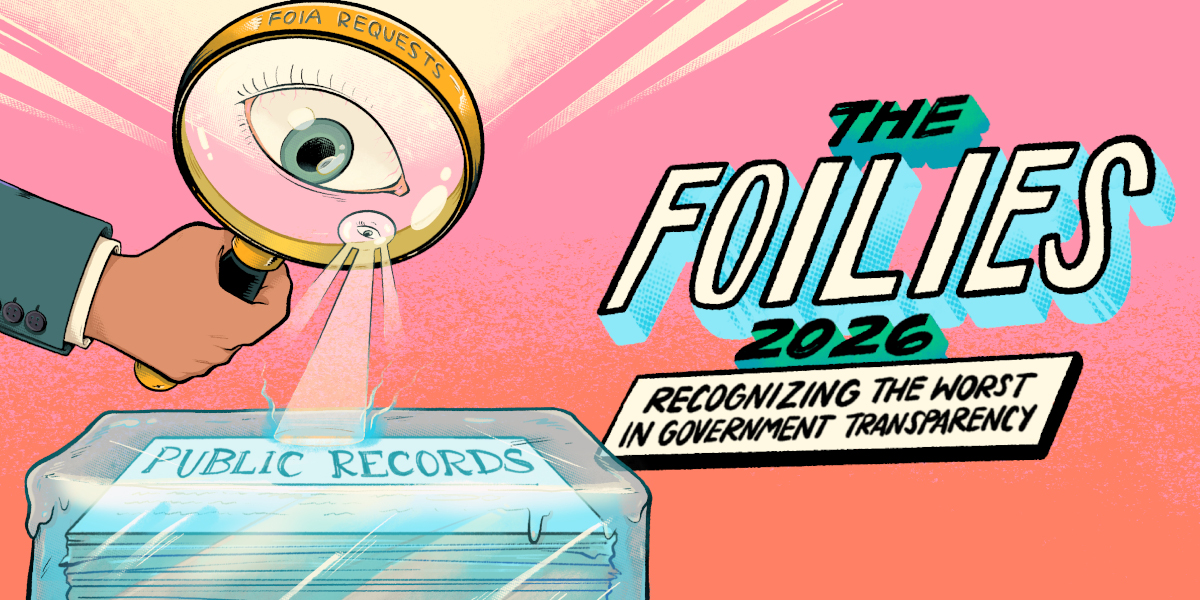
The Foilies 2026

Recognizing the Worst in Government Transparency 

The Foilies were written by EFF's Beryl Lipton, Dave Maass and Aaron Mackey and MuckRock's  Dillon Bergin, Kelly Kauffman and Anna Massoglia. Art by Shelby Criswell.

For the last six years, a class of journalism students at the University of Nevada, Reno, has kicked off each semester by filing their first Freedom of Information Act (FOIA) requests.

The assignment: Request copies of complaints sent to the Federal Communications Commission (FCC) about their favorite TV show, a local radio station, or a major broadcast event, such as the Grammys or the Super Bowl halftime show. The students are learning that the federal government and every state have laws establishing the public's right to request and receive public records. It's a bedrock principle of democracy: If a government belongs to the people, so do its documents. 

In the past, the FCC always provided records within a few weeks, if not days. But that changed in September when students requested consumer complaints filed against NPR and PBS stations to see if there was absolutely anything at all to merit defunding public media. Seven months later — crickets. 

Now the students are learning to persevere even when public officials demonstrate an utter disdain for transparency. And The Foilies are here for it. 

Established in 2015, The Foilies are an annual project by the Electronic Frontier Foundation and MuckRock to recognize the agencies, officials and contractors that thwart the public's right to know. We give out these tongue-in-cheek "awards" during Sunshine Week (March 15-21), a collective effort by media and advocacy organizations to highlight the importance of open government.  

This year, we've got a few "winners" whose behavior defies belief. 

But it's not all negative. Those same Reno students are also assigned to file public records requests for restaurant health inspections. This semester, the records started to show up in their inboxes within 20 minutes. 

If every agency followed Northern Nevada Public Health's example, we could sunset this Sunshine Week project. 

Quick links:

The Love Letters Award - Gov. Greg Abbott 

An illustration of Texas Gov. Greg Abbott holding up a redacted letter to Elon Musk.

Last spring, the office of Texas Gov. Greg Abbott withheld communications between himself and one of the state’s most powerful business figures, Elon Musk. The office claimed that the communications were exempt from public records law because they would reveal confidential legal and policy discussions, including how the state entices private companies to do business in Texas, or “intimate and embarrassing” information.

The claims were unelaborated boilerplate language based on exemptions in Texas’ public records law. But if you’re wondering what "intimate" and “embarrassing” exchanges Abbott and Elon Musk shared over email, you may be waiting a while. 

Last fall, the Office of the Texas Attorney General ordered Texas Gov. Greg Abbott’s office to release nearly 1,400 pages of communications between Abbott and Musk. About 1,200 of those pages were fully redacted–just sheets of gray obscuration. The records that were released don’t reveal much more than an invitation to a happy hour or a reminder of the next SpaceX launch.

The Surcharge, Eh? Award - Vancouver, B.C. 

Vancouver residents must now pay twice for public records. Despite taxes already funding the creation and storage of government records, the City Council approved charging people $10 Canadian (about $7.33 in the United States) every time they ask for “non-personal” public records.

Officials claim the fee is necessary to deter misuse and cover some administrative costs. The only people abusing anything, however, are the officials who imposed this tax on the public. The message Vancouver is sending is as crisp as a newly minted $10 note: Secrecy is a higher priority than public accountability.

The Shady Screenshot Award - Department of Homeland Security 

The Department of Homeland Security’s banner year of lawlessness included backsliding on its transparency obligations.

In response to a request from the nonprofit American Oversight, DHS stated that it was no longer automatically archiving text messages sent between officials. The department clarified that it had a new, and much worse, records retention policy. Instead of archiving officials’ text messages as the agency had done before, DHS now asks officials to take screenshots of any text messages conducting government business on their work phones. 

It’s hard to see the change as anything more than a giant middle finger to the public, especially because the Federal Records Act requires agencies to retain all records officials create while conducting their public duties, regardless of format. We won’t hold our breath waiting on DHS officials to dutifully press the volume and power button on their phones to record every text message they send and receive. 

The Discardment of Government Efficiency Award - DOGE 

As the Trump administration took over last year, there was a looming threat over government transparency: the so-called Department of Government Efficiency, also known as DOGE. 

Billionaire Elon Musk, soon to be the de facto leader of DOGE, proudly claimed “there should be no need for FOIA requests” and “all government data should be default public for maximum transparency.” What quickly became apparent was there may be no need for FOIA requests, because there may be no FOIA officers to fulfill those requests.

DOGE quickly went to work slashing through the federal government, including seizing control of the U.S. Institute of Peace. Part of the takeover included restricting access to the agency’s FOIA system and firing the employees responsible for fulfilling FOIA requests, according to a letter sent to Bloomberg reporter Jason Leopold. Meanwhile, when CNN filed a FOIA request with the Office of Personnel Management (OPM) for information about Musk and DOGE's security clearance, they were told: "Good luck with that," because the FOIA officers had been fired. 

DOGE also argued that its own records are exempt from FOIA under the Presidential Records Act, meaning records cannot be accessed until five years after President Donald Trump is out of office. 

While DOGE “doesn’t exist” anymore according to the OPM, there remains a lasting dark mark on the state of FOIA and records management. 

The Secret Eyes in the Sky Award - Chula Vista Police Department, Calif.

An illustration of a quadrotor drone with an eye and a badge.

In 2021, Arturo Castañares at La Prensa San Diego filed a request with the Chula Vista Police Department for copies of videos taken by drones responding to 911 calls as part of the city's "drone as first responder" program. One of the goals was to evaluate the technology’s efficacy and risks to civil liberties. 

The city worked overtime to maintain the secrecy of the footage at the same time officials publicly touted the drones as a revolution in policing. That’s some impressive trust-us-but-don’t-verify chutzpah.

The city argued that every second of every video recorded by its drones was categorically off limits because they were law enforcement investigative records. They even got a trial court to initially buy the argument.

But an appellate court ruled that the investigatory records exemption is more limited, shielding only drone footage that is part of a criminal investigation or evidence of a suspected crime. Footage of wildfires, car wrecks, wild animal sightings and the like are not criminal investigations and must be disclosed.

The California Supreme Court rejected both of CVPD's appeals and a trial court bench slapped the city for inaccurate and incomplete court filings. In the end, the city had to shell out north of $400,000 to its outside lawyers, and then paid Castañares’ lawyers more than $500,000 when he prevailed. 

So what were Chula Vista police hiding? A bunch of routine service calls, such as unverified reports of a vehicle fire and a vehicle collision.

Now, according to La Prensa's reporting, officials are trying to raid a public safety fund created by voters to reimburse the city for the cost of its ill-advised secrecy. 

The City of Darkness Award - Richmond, Va. 

Richmond’s creation of a new FOIA Library may seem like a step toward transparency, but there are questions about the city’s commitment after it left the same officials subject to records requests in charge of curating which records might be released.

Faced with a plan to post all of the city’s eligible public records released under Virginia’s “sunshine” law, the Richmond City Council instead opted to go with the mayor’s alternative proposal. That plan lets the mayor’s administration — the same one that might be the subject of those records — decide what’s worth posting to the library.

Instead of providing access to all public records that the city released under the Virginia Freedom of Information Act, the library will only contain a subset that officials believe meet certain criteria, including records that the administration deems "relevant" to city business or that would aid "accountability.” The city cites concerns that "transparency without context" might be too confusing for the average citizen. Forgive us for having more faith in Richmond residents than its leaders do.

The city’s secrecy shenanigans extend beyond the FOIA library.

In an ongoing legal battle, attorneys representing Richmond asked a judge to prohibit former city FOIA officer Connie Clay from filing FOIA requests seeking information about her firing, and sought a gag order to prevent her from talking about the case. Clay alleges she was fired for insisting the city comply with public records law, describing what she calls a “chaotic and mismanaged” and illegal FOIA request process. Rather than agree to a $250,000 settlement, Richmond has spent more than $633,000 in taxpayer funds on legal costs. The trial and the FOIA library launch are both slated for the summer of 2026. 

The Flock You Awards - Multiple Winners

 A police officer with dollar-sign sunglasses holding his hand out for money.

If you live in one of the 5,000 cities where surveillance vendor Flock Safety claims to have established relationships with local cops, you may have noticed the sudden installation of little black cameras on poles by the side of the road or at intersections. These are automated license plate readers (ALPRs), which document every vehicle that passes within view, including the license plate, color, make, model and other distinguishing characteristics. The images are fed to Flock's servers, and the company encourages police to share the images collected locally with law enforcement throughout the country. Each year, law enforcement agencies across the country conduct tens of millions of searches of each other's databases. 

In 2025, journalists and privacy advocates started filing public records requests with agencies to get spreadsheets called a "Network Audit," which shows every search, including who ran it and why. Accessing these audits uncovered abuse of the system including: investigating a woman who received an abortion, targeting immigrants, surveilling protesters, and running racist searches targeting Roma people

In response, some cities have terminated their contracts with Flock Safety. Other law enforcement agencies, and Flock itself, have gone a different direction: 

Taunton Police Department, Mass.: The police department told the ACLU of Massachusetts to cough up $1.8 million if the organization wanted its network audit logs–the highest public records fee we documented this year. The civil liberties group filed requests with agencies throughout the state for the audits, and most agencies handed over the spreadsheets for free and with little fanfare. Taunton, however, said it would take 20,000 hours to process the request, at $86.57 an hour. 

Orange County Sheriff's Department, Calif.: The Orange County Sheriff gave a number of reasons it wouldn't release the network audit logs in response to a public records request. The most inane (and misspelled one): It would "disincentive law enforcement from conducting such research." Aren't cops the ones who say if you’re not doing anything wrong, you've got nothing to hide? Well, well, well, how the tables have turned.

Flock Safety: The company responded to criticisms of its ALPR network by sending legal threats aimed at trying to silence its critics. First, the company used a bogus trademark claim to threaten DeFlock.me–a crowdsourced map of ALPR. (EFF represented its creator.) Then it hired a company to try to get the hosts of HaveIBeenFlocked.com, which hosts an interface for searching these network audits, to remove the site from the internet. 

The Database Deletion Award - Muneeb and Sohaib Akhter, formerly of Opexus

Brothers Muneeb and Sohaib Akhter are accused of essentially hitting delete on government data, destroying access to information contained in millions of records. 

The government hired a federal contractor called Opexus, which hosts data and provides services to dozens of federal agencies. The company employed the Akhter siblings, though in February 2025, Opexus learned about the brothers’ previous convictions for wire fraud and obstructing justice. Soon after, the company fired the pair. But, according to prosecutors, the two decided to double down on being wildly unsuited for administrative access to government records systems. 

The Akhters immediately turned around and retaliated “by accessing computers without authorization, issuing commands to prevent others from modifying the databases before deletion, deleting databases, stealing information, and destroying evidence of their unlawful activities," according to the U.S. Department of Justice.

The two have been accused of deleting 96 government databases, many of which contained FOIA records and sensitive investigative files. Their indictment alleges that a minute later, one brother queried an artificial intelligence tool for “how to clear system logs following the deletion of databases.” The brothers are also charged with stealing government records and conspiracy to commit computer fraud. 

The Brothers Akhter allegedly took mere moments to destroy untold amounts of information that belonged to the public. Though they could face decades in prison, the public may never know the extent of the damage.

Want more FOIA horror stories? Check out The Foilies archives!

  •  

On Its 30th Birthday, Section 230 Remains The Lynchpin For Users’ Speech

For thirty years, internet users have benefited from a key federal law that allows everyone to express themselves, find community, organize politically, and participate in society. Section 230, which protects internet users’ speech by protecting the online intermediaries we rely on, is the legal support that sustains the internet as we know it.

Yet as Section 230 turns 30 this week, there are bipartisan proposals in Congress to either repeal or sunset the law. These proposals seize upon legitimate concerns with the harmful and anti-competitive practices of the largest tech companies, but then misdirect that anger toward Section 230.

But rolling back or eliminating Section 230 will not stop invasive corporate surveillance that harms all internet users. Killing Section 230 won’t end to the dominance of the current handful of large tech companies—it would cement their monopoly power

The current proposals also ignore a crucial question: what legal standard should replace Section 230? The bills provide no answer, refusing to grapple with the tradeoffs inherent in making online intermediaries liable for users’ speech.

This glaring omission shows what these proposals really are: grievances masquerading as legislation, not serious policy. Especially when the speech problems with alternatives to Section 230’s immunity are readily apparent, both in the U.S. and around the world. Experience shows that those systems result in more censorship of internet users’ lawful speech.

Let’s be clear: EFF defends Section 230 because it is the best available system to protect users’ speech online. By immunizing intermediaries for their users’ speech, Section 230 benefits users. Services can distribute our speech without filters, pre-clearance, or the threat of dubious takedown requests. Section 230 also directly protects internet users when they distribute other people’s speech online, such as when they reshare another users’ post or host a comment section on their blog.

It was the danger of losing the internet as a forum for diverse political discourse and culture that led to the law in 1996. Congress created Section 230’s limited civil immunity  because it recognized that promoting more user speech outweighed potential harms. Congress decided that when harmful speech occurs, it’s the speaker that should be held responsible—not the service that hosts the speech. The law also protects social platforms when they remove posts that are obscene or violate the services’ own standards. And Section 230 has limits: it does not immunize services if they violate federal criminal laws.

Section 230 Alternatives Would Protect Less Speech

With so much debate around the downsides of Section 230, it’s worth considering: What are some of the alternatives to immunity, and how would they shape the internet?

The least protective legal regime for online speech would be strict liability. Here, intermediaries always would be liable for their users’ speech—regardless of whether they contributed to the harm, or even knew about the harmful speech. It would likely end the widespread availability and openness of social media and web hosting services we’re used to. Instead, services would not let users speak without vetting the content first, via upload filters or other means. Small intermediaries with niche communities may simply disappear under the weight of such heavy liability.

Another alternative: Imposing legal duties on intermediaries, such as requiring that they act “reasonably” to limit harmful user content. This would likely result in platforms monitoring users’ speech before distributing it, and being extremely cautious about what they allow users to say. That inevitably would lead to the removal of lawful speech—probably on a large scale. Intermediaries would not be willing to defend their users’ speech in court, even it is entirely lawful. In a world where any service could be easily sued over user speech, only the biggest services will survive. They’re the ones that would have the legal and technical resources to weather the flood of lawsuits.

Another option is a notice-and-takedown regime, like what exists under the Digital Millennium Copyright Act. That will also result in takedowns of legitimate speech. And there’s no doubt such a system will be abused. EFF has documented how the DMCA leads to widespread removal  https://www.eff.org/takedownsof lawful speech based on frivolous copyright infringement claims. Replacing Section 230 with a takedown system will invite similar behavior, and powerful figures and government officials will use it to silence their critics.

The closest alternative to Section 230’s immunity provides protections from liability until an impartial court has issued a full and final ruling that user-generated content is illegal, and ordered that it be removed. These systems ensure that intermediaries will not have to cave to frivolous claims. But they still leave open the potential for censorship because intermediaries are unlikely to fight every lawsuit that seeks to remove lawful speech. The cost of vindicating lawful speech in court may be too high for intermediaries to handle at scale.

By contrast, immunity takes the variable of whether an intermediary will stand up for their users’ speech out of the equation. That is why Section 230 maximizes the ability for users to speak online.

In some narrow situations, Section 230 may leave victims without a legal remedy. Proposals aimed at those gaps should be considered, though lawmakers should pay careful attention that in vindicating victims, they do not broadly censor users’ speech. But those legitimate concerns are not the criticisms that Congress is levying against Section 230.

EFF will continue to fight for Section 230, as it remains the best available system to protect everyone’s ability to speak online.

  •  

States Tried to Censor Kids Online. Courts, and EFF, Mostly Stopped Them: 2025 in Review

Lawmakers in at least a dozen states believe that they can pass laws blocking  young people from social media or require them to get their parents’ permission before logging on. Fortunately, nearly every trial court to review these laws has ruled that they are unconstitutional.

It’s not just courts telling these lawmakers they are wrong. EFF has spent the past year filing friend-of-the-court briefs in courts across the country explaining how these laws violate young people’s First Amendment rights to speak and get information online. In the process, these laws also burden adults’ rights, and jeopardize everyone’s privacy and data security.

Minors have long had the same First Amendment rights as adults: to talk about politics, create art, comment on the news, discuss or practice religion, and more. The internet simply amplified their ability to speak, organize, and find community.

Although these state laws vary in scope, most have two core features. First, they require social media services to estimate or verify the ages of all users. Second, they either ban minor access to social media, or require parental permission. 

In 2025, EFF filed briefs challenging age-gating laws in California (twice), Florida, Georgia, Mississippi, Ohio, Utah, Texas, and Tennessee. Across these cases we argued the same point: these laws burden the First Amendment rights of both young people and adults. In many of these briefs, the ACLU, Center for Democracy & Technology, Freedom to Read Foundation, LGBT Technology Institute, TechFreedom, and Woodhull Freedom Foundation joined.

There is no “kid exception” to the First Amendment. The Supreme Court has repeatedly struck down laws that restrict minors’ speech or impose parental-permission requirements. Banning young people entirely from social media is an extreme measure that doesn’t match the actual risks. As EFF has urged, lawmakers should pursue strong privacy laws, not censorship, to address online harms.

These laws also burden everyone’s speech requiring users to prove their age. ID-based systems of access can lock people out if they don’t have the right form of ID, and biometric systems are often discriminatory or inaccurate. Requiring users to identify themselves before speaking also chills anonymous speech—protected by the First Amendment, and essential for those who risk retaliation. 

Finally, requiring users to provide sensitive personal information increases their risk of future privacy and security invasions. Most of these laws perversely require social media companies to collect even more personal information from everyone, especially children, who can be more vulnerable to identify theft.

EFF will continue to fight for the rights of minors and adults to access the internet, speak freely, and organize online.

This article is part of our Year in Review series. Read other articles about the fight for digital rights in 2025.

  •  

Lawmakers Must Listen to Young People Before Regulating Their Internet Access: 2025 in Review

State and federal lawmakers have introduced multiple proposals in 2025 to curtail or outright block children and teenagers from accessing legal content on the internet. These lawmakers argue that internet and social media platforms have an obligation to censor or suppress speech that they consider “harmful” to young people. Unfortunately, in many of these legislative debates, lawmakers are not listening to kids, whose experiences online are overwhelmingly more positive than what lawmakers claim. 

Fortunately, EFF has spent the past year trying to make sure that lawmakers hear young people’s voices. We have also been reminding lawmakers that minors, like everyone else, have First Amendment rights to express themselves online. 

These rights extend to a young person’s ability to use social media both to speak for themselves and access the speech of others online. Young people also have the right to control how they access this speech, including a personalized feed and other digestible and organized ways. Preventing teenagers from accessing the same internet and social media channels that adults use is a clear violation of their right to free expression. 

On top of violating minors’ First Amendment rights, these laws also actively harm minors who rely on the internet to find community, find resources to end abuse, or access information about their health. Cutting off internet access acutely harms LGBTQ+ youth and others who lack familial or community support where they live. These laws also empower the state to decide what information is acceptable for all young people, overriding parents’ choices. 

Additionally, all of the laws that would attempt to create a “kid friendly” internet and an “adults-only” internet are a threat to everyone, adults included. These mandates encourage an adoption of invasive and dangerous age-verification technology. Beyond creepy, these systems incentivize more data collection, and increase the risk of data breaches and other harms. Requiring everyone online to provide their ID or other proof of their age could block legal adults from accessing lawful speech if they don’t have the right form of ID. Furthermore, this trend infringes on people’s right to be anonymous online, and creates a chilling effect which may deter people from joining certain services or speaking on certain topics

EFF has lobbied against these bills at both the state and federal level, and we have also filed briefs in support of several lawsuits to protect the First Amendment Rights of minors. We will continue to advocate for the rights of everyone online – including minors – in the future.

This article is part of our Year in Review series. Read other articles about the fight for digital rights in 2025.

  •  
❌