❌

Reading view

New Records Obtained by EFF Expose More Problems with Medicare’s AI Experiment

New records obtained by EFF expose additional issues with Medicare’s AI-driven prior authorization program and show why we need stronger legal limits around government use of automated decision-making. 

EFF sued the government back in March for information about the Wasteful and Inappropriate Service Reduction (WISeR) model, a new Medicare program that uses AI to evaluate prior authorization requests for certain medical services. We previously released records showing that WISeR has resulted in delays and denials of care, operational chaos, and reports of patient harm. Today, we’re publishing over 800 new pages of records, including:

  • Requests for information (RFIs) or requests for corrective action plans (CAPs) sent from the Centers for Medicare & Medicaid Services (CMS) to four of the six WISeR vendors, along with the vendors’ responses.
  • Applications of 66 companies to the WISeR model, including those of the 6 selected companies. 
  • Task orders and contracts for the evaluation, implementation, and monitoring of the WISeR model.

Documents obtained through EFF’s lawsuit are available here.

These newly released documents show that the WISeR rollout was rushed and rocky from the start, highlighting the dangers that arise when governments treat AI like a silver bullet for complex problems. The documents also highlight the need for more transparency about safeguards against inappropriate, AI-driven denials. The public still lacks the information needed to assess whether clinician review is providing meaningful oversight of AI systems and whether appropriate data is being used to evaluate prior authorization requests. 

EFF has long argued that AI has no place in consequential government decisions about peoples’ rights or access to benefits, such as immigration enforcement and policing decisions. That’s because using automated decision-making in these contexts risks decisions that violate people’s rights or deprive them of benefits they’re entitled to based on biased or inappropriate considerations and without proper due process or accountability if there is an error. 

By outsourcing decision-making to private AI companies without sufficient transparency, testing, or legal limits, WISeR jeopardizes seniors’ access to medical care. Congress should step in to place greater legal limits on the use of automated decision-making in Medicare. 

WISeR’s Rollout Was Rushed and Rocky 

CMS launched the WISeR program just six months after announcing it, ignoring calls from medical providers to delay its rollout. In records previously released by EFF, CMS acknowledged this “extremely condensed timeline.” 

New records suggest that WISeR’s unusually rapid rollout contributed to widespread problems in the first few months of the program. CMS did not disclose the extent of these issues to the public, even as agency employees privately contacted vendors about potential noncompliance with program requirements. 

In the first three months of the program, CMS sent RFIs or requests for CAPs to at least four of the six WISeR vendors. These requests, which describe delays, technical failures, and a lack of communication with providers, suggest that widespread problems during the program’s rollout were not limited to one vendor or state. 

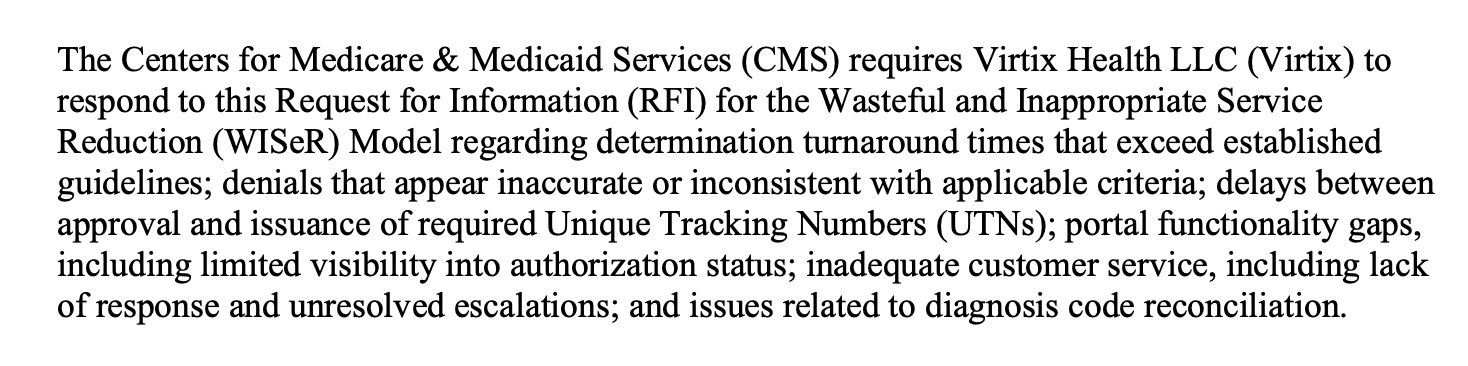
These letters underscore the severity of the problems with the program. For example, CMS requested information from one vendor, Virtix, about numerous reported issues, including “determination turnaround times that exceed established guidelines,” “denials that appear inaccurate or inconsistent with applicable criteria,” and “inadequate customer service.” CMS’s RFI to Zyter–a vendor that uses Palantir software infrastructure–observed that the agency had received reports that “Zyter is not issuing determination letters in a timely manner” and communications indicating that it “may lack adequate processes for responding to and escalating provider/supplier concerns.” The vendor Innovaccer received two CAP requests and a “Performance Notice of Non-Compliance” over its failure to implement a fully functional portal for WISeR providers and suppliers.

Excerpts from CMS’ letters to vendors describe problems during WISeR’s rollout:

Excerpt from the RFI for Virtix, March 17, 2026
Excerpt from the RFI for Zyter, February 27, 2026
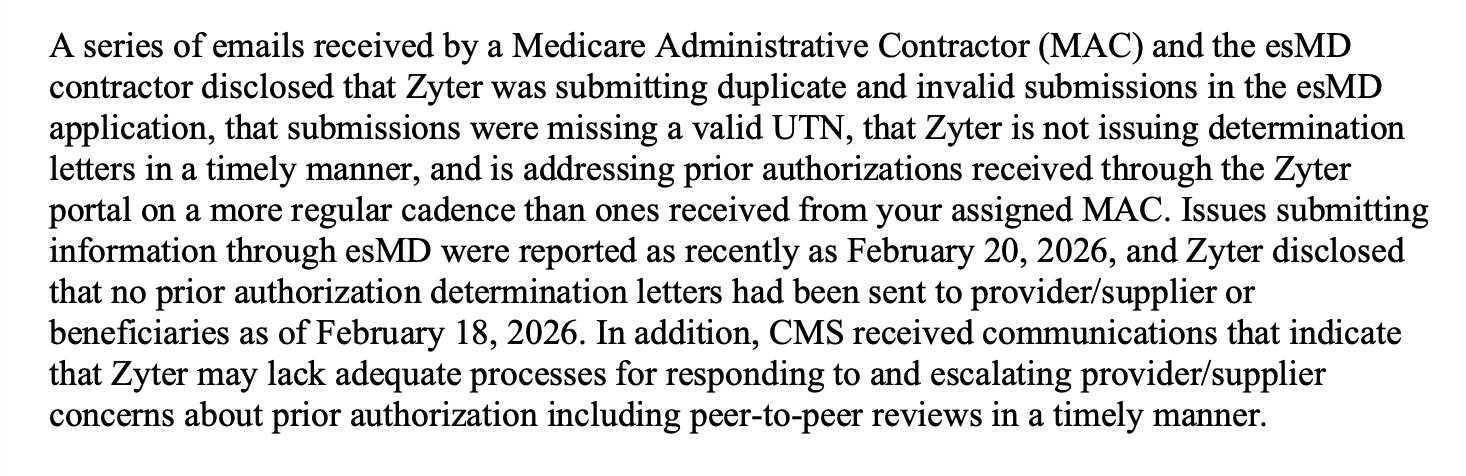
Excerpt from the Performance Notice of Non-Compliance for Innovaccer, February 20, 2026

Vendors’ responses to CMS provide further evidence that WISeR’s rushed rollout contributed to its problems. Innovaccer claimed it warned CMS months in advance that it might not be ready to provide full portal functionality by the launch date, even before signing a Participation Agreement. Another vendor claimed that “technical and workflow stabilization challenges were encountered due to the compressed implementation timeframe” it faced after joining the WISeR program a month after the other vendors. 

Excerpt from Innovaccer’s Proposed CAP, January 16, 2026
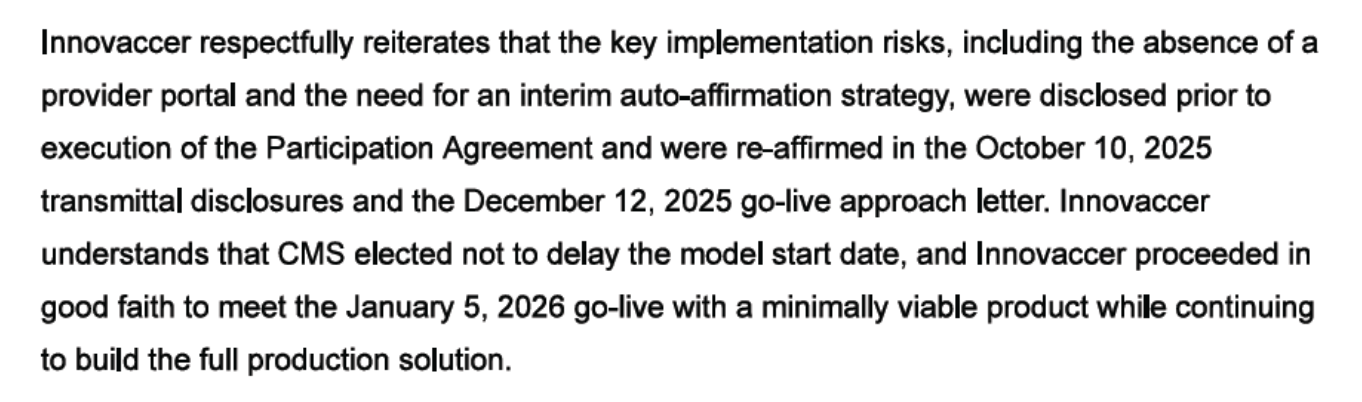
The issues reflected in CMS’s letters to vendors, and the vendors’ responses, illustrate the risks of deploying automated decision-making systems without proper testing or safeguards. While vendors’ responses describe fixes for the problems CMS identified, after-the-fact remedies cannot undo the harms that patients and providers already experienced during WISeR’s rushed rollout. 

More Transparency Needed About AI Safeguards

The public still knows far too little about any safeguards that WISeR vendors may have adopted—in part because the government chose to conceal some of this information. Transparency about these safeguards is critical to protecting patients, especially because WISeR’s payment structure gives vendors, as the government put it, “an incentive to deny as many claims as possible.” 

 Information provided by a vendor about safeguards that it says "ensure the responsible and clinically appropriate application of automation” appears to have been redacted from records released to EFF

The public has limited means to evaluate the effectiveness of even the safeguards that weren’t redacted from records released to EFF. For example, one vendor’s application touts safeguards like “Human-in-the-loop (HITL) workflows,” “Continuous model monitoring,” and “Transparent audit trails.” Yet it remains unclear whether these measures effectively prevent improper prior authorization denials. Some evidence suggests they may not: the company denied more requests than it approved in the first few months of the program, and CMS inquired about “denials that appear inaccurate or inconsistent with applicable criteria.”

Ultimately, the records obtained by EFF raise more questions than they answer about the safeguards used by WISeR vendors. 

Having a Human in the Loop Is Probably Not Enough

CMS has emphasized having a human in the loop as a key safeguard against inappropriate, AI-driven denials. The WISeR FAQ page on the CMS website states that “Non-affirmations will require the review of a human clinician and cannot be performed solely by technology.” But whether human review provides any meaningful protection depends on the details of its implementation, such as whether human reviewers have enough time to evaluate requests and practical authority to override AI recommendations. We still lack many of those details for WISeR vendors. 

A growing body of scholarship points to the substantial limitations of “human in the loop” policies as guardrails for AI systems. AI-generated recommendations can unduly influence human decisions, leading reviewers to over-rely on automated judgements and rubber stamp them as correct. Even worse, at least one health insurance company actively pressured clinical reviewers to accept its AI systems’ recommendations. Another company built a system that allowed clinical reviewers to reject claims without opening patient files; clinical reviewers using this system spent an average of just 1.2 seconds on each case.

Is the Right Kind of Data Informing Companies’ Decisions?

Some WISeR vendors’ applications offer general descriptions of the types of data informing their decisions. But far more details are needed to allow medical professionals to assess whether the data inputs to these AI systems are appropriate for evaluating prior authorization requests. 

Inappropriate training data or input data can lead to biased, unfair, or inaccurate decisions. CMS guidance for Medicare Advantage organizations using AI to make coverage decisions emphasizes the importance of basing decisions on individual patients’ circumstances. It cautions against using “an algorithm that determines coverage based on a larger data set instead of the individual patient's medical history, the physician’s recommendations, or clinical notes.” 

WISeR vendors’ applications reference data sources like “provider behavior,” “patient demographics,” “utilization management datasets,” “provider and payer performance metrics,” and “historical claims data.” Whether these sources could introduce bias or give too much weight to population-level patterns depends on how vendors use them to inform individual decisions. But we don’t yet have these important details about vendors’ data and algorithms. By outsourcing decision-making to private companies’ AI systems, the government has made it harder for the public to evaluate whether decisions are being made fairly.

Next Steps

As the government expands its use of automated decision-making, the potential for consequential mistakes increases rapidly. The records we’ve obtained so far raise questions about the rushed rollout and lack of guardrails for automated decision-making by the U.S. government. EFF urges transparency, oversight, and legal limits to protect people from the harms of automated decision-making in high risk systems.  

Related Cases: 

  •  

New Records Reveal Problems with Medicare’s AI Prior Authorization Experiment

EFF sued the government back in March for information about the Wasteful and Inappropriate Service Reduction (WISeR) model, a new Medicare program that uses AI to evaluate prior authorization requests for certain medical services. Today, we’re releasing approximately 1,000 pages of records obtained from the Centers for Medicare & Medicaid Services (CMS) through this litigation, including contracts with tech companies, internal status reports and providers’ complaints about the program. The documents (available here) show that WISeR has resulted in widespread delays and denials of care, operational chaos, and reports of patient harm.

Why We Sued for Records about WISeR

EFF filed the FOIA lawsuit to gain badly needed transparency into an experimental AI program that could jeopardize Medicare beneficiaries' access to care. In January 2026, CMS launched the WISeR model, subjecting seniors in six states to AI-driven prior authorization decisions. Medical providers must now request permission before delivering certain medical treatments if they want assurance that Medicare will cover them. Private companies contracted by CMS evaluate the requests using AI. In the absence of rigorous safeguards, AI-driven prior authorization determinations can lead to unwarranted—and even discriminatory—delays or denials of necessary medical care. 

Little is known about the AI systems that WISeR vendors are using to process prior authorization requests. Although CMS says that a qualified human clinician must review all denials, research has shown that AI-generated recommendations often influence human decisions. And the design of the WISeR program creates a financial incentive for vendors to deny care, since they are paid for averted expenditures. Just months after the program launched, medical providers reported improper denials, administrative friction, and lengthy delays that have left patients waiting in pain.

EFF’s FOIA request sought records pertaining to the CMS contracts with WISeR software vendors; any tests for accuracy, bias, or hallucinations in vendors' technology; and any audits, monitoring, or evaluation of WISeR and participating vendors.

CMS Documents Highlight Issues with the WISeR Model

CMS records obtained by EFF echo issues that medical providers, patient advocates, and lawmakers have warned about since WISeR began. This includes long wait times, rampant technical failures, inappropriate denials, and harm to patients.

Delayed Responses to Prior Authorization Requests

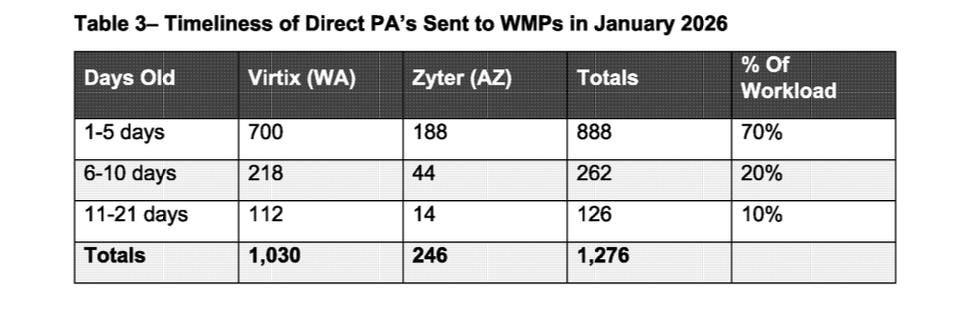
CMS publicly states that WISeR vendors should respond to prior authorization requests within 72 hours, but records received by EFF show widespread delays. Internal status reports from the first few months of the program show that a significant number of prior authorization requests took far longer than 72 hours to resolve. One status report cites a prior authorization request that went unanswered for 83 days ("WISeR FOIA Response - Combined Records," page 234). These delayed responses can have serious consequences for patients. Medical providers reported that WISeR has delayed medically necessary care and left patients in pain as they waited for approvals.

Timeliness data for two WISeR vendors in January 2026 show that a significant number of requests did not receive a response within 72 hours (WISeR FOIA Response - Combined Records, page 410)

Payment Methodology Provides Financial Incentive to Deny Care 

The released records confirm that WISeR’s payment methodology creates a financial incentive to deny care. Specifically, WISeR vendors are paid for requests that they deny (though not for denials reversed on appeal). This profit motive aggravates the risk that AI-assisted decision-making may unfairly deprive people of the services they need.

CMS publicly claims that it safeguards against inappropriate denials by tying vendors’ payment rates to “quality scores,” which reflect the timeliness and accuracy of vendors’ decisions. However, the recently released WISeR Data Reporting Guide shows that low quality scores reduce payments by only 5-10%.

Impact of low quality scores on payment rates described in the WISeR Data Reporting Guide (WISeR FOIA Response - Combined Records, page 99)

WISeR Vendors Have Denied Thousands of Prior Authorization Requests

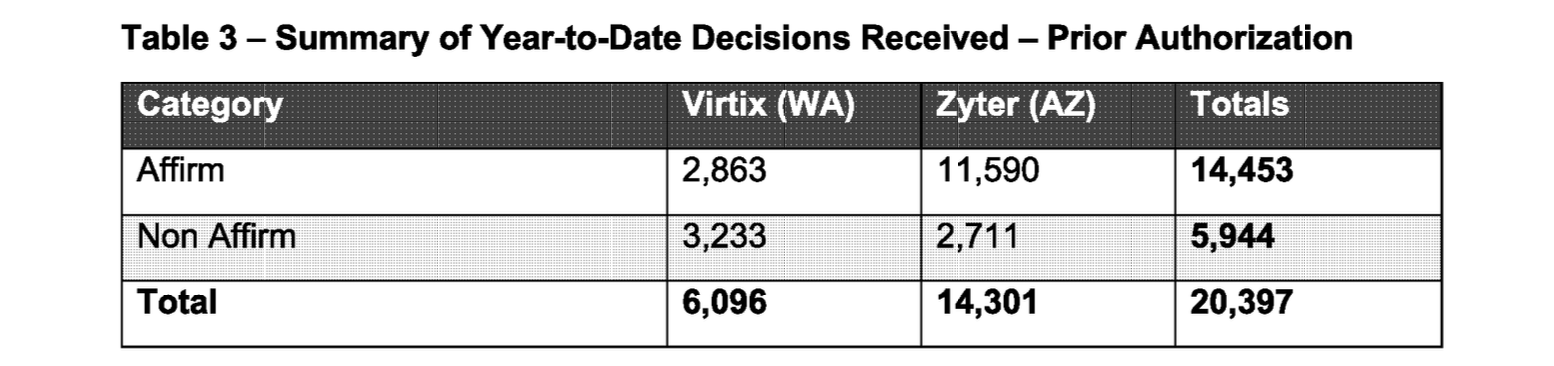
Documents obtained by EFF appear to support reports that WISeR vendors may be denying claims at unusually high rates. Two companies alone denied 5,944 prior authorization requests in the first 3 months of the program. One company, Virtix, the vendor that CMS required to submit a Corrective Action Plan, denied more requests than it approved during this time period.

Prior authorization decision data for two vendors in a March 30th, 2026 status report (WISeR FOIA Response - Combined Records, page 322)

Medical Provider Feedback Ties WISeR Delays to Patient Harm

Feedback from medical providers emphasize that WISeR delays have harmed patients. The released records include March 2026 responses to a feedback form about Innovaccer, the WISeR vendor processing requests for Ohio. Medical providers complained about a lack of communication, administrative issues, and long response times. Several responses emphasize that long response times from the WISeR vendor harmed patients ("WISeR FOIA Response - Feedback Survey Responses"):

“We have patients calling our offices crying in pain because their procedures are being delayed while awaiting approvals or guidance tied to this model. A 3–4 day delay for necessary pain procedures is already difficult for vulnerable patients, but when providers cannot obtain answers for weeks, the situation becomes unacceptable.”

“I HAVE HAD TO WATCH 3 PATIENTS CRY AT BEDSIDE FOR NOT HEARING BACK ON THEIR PRIOR AUTH FOR KYPHOPLASTY/VERTABRAL AUGMENTIATION PROCEDURE. THESE PATIENTS ARE IN DEEP PAIN.”

“I have had cases submitted and waiting over 1 1/2 months for a UTN to be generated… In the meantime patients are having to be cancelled for surgeries they need. This is not acceptable they are severely hindering patient care.”

Rushed Rollout Amidst Widespread Technical Failures 

CMS WISeR launched in January 2026, just six months after it was announced. Despite warnings from both medical providers and a vendor about insufficient preparation time, CMS chose not to delay the launch. 

Approximately a month before the launch, one of the vendors, Innovaccer, alerted CMS that it intended to go live with a version of its software that lacked full functionality and had not been fully tested. It cited several barriers to going live with full functionality, including changing requirements and expectations, unclear governance processes, and lack of time for end-to-end testing with the provider community ("WISeR FOIA Response - Combined Records,", page 216-217). Innovaccer said it would auto-affirm all prior authorization requests until it could develop full functionality and explained that “Given CMS's decision not to delay the model start date, auto-affirming is the only path available” ("WISeR FOIA Response - Combined Records," page 217).

Innovaccer had not yet finished developing or testing some features several months into the program, according to an April 2026 status report. Innovaccer was not the only vendor who faced technical challenges before and after WISeR launched. Weekly status reports and provider feedback in the released records show widespread challenges associated with WISeR’s rushed rollout (for example, "WISeR FOIA Response - Combined Records," pages 238 and 383).

A status report from April 6th, 2026 describes issues with incomplete solutions from Innovaccer (WISeR FOIA Response - Combined Records, page 200)

More Urgent Medical Services Considered for Inclusion in Future Years of WISeR Model

In its first year, the WISeR model introduced prior authorization requirements for a set of 13 medical services. The June 2025 Innovation Center Investment Plan for WISeR lists medical services that could be added to the program in future years. This planning document considers the possibility of adding services “where prior authorization would have to be done on a more urgent or emergent basis,” including air ambulance transport, cancer treatment, MRI scans, and medications without publicly available coverage criteria.

A planning document from June 2025 lists ideas for the expansion of WISeR to additional medical services (WISeR FOIA Response - Combined Records, page 22)

More Transparency is Needed About Medicare’s AI Experiment

CMS continues to produce records in response to EFF’s lawsuit. Records released thus far echo concerns that providers have raised since WISeR launched, including long delays, financial incentives to deny care, and technical problems. But important questions remain about the AI systems private companies are using to inform decisions about whether to provide people with Medicare benefits. As CMS continues to produce documents, we will continue to make them available to the public. The public deserves to know how AI is driving decisions that affect patients’ access to care.

Correction: An earlier version of this post misstated the number of prior authorization requests that had been denied by two WISeR vendors in the first three months of the program. This version has been corrected to reflect that the number of denials was 5,944. The post has also been updated to clarify that reported turnaround times reflect the full request pathway and are not solely controlled by WISeR vendors.

Related Cases: 

  •  

Most Smart Watches, Rings, and Bands Lack Basic Transparency Reports and Key Privacy Features

Oura Rings, Garmin GPS fitness watches, Apple Watches, Whoop bands—every year, more and more tech devices are promising to monitor our health and fitness, guide us toward healthier living, and provide useful health metrics to take to our doctors. But few of these tools provide the sorts of privacy and security promises we demand from all technology, let alone tech that captures personal health data. It’s time they step up and start providing transparency reports and stronger encryption options.

Surveys suggest that around 40 percent of people in the United States own some sort of commercially available wearable health device. Despite being marketed as health devices, they have no special health-related privacy protections that one might hope for. The companies who make these devices can and do collect an abundance of data, and many of them share that data with third-parties for marketing or to influence insurance rates, or use it for their own purposes, like training artificial intelligence models.

Health data is increasingly an important part of law enforcement or government investigations. Wearable data has been critical in a number of cases, where information about heart rate and steps was used to determine the whereabouts of individuals. And the surveillance company Penlink calls fitness trackers and wearables an “overlooked source” for law enforcement since they tend to show movement patterns and changes in heart rates. Law enforcement can try to get access to this data through subpoenas or warrants. 

There are many potential privacy issues with these sorts of devices, including whether the companies who make them share or sell information to third-parties. But here we are choosing to focus on two facets we’re concerned with around health data itself: 1) whether the company shares information with law enforcement and governments and 2) if they offer end-to-end encryption, which means the company itself can’t access that health data to begin with.

Reading through dozens of product review sites we narrowed our research in on ten companies that seem to make the majority of recommended consumer health products on the market:

  • Amazfit
  • Apple
  • Coros
  • Garmin
  • Google (including Fitbit)
  • Hume
  • Oura
  • Polar
  • Suunto
  • Whoop 

We reviewed each company’s public facing policies, then emailed them to confirm those findings. Here’s what we found.

Transparency Reports Are Few and Far Between

Companies should provide transparency reports of how often they provide data to the government, including information about whether it’s an official demand or an unofficial request. We have been calling on tech companies to publish transparency reports for a long time, but the practice is still rare across the industry. That’s especially true with fitness gadgets. 

Only two of the companies we surveyed, Apple and Google (which also owns Fitbit), currently publish transparency reports. Apple, Google, and Whoop promise to notify users of law enforcement requests in publicly available documentation. 

Oura now does too, after an update to their privacy policy in June 2026 that was perhaps prompted by a series of requests from journalist Zack Whittaker. In that same update and in an email to us, Oura promises that it is “actively evaluating ways to provide greater visibility into how we handle these requests, like through a transparency report.” This is promising, and we hope the company agrees that transparency reports are the best option moving forward. 

Any company that handles data that’s of interest to law enforcement and governments owes it to their users to publish transparency reports and, when legally possible, notify users when that data is requested.

Similarly, Suunto does not currently publish transparency reports, but in an email reply to our questions the company did express an openness to potentially doing so, stating, “We continuously evaluate our transparency practices and may publish additional information, such as a transparency report, in the future if we believe it would provide meaningful value for users and support our data protection efforts.” We hope they do, as these sorts of reports are a useful metric for all of us to better understand if and when our data can potentially be accessed by law enforcement.

We could not find instances where the other companies publicly state a policy around notification or transparency reports, and no others replied to our email questions.

Any company that handles data that’s of interest to law enforcement and governments owes it to their users to publish transparency reports and, when legally possible, notify users when that data is requested. This is especially true of personal health data, which can reveal our movements, and be used to infer details about what we’re doing at any given moment.

End-to-End Encrypted Data Is Far Too Rare of a Feature

End-to-end encryption is a method to ensure that your personal data is only accessible by you, and not the company who makes the device and manages the cloud storage. End-to-end encryption is usually used to refer to message encryption in communication apps, like Signal or WhatsApp, but can also refer to data storage. For example, many password managers use end-to-end encryption, and Ring implemented it for its cameras after we pushed for it. There’s no reason it can’t be offered for wearables too.

In the case of health data from wearable devices, it’s a way to store data in the cloud so that information can be synced and backed up between your device and an app on your phone in a way where only your devices can access it. 

Support for end-to-end encryption is more rare than transparency reports. 

The Apple Watch, at least with data that’s stored in the Health app, is the only popular fitness wearable that supports end-to-end encryption, and it’s enabled by default for all users (you are required to have two-factor authentication enabled as well, but that is also on by default for most accounts).

However, Apple Watch owners should remember that this protection is only for data stored in the Apple Health app. If you use other apps on your watch, or choose to share data with third-parties, like Strava, or if you’re sharing data with other wearables, like an Oura ring, that data is likely not end-to-end encrypted by the third-party company. 

Support for end-to-end encryption is more rare than transparency reports. 

And that’s it. Apple is the only one. No other popular consumer health wearable offers end-to-end encryption for the data it collects and stores online. Not Google. Not Garmin. Not Oura. Most of these companies instead offer encryption in transit and at rest, but this means those companies can still see and use your data. This is the industry standard, but it doesn’t have to be.

Another option would be more robust local-storage options. Some devices we looked at, like a handful of Garmin and Polar watches, can operate on the watch itself without syncing data to the cloud, but some models are limited in capability and cannot sync to an app without storing data online. More robust options for limiting the data to just the wearable and the phone app it's synced to would be a privacy improvement. For example, the Apple Watch has the option to disable iCloud sharing in Apple Health, which will keep the data only on your phone. It’s the only wearable we found that offers this feature without using a third-party app like Gadgetbridge or by physically connecting the wearable to a computer with a USB cable and transferring activity files over manually.

The general lack of local-only options or end-to-end encryption is a major privacy oversight, especially when you consider these devices collect heart rate, track sleep, and can log your location while also calculating a variety of health metrics supposedly intuiting everything from anxiety to your fitness “age.”

We understand that it’s technically more difficult to implement end-to-end encryption than other sorts of cloud storage, and comes with some limitations that may affect a user’s experience with a product. It also makes certain types of AI-related features harder to implement, since they’d typically need to work on-device (either in the app or the wearable device itself). Because of that, we believe an option for end-to-end encryption or local-only storage of the data collected by a wearable is the least companies can do. This way, those who want to use these devices can do so with the choice to either accept some privacy risks, or choose a more locked down option.

What’s Next

If you’re a user of a fitness wearable from any of the companies we’ve reached out to, or any other one, don’t be shy in asking for these sorts of features. In the rare cases a company offers a feature request page, use it—like for Garmin, Polar, Suunto, and Whoop. And when those types of outlets aren’t offered, don’t shy away from general contact pages, like those offered by Amazfit and Oura, or on community subreddits.

The companies that make these wearables, whether they’re designed for fitness or health, need to improve. At the bare minimum, companies need to publish transparency reports detailing how often they receive requests from law enforcement and commit to notifying users whenever that happens. 

It’s also well past the time for more companies to offer end-to-end encryption for the health data they’re storing. We acknowledge that this may be a trade-off for some features, like social networking features, but it should be up to users to decide if they’re willing to make those trade-offs. This level of privacy is an appealing feature that benefits users in myriad ways and more companies can set themselves apart by committing to this level of privacy.

Health data is some of the most personal data we produce, and most wearables companies are behind the times when it comes to basic privacy practices and transparency. Now’s the time to improve those practices.

  •  

AI Use by the US Government

On 14 April, the Trump administration quietly acknowledged the widespread use of AI to automate government processes. The office of management and budget (OMB) disclosed a staggering 3,611 active or planned use cases for AI across the federal government. The list has ballooned by 70% from the one published in the final year of the Biden administration, and includes many disturbing-seeming plans to hand over sensitive governmental functions to AI.

Scanning this list, many readers may find many causes for alarm. It represents a transfer of decision processes from human to machine on a massive scale over matters of individual freedom, public health and well-being, nuclear reactor safety and more.

Consider these examples. The Health and Human Services’ (HHS) office of administration for children and families hired the world’s “scariest AI company,” Palantir—notorious for its work on behalf of the military, the CIA and ICE—to scan all grant applications to flag those not ideologically aligned with the administration’s dictates. The Federal Bureau of Prisons is developing an AI system to assess the “potential for misconduct for newly admitted inmates,” routing people into high-security confinement before they have actually done anything wrong in their custody. These read like programs fit for a Philip K Dick or George Orwell novel.

Other use cases insert AI into life-and-death decision making. The Department of Veterans Affairs is developing an AI that will listen in on calls to the veterans crisis line, and then gather information from external databases to assess the mental state and suicide risk of the caller.

The Department of Energy is testing the use of AI to control nuclear reactors, targeting a way to autonomously respond to potential nuclear safety incidents. Here’s one that’s disturbing for its retirement, rather than its deployment: the state department has ended a program to use AI to forecast mass civilian killings, which had been intended to aid conflict prevention.

While it’s easy to raise questions about these and similar uses of AI, the reality is that any of these programs could be implemented responsibly. In some cases, like the HHS system, the AI might be enforcing alignment to a policy prescription that opponents abhor. But that concern is more about the policy itself rather than the idea that agencies should comply with executive orders.

In other cases, there may even be bipartisan agreement on the goal, like taking urgent action to help veterans at risk of self-harm. Lots of work and validation is needed to prove AI safe and effective for these use cases and convince the public it is appropriate, but the idea is plausible.

In other cases, a scary-sounding AI use may not even be new. The use of predictive methods and statistics to assign prisoner security classifications goes back decades, even if such systems are often biased and ineffective.

Using autonomous systems for model predictive control (MPC) of nuclear reactors is a well studied, and a widely applied aspect of nuclear plant management. And the recently disclosed addition of AI was initiated under the Biden administration.

But anyone reviewing the 2025 inventory could be forgiven for leaping to severe conclusions. What matters are the details of how the AI system is used, and here the inventory is severely lacking.

The disclosures carry minimal information, and lack the context necessary to understand their purpose and approach. The descriptions are typically just a sentence, and rarely more than a paragraph.

And while the process theoretically involves some form of public consultation, in reality there is generally none. It would take an eagle-eyed citizen to even come across this disclosure. Unless you read FedScoop regularly, or watch the OMB’s federal chief information officer’s GitHub account, you probably missed it.

Only one of the examples cited above (the DoJ) even proposes to involve the public. Under the administration’s policy, it’s not required for the rest because they are not classified as “high impact” use cases—a label that is applied inconsistently across agencies.

We wrote a book surveying applications of AI to democratic processes worldwide, including executive agencies as well as the courts, legislatures and politics. Our conclusion was that, while there are inappropriate applications of AI in governance that should be resisted, an urgent need to reform the economics of AI, and an imperative for renovating the democratic systems it is being unleashed on, there are also valuable and beneficial use cases for AI in government.

Machine translation is a good example. Customs and Border Protection (CBP) has deployed an AI translation system to help officers when human interpreters are not available. The idea that CBP, an agency under heavy scrutiny for reported abuses of human rights, would direct people to talk to a machine instead of a person may strike many as inhumane.

It’s true that human interpreters have very real advantages when it comes to understanding nuance from physical cues and social context. But an officer with a competent AI translator available immediately is better than one who cannot communicate with the person in front of them.

The Trump administration’s AI use case inventory has 70 such translation use cases, up from 58 in the Biden administration’s 2024 disclosure.

Disclosure of AI use cases could be a means to build public confidence and trust, but only if paired with consistent, meaningful public consultation. Washington DC and California are actively engaging the public to determine where and how it’s appropriate to use AI in government processes, or for government to regulate AI use in society.

Both have held public deliberations on this topic at a wide scale, using AI platforms. These examples demonstrate the potential for capturing broad-based public input to steer AI policy.

The international gold standard was arguably set by the French in 2016, via their Digital Republic Act. The law, itself informed by an online citizen consultation, requires all algorithms used to automate government administrative decisions to be subject to public records requests, to be appealable to a human reviewer, and to have mandatory notification of the use of automation to those affected by the decisions.

Canada offers another example of what more rigorous and participatory disclosure might look like. In 2025, they launched an AI use case registry, not unlike the US inventory. However, Canada also has a federal directive mandating a transparent risk-scoring and impact assessment process for automated systems that make administrative decisions about citizens.

That longstanding directive requires a detailed explanation of risks and benefits as well as consultation with certain stakeholders from the conception of the AI use case. The Canadian system could be improved; it could require a public comment period and an obligation for agencies to respond substantively to feedback before engaging in sensitive uses of AI.

AI offers real potential to improve the efficacy, efficiency and accessibility of government. But, equally, there is legitimate reason for public concern and distrust that can only be addressed through transparency and dialog. The US should adopt, at the federal and state level, algorithmic impact risk assessment procedures and public comment processes to facilitate a safe, trusted, equitable transformation of government agencies to take advantage of modern technology.

This essay was written with Nathan E. Sanders, and originally appeared in The Guardian.

  •  

The Foilies 2026

Recognizing the Worst in Government Transparency 

The Foilies were written by EFF's Beryl Lipton, Dave Maass and Aaron Mackey and MuckRock's  Dillon Bergin, Kelly Kauffman and Anna Massoglia. Art by Shelby Criswell.

For the last six years, a class of journalism students at the University of Nevada, Reno, has kicked off each semester by filing their first Freedom of Information Act (FOIA) requests.

The assignment: Request copies of complaints sent to the Federal Communications Commission (FCC) about their favorite TV show, a local radio station, or a major broadcast event, such as the Grammys or the Super Bowl halftime show. The students are learning that the federal government and every state have laws establishing the public's right to request and receive public records. It's a bedrock principle of democracy: If a government belongs to the people, so do its documents. 

In the past, the FCC always provided records within a few weeks, if not days. But that changed in September when students requested consumer complaints filed against NPR and PBS stations to see if there was absolutely anything at all to merit defunding public media. Seven months later — crickets. 

Now the students are learning to persevere even when public officials demonstrate an utter disdain for transparency. And The Foilies are here for it. 

Established in 2015, The Foilies are an annual project by the Electronic Frontier Foundation and MuckRock to recognize the agencies, officials and contractors that thwart the public's right to know. We give out these tongue-in-cheek "awards" during Sunshine Week (March 15-21), a collective effort by media and advocacy organizations to highlight the importance of open government.  

This year, we've got a few "winners" whose behavior defies belief. 

But it's not all negative. Those same Reno students are also assigned to file public records requests for restaurant health inspections. This semester, the records started to show up in their inboxes within 20 minutes. 

If every agency followed Northern Nevada Public Health's example, we could sunset this Sunshine Week project. 

Quick links:

The Love Letters Award - Gov. Greg Abbott 

An illustration of Texas Gov. Greg Abbott holding up a redacted letter to Elon Musk.

Last spring, the office of Texas Gov. Greg Abbott withheld communications between himself and one of the state’s most powerful business figures, Elon Musk. The office claimed that the communications were exempt from public records law because they would reveal confidential legal and policy discussions, including how the state entices private companies to do business in Texas, or “intimate and embarrassing” information.

The claims were unelaborated boilerplate language based on exemptions in Texas’ public records law. But if you’re wondering what "intimate" and “embarrassing” exchanges Abbott and Elon Musk shared over email, you may be waiting a while. 

Last fall, the Office of the Texas Attorney General ordered Texas Gov. Greg Abbott’s office to release nearly 1,400 pages of communications between Abbott and Musk. About 1,200 of those pages were fully redacted–just sheets of gray obscuration. The records that were released don’t reveal much more than an invitation to a happy hour or a reminder of the next SpaceX launch.

The Surcharge, Eh? Award - Vancouver, B.C. 

Vancouver residents must now pay twice for public records. Despite taxes already funding the creation and storage of government records, the City Council approved charging people $10 Canadian (about $7.33 in the United States) every time they ask for “non-personal” public records.

Officials claim the fee is necessary to deter misuse and cover some administrative costs. The only people abusing anything, however, are the officials who imposed this tax on the public. The message Vancouver is sending is as crisp as a newly minted $10 note: Secrecy is a higher priority than public accountability.

The Shady Screenshot Award - Department of Homeland Security 

The Department of Homeland Security’s banner year of lawlessness included backsliding on its transparency obligations.

In response to a request from the nonprofit American Oversight, DHS stated that it was no longer automatically archiving text messages sent between officials. The department clarified that it had a new, and much worse, records retention policy. Instead of archiving officials’ text messages as the agency had done before, DHS now asks officials to take screenshots of any text messages conducting government business on their work phones. 

It’s hard to see the change as anything more than a giant middle finger to the public, especially because the Federal Records Act requires agencies to retain all records officials create while conducting their public duties, regardless of format. We won’t hold our breath waiting on DHS officials to dutifully press the volume and power button on their phones to record every text message they send and receive. 

The Discardment of Government Efficiency Award - DOGE 

As the Trump administration took over last year, there was a looming threat over government transparency: the so-called Department of Government Efficiency, also known as DOGE. 

Billionaire Elon Musk, soon to be the de facto leader of DOGE, proudly claimed “there should be no need for FOIA requests” and “all government data should be default public for maximum transparency.” What quickly became apparent was there may be no need for FOIA requests, because there may be no FOIA officers to fulfill those requests.

DOGE quickly went to work slashing through the federal government, including seizing control of the U.S. Institute of Peace. Part of the takeover included restricting access to the agency’s FOIA system and firing the employees responsible for fulfilling FOIA requests, according to a letter sent to Bloomberg reporter Jason Leopold. Meanwhile, when CNN filed a FOIA request with the Office of Personnel Management (OPM) for information about Musk and DOGE's security clearance, they were told: "Good luck with that," because the FOIA officers had been fired. 

DOGE also argued that its own records are exempt from FOIA under the Presidential Records Act, meaning records cannot be accessed until five years after President Donald Trump is out of office. 

While DOGE “doesn’t exist” anymore according to the OPM, there remains a lasting dark mark on the state of FOIA and records management. 

The Secret Eyes in the Sky Award - Chula Vista Police Department, Calif.

An illustration of a quadrotor drone with an eye and a badge.

In 2021, Arturo Castañares at La Prensa San Diego filed a request with the Chula Vista Police Department for copies of videos taken by drones responding to 911 calls as part of the city's "drone as first responder" program. One of the goals was to evaluate the technology’s efficacy and risks to civil liberties. 

The city worked overtime to maintain the secrecy of the footage at the same time officials publicly touted the drones as a revolution in policing. That’s some impressive trust-us-but-don’t-verify chutzpah.

The city argued that every second of every video recorded by its drones was categorically off limits because they were law enforcement investigative records. They even got a trial court to initially buy the argument.

But an appellate court ruled that the investigatory records exemption is more limited, shielding only drone footage that is part of a criminal investigation or evidence of a suspected crime. Footage of wildfires, car wrecks, wild animal sightings and the like are not criminal investigations and must be disclosed.

The California Supreme Court rejected both of CVPD's appeals and a trial court bench slapped the city for inaccurate and incomplete court filings. In the end, the city had to shell out north of $400,000 to its outside lawyers, and then paid Castañares’ lawyers more than $500,000 when he prevailed. 

So what were Chula Vista police hiding? A bunch of routine service calls, such as unverified reports of a vehicle fire and a vehicle collision.

Now, according to La Prensa's reporting, officials are trying to raid a public safety fund created by voters to reimburse the city for the cost of its ill-advised secrecy. 

The City of Darkness Award - Richmond, Va. 

Richmond’s creation of a new FOIA Library may seem like a step toward transparency, but there are questions about the city’s commitment after it left the same officials subject to records requests in charge of curating which records might be released.

Faced with a plan to post all of the city’s eligible public records released under Virginia’s “sunshine” law, the Richmond City Council instead opted to go with the mayor’s alternative proposal. That plan lets the mayor’s administration — the same one that might be the subject of those records — decide what’s worth posting to the library.

Instead of providing access to all public records that the city released under the Virginia Freedom of Information Act, the library will only contain a subset that officials believe meet certain criteria, including records that the administration deems "relevant" to city business or that would aid "accountability.” The city cites concerns that "transparency without context" might be too confusing for the average citizen. Forgive us for having more faith in Richmond residents than its leaders do.

The city’s secrecy shenanigans extend beyond the FOIA library.

In an ongoing legal battle, attorneys representing Richmond asked a judge to prohibit former city FOIA officer Connie Clay from filing FOIA requests seeking information about her firing, and sought a gag order to prevent her from talking about the case. Clay alleges she was fired for insisting the city comply with public records law, describing what she calls a “chaotic and mismanaged” and illegal FOIA request process. Rather than agree to a $250,000 settlement, Richmond has spent more than $633,000 in taxpayer funds on legal costs. The trial and the FOIA library launch are both slated for the summer of 2026. 

The Flock You Awards - Multiple Winners

 A police officer with dollar-sign sunglasses holding his hand out for money.

If you live in one of the 5,000 cities where surveillance vendor Flock Safety claims to have established relationships with local cops, you may have noticed the sudden installation of little black cameras on poles by the side of the road or at intersections. These are automated license plate readers (ALPRs), which document every vehicle that passes within view, including the license plate, color, make, model and other distinguishing characteristics. The images are fed to Flock's servers, and the company encourages police to share the images collected locally with law enforcement throughout the country. Each year, law enforcement agencies across the country conduct tens of millions of searches of each other's databases. 

In 2025, journalists and privacy advocates started filing public records requests with agencies to get spreadsheets called a "Network Audit," which shows every search, including who ran it and why. Accessing these audits uncovered abuse of the system including: investigating a woman who received an abortion, targeting immigrants, surveilling protesters, and running racist searches targeting Roma people. 

In response, some cities have terminated their contracts with Flock Safety. Other law enforcement agencies, and Flock itself, have gone a different direction: 

Taunton Police Department, Mass.: The police department told the ACLU of Massachusetts to cough up $1.8 million if the organization wanted its network audit logs–the highest public records fee we documented this year. The civil liberties group filed requests with agencies throughout the state for the audits, and most agencies handed over the spreadsheets for free and with little fanfare. Taunton, however, said it would take 20,000 hours to process the request, at $86.57 an hour. 

Orange County Sheriff's Department, Calif.: The Orange County Sheriff gave a number of reasons it wouldn't release the network audit logs in response to a public records request. The most inane (and misspelled one): It would "disincentive law enforcement from conducting such research." Aren't cops the ones who say if you’re not doing anything wrong, you've got nothing to hide? Well, well, well, how the tables have turned.

Flock Safety: The company responded to criticisms of its ALPR network by sending legal threats aimed at trying to silence its critics. First, the company used a bogus trademark claim to threaten DeFlock.me–a crowdsourced map of ALPR. (EFF represented its creator.) Then it hired a company to try to get the hosts of HaveIBeenFlocked.com, which hosts an interface for searching these network audits, to remove the site from the internet. 

The Database Deletion Award - Muneeb and Sohaib Akhter, formerly of Opexus

Brothers Muneeb and Sohaib Akhter are accused of essentially hitting delete on government data, destroying access to information contained in millions of records. 

The government hired a federal contractor called Opexus, which hosts data and provides services to dozens of federal agencies. The company employed the Akhter siblings, though in February 2025, Opexus learned about the brothers’ previous convictions for wire fraud and obstructing justice. Soon after, the company fired the pair. But, according to prosecutors, the two decided to double down on being wildly unsuited for administrative access to government records systems. 

The Akhters immediately turned around and retaliated “by accessing computers without authorization, issuing commands to prevent others from modifying the databases before deletion, deleting databases, stealing information, and destroying evidence of their unlawful activities," according to the U.S. Department of Justice.

The two have been accused of deleting 96 government databases, many of which contained FOIA records and sensitive investigative files. Their indictment alleges that a minute later, one brother queried an artificial intelligence tool for “how to clear system logs following the deletion of databases.” The brothers are also charged with stealing government records and conspiracy to commit computer fraud. 

The Brothers Akhter allegedly took mere moments to destroy untold amounts of information that belonged to the public. Though they could face decades in prison, the public may never know the extent of the damage.

Want more FOIA horror stories? Check out The Foilies archives!

  •  

EFF Launches New Fight to Free the Law

EFF has filed a new lawsuit against the Consumer Product Safety Commission (CPSC) to ensure that the public has full access to the laws that govern us.

Our client Public.Resource.Org (Public Resource), a tiny non-profit founded by open records advocate Carl Malamud, has a mission that’s both simple and powerful: to make government information more accessible. Public Resource acquires and makes available online a wide variety of public documents such as tax filings, government-produced videos, and federal rules about safety and product designs. Those rules are initially created through private standards organizations and later incorporated into federal law. Such documents are often difficult to access otherwise, meaning the public cannot read, share, or comment on them. 

Working with Harvard Law School’s Cyberlaw Clinic, Public Resource has been submitting Freedom of Information Act requests to the CPSC requesting copies of the legally binding safety codes for children’s products—an area of law of intense interest to child safety advocates and consumer advocates, not to mention the families who use those products. But CPSC says it can’t release the codes, because the private association that coordinated their initial development insists that it retains copyright in them even after they have been adopted into law. That’s like saying a lobbyist who drafted a new tax law gets to control who reads it or shares it, even after it becomes a legal mandate.

Faced with similar claims, some courts, including the Court of Appeals for the Fifth Circuit, have held that the safety codes lose copyright protection when they are incorporated into law. Others, like the D.C. Circuit (in a case EFF defended on Public Resource’s behalf), have held that even if the standards don't lose copyright once they are incorporated into law, making them fully accessible and usable online is a lawful fair use. 

Now EFF has teamed up with the Cyberlaw Clinic to continue the fight. We’re asking a court to rule that copyright is no barrier to accessing and sharing the rules that are supposed to ensure the safety of our built environment and the products we use every day. With the rule of law under assault around the nation, it is more important than ever to defend our ability to read and speak the law, without restrictions.

  •  

Certificate Transparency Means What, Again?

Brian King // News from Google this week says that Chrome will start enforcing Certificate Transparency a year from now. https://groups.google.com/a/chromium.org/forum/#!topic/ct-policy/78N3SMcqUGw This means that when Chrome contacts a website, if […]

The post Certificate Transparency Means What, Again? appeared first on Black Hills Information Security, Inc..

  •  
❌