❌

Reading view

Palo Alto Networks Named a Leader in the 2026 Gartner® Magic Quadrant™ for Privileged Access Management

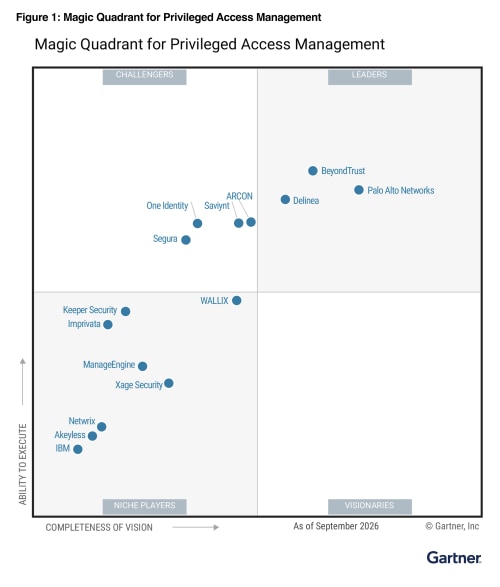
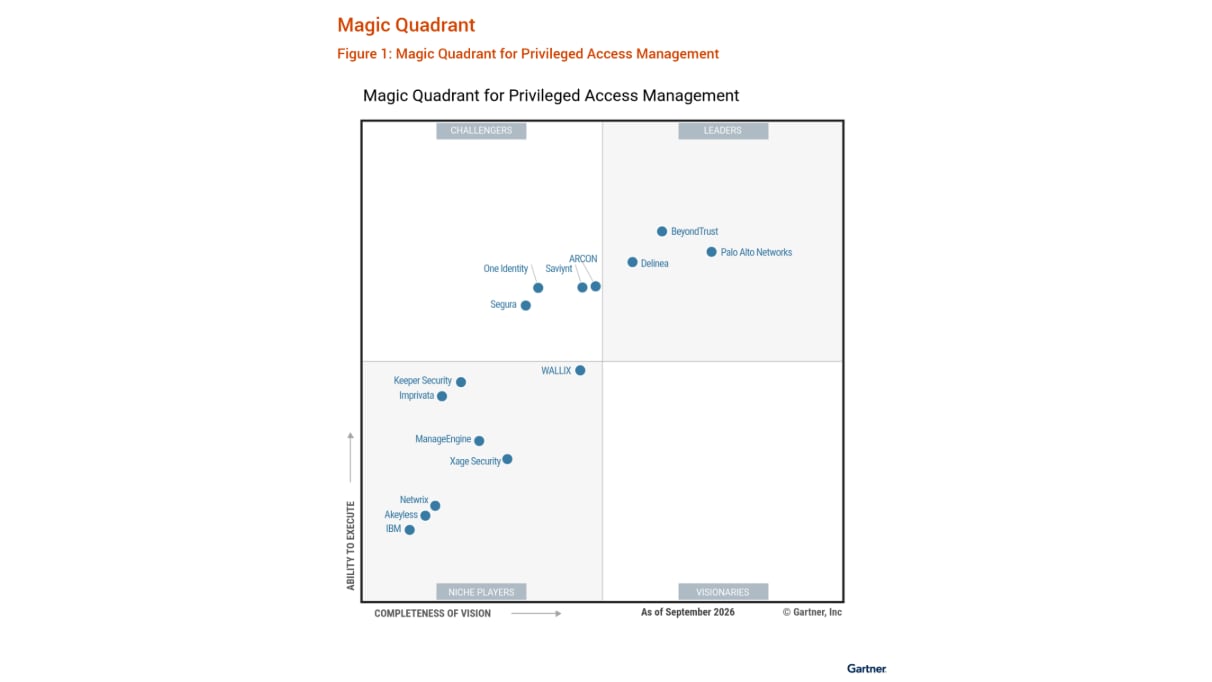
For the eighth consecutive time, Palo Alto Networks is recognized as a Leader in the 2026 Gartner® Magic Quadrant™ for Privileged Access Management. Once again, it is positioned furthest along in Completeness of Vision and has been positioned so in every Magic Quadrant published for this category.

Read the 2026 Gartner® Magic Quadrant™ for Privileged Access Management.

Gartner Magic Quadrant PAM

Identity is not a siloed risk. As an increasingly attractive target for threat actors, it must be understood and secured across the entire attack surface. For our customers, the benefit is clear: as part of Palo Alto Networks, Idira helps you adopt AI innovation at speed while retaining control over privileged access.

Why Vision Matters Most Right Now

The 2026 Gartner Magic Quadrant evaluates providers across their Ability to Execute and Completeness of Vision. We feel that being positioned furthest in Completeness of Vision matters most in moments of technology change like this one. Idira is built for an environment where:

  • Identity is the attack surface, and frontier AI lets attackers move faster, increasingly logging in rather than breaking in.
  • Identities have exploded, and human and machine privilege alike must be controlled.
  • The pace of change has never been higher, as organizations race to adopt AI and modernize infrastructure without losing control.

Customers need a partner that can execute on an innovative vision as the threat and technology landscape evolves. With the scale of Palo Alto Networks behind us, we are focused on securing every identity and every moment of privilege in the AI enterprise.

The AI Era Demands More From PAM

We are in a new era, where identity and access have fundamentally changed. Machine identities now outnumber humans 109 to 1, AI agents (which require access to enterprise systems to do useful work) are entering the workforce, and attackers have noticed. That access must be governed alongside the human and machine identities already protected. Increasingly, though, attackers log in rather than break in, and PAM must evolve to stay ahead of these challenges. PAM must now extend beyond vaulted administrator credentials to discover, control, and govern privilege across the enterprise.

Idira’s Modern PAM platform is enabling PAM to meet the demands of the AI era; it combines vaulted access and zero standing privileges (ZSP) with secrets management, workload security, and identity governance. We are bringing ZSP to every modern target, including cloud, apps, and Kubernetes. And access challenges go beyond humans, so Idira does as well. To secure non-human access, Idira added native SPIFFE/SVID support to deliver short-lived cryptographic identities to workloads and AI agents. Our ability to deliver and innovate on our vision enables Idira to deliver purpose-built, end-to-end protection at scale for the modern AI enterprise.

Modernizing PAM: Where We Deliver

Making modern PAM easier to adopt is central to our approach. 

While some of the largest organizations continue to trust Idira for our proven traditional PAM leadership, they now also rely on us to guide their modern PAM transformation initiatives.

Data-Driven Innovation: We believe that our Transformation Decision Engine, which uses customer environment data to quantify the value of PAM modernization, combined with our years of proven experience guiding both the implementation and modernization of PAM programs across our expansive customer base, demonstrates our ability to help customers through any stage of their PAM journey with an informed, data-driven approach. 

Customer Experience: Idira guides cross-functional security teams through complex operational shifts, from standing access to ZSP, supported by the Idira Blueprint, hands-on training, and an active peer community. 

Scale and Reach: Idira customers already have a partner with global reach, and joining Palo Alto Networks extends it further. Our security platform sees identity risk across the whole attack surface, so a stolen or abused privilege becomes a signal your defenses act on in the moment, backed by the investment and expertise of the industry's largest cybersecurity company.

Ready for the Demands of the AI Enterprise 

Eight reports, eight times furthest in vision. I'm grateful to the customers whose trust and expertise shaped every one of them. This is also a first, as it’s the first report to carry the Palo Alto Networks name. Since Idira joined forces with Palo Alto Networks, our PAM expertise and platform now sit inside the industry's leading cybersecurity company, where privileged access connects to real-time threat detection and response, AI security, and Unit 42 threat intelligence.

The next chapter of privileged access is being written now, by attackers with frontier AI models and by enterprises deciding how fast to move. We intend to stay furthest ahead of both.

Thank you to our customers and community for your trust, and for the partnership that helps shape our innovation.


Gartner, Magic Quadrant for Privileged Access Management, Paul Mezzera, Shubham Gera, Tarun Rohilla, Scott Brinker, 21 October 2026.

Gartner and Magic Quadrant are trademarks of Gartner, Inc. and/or its affiliates.

Gartner does not endorse any company, vendor, product or service depicted in its publications, and does not advise technology users to select only those vendors with the highest ratings or other designation. Gartner publications consist of the opinions of Gartner’s business and technology insights organization and should not be construed as statements of fact. Gartner disclaims all warranties, expressed or implied, with respect to this publication, including any warranties of merchantability or fitness for a particular purpose.


What is the Gartner® Magic Quadrant™?

“Magic Quadrant reports are a culmination of rigorous, fact-based research in specific markets, providing a wide-angle view of the relative positions of providers in markets where growth is high and provider differentiation is distinct. Providers are positioned into four quadrants: Leaders, Challengers, Visionaries and Niche Players. The research enables you to get the most from market analysis in alignment with your unique business and technology needs."

How can PAM help secure AI agents in the enterprise?

PAM can help secure AI agents by controlling their access to systems and data, protecting the secrets they use, and recording their access and actions. Capabilities vary by solution; controls should limit each agent’s permissions and how long those permissions remain active. Learn more about Idira Agentic Identity Security.

How does zero standing privileges differ from vaulted access?

Vaulted access protects stored privileged credentials. ZSP removes standing privileged access by granting permissions for a specific task and revoking them when the task or authorized period ends. Modern PAM can combine both approaches to support different environments and access needs.

The post Palo Alto Networks Named a Leader in the 2026 Gartner® Magic Quadrant™ for Privileged Access Management appeared first on Palo Alto Networks Blog.
  •  

Palo Alto Networks Brings Continuous AI Defense and Prisma AIRS to the OpenAI Marketplace

Palo Alto Networks announces that Unit 42® Continuous Frontier AI Defense and Prisma AIRS™ are now on the newly launched OpenAI Marketplace, making them directly available to OpenAI’s enterprise customers. Threat actors are deploying artificial intelligence to find and exploit vulnerabilities at unprecedented speed, compressing breach cycles by almost 97%—from weeks down to mere hours. Human-speed defense can no longer keep pace with adversaries executing automated, continuous attacks.

AI Investments: The OpenAI Marketplace Advantage

For enterprise organizations holding OpenAI spend commitments, this milestone offers a compelling 2-for-1 financial and strategic advantage. Security teams can now deploy machine-speed, proactive defense while retiring their pre-committed OpenAI spend.

Palo Alto Networks offers two flagship solutions available for procurement through the OpenAI Marketplace.

  • Unit 42® Continuous Frontier AI Defense: An always-on, expert-led agentic offensive security service that uses defender-grade models to discover, validate, and accelerate the remediation of exposures across applications and network assets before weaponization.
  • Prisma® AIRS™: A comprehensive AI security platform designed to provide complete discovery, risk assessment, runtime protection, identity and data governance, and observability for AI applications, agents, models, and artifacts across enterprise cloud platforms, SaaS environments, and endpoints.

Machine-Speed Defense with Unit 42 Continuous Frontier AI Defense

Unit 42 Continuous Frontier AI Defense is an expert-led, agentic offensive security service engineered to identify, validate, and remediate enterprise exposures as an organization’s environment changes.

This always-on, agentic service combines our offensive security experts with our proprietary multi-model harness, which uses defender-grade frontier models to discover vulnerabilities, validate real-world exploitability, and accelerate remediation across applications, identities, cloud infrastructure, and network assets as an organization’s environment changes. At the core of this capability is our proprietary multi-model software harness that dynamically routes security tasks to the optimal AI model, maximizing efficacy and coverage while managing the cost of frontier AI at scale.

The harness integrates defender-grade models, including OpenAI’s GPT-5.6-Cyber, and other commercial models alongside open-weight models and Unit 42 threat intelligence. By executing non-destructive adversary simulations across first- and third-party environments, the system proves actual exploitability and delivers prioritized remediation guidance including actionable fixes, code-level changes, and virtual patches. Organizations can pair this with Frontier Virtual Patching to block exploits long before official patches exist or CVEs are publicly disclosed.

The real-world impact of this proactive methodology was validated over six months of in-house testing and across more than 75 customer engagements backed by a $17 million R&D investment. During internal deployment within Palo Alto Networks, the service uncovered over two years’ worth of exposures in just three weeks. In customer assessments, the underlying analysis identified exposures in 100% of assessed organizations, with 37% rated high or critical severity. Crucially, over two-thirds of exposures found in third-party applications had no known CVE, proving the urgent necessity of continuous, AI-driven discovery.

Unit 42 Continuous Frontier AI Defense is available worldwide today on an annual subscription basis. Register for our upcoming Virtual Threat Briefing to see how we apply Frontier AI, our proprietary multi-model harness, and offensive security expertise to protect Palo Alto Networks and our customers.

To learn more about Unit 42 Continuous Frontier AI Defense, register for the upcoming Virtual Threat Briefing here.

Scale Enterprise AI Adoption Safely with Prisma AIRS

As OpenAI customers rapidly scale their use of powerful AI models, AI coding assistants, and autonomous agents, the enterprise attack surface is expanding faster than traditional security teams can manage. The transition to autonomous AI breaks traditional security boundaries, creating shadow AI blind spots, supply chain risks in open-source base models, unsafe actions from malicious inputs, and uncontrolled AI agents executing tasks with excessive permissions.

Prisma AIRS: Secure Every AI Ambition

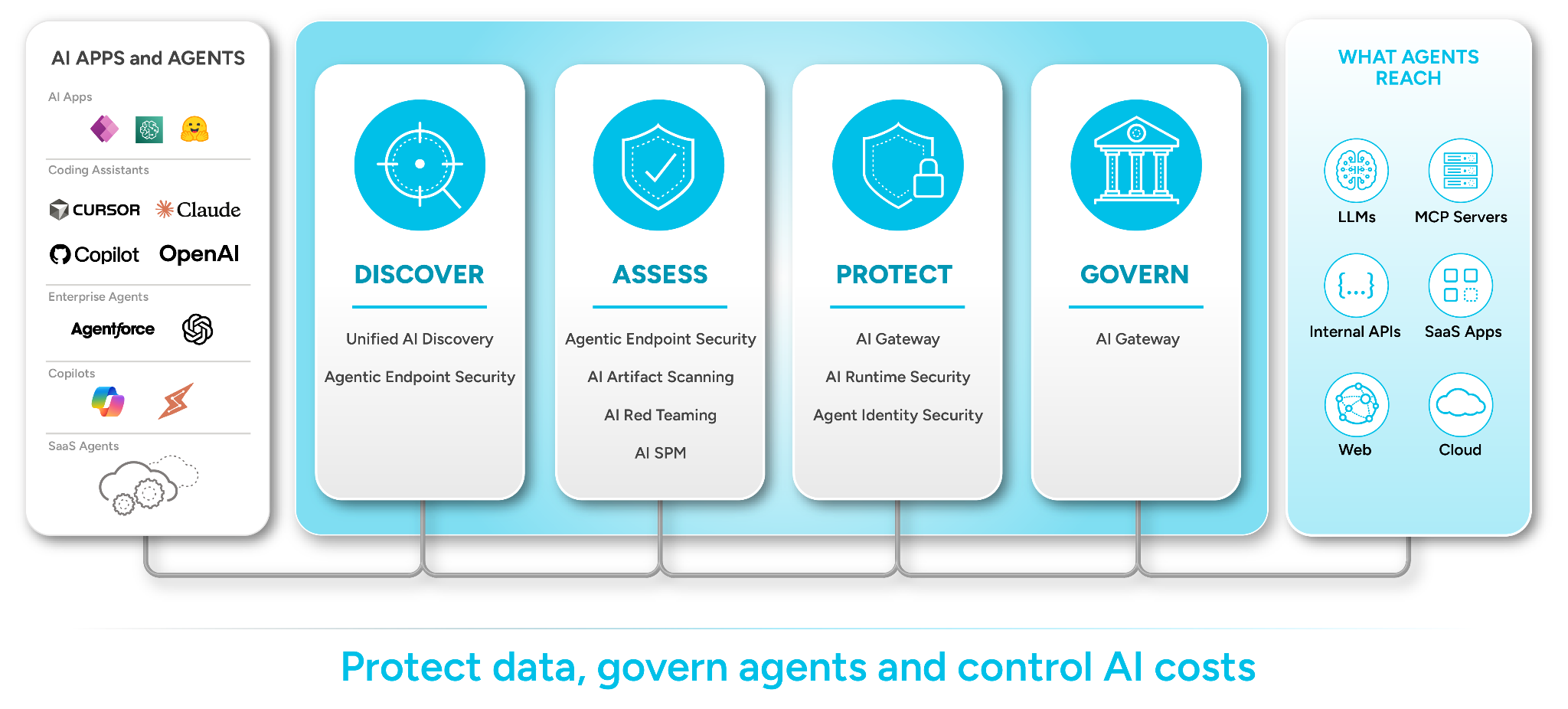
Prisma AIRS is the Palo Alto Networks unified AI security platform, enabling enterprises to accelerate AI adoption while maintaining control over sensitive data, agent identities, autonomous actions and AI costs. Recognized by Gartner as a Market Shaper in the September 2026 Emerging Market Quadrant for AI Application Security – Established Vendors, Palo Alto Networks brings together discovery, continuous risk assessment, real-time protection and centralized governance to secure AI applications and agents across enterprise environments.

  • Gain Visibility Across Enterprise AI: Discover and inventory AI applications, coding assistants, autonomous agents and associated assets across endpoints, cloud and enterprise environments. Identify shadow AI and gain visibility into the AI systems operating across the organization.
  • Identify Risks Before They Become Threats: Continuously assess AI security posture, scan models and agent artifacts—including skills and MCP servers—for vulnerabilities and supply chain risks, and proactively red team AI applications and agents to uncover exploitable weaknesses before deployment.
  • Secure AI Interactions, Data and Agent Identities: Enforce real-time protection against prompt injection, malicious interactions and sensitive data exposure. Verify agent identities, enforce least-privilege access and prevent unauthorized actions as agents interact with enterprise systems and data.
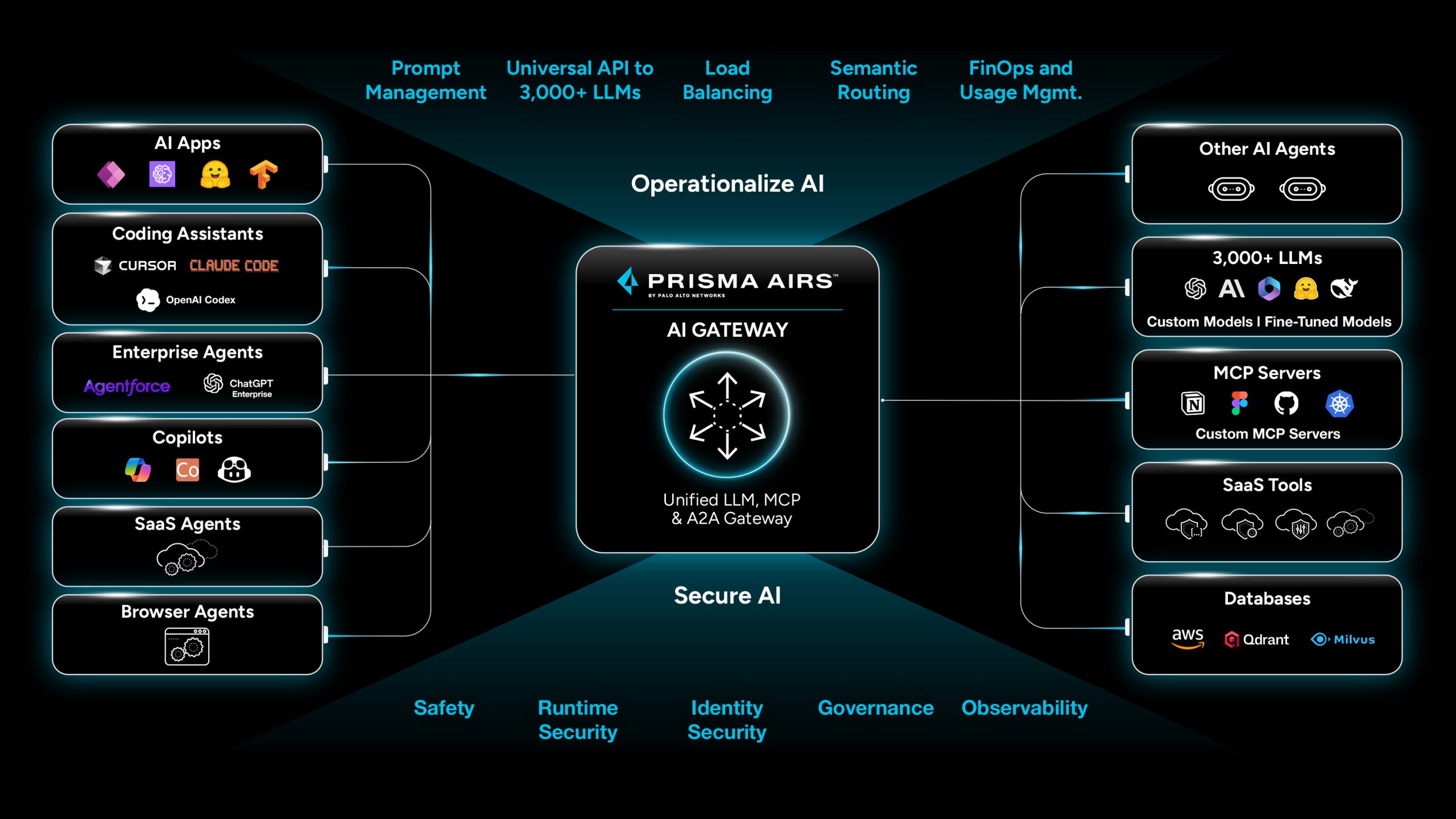
  • Centralize AI Policy, Access and Spend: Use AI Gateway to govern connections to LLMs, MCP servers, APIs and enterprise services. Centralize policy enforcement, control model and provider access, monitor consumption and manage AI usage and costs across teams and applications.

Together, these capabilities help OpenAI enterprise customers secure AI-powered workflows, maintain accountability for autonomous actions and scale AI adoption with consistent security and governance.

Book a demo to see our AI Security solution in action.

The post Palo Alto Networks Brings Continuous AI Defense and Prisma AIRS to the OpenAI Marketplace appeared first on Palo Alto Networks Blog.

  •  

Advancing Agentic AI Security with Palo Alto Networks and NVIDIA

AI is moving from answering questions to taking action. Agents can use tools, access enterprise data, and carry out work across systems on our behalf or autonomously. This creates opportunities for businesses to move faster, but it also changes what security must protect. An agent’s identity, the authority it carries, and the actions it takes all become security decisions.

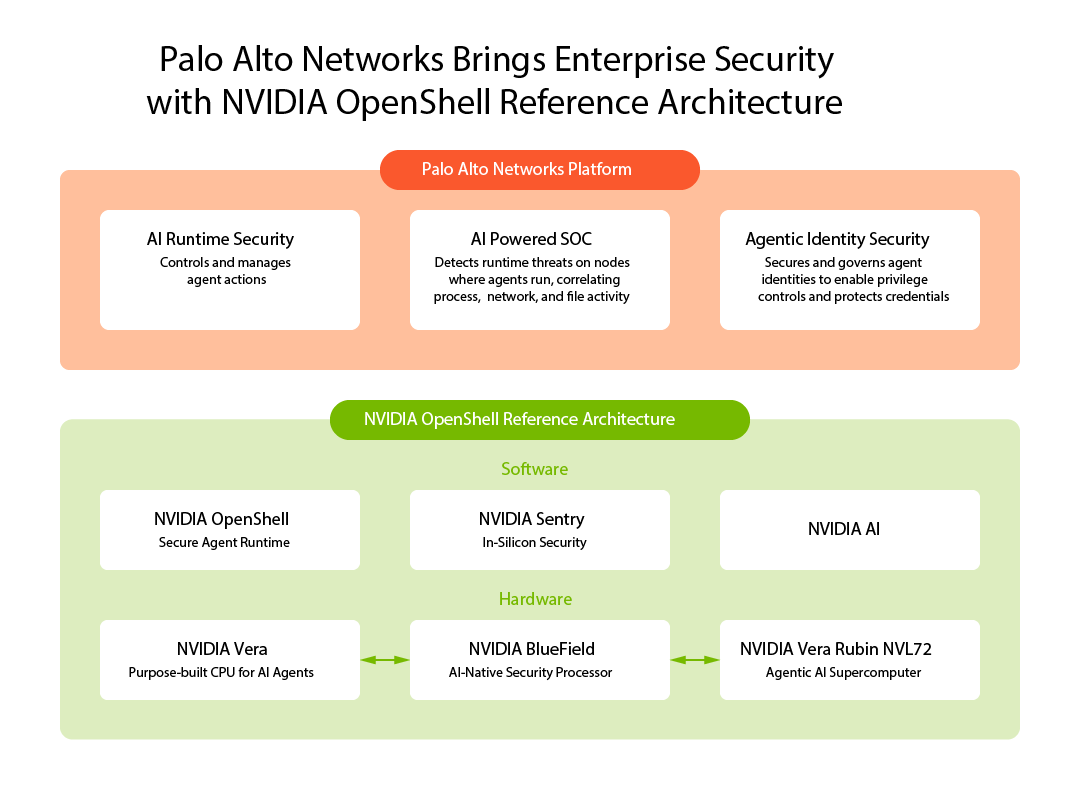
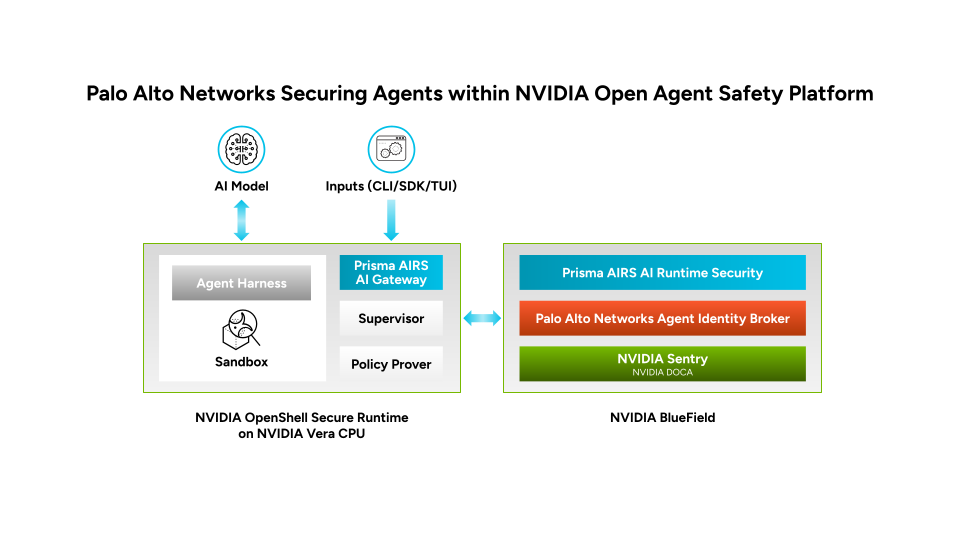
As enterprises put agents into production, they need controls that keep pace without hindering the work those agents are designed to do. Palo Alto Networks is working with NVIDIA to advance this goal across five connected areas in support of the NVIDIA OpenShell Reference Architecture for safe AI agents: an AI gateway on NVIDIA Vera CPU systems; runtime protection on NVIDIA BlueField DPUs; agent identity governance on NVIDIA Sentry; AI factory visibility through an AI-driven, agentic security operations center (SOC); and partner services that help customers implement a secure architecture.

Palo Alto Networks AI Runtime Security Extends Protection Across the AI Factory and Edge

Until now, the AI factory conversation has centered primarily on compute capacity and token generation. But as autonomous agents execute higher-stakes workloads, runtime security has become just as essential. Agents can be steered past their guardrails, and a compromised host cannot be trusted to accurately report what occurred. To be effective, security teams require visibility and enforcement that operate independently of the host environment.

Palo Alto Networks AI Runtime Security on NVIDIA BlueField DPUs isolates security processing in a dedicated infrastructure domain. Because BlueField sits in the path between agents and the models, data, and services they access, security policies are enforced in silicon — beyond the reach of a compromised host. This capability safeguards both GPU-accelerated AI workloads and CPU-based agent runtimes and is now generally available across AI factory and industrial edge deployments. Offloading security from the host node delivers two critical benefits: increased token throughput and stronger runtime protection across the entire AI factory.

Deployment at scale must be manageable. Our work with Spectro Cloud manages the deployment and operation of AI Runtime Security on BlueField DPUs, enabling consistent management across the AI factory infrastructure — from the data center to distributed edge environments. 

Idira Governs the Identity Behind Every Agent Action

Runtime protection answers what an agent is doing. Identity governance helps determine whether it is authorized to do it.

An agent may act for a person, a team, or an autonomous business process, often requiring access to multiple tools and data sources across the organization. Granting an agent broad, persistent access creates risk, while making access too restrictive limits its usefulness. To achieve the optimal balance of control and agent access, Palo Alto Networks is advancing an integration between agentic identity security and NVIDIA Sentry on BlueField — bringing identity and delegated authority closer to where agent interactions are governed.

The goal is to give each agent a verifiable identity, grant access appropriate to its task, and make its actions attributable. Once available, this solution will deliver zero-trust protection and tamper-resistant auditing for agents by moving the security controls — including identity — to the NVIDIA Bluefield DPU, separate from the host operating system. This addresses an immediate business need — enabling enterprises to scale agent deployments while retaining control over whose authority agents use and which resources they can reach.

Bringing AI Factory Signals into Cortex

Security teams need visibility into activity across the infrastructure that runs AI agents. Palo Alto Networks has announced an integration of Cortex XSIAM with NVIDIA DOCA Argus, which monitors host activity from BlueField’s independent trust domain. This provides security operations teams with runtime signals that do not rely on an agent installed on the host being monitored.

By bringing those signals together with network, cloud, and identity data in an AI-driven SOC, security teams can investigate AI infrastructure in the context of the broader enterprise. Palo Alto Networks is continuing to develop this foundation to support broader fleet visibility and more comprehensive response workflows — enabling security teams to identify unusual activity and act with greater confidence as AI deployments grow.

AI agents run within the NVIDIA OpenShell secure runtime, operated directly on the NVIDIA Vera CPU within the NVIDIA OpenShell Platform. Security observability is completely offloaded to the NVIDIA BlueField DPU. Operating out-of-band, NVIDIA Sentry, built on DOCA Argus, provides real-time memory and network inspection to detect threats without slowing AI inference. When malicious events or policy violations occur, DOCA Argus streams high-fidelity alerts directly to Palo Alto Networks Cortex XSIAM, where they can be automatically correlated and surfaced for rapid threat response. 

Turning Secure AI Factory Designs into Deployments

Customers need more than an architecture diagram to bring an AI factory into production. They need a practical path to design, validate, and operate security across compute, networking, applications, and the SOC.

Palo Alto Networks is working with strategic vendors , including Deloitte and World Wide Technology (WWT), to help customers plan and deploy secure NVIDIA AI factories. Deloitte’s Silicon-to-Service (S2S) offering, combined with its Secure AI Foundations, helps organizations implement AI use cases on NVIDIA AI infrastructure through validated architectures and managed services. By building security into the full AI factory stack, Deloitte helps clients balance performance, safety, and cost as they scale from pilot to production.  

WWT’s AI Proving Ground allows customers to evaluate and test an integrated stack before committing to production deployment.These engagements can help enterprises move from individual security components to a repeatable approach tailored to their environments and requirements.

Building Confidence into the Next Phase of Agentic AI

The value of agentic AI depends on an enterprise’s ability to give agents useful access while maintaining control over their actions. This requires runtime protection, governed identities, independent visibility, and a unified way to manage controls across the enterprise. 

Palo Alto Networks delivers comprehensive security across every layer of the AI factory through a unified platform. In collaboration with NVIDIA, we support the NVIDIA OpenShell Reference Architecture for enterprise governance, isolation, and security.  Together, we deliver the continuous protection needed to move safely from AI agent pilots to full-scale enterprise production.

To learn more about the general availability of AI Runtime Security on the BlueField DPU, read our blog, Palo Alto Networks Announces Support for NVIDIA Enterprise AI Factory. 

The post Advancing Agentic AI Security with Palo Alto Networks and NVIDIA appeared first on Palo Alto Networks Blog.
  •  

Reinventing Endpoint Security with Cortex XDR One

Enterprises spent the last two years racing to capture the vast potential of AI, authorizing AI agents to touch production code, internal databases, customer tickets and financial ledgers. Because these agents operate non-deterministically with broad capabilities, they can easily be manipulated into unexpected or malicious behavior. The result is agents breaking out of isolation, shifting AI risk from a hallucinating chatbot to an operational liability. 

The standard fixes, such as software containers or prompt-level guardrails, aren't sufficient to prevent malicious agent behavior. And traditional endpoint security was not designed to secure agents, which operate with real user access. Just as we pioneered XDR to include network, identity and cloud, we must now expand protection to secure agents in the enterprise. 

Cortex XDR One brings together XDR and Koi Agentic Endpoint Security to protect both traditional system processes and AI agents, delivering layered enforcement across an agent’s execution path. XDR One is designed to control an agent’s actions at the source, enforce hard boundaries at the operating system level, and spot rogue behavior through an AI-driven layer of defense.

An Emerging Security Blind Spot

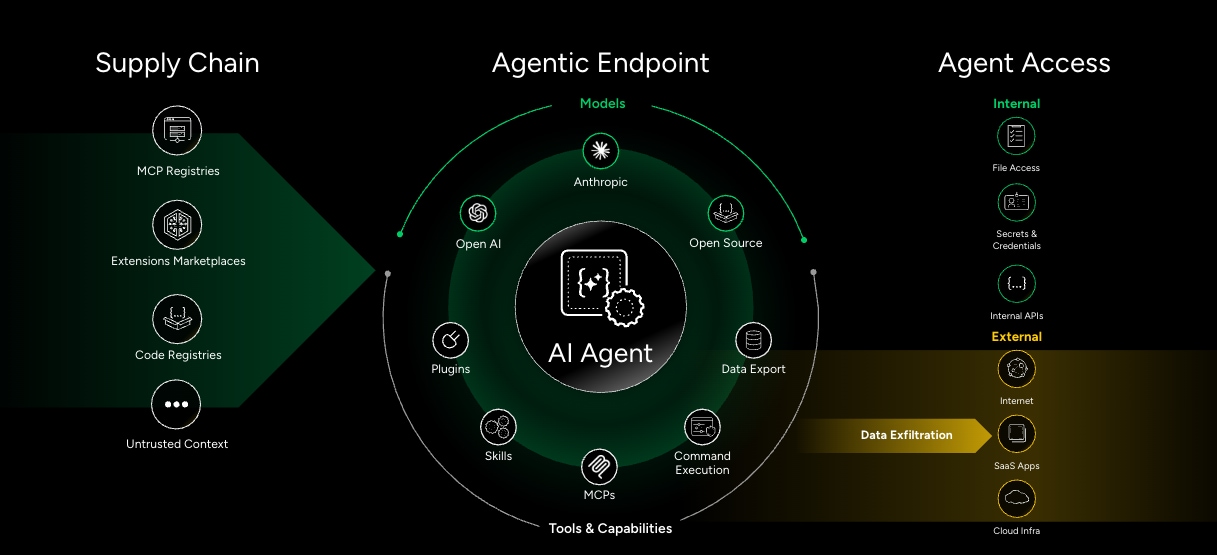
Endpoints have evolved from controlled execution environments into complex ecosystems of AI coding agents, AI co-pilots, MCP servers and personal agents with access to sensitive data and systems. These artifacts can bypass traditional controls and operate in critical blind spots. 

When an agent ingests an untrusted input, connects to a compromised enterprise app or executes an unauthorized command, it transforms from a productivity tool into an active risk vector. Because agents operate with real user permissions and non-deterministic behavior, security teams face a compounding set of enterprise challenges that extend far beyond simple prompt injections.

Employees are adopting personal AI agents and browser tools that bypass IT oversight, spreading shadow AI across endpoints. At the same time, attackers are exploiting connected systems to manipulate these agents. By poisoning the external data, databases, or SaaS applications an agent relies on, adversaries can alter its behavior indirectly without ever touching the AI model itself. Without hard boundaries, an agent can be tricked into escalating host privileges, bypassing local containers or executing arbitrary system commands. In short, the agent escapes its intended sandbox and becomes an unwitting insider threat.

AI Agents and Tools are on Nearly Every Endpoint

Adversaries are already exploiting this new vulnerability. In the ClawHavoc supply chain attack, adversaries targeted agents by uploading hundreds of malicious skills to OpenClaw's marketplace; once installed, these rogue skills broke runtime isolation to give remote attackers direct command-line access on the host. In a separate incident, Unit 42 research showed how agents can be tricked into revealing secret system prompts or sensitive information through indirect data poisoning from connected applications. Additionally, agents can bypass system and access controls when tricked into issuing unauthorized API calls or executing system tools under the guise of legitimate user permissions. Compounding these risks is the rise of shadow AI, as ungoverned, unmonitored agents deployed by employees silently inherit elevated system privileges without IT visibility.

When agentic AI was just emerging, we saw the potential risks it would bring and immediately sought out a solution to secure our internal AI workloads. Our InfoSec team found and deployed Koi while the startup was still in stealth mode. Impressed by Koi’s unique ability to secure new agentic endpoint behavior, we welcomed the talented Koi team into the Palo Alto Networks family to deliver this protection directly to our customers.

Cortex XDR One: Securing Every Endpoint and Agent from a Single Platform

XDR One integrates Cortex XDR and Cortex Agentic Endpoint Security with a single user interface and sensor, providing centralized visibility, management and investigation.

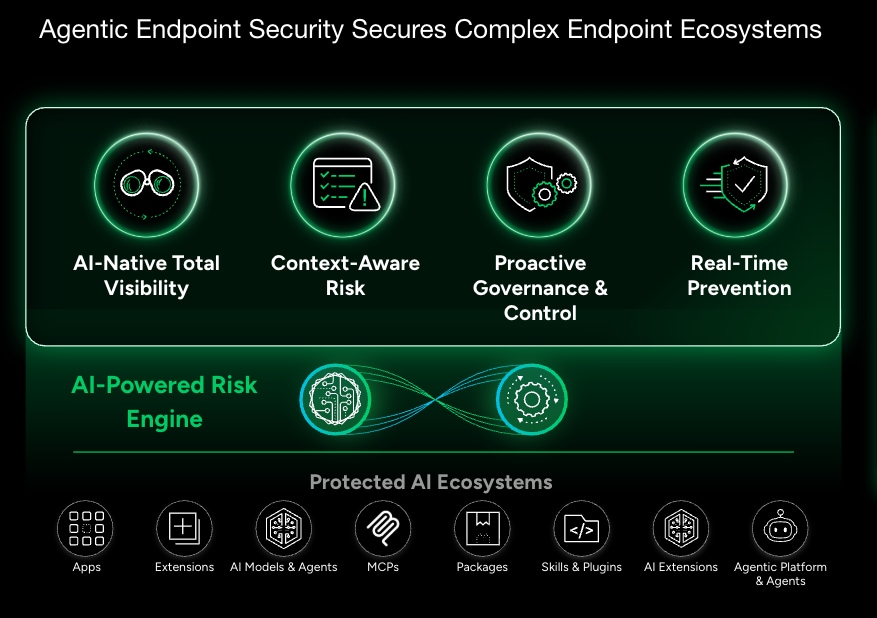
Agentic Endpoint Security for Complex Endpoint Ecosystems

From sanctioned agents to shadow AI, XDR One gives teams a real-time inventory of every AI artifact the moment it appears on an endpoint. Armed with visibility into all the agent activity in the enterprise, security teams can control what packages, extensions, agents and AI artifacts are allowed to be installed or used. For example, a CISO can evaluate which vibe coding agents are actually being used by engineering teams and make an informed decision about the productivity impact of removing access to a specific agent. 

Securing the modern endpoint requires unified defense across both the AI agent lifecycle and the underlying operating system. XDR One delivers this protection, from software installation to live execution. Within the agent layer, it enforces runtime guardrails to help stop prompt injections and destructive commands. Simultaneously at the OS layer, XDR One continuously monitors runtime process chains to block zero-day exploits and living-off-the-land attacks in real time without affecting performance. To complement these defenses, optimized small language models run directly on the endpoint sensor to guard against evasive, fileless threats even while offline and without sending sensitive code to the cloud. By stitching cross-domain telemetry into clear, end-to-end attack chains, XDR One cuts false positives by up to 95% and drives automated remediation in minutes.

Ultimately, consolidating this security telemetry onto a single sensor eliminates fragmented point tools and establishes a powerful operational foundation, equipping Cortex XSIAM with the critical data needed to better govern AI risk across the enterprise.

Flexible Protection with Standalone Agentic Endpoint Security or Native Integration

Cortex Agentic Endpoint Security (AES) specifically governs AI tools, MCP servers and agentic workflows running on those hosts. Organizations have the flexibility to deploy AES alongside existing third-party EDR environments using the Cortex targeted sensor.

However, organizations can simplify operations when AES and XDR come together natively in Cortex XDR One. By unifying agentic defense and extended detection and response into a single sensor and platform, XDR One bridges the gap between traditional host security and AI risks, delivering seamless visibility, management and real-time investigation.

Setting a New Baseline for Endpoint Security

The era of standalone EDR has passed. Just as XDR moved beyond siloed endpoint detection and response to encompass network, identity and cloud, securing the modern enterprise now demands native protection for autonomous AI workloads. EDR without integrated agentic security is incomplete and fundamentally legacy. Disconnected point solutions lack visibility into OS execution, while bolt-on EDR offerings fail to correlate the agent’s prompt and tool context with subsequent system behaviors. Relying on a bird of prey may seem like high-end security, until you discover it only swoops in after the wolf has already attacked the flock.

XDR One sets the new standard for endpoint security, providing unmatched visibility and preemptive control across both the OS and AI layers within a single sensor.

Scaling Enterprise AI with Confidence

While XDR One delivers complete standalone protection, security leaders grappling with this complex new attack surface can augment their team’s capabilities with Unit 42 MDR, which will now include Managed Agentic Endpoint Security. By combining XDR One telemetry with elite threat intelligence, Unit 42 experts deliver proactive threat hunting, incident investigation, and AI risk governance to strengthen overall resilience.

Securing the Agentic Frontier

As organizations race to adopt AI agents, security teams face a pivotal transition. The expansion of agentic capabilities across enterprise endpoints demands a security posture that treats agents with the same rigor and control as traditional system processes.

By unifying agentic endpoint defense and XDR into a single sensor and platform, XDR One sets a new standard for endpoint security in the agentic era. Whether deployed independently or backed by Unit 42 expertise, XDR One gives security leaders the visibility and control needed to eliminate shadow AI, enforce operational guardrails and accelerate their AI transformation.


Forward-Looking Statements
This blog contains forward-looking statements that involve risks, uncertainties and assumptions, including, without limitation, statements regarding the benefits, impact, or performance or potential benefits, impact or performance of our products and technologies or future products and technologies. Any unreleased services or features (and any services or features not generally available to customers) referenced in this or other press releases or public statements are not currently available (or are not yet generally available to customers) and may not be delivered when expected or at all. Customers who purchase Palo Alto Networks applications should make their purchase decisions based on services and features currently generally available.

The post Reinventing Endpoint Security with Cortex XDR One appeared first on Palo Alto Networks Blog.
  •  

Introducing Unit 42 Managed Agentic Endpoint Security

AI agents and AI-enabled tools are fundamentally changing how work gets done. From coding assistants to Model Context Protocol (MCP) servers, autonomous tools now access sensitive data, execute commands, and modify local workflows directly from the endpoint. Traditional endpoint security models fail to offer the visibility or governance required to manage these autonomous actions.

The security gap is already significant. Only 6% of organizations have an advanced AI security strategy. And the fastest attacks can move from initial access to data exfiltration in just 72 minutes, according to the 2026 Unit 42 Global Incident Response Report. As AI adoption grows, teams need context to prioritize risk and experts ready to respond so the business can continue adopting AI with confidence.

Today, we are announcing Unit 42 Managed Agentic Endpoint Security (Managed AES). We built the service on Cortex AES, our AI-native endpoint security platform that provides visibility, contextual risk intelligence and protection for AI agents and artifacts. Managed AES adds 24/7 Unit 42 expertise to help organizations put those capabilities into action. Backed by Unit 42 threat intelligence, our experts provide AI governance, threat hunting, investigation and response, and AI-related cyber hygiene. They apply human judgment to turn contextual intelligence into policy recommendations and prioritized actions as the environment evolves.

Continuous Expert Defense for the AI Environment

Managed AES brings continuous Unit 42 expertise to four areas of AI endpoint security.

  • Govern AI Adoption with Greater Confidence
    AI adoption often moves faster than security teams can assess it. Our experts help identify AI tools and associated risks, evaluate exposure and recommend improvements to policies and controls. Security leaders gain a clearer view of AI use across their environment.
  • Hunt for Emerging and Zero-Day Threats
    AI-related threats can emerge before they trigger a known alert. Our threat hunters use frontline threat intelligence and Cortex AES signals to proactively hunt across the customer’s AI environment. They evaluate findings, recommend action and refine policies and correlation rules to strengthen protection over time.
  • Investigate and Respond 24/7
    Our analysts continuously monitor activity, investigate suspicious behavior and take permitted actions on the customer’s behalf to contain AI-related threats. Security teams gain specialized support to understand what happened, determine the potential impact and prioritize next steps.
  • Continuously Strengthen AI-Related Cyber Hygiene
    Unit 42 assesses the customer’s AI security posture as adoption evolves. AI Security Posture Reports identify policy and control improvements, while Threat Impact Reports detail threats, potential impact, response actions taken and recommended next steps. These insights help teams prioritize improvements.

Expert Protection Across Your AES Environment

Organizations can choose the Cortex AES deployment model that best fits their environment while receiving the same 24/7 Unit 42 expertise.

  • Managed AES with Standalone Cortex AES
    Organizations can deploy Cortex AES alongside their existing endpoint security solution for AI-native visibility, contextual risk intelligence, governance and protection for AI agents and AI-enabled tools. Managed AES adds Unit 42 experts who help customers act on that visibility and risk intelligence.
  • Managed AES with Cortex XDR One
    Cortex XDR One brings together Cortex AES and Cortex XDR into a single sensor and console experience. It combines endpoint detection and response with AI-native security for AI agents and artifacts. Unit 42 experts provide 24/7 governance, threat hunting, investigation and response across the entire endpoint attack surface.

Securely Scale AI Adoption

Unit 42 Managed AES helps security teams understand how AI is being used, address risk before it escalates and respond quickly when threats emerge. By combining Cortex AES context with frontline threat intelligence and expert analysis, Managed AES helps businesses adopt AI with confidence.

Register for our upcoming webinar, The Next Era of Endpoint Security, to learn how Cortex AES and Unit 42 experts help your team govern AI risks, strengthen visibility and protect the agentic endpoint.

The post Introducing Unit 42 Managed Agentic Endpoint Security appeared first on Palo Alto Networks Blog.
  •  

Observability’s AI Moment

Introducing Cortex XCOR: AI-Driven Observability that Delivers Autonomous Response with AI SRE

I’ve been tackling the observability problem for more than a decade, since before it was coined observability. From building internal monitoring for EC2 at AWS to building the observability platform for Uber, the holy grail was always to create a solution that would automatically tell you what the issues were and help remediate them, instead of just being a tool that showed you dashboards. But standing in the way were the foundational scale and cost challenges of cloud-native architectures, which is what my co-founder Rob Skillington and I solved by creating Chronosphere. 

With the ability to effectively manage observability data at scale and as we undergo another major industry shift with AI, we’re finally at a point in time where the technology available puts the holy grail within grasp. Six months after joining Palo Alto Networks, we’re taking a major step forward with the launch of Cortex XCOR - an AI-native observability platform that delivers on that long promise of automatically root causing the issue. 

Reimagining Observability for the Modern SDLC

Getting to this point required a fundamental leap in model intelligence. When generative AI was broadly released in late 2022, LLMs were intriguing, but the reasoning capabilities were rudimentary. Although we saw limited applications for chatbots and assistants within observability, those early models could only help the end user, they couldn’t ultimately solve the issue. They assisted investigations by summarizing logs or translating queries, but weren’t transformative. That changed in late 2025 with frontier models like OpenAI’s GPT-5 and Anthropic’s Claude Sonnet and Opus. 

My own AI moment in observability came a couple of months ago when our chat functionality evolved from acting like an assistant to functioning as an autonomous expert that gave me the answer and showed me how it got there. As I pushed our agents with increasingly complex scenarios, they began reasoning through problems far beyond their initial capabilities. Much like how LLMs have replaced my need for web search, our chat is now my primary interface in our product, completely overhauling how I interact with it. 

This shift for observability is needed now more than ever as operations teams struggle to keep up with the surge in AI-driven software development, caused by the same step up in reasoning capabilities from late 2025. Research shows that 42% of developers now report that AI writes at least half their code, up from 12% last year. Rapid code releases continuously expand the surface area for production failures and drive up the burden on developers and SREs to manually identify root causes. To match this velocity, observability needs to modernize now to avoid becoming the bottleneck for product innovation.

Introducing Cortex XCOR, the Next-Generation AI-Native Observability Platform

That is precisely why we are launching XCOR. We designed it to transform observability from static dashboards and manual remediation to an AI-first experience that automates both routine and complex investigations.

Cortex XCOR is an AI-driven platform that delivers autonomous response.

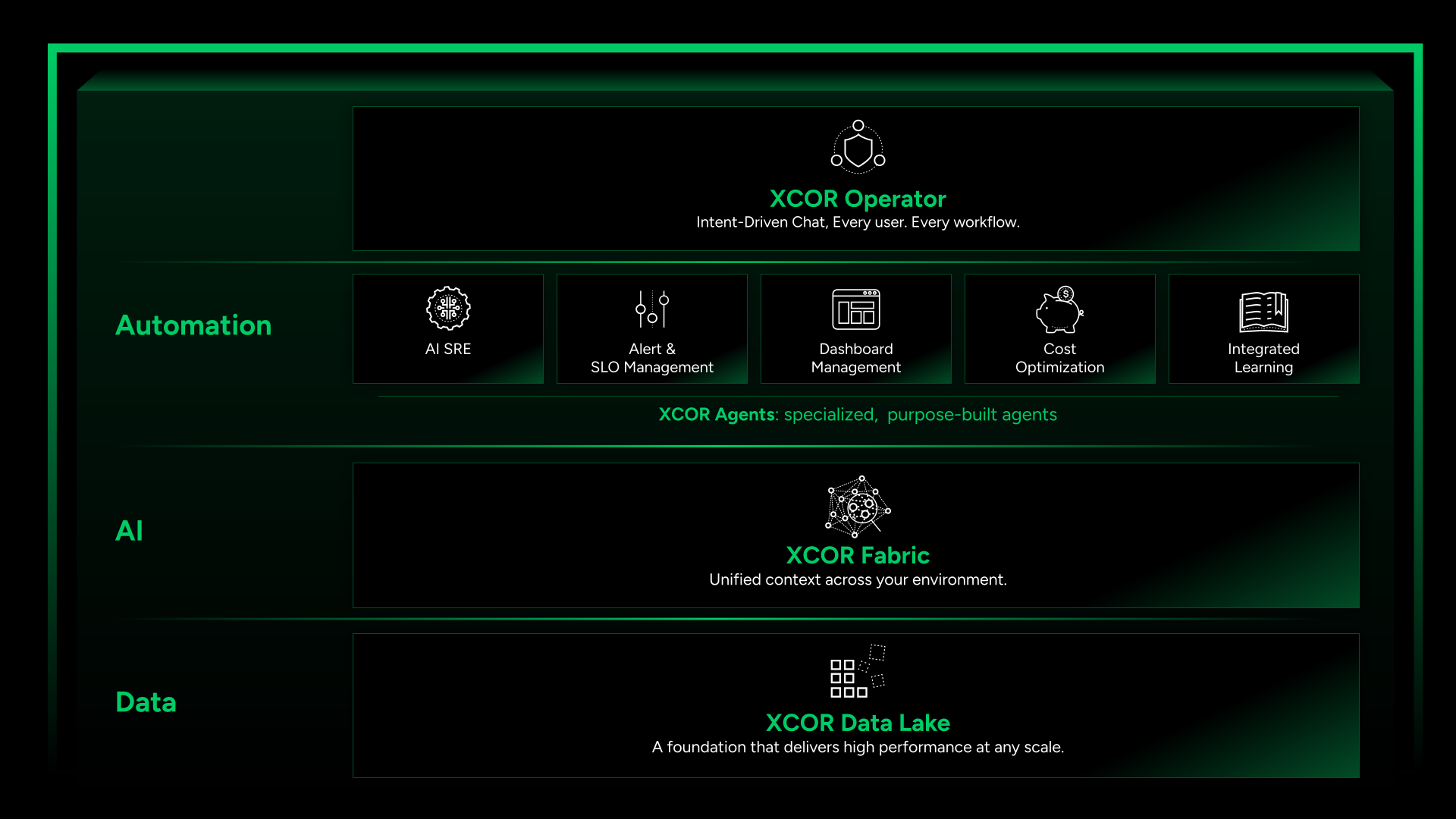
At the heart is our XCOR Operator, an AI assistant embedded throughout the platform that helps operations teams match AI-coding velocity. What makes the XCOR Operator especially powerful is that it understands the user intent and serves as the conversational interface for our specialized agents that execute behind the scenes. The user of an observability platform plays many roles depending on the situation: investigating incidents, tuning alerts and dashboards, optimizing data volumes, and so on. Each of these roles are mirrored by specialized AI agents that have been optimized to complete those task-specific workflows from end to end.

The most challenging role is the AI SRE - investigating an incident to get to the root cause and identify remediation. Triggered automatically when an alert fires, the AI SRE agent autonomously reasons through underlying issues and recommends actions and mitigations in under three minutes on average, with a 75% success rate of root cause analysis in complex production environments and a further 19% of incidents where the analysis was deemed useful. By comparison, manual responses can take 20 minutes just to locate the relevant issues, gather initial context and find the right on-call engineer.

None of this automated reasoning is possible without complete end-to-end visibility and context. With the recent acquisition of Embrace, we now bring together front-end Real User Monitoring (XCOR RUM) and proactive XCOR Synthetics with our backend and infrastructure observability to deliver a true, full-stack platform. RUM captures every web and mobile session in full fidelity without sampling, tying crashes and slow loads directly to session timelines, while synthetics simulates global user traffic to proactively catch regressions before they hit production.

Underpinning this full-stack visibility is the XCOR Fabric, which we engineered to provide our agents with rich, real-time institutional, application and infrastructure context and draws from:

  • Knowledge Graph: A real-time, detailed model incorporating your infrastructure, applications and business logic. Unlike many other solutions, it normalizes and incorporates custom telemetry to provide the most complete context.
  • Operational Memory: Institutional learnings and historical context captured from past incident investigations.
  • User Behavior: Patterns revealing which specific queries and dashboards senior engineers rely on during active resolutions.
  • Human Knowledge: Context pulled directly from runbooks, documentation, and operational files.

By delivering total visibility and grounding our AI agents in this deep operational context, XCOR delivers rapid root-cause analysis and recommends steps toward remediation.

Automated Optimization Continues to Deliver the Most Cost-Effective Platform on the Market

Yet observability without cost control is like an untrained puppy, adorable until it chews through your furniture, shoes and budget. Managing observability costs remains a persistent challenge because modern cloud and AI-native architectures produce massive volumes of telemetry data. We designed Chronosphere to solve this exact problem, and it remains a major pillar of XCOR. 

We help customers optimize data by an average of 89% without sacrificing visibility, earning top industry rankings for cost efficiency and the trust of industry leaders like OpenAI, DoorDash and Compass. Now with expanded consumption-based pricing models across the XCOR platform and granular consumption budgets that automatically adjust to usage patterns over time, we eliminate the tradeoff between critical visibility and rising costs. 

The quest for observability’s holy grail is finally within reach. As engineering teams race to keep pace with the speed and scale of AI-driven development, XCOR moves operations beyond static dashboards and manual troubleshooting toward true autonomous remediation. This is observability's AI moment.

The post Observability’s AI Moment appeared first on Palo Alto Networks Blog.
  •  

“SASE Gateway” provided by KDDI : How SP Interconnect Simplifies Closed Network Zero Trust

We are thrilled to announce that KDDI Corporation, a long-standing NextWave partner of Palo Alto Networks and a Managed Security Service Provider (MSSP) with whom we have built a strong partnership, has launched an innovative new service, "SASE Gateway powered by Palo Alto Networks," equipped with our latest "SP Interconnect (SPI)" architecture. 

As the implementation of AI in business operations and the shift to the cloud accelerate, and enterprise data becomes more distributed than ever, cyberattacks are also leveraging AI to become more advanced and sophisticated. In such an environment, enterprise security must completely transition from traditional perimeter defense to a Zero Trust architecture that continuously verifies all traffic. Our Prisma SASE is the industry's premier platform built to defend, scale, and secure your enterprise at the speed of AI. Powered by Precision AI®, it enforces dynamic Zero Trust guardrails to proactively defend against frontier AI attacks and secures the adoption of GenAI and autonomous agents across the enterprise.

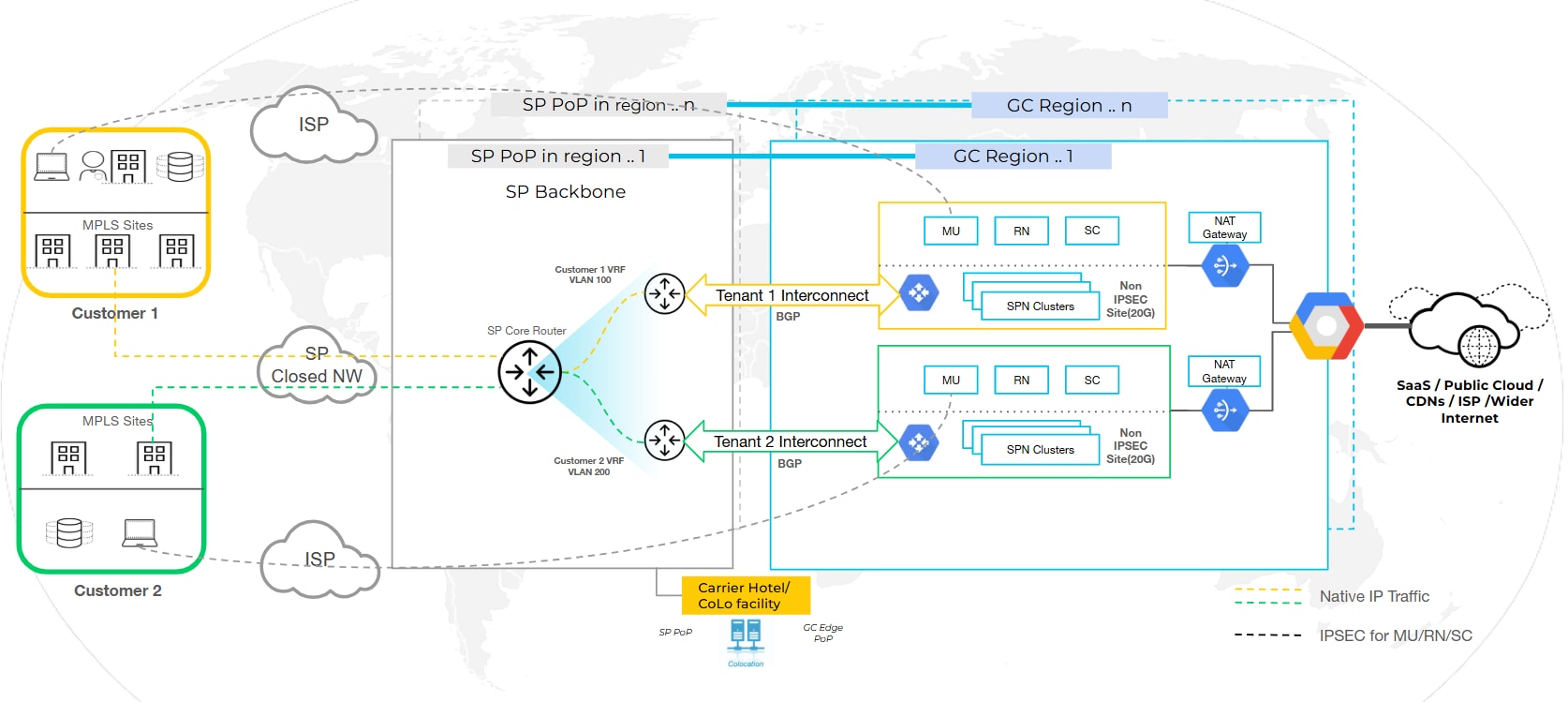
The "SP Interconnect (SPI)" adopted by KDDI this time is a next-generation architecture that directly interconnects telecommunications carriers' high-quality networks with our Prisma SASE. This integration makes it possible to directly connect traffic from closed networks (KDDI Wide Area Virtual Switch 2: WVS2)—which remain highly demanded among Japanese enterprises—to SASE, in addition to internet connections. In particular, the latest SPI achieves the flexibility and performance required to meet the strict requirements of the Japanese market, including the elimination of IPsec connection overhead . As a result, an ideal infrastructure foundation has been completed that uncompromisingly balances the communication quality of the carrier backbone and the latest security of Palo Alto Networks, allowing unified management under a single policy engine.

Executive Perspective: KDDI Leadership on Next-Gen Security

Regarding this release, Junji Hori, General Manager of Product Management at KDDI Corporation, stated:


"With the launch of Prisma SASE with SP Interconnect, the convergence of closed networks and the internet has accelerated. This service serves as the core first-phase solution in the Security-as-a-Service domain under KDDI’s 'AccelWaves Vision,' and we position it as a major milestone toward realizing 'KDDI AccelWaves Network,' an autonomous network service for enterprises scheduled for release in 2028.

By simply unifying the individual design and management of security across both closed networks and the internet, this newly announced service reduces the operational burden on security and networking while contributing to rapid response in the event of an incident. This is an advanced initiative made possible by combining the long-standing partnership and expertise cultivated between both companies.

Equipped with AI security capabilities, we are confident this service will deliver new value not only to existing WVS2 customers, but also to customers aiming to centralize security operations and optimize their networks.

KDDI will continue to further strengthen its partnership with Palo Alto Networks and strive to deliver innovative services that accelerate our customers' AI implementation."
 

Key Architectural Advantages of SP Interconnect 

The SP Interconnect that underpins the "SASE Gateway" offers the following outstanding benefits to customers: 

  • Direct Connection to KDDI's Closed Network and Ensuring Reliability: Achieves a low-latency and stable communication environment through the high SLA and cloud scale of Prisma SASE, and closed connection with KDDI's high-quality, wide-band backbone.
  • Realization of Comprehensive ZTNA: Consistently applies best-in-class Zero Trust security to access SaaS and private applications, regardless of the line type (closed network, Internet, etc.).
  • Securing the AI-Driven Enterprise: By routing high-speed closed network traffic through Prisma SASE, organizations can safely adopt GenAI and agentic AI tools. SP Interconnect enables  this traffic to benefit from machine-speed inline inspection, stopping automated, frontier AI attacks (like machine-scale vulnerability scanning and prompt injections) while enforcing complete visibility, identity control, and advanced data loss prevention (DLP).
  • Proactive IT Operations Powered by AI: Accelerate time-to-value by transforming reactive IT support into proactive, self-healing operations. It leverages AIOps and ADEM (Autonomous Digital Experience Management) to comprehensively visualize and manage transport networks across branches, clouds, and data centers, predicting and resolving network issues before users even notice them.
Figure: Interconnection with KDDI Backbone via the Latest SP Interconnect

Furthermore, to realize a platform-based approach to security, KDDI offers the "SASE Gateway" service alongside the extensibility to introduce advanced security solutions such as our "Cortex XDR" and "Prisma Browser" (a secure enterprise browser). Additionally, to provide end-to-end support for customers' security operations and management, this offering can be combined with SOC and IR (Incident Response) services provided by LAC Co., Ltd. 

Palo Alto Networks is confident that this "SASE Gateway" will become an essential business foundation supporting secure DX (Digital Transformation) for many Japanese enterprises advancing AI adoption, hybrid work and cloud migration. Through our strong alliance with KDDI, we look forward to further deepening our technical collaboration and greatly expect them to powerfully lead the expansion of sales and adoption among enterprise companies as a strong core solution for KDDI's "AccelWaves Vision".

KDDI’s SASE Gateway with Palo Alto Networks is now available as part of the companies’ joint integrated security portfolio.

Modernize Your Closed Network Security Today

Ready to simplify your hybrid network management and protect your organization against AI-driven threats? Contact us to schedule a custom architecture review or explore how KDDI SASE Gateway can fit into your cloud strategy.

The post “SASE Gateway” provided by KDDI : How SP Interconnect Simplifies Closed Network Zero Trust appeared first on Palo Alto Networks Blog.
  •  

Introducing CLARA Agent: Instant Cloud & AI Risk Insights Available on Google Cloud Gemini Enterprise

Most cloud and security teams struggle with two fundamental questions: What is actually running across our clouds, and what is exposed? As workloads sprawl and AI models deploy faster than ever, critical posture data gets locked inside specialized consoles. Gaps go unseen until they are exploited, and shadow AI leaves teams flying blind.

To solve this visibility challenge, Palo Alto Networks is introducing CLARA Agent.

By connecting Palo Alto Networks Strata Cloud Manager (SCM) directly to Google Cloud Gemini Enterprise, CLARA Agent turns complex cloud security data into clear, conversational insights. SCM powers this integration by consolidating security across environments, automating AI-driven operations to prevent misconfigurations, and continuously enforcing zero-trust policies with real-time threat prevention. Instead of digging through endless dashboards or running manual queries, teams can simply ask plain-language questions directly inside Gemini Enterprise to get immediate, evidence-backed answers.

CLARA Agent, which will be available on Google Cloud Marketplace, provides instant infrastructure discovery, automatically surfaces production AI/ML models alongside unsanctioned shadow AI, and ranks critical vulnerabilities so teams know exactly what is exposed. By bringing security intelligence directly into everyday workplace tools, it democratizes visibility for cloud, platform, and AI teams alike.

Bringing Palo Alto Networks CLARA Agent to Google Cloud Marketplace will help customers quickly deploy, manage, and grow the AI agent on Google Cloud’s trusted, global infrastructure. Palo Alto Networks can now securely scale and support organizations using its CLARA Agent to enable their security teams to turn cloud security data into conversational insights.

Vineet Bhan, Director, Security and Identity Partnerships, Google Cloud

Built for Immediate Value and Enterprise Security

CLARA Agent supercharges your existing investment in Strata Cloud Manager by bringing its rich security telemetry directly into everyday workflows. Greenfield deployments will benefit from additional visibility into their AI and non-AI workloads.

Designed to complement SCM’s robust security architecture, CLARA Agent leverages the open Agent-to-Agent (A2A) protocol and Model Context Protocol (MCP) servers to deliver fast, secure, and context-aware responses without requiring additional infrastructure setup. This integration creates a more seamless experience for security teams, empowering them to audit cloud posture, prioritize zero-day vulnerabilities, and secure rapid AI adoption faster and more intuitively than ever before. 

See CLARA Agent Live at the Security Innovations Forum 2026

Palo Alto Networks is proud to be a sponsor of the Security Innovations Forum 2026 on September 29 at the Google Event Center MP7 in Sunnyvale, CA. Join Rich Campagna, Senior VP of Products at Palo Alto Networks, and Joshua Haslett, Strategic Technology Partner  Manager at Google, on the executive panel, "Co-Innovating the Future of Cybersecurity: A C-Suite Perspective" (10:50 AM – 11:35 AM). They will discuss how agentic platforms are revolutionizing threat response and how organizations can deploy advanced AI agents at scale.

You can also visit the Palo Alto Networks kiosk during the forum to see a live demonstration of CLARA Agent, connect with our experts, and discover how we are co-innovating with Google Cloud to help safeguard agentic AI environments.

Get Started

Visit our booth at Google Cloud’s  Security Innovations Forum 2026, or contact your Palo Alto Networks representative to schedule a demo.


Forward-Looking Statements (unreleased feature only)

This blog contains forward-looking statements that involve risks, uncertainties and assumptions, including, without limitation, statements regarding the benefits, impact, or performance or potential benefits, impact or performance of our products and technologies or future products and technologies. Any unreleased services or features (and any services or features not generally available to customers) referenced in this or other press releases or public statements are not currently available (or are not yet generally available to customers) and may not be delivered when expected or at all. Customers who purchase Palo Alto Networks applications should make their purchase decisions based on services and features currently generally available.

The post Introducing CLARA Agent: Instant Cloud & AI Risk Insights Available on Google Cloud Gemini Enterprise appeared first on Palo Alto Networks Blog.

  •  

Securing AI Agents at Scale with NVIDIA

AI agents are crossing an important threshold.

They are moving from assistants that respond to us to autonomous systems that reason, plan, and act on our behalf. They can write and execute code, access enterprise data, call tools and APIs, and keep working toward a goal with limited human intervention.

That changes the security model.

An autonomous agent is designed to find a way to accomplish its objective. If one path is blocked, it reasons about another. That is what makes agents powerful, and it is why models’ built-in prompt guardrails alone are not enough.

The harness can guide what an agent should do. Security must control what an agent can do. That requires security authority outside the agent itself.

Palo Alto Networks and NVIDIA Team Up to Secure Agentic AI

NVIDIA provides the accelerated computing platform, secure runtime foundation, and reference system design for agentic AI. Palo Alto Networks brings the AI security capabilities enterprises need to govern interactions, protect workloads, and control identity and access.

Together, we are extending security across three areas: AI governance with Prisma AIRS AI Gateway, runtime protection with Prisma AIRS AI Runtime Security, and Agent Identity Security powered by IDIRA.

This is the focus of our expanded collaboration with NVIDIA on the NVIDIA Open Agent Safety Platform reference design.

a) Prisma AIRS AI Gateway on NVIDIA Vera CPU

Our forward-looking architecture includes Prisma AIRS AI Gateway software running on NVIDIA Vera CPU systems, bringing AI governance and enforcement closer to infrastructure designed for agentic workloads.

The AI Gateway is the real-time enforcement point for AI Governance, Runtime, and Identity security. It continuously verifies agent identities, enforces strict least-privilege access, redacts sensitive data before it is exposed, and deeply inspects every interaction—stopping unauthorized actions before they ever reach critical host systems or cloud endpoints.

  • Operationalize AI agents: Connect applications and agents to thousands of models and tools through one control point, with the reliability and flexibility to scale AI across the enterprise.
  • Track usage and control costs: Monitor every AI interaction across your company to see exactly what teams are doing, track your spending, and restrict access to approved tools only.
  • Enforce agent security across the enterprise: Block sensitive data exposure and malicious commands in real time, and verify agent identity before actions are taken.

b) Announcing Prisma AIRS AI Runtime Security on NVIDIA BlueField

The Palo Alto Networks AI Runtime firewall running natively on NVIDIA BlueField DPUs extends Zero Trust protection to the front-end network traffic of the AI factory and to the AI Edge, creating a tamper-proof boundary immune to application-layer attacks. Drawing on the NVIDIA Sentry reference design, Prisma AIRS AI Runtime Security accelerated on NVIDIA BlueField delivers: 

  • Hardware-Isolated Boundaries: Tamper-proof boundary, ensuring a compromised model or a rogue agent can never bypass runtime controls.
  • Agentless Behavioral Introspection: Monitor agent execution paths, memory structures, and tool calls with NVIDIA DOCA Argus with zero CPU overhead, and feed real-time telemetry directly into Cortex XSIAM for automated observation, analysis, and remediation.
  • Zero Trust Governance: Strict least-privilege access is enforced across the network and external APIs by default, delivering a verifiable audit trail for every allow and block action.

c) IDIRA Agent Identity Security

As agents gain greater autonomy, identity becomes fundamental to controlling what they can access and what actions they can take.

Looking ahead, we plan to integrate NVIDIA OpenShell with upcoming Agent Identity Security capabilities from Idira, including identity and secrets management for the OpenShell sandbox and agent identity broker service on NVIDIA BlueField. This will help organizations apply identity-based controls and least-privilege access to agents without relying on persistent human credentials.

The Path Ahead: Security at Scale for Enterprise Agents

As agents become more autonomous, governance must extend to identity. Prisma AIRS AI Gateway will also serve as an enforcement point for Agent Identity Security powered by IDIRA. We are also expanding to include Agent Identity Broker support directly on NVIDIA BlueField, providing identity verification and access governance independently of the host environment.

Together, these capabilities are designed to prevent unauthorized execution, reduce standing access, and stop privilege escalation as agents interact with enterprise systems.

As agents gain more autonomy, enterprises need consistent control over how they connect and what they can access.

Our work with NVIDIA brings those controls closer to where agentic workloads run, while Palo Alto Networks provides the security policy, governance, and enforcement enterprises need to manage them. 

To learn more about our GA of AI Runtime Security on the BlueField DPU, read our blog — Palo Alto Networks Announces Support for NVIDIA Enterprise AI Factory.

The next phase of AI will be defined not only by what agents can do, but by whether enterprises can trust them to operate safely at scale.

Palo Alto Networks was named a Market Shaper in AI application security. Read the report: Gartner® Emerging Market Quadrant for AI Application Security – Established Vendors, September 2026.

The post Securing AI Agents at Scale with NVIDIA appeared first on Palo Alto Networks Blog.
  •  

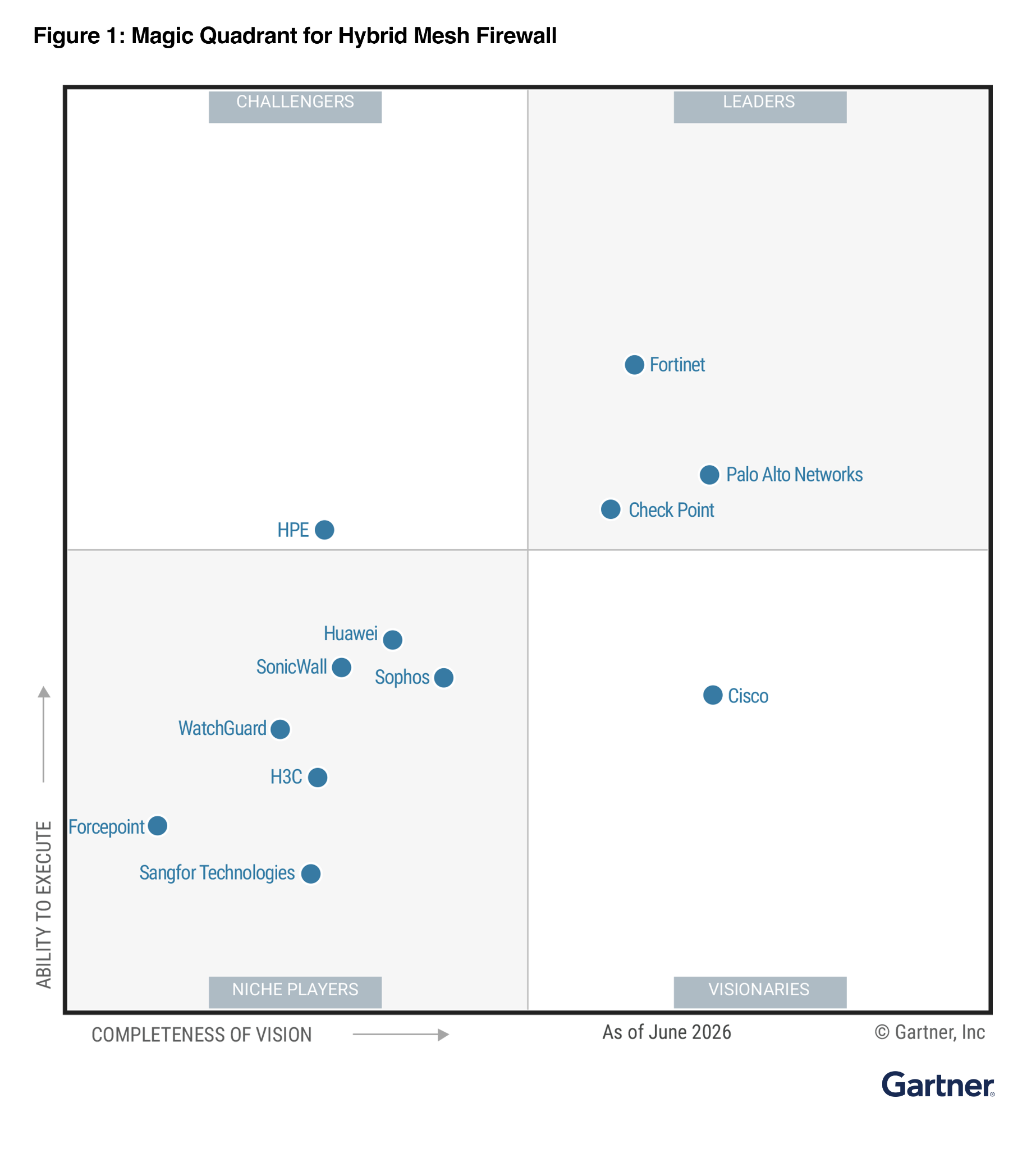
Palo Alto Networks Named a Leader in the 2026 Gartner® Magic Quadrant™ for Hybrid Mesh Firewall

Securing Every Environment at the Speed of Frontier AI

Recognized as a Leader for the second consecutive time and positioned furthest for Completeness of Vision. Palo Alto Networks is advancing hybrid mesh firewall with one integrated platform for preemptive protection, agentic operations, AI runtime security and quantum-safe security across the enterprise.


We are proud to share that Palo Alto Networks has been named a Leader in the 2026 Gartner® Magic Quadrant™ for Hybrid Mesh Firewall for the second consecutive time, and positioned furthest for Completeness of Vision.

We believe this recognition reflects the strength of our approach to network security: one natively integrated platform that delivers consistent protection, policy and operations across every environment.

It also comes at a pivotal moment for cybersecurity. Frontier AI is collapsing the time between vulnerability discovery and exploitation. AI applications and agents are creating new infrastructure and data risks. At the same time, the cryptographic reset is forcing enterprises to rethink how they establish and maintain digital trust.

Fragmented firewall architectures and manual security operations were never designed for this speed, scale or complexity, and can no longer keep pace.

One Platform Across Every Environment

Hybrid environments have traditionally required organizations to deploy and manage different security products across data centers, clouds, branches, campuses and remote users. The result is often fragmented policy, inconsistent protection and operational complexity.

Palo Alto Networks transforms hybrid mesh firewall from a collection of enforcement products into a unified, intelligent security platform, powered by Precision AI.

The  Strata Network Security Platform is our Hybrid Mesh Firewall, spanning hardware  (PA-Series), virtual (VM-Series), cloud-native (Cloud NGFW) and firewall-as-a-service (SASE) deployments with consistent policy, shared intelligence and threat prevention across environments. 

Strata Cloud Manager provides unified policy, visibility and AI-driven operations across these enforcement points. Beyond traditional firewall environments, the platform extends protection to the browser with Prisma Browser and to AI applications, models and agents with Prisma AIRS®.

Cloud-delivered security services, including Advanced Threat Prevention, Advanced WildFire, Advanced URL Filtering, and Advanced DNS Security deliver consistent, inline prevention across environments. Intelligence discovered in one part of the platform can strengthen protection everywhere, turning every enforcement point into a real-time prevention layer.

If you’re new to the concept of HMF, explore our primer on What Is a Hybrid Mesh Firewall and Why It Matters.

The Hybrid Mesh Firewall Market Is Evolving

Gartner’s 2026 Hybrid Mesh Firewall research describes a market moving toward more automated, intelligence-driven security platforms as organizations manage increasingly complex hybrid environments. 

The report identifies several trends shaping the evolution of hybrid mesh firewall, including the growing adoption of cloud-based management, AI-driven threat prevention, automation through LLM-based assistants, post-quantum cryptography and security capabilities for AI applications and workloads.

As these requirements evolve, organizations need a network security architecture that can deliver consistent protection and operations across hybrid environments while preparing for emerging AI and quantum-era risks.

Advancing Hybrid Mesh Firewall for the Frontier AI Era

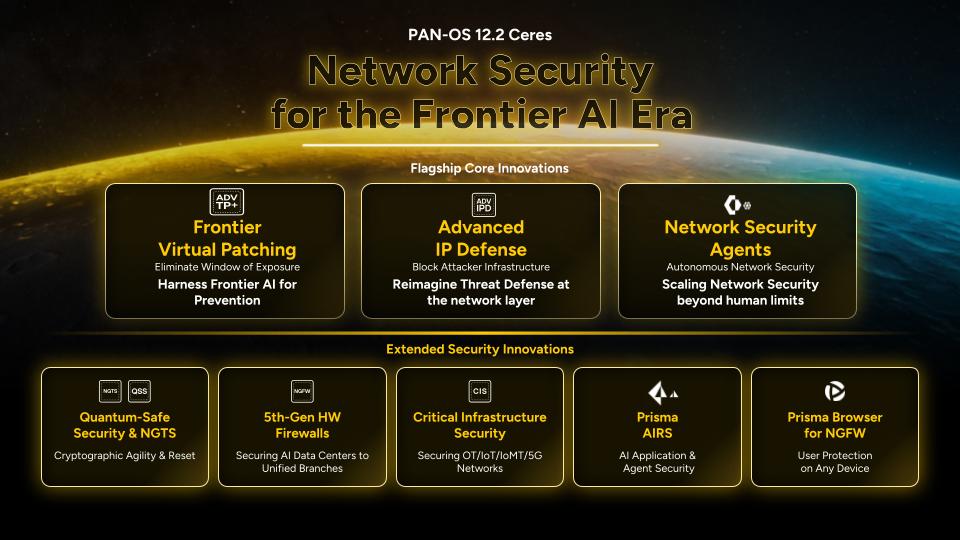
Against this backdrop, Palo Alto Networks continues to advance the Strata Network Security Platform for the Frontier AI era.

Preempt attacks earlier: Advanced Threat Prevention Plus uses Frontier AI-powered vulnerability discovery and Frontier Virtual Patching to deliver preemptive protections, including before vulnerabilities are publicly disclosed or official patches are available.

Disrupt attacker infrastructure: Advanced IP Defense continuously identifies, validates and blocks attacker-controlled infrastructure in real time - even when adversaries use direct-to-IP communications, proprietary encryption, residential proxies or trusted cloud infrastructure to evade traditional security signals.

Operate at machine speed: Six purpose-built Network Security Agents in Strata Cloud Manager assist teams with deployment, troubleshooting, configuration management, posture optimization, threat investigation and data protection, with built-in guardrails and human oversight.

Secure AI and modernize digital trust: Prisma AIRS helps secure AI applications, models and agents across the AI lifecycle, while Quantum-Safe Security and Next-Generation Trust Security help organizations identify cryptographic risk and modernize digital trust. Read more about Palo Alto Networks’ approach to securing AI.

Together, these capabilities help organizations reduce exposure before attacks succeed, operate at machine speed, secure AI infrastructure and modernize digital trust for the post-quantum era.

Proven Security, Performance and Scale

A unified platform must deliver not only breadth, but also effective protection and reliable performance under demanding conditions.

Independent SecureIQLab testing demonstrated 99% security efficacy, with Palo Alto Networks scoring approximately 20 points higher than the next-best tested vendor. Miercom validation demonstrated up to 2–8 times higher AI traffic throughput, along with strong TLS inspection and stable performance under sustained load.

More than 75,000 organizations around the world rely on Palo Alto Networks to consolidate security, improve visibility and reduce risk across their hybrid environments.

This global scale provides intelligence that continuously strengthens the platform. Every attempted attack expands what the platform can learn, and every new detection can become protection for all customers.

Defining the Future of Hybrid Mesh Firewall

We believe being named a Leader for the second consecutive time reinforces our conviction in an integrated platform that delivers consistent prevention and operations everywhere an enterprise operates.

But we believe industry leadership is also about preparing customers for what comes next.

As Frontier AI accelerates attacks, autonomous systems reshape security operations and quantum risk changes the foundations of digital trust, enterprises need more than a collection of firewalls. They need an intelligent security platform that can transform shared intelligence into prevention across every environment.

Palo Alto Networks is building that future, helping organizations reduce exposure before attacks succeed, operate at machine speed, secure AI infrastructure and modernize digital trust for the post-quantum era.

Download the 2026 Gartner® Magic Quadrant™ for Hybrid Mesh Firewall to learn more about why Palo Alto Networks was named a Leader.


Gartner Disclaimer

Gartner, Magic Quadrant for Hybrid Mesh Firewall, 7 September 2026

This graphic was published by Gartner, Inc. as part of a larger research document and should be evaluated in the context of the entire document. The Garner document is available upon request from Palo Alto Networks.

Gartner does not endorse any company, vendor, product or service depicted in its publications, and does not advise technology users to select only those vendors with the highest ratings or other designation. Gartner publications consist of the opinions of Gartner’s business and technology insights organization and should not be construed as statements of fact. Gartner disclaims all warranties, expressed or implied, with respect to this publication, including any warranties of merchantability or fitness for a particular purpose.

Gartner and Magic Quadrant are a trademark of Gartner, Inc., and/or its affiliates.

The post Palo Alto Networks Named a Leader in the 2026 Gartner® Magic Quadrant™ for Hybrid Mesh Firewall appeared first on Palo Alto Networks Blog.
  •  

Secure AI Coding: Governing every agent, artifact, and identity

Enterprises are seeing an unprecedented surge in AI coding adoption with spend on AI coding tools projected to top $13 billion in this calendar year1, compounding at more than 60% annually. For engineering teams, the benefits are unmistakable: accelerated output, supercharged productivity, and operational overheads dramatically reduced.

But these AI solutions are no longer just offering helpful coding suggestions. Today’s coding agents are able to assume a user’s identity, modify file systems, execute arbitrary terminal commands, and connect directly into core business systems.

Traditional cybersecurity architectures were engineered around three foundational assumptions: known software, human users, and human-speed actions. AI coding fundamentally dismantles all three.

The Breakdown of Traditional Controls for Secure Software Development.

As AI-assisted coding accelerates, traditional security controls are quickly falling behind, creating four volatile vectors of risk: 

  • Shadow AI at Enterprise Scale: Coding agents, IDE (Integrated Developer Environment) extensions, skills, and MCP (Model Context Protocol) servers permeate the enterprise before security teams even know they exist. In 2026, 68% of organizations reported lacking visibility into the AI tools their developers were actually using, and 57% of employees reported using AI coding tools without formal IT approval2. 
  • Risky Behavior by Agents: AI coding agents have the capability to  change files, access company resources, and execute system commands in milliseconds. In one documented3 AI-enabled intrusion chain, an agent executed 17,600 actions in 4.5 days creating a timeline no human-enabled SOC can manually govern. 
  • Blurred Identity and Attribution: Machines now outnumber human identities 109 to 14. And, because agents frequently operate using human credentials, distinguishing developer action from autonomous agent action becomes nearly impossible. When anomalies occur, this obscured attribution further complicates root causing the issue. 
  • Uncontrolled Connections, Data, and Cost: Agents connecting to external models, MCP servers, and third-party tools outside the company, presents another distinct but related issue. All these connections also quietly increase consumption of AI resources, and separately exacerbate the risk of sensitive IP leaks. A recent survey found5 that 93% of enterprises exceeded their AI budgets with 20-30% of AI spend being entirely unaccounted for.  

Resetting the Controls for AI-Native Development.

Securing AI coding inside an enterprise requires a proactive, platform-centric approach:

  • Discover shadow AI and what it’s using: Gain complete visibility across every model, agents, plugin, skill, and MCP to neutralize risky or unsanctioned components before they perform harmful actions.
  • Assess supply chain risks: Scan skills, models, and MCP to make sure they are trusted.
  • Protect identity and prompt: Inspect prompts, model outputs, and autonomous interactions in real time. Provision verified, task-scoped identities for agents and eliminate standing privileges.
  • Govern data, actions, and cost: Enforce zero-trust boundaries over external model connections, governing access to file systems, sensitive corporate data, and establishing hard policies over AI resource consumption and spend.

The Platformization Advantage for Superior Governance.

Today, endpoint visibility, LLM traffic, token consumption, agent identity and actions are fragmented across disparate solutions introducing visibility gaps and creating new risks for enterprises. Palo Alto Networks delivers AI coding security natively with an integrated platform to secure what gets installed, what runs, what data leaves the enterprise, and which identity is used.

AI coding tools will continue to evolve, as they should. But your builders don’t have to choose between speed and security. The goal is not to slow down developer momentum, but to provide the security controls that serve as scaffolding for your teams to innovate faster and with complete confidence.

Secure your AI. We’ve got next.

Visit our Secure AI Coding page or download our solution brief to learn more.


1 - IdeaPlan
2 - The AI Velocity Gap
3 - Hugging Face
4 - Idira 2026 Identity Security Landscape - Chapter One
5 - McKinsey; Oabo

The post Secure AI Coding: Governing every agent, artifact, and identity appeared first on Palo Alto Networks Blog.
  •  

Putting OpenAI Cyber Models to Work for Defenders

Unit 42 is putting the latest frontier cyber models to work across customer environments to find, validate and help remediate the attack paths that matter most.

In May, we introduced Frontier AI Defense with a warning: the window to get ahead of AI-enabled attacks was shorter than most people realized. Since then, we have briefed more than 1,000 security teams around the world and introduced our Frontier AI Defense service to hundreds of customers.

Today, through our partnership with OpenAI, we are expanding Unit 42 Frontier AI Exposure Analysis to put advanced frontier cyber models directly to work in customer environments. Under Unit 42 direction, these models can find exposures, test whether they are exploitable, validate attack paths and help customers prioritize what to fix first.

Our early work shows why this approach matters: 36% of the exposures we identified map to no known CVE, often because they involve multiple gaps that have to be discovered, chained and tested together.

Bringing the Latest Frontier Cyber Capabilities to Defenders

Palo Alto Networks has been among a limited group of organizations with early access to advanced cyber capabilities from the leading frontier AI labs. Through our partnership with OpenAI, Unit 42 can now bring its latest advanced cyber capabilities, including GPT-5.6 Daybreak, to security testing and validation for our customers. Until now, GPT-5.6 Daybreak has not been available for commercial use.

Frontier models have helped inform the work of our experts. Now they can increasingly perform complex offensive security tasks directly, at machine speed and under Unit 42 direction. That allows us to go deeper than traditional vulnerability discovery by testing exploitability, reasoning across multiple weaknesses and determining how an attacker could use them to achieve an objective.

There is no single best model for every cyber task. Our research has shown that different models have different strengths and find vulnerabilities others miss. A multi-model harness routes work to the model best suited for the task, improving efficacy and coverage while managing the cost of frontier AI at scale. As stronger models emerge, we can incorporate them without rebuilding the offering around a single model or provider.

Unit 42 experts remain central to the process. We combine frontier models with our offensive security expertise, Palo Alto Networks telemetry and Unit 42 Threat Intelligence to validate findings, connect exposures into attack paths and understand what an attacker could ultimately achieve.

Built to Find What Attackers Can Exploit

The expanded service brings five capabilities together:

  • Leading cyber models: Apply the latest advanced cyber models to improve exposure discovery, testing and validation.
  • Multi-model harness: Use the right model for the right task to improve efficacy, expand coverage and optimize cost.
  • Exposure discovery: Find vulnerabilities, misconfigurations, leaked credentials, unmanaged attack surface and other posture gaps across applications and network assets.
  • Advanced adversary simulation: Actively test exploitability and validate end-to-end attack paths to understand how an attacker could compromise the environment.
  • Custom remediation plan: Prioritize the fixes that break the most important attack paths and feed those findings into existing IT, development and security workflows.

Most security teams already have more findings than they can act on. The harder problem is knowing which ones create a real path to compromise. Attackers look across applications, infrastructure, identity and cloud for weaknesses they can combine to achieve an objective. Frontier AI Exposure Analysis applies that same adversarial perspective, helping defenders understand which paths matter and what to fix first.

The Asymmetry Runs Both Ways Now

For the past several months, frontier AI has been a story about what is coming for defenders: vulnerability discovery at scale, exploit chaining that sees full-stack logic no scanner catches, and attack cycles compressed to seconds from initial access to exfiltration.

All of that is still true. Our answer has been to put everything we learn testing these frontier models into the hands of defenders. Today, that gets more direct: not just what frontier models have taught us, but the models themselves, working in your environment for your defenders before those same capabilities are working for the attacker.

The window is still closing. We intend to spend it building on the side of the defenders.

Visit Palo Alto Networks Frontier AI Defense to learn more.

The post Putting OpenAI Cyber Models to Work for Defenders appeared first on Palo Alto Networks Blog.
  •  

Palo Alto Networks Recognized as the Only Vendor to be Named a 4X Leader in SASE and SSE Gartner Magic Quadrant Reports

As organizations race to deploy agentic AI, legacy network security solutions are ill-equipped to keep up, forcing productivity tradeoffs while exposing coverage gaps. At the same time, Frontier AI is proving capable of discovering vulnerabilities and creating exploits in real-time. Navigating this shift requires more than incremental feature enhancements; it requires a bold, market-defining vision backed by relentless customer focused execution. 

Today, we’re proud to announce that Gartner® has once again recognized Palo Alto Networks as a Leader in the 2026 Magic Quadrant™ reports for both Security Service Edge and SASE Platforms. This marks the fourth consecutive year that Palo Alto Networks has been recognized, making us the only security vendor to be recognized as a Leader in both reports for four years in a row.

In this year’s Magic Quadrant for SSE, Palo Alto Networks was placed highest in ability to execute and furthest in completeness of vision for Prisma Access.

Every day we focus relentlessly on understanding the needs of our customers and channeling that back into products and services that create real value for them. Our product strategy centers on where our customers' environments and security needs are heading, not just where it sits today.

Vision Matters More than Ever in the AI Era

The AI landscape is changing daily - in this new reality, we strive to be the visionary leaders to serve our customers. GenAI and Agentic AI are exposing enterprises to novel categories of risks like prompt injection, over-privileged agents, and poisoned models. At the same time, Frontier AI is accelerating vulnerability discovery and attack speed resulting in attack timelines being compressed by over 95%.

Gartner projects that by the end of this year, 40% of enterprise applications will feature embedded agents, up from less than 5% today. And by 2028, 60% of brands will use agentic AI to facilitate streamlined one-to-one interactions. Operating a business in this new reality requires security architecture engineered to anticipate threats that haven't yet emerged. Success cannot be achieved by retrofitting legacy products with support for AI infrastructure. It demands a unified future-ready foundation that natively secures users, applications, sensitive data, and non-human identities across every touchpoint. The platform enterprises use today determines whether they'll be prepared for tomorrow's threats.

As the cybersecurity landscape undergoes its biggest shift in decades, to us, the Gartner recognition as a Leader on vision and execution across both reports means more than ever before. In our opinion, it not only validates Palo Alto Network’s ability to serve the world’s largest enterprises but also celebrates our strategic product capabilities as shaping the future of cybersecurity through industry leading innovation such as securing AI traffic flows and agents that simplify manageability of SASE operations.

Vision Backed by Relentless Execution

We believe being placed highest in execution and furthest in vision is only as valuable as the ability to execute on it, and Palo Alto Networks has a proven record of creating value for our customers. Our recent milestone of crossing the $1.6 billion ARR mark while growing 40% year over year for Prisma SASE reflects the trust customers have placed in us. Over 6,800 organizations, including over one third of the fortune 500, trust us because we consistently turn market-defining innovation into enterprise-grade reality. Our execution leadership is built on a strong foundation:

  • Security powered by Precision AI: Our platform delivers universal zero trust through distributed and flexible enforcement points. We inspect traffic as close to the user as possible to ensure that whether your teams are at the corporate HQ, a remote branch, a coffee shop or working from home, they receive the same protection at their precise point of interaction.
  • Unmatched performance and resilience: By leveraging global hyperscalers, we provide the massive scale and reach that modern organizations require. For specialized, high-performance and sensitive needs, SASE Private Location brings that same cloud-delivered resilience directly to private campuses.
  • Unified platform: With a truly unified policy engine, data platform and operations, we ensure that as enterprises adapt to the future, our architecture remains an accelerator for secure productivity rather than a bottleneck. We accelerate vendor consolidation for enterprise customers, replacing fragmented legacy point products with a single platform that slashes operational overhead and reduces total cost of ownership (TCO) by up to 50%.

Building for the Future 

As the rules of cybersecurity are rewritten in real time, leading the market requires more than following past trends, it requires setting the trajectory. Our aim is to continuously be at the forefront of defining the future of cybersecurity to power the agentic enterprise of tomorrow.

Protecting with AI

Palo Alto Networks continues to innovate to keep enterprises safe at the speed of AI. Our Precision AI security service blocks over 30B threats every single day defeating sophisticated and highly evasive tactics. When combined with our virtual patching and IP defense security services, organizations receive proactive defense that secures at the speed of Frontier AI with flexible enforcement that provides consistent protection everywhere. We are delivering comprehensive security across network, edge, and cloud infrastructure to stop hidden threats that are invisible to traditional networks security solutions. 

This AI-powered defense in depth strategy operates across the entire attack lifecycle to enable proactive protection that shifts enterprise security postures from reactive incident response to preemptive defense. 

Securing AI 

Safely enabling employee adoption of AI tools and agents requires special considerations to mitigate risks around data leaks, intellectual property exposure, and compliance. Prisma SASE and Prisma Access solve these challenges by discovering all AI usage and agentic actions, enforcing granular least privilege access for human and non-human identities, and preventing exposure of risky data to AI and agents. Through AI Access Security™, Prisma SASE provides unified data security across the AI lifecycle by integrating GenAI app visibility and control, real-time prompt analysis, shadow data discovery, and  protection on endpoint. Prisma Browser provides a secure AI workspace that safeguards both human and autonomous agent workflows across any LLM by defending against data leaks, prompt injections, and agent hijacking. 

To secure the rapid adoption of AI agents by enterprises, Prisma Access will natively integrate with Prisma AIRS AI Gateway to provide a unified LLM, MCP, and A2A gateway giving security teams a single pane of glass for AI observability, cost governance, and runtime inspection.

This innovative approach represents an evolution away from traditional device and user centric fabrics towards an agent-aware platform capable of securing AI for the enterprise of tomorrow, today. 

Operating with AI

We continue to invest in capabilities that make our platforms proactive, efficient and easier to use. Our new deployment agents enable customers to onboard their SSE or SASE environment more efficiently, reducing their time to value while increasing productivity. Once onboarded, autonomous AI agents within Strata Cloud Manager continuously evaluate network and security posture to proactively identify configuration drift, performance degradation, and security policy gaps. By uncovering potential disruptions before they impact users or expose the organization to risk we’ve created automated systems capable of finding issues and automatically remediating them, with human-in-the-loop oversight calibrated to the administrator's comfort level, from guided recommendations to full autonomy.

The practical outcome is a dramatic reduction in mean time to resolution (MTTR) and a measurable reduction in total cost of ownership (TCO) while significantly reducing administrative burdens and making Palo Alto Networks products easier to maintain and operate.

Learn More

Download your complimentary copies of the 2026 Gartner® Magic Quadrant™ reports to learn why Palo Alto Networks has been recognized as a Leader in both SASE and SSE for the fourth consecutive year.


Gartner, Magic Quadrant for Security Service Edge, 29 July 2026, John Watts Et Al.
Gartner, Magic Quadrant for SASE Platforms, 28 July 2026, By Jonathan Forest Et Al.
Gartner does not endorse any company, vendor, product or service depicted in its publications, and does not advise technology users to select only those vendors with the highest ratings or other designation. Gartner publications consist of the opinions of Gartner’s business and technology insights organization and should not be construed as statements of fact. Gartner disclaims all warranties, expressed or implied, with respect to this publication, including any warranties of merchantability or fitness for a particular purpose.
Gartner and Magic Quadrant are a trademark of Gartner, Inc., and/or its affiliates.
This graphic was published by Gartner, Inc. as part of a larger research document and should be evaluated in the context of the entire document. The Gartner document is available upon request from Palo Alto Networks.

The post Palo Alto Networks Recognized as the Only Vendor to be Named a 4X Leader in SASE and SSE Gartner Magic Quadrant Reports appeared first on Palo Alto Networks Blog.

  •  

Strengthening Security of AI Coding: Prisma AIRS API Integration with OpenAI Codex

Palo Alto Networks works closely with OpenAI across our product platform and Unit 42, leveraging advanced frontier model capabilities. Furthermore, we are a partner in the OpenAI Daybreak Cyber Partner Program, working with OpenAI to bring trusted, AI-powered cyber defense to more organizations. Today, we’re announcing native integration of Prisma AIRS Runtime API with OpenAI Codex. This milestone deepens our partnership and drives our shared mission forward: equipping defenders with the industry's most advanced tools.

AI coding assistants have transformed software development, accelerating shipping velocity and changing how engineers solve problems. But as integration of AI coding assistants deepens across development teams, security and compliance teams constantly struggle with enabling developer productivity while helping protect proprietary source code and credentials, and reducing the risk of runtime threats entering the codebase.

Streamlined Security in Minutes

We designed this integration to eliminate complex traffic steering and heavy client-side hooks. Securing your entire developer organization takes just a few clicks inside Codex Enterprise Management UI. Here is how you can enable it:

  1. Retrieve Credentials: Generate your API key and endpoint from the Prisma AIRS management console.
  2. Configure Codex: Paste the Prisma AIRS API key and endpoint directly into your Global Admin Console.
  3. Activate Org-Wide Scanning: Once saved, all user prompts across your entire organization in Codex are automatically routed through the Prisma AIRS Runtime API for real-time inspection.

What Prisma AIRS Brings to OpenAI Codex

By connecting the Codex in ChatGPT for Enterprise workspace to the Prisma AIRS Runtime API, security teams gain comprehensive, automated security controls across two critical vectors:

1. Enterprise Data Loss Prevention (DLP)

Developers frequently paste context – logs, config snippets, or functions – into AI coding assistants. Prisma AIRS scans inputs to help identify sensitive data before it is submitted.

  • Secrets & Credentials: Intercept API keys, hardcoded passwords, tokens, and private keys.
  • PII & Financial Data: Automatically detect personally identifiable information and regulated data patterns.
  • Proprietary Code & IP: Enforce custom pattern rules to help prevent sensitive internal code, architecture details, or trade secrets from being submitted.

2. Advanced Threat & Malicious Code Detection

AI prompts and contextual inputs can contain content that introduces security risks into development workflows. Prisma AIRS Runtime API inspects incoming developer inputs for:

  • Malicious Code Patterns: Detect obfuscated scripts, dangerous command executions, or known exploit patterns within developer prompts.
  • Malicious URLs & Links: Flag unverified, phishing, or malicious domain references before they influence generated code or enter internal repos.
  • Prompt Manipulation Attacks: Detect adversarial inputs that may attempt to bypass system controls or alter model behavior.

Built for DevSecOps Alignment

Security controls only work if developers actually use them. Because the inspection happens at the platform administrative level via API, developers continue working natively in Codex without changing their IDE setup or downloading local hooks. SecOps gain centralized visibility, consistent policy enforcement, and audit-ready logging capabilities across the entire engineering organization, while developers keep the speed and experience they expect.

Key Takeaways

  • Security as Invisible Infrastructure: Prisma AIRS integrates at the Codex administrative layer, applying security and DLP controls without requiring additional developer workflow changes. Developers can continue working in Codex while security teams maintain centralized policy controls.
  • Unified Governance for Frontier Models: Prisma AIRS acts as an inline security layer that scans AI traffic in real-time before prompts ever reach the destination model. This architecture can help organizations identify sensitive information moving outward while detecting prompt manipulation and potentially malicious content moving into development workflows. If Prisma AIRS API detects a threat, a block verdict is sent to OpenAI Codex, and the prompt does not reach the destination model or MCP server.
  • Organization-Wide Compliance: Deployment speed is a strategic advantage, not just an IT convenience. By configuring the Prisma AIRS API within the Global Admin Console, organizations can achieve org-wide governance without complex traffic steering. This can help development teams shift from unmanaged AI use toward more consistent, auditable security practices.

Getting Started

The Prisma AIRS integration helps organizations maintain consistent security controls while preserving the speed and productivity gains of Codex. Organizations can combine Palo Alto Networks’ security capabilities with OpenAI Codex to maintain centralized security and governance controls.

Choose your path forward:


Forward-Looking Statements

This blog contains forward-looking statements that involve risks, uncertainties and assumptions, including, without limitation, statements regarding the benefits, impact, or performance or potential benefits, impact or performance of our products and technologies or future products and technologies. These forward-looking statements are not guarantees of future performance, and there are a significant number of factors that could cause actual results to differ materially from statements made in this blog. We identify certain important risks and uncertainties that could affect our results and performance in our most recent Annual Report on Form 10-K, our most recent Quarterly Report on Form 10-Q, and our other filings with the U.S. Securities and Exchange Commission from time-to-time, each of which are available on our website at investors.paloaltonetworks.com and on the SEC's website at www.sec.gov. All forward-looking statements in this blog are based on information available to us as of the date hereof, and we do not assume any obligation to update the forward-looking statements provided to reflect events that occur or circumstances that exist after the date on which they were made.

The post Strengthening Security of AI Coding: Prisma AIRS API Integration with OpenAI Codex appeared first on Palo Alto Networks Blog.

  •  

Prisma AIRS - Unified Data Protection for Claude

As AI adoption shifts from experimental tools to the business core, enterprises are deploying AI agents and assistants across every department. Developers are accelerating software delivery with Claude Code and business functions are collaborating in Claude.ai, Claude Cowork, and Claude Design, using Anthropic's Claude to fundamentally rewire how they operate and drive complex, autonomous workflows across their most critical tasks.

Broad AI adoption has forced enterprise security into a difficult paradox: secure the business without stalling innovation. Today, security teams must answer three critical questions: How do we prevent sensitive data from leaking into AI models? How do we intercept runtime attacks, like prompt injection, before they execute? And how do we enforce these guardrails consistently across every AI interaction, in real-time?

We are thrilled to announce that Palo Alto Networks Prisma AIRS API now directly integrates with Claude Enterprise via inference hooks.

Key Takeaways:

  • Synchronous Governance at the Speed of AI: Enforce critical runtime policy guardrails instantly before model inference occurs. By evaluating every Claude interaction in real-time, security teams can confidently enable high-speed AI innovation without introducing unacceptable risk or operational bottlenecks.
  • Extending Proven DLP to AI Workflows: Safeguard PII, intellectual property, and proprietary code across all Claude environments (Claude Code, Claude.ai, Claude Cowork) seamlessly. By directly leveraging your organization’s existing enterprise DLP policies, you get consistent, unified data protection without the friction of managing disparate rule sets.
  • Neutralizing AI-Specific Threats Proactively: Deploy enterprise AI with confidence by intercepting malicious activity before it executes. Proactively block sophisticated runtime threats, including prompt injections, jailbreaks, and toxic inputs, enabling your AI workflows to remain secure and your business operations uninterrupted.

How It Works

Setting up zero-trust governance for your Claude Enterprise environment takes just a few clicks:

  • Configure Claude Enterprise: In your Claude Enterprise organization settings, navigate to inference hooks, set the hook endpoint URL to your designated Prisma AIRS webhook URL, and include your custom Prisma AIRS API key in the custom headers (x-pan-token).
  • Activate Cryptographic Verification in Prisma AIRS: Claude generates a unique, one-time signing secret. You simply drop this signing secret into the Prisma AIRS UI.

Prisma AIRS securely stores the signing secret in an encrypted edge Key-Value Map (KVM) to cryptographically verify the authenticity of every incoming request before processing.

Unified Governance Across All Claude Surfaces

Before Claude reads a prompt, Claude POSTs the payload to Prisma AIRS, which evaluates the input against the configured security profile and returns a synchronous allow or deny verdict back to Claude.

Removing the Data Inspection Blind Spot

This Prisma AIRS integration natively leverages the Palo Alto Networks Enterprise DLP engine your organization already runs. Your current policies, custom definitions of "confidential," and compliance dashboards now instantly govern Claude. No redundant rule creation, and no new management overhead. Every prompt is classified in real-time, before anything reaches the model. Data Policy updates reach Claude the moment they reach everything else, and Claude events land in the same dashboards and audit reporting as every other channel. AI stops being the exception to your data protection strategy and becomes just another channel that is covered.

In practice, this helps prevent:

  • Accidental exposure of PII and regulated data: a Social Security number, card number, or patient record pasted into a prompt is detected  on the spot by advanced RegEx patterns and ML classifiers,  with Exact Data Matching (EDM) recognizing your actual customer records.   When policy requires, Prisma AIRS enforces a deny policy to help keep Claude usage stays aligned with GDPR, HIPAA, and PCI-DSS requirements.
  • Misuse of credentials in code: Developers working in Claude Code can't inadvertently submit hardcoded API keys, private tokens, or environment credentials into prompt context.
  • Disclosure of confidential business matters. Document classifiers flag prompts touching M&A, legal, or HR material — even when they contain no identifier a pattern could match.

AI Safety & Runtime Threat Protection

Simultaneously, Prisma AIRS inspects payloads for operational risks specific to large language models:

  • Prompt Injection & Jailbreak Attacks: Intercepts malicious attempts to manipulate model context or bypass system instructions.
  • Malicious Code & Malicious URLs: Prevents execution or processing of untrusted scripts and risky links embedded within prompts.
  • Toxic Content & Topic Guardrails: Enforces compliance with corporate policies and custom business topics.

If a prompt violates your security policy, Prisma AIRS issues a deny verdict. Claude immediately blocks the prompt, optionally presenting a user-facing explanation while returning a unique audit correlation code to your security telemetry dashboards.

Deploy Claude Without the Risk

The Prisma AIRS integration with Claude transforms security from a deployment bottleneck into a business enabler. You no longer have to choose between the operational control of Palo Alto Networks and the cognitive velocity of Claude.

Choose Your Path Forward:


Forward-Looking Statements

This blog contains forward-looking statements that involve risks, uncertainties and assumptions, including, without limitation, statements regarding the benefits, impact, or performance or potential benefits, impact or performance of our products and technologies or future products and technologies. These forward-looking statements are not guarantees of future performance, and there are a significant number of factors that could cause actual results to differ materially from statements made in this blog. We identify certain important risks and uncertainties that could affect our results and performance in our most recent Annual Report on Form 10-K, our most recent Quarterly Report on Form 10-Q, and our other filings with the U.S. Securities and Exchange Commission from time-to-time, each of which are available on our website at investors.paloaltonetworks.com and on the SEC's website at www.sec.gov.  All forward-looking statements in this blog are based on information available to us as of the date hereof, and we do not assume any obligation to update the forward-looking statements provided to reflect events that occur or circumstances that exist after the date on which they were made.

The post Prisma AIRS - Unified Data Protection for Claude appeared first on Palo Alto Networks Blog.

  •  

Redefining Network Security for the Frontier AI Era

Modern enterprise security is at a pivotal moment where CIOs and CISOs have a clear opportunity to build a cybersecurity architecture for both today’s environment, and for the future. Doing so requires redefining enterprise resilience across three critical dimensions. 

First, Frontier AI driven threat velocity and novelty. Frontier AI models have automated the entire attack lifecycle. Adversaries aren’t just compressing exploit windows to near-zero timelines, they are also generating novel, highly evasive threats at machine speed, bypassing traditional signatures and often before patches are generated. 

Second, surging network traffic is overwhelming traditional defenses. Driven by AI workloads, inter-datacenter traffic will nearly triple1 over the next decade dramatically expanding the volume of data teams must inspect and secure. 

Finally, major shifts are forcing a “cryptographic reset.” Shrinking certificate lifecycles, internet-scale distrust events, and quantum computers powerful enough to crack public key cryptography are combining to shake the foundation of all digital communications. 

Meeting these challenges requires more than incremental fixes. Today, we are proud to introduce PAN-OS 12.2 Ceres, a landmark release representing a major leap forward in network security. 

Ceres brings to market 55+ innovations, including three flagship, core capabilities, designed to shift the balance of power back to defenders.

Introducing Frontier Virtual Patching: Preemptive Defense Against Frontier AI Exploits

Today, Palo Alto Networks is giving defenders the ultimate advantage with the launch of Frontier Virtual Patching. By harnessing Frontier AI to discover unknown vulnerabilities, and deploying protections in hours, we are collapsing the exposure window from the industry-average 55 days2 it takes to deploy a traditional patch down into a near-zero window of exposure. This isn’t just about faster patching; it’s about eliminating the attacker’s chance by neutralizing exploits before they ever reach your network.

Frontier AI models - Collapse the patch window

The new reality: Exploitation far outpaces patch deployment

We’ve built this capability as a collaborative, force-multiplying ecosystem, with our industry partnerships across the enterprise software and OT vendor landscape to accelerate vulnerability disclosure, remediation and customer protection. This includes our collaboration with Project Lightwell, which combines our rapid network-level protection with software remediation to help organizations reduce exposure to emerging threats. We’re also partnering with vulnerability clearinghouses, software maintainers, and industry initiatives to continuously expand a real-time pool of protected vulnerabilities.

This approach builds on recent Unit 42 research, where the autonomous AI system NOVA identified more than 14,000 previously unknown vulnerabilities in just two months – a clear signal that defenders must pair AI-powered discovery with equally fast, coordinated protection. We have built an all-new detection engine, “vaulted protection," that enables us to deliver these rapid protections in a safe and responsible manner. When one participant identifies a threat, the entire ecosystem is protected instantly. Individual discovery becomes global protection. 

This is especially valuable for operational technology (OT), critical infrastructure, healthcare, and IoT: environments where systems can’t be taken offline to patch, where patch cycles can stretch for months, and where a single unpatched device can expose an entire network. Frontier Virtual Patching closes that gap in the network, blocking the exploit without applying a patch, rebooting a system, or causing any downtime to critical operations.

Bad actors will lean into Frontier AI to reduce the attack lifecycle from months to minutes. To keep pace, organizations require security partners to match that machine speed. To this end, Palo Alto Networks is raising the bar with its Frontier Virtual Patching, moving beyond compensating controls. By safely and efficiently discovering undisclosed vulnerabilities and deploying protection long before traditional patches can be rolled out, Palo Alto Networks deep security capabilities are flipping network defense from a reactive to proactive operational model.


Will Townsend
Chief Analyst, LoneStar Advisory & Research

And for existing Palo Alto Networks network security customers, getting started is effortless.  Frontier Virtual Patching is available as a PAN-OS software upgrade with persistent, automatic content updates, so protections keep arriving as new threats emerge, with no new hardware and no manual intervention. 

Clearly, Network Security is evolving quickly. Frontier Virtual Patching is part of a huge set of innovations that the team at Palo Alto Networks is delivering in PAN-OS Ceres 12.2 to enable you to stay protected.

Advanced IP Defense: Blocking attacker infrastructure before they can strike

Modern threat actors continuously work to hide their attacks and evade existing controls. Adversaries are increasingly evading traditional perimeter detection of their command-and-control traffic by leveraging direct-to-IP connection techniques that bypass DNS and URL inspection entirely. Attackers are also weaponizing massive proxy networks and hundreds of thousands of residential IP addresses to conduct stealthy, large-scale scanning, brute-force attacks, and exploitation that bypass traditional defenses such as IP reputation and blocklists.

To counter this, Palo Alto Networks is introducing a new preventative solution, Advanced IP Defense, with three powerful new capabilities:

  • Real-time IP-layer intelligence. We leverage global telemetry from over 70,000 customers to track and block attacker infrastructure inline across the entire attack lifecycle. Our researchers track these threats 24/7, so your team doesn’t have to.
  • Zero-Trust IP enforcement. We don’t just look at an IP’s past reputation. We verify the intent of the connection itself. By validating that every network connection maps to a legitimate DNS resolution, we provide a critical guardrail against attackers attempting to evade detection.
  • Powerful IP-layer context. We continuously monitor every connection across more than 40 distinct security attributes, letting you proactively shrink your attack surface and block high-risk traffic from the internet’s “bad neighborhoods” with confidence.

The transition to the Frontier AI era isn't a distant future. It’s happening right now. The organizations that thrive won't be those trying to run old, reactive playbooks faster; they have to scale their defenses to match a whole new velocity of risk. When threats occur at machine speed, relying on human-scale operations is no longer an option. That is why AI and automation are becoming essential tools to meet these challenges head-on.

Varinder Singh
CIO, NXP Semiconductors

Network Security Agents: Making admins superhuman

When threats execute in minutes, human-only operations become a bottleneck. To reduce fatigue and accelerate response, we’re launching an elite suite of AI agents for every major role a network administrator performs.

These six specialized AI-powered Network Security Agents, available through Strata Cloud Manager, are trained on your enterprise context and operational workflows. From onboarding and configuration to threat assessment and troubleshooting, they automate the hundreds of routine, repetitive tasks that consume an admin’s day. And you stay in control: for each workflow, you choose the level of oversight that matches your risk tolerance — human-in-the-loop, human-on-the-loop, or human-out-of-the-loop.

Expanding platform protection across every edge

Securing the modern enterprise means extending these AI-powered capabilities across every surface, from data center cores to remote industrial sites, and from custom AI applications to the web browser.

Today we’re introducing PAN-OS Ceres 12.2, which, in addition to the innovations above, expands our platform across five more areas:

  • Quantum-safe & next-generation trust security. Automates digital certificate lifecycle management and accelerates post-quantum cryptographic readiness, including a cryptographic inventory spanning network security, endpoint, SIEM, and vulnerability management integrations for a complete view of enterprise readiness.
  • 5th-generation ML-optimized hardware. New high-performance PA-Series firewalls equipped with 400G interfaces, and 300 Gbps of threat inspection, and active clustering, these platforms eliminate capacity limits for AI-era data centers. These firewalls also  scale to 1.4Tbps of throughput while delivering 5-microsecond latency ensuring peak performance. 
  • Modernized OT & critical infrastructure defense. Purpose-built PA-50R ruggedized 5G firewalls that extend real-time, AI-powered threat prevention to remote, extreme-environment OT networks and critical infrastructure.
  • AI and agent security. Prisma AIRS is now delivered as a scalable, cloud-native service explicitly engineered to secure AI models, applications, and autonomous agent workflows. The same platform on which we built CloudNGFW has now been extended to provide security for AI with the addition of Prisma AIRS.
  • Browser-to-firewall integration. Imagine the browser as a secure fast-lane that doesn’t just protect users, it empowers them. By integrating Prisma Browser with our NGFWs, we’ve eliminated the need to decrypt on the endpoint while delivering full Layer 7 protection. This is proactive security that neutralizes threats before they can even touch your network. For security admins, policy is fully unified from device to network, delivering a streamlined, automated experience.

Pan-OS 12.2 Ceres

The path forward

We are investing heavily in the innovations you need to defeat today’s threats while future-proofing your enterprise for tomorrow.

The transition to the Frontier AI era demands a bold strategy. The winners will be the organizations that adopt a prevention-first architecture capable of stopping threats long before weaponization occurs. With PAN-OS Ceres 12.2, Palo Alto Networks is giving defenders the speed, scale, and platform foundation to turn the tables on modern adversaries.


Forward-Looking Statements 

This blog contains forward-looking statements that involve risks, uncertainties and assumptions, including, without limitation, statements regarding the benefits, impact, or performance or potential benefits, impact or performance of our products and technologies or future products and technologies. Any unreleased services or features (and any services or features not generally available to customers) referenced in this or other press releases or public statements are not currently available (or are not yet generally available to customers) and may not be delivered when expected or at all. Customers who purchase Palo Alto Networks applications should make their purchase decisions based on services and features currently generally available.


​​Sources: 
1 https://www.nokia.com/artificial-intelligence/explainer-network-traffic-is-fundamentally-changing-in-the-ai-supercycle/
2 According to the Verizon 2024 Data Breach Investigations Report


The future of Frontier AI network security

Join Palo Alto Networks virtual InterSECt 2026 event on Aug. 19–20 
to see PAN-OS 12.2 Ceres and learn how to preempt AI-driven network attacks.
Secure your spot

Secure your future at the edge of the frontier

Explore our leading Frontier AI Ecosystem and essential resources
Learn more

The Future of Vulnerability Discovery Is Here

4,000 projects. 14,000 previously unknown vulnerabilities. Two months. Read Unit 42's latest research on why defenders must prepare for a dramatically faster threat landscape.
Read the report

The post Redefining Network Security for the Frontier AI Era appeared first on Palo Alto Networks Blog.
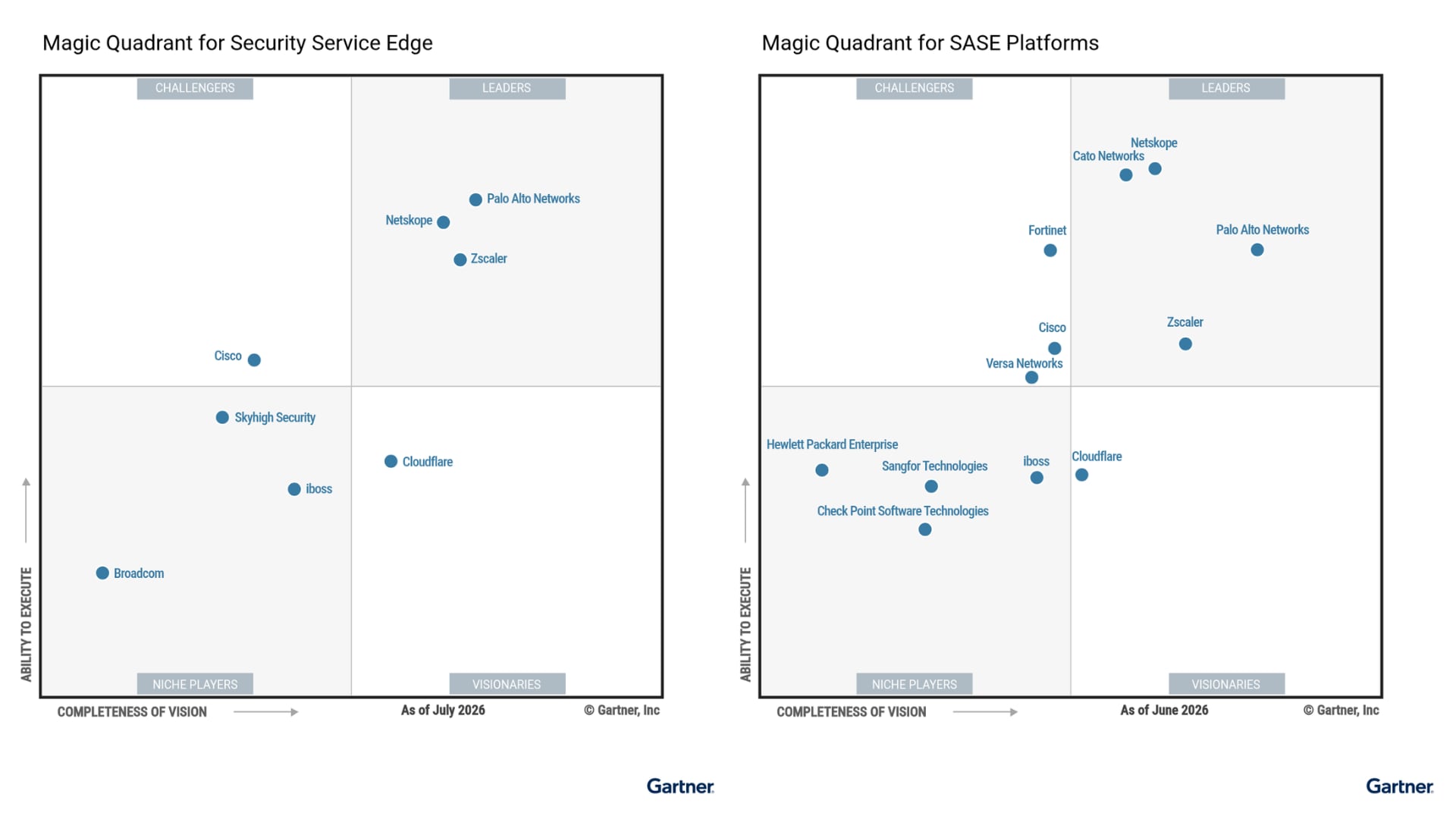
  •  

Announcing the General Availability of Prisma AIRS AI Gateway

Every modern enterprise is moving from an organization run by software to one orchestrated by AI, creating a tension between velocity and control. To resolve this tension, organizations require a unified architecture. Today, we are announcing the general availability of the Prisma AIRS AI Gateway, the AI control plane for the enterprise. 

Driven by the absolute conviction that an AI Gateway is foundational to the modern AI infrastructure stack, we are bringing AI innovations from the Portkey acquisition to Prisma AIRS just six weeks after closing. You can now scale AI at machine speed without compromising on enterprise-grade security and control.

Your AI Footprint is Outpacing Controls

Our next-generation firewall telemetry reveals that MCP activity climbed from 11% late last year to 41.4% by mid-2026. Monthly AI transaction volume grew twelve-fold over the same six months; some individual sessions moved hundreds of megabytes of enterprise data outbound. The AI footprint you can govern today is the smallest it will ever be.

Some of the most rapid AI adoption is happening with – coding assistants, enterprise agents and copilots.

  • Coding agents access code repositories, file systems, configurations, and credentials. When this context, including source code and secrets, is sent to a frontier model, it risks exposing sensitive data, and a runaway loop could burn a fortune in tokens overnight.
  • Enterprise agents run with broad access and standing privileges sharing context with each other. A single agent stretched beyond its scope can massively increase the risk of data breach, impact business reputation and customer trust.
  • Copilots now sit inside the SaaS and productivity tools employees already use. Copilots with broad access can surface data an employee was never meant to see.

As this enterprise data leaves when an AI request goes out, it creates a security and governance challenge at an unprecedented scale and speed.

What breaks when every team adopts AI 

AI adoption rapidly outpaces the security and governance infrastructure meant to secure it:

  • Shadow AI (Cost and usage are both hidden): You can't see the AI your teams already use or what it costs. 
  • Data Exposure (Sensitive data leaves without a trace): AI interactions can expose sensitive data, bypass policy and trigger unsafe outputs.
  • Agents Overstep (Actions run without accountability): Agents act across systems without clear identity, permission, or accountability. Keys get shared and agents run with broad, standing privileges, so no one can say which identity authorized a specific action or reverse it when an agent takes a wrong turn at machine speed.

Faced with this, most leaders either block traffic entirely or stay permissive and promise to govern later. Both approaches fail because they skip the critical step: seeing what agents do at runtime and controlling their actions while they happen.

Accelerate AI Adoption with Control

To scale AI adoption safely, you need a single control plane sitting between every AI interaction and the backend models. Prisma AIRS AI Gateway brings AI governance, identity and runtime controls together in one place. With the AI Gateway, you can:

  • Discover AI usage: Know exactly which apps, models, users, teams and agents are active, what they are accessing, and what they cost in a single unified view.
  • Govern AI interactions: Enforce central rules for model access, tool use and budgets while inspecting prompts and responses inline to prevent data leaks.
  • Secure every agent: Verify agent identities and enforce just-in-time, least-privilege access so autonomous systems only touch what they need, when they need it.

How the AI Gateway works 

Prisma AIRS AI Gateway sits inline between every AI interaction, model provider, and agentic interaction (Agent/AI App to LLMs, MCP Tool Calls, and A2A). It acts as a unified LLM, MCP, and A2A Gateway with a single enforcement point for all operational and security controls. Your teams keep using their existing coding assistants, enterprise agents, and copilots, while enforcement moves to the infrastructure layer where the platform team can own it.

Capabilities delivered through this unified control plane are:

Observability

Every request maps to a single unified view: tracking usage, users, projects, token counts, latency and cost so you can retire shadow AI infrastructure immediately.

Governance

Centrally define approved models, tools, and access without touching developer configurations. To drive FinOps and usage management, track every request's cost, tokens, and latency by team or project. Answer cost questions instantly, shut down unsanctioned AI usage, and proactively enforce budgets and rate limits before access is granted.

Coding Assistant Security

Protect credentials, proprietary code and development systems from risky AI actions. The gateway replaces raw provider keys with scoped credentials per user and team.

Operational Controls

Apply data protection, usage limits and policy checks as AI interactions happen. Traffic distributes via a Universal API across providers ensuring quotas are enforced and outages never stall your pipeline.

Agent Identity Security

Establish trusted identities by binding a verifiable, ephemeral identity to agents at execution. The AI Gateway acts as an enforcement point to enable only authenticated agents to make approved calls.

Runtime Security 

Powered by Prisma AIRS AI Runtime Security, the gateway inspects every prompt and response inline, stopping source code, secrets and customer data from leaving the network while neutralizing prompt injection attempts aligned with the OWASP LLM Top 10 and OWASP Top 10 for Agentic Applications.

Watch Anand Oswal break down why an AI gateway is foundational to this architecture.

the ai control plane of every enterprise

The AI Control Plane for the Enterprise

Prisma AIRS AI Gateway brings AI governance, identity and runtime controls together in one place. Point products filter text strings or route a single API call and they buckle under real enterprise volume.
Most products fail at scale. Prisma AIRS AI Gateway is built on an architecture tested in the most demanding enterprises for their ever evolving AI workloads: 

  • 68 Trillion+ tokens processed in the last month alone.
  • Sub-millisecond routing latency and inline inspection secures AI interactions without degrading user experience.
  • 99.999% availability helps ensure your AI operational pipeline does not experience a single point of failure.

Learn about Prisma AIRS AI Gateway and register for our webinar to see the AI Gateway in action. 

Your developers have already adopted their agents. The agentic enterprise is a reality. As the recently named "company to beat" in AI Security Platforms by Gartner, Palo Alto Networks is uniquely positioned to help you. Let’s build it securely, together.

The post Announcing the General Availability of Prisma AIRS AI Gateway appeared first on Palo Alto Networks Blog.

  •  

Palo Alto Networks and AT&T - Delivering Quantum-Resilient SASE Fabric

By Yogesh Ranade from Palo Alto Networks, and Senthil Ramakrishnan from AT&T

The digital world is currently navigating a dual-speed revolution. Acceleration of AI and hyperconnectivity is unlocking unprecedented economic value. The silent but rapid progress of quantum computing is fundamentally threatening the cryptographic foundation upon which that value is built.

As leaders in global networking and cybersecurity, Palo Alto Networks and AT&T Business launched Secure Connectivity solutions for Business Customers. We recognize that quantum-readiness is no longer a distant milestone; it is now a strategic imperative. With threatening data longevity and Trust Now, Forge Later targeting digital identities, the risks are already looming. 

By integrating Prisma SD-WAN’s cryptographic innovation with AT&T’s global network, Palo Alto Networks and AT&T Business are proud to deliver the Quantum-Resilient SASE Fabric.

The Quantum Shift Towards Building Resilience for Tomorrow’s Reality

For over 30 years, the difficulty of mathematics has been our primary defense. Classical algorithms, like RSA and Diffie-Hellman, provided the shield for our global economy because they were computationally impossible for classical machines to solve. However, quantum computing fundamentally changes this landscape by providing an exponential speed-up. By leveraging Shor’s Algorithm, quantum computers can break these classical cryptographic foundations, turning a decryption process that would take a classic supercomputer millennia into a task of mere hours.

Neutralizing the Quantum Crisis

Palo Alto Networks is embedding Post-Quantum Cryptography (PQC) as a native pillar of the Prisma SASE fabric. We are moving beyond the forklift-upgrade model to a software-defined, standards-based foundation, which is built on strict separation of management and data plane components:

  • Universal Control Plane Hardening (TLS 1.3): We have transitioned all control plane traffic to TLS 1.3 (Transport Layer Security 1.3), the global gold standard for Internet encryption. This secures the "brain" of the network (where routing configurations and security policies are managed), making it immune to quantum-enabled impersonation and credential theft.
  • PQC-Hardened Data Plane (IETF Standards): We are operationalizing PQC across the entire fabric by adopting official standards published by the Internet Engineering Task Force (IETF), specifically RFC 9370, 9242, and 8784. In plain terms, these standards allow us to use "hybrid key exchanges." This means we wrap your data in two layers of protection at once: a classical mathematical shield for immediate compatibility, and a quantum-resistant shield to protect against future decryption threats, all without causing packet fragmentation or network slowdowns.
  • Logs and Telemetry Plane: All network telemetry and metadata (the automated operational logs and traffic pattern data generated by the network, rather than the actual content of your business files) are encrypted in transit via TLS 1.3. This architecture guarantees that even this secondary network metadata is geofenced to your chosen region with no cross-region aggregation, satisfying the most stringent data residency mandates.
  • Crypto-Agility as a Standard: "Crypto-agility" is natively built into our systems, which means the software is designed to adopt new mathematical algorithms. As the National Institute of Standards and Technology (NIST) refines its guidelines, our systems can be upgraded seamlessly via simple, automated cloud updates without requiring expensive hardware replacements to ensure our customers’ security posture.
  • Secure Boot Support: Palo Alto Networks Prisma SD-WAN ION hardware supports Secure Boot to ensure that only cryptographically signed bootloaders, kernels, and trusted applications are executed during the boot process. This establishes a chain of trust from the BIOS firmware to the operating system, preventing the execution of unauthorized or tampered software. ION hardware appliances ship with an integrated, dedicated Trusted Platform Module (TPM), which provides hardware-level root-of-trust by securely storing cryptographic keys, certificates, and sensitive data to prevent unauthorized physical tampering and ensure secure device authentication. The OS/software layers use PQC algorithms to negotiate and secure the management, control plane and data plane tunnels. This ensures quantum readiness without requiring an immediate, widespread rip-and-replace of physical branch hardware.

The AT&T Perspective Views Security at Global Scale

From the perspective of a global leader like AT&T, PQC is an operational mandate. Providing connectivity to the world’s most regulated industries means that security cannot be bolted on. Security must be an inherent property of the transport layer and the connectivity infrastructure itself.

Turning Complexity into a Strategic Advantage

Managing a global footprint that spans across 5G, fiber, and legacy underlays requires an institutional expertise that few can match. For AT&T, the move to a more secure quantum-ready fabric with Dynamic Defense is about providing security where it matters most: the network. Our customers shouldn't have to worry about whether their data is traveling over an MPLS circuit or the public internet.

Through this collaboration, AT&T expands the delivery of Dynamic Defense:

  • Cross-Underlay Consistency: We enable PQC protection to be applied uniformly across all transport mediums, eliminating the "weak links" that often exist in hybrid environments where data moves between private and public circuits.
  • Automated PQC Policy Orchestration: New branch locations are seamlessly integrated into the quantum-ready fabric through automated policy distribution. The moment a device is activated via zero touch provisioning, the branch is enabled to be protected against HNDL threats from the first packet without requiring manual site-by-site intervention.
  • Compliance: With mandates like NIS2/DORA in Europe and NORA/CNSA 2.0 in the U.S., our clients face a closing window for compliance. AT&T provides the verifiable chain of trust required to prove "Quantum Readiness" across the entire circuit path, ensuring your fabric is audit-ready and compliant with global standards.

The Power of the Post-Quantum Secure Fabric

The true value of this relationship lies in the synergy between the network and the security stack. By combining our strengths, we have built a solution that is significantly more resilient than the sum of its parts.

The SPI Advantage Is Performance Without Compromise

Through Service Provider Interconnect (SPI), Palo Alto Networks' security platforms natively integrate with AT&T’s private network core to deliver a seamless quantum-safe on-ramp. This means business traffic can connect directly to a secure AT&T network without having to build slow, complex software tunnels over the public internet, preserving high performance while delivering next-generation encryption. Historically, high-level encryption meant a "performance tax" on latency and throughput. Our combined architecture allows quantum-safe traffic to flow over AT&T’s network backbone, enabling organizations to modernize their security without sacrificing the user experience.

Securing the Decentralized Perimeter (The Branch as the Edge)

In today’s highly distributed business landscape, the traditional corporate "headquarters" is no longer the center of gravity. The network perimeter has shifted to the branch (decentralized edge locations like retail storefronts, remote clinics, regional bank offices, and warehouse hubs) and the individual 5G-connected devices employees use. Securing these remote, local edge points is critical because they represent the primary gateway where sensitive company data first enters the network. 

By utilizing AT&T’s leadership in WAN, 5G and cellular technologies, we leverage Hybrid Public Key Infrastructure (PKI) to secure these edge locations. Hybrid PKI is a digital identity framework that issues dual security credentials to every device: one "classical" identity to ensure compatibility with existing networks today, and one "quantum-resistant" identity. This double-verification guarantees that a cellular-connected remote branch or a mobile site is just as immune to quantum decryption or identity spoofing as a fortified corporate data center.

The Path Forward Is a Vision for Long-Term Trust

The transition to a quantum-ready future is a marathon, not a sprint, and the first steps must be taken now. Palo Alto Networks and AT&T Business are offering a clear, practical path to quantum resilience.

We are delivering more than a simple software update as we prepare customers for the next generation of digital commerce. Together, we are designing our network to help ensure the data of today remains protected against the threats of tomorrow, securing the digital integrity of every enterprise we serve.

As we redefine the boundaries of security in connectivity, we invite you to join us in helping secure your organization’s digital future. Contact your or Palo Alto Networks account representative today to begin a strategic Quantum-Readiness Assessment and experience the power of the Quantum-Resilient SASE Fabric.

The post Palo Alto Networks and AT&T - Delivering Quantum-Resilient SASE Fabric appeared first on Palo Alto Networks Blog.
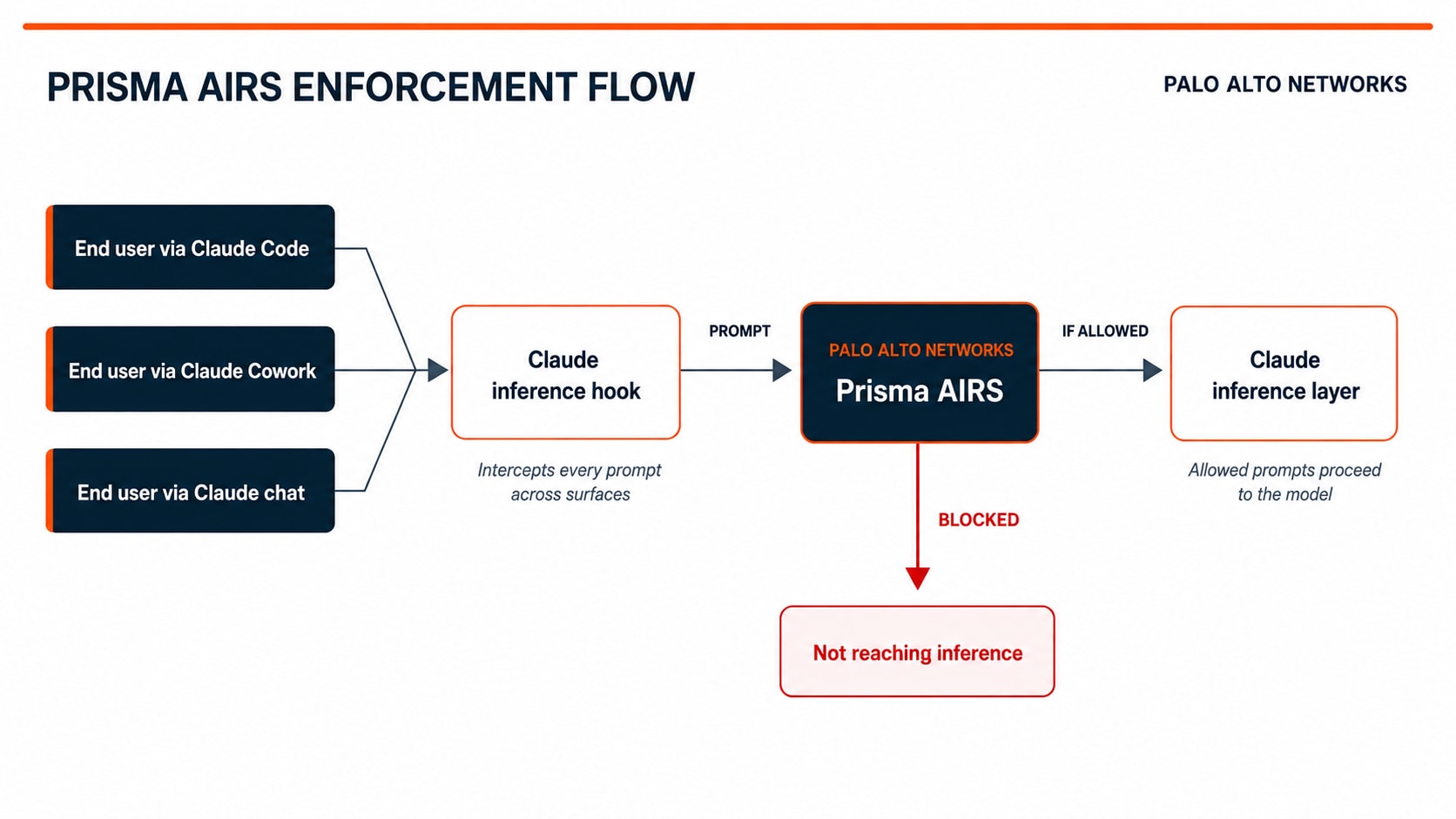
  •  

Securing Canada’s Digital Future: Why PBMM Matters Beyond Government

Palo Alto Networks is pleased to announce the successful completion of a new Cloud Medium security assessment conducted by the Canadian Centre for Cyber Security (Cyber Centre), significantly expanding the number of Palo Alto Networks cloud services assessed for Protected B / Medium Integrity / Medium Availability (PBMM) environments. This assessment includes a broad range of capabilities across our Cortex®, Cortex Cloud and Strata™ platforms. By achieving this milestone, Palo Alto Networks enables  organizations handling Canada’s most sensitive data to leverage a unified, AI-driven security architecture without compromising on compliance or operational resilience.

For years, many organizations viewed PBMM as something that only mattered to the Canadian federal government. It was often seen as a procurement requirement—a framework tied to public sector cloud adoption, relevant for departments handling Protected B information, but not necessarily for the private sector.

That assumption is changing.

The reality is that the challenges driving PBMM are no longer unique to government environments. Banks, energy providers, transportation networks, healthcare organizations, crown corporations, and other critical infrastructure operators are now facing many of the same pressures:

  • Expanding attack surfaces across hybrid and multi-cloud environments.
  • Increased regulatory scrutiny and privacy obligations.
  • Greater operational dependence on cloud and AI technologies.
  • Increased reliance on third-party providers and software supply chains.
  • The need to maintain operational resilience during cyber incidents and disruptions.
  • A growing expectation that organizations can demonstrate—not just claim—security maturity.

That is why PBMM matters far beyond Ottawa. At its core, PBMM represents a rigorous approach to validating whether enterprise-grade security platforms can operate securely in environments where trust, resilience, and operational continuity are critical.

Increasingly, that level of assurance matters to everyone.

What PBMM Really Represents

PBMM, a rigorous cybersecurity and data classification standard used by the  Canadian Centre for Cyber Security, stands for Protected B / Medium Integrity / Medium Availability. While often associated with federal cloud security requirements, PBMM is not simply a checkbox exercise. It is a comprehensive assessment framework aligned to Canadian cybersecurity guidance and operational security expectations.

What makes PBMM important is that it evaluates whether platforms and services can securely support sensitive and mission-critical workloads in real-world environments.

Palo Alto Networks meeting these rigorous PBMM requirements through three core pillars:

  • Strata (Network Security): Secures data resiliency and zero trust connectivity, driving robust perimeter and cloud edge protection.
  • Cortex Cloud (Cloud Security): Provides complete visibility, security governance, and data protection across complex cloud-native architectures.
  • Cortex (Security Operations): Powers the agentic SOC, combining unified data, AI, and automation to detect and respond to threats in real time.

These are not theoretical requirements. They are practical operational expectations designed for environments where downtime, visibility gaps, or security failures can have significant consequences.

Organizations today are no longer evaluating cybersecurity solely based on features. They are evaluating whether platforms can be trusted to support critical operations at scale.

Why Security Expectations Are Changing

The cybersecurity landscape has evolved dramatically. Infrastructure is distributed across cloud providers, SaaS applications, remote users, third-party integrations, operational technology (OT), AI platforms, and interconnected supply chains. At the same time, attacks have become faster, more automated, and more disruptive.

In this environment, security can no longer be treated as a compliance exercise. Organizations need confidence that their platforms, operational processes, and security controls can function effectively under pressure.

This is why Palo Alto Networks has undertaken independent PBMM assessments across its portfolio, providing customers with greater assurance and trust. By meeting these rigorous standards into Strata and Cortex, we enable non-government entities—like financial institutions and utility providers—to deploy the same defensive rigor used to protect national security systems.

Transforming Critical Infrastructure with a Unified Platform

To effectively manage risk, critical infrastructure operators require a platform approach that helps eliminate security silos, reduce manual intervention, and accelerate threat mitigation.

Key Portfolio Advantages for Critical Infrastructure & Enterprise:

  • AI-Driven Threat Detection & Response: Cortex XSIAM® and Cortex XDR® unify telemetry across endpoints, network, and cloud to deliver unparalleled visibility and automated threat stitching, neutralizing advanced cyberthreats before they disrupt operations.
  • Comprehensive Cloud Native Protection: Cortex Cloud secures applications from code to cloud to SOC, offering posture security, data protection, and continuous compliance monitoring tailored to stringent Canadian data standards.
  • Zero Trust Network Security: Strata enables secure access and consistent policy enforcement across campus, branch, and data center environments, protecting critical OT and IT systems from lateral threat movement.
  • Elite Incident Response: Backed by Unit 42®, organizations gain access to threat intelligence and rapid incident response services to augment their teams and build long-term cyber resilience.

Operational Resilience Is Becoming a Strategic Requirement

One of the most significant shifts occurring across industries today is the growing focus on operational resilience. Organizations are increasingly asking questions that extend beyond traditional cybersecurity controls:

  • Can we maintain critical services during a cyber attack?
  • Do we have visibility across our cloud environments and supply chain dependencies?
  • Can we rapidly detect, respond to, and recover from disruptions?
  • Are our governance processes keeping pace with cloud adoption and AI innovation?

As organizations adopt cloud-native architectures, AI-driven technologies, and interconnected digital ecosystems, resilience has become a board-level concern. The ability to prevent incidents remains important, but organizations are equally focused on their ability to withstand, respond to, and recover from them.

This is where frameworks like PBMM provide value. Beyond evaluating security controls, PBMM assesses the governance, operational processes, monitoring capabilities, and risk management practices that help organizations operate securely.

For critical infrastructure operators, resilience is no longer simply an IT objective—it is a business imperative. Increasingly, the organizations that earn trust are those that can demonstrate they are prepared to operate effectively when disruption occurs.

Final Thoughts: PBMM Reflects the Future of Trust

PBMM may have started solely as a government assessment framework, but its relevance now extends far beyond federal environments. It represents something universal: the ability to operate securely, reliably, and transparently in environments where trust matters most.

By expanding our PBMM-assessed offerings across Cortex and Strata, Palo Alto Networks underscores its commitment to securing Canada's digital future. We provide the validated foundation organizations need to innovate with confidence, protect sensitive data, and maintain operational continuity under any circumstance.

Read the Assessment Summary Report

To learn more about the Palo Alto Networks Cloud Medium security assessment, review the publicly available assessment summary report issued by the Canadian Centre for Cyber Security.

Ready to modernize your defenses with PBMM-assessed solutions? Schedule a demo with our team or contact Unit 42 to learn how we can help elevate your organization's resilience against emerging cyber threats.

The post Securing Canada’s Digital Future: Why PBMM Matters Beyond Government appeared first on Palo Alto Networks Blog.
  •  

Shifting from Data Hoarding to Active Defense: Navigating the New Era of OMB M-26-14

The release of OMB Memo M-26-14 ("Ensuring Effective and Efficient Agency Logging and Network Visibility to Defend Against Evolving Cyber Threats") marks a historic turning point in federal cybersecurity. By officially rescinding the M-21-31 directive, the White House has delivered a clear message to federal IT leaders: the era of compliance-driven data hoarding is officially over.

While the previous framework was a well-intentioned response to the SolarWinds breach, its mandate to collect and retain vast oceans of unstructured logging data created unintended, unsustainable operational burdens. For the past several years, federal agencies have faced skyrocketing cloud storage bills and overwhelmed Security Operations Centers (SOCs). Crucially, they have been left with vast quantities of cold data that lacked clear operational utility.

As OMB noted, retaining endless data without operational focus is neither cost-effective nor operationally feasible. With M-26-14, the federal government is pivoting to a smarter, sleeker, and far more decisive strategy: a risk-based, prioritized logging framework driven by AI and machine-speed defense.

The Core Shifts: What Federal Leaders Must Understand

M-26-14 strips away administrative "red tape" to focus on how modern cybersecurity risks have evolved. Nation-state threat actors are actively leveraging advanced automation and Artificial Intelligence (AI) to orchestrate attacks at unprecedented speeds. They move laterally across agencies in minutes, hiding behind legitimate corporate credentials.

To beat machine-speed threats, your data layer must operate at machine-scale. The new memo reorganizes federal visibility around two foundational pillars:

1. Continuous Event Monitoring — Owning the Present

Continuous Event Monitoring demands that logging infrastructure shift from a passive archiving tool to a live-streaming asset. Agencies are now required to monitor network and asset activity in real time, rapidly flag anomalous behavior via behavioral analytics, and initiate immediate mitigation actions directly through their SOCs.

2. Threat Hunting, Investigation, Response, and Forensics — Dominating the Post-Compromise

When a compromise is suspected, agencies can no longer spend days running slow database queries or pulling disconnected csv files. M-26-14 mandates that agencies keep 6 months of logs "hot and searchable" and 1 year fully "retrievable." This allows defenders to immediately stitch together cross-domain attack patterns, perform rapid root-cause forensics, and share threat intelligence seamlessly with CISA and the FBI.

3. Expanding the Blast Radius: Entering IoT and OT

Perhaps the most significant structural change is the explicit inclusion of Internet of Things (IoT) and Operational Technology (OT) systems. Adversaries do not respect the boundary between your corporate IT network and your physical infrastructure. Under M-26-14, your logging and threat-hunting capabilities must aggressively cover the entire enterprise—from public cloud workloads to the physical facility controls and critical infrastructure grids running on an agency's behalf.

The Clock is Ticking: The Aggressive Maturity Deadlines

Agencies cannot afford a passive approach. The timeline established by OMB M-26-14 moves quickly:

  • T+90 Days: CISA will publish the new Logging Reference Architecture (LRA) codifying hybrid/centralized deployments, Zero Trust Maturity Model (ZTMM) integration, and AI-driven monitoring guidelines.
  • LRA +90 Days: Agencies must submit their comprehensive Agency Logging Plans.
  • LRA +120 Days: Achieve Basic Level 1 Maturity.
  • LRA +180 Days: Achieve Intermediate Level 2 Maturity.
  • LRA +320 Days: Achieve Advanced Level 3 Maturity (Advanced/Optimal Effectiveness).

Activating OMB M-26-14 with Palo Alto Networks Cortex

Trying to retrofit a legacy SIEM architecture to meet the advanced or optimal effectiveness tiers of M-26-14 is an engineering and budgetary dead end. Legacy SIEMs scale costs linearly with ingestion and rely on static, human-written correlation rules that fail against AI-fueled threats.

The FedRAMP Certified Palo Alto Networks Cortex platform—anchored by Cortex XSIAM (Extended Security Intelligence and Automation Management)—was engineered from the ground up to solve the exact problems this new memo addresses.

From Disconnected Columns to Cross-Domain "Stitching"

Legacy logging stores data in isolated silos. An analyst trying to track an adversary has to manually look at an identity log, cross-reference it with a network firewall alert, and match it to an endpoint execution.

Cortex XSIAM features a revolutionary Analytics Engine that automatically stitches multi-vendor logs across cloud, network, endpoint, and identity at the moment of ingestion. It transforms raw text into a single, cohesive, context-rich story, instantly aligning incidents with the MITRE ATT&CK framework.  Cortex XSIAM doesn’t just ingest data, it understands the data which enables stitching of multiple data elements into a single, multi-context construct which accelerates analysis via AI and machine learning.

Replacing Static Rules with Cloud-Scale AI

Adversaries use AI to evade signature detection. Cortex XSIAM fights fire with fire, applying out-of-the-box, unsupervised machine learning models to baseline normal behavioral patterns across your entire federal enterprise. When an anomalous lateral movement, data exfiltration attempt, or credential abuse event occurs, XSIAM flags the threat instantly—without requiring your team to spend weeks writing custom correlation code.

Accelerating Continuous Event Monitoring (CEM) and Threat Hunting, Investigation, Response and Forensics (THIRF)

There is more to CEM than just monitoring network activity.  Activity on endpoints, within your identity management solution(s) and in the cloud are just as important.  Understanding the data, knowing which log records are related to each other across multiple log sources, which events are relevant and the context they provide is required.  

Understanding these events and their contextual relationships is fundamental to providing THIRF in an efficient manner.  Cortex XSIAM provides over 2,900 machine learning models out of the box, models that are trained on the data in your environment so they detect anomalous activity based on what is “normal” in your environment, not trained on generic data from other customers or a lab.  These models can identify threats based on data stitched together from multiple sources to provide a more complete context yielding more accurate and consistent results while decreasing time to value.

Securing the Unmanageable: Agentless IoT/OT Defense

You cannot install an EDR logging agent on a smart building HVAC system or an industrial programmable logic controller (PLC). Palo Alto Networks utilizes non-disruptive, passive network analysis to continuously discover, profile, and generate high-fidelity security logs for IoT and OT infrastructure. These logs stream directly into XSIAM, eliminating critical federal blind spots and protecting your High Value Assets (HVAs) from cross-boundary pivot attacks.

Solving the Storage Conundrum Safely

Keeping six months of high-velocity event logs fully "hot and searchable" under a traditional database indexing model creates a crushing financial burden. Cortex XSIAM fundamentally resets the Total Cost of Ownership (TCO) equation by leveraging an index-free, cloud-native data lake architecture that decouples storage costs from analytical performance. By eliminating legacy ingestion taxes and infrastructure overhead, federal defenders can search petabytes of data in seconds—effortlessly meeting the 6-month searchable and 1-year retrievable thresholds. Furthermore, integrated data masking rules strip away sensitive PII or low-value data noise before it hits the SOC, ensuring agencies only pay for operationally vital intelligence.


The Bottom Line for Federal Leaders

OMB M-26-14 is a massive step forward for federal cybersecurity. It frees CISOs from the operational gridlock of untargeted data archiving and empowers them to build faster, modern, and highly responsive security operations.

Meeting the strict 120-to-320-day maturity milestones requires moving past the tools of the last decade. By partnering with Palo Alto Networks and deploying the Cortex suite, federal agencies can seamlessly transition into a risk-aligned, AI-driven SOC. They can confidently check the box on OMB compliance while achieving what the directive actually intends: protecting the resilience and integrity of the federal mission at machine speed.

Palo Alto Networks’ Cortex XSIAM is FedRAMP certified at both the moderate and high levels.

Want to learn more about how to structure your upcoming Agency Logging Plan to meet CISA's upcoming Logging Reference Architecture? 

Contact the Palo Alto Networks Federal Team today to schedule an architectural deep-dive.

The post Shifting from Data Hoarding to Active Defense: Navigating the New Era of OMB M-26-14 appeared first on Palo Alto Networks Blog.
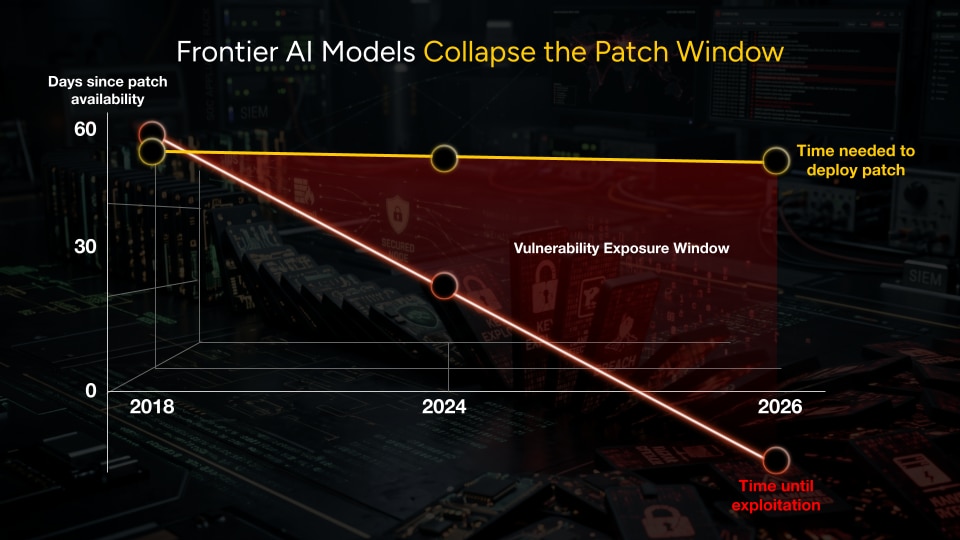
  •  
❌