Reading view

Enshittification Merch That Actually Fights Enshittification 

Enshittification isn't just a sweary word to describe the accelerating decay of the online platforms, apps, and services that we rely on.  

It's a framework for understanding the structural incentives that make tech companies enemies of their own users over time—the surveillance business model, the erosion of privacy, the monopoly power that eliminates alternatives, the regulatory capture that prevents accountability.  

SUPPORT EFF

GET LimITED EDITION MERCH + FIGHT ENSHITTIFICATION

These are some of EFF's core fights and have been for over 35 years. EFF sues. EFF advocates. EFF codes. And EFF wins. EFF is the most profound and powerful disenshittifying force on the planet Earth, and I’ve been proud to fight alongside them for nearly 25 of those years.  

One of the lessons you learn in battles with very long timelines against very powerful actors is that these battles are deeply serious, and because of that they must also be fun. “Enshittification” took off as a shorthand in part because of the minor license to vulgarity it confers. It's slightly crass for a reason: getting people to engage with the abstract issues of tech policy can be hard at the best of times. No one knows this better than my colleagues at EFF, who consistently surprise me with their ability to make complex, technical concepts concrete, memorable, and sometimes even joyful. 

Words matter, but so do visuals. For the cover of the U.S. edition of my book, Enshittification, designer Devin Washburn of No Ideas studio created an iconic variation of the "pile of poo" emoji, with angry eyebrows and a grawlix-scrawled censor bar over its mouth. It instantly became the symbol of enshittification I’d been looking for. 
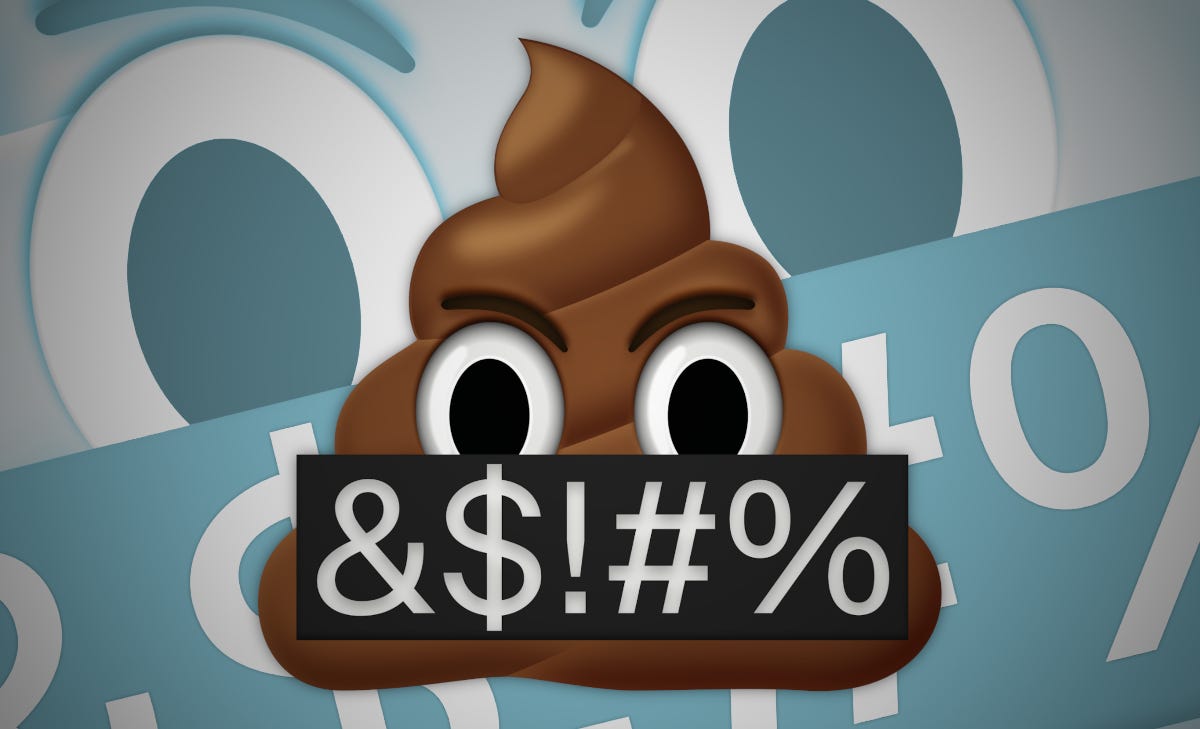
A digital illustration of an angry poop emoji holding a black sign reading "&!#%", set against a blue and gray background tiled with oversized "& !#%" characters.

I liked it so much I ordered a couple hundred enamel pins and a couple thousand vinyl stickers and handed them out to people I met on my 33-city book tour. Even when giving them away, I was inundated with requests to buy more of them.  

I've since bought out Devin's rights to the image and released it under a Creative Commons Attribution 4.0 license—free for anyone to use, remix, or build on, including commercially, with attribution. The high-resolution files are on Wikimedia CommonsFlickr, and the Internet Archive (including a PSD with an ink-density adjustment layer). It belongs to the commons now. 

But I made sure EFF had first crack at the design for their “official merch,” and they've done right by it. There are two items available now in the EFF shop, and all proceeds go directly to EFF's work defending digital rights. I’ve spent years admiring EFF’s merch and consistent, creative visual identity, so it fills me with pride to see this more-than-a-mere-poop-emoji in their shop.  

A recognizable visual shorthand is a genuine organizing tool. When someone sees the enshittification emoji, they know what the conversation is about. When you wear the pin or slap the sticker on your laptop, you're signaling that you understand what's happening to the internet, and that you know we can do better.  
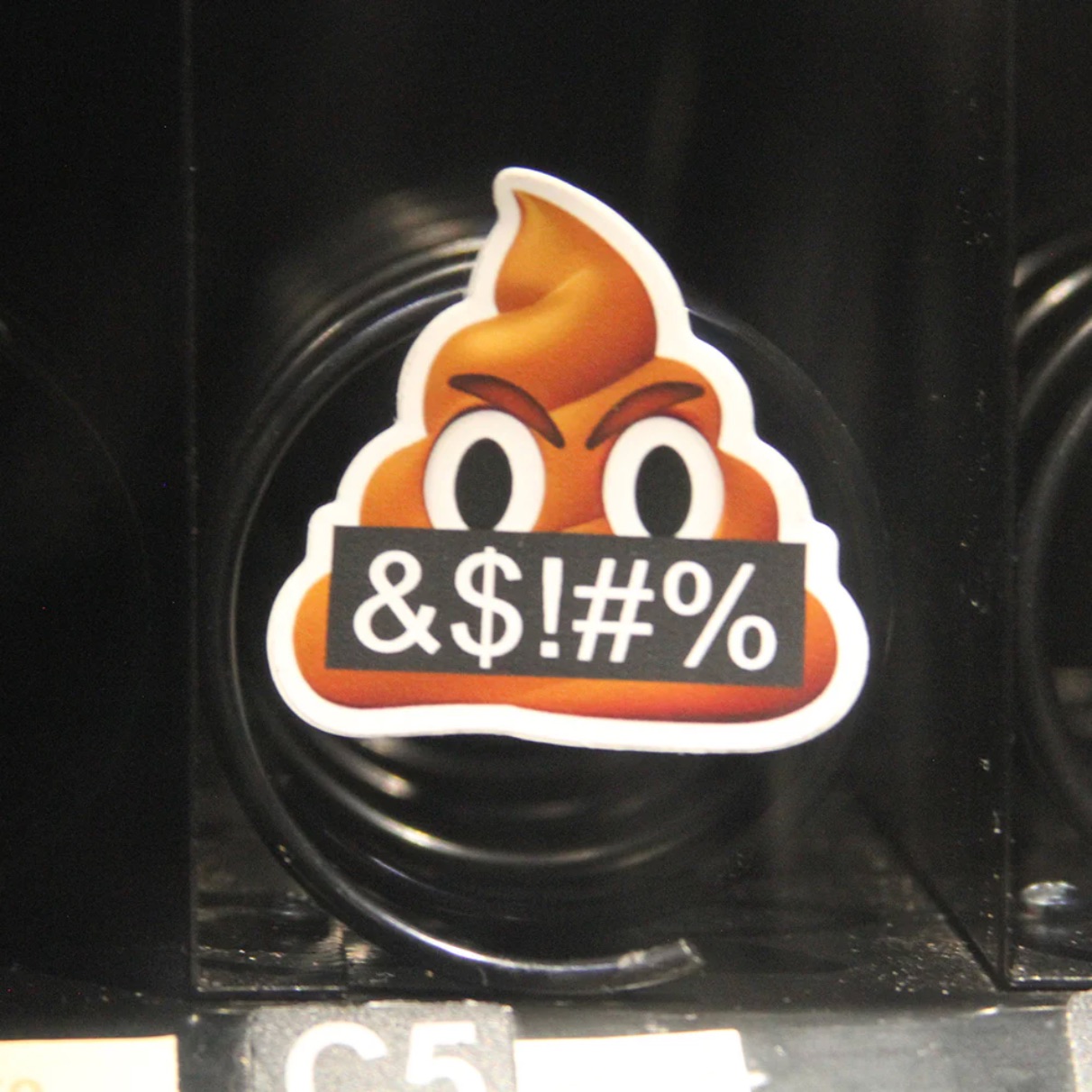
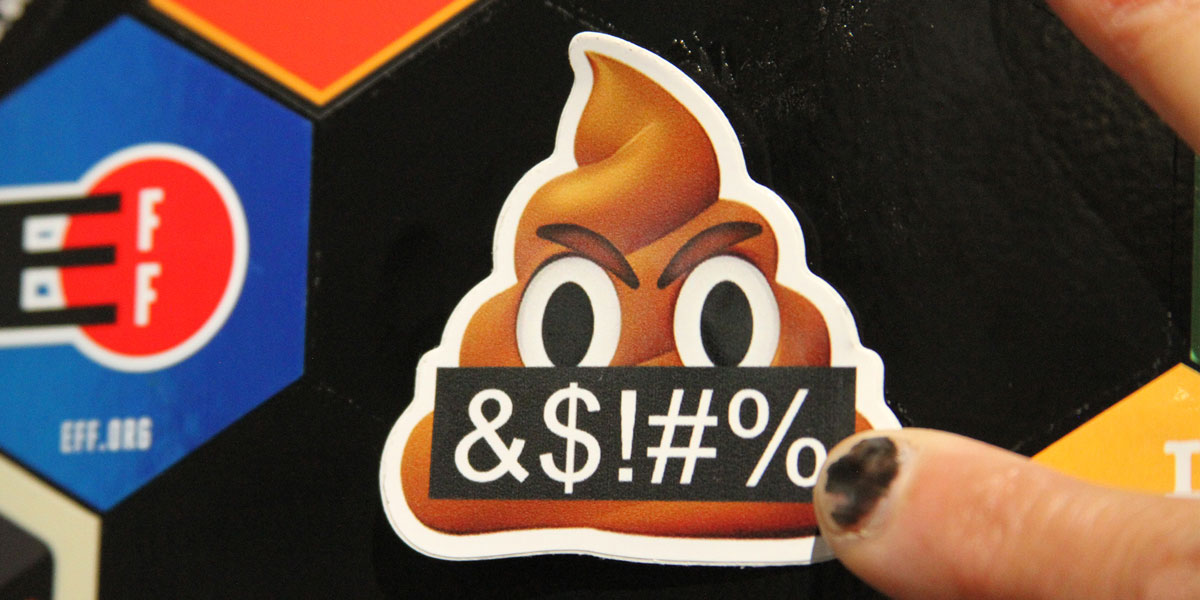
You can get a $5 sticker:

An angry poop emoji sticker affixed to the coiled spring mechanism inside a vending machine. The sticker depicts a scowling poop emoji holding a black sign reading "&$!#%".

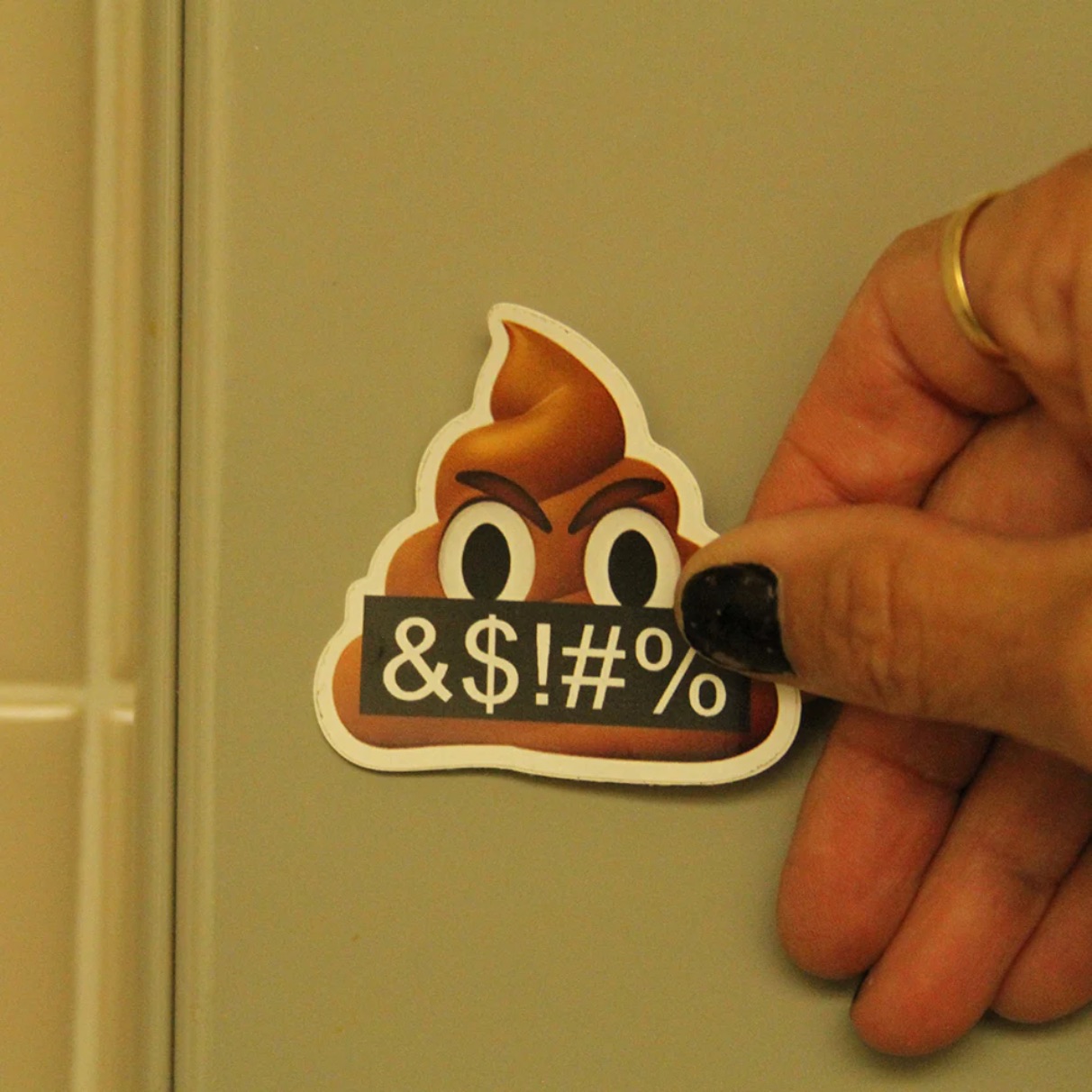
A hand with black nail polish and a gold ring holds an angry poop emoji sticker against a white door. The sticker shows a scowling poop emoji holding a black sign reading "&$!#%".

Or a $10 pin:

A close-up of an enamel pin on the lapel of a tan jacket. The pin depicts an angry poop emoji holding a black banner reading "&$!#%".

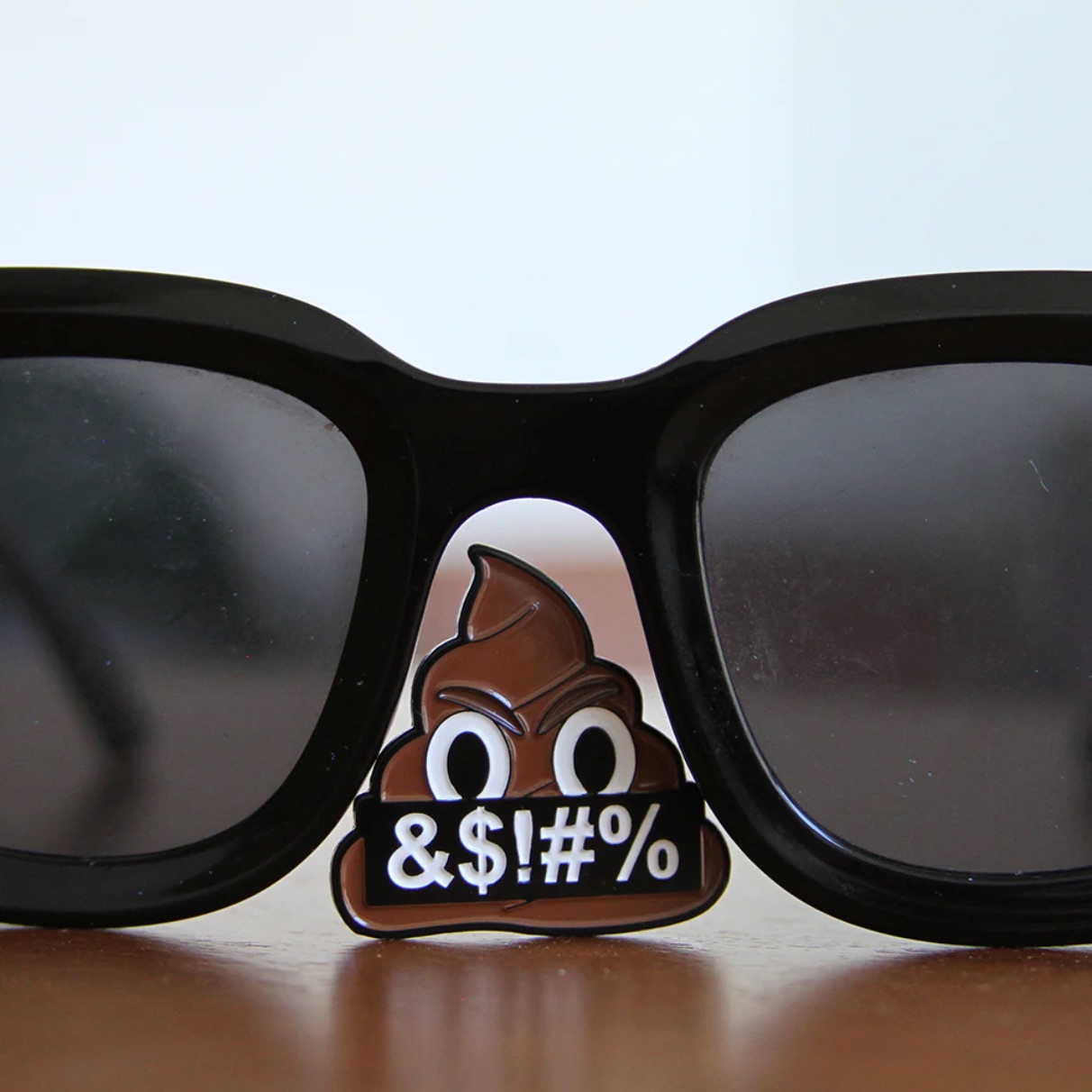
An enamel pin clipped to the nose bridge of black-framed sunglasses resting on a wooden surface. The pin depicts a scowling poop emoji holding a black banner reading "&$!#%". 

 Because the design is CC-licensed, you don't have to buy one. You can make your own merch, your own swag, your own illustrations. I made a lawn flag for my front garden.
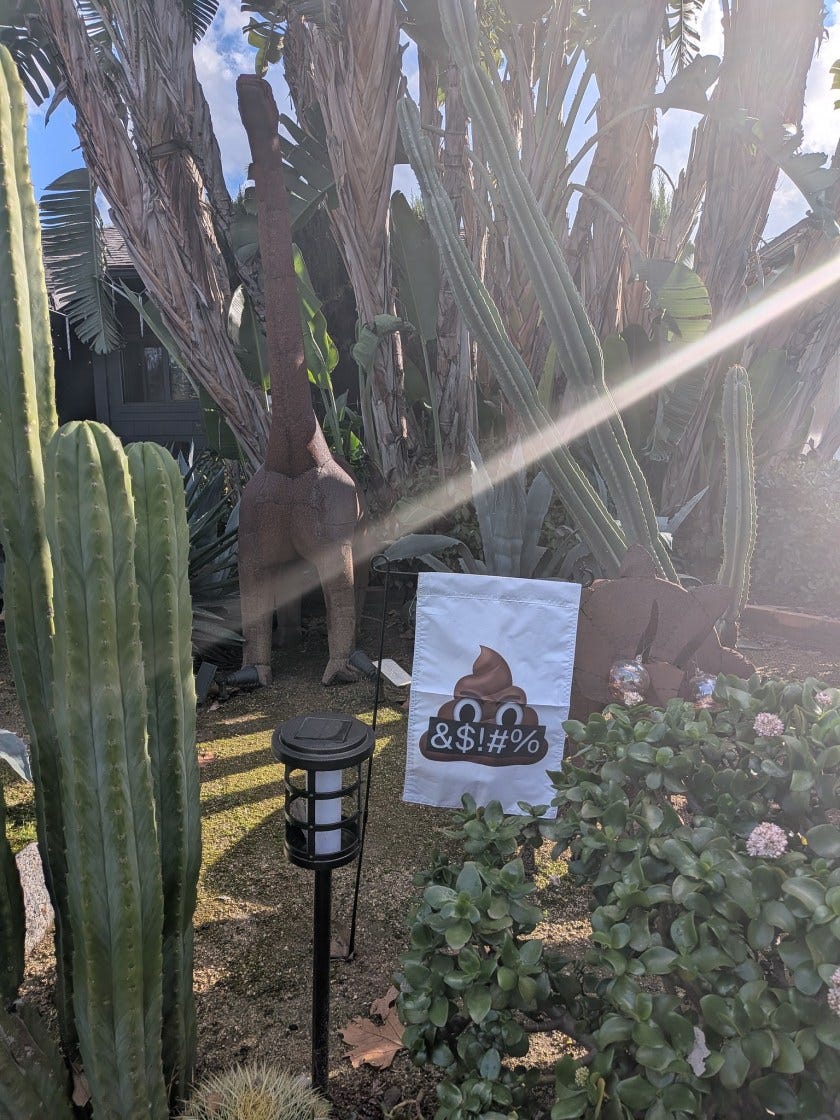
A  small white garden flag on a metal stake, planted among cacti and succulents in a sunny yard. The flag depicts an angry poop emoji holding a sign reading "&$!#%". 

But if you do want to buy a sticker or pin, you can do so while supporting the most profound and powerful disenshittifying force on the planet Earth—the Electronic Frontier Foundation.

SUPPORT EFF

GET LimITED EDITION MERCH + FIGHT ENSHITTIFICATION
 

  •  

Tell Congress: Just Say No to NO FAKES

The Senate Judiciary Committee is set to consider and vote on the Nurture Originals, Foster Art, and Keep Entertainment Safe Act (NO FAKES). Instead of targeting the real privacy harms posed by AI-generated replicas, this law would create another layer of internet censorship on top of the already existing legal and voluntary takedown systems. Congress should reject NO FAKES.

Take action

Tell Congress to Say No to NO FAKES

As currently written, NO FAKES proposes to tackle the problems of misleading AI-generated replicas by creating a broad property right in someone's look, voice, and general style. However, there are all kinds of First Amendment-protected expression that would be swept under the NO FAKES regime—think about parody, news, criticism.

NO FAKES also does a laughable job of protecting artists from use of their image in misleading ways. It doesn’t create a privacy right, but rather a property right that can easily be signed away—as major studios and record labels are almost certain to require in their contracts with artists. As a result, NO FAKES actually creates a new avenue for the exploitation of artists by companies instead of protection from misleading replicas. 

The bill also makes it trivially easy for protected speech to be censored. It is a supercharged version of the already flawed copyright takedown regime. It would essentially require platforms to institute filters that don't just look for exact matches of copyrighted material, as current filters do, but anything that might be a digital replica. Even though the latest version of this bill adds some forms of redress for bad faith takedowns, those provisions lack the teeth required to deter a malicious actor. 

NO FAKES targets speech, tools, and innovation instead of focusing on the real concern posed by these replicas: privacy. This bill was a bad idea when it was introduced, and got even worse when it was amended last year. Tell Congress to just say no to NO FAKES.

Take action

Tell Congress to Say No to NO FAKES

  •  

California’s AB 412 Still Demands Developers Do The Impossible

California lawmakers are again considering A.B. 412, a bill that would require AI developers to identify and disclose copyrighted works used to train generative AI systems.

The problem this year is the same as last year: it’s practically impossible to comply with this law. The bill demands information that often does not exist, and cannot realistically be obtained. 

EFF submitted an opposition letter to the California Senate Privacy Committee explaining why we continue to believe A.B. 412 is simply unworkable. To the extent developers do follow this law, it will have the effect of locking in the power of the largest companies in AI. 

A Burden That Can’t Be Met

A.B. 412 sounds simple: just have AI developers create and keep a list of all the registered copyrighted works they use in AI training. 

That may seem straightforward. In practice, it’s anything but. 

There is no machine-readable “list” of copyrighted works at the U.S. Copyright Office. And many copyright holders can get a copyright without even depositing a publicly viewable sample of the work—for example, software companies may register copyright on proprietary code without revealing it to the public. 

And on the open internet, copyright information is often incomplete, unavailable, or impossible to verify. One image may be registered with the copyright office, while the next is licensed under a free Creative Commons license (like the images that EFF creates), and the next is public domain. A message forum user might post an original story, photograph, or poem without any indication of ownership or registration status. 

The bill effectively asks developers to continuously cross-reference massive batches of online data against a copyright system that simply wasn’t designed to do so. If California passes A.B. 412, its impact will go far beyond the large AI companies we read about in the headlines. 

Not Just Big Tech

Supporters often frame this bill as a way to help creative workers have some leverage against Big Tech, but the bill reaches much further than the big AI companies. 

Its definition of “developer” extends to anyone who makes a generative AI model available to Californians. That includes indie developers tinkering with an existing model, open-source initiatives, nonprofits, and other non-commercial efforts. Recent amendments added exemptions for universities and government entities, which is important, but that still leaves out a vast swathe of non-commercial tech work that’s done by people without full-time jobs in government or academia. 

Large companies will hire compliance teams and lawyers to navigate these requirements. Smaller organizations and independent developers usually can’t. The result will be fewer opportunities for startups and new entrants. Faced with this massive compliance burden, some won’t even try. 

Courts Are Already Deciding These Questions

The bill is premised on the idea that copyright owners currently don’t have good remedies if they’re mistreated by AI companies. That simply isn’t true. And the growing wave of federal court filings in this space prove it. Content companies that want to sue tech companies, large or small, have no problem doing so. Those courts are still working through important questions about fair use and transformative use. Some courts have already concluded that many AI training activities qualify as fair use. Others continue to evaluate the issue.

California lawmakers should not rush to impose new state regulation while those questions remain unresolved. This is why copyright is governed at the federal level: both creators and fair users benefit from a single set of nationwide rules. 

At this point, the bill remains a solution in search of a problem. Rights holders already have powerful tools to protect their interests under existing federal law. What this bill adds isn’t clarity or transparency, but a costly and essentially impossible compliance burden that will discourage small developers and researchers. 

California has been able to support both artistic creativity and tech innovation for decades now.  But A.B. 412 does not strike the right balance. 

If you are a California resident and interested in speaking out about this bill, you can find and contact your representatives through this website

  •  

Another Court Rules Copyright Can’t Stop People From Reading and Speaking the Law

Another court has ruled that copyright can’t be used to keep our laws behind a paywall. The U.S. Court of Appeals for the Third Circuit upheld a lower court’s ruling that it is fair use to copy and disseminate building codes that have been incorporated into federal and state law, even though those codes are developed by private parties who claim copyright in them. The court followed the suggestions EFF and others presented in an amicus brief, and joined a growing list of courts that have placed public access to the law over private copyright holders’ desire for control.

UpCodes created a database of building codes—like the National Electrical Code—that includes codes incorporated by reference into law. ASTM, a private organization that coordinated the development of some of those codes, insists that it retains copyright in them even after they have been adopted into law, and therefore has the right to control how the public accesses and shares them. Fortunately, neither the Constitution nor the Copyright Act support that theory. Faced with similar claims, some courts, including the Fifth Circuit Court of Appeals, have held that the codes lose copyright protection when they are incorporated into law. Others, like the D.C. Circuit Court of Appeals in a case EFF defended on behalf of Public.Resource.Org, have held that, whether or not the legal status of the standards changes once they are incorporated into law, making them fully accessible and usable online is a lawful fair use.

In this case, the Third Circuit found that UpCodes’s copying of the codes was a fair use, in a decision closely following the D.C. Circuit’s reasoning. Fair use turns on four factors listed in the Copyright Act, and the court found that all four favored UpCodes to some degree.

On the first factor, the purpose and character of the use, the court found that UpCodes’s use was “transformative” because it had a separate and distinct purpose from ASTM—informing people about the law, rather than just best practices in the building industry. No matter that UpCodes was copying and disseminating entire safety codes verbatim—using the codes for a different purpose was enough. And UpCodes being a commercial venture didn’t change the outcome either, because UpCodes wasn’t charging for access to the codes.

On the second factor, the nature of the copyrighted work, the Third Circuit joined other appeals courts in finding that laws are facts, and stand at “the periphery of copyright’s core protection.” And this included codes that were “indirectly” incorporated—meaning that they were incorporated into other codes that were themselves incorporated into law.

The third factor looks at the amount and substantiality of the material used. The court said that UpCodes could not have accomplished its purpose—providing access to the current binding laws governing building construction—without copying entire codes, so the copying was justified. Importantly, the court noted that UpCodes was justified in copying optional parts of the codes as well as “mandatory” sections because both help people understand what the law is.

Finally, the fourth factor looks at potential harm to the market for the original work, balanced against the public interest in allowing the challenged use. The court rejected an argument frequently raised by copyright holders—that harm can be assumed any time materials are posted to the internet for all to access. Instead, the court held that when a use is transformative, a rightsholder has to bring evidence of harm, and that harm will be balanced against the public benefit. Because “enhanced public access to the law is a clear and significant public benefit,” and ASTM hadn’t shown significant evidence that UpCodes had meaningfully reduced ASTM’s revenues, the fourth factor was at least neutral. It didn’t matter to the court that ASTM offered to provide copies of legally binding standards to the public on request, because “the mere possibility of obtaining a free technical standard does not nullify the public benefits associated with enhanced access to law.”

This is a good result that will expand the public’s access to the laws that bind us—something that’s more important than ever given recent assaults on the rule of law. In the future, we hope that courts will recognize that codes and standards lose copyright when they are incorporated into law, so that people don’t have to spend years and legal fees litigating fair use just to exercise their rights.

  •  

EFF Launches New Fight to Free the Law

EFF has filed a new lawsuit against the Consumer Product Safety Commission (CPSC) to ensure that the public has full access to the laws that govern us.

Our client Public.Resource.Org (Public Resource), a tiny non-profit founded by open records advocate Carl Malamud, has a mission that’s both simple and powerful: to make government information more accessible. Public Resource acquires and makes available online a wide variety of public documents such as tax filings, government-produced videos, and federal rules about safety and product designs. Those rules are initially created through private standards organizations and later incorporated into federal law. Such documents are often difficult to access otherwise, meaning the public cannot read, share, or comment on them. 

Working with Harvard Law School’s Cyberlaw Clinic, Public Resource has been submitting Freedom of Information Act requests to the CPSC requesting copies of the legally binding safety codes for children’s products—an area of law of intense interest to child safety advocates and consumer advocates, not to mention the families who use those products. But CPSC says it can’t release the codes, because the private association that coordinated their initial development insists that it retains copyright in them even after they have been adopted into law. That’s like saying a lobbyist who drafted a new tax law gets to control who reads it or shares it, even after it becomes a legal mandate.

Faced with similar claims, some courts, including the Court of Appeals for the Fifth Circuit, have held that the safety codes lose copyright protection when they are incorporated into law. Others, like the D.C. Circuit (in a case EFF defended on Public Resource’s behalf), have held that even if the standards don't lose copyright once they are incorporated into law, making them fully accessible and usable online is a lawful fair use. 

Now EFF has teamed up with the Cyberlaw Clinic to continue the fight. We’re asking a court to rule that copyright is no barrier to accessing and sharing the rules that are supposed to ensure the safety of our built environment and the products we use every day. With the rule of law under assault around the nation, it is more important than ever to defend our ability to read and speak the law, without restrictions.

  •  

Copyright Bullying vs. Religious Freedom

The government should not help a religious institution to punish or deter members from inquiring about their faith. Yet, once again, the Watch Tower Bible and Tract Society is trying to use flimsy copyright claims to exploit the special legal tools available to copyright owners in order to unmask anonymous online speakers. And, once again, EFF has stepped in to urge the courts not to give Watch Tower’s attempts the force of law, with the help of local counsel Jonathan Phillips of Phillips & Bathke, P.C.

EFF’s client, J. Doe, is a member of the Jehovah’s Witnesses who became interested in the history of the organization’s public statements, and how they’ve changed over time. They created research tools to analyze those documents and ultimately created a website, JWS Library, allowing others to use those tools and verify their findings through an archive that included documents suppressed by the church. Doe and others discovered prophecies that failed to come true, erasure of a leader’s disgrace, increased calls for obedience and donations, and other insights about the Jehovah’s Witnesses’ practices. Doe also used machine translation on a foreign-language document to help the community understand what the church was saying to different audiences and also to help understand potential changes in the organization’s attitudes towards dissent.

Within the church, dissent or even asking questions has often been punished by labeling members as apostates and ostracizing—or “disfellowshipping”— them. As a result, Doe and others choose to speak anonymously to avoid retaliation that could cost them family, friend, and professional relationships.

There is no law against questioning the Jehovah’s Witnesses. Instead, Watch Tower argues that Doe’s activities constitute copyright infringement and seeks to use the special process provided in the Digital Millennium Copyright Act (DMCA) to unmask them. It sent DMCA subpoenas to Google and Cloudflare, seeking information that would help them uncover Doe’s identity.

The problem for Watch Tower is that Doe’s research and commentary are clear fair uses allowed under copyright law. The First Amendment does not permit the unmasking of anonymous speakers based on such weak claims. Indeed, the First Amendment protects anonymous speakers precisely because some would be deterred from speaking if they faced retribution for doing so.

EFF stands with those who question the claims of those in power and who share the tools and knowledge needed to do so. We urge the judges in the Southern District of New York to quash these improper subpoenas and not allow copyright to be used to suppress important, legitimate speech.

  •  

Artificial Intelligence, Copyright, and the Fight for User Rights: 2025 in Review

A tidal wave of copyright lawsuits against AI developers threatens beneficial uses of AI, like creative expression, legal research, and scientific advancement. How courts decide these cases will profoundly shape the future of this technology, including its capabilities, its costs, and whether its evolution will be shaped by the democratizing forces of the open market or the whims of an oligopoly. As these cases finished their trials and moved to appeals courts in 2025, EFF intervened to defend fair use, promote competition, and protect everyone’s rights to build and benefit from this technology.

At the same time, rightsholders stepped up their efforts to control fair uses through everything from state AI laws to technical standards that influence how the web functions. In 2025, EFF fought policies that threaten the open web in the California State Legislature, the Internet Engineering Task Force, and beyond.

Fair Use Still Protects Learning—Even by Machines

Copyright lawsuits against AI developers often follow a similar pattern: plaintiffs argue that use of their works to train the models was infringement and then developers counter that their training is fair use. While legal theories vary, the core issue in many of these cases is whether using copyrighted works to train AI is a fair use.

We think that it is. Courts have long recognized that copying works for analysis, indexing, or search is a classic fair use. That principle doesn’t change because a statistical model is doing the reading. AI training is a legitimate, transformative fair use, not a substitute for the original works.

More importantly, expanding copyright would do more harm than good: while creators have legitimate concerns about AI, expanding copyright won’t protect jobs from automation. But overbroad licensing requirements risk entrenching Big Tech’s dominance, shutting out small developers, and undermining fair use protections for researchers and artists. Copyright is a tool that gives the most powerful companies even more control—not a check on Big Tech. And attacking the models and their outputs by attacking training—i.e. “learning” from existing works—is a dangerous move. It risks a core principle of freedom of expression: that training and learning—by anyone—should not be endangered by restrictive rightsholders.

In most of the AI cases, courts have yet to consider—let alone decide—whether fair use applies, but in 2025, things began to speed up.

But some cases have already reached courts of appeal. We advocated for fair use rights and sensible limits on copyright in amicus briefs filed in Doe v. GitHub, Thomson Reuters v. Ross Intelligence, and Bartz v. Anthropic, three early AI copyright appeals that could shape copyright law and influence dozens of other cases. We also filed an amicus brief in Kadrey v. Meta, one of the first decisions on the merits of the fair use defense in an AI copyright case.

How the courts decide the fair use questions in these cases could profoundly shape the future of AI—and whether legacy gatekeepers will have the power to control it. As these cases move forward, EFF will continue to defend your fair use rights.

Protecting the Open Web in the IETF

Rightsholders also tried to make an end-run around fair use by changing the technical standards that shape much of the internet. The IETF, an Internet standards body, has been developing technical standards that pose a major threat to the open web. These proposals would give websites to express “preference signals” against certain uses of scraped data—effectively giving them veto power over fair uses like AI training and web search.

Overly restrictive preference signaling threatens a wide range of important uses—from accessibility tools for people with disabilities to research efforts aimed at holding governments accountable. Worse, the IETF is dominated by publishers and tech companies seeking to embed their business models into the infrastructure of the internet. These companies aren’t looking out for the billions of internet users who rely on the open web.

That’s where EFF comes in. We advocated for users’ interests in the IETF, and helped defeat the most dangerous aspects of these proposals—at least for now.

Looking Ahead

The AI copyright battles of 2025 were never just about compensation—they were about control. EFF will continue working in courts, legislatures, and standards bodies to protect creativity and innovation from copyright maximalists.

  •  

Online Gaming’s Final Boss: The Copyright Bully

Since earliest days of computer games, people have tinkered with the software to customize their own experiences or share their vision with others. From the dad who changed the game’s male protagonist to a girl so his daughter could see herself in it, to the developers who got their start in modding, games have been a medium where you don’t just consume a product, you participate and interact with culture.

For decades, that participatory experience was a key part of one of the longest-running video games still in operation: Everquest. Players had the official client, acquired lawfully from EverQuest’s developers, and modders figured out how to enable those clients to communicate with their own servers and then modify their play experience – creating new communities along the way.

Everquest’s copyright owners implicitly blessed all this. But the current owners, a private equity firm called Daybreak, want to end that independent creativity. They are using copyright claims to threaten modders who wanted to customize the EverQuest experience to suit a different playstyle, running their own servers where things worked the way they wanted. 

One project in particular is in Daybreak’s crosshairs: “The Hero’s Journey” (THJ). Daybreak claims THJ has infringed its copyrights in Everquest visuals and character, cutting into its bottom line.

Ordinarily, when a company wants to remedy some actual harm, its lawyers will start with a cease-and-desist letter and potentially pursue a settlement. But if the goal is intimidation, a rightsholder is free to go directly to federal court and file a complaint. That’s exactly what Daybreak did, using that shock-and-awe approach to cow not only The Hero’s Journey team, but unrelated modders as well.

Daybreak’s complaint seems to have dazzled the judge in the case by presenting side-by-side images of dragons and characters that look identical in the base game and when using the mod, without explaining that these images are the ones provided by EverQuest’s official client, which players have lawfully downloaded from the official source. The judge wound up short-cutting the copyright analysis and issuing a ruling that has proven devastating to the thousands of players who are part of EverQuest modding communities.

Daybreak and the developers of The Hero’s Journey are now in private arbitration, and Daybreak has wasted no time in sending that initial ruling to other modders. The order doesn’t bind anyone who’s unaffiliated with The Hero’s Journey, but it’s understandable that modders who are in it for fun and community would cave to the implied threat that they could be next.

As a result, dozens of fan servers have stopped operating. Daybreak has also persuaded the maintainers of the shared server emulation software that most fan servers rely upon, EQEmulator, to adopt terms of service that essentially ban any but the most negligible modding. The terms also provide that “your operation of an EQEmulator server is subject to Daybreak’s permission, which it may revoke for any reason or no reason at any time, without any liability to you or any other person or entity. You agree to fully and immediately comply with any demand from Daybreak to modify, restrict, or shut down any EQEmulator server.” 

This is sadly not even an uncommon story in fanspaces—from the dustup over changes to the Dungeons and Dragons open gaming license to the “guidelines” issued by CBS for Star Trek fan films, we see new generations of owners deciding to alienate their most avid fans in exchange for more control over their new property. It often seems counterintuitive—fans are creating new experiences, for free, that encourage others to get interested in the original work.

Daybreak can claim a shameful victory: it has imposed unilateral terms on the modding community that are far more restrictive than what fair use and other user rights would allow. In the process, it is alienating the very people it should want to cultivate as customers: hardcore Everquest fans. If it wants fans to continue to invest in making its games appeal to broader audiences and serve as testbeds for game development and sources of goodwill, it needs to give the game’s fans room to breathe and to play.

If you’ve been a target of Daybreak’s legal bullying, we’d love to hear from you; email us at info@eff.org.

  •  

Fair Use is a Right. Ignoring It Has Consequences.

Fair use is not just an excuse to copy—it’s a pillar of online speech protection, and disregarding it in order to lash out at a critic should have serious consequences. That’s what we told a federal court in Channel 781 News v. Waltham Community Access Corporation, our case fighting copyright abuse on behalf of citizen journalists.

Waltham Community Access Corporation (WCAC), a public access cable station in Waltham, Massachusetts, records city council meetings on video. Channel 781 News (Channel 781), a group of volunteers who report on the city council, curates clips from those recordings for its YouTube channel, along with original programming, to spark debate on issues like housing and transportation. WCAC sent a series of takedown notices under the Digital Millennium Copyright Act (DMCA), accusing Channel 781 of copyright infringement. That led to YouTube deactivating Channel 781’s channel just days before a critical municipal election. Represented by EFF and the law firm Brown Rudnick LLP, Channel 781 sued WCAC for misrepresentations in its takedown notices under an important but underutilized provision of the DMCA.

The DMCA gives copyright holders a powerful tool to take down other people’s content from platforms like YouTube. The “notice and takedown” process requires only an email, or filling out a web form, in order to accuse another user of copyright infringement and have their content taken down. And multiple notices typically lead to the target’s account being suspended, because doing so helps the platform avoid liability. There’s no court or referee involved, so anyone can bring an accusation and get a nearly instantaneous takedown.

Of course, that power invites abuse. Because filing a DMCA infringement notice is so easy, there’s a temptation to use it at the drop of a hat to take down speech that someone doesn’t like. To prevent that, before sending a takedown notice, a copyright holder has to consider whether the use they’re complaining about is a fair use. Specifically, the copyright holder needs to form a “good faith belief” that the use is not “authorized by the law,” such as through fair use.

WCAC didn’t do that. They didn’t like Channel 781 posting short clips from city council meetings recorded by WCAC as a way of educating Waltham voters about their elected officials. So WCAC fired off DMCA takedown notices at many of Channel 781’s clips that were posted on YouTube.

WCAC claims they considered fair use, because a staff member watched a video about it and discussed it internally. But WCAC ignored three of the four fair use factors. WCAC ignored that their videos had no creativity, being nothing more than records of public meetings. They ignored that the clips were short, generally including one or two officials’ comments on a single issue. They ignored that the clips caused WCAC no monetary or other harm, beyond wounded pride. And they ignored facts they already knew, and that are central to the remaining fair use factor: by excerpting and posting the clips with new titles, Channel 781 was putting its own “spin” on the material - in other words, transforming it. All of these facts support fair use.

Instead, WCAC focused only on the fact that the clips they targeted were not altered further or put into a larger program. Looking at just that one aspect of fair use isn’t enough, and changing the fair use inquiry to reach the result they wanted is hardly the way to reach a “good faith belief.”

That’s why we’re asking the court to rule that WCAC’s conduct violated the law and that they should pay damages. Copyright holders need to use the powerful DMCA takedown process with care, and when they don’t, there needs to be consequences.

  •  
❌