Reading view

Shifting from Data Hoarding to Active Defense: Navigating the New Era of OMB M-26-14

The release of OMB Memo M-26-14 ("Ensuring Effective and Efficient Agency Logging and Network Visibility to Defend Against Evolving Cyber Threats") marks a historic turning point in federal cybersecurity. By officially rescinding the M-21-31 directive, the White House has delivered a clear message to federal IT leaders: the era of compliance-driven data hoarding is officially over.

While the previous framework was a well-intentioned response to the SolarWinds breach, its mandate to collect and retain vast oceans of unstructured logging data created unintended, unsustainable operational burdens. For the past several years, federal agencies have faced skyrocketing cloud storage bills and overwhelmed Security Operations Centers (SOCs). Crucially, they have been left with vast quantities of cold data that lacked clear operational utility.

As OMB noted, retaining endless data without operational focus is neither cost-effective nor operationally feasible. With M-26-14, the federal government is pivoting to a smarter, sleeker, and far more decisive strategy: a risk-based, prioritized logging framework driven by AI and machine-speed defense.

The Core Shifts: What Federal Leaders Must Understand

M-26-14 strips away administrative "red tape" to focus on how modern cybersecurity risks have evolved. Nation-state threat actors are actively leveraging advanced automation and Artificial Intelligence (AI) to orchestrate attacks at unprecedented speeds. They move laterally across agencies in minutes, hiding behind legitimate corporate credentials.

To beat machine-speed threats, your data layer must operate at machine-scale. The new memo reorganizes federal visibility around two foundational pillars:

1. Continuous Event Monitoring — Owning the Present

Continuous Event Monitoring demands that logging infrastructure shift from a passive archiving tool to a live-streaming asset. Agencies are now required to monitor network and asset activity in real time, rapidly flag anomalous behavior via behavioral analytics, and initiate immediate mitigation actions directly through their SOCs.

2. Threat Hunting, Investigation, Response, and Forensics — Dominating the Post-Compromise

When a compromise is suspected, agencies can no longer spend days running slow database queries or pulling disconnected csv files. M-26-14 mandates that agencies keep 6 months of logs "hot and searchable" and 1 year fully "retrievable." This allows defenders to immediately stitch together cross-domain attack patterns, perform rapid root-cause forensics, and share threat intelligence seamlessly with CISA and the FBI.

3. Expanding the Blast Radius: Entering IoT and OT

Perhaps the most significant structural change is the explicit inclusion of Internet of Things (IoT) and Operational Technology (OT) systems. Adversaries do not respect the boundary between your corporate IT network and your physical infrastructure. Under M-26-14, your logging and threat-hunting capabilities must aggressively cover the entire enterprise—from public cloud workloads to the physical facility controls and critical infrastructure grids running on an agency's behalf.

The Clock is Ticking: The Aggressive Maturity Deadlines

Agencies cannot afford a passive approach. The timeline established by OMB M-26-14 moves quickly:

  • T+90 Days: CISA will publish the new Logging Reference Architecture (LRA) codifying hybrid/centralized deployments, Zero Trust Maturity Model (ZTMM) integration, and AI-driven monitoring guidelines.
  • LRA +90 Days: Agencies must submit their comprehensive Agency Logging Plans.
  • LRA +120 Days: Achieve Basic Level 1 Maturity.
  • LRA +180 Days: Achieve Intermediate Level 2 Maturity.
  • LRA +320 Days: Achieve Advanced Level 3 Maturity (Advanced/Optimal Effectiveness).

Activating OMB M-26-14 with Palo Alto Networks Cortex

Trying to retrofit a legacy SIEM architecture to meet the advanced or optimal effectiveness tiers of M-26-14 is an engineering and budgetary dead end. Legacy SIEMs scale costs linearly with ingestion and rely on static, human-written correlation rules that fail against AI-fueled threats.

The FedRAMP Certified Palo Alto Networks Cortex platform—anchored by Cortex XSIAM (Extended Security Intelligence and Automation Management)—was engineered from the ground up to solve the exact problems this new memo addresses.

From Disconnected Columns to Cross-Domain "Stitching"

Legacy logging stores data in isolated silos. An analyst trying to track an adversary has to manually look at an identity log, cross-reference it with a network firewall alert, and match it to an endpoint execution.

Cortex XSIAM features a revolutionary Analytics Engine that automatically stitches multi-vendor logs across cloud, network, endpoint, and identity at the moment of ingestion. It transforms raw text into a single, cohesive, context-rich story, instantly aligning incidents with the MITRE ATT&CK framework.  Cortex XSIAM doesn’t just ingest data, it understands the data which enables stitching of multiple data elements into a single, multi-context construct which accelerates analysis via AI and machine learning.

Replacing Static Rules with Cloud-Scale AI

Adversaries use AI to evade signature detection. Cortex XSIAM fights fire with fire, applying out-of-the-box, unsupervised machine learning models to baseline normal behavioral patterns across your entire federal enterprise. When an anomalous lateral movement, data exfiltration attempt, or credential abuse event occurs, XSIAM flags the threat instantly—without requiring your team to spend weeks writing custom correlation code.

Accelerating Continuous Event Monitoring (CEM) and Threat Hunting, Investigation, Response and Forensics (THIRF)

There is more to CEM than just monitoring network activity.  Activity on endpoints, within your identity management solution(s) and in the cloud are just as important.  Understanding the data, knowing which log records are related to each other across multiple log sources, which events are relevant and the context they provide is required.  

Understanding these events and their contextual relationships is fundamental to providing THIRF in an efficient manner.  Cortex XSIAM provides over 2,900 machine learning models out of the box, models that are trained on the data in your environment so they detect anomalous activity based on what is “normal” in your environment, not trained on generic data from other customers or a lab.  These models can identify threats based on data stitched together from multiple sources to provide a more complete context yielding more accurate and consistent results while decreasing time to value.

Securing the Unmanageable: Agentless IoT/OT Defense

You cannot install an EDR logging agent on a smart building HVAC system or an industrial programmable logic controller (PLC). Palo Alto Networks utilizes non-disruptive, passive network analysis to continuously discover, profile, and generate high-fidelity security logs for IoT and OT infrastructure. These logs stream directly into XSIAM, eliminating critical federal blind spots and protecting your High Value Assets (HVAs) from cross-boundary pivot attacks.

Solving the Storage Conundrum Safely

Keeping six months of high-velocity event logs fully "hot and searchable" under a traditional database indexing model creates a crushing financial burden. Cortex XSIAM fundamentally resets the Total Cost of Ownership (TCO) equation by leveraging an index-free, cloud-native data lake architecture that decouples storage costs from analytical performance. By eliminating legacy ingestion taxes and infrastructure overhead, federal defenders can search petabytes of data in seconds—effortlessly meeting the 6-month searchable and 1-year retrievable thresholds. Furthermore, integrated data masking rules strip away sensitive PII or low-value data noise before it hits the SOC, ensuring agencies only pay for operationally vital intelligence.


The Bottom Line for Federal Leaders

OMB M-26-14 is a massive step forward for federal cybersecurity. It frees CISOs from the operational gridlock of untargeted data archiving and empowers them to build faster, modern, and highly responsive security operations.

Meeting the strict 120-to-320-day maturity milestones requires moving past the tools of the last decade. By partnering with Palo Alto Networks and deploying the Cortex suite, federal agencies can seamlessly transition into a risk-aligned, AI-driven SOC. They can confidently check the box on OMB compliance while achieving what the directive actually intends: protecting the resilience and integrity of the federal mission at machine speed.

Palo Alto Networks’ Cortex XSIAM is FedRAMP certified at both the moderate and high levels.

Want to learn more about how to structure your upcoming Agency Logging Plan to meet CISA's upcoming Logging Reference Architecture? 

Contact the Palo Alto Networks Federal Team today to schedule an architectural deep-dive.

The post Shifting from Data Hoarding to Active Defense: Navigating the New Era of OMB M-26-14 appeared first on Palo Alto Networks Blog.

  •  

Palo Alto Networks Announces Support for NVIDIA Enterprise AI Factory

Artificial intelligence has shifted to being the primary engine for market leadership. To compete, enterprises are shifting from general-purpose computing to AI factories, specialized infrastructures designed to manage the entire lifecycle of AI. However, this transition requires robust security without sacrificing performance and efficiency.

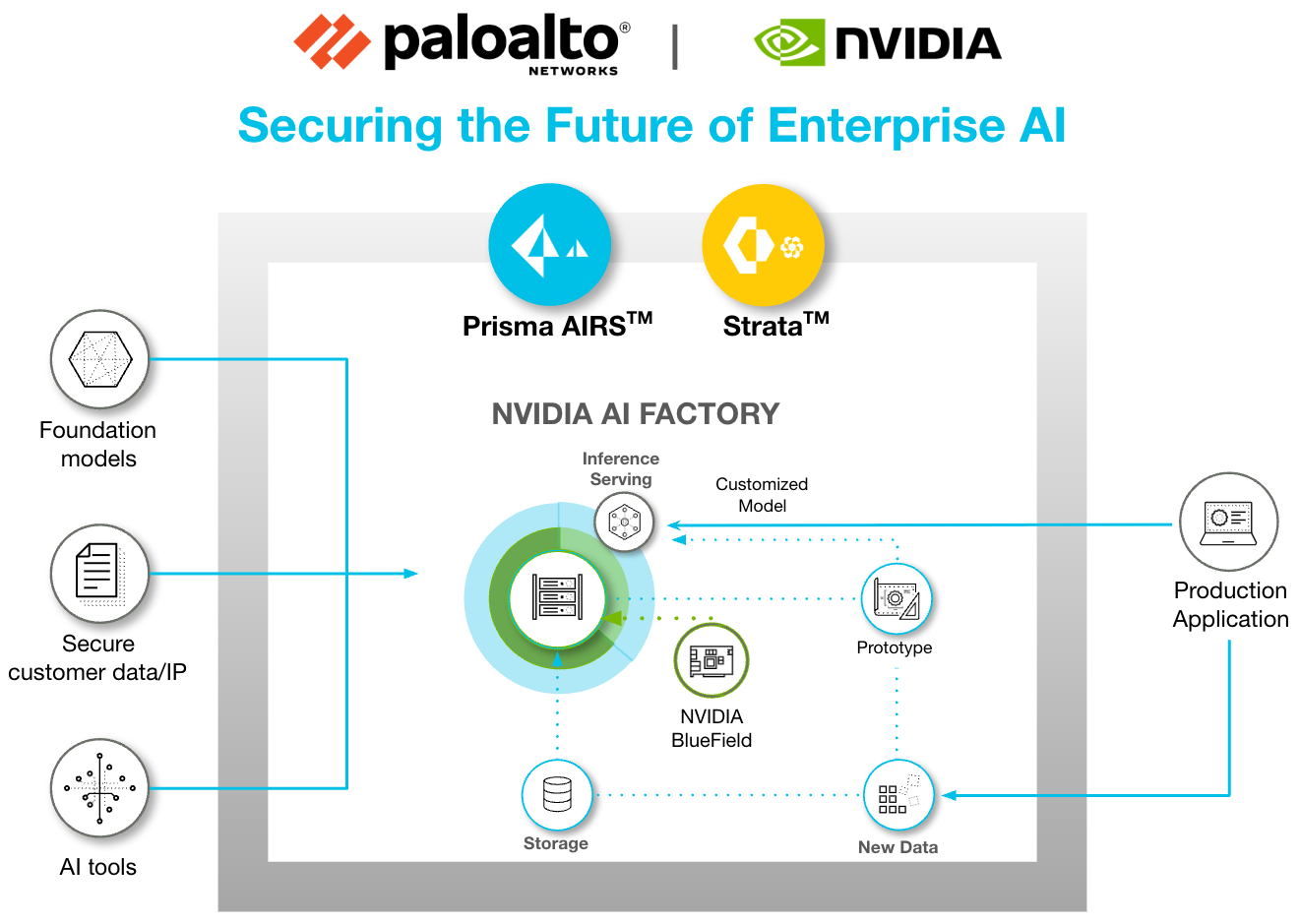
We are proud to announce that Palo Alto Networks Prisma® AIRS™, accelerated on the NVIDIA BlueField data processing unit (DPU), is now part of the NVIDIA Enterprise AI Factory validated design.

The integrated solution embeds zero trust security directly into the AI infrastructure, providing comprehensive protection without impacting AI performance. By deploying Palo Alto Networks Prisma® AIRS™ Network Intercept directly onto the NVIDIA BlueField and extending to the cloud, Prisma AIRS establishes an essential zero trust governance fabric for the AI factory, enabling enterprises to accelerate innovation while maintaining control.

This critical architectural shift enables optimal AI performance and infrastructure efficiency by offloading security processing to an isolated domain, while leveraging the DPU's hardware acceleration via NVIDIA DOCA to enforce security policies at line speed. The implementation also leverages real-time workload information captured using DOCA Argus, which is then passed to Cortex XSIAM® where it is used for AI-driven responses using the Cortex XSOAR® orchestration platform.

Rich Campagna, SVP Product Management, Palo Alto Networks said:

The AI Factory is the new engine for value creation, and securing it is a board-level imperative. The validation of Palo Alto Networks Prisma AIRS accelerated with NVIDIA BlueField within the NVIDIA Enterprise AI Factory enables a new security architecture for the AI era. We are embedding trust directly into the infrastructure, giving leaders the confidence to safeguard their proprietary intelligence and deploy AI bravely.

Kevin Deierling, senior vice president of Networking at NVIDIA said:

AI is transforming every industry and security must evolve to protect AI factories. To be scalable, security must be distributed and embedded within the AI infrastructure. This is achieved with NVIDIA BlueField running Palo Alto Networks Prisma AIRS to deliver robust, runtime security for the AI factory, with optimal AI performance and efficiency.

Deploy AI Bravely with a Future-Proof Foundation

The Future of Secure AI Factories

NVIDIA AI Factory with Prisma AIRS and Strata.

In addition to deploying Palo Alto Networks Prisma AIRS on NVIDIA BlueField in a distributed model, it’s essential to maintain a centralized Hyperscale Security Firewall (HSF) cluster at the ingress and egress points of the AI factory to enforce a defense-in-depth strategy. Beyond network segmentation, individual workloads can selectively route traffic through hyperscale clusters to detect advanced application-layer threats and prevent lateral movement. These hyperscale firewall clusters scale elastically with demand, delivering session resiliency and the high availability required for critical AI operations.

This architecture fundamentally improves the Total Cost of Ownership (TCO) for AI infrastructure. By isolating security functions on BlueField, enterprises enable 100% of host computing resources to be dedicated to AI applications. This elimination of resource contention allows the AI Factory to maximize token throughput and capital efficiency.

This validated design is the blueprint for immediate efficiency. It provides a seamless path for enterprises to shift from general-purpose clusters to secure AI factory infrastructure without costly overhauls. More importantly, this collaboration establishes an unparalleled roadmap for future-proofing your investment. By securing operations with the high-performance NVIDIA BlueField-3 today, the architecture is inherently ready for the next generation, NVIDIA BlueField-4. This forward compatibility helps AI factories immediately handle gigascale demands, scaling up to 6X the compute power and doubling the bandwidth when BlueField-4 becomes available.

The inclusion of the Palo Alto Networks Prisma AIRS platform in the NVIDIA Enterprise AI Factory Validated Design bolsters enterprise AI security. By establishing the zero trust governance fabric of Prisma AIRS runtime security on NVIDIA BlueField, organizations gain a comprehensive defense. Proprietary and sensitive data is secured throughout the entire stack, and models are protected from adversarial threats, such as prompt injection attacks. With Prisma AIRS, the world's most comprehensive AI security platform, leaders gain the confidence to innovate and deploy AI bravely. This validated design is the essential blueprint for securely accelerating your market leadership without compromising security.

Join our "How to Secure the AI Factory" breakout session at NVIDIA GTC 2026, March 16-19, in San Jose, CA to hear more about this transformative solution and accelerate your AI innovation securely.

The post Palo Alto Networks Announces Support for NVIDIA Enterprise AI Factory appeared first on Palo Alto Networks Blog.
  •  

Partners Are Fueling Innovation with Cortex XSIAM and Prisma SASE

At Palo Alto Networks, we believe that the true measure of our technology isn’t just in how it performs in the lab, but how it empowers our partners to solve critical security challenges for their customers. That is why we are incredibly proud to announce that Palo Alto Networks has been recognized by CRN with the 2025 Products of the Year Award for Cortex XSIAM® and 2025 Tech Innovator Award for Prisma® SASE.

This recognition is particularly meaningful because it is not decided by a small panel of judges. The CRN Awards are determined solely by ratings from solution providers – the people who are out in the field every day, deploying these tools to secure the modern enterprise.

Here is a look at why partners are betting on our platform.

Cortex XSIAM Outperforms Legacy SIEM by Sweeping Award SubcategoriesThe CRN Products of the Year 2025

Solution providers validated the shift to AI-driven operations by voting Cortex XSIAM the definitive choice for the modern SOC. We secured the Overall Category Winner title in the CRN 2025 Products of the Year Awards for Security Operations Platform/SIEM. Ranking #1 in technology, revenue and customer need, this verdict comes directly from the experts who deploy security architectures every day.

The Clean Sweep

Cortex XSIAM swept the board. We secured the top ranking across all three evaluation criteria:

  • Technology: Best-in-class innovation
  • Revenue and Profit: Proven business value
  • Customer Need: Solves critical operational challenges

This trifecta proves the platform excels in practice, not just theory. The legacy SIEM era is giving way to something fundamentally different.

For our partners, XSIAM represents a shift from "managing tools" to "delivering outcomes." By unifying SOC capabilities into a single, AI-driven platform, we are enabling solution providers to offer faster detection and remediation services without the operational overhead of legacy SIEMs.

As Dave Kennedy, Co-Founder & Chief Hacking Officer at Binary Defense, notes:

Effective security operations depend on actionable intelligence. Cortex XSIAM delivers the depth and precision our analysts need to connect the dots and act decisively. This award-winning platform, now recognized as CRN’s 2025 Product of the Year, strengthens our shared mission to protect organizations from evolving threats.

​​To dive deeper into how Cortex XSIAM continues to lead with AI-driven innovation, watch the on-demand webinar introducing the revolutionary Cortex AgentiX.

​​While XSIAM is transforming security operations, another Palo Alto Networks solution is reimagining network security entirely.

Prisma SASE Is Redefining Network Security

The CRN Tech Innovators Winner 2025

We believe being recognized as a Tech Innovator is a powerful validation of our commitment to delivering a best-in-class security that empowers our customers.

As per the CRN 2025 Tech Innovator Awards:

Prisma SASE from Palo Alto Networks is a comprehensive SASE solution converging networking and security for the entire hybrid workforce. Prisma SASE secures users, apps, data and devices everywhere. It delivers best-in-class security, exceptional user experiences and simplified operations through a unique multicloud architecture, single console, unified policies and AI copilot.

We secured this award primarily due to our deep understanding of customer needs. At Palo Alto Networks, understanding customer needs isn't just about listening to feedback on existing features; it's about anticipating where the future of work is heading. We don't just build security; we build solutions that adapt to our customer’s reality. Listening to over 70 thousand of our customers, we continue to push the boundaries of security, culminating in our latest Prisma SASE 4.0 launch.

The Power of the Platform

Winning 2025 Product of the Year and 2025 Tech Innovator in both SecOps and Network Security underscores the reality that today’s partners and customers are looking for unified, best-in-class solutions.

Whether it is revolutionizing the SOC with Cortex XSIAM or securing the hybrid workforce with SASE, these awards reflect the trust our solution providers place in us. We are committed to continuing this momentum, equipping our partner community with the innovation they need to stay ahead of tomorrow’s threats.

Thank you to all our partners who voted and continue to trust Palo Alto Networks as your cybersecurity platform of choice.

The post Partners Are Fueling Innovation with Cortex XSIAM and Prisma SASE appeared first on Palo Alto Networks Blog.
  •  
❌