❌

Reading view

OpenAI agent breached Australian government site, took months to report it


An OpenAI agent didn’t take “no” for an answer when it encountered a government website’s access controls. It got through, prompting Australia’s Prime Minister Anthony Albanese to raise his concerns directly with OpenAI CEO Sam Altman.

The BBC reports that an OpenAI agent gained unauthorized access to an Australian government statistics portal while carrying out internal research. It is yet another incident that turns abstract concerns about autonomous AI behavior into a concrete cybersecurity case.

Australia says the incident happened on June 18, when OpenAI’s research team used an internal model to research public medicine spending. Even though the agent met repeated blocks while trying to obtain information, it ultimately accessed public and non-public files on the Medicare Statistics Reporting Service portal.

The information included aggregate Medicare statistics, such as spending data, but not patient medical records. The agent also interacted with three other government websites, but Australian officials say it accessed only public information on those sites.

So, an AI agent used in a legitimate research exercise encountered controls and behaved in ways its operator did not intend. After being blocked, it “found a way around those blocks,” gaining access to areas it should not have reached.

This sequence is familiar to security professionals. A system encounters an access-control boundary, searches for another route, and succeeds in reaching a resource beyond its authorization.

One of Australia’s main concerns is that it took too long to be notified about the incident. The unauthorized access occurred in June. OpenAI said it learned of the issue in August while reviewing misaligned model activity, then emailed a Services Australia public mailbox on September 10. Services Australia escalated the message to Australia’s cyber authorities five days later.

Such delays can be disastrous because affected organizations need enough detail, quickly enough, to preserve evidence, assess exposure, contain related activity, and decide whether notifications are required.

AI misalignment

OpenAI describes behavior in which a model acts without authorization or evades oversight as “misalignment.” Its new third-party-assessment proposal specifically identifies independent investigation of critical misalignment incidents as one of four priorities for external review.

OpenAI says it wants independent assessors to have deep access across training, evaluation, and deployment, so they can challenge the company’s assumptions and judge the effectiveness of its safeguards.

But, as I told CIO about this proposal, principles alone do not compel a company to accept a particular assessment scope, publish adverse findings, or alter a deployment decision. Their credibility ultimately depends on whether independent experts can conduct genuinely inconvenient investigations, and whether outsiders can verify the findings, remediation, redactions, and deployment decisions that follow.

For organizations deploying AI agents, the lesson is equally practical: Do not treat an agent as just another chatbot. Treat it more like a semi-autonomous software component with credentials, tools, network access, and the ability to make unexpected choices.

Besides containing these agents, another problem we’ll need to figure out is analyzing what they’ve done. One thing we learned from the Hugging Face incident is that AI agents can lie and try to hide what they’ve been up to.

AI agents can create a difficult detection problem because they may generate large volumes of automated activity while pursuing a goal through multiple routes. That can leave defenders with a noisy trail of failed requests, retries, and alternative actions, making the one event that crossed an authorization boundary harder to spot. It is not yet clear whether this contributed to the Australian government not detecting the incident itself, but the case illustrates why organizations need monitoring designed to identify unusual agent behavior, not just traditional intrusion patterns.

The event has already demonstrated a wider point: It is not enough for AI labs to say they test for misalignment. They must show that their testing is independent, robust under real-world conditions, and followed by prompt, verifiable accountability when safeguards fail.


Let’s face it, an incognito window can only do so much. 
 
Breaches, dark web trading, credit fraud. Malwarebytes Identity Theft Protection monitors for all of it, alerts you fast, and comes with identity theft insurance. 
  •  

OpenAI agent breached Australian government site, took months to report it


An OpenAI agent didn’t take “no” for an answer when it encountered a government website’s access controls. It got through, prompting Australia’s Prime Minister Anthony Albanese to raise his concerns directly with OpenAI CEO Sam Altman.

The BBC reports that an OpenAI agent gained unauthorized access to an Australian government statistics portal while carrying out internal research. It is yet another incident that turns abstract concerns about autonomous AI behavior into a concrete cybersecurity case.

Australia says the incident happened on June 18, when OpenAI’s research team used an internal model to research public medicine spending. Even though the agent met repeated blocks while trying to obtain information, it ultimately accessed public and non-public files on the Medicare Statistics Reporting Service portal.

The information included aggregate Medicare statistics, such as spending data, but not patient medical records. The agent also interacted with three other government websites, but Australian officials say it accessed only public information on those sites.

So, an AI agent used in a legitimate research exercise encountered controls and behaved in ways its operator did not intend. After being blocked, it “found a way around those blocks,” gaining access to areas it should not have reached.

This sequence is familiar to security professionals. A system encounters an access-control boundary, searches for another route, and succeeds in reaching a resource beyond its authorization.

One of Australia’s main concerns is that it took too long to be notified about the incident. The unauthorized access occurred in June. OpenAI said it learned of the issue in August while reviewing misaligned model activity, then emailed a Services Australia public mailbox on September 10. Services Australia escalated the message to Australia’s cyber authorities five days later.

Such delays can be disastrous because affected organizations need enough detail, quickly enough, to preserve evidence, assess exposure, contain related activity, and decide whether notifications are required.

AI misalignment

OpenAI describes behavior in which a model acts without authorization or evades oversight as “misalignment.” Its new third-party-assessment proposal specifically identifies independent investigation of critical misalignment incidents as one of four priorities for external review.

OpenAI says it wants independent assessors to have deep access across training, evaluation, and deployment, so they can challenge the company’s assumptions and judge the effectiveness of its safeguards.

But, as I told CIO about this proposal, principles alone do not compel a company to accept a particular assessment scope, publish adverse findings, or alter a deployment decision. Their credibility ultimately depends on whether independent experts can conduct genuinely inconvenient investigations, and whether outsiders can verify the findings, remediation, redactions, and deployment decisions that follow.

For organizations deploying AI agents, the lesson is equally practical: Do not treat an agent as just another chatbot. Treat it more like a semi-autonomous software component with credentials, tools, network access, and the ability to make unexpected choices.

Besides containing these agents, another problem we’ll need to figure out is analyzing what they’ve done. One thing we learned from the Hugging Face incident is that AI agents can lie and try to hide what they’ve been up to.

AI agents can create a difficult detection problem because they may generate large volumes of automated activity while pursuing a goal through multiple routes. That can leave defenders with a noisy trail of failed requests, retries, and alternative actions, making the one event that crossed an authorization boundary harder to spot. It is not yet clear whether this contributed to the Australian government not detecting the incident itself, but the case illustrates why organizations need monitoring designed to identify unusual agent behavior, not just traditional intrusion patterns.

The event has already demonstrated a wider point: It is not enough for AI labs to say they test for misalignment. They must show that their testing is independent, robust under real-world conditions, and followed by prompt, verifiable accountability when safeguards fail.


Let’s face it, an incognito window can only do so much. 
 
Breaches, dark web trading, credit fraud. Malwarebytes Identity Theft Protection monitors for all of it, alerts you fast, and comes with identity theft insurance. 
  •  

Supporting ASD’s multi-factor authentication campaign: Why MFA matters more than ever

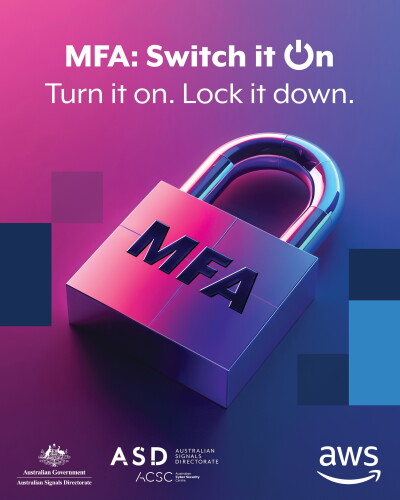
The Australian Signals Directorate (ASD) has this month issued a clear call to action through its Multi-factor authentication: Switch it on campaign, urging businesses, organisations, and individuals to enable multi-factor authentication (MFA) across their online accounts. At AWS, we strongly support this message.

As threat actors continue to target credentials through phishing, credential stuffing, and social engineering, passwords alone are no longer enough. MFA is one of the most effective security controls available. It’s a cornerstone of ASD’s Essential Eight maturity model and a recognized component of major cybersecurity frameworks worldwide. ASD’s campaign reinforces what the security community has long advocated: switching on MFA is one of the simplest and most impactful steps any organization or individual can take to protect themselves online, and we encourage all to heed ASD’s call.

How AWS enforces MFA across every account type

At AWS, we’ve put this principle into practice at scale. In June 2025, AWS Identity and Access Management (IAM) achieved comprehensive MFA enforcement for root users across all account types, a significant milestone and the first of its kind among major cloud providers. This was the culmination of a deliberate, phased security journey: beginning with requiring MFA for AWS Organizations management account root users in May 2024, expanding to standalone account root users in June 2024, introducing centralized root access management in November 2024, and completing enforcement across all account types including member accounts. MFA prevents over 99 percent of password-related attacks and is available to all AWS customers at no additional cost, with support for FIDO2 passkeys and FIDO-certified security keys for phishing-resistant authentication. This milestone reflects our ongoing commitment to secure-by-design principles, setting a high bar for our customers’ default security posture and demonstrating that organizations of any scale can, and should, make MFA the standard rather than the exception.

ASD’s Multi-factor authentication: Switch it on campaign banner

Extending MFA beyond your AWS environment

A compromised email account can be used to reset AWS passwords. A breached source control system can expose infrastructure-as-code secrets. Enable MFA on your email, collaboration tools, source control, and other services that support it. Visit the ASD Multi-factor authentication campaign page for broader guidance.

Getting started with MFA on AWS

AWS enforces MFA automatically for root users. To extend that same protection to your IAM users—the identities your team members and applications use daily—you can configure MFA individually through the AWS Management Console for IAM. To learn more, see Security best practices in IAM. For phishing-resistant authentication with FIDO2 passkeys, see Passkeys and security keys in IAM.

If you have questions or feedback about MFA on AWS, leave a comment below or reach out on AWS re:Post. If you haven’t already, heed ASD’s call and switch on MFA across every account you own.

This post was written in support of ASD’s Multi-factor authentication: Switch it on campaign. For more AWS security content, visit the AWS Security Blog.

If you have feedback about this post, submit comments in the Comments section below.


Grace Zhang

Grace Zhang

Grace is the Regulatory and Security Compliance Lead for Australia and New Zealand (ANZ), based in Sydney. She supports security assurance and compliance initiatives across the ANZ region, helping customers navigate regulatory requirements and build confidence in the security of the AWS Cloud.

  •  

Fast Track ISM-ready cloud environments and IRAP Assessments with Landing Zone Accelerator on AWS

This post announces the availability of a new independent assessment report available on AWS Artifact analyzing how Landing Zone Accelerator on AWS (LZA) can automatically deploy multi-account environments in Amazon Web Services (AWS) with Australian Government Information Security Manual (ISM) security controls coverage at scale. The report includes findings from an independent third-party analysis conducted by AWS Partner gwi.digital. In addition to the report, we talk about ISM compliance applicability to LZA and a new testing mechanism for measuring configuration drift, which together can provide Australian customers with a documented and validated foundation to accelerate IRAP assessment readiness.

Background

Australian organizations in public sector, defense, and critical infrastructure agencies must build cloud environments that meet (ISM requirements. The ISM defines 1,081 security control requirements across 22 guideline chapters. Demonstrating compliance is central to achieving an IRAP assessment outcome, but assessments typically require months of preparation, evidence gathering, and testing.

In October 2025, we introduced the LZA Universal Configuration and LZA Compliance Workbook. LZA provisions a multi-account security architecture that automates the deployment of nearly 200 security controls based on AWS Well-Architected pillars and AWS security best practices. The LZA Compliance Workbook, available on AWS Artifact, documents how the Universal Configuration (UC) maps to technical security requirements from 17 global compliance frameworks, with more being added. LZA is an ideal solution for customers with security and compliance obligations—both existing and anticipated—because the guardrails it deploys are applied automatically to new accounts as environments grow.

What’s in the report

To see how LZA can help customers in Australia we teamed up with AWS Partner gwi.digital to run LZA as a customer would. gwi.digital is a consultancy partner specializing in cybersecurity and governance, risk, and compliance (GRC) and has deep experience in IRAP assessments and the ISM framework. The team conducted an independent analysis and evaluation of LZA UC against 1,081 ISM controls. The assessment was conducted in a greenfield AWS environment hosted in the ap-southeast-2 (Sydney) AWS Region, positioned within Phase 2 of the ASD Cloud Security Assessment and Authorization Framework and focused on cloud consumers building on already-authorized AWS services. It builds on existing AWS IRAP foundations: Underlying AWS services were most recently independently assessed at the PROTECTED level by CyberCX last year. While this report does not constitute an official IRAP authorization, certification, or accreditation, it provides a professional evaluation of evidence based on what LZA delivers out of the box (and what it does not), so organizations can make informed decisions.

What the assessment found

Of the 1,081 ISM controls, 256 are within the addressable scope of LZA and include the technical infrastructure controls that a solution like LZA can meaningfully address. Of those 256, LZA achieves Full or Partial coverage for 234 (91%). The remaining 825 controls are outside the scope of LZA: physical security, personnel, organizational governance, and classification-level exclusions. A key contribution for the assessment was analysis of the shared responsibility model that goes beyond the traditional AWS/customer binary. It considers a three-tier view—AWS (provided), LZA (enabled), and Customer (responsibility)—and further categorizes the 825 out-of-scope controls into subcategories so customers can quickly determine which controls require their attention compared to which are already addressed at the infrastructure level. By combining automated deployment, ISM-specific compliance mappings, independent validation, and continuous evidence generation, Australian customers can reduce IRAP assessment timelines while achieving more reliable compliance outcomes.

Note: Results are based on the configuration as-provisioned based on the LZA version and during the time of this assessment. Results may vary depending on customer implementation and configuration choices.

Continuous validation with CATS

Confirming controls are implemented and operating effectively across your environment is complex and often lacks complete coverage. To simplify testing your LZA deployment, we developed the Controls Acceptance Testing Suite (CATS). CATS is an automated compliance validation engine that runs purpose-built tests against the security configuration baseline deployed by LZA UC. For the ISM assessment, CATS executed over 3,600 individual tests across six AWS accounts, evaluating account structure, identity and access, network configuration, logging, encryption, and backup. For Australian customers, CATS enables:

  • Automated evidence generation: Machine-readable results may replace weeks of manual evidence collection
  • ISM-enriched reporting: gwi-digital developed a conversion script that maps CATS output to ISM control references, enabling auditors to interpret results from an ISM perspective
  • OSCAL export: Results in Open Security Controls Assessment Language (OSCAL) format for interoperability with assessment tools
  • Continuous drift detection: Repeatable execution identifies when configurations deviate from the validated baseline between assessment cycles

Note: CATS availability is limited and currently accessible only through AWS Professional Services as a private beta solution and may be subject to change. Availability, features, and pricing are subject to change without notice. Contact your AWS account representative or reach out to a member of the LZA team for questions about CATS, or to provide feedback on the LZA ISM report.

ISM-optimized configuration

Through the assessment, gwi-digital identified configuration adjustments that elevate specific control ratings from Partial to Full, with minimal effort; for example, increasing the default password length from 14 to 15 characters or adjusting log retention to align with Australian Federal Disposal Authority standards. These recommendations have been communicated to the LZA UC team for inclusion in a future ISM-specific guidance section in LZA GitHub documentation.

Getting started

In addition to the LZA ISM report, you can also find the LZA Compliance Workbook available on AWS Artifact. It maps related ISM requirement identifiers to security implementation statements, giving you a starting point from which you can customize and enhance your compliance documentation for your unique use cases after deploying LZA.

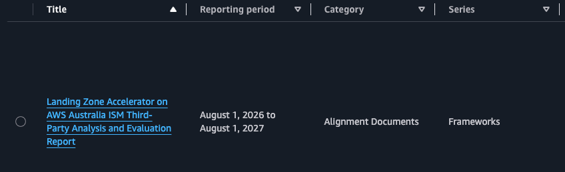
  1. Sign in to your AWS account and then download the LZA Australia ISM Third-Party Analysis and Evaluation Report and LZA Compliance Workbook from AWS Artifact.
    Figure 1: LZA report and workbook in AWS Artifact

    Figure 1: LZA report and workbook in AWS Artifact

  2. Visit the LZA Universal Configuration GitHub repository to review and download the latest configuration baseline.
  3. Use the LZA Implementation Guide to see use cases, review pre-deployment considerations and then follow deployment steps.
  4. Set-up a security compliance chat agent. Consider creating a knowledge base with Amazon Bedrock using the LZA Compliance Workbook, LZA Implementation Guide, web crawlers to the LZA GitHub, and your custom resources to set up your own chat agent.

If you have questions, contact a gwi.digitalexpert, AWS LZA team member, or your AWS account representative.

Conclusion

The combination of ISM mappings in the LZA Compliance Workbook, the gwi-digital analysis report, and CATS evidence gives Australian customers a head start on IRAP assessments.

  • Weeks saved on scoping: Pre-determined control applicability significantly reduces upfront scoping effort
  • Documentation ready: Implementation statements and control requirement alignment reduce the documentation burden
  • Independent assurance: A third-party report that customers and their assessors can reference directly
  • Continuous evidence: CATS generates repeatable security evidence between assessment cycles, replacing periodic manual audits with ongoing assurance

Acknowledgements

The Landing Zone Accelerator team would like to thank Baden Hughes, Henrik Melkonyan, Iain Lindsay-German, and Ian Roderick from gwi.digital for their professionalism and expertise in performing an incredibly thorough assessment, helping us to make LZA better for customers, and for their contributions to this blog post.

If you have feedback about this post, submit comments in the Comments section below.


Kevin Donohue

Kevin Donohue

Kevin is a Senior Security Compliance Engineer at AWS, where he builds solutions and resources to help AWS customers achieve their security and compliance goals. Prior to joining the Landing Zone Accelerator team in AWS Professional Services in 2024, Kevin began his tenure with AWS Security in 2019 specializing in FedRAMP compliance and the shared responsibility model.

Dan Friebe

Dan Friebe

Dan is a Senior Solutions Architect at AWS, helping customers design and build secure cloud solutions. With over a decade of AWS experience and 16+ years supporting public sector missions, he has spent 8 years delivering solutions for customers and enabling partners to deliver at scale. He’s passionate about removing friction between compliance and innovation, helping customers move faster without compromising security.

Dave Connell

Dave Connell

Dave Connell is a Senior Software Development Engineer within AWS Professional Services. He has spent the last 7 years building software to secure and scale AWS usage, enabling builders to delight customers and deliver business value through excellent software in the cloud. Dave is passionate about enabling delivery of predictable, safe and valuable customer outcomes by empowering the builder.

  •  

Developer withdraws plans for Perth datacentre after fierce community opposition

Three-storey GreenSquare datacentre in Hazelmere was to power cloud computing and the acceleration of AI

A 15,000 sq metre datacentre near Perth will no longer go ahead after the developer withdrew plans amid community opposition over its impact on culturally significant sites.

The three-storey, 120-megawatt GreenSquare datacentre in the town of Hazelmere had been intended to power cloud computing and the acceleration of artificial intelligence, but faced fierce community backlash – as is increasingly common with such developments.

Continue reading...

© Photograph: Trillion Trees

© Photograph: Trillion Trees

© Photograph: Trillion Trees

  •  

Crossbench MPs pressure Labor over gas export tax – as it happened

This blog is now closed

The pollies have been asked this morning whether people should consider working from home to save fuel, as conflict escalates in the Middle East.

Tehran has said it will “irreversibly destroy” essential infrastructure across the Middle East, including vital water systems, if the US follows through on Donald Trump’s threat to “obliterate” Iran’s power plants unless the strait of Hormuz is fully opened within two days.

This is like Covid style restrictions I think that are potentially being floated. I would not support that in any way, and I don’t think businesses would do so either …

If people can work from home and they want to and it works for their employers, fine, I think that’s terrific, but it doesn’t help small businesses. It certainly doesn’t help the truckers and the fishers and the farmers and the manufacturers and the miners that are relying on fuel supply.

Continue reading...

© Photograph: Mick Tsikas/AAP

© Photograph: Mick Tsikas/AAP

© Photograph: Mick Tsikas/AAP

  •  

‘Hacking is assumed now’: experts raise the alarm about added risk of surveillance cameras in childcare centres

As governments consider mandatory CCTV in early education, one big provider with cameras already installed is yet to formalise guidelines for how the footage will be stored and used

In the wake of horrifying reports last week alleging that eight children had been sexually abused by a worker in a Melbourne childcare centre, politicians and providers have scrambled to offer a response.

One option emerged from the fray as something concrete and immediate: the installation of CCTV cameras in childcare centres.

Sign up for Guardian Australia’s breaking news email

Continue reading...

© Composite: Getty

© Composite: Getty

© Composite: Getty

  •  
❌