
 Login
Login
Building effective AI for the SOC: How Intezer Forensic AI SOC follows Anthropic’s best practices
One of the most influential publications on real-world AI system design is Anthropic’s guide, Building Effective Agents. Its core message is simple:
Effective AI requires structure first, adaptability second.
Anthropic emphasizes that AI agents work best when:
- A deterministic workflow does all the structured work up front
- The agent only activates when uncertainty remains
- The agent begins with full context, not an empty slate
- Tool usage is controlled and evidence-driven
- Human-in-the-loop remains central for oversight and trust
These principles ensure accuracy, avoid hallucinations and keep investigations reproducible, all critical requirements for cybersecurity.
Intezer Forensic AI SOC is built on exactly this philosophy. Our platform uses a dual-mode design with Intezer AI Workflow and AI Agent, completely aligning with Anthropic’s best practices to deliver fast, scalable and highly accurate investigations across a broad range of alerts, all while keeping analysts in the loop.
Here is how Intezer implements Anthropic’s best practices for agents.
Structured first: Intezer AI Workflow handles the majority of alerts
Anthropic advises that AI systems should begin with deterministic workflows instead of free-form reasoning. In cybersecurity, this is essential for accuracy, auditability, trust and scalability (when handling huge volumes of alerts).
Intezer’s AI Workflow mode is a structured triage process designed by security experts and executed with strict consistency. It applies AI only at key decision points, not as the driver of the entire investigation.
This approach provides:
- Deterministic, reproducible results
- High speed due to streamlined, parallelizable steps
- Lower costs because heavy reasoning is used sparingly
- No drift or unexpected branching
- Clear human oversight points
Most alerts, especially well-defined ones, are fully resolved at this stage, giving SOCs broad alert coverage at low cost.
Adaptive only when needed: Intezer AI Agent extends the investigation
Anthropic states that agents should activate only when the structured workflow reaches uncertainty, and only after they inherit the full context. Intezer follows this exactly.
AI Agent mode activates only when the Workflow cannot reach a high-confidence verdict.
At that point, the agent:
- Starts with all evidence collected so far
- Avoids premature assumptions
- Uses tools deliberately and contextually
- Expands the investigation where human analysts would
- Surfaces deeper behavioral patterns or cross-asset correlations
This ensures the agent is guided, not free-floating, and its decisions remain grounded in evidence, not guesswork.
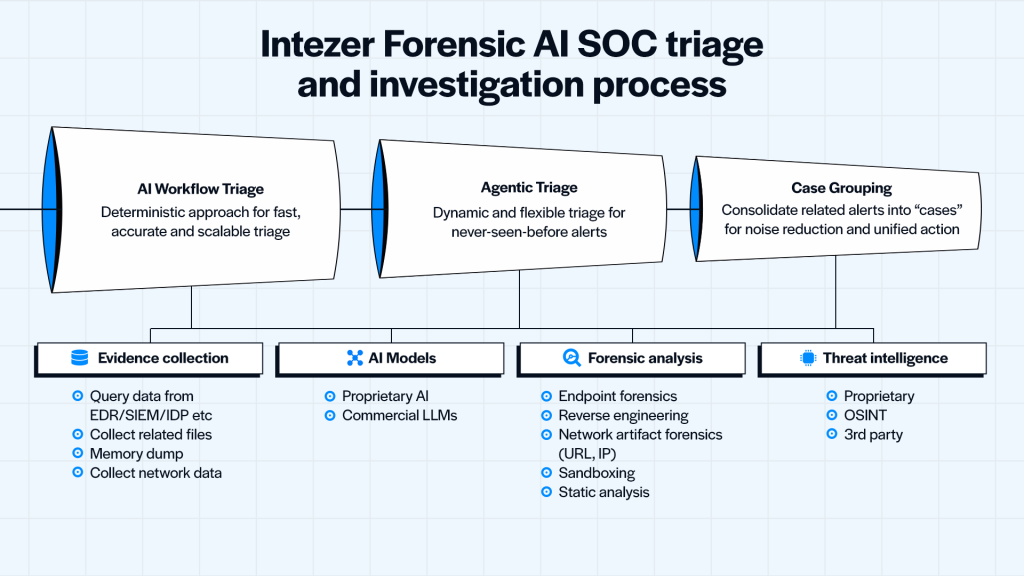
Tools the AI Agent can leverage once activated
- Dynamic SIEM queries
- EDR/XDR telemetry lookups
- Identity provider (IDP) investigation
- Behavioral analysis of processes and command lines
- User activity mapping
- Process ancestry and parent-child correlation
- Intezer’s historical alert database
- Code DNA similarity and malware lineage tracking
- Additional host, memory, or file-based forensics
The result is deeper investigation where it matters, without unnecessary cost.
Human-in-the-loop by design
Intezer keeps human analysts at the center so they can review and override conclusions, and trace every decision made by Intezer. Of course, all evidence and reasoning is grounded in forensic data and is fully transparent and explainable for beginners and advanced analysts alike.
This aligns with Anthropic’s principle that humans remain final decision-makers, especially in high-stakes domains like cybersecurity.
How this architecture improves SOC performance
Intezer’s adherence to Anthropic’s best practices produces measurable outcomes across the three most important SOC metrics: accuracy, coverage, and speed, while also reducing cost.
Accuracy
Intezer’s approach of combining deterministic forensics + adaptive AI = best-in-class verdict quality.
- The structured workflow prevents hallucinations
- The AI Agent only activates with strong guardrails
- Context inheritance ensures consistent reasoning
- Analysts always have visibility and control
This hybrid approach dramatically reduces false positives and prevents premature conclusions.
Triage of all alerts, including low-severity (where threats often hide)
Because AI Workflows handle the bulk of alerts inexpensively and AI Agents only run when needed, heavy and expensive reasoning calls are minimized
This frees SOCs from cherry-picking which alerts to ingest allowing them to triage and investigate them all.
This is crucial for:
- High-volume enterprise environments
- MSSPs with strict SLAs
- Cloud-scale detection pipelines
- 24/7 monitoring teams
You get broad alert coverage without inflating compute costs.
Speed: Structured steps + adaptive depth
- Workflow mode resolves most alerts within seconds
- Agents accelerate investigations that normally take analysts hours
- No bottlenecks, no backlog, no manual evidence gathering
The result is a SOC where every alert is investigated quickly, consistently, and with forensic depth.
Table of how Intezer’s design reflects Anthropic’s guidance
| Anthropic best practice | How Intezer implements it |
| Start with deterministic workflows | AI Workflow handles structured triage with predefined expert steps |
| Activate agents only when needed | AI Agent triggers only when confidence is insufficient |
| Give agents full context | Agent inherits the entire Workflow evidence set |
| Control tool usage | Agent selects tools based on evidence, not speculation |
| Maintain human-in-the-loop | Analysts can verify, guide, and override conclusions |
| Prioritize safety and reproducibility | Every action is logged, justified, and traceable |
Conclusion: Anthropic’s Agent principles in a real SOC
Anthropic’s framework for building effective agents is now influencing industries far beyond general AI research. Intezer Forensic AI SOC might be one of the strongest real-world implementations of these practices in cybersecurity.
By combining:
- Deterministic workflows for reliable baseline investigations
- Adaptive agents for deeper reasoning when needed
- Human oversight for trust and accountability
- Cost efficiency enabling full-pipeline alert coverage
Intezer is able to deliver fast, accurate, and scalable triage that transforms SOC operations.
Learn more about how you can transform your SOC today.
The post Building effective AI for the SOC: How Intezer Forensic AI SOC follows Anthropic’s best practices appeared first on Intezer.
