Key Vulnerabilities: Week of December 20 – December 26, 2025
Foundational Prioritization
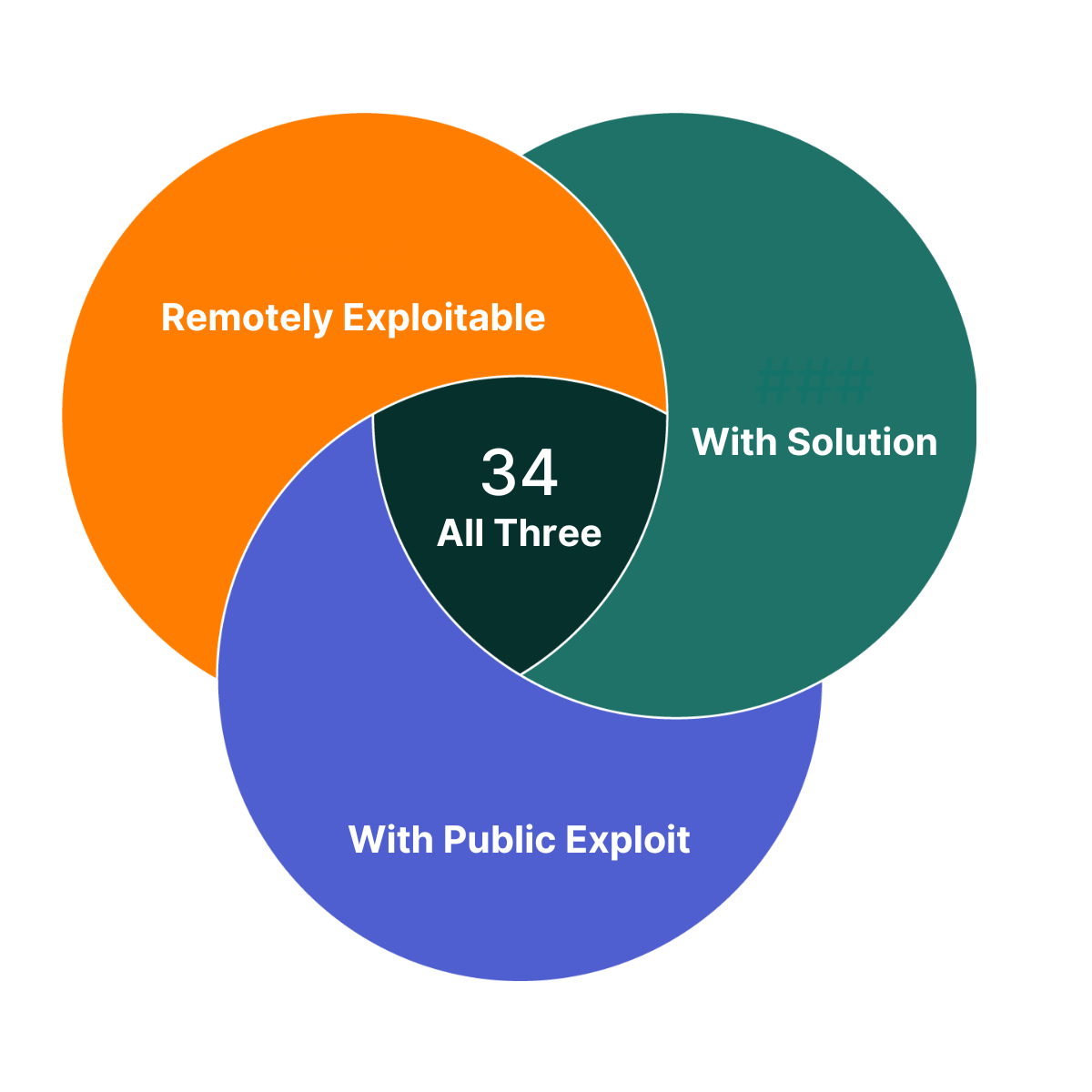
Of the vulnerabilities Flashpoint published this week, there are 34 that you can take immediate action on. They each have a solution, a public exploit exists, and are remotely exploitable. As such, these vulnerabilities are a great place to begin your prioritization efforts.
Diving Deeper – Urgent Vulnerabilities
Of the vulnerabilities Flashpoint published last week, four are highlighted in this week’s Vulnerability Insights and Prioritization Report because they contain one or more of the following criteria:
Are in widely used products and are potentially enterprise-affecting
Are exploited in the wild or have exploits available
Allow full system compromise
Can be exploited via the network alone or in combination with other vulnerabilities
Have a solution to take action on
In addition, all of these vulnerabilities are easily discoverable and therefore should be investigated and fixed immediately.
To proactively address these vulnerabilities and ensure comprehensive coverage beyond publicly available sources on an ongoing basis, organizations can leverage Flashpoint Vulnerability Intelligence. Flashpoint provides comprehensive coverage encompassing IT, OT, IoT, CoTs, and open-source libraries and dependencies. It catalogs over 100,000 vulnerabilities that are not included in the NVD or lack a CVE ID, ensuring thorough coverage beyond publicly available sources. The vulnerabilities that are not covered by the NVD do not yet have CVE ID assigned and will be noted with a VulnDB ID.
NOTES: The severity of a given vulnerability score can change whenever new information becomes available. Flashpoint maintains its vulnerability database with the most recent and relevant information available. Login to view more vulnerability metadata and for the most up-to-date information.
CVSS scores: Our analysts calculate, and if needed, adjust NVD’s original CVSS scores based on new information being available.
Social Risk Score: Flashpoint estimates how much attention a vulnerability receives on social media. Increased mentions and discussions elevate the Social Risk Score, indicating a higher likelihood of exploitation. The score considers factors like post volume and authors, and decreases as the vulnerability’s relevance diminishes.
Ransomware Likelihood: This score is a rating that estimates the similarity between a vulnerability and those known to be used in ransomware attacks. As we learn more information about a vulnerability (e.g. exploitation method, technology affected) and uncover additional vulnerabilities used in ransomware attacks, this rating can change.
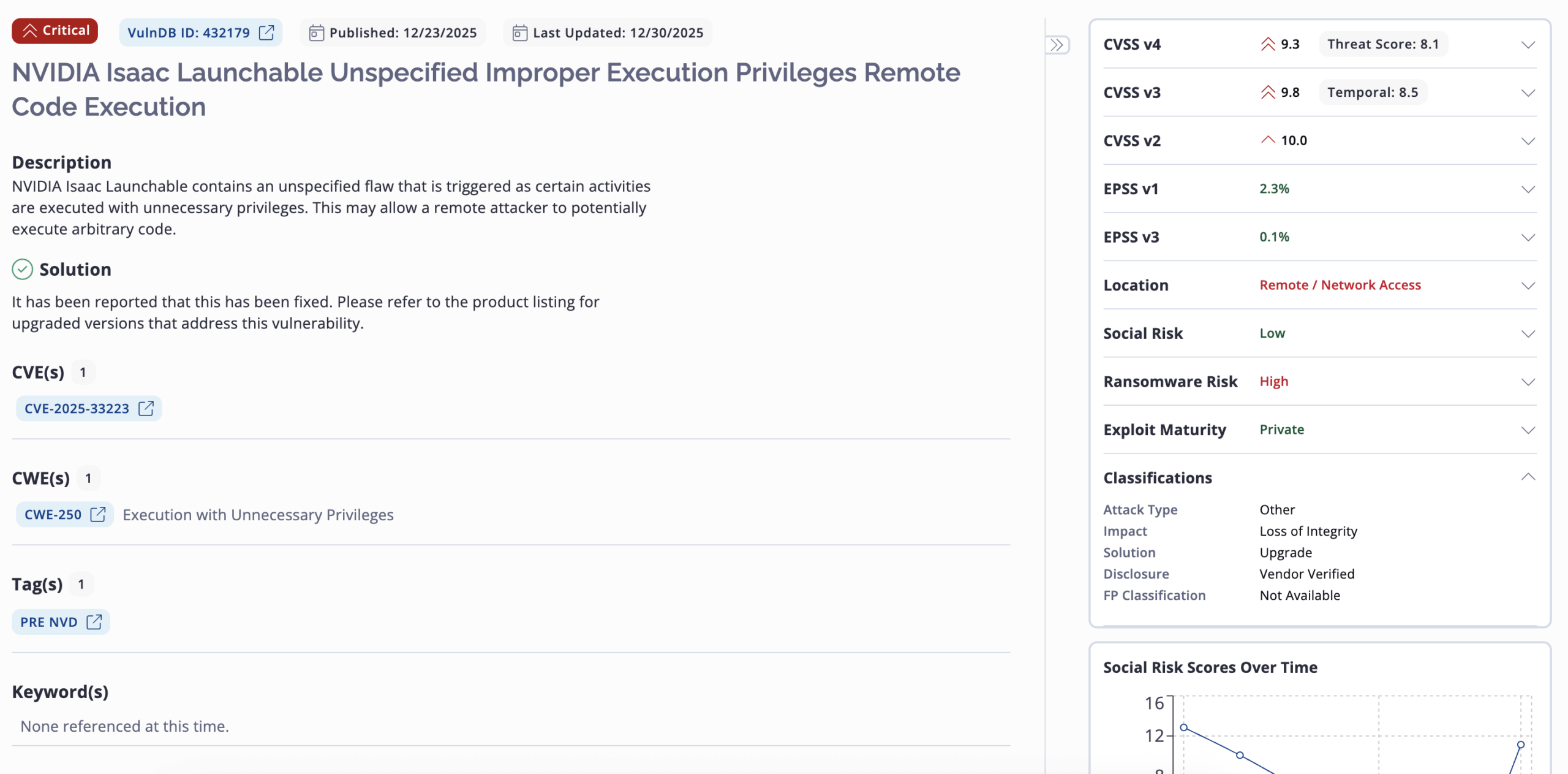
Flashpoint Ignite lays all of these components out. Below is an example of what this vulnerability record for CVE-2025-33223 looks like.
This record provides additional metadata like affected product versions, MITRE ATT&CK mapping, analyst notes, solution description, classifications, vulnerability timeline and exposure metrics, exploit references and more.
Analyst Comments on the Notable Vulnerabilities
Below, Flashpoint analysts describe the five vulnerabilities highlighted above as vulnerabilities that should be of focus for remediation if your organization is exposed.
CVE-2025-33222
NVIDIA Isaac Launchable contains a flaw that is triggered by the use of unspecified hardcoded credentials. This may allow a remote attacker to trivially gain privileged access to the program.
CVE-2025-33223
NVIDIA Isaac Launchable contains an unspecified flaw that is triggered as certain activities are executed with unnecessary privileges. This may allow a remote attacker to potentially execute arbitrary code.
CVE-2025-68613
n8n Package for Node.js contains a flaw in packages/workflow/src/expression-evaluator-proxy.ts that is triggered as workflow expressions are evaluated in an improperly isolated execution context. This may allow an authenticated, remote attacker to execute arbitrary code with the privileges of the n8n process.
CVE-2025-14847
MongoDB contains a flaw in the ZlibMessageCompressor::decompressData() function in mongo/transport/message_compressor_zlib.cpp that is triggered when handling mismatched length fields in Zlib compressed protocol headers. This may allow a remote attacker to disclose uninitialized memory contents on the heap.

 Login
Login


 Table Of Contents

 documents over