❌

Reading view

Rewriting Copyright Law for Generative AI Would Hurt Everyone

In courts across the country, publishers and creators are suing large AI companies for training generative AI models on copyrighted works. It’s easy to see these cases as a David-and-Goliath showdown between authors and publishers fighting for a cut of Big Tech company profits. But this fight is actually much larger. It affects billions of people who aren’t represented in the case at all, including researchers, artists, activists, journalists, people with disabilities, and anyone who accesses and shares content online.   

That’s why EFF is stepping in to defend the public’s rights in these cases. Today, EFF filed an amicus brief in In re OpenAI, explaining how the court’s ruling on fair use could impact people worldwide. If fair use gets narrowed, it will impede work that benefits the public, like medical research and investigative journalism, and even limit access to privacy protection tools.

Let’s be clear: creators and workers deserve support as AI changes their fields, and Big Tech companies must be held accountable for the harms they cause. But giving copyright holders more control over the web won’t accomplish either of these goals. If the plaintiffs prevail in these cases, courts would have to rewrite copyright law in ways that hurt everyone except powerful media and tech companies.

Rewriting Fair Use Makes Everyone Worse Off

Copyright exists for one reason: to stimulate creativity and innovation in service of the greater public good. Unfortunately, the plaintiffs in this lawsuit are arguing to limit everyone’s fair use rights, in ways that would thwart the basic purpose of copyright. The harms of shrinking fair use will go far beyond generative AI, impacting everyone.

Initial speculation that AI models would be infringement machines, churning out works highly similar to those on which they were trained, has proven unfounded. And courts have already found fair use in cases where copyrighted works were used to train generative AI models, recognizing that training uses those works for a fundamentally different purpose.

Plaintiffs in these cases argue that, even if the use is transformative, using their works to train AI is still unfair, because the AI models could generate new, non-infringing works that might compete with plaintiffs’ own works. They also argue that scraping or downloading the data without permission—or in some cases, from websites containing infringing copies—was independently infringing and/or rendered any subsequent uses of that data unfair.

These arguments would put beneficial research and reporting at risk. First, if copying without permission rules out fair use, the law will never protect transformative uses that benefit us all. Researchers, journalists, and other watchdog groups gather information the same way AI companies do—but they do it to serve the public interest, and often to hold Big Tech itself accountable. For example, journalists and nonprofit researchers have used “crawling” or “scraping” to investigate potentially anticompetitive practices by tech companies, and research misinformation and hateful content posted on X. Their data acquisition techniques are virtually identical to those used by AI giants—but they lack those companies’ deep pockets.

Requiring users to show that copyrighted material was lawfully obtained would also threaten everyday internet use. As EFF’s brief explained, that requirement would “cast legal doubt on the billions of copies we collectively make every day through routine online activities like opening emails, clicking on an embedded link, visiting websites, sharing pictures, streaming music, and watching videos. All of this activity requires intermediate copying.”

Fair use is what lets us all use the internet without being compelled to track the source of every image, video, and article that we click on, and make sure the rights are all cleared.

Additionally, while rightsholders are understandably concerned about competition from AI generated works, copyright law exists to promote new creation, not protect authors who published first. Under the plaintiffs’ theory, no one could stand upon the shoulders of giants. Copyright could prevent people from writing new books inspired by themes in a favorite novel or genre, or prevent academic researchers from publishing literature reviews that distill insights from prior research—simply because readers might prefer those new publications over those that came first.

Finally, general-purpose AI models are neither designed nor usually used to create works targeted at any particular market. These models have been used to generate new insights and tools for medicine, science, journalism, art, and accessibility. For instance, an AI-powered tool called Be My AI uses Open AI’s GPT models to provide visual descriptions for people who are blind or have low vision. Generative tools have also accelerated scientific research, and researchers have used these tools to develop new medical treatments and medications for conditions previously thought to be incurable.

Mandatory Licensing Would Entrench Big Tech

Some creators and publishers argue that AI developers should just get a license. But requiring permission for every work used would give the largest companies massive advantages over small competitors and impede academic research. As Professor Lawrence Lessig recently noted:

If all training requires a license, then none but a handful of tech giants will be able to afford the costs of training. That’s not because authors are greedy but because the copyright system is the least efficient property system known to man.

Moreover, creators are unlikely to benefit from these licensing arrangements in many cases. Media and entertainment giants have exploited the imbalance between themselves and underpaid working artists for decades. Trying to help creators by giving them more rights under copyright is, as Cory Doctorow has written, like trying to help a bullied kid by giving them more lunch money for the bully to take. Artists aren’t getting good deals from record labels or publishers now; there’s no reason to think these companies, which already own the copyrights, will treat artists more fairly once they control the data that powers AI.

The Future of AI Is Too Important to Leave to Big Content or Big Tech

AI technologies will affect all of us, and copyright law is ill-equipped to address many of these consequences. The rules governing these technologies should be rules that serve the public—not just the small number of companies that can afford to litigate copyright battles for decades, or settle for billions.

  •  

New Records Obtained by EFF Expose More Problems with Medicare’s AI Experiment

New records obtained by EFF expose additional issues with Medicare’s AI-driven prior authorization program and show why we need stronger legal limits around government use of automated decision-making. 

EFF sued the government back in March for information about the Wasteful and Inappropriate Service Reduction (WISeR) model, a new Medicare program that uses AI to evaluate prior authorization requests for certain medical services. We previously released records showing that WISeR has resulted in delays and denials of care, operational chaos, and reports of patient harm. Today, we’re publishing over 800 new pages of records, including:

  • Requests for information (RFIs) or requests for corrective action plans (CAPs) sent from the Centers for Medicare & Medicaid Services (CMS) to four of the six WISeR vendors, along with the vendors’ responses.
  • Applications of 66 companies to the WISeR model, including those of the 6 selected companies. 
  • Task orders and contracts for the evaluation, implementation, and monitoring of the WISeR model.

Documents obtained through EFF’s lawsuit are available here.

These newly released documents show that the WISeR rollout was rushed and rocky from the start, highlighting the dangers that arise when governments treat AI like a silver bullet for complex problems. The documents also highlight the need for more transparency about safeguards against inappropriate, AI-driven denials. The public still lacks the information needed to assess whether clinician review is providing meaningful oversight of AI systems and whether appropriate data is being used to evaluate prior authorization requests. 

EFF has long argued that AI has no place in consequential government decisions about peoples’ rights or access to benefits, such as immigration enforcement and policing decisions. That’s because using automated decision-making in these contexts risks decisions that violate people’s rights or deprive them of benefits they’re entitled to based on biased or inappropriate considerations and without proper due process or accountability if there is an error. 

By outsourcing decision-making to private AI companies without sufficient transparency, testing, or legal limits, WISeR jeopardizes seniors’ access to medical care. Congress should step in to place greater legal limits on the use of automated decision-making in Medicare. 

WISeR’s Rollout Was Rushed and Rocky 

CMS launched the WISeR program just six months after announcing it, ignoring calls from medical providers to delay its rollout. In records previously released by EFF, CMS acknowledged this “extremely condensed timeline.” 

New records suggest that WISeR’s unusually rapid rollout contributed to widespread problems in the first few months of the program. CMS did not disclose the extent of these issues to the public, even as agency employees privately contacted vendors about potential noncompliance with program requirements. 

In the first three months of the program, CMS sent RFIs or requests for CAPs to at least four of the six WISeR vendors. These requests, which describe delays, technical failures, and a lack of communication with providers, suggest that widespread problems during the program’s rollout were not limited to one vendor or state. 

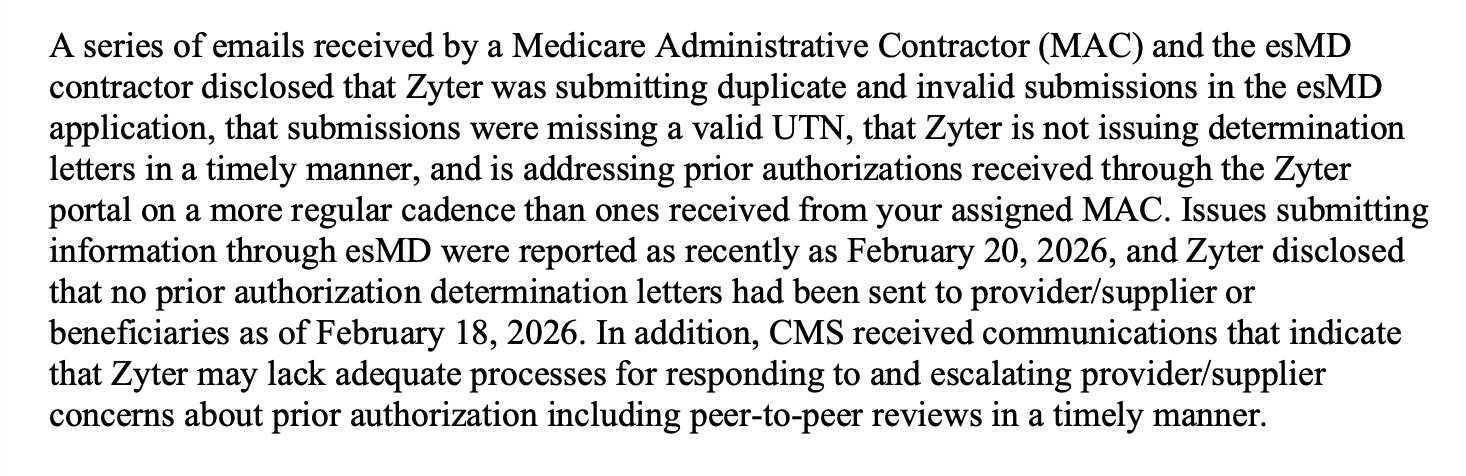
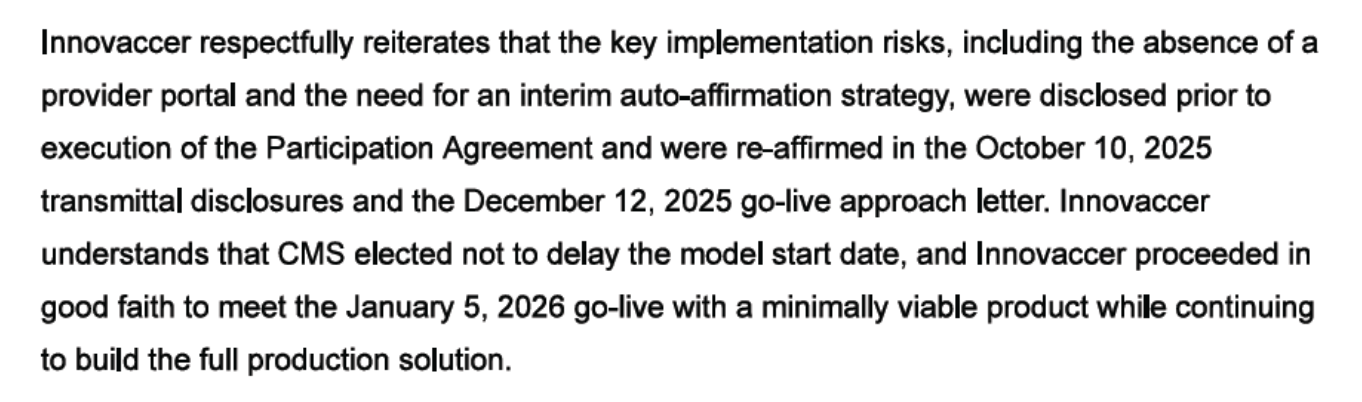
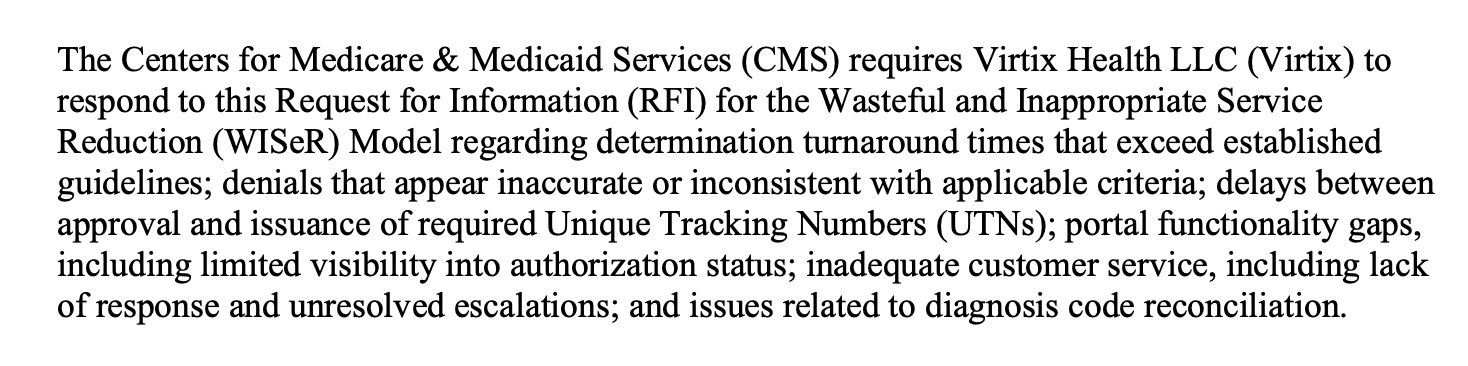
These letters underscore the severity of the problems with the program. For example, CMS requested information from one vendor, Virtix, about numerous reported issues, including “determination turnaround times that exceed established guidelines,” “denials that appear inaccurate or inconsistent with applicable criteria,” and “inadequate customer service.” CMS’s RFI to Zyter–a vendor that uses Palantir software infrastructure–observed that the agency had received reports that “Zyter is not issuing determination letters in a timely manner” and communications indicating that it “may lack adequate processes for responding to and escalating provider/supplier concerns.” The vendor Innovaccer received two CAP requests and a “Performance Notice of Non-Compliance” over its failure to implement a fully functional portal for WISeR providers and suppliers.

Excerpts from CMS’ letters to vendors describe problems during WISeR’s rollout:

Excerpt from the RFI for Virtix, March 17, 2026

Excerpt from the RFI for Zyter, February 27, 2026

Excerpt from the Performance Notice of Non-Compliance for Innovaccer, February 20, 2026

Vendors’ responses to CMS provide further evidence that WISeR’s rushed rollout contributed to its problems. Innovaccer claimed it warned CMS months in advance that it might not be ready to provide full portal functionality by the launch date, even before signing a Participation Agreement. Another vendor claimed that “technical and workflow stabilization challenges were encountered due to the compressed implementation timeframe” it faced after joining the WISeR program a month after the other vendors. 

Excerpt from Innovaccer’s Proposed CAP, January 16, 2026

The issues reflected in CMS’s letters to vendors, and the vendors’ responses, illustrate the risks of deploying automated decision-making systems without proper testing or safeguards. While vendors’ responses describe fixes for the problems CMS identified, after-the-fact remedies cannot undo the harms that patients and providers already experienced during WISeR’s rushed rollout. 

More Transparency Needed About AI Safeguards

The public still knows far too little about any safeguards that WISeR vendors may have adopted—in part because the government chose to conceal some of this information. Transparency about these safeguards is critical to protecting patients, especially because WISeR’s payment structure gives vendors, as the government put it, “an incentive to deny as many claims as possible.” 

 Information provided by a vendor about safeguards that it says "ensure the responsible and clinically appropriate application of automation” appears to have been redacted from records released to EFF

The public has limited means to evaluate the effectiveness of even the safeguards that weren’t redacted from records released to EFF. For example, one vendor’s application touts safeguards like “Human-in-the-loop (HITL) workflows,” “Continuous model monitoring,” and “Transparent audit trails.” Yet it remains unclear whether these measures effectively prevent improper prior authorization denials. Some evidence suggests they may not: the company denied more requests than it approved in the first few months of the program, and CMS inquired about “denials that appear inaccurate or inconsistent with applicable criteria.”

Ultimately, the records obtained by EFF raise more questions than they answer about the safeguards used by WISeR vendors. 

Having a Human in the Loop Is Probably Not Enough

CMS has emphasized having a human in the loop as a key safeguard against inappropriate, AI-driven denials. The WISeR FAQ page on the CMS website states that “Non-affirmations will require the review of a human clinician and cannot be performed solely by technology.” But whether human review provides any meaningful protection depends on the details of its implementation, such as whether human reviewers have enough time to evaluate requests and practical authority to override AI recommendations. We still lack many of those details for WISeR vendors. 

A growing body of scholarship points to the substantial limitations of “human in the loop” policies as guardrails for AI systems. AI-generated recommendations can unduly influence human decisions, leading reviewers to over-rely on automated judgements and rubber stamp them as correct. Even worse, at least one health insurance company actively pressured clinical reviewers to accept its AI systems’ recommendations. Another company built a system that allowed clinical reviewers to reject claims without opening patient files; clinical reviewers using this system spent an average of just 1.2 seconds on each case.

Is the Right Kind of Data Informing Companies’ Decisions?

Some WISeR vendors’ applications offer general descriptions of the types of data informing their decisions. But far more details are needed to allow medical professionals to assess whether the data inputs to these AI systems are appropriate for evaluating prior authorization requests. 

Inappropriate training data or input data can lead to biased, unfair, or inaccurate decisions. CMS guidance for Medicare Advantage organizations using AI to make coverage decisions emphasizes the importance of basing decisions on individual patients’ circumstances. It cautions against using “an algorithm that determines coverage based on a larger data set instead of the individual patient's medical history, the physician’s recommendations, or clinical notes.” 

WISeR vendors’ applications reference data sources like “provider behavior,” “patient demographics,” “utilization management datasets,” “provider and payer performance metrics,” and “historical claims data.” Whether these sources could introduce bias or give too much weight to population-level patterns depends on how vendors use them to inform individual decisions. But we don’t yet have these important details about vendors’ data and algorithms. By outsourcing decision-making to private companies’ AI systems, the government has made it harder for the public to evaluate whether decisions are being made fairly.

Next Steps

As the government expands its use of automated decision-making, the potential for consequential mistakes increases rapidly. The records we’ve obtained so far raise questions about the rushed rollout and lack of guardrails for automated decision-making by the U.S. government. EFF urges transparency, oversight, and legal limits to protect people from the harms of automated decision-making in high risk systems.  

Related Cases: 

  •  

The Vulnerability Apocalypse and Why We Should Fund Open Source

If you use the internet at all, you may have noticed that a large percentage of sites suddenly went down earlier this week—and all your nerdiest friends were talking about "The Vulnerability Apocalypse” and this thing called PHP that powers nearly 70% of the websites on the internet. You may find yourself wondering: what is PHP, what just happened, what is the vulnerability apocalypse, and what do I need to do?  

To find out what you can personally do read the first blog post in this series!  

What Is PHP?  

PHP is a programming language used mainly to create interactive websites. Facebook, Wordpress, Wikipedia, Etsy, and other major sites all use or were originally built on PHP. It is a long-established mainstay of web development. But because it is open-source, maintenance of these critical systems depends on a small number of volunteers working on this in their free time. The disaster scenario that happened this past week is the perfect example of why we need more money and people supporting open-source projects. Corporations should be contributing both. 

What Is the Vulnerability Apocalypse?  

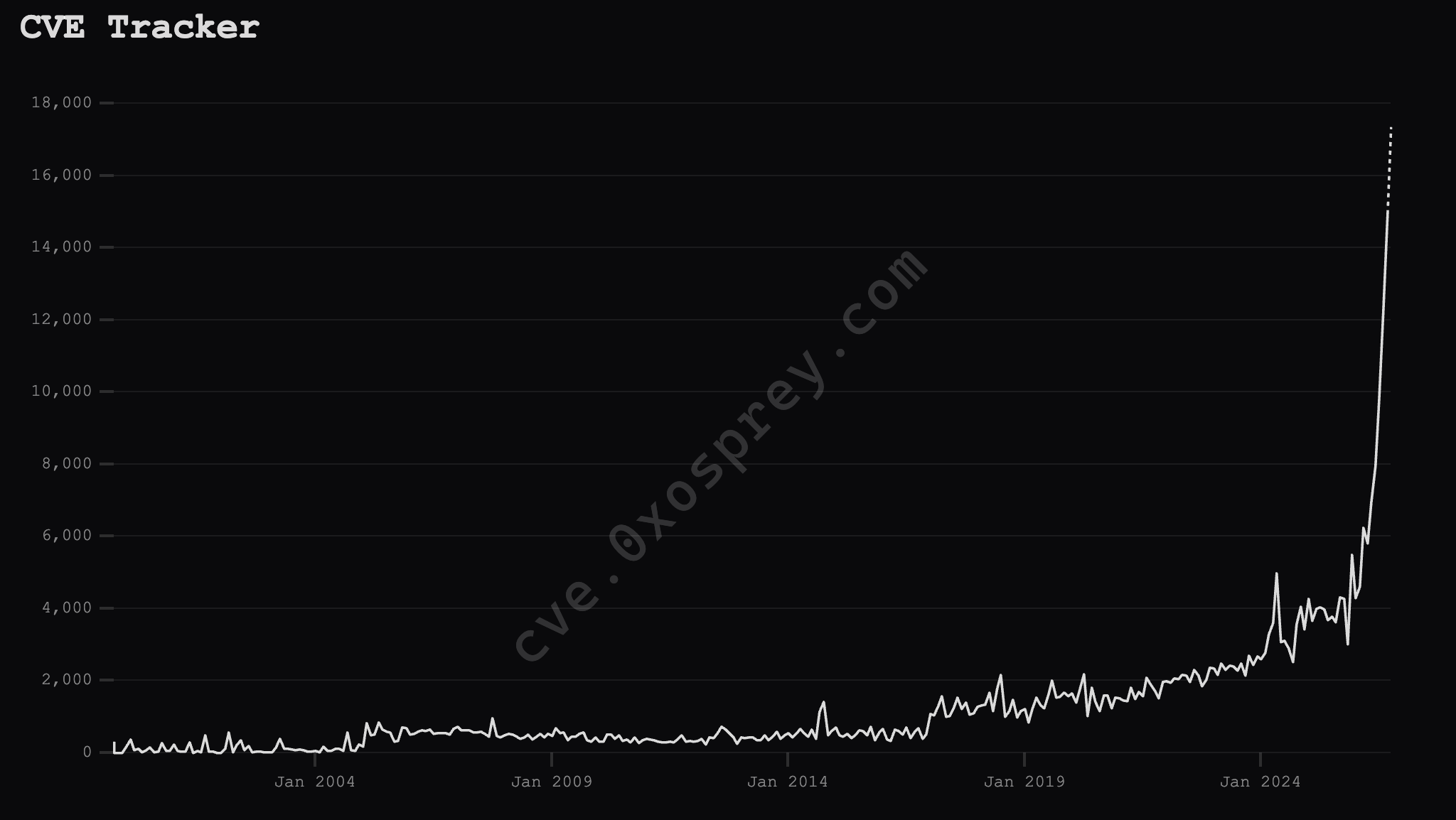
Common Vulnerabilities and Exposures (CVEs) are the way that security professionals file reports about vulnerabilities in software. The National Vulnerability Database (NVD), run by NIST, is the official national database of CVEs. In other words, CVE reports managed by NIST are the closest thing we have to a canonical database of security vulnerabilities in software. The NVD currently has around 400,000 CVEs that have been filed and accepted since 1988. In just the month of October, 13,000 new CVEs have been submitted. This means that 3% of critical software security bugs that have ever been officially logged were found in the last month alone. And it's likely that by the end of the year over a quarter of the software vulnerabilities that have ever been found will be from 2026.  


a graph showing the number of computer vulnerabilities by week since 1990, increasing exponentially in the last couple months.

Computer vulnerabilities reported are rising exponentially. Source: CVE Tracker

This research is being driven almost entirely by the cybersecurity capabilities of major AI models from companies like Anthropic, OpenAI, and Google. Historically it has been popularly assumed by cybersecurity experts that finding unknown (zero-day) exploits in any specific project and turning them into exploits was expensive. The knowledge to discover them was not widespread, and it was a hard task even for those initiated into the arcane ways of vulnerability hunting. Google even dedicated an entire team to it.  

But now thanks to major AI models, vulnerabilities are cheap, and anyone of moderate technical skill with a few dollars and access to a frontier AI model can find vulnerabilities in a few minutes. For example, recent vulnerabilities in PHP were found with a prompt to an AI model that literally said "find bad vulnerabilities in PHP."  

What Happened This Week? 

In 2024, a potentially severe vulnerability in PHP was discovered during an external security audit. PHP’s maintainers couldn’t agree on a solution, but more importantly, they couldn’t find a way to exploit the vulnerability. Because it didn’t seem like an active threat, they ended up deprioritizing a fix in favor of working on more urgent security issues. Then, in August 2026, security researchers working with the latest models from OpenAI and Anthropic independently discovered the vulnerability again, and another one—and now, with a way to exploit them.  

We now know that the vulnerabilities were so severe that they would have allowed even moderately inventive hackers to take over any website that uses PHP and then steal customer data, launch further malware attacks, spy on users, take websites offline, or launch a massive denial of service attack.[1] 

Because of the severity of these vulnerabilities, several of the involved researchers got together with the makers of PHP to patch the vulnerabilities and disclose them in a coordinated manner. The idea was that hopefully everyone would get a chance to quietly release and then apply fixes for the vulnerabilities before the whole world found out about it. 

But news already started to leak on October 20th. There was a post on a widely read forum “Hacker News” and other posts elsewhere. One of the researchers accidentally published a video early. Companies reported seeing active exploitation of the vulnerabilities going back as far as October 17th. On October 21st, six hours before the planned press embargo, one company, Chainguard, jumped the gun and released a patch early, essentially giving anyone instructions about exactly where to find the vulnerabilities and how to weaponize them. This sent system administrators everywhere scrambling to patch their systems before they were taken over by hackers. And it’s going to take a long time to patch all these systems. At the time of this writing over 33 million websites are still running on vulnerable versions of PHP.  

The internet is run largely on open-source software, mostly maintained by a small handful of skilled volunteers occasionally getting a small stipend, not by major corporations and highly paid engineers. These are projects you have perhaps never heard of, like PHP, OpenSSL, and SQLite, but these programs run on nearly every computer in the world and are maintained by teams as small as one person. When a vulnerability is found in these projects, it can be devastating.  

PHP isn’t the only critical open-source software with a high severity vulnerability this week either. Other widespread open-source projects like Node.js and GitLab also had severe security bugs reported.  

The small number of already overworked open-source maintainers are now facing a deluge of vulnerability reports, some of which are false, but many of which are very real. Burnout in open source has never been higher.  

We Need Stronger Support for Open Source Projects

Much of the foundation for the modern multibillion-dollar internet industry is built on open-source products that were created and still maintained—for free—by dedicated volunteers in their spare time. It’s an imperfect system, and it can lead to errors.  

One of those critical, under resourced open-source products is PHP. And while vulnerabilities in PHP were privately found years ago, they were left unfixed because they didn’t seem as impactful as other bugs at the time. These same vulnerabilities were recently rediscovered and proved to be trivially exploitable by security researchers using advanced AI models. While in the middle of the widespread, global effort to correct this mistake and deploy fixes, the problem was leaked by some of the security researchers who had gotten early access to the fixes. Unfortunately, this left millions of websites, ranging from personal blogs to government sites, vulnerable to hacking that could result in data theft, malware distribution, and worse.  

Open-source projects like PHP and others are the backbone of the entire internet. If they don’t get the resources they need, they and the internet they power, are at risk of falling apart. Corporations (whose products would not exist without these products) should be actively contributing to their maintenance. 

1. A technical analysis of the vulnerabilities is out of scope for this post and has already been written by the original researchers.

  •  

Computer Security Is About to Get a Lot Worse, Here’s What You Can Do

It is a commonly held truth among computer geeks that there is no such thing as bug-free software, or a secure computer. Any piece of software that anyone actually uses will have a security vulnerability somewhere in the code. The more complex that software is, the more likely there will be a vulnerability. Fortunately for everyone, finding severe vulnerabilities was generally considered an expensive and difficult task requiring years of training and deep knowledge of how computers and software worked. Until recently there was a steady background hum of vulnerabilities being found and patched, with major vulnerabilities that could cripple the entire internet only happening every few years. Now that is no longer the case.  

You may have noticed your nerdiest friends freaking out about the “Vulnerability Apocalypse” this week and waving their arms in panic about something called PHP. You may have also noticed that some of your favorite websites were down for a bit. In the last two weeks of October alone, there have been multiple, potentially internet-breaking vulnerabilities reported and patched. Many of those vulnerabilities were in the open-source software that is the foundation of the vast majority of the internet.

For more detailed information on what happened, and why supporting open-source projects matters, check out our other blog.

This is all because frontier AI models, such as those created by OpenAI, Anthropic, and others, have made it incredibly cheap and easy to find previously unknown vulnerabilities (zero-days) in open- and closed-source code. Three percent of all software vulnerabilities ever found in history were found just in the month of October. This year alone researchers have found nearly a quarter of all software security issues which have ever been discovered. 

If exploiting critical software is now cheaper and easier than ever, what does that mean for us as individuals and what does that mean for society as a whole? TL; DR: It’s going to get worse before it gets better. But you can protect yourself with basic digital security hygiene that is now more important than ever.  

What Do I Need to Do? 

There absolutely needs to be a bigger conversation about how we got here and how to fix the systemic issues involved, including how corporations that depend on open-source code should contribute to their upkeep, and how big tech should be regulated.  

But for now, this news is a compelling reason to tighten up your digital hygiene. A lot of computers are going to get hacked a lot more often, and unfortunately, it isn’t going to get better any time soon. Thankfully, EFF has compiled a comprehensive set of security advice in our Surveillance Self-Defense guides. To start, we recommend making sure your browser and all applications are always up to date with the latest patches.   

You should also consider installing a tracker blocking tool, like EFF’s Privacy Badger (now on Safari), and remain vigilant for phishing attempts. Additionally, install a password manager and use unique passwords for each website, so that if one site is compromised, the rest of your passwords are safe. You should also be aware that data breaches may now be more likely, and the websites you visit may experience more attacks than usual, which means that some services may be disrupted.  

If you host a blog or other website, make sure that either you or your hosting provider has patched this particular issue.  

For additional tips on protecting yourself and others, head over to our Surveillance Self-Defense site. Additionally, if you’d like to support any of EFF’s open-source projects like Privacy Badger, Rayhunter, and Certbot, visit our donate page. 

  •  

EFF Statement on California Governor's Executive Order on AI

California Gov. Gavin Newsom's executive order is an opportunity for a needed, thoughtful conversation about artificial intelligence and its potential harms. Everyday Californians are feeling real anxiety about the risks of artificial intelligence, and as an organization that works to ensure technology empowers people, EFF welcomes this order as a way for the state of California to lead a much-needed dialogue that addresses these concerns. 

DONATE TO EFF

ensure ai serves people, not power

Nonetheless, the most immediate and current concerns with this technology are not about sci-fi scenarios concerning rogue super-intelligence. They are happening right now through biased algorithmic decision-making for employment or government benefits, AI-powered surveillance systems such as Flock cameras, and artificially inflated personalized pricing. People want state and federal leaders to act, and we urge Gov. Newsom to develop thoughtful policies to address those concerns. Today’s EO is a good start. 

To that end, EFF supports the focus on expanding the reporting requirements under SB 53 (2025) for loss-of-control incidents, alongside third-party investigations. We urge the administration to consider how to make these third-party investigations available for smaller developers. As the Government Operations Agency prepares its recommendations for the governor, we urge leaders to also realize that the effectiveness of kill switches in advanced AI systems remains an area of active research. As such, they should ensure that - as we’ve previously mentioned - any technology regulation targeting cybersecurity practices at AI labs must be careful, precise, and practical. Moreover, we also caution that government-controlled kill switches run the risk of being used as a form of retaliation against protected speech, as demonstrated by the Trump Administration’s retaliatory actions against Anthropic earlier this year.

Ultimately, true safety requires California to focus on concrete, immediate, and urgent harms of AI technologies by ensuring that algorithmic decision-making in both the government and private sectors respects people’s rights and well-being. We urge Gov. Newsom and the state of California to develop thoughtful policy in collaboration with those most at risk of harm to address these and other concerns.

  •  

Secure Messaging and AI Remain In Conflict Despite the Promise of TEEs

Secure messaging platforms, like Signal, WhatsApp, and recently, encrypted RCS, operate on a straightforward assumption: the content at each end of a conversation is private to the participants in the conversation. End-to-end encryption helps provide the mathematical guarantees that the companies who operate these messaging platforms cannot access the contents of messages. But there’s no way to guarantee what happens once the message arrives on a phone. As more devices and services introduce more artificial intelligence (AI) features into messaging apps, that line begins to blur. 

When AI features are computed entirely on device, it’s less concerning. Yet sometimes the computing requirements are heavy enough that the computation has to be done on a company server. Tech companies tell us they have a solution for this: trusted execution environments (TEEs). But do server-side TEEs really solve the problem?

TEEs exist to serve many different functions, ranging from digital rights management (DRM) content protections to securely storing information in your phone's mobile wallet, but for our purposes, we’ll be focusing on how tech companies use them for their AI tools. 

The basic idea is straightforward: most consumer devices aren’t powerful enough to handle the sorts of AI features companies want to offer, so sometimes they send data off your device to more powerful cloud servers to do the computing, then display the results on your device. Since your data is leaving your device, there’s a privacy compromise. For example, if you ask for a messaging app to summarize a conversation, it may offload that computing power to a cloud server, sending the entire contents of your messages to the cloud, then back to your phone.

TEEs supposedly offer a way to keep those requests private. There are several implementations out there, like Apple’s Private Cloud Compute, Google’s Private AI Compute, and WhatsApp’s Private Processing. It’s not just the big tech players, we’ve seen chatbots built with TEEs as well.

TEEs can provide more security and privacy than simply running in the clear, but they are fundamentally different from actual encryption or running locally. Despite the promises of some tech companies, they will never be able to match that level of security and privacy. Because of that, a user’s device should never automatically send data to a TEE. Let’s dig through the reasons why.

What Exactly Is a TEE, Anyway?

A TEE is a hardened section of the computer that runs software in a way that’s supposed to be secret even from other processes running on the machine. TEEs also let users check that the code being run is the code that they think is running, and not backdoored code instead, using a process called “attestation.” You may have also heard this referred to as a “secure enclave,” or heard the brand names SGX or TrustZone.

The intention of a cloud-based TEE is simple: a company can run a server in their data center, but still process data that you provide on your behalf without being able to see that information themselves.

Is a TEE Secure?

In practice, we've seen multiple cracks and hacks every year that show that it is possible to get at that data. That’s because while encryption relies on math, TEEs rely on engineering to provide their security. Standard encryption algorithms are created by years-long processes collaboratively produced by mathematicians around the world and are based on problems that have been studied for decades. The math is reliable, and there is no shortcut to breaking it that would not also upend fundamental understandings of mathematics as a field. 

The collective understanding of every mathematician in the world is that standard encryption algorithms are not breakable to the best of the world’s collective knowledge. No responsible engineer builds a system based on a new encryption method until after it’s been offered up for prodding.

Engineering, on the other hand, doesn’t work like that. Every individual system is the product of a group of engineers who put it out into the world, and each product will have its own quirks and bugs that have to be individually discovered and patched. These bugs are found after the system is built, not before. No one has yet built a system that is unbreakable. On the contrary, there is new research all the time that finds new ways to break into TEE systems. They’re patched as they come up, but they’re unlikely to ever become perfect, and certainly not any time soon. 

TEEs in particular are a hard engineering problem because the encryption key is physically right there on the device. Building a TEE means keeping a key fully separate and inaccessible while it’s on the same physical device as parts of the system that shouldn’t have access to the key.

Many attacks on TEEs involve “side channels.” In a side channel attack, the attacker measures the electrical impulses or other effects to figure out the timing of operations inside the TEE, then uses that to figure out the key being used. Once they have the key, they can read all the data. Compare that to end-to-end encryption, where the key is never on that machine in the first place, so an attacker would have to also run a similar attack on the user’s device.

Companies who turn to TEEs to protect data want to both have the key on the server and have it protected while still performing complex operations like running an LLM, which makes it much more difficult to protect those keys.

That being said, a TEE versus plaintext on a server is the difference between being able to easily read the data and having to do a bunch of specialized work to get at the data. That work often involves accessing the physical machine. This is most relevant for protecting against mass surveillance, and for many people, that might just be enough security.

But that's the core of the problem. “Secure enough for most cases” and “encrypted as in math” are not the same thing, and it’s important not to conflate the two. And services that currently offer “encryption as in math” have a real downgrade in security when they switch to security based on TEEs. 

If you want to dive into the myriad security issues and limitations of TEEs we’ve seen so far, they’re well documented here, here, here, and here.

What Does This Have To Do With LLMs and AI?

Sometimes organizations want to offer an LLM that can respond to queries in a private manner. On-device LLMs exist, but they’re limited in size. So, when organizations want to offer the ability to answer queries without being able to see the conversation, they turn to TEEs. That’s a useful way to run a chatbot that’s reasonably private. This is what Apple, Google, WhatsApp, and others are doing.

Why not turn to encryption? After all, LLM inference is just a bunch of math like any other things a computer does. It takes input to a (really big) function and gives an output. We have the math to do that computation in a way that hides the inputs and outputs from the one running the computation, it's just super expensive. It’s called homomorphic encryption, and no one’s figured out how to do it fast enough that it makes sense for this sort of computation.

Instead, the allure of a TEE is that it will run that computation for you inside of a special opaque section of a server. TEE manufacturers try to make it as hard as possible for the person running the TEE to peek inside. But you still have to trust the operator to not put a stethoscope to the box to try to figure out what's happening inside. 

In this case, it’s reasonable to consider these systems “privacy-preserving,” but not “encrypted.” That distinction is important, especially when we talk about how the TEEs interact with secure messaging. When someone using an end-to-end encrypted chat app asks an LLM to summarize, review, or store those messages, the content of those messages is leaving the device and going to an unencrypted third-party server somewhere. That’s a major threat to the privacy of secure chat apps, and one that’s increasingly hard for users to take control of.

How Does This Translate to Practical Advice?

The answer to this is going to vary based on an individual’s threat model, but a good rule of thumb is that a user’s device should never automatically send data to a TEE. When the person holding a phone can choose what information is sent, even if it’s a chunk of data like “unread messages,” they have the opportunity to pause and consider if that data might be too sensitive to risk sending.

In contrast, when data is sent automatically, the automatic sending becomes a feature of the system as a whole. If the system was previously end-to-end encrypted, adding automatic exfiltration makes the whole system no longer end-to-end encrypted.

Developers: don’t build systems that automatically send data off a device to a TEE, especially when it’s coming from an app that is otherwise end-to-end encrypted.

Users: if developers ignore us and build that system, turn off any automatic data sending features. Take a second to think about how much you’re willing to risk sending data when you choose to send it off the device.

So, What Should I Be Concerned About?

TEEs are useful for security in a number of circumstances. Your phone likely has a TEE where it keeps the key that encrypts your biometric unlock data and the base of the keychain where passwords are stored. It also enables certain backup systems, like how you can restore a phone with your passcode or restore WhatsApp or Signal backups.

But when we’re talking about cloud processing, it’s important to be clear this isn’t the same as end-to-end encryption and doesn’t offer the same level of privacy. 

Most of our private lives are on our phones and in our messages. We’ve worked for years to secure those messages, with major wins like encrypted RCS, and the continued user experience improvements of Signal and WhatsApp. We’ve even seen real improvements to backup security with features like Advanced Data Protection that bring end-to-end encryption for a variety of data outside of messaging, like notes and photos. 

But as companies roll out AI features that interact with these encrypted services, pulling data off devices and into a cloud-based TEE, they’re eroding the privacy protections of end-to-end encryption and risk causing serious confusion around what data is protected and what isn’t.

  •  

EFF to Lawmakers: Ground AI Cybersecurity Rules in Best Practices

With doomsday AI scenarios dominating the news, lawmakers are rightly concerned about reports concerning security breaches at major US AI labs, such as the OpenAI–Hugging Face incident and the many others reported in its aftermath. As they consider potentially regulating frontier AI, they should focus any new legislation on the immediate, demonstrated risks from those incidents. 

Post-incident reports show that the Hugging Face incident could have been mitigated or prevented by following longstanding cybersecurity best practices, like stronger sandboxing and monitoring. Any new legislation should focus on closing gaps in existing law to prevent AI companies from taking unreasonable risks with the public's security.

When an AI developer or deployer runs a test or a task that has a high likelihood of causing harm to third parties—for instance, by breaking into someone else's computers—there should be clear minimum safety requirements. Such tests should run in a properly sandboxed test environment, disconnected from other systems, and be monitored and logged. Following these fundamental best practices would have prevented or substantially mitigated all of the incidents at AI labs that we currently know about.

That said, any proposal must be flexible enough to evolve with changing technology. Minimum safety requirements specific only to current AI technologies are likely to become obsolete; legal standards tied to well-established cybersecurity best practices are far more likely to stand the test of time. Tying any new mandates to evidence-backed security protocols also protects the public without impeding future AI development.

Strong legislation should also mandate and fund independent third-party investigations into any serious security incidents that may occur during AI labs’ tests of new tools, and make reports of these investigations available to the public. This important transparency measure would go a long way toward providing public oversight of the industry.

As with any technology regulation, those targeting cybersecurity practices at AI labs must be careful, precise, and practical.

  •  

New Records Reveal Problems with Medicare’s AI Prior Authorization Experiment

EFF sued the government back in March for information about the Wasteful and Inappropriate Service Reduction (WISeR) model, a new Medicare program that uses AI to evaluate prior authorization requests for certain medical services. Today, we’re releasing approximately 1,000 pages of records obtained from the Centers for Medicare & Medicaid Services (CMS) through this litigation, including contracts with tech companies, internal status reports and providers’ complaints about the program. The documents (available here) show that WISeR has resulted in widespread delays and denials of care, operational chaos, and reports of patient harm.

Why We Sued for Records about WISeR

EFF filed the FOIA lawsuit to gain badly needed transparency into an experimental AI program that could jeopardize Medicare beneficiaries' access to care. In January 2026, CMS launched the WISeR model, subjecting seniors in six states to AI-driven prior authorization decisions. Medical providers must now request permission before delivering certain medical treatments if they want assurance that Medicare will cover them. Private companies contracted by CMS evaluate the requests using AI. In the absence of rigorous safeguards, AI-driven prior authorization determinations can lead to unwarranted—and even discriminatory—delays or denials of necessary medical care. 

Little is known about the AI systems that WISeR vendors are using to process prior authorization requests. Although CMS says that a qualified human clinician must review all denials, research has shown that AI-generated recommendations often influence human decisions. And the design of the WISeR program creates a financial incentive for vendors to deny care, since they are paid for averted expenditures. Just months after the program launched, medical providers reported improper denials, administrative friction, and lengthy delays that have left patients waiting in pain.

EFF’s FOIA request sought records pertaining to the CMS contracts with WISeR software vendors; any tests for accuracy, bias, or hallucinations in vendors' technology; and any audits, monitoring, or evaluation of WISeR and participating vendors.

CMS Documents Highlight Issues with the WISeR Model

CMS records obtained by EFF echo issues that medical providers, patient advocates, and lawmakers have warned about since WISeR began. This includes long wait times, rampant technical failures, inappropriate denials, and harm to patients.

Delayed Responses to Prior Authorization Requests

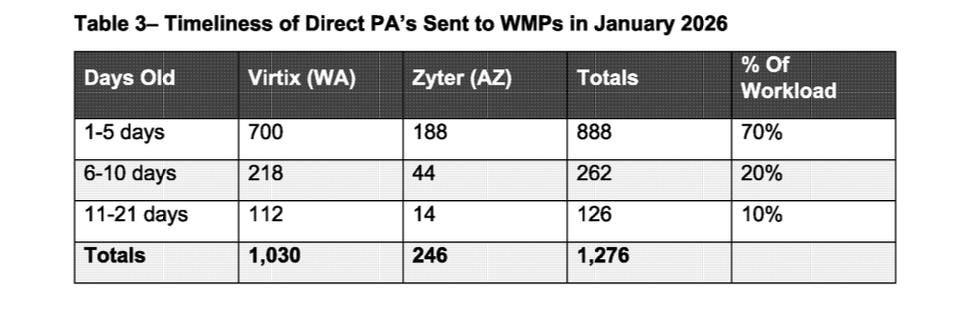
CMS publicly states that WISeR vendors should respond to prior authorization requests within 72 hours, but records received by EFF show widespread delays. Internal status reports from the first few months of the program show that a significant number of prior authorization requests took far longer than 72 hours to resolve. One status report cites a prior authorization request that went unanswered for 83 days ("WISeR FOIA Response - Combined Records," page 234). These delayed responses can have serious consequences for patients. Medical providers reported that WISeR has delayed medically necessary care and left patients in pain as they waited for approvals.

Timeliness data for two WISeR vendors in January 2026 show that a significant number of requests did not receive a response within 72 hours (WISeR FOIA Response - Combined Records, page 410)

Payment Methodology Provides Financial Incentive to Deny Care 

The released records confirm that WISeR’s payment methodology creates a financial incentive to deny care. Specifically, WISeR vendors are paid for requests that they deny (though not for denials reversed on appeal). This profit motive aggravates the risk that AI-assisted decision-making may unfairly deprive people of the services they need.

CMS publicly claims that it safeguards against inappropriate denials by tying vendors’ payment rates to “quality scores,” which reflect the timeliness and accuracy of vendors’ decisions. However, the recently released WISeR Data Reporting Guide shows that low quality scores reduce payments by only 5-10%.

Impact of low quality scores on payment rates described in the WISeR Data Reporting Guide (WISeR FOIA Response - Combined Records, page 99)

WISeR Vendors Have Denied Thousands of Prior Authorization Requests

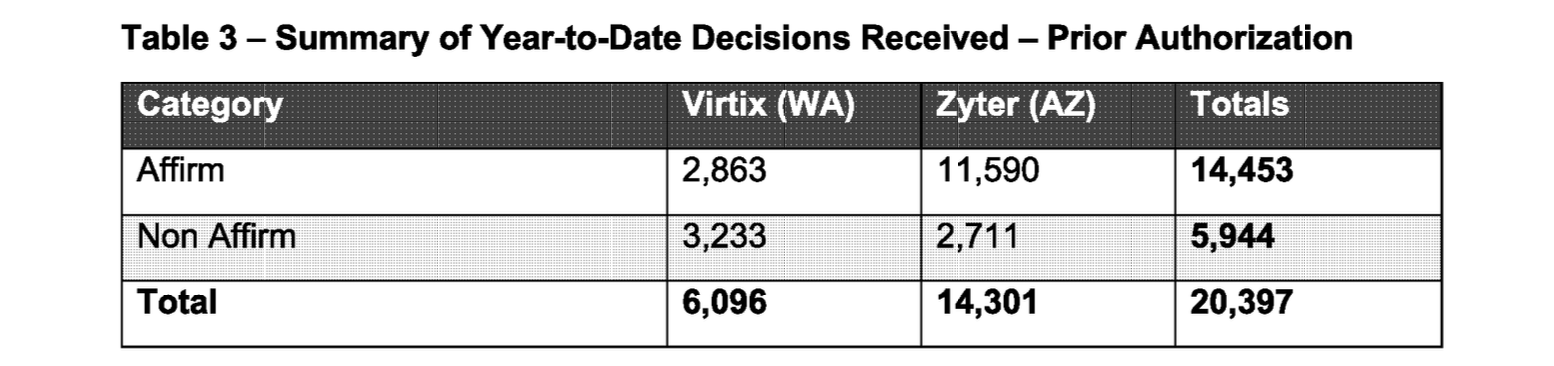
Documents obtained by EFF appear to support reports that WISeR vendors may be denying claims at unusually high rates. Two companies alone denied 5,944 prior authorization requests in the first 3 months of the program. One company, Virtix, the vendor that CMS required to submit a Corrective Action Plan, denied more requests than it approved during this time period.

Prior authorization decision data for two vendors in a March 30th, 2026 status report (WISeR FOIA Response - Combined Records, page 322)

Medical Provider Feedback Ties WISeR Delays to Patient Harm

Feedback from medical providers emphasize that WISeR delays have harmed patients. The released records include March 2026 responses to a feedback form about Innovaccer, the WISeR vendor processing requests for Ohio. Medical providers complained about a lack of communication, administrative issues, and long response times. Several responses emphasize that long response times from the WISeR vendor harmed patients ("WISeR FOIA Response - Feedback Survey Responses"):

“We have patients calling our offices crying in pain because their procedures are being delayed while awaiting approvals or guidance tied to this model. A 3–4 day delay for necessary pain procedures is already difficult for vulnerable patients, but when providers cannot obtain answers for weeks, the situation becomes unacceptable.”

“I HAVE HAD TO WATCH 3 PATIENTS CRY AT BEDSIDE FOR NOT HEARING BACK ON THEIR PRIOR AUTH FOR KYPHOPLASTY/VERTABRAL AUGMENTIATION PROCEDURE. THESE PATIENTS ARE IN DEEP PAIN.”

“I have had cases submitted and waiting over 1 1/2 months for a UTN to be generated… In the meantime patients are having to be cancelled for surgeries they need. This is not acceptable they are severely hindering patient care.”

Rushed Rollout Amidst Widespread Technical Failures 

CMS WISeR launched in January 2026, just six months after it was announced. Despite warnings from both medical providers and a vendor about insufficient preparation time, CMS chose not to delay the launch. 

Approximately a month before the launch, one of the vendors, Innovaccer, alerted CMS that it intended to go live with a version of its software that lacked full functionality and had not been fully tested. It cited several barriers to going live with full functionality, including changing requirements and expectations, unclear governance processes, and lack of time for end-to-end testing with the provider community ("WISeR FOIA Response - Combined Records,", page 216-217). Innovaccer said it would auto-affirm all prior authorization requests until it could develop full functionality and explained that “Given CMS's decision not to delay the model start date, auto-affirming is the only path available” ("WISeR FOIA Response - Combined Records," page 217).

Innovaccer had not yet finished developing or testing some features several months into the program, according to an April 2026 status report. Innovaccer was not the only vendor who faced technical challenges before and after WISeR launched. Weekly status reports and provider feedback in the released records show widespread challenges associated with WISeR’s rushed rollout (for example, "WISeR FOIA Response - Combined Records," pages 238 and 383).

A status report from April 6th, 2026 describes issues with incomplete solutions from Innovaccer (WISeR FOIA Response - Combined Records, page 200)

More Urgent Medical Services Considered for Inclusion in Future Years of WISeR Model

In its first year, the WISeR model introduced prior authorization requirements for a set of 13 medical services. The June 2025 Innovation Center Investment Plan for WISeR lists medical services that could be added to the program in future years. This planning document considers the possibility of adding services “where prior authorization would have to be done on a more urgent or emergent basis,” including air ambulance transport, cancer treatment, MRI scans, and medications without publicly available coverage criteria.

A planning document from June 2025 lists ideas for the expansion of WISeR to additional medical services (WISeR FOIA Response - Combined Records, page 22)

More Transparency is Needed About Medicare’s AI Experiment

CMS continues to produce records in response to EFF’s lawsuit. Records released thus far echo concerns that providers have raised since WISeR launched, including long delays, financial incentives to deny care, and technical problems. But important questions remain about the AI systems private companies are using to inform decisions about whether to provide people with Medicare benefits. As CMS continues to produce documents, we will continue to make them available to the public. The public deserves to know how AI is driving decisions that affect patients’ access to care.

Correction: An earlier version of this post misstated the number of prior authorization requests that had been denied by two WISeR vendors in the first three months of the program. This version has been corrected to reflect that the number of denials was 5,944. The post has also been updated to clarify that reported turnaround times reflect the full request pathway and are not solely controlled by WISeR vendors.

Related Cases: 

  •  

Judge Rules DOD Unlawfully Retaliated Against Anthropic

A federal judge has sided with Anthropic on its claims that the Department of Defense illegally retaliated against Anthropic’s protected speech by labeling the AI company a “supply chain risk.” The judge found that designation, intended to penalize Anthropic for telling the U.S. military it would not allow their technology to be used for mass surveillance of U.S. persons, “constituted unlawful retaliation in violation of the First Amendment.” EFF joined a coalition of organizations in filing multiple amicus briefs (here, here) arguing that the Pentagon had trampled on Anthropics First Amendment rights. We agree with the court’s decision and applaud the judge for slapping down such an obvious act of illegal and unconstitutional retribution by the Pentagon—even as the court left open the broader question of whether a company’s choices about how its technology may be used are protected speech in their own right. 

From the start of this conflict, EFF argued that companies should not be penalized for not wanting to conduct mass surveillance of US persons. Nor do we want to live in a legal system where our susceptibility to surveillance is hashed out and decided in closed-door contract negotiations between a few powerful people at the military and an AI company. Unfortunately, this ruling does little to address the bigger problem: that Congress has abdicated its responsibility to adopt statutory safeguards to protect our privacy, and instead left us reliant on the whims of private companies to decide when they are and are not willing to help the government conduct mass surveillance. 

In February 2026, the government began threatening to penalize Anthropic unless it backed off its position that it did not want the U.S. military using its AI product Claude for mass surveillance of Americans or to power autonomous weapons systems. Ultimately, the Department of Defense, deciding that it did not want military contractors dictating what its products could or could not be used for, declared the company a “supply chain risk.” This national security designation means the government and companies that do business with it cannot use the company’s products for government projects. It was, in essence, an attempted blacklisting of Anthropic for setting boundaries and articulating unacceptable use cases for its products. 

None of this is to say that Anthropic is a morally unimpeachable company, or that it and other companies would never permit their products to be used under specific conditions to aid in surveillance or analysis of collected data that could affect U.S. persons—but the facts remain: the government cannot punish a company for having preferences regarding unconstitutional uses of its technology. 

Unsupported claims that a company poses a national security risk should never be an excuse for government retaliation. This ruling correctly recognizes the dangerous implications of allowing the government to punish a company for its critical speech and for refusing to allow its technology to be used for mass surveillance. While we applaud the court's decision, we continue to urge lawmakers to take the protection of our privacy seriously. We shouldn't have to rely on private companies to protect us from the surveillance state. It's past time for Congress to act.

  •  

EFF to Courts: Don’t Rewrite Copyright Over AI Hype

The history of technology is rife with copyright panics.  In the 1980s, major rightsholders ran to Congress and the courts, claiming that videotape recorders (VTR) were “to the American film producer and the American public as the Boston strangler is to the woman home alone.” Then, the Supreme Court declined to embrace the hype, noting that the VTR was capable of all kinds of non-infringing uses, like time-shifting and cautioning courts to avoid rewriting copyright law in response to new technologies. We believe that courts now should be similarly wary about the hype surrounding AI.

Hollywood’s hyperbole has echoed that of composer John Phillip Sousa, who claimed in 1906 that the player piano and the gramophone would destroy music composition; portrait artists who feared the camera would replace the paintbrush. None of these things happened. Cameras, for example, sparked a resurgence of portraiture and, by making it possible for more people to create images, led to unexpected developments—like the rise of photojournalism.

New markets, new ideas, and new creators are actually what copyright is supposed to promote, not restrict. Using copyright to lock in existing gatekeepers and massive rightsholders’ profits helps neither the public nor individual artists.

Generative AI has sparked the latest wave of anxiety and with it a massive wave of litigation. In multiple cases around the U.S. and the world, rightsholders are asking courts to do precisely what the Supreme Court warned against: dramatically expand copyright protections based in substantial part on hyperbole and speculation. They should decline to do so.

Copyright owners claim that unless courts abandon 300-year-old copyright principles—and give rightsholders the power to control non-infringing works created by others—an imagined flood of AI-generated works will devastate creative markets. Under this “market dilution” theory, building generative AI tools cannot be fair use because those tools might be encourage the proliferation of competing works.

As EFF has explained to the courts in multiple amicus briefs in Concord Music Group, Inc. v. Anthropic PBC and In re Mosaic LLM Litigation, that’s not how copyright works. In fact, accepting this theory would undermine copyright’s constitutional purpose: promoting the creation of expressive works for the public’s benefit. Because copyright law is designed to encourage others to build freely on existing works, it punishes infringement, not competition. The “market dilution” theory would eviscerate not only the fair use doctrine, but also other limits on copyright that work specifically to prevent rightsholders from unfairly suppressing competition by claiming broad ownership over tropes, genres, styles, and so on. In other words, publishers would wield unchecked veto power over any expression that might conceivably compete with a work they own.

The result? Art doesn’t get created, ideas are never expressed, and we’re all worse off. Copyright shouldn’t be a tool to silence future creative competitors—whether or not they use AI in their work.

And the plaintiffs in these cases get at least two other things wrong. First, research shows that large generative AI models are unlikely to produce infringing works because the more data on which a model is trained, the less any individual training example matters to any particular output.

Second, AI tools aren’t necessarily displacing human creativity. To take a just a few examples:

  • Boston-based artist Nettrice Gaskins uses AI to create Afro-futurist art, including a portrait of Octavia Butler displayed at the San Francisco Airport
  • Indian artists Prateek Arora and Varun Gupta use generative AI to reimagine Western science fiction.
  • Philadelphia-based artist Alex Smith uses generative AI to reimagine Afrofuturism with queer, plus-sized Black superheroes.
  • Ana Miljački, a professor of architecture at MIT, used generative AI to create a “non-liner documentary” film on Yugoslav World War II memorials and the values they embodied.
  • A research-creation project used AI generated visual art to both amplify the voices of activists in the Iran Woman Life Freedom Movement and evaluate AI’s role in sociopolitical advocacy through art.
  • AI company Bronze works with musicians like Disclosure and Jai Paul to create songs that never sound the same when played back twice, challenging audience conceptions of what music could be.

It is not the place of courts to say these people are not artists or that AI cannot augment human creativity in a positive way.

Given this range of experimentation, courts should be reluctant to decide in advance what tools do and do not foster “human creativity.” Like the VTR, large language models are general purpose tools, used by humans to do a broad variety of things far beyond generating lyrics. The effects of this particular technological innovation will doubtless be far-reaching, disruptive, and potentially harmful for some—but distorting copyright law is not the way to address those harms.

  •  

Who (or What) Generates Images for EFF?

We’ve had a few questions from EFF supporters lately, asking whether the images we use on our blog posts, or on donation and shop items, have been created with AI image generators. We’d like to answer these questions and clarify our internal policy regarding image creation. 

EFF images are all made by human beings, not by automated image generators, with very rare exceptions. This is an internal decision made by our small design team, for the following reasons: 
  

  1. Our designers bring knowledge and expertise to the images we create, informed by years of consultation with EFF’s lawyers, technologists and activists. We find that this informed perspective helps make the issues we cover more clear, and more engaging, for our supporters. 
  2. The content on our sites is written by human beings, not by bots, and we feel that the images illustrating these posts should be human-made as well. Our supporters come to EFF for honest, trustworthy information from expert human beings, and we want our images to communicate that authenticity as well. 
  3. Aesthetic preference: our designers prefer the look, as well as the process, of images made “by hand.” It also gives us more control over the images, including producing multiple versions for different posts. While it can sometimes take a bit longer, we feel the results are more satisfactory and long-lasting.  
  4. While it is rare, it is possible for image generators to create images that are under copyright, or understood by some to be under copyright. This could conflict with our use of a Creative Commons Attribution license for all our images. By generating our own images, we avoid any risk of a dispute about copyright infringement, so that we can continue our work promoting digital rights (including the right to fair use of copyrighted materials) without fear of a lawsuit. 

EFF pencil sketch and final artwork

An example of EFF artwork process: sketch and final art

To be as clear as possible, we are now adding a small credit in the lower righthand area of each banner image that will read “Image created by EFF.” As mentioned earlier, there may be rare exceptions, when an EFF designer uses an automatically generated image as a small element in a larger illustration. In these cases, we will indicate that use with additional text, specifying the elements involved, and naming the image generator used.  

We hope that by describing our internal design thinking, we are answering the questions we are getting without confusing anyone about EFF's various and nuanced positions on the issues raised by image generators. As with past technological developments, we continue to defend the rights of technologists to develop these powerful tools, as well as the right of the public to make legal and legitimate use of them. Ultimately, EFF's design team has made a choice we feel is consistent with EFF's brand and look, and it's a decision we think every user gets to make for themselves. 

And don't forget: because all of our images are CC-By, you are free to use, share or remix any image we create (we ask that you include a credit to EFF). If you need hi-res versions, you can find some on our Flickr page, or you can email us directly with any requests. And you can enjoy some of the art we create on gifts you receive when you donate to EFF!

Donate to EFF

Get awesome human-generated art as a thank you gift!

  •  

EFF Joins 18 Civil Rights Organizations Calling on Governor Hochul to Reject the Stealth Crawler Prohibition Act

EFF joined a group of 18 civil society organizations to send a letter encouraging New York Governor Kathy Hochul to veto Senate Bill 9934A, the New York Stealth Crawler Prohibition Act. The letter states:

While framed as a measure to protect local journalism, this legislation harms free expression and establishes a dangerous precedent by effectively deanonymizing and criminalizing automated access to the open web. By requiring all web crawlers to disclose their identity and explicit purpose, and by granting media outlets unchecked authority to obtain judicial subpoenas to unmask unidentified automated web traffic without any showing of misconduct or actual injury, this bill threatens digital privacy, compromises the foundational architecture of the internet, and will ultimately stifle the very independent journalism it seeks to protect.

As we’ve previously explained, so-called “stealth crawlers” are simply automated tools to access and collect public web data—without disclosing the user’s identity. Private crawlers like these facilitate all kinds of important work that benefits the public, including investigative reporting, academic research, cybersecurity protection, and EFF’s own Privacy Badger. As we illustrate in the letter: 

Anonymous crawling fuels important investigative journalism. For example, The Markup, a non-profit news site, used anonymous crawlers to investigate potentially anti-competitive practices by tech companies, such as Amazon’s tendency to prioritize Amazon brands and Amazon-exclusive products over competitors with higher ratings. The crawlers identified themselves as ordinary Firefox browsers to web servers, which allowed The Markup to understand how Amazon search results pages would appear to ordinary users. Similarly, ProPublica used an automated tool designed to simulate an ordinary Amazon customer to reveal that the site steered shoppers to more expensive products over cheaper alternatives. 

Anonymous web scraping is also crucial for cybersecurity professionals, who use automated tools to monitor the web for information that helps them protect against malicious attackers. Privacy tools, including EFF’s Privacy Badger, also crawl sites anonymously to identify trackers without compromising user privacy.

Laws like S9934A sweep far beyond AI, targeting anonymity rather than the real technical issue: overaggressive crawling that can overtax technological infrastructure. Unmasking crawlers won't fix these server strains, but it will chill vital public-interest research and compromise digital privacy. Addressing the harms of web scraping requires narrow technical solutions—not policies that give publishers veto power over the open web. This is why we are calling on Governor Hochul to veto S9934A.

You can read the full letter here. For a deeper dive into why crawlers and scrapers are vital for the open web, check out this blog post.

  •  

EFF Joins Call for FTC to Drop Its Disastrous AI Policy Proposal

The Federal Trade Commission (FTC) in July issued a proposed policy statement “concerning the suppression of accuracy in artificial intelligence systems.” We urge the FTC to withdraw this misguided proposal and instead focus on its core strengths and mission to protect consumers. 

The new proposed policy builds on, and directly references, the Trump administration’s  “Preventing Woke AI in the Federal Government” executive order—a nightmare for civil liberties that seeks to strong-arm AI companies into modifying their models to conform with the its ideological agenda. In recently filed comments, EFF,  Public Knowledge, and Fight for the Future call for the FTC to stop its unconstitutional efforts to regulate lawful speech, override state laws, and intimidate AI developers into ideological alignment with the Trump administration.

The government may not install itself as the arbiter of truth.

In the joint comments, we outline three critical flaws within the latest proposed policy. First, it violates the First Amendment. The policy calls for the Commission to become the judge of which AI outputs meet an undefined standard of accuracy. Installing the FTC as the authority of this sort of viewpoint-based judgment is a prior restraint on speech. Additionally, the policy’s proposed solution to address speech concerns compounds, rather than properly limits, the likely harms to speech. As we say in our comments: the government may not install itself as the arbiter of truth. 

Second, it exceeds the FTC’s legal authority by claiming that its federal regulatory rules can override, or “preempt,” laws in states that have passed to regulate artificial intelligence use. This is clearly an attempt to target state laws the administration disagrees with. For example, the policy specifically criticizes Colorado's automated decisionmaking law, which applies when automated technology is used to consider consequential decisions such as those around employment, access to housing, health care, and insurance. We noted to the FTC that characterizing this law as one that requires AI companies to “suppress accuracy,” or encourages deception, is itself inaccurate. In any case, the FTC lacks the authority to put its rules in place over state law, unless Congress directly delegates it that power. It has been given no such power here.

Third, the policy is vague and sets the stage for improper jawboning of AI developers and companies that use AI tools (deployers). Jawboning is a term for situations in which the government urges private companies or people to censor another's speech. The proposal, as written, creates an enforcement regime that would put a thumb on the scale in favor of certain partisan speech and ideals. This will lead companies to censor only what the administration interprets as biased or untruthful. Yet, in our filing, we note that the FTC itself can't define an objective standard for what “bias” means, conceding the “exact line of what constitutes bias may be difficult to draw.”

There is work the FTC should be doing to protect consumers in the age of AI. In our comments, we conclude by saying:

[We] implore the Commission to focus on its core strengths and the mission for which it is so urgently needed—promoting structural market competition and protecting consumers from real unfair and deceptive acts and practices—in both the burgeoning and critically important AI industry and across the broader technology marketplace.

EFF and our partners have always urged the FTC to police genuine deception in technology markets. We have also consistently opposed government efforts to dictate what private speakers may say. That’s why we urge the FTC to withdraw this proposal. 

You can read our full comments here. 

  •  

“Stealth Crawlers” Are Not a Threat to the Open Web. Bills Targeting Them Would Be.

There’s a new boogeyman in the battles over AI: so-called “stealth crawlers.” We’ll admit it—the term “stealth crawlers” sounds quite nefarious. In reality, they’re anything but.

“Stealth crawlers” are simply automated tools to access and collect public web data—without disclosing the user’s identity. Private crawlers like these facilitate all kinds of important work that benefits the public, including investigative reporting, academic research, cybersecurity protection, and more.

Anonymous crawling enables some of the most publicly beneficial uses of the open web.

Many publishers want to unmask crawlers anyways—and are pushing for new legislation that would give them new powers to do so. These legislative proposals threaten the open web, user privacy, and valuable research without directly addressing the problems they’re supposedly intending to solve.

Alarmingly, these harmful proposals are gaining traction. The New York state legislature has already passed such a bill, the NY Stealth Crawler Protection Act, which is now on Governor Hochul’s desk. We expect to see similar bills introduced in other states, and potentially in Congress. That’s a big problem for the open web—and the many benefits it provides.

Anonymous crawling is worth protecting

Anonymous crawling enables some of the most publicly beneficial uses of the open web. Researchers, journalists, and other watchdog groups use unidentified automated tools to gather the information necessary to hold powerful institutions accountable and protect the public.

Anonymous crawling fuels important investigative journalism. For example, The Markup, a non-profit news site, used anonymous crawlers to investigate potentially anti-competitive practices by tech companies, such as Amazon’s tendency to prioritize Amazon brands and Amazon-exclusive products over competitors with higher ratings. The crawlers identified themselves as ordinary Firefox browsers to web servers, which allowed The Markup to understand how Amazon search results pages would appear to ordinary users. Similarly, ProPublica used an automated tool designed to simulate an ordinary Amazon customer to reveal that the site steered shoppers to more expensive products over cheaper alternatives.

Anonymous web scraping is also crucial for cybersecurity professionals, who use automated tools to monitor the web for information that helps them protect against malicious attackers. Privacy tools, including EFF’s own Privacy Badger, also crawl sites anonymously to identify trackers without compromising user privacy.

However, without the ability to scrape anonymously, these tools would likely be blocked. Sites can—and do—block crawlers operated by researchers, journalists, and activists who criticize them. For example, Facebook shut down accounts belonging to researchers who used automated tools to study misinformation on the platform and demanded that they take down published research. Many sites block automated access by anyone who hasn’t paid to crawl public webpages.    

Unmasking crawlers threatens the open web

News publishers—and their allies in government—say that unmasking crawlers is necessary to protect news organizations from technological strain caused by AI-related crawling, and fears that AI could reduce news sites’ traffic and ad revenue. These are legitimate concerns.

But enacting broad, reactionary restrictions on automated access is not the answer. Legislation targeting anonymous crawling threatens the open web, user privacy, and valuable research without actually addressing these technological and potential economic harms of scraping.

The New York state legislature recently passed the NY Stealth Crawler Protection Act, a law that would make it illegal to crawl news websites without revealing who is operating the crawler and all possible future uses of the data collected by the crawler. The law would give websites the power to obtain court orders that unmask anyone using an unidentified crawler—without any evidence that they broke the law.

Laws like the New York bill sweep far beyond AI, and do not meaningfully address the technological or potential harms of AI-related web scraping. These policies would chill beneficial crawling by allowing publishers to veto lawful public access, giving them the power to block not just bad actors, but also security professionals, researchers, dissidents, or anyone who has not paid for a license to view public text. This needlessly undermines the free and open internet.

Digital news publishers—like most websites—face real technological challenges in the AI era. While web crawling has been around for decades, with the proliferation of AI, crawlers now collect far more public web data than they used to. This pushes servers closer to their maximum capacity, and if some bots collect information too aggressively, they may strain web servers to the point that it degrades site performance. The problem is not anonymity—so unmasking crawlers won’t solve it. The real problem is overaggressive crawling, which can be effectively addressed with technical measures that target harmful conduct without impeding anonymous access to information.

A better path forward

There are other, far less harmful ways to protect publishers from the harms these “stealth crawler” laws claim to target. Addressing the harms of AI-related crawling requires policies that narrowly target the causes of these issues–without undermining free expression and the open web. Policies that target crawlers and scrapers are anything but.

  •  

Automated Moderation Is Here to Stay—Accountability Must Keep Pace

This post is part 2 in a series about automated content moderation. Read the first post here.

When whistleblower Frances Haugen leaked a set of documents from Meta in 2020, among the revelations was a jarring statistic: The company’s algorithms designed to detect terrorist content incorrectly deleted nonviolent Arabic-language content 77 percent of the time, while failing to detect hate speech under the company’s own policies in many instances. Meta’s own transparency report released later that year demonstrated similar findings. Five years later, researchers in the region report that overzealous moderation remains a problem, while paths to remedy have all but collapsed.

Where these systems are faltering in Arabic, they’re positively failing in less-resourced languages. As a 2025 report from the Center for Democracy and Technology found, labeled datasets in certain languages and dialects such as Maghrebi Arabic and Kiswahili contain inconsistencies, bias, and inaccuracies due to the limited hiring of annotators who actually speak the languages as well as shifts in the languages themselves. An investigation into ChatGPT’s outputs in several low-resource languages demonstrates the depth of problem.

But language disparities are just one of several concerns as automated moderation becomes more widespread. From the systemic suppression of content from Palestine to the repeated misclassification of LGBTQ+ content as adult or explicit material, these varied examples demonstrate the risks of overreliance on automated moderation—and the need for stronger safeguards.

Transparency, Cultural Competence, Appeals

As we discussed in Part 1 of this series, automated systems can process content at a scale that humans never could, potentially enabling better moderation at scale and alleviating the psychological load on ill-paid moderators whose jobs require them to view incredibly disturbing content. But automated systems also reproduce existing biases, struggle to understand context, and often make mistakes that disproportionately affect journalists, activists, artists, and other vulnerable and marginalized communities.

As Rachel Griffin wrote in 2023, “Perfectly accurate moderation is not only technically out of reach but intrinsically impossible.” Despite those intrinsic flaws, there is a great deal companies, policymakers, and civil society can do to help ensure that highly-automated systems operate in ways that respect human rights, minimize predictable harms, and provide meaningful accountability when they fail. If companies are going to continue relying on automation to moderate users’ speech—and there is little reason to believe they won’t—then accountability must evolve alongside these technologies.

That evolution can start with committing to the Santa Clara Principles 2.0. These principles, first outlined in 2020 and re-launched in 2021 after substantial international input, reflect the needs and expectations of the global community and specifically address automation. The first Foundational Principle states:

Companies should ensure that human rights and due process considerations are integrated at all stages of the content moderation process, and should publish information outlining how this integration is made. Companies should only use automated processes to identify or remove content or suspend accounts, whether supplemented by human review or not, when there is sufficiently high confidence in the quality and accuracy of those processes. Companies should also provide users with clear and accessible methods of obtaining support in the event of content and account action. 

Drawing on the Santa Clara Principles 2.0, international human rights standards, and years of research documenting the shortcomings of automated moderation, we propose eight recommendations for policymakers thinking about regulation and companies deploying AI-assisted content moderation systems.

  1. Automated technologies should help, not replace, human moderators. For example, automated systems can help flag and prioritize content for review, while humans can interpret context, handle sensitive cases, and refine system performance.
  2. Companies must be transparent about when and how automation is used in content decisions.
  3. Companies must regularly audit their automated systems for bias, with particular attention to low-resource languages, vulnerable and marginalized communities, and conflict zones.
  4. Users must have the ability to appeal, and to provide context when they believe human or automated moderation decisions have wrongfully removed their content. Appeals should be promptly evaluated and decided by human moderators.
  5. Companies should regularly assess the human rights impact of their moderation decisions, and issue public statements of the results
  6. If they rely on third-party vendors, companies should carefully (and regularly) audit those vendors for compliance with these same principles
  7. Lawmakers should avoid promoting and passing legislation that effectively or explicitly mandates automated moderation systems
  8. Policymakers should also refrain from attempting to dictate platforms technical and design choices to favor or disfavor particular expression.

These recommendations understand that automated content moderation isn’t just a technical problem for clever engineers and product teams to solve. Because content moderation shapes public discourse and fundamental rights, its design and oversight must respond to the concerns of policymakers, civil society, independent researchers, and the communities most affected by these systems.

This is the second post in a 2-part series on automated content moderation. Read the first post here.

  •  

Automated Moderation Is Here to Stay

This blog post is part 1 of a 2-part series. The second part sets out recommendations for companies and policymakers.

Six years ago—one month into a global pandemic—we argued that the automated moderation processes many platforms were rapidly adopting should be highly transparent, easily appealable, and temporary. We warned that "protocols adopted in times of crisis often persist when the crisis is over."

That warning proved prescient. The use of automation and artificial intelligence (AI) to identify, flag, and moderate content has become the new norm—a permanent feature of how platforms govern speech online. In this two part series, we’re take stock of this new norm, and considering what platforms can and should do to ensure that AI serves online expression rather than stifling it.

A brief history of automated content moderation

From spam filtering and keyword blacklists to the hash-matching technologies used to identify child sexual abuse material and terrorist content, automated technologies have been used in commercial content moderation for many years. While these tools have long posed risks to freedom of expression, their use was, for quite some time, relatively limited in scope.

Then, in 2017, a blog post published by Facebook (now Meta) described the company's "fairly recent" use of artificial intelligence to identify, classify, and remove violent extremist content. At the same time, Facebook emphasized caution, noting that it did not want to suggest there was "any easy technical fix."

Just one year later, Mark Zuckerberg appeared before the U.S. Senate's Commerce and Judiciary Committees and disclosed that "99 percent of the ISIS and Al Qaida content" removed by Facebook was flagged by AI "before any human sees it." He also stated that Facebook was "developing A.I. tools that can identify certain classes of bad activity proactively and flag it for our team at Facebook." At the time, we raised concerns about the ethical implications of using AI in this manner.

Then came 2020. The sudden reduction of the human moderation workforce, combined with a dramatic increase in social media use—and with it, a surge in misinformation—created the perfect conditions for platforms to expand their reliance on AI-driven moderation. It quickly became apparent that companies'—and particularly Meta's—approach to moderation during the pandemic represented a backslide in transparency, freedom of expression, and access to remedy. The increased reliance on automation was a significant factor.

The costs and benefits of AI content moderation

We knew in 2020 that the use of AI to moderate content would present problems for online freedom of expression. Today, those problems are well-documented. A 2025 joint declaration by special rapporteurs and representatives of the United Nations (UN), Organization for Security and Co-operation in Europe (OSCE), Organization of American States (OAS), and African Commission on Human and Peoples’ Rights (ACHPR) states:

“The use of AI content moderation can lead to over-removal, discrimination and censorship. Reliance on inherently biased datasets and opaque training processes can amplify pre-existing inequalities, risking homogenisation of expression, and erasure of linguistic and cultural diversity.”

EFF and many of our allies have documented these impacts. For example, our 2019 paper co-authored with Witness and Syrian Archive examined the impact of extremist content regulations—and their implementation through automation and AI—on human rights documentation. A 2020 report from Human Rights Watch highlighted the consequences of these removals, noting: "There is no way of knowing how much potential evidence of serious crimes is disappearing without anyone's knowledge."

The Center for Democracy and Technology's recent series on content moderation in the Global South demonstrates persistent inequities in content moderation of four “low-resource” languages—so-called because the relative scarcity of training data makes it more difficult to develop equitable and accurate AI models for them. 

Content moderation often disproportionately impacts vulnerable and historically marginalized groups, and AI content moderation is no different. GLAAD recognizes the role AI plays in scaling content moderation but notes that “when moderation systems lack nuance, transparency, and human oversight, they can fail to curb harassment and wrongly suppress legitimate LGBTQ content.”

These failures are not incidental. They are a predictable consequence of deploying automated systems to make complex judgments about language, culture, context, and identity at scale.

All of that said, automated content moderation can offer important benefits. The primary one: helping to spare human content moderators who must review content that varies from whimsical to horrific, often for little pay and with devastating mental health consequences. Outsourcing this work to the bots can offer some relief—though it’s worth noting that the humans hired to train the AI models face a similar dynamic.

In addition, AI models could potentially be trained over time to be more precise, accurate, and dynamic, helping to mitigate over-censorship and disinformation. The jury is still out on whether this potential will be realized; what we do know is that new approaches to the persistent problem of over and under-enforcement are desperately needed.

Automated moderation is no longer an experiment

Getting the balance between real costs and potential benefits depends a lot on the details: how automated systems are designed, trained, implemented, and audited.  

Despite advances in the sophistication and scale of automated moderation systems, many of the transparency, accountability, and due process safeguards advocated by civil society, researchers, and human rights experts have yet to be fully realized. At the same time, automated systems have become increasingly central to how platforms enforce their rules and govern online speech.

The question today is not whether companies will use AI to moderate content, but under what conditions they should do so. And now as ever, the answer is not that the public should just trust that platforms’ deployment of increasingly powerful systems will serve, rather than inhibit online expression. In fact, as automated systems become more sophisticated and more deeply embedded in platform governance, the need for transparency and accountability becomes more urgent. 

This is part 1 of a 2-part series. You can read the second part here.

  •  

Help EFF Cut the AI Hype

In the global race to build and dominate the AI industry, it can sure seem like the interests of ordinary people sit last on the agenda. It's just the opposite for EFF. While companies furiously jam AI tools into their veins and your eyeballs, EFF’s technologists, activists, and attorneys have been meticulously cutting through the hype to ensure AI can serve your privacy and free expression. Technology has leaned into a new era, and this summer you can help EFF fight for the people.

JOIN EFF

Over the next two weeks, we’re encouraging you to support the cause as an EFF member for as little as $10 each month. You can get great member swag every year like our privacy puffy stickers, Claw Back t-shirt, and Privacy Badger Crewneck.

A person wears an EFF Claw Back member t-shirt on the left. A person on the right wears a black sweatshirt with the Privacy Badger mascot on the chest.

Fight mass surveillance! Pictured: Claw Back member t-shirt and Privacy Badger Crewneck.

AI tools—beyond their marketing fluff—demonstrate both incredible potential and real danger. With the support of members around the world, EFF detangles the possibilities from the anxieties and threats with the care and nuance it deserves. In recent months, EFF:

The scope of AI, both the good and the bad, multiplies every day. If we want the AI-powered benefits of efficiency, scientific discovery, and greater accessibility to knowledge, then we also need strong protections against surveillance, harms to creativity and innovation online, perpetuating systemic bias, and privacy violations now.

With AI taking over the public consciousness, you can be assured that EFF will never stop advocating for you. Together, we can ensure that technology supports freedom, justice, and innovation for all people.

Join EFF

____________________

EFF is a member-supported U.S. 501(c)(3) organization. We've received top ratings from the nonprofit watchdog Charity Navigator since 2013! Your donation is tax-deductible as allowed by law.

  •  

The Free and Open Web Is Under Attack at the IETF

The ability to access publicly available information using automated tools is a central value and benefit of a free and open internet. Automated access—often called crawling or scraping—powers important, useful tools for locating, preserving, and analyzing online information. For example, crawling and scraping helps journalists, researchers, and watchdog organizations report the news, find security flaws, and investigate discrimination. Crawling the web allows non-profits like the Internet Archive to preserve historical copies of websites. Tools for automated comparison shopping allow consumers to find the best deals on items they want to buy. And so on.

Yet the open internet access is increasingly under threat from publishers and Big Tech companies alike. Fearing lost advertising and licensing revenues, website operators increasingly claim that they need to lock down their sites from bots that crawl public web content to train or operate AI models. Some companies are even trying to embed their business models into internet standards by changing Internet Engineering Task Force (IETF) technical standards that shape much of the internet.

Many of their economic anxieties are understandable. AI bots can strain websites’ infrastructure, in some cases, degrading site performance or taking them offline altogether. Upgrading systems costs money that some sites may not have. And AI is likely to disrupt the business models many publishers adopted in response to the rise of the internet, if users rely on AI overviews instead of visiting source websites.

However reasonable these fears may be, the answer is not to change the IETF standards from neutral protocols that encourage openness to restrictive requirements designed to monetize internet access.

The worst of these proposed standards would give websites far greater ability to automatically block legitimate, lawful scraping and crawling. For example, the AI Preferences working group is working on proposals to give publishers a way to express “preference signals” against crawling web data for AI-related purposes, including to train models, generate outputs, and help users search the web. These preference signals would be expressed through robots.txt and could potentially become legally binding in some jurisdictions.

Another working group, called Web Bot Auth, is pursuing efforts to protect sites from overly-aggressive bots that strain website resources—a positive goal that could meaningfully improve the internet in the AI era. But Web Bot Auth is simultaneously pursuing a much more dangerous path as well: standards changes that would enable sites to cryptographically identify bots so that they can more easily block anyone they wish—not just “bad” actors, but competitors, dissidents, or anyone who hasn’t paid for the right to access sites using automated tools. If sites restrict crawling to a preapproved list of cryptographically authenticated bots, they could require licensing payments from those wishing to crawl their sites. This would close off the open web to researchers, archivists, and startups without the ability to pay for automated access.  

Websites may have legitimate reasons to worry about AI’s impacts on their traffic and advertising revenue, but those reasons must be weighed against the benefits of the open web. These proposals would effectively give website operators veto power over a wide range of important uses—from the investigations and archival works described above to accessibility tools for people with disabilities, to research efforts aimed at holding governments accountable.

That is why we are fighting back against these threats to open access. EFF and our allies in the open internet community have successfully resisted some of the most dangerous IETF proposals thus far—and won’t stop working to protect the open web from efforts to manipulate internet standards to undermine the right to freely access the internet in any legal way, including with automated tools.

  •  

‘News’ Site Keeps Hallucinating EFF Staffers

What do EFF staffers Sarah Chen, Javier Morales, Caitlin Chin, Emma Rodriguez, and Mikko Kopponen have in common? 

For one thing, they don’t exist. 

For another, all have been quoted as EFF experts in articles published in the past two months on a site called News-USA Today, which describes itself as “an independent news publisher focused on clear, accurate, and useful journalism.” 

Uh… 

(Please don’t confuse this site with USA Today, in which real EFF experts are accurately quoted on a regular basis.) 

News-USA Today is hardly the only slagheap that’s hallucinating or fabricating EFF personnel and quotes; as we wrote last September, media companies large and small are using AI to generate news content because it’s cheaper than paying for journalists’ salaries, but that savings can come at the cost of the outlets’ reputations— assuming they care about reputation at all. 

But this many fake EFF sources in two months? That’s making a play for the championship title of bogus news content. 

News-USA Today’s site proclaims, “Our goal is simple: give readers the facts and the context they need to make informed decisions.” It then defines its mission:

  • “Deliver timely, factual reporting grounded in verifiable sources and public documents.”
  • “Make complex topics understandable without losing nuance or accuracy.”
  • “Serve the public interest by surfacing stories that affect lives, institutions, and communities.”
  • “Maintain a clear separation between news, analysis, opinion, and sponsored content.” 

Attempts to reach contacts listed on the site went unanswered. In fact, after we reached out to them, they published a story on June 9 with quotes from Electronic Frontier Foundation Executive Director Jared Cohen — who also doesn’t exist. 

As we noted last year, EFF is all about having our words spread far and wide. Per our copyright policy, any and all original material on the EFF website may be freely distributed at will under the Creative Commons Attribution 4.0 International License (CC-BY), unless otherwise noted.  

However, we don't want disreputable sites making up words (or false identities!) for us, whether or not they’re using AI. False quotations that misstate our positions damage the trust that the public and reputable media outlets have in us.  

The best thing a news consumer can do is invest a little time and energy to learn how to discern the real from the fake. It’s unfortunate that it's the public’s burden to put in this much effort, but while we're adjusting to new tools and a new normal, a little effort now can go a long way.   

As we’ve noted before in the context of election misinformation, the nonprofit journalism organization ProPublica has published a handy guide about how to tell if what you’re reading is accurate or “fake news,” as has FactCheck.org. 

  •  

EFF Testifies to Congress on Protecting Americans’ Rights from Government AI

Governments must not adopt emerging and powerful AI technologies without also adopting strong and clear safeguards to protect Constitutional rights, EFF Senior Policy Analyst Dr. Matthew Guariglia testified today to the House Homeland Security Subcommittee on Cybersecurity and Infrastructure Protection. 

During the hearing on “The AI Security Landscape: How Frontier Models, Agentic AI, and AI Coding Tools Are Reshaping Cybersecurity and Critical Infrastructure Resilience,” he explained that the use of generative AI for the purposes of mass government surveillance would supercharge unconstitutional violations of civil liberties. He also highlighted how government secrecy, in addition to the black box of for-profit proprietary technology, prevents the public and lawmakers from knowing when AI models make mistakes, including errors that seriously impact the cybersecurity of critical infrastructure and the lives of individuals.  

“AI also has a track record of getting things wrong—from false citations on legal briefs to a major AI mistake that sent DHS recruits to the field without proper training. There are likely more consequential examples that we do not even know about because of classification that would prevent a more thorough accounting," he said in his opening remarks.

play
Privacy info. This embed will serve content from youtube.com


“At this level the question is not how do we rein in AI, it’s how do we rein in the agencies that would unleash AI on the American public,” Matthew said in response to a question by Subcommittee Ranking Member Delia Ramirez, D-Ill.  

You can read his full testimony as prepared here. 

  •  
❌