Reading view

California Coastal Community Must Reject CBP's AI-Powered Surveillance Tower

Customs and Border Protection (CBP) is seeking permission from the California city of San Clemente to install an Anduril Industries surveillance tower on a cliff that would allow for constant monitoring of entire coastal neighborhoods. 

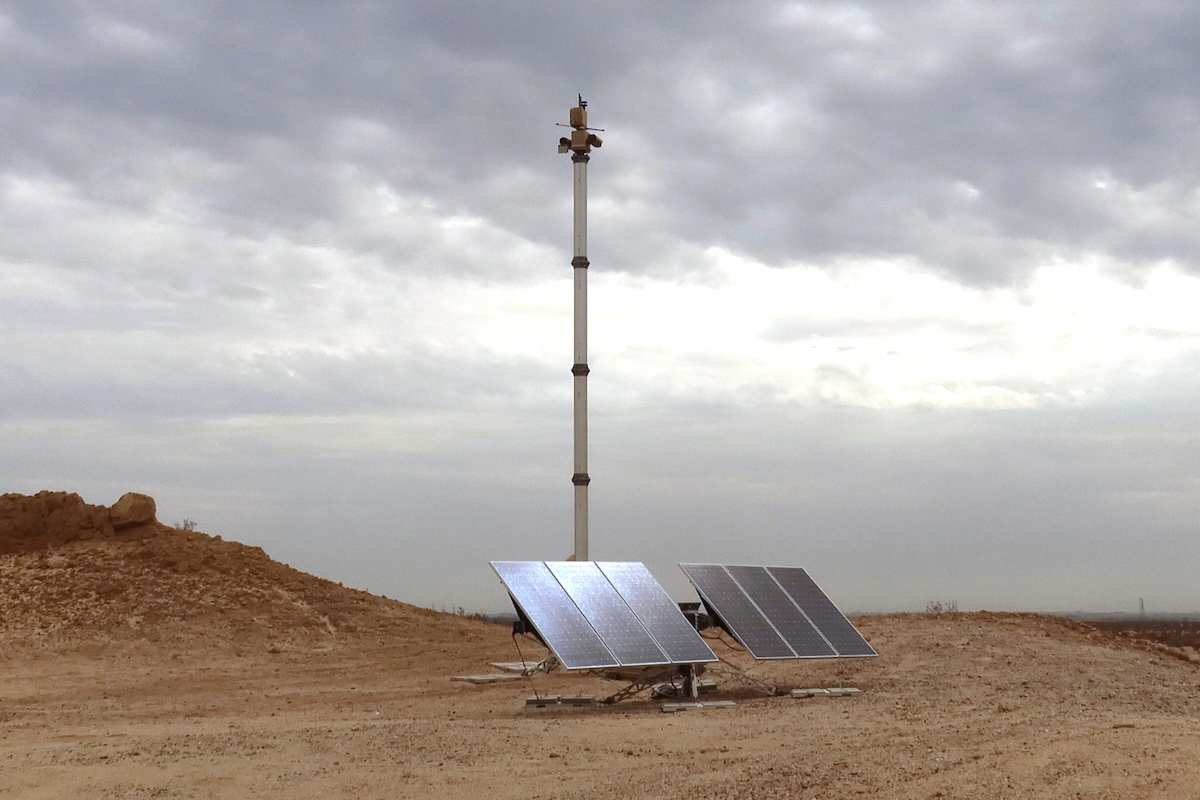
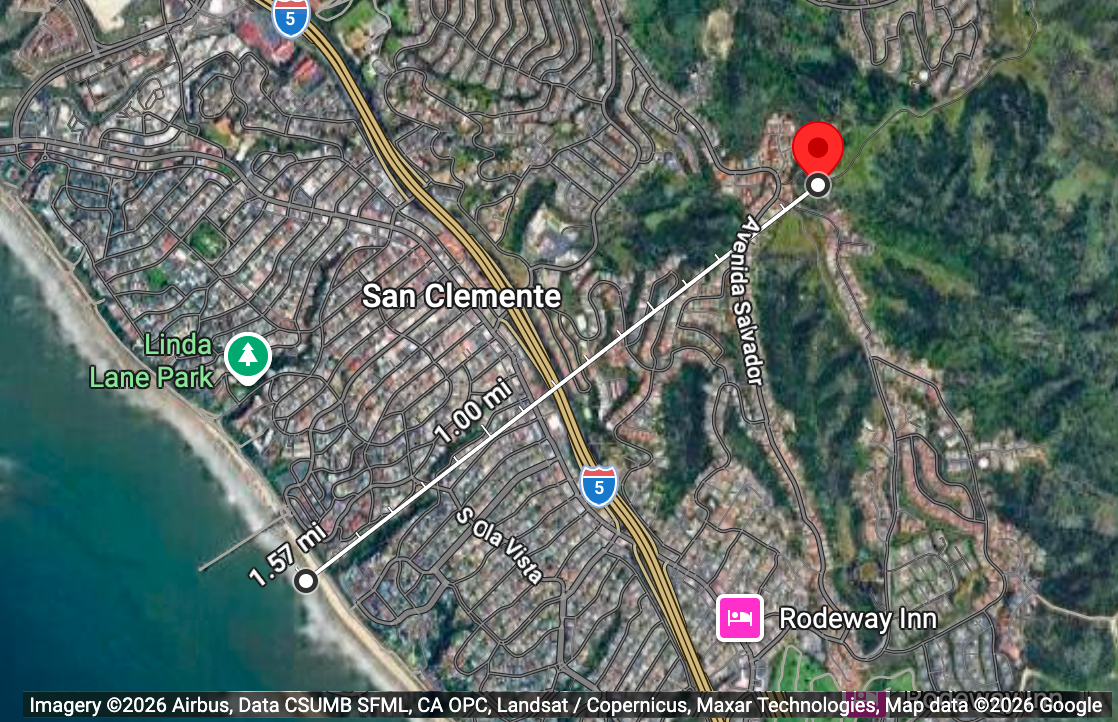
The proposed tower is Anduril's Sentry, part of the Autonomous Surveillance Tower (AST) program. While CBP says it will primarily monitor the coastline for boats carrying migrants, it will actually be installed 1.5 miles inland, overlooking the bulk of the 62,000-resident city. By CBP's own public statement, the system–which combines video, radar, and computer vision–is "constantly scanning" for movement and identifying and tracking objects an AI algorithm decides are of interest. Depending on the model–the photos provided by CBP indicate it is a long range maritime model–the camera could see as far as nine miles, which would cover the entire city and potentially see as far as neighboring Dana Point.

Map of San Clemente showing 1.5 miles between the tower and the coast

"The AST utilize advanced computer vision algorithms to autonomously detect, identify, and track items of interest (IoI) as they transit through the towers field of view," CBP writes in a privacy threshold analysis. "The system can determine if an IoI is a human, animal, or vehicle without operator intervention. The system then generates and transmits an alert to operators with the location and images of the IoI for adjudication and response." 

On April 28, local residents and Oakland Privacy, a privacy- and anti-surveillance-focused citizens’ coalition, are holding a town hall to inform the public about the dangers of this technology. We urge people to attend to better understand what's at stake. 

"The planned deployment of an Anduril tower along a heavily used Orange County coastline 75 miles from the border demonstrates that the militarization of the border region is rapidly moving northwards and across the entire state," writes Oakland Privacy. 

City officials raised concerns about resident privacy and proposed that a lease agreement include a prohibition on surveilling neighborhoods. CBP rejected that proposal, instead saying that they would configure the tower to "avoid" scanning residential neighborhoods, but the system would remain capable of tracking human beings in residential areas. According to the staff report: 

In response to privacy concerns, CBP has stated the system would be configured to avoid scanning residential areas that fall into the scan viewshed, focusing the system on the marine environment. CBP has maintained the purpose of the system is specifically maritime surveillance, and the system would be singularly focused on offshore activities. However, there may be an instance in which there is an active smuggling event, detected by the system at sea, in which the subsequent smuggling event traverses through the residential neighborhoods. In such a case, the system may continue to track and monitor. To restrict this functionality would be contrary to the spirit and intent of the deployment. Therefore, they cannot make such a contractual obligation.

The Anduril towers retain a variety of data, including images and more. 

image of surveillance tower from public records

The proposed Anduril surveillance tower. Source: City of San Clemente

"The AST capture and retain imagery which occurs in plan view of the tower sites and is stored as an individual event with a unique event identified allowing replay of the event for further investigation or dismissal based on activity occurring," according to the private threshold analysis.

The document indicates a potential 30-day retention period for imagery, but then contradicts itself to say that data will be held indefinitely to train algorithms: "AST will also be maintaining learning training data, these records should not be deleted." This means that taxpayers would be paying for the privilege of having their data turned into fuel for Anduril's product.

In 2020 CBP said it would work with National Archives and Records Administration (NARA) to develop a retention schedule for training data (i.e., a timeline for deletion). However, when EFF filed a Freedom of Information Act (FOIA) with NARA, the agency said there were no records of these discussions. Likewise, CBP has not provided records in response to the FOIA request EFF filed with them seeking the same records. 

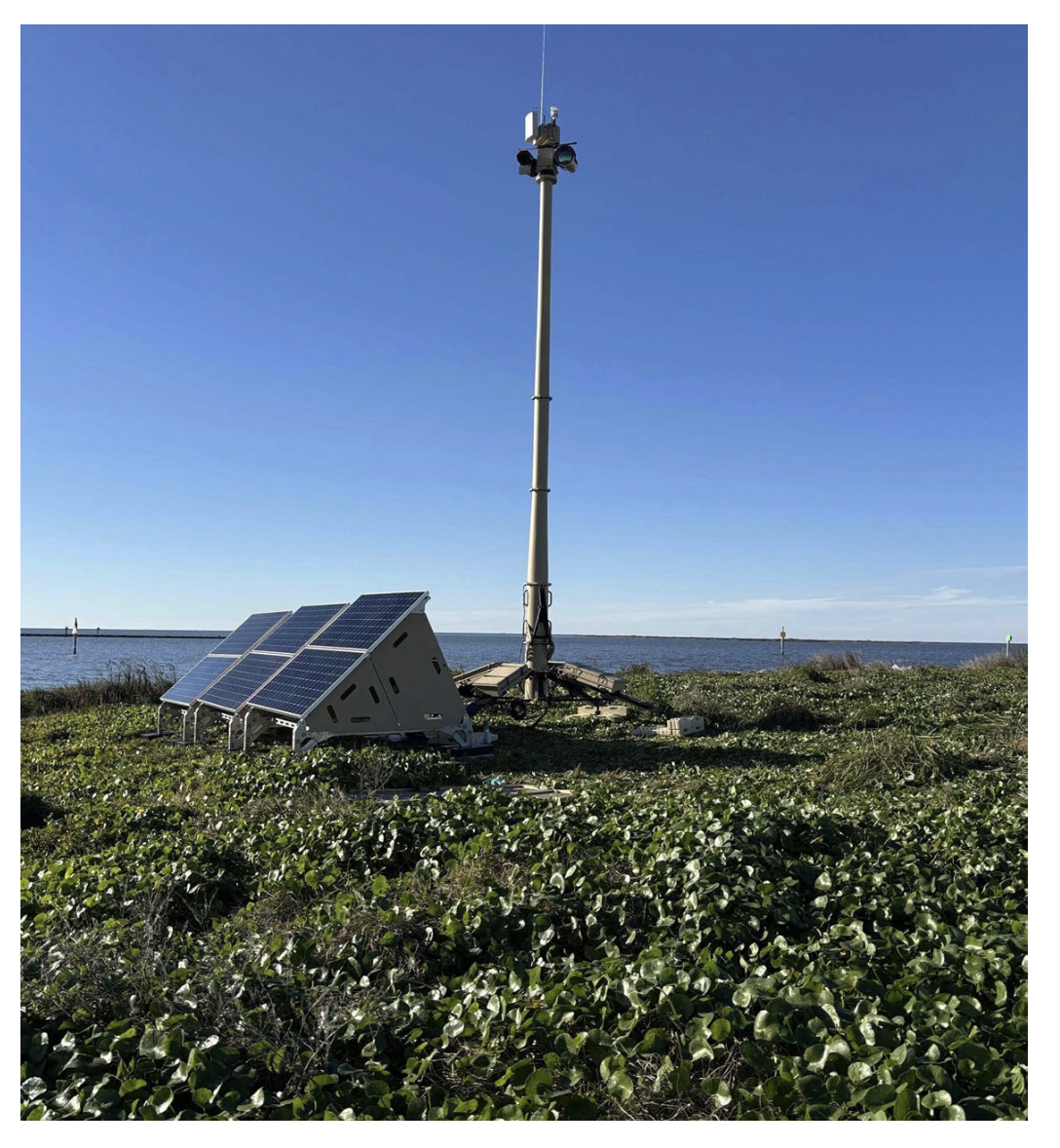
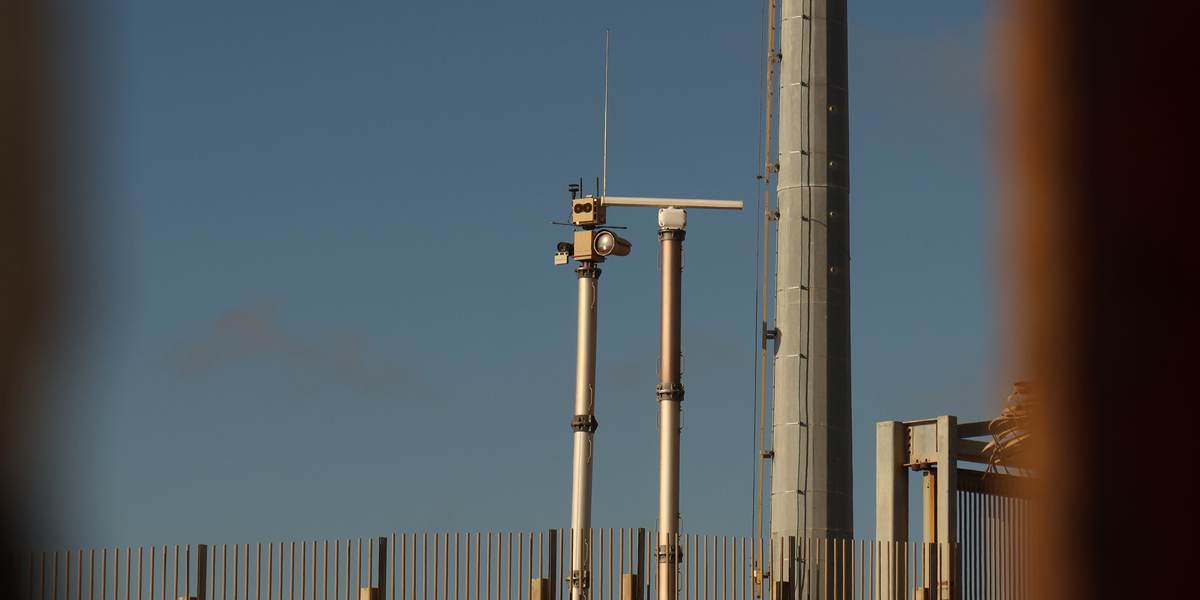
An Anduril surveillance tower at the borde fence with a Border Patrol vehicle.

Anduril Maritime Sentry in San Diego, where the border fence meets the ocean.

This would not be the first CBP tower placed along the coastline in California. EFF identified one in Del Mar, about 30 miles from the border, and another in San Diego County where the border fence meets the Pacific Ocean. CBP has also applied to place towers–although not necessarily the Anduril model–in or near several other coastal locations: Gaviota State Park, Refugio State Park, Vandenberg Air Force Base, Piedras Blancas and Point Vicente. The California coastline isn’t the only coastline dotted with surveillance towers. The Migrant Rights Network has also documented numerous Anduril towers along the southeast coast of England. Where the San Clemente tower would differ is that there is a substantial population between the tower and the beach, and because it's a 360-degree system, it can watch neighborhoods even further from the coast. 

However, this won't be the first time an Anduril tower has been placed next to a community. EFF has documented numerous Anduril towers in public parks along the Rio Grande in Laredo and Roma, Texas. In Mission, Texas, an Anduril tower was placed outside an RV park: the tower could not even see the border without capturing data from the community. Because AI can swivel the cameras 360 degrees, two churches were within the "viewshed" of that tower. 

Click here to view EFF's ongoing map of CBP surveillance towers.

Many border surveillance towers are placed on city or county property, requiring a lease to be approved by the local governing body–as is the case with San Clemente. In 2024, EFF and Imperial Valley Equity and Justice organized an effort to fight the renewal of a Border Patrol's lease for a tower next to a public park. The coalition lost narrowly after a recall election ousted two officials who were critical of the lease.

CBP is rapidly increasing the number of towers at the border and beyond, recently announcing the potential to install 1,500 more towers in the next few years–more than tripling what we've documented so far–at a cost of more than $400 million to the public for maintenance alone. This is despite more than 20 years of government reports that have documented how tower-based systems are ineffective and wasteful.

It's time to fight back. 

  •  

Hot Off the Press: EFF's Updated Guide to Tech at the US-Mexico Border

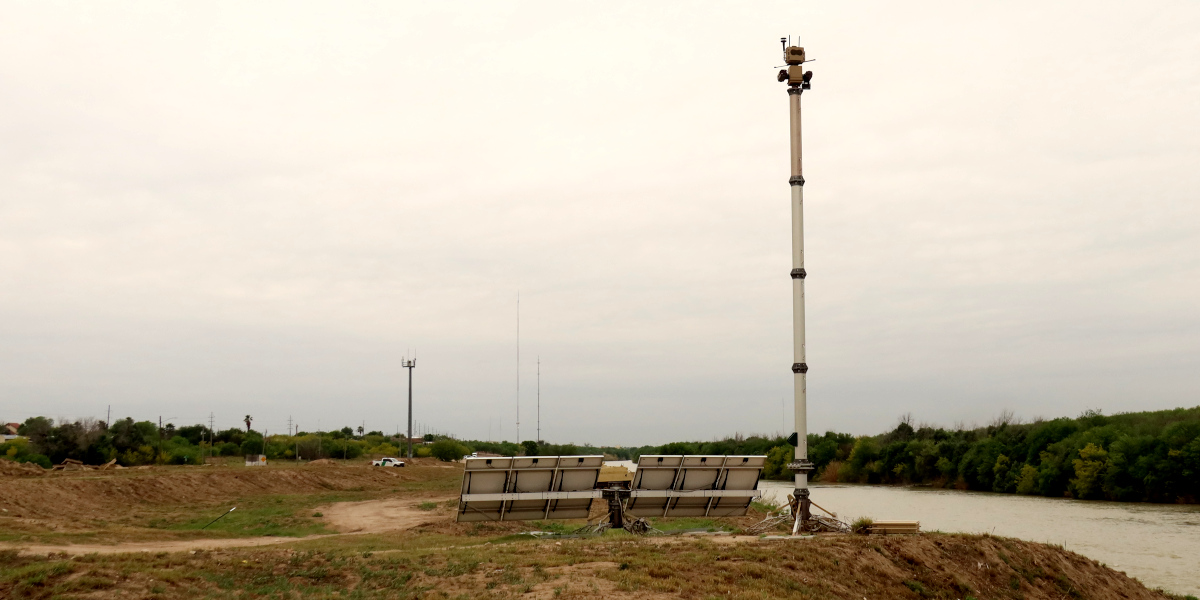
When people see Customs & Border Protection's giant, tethered surveillance blimp flying 20 miles outside of Marfa, Texas, lots of them confuse it with an art installation. Elsewhere along the U.S.-Mexico border, surveillance towers get mistaken for cell-phone towers. And that traffic barrel? It's actually a camera. That piece of rusted litter? That's a camera too.

Today we are publishing a major update to our zine, "Surveillance Technology at the U.S.-Mexico Border," the first since the second Trump administration began. To help people identify the machinery of homeland security, we've added more models of surveillance towers, newly deployed military tech, and a gallery of disguised trail cams and automated license plate readers.

You can get this 40-page, full-color guide through EFF's Shop or download a Creative-Commons licensed version here.

"The Battalion Search and Rescue always carries the Electronic Frontier Foundation’s zine in our desert rig," says James Holeman, who founded the humanitarian group that looks for human remains in remote parts of New Mexico and Arizona. "We’re finding new surveillance all the time, and without a resource like that, we wouldn't know what the hell we're looking at.”

The original version of the zine was distributed nearly exclusively to our allies in the borderlands—journalists, humanitarian aid workers, immigrant advocates—to help them better identify and report on the technology they discover on the ground. We only made a handful available in our online shop, and they went fast.

This time, we've printed enough for our broader EFF membership. Even if you don't live near the border, you can support our work uncovering how the U.S. Department of Homeland Security's technology threatens human rights by picking up a copy.

The zine is the culmination of a dozen trips to the border, where we hunted surveillance towers and other tech installations. We attended multiple border security conventions to collect promotional and technical materials directly from vendors. We filed public records requests, reviewed thousands of pages of docs, and analyzed satellite imagery of the entire 2,000-mile border several times over. Some of the images came from local allies, like geographer Dugan Meyer and Borderlands Relief Collective, who continue to share valuable intelligence on the changing landscape of border surveillance.

The update is available in English, with an updated Spanish version expected later this year. In the meantime, we have reprinted the original Spanish edition.

If you want to know more, a collection of EFF's broader work on border technology is available here. And if you're curious exactly where these technologies are located, you can check our ongoing map.

SUPPORT THIS WORK

  •  

EFF Statement on ICE and CBP Violence

Dangerously unchecked surveillance and rights violations have been a throughline of the Department of Homeland Security since the agency’s creation in the wake of the September 11th attacks. In particular, Immigration and Customs Enforcement (ICE) and Customs and Border Protection (CBP) have been responsible for countless civil liberties and digital rights violations since that time. In the past year, however, ICE and CBP have descended into utter lawlessness, repeatedly refusing to exercise or submit to the democratic accountability required by the Constitution and our system of laws.  

The Trump Administration has made indiscriminate immigration enforcement and mass deportation a key feature of its agenda, with little to no accountability for illegal actions by agents and agency officials. Over the past year, we’ve seen massive ICE raids in cities from Los Angeles to Chicago to Minneapolis. Supercharged by an unprecedented funding increase, immigration enforcement agents haven’t been limited to boots on the ground: they’ve been scanning faces, tracking neighborhood cell phone activity, and amassing surveillance tools to monitor immigrants and U.S. citizens alike. 

Congress must vote to reject any further funding of ICE and CBP

The latest enforcement actions in Minnesota have led to federal immigration agents killing Renee Good and Alex Pretti. Both were engaged in their First Amendment right to observe and record law enforcement when they were killed. And it’s only because others similarly exercised their right to record that these killings were documented and widely exposed, countering false narratives the Trump Administration promoted in an attempt to justify the unjustifiable.  

These constitutional violations are systemic, not one-offs. Just last week, the Associated Press reported a leaked ICE memo that authorizes agents to enter homes solely based on “administrative” warrants—lacking any judicial involvement. This government policy is contrary to the “very core” of the Fourth Amendment, which protects us against unreasonable search and seizure, especially in our own homes 

These violations must stop now. ICE and CBP have grown so disdainful of the rule of law that reforms or guardrails cannot suffice. We join with many others in saying that Congress must vote to reject any further funding of ICE and CBP this week. But that is not enough. It’s time for Congress to do the real work of rebuilding our immigration enforcement system from the ground up, so that it respects human rights (including digital rights) and human dignity, with real accountability for individual officers, their leadership, and the agency as a whole.

  •  

Report: ICE Using Palantir Tool That Feeds On Medicaid Data

EFF last summer asked a federal judge to block the federal government from using Medicaid data to identify and deport immigrants.  

We also warned about the danger of the Trump administration consolidating all of the government’s information into a single searchable, AI-driven interface with help from Palantir, a company that has a shaky-at-best record on privacy and human rights. 

Now we have the first evidence that our concerns have become reality. 

“Palantir is working on a tool for Immigration and Customs Enforcement (ICE) that populates a map with potential deportation targets, brings up a dossier on each person, and provides a “confidence score” on the person’s current address,” 404 Media reports today. “ICE is using it to find locations where lots of people it might detain could be based.” 

The tool – dubbed Enhanced Leads Identification & Targeting for Enforcement (ELITE) – receives peoples’ addresses from the Department of Health and Human Services (which includes Medicaid) and other sources, 404 Media reports based on court testimony in Oregon by law enforcement agents, among other sources. 

This revelation comes as ICE – which has gone on a surveillance technology shopping spree – floods Minneapolis with agents, violently running roughshod over the civil rights of immigrants and U.S. citizens alike; President Trump has threatened to use the Insurrection Act of 1807 to deploy military troops against protestors there. Other localities are preparing for the possibility of similar surges. 

Different government agencies necessarily collect information to provide essential services or collect taxes, but the danger comes when the government begins pooling that data and using it for reasons unrelated to the purpose it was collected.

This kind of consolidation of government records provides enormous government power that can be abused. Different government agencies necessarily collect information to provide essential services or collect taxes, but the danger comes when the government begins pooling that data and using it for reasons unrelated to the purpose it was collected. 

As EFF Executive Director Cindy Cohn wrote in a Mercury News op-ed last August, “While couched in the benign language of eliminating government ‘data silos,’ this plan runs roughshod over your privacy and security. It’s a throwback to the rightly mocked ‘Total Information Awareness’ plans of the early 2000s that were, at least publicly, stopped after massive outcry from the public and from key members of Congress. It’s time to cry out again.” 

In addition to the amicus brief we co-authored challenging ICE’s grab for Medicaid data, EFF has successfully sued over DOGE agents grabbing personal data from the U.S. Office of Personnel Management, filed an amicus brief in a suit challenging ICE’s grab for taxpayer data, and sued the departments of State and Homeland Security to halt a mass surveillance program to monitor constitutionally protected speech by noncitizens lawfully present in the U.S. 

But litigation isn’t enough. People need to keep raising concerns via public discourse and Congress should act immediately to put brakes on this runaway train that threatens to crush the privacy and security of each and every person in America.  

  •  

ICE Is Going on a Surveillance Shopping Spree

Read more about how enterprising hackers have started projects to do counter surveillance against ICE, and learn how to follow the Homeland Security spending trail.

U.S. Immigration and Customs Enforcement (ICE) has a new budget under the current administration, and they are going on a surveillance tech shopping spree. Standing at $28.7 billion dollars for the year 2025 (nearly triple their 2024 budget) and at least another $56.25 billion over the next three years, ICE's budget would be the envy of many national militaries around the world. Indeed, this budget would put ICE as the 14th most well-funded military in the world, right between Ukraine and Israel.  

There are many different agencies under U.S. Department of Homeland Security (DHS) that deal with immigration, as well as non-immigration related agencies such as Cybersecurity and Infrastructure Security Agency (CISA) and Federal Emergency Management Agency (FEMA). ICE is specifically the enforcement arm of the U.S. immigration apparatus. Their stated mission is to “[p]rotect America through criminal investigations and enforcing immigration laws to preserve national security and public safety.” 

Of course, ICE doesn’t just end up targeting, surveilling, harassing, assaulting, detaining, and torturing people who are undocumented immigrants. They have targeted people on work permits, asylum seekers, permanent residents (people holding “green cards”), naturalized citizens, and even citizens by birth. 

While the NSA and FBI might be the first agencies that come to mind when thinking about surveillance in the U.S., ICE should not be discounted. ICE has always engaged in surveillance and intelligence-gathering as part of their mission. A 2022 report by Georgetown Law’s Center for Privacy and Technology found the following:

  • ICE had scanned the driver’s license photos of 1 in 3 adults.
  • ICE had access to the driver’s license data of 3 in 4 adults.
  • ICE was tracking the movements of drivers in cities home to 3 in 4 adults.
  • ICE could locate 3 in 4 adults through their utility records.
  • ​​ICE built its surveillance dragnet by tapping data from private companies and state and local bureaucracies.
  • ICE spent approximately $2.8 billion between 2008 and 2021 on new surveillance, data collection and data-sharing programs. 

With a budget for 2025 that is 10 times the size of the agency’s total surveillance spending over the last 13 years, ICE is going on a shopping spree, creating one of the largest, most comprehensive domestic surveillance machines in history. 

How We Got Here

The entire surveillance industry has been allowed to grow and flourish under both Democratic and Republican regimes. For example, President Obama dramatically expanded ICE from its more limited origins, while at the same time narrowing its focus to undocumented people accused of crimes. Under the first and second Trump administrations, ICE ramped up its operations significantly, increasing raids in major cities far from the southern border and casting a much wider net on potential targets. ICE has most recently expanded its partnerships with sheriffs across the U.S., and deported more than 1.5 million people cumulatively under the Trump administrations (600,000 of those were just during the first year of Trump’s second term according to DHS statistics), not including the 1.6 million people DHS claims have “self-deported.” More horrifying is that in just the last year of the current administration, 4,250 people detained by ICE have gone missing, and 31 have died in custody or while being detained. In contrast, 24 people died in ICE custody during the entirety of the Biden administration.

ICE also has openly stated that they plan to spy on the American public, looking for any signs of left-wing dissent against their domestic military-like presence. Acting ICE Director Todd Lyons said in a recent interview that his agency “was dedicated to the mission of going after” Antifa and left-wing gun clubs. 

On a long enough timeline, any surveillance tool you build will eventually be used by people you don’t like for reasons that you disagree with.

On a long enough timeline, any surveillance tool you build will eventually be used by people you don’t like for reasons that you disagree with. A surveillance-industrial complex and a democratic society are fundamentally incompatible, regardless of your political party. 

EFF recently published a guide to using government databases to dig up homeland security spending and compiled our own dataset of companies selling tech to DHS components. In 2025, ICE entered new contracts with several private companies for location surveillance, social media surveillance, face surveillance, spyware, and phone surveillance. Let’s dig into each.

Phone Surveillance Tools 

One common surveillance tactic of immigration officials is to get physical access to a person’s phone, either while the person is detained at a border crossing, or while they are under arrest. ICE renewed an $11 million contract with a company called Cellebrite, which helps ICE unlock phones and then can take a complete image of all the data on the phone, including apps, location history, photos, notes, call records, text messages, and even Signal and WhatsApp messages. ICE also signed a $3 million contract with Cellebrite’s main competitor Magnet Forensics, makers of the Graykey device for unlocking phones. DHS has had contracts with Cellebrite since 2008, but the number of phones they search has risen dramatically each year, reaching a new high of 14,899 devices searched by ICE’s sister agency U.S. Customs and Border Protection (CBP) between April and June of 2025. 

If ICE can’t get physical access to your phone, that won’t stop them from trying to gain access to your data. They have also resumed a $2 million contract with the spyware manufacturer, Paragon. Paragon makes the Graphite spyware, which made headlines in 2025 for being found on the phones of several dozen members of Italian civil society. Graphite is able to harvest messages from multiple different encrypted chat apps such as Signal and WhatsApp without the user ever knowing. 

Our concern with ICE buying this software is the likelihood that it will be used against undocumented people and immigrants who are here legally, as well as U.S. citizens who have spoken up against ICE or who work with immigrant communities. Malware such as Graphite can be used to read encrypted messages as they are sent, other forms of spyware can also download files, photos, location history, record phone calls, and even discretely turn on your microphone to record you. 

How to Protect Yourself 

The most effective way to protect yourself from smartphone surveillance would be to not have a phone. But that’s not realistic advice in modern society. Fortunately, for most people there are other ways you can make it harder for ICE to spy on your digital life. 

The first and easiest step is to keep your phone up to date. Installing security updates makes it harder to use malware against you and makes it less likely for Cellebrite to break into your phone. Likewise, both iPhone (Lockdown Mode) and Android (Advanced Protection) offer special modes that lock your phone down and can help protect against some malware.

The first and easiest step is to keep your phone up to date.

Having your phone’s software up to date and locked with a strong alphanumeric password will offer some protection against Cellebrite, depending on your model of phone. However, the strongest protection is simply to keep your phone turned off, which puts it in “before first unlock” mode and has been typically harder for law enforcement to bypass. This is good to do if you are at a protest and expect to be arrested, if you are crossing a border, or if you are expecting to encounter ICE. Keeping your phone on airplane mode should be enough to protect against cell-site simulators, but turning your phone off will offer extra protection against cell-site simulators and Cellebrite devices. If you aren’t able to turn your phone off, it’s a good idea to at least turn off face/fingerprint unlock to make it harder for police to force you to unlock your phone. While EFF continues to fight to strengthen our legal protections against compelling people to decrypt their devices, there is currently less protection against compelled face and fingerprint unlocking than there is against compelled password disclosure.

Internet Surveillance 

ICE has also spent $5 million to acquire at least two location and social media surveillance tools: Webloc and Tangles, from a company called Pen Link, an established player in the open source intelligence space. Webloc gathers the locations of millions of phones by gathering data from mobile data brokers and linking it together with other information about users. Tangles is a social media surveillance tool which combines web scraping with access to social media application programming interfaces. These tools are able to build a dossier on anyone who has a public social media account. Tangles is able to link together a person’s posting history, posts, and comments containing keywords, location history, tags, social graph, and photos with those of their friends and family. Penlink then sells this information to law enforcement, allowing law enforcement to avoid the need for a warrant. This means ICE can look up historic and current locations of many people all across the U.S. without ever having to get a warrant.

These tools are able to build a dossier on anyone who has a public social media account.

ICE also has established contracts with other social media scanning and AI analysis companies, such as a $4.2 million contract with a company called Fivecast for the social media surveillance and AI analysis tool ONYX. According to Fivecast, ONYX can conduct “automated, continuous and targeted collection of multimedia data” from all major “news streams, search engines, social media, marketplaces, the dark web, etc.” ONYX can build what it calls “digital footprints” from biographical data and curated datasets spanning numerous platforms, and “track shifts in sentiment and emotion” and identify the level of risk associated with an individual. 

Another contract is with ShadowDragon for their product Social Net, which is able to monitor publicly available data from over 200 websites. In an acquisition document from 2022, ICE confirmed that ShadowDragon allowed the agency to search “100+ social networking sites,” noting that “[p]ersistent access to Facebook and Twitter provided by ShadowDragon SocialNet is of the utmost importance as they are the most prominent social media platforms.”

ICE has also indicated that they intend to spend between 20 and 50 million dollars on building and staffing a 24/7 social media monitoring office with at least 30 full time agents to comb every major social media website for leads that could generate enforcement raids. 

How to protect yourself 

For U.S. citizens, making your account private on social media is a good place to start. You might also consider having accounts under a pseudonym, or deleting your social media accounts altogether. For more information, check out our guide to protecting yourself on social media. Unfortunately, people immigrating to the U.S. might be subject to greater scrutiny, including mandatory social media checks, and should consult with an immigration attorney before taking any action. For people traveling to the U.S., new rules will soon likely require them to reveal five years of social media history and 10 years of past email addresses to immigration officials. 

Street-Level Surveillance 

But it’s not just your digital habits ICE wants to surveil; they also want to spy on you in the physical world. ICE has contracts with multiple automated license plate reader (ALPR) companies and is able to follow the driving habits of a large percentage of Americans. ICE uses this data to track down specific people anywhere in the country. ICE has a $6 million contract through a Thomson Reuters subsidiary to access ALPR data from Motorola Solutions. ICE has also persuaded local law enforcement officers to run searches on their behalf through Flock Safety's massive network of ALPR data. CBP, including Border Patrol, also operates a network of covert ALPR systems in many areas. 

ICE has also invested in biometric surveillance tools, such as face recognition software called Mobile Fortify to scan the faces of people they stop to determine if they are here legally. Mobile Fortify checks the pictures it takes against a database of 200 million photos for a match (the source of the photos is unknown). Additionally, ICE has a $10 million contract with Clearview AI for face recognition. ICE has also contracted with iris scanning company BI2 technologies for even more invasive biometric surveillance. ICE agents have also been spotted wearing Meta’s Ray-Ban video recording sunglasses. 

ICE has acquired trucks equipped with cell-site simulators (AKA Stingrays) from a company called TechOps Specialty Vehicles (likely the cell-site simulators were manufactured by another company). This is not the first time ICE has bought this technology. According to documents obtained by the American Civil Liberties Union, ICE deployed cell-site simulators at least 466 times between 2017 and 2019, and ICE more than 1,885 times between 2013 and 2017, according to documents obtained by BuzzFeed News. Cell-site simulators can be used to track down a specific person in real time, with more granularity than a phone company or tools like Webloc can provide, though Webloc has the distinct advantage of being used without a warrant and not requiring agents to be in the vicinity of the person being tracked. 

How to protect yourself 

Taking public transit or bicycling is a great way to keep yourself off ALPR databases, but an even better way is to go to your local city council meetings and demand the city cancels contracts with ALPR companies, like people have done in Flagstaff, Arizona; Eugene, Oregon; and Denver, Colorado, among others. 

If you are at a protest, putting your phone on airplane mode could help protect you from cell-site simulators and from apps on your phone disclosing your location, but might leave you vulnerable to advanced targeted attacks. For more advanced protection, turning your phone completely off protects against all radio based attacks, and also makes it harder for tools like Cellebrite to break into your phone as discussed above. But each individual will need to weigh their need for security from advanced radio based attacks against their need to document potential abuses through photo or video. For more information about protecting yourself at a protest, head over to SSD.

There is nothing you can do to change your face, which is why we need more stringent privacy laws such as Illinois Biometric Information Privacy Act.

Tying All the Data Together 

Last but not least, ICE uses tools to combine and search all this data along with the data on Americans they have acquired from private companies, the IRS, TSA, and other government databases. 

To search all this data, ICE uses ImmigrationOS, a system that came from a $30-million contract with Palantir. What Palantir does is hard to explain, even for people who work there, but essentially they are plumbers. Palantir makes it so that ICE has all the data they have acquired in one place so it’s easy to search through. Palantir links data from different databases, like IRS data, immigration records, and private databases, and enables ICE to view all of this data about a specific person in one place. 

Palantir makes it so that ICE has all the data they have acquired in one place so it’s easy to search through.

The true civil liberties nightmare of Palantir is that they enable governments to link data that should have never been linked. There are good civil liberties reasons why IRS data was never linked with immigration data and was never linked with social media data, but Palantir breaks those firewalls. Palantir has labeled themselves as a progressive, human rights centric company historically, but their recent actions have given them away as just another tech company enabling surveillance nightmares.

Threat Modeling When ICE Is Your Adversary 

 Understanding the capabilities and limits of ICE and how to threat model helps you and your community fight back, remain powerful, and protect yourself.

One of the most important things you can do is to not spread rumors and misinformation. Rumors like “ICE has malware so now everyone's phones are compromised” or “Palantir knows what you are doing all the time” or “Signal is broken” don’t help your community. It’s more useful to spread facts, ways to protect yourself, and ways to fight back. For information about how to create a security plan for yourself or your community, and other tips to protect yourself, read our Surveillance Self-Defense guides.

How EFF Is Fighting Back

One way to fight back against ICE is in the courts. EFF currently has a lawsuit against ICE over their pressure on Apple and Google to take down ICE spotting apps, like ICEBlock. We also represent multiple labor unions suing ICE over their social media surveillance practices

We have also demanded the San Francisco Police Department stop sharing data illegally with ICE, and issued a statement condemning the collaboration between ICE and the malware provider Paragon. We also continue to maintain our Rayhunter project for detecting cell-site simulators. 

Other civil liberties organizations are also suing ICE. ACLU has sued ICE over a subpoena to Meta attempting to identify the owner of an account providing advice to protestors, and another coalition of groups has thus far successfully sued the IRS to stop sharing taxpayer data with ICE

We need to have a hard look at the surveillance industry. It is a key enabler of vast and untold violations of human rights and civil liberties, and it continues to be used by aspiring autocrats to threaten our very democracy. As long as it exists, the surveillance industry, and the data it generates, will be an irresistible tool for anti-democratic forces.

Join EFF

Help protect digital privacy & free speech for everyone

  •  

The Homeland Security Spending Trail: How to Follow the Money Through U.S. Government Databases

This guide was co-written by Andrew Zuker with support from the Heinrich Boell Foundation.

The U.S. government publishes volumes of detailed data on the money it spends, but searching through it and finding information can be challenging. Complex search functions and poor user interfaces on government reporting sites can hamper an investigation, as can inconsistent company profiles and complex corporate ownership structures. 

This week, EFF and the Heinrich Boell Foundation released an update to our database of vendors providing technology to components of the U.S. Department of Homeland Security (DHS), such as Immigration and Customs Enforcement (ICE) and Customs and Border Protections (CBP). It includes new vendor profiles, new fields, and updated data on top contractors, so that journalists and researchers have a jumping-off point for their own investigations.

Access the dataset through Google Sheets (Google's Privacy Policy applies) or download the Excel file here

This time we thought we would also share some of the research methods we developed while assembling this dataset.

This guide covers the key databases that store information on federal spending and contracts (often referred to as "awards"), government solicitations for products and services, and the government's "online shopping superstore," plus a few other deep-in-the-weeds datasets buried in the online bureaucracy. We have provided a step-by-step guide for searching these sites efficiently and help tips for finding information. While we have written this specifically with DHS agencies in mind, it should serve as a useful resource for procurement across the federal government. 


1. Procurement Sites: FPDS.gov and USASpending.gov

Federal Procurement Data System - fpds.gov

Update Jan. 30, 2026: In mid 2026, FPDS.gov's functions will be transferred to SAM.gov. More info here.

The Federal Procurement Data System (FPDS) is the best place to start for finding out what companies are working with DHS. It is the official system for tracking federal discretionary spending and contains current data on contracts with non-governmental entities like corporations and private businesses. Award data is up-to-date and includes detailed information on vendors and awards which can be helpful when searching the other systems. It is a little bit old-school, but that often makes it one of the easiest and quickest sites to search, once you get the hang of it, since it offers a lot of options for narrowing search parameters to specific agencies, vendors, classification of services, etc. 

How to Use FDPS
To begin searching Awards for a particular vendor, click into the “ezSearch” field in the center of the page, delete or replace the text “Google-like search to help you find federal contracts…” with a vendor name or keywords, and hit Enter to begin a new search. 
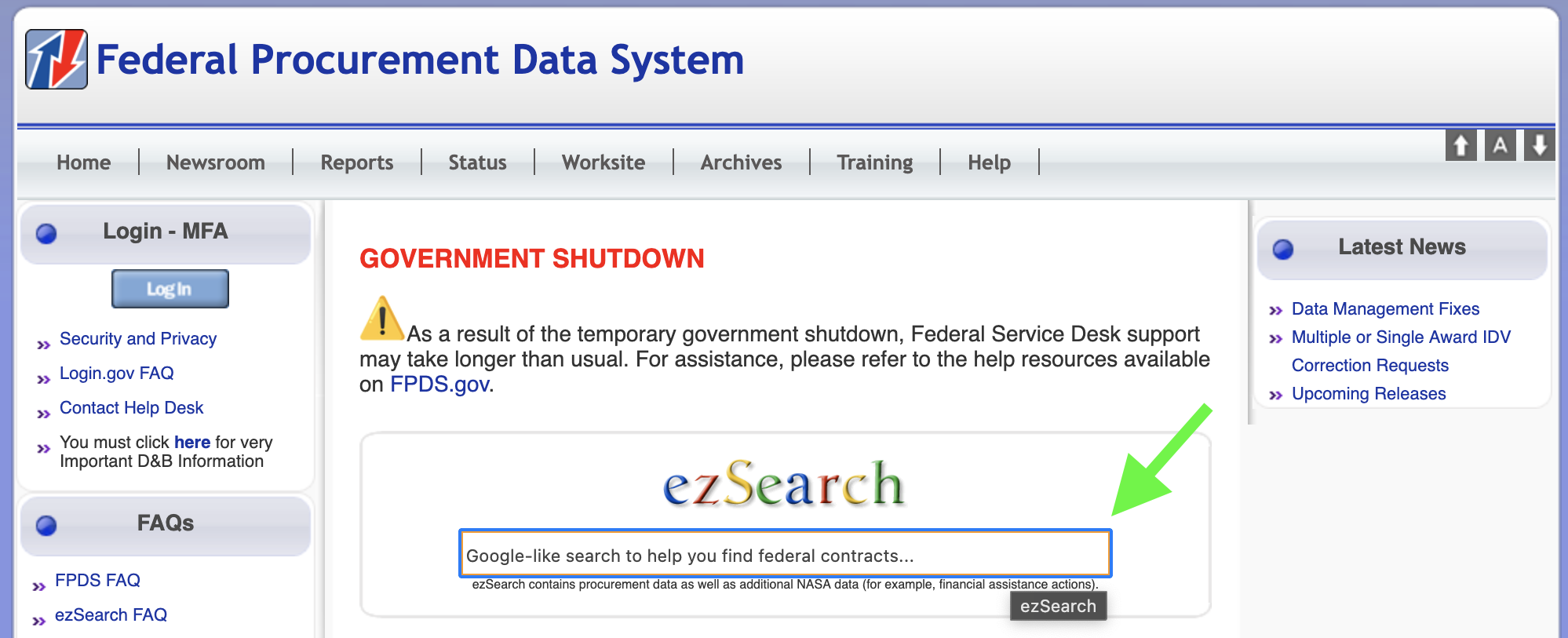
The EZ Search landing page for FPDS.gov

A new tab will open automatically with exact matches at the top. 
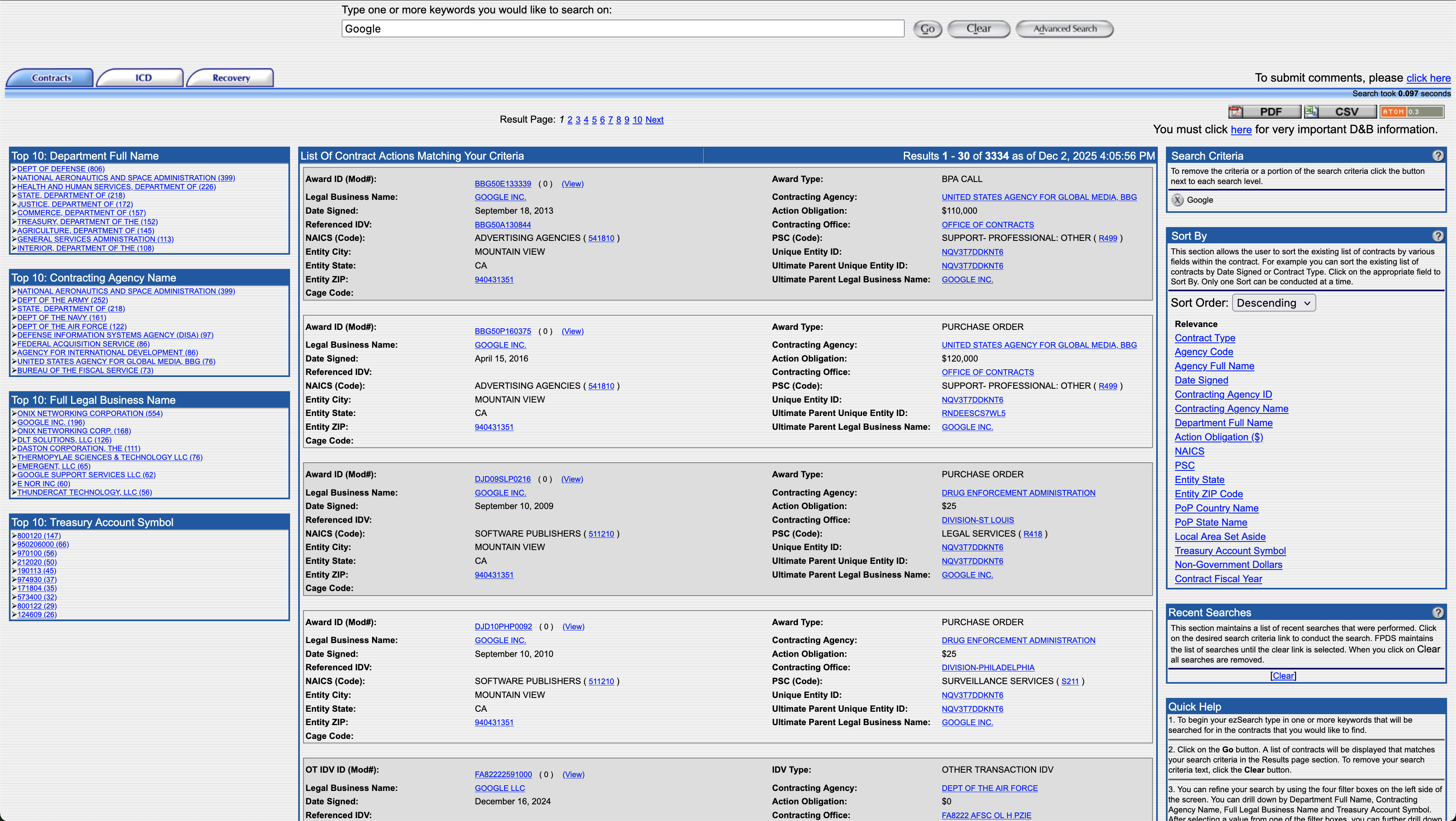
A page of results for Google's contracts with the federal government.

Four “Top 10” modules on the left side of the page link to top results in descending order: Department Full Name, Contracting Agency Name, Full Legal Business Name, and Treasury Account Symbol. These ranked lists help the user quickly narrow in on departments and agencies that vendors do business with. DHS may not appear in the “Top 10” results, which may indicate that the vendor hasn’t yet been awarded DHS or subagency contracts.

For example, if you searched the term “FLIR”, as in Teledyne FLIR who make infrared surveillance systems used along the U.S.-Mexico border, DHS is the 2nd result in the “Top 10: Department Full Name” box. 
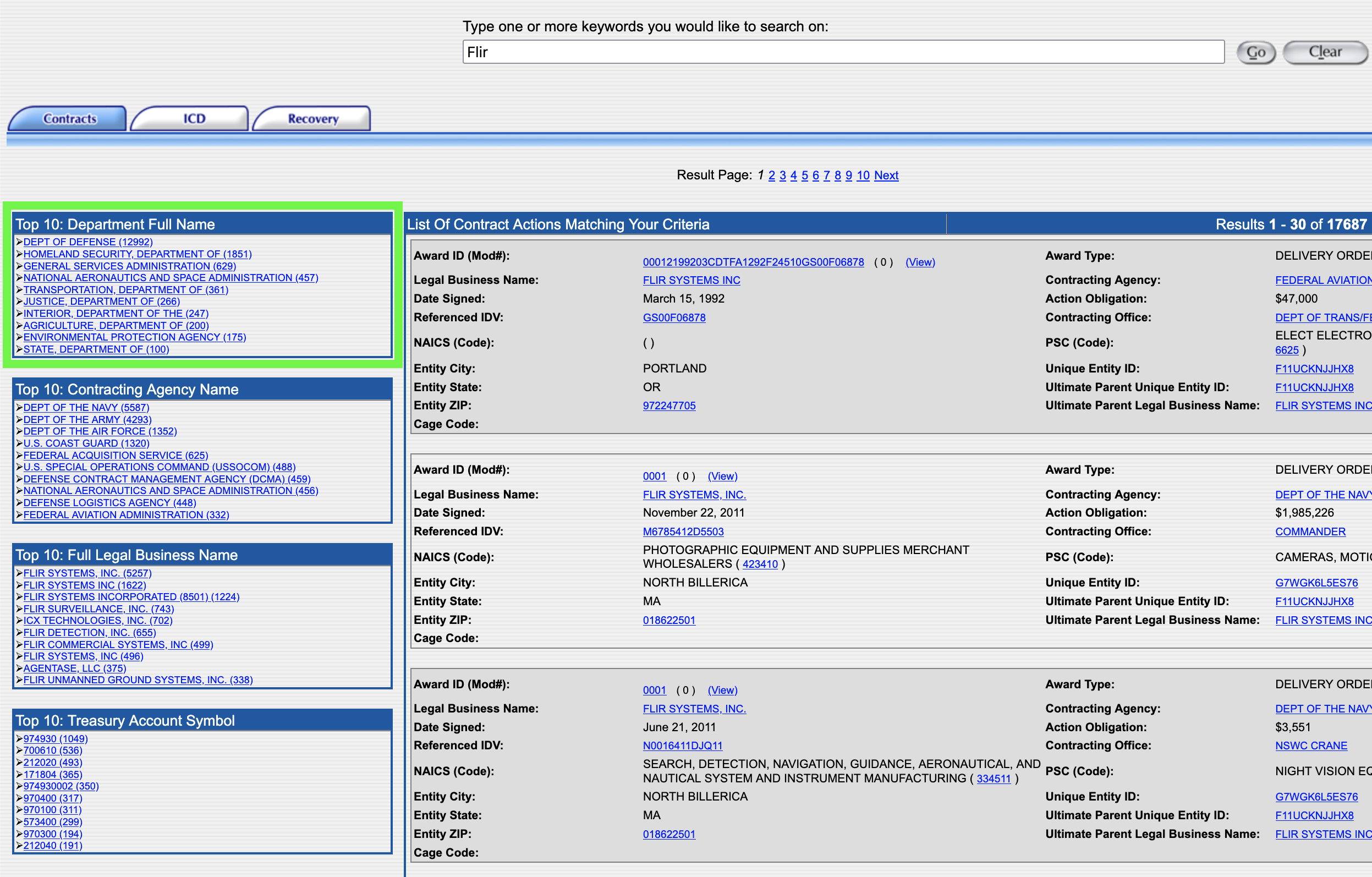
FDPS.gov results for FLIR with the agency full name sidebar highlighted.

To see all DHS contracts awarded to the vendor, click “Homeland Security, Department of” from the “Top 10 Department Full Name” module. When the page loads, you will see the subcomponents of DHS (e.g., ICE, CBP, or the U.S. Secret Service) in the lefthand menu. You can click on each of those to drill down even further. You can also drill down by choosing a company. 

Sorting options can be found on the right side of the page which offer the ability to refine and organize search results. One of the most useful is "Date Signed," which will arrange the results in chronological order. 
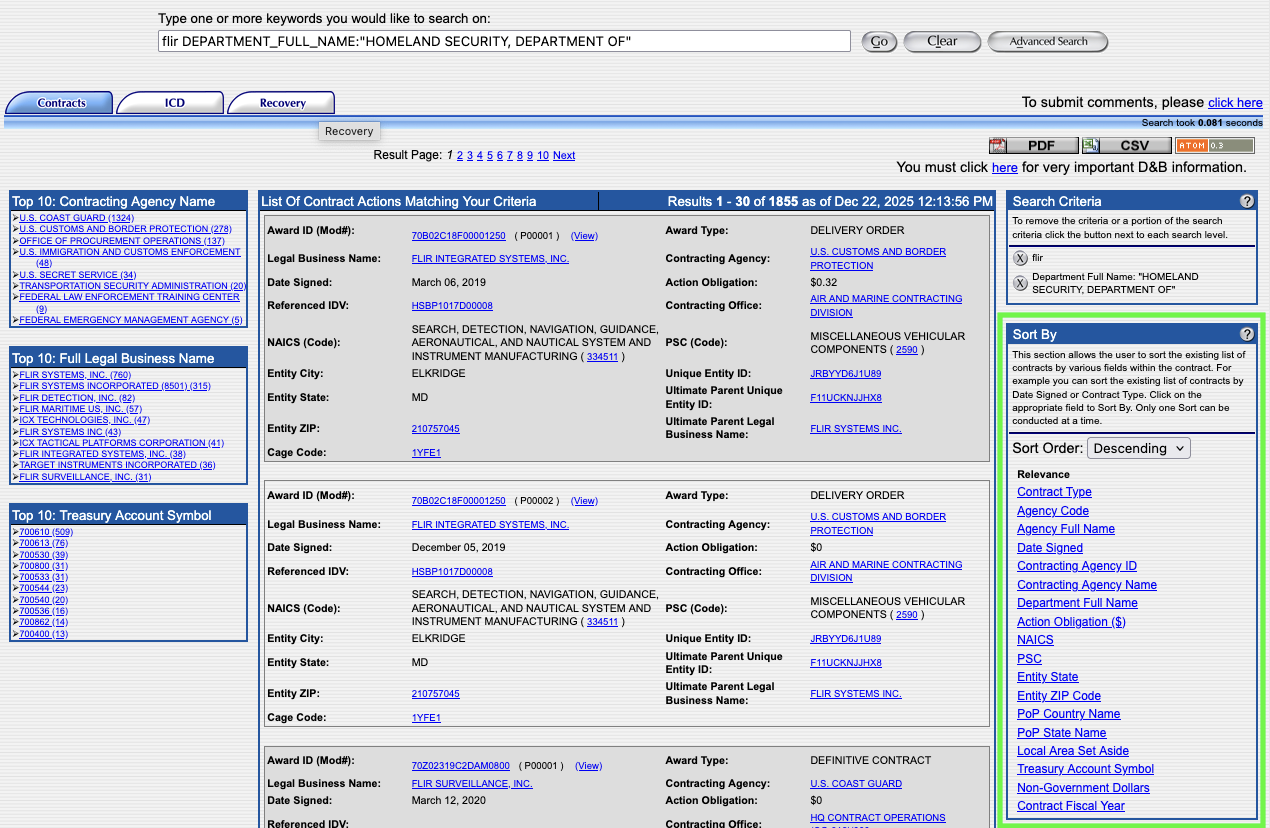
FPDS.gov results for FLIR with the sort by sidebar highlighted

You don't have to search by a company name. You can also use a product keyword, such as "LPR" (license plate reader). However, because keywords are not consistently used by government agencies, you will need to try various permutations to gather the most data. 

Each click or search filter adds a new term to the search both in the main field at the top and in the Search Criteria module on the right. They can be deleted by clicking the X next to the term in this module or by removing the text in the main search field.

FPDS.gov results with the sidebar for deselecting terms highlighted with an arrow.

For each contract item, you can click "View" to see the specific details. However, these pages don't have permalinks, so you'll want to print-to-pdf if you need to retain a permanent copy of the record. 

Often the vendor brand name we know from their marketing or news media is not the same entity that is awarded government contracts. Foreign companies in particular rely on partnerships with domestic entities that are established federal contractors. If you can’t find any spending records for a vendor, search the web for information on the company including acquisitions, partnerships, licensing agreements, parent companies, and subsidiaries. It is likely that one of these types of related companies is the contract holder. 

USA Spending - usaspending.gov

The Federal Funding and Accountability Act (FFATA) of 2006 and the DATA Act of 2014 require the government to publish all spending records and contracts on a single, searchable public website, including agency-specific contracts, using unified reporting standards to ensure consistent, reliable, searchable data. This led to the creation of USA Spending (usaspending.gov). 

USA Spending is populated with data from multiple sources including the Federal Procurement Data System (fpds.gov) and the System for Awards Management (sam.gov - which we'll discuss in the next section). It also compiles Treasury Reports and data from the financial systems of dozens of federal agencies. We relied heavily on Awards data from these systems to verify vendor information including contracts with the DHS and its subagencies such as CBP and ICE. 

USA Spending has a more modern interface, but is often very slow with the information often hidden in expandable menus. In many ways it is duplicative of FPDS, but with more features, including the ability to bookmark individual pages. We often found ourselves using FPDS to quickly identify data, and then using the "Award ID" number to find the specific record within USA Spending. 

USA Spending also has some visualizations and ways to analyze data in chart form, which is not possible with the largely text-based FPDS. 

How to Use USA Spending

To begin searching for DHS awards, click on either “Search Award Data” on the navigation bar, or the blue “Start Searching Awards”button. 
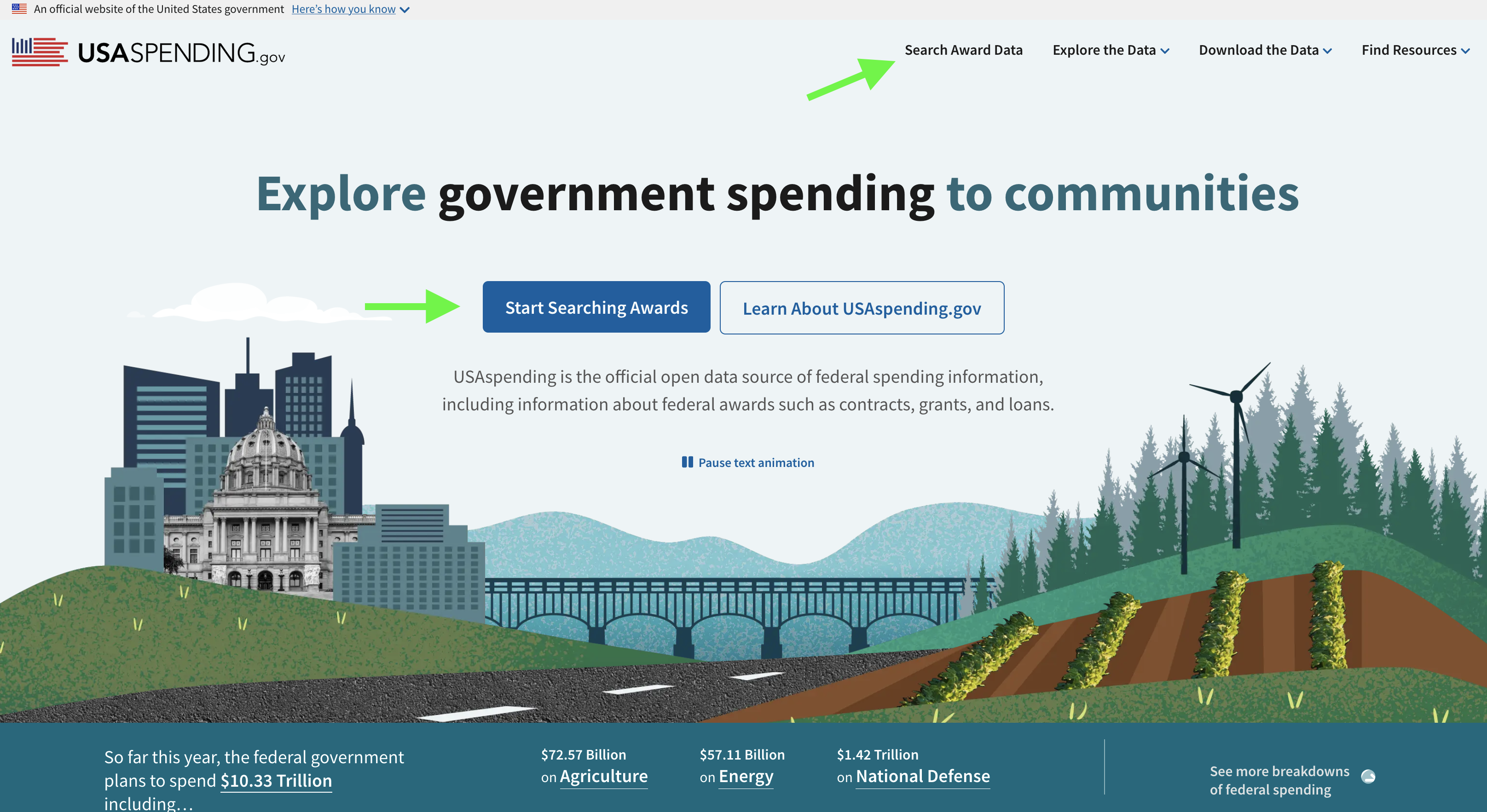
The landing page of USA Spending with arrows pointing to the search links.

On the left of the Search page are a list of drop down menus with options. You can enter a vendor name as a keyword, or expand the “Recipient” menu if you know the full company name or their Unique Entity Identifier (UEI) number. Expand the “Agency Tab” and enter DHS which will bring up the Department of Homeland Security Option.
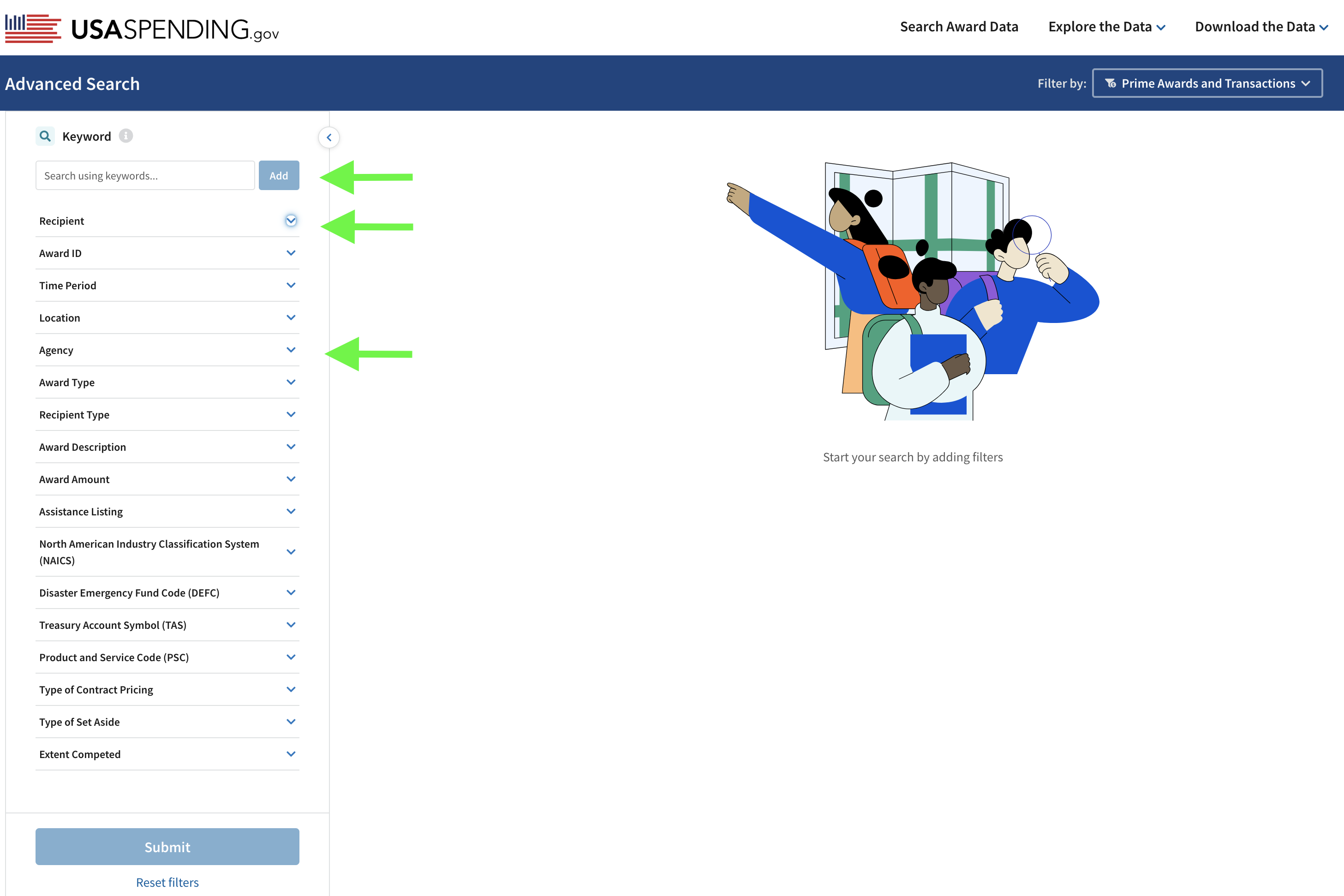
USA Spending page with arrows pointing to the key search filters.

In the example below, we entered “Palantir Technologies” as a keyword, and selected DHS in the Agency dropdown:

Search results showing Palantir contracts

For vendors with hundreds of contracts that return many pages of results, consider adding more filters to the search such as a specific time period or specifying a Funding Agency such as ICE or CBP. In this example, the filters “Palantir Technologies” and “DHS” returned 13 results (at the time of publication). It is important to note that the search results table is larger than what displays in that module. You can scroll down to view more Awards and scroll to the right to see much more information. 

Scroll down outside of that module to reveal more info including modules for Results by Category, Results over Time, and Results by Geography, all of which can be viewed as a list or graph. 
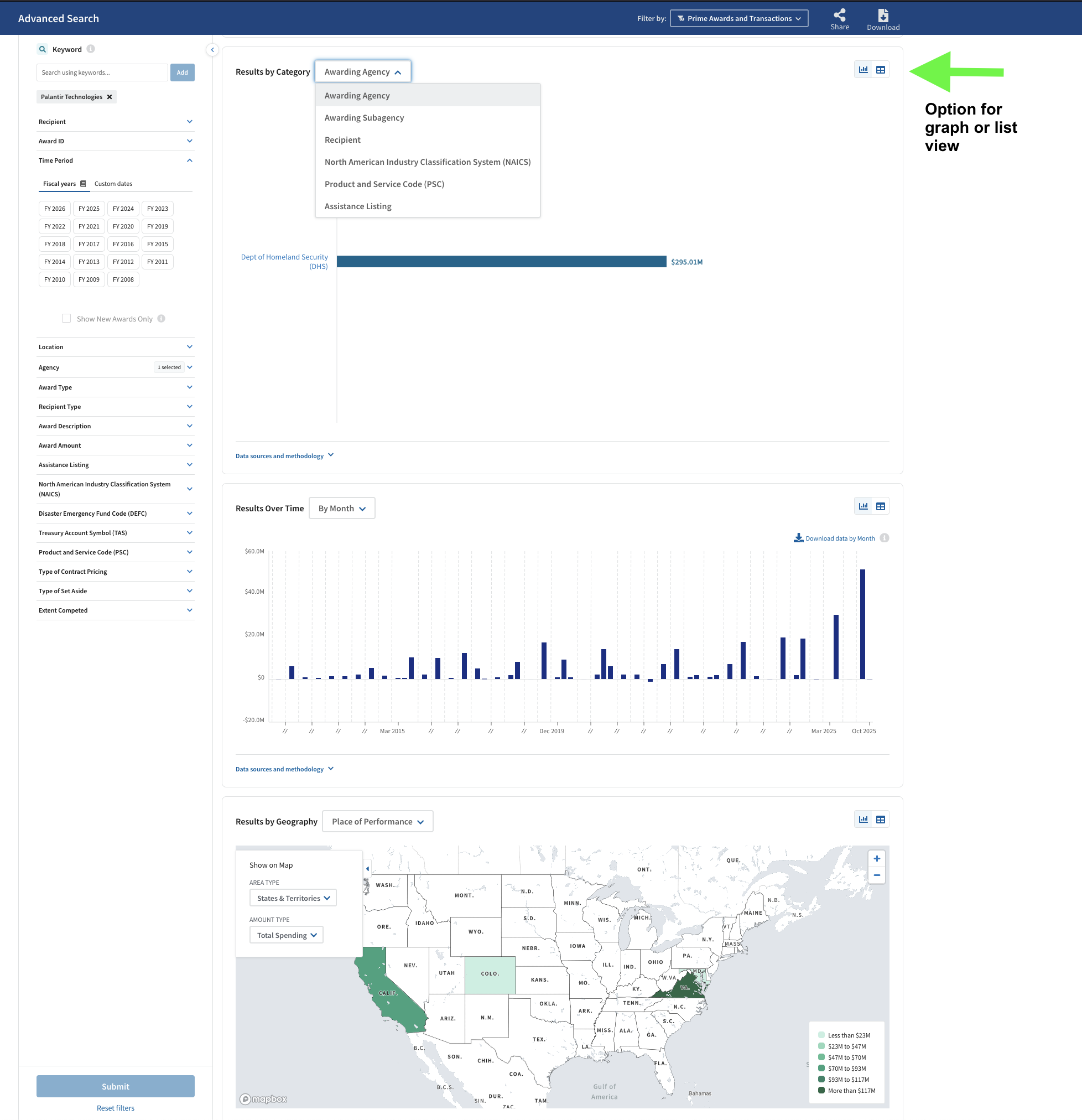
USA Spending page with graphs and charts

Once you've identified a contract, you can click the "Prime Award ID" to see the granular details for each time. 

From the search, you can also select just the agency to see all the contracts on file. Each agency also has its own page showing a breakdown for every fiscal year of how much money they had to spend and which components spent the most. For example, here's DHS's page.

2. Contracting Opportunities  - SAM.gov  

So far we've talked about how to track contracts and spending, but now let's take a step back and look at how those contracts come to be. The System for Award Management, SAM.gov, is the site that allows companies to see what products and services the government intends to buy so they can bid on the contract. But SAM.gov is also open to the public, which means you can see the same information, including a detailed scope of a project and sometimes even technical details. 

How to Use Sam.gov

SAM.gov does not require an account for its basic contracting opportunity searches, but you may want to create one in order to save the things you find and to receive keyword- or agency-based alerts via email when new items of interest are posted. 

First you will click "Search" in the menu bar, which will bring you to this page: 
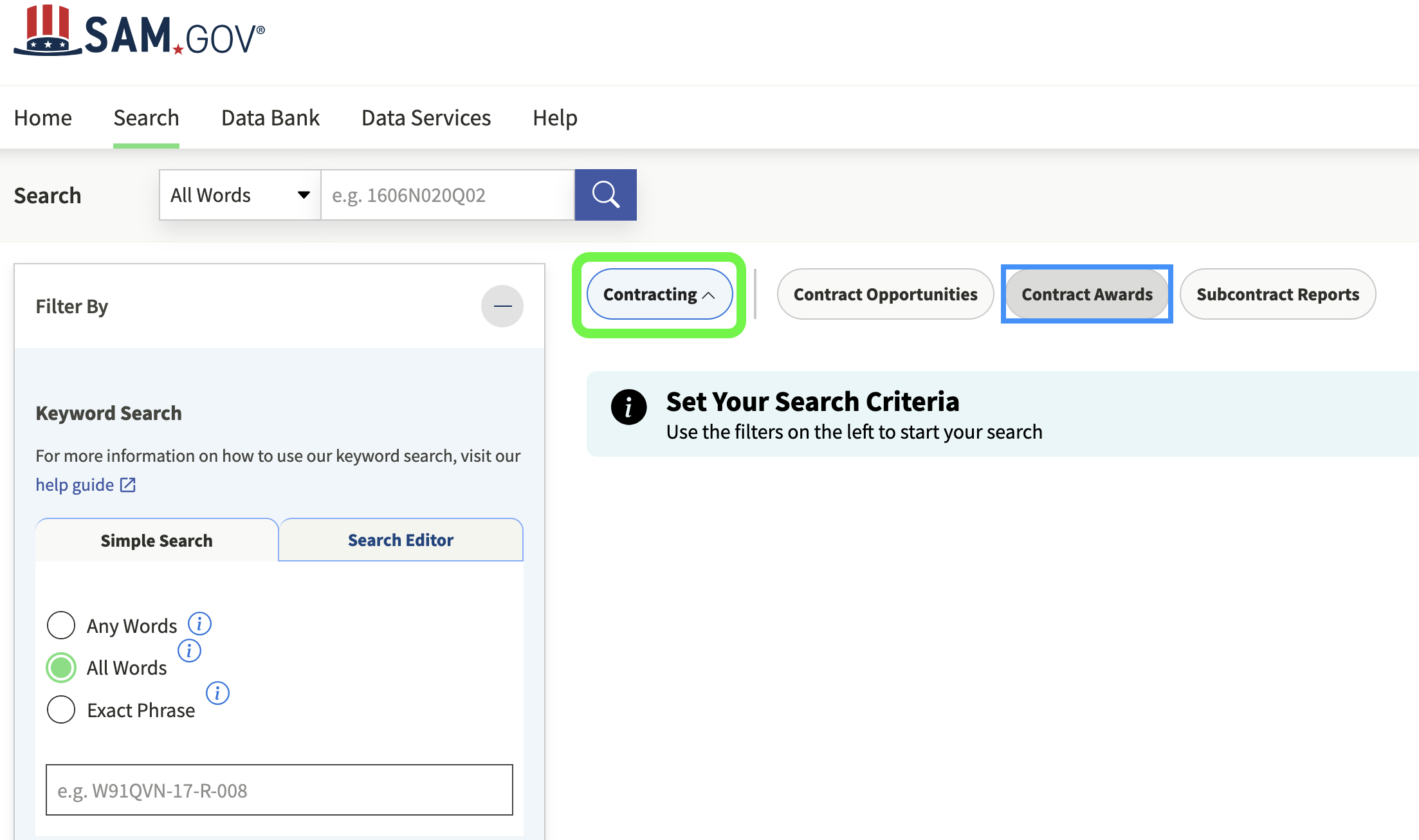
Search page on Sam.gov

We recommend selecting both "Active" and "Inactive" in the Status menu. Contracts quickly go inactive, and besides, sometimes the contracts you are most interested in are several years old. 

If you are researching a particular technology such as unmanned aerial vehicles, you might just type "unmanned" in the Simple Search bar. That will bring up every solicitation with that keyword across the federal government.

One of the most useful features is filtering by agency, while leaving the keyword search blank. This will return a running list of an agency's calls for bids and related procurement activities. It is worth checking regularly. For example, here's what CBP's looks like on a given day: 
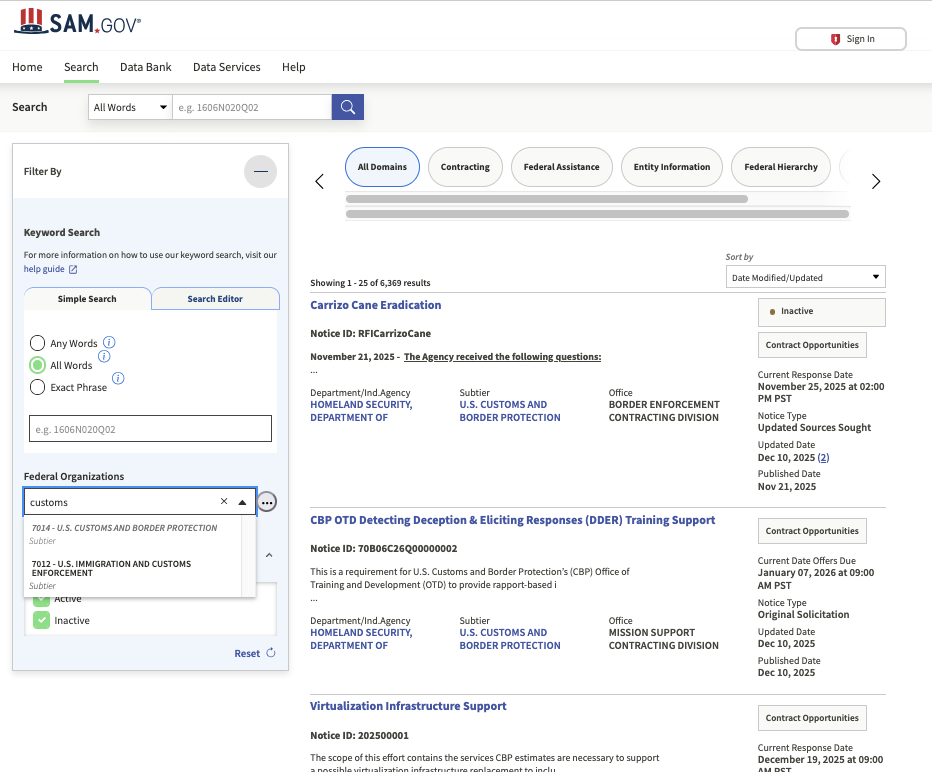
Sam.gov results for Customs and Border Patrol

If you click on an item, you should next scroll down to see if there are attachments. These tend to contain the most details. Specifically, you should look for the term "SOW," the abbreviation for "Statement of Work." For example, here are the attachments for a CBP contracting opportunity for "Cellular Covert Cameras": 
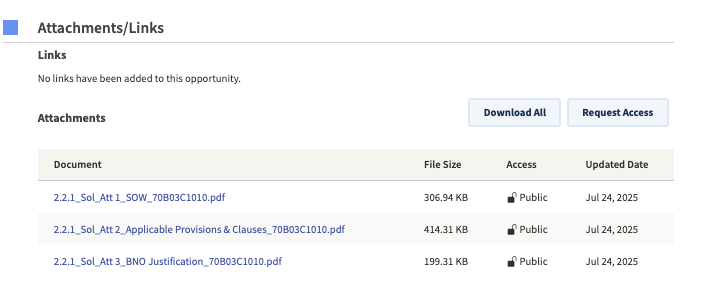
Links for attachments

The first document is the Statement of Work, which tells you the exact brand, model, and number of devices they want to acquire: 
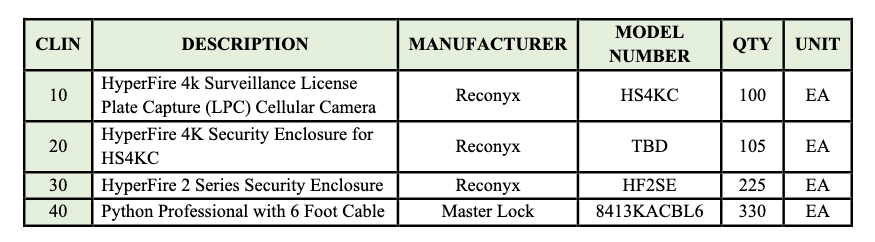
Line items for hundreds of Hyperfire cameras and related components.

The attachments also included a "BNO Justification." BNO stands for "Brand Name Only," and this document explains in even more detail why CBP wants that specific product:

Explanation of why the government wants to purchase this particular model of camera.

If you see the terms "Sole Source" in a listing, that also means that an agency has decided that only one product meets its requirements and it will not open bidding to other companies. 

In addition to contracting, many agencies announce "Industry Day" events, usually virtual, that members of the public can join. This is a unique opportunity to listen in on what contractors are being told by government purchasing officials. The presentation slides are also often later uploaded to the SAM.gov page. Occasionally, the list of attendees will also be posted, and you'll find several examples of those lists in our dataset.

3. The Government's "Superstore" - gsaadvantage.gov

Another way to investigate DHS purchasing is by browsing the catalog of items and services immediately available to them. The General Services Administration operates GSA Advantage, which it describes as "the government's central online shopping superstore." The website's search is open, allowing members of the public to view any vendors' offerings–including both products and services– easily as they would with any online marketplace. 

For example, you could search for "license plate reader" and produce a list of available products: 
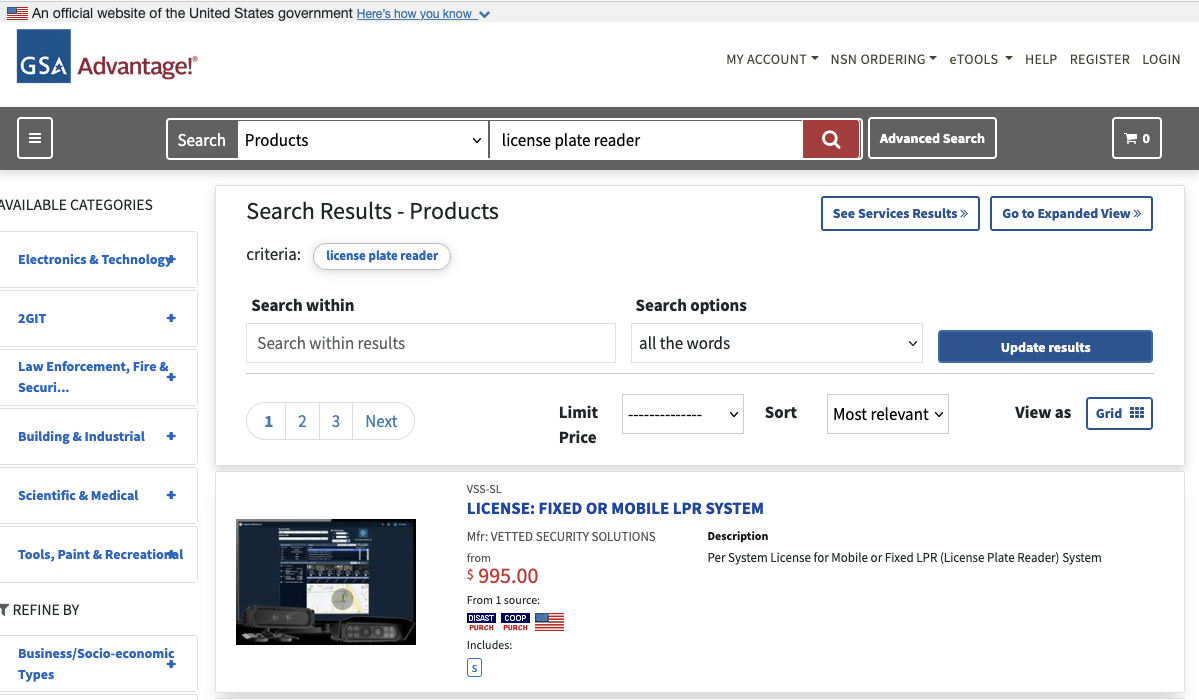
Search results that show a license plate reader for sale for $995.

If you click "Advanced Search," you can also isolate every product available from a particular manufacturer. For example, here are the results when you search for products available from Skydio, a drone manufacturer.
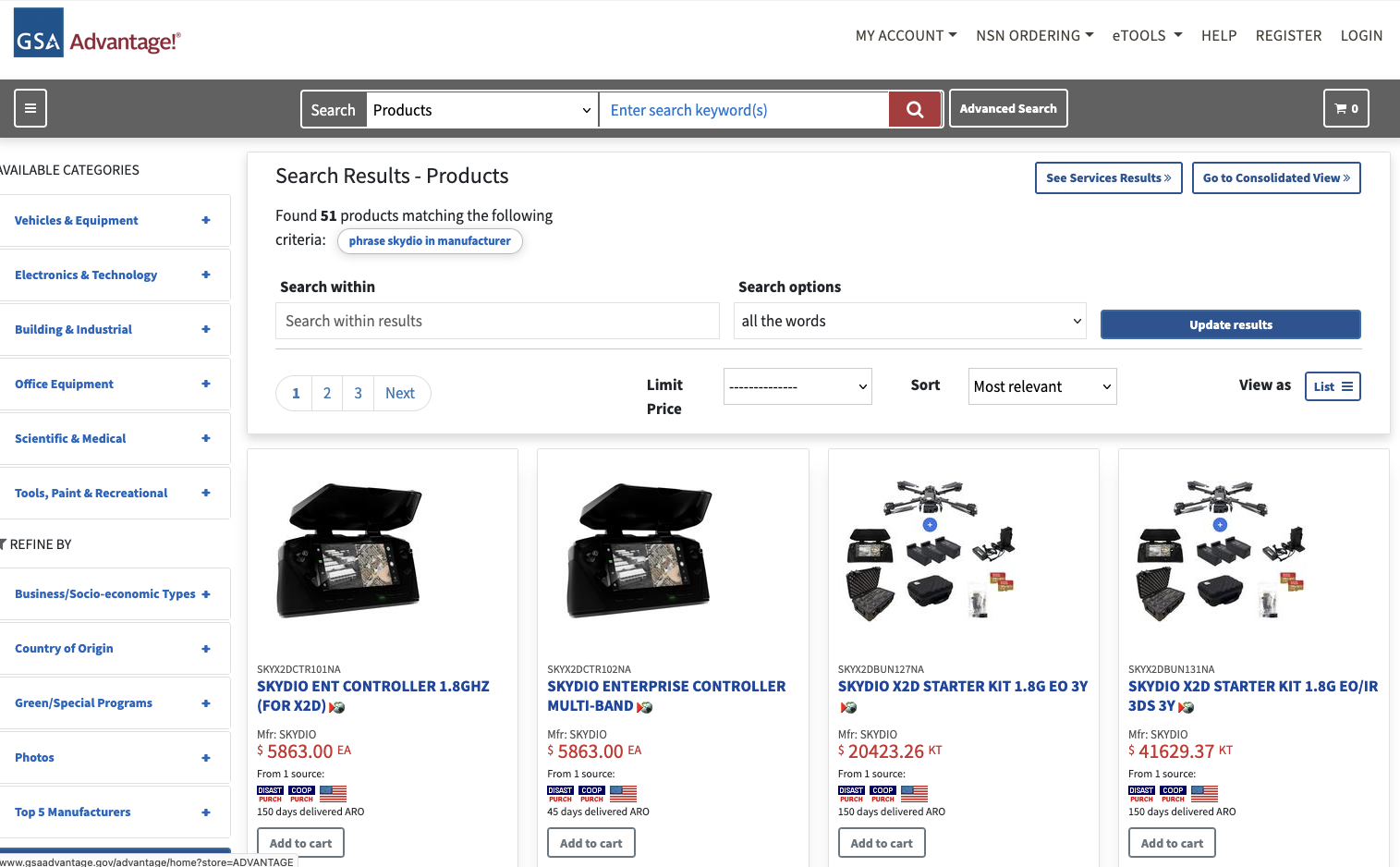
Search results for 50 Skydio drone-related products

If you switch from "Products" to "Services" you can export datasets for each company about their offerings. For example, if you search for "Palantir" you'll get results that look like this:
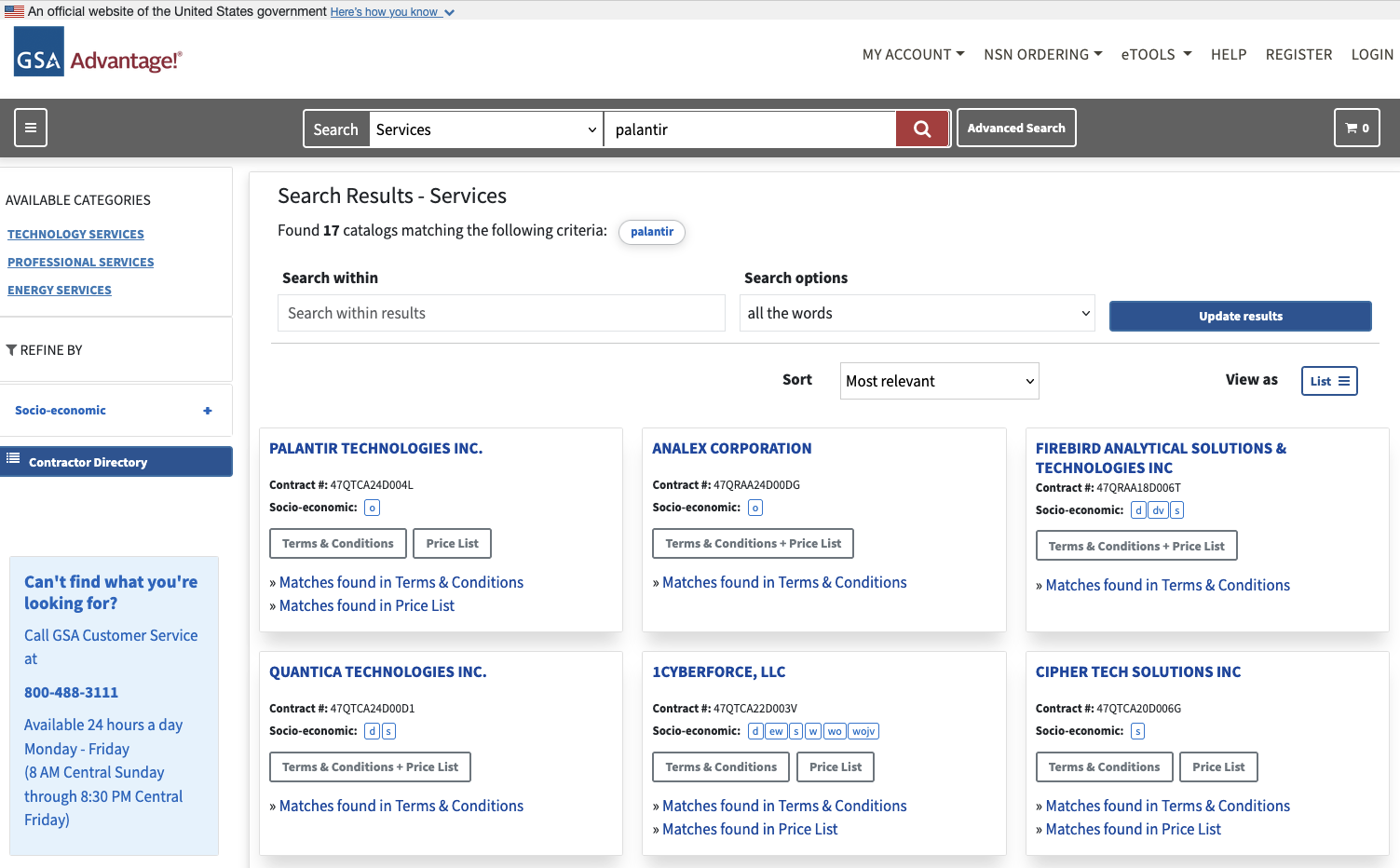
Search results with companies offering Palantir-related services.

This means all these companies are offering some sort of Palantir-related services. If you click "Matches found in Terms and Conditions," you'll download a PDF with a lot of details about what the company offers. 

For example, here's a a screengrab from Anduril's documentation

A menu of surveillance towers with prices.

If you click "Matches Found in Price List" you'll download a spreadsheet that serves as a blueprint of what the company offers, including contract personnel. Here's a snippet from Palantir's: 

A spreadsheet with prices for various Palantir services.

4. Other Resources

Daily Public Report of Covered Contract Awards - Maybe FPDS isn't enough for you and you want to know every day what contracts have been signed. Buried in the DHS website are links to a daily feed of all contracts worth $4 million or more. It's available in XML, JSON, CSV and XLSX formats. 

DHS Acquisition Planning Forecast System (APFS) - DHS operates a site for vendors to learn about upcoming contracts greater than $350,000. You can sort by agency at a granular level,  such as upcoming projects by ICE Enforcement & Removal Operations. This is one to check regularly for updates. 
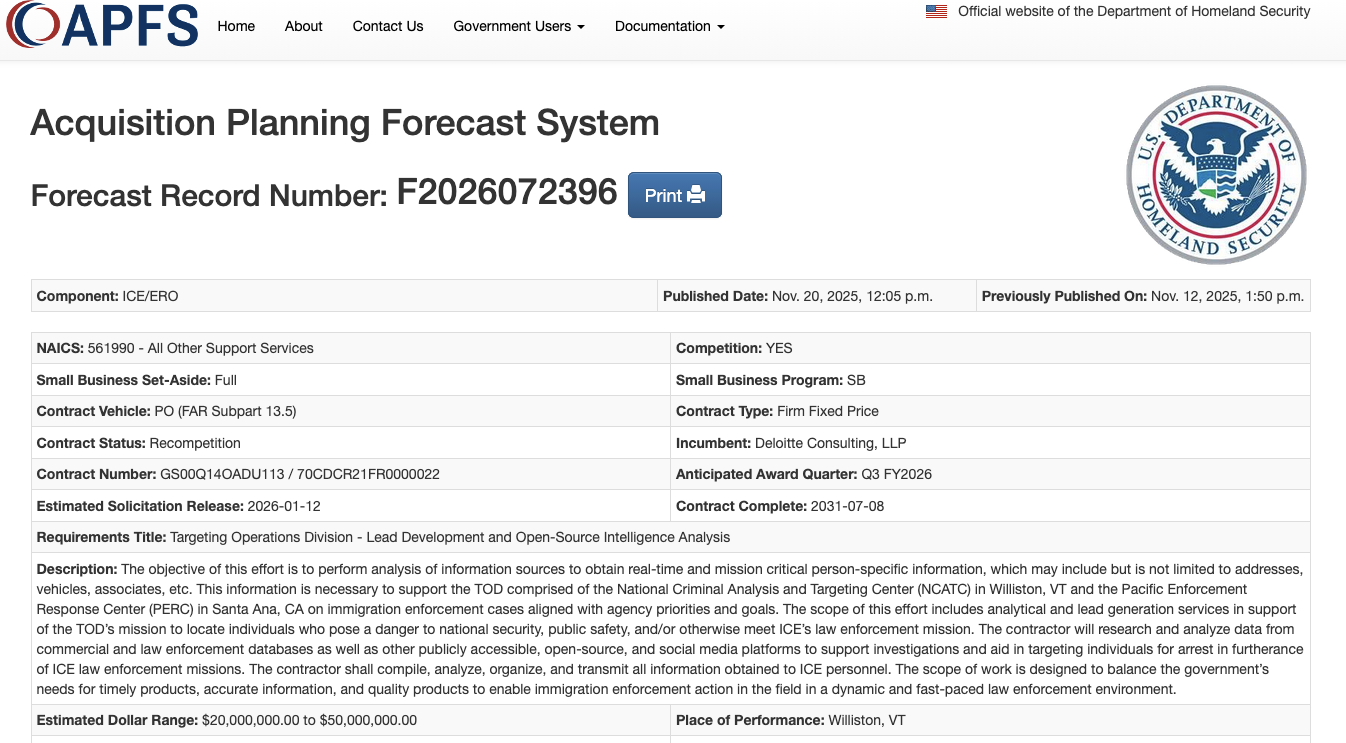
Results for a proposed contract for open source intelligence

DHS Artificial Intelligence Use Case Inventory - Many federal agencies are required to maintain datasets of "AI Use Cases." DHS has broken these out for each of its subcomponents, including ICE and CBP. Advanced users will find the spreadsheet versions of these inventory more interesting. 
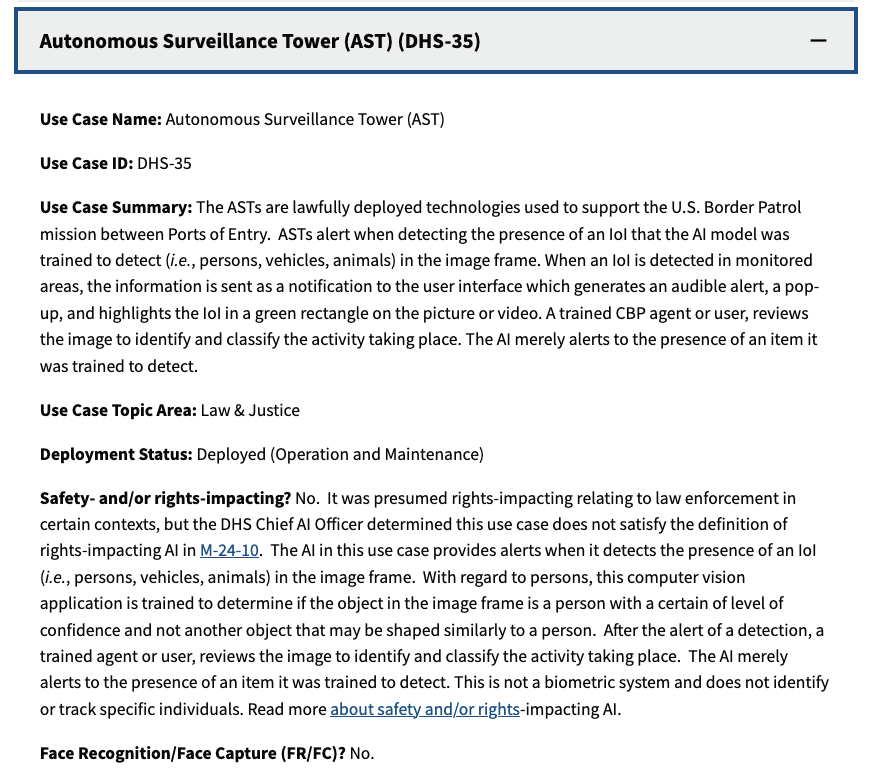
Use case summary for surveillance towers

NASA Solutions for Enterprise-Wide Procurement (SEWP) - SEWP is a way for agencies to fast track acquisition of "Information Technology, Communication and Audio Visual" products through existing contracts. The site provides an index of existing contract holders, but the somewhat buried "Provider Lookup" has a more comprehensive list of companies involved in this type of contracting, illustrating how the companies serve as passthroughs for one another. Relatedly, DHS's list of "Prime Contractors" shows which companies hold master contracts with the agency and its components. 

List of resellers of Palantir technology

TechInquiry - Techinquiry is a small non-profit that aggregates records from a wide variety of sources about tech companies, particularly those involved in government contracting. 

  •  
❌