
Reading view

The other half of the AI SOC: Intezer, now inside your AI workspace

Two kinds of work you want AI to do in a SOC

  1. Work you want off your plate. Alert triage is the obvious example: every alert deserves a real investigation, most of them turn out to be noise, and they arrive at 3am as happily as at noon. Nobody wants help with this work. They want it gone. That’s the half Intezer has spent years building. Autonomous triage that investigates every alert at forensic depth, around the clock, and only interrupts a human when something actually needs human judgment.
  2. Work you want to keep, but accelerate. Deciding what to do with an escalation. Writing the incident report. Picking apart the weird binary someone found on a build server. Chasing a hunch across five systems. For this work you don’t want a replacement. You want to be a 10x version of yourself.

Today we’re shipping the second half.

We rebuilt the Intezer MCP server from the ground up, and it turns the AI platform your team already lives in, Claude, Codex, Cursor, or any MCP client, into a full security workspace: your cases, your alerts, file and URL verdicts, live SIEM and EDR telemetry, tuning rules, all of it. We had an MCP server before, and it was a fine way to ask Intezer questions from a chat window. This one is built around a bigger idea: your AI workspace should be able to do everything you can do in Intezer, then combine it with everything else you have access to.

If you read our piece on making sense of the 2026 SOC stack, this release is the missing connection between the top two layers. Detection tools are the hardware. The AI SOC is the operating system that turns raw signals into investigated verdicts and institutional memory. AI platforms like Claude are the applications where people actually work. This release plugs the operating system into the applications.

Watch one investigation, end to end

The video walks through one escalated case, but the pattern behind it is the real story. Intezer’s autonomous triage investigates every alert to forensic depth and resolves what it can on its own. What lands in front of a human is the residue. Cases where the technical facts are settled but the decision still needs judgment, usually because it turns on business context no security tool can see. Was this data share authorized? Is this vendor one we actually work with? Escalating those isn’t a triage failure, rather it’s the line where execution ends and judgment begins.

Putting Intezer inside your AI workspace is what makes that handoff productive. Pick up a case in Claude, Codex, or Cursor and you inherit the full investigation Intezer already ran, plus its recommendation, with a partner that can reach the context security tools never had: your email, Slack, the ticket queue. You keep the decision; it does the legwork around you at machine speed, pulling the case, cross-referencing your systems, documenting the verdict, writing a tuning rule. What used to be an afternoon of pivoting between consoles becomes a short, supervised exchange.

That’s the point of the combination: the autonomous half absorbs the scale, the assistive half carries the judgment, and every call you make feeds back as logic that makes the autonomous half smarter. You’re not handing off your work; you’re making judgment calls with the context, evidence, and follow-through already assembled around you.

The same question, with and without Intezer
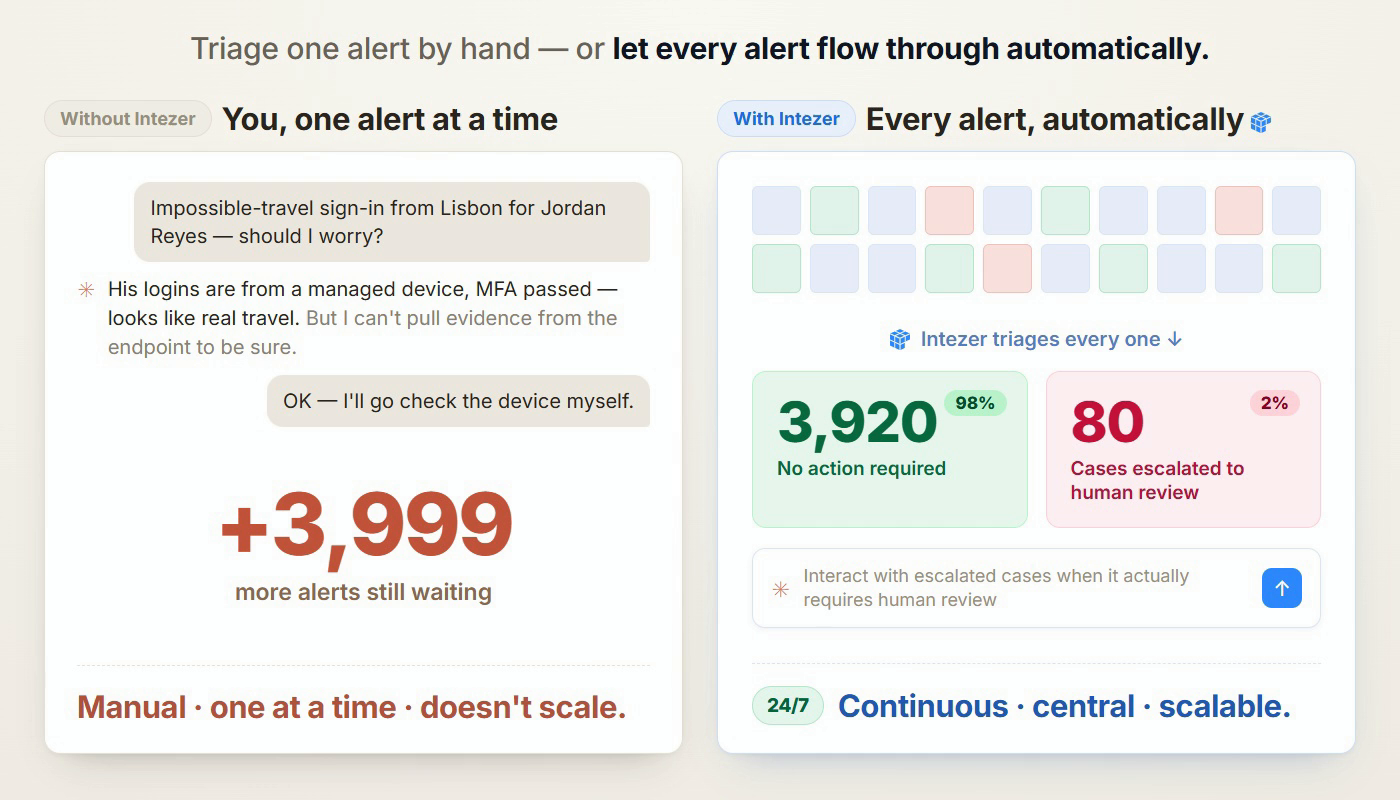
Triage before and after Intezer

Same alert, two ways to handle it. On the left, Claude on its own takes the impossible-travel sign-in and works it by hand. It reasons well and gets close — managed device, MFA passed, probably real travel — but it can’t collect evidence from the endpoint to confirm, so the last step falls back to a human checking the laptop. And that’s one alert; almost 4,000 more are still waiting behind it. One analyst, one alert at a time, with no way to run it across the whole team. On the right, the same alert inside the AI SOC: Intezer triages every alert around the clock, closes the ~98% that need no action, and escalates only the ~2% that genuinely need a person. Claude is where you pick those up so you can stop grinding the queue and start supervising the few cases that actually need you.

Most of the org knowledge an investigation needs is already centralized in Intezer. That’s the whole point of the platform. But some context only ever lives with you: a procurement thread in someone’s inbox, a Slack message from three weeks ago, a calendar invite. With Intezer connected on one side and your IT and communication stack on the other, your AI workspace can cross-reference both in a single investigation.

Why not plug Claude into all security tools directly?

You could also wire your AI client straight into each security tool yourself. Most of them ship an MCP these days. Two things make that a worse deal than it looks. First, the integration work is now yours: stitching a dozen connectors together, learning each product’s query quirks, and getting back a pile of disconnected results instead of one correlated picture. Second, raw tool access still isn’t investigation. With every EDR, SIEM, and intel feed wired in, the model can read your data, but it can’t collect evidence off an endpoint, run memory forensics, or weigh conflicting signals into a verdict it will actually stand behind, which is exactly where Claude stalls on the left in above image.

Intezer already did both jobs. One connector hands the model a SOC’s worth of normalized cases, verdicts backed by real forensic evidence, and cross-tool correlation. An AI platform does its best work standing on a real foundation of security knowledge, not on a dozen raw feeds it has to assemble itself.

Investigate and close the cases Intezer escalates to you

This is where analyst hours should go, so it’s where the MCP goes deepest. Whatever the alert type, the shape is the same: pull the case, build on everything the autonomous triage already found, cross-reference your other systems, decide interactively with you, and close with evidence.

And “pull the case” carries real weight here. A case from Intezer is not a bare ticket. It arrives with everything triage already did: the evidence it collected, the SIEM and EDR queries it ran, the forensic analysis of each artifact, the verdicts it reached. You’re not starting from a blank page; you’re picking up a deep investigation and taking it the last mile.

“Pick up the oldest escalated open case and let’s investigate it together.”

The clip above takes an impossible-travel alert. The MCP brings the full login history including every IP and geo, and who else touched the same address as well as your AI workspace cross-references calendar and Slack for travel context. When the evidence still isn’t conclusive, it can ask the user directly and close on their answer, so the one human check that actually mattered takes seconds instead of becoming a follow-up ticket.

Make tomorrow’s autonomous triage smarter

If a case should never have reached you, closing it is half the job. The other half is making sure it never reaches you again.

“We keep getting this exact false positive. Write a tuning rule so it never escalates again, then retriage the case.”

Claude inspects the alert’s triage indicators, drafts a narrowly scoped tuning rule, and tests the pattern against the real alert object before proposing anything. It checks whether an existing rule should be extended instead of creating a near-duplicate. It asks the question every detection engineer should ask: could an attacker hide inside this rule? Then it pushes the rule to Intezer for your approval and retriages the affected alerts so the fix applies immediately.

Tuning runs both directions, too. The same mechanism can tell the autonomous triage to always escalate a pattern it can’t yet call malicious with confidence, so the genuinely ambiguous cases land in front of a human by design, not by luck.

This is where the two halves of the AI SOC meet. Every rule your AI workspace writes makes the autonomous half smarter, which means fewer escalations next month, which means the time you spend supervising keeps shrinking. The system compounds.

From case to incident report in one prompt

When a case turns into a real incident, the hours after containment go to reconstruction: which alerts were related, which machines were touched, what happened first, and what to tell leadership.

“Write an incident report for the latest case we worked on — timeline, affected assets, and an exec summary I can send to the CISO.”

Your AI workspace pulls the case and its full activity trail from Intezer, expands across the users, devices, and IPs involved, and rebuilds the timeline from the forensic evidence already on file. Then it writes the report with an executive summary up top, technical detail below, in your template if you have one, and finally exports it to a clean, brand-styled PDF you can send as-is. The data was always in Intezer; the report was just assembly. Now assembly is one prompt.

Threat hunting: start from a lead, not an alert

Not every investigation starts in the queue. Sometimes it starts with your CISO forwarding an article about a campaign that’s hitting your industry.

“Here’s a writeup of a new campaign [link]. Check whether any of these IOCs appear anywhere in our environment, and analyze anything you find.”

Your AI workspace extracts the indicators and techniques from the writeup, sweeps your environment through Intezer’s SIEM and EDR query tools, and returns the matching assets, alerts, and artifacts for analysis. When you find something worth a closer look, you can fire deep forensics to go one step further with your hunt.

How it works
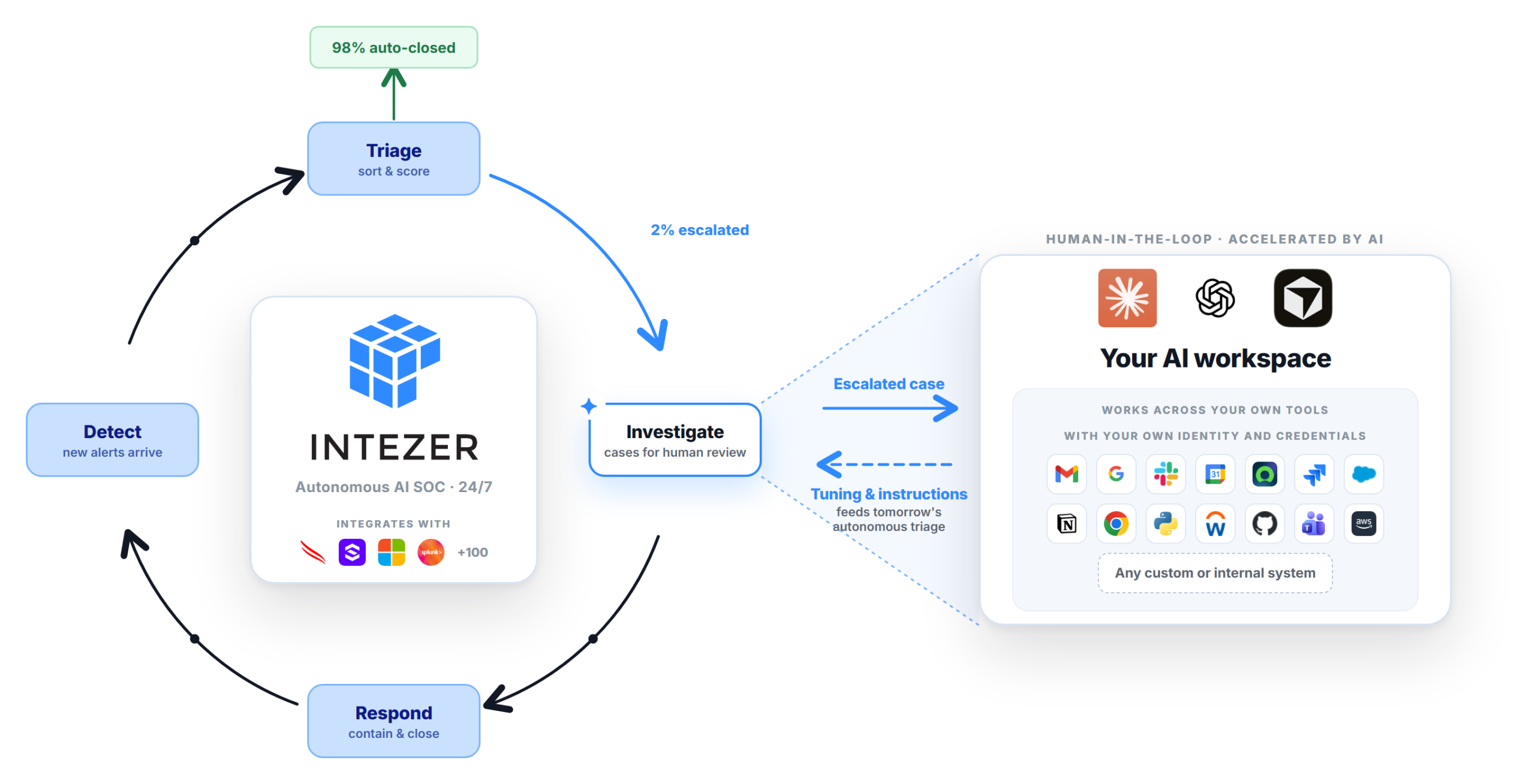
How Intezer AI SOC works with Claude and other AI platforms

The Intezer MCP server is hosted by us. You authorize over OAuth from any MCP client: Claude (Desktop, Code, or claude.ai), ChatGPT, Codex, Cursor, or anything else that speaks the protocol.

Under the hood it exposes 66 tools covering the full case lifecycle: search and fetch cases and alerts, file and URL analysis, live queries against more than a dozen SIEM and EDR products in their native query languages (KQL, SPL, XQL, SDL, and the rest, with per-vendor syntax guides built in so the model gets them right), tuning rules and AI instructions, retriage, and case editing.

This architecture is what makes the two halves described above work as one system: the autonomous half clears work off your plate, while the assistive half accelerates the tasks where you still want to stay in the loop.

Getting started

  1. If you’re already an Intezer customer, an Intezer admin creates an MCP OAuth application under Account Settings → MCP OAuth Applications.
  2. Add Intezer as a custom connector in your AI client such as Claude, ChatGPT, or any MCP client. Point it at the hosted server, and authorize with your own Intezer login over OAuth.
  3. Open with one prompt: ask it to pick up your oldest open escalation.

The autonomous half investigates everything, around the clock, so your team only sees what matters. The assistive half makes the time you spend on what matters dramatically shorter. One system of record and detection logic underneath both: your cases, your verdicts, your tuning rules, your institutional memory, working for you whether the investigation runs inside Intezer or inside your AI workspace.

AI executes. Humans supervise. And now the supervising got a lot faster too.

If you’re not an Intezer customer yet, book a demo and we’ll show you both halves at once: autonomous triage working every alert around the clock, and a co-pilot that helps your analysts close the escalations that do reach them 10x faster.

The post The other half of the AI SOC: Intezer, now inside your AI workspace appeared first on Intezer.
  •  

Generalist AI for your SOC: When and where to use it

Many security leader are asking the same question right now. We already pay for Microsoft Copilot, ChatGPT Enterprise, or Claude. Why buy anything else?

It is a fair question. These are genuinely impressive platforms. And the honest answer is that they can help with some things. Just not the things that matter most for most SOC teams.

This post is a practical guide to where generalist AI earns its place in a SOC and where it runs out of road.

Where generalist AI platforms actually add value

Let’s be direct about what generalist AI platforms do well in a security context.

They are good at drafting, incident summaries, policy documentation, communication templates, and post-mortems. If an analyst needs to translate a technical finding into plain language for an executive, a general-purpose LLM can accelerate that substantially.

They are useful for on-demand research. Asking a question about a CVE, looking up MITRE ATT&CK techniques, or getting a quick primer on an unfamiliar attack class. These are real productivity wins.

They can assist with simple scripting and query construction. Writing a KQL query for a Sentinel rule, generating a Python snippet to parse a log format. Useful, time-saving work.

The common thread is that these are assistance tasks. A human still needs to initiate the process while the AI is a capable co-pilot. And for these use cases, a general-purpose tool is perfectly appropriate.

Where generalist AI runs out of road

The problem is that none of those use cases address the actual constraint facing most SOC teams.

Security teams are not failing because analysts lack knowledge or work too slowly. They are constrained by investigative capacity. Alert volumes are rising. Environments are growing. Attacks are moving faster. And the operating model still assumes humans will triage and investigate the majority of what comes in.

When that assumption breaks down, investigation becomes selective. High-severity alerts get attention. Medium alerts accumulate. Low-severity alerts are deferred or auto-closed. And the uncomfortable truth is that real attacks frequently begin as weak signals. Credential misuse, living-off-the-land techniques, early-stage lateral movement. They rarely present as critical alerts. They appear ordinary until someone actually investigates them.

Generic AI does not fix this. Here is why.

Generalist AI is built for breadth, not depth

ChatGPT and Microsoft Copilot are built for general-purpose text generation. Forensic investigation of a suspicious process execution chain, or a cloud misconfiguration alert at 3am, requires domain-specific knowledge and structured reasoning those platforms were not designed to provide.

Generalist AI assists but does not execute 

Even with a great prompt, a general-purpose AI is accelerating an analyst’s workflow, not replacing the need for one. The investigation still depends on human capacity. And human capacity does not scale as fast as the alert surface grows.

Generalist AI KPIs are increased token usage

Microsoft’s KPI, for example, is token usage. More engagement equals more revenue, regardless of whether your security outcomes improved. That is not a subtle difference. It shapes every product decision, every definition of success. And this can result in very high costs for SOC teams heavily relying on these platforms. This is in stark contrast to Intezer AI SOC which selectively uses LLMs while primarily executing forensic investigations with highly scalable tools and processes. 

Read more about how Intezer Forensic AI SOC follows Anthropic’s best practices.

A practical AI decision framework

Use generalist AI when:

  • The task requires drafting or synthesizing text and security context is not critical to the output
  • An analyst is researching something unfamiliar and needs a starting point
  • The work is advisory and a human will validate and act on every output
  • Speed of completion matters more than forensic accuracy

Consider purpose-built AI when:

  • You need investigation to happen without an analyst driving every step
  • Alert volume has outpaced the team’s capacity to investigate manually
  • Medium and low-severity alerts are going uninvestigated because there simply is not time
  • You need verdicts accurate enough to act on, not just suggestions to review

The line between these two categories comes down to one question. Do you need AI assistance, or do you need AI execution?

What autonomous execution actually requires

This distinction matters because it shapes what you need from a platform.

Assistance is achievable with a good LLM and a capable prompt. Execution requires something harder: accuracy and forensic depth at investigation time.

General-purpose AI tools and many first-generation AI SOC products rely primarily on LLM analysis and SIEM queries. That is not enough to produce verdicts you can trust without a human checking every one.

Intezer AI SOC is built for the execution side of that line. Automated evidence collection, threat intelligence correlation, network forensics, endpoint forensics, and reverse engineering. That additional depth is what generates the high-confidence verdicts that allow organizations to trust the outcome without a human reviewing every decision.

Below a certain threshold of accuracy and depth, AI assists humans. Above it, organizations can safely offload Tier 1 and Tier 2 work entirely. The threshold is not crossed through breadth. It is crossed through domain specialization and forensic rigor.

Intezer’s investigations produce evidence-based verdicts with 98% accuracy. Up to 2% of alerts are escalated as real incidents while the rest are resolved automatically. That is not a productivity improvement. That is a fundamentally different operating model.

The closed loop of triage and detection engineering

There is one more dimension where general-purpose tools fall short and that is detection engineering.

When a generic AI tool helps an analyst triage an alert, that interaction is largely isolated. The outcome does not feed back into your SIEM rules. It does not surface coverage gaps. It does not help you get better at detecting the same class of threat next time.

Intezer’s investigation outcomes feed directly into detection engineering at the source, continuously identifying broken or noisy rules, flagging coverage gaps against the MITRE ATT&CK framework, and generating deployment-ready detection rules informed by real investigation results. The system improves with every alert it processes. Detection gets better based on evidence, not assumptions.

That closed loop is the difference between a productivity tool and an operating model.

Is a single generalist interface with multiple plugins the answer?

There is also an important architectural point worth making. Generalist AI platforms are increasingly effective at consolidating workflows into a single interface, and in theory, you could extend them into security operations through plugins and MCPs. The building blocks exist.


But in practice, stitching together the specialist capabilities needed for real alert triage such as forensic evidence collection, threat intelligence correlation, reverse engineering, network analysis, etc.  means sourcing, integrating, and maintaining a patchwork of plugins across multiple providers. Each one has its own update cycle, its own failure modes, and its own gaps. The integration burden falls on your team, and keeping it all working reliably over time is its own operational overhead.


At some point the question becomes whether the effort of assembling and maintaining a DIY investigation pipeline inside a generalist platform is worth it — or whether it makes more sense to use a purpose-built system where those capabilities are already unified, tested, and working together out of the box.

The bottom line

Generalist AI platforms have a real role to play in the SOC. Use them for drafting, research, and analyst-driven assistance tasks. It is good at those things and it is likely already paid for.

But do not confuse that with solving the capacity problem. When investigation still depends on human bandwidth, the alert backlog does not disappear. It just accumulates more slowly.

The future SOC is one where AI executes investigation and humans supervise outcomes. Getting there requires technology purpose-built for that job.

Learn more about Intezer AI SOC.

The post Generalist AI for your SOC: When and where to use it appeared first on Intezer.

  •  

AI SOC Live at Nasdaq: Real conversation about modern security operations

The SOC is broken. Not because of a lack of talent or effort, but because human capacity does not scale. Alert volumes keep rising. Attacks move faster. And the operating model still assumes analysts will investigate most of what comes in, which means the vast majority of alerts never get looked at.

Our AI SOC Report 2026, based on analysis of 25 million alerts across our global customer base, put a sharp number on the problem. Over 60% of alerts are never reviewed by SOC and MDR teams. Nearly 1% of all incidents trace back to alerts classified at the lowest severity levels, signals most teams never touch. With average enterprises generating around 450,000 alerts annually, that equates to roughly one real threat per week hiding in the backlog, undetected.

That is not a tool problem. It is an operating model problem.

On April 27, we are bringing together the security leaders who are doing something about it.

Get your invite to AI SOC Live at the NASDAQ today.

What is AI SOC Live

AI SOC Live is a monthly, online event where security leaders discuss the latest issues facing the cyber industry. This month, AI SOC Live will be a full-day, invitation-only event at the Nasdaq in New York City. It is designed for CISOs, security directors, SOC managers, and MSSPs who are not just watching AI transform security operations from the sidelines, but are in the middle of it, making decisions about how their teams operate, what they invest in, and where the humans actually need to be.

This event is a full day of sessions, panels, and conversations built around the people, processes, and technology required to run a world-class SOC in 2026.

Who you will hear from at AI SOC Live Nasdaq

The speaker lineup reflects how seriously we have curated this event.

Itai Tevet, CEO and Founder of Intezer, will open the day with a session on the new SOC operating model, what it means when AI executes investigation and humans supervise outcomes, and why that shift changes security results structurally, not incrementally.

Alon Cohen, Founder and Executive Chairman of both Intezer and CyberArk, will speak to the broader impact of AI on security, drawing on decades of experience building foundational security companies.

Pavi Ramamurthy, Global CISO & CIO at Blackhawk Network as well as a founding member of the Professional Association of CISOs, and a venture advisor at YL Ventures. She will be speaking about the role of humans in the SOC.

David Spark, Founder and Executive Producer of the CISO Series Podcast, will host a live recording of the show featuring Nick Vigier, CISO at Oscar Health, digging into AI SOC beyond the hype.

You will also hear from CISOs at WCG Clinical, and ION Group, alongside practitioners from Realm Security, Legato Security, Upwind Security, and Monad. Sessions cover cloud security for the AI era, the blueprint for AI SOC success, and what every CISO needs to manage not only their security, but their executive board as well. 

And Mitchem Boles, Field CISO at Intezer, and Marcus Mingo, Detection Engineer at Intezer, will be there all day, available for the kind of real, technical conversations that rarely happen at larger conferences. See the full list of speakers.

What the day looks like

The agenda moves quickly and stays practical.

The morning opens with sessions on the new operating model and AI’s impact on security, followed by a CISO panel on the role of humans in the SOC and a session from Realm Security on building a data-first AI SOC. After a working lunch with interactive product demos, the afternoon covers cloud security, a live CISO Series recording, and a panel on advancing SOC outcomes at the C-suite level.

The day closes with a photo opportunity in front of the iconic Nasdaq billboard, followed by a cocktail reception overlooking New York City.

Attendees also earn CPE credits through the event’s partnership with ISC2.

Why this conversation matters now

The 2026 data makes the stakes clear. Our report found that more than half of confirmed compromised endpoints had been marked as “mitigated” by the EDR vendor, meaning teams believed those machines were clean when they were not. 

The gap between what organizations believe is covered and what is actually investigated is where real risk lives. Closing that gap requires a different operating model, one where AI investigates every alert, including the low-severity signals that human teams deprioritize, and humans supervise outcomes instead of grinding through queues.

That is the conversation happening at AI SOC Live.

Who should attend

This event is designed for CISOs, VPs and Directors of Information Security, SOC managers, and MSSPs from large enterprises who are responsible for security strategy, risk decisions, and operational outcomes. Whether you are evaluating AI for the first time or scaling capabilities you already have deployed, the sessions and conversations are built for leaders making real decisions, not attendees collecting swag.

Space is limited and invitations are by request.

Request your invitation at intezer.com/ai-soc-live-nasdaq


The post AI SOC Live at Nasdaq: Real conversation about modern security operations appeared first on Intezer.

  •  

Alert fatigue is costing you: Why your SOC misses 1% of real threats

Introducing the 2026 Intezer AI SOC Report for CISOs

For years, security leaders have lived with an uncomfortable truth. It has been to date, simply impossible to investigate every alert. As alert volumes exploded and teams failed to scale, SOCs, whether in-house or outsourced, normalized “acceptable risk” with the deprioritization of low-severity and informational alerts.

Our latest research shows that this approach is no longer defensible.

Intezer has just released the 2026 AI SOC Report for CISOs, based on the forensic analysis of more than 25 million security alerts across live enterprise environments. The findings reveal a critical disconnect between how security teams prioritize alerts and where real threats actually originate, and the cost of that gap is far higher than most organizations realize .

Why “acceptable risk” is no longer acceptable 

Across endpoint, cloud, identity, network, and phishing telemetry, Intezer found that nearly 1% of confirmed incidents originated from alerts initially labeled as low-severity or informational. On endpoints, that figure climbed to nearly 2%.

At enterprise scale, that percentage is not noise.

For a typical organization generating roughly 450,000 alerts per year, this translates to ~50 real threats annually, about one per week, never investigated by a SOC or MDR team. These are not theoretical risks. They are real compromises hiding in plain sight, dismissed not because they were benign, but because teams lacked the capacity to look.

What the data revealed across the attack surface

Because Intezer AI SOC investigates 100% of alerts using forensic-grade analysis, the report exposes how attackers actually operate once you remove triage bias from the equation.

Endpoint security is more fragile than reported

More than half of endpoint alerts were not automatically mitigated by endpoint protection tools. Of those, nearly 9% were confirmed malicious. Even more concerning, 1.6% of endpoints undergoing live forensic scans were still actively compromised despite being reported as “mitigated” by EDR tools.

See the full endpoint threat data → Download the 2026 AI SOC Report

Low-severity does not mean low-risk

Within endpoint alerts alone, 1.9% of low-severity and informational alerts were real incidents, the exact alerts most SOCs never review.

Attackers favor stealth over noise

Cloud telemetry was dominated by defense evasion and persistence techniques, reflecting a shift toward long-term access, token abuse, and misuse of legitimate services rather than overt exploitation.

Phishing has moved into trusted platforms and browsers

Fewer than 6% of malicious phishing emails contained attachments. Most relied on links, language, and abuse of legitimate services such as cloud file sharing, code sandboxes, CAPTCHA mechanisms, where traditional controls have limited visibility.

Cloud misconfigurations persist as silent risk multipliers

Most cloud posture findings stemmed from legacy or default configurations, especially in Amazon S3, including missing encryption, weak access controls, and lack of logging—issues often classified as “low severity,” yet repeatedly exploited once attackers gain a foothold.

To read the full report and all the findings, download the CISOs guide to AI SOC 2026 here. 

Why traditional SOCs fail: capacity, fragmentation and judging alerts by their severity

Modern SOC failures are rarely the result of a single broken tool or negligent team. They are the outcome of structural tradeoffs that every traditional SOC—internal or MDR—has been forced to make.

Capacity is the first constraint.
Human analysts do not scale linearly with alert volume. As telemetry expands across endpoint, cloud, identity, network, and SaaS, SOCs hit a hard ceiling. The only way to cope is aggressive triage: close most alerts automatically, investigate only what looks “important,” and hope severity labels align with reality. The 2026 AI SOC Report shows that this assumption is false at scale.

Tool fragmentation compounds the problem.
Most SOC stacks are collections of siloed detections, EDR, SIEM, identity, cloud posture, email, each optimized for a narrow signal. Severity is assigned locally, without cross-surface context or forensic validation. As a result, alerts are scored based on abstract rules, not evidence of compromise. When SOCs trust these labels blindly, they inherit the tools’ blind spots.

Process tradeoffs lock risk in place.
Once triage rules are defined, they become institutionalized. Low-severity alerts are ignored by design. MDR providers codify this into SLAs. Internal SOCs bake it into runbooks. Crucially, there is no closed-loop feedback: missed threats do not automatically improve detections, because they were never investigated in the first place.

The outcome is not an occasional failure. It is systematic, repeatable risk, embedded directly into how SOCs operate.

Real-world examples of missed threats hiding in plain sight

The data in the 2026 AI SOC Report makes clear that missed threats are not exotic edge cases. They are ordinary attacks progressing quietly through environments because no one looked.

Endpoints marked “mitigated” but still compromised
In over 1.6% of live forensic endpoint scans, Intezer found active malicious code running in memory even though the EDR had already reported the threat as resolved. These cases included stealers, RATs, and post-exploitation frameworks, often originating from low-severity alerts that never triggered deeper inspection. Without memory-level forensics, these compromises would have remained invisible.

Phishing hosted on trusted platforms
Attackers increasingly host phishing pages on legitimate developer platforms like Vercel and CodePen, or abuse trusted cloud services such as OneDrive and PayPal. The parent domains appear reputable, so alerts are downgraded or ignored. Yet behind them are live credential-harvesting pages that bypass email gateways and browser-based defenses alike.

Cloud misconfigurations as delayed breach accelerators
Many cloud posture findings such as unencrypted S3 buckets, missing access logs and permissive cross-account policies rarely trigger action. But once an attacker gains any foothold, these long-standing misconfigurations dramatically accelerate lateral movement, persistence, and data exposure.

In every case, the failure was not detection. The signal existed. The failure was investigation.

How attackers deliberately exploit SOC blind spots

Attackers understand SOC economics better than most defenders.

They know which alerts generate fatigue.
They know which detections are noisy.
They know which categories are deprioritized by default.

As a result, modern attackers design their campaigns to blend into the backlog, not trigger alarms.

Stealth over speed
Cloud intrusions favor defense evasion, persistence, and token abuse over loud exploitation. These behaviors generate alerts, but rarely high-severity ones. The report shows cloud telemetry dominated by exactly these tactics, indicating attackers are optimizing for long-term access rather than immediate impact.

Living off trusted infrastructure
Phishing campaigns increasingly abuse legitimate brands, file-sharing services, CAPTCHA frameworks, and developer platforms. These environments inherit trust by default, allowing attackers to operate under severity thresholds that SOCs routinely ignore.

Multi-stage loaders and memory-only execution
On endpoints, attackers rely on layered loaders, in-memory payloads, and obfuscation techniques that evade static detections. Initial alerts may look benign or incomplete. Without forensic follow-through, SOCs miss the actual compromise entirely.

Attackers are not evading detection systems alone, rather they are exploiting SOC decision-making models.

What this means for your SOC operations

For CISOs and SOC leaders, the implication is stark:
Risk is no longer defined by what you detect, but by what you choose not to investigate.

If your SOC:

  • Ignores low-severity alerts by default
  • Relies on severity labels without forensic validation
  • Limits investigations based on human capacity
  • Operates without a feedback loop between outcomes and detections

Then missed threats are not anomalies, they are guaranteed.

The organizations that will reduce risk in 2026 are not adding more dashboards or rewriting triage rules. They are adopting operating models where investigation is no longer a scarce resource.

This is why AI-driven, forensic-grade SOC platforms fundamentally change the equation. When every alert is investigated:

  • Severity becomes evidence-based, not assumed
  • Detection quality improves through real-world validation
  • Attackers lose the ability to hide in “acceptable risk”
  • SOC teams regain control without scaling headcount

This is the shift behind the Intezer AI SOC model and why the concept of acceptable risk must be redefined for the modern threat landscape.

This all changes when you can investigate everything

The data in the 2026 AI SOC Report points to a different reality, one where AI-driven forensic analysis removes investigation capacity as a constraint.

When every alert is investigated:

  • “Low severity” stops being a proxy for “safe”
  • Detection quality improves through real-world validation
  • Missed threats drop from dozens per year to near zero
  • Escalations fall below 2%, without sacrificing coverage
  • Risk tolerance is defined by evidence, not exhaustion

This is the operating model behind Intezer AI SOC, powered by ForensicAI™ and it is why the definition of acceptable risk must be reset.

Download the report and join the discussion

The 2026 AI SOC Report for CISOs is grounded in:

  • 25 million alerts analyzed
  • 10 million monitored endpoints and identities
  • 82,000 forensic endpoint investigations, including live memory scans
  • Telemetry from 7 million IP addresses, 3 million domains and URLs, and over 550,000 phishing emails

All data was aggregated and anonymized across Intezer’s global enterprise customer base.

👉 Download the full report to explore the findings in detail, and
👉 Join Intezer’s research team on Wednesday, February 4th at 12 p.m. ET for a live webinar breaking down what this data means for SOC leaders and CISOs.

Because in 2026, the biggest risk is no longer what you detect, it’s what you choose not to investigate.

The post Alert fatigue is costing you: Why your SOC misses 1% of real threats appeared first on Intezer.

  •  

The 7 CISO requirements for AI SOC in 2026

I recently participated in a security leader roundtable hosted by Cybersecurity Tribe. During this session, I got to hear firsthand from security leaders at major organizations including BNP Paribas, the NFL, ION Group, and half a dozen other global enterprises.

Across industries and maturity levels, their priorities were remarkably consistent. When it comes to AI-powered SOC platforms, these are the seven capabilities every CISO is asking for.

1. Trust and traceability

If there was one theme that came up more than anything else, it was trust. Security leaders don’t want “mysterious” AI. They want transparency.

They repeatedly insisted that AI outputs must be auditable, explainable, and reproducible.
They need to show the work, for compliance auditors, for internal governance boards, and increasingly to address emerging legal and regulatory risk.

Black-box decisions won’t cut it. AI must generate evidence, not just conclusions.

2. Reduction of alert fatigue (operational efficiency)

Every leader I spoke with is wrestling with alert overload. Even mature SOCs are drowning in low-value notifications and pseudo-incidents.

A measurable reduction in alerts escalated to humans is now a top KPI for evaluating AI platforms. Leaders want an environment where analysts spend their time on exploitable, high-impact threats, not noise.

If AI can remove repetitive triage work, that’s not just helpful,  it’s transformational.

3. Contextual, risk-based prioritization (beyond CVSS)

No one wants yet another dashboard that nags them about high CVSS scores on systems nobody actually cares about.

CISOs want AI that can fuse:

  • Telemetry
  • Vulnerability data
  • Identity information
  • Business context (asset criticality, job role, data sensitivity, process impact)

The goal is prioritization that reflects real organizational risk, not arbitrary severity scores.

They want AI to tell them: This is the one alert that actually matters today and here’s why.”

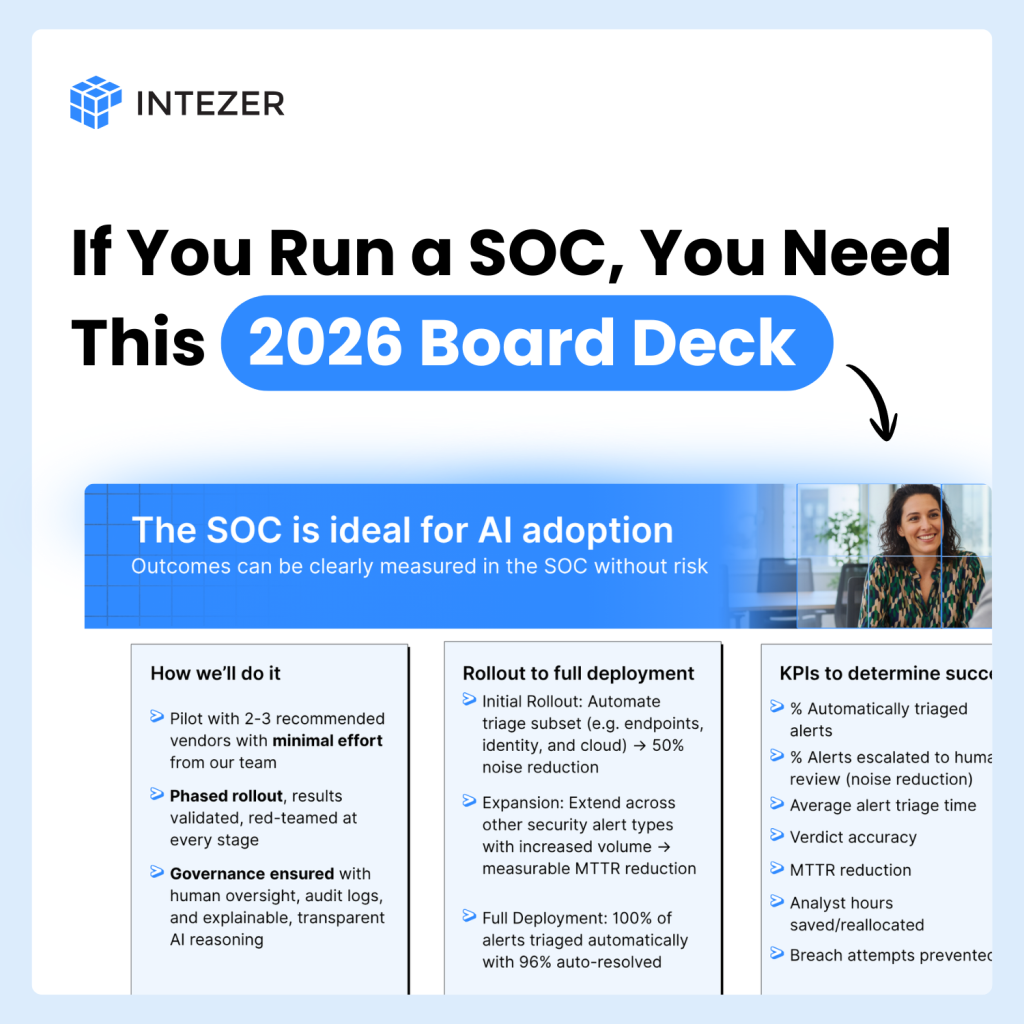
Get your editable copy of the one deck you need to pitch your board for 2026 AI SOC budget.

4. Safe automation with human-in-the-loop for high-impact actions

Most leaders are open to selective autonomous remediation, but only in narrow, well-defined, high-confidence scenarios.

For example:

  • Rapid ransomware containment
  • Isolation of clearly compromised endpoints
  • Automatic execution of repeatable hygiene tasks

But for broader or higher-impact actions, CISOs still want human review. The tone was clear:
AI should move fast where appropriate, but never at the expense of control.

5. Integration and practical telemetry coverage

Every leader emphasized that an AI platform is only as good as the data it can consume.

The must-have list included:

  • Cloud telemetry (AWS, Azure, GCP)
  • Identity providers (Okta, Entra ID, Ping)
  • EDR/XDR
  • SIEM logs
  • Ticketing/ITSM
  • Custom threat intelligence feeds

They don’t want a magical AI that promises answers without good data.
They want a connected system that can see across the entire environment.

6. Executive & board alignment with demonstrable ROI

CISOs aren’t implementing AI in a vacuum. Their boards and executive leadership teams are pressuring them from two very different angles:

  • Some are mandating AI adoption as a strategic priority.
  • Others are slowing everything down with extensive governance, risk, and compliance processes.

To navigate this dynamic, CISOs need clear, defensible ROI:

  • Reduced operating costs
  • Faster mean-time-to-respond
  • Fewer escalations
  • More predictable outcomes

AI without measurable value is no longer acceptable.
They need something they can put in front of the board and say, “Here’s the impact.”

7. Accountability and legal clarity

Before enterprises allow AI to autonomously take security actions, CISOs need a fundamental question answered:

“Who is accountable when the AI acts?”

This isn’t just a theoretical concern. It’s a gating requirement for adoption.

Until there is clear guidance on liability, responsibility, and governance, many organizations will keep AI on a tight leash.

Closing thoughts

Across all of these conversations, the message was consistent:
AI in the SOC is inevitable, but it must be safe, transparent, integrated, and measurable.

CISOs aren’t looking for science fiction. They’re looking for credible, operational AI that enhances their teams, strengthens their defenses, and aligns with business realities.

Read about why the best LLMs are not enough for the AI SOC.

The post The 7 CISO requirements for AI SOC in 2026 appeared first on Intezer.

  •  
❌