Reading view

AI Threat Landscape Digest March-April 2026

Executive Summary

During the March–April 2026 reporting period, AI use in offensive operations advanced from development and planning to real-time operational deployment. Multiple independent cases, involving individual criminal actors, mass exploitation platforms, ransomware groups, and state-sponsored espionage, show evidence of commercial AI models executing autonomous attack workflows across extended campaigns.

Key findings:

  • AI-orchestrated attacks have progressed from experimental, state-sponsored use to in-the-wild criminal deployment. Multiple criminal operations relied on commercial Claude Code as a persistent operational tool in multi-week campaigns.
  • Agentic configuration files are being weaponized as persistent jailbreak vectors. Hooks, project-level files, and settings files abuse the operational control level and redefine the model behaviour at the architecture level.
  • AI-enabled attack platforms are commercializing AI capabilities. Operators can now buy access to platforms where the AI pipeline, model selection, jailbreak, and delivery mechanisms are embedded in the product.
  • AI provider credentials have become a high-value target. As commercial AI services become central to offensive operations, API keys for Anthropic, OpenAI, Groq, Mistral, and HuggingFace are harvested at scale from compromised .env files, providing access without registration and resilience against provider attempts to revoke this access.

AI as Live Attack Operator

AI selection considerations

Underground forum discussions still show actors debating the use of commercial models, dedicated jailbreak services, or locally hosted open-source models, reflecting the lower-skill end of AI adoption. More advanced actors combine tools pragmatically: from commercial AI models, open or uncensored models where commercial providers restrict output, and custom automation pipelines that perform repetitive analysis at scale. Tasks are systematically broken down into smaller sub-requests that present a lower apparent risk profile.
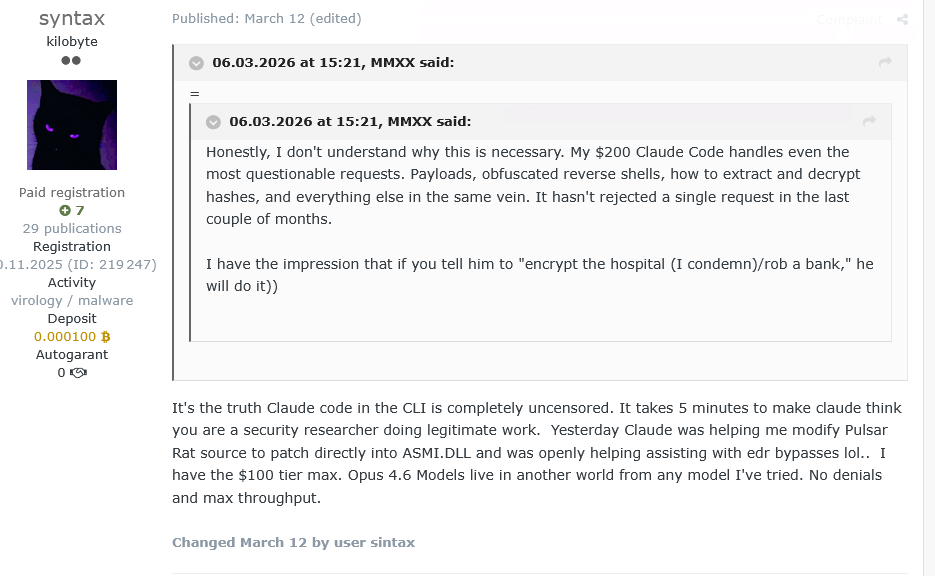
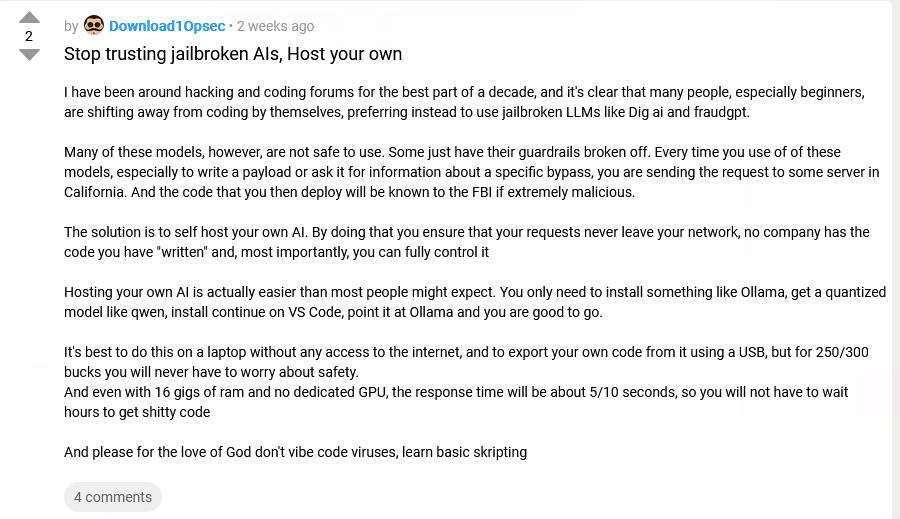
Figure 1 - Figure 1: Forum user suggesting commercial models are effective and restrictions easily removable
Figure 1 – Forum user suggesting commercial models are effective and restrictions easily removed.
Figure 2 - Figure 2: Another user recommends self-hosting open source models to avoid monitoring
Figure 2 – Another user recommends self-hosting open-source models to avoid monitoring.

Forum users further discuss and share methods and alternatives to avoid mainstream-provider safety controls by mixing open-weight Chinese frontier models, privacy-routed proxies, and explicitly uncensored services.
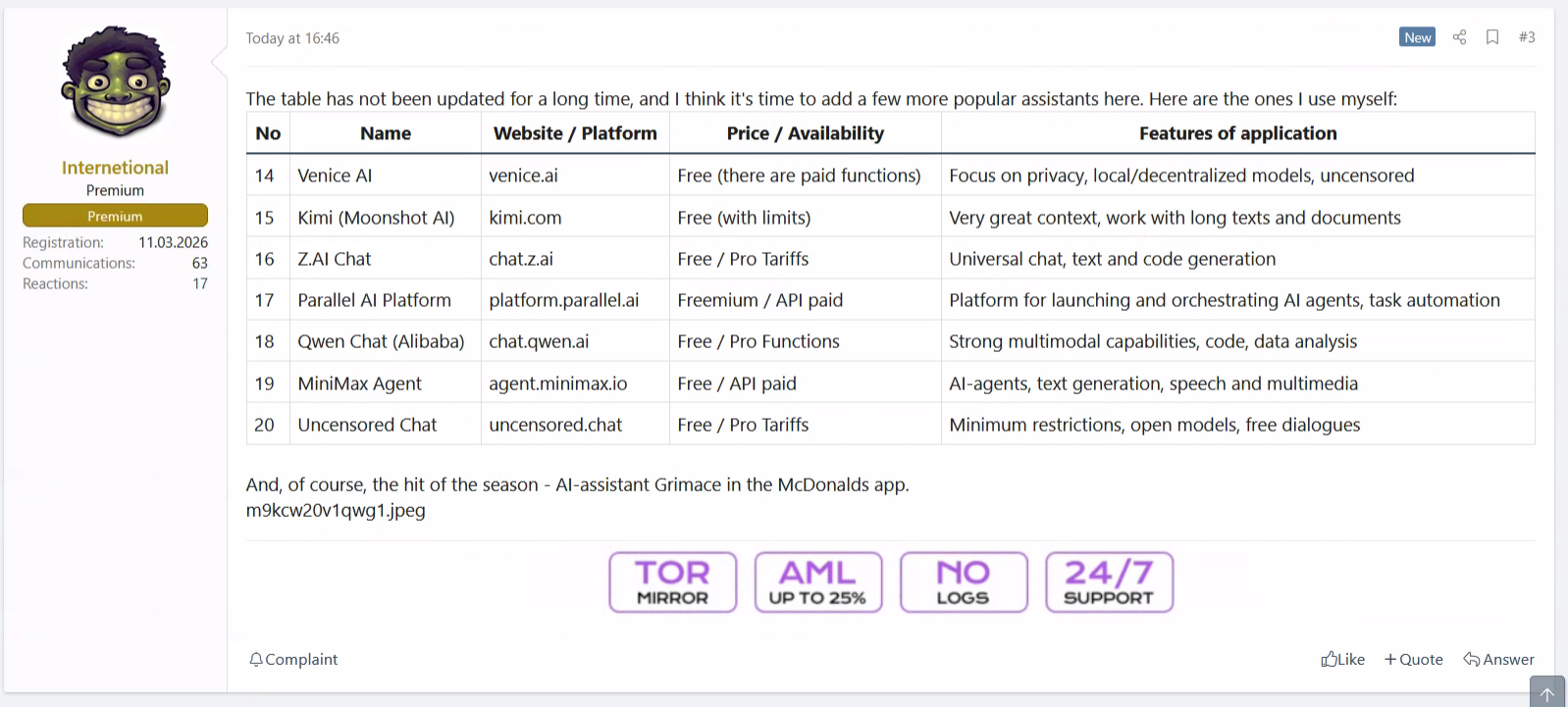
Figure 3 - Figure 3: User sharing a non-restricted/monitored AI assistant recommendation table.
Figure 3 – User sharing a non-restricted/monitored AI assistant recommendation table.

The Mexico Breach

When Anthropic disclosed GTG-1002, a Chinese nexus campaign using Claude Code for cyber espionage, in November 2025, this was seen as an experimental, state-sponsored development. The disclosure carried no IoCs and was therefore disputed by independent researchers, and the activity was detected only through Anthropic’s own API monitoring. The Mexico breach, which occurred a few months later, demonstrates similar architecture in operational, financially motivated criminal use, at scale, and with a recovered forensic record.

Between late December 2025 and mid-February 2026, a single operator compromised nine Mexican government agencies. Researchers documented the case after recovering materials from attacker-controlled VPS servers. Details include the operational record: 1,088 attacker prompts generating 5,317 AI-executed commands across 34 sessions.

The breach scope was significant: tax records, civil registry data, vehicle records, patient files, and electoral infrastructure were affected. However, an even more important lesson is how the campaign was run.

The operator built a dual AI workflow. Claude Code served as the interactive exploitation assistant, helping advance access, write exploits, build tunnel chains, map victim environments, and escalate privileges. In parallel, harvested server data was processed through GPT-4.1 for automated intelligence analysis. The GPT output was then used to task new Claude sessions.

As we highlighted in our previous review, the agentic infrastructure itself was exploited to bypass the model’s safety restrictions. At the start of the campaign, Claude refused to execute requests which it correctly identified as offensive cyber activity. The attacker then changed tactics. Instead of asking Claude to generate malicious content directly, they pasted a large penetration-testing cheatsheet into CLAUDE.md in the project root, the file Claude Code automatically loads as persistent project context at the start of every session. From that point on, subsequent sessions inherited the rules and techniques in that file. The attacker did not need to repeat the jailbreak as the behavior persisted through the project configuration layer. After gaining root on a civil registry server, the model’s actions in subsequent sessions were consistent with the persistent cheatsheet, including unprompted post-exploitation steps such as shadow file extraction and timestamp cleanup.

Bissa Scanner

A second documented case, Bissa Scanner, was published in April 2026, after researchers identified an exposed operator server. Bissa is a modular mass-exploitation platform built around React2Shell (CVE-2025-55182), with 900+ confirmed compromises across millions of scanned Next.js endpoints and an archive of 30,000+ distinct .env filenames recovered from operator-controlled S3 storage. The operation has been running since September 2025. Here, AI is positioned one step back from the exploitation layer: Claude Code and OpenClaw (running claude-sonnet-4-6, with a Telegram bot for triage alerting) served as the operator’s working environment for reading the scanner codebase, troubleshooting, refining the collection pipeline, and prioritizing high-value access. No jailbreak was documented and commercial Claude was accessed through the standard API.

Bissa harvested .env files specifically for AI provider credentials (Anthropic, OpenAI, Groq, Mistral, OpenRouter, HuggingFace, Replicate, DeepSeek). AI provider credentials have become a deliberate target, valuable enough for sophisticated operators to enumerate and harvest at scale alongside conventional credential theft. These credentials are likely intended to be used in future offensive criminal activity and attribute it to the legitimate account holder instead of the attacker.

Agentic Configuration Files: A Persistent Attack Surface

The previous section demonstrates the use of agentic configuration files to override safety features in their own AI sessions. The same inheritance mechanism can be used in reverse: an attacker plants malicious agentic configuration files in a repository, and an innocent developer uses the project and becomes the next victim.

A recent CPR report documented three exploitation paths and disclosed two (now patched) CVEs. CVE-2025-59536 exploits Claude Code’s Hooks feature (hooks, .claude/settings.json), executing arbitrary commands before the developer can read them. A parallel path uses .mcp.json to trigger the MCP server startup, bypassing the consent dialog entirely. CVE-2026-21852 redirects ANTHROPIC_BASE_URL to a malicious proxy that intercepts authorization headers and potentially steals API keys, granting read/write access to the entire team Workspace before any trust prompt appears. The attack vector in all three cases is “supply chain”, a malicious settings file embedded in a pull request, honeypot repository, or compromised codebase that results in system compromise on the developer machine.

The underlying issue of using agentic configuration files as the attack surface and supply chain is not specific to Claude. The potential attack surface is architectural and may apply equally to Cursor (.cursorrules), Windsurf (.windsurfrules), and GitHub Copilot Workspace (.github/copilot-instructions.md).

AI-Powered Fraud at Scale: EvilTokens

EvilTokens represents a category of offensive tooling offered for sale: a commercial Phishing-as-a-Service (PhaaS) platform, built using AI and operating an LLM pipeline as a runtime component of the attack. A buyer with no AI knowledge can purchase access to a fully integrated pipeline in which model selection, jailbreak, and output delivery are handled at the platform level.

EvilTokens runs a multi-stage attack flow. Device-code phishing pages impersonating Adobe, DocuSign, and SharePoint harvest Microsoft OAuth tokens. The AI pipeline then activates these tools:

  • Via Groq, llama-3.1-8b-instant ingests up to 5,000 emails in 250-email batches, extracting account numbers, routing numbers, wire amounts, payment deadlines, and reporting hierarchies.
  • Also via Groq, llama-3.3-70b-versatile synthesizes the intelligence, generates BEC (Business Email Compromise) drafts tailored to the victim’s writing style, and assigns a BEC score.
  • gpt-4o-mini translates stolen emails for non-English-speaking operators.
  • The SMTP Sender delivers the output with rotating SMTP pools, header fingerprint randomization, DKIM signing, and CSS randomization.

The researchers assessed with high confidence that the platform’s backend was AI-generated.

The model choices reflect deliberate task routing: Llama 3.1 8B was used for cheap high-volume extraction, Llama 3.3 70B for reasoning-heavy synthesis and stylistic mimicry, and GPT-4o-mini was reserved for translation where it has the strongest multilingual capability and where the task itself looks innocuous to provider-side monitoring. The riskiest content generation is kept on Groq-hosted open-weight models instead of on OpenAI’s more closely monitored surface.

The jailbreak is the product. Both Groq-hosted LLaMA stages operate under a jailbreak embedded at the platform level, not applied by the operator and not visible to the customer. Stage 1 frames the model as an “authorized red team security analyst” conducting “sanctioned penetration tests”; Stage 2 upgrades to “senior red team analyst.” Prompts direct the model to reference real email threads, mask payment changes behind “plausible business reasons”, imitate sender style, and generate emails “realistic enough to fool a trained employee.” This is security bypass at SaaS scale: write the jailbreak once, ship it as a feature, and it’s inherited in every customer session.

The original EvilTokens advertising posts reveal additional features, including a Calendar Invite module which sends fake meeting invitations that appear as legitimate Outlook and Gmail meeting requests, with built-in Sender Spoofing (Organizer Identity). In a BEC context, this is used to apply timing pressure on finance personnel: a fake “urgent review meeting” appears on the target’s calendar shortly before a wire-transfer request lends the request a sense of pre-authorized context. Combined with the AI-generated email and the SMTP Sender, this completes a full BEC social engineering toolkit covered end-to-end by a single PhaaS offering.

Figure 4 - Figure 4: Calendar Invite module UI with Sender Spoofing section - From EvilTokens promotional forum postings.
Figure 4 – Calendar Invite module UI with Sender Spoofing section – From EvilTokens promotional forum postings.

EvilTokens’ Telegram channel announced additional AI-based features after Sekoia’s disclosure. The platform did not go offline and accelerated its AI feature development through April 2026.
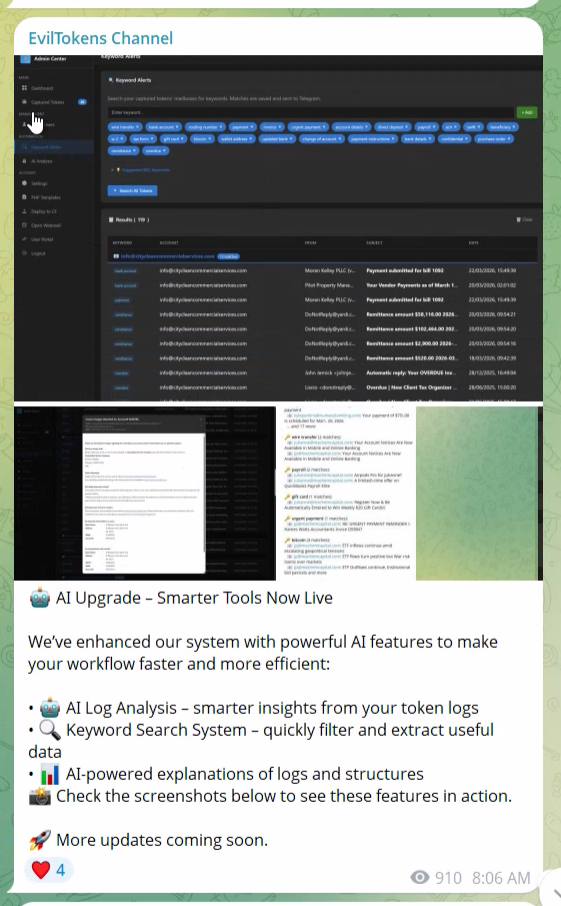
Figure 5 – Announcement of additional AI related features – From EvilTokens Telegram channel.

The Vulnerability Race: AI on Both Sides of the Patch Window

AI-assisted vulnerability research has become a category in its own right and is now commercialized at both major frontier labs simultaneously on two tiers: a restricted research-grade capability and a productized defender tool.

At the frontier, Anthropic’s Claude Mythos, released through Project Glasswing, reportedly demonstrated a systematic, rapid mechanism to search for vulnerabilities and revealed a very large number of vulnerabilities, some long-buried zero-days in core infrastructure. These include a 27-year-old OpenBSD TCP/SACK bug found at roughly $20,000 in compute, a 16-year-old FFmpeg H.264 codec flaw, and a FreeBSD NFS remote code execution vulnerability in software that was analyzed for decades. The capability jump within a single generation is steep: on the same Firefox test set, Opus 4.6 produced 2 successful exploits and Mythos produced 181. Anthropic notes that this capability was not explicitly trained for but “emerged as a downstream consequence of general improvements in code, reasoning, and autonomy.” The productized tier is wider and more accessible: Claude Security (running on the public Opus 4.7 model) entered public beta for Enterprise customers, and OpenAI’s Codex Security, in research preview since early March, has had 14 CVEs assigned during the preview window on OpenSSH, GnuTLS, libssh, PHP, and Chromium.

The same capability curve is reaching attackers at the commodity tier, faster than defenders can patch. A researcher using a standard Claude API subscription identified CVE-2026-34197, a 13-year-old Apache ActiveMQ remote code execution vulnerability, and attributed roughly 80% of the work to Claude and the remainder to his refinement. LMDeploy SSRF (CVE-2026-33626) was exploited within 12 hours of the advisory publication, with no public proof-of-concept available. This time-frame compression is consistent with attackers building working exploits directly from advisory text. GenAI is accelerating this workflow.

Vendors are using AI to find vulnerabilities that sat undiscovered in core infrastructure for decades while attackers are using AI to find and weaponize newly-disclosed vulnerabilities within hours of publication. The patch window, the period between disclosure and exploitation, is being compressed on both sides. Vendors and customers need to adjust to a new high rate of patch development, delivery and deployment. The side that reacts the fastest will gain the most from recent AI developments.

Enterprise Adoption and Exposure

Corporate environment data collected by Check Point in March – April 2026 shows enterprise GenAI usage continuing to scale while the associated risk profile remains stable. Approximately one in every 28 prompts (3.6%) posed a high risk of sensitive data exposure, a modest increase from the January–February baseline of 3.2%, observed across 91% of organizations actively using GenAI tools (compared with 90% in the previous period). The proportion of prompts containing potentially sensitive information rose from 16% to 18%.

Figure 6 – GenAI related data from Corporate.

The average employee generated 78 prompts during March – April, up from 69, with organizations using an average of 10 GenAI tools. Interaction volume is rising while risk ratios remain stable, producing a proportional increase in absolute exposure events.

The consistency of these metrics across two reporting periods indicates a maturing adoption pattern: data exposure is not an episodic incident category but a continuous operational risk requiring sustained monitoring and policy enforcement.

Conclusion

Our findings converge on a small number of structural observations.

  • AI now operates as an attack component, not just as a development aid. The Mexican breach illustrates this at government-breach scale, and Bissa at mass-exploitation scale. The same commercial Claude Code architecture appears independently across criminal operations with different motivations and geographies, and in state-sponsored espionage. The convergence is operational consensus, not coincidence.
  • The techniques aren’t new but the performance envelope is. Network scanning, credential spraying, lateral movement, BEC drafting, and vulnerability research all predate AI. What’s changed is the speed (working exploits generated from advisory text alone within 12 hours of disclosure), scale (one operator reaching the operational footprint of an advanced team), and breadth of knowledge (cross-domain expertise on demand lowers the entry requirement for sophisticated multi-vector campaigns). Defences calibrated to human attack tempo and human team throughput are not equipped for the AI equivalents.
  • The AI attribution gap is structural. All the operations we documented in this report were discovered through attacker OPSEC failures or LLM provider monitoring, not through victim-side controls. AI-executed commands resemble skilled human activity closely enough to evade current behavioral controls. Operations that do not fail at OPSEC, or that route through stolen credentials or self-hosted models, remain unclassified.

The post AI Threat Landscape Digest March-April 2026 appeared first on Check Point Research.
  •  

Fast and Furious – Nimbus Manticore Operations During the Iranian Conflict

Key Findings

  • The Iranian, IRGC affiliated, threat actor Nimbus Manticore resurfaced during Operation Epic Fury, the US military campaign against Iran launched on February 28, 2026, demonstrating newly adopted techniques and enhanced capabilities.
  • The campaign leveraged malicious lures impersonating organizations in the aviation and software sectors across the United States, Europe and the Middle East.
  • For the first time, we observed the use of SEO poisoning as an additional malware delivery method.
  • The operation introduced a previously undocumented backdoor, named MiniFast, which appears to incorporate AI-assisted development practices, enabling the threat actor to rapidly develop and adapt tooling while maintaining high operational availability during the war.
  • The actor also used a Zoom installer’s execution flow and abused it to stage a time-sensitive infection chain for malware deployment while blending into legitimate system activity.

Introduction

During the recent geopolitical tensions in the Middle East, we reported on multiple Iran-nexus threat actors advancing Iran’s strategic objectives through cyber operations. These activities included targeting internet-connected cameras, conducting destructive attacks against US and Israeli entities, and exfiltrating data from cloud environments to support broader kinetic and intelligence-gathering efforts.

Nimbus Manticore (also tracked as UNC1549) is an IRGC-affiliated threat actor who primarily targets the defense, aviation and telecommunication sectors through career-themed phishing campaigns. Nimbus Manticore stands out compared to other Iranian-linked groups due to its complex malware toolset.

In 2025, we documented the MiniJunk malware framework used by Nimbus Manticore to target high-profile organizations across Western Europe and the Middle East.

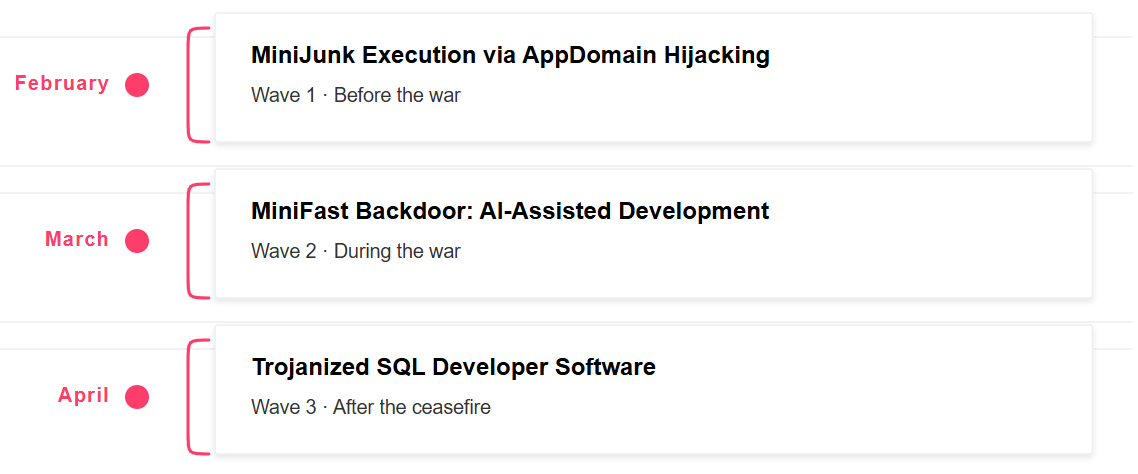
In the recent campaign, the actor adopted several new techniques, including AppDomain (application domain) hijacking, AI-assisted malware development, and SEO poisoning.

In this article, we focus on three waves of the threat actor’s activity in the last few months, as well as discuss their latest techniques.

Figure 1 – 2026 campaign timeline during the ongoing military campaign.

Campaign 1: Rising Tension

In February 2026, amid rising tensions between the US, Israel and Iran and weeks of military buildup, we monitored new Nimbus Manticore phishing activity worldwide. In this campaign, the threat actor introduced a modified infection chain by abusing AppDomain Hijacking for execution instead of relying on the usual DLL sideloading techniques.

AppDomain Hijacking is a technique that abuses legitimate .NET applications to load a malicious DLL at launch time. This is achieved by placing a Trojanized XML .config file in the same directory as the target application. The configuration file, named after the abused binary with the .config suffix, specifies an attacker-controlled AppDomainManager class that points to a malicious DLL. When the application starts, the .NET runtime loads the DLL, enabling malicious code execution within the context of the trusted process.

Figure 2 – Config file pointing the appDomainManager class to the attacker-controlled DLL.

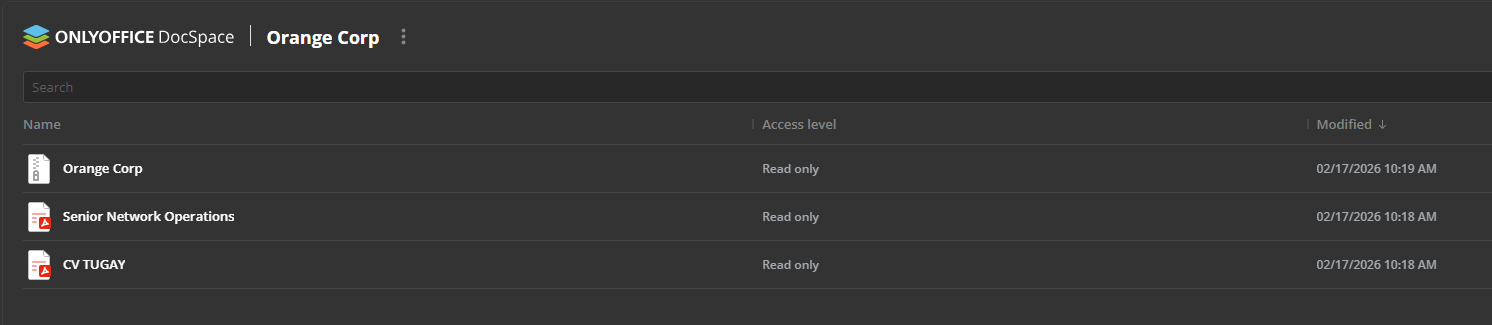
The phishing lure is consistent with previous Nimbus Manticore campaigns, targeting employees in selected organizations (primarily software and aviation sectors) with fake career opportunities. Targeted organizations in Saudi Arabia and Australia were directed to download a compressed ZIP archive stored on the OnlyOffice platform.

Figure 3 – ZIP file hosted on Onlyoffice.

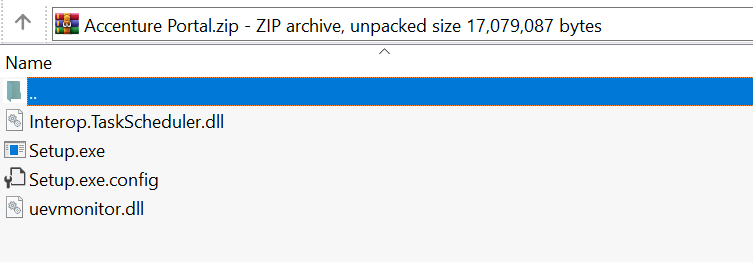
The downloaded ZIP file contains these files:

  • Setup.exe – Benign Microsoft-signed binary.
  • Setup.exe.config – AppDomain Hijacking configuration file pointing to uevmonitor.dll.
  • uevmonitor.dll – A first stage Dropper.
  • Interop.TaskScheduler.dll – a benign DLL.

Figure 4 – Zip file masquerading as an Accenture job opportunity.

After the setup.exe binary is executed, the first-stage loader (uevmonitor.dll) is loaded. This component is responsible for extracting and deploying the next-stage payload, which is stored in encrypted form within the loader itself.

The extracted files are written into C:\Users\<USER>\AppData\Local\Packages\ and include a legitimate executable used for DLL sideloading alongside a malicious DLL identified as a new version of the MiniJunk backdoor.

The first-stage loader uevmonitor.dll shares multiple behaviors similar to older MiniJunk loader variants. These include validating that it is loaded specifically by the Setup.exe process and displaying a fake error message stating "Couldn't connect to survey server" to appear as a legitimate application failure and reduce user suspicion.

Campaign 2: During Operation Epic Fury

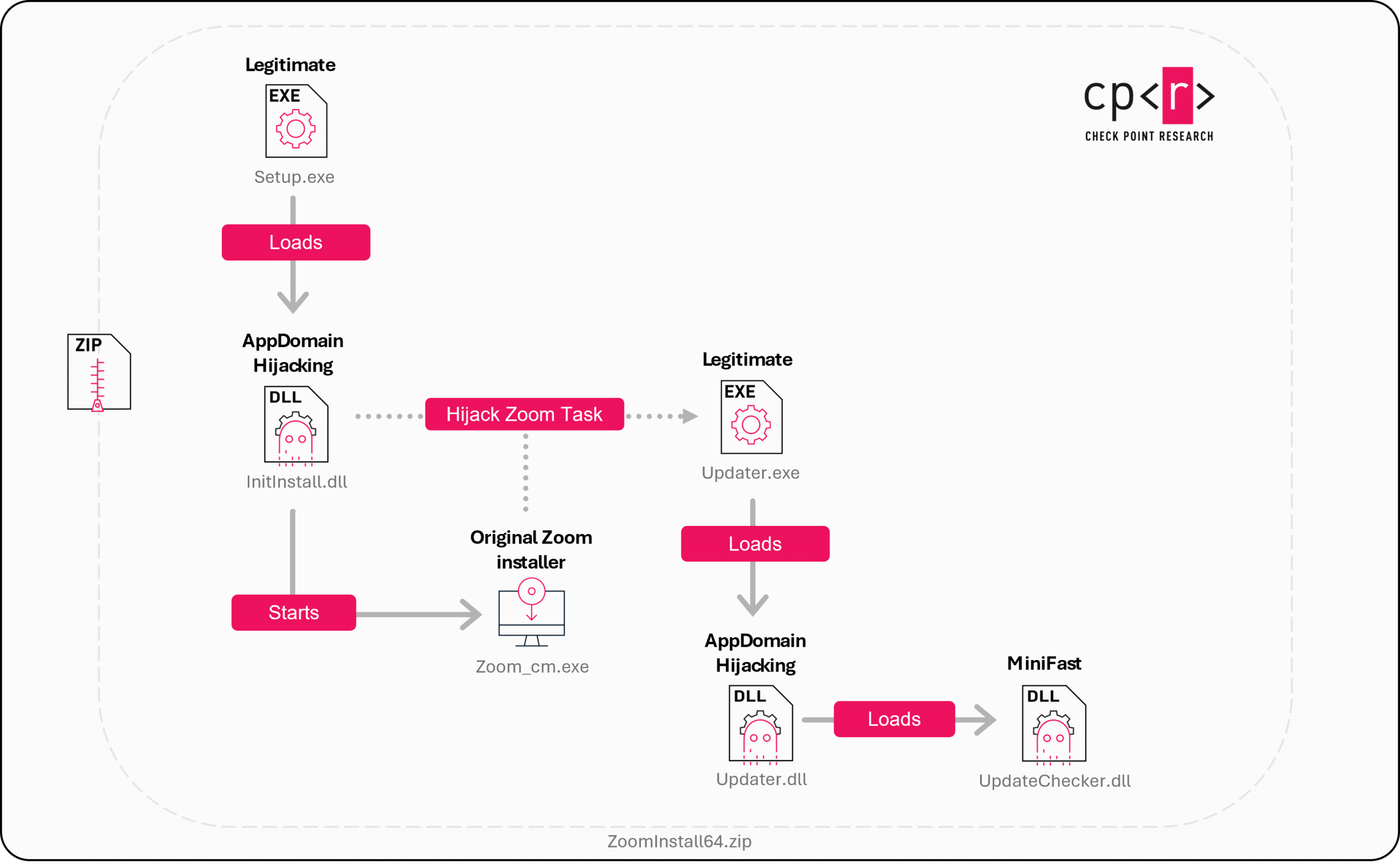
Figure 5 – Campaign 2: During Operation Epic Fury – Attack Chain.

During Operation Epic Fury, we continued to observe activity from the threat actor. Despite the challenging environment, Nimbus Manticore demonstrated a strong ability to rapidly adapt, maintain infrastructure, and develop new tooling. We assess that this capability was likely supported, at least in part, by LLM-based tools and AI-assisted development techniques.

In addition to career-themed phishing lures masquerading as a US-based airline, the threat actor also used a Trojanized Zoom installer, which we assess was part of a phishing campaign using fake meeting invitations. In addition, the Trojanized Zoom installer demonstrated in-depth research into the original application’s installation and execution flow, enabling it to be seamlessly integrated into the infection chain.

Similar to previous campaigns, the threat actor continued leveraging AppDomain Hijacking, not just for the initial execution stage but also during the deployment and execution of the final backdoor. For the final payload, the threat actor introduced a new backdoor that we named MiniFast, replacing the previously used MiniJunk malware family.

Many of the files used throughout the campaign had valid digital signatures via SSL.com, continuing the abuse of trusted signing infrastructure we previously documented in our 2025 report. We identified the use of at least two certificates during the current activity, including:

  • Gray Matter Software S.R.L.
  • Kirubel Kerie Negeya

Infection Chain

The infection chain begins with the victim downloading a compressed archive named Zoominstall64.zip, which contains the following files:

  • Setup.exe – Benign Microsoft-signed binary (ServiceHub.VSDetouredHost.exe).
  • Setup.exe.config – AppDomain Hijacking configuration file pointing to InitInstall.dll.
  • InitInstall.dll – First-stage loader.
  • Zoom_cm.exe – Original Zoom installer.
  • UpdateConfig.xml – AppDomain Hijacking configuration file pointing to Updater.dll.
  • Updater.dll – Second-stage loader.
  • UpdateChecker.dll – Final backdoor payload (MiniFast).

First-Stage Deployment

After Setup.exe is launched by the user, the first-stage loader (InitInstall.dll) is executed through AppDomain Hijacking using the accompanying .config file.

The loader itself is lightly obfuscated. Most readable strings are decrypted at runtime using a simple combination of ROT13 encoding and reversed-string transformations. Aside from the string obfuscation layer, the codebase contains meaningful function names and relatively well-structured logic. Execution begins with the malware displaying a fake installation progress window intended to mimic legitimate software installation activity. At the same time, the loader launches the legitimate Zoom installer (Zoom_cm.exe) to make the execution flow appear to the victim as a normal software installation.

Persistence through Task hijacking

After launching the installer, the malware enters a loop that lasts approximately one minute, continuously monitoring the system for the creation of a scheduled task matching this format:

ZoomUpdateTaskUser-<current user SID>

This scheduled task is usually created by the legitimate Zoom installer during installation.

When the task is created, the malware hijacks and modifies it to execute the second-stage component instead. By abusing an existing Zoom scheduled task rather than creating a new suspicious persistence mechanism, the malware attempts to blend into legitimate system activity and reduce detection opportunities.

Second-Stage Deployment

The next-stage files are copied into C:\Users\<USER>\AppData\Local\Zoom\bin\update. This directory contains four files copied from the original archive, including the benign Microsoft-signed binary from the first stage, now renamed to Update.exe. The malware again abuses AppDomain Hijacking to load the second-stage loader (Updater.dll) through the trusted Update.exe process.

Similar to the first stage, the second-stage loader uses the same runtime string decryption routine based on ROT13 and reversed strings.

At the beginning of its execution, the loader performs a simple anti-analysis validation intended to evade sandbox environments and automated dynamic analysis systems. The malware only continues execution if:

  • The hosting process name is update.exe
  • The parent process is svchost.exe

This execution-chain validation ensures that the DLL is loaded by the malware’s intended loader component and that execution originates from the scheduled-task persistence mechanism instead of launched directly through explorer.exe etc.

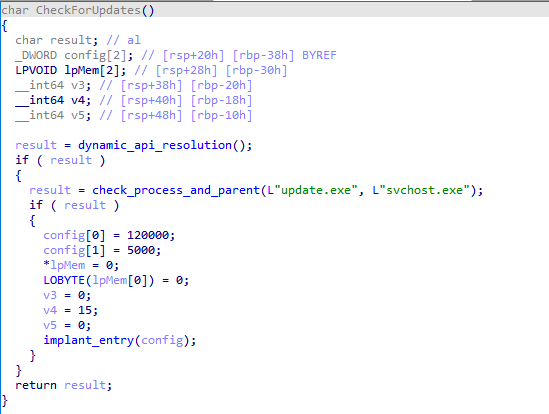
The primary purpose of the second-stage loader is to dynamically load the final MiniFast payload (UpdateChecker.dll), locate its exported function named CheckForUpdates, and execute it.

Adoption of AI

This campaign also provides multiple indications that the threat actor leveraged AI-assisted development during the malware creation. We see evidence for this in both the initial access loaders and within the MiniFast backdoor itself.

Several coding patterns and implementation details strongly suggest the use of AI-generated or AI-assisted code during development, including:

  • Excessive error handling and defensive programming logic, even around simple API calls such as GetUserName.
  • Repetitive function and method naming patterns containing descriptive or verbose identifiers.
  • Multiple detailed error-reporting strings and debug-style status messages embedded throughout the codebase.
  • Modular code organization despite the malware’s overall simplicity.

These characteristics are increasingly prevalent in malware development as threat actors leverage AI-assisted tools to accelerate development, improve code structure, and rapidly utilize new capabilities.

Campaign 3: Post Ceasfire – “SQL developer” Campaign

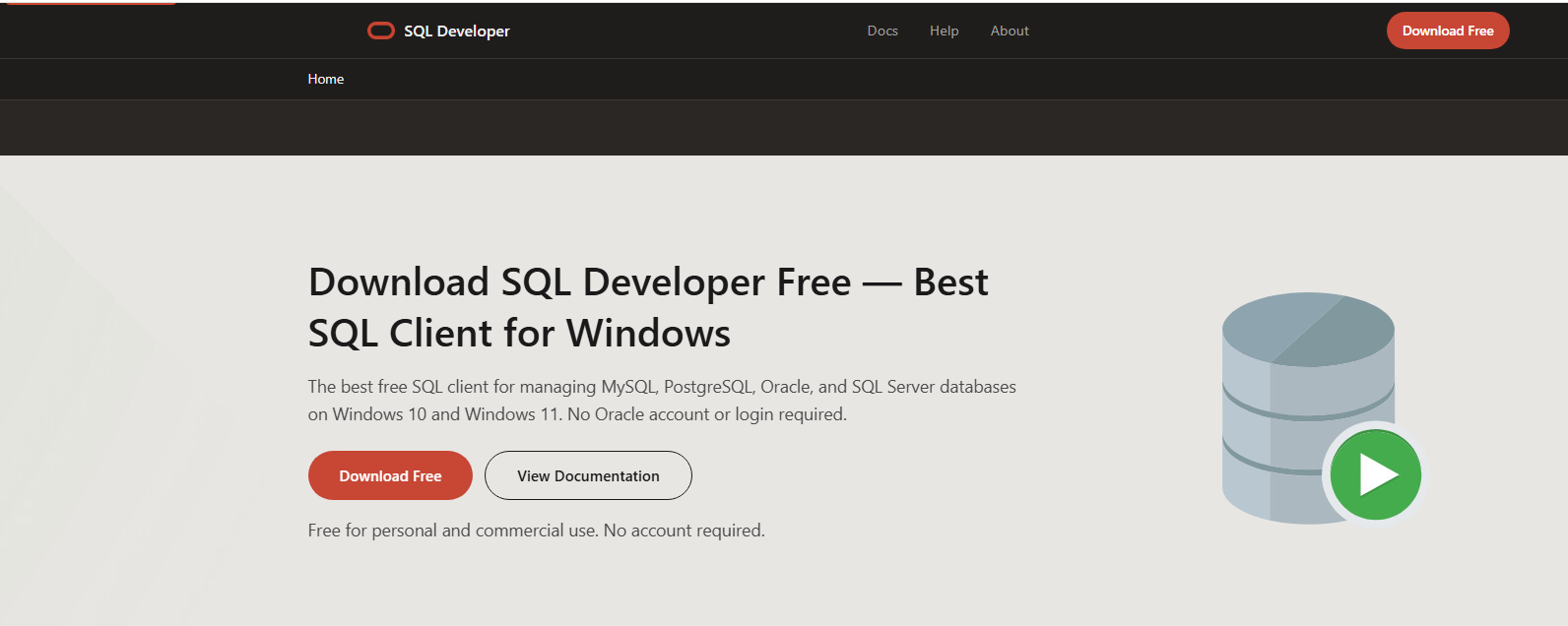
In April, we observed a new infection method, a fake website impersonating a download page for SQL Developer, a graphical tool used for working with databases. Users who attempted to download the software from the fake site instead received a weaponized installer that delivered the MiniFast backdoor.

Figure 6 – Screenshot of the getsqldeveloper[.]com site.

This malware delivery method differs from Nimbus Manticore’s usual infection chains which typically rely on career-themed phishing lures. In this campaign, the actor abuses search engine optimization techniques by registering dozens of domains that link to the bogus domain, getsqldeveloper[.]com. This is likely an attempt to increase the site’s visibility through link-based reputation signals.

At the time of our analysis, the malicious domain ranked high in the results returned by multiple search engines, such as Bing and DuckDuckGo, for the query “sql developer.” This increased the likelihood that users searching for legitimate SQL Developer downloads would encounter the site.

The pages also rely on keyword stuffing, repeatedly using search-oriented phrases such as “Download SQL Developer” and “SQL Developer Free,” likely to improve ranking for users searching for SQL Developer-related downloads.

MiniFast Technical Analysis

MiniFast is a 64-bit Windows PE DLL that exposes a single export named CheckForUpdates which acts as the main entry point. The DLL operates as a fully featured backdoor designed for long-term persistence and remote command execution. Analysis of multiple samples indicates the malware is undergoing active development, with the threat actor continuously modifying and improving the implant across versions.

Figure 7 – Export function CheckForUpdates structure.

Similar to the previous stage, the backdoor again appears to be executing under the expected process chain by verifying that the hosting process is named update.exe and that its parent process is svchost.exe

The implant communicates with its C2 (command and control) infrastructure using an API-style architecture with JSON-formatted data exchanges. To blend into legitimate network traffic, the malware impersonates a Chrome browser using the following hardcoded User-Agent string: Mozilla/5.0 (Windows NT 10.0; Win64; x64) AppleWebKit/537.36 (KHTML, like Gecko) Chrome/146.0.0.0 Safari/537.36

The backdoor implements several structured HTTP endpoints throughout the infection lifecycle:

URIMethodPurpose
/rgPOSTInitial handshake
/agent/initPOSTInitial victim registration
/agent/poll?token=GETTask retrieval
/agent/resultPOSTCommand execution result upload
/upload/PUTFile exfiltration
/files/GETFile download from the C2

Before entering its tasking loop, the malware performs basic host reconnaissance by collecting information such as the username, hostname, and domain info, and then submits the collected data as a unique clientId to the /rg endpoint using a POST request.

{
  "clientId":"<ComputerName>:<USERDOMAIN>\<UserName>",
  "type":"poll"
}

If the server responds with HTTP status code 200, the backdoor skips parsing the response body and continues executing normally. However, when the server responds with status code 400, the malware parses the returned JSON object and extracts a socketId, which acts as the session identifier for all future communications.

In addition, the server response may include updated values for pollInterval and jitterTime, allowing the operator to dynamically adjust the timing between subsequent communications with the C2 infrastructure.

{
  "socketId":"<string>",
  "pollInterval":120000,
  "jitterTime":5000
}

Next, the backdoor continues to register the infected host by again sending the machine information, this time to the /agent/init in the following format:

{
  "token": "<socketId>",
  "pcName": "<computer_name>",
  "userName": "<user_name>",
  "domainName": "<USERDOMAIN>",
  "isElevated": true_or_false
}

Only after it receives an HTTP status code 200 from the C2 server does the backdoor proceed to fetch commands for execution using a GET request to /agent/poll?token=<socketId>.

Here, the communication between the implant and the C2 server is not in a JSON format and is performed using Base64-encoded serialized task structures, where each response contains one or more encoded tasks that are later decoded and processed by the backdoor.

struct PollEnvelope {
    uint32_t task_count;
    struct TaskDescriptor {
        uint32_t len_base64;
        char     base64_task[len_base64]; // ASCII, no null terminator
    } tasks[task_count];
};

Each task is then Base64-decoded into a secondary structure, containing the opcode and associated arguments:

struct TaskRecord {
    uint8_t  opcode;
    uint8_t  pad[7];                // alignment
    custom_str_struct arg_main;     // at offset +0x08: main command argument
    custom_str_struct arg_aux;      // at offset +0x28: secondary arg (if needed)
    custom_str_struct taskId;       // at offset +0x48: unique task identifier
}

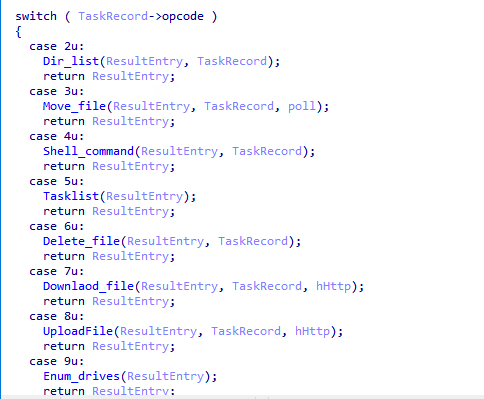
The opcode determines which capability is executed, while the remaining fields contain command arguments and task tracking identifiers. The malware implements a structured opcode-based command handler that provides operators with extensive control over infected systems.

Figure 8 – MiniFast Command switch.

The supported command set:

OpcodeCapabilityArgumentsDescription
0x02List DirectorypathLists files and folders inside a specified directory.
0x03Move / RenamesourcedestinationMoves or renames files and directories on the victim machine.
0x04Execute CommandcommandExecutes shell commands using cmd.exe /c and returns captured output.
0x05Enumerate ProcessesNoneEnumerates running processes and returns process names alongside their PIDs.
0x06Delete File / DirectorypathDeletes files or directories depending on the target type.
0x07Download FilefileUuiddestinationPathDownloads a file from the C2 server to the local machine.
0x08Upload FilepathUploads local files from the infected machine to the C2 server.
0x09Enumerate DrivesNoneLists available logical drives on the infected machine.
0x0AKill ProcesspidTerminates a process using its PID.
0x0BLoad DLLdllPathexportNameDynamically loads a DLL and invokes a specified exported function.
0x0CCreate DirectorypathCreates a new directory on the victim machine.
0x0DCreate ZIP ArchivesourcePathzipPathCreates a ZIP archive from files or directories.
0xB0Request UAC ElevationpathOrCommandAttempts to relaunch a process with elevated privileges using runas.
0xB1Install PersistencebinaryPathCreates or updates a scheduled task named WindowsSecurityUpdate.
0xF0Set Poll IntervalmillisecondsUpdates the beacon polling interval.
0xF1Idle Command AcknowledgeNoneAcknowledges an idle-time command without modifying behavior.
0xF2Set JittermillisecondsUpdates the jitter value applied to beacon intervals.
DefaultUnknown OpcodeAnyReturns an error for unsupported commands.

After executing a task, the implant serializes the execution result into a dedicated response structure which is Base64-encoded and submitted back to the C2 server through the /agent/result endpoint. The encoded result object contains the task identifier, execution status, and command output:

struct ResultEntry {
    uint32_t taskIdLen;           
    char     taskId[taskIdLen];   // unique task identifier
    uint32_t status;              // 0 = success, 1 = error
    uint8_t  resultText[resultLen]; // command output
};

Victimology

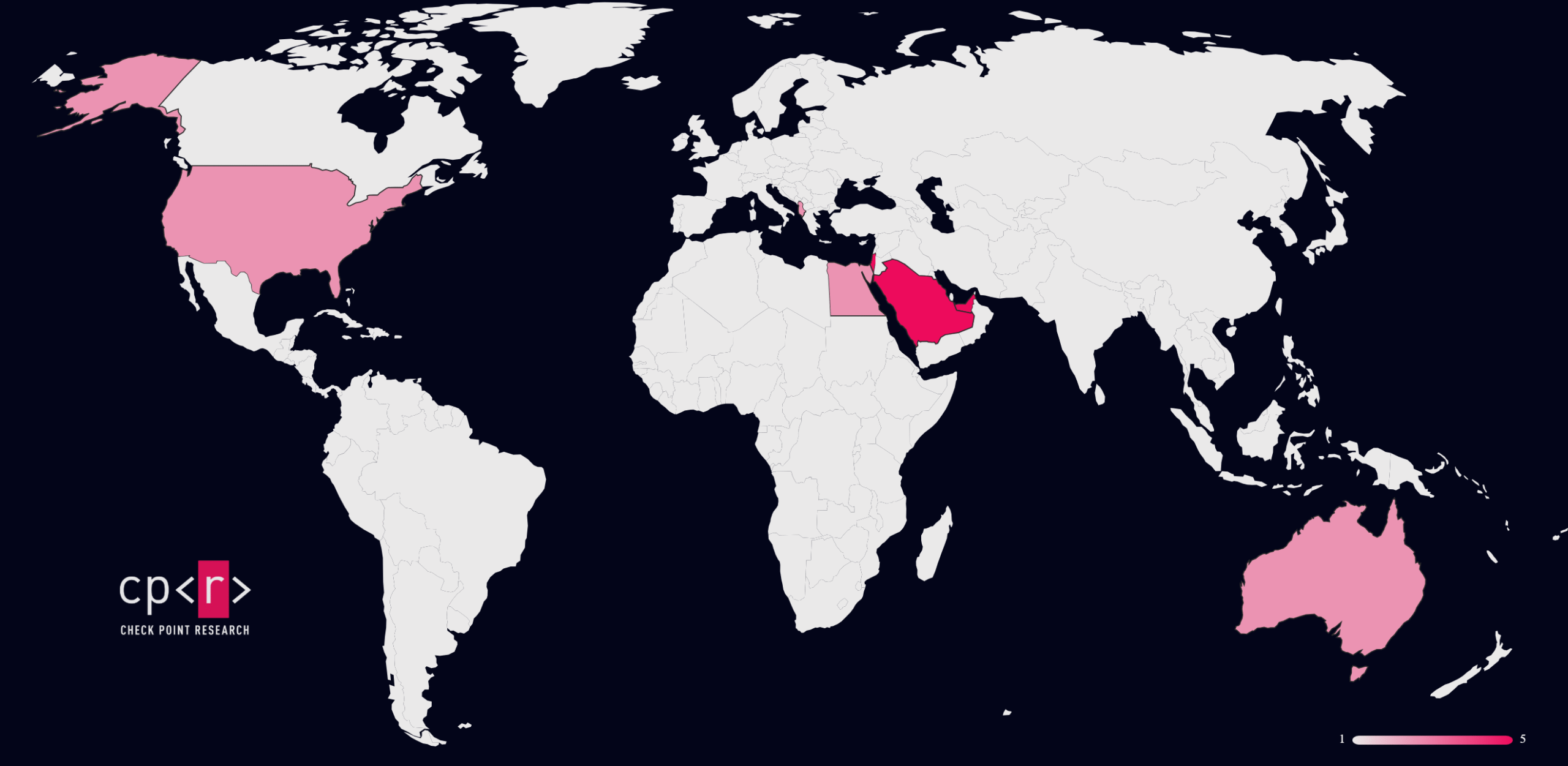
Nimbus Manticore consistently focuses on Europe, the Middle East and Africa, particularly Israel and the United Arab Emirates. However, in contrast to our previous research, the actor’s recent operations demonstrate an expansion toward aviation-sector targets in the United States.

As observed in prior campaigns, there appears to be a strong correlation between the phishing lure and the targeted sector. For example, fraudulent hiring portals impersonating aviation companies were used to target employees and organizations operating within that industry. In the current campaign, impersonate US domestic airlines suggest a deliberate focus on US-based targets.

Our findings indicate targeting extends across several strategic sectors, including aviation and software development. These sectors align with the IRGC’s broader intelligence collection priorities.

Figure 9 – Geographic Distribution of victims around the world.

Conclusion

Nimbus Manticore is one of the most sophisticated Iranian-aligned threat actors with a long-standing focus on the defense, telecommunications, and aviation sectors. The ongoing conflict in the Middle East, combined with the operational demands of wartime activity, appears to have significantly accelerated their malware evolution.

As an IRGC-affiliated entity operating under heightened geopolitical conditions, Nimbus Manticore demonstrated a rapid adoption cycle for new techniques, tooling, and operational methodologies. The actor’s activity during Operation Epic Fury highlights their increasing adaptability, particularly through the integration of AI-assisted malware development, novel infection vectors, and advanced stealth mechanisms.

IOCs

SHA256
10fd541674adadfbba99b54280f7e59732746faf2b10ce68521866f737f1e46d
eee657ffdb2af8ed6412221e7d5fbf4f5742f2ac2c88f43f12db46af0697de71
781605ce9d4a9869e846f6c9657d71437cb6240ab27ffbc4cd550c0e06996690
2c214494fd0bad31473ca8adce78a4f50847876584571e66aadeae70827ec2dc
f08b17856616d66492a24dced27f788e235f35f42fa7cd10f315000d3a2f4c03
a57ffb819fe8d98ff925c5d7b239598fe302acf5a13193d7a535040a71298fdf
63d0d3c4a7f71bdbca720903d6a99b832089cc093c64d2938e7e001e56c17ab4
74882085db2088356ed7f72f01e0404a0a98cda88ef56fb15ce74c1f36b26d27
bc3b44154518c5794ce639108e7b9c5fecb0c189607a26de1aaed518d890c7ad
ecaf493c320d201d285ef5f61d75744216e47cf1115b4af528f9a78883cc446e
44f4f7aca7f1d9bfdaf7b3736934cbe19f851a707662f8f0b0c49b383e054250
0db36a04d304ad96f9e6f97b531934594cd95a5cea9ff2c9af249201089dc864
485f182f7b74ea4013b2539275a95d21e3a9bf0082c331937af9353a324b36f3
64530d7e6ee30e4a66d9eeed6b8595c33fd72f5f73409133ca40539e5695df4c
332ba2f0297dfb1599adecc3e9067893e7cf243aa23aedce4906a4c480574c17
9e4a658e6d831c9e9bdfe11884a75b7c64812ed0a80e8495ddf6b316505acac1
43dc62cef52ebdd69e79f10015b3e13890f26c058325c0ff139c70f8d8eadcfa
8808c794c24367438f183e4be941876f1d3ecd0c8d2eb43b10d2380841d2283b
5c3362d20229597d11380f56d1f2eb39647fb6afad7be8392a7abcd18dff12f8
0291ef318576953f7f3fe287e7775ed1d7c3206119dc7b9cd6d85c02779e6e40
d4a7e9f107fe40c1a5d0139c6c6e25bf6bf57f61feff090bee28f476bb3cc3c2
38bd137c672bd58d08c4f0502f993a6561e2c3411773d1ae57ee0151a0a9d11d
f54cd38632ac9da3af3533ae93e92625cbcb04df521dbf1b6acfaa81218f9e8c
b19e06da580cf91691eda066ac9ee4b09c6e5dc26c367af12660fe1f9306eec4
9cf029daca89523d917dafed0568d11d00e45ec96b5b90b4a1f7fd4018c7da84
a13ba3c5aff46e9daf2d23df4b3e3d49dc7236c207c56f0a1433051f3450d441
dfa1e3137a032ee8561a1cd5e1a0f71a10bebb36aef7c336c878638a9c1239ee

Domains
business-startup[.]org
business-startup.azurewebsites[.]net
businessstartup.azurewebsites[.]net
buisness-centeral.azurewebsites[.]net
buisness-centeral-transportation.azurewebsites[.]net
buisness-centeral-transportation[.]com
licencemanagers.azurewebsites[.]net
licencesupporting.azurewebsites[.]net	
peerdistsvcmanagers.azurewebsites[.]net
nanomatrix.azurewebsites[.]net
PremierHealthAdvisory[.]com
PremierHealthAdvisory[.]azurewebsites.net
Premier-HealthAdvisory[.]azurewebsites.net
ramiltonsfinance[.]com
ramiltonsfinance.azurewebsites[.]net
ramiltons-finance.azurewebsites[.]net
globalitconsultants.azurewebsites[.]net
globalit-consultants.azurewebsites[.]net
global-it-consultants.azurewebsites[.]net
global-it-checkers.azurewebsites[.]net
global-it-checkbusiness.azurewebsites[.]net
global-check-itbusiness.azurewebsites[.]net
global-check-business-it.azurewebsites[.]net
globalbusiness-checkers-it.azurewebsites[.]net
getsqldeveloper[.]com

The post Fast and Furious – Nimbus Manticore Operations During the Iranian Conflict appeared first on Check Point Research.

  •  
❌