Reading view

How AI and Evasion Demand a Radical Shift in Network Threat Prevention

The Future of Threat Defense Resides at the IP Layer

For years, network security operated on a relatively predictable premise: inspect traffic, identify malicious content, and block it. Because deep content inspection created a seemingly robust defense in depth, relatively static legacy approaches—like reliance on threat intelligence feeds—were allowed to simply persist in the background.

The weaponization of agentic AI and highly evasive techniques has fundamentally shattered that model. Attackers are no longer just iterating on old threats. They are launching attacks at staggering velocity, completely outpacing threat feeds, and employing evasion tactics that actively starve legacy prevention solutions of the content they rely on to inspect.

Our new research report from Unit 42, Attackers Are Evading Threat Prevention at the Internet Edge, reveals how adversaries are actively exploiting the contextual vacuum at the IP layer to bypass standard security controls. For security leaders, understanding this shift is no longer optional. As the nature of the threat fundamentally changes, our strategic approach to network security must definitively change with it.

The AI-Accelerated, Evasive Attack Lifecycle

To understand why legacy defenses are failing, we must look at how adversaries are accelerating and obfuscating every stage of the attack lifecycle. As these threats progress, the commonly used network indicators we have long relied upon are vanishing, collapsing traditional defenses and leaving defenders with little to act on.

Powered by frontier AI, adversaries now automate reconnaissance and exploitation at huge scale and speed, while using anonymizers to mask their intent. Once an intrusion is launched, orchestration shifts to highly evasive command and control (C2). Attackers hide communications using advanced encryption and AI-built malware-less techniques. They’re also bypassing traditional web and DNS inspection entirely by routing traffic directly to IP addresses—a tactic Unit 42 found in 23% of modern malware

Ultimately, the takeaway is clear: network threat prevention can no longer rely solely on detecting malicious payloads. As AI-driven attacks continue to minimize their footprint, security strategies must augment content inspection with real-time IP layer monitoring to left-shift threat detection and counter these rapid, machine-speed threats at the network foundation.

Existing Approaches Aren’t Working

Where content-based detection falls short, many security vendors and organizations still rely on IP threat intelligence feeds to pick up the slack in an attempt to filter out malicious connections on the network layer. However, after years of operating under this model, the results are in—the traditional feed is showing its age.

Attackers have long relied on proxies, anonymizers, residential routers and public cloud providers as a tactic to evade detection. However, agentic AI morphs this process, enabling rapid infrastructure rotation and stealth at an unprecedented scale. As this autonomous evasion accelerates, experienced network defenders continue to run into the well-known limitations of classic IP blocklists:

  • Too slow to keep pace: Unit 42 found an average 20-day lag time before new threats hit popular feeds. Because agentic AI enables adversaries to autonomously rotate proxy IPs in hours, these lists are obsolete at the moment of delivery.
  • Fundamentally incomplete: IP feeds are unable to see a massive portion of the modern attack surface. Unit 42 research indicates that 52% of malicious IPs used for direct-to-IP connections are completely absent from these lists.
  • Unactionable on shared infrastructure: Even known threats are often impossible to block. The Unit 42 team reports that 37% of direct-to-IP traffic uses reputable CDNs and cloud providers. IP feeds cannot distinguish malicious connections from legitimate ones, making blocking too risky for business continuity.
  • A management nightmare: Among the security teams that Unit 42 polled, 30% indicate resource-intensive vetting and false-positive triage as their top pain point. To avoid breaking legitimate traffic, feeds are frequently relegated to an alert-only mode, defeating the entire purpose of prevention.

If modern and agentic AI-enabled attacks can outrun traditional network payload-based detections, we need a new weapon in the network defender’s arsenal. We can no longer depend on yesterday’s IP feeds to secure such an extremely agile threat environment.

The Blueprint for Modernizing the Internet Edge

To outpace the impact of agentic AI and advanced evasion on network threat prevention, security leaders must redefine their defense strategy and shift-left to track the attacker infrastructure itself—monitoring the exact IP layer locations where adversaries build and control their campaigns. Deep content inspection remains essential, but securing the modern edge requires establishing the context and intent of a connection before a session is established.

To achieve this goal, organizations must move beyond the limitations of static defense and adopt a modern security blueprint:

  • Proactive protection against attacker infrastructure: While high-quality threat feeds remain essential for SOC investigations and incident response, relying on them for frontline, real-time prevention creates major blind spots. Instead, security teams must use real-world, global telemetry to proactively identify and block connections to attacker-controlled hosts before requesting a URL or file.
  • Zero trust principles applied to the network layer: An IP address without a negative reputation does not equal a safe connection. Continuous verification requires extending zero trust down to the network foundation. It validates the real-time behavior and intent of every single session to ensure attackers cannot hide in the contextual vacuum of the IP layer.  
  • Reducing the attack surface with rich contextual attributes: Traditional IP blocking is like a blunt instrument that creates unacceptable false positives and alert fatigue. To modernize the edge, security teams need deep, attribute-based visibility across the entire Internet address space to reduce noise and replace legacy IP feeds entirely.  

By moving away from point-in-time assumptions and embracing real-time, inline protection, security leaders can reclaim the advantage at the network foundation.

To see how these evasion tactics operate in the wild, read the latest Unit 42 report, Attackers Are Evading Threat Prevention at the Internet Edge. You’ll find this report valuable in understanding the systemic gaps in legacy risk models and learning why continuous verification must be our new mandate.

The post How AI and Evasion Demand a Radical Shift in Network Threat Prevention appeared first on Palo Alto Networks Blog.

  •  

Reinventing Security for the Agentic NVIDIA AI Factory

Building on the momentum of NVIDIA GTC Taipei at COMPUTEX  2026, the conversation has moved beyond AI experimentation to the industrialization of intelligence. Organizations are rapidly deploying AI Factories – high-performance, purpose-built computing infrastructures designed to manufacture intelligence at an unprecedented scale. AI’s next phase is agentic. Autonomous AI agents are reshaping enterprise operations—and demand security architectures that can keep pace with the speed and scale of innovation.  We are proud to announce the integration of Palo Alto Networks Cortex XSIAM with the NVIDIA DOCA Argus framework, a breakthrough that brings real-time, AI-powered security operations directly into the heart of the NVIDIA AI factory. 

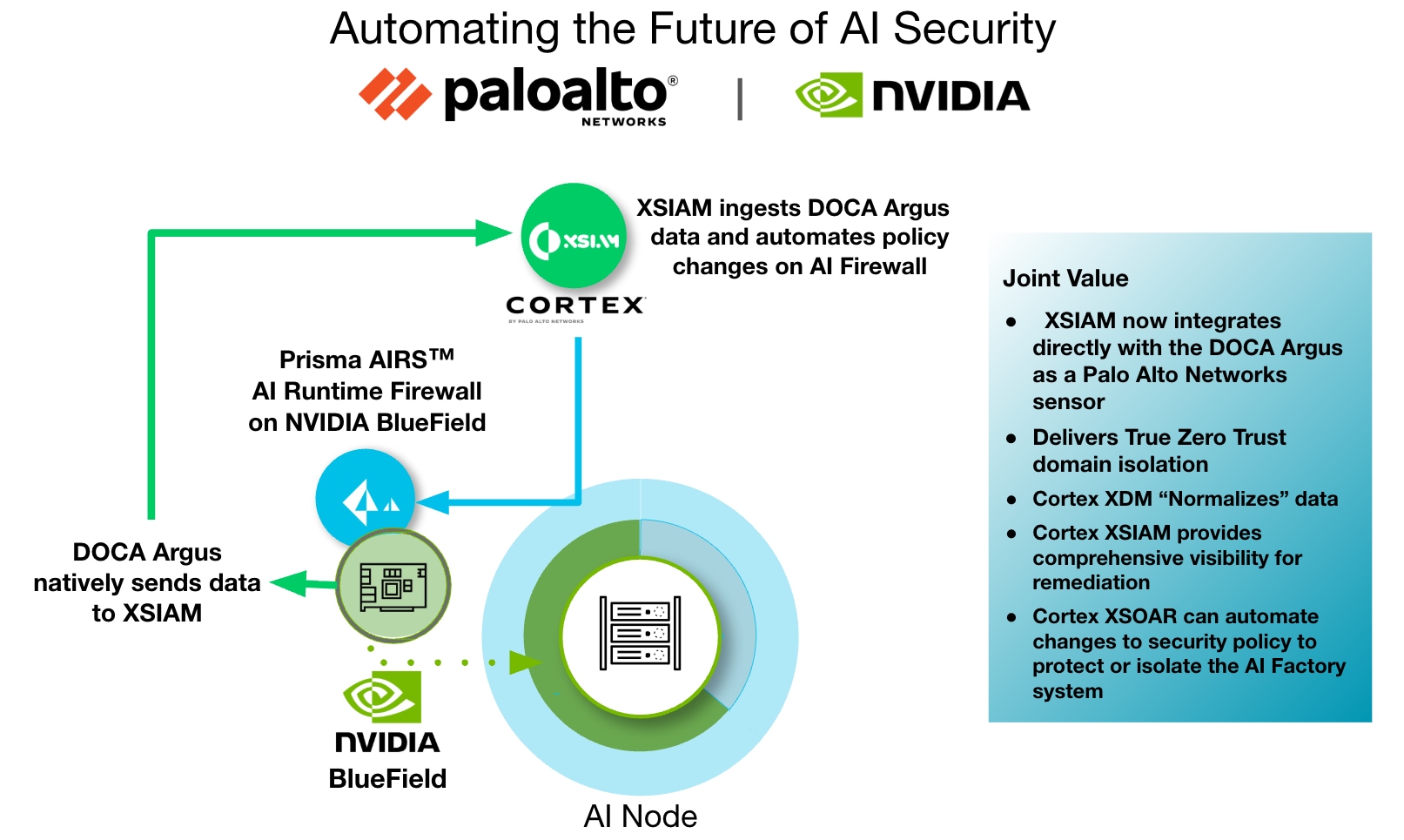
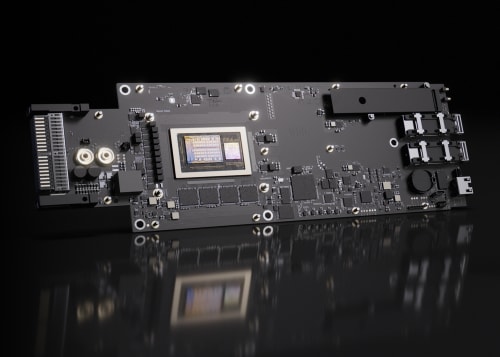
By operating on the NVIDIA BlueField data processor, DOCA Argus provides situational awareness through real-time memory analysis at the silicon level. This allows Cortex XSIAM to detect kernel-level rootkits and "living-off-the-land" attacks without installing security agents on the host system.

This innovation builds upon our proven foundation with Palo Alto Networks Prisma AIRS, where AI Runtime Security is deployed natively on NVIDIA BlueField, and powered by NVIDIA DOCA, bringing defense in depth. This integration enables offload , isolation and acceleration of security in AI factories.  

Purpose-Built Observability for the AI Factory

Deployed consistently across the AI factory, DOCA Argus monitors and correlates AI application processes, network telemetry, and data access to detect sophisticated anomalies that traditional tools miss. With this integration, Cortex XSIAM recognizes the high-fidelity data from DOCA Argus as a native Palo Alto Networks sensor, allowing for better decisions with the new intelligence gathered directly from the host.

By integrating Cortex XSIAM with the NVIDIA DOCA Argus framework, we leverage the innovations of two industry leaders to deliver a seamless, high-performance SecOps ecosystem for your most valuable AI assets.

Why This Integration Is a Game-Changer for SecOps

  • Process Introspection: Residing on NVIDIA BlueField, DOCA Argus has the unique ability to correlate network telemetry with deep process inspection.
  • Anomaly Detection: By analyzing traffic and host behavior simultaneously, XSIAM can detect sophisticated anomalies (e.g., lateral movement or data exfiltration) that traditional tools miss.
  • Unified Intelligence: Cortex XSIAM recognizes the security and alert information in this high-fidelity data, providing security teams with end-to-end visibility and dedicated security dashboards specifically for their AI infrastructure.


Native integration of DOCA Argus with XSIAM


Palo Alto Networks Prisma AIRS Across the NVIDIA AI Factory

The inclusion of Prisma AIRS in NVIDIA AI Factory validated design delivers a unified security platform, providing proactive, defense-in-depth security across critical layers of the AI ecosystem. 

Serving as the network enforcement engine for this architecture, Prisma AIRS secures the infrastructure of the modern AI Factory. By unifying protection and visibility into a single automated fabric, it eliminates the traditional trade-off between security and agility, allowing organizations to innovate at machine speed without compromising performance or governance. 

Beyond enforcement, the broader Prisma AIRS platform acts as the security blueprint for the entire enterprise AI ecosystem—consolidating fragmented point-tools to slash total cost of ownership while providing end-to-end observability from the data plane to the model layer. The platform scales dynamically alongside your AI clusters to safeguard raw datasets, build Layer 7 micro-perimeters around autonomous agents, and protect proprietary model weights from external threats—all without throttling mission-critical performance.

By deploying the AI Runtime Firewall directly on NVIDIA BlueField, we establish a foundational network security layer that is fully offloaded, isolated, and accelerated. This provides pervasive protection across the Enterprise AI Factory without sacrificing critical compute resources.

Securing the NVIDIA AI factory requires the entire Prisma AIRS suite, which secures the AI lifecycle through five specialized pillars:

  • AI Model Security: Protects against model tampering, malicious scripts and data exfiltration attacks before deployment.
  • AI Red Teaming: Advanced threat simulation and vulnerability discovery to enable the safety, security and integrity of your AI and Agents deployments.
  • AI Runtime Security Firewall: Protects against prompt injection, data leakage, abuse and AI-specific runtime threats across distributed inference flows.
  • AI Agent Gateway acts as the control plane for the AI enterprise – governing tool calls, model access and external connections. Every agent interaction is enforced through centralized policies.
  • Agent Identity Security assigns each agent a governed identity with precise permissions and full traceability, ensuring actions are attributable and enforceable.


A Forward-Looking Architecture: Embracing Vera NVIDIA BlueField-4 STX

Looking ahead to the next frontier of enterprise-scale agentic AI, Palo Alto Networks is closely aligning its platform approach with the NVIDIA Vera BlueField-4 STX architecture, extending protections to AI data storage infrastructure. As AI data demands surge, high-throughput, large-scale environments require a move toward hardware-isolated, performance-neutral protection to support the rapid growth of critical AI applications.

Operating within an isolated trust domain on future BlueField-4 silicon, our inline security capabilities will maintain strict, policy-driven controls independently of the host operating system and storage systems. This co-design enables critical forward-looking innovations for data, agents, and context memory, ensuring security is offloaded, isolated and accelerated to support the next generation of the AI Factory.


NVIDIA BlueField-4


Key Takeaways

Our ongoing collaboration with NVIDIA focuses on these essential pillars for reimagining AI security:

  • Deliver the industry-leading security platform reinvented for the unique demands of the AI factory. High-throughput, large-scale environments require a move toward hardware-isolated and performance-neutral protection to support the rapid growth of critical AI applications. By offloading AI Runtime Firewall directly to the NVIDIA BlueField, we enable zero-latency protection and strict data governance that neutralizes threats (like model theft) while maintaining peak performance and the integrity of your proprietary models.This architecture embeds security directly into the infrastructure, out of the way of app developers.
  • Transform the SOC and achieve deep visibility across AI environments by leveraging Cortex XSIAM to provide real-time detections and automated response. By connecting infrastructure protection with this centralized intelligence, you can secure the AI journey, from development in the factory to operations at the secure industrial edge.
  • Zero-Trust for AI Infrastructure: This helps ensure that as your operations scale toward multi-agent architectures, your security footprint is fully offloaded, isolated, and accelerated to protect advanced inference flows, autonomous agents, and data pipelines without throttling performance.
  • Unified Platform Architecture: Beyond standalone point tools, the Prisma AIRS platform serves as a unified security fabric that spans the entire AI lifecycle—from safeguarding raw data to autonomous agents.

Deploy Bravely

The Palo Alto Networks platform approach delivers a comprehensive solution to secure an enterprise's entire AI ecosystem. By integrating Cortex XSIAM with the NVIDIA DOCA Argus framework, we are extending this comprehensive, deep visibility and protection to the very heart of the AI Factory. With this integration, security teams can leverage an agentless approach via DOCA Argus to gain deep visibility into AI systems hosts by simply downloading the content pack from the Cortex Marketplace.

The Palo Alto Networks platform secures the entire AI journey, protecting the infrastructure, intelligent applications, agents and data it produces. With the inclusion of Prisma AIRS in NVIDIA Enterprise AI Factory Validated Design, we have delivered the blueprint for secure AI. 

Palo Alto Networks and NVIDIA are redefining security for the AI factory. Together, we are ensuring your security architecture is as fast, scalable and innovative as the intelligence it protects, empowering you to scale AI production with reduced latency and stronger governance.

Discover more through the Palo Alto Networks partner directory, or read the official press release from NVIDIA for more details.

The post Reinventing Security for the Agentic NVIDIA AI Factory appeared first on Palo Alto Networks Blog.
  •  

A 4X Gartner Magic Quadrant for EPP Leader. Built for the Agentic Era.

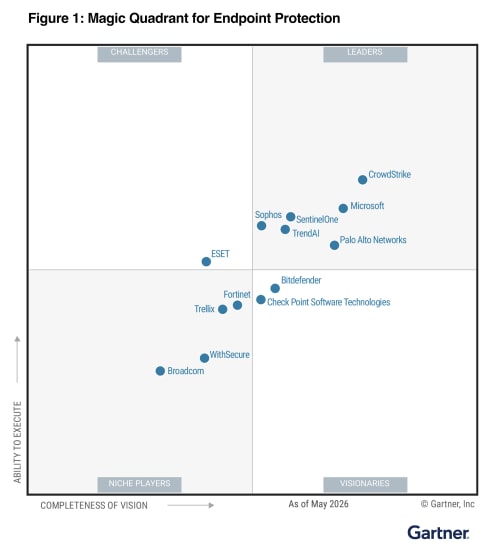
I am incredibly proud to share that Palo Alto Networks has been named a Leader in the 2026 Gartner® Magic Quadrant™ for Endpoint Protection Platforms for the fourth consecutive year. For us, this recognition is a testament to our team's relentless vision as we continue to define endpoint defense—from the pioneer days of XDR to the new frontier of agentic AI.

We believe our repeated recognition as a Leader is built on a single, uncompromising commitment to our customers and partners: empowering organizations with reduced overhead, rapid threat response, a strengthened security posture, and the resilient protection required to close the most critical security gaps. We are now leading the shift into the agentic era. While AI agents significantly boost enterprise productivity, they also introduce novel attack surfaces that legacy EDR tools are unable to protect. As the pioneer of XDR, we are committed to defining the next generation of cybersecurity by securing this new frontier.

Cortex® XDR is helping customers:

  • Secure Agentic AI with Koi: Gain unprecedented visibility, guardrails, and control over AI agents and agentic tools before they become a liability.
  • Stop the Unseen: Leverage battle-tested prevention powered by behavioral analytics, and industry-leading automation and response.
  • Unify Your Defense: Consolidate your endpoint and workspace security with a proven, four-time industry Leader.

We are incredibly proud to be recognized as a Leader once again, an acknowledgement that belongs just as much to our customers and partners as it does to us. Your trust, feedback, and real-world challenges keep us sharp and dictate our roadmap. At the end of the day, our continued leadership is built on one core promise: make each day more secure than the day before.

To get the full story and a comprehensive analysis of the endpoint security market, I invite you to read the 2026 Gartner Magic Quadrant report.

Get Your Complimentary Copy of the Report

Gartner, Magic Quadrant for Endpoint Protection Platforms, By Deepak Mishra, Evgeny Mirolyubov, Nikul Patel, May 29, 2026

Gartner and Magic Quadrant are trademarks of Gartner, Inc. and/or its affiliates. Gartner does not endorse any company, vendor, product or service depicted in its publications, and does not advise technology users to select only those vendors with the highest ratings or other designation. Gartner publications consist of the opinions of Gartner’s business and technology insights organization and should not be construed as statements of fact. Gartner disclaims all warranties, expressed or implied, with respect to this publication, including any warranties of merchantability or fitness for a particular purpose.

The post A 4X Gartner Magic Quadrant for EPP Leader. Built for the Agentic Era. appeared first on Palo Alto Networks Blog.

  •  

The “Why” Behind NextWave’s New Requirements

Helping Partners Stay Competitive for the Future

Key Takeaways

  • The evolved NextWave Partner Program raises expectations while strengthening enablement, incentives and the Partner Development Fund to support partner growth and reinvestment.
  • Levels and specializations are more closely aligned to next-generation security priorities, helping partners deepen expertise and making partner distinctions more meaningful for customers.
  • These changes help create a more capable partner ecosystem, with deeper capabilities, greater alignment with customer needs, and a stronger foundation to support the future of security.

Cybersecurity partnerships are operating in a more demanding environment. As customers consolidate vendors, modernize security architectures and adopt artificial intelligence (AI) across the enterprise, they’re placing greater expectations on partners to help guide decisions across network, cloud and security operations. They also want clearer evidence that their selected partners have invested in growing the skills and expertise needed to support more integrated and fast-changing security priorities.

The Palo Alto Networks NextWave Partner Program has evolved to help partners meet these heightened expectations. As security delivery becomes broader and more strategic, customers are placing more weight on what a partner’s credentials actually represent. That’s why stronger performance and enablement requirements are part of our reimagined program. The new requirements help partners better understand what they need to build real capability and advance within our program. They also give more substance to the designations customers see when choosing a partner.

Our objective was never simply to raise the standards for engagement in our program. It was to inspire partners at all levels – Registered, Innovator, Platinum and Diamond – to invest deliberately and continuously in learning, so they can deepen their proficiency and earn specializations that will help them stay competitive and build and deliver the future of security.

Why Requirements and Incentives Had to Evolve Together

Raising performance expectations was only part of the work in evolving the NextWave program. We also wanted to give our partners compelling reasons to invest in the capabilities Palo Alto Networks wants to see scale. That meant looking more closely at how standards, specializations and incentives fit together, and how we can help accelerate mutual success.

We are providing our partners with better access, better visibility and better support for learning and enablement. In turn, we are recognizing and rewarding partners for their efforts to develop and maintain the competency, capability and capacity needed to go to market successfully with Palo Alto Networks.

This approach, shaped largely by partner feedback, is designed to make incentives easier to access while still directing partner investment toward deeper specialization and next-gen security capabilities. Program levels and product specializations help define what partners need to do to grow within our program and to excel at selling, supporting or delivering Palo Alto Networks products and services.

The program’s Partner Development Fund adds another dimension to this evolved model. It gives all partners a more deliberate way to reinvest a portion of their earned incentives into the capabilities they need to stay competitive and innovate, including training, certification, workshops, demos and other strategic activities that help strengthen their team’s overall readiness over time. In that sense, the program is both rewarding current performance and driving mutual growth.

Training and Enablement that Move with the Market

As we continue to strengthen our partner program, Palo Alto Networks is refreshing courses, updating certification paths and redesigning training to better reflect the customer needs that partners are helping to address today, including emerging areas like AI security.

Notable improvements:

  • Introduced more online, on-demand learning experiences across all products and across all roles, including sales, technical presales and post-sales professionals.
  • Expanded access to lab environments for hands-on experiences, as well as access to perform demos for customers.
  • Injected AI roleplay into learning experiences to help sales and presales teams improve their ability to educate customers about our products and services while addressing questions or concerns.
  • Instituted a continuous education component that encourages partners to stay current with certifications and other program requirements, so they don’t need to be tested annually.

Our aim with these changes is to keep learning options relevant, practical and easier to engage in and apply in practice. We believe product and services training should help partners deepen expertise, validate skills and stay current as technologies, customer expectations and threats shift. It should also recognize the experience many professionals already bring to the table, with learning paths that are rigorous without being repetitive or unnecessarily burdensome.

Ultimately, the impact of providing more effective enablement for our partners (and outlining clear requirements for advanced specializations and total certified staff for specific partner paths) positively impacts the customer experience through more informed conversations, stronger design guidance and more consistent support across the entire security lifecycle.

A More Focused Program to Help Accelerate Next-Generation Security

Part of what makes the current evolution of the NextWave program so significant is its focus on helping partners build the bench strength they will need to stay competitive as security becomes more platform-driven, AI-influenced and interconnected across domains. The program also encourages bookings tied to next-generation security priorities, helping direct partner investment toward the areas customers are prioritizing most. That focus is especially visible in areas such as Idira®Prisma® SASE, Cortex® Cloud™ and Cortex, where customer demand and program priorities are increasingly aligned.

The benefits of that alignment extend beyond the partner organization. Customers gain access to partners that are better prepared to support more connected security strategies without adding unnecessary complexity. They can work with partners that are building expertise around the technologies and use cases becoming more central to modern enterprise security programs.

This kind of alignment also strengthens the broader ecosystem. It creates a clearer connection between customer needs, partner capabilities and Palo Alto Networks platform strategy. It’s the value exchange in cybersecurity in action: Ongoing investment in knowledge, skills and services that helps partners grow while giving customers faster time-to-value realization.

What Stronger Program Requirements Mean for Customers

For customers, stronger requirements for our Nextwave program can make partner distinctions more meaningful. A specialization or program level should point to something real, such as training completed, certifications maintained and expertise developed. While those accomplishments don’t guarantee security outcomes, they do provide evidence that a partner has built the depth needed to support more complex environments.

Partner distinctions are also reinforced through an active compliance framework rather than treated as a one-time achievement. Partners have ongoing visibility into their progress and can be recognized immediately throughout the year as they meet requirements. Reviews take place on a defined cycle, and status changes are subject to oversight. Taken together, these elements add credibility to the designations customers see and give them more weight in the partner selection process.

This becomes increasingly important as customers look for security partners that can do more than support a single transaction or product decision. Many are seeking guidance at the architecture stage and during implementation, and expecting continuity as IT environments evolve and new risks emerge. It also raises the level of scrutiny that partner selection deserves:

  • Is a partner specialized in the areas most relevant to the customer’s priorities?
  • Do they have the certifications and technical expertise required to support the solutions being considered?
  • Can they provide the level of guidance, implementation support and ongoing engagement the relationship will require over time?

In a fast-moving security market, questions like these can help customers make more informed decisions about which partners are best equipped to deliver long-term value.

What Partners Should Do Now

Now that we’ve introduced our new program requirements, partners should take stock of whether their certifications, specializations and go-to-market priorities are aligned to where customer demand and the future of security are headed. Steps partners can take:

  • Evaluate your current book of business: Consider where you may be missing growth opportunities because the right specializations aren’t yet in place. Those gaps can affect both business momentum and the ability to earn incentives.
  • Reflect on the current direction of your practice: Which customer conversations are signaling the need for deeper expertise? Which areas of next-generation security are becoming more central to your future? These questions can help guide your next investments by clarifying where your practice needs to build more depth sooner rather than later.
  • Review certifications and specializations with growth in mind: Look at where new specializations could open the door to additional incentives and stronger alignment with customer demand, while ensuring your team’s existing certifications and specializations remain on track for the next compliance cycle.

Partners that take the time now to assess our new requirements and create a plan to meet them will be better positioned to advance within and benefit from our partner program, while developing the capabilities needed to help build the future of security.

Partners with a designated Palo Alto Networks Channel Business Manager can get detailed data and analysis now on their progress and performance in the Nextwave program, including the status of their certifications and which team members have engaged in training, demos and more. In the second half of 2026, we plan to make the same dashboard capabilities and insights directly available to all partners, so they can understand exactly what they need to do to excel in our program. These red-yellow-green dashboards are simple but powerful tools, and we are eager to put them in our partners’ hands soon.

Visit the NextWave Partner Portal to learn more.

The post The “Why” Behind NextWave’s New Requirements appeared first on Palo Alto Networks Blog.

  •  

Beyond the Frontier — Expanding the Ecosystem for Autonomous Defense

Over the past few weeks, we have reached a critical turning point in cybersecurity. Following the launch of our Frontier AI Defense initiative, we’ve continued testing the latest frontier models (including Anthropic’s Mythos and Claude Opus 4.7, as well as OpenAI’s GPT-5.5-Cyber) as part of the Trusted Access for Cyber program.

The urgency to innovate continues to ramp up. As Lee Klarich recently detailed in his Defender's Guide to the Frontier AI Impact on Cybersecurity, our current landscape is defined by a brief three-to-five-month window to gain a strategic advantage over attackers. To outsmart AI-based exploits, enterprises must decisively address vulnerabilities across their code and stand up the right security stack to enable real-time, automated defenses.

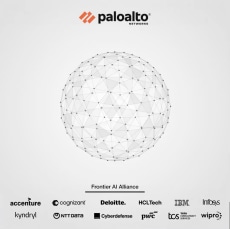
With such a ticking clock in front of us, acting rapidly and at-scale to support our customers is paramount. Today, we exponentially grow our scale of delivery by expanding our Frontier AI Alliance.

Since introducing this initiative, our collaboration with initial partners – Accenture, Deloitte, IBM, NTT DATA, and PwC – has already begun changing the defensive math for our customers. This is a moment that calls for radical collaboration across the entire security ecosystem, so today we are proud to welcome a new cohort of strategic partners – Cognizant, HCLTech, Kyndryl, TCS, Infosys, McKinsey & Company, Orange Cyberdefense, and Wipro – who will join us in delivering AI readiness at scale.

Frontier AI Alliance

While this expansion significantly increases our reach, this is only the beginning. We are committed to a continuous evolution of this alliance and will be adding more critical partners in the future across the globe to ensure our customers have the most robust defense network possible.

By combining our technology with these partners’ deep consulting expertise, we are delivering:

  • Machine-Speed Security: Natively integrating Frontier AI to provide real-time, automated defense against autonomous threats.
  • Intelligence-Led Resilience: Leveraging Unit 42® experts to fast-track the discovery and remediation of exposures at machine speed.
  • Hardened Defenses: Utilizing early access to frontier models from partners like OpenAI and Anthropic to simulate and block attack chains before they hit the mainstream.

The stakes are high. The attack cycle has compressed with the time from initial access to data exfiltration collapsing to just 39 seconds. Machine-speed MTTR (mean time to respond) is no longer an ambitious goal, it is a requirement.

This initiative underscores our commitment to providing every client with integrated, real-time protection.

Discover further details: Palo Alto Networks Frontier AI Defense.

Forward-Looking Statements

This blog contains forward-looking statements that involve risks, uncertainties and assumptions, including, without limitation, statements regarding the benefits, impact, or performance or potential benefits, impact or performance of our products and technologies or future products and technologies. These forward-looking statements are not guarantees of future performance, and there are a significant number of factors that could cause actual results to differ materially from statements made in this blog. We identify certain important risks and uncertainties that could affect our results and performance in our most recent Annual Report on Form 10-K, our most recent Quarterly Report on Form 10-Q, and our other filings with the U.S. Securities and Exchange Commission from time-to-time, each of which are available on our website at investors.paloaltonetworks.com and on the SEC's website at www.sec.gov.  All forward-looking statements in this blog are based on information available to us as of the date hereof, and we do not assume any obligation to update the forward-looking statements provided to reflect events that occur or circumstances that exist after the date on which they were made.

The post Beyond the Frontier — Expanding the Ecosystem for Autonomous Defense appeared first on Palo Alto Networks Blog.

  •  

Defender's Guide to the Frontier AI Impact on Cybersecurity: May 2026 Update

By now, you’ve heard about the latest frontier AI models that are remarkably good at finding vulnerabilities in code and creating potential exploits. So good, in fact, that these models have been significantly limited from general use in an attempt to give defenders time to find and fix vulnerabilities before attackers find and exploit them.

For context, on April 7, 2026, we began testing Anthropic’s Claude Mythos model as a launch partner for Project Glasswing. Our conclusion was clear: The latest models are extraordinarily capable at finding vulnerabilities and changing them into critical exploit paths in near-real-time. In Defender's Guide to the Frontier AI Impact on Cybersecurity, I shared our early findings and recommendations.

Since then, we’ve continued testing the latest frontier AI models, including Anthropic’s Mythos and Claude Opus 4.7 and OpenAI’s GPT-5.5-Cyber as part of the Trusted Access for Cyber program. The big question just a few weeks ago was: “Are we overstating the model capabilities?” With more testing, I can confidently say we weren’t. In fact, these models are likely even better at finding vulnerabilities than we initially realized. Today, we’re providing an update on our ongoing research, our learnings uncovered in the process, and the approach we’re taking to protect our customers.

Find and Fix Before Attackers Find and Exploit

Today, we released our May “Patch Wednesday” security advisories, our monthly cadence of transparent vulnerability disclosure and remediation. This is the first time where the majority of findings were the result of frontier AI models scanning our code.

  • These are the results of the full, initial scan of over 130 products across all three platforms.
  • As of today, we’ve patched all important vulnerabilities in our SaaS delivered products, and all customer-operated products now have patches available.
  • Today’s advisory covers 26 CVEs (representing 75 issues) versus our usual volume (typically less than 5 CVEs in a month); none of which are being exploited in the wild. Note, this excludes CyberArk vulnerabilities, which are disclosed in their normal process.

It's important to understand this isn’t a one-and-done situation. We’re now rescanning, applying all our learnings about how to provide the right context and threat intelligence to the models. We intend to fix every vulnerability we find before advanced AI capabilities become widely available to adversaries.

While incredibly powerful, AI models aren’t simply magic. To achieve high-fidelity results, you need to build AI scanning harnesses, leverage context, guardrails and threat intelligence. We’ve also discovered a variance across models, due to variations in their training. A multimodel approach is required to identify the superset of vulnerabilities. And finally, while the immediate priority is finding and fixing the vulnerabilities that organizations currently have, the longer-term shift is incorporating these models directly into the software development lifecycle. This is the light at the end of the tunnel: A future where software is secure by design.

Four Steps Every Organization Needs to Take Immediately

Regardless of the current restricted access, we believe these capabilities will flow more broadly to other models. We now estimate a narrow three-to-five-month window for organizations to outpace the adversary before AI-driven exploits start to become the new norm. This impending vulnerability deluge demands urgency. Organizations that haven’t put appropriate safeguards in place will face an entirely new class of risk. Here’s what we recommend:

  1. Find and Fix Vulnerabilities In Your Applications, Products and Code
    Find and fix before attackers find and exploit.
    • Leverage AI models to identify vulnerabilities across all codebase.
    • Apply the same AI scanning to your open-source supply chain, and remediate or mitigate findings.
    • Run accelerated patching tightly coordinated with product and development teams.
  2. Assess, Reduce and Remediate Your Exposure
    Reduce what is reachable by attackers, secure what must be accessible, such as customer-facing applications.
    • Attack surface management products, like Cortex Xpanse®, have never been more critical for finding and reducing exposure.
    • The latest frontier AI models are very adept (with the right AI scanning harness) at evaluating exposures, understanding security misconfigurations and prioritizing attack-path reachability.
    • Audit your supply chain, including AI infrastructure, runtime environments and model dependencies.
  3. Ensure Attack Protections
    Vulnerability exploits are typically just one step of a multi-step attack lifecycle. Ensuring best-in-class protections is now even more important for preventing breaches.
    • Map current sensor coverage to identify critical blind spots in detection, prevention and telemetry.
    • Deploy best-in-class XDR everywhere with an emphasis on real-time ML-based detection and prevention of attacks with all hosts on-premises and cloud included.
    • Deploy Agentic Endpoint Security to secure wide-scale adoption of vibe coding and AI security across the enterprise (e.g. Prisma AIRS® and our recent acquisition of Koi are now a necessity for securing the agentic endpoint).
    • Secure enterprise browsers with AI-based security are a must have for securing where users now do their work.
    • Zero trust and Identity Security are foundational to securing every user and connection, extending to internal segmentation and outbound application connections.
  4. Deploy Real-Time Security Operations
    Autonomous AI-driven attacks will drive attack lifecycles to minutes requiring every SOC to achieve single-digit mean time to detect (MTTD) and mean time to respond (MTTR).
    • Attack detections must be AI/ML-driven to detect even frequently changing and novel attacks at scale.
    • These AI detections must operate against a wide range of first party and third party data sources. A best in class AI SOC must operate on ALL relevant data sources.
    • Automation, both natively integrated and throughout the SOC lifecycle, is necessary to achieve single-digit MTTR. This automation will increasingly be agentic.
    • This must be delivered as a platform to remove seams and gaps created by point solutions.
    • Assess and act as quickly as possible.

Fighting AI with AI — AI Frontier Security Innovations Coming Soon

So far, frontier AI models only find new attacks, not new attack techniques. This means that with the right innovations, we can expand our use of AI to solve the security challenges that organizations are facing, and deliver what our customers need to stay ahead of the ever-evolving threat landscape, including:

  • Reimagining virtual patching with proactive, high-fidelity content updates across network, endpoint and cloud security – We expect that across open source and technology suppliers there will be a deluge of patches, and virtual patching will provide a mitigation layer necessary to give your teams time to update. We expect to roll out the first phase of capabilities very soon.
  • Enhanced attack preventions, including cyber-LLM trained ML and small language models (SML) and behavior protections – Early testing with Cortex XDR® and our network security security services, such as WildFire® malware prevention, indicate high protection coverage from the types of attacks created using these new frontier AI models.
  • Using these models to scan our code, applications and even security configurations – Our intention is to productize these capabilities and incorporate them into our platforms.

Unit 42 — We’re Here to Help

We recognize that not everyone has the capacity and/or expertise to action all of the recommendations to effectively counter frontier AI-driven risks in the short timeframe mandated by AI innovation. Our Unit 42 Frontier AI Defense service is designed to discover and remediate your current exposure before attackers do, strengthen controls that reduce exposure and contain impact and modernize security operations so teams can detect and respond at machine speed.

This is a pivotal moment for our industry. While the scale of the challenge presented is real, I’m confident in our ability to solve it. We’re here to help our customers navigate this transition and ensure that as the landscape continues to evolve, the advantage remains with the defender.

Forward-Looking Statements

This blog contains forward-looking statements that involve risks, uncertainties and assumptions, including, without limitation, statements regarding the benefits, impact, or performance or potential benefits, impact or performance of our products and technologies or future products and technologies. These forward-looking statements are not guarantees of future performance, and there are a significant number of factors that could cause actual results to differ materially from statements made in this blog. We identify certain important risks and uncertainties that could affect our results and performance in our most recent Annual Report on Form 10-K, our most recent Quarterly Report on Form 10-Q, and our other filings with the U.S. Securities and Exchange Commission from time-to-time, each of which are available on our website at investors.paloaltonetworks.com and on the SEC's website at www.sec.gov. All forward-looking statements in this blog are based on information available to us as of the date hereof, and we do not assume any obligation to update the forward-looking statements provided to reflect events that occur or circumstances that exist after the date on which they were made.

The post Defender's Guide to the Frontier AI Impact on Cybersecurity: May 2026 Update appeared first on Palo Alto Networks Blog.

  •  

From WarGames to Cyberwar

How Nations Hack, Why Attribution Fails, and What AI Changes

Executive Summary:
Code War author Allie Mellen, argues that cyberwarfare must be understood through a human and geopolitical lens to close the knowledge gap between the security community and the public.

Disclaimer:
This post reflects the perspectives shared in the book Code War: How Nations Hack, Spy, and Shape the Digital Battlefield, and does not represent the views of the publisher of this blog.


The summer of 1983, President Reagan watched WarGames at Camp David and couldn't get it out of his head. A week later, he walked into a White House meeting with cabinet members and Congress and launched into a detailed plot summary of a Matthew Broderick movie about a teenager who nearly hacks the world into nuclear war. The room full of defense experts sat uncomfortably, suppressing smirks. Then Reagan turned to General John Vessey, Chairman of the Joint Chiefs, and asked if something like that could actually happen.

Vessey came back a week later with an answer: "Mr. President, the problem is much worse than you think."

Fifteen months after that, Reagan signed a classified presidential directive titled "National Policy on Telecommunications and Automated Information Systems Security" – the first federal policy of its kind. A movie had done what years of expert warnings hadn't: It made the most powerful person in the world stop and ask the right question.

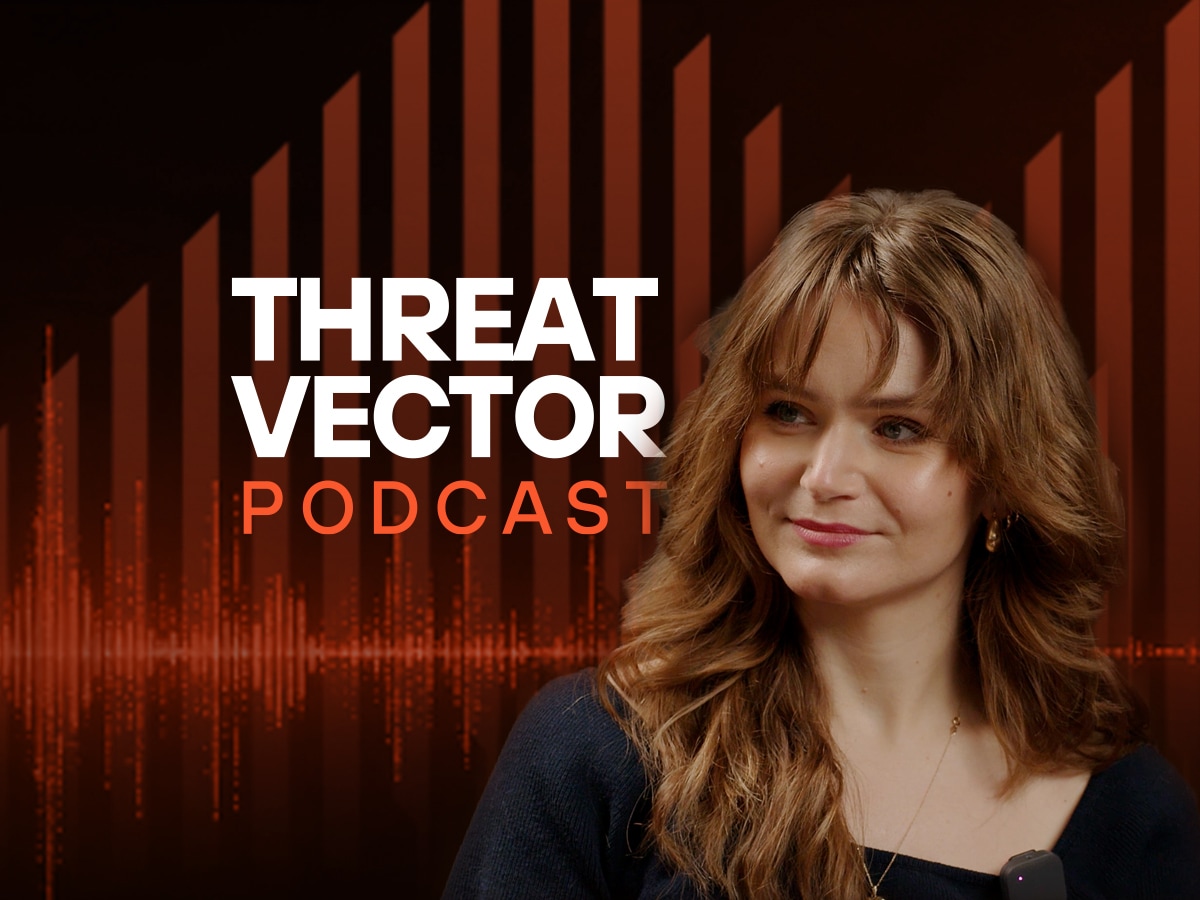
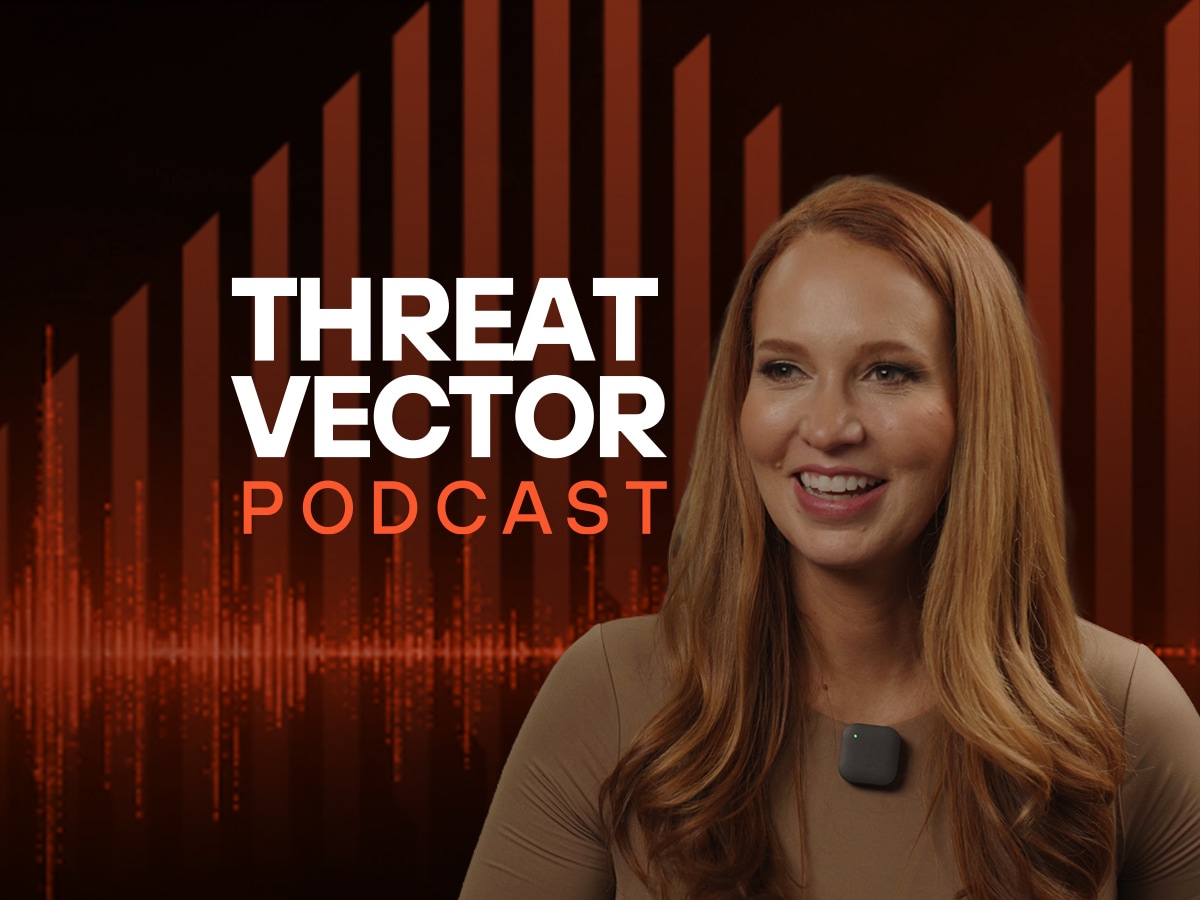
Allie Mellen, author of Code War: How Nations Hack, Spy, and Shape the Digital Battlefield, loves to tell this story, and it captures exactly why she wrote the book. In a conversation recorded at RSA 2025, Mellen joined Threat Vector host, David Moulton, to talk about nation-state threats, attribution pitfalls, and why the security industry's biggest problem isn't technical.

"They're human stories, and if we can communicate them that way to the general public, then we'll get more people interested in cybersecurity, invested in cybersecurity, and invested in protecting their data."

That gap, between what the security community understands and what everyone else grasps, is the core problem Mellen set out to solve. And in today's geopolitical moment, closing it has never been more urgent.

Every Nation Hacks Differently

One of the central arguments in Code War is that you can't understand a nation's cyber behavior without understanding its history, doctrine and social contract. China, Russia, Iran, North Korea and the U.S. each approach offensive and defensive cyber operations from completely different starting points, and those differences matter enormously to defenders.

China operates with patience. Its attacks tend to be low and slow, focused on long-term espionage rather than loud disruption. But that changes sharply in its own region, where operations targeting Taiwan are aggressive and relentless. Russia, by contrast, is bombastic; they want you to know it was Russia. Its influence operations have been some of the most effective in modern history, studied and imitated by Iran and others.

Interestingly, the very system China built to protect itself has become a liability in one specific domain. Because Chinese operators live behind the Great Firewall, without access to western social media, they lack the cultural fluency that makes Russian disinformation so effective. "They try to use memes, but it's like ‘uncanny valley’," Mellen explains. "They just slightly miss every time and so it doesn't go viral." The walled garden that gives China control over its own population makes it harder to manipulate everyone else's.

Attribution Is a Geopolitical Tool, Not Just a Technical One

Mellen is careful about attribution, and she wants defenders to be too. The standard technical signals (coding language, infrastructure patterns, operational hours) are necessary but not sufficient. Nation-states, especially the U.S., have developed tools specifically designed to mimic other actors' signatures. AI will make that problem significantly worse.

But the bigger issue is motivation. Mellen walks through a case from the Olympics where an attack was initially attributed to North Korea, even though North Korea was actively trying to normalize relations at the time by sending Kim Jong Un's sister to the games. The actual perpetrator was Russian, using a false flag to obscure its involvement. The lesson: Attribution requires asking not just "who has the technical capability?" but "who has the motive right now, given everything happening geopolitically?"

The pitfalls are real:

  • Tools once used exclusively by intelligence agencies are now publicly available, making code signatures unreliable.
  • Working-hours analysis is easy to spoof, especially for sophisticated actors.
  • Government-controlled research in adversarial nations can deliberately skew attribution findings.
  • False flag operations are increasingly sophisticated and harder to disentangle.

Why Your Data Is a Geopolitical Asset

One of the more powerful sections of the conversation centers on a question Mellen hears constantly: why would China care about my data?

Her answer cuts through the dismissiveness. These nations aren't collecting data out of idle curiosity. They're willing to constrain companies for it, invest billions in infrastructure for it, and in some cases, far worse. "Whether you wanna be involved in that system or not, you are involved in that system," she says. "And so you can either choose to take control of your information in that environment, or you can just pretend like it's not your problem."

The historical context she offers is striking. One of the driving forces behind GDPR in the EU was the collective memory of how Nazi Germany used data to target Jewish people during the Holocaust. Europe built privacy protections into law because it had seen what happens when governments gain unrestricted access to population data. That's not an abstract concern. It's a lesson written in history that the rest of the world is still catching up to.

AI Makes Everything Harder

Mellen isn't optimistic about the trajectory. Attribution is about to get much harder. Attacks are about to get much more dynamic. And AI is the reason for both.

She points to research on Chinese state-sponsored actors using AI to orchestrate attacks across the full kill chain, with only a couple of human checkpoints in the loop. The implication isn't just faster attacks. It's more adaptive malware that can adjust to different operating environments, more convincing disinformation that clears the cultural context bar, and reconnaissance-to-exploitation cycles that move faster than most defenders can process.

The constraints that have always slowed sophisticated attackers – understanding the operating system, identifying vulnerabilities, crafting exploits, mimicking attribution – all get easier with AI. All of that becomes more dynamic. And most enterprises, Mellen acknowledges, are not yet equipped to respond effectively.

The investment required is in the basics the industry has always struggled to get right, executed now at a pace and scale that demands automation and AI on the defensive side. Fighting AI with AI isn't a vendor talking point. It's the only math that works.

More to Explore

The nation-state threats Mellen describes aren't theoretical. Unit 42 responded to more than 750 major incidents in 2025. See what they found. Download the 2026 Global Incident Response Report.

Listen to the full conversation with Allie Mellen, author of Code War, on the Threat Vector podcast

The post From WarGames to Cyberwar appeared first on Palo Alto Networks Blog.

  •  

Idira — Our Journey to Democratize Privilege Controls

Key Takeaways

  • Built on the Pioneers of PAM (privileged access management): Idira™ is Palo Alto Networks next-generation identity security platform, extending privileged access controls to every human, machine and AI agent identity in the AI enterprise.
  • Zero Standing Privilege by Default: Idira replaces static, always-on access with dynamic privilege, granted just-in-time on a single control plane.
  • AI-Driven Identity: AI runs natively inside Idira to surface hidden entitlements, unmanaged accounts, recommend least privilege, and remediate to close the gap between attackers who move in 72 minutes and defenders who historically took days.

Since Palo Alto Networks and CyberArk came together in February, customers have been asking me the same question: What does the future of identity security actually look like?

At IMPACT, I got to answer that question.

I am proud to introduce Idira™, the next-generation identity security platform from Palo Alto Networks. Idira secures every identity in the AI enterprise (human, machine, AI agent) on a single control plane that discovers risk, applies privilege dynamically, and governs the full lifecycle from first access to last session.

Idira begins with a belief shaped by more than 20 years of working on this problem. Privilege is the most challenging aspect of identity security. For a generation, the industry learned how to manage it well for a small population – administrators inside the most security-sensitive organizations in the world. That was necessary. But it is no longer enough.

The moment has come to extend that same rigor to every identity, because every identity today carries the power to move the business, or enable an attacker. That is the journey Idira takes us on. From privilege controls for administrators, to privilege controls for every identity.

Attackers Are Not Breaking In. They Are Logging In.

For most of the last two decades, identity security was built on a comfortable assumption: One can maintain a firm divide between a small number of powerful administrators and a much larger number of ordinary users; that is enough to secure the organization. That assumption no longer holds.

Our Chairman and CEO, Nikesh Arora, calls it the “IAM fallacy,” and the data in the 2026 Identity Security Landscape Report makes clear why it is time to retire this assumption.

Based on responses from 2,930 cybersecurity decision-makers worldwide:

  • Machine identities now outnumber humans by 109 to 1. Of those, 79 are AI agents.
  • 91% of organizations already run autonomous agents in production.
  • 90% of organizations suffered an identity-related breach in the past 12 months. 83% of organizations suffered two or more incidents.

The old model is not failing because identity became less important. It is failing because identity and privilege became universal and ubiquitous.

Every major breach I have studied over the last two years follows the same pattern. An attacker steals a credential. They move laterally using standing access that should have expired. They escalate privilege. They reach the data, the infrastructure or the business systems they came for: Okta, MGM, Microsoft. Different industries. Different scales. The same pattern.

One overprivileged identity unlocks the entire enterprise.

And when defenders have a chance to respond, they are already behind and disadvantaged. 97% of practitioners tell us that fragmented tools add 12 hours to every identity incident response time. All while Unit 42® has observed the fastest attackers move from a first foothold to exfiltration in as little as 72 minutes.

Identity is now the enterprise perimeter. And the perimeter was built for a threat model that no longer exists.

Every Identity Is Privileged — Idira’s First Fundamental Principle

The premise of Idira is simple. Every identity in your organization is privileged.

Every login, every token, every service account, every workload, every AI agent can trigger a workflow, call an API, or reach sensitive data. Some can create and destroy infrastructures, direct organizational spend, or create new identities. Privilege is no longer reserved for a small class of administrators. It is distributed across the enterprise, quietly and continuously, every second of the day.

The controls that protect privilege cannot be reserved for the few, either.

Idira changes three things from day one.

First, We Discover

Idira continuously finds every identity, every entitlement and every access path across your entire environment: humans, machines, workloads, secrets, certificates and AI agents everywhere – on the network, in the cloud, on servers and endpoints, in the browser. If someone or something can authenticate, Idira knows it is there, knows what it can reach, and evaluates how much of that access is actually necessary.

Second, We Control

Idira replaces static, always-on accounts attackers rely on with dynamic privileges that exist only in the moment of use. Zero standing privilege moves from aspiration to default, and it applies equally to the administrator logging into production, the developer deploying code, and the AI agent calling a tool. This is the shift to identity-centric active security.

Third, We Govern

Idira automates the identity lifecycle end-to-end. Governance stops being a quarterly compliance exercise and becomes a continuous enforcement loop. The 12-hour fragmentation tax closes.

This is what I mean when I say we are democratizing privilege controls. We are not loosening them. We are extending the strongest privilege controls the industry has ever built to every identity that now carries the weight of the business, without penalizing these identities for the powers they carry.

Already Better Together

Idira is not launching into an empty runway. We have been executing against this roadmap since the day we joined Palo Alto Networks, and the early results give us real confidence in what comes next.

Earlier this year at the RSA Conference, we launched Next-Generation Trust Security (NGTS), the first network-native platform to automate certificate lifecycle management and accelerate post-quantum readiness. That matters because 71% of organizations have not yet automated certificate renewal. As public TLS lifetimes compress to 47 days and manual workloads multiply, that gap becomes more than an operational burden. It becomes a business continuity risk.

NGTS closes it in the network itself.

As one of the core platforms of Palo Alto Networks along with Strata® and Cortex®, Idira is providing deep identity integrations across the entire portfolio to enhance platform value for customers. Prisma® Browser™ delivers privileged access directly in the place where enterprise users work. Prisma AIRS™ 3.0 natively integrates with Idira to extend deep identity security and privilege controls to AI agents. Cortex will receive first-party identity signals to sharpen detection and take automatic identity- and privilege-driven response actions when indicators of compromise are detected.

Customers are already seeing the impact. Northern Trust improved password compliance by 137 percent. Panasonic Information Systems rebuilt its security operations around identity. Healthfirst grounded its zero trust program in identity-first controls. PDS Health secured clinical access for more than 900 practices. They had different problems with the same answer.

Different challenges. One answer. One platform. Consistent privilege controls applied to every identity that matters.

AI Makes This Urgent. AI Makes This Possible.

AI has changed the speed, scale and economics of identity risk.

Frontier models have crossed a threshold. Anthropic's Claude Mythos Preview has already identified thousands of zero-day vulnerabilities across the operating systems and browsers that businesses rely on every day. Every exposed secret, every standing admin path, every forgotten service account can now be discovered, validated and weaponized faster than most security teams can respond. 55% of the decision-makers in our 2026 survey named AI-enabled threats as their top identity concern.

Our answer is clear: We fight AI with AI.

If frontier models are rewriting the economics of attack, the only credible response is to rewrite the economics of defense with the same technology.

Idira is how we do that in identity. AI is built into the platform to surface hidden entitlements, identify risky access combinations, recommend the least privilege automatically, and drive surgical remediation. That same intelligence lets attackers find the weakest link in 72 minutes and helps defenders close it in seconds.

When code cannot be patched fast enough, identity becomes the control plane that can still adapt at machine speed.

Same Mission, Stronger Together

For more than two decades, the pioneers of privileged access have management-built controls trusted to safeguard the world's most critical environments. That mission created a category and earned the trust that made today possible.

Idira carries that mission forward and expands it to match the scale of the problem we now face.

This is the first wave, not the last. The roadmap extends privilege controls to workforce identity, advances machine and agentic identity security, and unifies a fragmented market into one platform. We are building it in the open, shaped by the customers in the room with us at IMPACT and by the realities they face every day.

The future of identity security will not be defined by access alone. It will be defined by control. See what Idira is built to deliver.


Forward-Looking Statements

This blog contains forward-looking statements that involve risks, uncertainties and assumptions, including, without limitation, statements regarding the benefits, impact, or performance or potential benefits, impact or performance of our products and technologies or future products and technologies. Any unreleased services, integrations or features (and any services or features not generally available to customers) referenced in this or other press releases or public statements are not currently available (or are not yet generally available to customers) and may not be delivered when expected or at all. Customers who purchase Palo Alto Networks applications should make their purchase decisions based on services and features currently generally available.

The post Idira — Our Journey to Democratize Privilege Controls appeared first on Palo Alto Networks Blog.

  •  

A New Era of Security: Frontier AI Defense

For the last several months, we have had early, unbounded access to the latest frontier AI models. What we’ve seen from that vantage point has made it clear that the window for organizations to get ahead of what’s coming is shorter than most leaders realize.

We have moved past the era of incremental AI improvements into a threat landscape shift. Our testing has revealed a step-change in capability that demonstrates an intuitive understanding of software vulnerabilities. This is more than faster code generation, it is a shift from AI as an assistant to AI as an autonomous agent capable of discovering and chaining flaws at a scale that most defenders aren’t prepared for.

These capabilities will not stay confined to controlled environments for long. When Mythos first launched, we predicted a six-month window before attackers gained access. We now believe that timeline has accelerated significantly.

To meet this inflection point, defense must operate at the speed of the adversary. That is why Palo Alto Networks has introduced Frontier AI Defense. This initiative unites our AI-native security platforms with Unit 42® consulting and threat expertise with strategic partners to deliver continuous protection, prioritized risk mitigation and autonomous remediation.

What the Threat Looks Like Now

The latest frontier models, including OpenAI’s GPT-5.5-Cyber, Anthropic’s Mythos and Claude Opus 4.7, and the specialized variants emerging across major labs, represent roughly a 50% improvement in coding efficiency over their predecessors. That number sounds incremental, but in practice, it’s the threshold at which AI crosses from a helpful assistant into an autonomous operator.

Based on our testing and review, we found four key developments that, taken together, redefine the modern threat landscape:

  • Vulnerability Discovery at Scale: Frontier AI is exceptionally effective at identifying vulnerabilities across massive, complex codebases. In our testing, three weeks of model-assisted analysis matched a full year of manual penetration testing, with broader coverage.
  • Exploit Chaining & Synthesis: What is more consequential than individual discovery is the models’ ability to think like an attacker. They link multiple lower-severity issues into single, critical exploit paths, seeing full-stack logic, including SaaS and public-facing surfaces, in ways traditional scanners cannot.
  • Attack Cycle Compression: In AI-assisted scenarios, the time from initial access to exfiltration has collapsed to as little as 25 minutes. Detection and response measured in hours is no longer a viable standard; single-digit MTTR (Mean Time to Respond) is the new floor.
  • The Unsupervised Attack Surface: Rapid AI development and decentralized innovation are creating a massive, unsupervised attack surface in real-time. As local AI agents become commonplace, every desktop is now effectively a server, yet most organizations lack visibility into the code their own employees are generating and deploying.

Our Approach

These emerging threats form the foundation of how we have architected our platform response for the agentic era – Frontier AI Defense. Our approach moves beyond traditional, reactive defense to provide a comprehensive framework built to outpace frontier-AI-enabled attackers. This initiative is defined by:

  • Advanced Access: We leverage early access to frontier AI models to harden defenses and simulate attacks before they reach the mainstream.
  • Intelligence-Led Resilience: Unit 42 experts leverage frontier AI to fast-track discovery and remediation of exposures at machine speed through our Unit 42 Frontier AI Defense service.
  • Unified Global Ecosystem: We provide the scale required for global protection through our Frontier AI Alliance of elite partners, including Accenture, Armadin, Deloitte, IBM, NTT DATA, and PwC.
  • Machine Speed Security: By natively integrating Frontier AI across our platforms, we deliver the automated, real-time defense necessary to counter autonomous threats.

The Window Is Open. It Won’t Be for Long.

The capabilities we tested under early-access conditions are expected to become widely available over the next several months. Success in this new environment requires adapting your cybersecurity stack before these tools are in the hands of every adversary.

The threat has never been more sophisticated. The window to prepare for this shift is closing. And we're here to help secure your future at the edge of the frontier.

Visit Palo Alto Networks Frontier AI Defense to learn more.

The post A New Era of Security: Frontier AI Defense appeared first on Palo Alto Networks Blog.

  •  

Nutanix and Palo Alto Networks Integrate for Robust Model Trust

Elevating AI Security

Every AI system you deploy is a potential attack surface. Models and agents can carry embedded backdoors, malicious operators or compromised dependencies. Once running, these artifacts can exfiltrate sensitive data or execute unauthorized code, creating persistent vulnerabilities within the enterprise perimeter. Organizations running AI workloads on Nutanix need security that catches these threats before they reach production.

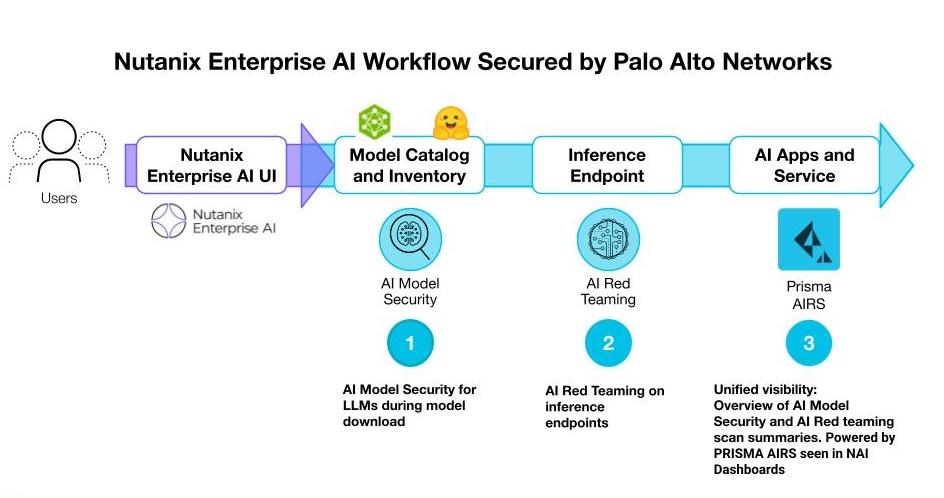
Nutanix and Palo Alto Networks are excited to announce a purpose-built integration between the Nutanix Enterprise AI and Palo Alto Networks Prisma AIRS® advanced security capabilities, specifically focusing on AI Model Security and AI Red Teaming. This partnership directly addresses the critical need for a secure-by-design approach to AI development, giving customers the confidence to accelerate their AI journey.

Seamless Security Integration on the Nutanix Enterprise AI Platform

The Nutanix Enterprise AI platform provides a unified, scalable and secure foundation for the entire AI lifecycle: from data preparation and model fine-tuning to deployment and management. By integrating cutting-edge AI security tools by Palo Alto Networks directly into this workflow, we enable security checks to become an intrinsic part of the AIOps pipeline.

Nutanix Enterprise AI workflow secured by Palo Alto Networks.
Prisma AIRS integration user flow.

Scanning AI Models for Comprehensive Vulnerability Detection

The Prisma AIRS AI Model Security solution introduces sophisticated model scanning capabilities that are essential for preemptively identifying and mitigating risks.

  • Prisma AIRS Model Security Integration: Automatically scans AI models (e.g., during check-in to a model registry on the Nutanix Enterprise AI platform) for inherent vulnerabilities, policy violations and malicious code. This provides Proactive Risk Mitigation by detecting malicious or vulnerable model artifacts before deployment, helping prevent zero-day exploits and potential data leakage caused by compromised models.
  • Dependency Analysis: Examines all open-source libraries and dependencies used in the model environment for known vulnerabilities and license compliance issues. This enables Supply Chain Security, eliminating risks introduced by third-party components throughout the entire AI deployment lifecycle.
  • Model Supply Chain Threats: The system addresses malicious model artifacts, including deserialization exploits, embedded backdoors, unsafe file formats, unauthorized code execution, untrusted sources and noncompliant licenses. This enables Model Integrity and Governance by validating model safety, provenance, approved formats, license compliance and detecting hidden execution paths before deployment.

AI Red Teaming Your AI Systems for Adversarial Resilience

AI Model Security addresses known issues, but the malicious actors of tomorrow are developing new ways to exploit AI systems. This is where the power of Prisma AIRS AI Red Teaming by Palo Alto Networks comes into play, creating a crucial layer of proactive testing against adversarial attempts. AI Red Teaming involves simulating sophisticated attacks against the AI application’s behavior to test its resilience under attack.

  • Continuous AI assessment: Onboard an LLM model, application and agent, then start scanning in less than 10 minutes. Use documented APIs to integrate into CI/CD pipelines to trigger automated red teaming whenever versions are updated. Connect AI endpoints securely via an outbound web socket channel to eliminate the need for routing changes, while maintaining the option for IP allowlisting, if preferred. Your team controls access. This reduces technical setup overheads and empowers you to keep your assessment current.
  • Contextual Vulnerability Insights: Prisma AIRS profiles your LLM model, application or agent and informs the Red Teaming Agent to design relevant attack objectives. The Red Teaming Agent is trained on over 50 techniques and simulates attack prompts to achieve those objectives. This reduces noise and lets you focus on actual business relevant risk.
  • Comprehensive Threat Coverage: Prisma AIRS uses a library of over 750 attacks to evaluate your defensibility. Both the library and the red teaming agent are updated and trained on a constant basis to keep up with the AI threat landscape. This stress tests your AI system thoroughly, so your system is defensible to known and unknown threats.
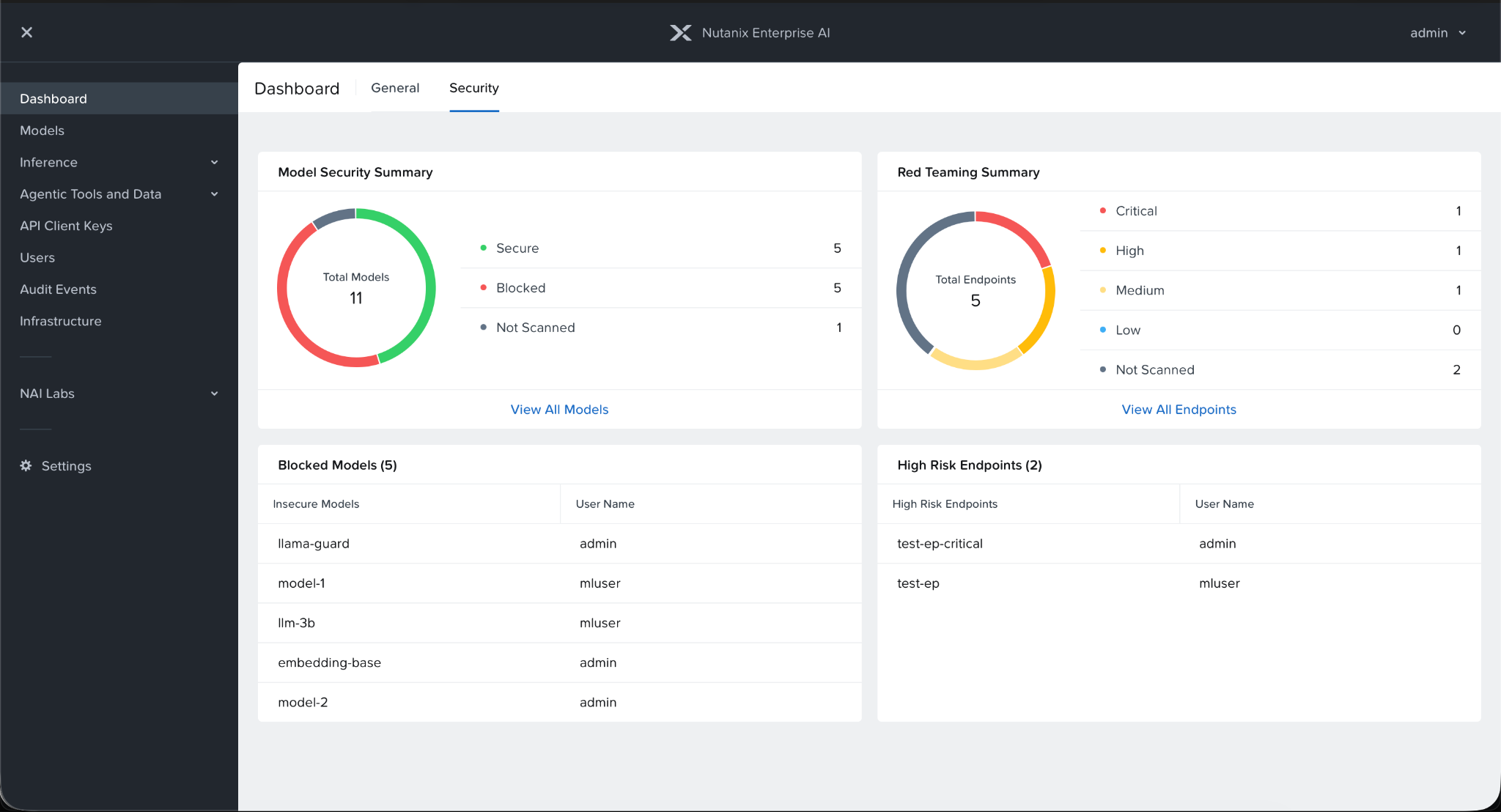
Nutanix Enterprise AI dashboard preview.
Unified Security Dashboard for AI Model Security and AI Red Teaming being made available in Nutanix Enterprise AI.

Securing the Future of Enterprise AI — The Nutanix and Palo Alto Networks Integration

This integration between the scalable, high-performing Nutanix Enterprise AI platform and the advanced security intelligence of Palo Alto Networks offers measurable value to AI-driven organizations:

  1. Accelerated Time-to-Trust – By automating critical security checks as part of the MLOps process on the Nutanix Enterprise AI platform, teams can deploy models faster, knowing they have been rigorously vetted by a leading security partner.
  2. Simplified Compliance and Governance – The joint solution provides a verifiable record of security testing (scanning and red teaming), making it simpler to demonstrate adherence to internal governance standards and external regulatory mandates.
  3. End-to-End AI Security Posture – Customers gain a holistic view of security, from the unified AI infrastructure layer managed by Nutanix, to the network security enforced by Palo Alto Networks. This visibility now extends critically into the AI models themselves, completing the security posture by unlocking controlled access to vendor models, so protection is enforced seamlessly.
  4. Cost and Resource Efficiency – Integrating security tools within the existing AI platform streamlines workflows. Data Scientists and ML Engineers can trigger red teaming simulations and scanning directly within their familiar Nutanix environments, reducing the need for dedicated, siloed security teams to manually test every model.

The partnership between Nutanix and Palo Alto Networks is a commitment to building a more secure future for enterprise AI. With this integration, you can bring LLM models into your environment without fear. Malicious code and hidden backdoors are blocked before they ever reach you. Your endpoints stay continuously protected, with coverage across over 50 attack techniques and the contextual risks that come with agentic AI. When you're evaluating a model or an endpoint, the risk picture is right there inside NAI – no context-switching, no guesswork. And a custom security dashboard gives you a single place to see where you stand. The result is AI you can actually trust at the core of your lifecycle, so your teams can build faster without trading off security for speed.

Key Takeaways

A "Secure-by-Design" AI Pipeline: The partnership between Nutanix and Palo Alto Networks is a commitment to building a more secure future for enterprise AI. The integration enables advanced level AI security in AIOps workflow. By embedding Prisma AIRS directly into the Nutanix Enterprise AI platform, organizations can automate model scanning and vulnerability detection during the initial check-in phase, authorizing only validated, secure models to reach production.

Proactive Defense via AI Model Security and AI Red Teaming: The solution provides a dual-layer defense: AI Model Security preemptively blocks hidden backdoors, malicious code and supply chain threats in third-party artifacts, while AI Red Teaming uses autonomous agents for contextual discovery to generate new attack scenarios and have over 750 sophisticated adversarial attack scenarios. This enables resilience against both known vulnerabilities and emerging zero-day AI exploits.

Unified Governance and Operational Efficiency: The partnership consolidates security and visibility into a single custom dashboard within the Nutanix environment. This unified view allows Security and AI teams to manage risk while having continuous assessments and compliance records significantly accelerating the time to trust.

Next Steps

For more information, visit the Palo Alto Networks partner directory or contact your local sales representatives to learn more about a trial run.

The post Nutanix and Palo Alto Networks Integrate for Robust Model Trust appeared first on Palo Alto Networks Blog.

  •  

39 Seconds — That's How Long It Takes to Lose Your Data

Not hours. Not days. It takes thirty-nine seconds from initial access to data exfiltration.

That stat, pulled from Unit 42® research, isn't hypothetical. It's what defenders are up against right now, while most organizations are still building security teams around manual detection and response workflows that were never designed to operate at machine speed.

Wendi Whitmore, Chief Security Intelligence Officer at Palo Alto Networks, put it plainly in a recent conversation on the Threat Vector podcast, recorded live at RSA this year:

If you're applying a manual detection and response capability, you are going to be beat by the attacker every day.

It's the kind of sentence that should make security budgets move faster.

The Threat Landscape Doesn't Wait for Organizational Consensus

Whitmore has spent nearly 25 years tracking nation-state actors, and she's unequivocal about what's changed. The adversaries today aren't just better funded and more sophisticated. They're faster, and increasingly AI-powered.

Consider what's converging right now:

Chinese nation-state groups like Volt Typhoon and Salt Typhoon have been operating with near-surgical patience inside critical infrastructure, leveraging existing administrative tools to avoid detection. Volt Typhoon is focused on military prepositioning in power grids, water systems and telecommunications. Salt Typhoon has been systematically collecting intelligence from those same networks. Neither group announces itself with novel malware. They disappear into environments using the tools already there.

Meanwhile, threat actors tied to Iran are operating with entirely different objectives: tactical disruption and destruction. And financially motivated cybercriminal groups are automating ransomware campaigns at a pace that has compressed attack timelines from weeks to minutes.

Every CISO is being asked to defend against all of them simultaneously, while also managing their organization's AI expansion, and doing it without adding headcount.

Speed Is the New Perimeter

When Whitmore references the 39-second exfiltration window, she's pointing at something structural, not just alarming. It reflects how completely the attacker's operational tempo has shifted.

The 72-minute data breach figure from Unit 42 Incident Response data is equally striking: From initial access to full data theft in the time it takes to sit through a decent movie. A 400-times year-over-year increase in exfiltration speed isn't a trend. It's a fundamental change in the physics of an attack.

"There is no way that we are going to defeat these adversaries if we are working at manual speed," Whitmore explained. The answer isn't just more analysts. It's fighting AI with AI, letting machines handle the volume and velocity, so humans can focus on the problems that actually require human judgment.

Two Sides of the Same AI Problem

Here's where the conversation gets more nuanced and more important.

Most of the AI-in-security conversation focuses on the offensive side: adversaries using generative AI to craft convincing phishing lures, accelerate reconnaissance and automate attack sequences. That's real, and it's accelerating.

But Whitmore raised the other half of the problem, one that gets far less attention: The attack surface that organizations are creating by deploying AI without securing it.

Innovation of AI doesn't so far outpace the security of AI.

This is the outcome she wants to see. Right now, that's not what's happening. Business pressure to deploy AI quickly is outrunning the security architecture required to protect it. Every new AI deployment touching production data, cloud APIs and enterprise systems expands the attack surface. Shadow AI, prompt injection, model poisoning: These are not future threat vectors. They're present tense.

The distinction Whitmore draws is useful: AI for cybersecurity (faster detection, automated response, reduced analyst burden) needs to advance in parallel with cybersecurity for AI (securing the models, prompts and data pipelines that organizations are building on). One without the other creates exactly the kind of asymmetry attackers will exploit.

Visibility Is Where It Starts

Whether the conversation is about defending against nation-state actors or securing AI deployments, Whitmore keeps returning to the same foundation of visibility.

Not complexity. Not more tools. Visibility is a single, unified view of what's happening across endpoints, networks, cloud and AI systems, that’s fast enough to matter when the window is measured in seconds, not days.

For SOC teams, that means being able to detect and contain a threat before a compromise of one system becomes an enterprise-wide event. For CISOs thinking about AI governance, it means understanding what's being deployed, what's being prompted, and where the data is going before an incident surfaces for them.

The organizations Whitmore sees succeeding aren't the ones with the largest security budgets. They're the ones with the clearest picture of their environment, and the architecture to act on it in real time.

The Win Looks Different Now

Perhaps the most important reframe in the conversation is that the objective is no longer to prevent every attack. That goal is not achievable against adversaries operating at AI speed with nation-state resources.

The win is resilience. Detecting fast and containing fast. Keeping one compromised endpoint from becoming an enterprise-wide breach.

That shift in framing, from prevention to rapid recovery, has significant implications for how security teams are built, how AI is integrated into workflows, and how CISOs make the case for investment to leadership that still thinks in terms of keeping attackers out.

The adversaries already know the perimeter is gone. The question is whether your defense strategy has caught up.

Want to Dig in More?

Listen to the full interview here.

The Unit 42 2026 Global Incident Response Report goes deep on the threat trends shaping how modern attacks unfold. If you want the data behind the headlines, start here. Download the Report →

The post 39 Seconds — That's How Long It Takes to Lose Your Data appeared first on Palo Alto Networks Blog.

  •  

The Dangerous Momentum of Autodownload Phishing

Modern phishing campaigns are no longer trying to convince users. They are trying to outrun them. By forcing an automatic progression from click to download, attackers eliminate the moment of hesitation entirely by forcing files to download instantly using trusted cloud platforms like Dropbox and Google Drive.

Detecting when these legitimate SaaS auto-download features are being weaponized is an immense challenge for traditional defenses. This is exactly where Cortex® Email Security steps in. By combining deep static analysis with advanced behavioral intelligence, the module can distinguish in this attack between a benign file share and a malicious, forced-momentum trigger.

This technical detection is vital because while the autodownload method is the primary cause of infection, its effectiveness relies on a clever strategy, using a wide range of changing social engineering lures. By alternating between lures like 'Invoices' or 'Quotes,' attackers rotate their themes to catch a wider variety of victims. This strategy allows attackers to convert trusted email links into rapid, dangerous file executions that effectively evade standard security measures.

How Forced Momentum Drives Auto-Downloads

The core of this attack leverages the infrastructure of real SaaS providers to eliminate the user's preview buffer. Typically, cloud sharing directs users to a webpage for file examination. In this campaign, however, forced-download parameters (such as ?dl=1 on Dropbox) are used instead. To ensure the victim executes the file once it lands on their machine, attackers hide the danger behind "visual anchors." By using double extensions like PDF and .EXE, the threat actor exploits default settings in certain operating systems that hide known extensions. The user's eyes stop at the familiar ".PDF" or ".ZIP," leading them to believe the file is a harmless document rather than a malicious executable.

When the targeted victim clicks the link in the email, it triggers an immediate file download in the browser, effectively bypassing any intermediary steps.

Attack Flow: From Email to Execution

  • The Bait: A highly personalized email arrives, using a trusted cloud link (like Dropbox) to lower the victim's guard.
  • The Trap: Clicking the link skips the usual "preview" screen and instantly drops a file onto the victim's computer.
  • The Disguise: The file is cleverly named to look like a safe PDF or document, hiding its true identity as a harmful program.
  • The Lock: In many cases, the attacker ensures only the intended victim can open the file, preventing security tools from scanning it first.
  • The Takeover: Once the victim opens the file, the attacker gains remote access to the system.
Attack flow chart, from email to execution.
Multi-step attack flow, starting from targeted phishing email, to bypass security and establish persistence.

The Library of Lures Strategy

To fuel the autodownload machine, attackers employ a flexible strategy by switching between various social engineering themes. This spear phishing campaign targets specific inboxes, such as "Orders," to exploit professional routines. Some common lures found in this campaign include:

  • Financial Urgency Fake "Invoices" or "Receipts" that induce anxiety. These often set close-day payment deadlines, pressuring recipients to click quickly.
  • Business Operations – "Quote Requests" or "Purchase Orders" that exploit professional habits.
  • Deceptive Naming – Concealing the download as a safe document, using display text like "invoice.pdf" in the email body to hide the underlying Dropbox URL.

Government Domain Impersonation

Attackers often leverage high-authority lures designed to paralyze a user's critical thinking. In one sophisticated wave, we observed threats impersonating a government entity by exploiting the high-reputation, official government domain. By borrowing the reputational authority associated with official infrastructure, the attacker successfully maneuvered an "Unidentified Payment Notice" past standard "Untrusted Sender" filters. To the recipient, the email carries the weight of a sanctioned document. Fearing legal or financial ramifications, they feel a heightened sense of urgency to click "View Invoice" to resolve the issue immediately.

Employee Impersonation

When government authority isn’t the angle, attackers shift to impersonating internal staff. In one case, the sender’s display name was spoofed to match a real employee in the target organization. Attackers rely on a “Momentum of Trust” tied to familiar names to overwhelm user judgment. Even when a generic Gmail address is used, users, especially those on mobile devices, rarely pause to check the underlying headers.

Internal Trust Amplification ("Human Relay")

The most effective aspect of this campaign occurs through Internal Laundering, where the threat shifts from external suspicion to a trusted internal message. This was observed when a Finance Department employee received a "Quote Analysis" file and, believing it to be a valid inquiry, mistakenly forwarded the link to the Procurement department.

At that stage, the attack no longer depended on deception, it propagated through trusted human workflows. These various tactics illustrate the sophistication and adaptability of phishing campaigns and highlight the importance of vigilance in email security.

How We Uncovered a Single Threat Actor

Although the lures appeared diverse, a deeper technical analysis revealed that they were all orchestrated by a single, coordinated threat actor.

By mapping the campaign, we uncovered a significant pattern: Each autodownload link pointed to a different file hash to evade signature detection, but all unique executables were ultimately associated with the same parent installer hash.

The file was identified as a specific Remote Monitoring and Management (RMM) executable, an administrative software used to manage computers remotely. Because RMM tools are legitimate, they often trigger fewer alerts than traditional Trojans. This allows the attacker to maintain persistent access under the guise of “authorized” system activity.

How Cortex Email Security Addresses the Threat

To defend against a campaign that emphasizes speed and rotation, behavioral analysis is essential.

The Cortex® Email Security Module addresses this threat:

  • Advanced URL Analysis – Detection of forced-download parameters, combined with delivery of high-risk files via URLs.
  • Deep Metadata Correlation Correlating sender identity with behavioral anomalies to flag threats that traditional scanners might overlook.
  • LLM-Based Intent Analysis Classifying phishing themes (invoice, payment, quote) despite variation.

The security engine triggers an alert by synthesizing LLM analysis with real-time email telemetry, global threat intelligence and behavioral signals.

Securing the Click

The combination of autodownload links and rotating lures is crafted to exploit user momentum and the "psychology of trust."

This campaign represents a shift from deception to acceleration. Attackers no longer need perfect lures, they only need to remove friction. Defenders must evolve accordingly, focusing not only on what a link is, but on what it forces a user to do.

Palo Alto Networks Cortex Advanced Email Security was built for this evolution. By moving beyond static file analysis to identify the behavioral "red flags" of autodownloads and forced-momentum URLs, we provide the visibility needed to stop these attacks before they reach the device.

The module examines email metadata, content, and behavior to uncover hidden malicious intent and sophisticated impersonation, including AI-crafted threats. By assigning precise risk scores to every detection, the system filters out the noise, allowing analysts to move past alert fatigue and focus on the most critical threats first.

Indicators of compromise discovered during this research are detailed on Unit 42’s GitHib instance.


FAQs

  1. Why is the "Auto-Download" parameter so effective? It removes the "moment of doubt." By bypassing the preview page, the attacker forces the file onto the computer instantly, prompting the user to "Open" it out of habit.
  2. How does the use of rotating lures benefit the attacker? It maximizes both psychological and technical success. People have different "blind spots" (e.g., finance professionals are likely to click on invoices), and variety increases the chances of finding a template that can bypass specific customers' security filters.
  3. Why might a sandbox fail to catch the malicious file? Because the link was "Identity-Bound." To the scanner, the link appeared to lead to a harmless error page (cloaking), resulting in a false negative.

Cloaking involves showing different content to security scanners than what is presented to the victim. By using Identity-Bound access, the file only reveals itself to the intended target.

The post The Dangerous Momentum of Autodownload Phishing appeared first on Palo Alto Networks Blog.

  •  

Enhancing AI-Driven Defense with Anthropic’s Claude Opus 4.7

As Frontier AI crosses new thresholds, the landscape for both attackers and defenders is shifting. At Palo Alto Networks, we are committed to ensuring defenders maintain the advantage.

To deliver this critical edge, our Unit 42 Frontier AI Defense will now leverage Anthropic’s Claude Security, powered by Opus 4.7. By integrating one of the world’s most advanced AI models, we are empowering our customers to outpace automated threats. Through Frontier AI Defense, organizations can rapidly assess their security posture, remediate vulnerabilities and harden their infrastructure against next-generation, AI-driven attacks.

We are utilizing Claude Security’s deep technical reasoning to enable our customers to find and fix vulnerabilities with unprecedented speed. This includes:

  1. AI-Driven Exposure Analysis – Identifying complex exploit chains that turn minor findings into critical risks.
  2. Scalable Application Analysis – Performing deep-stack code reviews at a scale and depth previously unavailable.
  3. Agentic Defense – Powering autonomous workflows that detect and remediate threats at machine speed, backed by human oversight.

Palo Alto Networks is also participating in Anthropic's Cyber Verification Program, which credentials security teams for legitimate defensive use of frontier models.

The threat timeline is accelerating. Within months, AI-driven attack capabilities will become a standard fixture of the threat landscape. Palo Alto Networks is dedicated to ensuring our global customers are equipped with the modern frontier AI models necessary to stay secure both today and tomorrow.

The post Enhancing AI-Driven Defense with Anthropic’s Claude Opus 4.7 appeared first on Palo Alto Networks Blog.

  •  

Unit 42 Expands Frontier AI Defense with Armadin Partnership

Frontier AI is changing what is possible for attackers. To meet this escalating threat, Palo Alto Networks is teaming up with Armadin, the new offensive security company founded by Kevin Mandia. This partnership expands our newly introduced Unit 42 Frontier AI Defense service, scaling our ability to identify and remediate AI-driven exposures, and accelerating protection across the enterprise.

Over the past few weeks, we’ve spoken with hundreds of CISOs who universally feel the urgency on the frontlines. Security leaders need to know exactly where they stand against the AI-driven attacks happening right now, and the ones coming in the next six months.

Expanding Frontier AI Defense — The External AI Hyperattack Assessment

For organizations seeking to actively pressure-test their perimeter, this partnership introduces an autonomous, AI-driven offensive assessment of your external attack surface.

This added layer identifies real attack paths and proves exploitability across internet-facing assets. The platform begins with passive discovery, validating publicly exposed assets, cloud resources and secrets. Next, Armadin deploys a coordinated swarm of autonomous AI attack agents, operating at machine speed across your external footprint.

These agents execute active reconnaissance, launch attacks and exploit vulnerabilities in parallel, using over 50,000 templates. Upon initial access, the swarm simulates post-exploitation behavior to demonstrate impact, logging every attack chain as decision-grade evidence of exploitable risk.

Decision-Grade Proof of Exploitable Risk

With this added layer of autonomous simulation, Unit 42 Frontier AI Defense provides an even more rigorous, pressure-tested view of an organization's external attack surface. This allows our experts to accurately simulate the tradecraft of the most capable, AI-equipped threat actors, compressing complex attack lifecycles from days into minutes.

AI may change what is possible for attackers, but in the hands of defenders, it becomes a decisive advantage. This partnership is another important step in making sure that advantage stays with the defenders.

A member of Project Glasswing and OpenAI’s Trusted Access for Cyber (TAC) program, Palo Alto Networks remains the only company equipped to deliver this strategic level of partnership through Unit 42 Frontier AI Defense and the Frontier AI Alliance, driven to integrate cutting-edge technologies into our products and services.

Get started with Unit 42 Frontier AI Defense today.

The post Unit 42 Expands Frontier AI Defense with Armadin Partnership appeared first on Palo Alto Networks Blog.

  •  

Securing and Governing AI Agents At Scale Through A Unified AI Gateway

Palo Alto Networks Completes Acquisition of Portkey

We are pleased to announce that Palo Alto Networks has officially completed the acquisition of Portkey. 

We are moving from vision to reality by integrating Portkey’s pioneering AI Gateway directly into the fabric of the Palo Alto Networks product portfolio. Prisma AIRS AI Gateway will provide a unified vantage point to secure and govern AI agents at scale, offering a mission-critical control plane to identify, authenticate and authorize every agentic interaction in real time.  

We are delivering the industry’s most comprehensive security and unified control framework for the agentic enterprise, enabling our customers to scale autonomous AI workloads with complete confidence.

The era of the AI Enterprise has arrived. Today, 81% of enterprises are piloting the use of AI agents or have fully implemented AI agent solutions. We aren't just talking about smart chatbots. We are talking about autonomous agents that execute.

By leveraging APIs and MCP servers, these agents navigate complex workflows, access sensitive data and make real-time, business-critical decisions. The question is no longer if companies will adopt AI agents, but how to securely operationalize them without putting the brakes on innovation. 

The Challenge: Expanding Attack Surfaces

AI agents are creating a new and largely invisible attack surface. The risk is not just their independence, but the lack of visibility and accountability. Without a centralized enforcement layer for operational and security controls, every team that deploys an agent may unintentionally expose the enterprise to unauthorized data access and heightened security risks.

To solve this, Palo Alto Networks is redefining security for the agentic era. We recently introduced Prisma AIRS™ 3.0, the industry’s first platform to secure the entire agentic AI lifecycle. Portkey's acquisition accelerates that momentum.

The Prisma AIRS AI Gateway: From Chaos to Control 

Portkey's AI Gateway will be integrated into Prisma AIRS to deliver the unified control plane that enterprises need to operationalise and secure AI apps and agents at scale.

Moving from “chaos to control” requires a centralized approach to governance. Currently, many AI initiatives are hindered by fragmented security and a lack of oversight. The AI Gateway solves this by providing a unified vantage point where organizations can enforce consistent policies across all models and agents, ensuring every interaction is identified, authenticated and authorized in real time within a single governing framework.

The Prisma AIRS AI Gateway will establish a mission-critical control plane for the agentic enterprise, enabling teams to move autonomous workloads from development into at-scale production with confidence. With operational features like a unified API to LLMs, an agent registry, semantic routing and caching, the AI Gateway equips enterprises with complete control in one platform. By serving as a centralized enforcement point at the center of Prisma AIRS for all agent traffic, the AI Gateway will provide critical security functions, including Agent Artifact scanning, automated Red Teaming and Runtime Security needed to monitor behavior, route requests and mitigate risks in real time. Crucially, the AI Gateway will reinforce Agent Identity Security via Idira (formerly CyberArk), applying strict protocols to ensure every autonomous action is authenticated and governed by least-privilege controls.

Our vision is for the Prisma AIRS AI Gateway to serve as the industry blueprint for enterprises in the agentic era. By making security a foundational component of the operational lifecycle, we are empowering enterprises to build and govern an AI ecosystem that is secure by design.


Secure All Agents with the Prisma AIRS AI Gateway


Why Portkey? The Pioneer in AI Gateways

  • Battle-Tested: Portkey’s AI Gateway is already supporting the demands of the modern enterprise, at scale, with several Fortune 500 customers, processing trillions of tokens per month with the low latency that is required for agent-to-agent communication. This ensures that agentic security does not come at the cost of developer speed or application performance. 
  • Architectural Simplicity: Portkey offers plug-and-play capabilities with just three lines of code required to implement the AI Gateway. The AI Gateway, powered by unified APIs, also provides secure access to over 3,000 LLMs, MCP servers and agents, giving enterprises a flying start to building and executing with AI agents.
  • Better Together: Palo Alto Networks and Portkey’s joint vision is to make Prisma AIRS the most ubiquitous platform for AI security. With exceptional AI security by Palo Alto Networks combined with Portkey’s AI Gateway, we will offer a comprehensive AI Security platform.

Prisma AIRS comprehensive AI App and agent security platform.

What’s Next?

The era of AI Enterprises is here. We’re making sure it is secure by design. The complexity of managing agents and securing them has long created friction in enterprises. With the integration of Portkey into Prisma AIRS, we will remove the trade-off between agent autonomy and authority. We are ensuring that as businesses accelerate into the era of autonomous agents, the security architecture isn’t just keeping up, it is setting the pace. 

Learn more about Prisma AIRS - the world’s most comprehensive AI security platform.

Forward-Looking Statements

This blog contains forward-looking statements that involve risks, uncertainties, and assumptions, including, but not limited to, statements regarding the anticipated benefits and impact of the acquisition of Portkey on Palo Alto Networks, Portkey and their customers. There are a significant number of factors that could cause actual results to differ materially from statements made in this blog, including, but not limited to: risks related to disruption of management time from ongoing business operations due to the acquisition and the integration of Portkey and other recent acquisitions; our ability to effectively operate Portkey's operations and business, integrate Portkey’s business and products into our products, and realize the anticipated synergies in the transaction in a timely manner or at all; changes in the fair value of our contingent consideration liability associated with acquisitions; developments and changes in general market, political, economic and business conditions; failure of our platformization product offerings; risks associated with managing our growth; risks associated with new product, subscription and support offerings; shifts in priorities or delays in the development or release of new product or subscription or other offerings or the failure to timely develop and achieve market acceptance of new products and subscriptions, as well as existing products, subscriptions and support offerings; failure of our product offerings or business strategies in general; defects, errors, or vulnerabilities in our products, subscriptions or support offerings; our customers’ purchasing decisions and the length of sales cycles; our ability to attract and retain new customers; developments and changes in general market, political, economic, and business conditions; our competition; our ability to acquire and integrate other companies, products, or technologies in a successful manner; our debt repayment obligations; and our share repurchase program, which may not be fully consummated or enhance shareholder value, and any share repurchases which could affect the price of our common stock.

Additional risks and uncertainties that could affect our financial results are included under the captions "Risk Factors" and "Management's Discussion and Analysis of Financial Condition and Results of Operations" in our Quarterly Report on Form 10-Q filed with the SEC on February 18, 2026, which is available on our website at investors.paloaltonetworks.com and on the SEC's website at www.sec.gov. Additional information will also be set forth in other filings that we make with the SEC from time to time. All forward-looking statements in this blog are based on information available to us as of the date hereof, and we do not assume any obligation to update the forward-looking statements provided to reflect events that occur or circumstances that exist after the date on which they were made.

The post Securing and Governing AI Agents At Scale Through A Unified AI Gateway appeared first on Palo Alto Networks Blog.

  •  

Palo Alto Networks and Google Cloud

Expand Strategic Collaboration to Secure the AI Enterprise

The transition from generative AI to agentic AI represents one of the most significant shifts in the history of enterprise technology. As organizations move from simple chatbots to autonomous agents that can execute business processes, the attack surface isn't just changing, it's exploding.

At Google Cloud Next 2026 in Las Vegas, Palo Alto Networks is proud to announce a series of groundbreaking integrations with Google Cloud. These innovations are designed to do more than just monitor the new AI-driven landscape; they are built to secure it by design. AI deployment is currently outpacing AI governance. By embedding our security platform into Google Cloud’s infrastructure, we are giving today’s enterprises the foundation to become the autonomous organizations of tomorrow.

Here is a look at the four major milestones of our partnership being unveiled this week.

Secure AI Agents with Google Cloud + Prisma AIRS

As autonomous AI agents become the new enterprise standard, security can no longer be an afterthought; it must be architectural. By integrating Prisma AIRS™ natively with Google Cloud Gemini Enterprise Agent Platform, we provide the proactive defenses required to govern complex agentic workflows. This integration ensures that as you scale your autonomous workforce, your security scales with it, providing comprehensive operational integrity without hindering the speed of innovation.

We are delivering capabilities across three critical pillars:

  • Protecting Agent-Specific Runtime Risks: In an agentic ecosystem, the primary risk is unauthorized or a destructive action taken by the AI agents themselves. Prisma AIRS secures the "agent-to-tool" interface, preventing poisoned context from triggering malicious scripts or destructive actions. The solution monitors agent execution in real-time, so agents cannot leak sensitive credentials or tool schemas, maintaining the boundary between agents and their access to enterprise data.
  • Securing the GenAI Application Surface: Modern AI applications and agents require a secure-by-design approach. Prisma AIRS AI Runtime Security™ provides prevention of more than 30 adversarial prompt injection and jailbreak techniques, as well as malicious code and URLs within LLM outputs. Prisma AIRS utilizes over 1,000 predefined patterns out of the box and ML-powered Enterprise DLP to stop sensitive data leakage.
  • Enforcing Enterprise AI Safety and Grounding: Trust in AI is built on the consistency and safety of its output. Prisma AIRS allows organizations to define safety policies in natural language and filter toxic content across eight distinct categories to protect brand reputation. Using contextual grounding, Prisma AIRS can prevent misleading outputs that contradict internal RAG data, keeping agents tied to real facts.

This integration ensures that as you scale your autonomous workforce, your security posture scales with it, providing operational integrity without hindering the speed of innovation.

Security-as-Code for Prisma AIRS Integration with Application Design Center (ADC)

The traditional bolt-on approach to security is no longer viable in a cloud-first world. Google Cloud’s Application Design Center (ADC) is revolutionizing how applications are built, using an intuitive canvas and natural language via Gemini Code Assist.

Palo Alto Networks is announcing that it will be published as a template within the Application Design Center, providing more capabilities to engineering teams:

  • Drag-and-Drop Security – Visually "snap" VM-Series firewalls and Prisma AIRS AI protections directly into network flows.
  • AI-Driven Architecture – Use natural language prompts to generate secure-by-default, multiregion architectures.
  • Simultaneous Deployment – Deploy entire application stacks and security services in a single, unified workflow, ensuring protection is present from the very first minute of deployment.

Zero-Day Protection at Scale with Advanced Malware Sandboxing for Google Cloud NGFW Enterprise

The battle against malware has shifted to the cloud. Modern attacks are faster, more evasive and capable of bypassing traditional defenses.

That is why we are excited to announce Advanced WildFire®, powered by Palo Alto Networks, natively integrated into Google Cloud NGFW Enterprise, delivering AI-driven malware prevention directly within Google Cloud environments.

This integration embeds inline sandboxing and real-time threat intelligence directly into Google Cloud’s distributed firewall to stop advanced and unknown threats before they impact workloads, enabling:

  • Secure Detonation – Suspicious files are safely executed in a controlled sandbox environment to uncover hidden and unknown threats.
  • Inline Traffic Inspection – Inbound and outbound traffic is analyzed in real time to prevent lateral movement of malicious payloads across cloud environments.
  • AI-Driven Threat Prevention – Leverages global threat intelligence by Palo Alto Networks to block zero-day threats before they compromise workloads.

With Advanced WildFire embedded directly into Google Cloud NGFW Enterprise, organizations can extend consistent protection across their cloud infrastructure while maintaining operational simplicity.

Cloud NGFW Enterprise Advanced Malware Sandboxing will be available in Public Preview soon.

Defining the Future with the Google Cloud Marketplace

Palo Alto Networks has joined the Google Cloud Marketplace Agent-as-a-Service as a launch partner to introduce the Prisma AIRS Model Security agent. Operating as an Agent-as-a-Service, this solution scans AI models for vulnerabilities and policy noncompliance before they reach production.

Available in the Agent Gallery inside Gemini Enterprise, this marketplace offering runs entirely within the customer’s own Google Cloud environment, providing both new and existing Prisma AIRS users a seamless and simple deployment experience inside Gemini Enterprise.

Securing AI Innovation at Scale

The collaboration between Palo Alto Networks and Google Cloud is built on a shared vision: Security should be an accelerator for innovation, not a bottleneck. As we look toward the future of the AI-powered enterprise, our commitment remains to provide the most robust, platform-driven security for every workload, every agent and every interaction.

Want to see these integrations in action? Contact your Palo Alto Networks representative to learn more about how we are securing the future of the cloud together. If you’re attending Google Cloud Next 2026, join us at these sponsored sessions:

The post Palo Alto Networks and Google Cloud appeared first on Palo Alto Networks Blog.

  •  

Scaling AI Agents with Confidence

The Google Cloud and Palo Alto Networks Partnership

As AI agents move into business-critical environments, they are transforming everything from security operations to internal workflows. However, scaling these AI applications introduces unprecedented hurdles for security executives, from detecting "shadow AI" and unsanctioned usage to governing complex nonhuman identities across multimodel environments.

To overcome these challenges, organizations need more than just tools; they need a layered architecture built on a foundation of platformization. The long-standing partnership between Palo Alto Networks and Google Cloud provides this essential framework, offering customers:

  • Integrated Security Ecosystems: Seamlessly manage the full agent lifecycle with visibility and observability across your entire AI infrastructure.
  • Jointly Engineered Solutions: Leverage over 80 co-engineered integrations designed to eliminate the tradeoff between a cloud-native experience and best-in-class security.
  • Proven Scale and Performance: Benefit from a partnership that has already delivered impactful, AI-driven solutions to protect joint customers from evolving threats.

Google Cloud Marketplace enables customers to discover, try, buy and use industry-leading applications that have been validated to run on Google Cloud. Palo Alto Networks has closed $2.4 billion in GCP bookings, helping address evolving customer needs, such as simplified procurement and seamless deployment.

Kevin Ichhpurani, President, Global Partner Ecosystem at Google Cloud:

We’re pleased to celebrate Palo Alto Networks as our Global Technology Partner of the Year… Palo Alto Networks has consistently delivered impactful, AI-driven security solutions that help Google Cloud customers better protect their organizations from evolving threats.

The extensive, long-standing collaboration between Palo Alto Networks and Google Cloud includes jointly engineered offerings, built on 80 solution integrations that help customers build, run and secure AI-enhanced cloud infrastructure and applications with end-to-end protection.

Palo Alto Networks Wins 2026 Global Technology Google Cloud Partner of the Year Award

At Google Cloud Next, Palo Alto Networks has been recognized with four 2026 Google Cloud Partner of the Year awards. By partnering with Google Cloud, we help customers securely leverage the power of the cloud and AI-driven growth with comprehensive cloud-native security offerings. Wins included the following:

  • Global Technology
  • Marketplace: Technology
  • Marketplace: Security
  • Security: Artificial Intelligence

These Partner of the Year Awards underscore our expanding partnership with Google Cloud. We share a mutual dedication to improve cloud, network security and AI observability, as well as the progress we’ve made in protecting our joint customers from today’s and tomorrow’s cyberthreats.

By combining our industry-leading security engineering with Google Cloud’s industry-leading cloud infrastructure and services, we’re providing advanced protection for every stage of a customer’s digital journey. We want customers to feel secure from the formative steps of lifting workloads into the cloud, to expanding digital innovation across platforms, to reaching new levels of business scale and velocity.

Protecting these journeys requires alignment and modernization of infrastructure (lift and shift), applications (refactoring) and user access models (zero trust). It requires an advanced AI drive security operations transformation across all IT domains, leveraging machine learning and sophisticated models to minimize human interventions and unguarded sides.

Our relationship with Google Cloud is based on a deep engineering relationship, yielding integrated solutions that help customers achieve better digital outcomes. Our partnership can help your organization eliminate tradeoffs between a cloud-native experience and best-in-class security. We have more than 80 co-engineered integrations, helping to improve and protect hybrid workers, cloud migrations and application modernization efforts.

We remain committed to our goals of outpacing cyberthreats, helping customers at every stage of their cloud journey, and creating a world where tomorrow is more secure than today.

Whether you’re just beginning your cloud journey or managing complex transformational projects, our jointly engineered, AI-driven solutions are designed to deliver seamless, scalable security. Explore the dynamic partnership between Palo Alto Networks and Google Cloud. Join us at Google Cloud Next '26 in Las Vegas from April 22-24 to discover how to secure your development lifecycle from code to cloud.

The post Scaling AI Agents with Confidence appeared first on Palo Alto Networks Blog.

  •  

Palo Alto Networks Joins DNS-OARC as a Platinum Member

Palo Alto Networks recently joined the DNS-OARC community as a Platinum Member. Together, our organizations share a commitment to advancing collaboration in research and operational excellence across the global DNS ecosystem. DNS is critical to both internet infrastructure and security, and this collaboration facilitates the sharing of real-world insights among researchers and practitioners.

Our Contribution

We help organizations secure their digital environment with a comprehensive portfolio of cybersecurity solutions spanning Network, Cloud, Security Operations, AI and Identity. Trusted by more than 70,000 customers worldwide and informed by Unit 42® Threat Intelligence, their AI-driven platforms help organizations reduce complexity, modernize with confidence, and securely enable innovation.

As a Platinum Member, our subject matter experts will actively participate in the DNS-OARC community by engaging in discussions and contributing to research on evolving DNS threats and network challenges. The growing intersection of DNS and security makes access to intelligence and experience increasingly important. It strengthens the community’s ability to respond to emerging challenges and improves resilience across the internet.

Through our participation, our customers will gain stronger protection informed by community-driven intelligence and real-world operational insight. These learnings are continuously integrated into our threat intelligence and security capabilities. Our participation signals our support for DNS-OARC’s mission of fostering open dialogue and shared learning across the DNS ecosystem. This collaboration helps bridge DNS operations with broader security practices, improving coordination between operators, researchers and security practitioners.

Our Commitment to the DNS-OARC and Global Communities

Collaboration between our organizations strengthens the connection among DNS operations and modern security practices by bringing together operational insight and a global community dedicated to advancing the internet’s resilience.

For the DNS-OARC community, our commitment enhances knowledge sharing around evolving DNS threats, large-scale network operations and practical approaches to emerging challenges.

For organizations and customers, it reinforces a stronger alignment between DNS infrastructure and security, expands access to community-driven intelligence and supports more resilient, well-informed defenses.

Tong Zhao, Senior Manager of DNS Security Engineering, Palo Alto Networks:

We recognize the critical role of DNS-OARC in DNS operations and research. The teams from Palo Alto Networks believe that our DNS-OARC membership aligns perfectly with our goals. We are eager to participate in and contribute to the DNS community.

Our partnership with the DNC-OARC highlights the value of open collaboration in helping both the community and its participants stay ahead of an increasingly complex threat landscape. To learn more about how our expertise and insights support DNS-OARC’s mission to improve the security and stability of the internet’s DNS, visit DNS-OARC.

The post Palo Alto Networks Joins DNS-OARC as a Platinum Member appeared first on Palo Alto Networks Blog.

  •  

The AI Ecosystem Edge — Introducing Our Frontier AI Alliance

Acting swiftly with intent, together with Accenture, Deloitte, IBM, NTT DATA and PwC

With the imminent release of unbounded frontier models, the barrier to entry for sophisticated cyberattacks has vanished. Anthropic’s Mythos represents a 50% leap in coding capability over previous models. It’s a leap that, as Lee Klarich stated, translates into autonomous agents capable of both surfacing a massive surge of vulnerabilities and exploiting them faster than we’ve ever seen or imagined.

In this new era, business continuity requires more than just better tools; it requires a unified ecosystem of experts capable of orchestrating a defense that matches this new pace of attack.

As we drive the industry standard for addressing these emerging risks with our Unit 42® Frontier AI Defense, we’ve united an alliance of global transformation leaders, starting with Accenture, Deloitte, IBM, NTT DATA and PwC, and will continue to scale these alliances to ensure every enterprise has a rapid path to AI resilience.

Frontier AI Alliance: Palo Alto Networks, Accenture, Deloitte, IBM, NTT Data, pwc.

By combining the world’s most advanced AI security platform with deep industry expertise, we are delivering the security assessment and rapid protection needed to help customers stop emerging threats and keep their business resilient.

Rex Thexton,
Chief Technology Officer, Accenture Cybersecurity:

As AI-driven attacks accelerate to machine speed, organizations must rethink how they protect critical assets. Together with Palo Alto Networks, we're helping clients automate protection and reduce risk. By enabling an autonomous defense posture that detects and responds in minutes, we can empower organizations to scale their AI innovation with confidence.

Deborah Golden,
principal, Deloitte:

As AI-driven threats accelerate, our mission is to help clients move even faster. By combining Deloitte's implementation experience with Palo Alto Networks' AI blueprint, we are rapidly delivering more complete security coverage to clients with near-real-time responsiveness, turning potential vulnerabilities into a foundation for resilient innovation.

Mark Hughes,
Global Managing Partner of Cybersecurity Services, IBM Consulting:

In an environment where frontier models let attackers move faster than ever, organizations need defenses that can keep up. Joining the Frontier AI Alliance strengthens our commitment to helping organizations prepare for this new class of agentic, machine speed threats. IBM Autonomous Security plus Palo Alto Networks technologies bring together interoperable, vendor-agnostic digital workers that operate across an organization's full security stack, enabling security programs to act as a system rather than a collection of disconnected tools.

Sandip Gupta,
Head of Global Strategic Alliances, NTT DATA:

Frontier AI is reshaping the economics of cyber defense. As threat actors move faster and operate with greater automation, organizations need a more resilient and adaptive approach to protecting business continuity. Through the Frontier AI Alliance, NTT DATA is combining Palo Alto Networks' innovation with its global cybersecurity solutions and deep industry experience to help clients close critical security gaps, reduce complexity and strengthen resilience against AI-powered threats.

Morgan Adamski,
Principal and Cyber, Data, & Technology Risk Leader, PwC:

As AI-enabled cyber risk accelerates in both speed and scale, organizations cannot remediate issues fast enough through traditional approaches. Palo Alto Networks Unit 42 Frontier AI Defense combines Palo Alto Networks innovation in vulnerability discovery with PwC's expertise to prioritize what matters, accelerate remediation, and build governance and resilience frameworks that operate at machine speed.

01/05

By engaging directly with Palo Alto Networks, or working with our partners through the Frontier AI Alliance, our customers can move past the complexity of building an AI-ready defense from scratch and gain:

  • Accelerated Immunity: Go from a high-exposure state to a hardened posture using a prevalidated AI Defense Blueprint, delivering coverage in weeks, not years.
  • On-Demand Expertise: Our partners provide the specialized prompting and verification required to make the latest AI Frontier models work for the defender.
  • Operational Resilience: While Unit 42 provides the Frontier AI Exposure Analysis, our ecosystem partners provide the boots on the ground to remediate those findings and leverage our product portfolio to deliver AI-readiness to your enterprise.

The threat of Mythos-class models is imminent, but the path to resilience is clear. Whether you are looking for an immediate strategic assessment or a deep operational overhaul, the Frontier AI Alliance is ready to move at the speed of your business.

The post The AI Ecosystem Edge — Introducing Our Frontier AI Alliance appeared first on Palo Alto Networks Blog.

  •  

Defender's Guide to the Frontier AI Impact on Cybersecurity

The release of the newest frontier AI models marks a turning point for cybersecurity. Palo Alto Networks has conducted early testing of the latest frontier AI models, including Anthropic’s Mythos model as part of Project Glasswing and OpenAI’s latest models as part of Trusted Access for Cyber program. The conclusion is clear: They are extraordinarily capable at finding vulnerabilities and generating corresponding exploits.

This generational improvement in coding ability directly translates to a significant advance in vulnerability discovery and exploit generation. These capabilities, however guardrailed, will not stay contained. Similar advances will appear across other major AI labs, Chinese models, and open source models. Attackers will find the seams in those guardrails. They will use advanced AI to discover zero-day vulnerabilities at scale, generate exploits in near real time, and develop autonomous attack agents unlike anything the industry has faced.

Within six months, advanced AI models with deep cybersecurity capabilities will become commonplace. Organizations that have not put appropriate safeguards in place will face an entirely new class of risk across their enterprise and critical infrastructure.

Frontier AI: A Quantum Leap in Code Fluency

As you have probably already seen, the latest unbounded models like Mythos represent roughly a 50% improvement in coding efficiency over Anthropic’s previous leading model. Palo Alto Networks has had early access to unbounded models and we’ve been able to leverage this vast improvement in coding to a quantum leap in scanning and offensive capability.

Hundreds of our best security engineers have been assessing these capabilities and developing best practices for using it effectively. The results revealed several core truths:

  • Vulnerability discovery at scale: Frontier AI is exceptionally effective at identifying vulnerabilities in code. In less than three weeks, it accomplished the equivalent of a full year’s worth of penetration testing effort.
  • Attack path determination: Perhaps more impressive than finding individual vulnerabilities, Frontier AI excels at vulnerability chaining, combining multiple lower-severity issues into critical-level exploit paths. For example, linking two medium-severity and one low-severity vulnerability into a single critical exploit.
  • Full-stack logic analysis: Frontier AI can analyze the full exposure surface of applications, including SaaS and public-facing platforms, identifying logic-based vulnerabilities that traditional tools miss.

Impacts on the Cyber Landscape

Attackers have been using LLMs for years, but based on our testing of frontier AI models, there are three key areas where they will have a significant impact on the cybersecurity landscape:

  1. The Vulnerability Deluge: Frontier AI models will dramatically accelerate the rate at which vulnerabilities are discovered, by defenders and attackers alike. This will be particularly acute in open source and critically, the flood of patches that follows will itself create risk. Every patch that is not applied immediately becomes a known, targetable vulnerability. Organizations will need to accelerate and automate their patching programs, rethink how they prioritize and apply patches, and ensure best-in-class protections are in place to mitigate vulnerability until they can be remediated.
  2. Rise of Inside-Out Attacks: Recent supply chain attacks on tools like LiteLLM and Trivy demonstrate a growing pattern where attacks land adversaries inside an organization’s infrastructure, bypassing multiple conventional attack steps and reducing the number of prevention opportunities available to defenders. The rapid deployment of AI infrastructure has made this problem more acute as the AI supply chain, including runtime environments, communication infrastructure, and model dependencies, is often insufficiently protected. While open source usage and patching practices must become significantly more robust, organizations will need structural containment of potential attacks through zero trust, identity modernization, outbound connection restrictions and lateral movement protections.
  3. Faster AI-Assisted Attack Cycles: I expect the most consequential shift with frontier AI models is the move from AI-assisted to AI-driven attacks. Attackers will build autonomous attack agents that dramatically compress attack cycle times. What once took days or weeks of skilled manual effort will soon be executed in minutes. This democratization of advanced attack capabilities means that defenders must match that speed with near-real-time detection and response, which is only possible with extensive AI and automation throughout security operations. Organizations whose Mean Time to Detection and Mean Time to Response are not measured in low single-digit minutes will be outpaced.

The Defenders Guide: Assessment, Protection, Platformization

The framework for defending against AI-driven threats is not completely new, but the standard for execution must be absolute. Organizations that are “mostly protected” are effectively unprotected. What follows is a phased approach – assessment, protection and platformization – that organizations should pursue in parallel to close gaps before attackers exploit them.

Assessment: Every organization should use the latest AI models to assess its entire code and application landscape and build a comprehensive asset and exposure inventory.

Key priorities:

  • Leverage AI models to identify vulnerabilities across your codebase, applications and infrastructure before attackers do.
  • Evaluate exposure with full context, including how vulnerabilities chain together to form critical exploit paths.
  • Audit your open source supply chain, including AI infrastructure, runtime environments and model dependencies.
  • Map your current sensor coverage. Detection, prevention and telemetry gaps represent critical blind spots.

Protect & Remediation: Remediating and reducing exposure is table-stakes. What in the past may have been difficult due to cross-organizational friction of finding and fixing at pace should now be accelerated with the c-suite attention of these new AI models. But this must go further and extend to comprehensive deployment of best-in-class attack prevention capabilities where the new standard is 100% coverage and optimization.

  • XDR everywhere, with emphasis on real-time ML-based detection and prevention of attacks; all hosts on prem and cloud included.
  • Agentic endpoint security to secure wide-scale adoption of vibe coding and AI security across the enterprise (e.g. Prisma AIRS and our recent acquisition of Koi is now a necessity for securing the agentic endpoint).
  • With an average of 85% of work now happening in the browser, secure enterprise browsers with real-time security become a must-have for attack prevention.
  • Zero trust and identity security are foundational to securing every user and every connection.

Real-Time Security Operations: With attack cycle times shrinking rapidly, the legacy approach to security operations simply doesn’t work. Disparate tools analyzing data in silos overlaid with manual processes must be replaced with AI and automation throughout. Cortex XSIAM, our AI-driven SOC platform, is what I consider to be the gold standard for how to take a next-generation approach to deliver MTTD and MTTR in single digit minutes.

  • Attack detections must be AI/ML driven to detect even frequently-changing and novel attacks at scale.
  • These AI detections must operate against a wide range of 1st party and 3rd party data sources – a best in class AI SOC must operate on ALL relevant data sources.
  • Automation both natively integrated and throughout the SOC lifecycle is necessary to achieve single digit MTTR; this automation will increasingly be agentic.
  • This must be delivered as a platform to remove the seams and gaps between point solutions.

We’re Here to Help

Achieving this level of resilience requires the right platforms and the right expertise.

To help you navigate this shift, we are introducing Unit 42 Frontier AI Defense. This new offering is designed to discover and remediate your current exposure before attackers do, strengthen controls that reduce exposure and contain impact and modernize operations so teams can detect and respond at machine speed.

This is the moment we’ve been preparing for. The threat has never been more sophisticated, but the path forward has never been clearer, and we’re here to partner with you on what comes next.

The post Defender's Guide to the Frontier AI Impact on Cybersecurity appeared first on Palo Alto Networks Blog.

  •  
❌