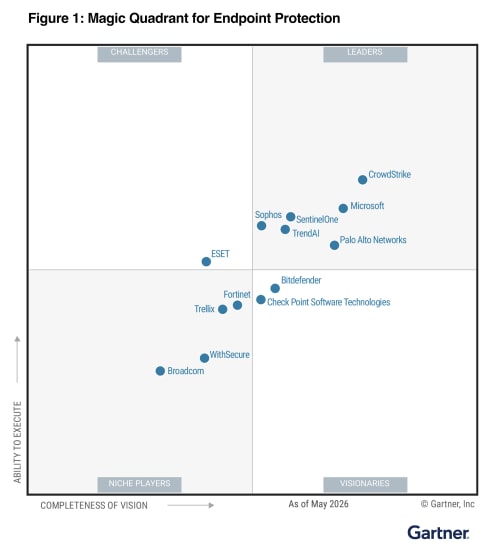
I am incredibly proud to share that Palo Alto Networks has been named a Leader in the 2026 Gartner® Magic Quadrant for Endpoint Protection Platforms for the fourth consecutive year. For us, this recognition is a testament to our team's relentless vision as we continue to define endpoint defense—from the pioneer days of XDR to the new frontier of agentic AI.
We believe our repeated recognition as a Leader is built on a single, uncompromising commitment to our customers and partners: empowering organizations with reduced overhead, rapid threat response, a strengthened security posture, and the resilient protection required to close the most critical security gaps. We are now leading the shift into the agentic era. While AI agents significantly boost enterprise productivity, they also introduce novel attack surfaces that legacy EDR tools are unable to protect. As the pioneer of XDR, we are committed to defining the next generation of cybersecurity by securing this new frontier.
Cortex® XDR is helping customers:
Secure Agentic AI with Koi: Gain unprecedented visibility, guardrails, and control over AI agents and agentic tools before they become a liability.
Stop the Unseen: Leverage battle-tested prevention powered by behavioral analytics, and industry-leading automation and response.
Unify Your Defense: Consolidate your endpoint and workspace security with a proven, four-time industry Leader.
We are incredibly proud to be recognized as a Leader once again, an acknowledgement that belongs just as much to our customers and partners as it does to us. Your trust, feedback, and real-world challenges keep us sharp and dictate our roadmap. At the end of the day, our continued leadership is built on one core promise: make each day more secure than the day before.
To get the full story and a comprehensive analysis of the endpoint security market, I invite you to read the 2026 Gartner Magic Quadrant report.
Gartner, Magic Quadrant for Endpoint Protection Platforms, By Deepak Mishra, Evgeny Mirolyubov, Nikul Patel, May 29, 2026
Gartner and Magic Quadrant are trademarks of Gartner, Inc. and/or its affiliates. Gartner does not endorse any company, vendor, product or service depicted in its publications, and does not advise technology users to select only those vendors with the highest ratings or other designation. Gartner publications consist of the opinions of Gartner’s business and technology insights organization and should not be construed as statements of fact. Gartner disclaims all warranties, expressed or implied, with respect to this publication, including any warranties of merchantability or fitness for a particular purpose.
Traditional Security Is Blind to the Agentic Endpoint
Modern endpoints are no longer defined only by executables. Increasingly, endpoint behavior is shaped by non-binary software, such as code packages, browser extensions, IDE plugins, scripts, local servers (including MCP), containers and model artifacts. They are installed directly by employees and developers without centralized oversight. Because these components are not classic binaries, they often fall outside the visibility and control of traditional endpoint security tooling.
AI agents compound this problem. They are legitimate tools that operate with the user’s credentials and permissions, enabling them to read, write, move data and take privileged actions across systems. When compromised or misused, agents become the “ultimate insider.” They can autonomously discover, invoke and even install additional components at machine speed, accelerating risk across an already expanding, largely unmanaged software layer.
Weaponizing Trusted Automation
This is not a future concern. The recent viral emergence of OpenClaw serves as a cautionary tale for the agentic era. Developed by a single individual in just one week, it rapidly secured millions of downloads while gaining broad permissions across users' emails, filesystems and shells. Within days, researchers identified 135,000 exposed instances and more than 800 malicious skills in its marketplace, underscoring how a single unvetted agent can create an immediate, global attack surface.
OpenClaw is not an outlier. Recent research highlights how quickly this risk is materializing:
Vibe Coding Threats: An AI extension in VS Code was found leaking code from 1.5 million developers. This tool could read any open file and send it back to the developer, collect mass files without user interaction, and track users with commercial analytics SDKs.
Malicious MCP Server:Koi documented the first malicious Model Context Protocol (MCP) server in the wild. When developers added a specific skill to tools like Claude Code or Cursor, it silently forwarded every email to the plugin creator. What’s more, this capability was added later, after developers had already started using it.
Compounding this risk is the fact that autonomous agent actions are often difficult to trace or reconstruct, leaving Security Operations Centers (SOCs) without the visibility they need when an incident occurs.
A New Category of Protection
Complete endpoint security for the rapidly expanding risk of agentic AI calls for a new category of protection: Agentic Endpoint Security. That’s why we announced our intent to acquire Koi, a pioneer in this space. Koi is designed to eliminate blind spots across the AI-native ecosystem and help organizations govern agentic tools safely.
Its technology rests on three core pillars:
See All AI Software – Gain complete visibility into the AI tools, agents and non-binary software running in your environment.
Understand Risks – Continuously analyze and understand the intent and risk level of all software and AI agents.
Control the AI Ecosystem – Enforce policy in real-time to remediate issues and block risky behaviors.
Securing the Agentic Enterprise
We are convinced that Agentic Endpoint Security will soon become a standard requirement for enterprise security. Upon closing the proposed acquisition, we intend to integrate Koi’s capabilities across our platforms to help our customers secure the AI-native workspace.
The wave of AI agents approaching the enterprise cannot be held back. Instead, we must offer secure tools that enable companies to confidently embrace agentic innovation.
Forward-Looking Statements
This blog post contains forward-looking statements that involve risks, uncertainties, and assumptions, including, but not limited to, statements regarding the anticipated benefits and impact of the proposed acquisition of Koi on Palo Alto Networks, Koi and their customers. There are a significant number of factors that could cause actual results to differ materially from statements made in this blog post, including, but not limited to: the effect of the announcement of the proposed acquisition on the parties’ commercial relationships and workforce; the ability to satisfy the conditions to the closing of the acquisition, including the receipt of required regulatory approvals; the ability to consummate the proposed acquisition on a timely basis or at all; significant and/or unanticipated difficulties, liabilities or expenditures relating to proposed transaction, risks related to disruption of management time from ongoing business operations due to the proposed acquisition and the ongoing integration of other recent acquisitions; our ability to effectively operate Koi’s operations and business following the closing, integrate Koi’s business and products into our products following the closing, and realize the anticipated synergies in the transaction in a timely manner or at all; changes in the fair value of our contingent consideration liability associated with acquisitions; developments and changes in general market, political, economic and business conditions; failure of our platformization product offerings; risks associated with managing our growth; risks associated with new product, subscription and support offerings; shifts in priorities or delays in the development or release of new product or subscription or other offerings or the failure to timely develop and achieve market acceptance of new products and subscriptions, as well as existing products, subscriptions and support offerings; failure of our product offerings or business strategies in general; defects, errors, or vulnerabilities in our products, subscriptions or support offerings; our customers’ purchasing decisions and the length of sales cycles; our ability to attract and retain new customers; developments and changes in general market, political, economic, and business conditions; our competition; our ability to acquire and integrate other companies, products, or technologies in a successful manner; our debt repayment obligations; and our share repurchase program, which may not be fully consummated or enhance shareholder value, and any share repurchases which could affect the price of our common stock.
Additional risks and uncertainties that could affect our financial results are included under the captions "Risk Factors" and "Management's Discussion and Analysis of Financial Condition and Results of Operations" in our Quarterly Report on Form 10-Q filed with the SEC on November 20, 2025, which is available on our website at investors.paloaltonetworks.com and on the SEC's website at www.sec.gov. Additional information will also be set forth in other filings that we make with the SEC from time to time. All forward-looking statements in this blog post are based on information available to us as of the date hereof, and we do not assume any obligation to update the forward-looking statements provided to reflect events that occur or circumstances that exist after the date on which they were made.

 Login
Login
 for Endpoint Protection Platforms for the fourth consecutive year. For us, this recognition is a testament to our team's relentless vision as we continue to define endpoint defense—from the pioneer days of XDR to the new frontier of agentic AI.