Reading view

Palo Alto Networks and AT&T - Delivering Quantum-Resilient SASE Fabric

By Yogesh Ranade from Palo Alto Networks, and Senthil Ramakrishnan from AT&T

The digital world is currently navigating a dual-speed revolution. Acceleration of AI and hyperconnectivity is unlocking unprecedented economic value. The silent but rapid progress of quantum computing is fundamentally threatening the cryptographic foundation upon which that value is built.

As leaders in global networking and cybersecurity, Palo Alto Networks and AT&T Business launched Secure Connectivity solutions for Business Customers. We recognize that quantum-readiness is no longer a distant milestone; it is now a strategic imperative. With threatening data longevity and Trust Now, Forge Later targeting digital identities, the risks are already looming. 

By integrating Prisma SD-WAN’s cryptographic innovation with AT&T’s global network, Palo Alto Networks and AT&T Business are proud to deliver the Quantum-Resilient SASE Fabric.

The Quantum Shift Towards Building Resilience for Tomorrow’s Reality

For over 30 years, the difficulty of mathematics has been our primary defense. Classical algorithms, like RSA and Diffie-Hellman, provided the shield for our global economy because they were computationally impossible for classical machines to solve. However, quantum computing fundamentally changes this landscape by providing an exponential speed-up. By leveraging Shor’s Algorithm, quantum computers can break these classical cryptographic foundations, turning a decryption process that would take a classic supercomputer millennia into a task of mere hours.

Neutralizing the Quantum Crisis

Palo Alto Networks is embedding Post-Quantum Cryptography (PQC) as a native pillar of the Prisma SASE fabric. We are moving beyond the forklift-upgrade model to a software-defined, standards-based foundation, which is built on strict separation of management and data plane components:

  • Universal Control Plane Hardening (TLS 1.3): We have transitioned all control plane traffic to TLS 1.3 (Transport Layer Security 1.3), the global gold standard for Internet encryption. This secures the "brain" of the network (where routing configurations and security policies are managed), making it immune to quantum-enabled impersonation and credential theft.
  • PQC-Hardened Data Plane (IETF Standards): We are operationalizing PQC across the entire fabric by adopting official standards published by the Internet Engineering Task Force (IETF), specifically RFC 9370, 9242, and 8784. In plain terms, these standards allow us to use "hybrid key exchanges." This means we wrap your data in two layers of protection at once: a classical mathematical shield for immediate compatibility, and a quantum-resistant shield to protect against future decryption threats, all without causing packet fragmentation or network slowdowns.
  • Logs and Telemetry Plane: All network telemetry and metadata (the automated operational logs and traffic pattern data generated by the network, rather than the actual content of your business files) are encrypted in transit via TLS 1.3. This architecture guarantees that even this secondary network metadata is geofenced to your chosen region with no cross-region aggregation, satisfying the most stringent data residency mandates.
  • Crypto-Agility as a Standard: "Crypto-agility" is natively built into our systems, which means the software is designed to adopt new mathematical algorithms. As the National Institute of Standards and Technology (NIST) refines its guidelines, our systems can be upgraded seamlessly via simple, automated cloud updates without requiring expensive hardware replacements to ensure our customers’ security posture.
  • Secure Boot Support: Palo Alto Networks Prisma SD-WAN ION hardware supports Secure Boot to ensure that only cryptographically signed bootloaders, kernels, and trusted applications are executed during the boot process. This establishes a chain of trust from the BIOS firmware to the operating system, preventing the execution of unauthorized or tampered software. ION hardware appliances ship with an integrated, dedicated Trusted Platform Module (TPM), which provides hardware-level root-of-trust by securely storing cryptographic keys, certificates, and sensitive data to prevent unauthorized physical tampering and ensure secure device authentication. The OS/software layers use PQC algorithms to negotiate and secure the management, control plane and data plane tunnels. This ensures quantum readiness without requiring an immediate, widespread rip-and-replace of physical branch hardware.

The AT&T Perspective Views Security at Global Scale

From the perspective of a global leader like AT&T, PQC is an operational mandate. Providing connectivity to the world’s most regulated industries means that security cannot be bolted on. Security must be an inherent property of the transport layer and the connectivity infrastructure itself.

Turning Complexity into a Strategic Advantage

Managing a global footprint that spans across 5G, fiber, and legacy underlays requires an institutional expertise that few can match. For AT&T, the move to a more secure quantum-ready fabric with Dynamic Defense is about providing security where it matters most: the network. Our customers shouldn't have to worry about whether their data is traveling over an MPLS circuit or the public internet.

Through this collaboration, AT&T expands the delivery of Dynamic Defense:

  • Cross-Underlay Consistency: We enable PQC protection to be applied uniformly across all transport mediums, eliminating the "weak links" that often exist in hybrid environments where data moves between private and public circuits.
  • Automated PQC Policy Orchestration: New branch locations are seamlessly integrated into the quantum-ready fabric through automated policy distribution. The moment a device is activated via zero touch provisioning, the branch is enabled to be protected against HNDL threats from the first packet without requiring manual site-by-site intervention.
  • Compliance: With mandates like NIS2/DORA in Europe and NORA/CNSA 2.0 in the U.S., our clients face a closing window for compliance. AT&T provides the verifiable chain of trust required to prove "Quantum Readiness" across the entire circuit path, ensuring your fabric is audit-ready and compliant with global standards.

The Power of the Post-Quantum Secure Fabric

The true value of this relationship lies in the synergy between the network and the security stack. By combining our strengths, we have built a solution that is significantly more resilient than the sum of its parts.

The SPI Advantage Is Performance Without Compromise

Through Service Provider Interconnect (SPI), Palo Alto Networks' security platforms natively integrate with AT&T’s private network core to deliver a seamless quantum-safe on-ramp. This means business traffic can connect directly to a secure AT&T network without having to build slow, complex software tunnels over the public internet, preserving high performance while delivering next-generation encryption. Historically, high-level encryption meant a "performance tax" on latency and throughput. Our combined architecture allows quantum-safe traffic to flow over AT&T’s network backbone, enabling organizations to modernize their security without sacrificing the user experience.

Securing the Decentralized Perimeter (The Branch as the Edge)

In today’s highly distributed business landscape, the traditional corporate "headquarters" is no longer the center of gravity. The network perimeter has shifted to the branch (decentralized edge locations like retail storefronts, remote clinics, regional bank offices, and warehouse hubs) and the individual 5G-connected devices employees use. Securing these remote, local edge points is critical because they represent the primary gateway where sensitive company data first enters the network. 

By utilizing AT&T’s leadership in WAN, 5G and cellular technologies, we leverage Hybrid Public Key Infrastructure (PKI) to secure these edge locations. Hybrid PKI is a digital identity framework that issues dual security credentials to every device: one "classical" identity to ensure compatibility with existing networks today, and one "quantum-resistant" identity. This double-verification guarantees that a cellular-connected remote branch or a mobile site is just as immune to quantum decryption or identity spoofing as a fortified corporate data center.

The Path Forward Is a Vision for Long-Term Trust

The transition to a quantum-ready future is a marathon, not a sprint, and the first steps must be taken now. Palo Alto Networks and AT&T Business are offering a clear, practical path to quantum resilience.

We are delivering more than a simple software update as we prepare customers for the next generation of digital commerce. Together, we are designing our network to help ensure the data of today remains protected against the threats of tomorrow, securing the digital integrity of every enterprise we serve.

As we redefine the boundaries of security in connectivity, we invite you to join us in helping secure your organization’s digital future. Contact your or Palo Alto Networks account representative today to begin a strategic Quantum-Readiness Assessment and experience the power of the Quantum-Resilient SASE Fabric.

The post Palo Alto Networks and AT&T - Delivering Quantum-Resilient SASE Fabric appeared first on Palo Alto Networks Blog.
  •  

Introducing Palo Alto Networks Quantum-Safe Security

Accelerating the Migration to the Post-Quantum Era

The promise of quantum computing brings an unprecedented paradox. While it will unlock revolutionary breakthroughs in science, materials discovery and medicine, it simultaneously poses an existential threat to the mathematical foundations of modern cybersecurity.

For decades, the global economy has relied on public key cryptography to safeguard everything from personal privacy to national security. This cryptography is built on mathematical problems that are computationally infeasible for classical computers to solve but that quantum computers can solve efficiently, rendering today’s cryptographic protocols obsolete.

Using Shor’s algorithm, a sufficiently powerful quantum computer could factor the large prime numbers that underpin public key cryptography, in minutes. These are tasks that would take today’s most advanced supercomputers a millennium to crack. This capability would effectively turn our strongest digital defenses into open doors, creating a period of vulnerability leading up to Q-Day – the day today’s encryption is broken.

The Migration Crisis: Why Traditional Strategies Fail

For CISOs and technical leaders, the transition to post-quantum cryptography (PQC) is not a simple patch-and-deploy exercise. It is a multiyear transformation that requires updating cryptography across every device, application, certificate and infrastructure component in the enterprise.

Most enterprises today are constrained by cryptographic debt – years of accumulated, undocumented and deprecated encryption protocols buried deep within legacy applications, third-party software libraries and unmanaged IoT devices. This creates a vast and largely invisible attack surface that traditional vulnerability scanners were never designed to detect.

The challenge is compounded by the absence of a unified source of truth. Existing tools offer a fragmented "outside-in" view of the environment. They may identify devices on the network, but they lack visibility into cryptographic libraries embedded within live traffic. Without a real-time Cryptographic Bill of Materials (CBOM), security teams are forced to rely on manual, point-in-time audits that become outdated almost immediately. Spreadsheets cannot scale to this problem.

This visibility gap makes it impossible to prioritize remediation, leaving sensitive data exposed to harvest now, decrypt later (HNDL) attacks. In these attacks, adversaries intercept and store encrypted data today with the intent of unlocking it once quantum computing capabilities mature.

Operationally, traditional migration approaches are equally unworthy. Manually updating cryptography across thousands of global endpoints and branch offices often requires disruptive rip and replace strategies that threaten uptime and demand specialized expertise that is in extremely short supply. Organizations need a way to bridge today’s classical infrastructure with a quantum-resilient future without disrupting business operations or exhausting IT resources.

At Palo Alto Networks, we believe global enterprises cannot afford to wait. Our new Quantum-Safe Security solution is designed to remove these operational roadblocks by making cryptographic discovery, risk assessment and transition both continuous and actionable. We empower enterprises to gain real-time visibility into cryptographic risk and begin building agentic resilience at enterprise scale by integrating with existing security and infrastructure systems, including security information and event management (SIEM), load balancers, endpoint detection and response (EDR), as well as Application Vulnerability Management (AVM) tools.

The Four Stages of Cryptographic Inventory & Remediation

Palo Alto Networks Quantum-Safe Security is built around four foundational stages.

1. Continuous Discovery through Ecosystem Ingestion

Visibility is the first line of defense, but in a complex enterprise, true visibility requires more than a periodic scan. It requires continuous, high-fidelity ingestion of cryptographic intelligence across the environment.

Our solution acts as a central nervous system for your cryptographic posture, ingesting telemetry and logs directly from PAN-OS NGFW and Prisma® Access, enriched with data from a broad ecosystem of third-party security solutions, simplifying Day 0 onboarding. By leveraging your existing network infrastructure as sensors, we provide a comprehensive view of the cryptographic behavior of all assets without the operational friction of deploying new software.

To eliminate blind spots, we go beyond our own telemetry to ingest critical information from your existing systems you rely on. This includes syncing with configuration management database (CMDB) and asset management platforms to align cryptographic data with business inventories, integrating with EDR and access control solutions to monitor endpoint behavior, and aggregating data from network clouds and log platforms. The result is a unified intelligence layer that reflects how cryptography is actually used across the enterprise.

By synthesizing these data streams, we deliver a multidimensional view of cryptographic exposure:

  • Discovery – Identification of every application, user device, infrastructure component and IoT device.
  • Behavior – Analysis of traffic metadata, including protocols, key exchange mechanisms, encryption algorithms, hashes, certificates and tunnels.
  • Context – Precise attribution of hardware models, cryptographic libraries (such as deprecated OpenSSL versions), and browser versions in use.

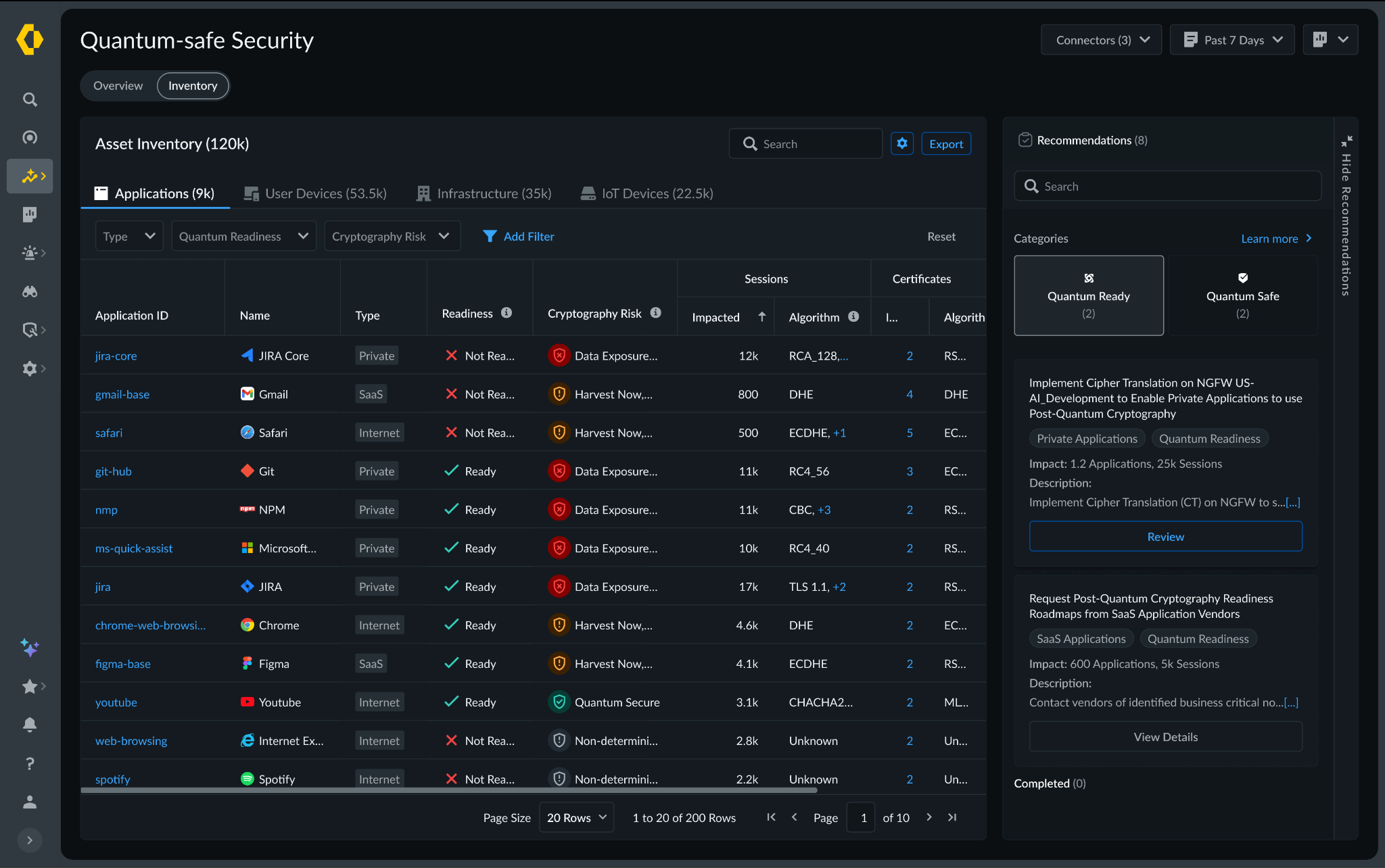
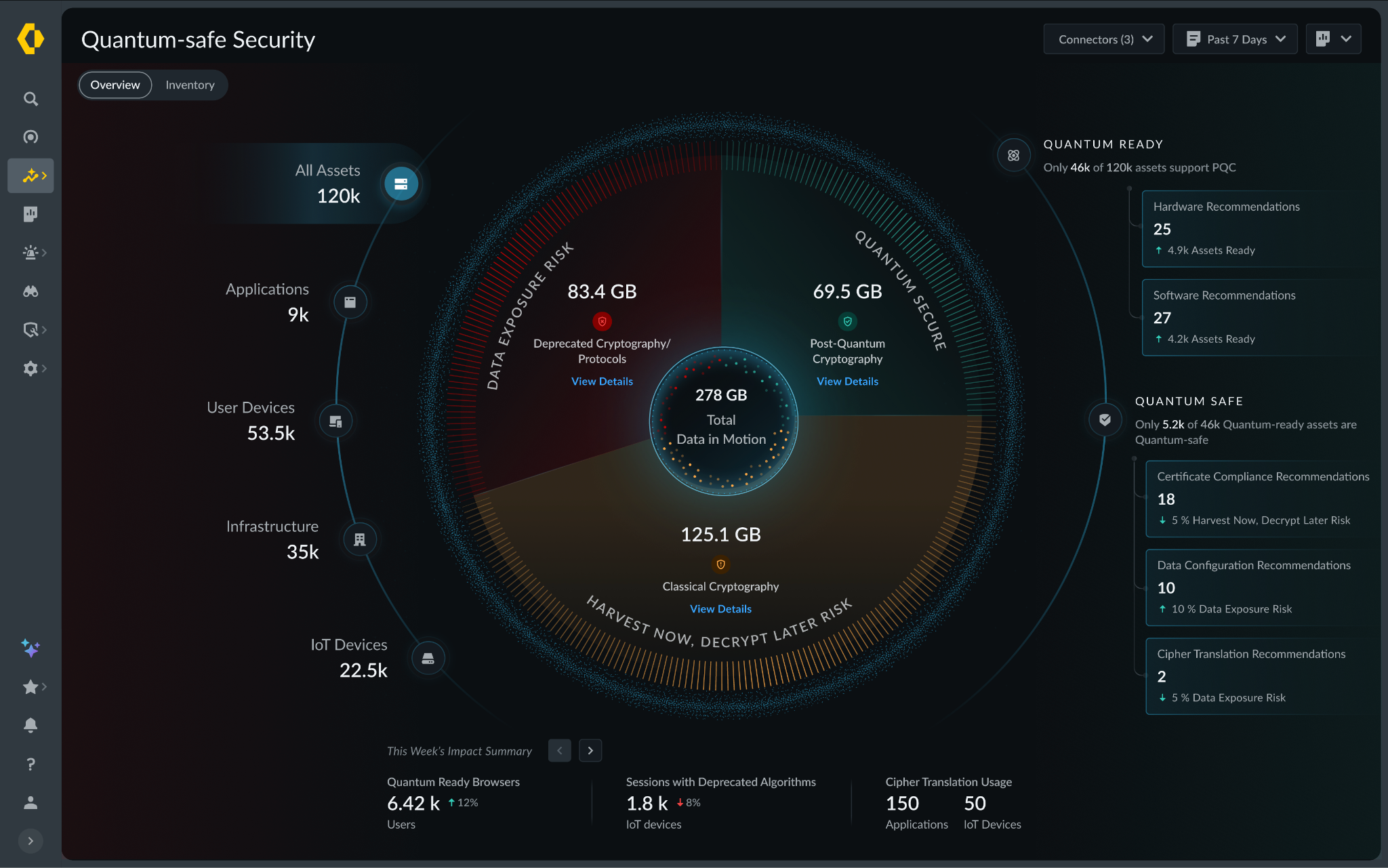
Quantum-safe Security dashboard screenshot.

2. Risk Assessment & Prioritization

Not all data is created equal, and a successful migration requires a surgical focus on where the exposure is most acute. Our Quantum Safe Security solution quantifies risk by correlating cryptographic strength with business criticality, providing a clear, prioritized view of current risk and where remediation matters most.

Assets are categorized into strategic zones, starting with immediate exposure risks caused by deprecated protocols that are vulnerable to classical exploitation today. From there, the solution addresses long-term harvest now, decrypt later threats. As threat models evolve, the risk engine is designed to expand to emerging vectors like identity and authentication integrity, anticipating risks such as “Trust Now, Forge Later" attacks that could undermine digital trust at scale.

At the same time, the solution validates and tracks quantum-secure assets that have successfully transitioned to post-quantum or hybrid-PQC algorithms. By correlating this intelligence with business criticality and data shelf-life, security leaders can make informed decisions. For example, a crown jewel asset containing data that must remain confidential for a decade or more, is flagged as a high HNDL risk today and elevated to the top of the migration queue.

Quantum-safe security dashboard overview.

3. Comprehensive Remediation

Moving from a vulnerable state to quantum resilience is a structured journey. Our comprehensive remediation framework guides organizations through three critical stages, supported by automated workflows and prioritized recommendations at every step.

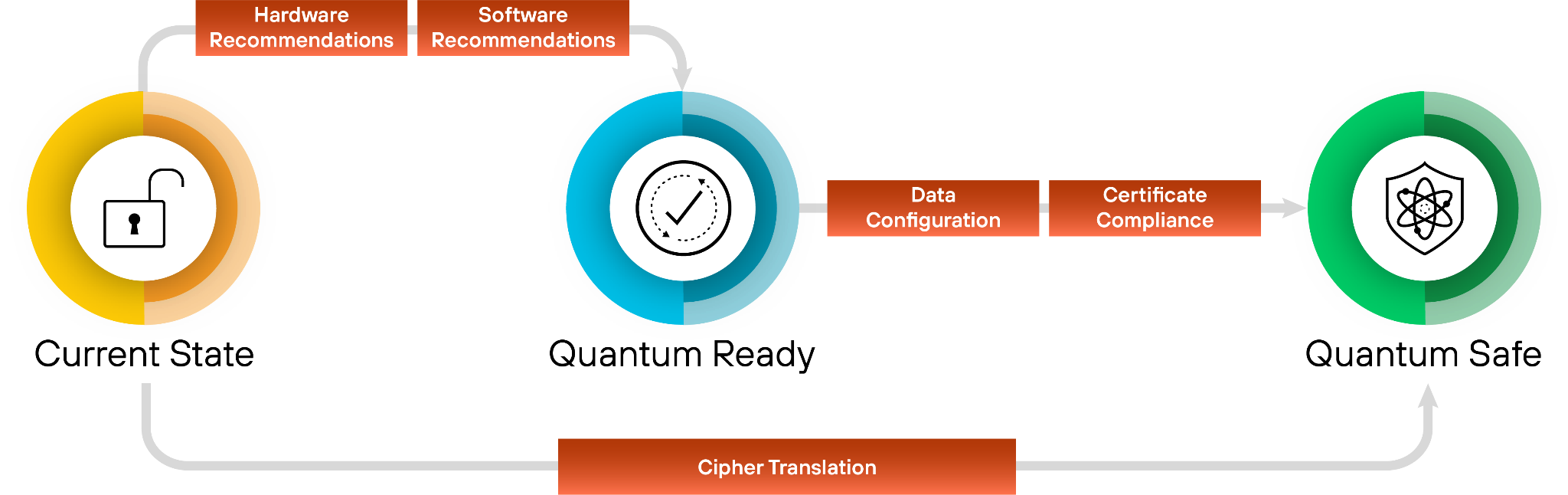
  • Current State to Quantum Ready: The first stage focuses on infrastructure modernization. Using continuous discovery insights, the solution provides hardware and software recommendations required to support next-generation cryptographic protocols. An asset reaches a Quantum Ready state once it has the underlying hardware and OS capabilities to support post-quantum algorithms, even if those protocols are not yet activated.
  • Quantum Ready to Quantum-Safe: Transitioning to a Quantum-safe state requires activation and configuration of post-quantum defenses. Our solution provides data configuration and certificate compliance guidance to enable PQC/Hybrid-PQC algorithms to be correctly implemented across the estate.
  • Virtual Patching via Cipher Translation: For all current and especially legacy systems or IoT devices that cannot be upgraded, we provide an accelerated path to quantum-safety. Through Cipher Translation, the infrastructure acts as a proxy, providing agentic remediation that reencrypts vulnerable traffic into quantum-safe standards (such as ML-KEM) in real-time at the network edge. This approach instantly moves legacy assets from a high-risk current state to a Quantum-safe posture without a single line of code change. Chain of hardware recommendations, software recommendations, data configuration, certificate compliance, cipher translation.

4. Governance: Continuous Crypto-Hygiene & Global Compliance

Quantum readiness is not a one-time event; it is a strategic enterprise transformation that requires continuous oversight to prevent the re-emergence of vulnerabilities. Our governance framework provides the guardrails for your migration through two critical layers of management:

Continuous Crypto-Hygiene & Ongoing Management: Maintaining high-fidelity visibility is essential to preventing the accumulation of "crypto-debt." Our solution automates real-time mapping of all cryptographic dependencies, ensuring your CBOM remains dynamic and accurate as your environment evolves. Furthermore, we introduce Active Drift Detection, which automatically detects and can even block the use of weak or noncompliant ciphers in real-time, preventing developers or third-party services from accidentally introducing insecure protocols.

Global Crypto-Compliance Enforcement & Reporting: As regulatory pressure from governments (like the US Commercial National Security Algorithm Suite 2.0) mounts, organizations must demonstrate measurable progress. Our solution will provide Automated Framework Auditing, offering continuous, native mapping of your environment against global standards, including NIST, FIPS 140-3, and DORA.

Architecting a Quantum-Resilient Enterprise

The transition to quantum-safe security is far more than a technical upgrade. It represents a fundamental shift in how organizations protect the longevity and integrity of their digital assets. Achieving quantum resilience is a multiyear effort that requires both advanced technology and strategic partnership.

That's why Palo Alto Networks has established Integrated Quantum Practices, bringing together technology, partners and professional services to help organizations navigate the complexity of this transition with confidence. By combining deep cryptographic visibility with intelligent, agentic remediation, organizations can systematically retire their cryptographic debt and build resilience into their security architecture over time.

This proactive approach does more than mitigate emerging risk. It establishes a foundation of digital trust that is resilient against the threats of tomorrow, enabling your most sensitive intellectual property to remain secure for its entire shelf life, even as cryptographic standards evolve.

Secure Your First-Mover Advantage: The Quantum Readiness Assessment

Don’t let the complexity of the quantum transition stall your organization’s progress. Begin your path to resilience with a Quantum Readiness Assessment, a focused engagement to clarify current exposure and identify the most critical areas for action. To go deeper, watch the Quantum-Safe Summit on demand for expert perspectives on cryptographic risk and quantum readiness.

The Palo Alto Networks Quantum-Safe Security solution is expected to be generally available to customers on January 30, 2026, with additional integration enhancements planned for April 2026.

Forward-Looking Statements

This blog contains forward-looking statements that involve risks, uncertainties and assumptions, including, without limitation, statements regarding the benefits, impact or performance or potential benefits, impact or performance of our products and technologies or future products and technologies. These forward-looking statements are not guarantees of future performance, and there are a significant number of factors that could cause actual results to differ materially from statements made in this [blog. We identify certain important risks and uncertainties that could affect our results and performance in our most recent Annual Report on Form 10-K, our most recent Quarterly Report on Form 10-Q, and our other filings with the U.S. Securities and Exchange Commission from time-to-time, each of which are available on our website at investors.paloaltonetworks.com and on the SEC's website at www.sec.gov. All forward-looking statements in this blog are based on information available to us as of the date hereof, and we do not assume any obligation to update the forward-looking statements provided to reflect events that occur or circumstances that exist after the date on which they were made.

The post Introducing Palo Alto Networks Quantum-Safe Security appeared first on Palo Alto Networks Blog.
  •  
❌