Reading view

Enterprise-Grade Application Security, Cloud-Native Speed: Introducing Imperva for Google Cloud

In today’s dynamic digital environment, the pressure to innovate has never been greater. Development teams are pushing for native cloud tools to maximize performance and cost-efficiency, while security teams require best-of-breed, enterprise-grade protection to defend against an ever-evolving threat landscape. This often creates a point of friction, forcing organizations into a difficult trade-off: sacrifice performance for security, or accept weaker protections for the sake of speed.

To resolve this challenge, Thales Imperva is collaborating with Google Cloud to deliver a solution that helps bridge this gap. We are proud to introduce Imperva for Google Cloud (IGC), an integrated security solution that offers the best of both worlds: enterprise-grade application security with the cloud-native performance you expect from Google Cloud.

Imperva for Google Cloud: A Holistic, Integrated Solution

Imperva for Google Cloud is not just another security layer; it is a fully managed, best-in-class Web Application and API Protection (WAAP) solution built directly into the fabric of Google Cloud. This integration, available now on Google Cloud Marketplace,   provides robust protection without disrupting your existing infrastructure or workflows.

  • Cloud-Native Performance Without Compromise: Imperva for Google Cloud uses Google Cloud’s native Service Extension and Private Service Connect to inspect traffic within the Google Cloud network. This means all traffic analysis happens without your data ever leaving Google Cloud infrastructure, preserving optimal latency, performance, and data residency.
  • Quick Deployment: Forget complex re-architecture. Imperva for Google Cloud can be deployed quickly using familiar tools like Terraform, Google Cloud CLI (gCloud CLI), or the Google Cloud console UI. There are no disruptive DNS, SSL, or network routing changes required, allowing you to achieve production-ready protection almost immediately.
  • Enterprise-Grade Protection Out of the Box: Imperva for Google Cloud is powered by Imperva’s industry-leading security engine, delivering comprehensive WAF, advanced API Security, and Account Bot Protection. Backed by 24/7 threat research, the Imperva solution provides near-zero false positives, with 97% of customers successfully using default policies and 95% running in blocking mode from day one. This dramatically reduces the operational overhead of constant rule tuning.

Real-World Impact: Securely Accelerating Your Business

By eliminating the trade-offs between security and performance, Imperva for Google Cloud helps organizations achieve key business outcomes:

  • Accelerate Lift-and-Shift Migrations: Migrate workloads to Google Cloud confidently with security that adapts to your applications, not the other way around. Eliminate migration delays caused by complex security re-architecture.
  • Unleash DevOps-Friendly Security: Empower development teams to innovate at speed. IGC closes the security gaps in built-in tools without slowing down deployment velocity or requiring developers to become security experts.
  • Protect Modern Cloud-Native Applications: Secure your Kubernetes and microservices architectures with best-in-class defenses optimized for low-latency environments.
  • Achieve Unified Multi-Cloud Governance: Manage security for all your Imperva-protected environments from a single, unified dashboard, providing consistent policy management and visibility across your entire multi-cloud estate.

“Bringing Thales Imperva to Google Cloud Marketplace will help customers quickly deploy, manage, and grow the company’s integrated security solution on Google Cloud’s trusted, global infrastructure,” said Dai Vu, Managing Director, Marketplace & ISV GTM Programs at Google Cloud. “Thales can now securely scale and support organizations that want to use its Imperva for Google Cloud solution to increase protection for their cloud-native applications, APIs, microservices and more.”


Join Us on the Journey to More Seamless Cloud Security

As we approach key industry events like our exclusive Executive Briefing Center (EBC) meeting in late March and Google Cloud Next 2026 in April, the conversation around integrated  security has never been more relevant. The launch of Imperva for Google Cloud marks a pivotal moment in our relationship with Google, providing a clear path for customers to secure their digital assets without compromise.

Ready to secure your cloud-native applications?

The post Enterprise-Grade Application Security, Cloud-Native Speed: Introducing Imperva for Google Cloud appeared first on Blog.

  •  

Why AI Bot Protection and Control Are Essential for Application Security

AI-driven automation is no longer emerging. It is already integrated and accepted as internet traffic. From AI assistants and crawlers to enterprise automation tools, websites are now routinely accessed by non-human actors operating at scale.  Vulnerabilities or weaknesses in your application infrastructure, including risky APIs, are no longer difficult to find, as agentic AI tools, paired with automation, can observe and test endpoints and access points faster than any human.

AI-aware bot protection is a security approach that detects, classifies, and controls automated traffic generated by AI agents, LLM-powered assistants, and autonomous tools — then applies granular policies based on each bot’s identity, intent, and behavior.

Key Takeaways:

  • AI-powered bots now represent a significant and growing share of internet traffic, blending seamlessly into legitimate user sessions.
  • Traditional bot detection cannot reliably distinguish between beneficial AI assistants and malicious AI-driven agents.
  • Unmanaged AI bots create measurable business risks: analytics distortion, inventory manipulation, API abuse, account takeover, and content scraping.
  • Imperva Advanced Bot Protection provides granular visibility and control over AI-driven traffic by tool type, category, behavior, and business function.
  • Effective AI bot management in 2026 requires multilayered detection with real-time, policy-based response capabilities.

The challenge for security teams is no longer understanding why automation is increasing, but gaining clear visibility and control over what that automation is doing.

The result is a growing grey zone where distinguishing among human users, legitimate AI agents, and malicious bots becomes significantly more challenging, and where traditional security controls often lack the visibility needed to reliably distinguish among them.

According to Imperva’s 2025 Bad Bot Report, bad bots accounted for 32% of all internet traffic — a 2% increase year-over-year. With AI-powered tools accelerating automation, this figure is expected to grow significantly in 2026, making bot detection and bot management a critical priority for every organization.

How Do AI Bots Blend Into Legitimate Web Traffic?

AI agents and automated tools are improving how people interact with the internet, dramatically enhancing productivity and convenience. For example:

  • AI assistants like ChatGPT, Perplexity AI, and Google Gemini retrieve real-time answers from multiple websites to summarise content or compare products
  • Travel platforms continuously check flight prices, seat availability, and hotel inventory
  • E-commerce monitoring tools track pricing, stock levels, and competitor offers across retailers
  • AI-powered shopping assistants help users find deals or complete purchases faster
  • Enterprise AI tools query SaaS platforms and APIs to automate workflows like reporting, customer support, and data enrichment
  • Search and indexing bots extract and index web content to power AI-driven search experiences

However, the same technological advancements that enable these positive experiences are also empowering cybercriminals. Automation at scale lowers the barrier for malicious activity, putting malicious bots at a significant advantage when automated traffic is the expected baseline. They can blend seamlessly into legitimate traffic patterns, making detection significantly more challenging.

What Are the Business Risks of Unmanaged AI Bot Traffic?

Many organizations still view bot protection as optional. However, with AI agents such as crawler bots and fetch bots, now an accepted part of internet traffic and automation accelerating at scale, bot protection has become a core security requirement. Failing to treat it as such exposes organizations to serious business risks:

Risk Category Description Business Impact
Analytics Manipulation AI bots inflate traffic metrics and distort conversion data Misinformed decisions, wasted ad spend
Inventory Hoarding Automated agents reserve or purchase inventory at scale Revenue loss, customer experience degradation
API Business Logic Abuse AI agents exploit API endpoints beyond intended use Infrastructure costs, data exposure
Account Takeover (ATO) AI-powered credential stuffing at scale Customer trust erosion, regulatory liability
Data Scraping AI systems extract proprietary content for training or replication Competitive disadvantage, IP loss
Customer Experience Bot traffic degrades site performance and availability Reputational damage, increased churn

How Does Imperva Deliver AI Bot Detection and Control?

The ability to control which parts of your application functionality are accessible to AI tools is critical to your AI Security Strategy.

How Does Imperva Provide Visibility Into AI Bot Traffic?

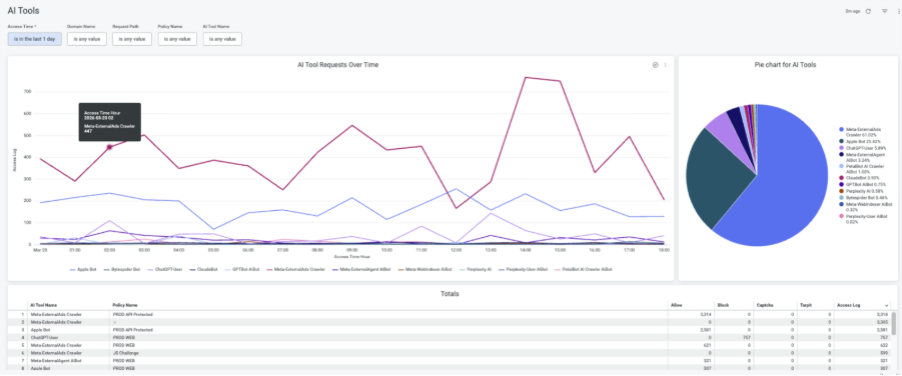
Imperva Advanced Bot Protection (ABP) offers granular visibility into AI tools, agents, and crawlers, providing a detailed, real-time view of which AI tools are accessing your websites, applications, and API endpoints.

With ABP, security teams can clearly see which AI tools are hitting their environment, which applications and URLs are being accessed, the volume and frequency of requests, and whether those requests are being allowed, blocked, or challenged

This level of visibility ensures organizations know exactly what is interacting with their digital services and helps identify unintended policy outcomes, such as blocking AI tools they want to allow, or allowing tools they should restrict.

The AI Tools dashboard provides a centralized view of AI-driven traffic, enabling faster investigation and more informed decision-making.

The AI Tools dashboard

How Can You Control AI Bots by Tool Type, Category, and Behavior?

Beyond visibility, Imperva enables precise control over how AI tools interact with your applications.

With ABP, security teams can easily:

  • Allow, block, or rate-limit specific AI tools
  • Apply policies based on categories such as AI crawlers, AI agents, and AI fetch bots
  • Quickly adapt policies as new AI tools emerge

This allows organizations to move from reactive blocking to intentional control of automated access.

How Does Imperva Protect Critical Business Functions from AI Bots?

Imperva ABP also provides granular control at the application and business function levels, allowing organizations to define exactly which parts of their applications AI tools are allowed to access. This ensures that:

  • Approved tools can only reach intended endpoints
  • Sensitive paths, APIs, or business logic remain protected
  • Access policies align with business and data governance requirements

This ensures AI tools interact with applications in a controlled, predictable, and secure way.

Why Is Imperva ABP a Leading Bot Management Solution?

ABP protection against AI builds on an already strong foundation of Advanced Bot Protection, combining multilayered detection, intelligent risk scoring, and real-time controls to accurately distinguish between human, legitimate automation, and malicious bots. With deep visibility, rapid decisioning, and expert support, ABP is already a proven solution for managing sophisticated bot threats. It is now further strengthened by the ability to monitor and control AI-driven traffic precisely.

Capability Traditional Bot Detection AI-Aware Bot Protection (Imperva ABP)
Detection Method Signature and rule-based ML-based behavioral analysis + AI tool fingerprinting
AI Tool Classification No distinction between AI tools Granular classification by tool type, category, and identity
Granularity of Control Block or allow all bots Allow, block, rate-limit, or challenge per AI tool and per endpoint
Visibility Limited to known bot signatures Real-time dashboard of all AI tool activity by type and behavior
Adaptability Manual rule updates required Continuous learning with rapid policy adaptation for new AI tools
Business Function Protection URL-level blocking only Granular control at the application and business function level

Frequently Asked Questions About AI Bot Protection

Q: What is AI-aware bot protection?

A: AI-aware bot protection is a security approach that detects, classifies, and controls automated traffic from AI agents, LLM-powered assistants, and autonomous tools. Unlike traditional bot detection that relies on static signatures, AI-aware protection uses behavioral analysis and AI tool fingerprinting to distinguish between beneficial AI assistants, legitimate automation, and malicious bots.

Q: What is the difference between traditional bot detection and AI-aware bot management?

A: Traditional bot detection identifies bots using predefined signatures and rules, treating most automated traffic as either good or bad. AI-aware bot management goes further by classifying AI tools by type, category, and behavior — enabling organizations to allow helpful AI agents while blocking or rate-limiting harmful ones with granular policies.

Q: How do AI agents bypass conventional bot defenses?

A: AI agents can mimic human browsing behavior, rotate IP addresses, solve CAPTCHA, and generate realistic session patterns. Because they operate as legitimate AI tools (such as AI assistants and search crawlers), they often pass through conventional defenses that only look for known malicious signatures.

Q: What business risks do AI bots create?

A: Unmanaged AI bots can distort marketing analytics, hoard inventory, abuse API business logic, perform credential stuffing for account takeover, scrape proprietary data and competitive intelligence, and degrade customer experience through increased site latency.

Q: Can businesses allow some AI bots while blocking others?

A: Yes. Solutions like Imperva Advanced Bot Protection enable granular control, allowing organizations to allow specific AI tools (such as approved search crawlers), rate-limit others (such as AI assistants accessing content), and block malicious AI agents — all at the individual tool, category, or endpoint level.

Q: What is agentic AI, and why does it matter for application security?

A: Agentic AI refers to autonomous AI systems that can independently browse the web, interact with APIs, and complete multi-step tasks without human oversight. These agents can probe for vulnerabilities, test endpoints, and access business functions faster than any human, making agentic AI security a critical concern for organizations.

Monitor, Control, and Prevent AI-Driven Bot Threats

Automation is now a permanent and growing part of how the internet operates. The critical challenge is no longer detecting bots alone but understanding and controlling AI-driven interactions at scale.

Organizations need to know exactly which AI tools are accessing their environments, what they are doing, and how to control that access with precision.

Imperva Advanced Bot Protection delivers the visibility, control, and adaptive protection required to operate securely in this new environment.

By enabling organizations to monitor AI agents, control their access at a granular level, and prevent malicious automation from hiding within legitimate traffic, Imperva helps businesses confidently embrace the future of AI-driven digital experiences.

Learn how Imperva Advanced Bot Protection delivers AI-aware bot management for your applications. Explore our bot protection solutions or download the latest Imperva Bad Bot Report for the most current data on AI-driven bot threats.

The post Why AI Bot Protection and Control Are Essential for Application Security appeared first on Blog.

  •  

API Security for AI Agents: Why Protection Has Never Been More Important.

For years, a lot of risky APIs survived simply because they were hard to find. They weren’t documented. Only a handful of engineers knew the endpoints. And if an attacker wanted to abuse them, they had to spend real time reverse‑engineering traffic and guessing how things worked.

That “security by obscurity” was never a security strategy, but it did create friction.

AI removes that friction.

Today, coding assistants and agentic tools can observe patterns in traffic, infer undocumented endpoints, generate proof‑of‑concept exploits, and test thousands of permutations faster than any human. We’ve already seen what happens when exposed APIs meet automation at scale: a hobbyist was able to gain control of thousands of robot vacuums due to exposed APIs and an over‑privileged token, something that simply wouldn’t have scaled without automation on the attacker side.

The takeaway is straightforward: if you don’t know where your APIs are, what they expose, and who can talk to them, AI will find those gaps for you, either in the hands of your developers or your attackers.

Why has API security become critical in the age of AI agents?

API security is the foundation of protecting applications against automated, AI-driven threats. In the past, attackers relied on manual reverse-engineering to discover undocumented API endpoints. Today, AI agents and coding assistants can autonomously map traffic patterns, infer hidden endpoints, and test thousands of exploit permutations in seconds. Furthermore, AI agents can bypass traditional web application firewalls (WAFs) by executing perfectly formatted, syntactically correct requests that abuse business logic—such as chaining legitimate calls to perform a Broken Object Level Authorization (BOLA) attack.

Because AI agents use APIs as their primary control plane, securing these interfaces is no longer just about preventing data breaches; it is about establishing the necessary guardrails to ensure AI tools operate safely and within their intended scope.

How AI Agents Change the Threat Model

AI doesn’t just make attackers faster. It changes what “attack” looks like, because agents can behave like normal users while still doing abnormal things.

1) Business Logic is the New Frontline

Traditional API protections – gateways, WAFs, basic input validation, are good at stopping obviously bad traffic: missing tokens, malformed payloads, suspicious content types.

But agents don’t have to look suspicious. They can follow every syntactic rule and still abuse your business logic.

Imagine an agent that:

  • Uses a valid user token and calmly walks the edges of a pricing API until it discovers discount combinations you never intended to allow.
  • Chains perfectly legitimate calls to pivot from one customer data to another customer’s data. This effectively executes a Broken Object Level Authorization (BOLA) attack – a critical vulnerability highlighted in the OWASP API Security Top 10 – without brute‑forcing raw IDs.

Nothing in those requests’ screams “attack.” The danger is in the sequence, the intent, and the scale, the exact things many baseline controls don’t reason about.

2) Agent-Specific Protocols Expand the Attack Surface

Agents aren’t only calling the same APIs as your mobile app calls. They’re increasingly using agent‑first toolchains and protocols that wrap platforms behind “tool” interfaces, making discovery and invocation easier than ever.

Look at what’s happening across major SaaS ecosystems: new CLIs and frameworks are designed so an agent can discover capabilities, understand schemas, and call dozens of APIs through a single control surface. Under the hood it’s still JSON over HTTP but packaged in protocols and workflows many security tools don’t meaningfully parse or recognize.

If your security stack doesn’t understand what it’s looking at, it can’t apply real policy. It just sees “some JSON” and hopes for the best.

The Thales Vision: API Security as the AI Agents’ Control Plane

At Thales, we see API Security evolving into the control plane for AI agents: the place where you get a coherent view of what agents are doing, which APIs they’re touching, and how to govern that behavior, consistently and at scale.

1) Start with ruthless visibility

You can’t protect what you can’t see, and AI moves too fast for spreadsheets and tribal knowledge.

We’re focused on:

  • Finding every API: Discovering shadow, zombie, and newly created APIs across clouds and data centers, then mapping the data they expose and the business functions they support.
  • Making agent traffic visible: Identifying traffic that comes from agents and agent toolchains, tying it back to the human or system they’re acting for, and surfacing suspicious patterns early.

The goal: when your CISO asks, “Which agents can touch customer PII today?” you can answer with confidence instead of guesswork.

2) Speak the same language as AI agents

We’re extending the API Security engine, so it doesn’t just see “JSON over HTTP ” but understands the agent protocols layered on top, things like MCP (Model Context Protocol) style streams and backend API calls from an agent-oriented CLI.

Once we can parse and normalize that traffic, we can:

  • Apply the same validation and anomaly detection we already use for REST and GraphQL.
  • Correlate what an agent is doing across back‑end services, rather than treating every request as an isolated event.

In practice, that means the security brain becomes protocol‑aware. Whether an action comes from a mobile app, a browser, or an AI agent using a modern toolchain, the same set of eyes is watching.

3) Put real guardrails around tokens and delegation

Agents run on delegation. They act on behalf of users and services using tokens, keys, and temporary credentials. When those credentials are over‑privileged or long‑lived, you get “quiet catastrophe” scenarios, like a single token shared among thousands of agents.

We’re building on our existing token visibility to:

  • Score token risk: Evaluate scope, lifetime, usage patterns, and anomalies like sudden geography changes or volume spikes.
  • Create policies specifically for agent delegation: For example, “This support agent’s token can only read billing data for the current customer, up to N requests per hour, and never export full datasets.”
  • Catch replay and abuse: Detect when tokens are cloned, reused from odd locations, or used by unexpected agent identities.

If an AI agent starts stretching beyond the intent of its access, querying too broadly, too often, or in the wrong context, the platform should be able to flag, throttle, or cut it off in real time.

4) Defend the messy middle: business logic and BOLA

Agents follow natural‑language prompts, not carefully designed UI flows. That makes them unusually good at stumbling into the “negative space” of your application: edge paths nobody documented, but your back end still accepts.

Our approach anchors security in behavior and intent:

  • Model sequences of calls as workflows and look for patterns that don’t match real user behavior, for example, moving from one customer account to another without a corresponding permission to change.
  • Treat BOLA as more than “did you increment an ID,” and start reasoning about what resource the agent is effectively asking for when it requests “all internal reports” or “all projects in the system.”

The endgame is business‑level guardrails you can express clearly, and enforce across all agents, regardless of how clever the prompts are.

Meeting you where you already are

None of this works if it requires an exotic, parallel deployment just for AI. That’s why we’re embedding agent controls into the places customers already rely on Imperva today:

  • Imperva Cloud WAF for internet-facing API
  • Imperva WAF Gateway for on-prem and hybrid environment
  • Imperva eWAF for cloud-native and microservices workloads

In each case, it’s the same security engine doing heavy lifting, discovering APIs, understanding protocols, analyzing behavior, and enforcing policy inline on every agent’s call.

Where we’re heading

AI agents are already inside organizations, helping engineers, answering customers, and automating operations. The real question is whether they’re operating inside guardrails you actually understand.

Our view is simple:

  • You don’t secure AI by bolting something onto the model.
  • You secure AI by controlling the APIs and data the model can reach.

By turning API Security into the shared control plane for AI agents, across discovery, protocol understanding, token governance, and business‑logic protection, we want to help teams say “yes” to AI without crossing their fingers behind their back.

If you can see every agent, every call, and every token, you can turn AI from a wild card into an engineered advantage. That’s the future we’re building toward.

The post API Security for AI Agents: Why Protection Has Never Been More Important. appeared first on Blog.

  •  

Securing Applications Anywhere: Breaking Down the Wall of Confusion

Application development has changed dramatically. Enterprises now release software faster, operate more digital services, and deploy applications across a mix of public cloud, private cloud, APIs, containers, and on-premises infrastructure.

As application delivery has accelerated and architectures have become more distributed, a disconnect has emerged between the teams building applications and those responsible for protecting them.

This tension is often described as the Wall of Confusion between DevOps and IT Security.

But the challenge does not stop there.

Over time, organizations have also introduced multiple security tools to protect different parts of the application stack. Each tool is managed separately, often by different teams, through different platforms, policies, and workflows.

The result is an additional layer of complexity. Security teams must navigate multiple vendors and fragmented controls, while DevOps teams experience delays as security becomes harder to integrate into fast-moving development cycles.

Understanding how to break down both the organizational and operational layers of this confusion is essential for organizations that want to maintain innovation while ensuring consistent, scalable security.

Applications Now Run Across Hybrid Environments

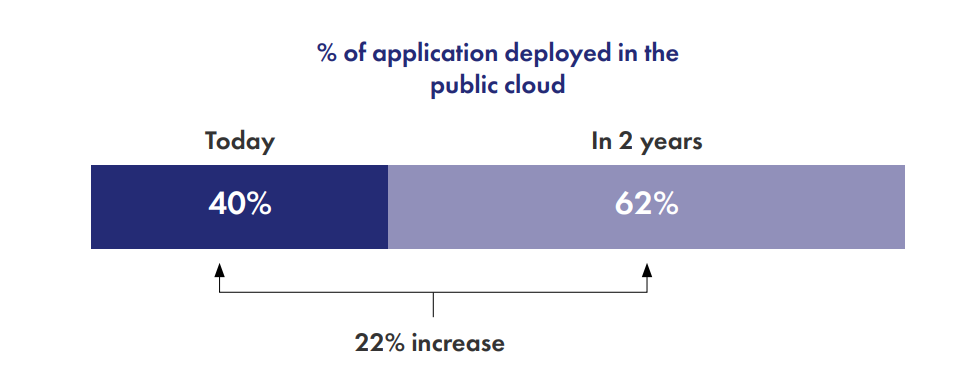
Today, around forty percent of enterprise applications run in the public cloud, and that number is expected to rise significantly to 62% over the next two years.

modern applicatoin delivery key finding 1
Source: Vanson Bourne Survey, “DevOps vs Security: Breaking Down the Wall of Confusion in Modern Application Delivery”

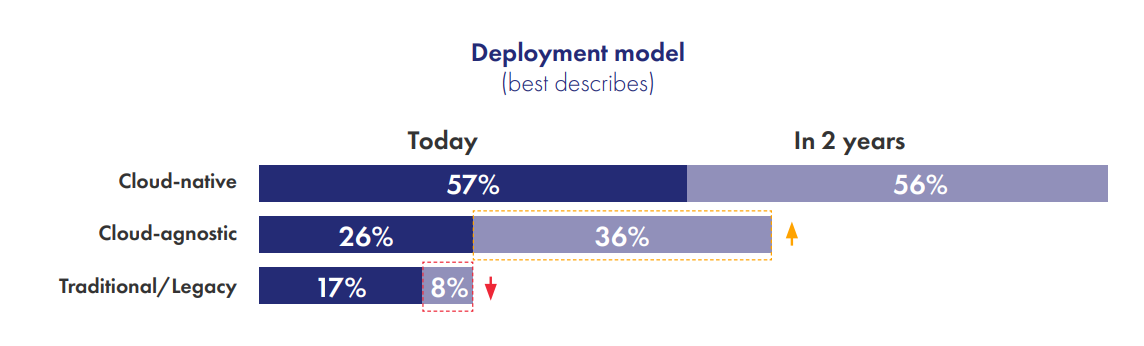
Yet the shift to cloud does not mean applications live in one place. Most organizations now operate across hybrid and multi-cloud environments where applications run across public cloud platforms, private cloud infrastructure, on-premises systems, Kubernetes clusters, and an expanding network of APIs.

Cloud-agnostic strategies are also becoming more common as organizations seek flexibility and avoid dependence on a single provider. At the same time, many enterprises continue to operate legacy systems alongside modern cloud-native services.

The result is a highly distributed application landscape. Applications now run across multiple environments simultaneously, and security must be able to protect them wherever they operate.

modern applicatoin delivery key finding 2
Source: Vanson Bourne Survey, “DevOps vs Security: Breaking Down the Wall of Confusion in Modern Application Delivery”

DevOps and Security Want the Same Outcome

Despite the perception of conflict, DevOps and IT Security teams are largely aligned on the goals of modern application security. Both groups ultimately want the same outcome: applications that are secure, reliable, and able to scale with business demand.

Research conducted with Vanson Bourne reinforces this alignment. 96% of DevOps and 95% of IT Security professionals agree that modern environments require security that is flexible across any architecture.

This global study of 1,500 professionals across the US, Europe, and APAC highlights an important point. Modern application security is not just a technology problem. It is a workflow and collaboration challenge.

Security and DevOps want the same outcome, but they experience different frustrations. These gaps can create delays, bottlenecks, false positives, and friction that undermine the cloud-native innovation organizations are working to achieve.

The Wall of Confusion: Conflicting Priorities, Fragmented Security and Tool Sprawl

The Wall of Confusion is not just about DevOps and Security working in silos. It is also about how security is delivered. Over time, organizations have added more and more security tools. One for web applications, another for APIs, another for cloud, another for containers. Each tool solves a specific problem, but together they create complexity instead of clarity.

Security teams are left navigating multiple vendors, switching between management platforms, and maintaining different policies across environments. This makes it difficult to keep controls aligned and increases operational overhead.

At the same time, gaps begin to appear. As applications move across environments, it is not always clear if they are fully protected. Policies become inconsistent because what is set in one environment does not automatically apply to another.

In fact, based on a 2026 survey of Imperva Application Security customers, 77% of security professionals say operational complexity is their biggest challenge.

For DevOps teams, this complexity shows up as delay. Security becomes a bottleneck not because it is unnecessary, but because it is too difficult to operationalize.

That is the wall and it is what needs to come down.

Why Traditional Security Models Fall Short

When applications operate across multiple environments, security approaches designed for fixed infrastructure quickly become difficult to manage.

Many organizations rely on a mixture of embedded protections, centralized security services, and environment-specific tools to protect different parts of their application landscape. While each solution may address a particular need, together they can create fragmented security architectures. This fragmentation leads to inconsistent policies, duplicated alerts, limited visibility, and increased manual effort.

Security teams must manage multiple tools and workflows, while development teams experience delays when security is applied inconsistently or too late in the process. Both teams are constrained by the same underlying issue: security models that were not designed for modern, distributed application environments.

Security Must Move with the Application

Modern applications are no longer tied to a single infrastructure model. They are composed of microservices and APIs, deployed through automated pipelines, and distributed across multiple environments.

Security therefore cannot remain a centralized checkpoint that appears late in the development process. Instead, protection needs to move with the application and operate consistently wherever that application runs.

This means security controls must function across public cloud environments, private infrastructure, hybrid deployments, Kubernetes clusters, APIs, and the traditional systems that many organizations still rely on.

DevOps and IT Security teams increasingly recognize this shift. They are not asking for less security. They are asking for security that works the way modern applications work.

Securing Applications Anywhere with Thales

As application architectures continue to evolve, organizations are no longer dealing with a single security challenge, but with the need to protect applications consistently across every environment they operate in.

The issue is not just distribution. It is how to secure that distribution without adding more tools, more complexity, or more operational overhead.

Security strategies built around isolated environments or disconnected tools are no longer sufficient. What is needed is a unified approach that delivers consistent protection, visibility, and control across the entire application landscape.

Now, the question becomes how to deliver that in practice.

Many vendors talk about flexibility but still require organizations to choose a single deployment model or manage multiple disconnected solutions. Imperva takes a fundamentally different approach. It meets organizations where they are, supporting multiple deployment models while maintaining a single, unified security experience.

This includes protection for internet-facing applications and APIs through Imperva Cloud, native integration for public cloud environments (Imperva for Google Cloud), container-based deployment for Kubernetes and microservices, and gateway deployment for on-premises, hybrid, and air-gapped environments.

The key is that all of these deployment options are powered by the same Imperva Security Engine.

This means one management console, consistent policies across every environment, and unified visibility across the entire application portfolio, regardless of where applications are deployed. Security teams do not need to manage multiple tools or vendors, and DevOps teams do not need to change how they build and deploy applications.

That is what securing applications anywhere really means.

Download the whitepaper: DevOps vs Security: Breaking Down the Wall of Confusion in Modern Application Delivery

The post Securing Applications Anywhere: Breaking Down the Wall of Confusion appeared first on Blog.

  •  
❌