Reporting on cyberattacks against Japanese entities rose 48% between Q2 and Q3 2026, encompassing ransomware, exploitation of vulnerabilities, credential leaks, and service disruptions. Significant incidents exposed millions of customer records and disrupted operations across multiple sectors, with attacks on shared service providers extending the impact to downstream organizations. Further incidents in October 2026 indicate that these trends have persisted into Q4. This report examines potential contributing factors, including demand for Japanese personal information, legacy systems, software vulnerabilities, weak API controls, and AI’s likely role in lowering technical and language barriers. New incident-reporting requirements under Japan’s Active Cyber Defense (ACD) law, effective October 1, may further increase the number of disclosures of incidents affecting Japanese organizations.
Two critical remote code execution vulnerabilities in the PHP engine, CVE-2026-109618 and CVE-2026-109619 (nicknamed “PHP2Shell”), are reportedly being targeted in active exploitation attempts following the leak of technical details ahead of PHP’s October 21, 2026, security release. Because the flaws affect PHP itself rather than a specific application, websites running vulnerable PHP versions may be exposed, including those built on WordPress, Drupal, and Joomla.
This post covers PHP’s advisories, exploitation reports, public proof-of-concept exploits, exposure data, and patching guidance, along with details from the TTP Instance Insikt Group® published to customers. Attack Surface Intelligence signatures for CVE-2026-109618 and CVE-2026-109619 are available to Recorded Future customers. Organizations running PHP should patch immediately.
The threat actor linked to recent AI-assisted attacks on South Korean financial institutions was testing infrastructure and assembling attack tools as early as August 2026, weeks before the banking campaign became public, according to new research from Recorded Future’s Insikt Group. Subsequent public reporting indicated that the breaches exposed personal data belonging to at least 68,000 people across at least seven financial institutions.
Insikt Group’s investigation expands the known timeline and capabilities of the actor, tracked as TAG-217. Insikt Group uncovered tools designed to steal cryptocurrency wallet files, gain greater access to Linux systems, and test weaknesses in mobile devices. The findings illustrate the “jagged edge” of AI-enabled attacks: threat actors realizing significant gains while committing basic operational security mistakes. AI helps attackers pursue more targets across more environments, but does not prevent them from making the security mistakes that allowed Recorded Future to uncover preparations and capabilities beyond the reported banking campaign. Those mistakes give defenders opportunities to identify related activity and disrupt operations.
Targeting South Korean Banks
In early October 2026, South Korea’s Financial Services Commission (FSC) disclosed that multiple financial institutions had been hit by cyberattacks. The attacks had compromised different systems and allowed unauthorized access to different data at each victim entity, with one breach exposing the personal information of an outsourced developer and another resulting in the theft of customer data. Industry sources reported that the attacks involved the use of ARTEX, a Chinese-language, open-source AI penetration testing framework. The variety of targets at each financial institution likely demonstrates an advantage of AI over human operators: the ability to opportunistically test for weaknesses at scale until a valuable target is found.
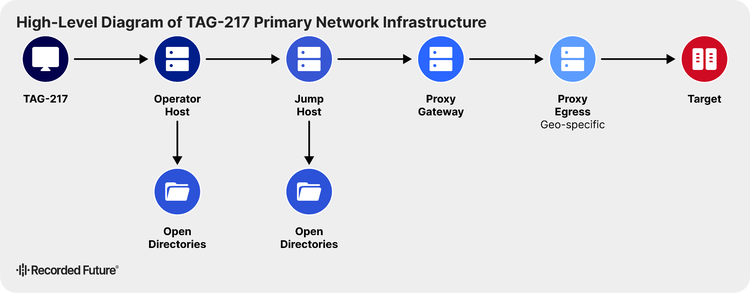
On October 7, 2026, public analysis of the incident identified that the threat actor, suspected to be a Chinese speaker, used several AI tools as part of their campaign, including Claude Code, DeepSeek, Grok, and Zhipu AI. Other reports shared network infrastructure indicators used in the campaign, including a primary server running ARTEX and the use of residential proxies, likely to obfuscate the origin of the activity.
Recorded Future investigated this infrastructure to better understand the actor’s operations and tracked this activity under the designation TAG-217.
Putting Together a More Complete Timeline for TAG-217
Differentiating between agentic and human-operated attacks can be difficult, especially when skilled threat actors use AI to enhance operational effectiveness. Agentic attacks use the same tactics and techniques as human operators, though faster and at scale. In the case of TAG-217, operational security mistakes allowed Insikt Group to piece together how the threat actor used AI tools to amplify their intrusion attempts across multiple environments and to uncover earlier preparations and a broader set of capabilities than public reporting revealed.
TAG-217 routed its traffic through residential internet connections, likely to reduce the chances of detection. Recorded Future analysts used open directories within TAG-217 infrastructure to further understand its operations (Source: Recorded Future)
Although Recorded Future was founded by Swedish scientists and innovators, our HQ has always been a key part of the Somerville and Boston tech startup scene. Recognized for our award-winning platform and amazing culture, the team and our HQ have changed quite a bit over the years.
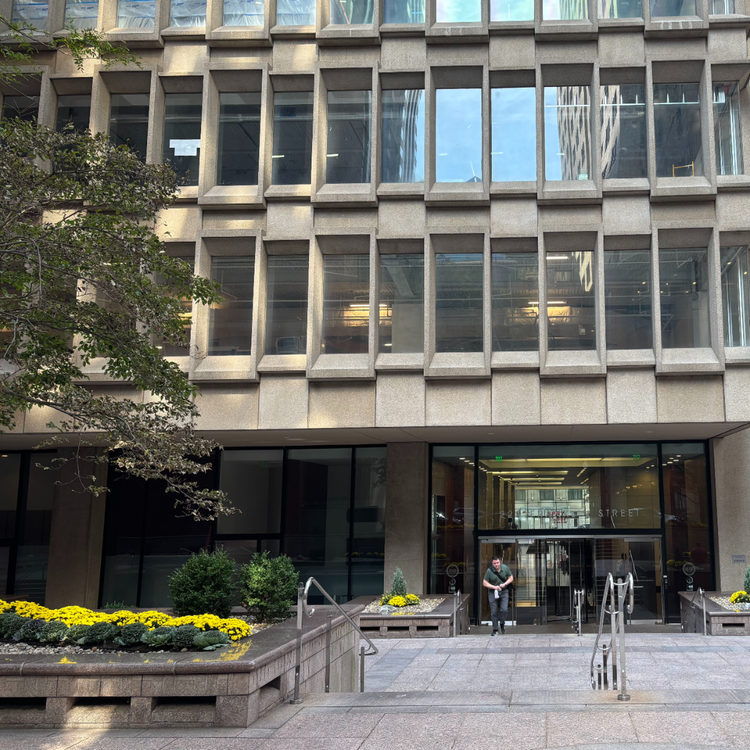
Initially established in Somerville, MA, north of Boston, the Futurists' headquarters was once a laundromat. Twelve years after we set up camp there, it is time for the next chapter. Our HQ has moved to downtown Boston in Post Office Square — and we’re ready to make new memories there.
Somerville Office laundromat sign | Boston Office (Current) on Franklin Street
Key functions operate out of our Boston-based office, including customer success, security, data engineering, product, and marketing. Nearly 200 Futurists call the Boston office their home base, and many others travel for team meetings and strategic onsites.
“In 2019, when I started, we were about 300 people globally — now we’re almost 200 just in the Boston office!”
Lacey Maddalena
Global Office Operations & Facilities Director
“We’ve grown to more than 1,000 employees, and let’s just say the days of one-person teams are behind us!”
Since mid-2025, the Kremlin has intensified restrictions on digital communications and infrastructure, very likely to suppress the organization of domestic political dissent and conduct digital surveillance within Russia. Increasingly strict measures targeting virtual private networks (VPNs), state-managed internet shutdowns, limitations on civilian communications platforms, and monitoring of domestic and foreign entities very likely represent an escalation from the approaches to censorship and surveillance pursued prior to 2024.
However, despite intensifying internet restrictions, technical and political limitations will likely prevent the Kremlin from achieving its long-held objective of a fully “sovereign internet” in the near term. The most likely scenario is that Moscow exerts extensive censorship and monitoring of online activity with increasingly strict –– though not absolute –– controls on circumvention and anonymizing tools.
Insikt Group assesses that the Kremlin’s primary objectives regarding internet restrictions are twofold: facilitating extensive surveillance of online activity to support control over the domestic information space while maintaining connectivity to the global internet, and developing national internet infrastructure under Kremlin control, enabling isolation from the global internet if the Kremlin so chooses. Efforts in support of these objectives have almost certainly provided the Kremlin with enhanced ability to control and monitor domestic online discourse.
In this environment, individuals and organizations operating in Russia are subject to increasing operational risks, including surveillance and exposure of sensitive data, challenges in conducting emergency communications, disruptions to corporate tools and digital applications, and legal risks. Entities with indirect exposure to Russia face an increased likelihood of supply-chain disruptions and sanctions violations and, over the longer term, face challenges in assessing the political and economic situation in Russia, as restrictions limit the availability of high-quality open sources.
Key Findings
The Kremlin is very likely using managed internet shutdowns across Russia to test and improve its ability to isolate the Russian internet, though technical and political limitations make it unlikely that it will achieve its objective of establishing a fully “sovereign internet” in the near term.
In the near- to medium-term, a combination of falling approval ratings for Russian President Vladimir Putin, declining public opinion amid economic strain, and ongoing Ukrainian drone strikes very likely incentivize Moscow to impose further internet restrictions, regardless of reported public dissatisfaction with some of these measures.
The Kremlin will very likely continue to pursue strategies to deter VPN use by forcing platforms to support VPN blocks and making VPN use more expensive and inconvenient, though likely avoiding direct punitive measures against individual users.
Kremlin Systematically Tightening Internet Restrictions
Since July 2025, the Kremlin has systematically tightened access to widely used civilian communications applications and VPNs, caused regular mobile internet outages across Russia, and instituted requirements that place Russian and foreign individuals and firms under increased government surveillance. The Kremlin likely views these measures as necessary to make it more difficult for Russian elites or the public to coordinate political dissent, and for the Ukrainian government to launch drone strikes against Russian critical infrastructure.
Restrictions Represent Marked Escalation in Control Over Russian Internet
Insikt Group assesses that, since 2012, Russians have seen their ability to operate without restriction on the internet decline in several waves, primarily driven by the Kremlin's calculation that Russians were using the internet to organize anti-government political actions.
2000–2012: Little Government Oversight
Laissez-Faire State Policy
During this period, the Kremlin generally viewed the internet as politically non-threatening, in part due to low internet penetration rates in Russia (from 1.8% in 2000 to 58% in 2011).
Thriving Media and Social Platforms
Individual expression on the internet was relatively free, with independent news sites such as Lenta, Novaya Gazeta, Ekho Moskvy, and Gazeta able to operate largely without government interference.
In addition, platforms such as LiveJournal and VKontakte (VK) –– Russia’s Facebook mirror –– operated largely without government control.
Minimal Government Regulation
Russian state telecommunications regulator Roskomnadzor was founded in 2008, but primarily handled telecommunications licensing rather than censorship or content filtering.
2012–2015: Blocklists and Platform Takeovers Following Mass Protests
Laws Passed Creating Blocklists of Websites
In 2012, following the largest protests in Russia since the fall of the Soviet Union, the Kremlin passed law No. 139-FZ, titled “On Introducing Amendments to the Law on Protection of Children from Information Harmful to Their Health and Development,” which created the Unified Register of Banned Websites. This introduced internet service provider (ISP)-level technical infrastructure, enabling the Russian government to block domains and IP addresses through domain name system (DNS) tampering.
In 2014, the Kremlin passed the Lugovoy Law (No. 398-FZ), allowing for extrajudicial blocking of websites the government considered “extreme” or which called for unauthorized protests.
Platform Takeovers by the Kremlin
The Russian Government started taking over platforms it considered politically threatening. For example, VKontakte founder Pavel Durov was forced out of Russia in 2014 after refusing to hand over data to the Federal Security Service (FSB). The Kremlin facilitated the transfer of control of VK to state-aligned businessmen, including Vladimir Kiriyenko, who is currently VK's CEO.
Data Localization Targeting Foreign Internet Companies
In 2014, the Russian government passed the Data Localization Law (No. 242-FZ), mandating that foreign internet companies store Russian citizens’ personal data on physical servers inside Russia, likely to make it easier for the Kremlin to access that data for surveillance purposes.
2016–2021: Surveillance Mandates and Attempts to Block Platforms
Laws Passed to Mandate Data Sharing, Restrict VPNs, and Pursue Sovereign Internet
In 2016, the Kremlin passed the Yarovaya Law (No. 374-FZ and No. 375-FZ), which forced ISPs and communication providers to retain metadata for up to three years and message and audio content for six months, and to provide that information to Russian security services without a warrant.
In 2017, the Kremlin passed the Anonymizers Law (No. 276-FZ), formally prohibiting the use of VPNs to circumvent blocked websites.
In 2019, the Kremlin passed the Sovereign Internet Law (No. 90-FZ), which required Russian ISPs to install TSPU (technical means of counteracting threats, технические средства противодействия угрозам) controlled by Roskomnadzor, thereby giving the state the power to throttle or sever external traffic to a platform.
Attempts to Block Platforms Have Mixed Results
In 2018, Roskomnadzor attempted to block Telegram by IP-banning millions of cloud servers. The attempt failed, disrupting banking and retail systems without shutting down Telegram.
In 2021, the Kremlin launched its first large-scale deployment of TSPU –– deep packet inspection (DPI) hardware –– to throttle a mainstream social media platform, thereby demonstrating technical maturity in the Kremlin’s ability to throttle platforms.
2022–2024: Crackdown on Independent Media, VPN Blocks
Mass Blocking and Shutdown of Independent Media
Following Russia’s full-scale invasion of Ukraine, the Kremlin blocked hundreds of independent news outlets (including Meduza, BBC, Radio Free Europe, and Ekho Moskvy) by pushing DNS and SNI (Server Name Indication)-level blocks to TSPU devices across all ISPs simultaneously. In addition, the Kremlin throttled, before outright blocking access to, social media platforms such as Facebook and Instagram. This was accomplished via TSPU's packet-dropping mechanism before full blocks were applied in March 2022.
In 2024, Roskomnadzor began throttling YouTube to near-unusable levels, likely to force users onto state-controlled video platforms.
Anti-VPN Actions
In 2023–2024, Roskomnadzor began blocking underlying VPN protocols, including OpenVPN, WireGuard, and Shadowsocks, via DPI hardware.
In 2024, the VPN Advertising Ban (No. 406-FZ) took effect, prohibiting the advertising of VPNs and other tools that circumvent blocks on certain websites and platforms.
Table 1:Russian approaches to internet restrictions from 2000–2024 (Source: Recorded Future)
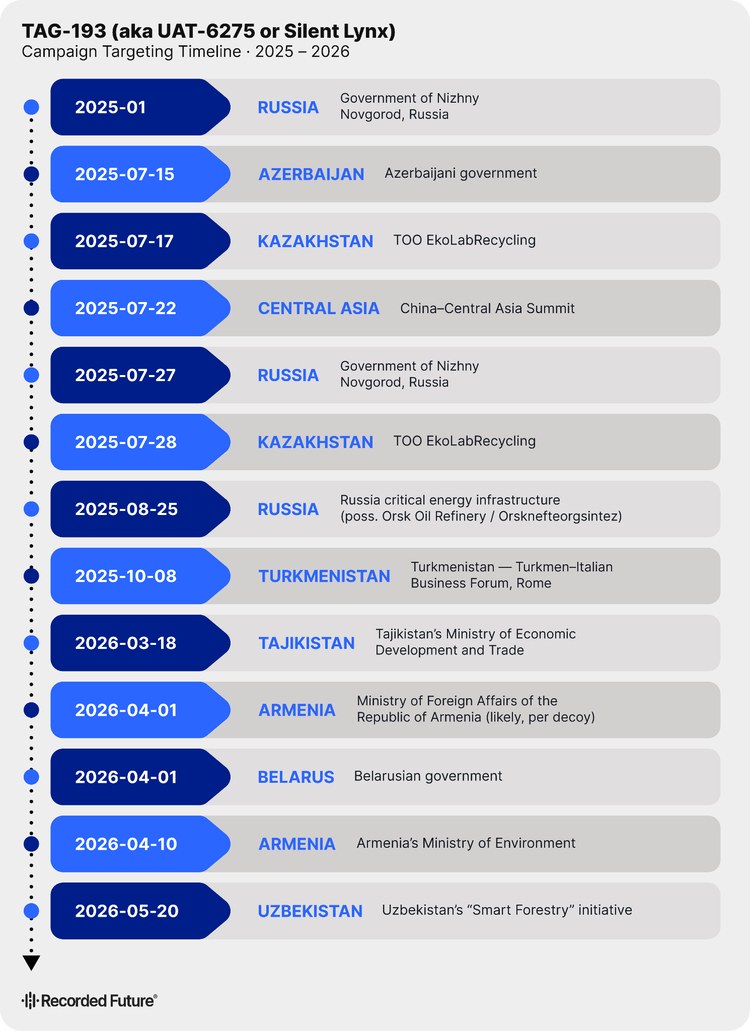
Joint research by Cisco Talos and Recorded Future’s Insikt Group examined sustained cyber-espionage activity by TAG-193 targeting government organizations across Central Asia and the wider Commonwealth of Independent States (CIS). Tracked by Cisco Talos as UAT-6275 and also known as Silent Lynx, TAG-193 combines diplomatic and economic targeting with an interest in environmental policy, water resources, and forestry. Exposed infrastructure provided new visibility into its malware, operational practices, and evolving delivery techniques. The findings point to possible links to Kazakhstan, but questions remain about the group’s origins. This post highlights how TAG-193’s operations reflect the intelligence value of regional diplomacy and resource management, and how its expanding toolkit supports that mission.
Government Targeting across the Region
TAG-193’s targeting extends across government institutions responsible for diplomacy, economic development, agriculture, and environmental management. These organizations hold information that can inform negotiations, economic planning, and regional security decisions. Across Central Asia, shared river systems and interconnected energy and transport infrastructure give such information particular strategic value.
In September 2026, Insikt Group® identified 94 high-impact vulnerabilities to prioritize for remediation, 59 of which had a Very Critical Recorded Future Risk Score. This represents a 29% increase from last month. 43 of these vulnerabilities were surfaced through the US Cybersecurity and Infrastructure Security Agency (CISA)’s Known Exploited Vulnerabilities (KEV) catalog, 37 were reported in open sources and validated by Insikt Group, and 14 were exclusively surfaced through honeypot data.
The 94 vulnerabilities identified affected products from 58 vendors, with Linux and Microsoft together accounting for approximately 13% of the vulnerabilities. The remaining exposures spanned network edge and security management appliances; operating systems (OS) and mobile devices; collaboration, content management, and enterprise platforms; artificial intelligence (AI), developer, and automation tools; and operational technology and industrial systems.
September reporting also highlighted zero-day exploitation of CVE-2026-88771 and CVE-2026-88772 (NetScaler), as well as renewed exploitation of CVE-2026-35273 (PeopleSoft) against unpatched systems.
Quick reference: September 2026 vulnerability table
All 80 vulnerabilities below were actively exploited or operationally weaponized in September 2026.This table does not include the 14 CVEs that were exclusively surfaced through honeypot data, which are available to Recorded Future Intelligence Platform customers via the CVE Monthly report.The table below also provides examples of public PoCs identified by Insikt Group. These PoCs were not tested for accuracy or efficacy. Vulnerability management teams should exercise caution and verify the validity of PoCs before testing.
Table 1:List of vulnerabilities that were actively exploited in September 2026 based on Recorded Future data (excluding honeypot-sourced CVEs).
Key trends: September 2026
September reporting linked NightEagle and UNC3569 to GhostContainer and GRAYRABBIT deployments, while Cisco FMC exploitation by three threat clusters led to credential theft, Cyclops Blink deployment, and Qilin ransomware.
A suspected Chinese-speaking actor used a SecFlow-based environment with Claude-, Qwen-, and DeepSeek-backed workers, and a suspected Russian-speaking actor used hundreds of AI agents to compromise at least 440 PaperCut NG/MF instances associated with 395 organizations.
47 of the 94 vulnerabilities enabled remote code execution (RCE). Network-edge and security-management products were the most affected product type. Apache and Google represented the largest share of vendors, with three RCE vulnerabilities each.
Insikt Group identified public proof-of-concept (PoC) exploits or scanners for 75 of the 94 vulnerabilities identified in September.
The most common weakness class was CWE-306 (Missing Authentication for Critical Function), with seven vulnerabilities, followed by CWE-22 (Path Traversal), with six. CWE-78 (OS Command Injection), CWE-89 (SQL Injection), and CWE-94 (Code Injection) each affected five vulnerabilities.
Eight of the 94 vulnerabilities were at least five years old, and the oldest was approximately 12 years old.
Trend analysis
AI-assisted campaigns combine older flaws with post-compromise tooling
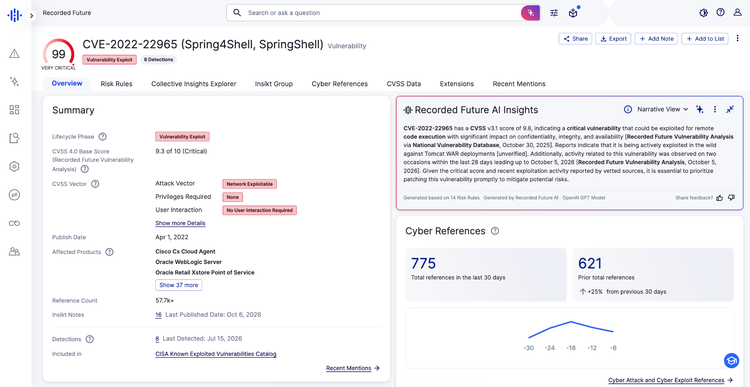
Insikt Group detailed a suspected Chinese-speaking actor using a SecFlow-based operations environment with Claude-, Qwen-, and DeepSeek-backed workers to support reconnaissance, exploitation, post-exploitation, and collection across Asian targets. The threat actor tested or staged workflows for CVE-2014-6271, CVE-2020-1938, CVE-2022-22965, CVE-2016-4437, CVE-2021-43798, CVE-2024-4956, CVE-2021-29441, and CVE-2021-44228. The workflow routed candidate findings to vulnerability-specific playbooks, but not every attempt produced confirmed access.
A separate September report described a suspected Russian-speaking threat actor using hundreds of AI agents in a campaign targeting PaperCut NG/MF. The campaign exploited CVE-2026-81578 and CVE-2026-82078, compromising at least 440 instances associated with 395 organizations.
Figure 1:Risk Rules history on theVulnerability Intelligence Card®for CVE-2022-22965 in Recorded Future (Source: Recorded Future)
One malware hash can turn a vague alert into a concrete investigation. Analysts can search endpoints for the exact file, trace where it appeared, and determine whether related activity exists elsewhere. But if the attacker changes the file, the hash changes too. Domains and Internet Protocol (IP) addresses can also lose relevance as attackers rotate infrastructure.
This is why malware indicators of compromise work best as evidence within a larger investigation, not as isolated entries on a blocklist. Their value grows when analysts can establish where an indicator came from, how recently it was observed, what threats are connected to it, and whether those connections matter to their organization.
Malware indicators of compromise are technical artifacts or observations that suggest malicious activity. They help security teams detect, investigate, and contain threats, but an IoC is most useful when analysts can assess its source, timing, confidence, and relationship to other threat activity.
Key takeaways
Malware indicators can include file-based artifacts, network infrastructure, and other technical evidence associated with malicious activity.
IoCs do not exclusively describe past attacks. They can point to malicious activity that may be underway or has already occurred.
Indicator types have different defensive lifespans. An IP address may quickly lose relevance, while a file hash remains an exact identifier for the same sample even if attackers create a new version.
Threat intelligence can add context that helps analysts prioritize IoCs, connect related activity, and move from an isolated match toward a wider investigation.
What are malware indicators of compromise?
An indicator of compromise (IoC) is a technical artifact or observable that suggests malicious activity. The National Institute of Standards and Technology (NIST) defines IoCs broadly enough to include signs that an attack may be imminent, underway, or that a compromise may already have occurred.
For a security operations center (SOC) analyst or incident responder, an IoC can help answer a practical question: Have we seen evidence associated with this threat in our environment?
Analysts can use malware IoCs to validate an alert, search logs and endpoints for related activity, or scope an incident after malicious activity is confirmed. They can also use an indicator as a starting point for investigating connected infrastructure, malware, or attacker behavior.
An IoC does not automatically prove that an organization has been compromised. Context matters. Finding a malware hash executing on an endpoint carries a different meaning from finding the same hash in an intelligence feed.
IoCs and TTPs serve different purposes
Indicators of compromise identify observable evidence associated with malicious activity. Tactics, techniques, and procedures (TTPs) describe how an adversary operates.
A specific command-and-control domain is an IoC. The techniques an attacker repeatedly uses to establish persistence or move through a network are TTPs.
Atomic indicators are often easier to match against security telemetry, but attackers may be able to change them quickly. TTP-based detection can be harder to evade when it focuses on established attacker behavior, but it can also demand richer telemetry and more detection engineering.
Security teams do not need to choose one or the other. An IoC can provide the first concrete lead, while TTPs can help analysts search for related activity after an attacker changes a domain or recompiles malware.
The most common types of malware indicators
Malware indicators generally appear either in files and host activity or in network communications. Each gives analysts a different view of what the malware has done.
File-based IoCs
File hashes such as SHA-256 fingerprints allow security tools to identify an exact known file. They provide a precise match, but attackers can alter a malware sample and generate a new hash.
Other file and host artifacts can reveal how malware operates after reaching a system. Analysts may examine suspicious file names and paths along with changes malware makes to the operating system, such as registry activity or mutex creation.
These artifacts can help investigators determine whether the same malware has appeared elsewhere in the environment.
Network-based IoCs
Network indicators show where malware connects or where malicious content is hosted.
These may include IP addresses associated with command-and-control infrastructure, domains used to distribute malware, or URLs connected to malicious activity. Analysts can also examine characteristics of network traffic when those characteristics are specific enough to the threat.
Network IoCs can help teams find infected systems that contacted known malicious infrastructure. Their usefulness can change over time because infrastructure may be abandoned, reassigned, or shared with legitimate services.
Why raw IoCs have limits
The main problem with raw malware indicators is not that they are useless. It is that the indicator alone often does not tell an analyst enough to make a good decision.
Indicators can lose defensive value quickly
Threat actors can move command-and-control infrastructure, register new domains, or change malware files to avoid known indicators. This makes some IoCs highly time-sensitive.
It is more accurate to think in terms of defensive lifespan than to assume every IoC simply expires. A hash continues to identify the same file, for example, but it stops detecting new versions once an attacker changes the sample.
A malicious label does not provide organizational context
An IP address listed as malicious does not tell a SOC whether its own systems communicated with it, whether the activity is current, or what defensive action is appropriate.
This is where raw feeds can create unnecessary analyst work. Teams must investigate why an indicator was flagged and decide whether that evidence applies to their environment.
Recorded Future recommends combining external indicator context with internal network data and subjecting indicators to organizational vetting before using them for detection in its guidance on indicators of compromise.
More indicators can create more noise
Threat intelligence feeds can contain overlapping, stale, or irrelevant information. Adding feeds without a way to assess their quality can increase alert volume without giving analysts better evidence.
Volume can still matter when a source provides useful threat coverage. It should not serve as the only measure of intelligence quality. Timeliness, confidence, provenance, and relevance also affect whether an indicator deserves attention.
IoCs do not provide complete threat visibility
Threat intelligence can tell analysts a great deal about an indicator that has already been observed. It cannot provide context for infrastructure or malware that its collection sources have never seen.
Better information about known IoCs can improve interpretation, but it does not guarantee complete threat visibility.
How threat intelligence makes malware indicators more useful
Security teams can get more value from IoCs by connecting individual observations to evidence that explains why they matter.
Recorded Future malware intelligence connects malware samples with associated IoCs and threat context. It also supports automated YARA rule generation for malware hunting.
Add context before taking action
Useful context can show when an indicator was observed, what malware is associated with it, and what other infrastructure or activity is connected to it.
Recorded Future uses Risk Scores to help analysts prioritize indicators. These scores can help determine what deserves attention, but they should inform security decisions rather than replace organizational context.
Automate repetitive IoC work
Large indicator volumes make manual lookup difficult. Application programming interfaces (APIs) and security integrations can automate IoC lookup, add threat context, and bring external intelligence into existing security workflows.
Recorded Future Cyber Operations supports these workflows through threat intelligence, APIs, and integrations.
Automation does not need to mean automatic blocking. Teams can automate research and prioritization while applying stronger requirements before an indicator triggers a direct enforcement action.
Turn individual indicators into threat-hunting leads
An IoC often becomes more useful when it leads analysts to related activity.
A malware sample can point investigators toward related variants, behaviors, and infrastructure. Recorded Future malware intelligence includes Auto YARA, which analyzes malware samples for distinctive patterns and generates YARA rules that analysts can use in malware hunting.
This lets teams move beyond searching only for a known hash and look for related files that share useful characteristics. Recorded Future University's guide to malware hunting provides more detail on how threat hunters approach that work.
Best practices for an IoC-driven security program
A useful IoC program should focus on the quality of security decisions rather than the size of the indicator database.
Check context before enforcement. Establish the source, confidence, and timing of an indicator before deciding whether it should trigger blocking or containment.
Match automation to the consequence. Automating lookup and prioritization carries less operational risk than automatically blocking infrastructure. Raise the confidence requirement as the action becomes harder to reverse.
Connect external intelligence with internal evidence. External threat data can show why an indicator deserves attention. Internal telemetry shows whether that threat has reached systems that matter to your organization.
Review active indicator sets over time. An indicator that no longer belongs in an active detection or blocking rule may still have value for historical investigation. Removing it from active enforcement does not mean deleting the intelligence.
Recorded Future's research into malware and vulnerability trends provides further context on changing malware activity and the threats defenders need to watch.
The future of IoC detection
Attackers can change hashes, IP addresses, and domains to evade known indicators. Security teams, therefore, need ways to connect individual IoCs to related malware activity and attacker behavior.
Automated malware analysis and detection-rule generation can help teams move from a new observation to a broader hunt with less manual work. This does not make atomic indicators obsolete. It gives teams another way to use them alongside behavioral detections and threat context.
Recorded Future combines malware analysis with threat intelligence so security teams can investigate individual IoCs in the context of related malware, infrastructure, and behavior.
Ready to spend less time chasing stale or low-value indicators? Request a demo to see how Recorded Future can help your team add context to malware IoCs and put threat intelligence into existing security workflows.
FAQs about using malware IoCs in security operations
Are YARA rules the same as malware IoCs?
No. An IoC is an observable artifact or piece of evidence associated with malicious activity. A YARA rule is detection logic that searches files or other data for defined patterns. Analysts can create YARA rules from characteristics found during malware analysis, allowing them to search for related samples rather than relying on one exact file hash.
How are malware indicators of compromise collected and shared?
IoCs can come from malware analysis, incident investigations, security telemetry, threat research, and intelligence-sharing communities. Organizations can share structured threat information using standards such as Structured Threat Information Expression (STIX), while Trusted Automated Exchange of Intelligence Information (TAXII) supports the exchange of that information between systems.
Are indicators of attack the same as indicators of compromise?
No, although the distinction is not simply that one predicts an attack and the other describes the past. Indicators of attack (IoAs) focus on behaviors or activity associated with attacker intent or an attack in progress. IoCs identify technical evidence associated with malicious activity, which may relate to activity that is ongoing or has already occurred.
Can two intelligence sources assess the same IoC differently?
Yes. Intelligence sources may rely on different observations, collection methods, scoring systems, and timeframes. Infrastructure can also change ownership or use over time. Analysts should consider the source, supporting evidence, and observation dates rather than assuming every malicious classification carries the same meaning.
Today, Recorded Future is announcing AI Infrastructure Indicator Lists, curated datasets for security teams to identify, monitor, and implement controls for AI-related network traffic. AI Infrastructure Indicator Lists are included for free for Recorded Future customers with a Cyber Operations license.
Artificial intelligence has increasingly become enterprise infrastructure and organizations are now confronting unsanctioned tool use (also known as shadow AI), data exposure, and autonomous behavior that their controls cannot always see.
Recorded Future's AI Infrastructure Indicator Lists focus on closing this gap across risk, IT, and GRC teams whether the goal is policy enforcement, data loss prevention, or detecting shadow AI.
AI is accumulating security debt
The hidden risks of an abundance of AI within an organization are often overshadowed by the daily threats that have to be prioritized by a security team. Last year, we reported on how security debt has been accrued by almost every organization, and the unaddressed risks are piling up faster than teams can service them. As a result, blind spots in AI governance are also increasing.
Take, for example, agentic AI. Its adoption is accelerating rapidly and agents are operating across interconnected systems, giving threat actors more room to exploit vulnerabilities at the organizational level and across supply chains.
Consider a free, viral AI assistant that an employee discovers on social media and installs on their own machine to boost productivity. No procurement process, no security review, no IT visibility.
That's not a hypothetical. OpenClaw, a free open-source AI assistant, saw explosive adoption earlier this year with almost no organizational oversight. Multiply that across a workforce and security teams left trying to govern tools they don't know exist.
By 2027, an estimated 75% of employees are expected to adopt or build technology outside IT governance. As agents become more ubiquitous, defenders need to ensure they can identify which technologies are living on their networks, and begin to track and manage access permissions for autonomous processes in the same way they manage permissions for human users.
Introducing AI Infrastructure Indicator Lists
While many threat feeds give you a wall of indicators and leave you to figure out what they are and whether to trust them, Recorded Future’s AI Infrastructure Indicator Lists do the opposite.
AI Infrastructure Indicator Lists are curated, regularly refreshed datasets that map the AI infrastructure your users, developers, and adversaries are actually reaching for. Indicators include IP addresses, CIDR ranges, and domains, carrying their own Risk Scores and comment fields with service attribution.
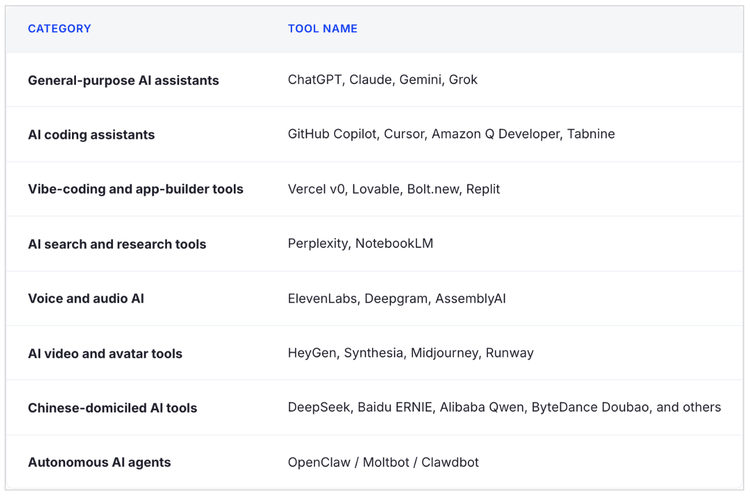
Recorded Future provides two distinct AI-related lists: the AI infrastructure list and the Chinese AI infrastructure list. The lists cover a comprehensive range of tools, including general-purpose AI assistants, AI coding assistants, vibe-coding tools, AI search tools, voice and audio AI tools, AI video tools, Chinese-domiciled AI tools, and autonomous AI agents.
Figure 1: List of AI tools monitored in AI Infrastructure Indicator Lists
Japan’s Active Cyber Defense (ACD) framework shifts the country from voluntary information sharing and post-incident investigation to mandatory reporting, preventive communications analysis, and limited disruption of attack infrastructure. Beginning October 1, 2026, designated critical infrastructure operators must notify the government about covered systems and report qualifying incidents; those with existing systems have six months to submit initial notifications. New authorities that allow the government to collect and act on communications information (通信情報) will not take effect until November 23, 2027.
The transition comes amid persistent Chinese strategic collection, North Korean revenue-driven cyber operations, and Russian cyber espionage. In cases directly linked to Japan, indicators related to these threat activities were frequently observed among victims, overseas affiliates, vendors, carriers, hosting providers, and government agencies. We assess with moderate confidence that connecting those indicators quickly enough to identify broader campaigns, warn potentially affected organizations, and coordinate defensive action will be ACD’s principal operational constraint. Its practical reach will extend beyond designated operators: overseas compromises may trigger Japanese reporting duties when they reach covered systems; vendors should expect remediation requests; carriers may be required to assist government measures; and hosting providers may encounter action against malicious systems operating on their infrastructure.
We further assess that improved visibility within covered organizations will likely make foreign subsidiaries, non-designated suppliers, employees, and external platforms comparatively attractive access paths for threat actors without reducing overall attack volume (because initial activity along these routes likely falls outside ACD’s mandatory-reporting perimeter or precedes recognition of a qualifying incident). Companies should therefore treat ACD not as a narrow compliance requirement, but as a change to incident escalation, contracting, evidence preservation, and public-private intelligence sharing across their operations and supply chains.
Key Findings
Japan’s Active Cyber Defense is a two-statute framework — Acts 42 and 43 of 2025 — organized around four principal pillars: public-private collaboration, government use of communications information, access and neutralization of cyber threats, and institutional restructuring and independent oversight. Act 42 establishes the reporting, information-sharing, communications-analysis, and oversight framework, while Act 43 amends existing laws to authorize neutralization measures and reorganize Japan’s cybersecurity institutions.
Japan's mandatory cyber incident reporting begins October 1, 2026, but the government's communications-information collection capacity will not enter force until November 23, 2027 — a gap of roughly 13 months between the reporting duty and the detection capability intended to support it.
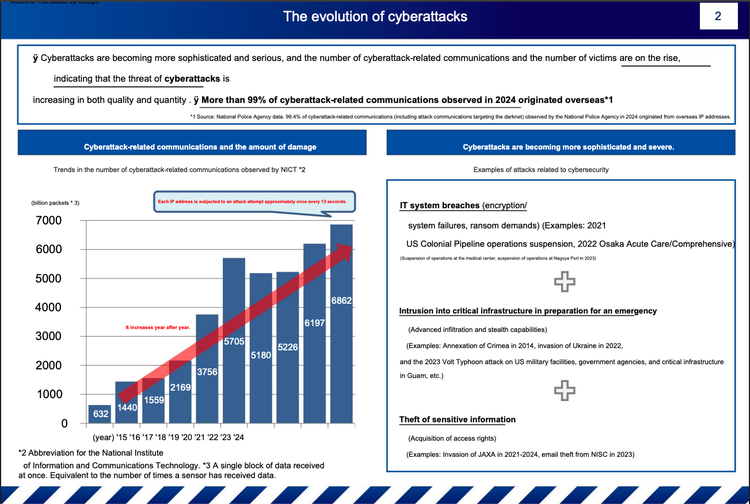
Japanese agencies recorded an eleven-fold increase in cyberattack-related packets from 63.2 billion in 2015 to 686.2 billion in 2024, while 99.4% of observed attack packets used overseas source IP addresses. This is equivalent to roughly one attempted attack per IP address every thirteen seconds.
Chinese, Russian, and North Korean cyber operations targeting Japan reflect distinct primary drivers: China pursues enduring strategic intelligence collection, North Korea prioritizes sanctions-driven revenue generation, and Russia combines standing espionage requirements with disruption that can track Japanese policy decisions.
Threat actors will likely emphasize five access paths likely to maintain limited visibility under ACD after reporting begins on October 1, 2026: foreign subsidiaries, non-designated suppliers, individual employees, consumer platforms, and short-lived infrastructure distributed across hosting providers. Organizations occupying these positions may consequently face greater targeting despite having no direct ACD reporting obligation.
Background
Japan’s Active Cyber Defense framework (能動的サイバー防御, “ACD”) is a package of legal and institutional reforms intended to prevent serious cyberattacks against government and critical infrastructure. The ACD establishes mechanisms for public-private collaboration (官民連携), government use of specified communications information (通信情報の利用), and narrowly defined authority to access and neutralize systems being used to conduct cyberattacks (アクセス・無害化措置) before they cause significant harm or damage. The framework also restructures the government’s central cybersecurity institutions and establishes independent oversight of the framework’s most sensitive authorities.
The framework is principally established through two statutes passed by the National Diet (国会) on May 16, 2025, and promulgated on May 23, 2025:
Cyber Response Capability Strengthening Act (サイバー対処能力強化法), Act No. 42 of 2025 Full statutory title: Act on the Prevention of Damage from Unauthorized Acts against Important Computers (重要電子計算機に対する不正な行為による被害の防止に関する法律). This statute establishes the critical-infrastructure reporting, communications information use, public-private information-sharing, and independent oversight framework.
Cyber Response Capability Strengthening Act Arrangement Act (サイバー対処能力強化法整備法), Act No. 43 of 2025 Full statutory title: Act on the Arrangement of Related Laws Accompanying Enforcement of the Act on the Prevention of Damage from Unauthorized Acts against Important Computers (重要電子計算機に対する不正な行為による被害の防止に関する法律の施行に伴う関係法律の整備等に関する法律). This companion statute amends existing legislation, including the Police Duties Execution Act (警察官職務執行法), Self-Defense Forces Act (自衛隊法), and the 2014 Basic Act on Cybersecurity (サイバーセキュリティ基本法). These amendments authorize access-and-neutralization measures, restructure the government’s cybersecurity institutions, and strengthen interagency coordination.
Implementation is phased; the reorganization of the government’s central cybersecurity institutions took effect on July 1, 2025, and the independent Japan Active Cyber Defense Oversight Commission (サイバー通信情報監理委員会) was established on April 1, 2026. The public-private reporting and access-and-neutralization provisions will take effect on October 1, 2026. Supplementary Article 1(4) of Act No. 42 requires the communications-information use provisions to enter force within two years and six months of promulgation, by November 23, 2027.
The Four Pillars
For explanatory purposes, this overview organizes the ACD framework into four principal pillars:
Public-Private Collaboration (官民連携)
Government Use of Communications Information (通信情報の利用)
Government Access and Neutralization Measures (アクセス・無害化措置)
Institutional Restructuring and Independent Oversight (組織・体制整備・独立監督)
Together, the pillars summarize the framework’s principal government authorities, institutional changes, oversight mechanisms, and legal obligations for public- and private-sector organizations. They reflect a fundamental shift in Japan’s cybersecurity posture toward earlier detection, structured public-private cooperation, and preventive disruption, while placing the framework’s most sensitive authorities under specialized independent oversight. They do not encompass every provision within the two statutes.
Pillar 1 — Public-Private Collaboration (官民連携)
Pillar 1 creates mandatory reporting requirements and a consent-based information-sharing framework. For ACD reporting purposes, “designated operators” (特別社会基盤事業者) are critical-infrastructure operators designated under the Economic Security Promotion Act that use covered systems — Specified Important Computers (特定重要電子計算機). These include qualifying operators in sectors such as electricity, telecommunications, transport, and finance. Designated critical-infrastructure operators must notify the responsible government minister when they introduce covered systems — Specified Important Computers — and report qualifying cyber incidents (特定侵害事象等) to that minister and the prime minister. The prime minister will establish a statutory council (協議会)for information sharing and countermeasures to prevent damage to Important Computers (重要電子計算機) — the law’s broader category of protected computer systems, including Specified Important Computers — from specified unauthorized acts. This statutory council will replace and strengthen the existing 2019 Cybersecurity Council (サイバーセキュリティ協議会). Council members may be required to provide relevant materials and must comply with statutory confidentiality requirements.
In practice, two things change under Pillar 1. First, ACD-specific reporting becomes a statutory duty for designated critical-infrastructure operators that use covered systems — including operators in sectors such as electricity, telecommunications, transport, and finance — thereby reducing the government’s dependence on voluntary disclosure once a qualifying incident is detected. Second, government-to-industry sharing enters a protected statutory framework designed to support the distribution of sensitive threat and mitigation information. Pillar 1, therefore, aims to give the government broader visibility into threats while providing participating organizations with actionable warnings. Joining the council is voluntary, but participating members must comply with statutory information-handling and confidentiality obligations and may be required to provide relevant materials.
Pillar 2 — Government Use of Communications Information (通信情報の利用)
Pillar 2 authorizes the government to obtain and analyze specified communications information through two principal pathways:
Voluntary agreements with participating organizations (当事者協定)
Defined government measures involving certain foreign-related communications (国外関係通信)
The latter includes foreign-to-foreign communications transiting Japan, as well as limited foreign-to-domestic or domestic-to-foreign communications associated with specified cyber threats. Before a government employee may review acquired data, automated selection (自動選別) must retain only defined mechanical information (機械的情報), such as IP addresses, timestamps, and command information, and delete the remainder. Government measures not based on consent generally require prior approval from the Japan Active Cyber Defense Oversight Commission.
In practice, two things change under Pillar 2. First, the government gains a standing statutory framework for obtaining and analyzing communications information for preventive cyber defense: Japan’s pre-ACD Communications Interception Act authorized interception only for criminal investigations of specified offenses and pursuant to a judge-issued warrant, and Japan lacked a comparable framework for systematic preventive collection and analysis. Second, the limit on what may be retained is enforced by the collection architecture rather than by rules governing analyst conduct. Officials set the selection criteria, but no person may examine the acquired data before the selection is complete, and unselected material must be deleted immediately.
Pillar 3 — Government Access and Neutralization Measures (アクセス・無害化措置)
Pillar 3 establishes access-and-neutralization authority through amendments to the Police Duties Execution Act and Self-Defense Forces Act. Specially designated Cyber Harm Prevention Measure Enforcement Officers (サイバー危害防止措置執行官) may order an administrator to take necessary measures against a computer associated with communications or electronic records identified as being used in malicious cyber activity, or may take those measures directly. Depending on the circumstances, those measures could include:
Changing system settings to prevent an attacker from continuing to control compromised infrastructure
The authority applies when an urgent need exists to prevent serious harm to life, physical safety, or property. Measures generally require prior approval from the Japan Active Cyber Defense Oversight Commission. When circumstances leave no time for advance approval, a measure may proceed, but the Commission must be notified promptly afterward and confirm whether the measure was appropriate.
In practice, Pillar 3 gives designated officers legal authority to intervene against attack infrastructure — including through actions that could otherwise constitute unauthorized access under the 1999 Act on Prohibition of Unauthorized Computer Access — rather than relying on criminal investigation or voluntary remediation. The authority can reach infrastructure outside Japan, but overseas operations are subject to additional restrictions. Police measures against systems not reasonably believed to be in Japan may be conducted only by officers of the National Police Agency (NPA) following consultation with the minister for foreign affairs. In cases involving highly organized and planned threats by a person outside Japan, the prime minister may order the Japan Self-Defense Forces (JSDF) to conduct Communications Protection Measures (通信防護措置) jointly with police, but only when the JSDF’s specialized technology or information is indispensable, and the National Public Safety Commission has requested or consented to JSDF involvement.
Pillar 4 — Institutional Restructuring and Independent Oversight (組織・体制整備・独立監督)
Pillar 4 restructures the government's cybersecurity institutions and creates an independent body to oversee the authorities established in Pillars 2 and 3. The reforms include:
The National Cybersecurity Office (国家サイバー統括室, NCO) replaces the former National Center of Incident Readiness and Strategy for Cybersecurity (内閣サイバーセキュリティセンター, NISC).
A new cabinet cyber officer (内閣サイバー官) leads the NCO and coordinates cybersecurity policy across the government.
The restructured Cybersecurity Strategy Headquarters (サイバーセキュリティ戦略本部) is headed by the prime minister (内閣総理大臣) rather than the chief cabinet secretary, with all other ministers of state as members.
The Japan Active Cyber Defense Oversight Commission (サイバー通信情報監理委員会) grants prior approvals, conducts ongoing inspections, reviews emergency measures taken without advance approval, and may issue recommendations.
In practice, two things change under Pillar 4. First, central coordination is elevated: the Strategy Headquarters is now chaired by the prime minister rather than the chief cabinet secretary, while the cabinet cyber officer and NCO support government-wide coordination. Second, the sensitive authorities in Pillars 2 and 3 are reviewed by a commission separate from the agencies implementing them. Rather than requiring judicial warrants, the framework uses independent administrative review: the Japan Active Cyber Defense Oversight Commission approves nonconsensual communications acquisition and ordinarily approves neutralization measures, conducts continuing inspections, and receives notification of emergency measures. It may issue recommendations and must report annually to the National Diet through the prime minister and publish a summary. Pillar 4 does not establish a separate offensive cyber authority; cross-border neutralization remains governed by Pillar 3.
Key Limits on ACD Authority
The ACD framework expands Japan’s preventive cybersecurity authorities but does not provide an unrestricted mandate for surveillance or offensive cyber operations. Its principal statutory boundaries include:
Communications analysis is not general content surveillance. Human review is limited to automatically selected mechanical information, including technical data such as IP addresses, timestamps, and computer commands, meeting statutory criteria. Purely domestic communications are not a category that the government may target without the parties’ consent. If included in data provided under a Party Agreement (当事者協定), they must be excluded through automated selection and deleted without human review. Separate laws continue to govern warrant-based interception for criminal investigations.
Access and neutralization authority is tied to specific mission objectives outlined in the ACD, rather than blanket provisions for government operators. Measures must address communications or electronic records used or reasonably suspected of being used in malicious activity and must be urgently necessary to prevent serious harm to life, physical safety, or property. Overseas measures carry additional procedural and international-law requirements.
The JSDF cannot independently initiate Communications Protection Measures. Its involvement is limited to highly organized and planned threats by a person outside Japan that present a high risk of serious, difficult-to-recover disruption, and requires a case-by-case finding that the JSDF’s technology or information is essential in preventing that disruption. Qualifying action requires a prime ministerial order, a request from or the consent of the National Public Safety Commission, and joint implementation with the police.
Reporting obligations are not universal. They apply to designated critical-infrastructure operators and covered systems, not to every Japanese organization or local government. Local governments instead fall under the separate Local Autonomy Act, which has required them, since April 1, 2026, to establish cybersecurity policies and implement corresponding measures. Qualifying local-government systems may still receive protection under the ACD framework.
Tokyo’s Rationale For the ACD
The ACD framework originates in Japan's 2022 National Security Strategy (NSS), which identified a rapidly deteriorating cyber threat environment and concluded that Japan’s legal authorities and institutional capabilities required expansion. The NSS stated that the “threat of cyberattacks, in which the risk of exposure is relatively low and attackers have an advantage, is growing rapidly.” In essence, cyberattacks were seen as low-risk (for the attackers), potentially high-impact means of disrupting operations, stealing information, or advancing strategic and financial objectives while complicating detection, attribution, and timely government response. The NSS set the objective that Japan’s cybersecurity response capabilities should be “strengthened equal to or surpassing the level of leading Western countries.” Tokyo’s rationale can be organized around three overlapping pressures: a sharp increase in malicious cyber activity observed by Japanese authorities; several high-profile cyberattacks that disrupted Japanese public- and private-sector operations; and gaps in the government’s legal authorities and institutional capabilities for sharing information, analyzing threats, and taking preventive action.
First, Japanese authorities have identified an increase in foreign-origin cyberattacks against Japanese public- and private-sector entities. A September 2025 Japanese NCO briefing document reported, citing the NPA, that 99.4% of observed attack packets in 2024 originated from overseas IP addresses (Figure 1). The same document, citing the National Institute of Information and Communications Technology (NICT), reported an approximately elevenfold increase in cyberattack-related communications between 2015 and 2024, from 63.2 billion observed packets in 2015 to 686.2 billion in 2024. The briefing described this volume as equivalent to approximately one attempted attack per IP address every thirteen seconds, although the underlying measurement represents packets received by sensors rather than confirmed, discrete attacks. Neither dataset identifies actors or intent, and the same briefing explains why the overseas share does not establish that the actors themselves are specifically based overseas: attacks are routed through chains of compromised intermediary machines, so tracing even a domestic-looking source usually leads to an overseas relay. Nevertheless, these figures indicate sustained growth in hostile traffic reaching the Japanese address space.

 Login