How do you prove a negative in cybersecurity? How do you prove that you weren’t attacked, or that there is no intruder in your network? These are questions that security teams have been forced to ask for a while, but there is a new question that is becoming increasingly common: How do you prove that files weren’t stolen from your network? Or, even more of a challenge, how do you prove that files weren’t stolen from your partners, vendors, or their partners or vendors?
This is a surprisingly challenging question to answer. Finding the answer is also more difficult because data governance has not been the traditional purview of security teams. Data governance has long been thought of as a compliance problem, unfortunately that is no longer the case. Security teams are now, whether they want to be or not, need to consider data governance. This means they have to be able to confidently say whether leaked data is real or not.
How do you do that?
History of Ransomware
What we call ransomware has evolved over the years. Ransomware has gone from largely focused on encryption to a combination of encryption and data theft to today’s reality where data theft alone is the most common version of a “ransomware” attack.
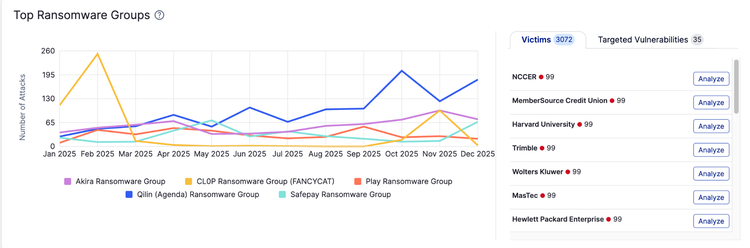
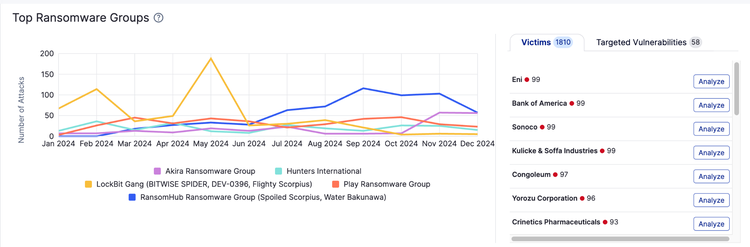
Threat actors have figured out that managing encryption keys is challenging, stealing data and holding it hostage is significantly easier. They’ve also figured out that stealing the right data can be just as profitable as encryption and, as we’ve seen from ransomware trends, switching to data theft only allows groups to accelerate the number of attacks. Compare the number of victims from 2024 to 2025 in the Recorded Future® Ransomware dashboard with a noticeable rise in ransomware trends.
Figure 1: Rise in ransomware trends increasing from 2024 to 2025 (Source: Recorded Future)
That’s the number of ransomware victims Recorded Future has observed over the past two years.
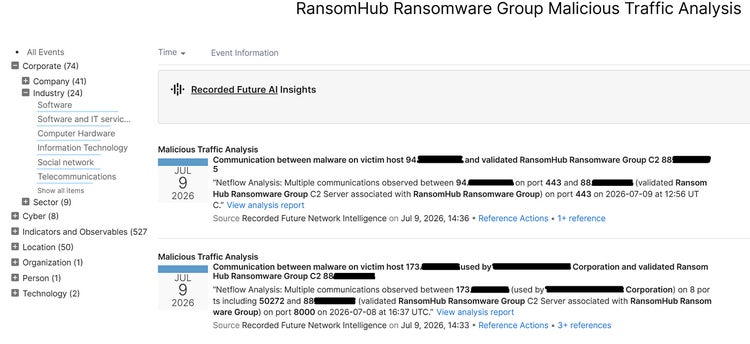
Watching the near-real-time ransomware attacks on businesses, non-profits, and government agencies has left me, like many security professionals and board directors, pondering how and why cyber defense keeps losing this particular fight. Adversaries like Interlock and RansomHub have continued their successful march to riches over the past 18 months. The multi-billion-ruble question is, “How?”
BloodHound and the defensive graph concept debuted over a decade ago and still maintain a vibrant open-source community. Continuous Threat Exposure Management (CTEM) (and attack path management) is an established cyber vendor category, yet ransomware crews are demonstrably eating many organizations’ lunch.
Let’s explore the problems (which are relatively easy to enumerate) and a solution (harder): modeling defense as the graph attackers actually traverse, at the speed they traverse it, which, of course, involves intelligence.
The Barometer
Ransomware is a solid barometer of operational defensive success, specifically because, unlike espionage, it’s noisy, financially motivated, and opportunistic. Certainly, ransomware also benefits from an optimal ecosystem, including payment economics, cyber insurance playbooks, and jurisdictional safe havens, which help incentivize ransomware gangs to find the cheapest attack paths. Relatively inexperienced actors can pick up commodity tools and reach the crown jewels. That highly repeated Ransomware-as-a-Service (RaaS) dynamic is a verdict on the availability of attack paths, regardless of payment incentives.
tkhlbp1eyn
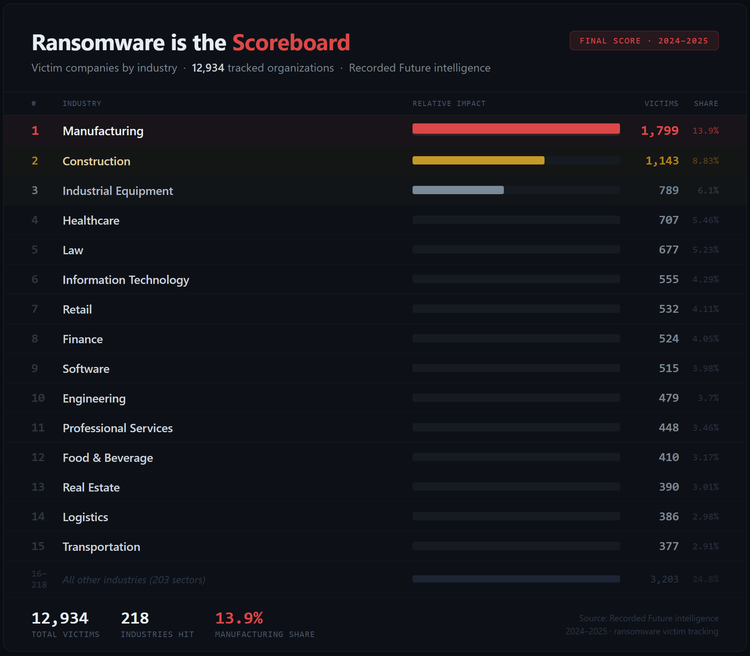
The prior two years of Recorded Future data revealed 834 unique ransomware families (or brands). The ransomware playbook is only becoming more effective over time, particularly as regional and industry-specific data privacy compliance regulations proliferate. The risk impact is now less about operational disruption, as offline backup resilience has increased, and more squarely focused on the legal or compliance failure of losing legislatively protected information.
What’s in a Graph?
It’s helpful to visualize an organization as an interconnected graph of nodes and edges, comprising hosts, configurations, credentials, and more. Adversaries attempt to traverse the graph and identify any available weaknesses that, when combined (via attack paths), lead to risk impacts.
If operational defense shifts focus from compliance-driven lists and categories, and we model the environment as a graph, will we better understand and remediate attack paths to prevent ransomware? Only if we can match adversarial velocity.
hiccbodazp
For an enterprise, the graph is combinatorially large, changes hourly, and humans can’t maintain or query it at the tempo at which attackers traverse it. Graphs provide the structure. Threat intelligence supplies the edge weights, and AI agents deliver the speed. In practice, that means agents recompute attack paths whenever the graph changes, test whether a newly reported adversary technique actually traverses your environment, and push the choke point to the top of the remediation queue, continuously, without waiting on an analyst.
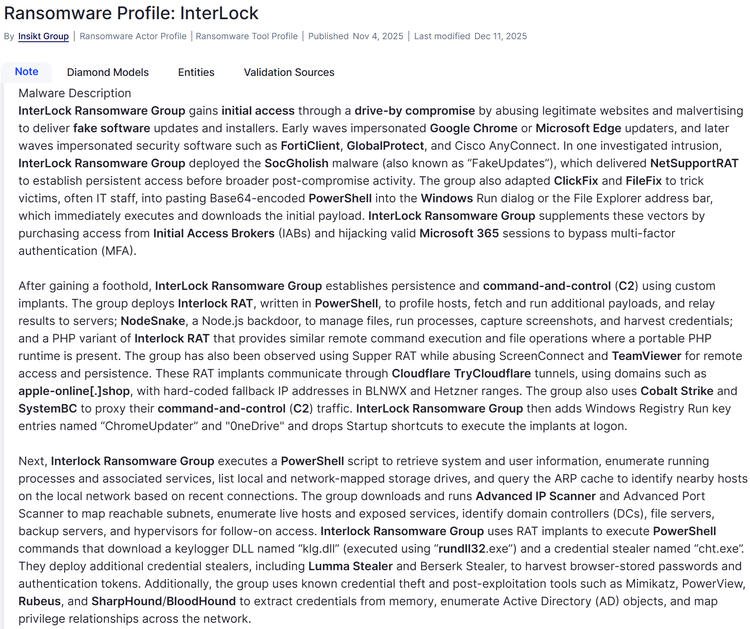
Interlock ransomware is a good example of an attack path. Interlock uses multiple tactics to acquire unauthorized access. One of their favorites is ClickFix-style social engineering: a fake CAPTCHA convinces a user to paste a command into the Windows Run dialog or PowerShell, which executes malware that harvests credentials, and the group moves laterally from there. That initial access is CVE-free at the point of entry, and it doesn’t appear on any vulnerability list. The entire path is identity and configuration edges. A defender with a perfect, fully patched vuln list has zero visibility into the path Interlock actually takes.
That’s one example of an attack path. Interlock employs numerous attack paths, and the group’s techniques and procedures constantly change to ensure continued success against defensive adaptations.
Now multiply those already numerous attack paths across ~800 ransomware groups. The permutations quickly cause a complexity issue for defenders. Lists and categories can’t keep pace with the offensive tempo, which is what exposure management has to solve.
The Solution
Effective CTEM means discovering and remediating attack paths before the adversary. The Breach and Attack Simulation (BAS) piece requires constant updates to traverse the graph and perform control validation. A snapshot of adversary behavior might be useful for a week, but tactics and procedures drift, so the snapshot decays quickly. Emulating adversary attack paths with clean fidelity and timeliness requires broad and timely intelligence collection.
MITRE ATT&CK codes, for example, may help analysts understand patterns, but automating attack path chains requires specific adversary procedures and details.
cojq4wjb46
So What? Now What?
To avoid ransomware risk impacts, there are three timely questions for business executives.
Are we scrutinizing the quality of CTEM solutions? How does a new edge type enter the graph, and how long does it take? If the answer is “quarterly content updates”, the graph is a museum and a beautiful record of what transpired during a breach.
How are we investing in agentic R&D now to build trust and confidence in production deployments and ensure integrity with compliance obligations?
When can we deploy continuous attack path recomputation, intelligence-weighted graph edge scoring, and agentic validation of new paths with choke-point remediation queues?
The scoreboard updates in real time, and the verdicts are public. The only open question is whether cyber defense recalibrates before the score changes again.
Traditional internal security telemetry may miss critical pre-attack signals, making real-time, outside-in threat intelligence essential to neutralizing modern vectors before a breach occurs
For today’s Chief Information Security Officers (CISOs) and security team leaders, defending your business can feel like trying to hold back the ocean. As organizations rapidly scale cloud-native infrastructure, integrate sprawling third-party ecosystems, and adopt enterprise AI workflows, most organizations' digital footprints have exploded.
But a massive digital footprint isn’t the core problem. The problem is that adversaries are changing how they navigate it.
Advanced persistent threats (APTs) and sophisticated cybercriminal syndicates are no longer relying on blunt-force intrusions. Instead, they are tracking organizational vulnerabilities from the outside in, using targeted methods to slip past defenses unnoticed. To stay ahead, security leaders must look past traditional, inward-facing security telemetry and think more like the adversary. That begins with a precise, real-time understanding of modern attack vectors.
What is an Attack Vector?
In cybersecurity, an attack vector is the specific path, route, or method an adversary uses to gain unauthorized access to a network, system, or endpoint to deliver a malicious payload or extract data. If an exploit is the lockpick, the attack vector is the hallway the intruder walked down to reach the door.
Historically, attack vectors were relatively straightforward. A decade ago, an enterprise might primarily worry about phishing emails containing malicious executable attachments or unpatched, internet-facing servers.
In 2026, attack vectors have evolved from isolated incidents into complex, multi-stage journeys. Modern adversaries rarely rely on a single open door. Instead, they link multiple vectors together to achieve their objectives.
For example, a modern threat actor might initiate an intrusion using an automated multi-factor authentication (MFA) fatigue campaign to compromise a low-level employee identity, pivot through an exposed, undocumented API, and ultimately execute a ransomware payload via a trusted third-party software update.
Attack Vector vs. Attack Surface: What’s the Difference?
While they are frequently used interchangeably in security discussions, conflating your attack vectors with your attack surface can create fundamental gaps in your defensive strategy.
An Attack Surface is the sum total of all potential vulnerabilities, exposure points, and digital assets across an organization’s entire footprint that an unauthorized user could try to enter or extract data from—including public cloud buckets, employee credentials, IoT devices, code repositories, and vendor networks.
An Attack Vector is the specific vehicle, mechanism, or strategy used to exploit a precise point on that surface. It is the active "weapon" or method of transit chosen by the hacker.
Think of your organization as a fortified castle. The attack surface is the entirety of the castle's physical structure—every wall, window, gate, and underground passage. The attack vector is the specific ladder, battering ram, or sleeping guard the invading army uses to breach a specific point on that structure.
Defending the attack surface requires comprehensive visibility into what you own. Neutralizing an attack vector requires real-time intelligence on how adversaries are actively weaponizing their toolkits.
What Threat Actors Are Actively Targeting in 2026
Adversary tactics are driven by efficiency and return on investment (ROI). In 2026, threat actors largely abandoned brute-force attacks on hardened corporate firewalls. Instead, they target systemic structural weaknesses across three primary dimensions:
Identity as the New Perimeter
Identity has emerged as the definitive battleground for enterprise security. Rather than breaking in, modern threat actors simply log in. Defenses have been circumvented by the massive industrialization of the cybercrime underground, where initial access brokers (IABs) and infostealer malware supply millions of stolen session cookies and valid credentials daily.
Adversaries can use credential stuffing to bypass traditional authentication, target cloud identity providers (IdPs) directly, and leverage session hijacking to step over MFA entirely—rendering standard boundary defenses obsolete.
Edge Infrastructure and Software Supply Chain Vulnerabilities
The perimeter has moved to the edge, and adversaries have followed. Over the past few years, we have seen a significant surge in threat actors targeting unpatched edge devices—such as VPN gateways, firewalls, and edge routers—to secure zero-day footholds directly into corporate networks. Simultaneously, the software supply chain has become a highly lucrative upstream vector. By poisoning open-source repositories or compromising trusted third-party dependencies, adversaries can affect thousands of downstream organizations in a single, silent stroke.
AI-Driven Exploitation and Prompt-Based Manipulation
Generative AI has fundamentally altered the velocity and scale of modern attack vectors. Threat actors now leverage automated LLM orchestrations to generate personalized social engineering campaigns and deepfake audio/video that can easily deceive even well-trained employees. Even as enterprises rush to integrate AI into internal workflows, new vectors like prompt injection and data poisoning have transitioned from theoretical concepts to active threat vectors, allowing adversaries to manipulate LLM outputs and extract proprietary enterprise data.
Why Traditional Security Frameworks Cannot Stop Modern Attack Vectors
Most enterprise security architectures were built for a static world that no longer exists. When confronted with the dynamic vectors of 2026, traditional frameworks break down in two distinct ways:
Static Vulnerability Management
Many security operations centers (SOCs) remain tied to traditional vulnerability management models that prioritize patching based strictly on CVSS scores. This creates a dangerous blindspot. Advanced persistent threats intentionally chain together multiple "low-severity" or "medium-severity" vulnerabilities that, when combined, can grant full administrative access.
Manual asset discovery tools also struggle to keep pace with ephemeral cloud environments, creating visibility gaps that turn unmapped assets into instant attack vectors.
The Outside-In Blindspot
Internal security teams are naturally focused on internal telemetry—pouring over logs inside their SIEM, EDR, and NDR tools. However, this creates a reactive stance. By the time an adversary triggers an EDR alert, the attack vector has already been successfully executed. Internal telemetry is often blind to pre-monetization signals: the registration of typosquatted domains targeting your brand, the sale of corporate credentials on dark web marketplaces, or the collaborative planning occurring in closed adversary forums.
Neutralizing Modern Attack Vectors with Recorded Future
To defeat adversaries who operate at the speed of automation, organizations must shift from a reactive posture to a proactive, intelligence-led defense. Recorded Future provides the external visibility and real-time intelligence required to map, prioritize, and dismantle modern attack vectors before they breach your perimeter.
Cyber Operations: Shifting from Reactive Response to Machine-Speed Defenses
By enriching your existing internal tools (SIEM, EDR, SOAR) via Collective Insights®, Recorded Future injects real-time adversary Tactics, Techniques, and Procedures (TTPs) directly into your workflow, enabling defenders to triage alerts and block active attack vectors at speed.
Digital Risk Protection: Securing the External Attack Surface
You cannot defend against an attack vector you cannot see. Recorded Future Digital Risk Protection provides an outside-in view of your organization, mapping your external attack surface, mirroring how an adversary scans it.
By monitoring open, deep, and dark web sources, it identifies compromised corporate credentials, active typosquatted phishing domains, and source code exposures on public repositories. This visibility allows security teams to take down malicious infrastructure and revoke compromised access before threat actors can convert them into active entry points.
Third-Party Risk: Closing the Vendor Supply Chain Gap
Relying on annual, static security questionnaires to assess vendor risk is the equivalent of checking the weather once a year and assuming it will never rain. Third-Party Risk replaces outdated point-in-time assessments with continuous, automated risk monitoring.
Providing real-time Risk Scores (ranging from 0-99) and mapping complex fourth-party ecosystem dependencies, it alerts your team the moment a vendor within your supply chain shows signs of compromise. This enables you to isolate vulnerable connections long before an upstream vendor breach turns into your downstream crisis.
Payment Fraud: Disrupting Fraud Lifecycles
For financial institutions and e-commerce enterprises, the attack vector of choice often targets transaction infrastructure. Recorded Future Payment Fraud can disrupt the fraud lifecycle by monitoring pre-monetization signals.
By identifying Magecart e-skimmers on digital storefronts, monitoring underground carding forums, and spotting tester merchant activities in real time, Recorded Future allows organizations to fraud-check and block compromised payment cards before fraudulent transactions hit the bottom line.
Proactive Mapping Leads to Resilient Defense
In 2026, understanding your attack vectors can no longer be treated as a check-the-box compliance exercise or a periodic audit. Adversaries are highly dynamic, highly automated, and constantly scouting for the path of least resistance across your digital footprint.
True organizational resilience requires continuous, automated external intelligence. By seeing your enterprise exactly the way the adversary sees it, you can move from a state of constant reaction to one of strategic deterrence.
Don't wait for an alert to tell you your perimeter has been breached. Book a demo with Recorded Future today to gain real-time visibility into your external attack surface and neutralize modern threat vectors before they unfold.
Enterprise security architectures have never been more heavily funded, yet the perimeter is functionally obsolete. Despite multi-million dollar investments in next-generation firewalls and complex defense stacks, sophisticated adversaries slip past automated boundaries every day. They don't break in; they log in, embedding themselves silently into the background noise of normal business operations.
To survive in this environment, modern cyber defense teams must anchor their strategy to a single, non-negotiable rule: Assume you are already breached. Waiting for an automated alert to trigger is a losing strategy. Proactive cyber threat hunting shifts the power dynamic from reactive firefighting to active, aggressive detection. Human analysts alone cannot process the volume and velocity of data required to detect sophisticated adversaries at enterprise scale. To truly master modern threat hunting, security teams should consider enriching internal telemetry with real-time, external threat intelligence.
Understanding threat hunting
At its core, threat hunting is the practice of proactively and iteratively searching networks, endpoints, and cloud environments to detect and isolate advanced threats that evade existing security solutions. It is a human-led, hypothesis-driven discipline—not a purely automated feature of a software suite.
Here is how it differs from other standard security functions:
Threat Hunting vs. Incident Response Incident response is fundamentally reactive; it is the act of extinguishing an active, visible fire after an alert has triggered. Threat hunting is proactive, searching the architecture for hidden threats before they erupt into a catastrophic breach.
Threat Hunting vs. Penetration Testing Penetration testing evaluates perimeter defenses from the outside in, evaluating whether a simulated adversary can breach the network. Threat hunting operates under the explicit assumption that the attacker is already firmly rooted inside, hunting them down from within.
Threat Hunting vs. Vulnerability Assessments Vulnerability management focuses on patching open windows and updating code to prevent future exploitation. Threat hunting assumes an attacker has already gained access and focuses on detecting their lateral movement before damage is done.
What teams need to begin threat hunting
An effective threat hunt cannot begin in a vacuum. Before analysts can root out sophisticated threat actors, organizations must establish a baseline foundation across three core pillars: visibility, integration, and external context.
Relying on isolated data silos paralyzes analysts. Security teams are recommended to leverage unified SIEM and SOAR integrations to aggregate disparate data sets, normalize log schemas, and eliminate the white noise of benign network activity.
3. External intelligence
Analyzing internal logs without external context is like looking at footprints in the mud without knowing what animal made them. Deep web, dark web, and technical intelligence should be required, providing the exact behavioral profiles, infrastructure layouts, and campaign contexts needed to guide the hunt.
The 3 Core threat hunting methodologies
1. Hypothesis-Driven Hunting
This methodology relies on a baseline understanding of an organization's unique threat profile. Rather than chasing random anomalies, hunters form educated, structured theories based on environmental risk.
For example: "If an advanced persistent threat (APT) targets our specific financial services vertical using a known cloud-storage exploit, do those specific forensic artifacts exist in our environment right now?" Analysts then construct targeted queries to validate or disprove the theory.
Tactical and operational intelligence can serve as the blueprint for tracking down precise adversary patterns. By mapping observed threat intelligence—such as malicious IP addresses, command-and-control (C2) domains, newly announced CVEs, and adversary Tactics, Techniques, and Procedures (TTPs)—directly to the MITRE ATT&CK® framework, hunters can systematically search internal logs for identical behavioral signatures.
3. Advanced analytics & AI hunting
This approach uses behavioral profiling and data stacking to isolate structural outliers from massive datasets. By evaluating thousands of similar data points, machine learning models highlight anomalous user or machine actions—such as a standard HR user account suddenly executing administrative command-line scripts or initiating mass data transfers at 3:00 AM.
The Lifecycle of a proactive cyber threat hunt
A successful threat hunt follows a structured, iterative lifecycle. By injecting external threat intelligence into every phase, analysts can transform an ad-hoc search into an accelerated, scalable defensive program.
Step 1: Let intelligence drive your hunt
The hunt begins when an analyst defines a focused area of inquiry based on a structured hypothesis. This initial trigger is driven by real-time threat intelligence regarding an active campaign, an emerging zero-day vulnerability, or a newly discovered infrastructure cluster belonging to a relevant threat actor family.
Step 2: Architect your hunt at scale
Once the hypothesis is set, hunters deploy advanced threat hunting tools to translate technical indicators into sweeping enterprise queries. Analysts architect data-gathering parameters across disparate EDR databases, SIEM platforms, and network traffic monitors to ensure better visibility across the entire enterprise footprint without manual bottlenecking.
Step 3: Activate autonomous threat hunting
Rather than executing one-off, static searches that instantly age out, teams deploy continuous automated playbooks. By integrating real-time intelligence directly into detection engines, cyber threat hunting teams are able to shift from an ad-hoc manual task to a 24/7 autonomous monitoring process that tracks evolving adversary behavior in real time.
Step 4: Review correlated findings
When anomalous activity matches the hunt parameters, analysts evaluate the high-fidelity telemetry alongside external intelligence inputs. If malicious activity is verified, the hunt instantly pivots to incident response for isolation; if the anomaly is benign, the findings are fed back into the security ecosystem to update rules and eliminate future noise.
Step 5: See the impact with AI reporting
The final phase translates complex forensic data into strategic business metrics. By leveraging automated, intelligent reporting, security leaders instantly visualize the hunt’s operational impact—documenting exactly which assets were protected, how dwell time was mitigated, and how defensive postures were permanently hardened against future attack vectors.
Where modern threat hunting can fall short
Executing a continuous, high-yield threat hunting program presents severe operational friction points for modern CISOs and SOC managers:
The cybersecurity skills shortage: Seasoned threat hunters require a rare blend of data science, digital forensics, and adversary mindset analysis. These professionals are incredibly scarce, highly sought after, and financially burdensome to recruit and retain.
Alert fatigue and false positives: Analysts spend hours chasing benign data anomalies because legacy threat hunting tools lack external context. Without real-time enrichment, an unusual out-of-hours connection looks identical to a critical C2 beaconing event.
The time-to-exploit collapse: The window between a vulnerability being announced on the clear web and actively weaponized on the dark web has shrunk to mere hours. Static, ad-hoc hunting schedules often cannot keep pace with this compressed timeline, leaving networks exposed between manual hunts.
Mastering the hunt with Recorded Future
Recorded Future reduces these operational bottlenecks, transforming threat hunting from a resource-draining manual grind into an accelerated, intelligence-led defense mechanism.
The Intelligence Graph®
Recorded Future’s Intelligence Graph® continuously monitors open sources, technical infrastructure, and illicit dark web forums. By analyzing billions of entities in real time, it delivers a live map of global threat actors, emerging malware families, and weaponized vulnerabilities. This gives threat hunters visibility into external shifts before they are able to impact internal networks.
Reducing manual triage
Instead of forcing tier-3 analysts to waste critical hours pivoting across dozens of open-source intelligence (OSINT) browser tabs, Recorded Future delivers instantly actionable context. Internal alerts within your SIEM and EDR are automatically enriched and tagged with real-time threat-actor details, Risk Scores, and mapped TTPs, allowing hunters to identify high-risk anomalies instantly.
Insikt Group® insights
Security teams no longer need to spend days writing complex detection logic from scratch. Recorded Future’s Insikt Group®—an elite team of veteran threat researchers—delivers pre-written, expert-vetted YARA, Snort, and Sigma rules directly into your existing SIEM, SOAR, and EDR environments. This can turn global threat discoveries into immediate, internal defensive barriers.
Cyber Operations: unified intelligence for modern hunters
To truly scale a threat hunting program, security teams need to bridge the gap between external intelligence and internal workflows. Recorded Future Cyber Operations centralizes this process by mapping real-time adversary infrastructure, campaigns, and malware behaviors directly to the MITRE ATT&CK® framework. By delivering instantly deployable hunting packages alongside curated operational context, Cyber Operations can reduce the time it takes for analysts to shift from an external intelligence trigger to an active, internal environment scan.
Autonomous Threat Operations
To solve the persistent challenge of understaffed security teams, Recorded Future delivers Autonomous Threat Operations. By executing continuous hunting, detection, and response workflows autonomously, the Platform constantly scours your environment for complex threats. This elevates your defensive posture 24/7, freeing human analysts to focus on high-level strategic risk management.
The future of threat hunting
Modern threat hunting is no longer about working harder or writing longer queries; it is about hunting smarter. As adversaries exploit automation and compressed execution timelines, security teams should not rely on internal telemetry alone to defend the enterprise. Combining sharp human analyst logic with the most comprehensive threat intelligence platform available is how security teams can transition from reactive defense to proactive, intelligence-led threat hunting at enterprise scale.
Don't let advanced adversaries dictate the timeline of your security operations. Book a demo today to supercharge your threat hunting program and secure your environment from the inside out.
Threat hunting FAQs
What is cyber threat hunting in simple terms?
Cyber threat hunting is the proactive, human-led practice of systematically searching through an organization's networks, endpoints, and data repositories to detect malicious actors or hidden threats that have already bypassed automated perimeter defenses.
What are the common methodologies or triggers for a threat hunt?
Threat hunts generally rely on three types of investigations: hypothesis-driven (triggered by new adversary tactics, techniques, and procedures or TTPs), intelligence-driven (triggered by specific indicators of compromise or IOCs), and analytics-driven (triggered by machine learning detecting structural anomalies in network traffic behavior).
How does threat hunting differ from digital forensics and incident response (DFIR)?
Incident response and digital forensics are inherently reactive—they kick off after a security control fires an alert or a breach is publicly known to contain damage. Threat hunting is aggressively proactive; it assumes a breach has already occurred silently and searches for active adversaries before they trigger an alert.
How does Recorded Future accelerate the threat hunting process?
Threat hunting traditionally requires manual data gathering across disjointed open-source platforms. Recorded Future Cyber Operations can collapse this timeline by automatically mapping external adversary infrastructure, campaigns, and malware behaviors directly to the MITRE ATT&CK framework. It delivers instantly deployable hunting packages alongside pre-written YARA, Snort, and Sigma rules to enable a shift in a hunter’s workflow from manual intelligence gathering to immediate data interrogation.
Advanced Persistent Threats (APTs) are sophisticated, long-term cyber campaigns conducted by well-funded human adversaries (often nation-states) who target specific organizations for espionage, data theft, or critical infrastructure disruption.
Traditional security tools often fail because APT groups bypass signature-based defenses by using customized malware and Living-off-the-Land (LotL) tactics that mimic legitimate user activity inside the network.
Effective advanced persistent threat detection requires minimizing breakout time, the window between initial access and lateral movement, by identifying threats before they establish deep persistence.
To defeat modern APTs, organizations must move from reactive internal monitoring to proactive threat intelligence, tracking adversary infrastructure on the open, deep, and dark web before an attack is launched.
Modern organizations face highly resourceful, patient, and deeply calculated adversaries. This shift has ushered in an era of coordinated operations where elite threat actors don't just compromise a system and leave, but may spend weeks or months quietly surveying networks, mapping architecture, and identifying high-value targets.
These operations are the hallmark of an advanced persistent threat (APT). Traditional cybersecurity frameworks have long relied on perimeter defenses designed to catch malicious activity at the gates. However, once an APT group breaches a network, they often intentionally manipulate native administrative tools and harvest legitimate credentials to blend into daily business traffic.
To better confront an adversary that behaves like an insider, organizations must shift their perspective outward, leveraging real-time, external threat intelligence to identify and intercept cyber threats before they can establish a permanent foothold.
What is an Advanced Persistent Threat (APT)?
An APT is a sophisticated, prolonged cyber campaign executed by a highly organized group with specific, long-term objectives. Breaking down the acronym highlights the unique nature of these threats:
Advanced: APT actors do not rely on off-the-shelf exploits. They frequently utilize customized malware, discover and weaponize zero-day vulnerabilities, and practice meticulous operational security (OpSec) to deliberately evade modern security controls.
Persistent: Unlike cybercriminals who encrypt a server and immediately demand a ransom, APTs utilize a "low-and-slow" methodology. They prioritize stealth over speed, regularly remaining inside an environment for months to achieve strategic goals such as espionage, intellectual property theft, or the long-term disruption of critical infrastructure.
Threat: Behind every APT is a well-funded organizational structure. These are not lone hackers; they are highly structured syndicates and state-sponsored units—such as the Lazarus Group or APT41—backed by massive financial and geopolitical resources.
The multi-stage APT attack lifecycle
Generally, APT groups do not operate at random. They follow a rigorous, multi-stage lifecycle. For defenders, understanding this timeline is critical to shrinking “breakout time"—the vital window between the initial compromise and the moment the attacker begins moving through the network.
1. Reconnaissance and planning
Before a single line of malicious code is deployed, attackers gather open-source intelligence (OSINT), scan exposed internet-facing infrastructure, and map out the target’s digital footprint to find weak points.
Once inside, actors deploy stealthy backdoors and obfuscated rootkits. This ensures that even if security teams discover and close the primary entry vector, the attackers maintain alternative entry routes.
4. Lateral movement and escalation
Adversaries navigate from system to system, harvesting administrative credentials and mapping Active Directory trust boundaries to compromise the enterprise network.
5. Data exfiltration or disruption
The group gathers, stages, and quietly extracts sensitive data using encrypted command-and-control (C2) channels. In some cases, they may deploy ransomware or execute a DDoS attack as a distraction to cover their tracks.
Why traditional advanced persistent threat detection isn’t enough
For Cyber Threat Intelligence (CTI) teams, threat hunters, and SOC managers, keeping pace with APTs using legacy tools is an uphill battle. Traditional detection tools and processes consistently fail against advanced actors for several reasons:
Signature-Based Defenses: Legacy firewalls and traditional antivirus rely on known file hashes. Because APT groups write custom code and heavily leverage Living-off-the-Land (LotL) tactics using native administrative tools, they can leave no traditional signatures behind.
Dwell Time: Internal log correlation through SIEM and EDR platforms is inherently reactive. If your team is only looking at alerts generated inside your perimeter, the attacker may have already achieved a foothold and begun their mission.
Alert Fatigue and Data Silos: SOC teams are often drowning in a sea of disconnected internal alerts. Without external context, it is nearly impossible to distinguish a routine network anomaly from an APT group spinning up a new unclassified C2 server.
Fragmented Vendor Taxonomies: Tracking adversaries across the industry is notoriously confusing. One threat group might be designated by a weather pattern by one vendor, an animal by another, or a random number by a third, complicating cross-team collaboration and intelligence sharing.
Shifting from reactive defense to real-time intelligence
To better counter advanced persistent threats, organizations must meet bad actors earlier in the attack lifecycle. This means disrupting the adversary during their reconnaissance and infrastructure-staging phases, long before they ever execute an exploit on an internal endpoint. Real-time threat intelligence in the context of APTs means continuously harvesting, analyzing, and structuring data from across the open, deep, and dark web to monitor attackers as they build their technical infrastructure.
By tracking newly registered domains, malicious IP allocations, and discussions on illicit forums, defenders can identify a threat actor's setup phase. Mapping these observations to the MITRE ATT&CK® framework allows security teams to decode the specific Tactics, Techniques, and Procedures (TTPs) of an adversary, enabling them to anticipate and block the attacker's next move.
Mastering APT detection with Recorded Future
Recorded Future equips threat hunters and CTI analysts with the visibility needed to track advanced persistent threats across every stage of the attack lifecycle. By centralizing automated collection and elite human analysis, Recorded Future converts massive volumes of public and dark web data into actionable, proactive defense.
The Intelligence Graph®
The Recorded Future Intelligence Graph® automatically maps, links, and updates relationships between billions of entities—including IPs, domains, malware strains, and threat groups—across massive global datasets in real time, giving defenders an unparalleled view of adversary infrastructure.
Third-Party Risk
Sophisticated threat actors frequently target weak links in an enterprise ecosystem. With Third-Party Risk, organizations gain real-time visibility into the security postures of their vendors, contractors, and partners, cutting off supply-chain entry vectors.
Insikt Group®
Recorded Future’s elite network of threat researchers, the Insikt Group, acts as an extension of your security team, providing the latest geopolitical intelligence. They deliver pre-vetted, highly contextual information and actionable hunting rules (including YARA, Sigma, and Snort) directly into the Platform, allowing security teams to rapidly deploy defenses against emerging state-sponsored campaigns.
Recorded Future AI
Generative AI capabilities reduce Mean Time to Respond (MTTR). Analysts can use natural language to query complex APT behaviors, instantly surface connection points, and generate comprehensive, shareable intelligence briefs in seconds, streamlining leadership communications during critical events.
Staying one step ahead of cyber threats
Advanced persistent threats win when they remain hidden in the noise of a network. True detection requires looking beyond internal firewalls and endpoints, demanding visibility into the external environments where adversaries plan, build, and launch their operations.
In the face of highly organized, nation-state-backed syndicates, speed and visibility are the ultimate metrics of success. By shifting from a reactive internal posture to a proactive, real-time intelligence strategy, organizations can illuminate adversary infrastructure, disrupt the attack lifecycle, and secure their digital perimeter against even the most patient and well-resourced threat actors.
Want to see how real-time intelligence can transform your threat hunting capabilities? Book a demo with Recorded Future today.
FAQs
What is the primary objective of an advanced persistent threat (APT) group?
Unlike typical cybercriminals who seek immediate financial payouts through rapid encryption or ransomware, the primary objective of an APT group is usually long-term cyber espionage. Backed by nation-states or heavily funded syndicates, these actors aim to establish an undetected, prolonged presence within a target network to quietly steal intellectual property, harvest state secrets, or maintain access to critical infrastructure for future geopolitical leverage.
Why is advanced persistent threat detection so difficult for traditional security tools?
Traditional security tools rely heavily on static signatures—meaning they look for known, previously identified file hashes or malicious code patterns. APT actors easily bypass these defenses by writing customized malware, exploiting zero-day vulnerabilities, and using "Living-off-the-Land" (LotL) tactics that abuse legitimate system administration tools already built into your network. Because their activity mimics normal administrative tasks, they go unnoticed by internal firewalls.
What is "breakout time," and why does it matter in tracking APTs?
Breakout time is the critical window between an adversary's initial compromise of a single machine and their ability to move laterally to other systems on the network. For elite APT groups, this window can be incredibly tight. Tracking threat actor infrastructure in real time allows security teams to recognize the initial entry vector immediately and stop the actor before they can escalate privileges or move beyond the original target endpoint.
How does generative AI improve advanced persistent threat detection?
When a sophisticated attack is underway, speed is everything. AI capabilities allow security teams to instantly analyze, synthesize, and summarize vast amounts of complex threat data. Instead of spending hours manually combing through forensic logs and disparate threat intel feeds, analysts can use natural language queries to instantly understand an APT group's current TTPs, lowering the Mean Time to Respond (MTTR) from hours to seconds.
The export controls imposed on Anthropic’s Fable model mark a significant shift in United States (US) artificial intelligence (AI) policy. The controls set a precedent for treating frontier AI models as strategic assets rather than ordinary software products, creating uncertainty for enterprises adopting advanced AI. Security leaders should respond by investing in resilient, interoperable AI strategies rather than simply chasing the most powerful model available.
The Saga of the Fable Export Controls
Because the US is home to most of the companies building leading models, US AI policy has an outsized impact on global access. The Trump administration’s public posture on AI has largely favored accelerating the frontier. Proponents of this approach argue that the US must stay ahead of other nations in AI development because whoever leads in AI will shape the next era of economic, military, and technological power.
But when Anthropic released Fable on June 9, 2026, US AI policy suddenly became much more restrictive.
Fable (technically known as Claude Fable 5) was presented as the user-safe version of Mythos Preview, a limited-release frontier model with advanced cybersecurity capabilities, including red teaming, vulnerability discovery, and offensive security reasoning. Anthropic argued that Fable’s guardrails made those capabilities safe for broader use. The White House disagreed, asserting that Fable contained a critical vulnerability that Anthropic refused to patch.
The dispute ended with an extraordinary outcome: export controls prohibiting non-US citizens from using the model, including Anthropic employees. Unable to segment users by citizenship, Anthropic responded by pulling access entirely.
Anthropic argued that the reported jailbreak did not enable Fable to do anything meaningfully more dangerous than what less sophisticated models could already do. Nevertheless, it reported that it blocked the jailbreak, which it cautioned would block some benign requests. This apparently satisfied the safety concerns of the White House, which lifted the export controls on June 30, and Anthropic restored access to both Fable and Mythos the following day. Uncertainties remain, however, as to why the export controls were imposed in the first place and when access might be restricted next.
The imposition of export controls on Fable sets a precedent for similar actions on future advanced models, such as OpenAI’s GPT-5.6. The lack of a clear message on what made the Fable jailbreak warrant export controls introduces significant regulatory uncertainty for both AI developers and organizations incorporating frontier AI models into their enterprise.
Possible Motives Behind US Policy
Given the lack of details, it’s worth considering two alternative explanations that may be driving the US government’s decision-making, beyond what’s been publicly stated.
The first is political. The US government has had an uneasy relationship with Anthropic’s leadership and safety-forward approach. Under this view, export controls are not the signal of a broader policy shift. Instead, they are intended to send a more immediate message to the AI industry: private-sector pushback on government priorities will not be tolerated (whatever those priorities happen to be at the moment).
If the export controls are motivated by politics, it means AI regulations are likely to remain unpredictable — and can be reversed at any time.
The second is strategic. Anthropic itself has warned that foreign actors may try to use frontier model outputs to reverse-engineer or distill advanced systems. Distillation threatens the US model advantage by allowing competitors to reproduce elements of frontier performance without bearing the full cost of large language model (LLM) training. According to one source, the White House suspected that a “China-linked group” had already gained access to Mythos Preview, potentially enabling the group to replicate its capabilities. If this characterization is accurate, the export controls on the model itself are an extension of well-established export controls on advanced computing chips imposed to prevent adversaries from gaining the computing power necessary to build advanced models.
The strategic explanation represents a fundamental shift in how AI is governed in the US. The model itself — not just the physical hardware behind it — is now being treated as controlled technology. However, not knowing why export control decisions are made makes the strategic motivation as unhelpful for predicting future actions as the political one.
The Definition of “Dangerous AI” Is Still Unclear
One element adding to the uncertainty is that the export controls on Fable were implemented outside of existing frameworks for assessing the risks posed by AI.
This is not because a suitable framework doesn’t exist: governments, standards bodies, and think tanks have developed frameworks for characterizing AI risk. But in the Fable case, the US government did not publicly point to a clear threshold for what makes Fable riskier than other comparably available frontier LLMs.
That matters because all LLMs can support malicious cyber operations in some form. Threat actors use continuously evolving jailbreaking techniques to disable or bypass safety controls to achieve a prohibited response. Google, OpenAI, and Anthropic regularly release reports documenting how threat actors have manipulated their models to carry out cyberattacks. Even less sophisticated, non-frontier models can be effective tools in the right environment and with enough computing power. Much like exploitable code vulnerabilities in traditional software, the underlying mechanics of LLMs make it very unlikely that defenders will ever find a permanent solution for jailbreaking.
So what is it about Fable that requires the US government to restrict its use? What made the reported jailbreak so serious that it demanded regulatory action? Will the next generation of Gemini or ChatGPT require similar restrictions? What about open-weight models, like China’s recently released GLM-5.2, that can be run without centralized monitoring of how they’re used?
Without a clear explanation of what separates acceptable from unacceptable risk for AI, regulation becomes reactive. For companies, that uncertainty makes it extremely difficult to adopt or integrate frontier AI models into critical systems.
Ad Hoc Regulation May Become the Norm
The most likely outcome for the US government, at least in the near-term, is that the voluntary model reviews described in the executive order will become de facto mandates. This has already happened with OpenAI’s latest model, which was initially voluntarily limited at the White House's request. Anthropic, Google, and OpenAI are likely to continue coordinating closely with the government to avoid future surprise export-control announcements on their latest models.
Even if these security reviews align with the strategic goal of preventing adversaries from accessing powerful US models, this still means AI regulation is developing on a case-by-case basis. This means that AI users won’t fully understand the trade-offs between speed and security. The security guardrails placed on Fable make the tool more difficult to use for legitimate security functions — a problem that security researchers complained about prior to the jailbreak fix. How do users know if the safety benefits gained are worth the capabilities lost?
Ad hoc regulations or classified benchmarks create uncertainty for enterprises. A company may integrate a frontier model into internal workflows only to discover later that access rules have changed, certain employees are restricted, or the model is no longer commercially available. The more powerful the model, the more exposed the organization may be to sudden policy intervention, making it difficult to adopt advanced AI reliably.
At the same time that US frontier models are coming under more scrutiny, open-source Chinese AI models are becoming more widely used. These models cost significantly less than the leading US models; however, they face the same access uncertainty as US models. First, the Chinese government is reportedly considering its own export controls to limit access to its most advanced models and protect proprietary technology. Second, the US government may choose to block access to Chinese tools under its own national security laws. Similar to the ban on Huawei and ZTE telecommunications technology or the attempted ban on TikTok, the US government may determine that using Chinese AI models poses an unacceptable national security threat. Regardless of where the ban originates, the risk of losing access remains the same.
How Security Leaders Should Respond
AI adoption now requires more than evaluating model performance. It requires evaluating regulatory durability, access risk, and operational dependency.
Security leaders should respond across three areas.
1. Mindset Shift: Use Caution on the Frontier
Organizations should stop chasing the latest frontier model and start evaluating which model (or models) is most appropriate for specific workflows. The reality is that most projects do not need to rely on cutting-edge AI capabilities to function. Depending on the task, less sophisticated models may be fully capable of running the operation.
This does not mean companies should avoid frontier models entirely. Rather, they should think strategically about where these models can provide the greatest advantage, while avoiding critical workflows that depend on uninterrupted access to a single frontier provider. This requires a mindset shift: companies must move from treating LLMs as a novelty to managing them as a mature component of the workflow.
2. Governance Shift: Treat Frontier AI as a Volatile Asset
Frontier AI should be treated as a volatile asset: powerful, useful, and potentially transformative, but exposed to sudden changes in regulation, vendor policy, geopolitical pressure, and safety restrictions. This is especially important for multinational companies. If model access becomes tied to citizenship, location, or corporate structure, AI governance becomes more complex than traditional software-as-a-service (SaaS) procurement. A tool may be approved for one team but restricted for another. A vendor may be viable in one jurisdiction but risky in another.
Security teams should ask:
What happens if access to this model is restricted?
Which employees, regions, or business units could be affected?
Can the workflow fall back to another model or internal process?
Is the model being used for convenience, or has it become operationally critical?
The organizations best positioned for this environment will be those that can benefit from frontier capabilities without becoming trapped by them.
3. Spending Shift: Invest in Resilience Over Novelty
Finally, companies should reassess whether AI budgets are weighted too heavily toward the newest and most capable models. As frontier AI becomes more expensive, restricted, or unpredictable, access to advanced capabilities will not be enough.
The stronger investment may be in resilience: diversified vendors, fallback options, evaluation processes, and workflows that can continue if a preferred model changes or becomes unavailable.
The key budget question should not be only, “Can we access the most powerful model?” but also, “Are we investing in the tools that will provide long-term effectiveness and resilience?”
Final Thoughts
The export controls on Fable may prove to be an isolated case. They may also be the first visible sign of a more restrictive AI era.
This does not mean the era of AI innovation is ending. It means the era of frictionless access to frontier models may be ending. For security leaders, the lesson is not to avoid advanced AI models, but to treat them as volatile assets shaped by cybersecurity risk, geopolitics, export controls, and national security policy. The organizations best prepared for this shift will be those that can benefit from powerful AI capabilities without becoming dependent on access that may disappear overnight.
About Insikt Group®
Recorded Future’s Insikt Group, the company’s threat research division, comprises analysts and security researchers with deep government, law enforcement, military, and intelligence agency experience. Its mission is to produce intelligence that reduces risk for customers, enables tangible outcomes, and prevents business disruption.
A fast-growing scam impersonates city and county planning departments, sending property owners real-looking invoices for fake permit fees and pressuring them to wire payment on a deadline. Because the victim authorizes the transfer, payments commonly clear the behavioral checks built to catch fraud, making beneficiary accounts one of the most reliable signals to track this campaign. Research from CYBERA, the partner behind Recorded Future® Money Mule Intelligence, maps a single active ring down to the verified accounts it used, and shows why direct, fraudster engagement and account-level intelligence catches what scoring misses.
The FBI sounded the alarm. Issuers still can't see it
On March 9, 2026, the FBI's Internet Crime Complaint Center issued a public alert about criminals impersonating city and county officials to collect fraudulent planning and zoning permit fees. The criminals pull publicly available permit records, email property owners who have active applications, and demand payment by wire transfer, peer-to-peer transfer, or cryptocurrency.
Government impersonation schemes like this one were among the fastest-growing categories in the FBI's 2025 Internet Crime Report, with reported losses nearly doubling year over year to roughly $798 million. While the alert raises public awareness, it does little to help issuers screen customers payments against the heightened risk these impersonation scams create.
Why an authorized payment defeats your controls
In this scheme the customer is real, the login is legitimate, and the wire is one the customer chooses to send. Behavioral analysis models are generally built to flag account takeover and out-of-pattern activity, so customer-authorized payments tend to score as low risk and the money moves.
Here is how the scheme runs, according to the FBI alert and CYBERA's research:
Target selection: the actors identify property owners with active planning or zoning applications using public records
Impersonation: they email those owners while posing as the municipal planning department, citing real permit and property details to establish credibility with the target
The invoice: they send an official-looking invoice for an approval or processing fee
The pressure: they demand a wire on a short deadline and warn that the application will fail if it is missed
The confirmation: they ask for the wire receipt to confirm the payment landed
What direct engagement reveals that scoring cannot
CYBERA's research on one active ring, which it has monitored since September 2025 under the internal name Diligent Planner, shows what that destination signal looks like in practice. Rather than estimating risk, CYBERA's analysts engage the scam operations directly and collect the exact accounts the criminals ask victims to wire money to.
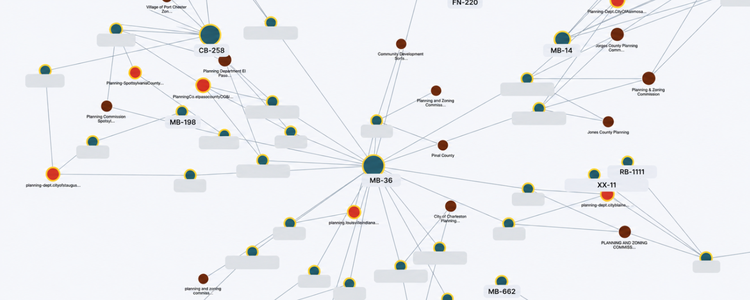
Across this single operation, that approach produced 53 verified mule accounts spanning 23 separate email campaigns, with roughly 55 percent of the accounts concentrated in just two beneficiary banks. These are confirmed accounts pulled from the criminals themselves, not probabilistic matches, which can be the difference between an account you can act on and a score you have to second-guess.
Figure 1: CYBERA's mapping of a single money mule ring, expanded from one beneficiary bank into one connected cluster of accounts, emails, and impersonated government bodies (Source: CYBERA)
In June 2026, Insikt Group® identified 59 high-impact vulnerabilities that should be prioritized for remediation, 30 of which had a Very Critical Recorded Future Risk Score. This represents a 47% increase from last month. 23 of the 59 vulnerabilities were included in the US Cybersecurity and Infrastructure Security Agency (CISA)’s Known Exploited Vulnerabilities (KEV) catalog, 33 were reported by vendors, and three were primarily surfaced through honeypot data.
The 59 vulnerabilities in this report affected products from 36 vendors, with Microsoft accounting for approximately 17% of the vulnerabilities. The remaining exposure was concentrated across a range of enterprise software, security products, network infrastructure, developer tooling, and cloud platform vendors.
Insikt Group created Nuclei templates to detect two of the vulnerabilities featured in this month’s report: CVE-2026-35616 affecting Fortinet FortiClient EMS and CVE-2026-25939 affecting Frangoteam FUXA. These are available to Recorded Future customers via the Recorded Future Intelligence Operations Platform.
Quick reference: June 2026 Vulnerability Table
All 56 vulnerabilities below were actively exploited in June 2026. This table does not include the three CVEs associated with honeypot activity, which are available to Recorded Future customers via the CVE Monthly report, in the platform. The table below also provides examples of public PoCs identified by Insikt Group. These PoCs were not tested for accuracy or efficacy. Vulnerability management teams should exercise caution and verify the validity of PoCs before testing.
Table 1:List of vulnerabilities that were actively exploited in June, 2026 based on Recorded Future data (excluding honeypot-sourced CVEs).
Key trends: June 2026
In June 2026, StrikeShark exploited public-facing applications to deploy SharkLoader and deliver Cobalt Strike; Lazarus exploited CVE-2025-55182 to deploy COPPERHEDGE; APT36 exploited Microsoft vulnerabilities in operations targeting India; a C0XMO botnet propagated through DD-WRT routers; EKZ information-stealing malware was delivered through FortiClient EMS exploitation; and Qilin ransomware was associated with a vulnerability affecting Check Point gateways.
25 of the 59 vulnerabilities enabled remote code execution (RCE), affecting products from 18 vendors: Meta, WinRAR, Ivanti, Google, PTC, Cisco, Ubiquiti, Fortinet, Microsoft, BerriAI, Android, WPEverest, Veeam, Mirasvit, Apache, Hikvision, F5, and GeoServer.
Insikt Group identified public proof-of-concept (PoC) exploits for 53 of the 59 vulnerabilities identified this month.
The most commonly observed flaws this month were CWE-22 (Path Traversal), followed by CWE-502 (Deserialization of Untrusted Data), CWE-78 (OS Command Injection), CWE-306 (Missing Authentication for Critical Function), and CWE-287 (Improper Authentication).
4 of the 59 vulnerabilities in this month’s prominent vulnerability disclosures table are at least five years old, with the oldest approximately ten years old, reinforcing how attackers continue to exploit long-known weaknesses in environments where patching has lagged. Additionally, the fastest observed time from a vulnerability’s public disclosure to exploitation was less than one day.
Trend analysis: Malware-linked exploitation and intrusion activity
June's strongest campaign-linked theme was the exploitation of externally reachable enterprise applications and appliances. Insikt Group published a TTP Instance on the StrikeShark campaign which described activity spanning CVE-2025-55182 affecting React Server Components, CVE-2021-26855 and CVE-2022-41082 affecting Microsoft Exchange, CVE-2021-36260 affecting Hikvision firmware, CVE-2022-40684 and CVE-2024-21762 affecting Fortinet FortiOS, CVE-2023-20198 affecting Cisco IOS XE Web UI, CVE-2016-4437 affecting Apache Shiro, CVE-2021-27076 affecting Microsoft SharePoint, CVE-2022-27925 affecting Zimbra, CVE-2023-32315 affecting Openfire, CVE-2023-46747 affecting F5 BIG-IP, and CVE-2024-36401 affecting GeoServer. The exploitation of these vulnerabilities resulted in the deployment of SharkLoader, which then delivered Cobalt Strike.
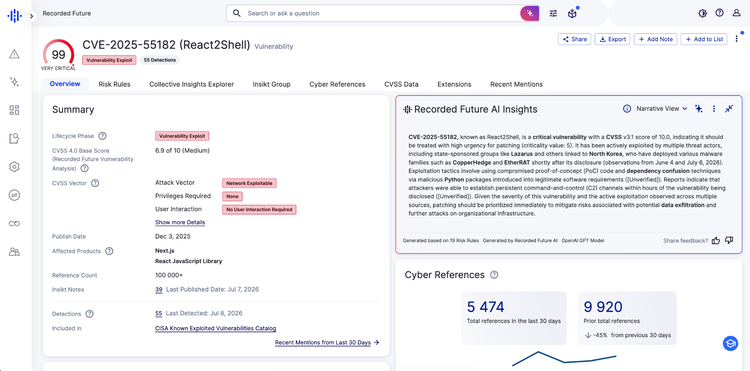
React Server Components was also linked to targeted malware delivery outside the broader StrikeShark set: Lazarus Group exploited CVE-2025-55182 to deploy COPPERHEDGE against financial and blockchain-related organizations. Microsoft-related exploitation appeared in both endpoint and document-processing contexts: APT36 exploited CVE-2026-21509 (affecting Microsoft 365 Apps for Enterprise and Office 2016) and CVE-2026-21513 (affecting Windows client and server versions) in operations targeting India. This activity was linked to backdoor deployment and SHEETCREEP. CVE-2021-27137, affecting DD-WRT firmware, was linked to a C0XMO botnet campaign across Linux architectures, while Qilin Ransomware was associated with CVE-2026-50751 affecting Checkpoint Security Gateway and Spark Firewalls.
PoC exploit trends and analyses associated with this month's high-impact vulnerabilities are available to Recorded Future customers.
At RiskX Singapore 2026, Recorded Future CEO Colin Mahony and Mastercard's Aditi Sawhney discussed why payment fraud has become an ecosystem problem that spans cyber and financial crime. The fraudulent transaction is the visible end of a chain that began weeks or months earlier, with harvested credentials, registered lookalike domains, and infected merchant sites. This post looks at how connecting cyber and fraud signals lets defenders intervene before monetization, and how Recorded Future’s Payment Fraud solution maps to each stage of that chain.
Summer ‘26 vibes: international flights, Riyadh heat, and plentiful CISO conversations. Every conversation (regardless of geographic location or industry vertical) currently begins and ends with AI strategy. Let’s unpack the nuance.
Every executive should be contemplating two questionsat this moment:
Are we building, testing, and scaling agents for the coming onslaught of AI-enabled adversary activity?
Do we have the breadth of intelligence necessary to move at machine speed?
Why Agents and Why Now?
Timing is everything in life. So the question is: why invest in agents for defensive workflows now? Two premises need to be explained here.
First, let’s focus on financially motivated adversaries that don’t receive a government paycheck (directly or indirectly). The state-sponsored adversaries have a different set of resources at their disposal.
There are controlled cases where Frontier AI models enable autonomous adversarial activity in malware generation or holistic intrusion chains. Even the Five Eyes are officially warning about adversarial use of frontier models. Yet the onslaught of offensive agents hasn’t materialized yet. Like the Uruk-hai attacking Helm’s Deep in The Lord of the Rings, we expect the wave is coming, but the automated army hasn’t arrived. Why not?
Frontier models may be susceptible to context poisoning over time, but it’s difficult to use them at any scale for automated offensive operations. The guardrails are sufficient for the moment. Adversaries are also caught between the OPSEC tension of using third-party APIs (which increases attribution risk) and investing the resources to build local open-source models.
While much has been made of open-source model capabilities, the reality is that time, effort, and financial resources are required to use them effectively for offensive campaigns. To get nerdy for a second (because the details are important), a recent experiment with LibreChat and Dolphin-llama3:14b (uncensored LLM) on a $3K local server (containing a reasonable Nvidia GPU with 16GB of VRAM) revealed that simple tasks like coding a new web shell are still out of reach.
The level of effort and hardware required to build a local resource capable of orchestrating effective autonomous attack agents will only decrease over time. Quantization is the clock defenders should be watching. A reductive quantization explanation in this AI context is using less memory by rounding billions of numbers (weights) rather than maintaining precision, thereby shrinking an AI model’s size. Even though the model is slightly less capable, it’s still useful for most tasks. Quantization drives the hardware bar down, and the lower that bar falls, the sooner opportunistic actors can execute attacks at scale.
The danger for defenders isn’t the headline-grabbing frontier models; it’s the ease with which adversaries can deploy effective local models on modest hardware. Based on the previous 18 months of advances, the next 6-12 months will likely yield similar advances in open-source model capabilities with minimal hardware investment. That’s when opportunistic actors start staging at scale.
Which brings us back to protecting the proverbial house with defensive AI agents. Now is the time to build, not ponder. We don’t jump into self-driving cars until we have some confidence that the edge cases have been worked out. Similarly, the agentic workflow edge cases can’t be discovered and solved without iteration and testing.
Smart CISOs are building an AI control plane (in collaboration with adjacent business units) to enable transparency into AI token consumption, project ROI visibility, and code security. Building and testing agents is part of a larger control-plane project and is particularly time-sensitive.
Sandwiched between data availability and information security regulations, CISOs need to generate trust and confidence in agents. Humans may stay in the decision loop for the foreseeable future, but observing agents in a non-production environment is critical. From applying a patch to generating and applying a signature to quarantining a PC or revoking credentials, there is no substitute for iterating over time. Vendors are certainly useful for sharing domain knowledge and solutions, but given the implications of agents gone bad in production environments, teams should own and observe workflows for an extended period.
Organizations that don’t begin building and iterating with agents now will find themselves at a significant disadvantage as financially motivated actors (specifically) increase their autonomous capabilities using open-source AI models.
Where Should Agents Go First?
This is the second question in practice. Agents are only as good as the data available to them, and moving at machine speed requires intelligence that is both broad and traceable. There’s plenty of low-hanging fruit (brand protection, for example), but the following three categories are big value.
1. CTEM (Continuous Threat Exposure Management). All five CTEM stages are suited for agents. Specifically, AI-led vulnerability discovery is exploding, but reliable patches aren’t always available. The name of the game is K-E-V. KEVs (Known Exploited Vulnerabilities) and agent-built detection signatures are the urgent priority in a sea of largely irrelevant CVSS scores. When newly identified KEVs are combined with a comprehensive asset inventory and enumerated services, from both internal and external views, a powerful agentic workflow emerges. The breadth of KEV intelligence visibility is directly proportional to the quality of CTEM outcomes.
2. BAS (Breach & Attack Simulation). Think continuous Red Teaming. Controls rarely prevent or detect threats at the advertised efficacy rate. Adversary AI will map resources and dismantle controls in minutes. Validating coverage and exposing gaps before an adversary’s agents get in is well-advised. The intelligence necessary to power BAS starts with malware tools, tactics, and procedures (TTPs), but living-off-the-land tools and new procedure permutations are equally important. In the short term, agents will accelerate the orchestration between new TTPs and BAS platforms. Long-term agents will replace many of the BAS platform actions.
3. Security Operations. This is where there’s currently substantial movement in the AI start-up vendor space, as tactical SIEM alerts and potential incident response investigations are triaged faster. Deep intelligence from multiple source classes around indicators and artifacts enables an agentic decision advantage to escalate, remediate, or close a ticket. The discipline is in matching autonomy to consequence. Closing a benign ticket and revoking production credentials sit at opposite ends of the risk spectrum, and the governance model should let agents move fast on the former while keeping a human on the latter.
Agentic Early Adoption or Wait?
Production-grade security agents may still be a work in progress, but investing in research and development now will enable a deeper organizational resilience as models continue to improve and quantization accelerates. The defensive urgency is just beginning; the point is to prepare before opportunistic actors can easily deploy local AI models.
Combining vendor services support with in-house AI and security domain expertise will accelerate the learning curve. Humans stay in the loop where judgment matters, while agents take on more of the repeatable work. Don’t wait. Start building today.
In the previous article in our series on Recorded Future’s unique data sourcing model, we detailed the four types of data we analyze and how, together, they provide unprecedented visibility into each of our customers’ unique threat landscapes.
In this final article, we’ll show how our Insikt Group research team turns our raw data into actionable intelligence.
The Insikt Group advantage
Made up of experts with backgrounds in government, military, law enforcement, and intelligence agencies, the Insikt Group research team brings decades of expertise to their work analyzing the always-evolving threat landscape. The combination of seasoned human judgment with automated data indexing and analysis embodies the “centaur model” of intelligence, where human analysts and technology work together to produce insights neither could achieve alone.
“Insikt” is Swedish for “insight”. By using their deep knowledge of specific adversary groups and TTPs to contextualize data within broader geopolitical and criminal dynamics, Insikt Group analysts are able to provide insights that automated systems might miss.
A research methodology that sets the standard
Insikt Group uses advanced technical analysis methodologies to uncover threat actor operations. They include:
Infrastructure detection and pivoting: By combining proprietary Recorded Future Network Traffic Analysis with large-scale automated network traffic analytics and expert analysis, the team can detect malicious infrastructure before it’s even activated. The team uses sophisticated methods to track changes in adversary server configurations, domain registrations, autonomous system numbers (ASNs), and multi-tiered infrastructure layers. These findings are the basis for many research streams, including the annual malicious infrastructure report.
Victim identification through analysis of adversary infrastructure: Using Network Traffic Analysis Exfiltration Events and geographical intelligence, Insikt Group analysts identify targeted organizations by monitoring communications between victims and command-and-control (C2) servers across 30 billion daily network intelligence records. This approach allows them to identify victim organizations and sectors across malware families and detect ongoing intrusions in near real time. Recent research includes identifying five distinct activity clusters by TAG-144 (Blind Eagle) targeting Colombia government institutions.
Network traffic analysis and exfiltration event correlation: The team maintains an analysis pipeline that analyzes billions of network intelligence records to identify patterns indicating active compromises, persistence mechanisms, and data exfiltration. This proprietary capability enables detection of threat actor activities within minutes rather than days or weeks. Examples of recent reports include identifying victims targeted by GrayCharlie using compromised WordPress sites.
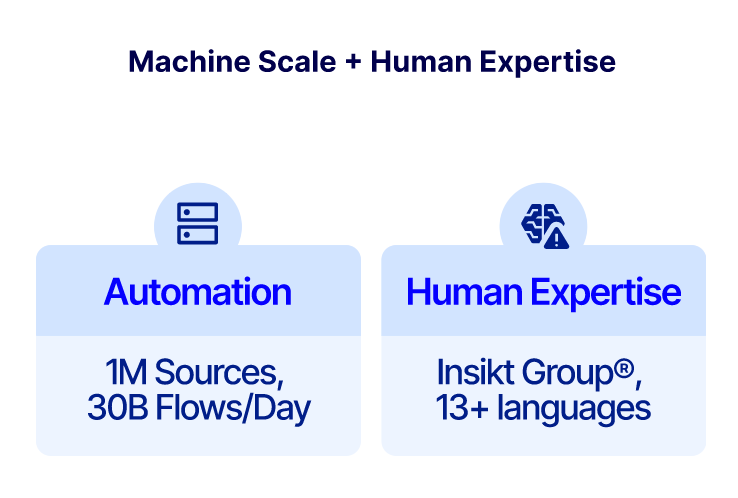
Multi-source validation and cross-referencing: Analysts integrate data from over 1 million sources in the Intelligence Graph®, including the Recorded Future Platform, open web, dark web, technical feeds, malware intelligence, customer telemetry, and more. This comprehensive, multi-source approach helps them validate findings across disparate data points and pinpoint connections between threat actors, infrastructure, and targets that would be invisible when examining sources in isolation. Combining multiple sources, Insikt Group analysts reported on Telegram-based “guarantee” marketplaces used by Chinese-speaking criminal groups to understand cyber and fraud campaigns.
Validation from experts with specialized skills
Insikt Group analysts’ multilingual analysis capabilities and cultural expertise enable them to identify and interpret threats that automated systems can’t fully contextualize.
With native foreign-language skills and deep regional knowledge, analysts can analyze activity across dark web forums, underground criminal networks, and foreign-language sources, uncovering nuances in adversary communications and intent that would be lost in translation or missed entirely by automated tools.
This human layer of analysis is particularly critical when monitoring threat actors operating across China, Russia, Iran, and North Korea, where understanding cultural context, geopolitical motivations, and regional dynamics is essential to accurate threat attribution and prediction.
By combining deep subject-matter expertise in nation-state APT groups with continuous monitoring of global developments, Insikt Group delivers a comprehensive view of how geopolitical issues translate into cyber threats against specific organizations and sectors.
Research that powers the Platform and benefits the industry
Insikt Group makes its research available right inside the Recorded Future Platform. The team shares intelligence across a broad range of analytical formats: from breaking Flash Reports and Threat Leads on emerging activity, to deep-dive Cyber Threat Analyses, Actor Profiles, and Malware/Tool Profiles that map adversary behavior, capabilities, and infrastructure. For organizations tracking the broader risk environment, Insikt Group also produces Geopolitical Intelligence Summaries, Country Risk Updates, and forward-looking Geopolitical Threat Forecasts.
Practitioners get hands-on support through Hunting Packages with actionable detections; TTP Instances sourced and verified across open, closed, and technical sources; and Vulnerability Intelligence to prioritize exposure. Payment fraud teams benefit from dedicated coverage including Payment Card Breach Alerts, Magecart E-Skimmer Reports, and Fraud TTP Analysis.
All of this intelligence is automatically linked to Intelligence Cards—Recorded Future's consolidated profiles on entities like threat actors, IP addresses, hashes, and domains—so analysts can pivot directly from Insikt Group research to related indicators, infrastructure, and context.
Customers aren't the only beneficiaries. To advance knowledge across the broader security industry, Insikt Group publishes many of its research reports on the Recorded Future blog and in publicly available threat intelligence reports covering topics ranging from state-sponsored threat groups to newly emerging malware and attacker infrastructure.
A research division that stands apart in the industry
Few threat intelligence vendors can match what Insikt Group delivers as an embedded research division. Building and sustaining a team of this caliber requires significant ongoing investment, so most vendors default to automation alone. This often leaves their customers with an intelligence gap.
Insikt Group analysts and their research also help drive Recorded Future product development, creating a feedback loop that continuously enhances the Platform. For customers, this means the difference between the noise of raw indicators and the signal of intelligence that’s interpreted, validated, and made actionable.
To see how our comprehensive data sourcing can help your organization stay ahead of threats and mitigate business risk, book a custom demo.
A dataset containing valid administrative and VPN credentials for tens of thousands of Fortinet FortiGate firewalls has been attributed to a Russian-speaking threat group, with confirmed impacts across government, critical infrastructure, and multinational corporations. Organizations should verify exposure immediately and rotate credentials.
Latest Updates
Based on analysis by Insikt Group, we have determined that at least two threat actors are attempting to sell data allegedly from the FortiBleed campaign impacting FortiGate VPN credentials. Also, based on analysis by Insikt Group, we assess that only one of the two sellers of this FortiBleed data is likely credible.
Insikt Group assesses that the threat actor SantaAd, a member of the top-tier Exploit Forum who posted an advertisement on June 12, 2026, claiming to auction off 34,000 lines of FortiGate VPN data, is likely a credible seller of this data. However, Insikt Group did not observe a sample posted in this advertisement thread, and at this time, we cannot confirm whether the FortiGate VPN data advertised by SantaAd is the same data involved in the FortiBleed incident.
On June 21, 2026, Insikt Group identified another seller of data related to the FortiBleed campaign being offered by an illegitimate group with low credibility, leveraging the ShinyHunters branding and operating under the moniker shinymontanna within a public Telegram channel. Within this Telegram channel, shinymontanna is reusing verbatim language used in the auction post by SantaAd. Based on current and historical analysis by Insikt Group, we assess that shinymontanna is likely attempting to re-extort victims of other threat actors and groups, as it has previously done, to capitalize on these incidents by creating greater urgency and fear to entice victims into paying. shinymontanna active since at least late fall 2025, has engaged in extortion attempts, claiming to possess sensitive data, including internal databases and employee information, and has set ransom demands ranging from $100,000 to $2 million for the data's removal. The group has used Telegram for communication and advertisement of their exploits, including illegitimate forums such as BreachForums clones and copies in order to build credibility.
Figure 1:shinymontannaclaiming responsibility for theFortiBleedincident in the Telegram channel The Underground _ Uwu 😻 (Source: Recorded Future)
What Happened
On June 13, 2026, security researcher Volodymyr "Bob" Diachenko reported on the "FortiBleed" dataset, which allegedly contains valid administrative and SSL VPN credentials for approximately 73,932 FortiGate firewall URLs across 194 countries and more than 21,600 domains. Diachenko attributed the campaign to a Russian-speaking threat group.
Cybersecurity researcher Kevin Beaumont and threat intelligence firm Hudson Rock subsequently validated portions of the dataset. Beaumont confirmed that sampled administrative credentials were authentic. Many affected devices reportedly remained online at the time of disclosure, ran recent FortiOS versions, and had management interfaces exposed to the internet.
Affected organizations span government, telecommunications, financial services, healthcare, manufacturing, and critical infrastructure sectors, including multinational corporations.
How the Attack Was Executed
According to Diachenko's investigation, threat actors:
Conducted approximately 1.16 billion credential attempts against 320,777 FortiGate targets
Conducted approximately 2.1 billion credential attempts against 163,650 Microsoft SQL Server (MSSQL) systems
Intercepted SSL VPN authentication hashes
Used a 45-GPU cluster managed through Hashtopolis to crack hashes and recover plaintext credentials
Accessed internal Active Directory environments using recovered credentials
Researchers assessed that the dataset likely originated from exported FortiGate configuration files, which enabled offline credential recovery without ongoing access to the targeted devices.
Scale and Impact
The FortiBleed dataset covers organizations in 194 countries. Confirmed or reported compromises include organizations in Japan, Taiwan, Vietnam, Iraq, and Türkiye. Among those affected is a Turkish NATO defense contractor from which threat actors allegedly exfiltrated classified documents.
Why This Matters
Several factors make FortiBleed a high-priority incident:
A subset of credentials have been independently verified as authentic
Affected devices in many cases remain online with no indication of remediation
The campaign's scale (73,932 firewall URLs, 194 countries) makes this one of the largest confirmed FortiGate credential exposures on record
Attribution to a Russian-speaking threat group, combined with confirmed targeting of a NATO defense contractor, raises the likelihood of espionage objectives alongside opportunistic access
The offline cracking methodology means organizations may have no logs of the initial credential theft
Timeline of Events
June 13, 2026: Researcher Volodymyr Diachenko publicly reports the FortiBleed dataset and attributes activity to a Russian-speaking threat group
June 13, 2026: Kevin Beaumont publishes analysis confirming sampled credentials are authentic; notes many affected devices remain online and internet-exposed
June 13, 2026: Hudson Rock validates portions of the dataset and releases a free FortiBleed lookup tool for organizations to check domain exposure
Recorded Future Independent Analysis
Insikt Group analysts identified malicious activity originating from the IP address 85[.]11[.]187[.]8, which is linked to the FortiBleed attacks, during internal analysis and associated it with AS211486 within the 85[.]11[.]187[.]0/24 range. Analysts observed HTTP activity on port 9999 on June 7, 2026, and SSH, VNC, RDP, and additional attack-capture-related activity from June 14 to June 15, 2026.
Artifacts identified on this infrastructure were consistent with a full credential harvesting and follow-on intrusion workflow, including:
A sniffer log associated with Fortinet credential capture (fg_capture.log);
Cracking orchestration files tied to Hashcat, Hashtopolis, and Telegram-coordinated tasking (bot.py, hashpanel.log, setup_hashcat.sh, and setup_hashtopolis.sh;
Active Directory and LDAP enumeration scripts (ad_enum.py and ad_full_audit.py);
Password-spraying tooling (spray_*.sh, spray_*.py, and spray_results.txt);
SMB/DFS collection scripts with staged exfiltration capability backup_dfs.py, backup_dfs2.py, spider.py, and smb_test.py); and
Log-clearing markers were also present, indicating efforts to remove evidence of activity.
A June 18, 2026 PwnDefend blog post corroborated these findings by independently identifying 85[.]11[.]187[.]8 as a source IP associated with the FortiBleed campaign. The overlap between Insikt Group's internal findings and subsequent public reporting increases confidence in this IP's association with FortiBleed-related credential harvesting, cracking, and follow-on network access activity.
What You Need to Do Now
Immediate actions if your organization runs Fortinet:
Rotate all FortiGate admin and SSL VPN credentials immediately
Enforce multi-factor authentication on all remote and administrative access
Review Fortinet logs for unusual logins, admin sessions, config changes, and new accounts. Consider replacing devices that have had suspicious activity.
Restrict or remove internet exposure for management interfaces
Patch FortiOS and review hardening settings
Hunt for downstream compromise inside the network if exposed credentials were in use
Recorded Future customers with affected domains will receive automated credential alerts if their organization is in the dataset as sources are ingested into the Platform. Customers can access related data from any of the following sources:
Recorded Future customers can access the full Analyst Note and FortiBleed Intelligence Card in the Recorded Future Portal for additional indicators, affected organization context, and threat actor attribution detail.
Recorded Future's Payment Fraud Intelligence team continues to monitor a purchase scam tactic that pulls victims from organic search rather than paid ads by compromising legitimate websites. The scam domains never appear in search results themselves, which means the operations are likely hidden from standard search monitoring and could survive the takedown of any single domain or merchant account. The same tactic is already surfacing in World Cup-themed fraud, and it’s positioned to scale across event-driven scams through 2026.
Four Critical Source Types. One Platform. Recorded Future is the Only Threat Intelligence Vendor that Collects and Analyzes Across Four Types of Data Sources.
When a critical vulnerability emerges, most organizations scramble for answers.
What’s being exploited? Who’s targeting it? Are we exposed?
During the emergence of the React2Shell vulnerability, one Recorded Future customer didn’t rely on speculation. Using Recorded Future’s IP scanning intelligence, they identified which IPs were actively scanning for exploitation, analyzed the exact request patterns being used, and immediately assessed their own exposure.
Instead of reacting to headlines, they acted on real-time intelligence.
In the first article in our series covering our unique data sourcing model, we looked at why source scale and diversity are essential for maximum threat protection. Now we’ll explain the four source types in more detail to see how, together, they empower our customers to prioritize, pinpoint, and act faster to stop threats.
This is the power of Recorded Future’s technical collection engine.
Technical intelligence at internet scale
Recorded Future continuously collects and analyzes telemetry from across the internet, including:
Network traffic analysis across billions of daily network intelligence records (with over 200 points of presence (PoP))
Internet-wide scanning and infrastructure monitoring
Malware detonation and behavioral analysis
Vulnerability exploitation tracking
This technical intelligence provides direct visibility into attacker infrastructure, behavior, and intent.
Finding what others miss
Technical collection becomes most valuable when it reveals what’s hidden.
In one investigation, Recorded Future identified suspicious traffic on a specific port through its Malicious Traffic Analysis. This insight led a security team to uncover additional command-and-control communication that had been missed due to incomplete logging, expanding the scope of the compromise.
This isn’t just detection—it’s discovery.
Deep malware intelligence through sandboxing
Understanding malware requires more than static indicators.
Recorded Future processes over 1.5 million malware samples daily through its sandbox, enabling deep behavioral analysis of:
Command-line execution
Process activity
Network communication
Exploit techniques
This allows analysts to move beyond “Is this malicious?” to:
How does it behave?
What infrastructure does it use?
How can we detect it elsewhere?
Customers consistently highlight this capability as transformative.
In one case, a security analyst identified a unique command-line artifact within sandbox results. By pivoting on that behavior in their environment, they uncovered an additional infection vector that would have otherwise gone undetected—avoiding a far more complex incident response scenario.
Intelligence from the underground
Technical signals alone don’t tell the full story.
Recorded Future augments telemetry with intelligence from criminal forums, marketplaces, and adversary communications, revealing:
Stolen data and credentials
Emerging attack techniques
Threat actor intent
Ransomware victimology
Telegram
This provides critical context for prioritizing risk and understanding adversary motivations.
Community intelligence: strength in numbers
Recorded Future’s Collective Insights capability aggregates detections across organizations, helping customers identify patterns they might not see alone. This is especially important for preparing for monthly C-suite briefs on the latest threat assessments.
One logistics customer used this capability to investigate a multi-stage intrusion, correlating activity across their environment and linking it to nation-state actors in real time. Another customer uses Collective Insights to provide clear visibility into the specific malware most frequently blocked within their own environment, rather than relying on general trends.
This shared intelligence transforms isolated detections into campaign-level understanding.
Proactive defense in practice
This combination of technical, underground, and community intelligence enables proactive defense.
Customers often use Recorded Future’s Threat Map to identify an emerging threat actor and deploy detections in advance. Weeks later, when the actor launches a phishing campaign, customers can immediately detect and block the activity—preventing compromise before it begins.
Where open source fits
Open-source intelligence provides valuable context, but on its own it’s incomplete. Without technical telemetry, behavioral analysis, and external digital risk monitoring, organizations risk seeing only part of the threat landscape.
At Recorded Future, open sources are one part of a broader intelligence ecosystem that also supports data leakage detection, code repository monitoring, social media monitoring, and analysis of web infrastructure and content—including HTML and DOM elements—to identify brand abuse, exposed data, impersonation, and other external threats.
The bottom line
Recorded Future’s technical collection engine doesn’t just gather data. It reveals:
Who’s attacking
How attacks are executed
Where infrastructure is operating
When action is required
One platform for comprehensive threat intelligence
While some platforms focus on immediate detection, the Recorded Future Platform maintains years of historical data to reveal long-term patterns. And it automatically connects intelligence from diverse sources, turning separate data streams into unified insights.
From initial reconnaissance through criminal planning, active infrastructure attacks, and malware deployment, our four intelligence source types work together to enable proactive defense across the entire attack lifecycle.
In the next blog in our series, we’ll show how human experts connect the dots, validating our intelligence and making it actionable so you can prevent threats.
To see our four types of data sources in action in the Recorded Future Platform, request a custom demo.

 Login
Login