❌

Reading view

Recorded Future Launches Impact and Metrics Dashboard

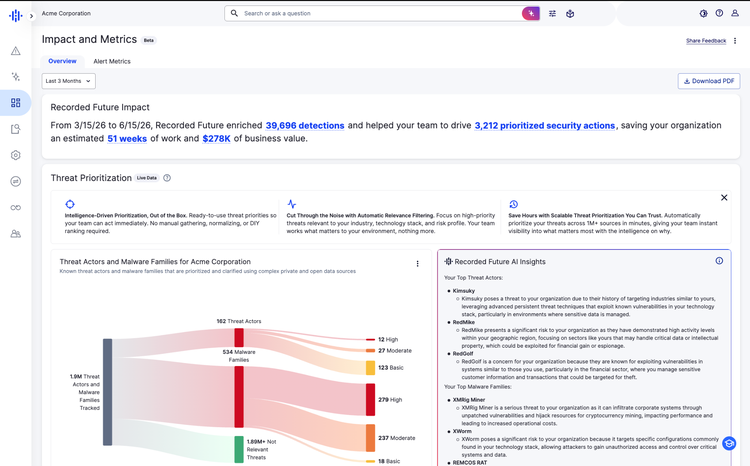
Today, Recorded Future is announcing the Impact and Metrics Dashboard, a new way for every Recorded Future customer to see the value their intelligence program generates without building reports by hand. The dashboard pulls data from your environment, alerts, integrations, threat detections, and analyst activity, then surfaces the metrics that map to the business and security outcomes your leadership cares about.

Security teams have always known that intelligence drives better outcomes. The hard part has been proving it in the language of the business. Boards, CFOs, and CIOs aren't asking for threat counts. They want measurable risk reduction tied to business context, and they want it in numbers they can defend.

Our 2025 ROI Report, validated across nearly 300 customers, puts numbers to what security teams already know. Recorded Future customers have reported achieving 351.3% ROI annually. 57% say the platform has substantially reduced their overall cyber risk. 96% would recommend it to a peer.

But the numbers that resonate most are not the averages. They are the attacks that your team was able to get ahead of. Ransomware stopped before detonation. Credentials reset before an adversary could use them. Fraud campaigns contained before they could reach customers. Until now, capturing that story meant pulling data from across the platform, stitching it together by hand, and rebuilding the same readout every quarter.

The most powerful version of that story is yours and that is what the Impact and Metrics Dashboard is built to show.

What the dashboard covers

Platform-Wide Security Value: Your headline number. Aggregate risk reduction and intelligence coverage across your environment, built for leadership conversations.

Threat Prioritization: See which threat actors and malware families are relevant to your organization, and how Recorded Future AI cuts noise so your team focuses on what matters. Customers who aligned their alerting to PIRs reported identifying new threats 65% faster.

Threat Detection: Understand how intelligence is moving through your security stack, from malware detected in your telemetry to integrations and threat hunting activity. Customers often receive critical alerts hours or days earlier than from other vendors.

Digital Risk Protection: Quantify exposure reduced from fraud, brand impersonation, and credential threats. For organizations with significant brand or customer risk, this is where ROI becomes immediately tangible and immediately explainable to a CFO.

Account & Credential Monitoring: See identity threats surfaced and remediated before they became incidents.

Recorded Future AI & Insikt GroupⓇ Research: Recorded Future’s expert Intelligence team & AI does the work for you, providing deeper insights than most teams could do alone. Measure analyst hours recaptured through AI-powered automation and the volume of expert research your team has put to work. Your efficiency case, in your own numbers.

Today the dashboard surfaces key metrics to start the conversation and give your team something concrete to point to. Over time the calculations will get more personalized, the benchmarks more specific to your organization, and the integration with your business context deeper.

The Impact and Metrics Dashboard is available now for every customer. To find it, navigate to Dashboards > Impact and Metrics in your Recorded Future instance. For setup help or questions, contact your Technical Account Manager (TAM).

  •  

2026 FIFA World Cup: What Public Safety Officials Need to Know

Starting tomorrow, millions of people will gather in sixteen host cities across the United States, Canada, and Mexico to cheer on their teams in the 2026 FIFA World Cup. Securing the tournament will require preparing for a mix of physical security risks, cyber threats, scams, protests, politically motivated activity, and reputational disruption tied to one of the world’s most visible sporting events.

The World Cup’s global profile creates an attractive target environment for a wide range of threat actors. Cybercriminals are already exploiting tournament demand through fraudulent domains, fake stores, credential-harvesting sites, and advertising campaigns. Hacktivists and influence operators will likely try to use the event’s visibility to amplify political narratives or claim responsibility for disruptive activity. At the same time, public safety officials must manage the physical security challenges associated with large crowds, soft targets, protests, transportation hubs, hospitality infrastructure, and fan zones.

Together, these risks create a blended cyber-physical threat environment that requires coordination across public safety, cybersecurity, fraud, legal, communications, brand protection, executive protection, travel security, and third-party risk teams.
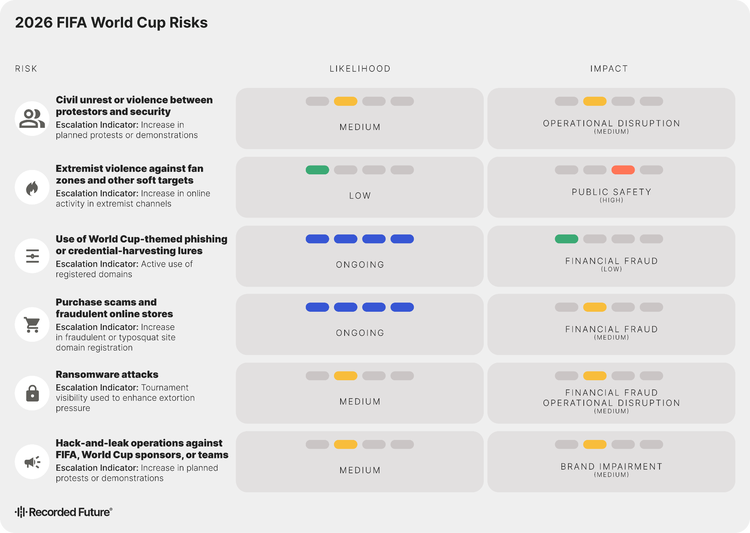
An assessment of physical, cyber, and fraud threats to the 2026 FIFA World Cup, visualizing various risk categories associated with the event

Figure 1: Assessment of physical, cyber, and fraud risks affecting the 2026 FIFA World Cup

(Source: Recorded Future)

  •  

China's Noncombatant Evacuation Operations: 2005–2025

Over the past two decades, noncombatant evacuation operations (NEOs) have emerged as an important tool for protecting China’s overseas interests. To assess China’s NEO capabilities for the US Army War College China Landpower Studies Center’s 2026 Carlisle Conference on the PLA (People’s Liberation Army), Insikt Group built an original dataset of 37 Chinese NEOs carried out between January 2005 and August 2025. This blog post has been adapted from Insikt Group’s conference paper, and our “China 2005–2025 Noncombatant Evacuation Operation Dataset” is attached as a PDF.

One of Insikt Group’s most notable findings is that, over the past twenty years, China has consistently mobilized civilian resources to facilitate NEOs, demonstrating China’s reliance on these resources for NEOs and its capability to call upon diverse instruments of national power to protect overseas interests. During this period, at least 65% of China’s NEOs involved support from Chinese state-owned enterprises (SOEs), private enterprises, or United Front/civil society organizations located in the host country, third-party countries, or China. The contributions of SOEs, private enterprises, and United Front/civil society organizations to China’s NEOs include:

  • Organizing evacuation efforts on the ground
  • Communicating official instructions
  • Providing air, land, and maritime transportation
  • Providing relief to evacuees once they arrive in neighboring countries or return to China-


The Chinese Communist Party (CCP) and the Chinese government have continued to take advantage of civilian resources for NEOs since August 2025 — such as for its Iran NEO in early 2026 — and will almost certainly continue to mobilize these resources in the future.

Overview of China’s NEOs

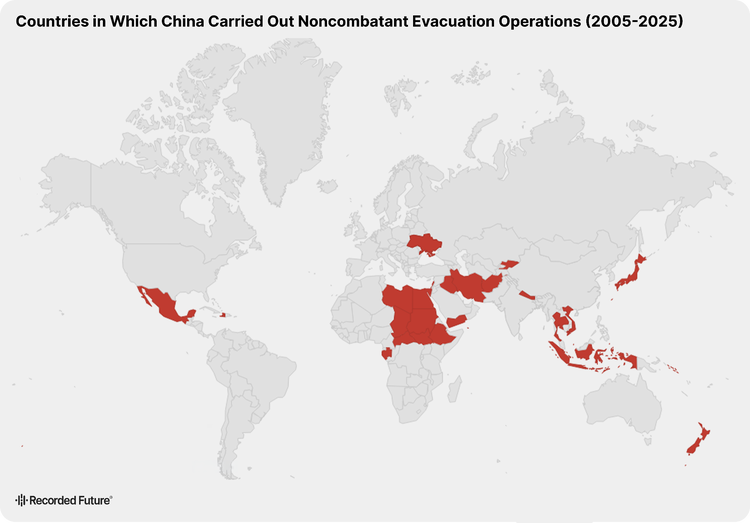
China carried out at least 37 NEOs in 28 different countries between 2005 and 2025 (see image below). China carried out eleven NEOs in Africa, nine in the Middle East, and nine in Asia, with the other eight occurring in the Caribbean, Pacific Islands, Europe, and North America. China conducted multiple NEOs in the Central African Republic, Haiti, Iran, Israel, Kyrgyzstan, Lebanon, Libya, and South Sudan.

Map highlighting 28 countries in which China carried out Noncombatant Evacuation Operations (2005-2025)
The 28 countries in which China carried out a NEO between 2005 and 2025 (Source: Recorded Future)

  •  

May 2026 CVE Landscape

In May 2026, Insikt Group® identified 41 high-impact vulnerabilities that should be prioritized for remediation, all of which had a Very Critical Recorded Future Risk Score. This represents an 11% increase from last month.

These vulnerabilities affected products from 20 vendors. 21 of the 41 vulnerabilities were included in the US Cybersecurity and Infrastructure Security Agency (CISA)’s Known Exploited Vulnerabilities (KEV) catalog, 19 were surfaced through honeypot data, and one was reported by a cybersecurity vendor.

The 41 vulnerabilities in this report affected products from 20 vendors. Vercel accounted for approximately 27% of the vulnerabilities, driven by honeypot-sourced Next.js activity. The remaining exposure was concentrated across a range of enterprise software, security, networking, developer tooling, and cloud-related products.

Quick Reference: May 2026 Vulnerability Table

All 22 vulnerabilities below were actively exploited in May 2026. This table does not include the 19 CVEs associated with honeypot activity, which are available to Recorded Future customers via the CVE Monthly Report. The table below also provides examples of public PoCs identified by Insikt Group®. These PoCs were not tested for accuracy or efficacy. Vulnerability management teams should exercise caution and verify the validity of PoCs before testing.

#
Vulnerability
Risk
Score
Vendor/Product
KEV
Malware Analysis
RCE
PoC
1
CVE-2008-4250
99
Microsoft Windows
✓
✓
2
CVE-2009-1537
99
Microsoft DirectX
✓
3
CVE-2009-3459
99
Adobe Acrobat and Reader
✓
4
CVE-2010-0249
99
Microsoft Internet Explorer
✓
5
CVE-2010-0806
99
Microsoft Internet Explorer
✓

✓

(available to Recorded Future Customers)

6
CVE-2025-34291
99
Langflow
✓
7
CVE-2026-0257
99
Palo Alto Networks PAN-OS, Cloud NGFW, and Prisma Access
✓
8
CVE-2026-0300
99
Palo Alto Networks PAN-OS, Cloud NGFW, Prisma Access
✓
9
CVE-2026-20182
99
Cisco Catalyst SD-WAN and SD-WAN Manager
✓
10
CVE-2026-31431
99
Linux Kernel
✓

✓

(available to Recorded Future Customers)

11
CVE-2026-34926
99
Trend Micro Apex One (On-Premise)
✓
12
CVE-2026-41091
99
Microsoft Defender
✓
13
CVE-2026-42208
99
BerriAI LiteLLM
✓
14
CVE-2026-42897
99
Microsoft Exchange Server
✓
15
CVE-2026-45321
99
TanStack (Multiple Packages)
✓
16
CVE-2026-45498
99
Microsoft Defender
✓
17
CVE-2026-48027
99
Nx Console
✓
18
CVE-2026-48172
99
LiteSpeed cPanel Plugin
✓
19
CVE-2026-6973
99
Ivanti Endpoint Manager Mobile (EPMM)
✓
✓
20
CVE-2026-8398
99
Daemon Tools Lite
✓
21
CVE-2026-9082
99
Drupal Core
✓
22
CVE-2026-26980
99
Ghost CMS

✓

(available to Recorded Future Customers)

Table 1: List of vulnerabilities that were actively exploited in May, 2026 based on Recorded Future data (excluding honeypot-sourced CVEs).

Key Trends: May 2026

  • In May 2026, threat actors exploited a Ghost CMS vulnerability in large-scale ClickFix and FakeCaptcha poisoning campaigns.
    • The campaigns used compromised Ghost CMS websites to inject malicious JavaScript, redirect victims through social engineering lures, and stage dropper and loader payloads from attacker-controlled infrastructure.
  • 12 of the 41 vulnerabilities enabled remote code execution (RCE), affecting products from 8 vendors: Microsoft, Adobe, Langflow, Palo Alto Networks, Apache, openDCIM, Fortinet, and Ivanti.
  • Insikt Group identified public proof-of-concept (PoC) exploits for 32 of the 41 vulnerabilities reported this month.
  • The most commonly observed flaws this month were CWE-79 (Cross-site Scripting), CWE-506 (Embedded Malicious Code), and CWE-89 (SQL Injection), with three CVEs each.
  • 5 of the 41 vulnerabilities in this month’s prominent vulnerabilities table were first disclosed between 2008 and 2010, making them at least 15 years old, with the oldest vulnerability being approximately 18 years old.
    • This reinforces our finding that attackers continue to exploit long-known weaknesses in environments where patching has lagged.
    • Additionally, the fastest observed time from a vulnerability’s public disclosure to exploitation was less than one day.

Exploitation Analysis

This section highlights some of the highest-impact, actively exploited vulnerabilities this month, specifically those linked to known threat actor campaigns or that have public PoC exploits available. Vulnerabilities with no meaningful public technical detail are summarized in the quick reference table above only.

Threat Actors Exploit CVE-2026-26980 in Ghost CMS To Conduct Large-Scale ClickFix Poisoning Campaigns, Sample Available From Recorded Future Malware Intelligence

On May 21, 2026, cybersecurity firm XLab published a technical analysis detailing large-scale ClickFix poisoning campaigns targeting vulnerable Ghost Content Management System (CMS) instances by exploiting CVE-2026-26980. Ghost CMS allows users to create, manage, and publish content for blogs, media sites, newsletters, and subscription-based websites through a node.js-based publishing platform.

CVE-2026-26980 is a critical SQL injection vulnerability in Ghost CMS that allows unauthenticated threat actors to extract Ghost Admin API Keys and modify website content through the Ghost Admin API.

As previously reported by Insikt Group®, at least two threat groups exploited CVE-2026-26980 to inject malicious JavaScript into more than 700 compromised Ghost CMS websites across industries, including blockchain, artificial intelligence (AI), and financial technology (fintech). According to XLab, the threat actors used the compromised websites to deliver ClickFix and FakeCaptcha social engineering attacks that tricked victims into executing malicious commands and malware payloads on their systems.

Insikt Group® obtained one of the malicious samples, UtilifySetup.exe, from Recorded Future Malware Intelligence. The sample matched the sandbox YARA rule for detecting Inno Setup packaging. Based on sandbox and static code analysis, the sample performs the following actions on a victim’s machine:

  • Conducts DLL injection
  • Retrieves the system language and geolocation using the Windows registry
  • Drops files named UtilifySetup.tmp (SHA256: 7790fd1035266000ed6d6cc35822f7683f5271663af8a5b5effadff85316df6d) and Grape.exe
  • Enumerates files and directories
  • Retrieves system information
  • Delays execution using the Sleep API function for evasion
  • Detects debuggers using the GetTickCount API function to compare the timing and the IsDebuggerPresent API function
  • Creates a file inside the C:\Users\user\AppData\Local\SuperMaxionQuickMaxlite directory, corroborating XLab’s analysis
  • Terminates running processes

Sandbox analysis categorized UtilifySetup.tmp as malicious due to the sample exhibiting discovery capabilities. Based on sandbox and static code analysis, the sample performs the following actions on a victim’s machine:

  • Conducts DLL injection
  • Retrieves the system language and geolocation using the Windows registry
  • Executes UtilifySetup.exe installer from the %Temp% directory using internal Inno Setup /SL5 launch parameters
  • Executes a file named Grape.exe inside the C:\Users\user\AppData\Local\SuperMaxionQuickMaxlite directory

Once executed, Grape.exe performs the following actions on a victim’s machine:

  • Adds a Windows registry Run key entry named electron.app.Grape set to execute itself when the victim logs in
  • Enumerates running processes
  • Sends DNS request to web-telegram[.]ug

Further technical details associated with this activity, including sample analysis, MITRE ATT&CK techniques, and IoCs, are available to Recorded Future customers via Insikt Group® reporting.

Recorded Future customers can also access Malware Intelligence queries that surface samples communicating with campaign-associated URLs, domains, and IP addresses.

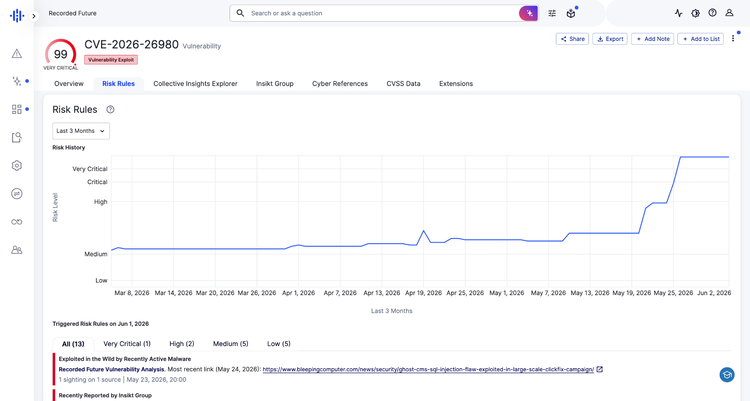
Figure 1: Risk Rules History from Vulnerability Intelligence Card® for CVE-2026-26980 in Recorded Future (Source: Recorded Future)

  •  

Why Holistic Sourcing Wins: The Numbers Behind the Recorded Future Advantage

Threats don't operate in silos, and neither should your intelligence. This post, the first in a three-part series, breaks down why comprehensive sourcing is the foundation of effective threat intelligence -- and how Recorded Future's Intelligence Graph® monitors over one million sources across technical, criminal, collective, and open-source domains to surface what narrow or siloed solutions miss. From nation-state TTPs to criminal infrastructure to credential leaks, complete coverage is what separates awareness from action.

  •  

Remembering Sir Alex Younger

There are moments when you meet a person who you immediately know will have a formative influence on you — a person you will learn from, who you will respect, who you will follow anywhere, who you will listen to, who will be your friend. Sir Alex was just that.

I was lucky to meet Sir Alex just as he was leaving MI6 in 2020. I traveled to London, having to navigate a few Covid restrictions. I asked him if this would cause problems. He smiled: “It is always better to ask for forgiveness than seek permission,” he said. Immediately I knew that this was someone I would get along with very well.

The objective was straightforward: I was hoping to recruit him to the Recorded Future board of directors, which we eventually accomplished after significant complications got in the way, once again solved by the previous method.

Sir Alex joined a Recorded Future board meeting in New York. As I welcomed him, Alex — smiling characteristically — introduced himself as having run the world’s best intelligence agency, a pointed reminder that superb people, tradecraft, and pedigree can rival any scale. And we wanted to learn from the best.

My assumption, as much as one should not make them, was that Alex could teach us everything in intelligence, except for perhaps around the technical SIGINT-like apparatus that is at the core of Recorded Future. Yet, in our first discussion, talking about “connecting dots,” Alex said, “it is not about connecting dots, it is about connecting entire collections,” which became the very underpinning of how we build our Intelligence Graph®. I was humbled, having underestimated him, and it taught me a valuable lesson.

Yet, the confidence of having run the world’s best intelligence agency did not at all hold back Alex from asking even the most basic questions. Coming from public service, driving revenue was not a familiar concept. As opposed to most senior characters who would do anything to not seem to have all the answers, Alex, early in the first meeting, when hearing the terms ARR and revenue, raised his hand and said, “please explain annualized revenue.” That is the sign of somebody who always wanted to learn and would not let pride get in the way of gaining insights.

Sir Alex brought great moral clarity, yet not the kind that is based on anger, “you’re either with us or against us,” rather, the kind that leads to an alliance of peers sharing in values that can defeat any autocratic counterpart. Teamwork, he would say, is the unique strength of the West, as we can build on trust, whereas our adversaries fundamentally cannot.

Speaking at the Recorded Future 2023 Predict conference, our audience spellbound, Sir Alex paraphrased Milton Friedman: “No individual can make a pencil alone.” He was cheered by everyone, and we know that this was the answer to beat our adversaries.

Over the last few months, I asked Alex for some favors, and I now find myself wondering whether I asked too much of him. He gave a briefing to thousands of Recorded Future clients on Iran with an energy and intellect that would put anyone to shame. And more recently, I asked him for help with a personal endeavour, which in hindsight was too much to ask at the time, yet he did something amazing.

I can only hope that I can be such a friend to my friends as Alex was to me.

Six months ago, when Alex was in the midst of treatment, I asked him if I could take him for a special dinner. We enjoyed amazing food and, truth be told, even more amazing wine. I came early to the restaurant and suggested to them, “he may eat and drink a little, please do not make a fuss about that.” Yet, Alex went at the food and wine with a vengeance, claiming that his treatment left him very hungry. If there ever was a fighting spirit, it was his.

Sir Alex and Christoper sitting at a restaurant and a picture of the course menu on the left.

Please join my Recorded Future colleagues in our cheers for Sir Alex Younger and thoughts for Sarah and their family.

I’m certain that he would want us to take the fight to the bad guys and build even greater alliances with our friends.

  •  
❌