In May 2026, Insikt Group® identified 41 high-impact vulnerabilities that should be prioritized for remediation, all of which had a Very Critical Recorded Future Risk Score. This represents an 11% increase from last month.
These vulnerabilities affected products from 20 vendors. 21 of the 41 vulnerabilities were included in the US Cybersecurity and Infrastructure Security Agency (CISA)’s Known Exploited Vulnerabilities (KEV) catalog, 19 were surfaced through honeypot data, and one was reported by a cybersecurity vendor.
The 41 vulnerabilities in this report affected products from 20 vendors. Vercel accounted for approximately 27% of the vulnerabilities, driven by honeypot-sourced Next.js activity. The remaining exposure was concentrated across a range of enterprise software, security, networking, developer tooling, and cloud-related products.
Quick Reference: May 2026 Vulnerability Table
All 22 vulnerabilities below were actively exploited in May 2026. This table does not include the 19 CVEs associated with honeypot activity, which are available to Recorded Future customers via the CVE Monthly Report. The table below also provides examples of public PoCs identified by Insikt Group®. These PoCs were not tested for accuracy or efficacy. Vulnerability management teams should exercise caution and verify the validity of PoCs before testing.
Table 1:List of vulnerabilities that were actively exploited in May, 2026 based on Recorded Future data (excluding honeypot-sourced CVEs).
Key Trends: May 2026
In May 2026, threat actors exploited a Ghost CMS vulnerability in large-scale ClickFix and FakeCaptcha poisoning campaigns.
The campaigns used compromised Ghost CMS websites to inject malicious JavaScript, redirect victims through social engineering lures, and stage dropper and loader payloads from attacker-controlled infrastructure.
12 of the 41 vulnerabilities enabled remote code execution (RCE), affecting products from 8 vendors: Microsoft, Adobe, Langflow, Palo Alto Networks, Apache, openDCIM, Fortinet, and Ivanti.
Insikt Group identified public proof-of-concept (PoC) exploits for 32 of the 41 vulnerabilities reported this month.
The most commonly observed flaws this month were CWE-79 (Cross-site Scripting), CWE-506 (Embedded Malicious Code), and CWE-89 (SQL Injection), with three CVEs each.
5 of the 41 vulnerabilities in this month’s prominent vulnerabilities table were first disclosed between 2008 and 2010, making them at least 15 years old, with the oldest vulnerability being approximately 18 years old.
This reinforces our finding that attackers continue to exploit long-known weaknesses in environments where patching has lagged.
Additionally, the fastest observed time from a vulnerability’s public disclosure to exploitation was less than one day.
Exploitation Analysis
This section highlights some of the highest-impact, actively exploited vulnerabilities this month, specifically those linked to known threat actor campaigns or that have public PoC exploits available. Vulnerabilities with no meaningful public technical detail are summarized in the quick reference table above only.
Threat Actors Exploit CVE-2026-26980 in Ghost CMS To Conduct Large-Scale ClickFix Poisoning Campaigns, Sample Available From Recorded Future Malware Intelligence
On May 21, 2026, cybersecurity firm XLab published a technical analysis detailing large-scale ClickFix poisoning campaigns targeting vulnerable Ghost Content Management System (CMS) instances by exploiting CVE-2026-26980. Ghost CMS allows users to create, manage, and publish content for blogs, media sites, newsletters, and subscription-based websites through a node.js-based publishing platform.
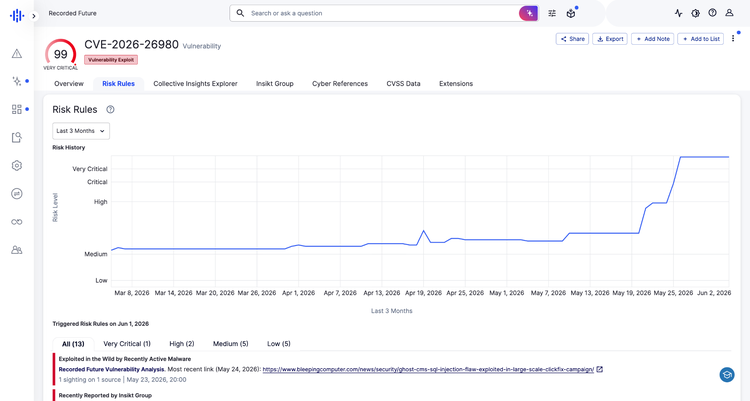
CVE-2026-26980 is a critical SQL injection vulnerability in Ghost CMS that allows unauthenticated threat actors to extract Ghost Admin API Keys and modify website content through the Ghost Admin API.
As previously reported by Insikt Group®, at least two threat groups exploited CVE-2026-26980 to inject malicious JavaScript into more than 700 compromised Ghost CMS websites across industries, including blockchain, artificial intelligence (AI), and financial technology (fintech). According to XLab, the threat actors used the compromised websites to deliver ClickFix and FakeCaptcha social engineering attacks that tricked victims into executing malicious commands and malware payloads on their systems.
Insikt Group® obtained one of the malicious samples, UtilifySetup.exe, from Recorded Future Malware Intelligence. The sample matched the sandbox YARA rule for detecting Inno Setup packaging. Based on sandbox and static code analysis, the sample performs the following actions on a victim’s machine:
Conducts DLL injection
Retrieves the system language and geolocation using the Windows registry
Drops files named UtilifySetup.tmp (SHA256: 7790fd1035266000ed6d6cc35822f7683f5271663af8a5b5effadff85316df6d) and Grape.exe
Enumerates files and directories
Retrieves system information
Delays execution using the Sleep API function for evasion
Detects debuggers using the GetTickCount API function to compare the timing and the IsDebuggerPresent API function
Creates a file inside the C:\Users\user\AppData\Local\SuperMaxionQuickMaxlite directory, corroborating XLab’s analysis
Terminates running processes
Sandbox analysis categorized UtilifySetup.tmp as malicious due to the sample exhibiting discovery capabilities. Based on sandbox and static code analysis, the sample performs the following actions on a victim’s machine:
Conducts DLL injection
Retrieves the system language and geolocation using the Windows registry
Executes UtilifySetup.exe installer from the %Temp% directory using internal Inno Setup /SL5 launch parameters
Executes a file named Grape.exe inside the C:\Users\user\AppData\Local\SuperMaxionQuickMaxlite directory
Once executed, Grape.exe performs the following actions on a victim’s machine:
Adds a Windows registry Run key entry named electron.app.Grape set to execute itself when the victim logs in
Enumerates running processes
Sends DNS request to web-telegram[.]ug
Further technical details associated with this activity, including sample analysis, MITRE ATT&CK techniques, and IoCs, are available to Recorded Future customers via Insikt Group® reporting.
Recorded Future customers can also access Malware Intelligence queries that surface samples communicating with campaign-associated URLs, domains, and IP addresses.
Figure 1:Risk Rules History fromVulnerability IntelligenceCard® for CVE-2026-26980 in Recorded Future (Source: Recorded Future)
Threats don't operate in silos, and neither should your intelligence. This post, the first in a three-part series, breaks down why comprehensive sourcing is the foundation of effective threat intelligence -- and how Recorded Future's Intelligence Graph® monitors over one million sources across technical, criminal, collective, and open-source domains to surface what narrow or siloed solutions miss. From nation-state TTPs to criminal infrastructure to credential leaks, complete coverage is what separates awareness from action.
The 2026 FIFA World Cup, which takes place across sixteen host cities in the United States (US), Mexico, and Canada, presents a complex threat environment across multiple security domains. The tournament’s global visibility creates opportunities for both financially and geopolitically motivated threat actors to target attendees, affiliated organizations, sponsors, vendors, and event-supporting infrastructure.
Physical security will almost certainly remain the highest priority for event coordinators and local government officials, given the high levels of international attention and the concentration of large crowds in host cities spanning three countries and multiple, distinct security environments. Mexico’s host cities face the highest physical risk due to the persistent presence of local and transnational criminal organizations (TCOs), with elevated concerns around theft, extortion, kidnapping, and fraud. US and Canadian host cities likely face a more limited threat from violent extremists, with greater risks to soft targets such as fan zones, watch parties, transit hubs, and other crowded public areas.
Civil unrest and disruptive protests are also very likely in a majority of host cities. Localized travel disruptions are especially likely in Mexico, where prior demonstrations have already blocked roads near World Cup venues. Large police or military deployments near event sites will likely increase the risk of confrontation.
The most immediate risk to corporate sponsors and affiliates is likely cybercriminal exploitation of World Cup demand and branding. Recorded Future’s Payment Fraud Intelligence team has already identified World Cup-themed purchase scams, fake FIFA-branded stores, and spoofed FIFA and host city domains. Carders are also likely to leverage stolen payment card credentials to fraudulently purchase event tickets and travel-related services for rapid resale and monetization. Efforts to use individuals’ interest in the World Cup to deliver malware or carry out data extortion or fraud will likely accelerate as the tournament approaches. Threat actors will likely continue to use AI-generated content to scale fraud, impersonation, phishing, smishing, and social engineering campaigns.
The concentration of senior government officials, diplomats, security personnel, corporate executives, and media at World Cup events also very likely increases the risk of cyber espionage and disruptive cyber incidents. Russian, Chinese, and Iranian state-sponsored threat groups will likely use the tournament as an intelligence collection opportunity, targeting executives, VIP attendees, national delegations, media partners, telecommunications providers, airlines, hotels, event logistics firms, and commercial affiliates. China is most likely to pursue targeted espionage, while Russia and Iran pose a higher risk of more disruptive attacks through proxy hacktivism.
Influence activity related to the tournament remains largely overt, driven by state media and diplomatic messaging from Russia, China, and Iran. These narratives focus on host-country legitimacy, Iran’s conditional participation, visa and access issues, public safety, immigration, ticketing, and alleged politicization of the event. Covert influence activity has so far been limited and opportunistic, but could increase as the tournament approaches, particularly around geopolitical flashpoints or viral news events.
Organizations involved in or exposed to the World Cup should prioritize proactive monitoring of location-specific physical security risks, protest activity, cybercriminal infrastructure, phishing and credential exposure, malicious traffic, ransomware indicators, and influence operations. Cyber indicators such as increased scanning activity or newly registered domains linked to FIFA or host cities may indicate an expansion of criminal or espionage activity. Developments around geopolitical flashpoints such as the war in Iran may increase the likelihood of attempts to disrupt the tournament through cyber or physical attacks.
Key Findings
World Cup crowds will likely elevate physical security risks around match venues and fan areas, exacerbated by factors such as TCO activity in Mexico and impending primary elections and 250th Independence Day celebrations in the US.
Opportunistic criminal activities tied to organized crime very likely constitute the largest physical security risks to Mexico’s World Cup host cities, while US venues face very likely less substantial (but nonetheless tangible) threats from violent extremists, particularly homegrown violent extremists (HVEs).
Cybercriminal threat actors are exploiting World Cup-themed branding via purchase scams and phishing infrastructures, with AI-generated content likely enabling operations to surpass volumes observed during prior World Cups. Carders frequently use fraudulent ticket purchases and resale schemes as a rapid monetization method for stolen payment card credentials.
Russian, Chinese, and Iranian state-sponsored threat groups will likely use the World Cup as an intelligence collection opportunity, while Russia and Iran pose additional risks of disruptive cyber operations, particularly from proxies and hacktivist personas.
World Cup-related influence activity from Russia, China, and Iran is driven overwhelmingly through overt state media and diplomatic messaging, while observed covert activity remains limited, opportunistic, and largely secondary to broader geopolitical narratives about Iran, host-country legitimacy, and US access and security policies.
Country Risk
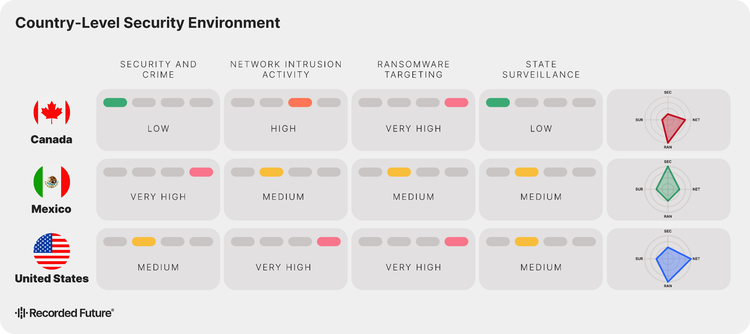
Insikt Group assessed four categories of country-level risk in World Cup host countries: security and crime data; network intrusion activity, which measures Malicious Traffic Analysis events targeting each country; ransomware attacks targeting victims in each country; and data privacy and surveillance-related risks, accessible in the Recorded Future Intelligence Operations Platform as State Surveillance risk. While public reporting indicates declining crime rates in many World Cup host cities, violent crime risks are almost certainly greatest in Mexico; opportunistic crime, such as theft, likely presents the greatest physical security risk in Canadian and US host cities. By comparison, threats to data security and privacy are likely greatest in the US and Canada, given the higher volume of malicious cyber activity targeting US and Canadian entities. Factors complicating the security environment across World Cup host nations include TCO operations in Mexico; 250th anniversary celebrations in the US; and the lead-up to the US midterm elections in November 2026, including summer primary elections.
Figure 1: Composite Country Risk Scores for Canada, Mexico, and the US (Source: Recorded Future)
There are moments when you meet a person who you immediately know will have a formative influence on you — a person you will learn from, who you will respect, who you will follow anywhere, who you will listen to, who will be your friend. Sir Alex was just that.
I was lucky to meet Sir Alex just as he was leaving MI6 in 2020. I traveled to London, having to navigate a few Covid restrictions. I asked him if this would cause problems. He smiled: “It is always better to ask for forgiveness than seek permission,” he said. Immediately I knew that this was someone I would get along with very well.
The objective was straightforward: I was hoping to recruit him to the Recorded Future board of directors, which we eventually accomplished after significant complications got in the way, once again solved by the previous method.
Sir Alex joined a Recorded Future board meeting in New York. As I welcomed him, Alex — smiling characteristically — introduced himself as having run the world’s best intelligence agency, a pointed reminder that superb people, tradecraft, and pedigree can rival any scale. And we wanted to learn from the best.
My assumption, as much as one should not make them, was that Alex could teach us everything in intelligence, except for perhaps around the technical SIGINT-like apparatus that is at the core of Recorded Future. Yet, in our first discussion, talking about “connecting dots,” Alex said, “it is not about connecting dots, it is about connecting entire collections,” which became the very underpinning of how we build our Intelligence Graph®. I was humbled, having underestimated him, and it taught me a valuable lesson.
Yet, the confidence of having run the world’s best intelligence agency did not at all hold back Alex from asking even the most basic questions. Coming from public service, driving revenue was not a familiar concept. As opposed to most senior characters who would do anything to not seem to have all the answers, Alex, early in the first meeting, when hearing the terms ARR and revenue, raised his hand and said, “please explain annualized revenue.” That is the sign of somebody who always wanted to learn and would not let pride get in the way of gaining insights.
Sir Alex brought great moral clarity, yet not the kind that is based on anger, “you’re either with us or against us,” rather, the kind that leads to an alliance of peers sharing in values that can defeat any autocratic counterpart. Teamwork, he would say, is the unique strength of the West, as we can build on trust, whereas our adversaries fundamentally cannot.
Speaking at the Recorded Future 2023 Predict conference, our audience spellbound, Sir Alex paraphrased Milton Friedman: “No individual can make a pencil alone.” He was cheered by everyone, and we know that this was the answer to beat our adversaries.
Over the last few months, I asked Alex for some favors, and I now find myself wondering whether I asked too much of him. He gave a briefing to thousands of Recorded Future clients on Iran with an energy and intellect that would put anyone to shame. And more recently, I asked him for help with a personal endeavour, which in hindsight was too much to ask at the time, yet he did something amazing.
I can only hope that I can be such a friend to my friends as Alex was to me.
Six months ago, when Alex was in the midst of treatment, I asked him if I could take him for a special dinner. We enjoyed amazing food and, truth be told, even more amazing wine. I came early to the restaurant and suggested to them, “he may eat and drink a little, please do not make a fuss about that.” Yet, Alex went at the food and wine with a vengeance, claiming that his treatment left him very hungry. If there ever was a fighting spirit, it was his.
Please join my Recorded Future colleagues in our cheers for Sir Alex Younger and thoughts for Sarah and their family.
I’m certain that he would want us to take the fight to the bad guys and build even greater alliances with our friends.
Iran’s Ministry of Intelligence (MOIS) has likely broadened the use of its “Handala” brand to encompass MOIS’s external physical and influence operations targeting US and Israeli interests. Since the beginning of the Iran War, Insikt Group has observed significant overlaps in the online activities of Handala Hack Team, a newly created, Handala-branded persona referring to itself as the “Handala Popular Resistance Front” (HPRF), and three influence operations networks previously identified by Insikt Group. Based on frequent amplification and cross-posting of claims and content between Handala Hack Team and these four additional entities, we now attribute these groups to MOIS, with varying degrees of confidence.
The nexus between these personas and MOIS, as well as their multidomain tactics, techniques, and procedures (TTPs) and targeting, likely reflects how MOIS’s external operations have shifted in response to the Iran War. Notably, the HPRF and the three influence operations networks all almost certainly share a modus operandi: their administrators solicit individuals to conduct physical attacks and espionage targeting US and Israeli entities, on behalf of Iranian intelligence agencies, for a financial reward. By encompassing these groups under the Handala brand, MOIS likely seeks to take advantage of Handala’s global recognition to amplify its solicitation efforts.
MOIS’s likely coordination of distinct cyber, physical, and influence personas under a single brand very likely amplifies physical and cyber threats to targeted individuals and facilities. Handala-linked physical threat actors could almost certainly leverage the recognition of the brand’s hacktivist personas to recruit individuals to conduct targeted violent attacks, espionage, sabotage, or other physical threat activities. Shared resources, intelligence, and coordination efforts from a centralized source likely increase the impact of an attack. This very likely entails heightened risks for US and Israeli law enforcement, military, and intelligence agencies and their personnel, in addition to energy, transportation, and research organizations operating in the region.
I've had some version of the same conversation dozens of times since Mythos and Daybreak emerged. CISOs want to know how worried they should be. My honest answer: less than the headlines suggest, and more than most programs are currently prepared for.
Last year, roughly 50,000 software vulnerabilities were disclosed. Recorded Future tracked 446 that were actually weaponized by threat actors. That's less than 1%. The problem was never finding vulnerabilities. It was always knowing which ones adversaries will actually use.
AI makes that distinction harder. Discovery accelerates for everyone, the noise grows faster than any team can manually triage, and the window between a disclosed vulnerability and a working exploit keeps shrinking. Security leaders who've built intelligence-led programs are ready for what's coming. For them, Mythos isn't a crisis. It's the moment their program finally gets the attention it deserves, including in the boardroom.
The threat got faster. The fundamentals didn't.
The instinct to treat AI-assisted vulnerability discovery as a wholesale transformation of the threat landscape isn't quite right, and that imprecision will hurt you in a board conversation.
What's changed is speed. AI has compressed the time between a disclosed vulnerability and a working exploit from days to minutes. Your team has to match that tempo.
What hasn't changed is the fundamental prioritization problem. Disclosed vulnerabilities have more than doubled over the last five years, from roughly 21,000 in 2021 to approximately 50,000 in 2025. That growth happened before AI-assisted discovery became widely accessible. AI makes that challenge faster and more consequential. It doesn't make it new.
That distinction matters because it changes the conversation from "we need to completely rebuild our security program" to "we need to make sure our intelligence capability is operating at the speed the threat environment now demands." The first conversation is expensive and destabilizing. The second is actionable.
Most programs have a triage problem, not a discovery problem
When an AI model returns hundreds of new vulnerability findings, the bottleneck shifts immediately to prioritization. In most organizations, that process is still largely manual. Analysts research each finding, assess severity, cross-reference existing guidance, and attempt to sequence a response. At the volume and velocity these models produce, that workflow can’t keep pace.
The result is a backlog where genuinely critical exposures sit alongside noise, and triage decisions get made without the context needed to get them right. That's not a tooling problem. It's an intelligence problem.
The organizations handling this well have built a layer between discovery and action that automatically correlates every finding against real-world adversary activity, flags vulnerabilities tied to active campaigns, and tells the analyst what it means and what to do about it, not just what was found. Raw discovery tells you that you have a problem. Intelligence-led response tells you which one to solve first, then hunts it down autonomously at machine speed.
There's a second exposure worth naming, and it can produce an uncomfortable board conversation. Most enterprise security investment is concentrated on what enters the environment and what executes at the endpoint. AI-assisted discovery surfaces a different category of risk: exposures that already exist inside the environment, in software running on your infrastructure today, in third-party components that weren't fully inventoried, in vendor systems connected to yours in ways that aren't fully mapped.
Organizations that have concentrated their posture at the edge may find that some of their most consequential vulnerabilities sit somewhere else. That's a hard answer to give a board that just read about Mythos. It's better to surface it yourself than to have someone else surface it for you.
The programs that didn't panic had something in common
The CISOs I talk to who've been building intelligence-led programs for years have handled Mythos differently than organizations that haven't. They didn't need to rebuild anything from the ground up. They used the moment to sharpen programs they'd already been investing in.
But not every organization was already there when Mythos was announced, and that's the more important story for most security leaders reading this. The announcement was a forcing function. The organizations that treated it as one are already in a different position than the ones that didn't.
A financial services customer who came to us shortly after the Mythos announcement is a good example of what moving quickly actually produces. They rebuilt their vulnerability workflow around our automation capability and within two weeks their team had recovered over 20 hours a week that had previously gone to manual triage and research. Those aren't hours saved on busywork. They're hours now going toward work that actually reduces exposure. And when the next wave hits, they won't be caught flat-footed.
What made that possible wasn't just better tooling. It was an intelligence layer that automatically matches vulnerabilities to known threat actors, ties findings to active campaigns where relevant, and scores on real-world exploitation evidence rather than theoretical severity. Every finding arrives with the context an analyst needs to act, without hours of manual research standing between the signal and a response.
The practical outcome is coverage at scale without proportionally growing the team. That's what operating at machine speed means in practice, and it can hold up in a board conversation for a simple reason: it's not just a security answer, it's a business one.
What wins the board conversation
Boards are asking about AI-driven vulnerability discovery because it's broken into mainstream coverage in a way most threat developments haven't. That attention isn't going away. Security leaders who can walk into that conversation with a clear, specific answer about how they're managing the risk will come out with more credibility and more resource authority.
Mythos and Daybreak are the start of a longer trend. The right response isn't to treat each new model as a fresh crisis. It's to build the intelligence foundation that makes your program resilient regardless of what comes next. When you've done that, AI-assisted discovery stops being a source of anxiety and becomes what it should be: a faster path to finding and fixing what actually matters.
Ready to go deeper on the operational response? Recorded Future Chief Product Officer Jamie Zajac lays out the full playbookhere.
Discovery has been commoditized. Frontier AI models like Mythos and GPT 5.5 are making vulnerability discovery cheap, fast, and broadly accessible.
The defender's job is to match the speed. Manual triage has lost the throughput race.
Threat intelligence is the prioritization layer at machine speed. Recorded Future Intelligence observed only 446 actively exploited CVEs in 2025 against approximately 50,000 disclosed — less than 1%.
Recorded Future's agentic processing plus Autonomous Threat Operations can be the answer. It offers detection signatures in just 31 minutes and automated action across more than 100 integrations, with third-party reach coming soon. Attackers are operating at this speed. Your defenses have to match them.
It’s now a question I get daily: “What is Recorded Future doing about Mythos?”
It's a fair question. Anthropic's Project Glasswing announcement, paired with the vulnerability research benchmarks coming out of OpenAI's GPT 5.5, has made AI-driven vulnerability discovery a board-level topic in a matter of weeks.
To answer that question, first we need to discuss the operational problem defenders actually face and why threat intelligence can be the best way to counter it at machine speed. Then we'll get into what Recorded Future is already deploying to solve it: our agentic processing.
The problem: drowning in signal, starving for context
Even before AI and the news of Mythos’ capabilities and speed, defenders were struggling. Signal volume was outpacing analyst capacity. Coverage gaps widened daily as long-tail vendors and niche platforms went unmonitored. Raw findings arrived without root cause, threat-actor relevance, or vetted remediation paths. Producing one analyst-grade enrichment took hours of senior researcher time. The math didn't work at enterprise scale.
The reality check: 50,000 disclosed, 446 actually exploited
The data point that should anchor any conversation about the AI vulnerability surge: The NVD disclosed approximately 50,000 CVEs in 2025. Recorded Future Intelligence observed only 446 actively exploited in the wild — less than 1%.
Finding vulnerabilities is one thing, but knowing which ones matter, to which environments, against which adversaries, and with which compensating controls already in place is a whole different matter. Forrester put it directly: “The limiting factor in security is no longer the ability and knowledge to find problems — it's the ability to absorb, prioritize, and act on them before adversaries do.” The bottleneck has always been on the absorb-prioritize-act side. The find side was never the problem.
Frontier AI models accelerate the finding side. Threat intelligence is what helps close the prioritization gap on the fixing side.
The prioritization filter: what turns 50,000 into 446
Threat intelligence is operational, not philosophical. It comes down to four signals that distinguish the small fraction of CVEs adversaries actually weaponize from the overwhelming majority that they don't. These four signals are non-negotiable to be able to get to the prioritizing at speed and scale:
A live risk score. A composite index of exploitation likelihood and impact, recalculated continuously as evidence shifts. Not a static CVSS rating; a live measure of which vulnerabilities are weaponizable, exploitable in modern environments, and likely to be picked up by threat actors.
Active exploitation in the wild. Observed exploitation evidence — not theoretical PoC availability, but documented use against real systems by real actors. Sources include open and dark web telemetry, vendor disclosures, government advisories (CISA KEV catalog and equivalents), and primary research like what Insikt Group® produces.
Ransomware actor association. Mapping CVEs to specific ransomware operators and access broker activity. The same vulnerability used by a financially motivated ransomware affiliate against your sector is a different incident than the same CVE in a state-actor toolkit targeting a different region.
Sector and campaign targeting. Which threat actors are targeting your industry, which TTPs they're using, which exposures map to known tooling.
Together, these four signals are how you prioritize what actually matters for any given defender.
Recorded Future's answer: agentic processing plus Autonomous Threat Operations
If attackers are moving at Mythos speed, your defenses need to keep up using agentic processing and Autonomous Threat Operations. This is my answer to the question we started with about what Recorded Future is doing about the new world we live in.
Agentic processing is the production system that turns exposure signals into deployable intelligence. The pipeline reads descriptions, vendor advisories, and patch diffs the moment they appear. It produces production-ready detection signatures — documented detection logic, evidence specification, passive fingerprinting strategy. It writes analyst-grade enrichment for every finding — root cause, exploit mechanics, threat-actor associations, prioritized defensive controls with deploy-time and false-positive estimates, validated remediation tasks with acceptance criteria and rollback plans.
It’s end-to-end target: identification to deployment in customer environments in only 31 minutes. Internal averages run lower. No security team operating manual triage workflows is matching that throughput.
ATO turns agentic-processing outputs and correlated intelligence into operational action across over 100 integrations spanning SIEM, SOAR, EDR/XDR, NGFW, vulnerability management, threat intelligence platforms, identity and access management, email and cloud security, GRC, and threat-informed defense. It continuously deploys priority intelligence, runs autonomous threat hunts, pushes detection rules, and takes preventive action without analyst hours spent on manual correlation. The 8-to-12 hours of weekly correlation work most analyst teams perform manually is almost entirely eliminated. The hunting cadence becomes 24/7.
Soon, ATO will do this across your attack surface and third parties, as vendor exposure has been the most common path to breach for the past three years.
The five-stage pipeline that produces all of this — threat signals, intelligent enrichment, validation and verification, structured output, and customer workflow — runs continuously. Production-ready content is in customer environments within minutes of the originating disclosure across every category of threat the platform detects.
Why agentic processing is different, and why your organization needs it
Four things distinguish agentic processing from anything a security team can build manually:
Hours → minutes. A complete enriched finding can be produced in minutes, not the hours of manual research the same output used to require.
Order-of-magnitude efficiency. Based on Recorded Future R&D findings, per-vulnerability triage runs at 40x the efficiency of manual research effort, enabling coverage at scale your team cannot achieve by hand.
Long-tail coverage. Localized vendors, niche platforms, and legacy systems become economically viable to cover at breadth.
Always current. Continuous refresh cycles keep intelligence accurate as threats evolve.
These benefits represent the difference between preventing threats pre-attack and absorbing the damage after.
Let’s look at an example of what agentic processing does at machine speed.
React2Shell with agentic processing
Take CVE-2025-55182 — React2Shell, a pre-authentication remote code execution vulnerability in React Server Components. Within minutes of disclosure, agentic processing produced:
An Attack Surface Intelligence (ASI) detection signature with documented detection logic, evidence specification, and passive fingerprinting strategy
Root cause and exploit mechanics down to the specific code path
Active campaigns, threat-actor associations, observed exploitation evidence
Confidence-graded indicators of compromise with detection commands
Prioritized defensive controls with deploy-time and false-positive estimates
Manual validation procedures, remediation tasks with acceptance criteria and rollback plans, and post-remediation verification commands
In this new Mythos age, this type of agentic processing and speed is going to be required as the new baseline.
Beyond vulnerabilities: the same playbook generalizes
Vulnerability disclosure is the most visible trigger for the intelligence-at-speed pattern, but it isn't the only one. The same operational logic applies wherever a new threat signal surfaces and a defender needs to act on it before the adversary monetizes it.
When a brand impersonation site is stood up, the defensive sequence is the same: detection, intelligence enrichment (registrant, registrar, hosting infrastructure, historical campaign association), prioritized defensive controls (takedown coordination, blocking at email and web layers, alerting affected employees), and verification that the takedown landed. Recorded Future's Digital Risk Protection runs this loop continuously across the open, deep, and dark web.
When a stolen credential surfaces in an infostealer log market, Identity Intelligence runs the same pattern: detection of credentials tied to your environment, enrichment with infection context (malware family, device, other credentials in the same log, MFA cookie capture status), prioritized response (force password reset, revoke active sessions, alert the user), and verification.
The pattern is the posture. Apply intelligence at machine speed wherever the adversary is acting, across every category of threat surface. Vulnerabilities are one trigger. The work generalizes. Recorded Future is operationalizing intelligence at machine speed across our four solutions, Cyber Operations, Digital Risk Protection, Third-Party Risk, and Payment Fraud Intelligence.
What this means for defenders
The operational response to AI-driven vulnerability discovery is what separates organizations that contain exposures from those that wake up to incident response calls.
We are seeing customers set up automation to move faster in response to this new reality. A large enterprise in the financial services sector used Recorded Future to transform their vulnerability management workflow. Following a major patching effort across the organization, the team built out automation between their vulnerability scanning and IT service management tools. The result: a streamlined, repeatable process and an estimated weekly time savings of over 20 hours for the team.
We recommend taking these five actions so you can respond as well:
Move to autonomous intelligence-led security. Asset inventories are no longer sufficient without knowing if a vulnerability exists, if it is a priority, and what the blast radius is.
Compress your disclosure-to-detection cycle to minutes. Manual signature creation runs in days. Adversaries are moving in hours. Whatever your current cycle time, halving it is now baseline.
Demand intelligence-led prioritization, not severity scores. CVSS and EPSS describe the universe of vulnerabilities, not which ones are being weaponized against your sector this quarter. Threat intelligence helps you prioritize.
Action across the full stack, not just the endpoint. AI-driven discovery surfaces flaws in app code, kernels, libraries, and cloud configurations. Defensive response requires reaching wherever the attacker might use the bug.
Apply the same posture across all four threat surfaces. Cyber Operations, Digital Risk Protection, Third-Party Risk, and Payment Fraud all face the same AI-augmented attacker clock speed.
AI-driven vulnerability discovery is here. The big question is whether your systems can operate at attacker speed, with a depth of intelligence that survives executive scrutiny. If the answer isn’t a confident yes, then Mythos and the category behind it have already shifted the math against you.
See it in production.Request a demo to see Recorded Future Intelligence and Autonomous Threat Operations turn a vulnerability disclosure into deployable detection and action across your stack within minutes.
In April 2026, Insikt Group® identified 37 high-impact vulnerabilities that should be prioritized for remediation, 35 of which had a Very Critical Recorded Future Risk Score. This represents a 19% increase from last month.
31 of the 37 were included in the US Cybersecurity and Infrastructure Security Agency (CISA)’s Known Exploited Vulnerabilities (KEV) catalog, and six were surfaced only through honeypot data. Those six CVEs associated with honeypots are available only to Recorded Future customers.
Those 37 vulnerabilities affected products from 23 vendors. Microsoft accounted for approximately 22%, while the remaining exposure was concentrated across a range of enterprise-facing vendors, particularly security and systems management tools, collaboration and server platforms, developer and application-delivery software, remote support tools, and network-edge infrastructure.
In April, Insikt Group created Nuclei templates for the missing authentication vulnerabilities in Nginx UI (CVE-2026-33032) and Marimo (CVE-2026-39987). These Nuclei templates are available to Recorded Future customers.
Quick Reference: April 2026 Vulnerability Table
All 31 vulnerabilities below were actively exploited in April 2026. This table does not include the 6 CVEs associated with honeypot activity. The table below also provides examples of public PoCs identified by Insikt Group®. These PoCs were not tested for accuracy or efficacy. Vulnerability management teams should exercise caution and verify the validity of PoCs before testing.
#
Vulnerability
Risk Score
Vendor/Product
KEV
Malware Analysis
RCE
PoC
1
CVE-2009-0238
99
Microsoft Office Excel, Excel Viewer, Office Compatibility Pack, Office
Table 1:List of vulnerabilities that were actively exploited in April based on Recorded Future data (excluding honeypot-sourced CVEs).
Key Trends: March 2026
In April 2026, seven of the 37 vulnerabilities in this report were linked to ransomware activity.
Six are explicitly tied to Storm-1175's Medusa ransomware operations.
CISA has also linked CVE-2026-41940 with known ransomware use (Sorry Ransomware, per open source reporting).
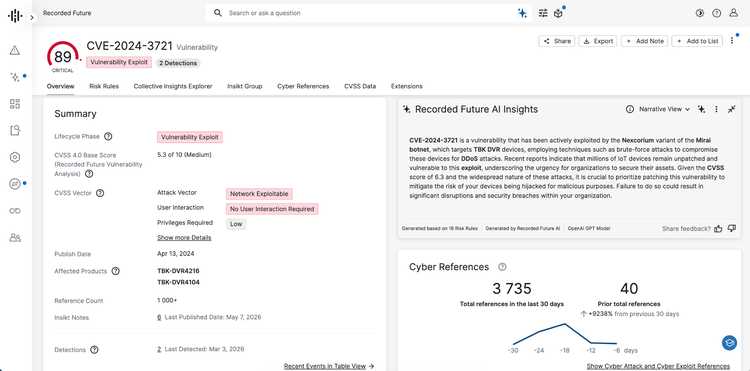
Additionally, threat actors exploited CVE-2024-3721 in TBK DVR devices to deliver the Nexcorium botnet.
Sixteen of the 37 vulnerabilities enabled remote code execution (RCE), affecting products from twelve vendors: Adobe, Apache, D-Link, Fortinet, Google, Ivanti, Kentico, Marimo, Microsoft, SimpleHelp, TrueConf, and Wazuh.
Insikt Group® identified public proof-of-concept (PoC) exploits for 24 of the 37 vulnerabilities in this report.
The most commonly observed flaws this month were CWE-22 (Path Traversal), followed by CWE-94 (Code Injection), CWE-20 (Improper Input Validation), and CWE-306 (Missing Authentication for Critical Function).
Three of the 37 vulnerabilities are at least five years old, with the oldest approximately seventeen years old, reinforcing how attackers continue to exploit long-known weaknesses in environments where patching has lagged. Additionally, the fastest observed time from a vulnerability’s public disclosure to exploitation was two days.
Exploitation Analysis
This section highlights some of the highest-impact, actively exploited vulnerabilities this month, specifically those linked to known threat actor campaigns, that have public PoC exploits available, or for which Insikt Group® has created Nuclei templates to detect the vulnerability. Vulnerabilities with no meaningful public technical detail are summarized in the disclosures table only.
Threat Actors Exploit TBK DVR Vulnerability (CVE-2024-3721) to Deliver Nexcorium
On April 17, 2026, FortiGuard Labs (@FortiGuardLabs on X, formerly known as Twitter), associated with Fortinet (@Fortinet), published a technical analysis detailing a campaign that exploits TBK Digital Video Recorder (DVR) devices to deliver Nexcorium, a Mirai-based botnet. A TBK DVR device is a surveillance system recorder that captures, stores, and allows playback or remote viewing of video from connected security cameras. According to FortiGuard Labs, Nexcorium targets TBK DVR-4104 and DVR-4216 systems by exploiting CVE-2024-3721, an operating system (OS) command injection vulnerability that allows remote threat actors to execute arbitrary system commands.
Based on FortiGuard Labs’ analysis, the campaign begins with the exploitation of CVE-2024-3721 through crafted requests that manipulate the mdb and mdc arguments in TBK DVR devices, which delivers a downloader script named dvr. The exploit includes the HTTP header X-Hacked-By with the value Nexus Team - Exploited By Erratic. The dvr script retrieves Nexcorium binaries with filenames beginning with nexuscorp for architectures such as ARM, MIPS R3000, and x86-64. The dvr script then sets the Nexcorium binaries’ permissions to 777, and executes them with an argument that identifies the compromised system.
Further technical details associated with this activity, including sample analysis and IoCs, are available to Recorded Future customers via Insikt Group reporting.
Recorded Future customers can also access Malware Intelligence queries, which surface samples that connect to known network indicators.
As of April 15, 2026, NIST enriches only CVEs that appear in the CISA Known Exploited Vulnerabilities catalog, federal government software, or software designated critical under Executive Order 14028. Everything else carries a "Lowest Priority" status: no CVSS score, no affected product mappings, no weakness classification. NIST enriched roughly 42,000 CVEs in 2025, and submissions in early 2026 are running about a third higher year-over-year. Industry estimates suggest the prioritized categories will cover only 15–20% of anticipated CVE volume going forward.
For teams whose vulnerability management workflows depend on CVSS scores from NVD, this could create an operational gap. The CVEs in the unenriched backlog can signify real vulnerabilities affecting real software. They don't necessarily stop mattering because NIST didn't get to them.
Recorded Future does not believe that the solution is to source CVSS scores faster. Instead, Recorded Future endeavors to provide the signals that actually reflect attacker behavior. CVSS was designed to characterize the technical properties of a vulnerability — attack vector, complexity, required privileges, potential impact. CVSS was not designed with patch prioritization as a prime concern. This distinction has always existed; the growing gap in NVD enrichment increases the importance of the right intelligence and insights that can capture attacker behavior in real time.
Where vulnerability risk actually originates
Exploit code surfaces on GitHub. Proof-of-concept development gets discussed in offensive security forums and underground communities. Ransomware operators evaluate which vulnerabilities fit their deployment pipelines. Threat actors incorporate specific CVEs into their toolkits and begin scanning in search of exploitable targets.
At some point during or after that sequence, a CVE gets assigned and, under the previous policy, would eventually be enriched by NVD. By the time a practitioner sees a CVSS score in their scanner, the risk may already have materialized.
The delay between attacker use and the assignment of a CVE and CVSS score is not a new dynamic. For this reason, Recorded Future's vulnerability Risk Scores were never built to depend on NVD enrichment.
The intelligence that determines whether a vulnerability is dangerous originates in the technical communities, underground markets, exploit repositories, and malware ecosystems where attackers work. It does not come from institutional databases processing CVEs up to weeks or months post-assignment. NVD's policy change doesn't create a gap in Recorded Future's coverage because NVD is not the primary signal behind Recorded Future Vulnerability Intelligence.
What the model actually weighs
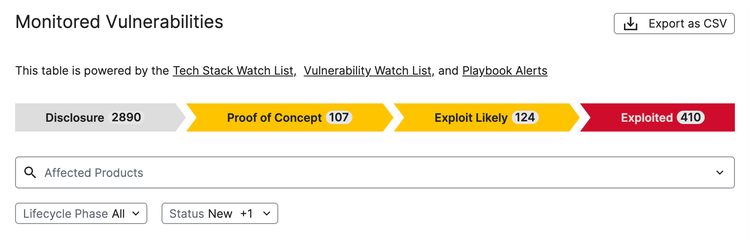
Recorded Future's risk scoring maps directly to the vulnerability weaponization lifecycle. Many of the signals fire based on where a CVE sits on that path, not on what NIST has or hasn't scored.
Figure 1: The vulnerability weaponization lifecycle, as displayed on Recorded Future’s Vulnerability Intelligence dashboard (Source: Recorded Future).
The signals that carry the most weight are those tied to active exploitation in the wild — malware samples observed by Recorded Future's collection infrastructure, ransomware operations validated by Insikt Group® analysts, and other direct evidence of attacker use. Confirmed exploitation activity carries the most weight in the model, regardless of a CVE's CVSS score. These are the signals that answer the question practitioners actually need answered: is someone using this right now?
Below active exploitation, the model tracks proof-of-concept availability, including the distinction between a verified and unverified PoC. Verified exploit code that demonstrates remote execution is a materially different signal from an unverified proof of concept of unknown reliability. As an example, exploit code on GitHub is not theoretical risk; it usually compresses the time between disclosure and weaponization. Recorded Future Risk Scores treat it accordingly.
In addition to these collection and analytic capabilities, Recorded Future tracks web reporting about a CVE before NVD has published enrichment data. For the majority of new CVEs going forward, this pre-NVD signal may be the earliest structured intelligence available anywhere. A CVE that NIST has marked Lowest Priority can still accumulate signals across many dimensions. As a result, the absence of a CVSS score in NVD doesn't create a blind spot in Recorded Future's assessment.
CVSS still matters. It just isn't the foundation.
CVSS scores flow into the model from multiple sources. Many CVE numbering authorities (CNAs) supply CVSS scores at the point of submission, and CVSS coverage across published CVEs remained above 90% in 2025 even as NVD's independent enrichment narrowed. That doesn't mean CNA-supplied scores are interchangeable with NVD's. Academic analyses of dual-scored CVEs have documented divergence rates above 50% throughout the past decade, reaching 70% in 2023, with disagreements sometimes large enough to move a vulnerability across severity tiers. For CVEs where neither NVD nor a CNA has provided scoring, Recorded Future independently assigns scores through its own analysis. CVSS occupies one position in the model, alongside signals grounded in observable attacker behavior, and those signals operate independently of whether a CVSS score exists at all.
What to do with this
Audit where your prioritization signals come from. If your program is relying entirely or primarily on CVSS scores pulled from NVD, you may have exposure, not just from the existing backlog, but from every new CVE entering the ecosystem under the new policy.
Recorded Future Vulnerability Intelligence, as a part of the Cyber Operations solution, scores every CVE against the full signal set — exploitation activity, malware and ransomware associations, proof-of-concept availability, threat actor targeting, and analyst-validated intelligence. All independent of NVD's enrichment pipeline. See this prioritization and automation in action with this click-through tour.
See how Vulnerability Intelligence integrates with your existing vulnerability management workflow — request a demo.
Artificial intelligence is often discussed as a tool for automating and accelerating existing cybersecurity workflows. While that framing is accurate, it is incomplete. The most consequential shift occurs when AI is combined with threat intelligence — both intelligence about attacker capabilities and TTPs, and intelligence about our own defensive weaknesses and exposure. This combination produces qualitatively new defensive capabilities that may, for the first time, begin to structurally narrow the long-standing asymmetry between attackers and defenders.
This memo examines what is genuinely new about AI-enabled defense, with particular emphasis on how the fusion of threat intelligence and AI reasoning changes the strategic calculus. It also argues that in the end, it is a question of who can most efficiently use scarce resources (compute and energy) to get the upper hand. Intelligence guides defenders in how to best use these resources to defend, thereby changing the balance of power against adversaries.
The Traditional Defender’s Dilemma
The core asymmetry in cybersecurity is well understood: defenders must protect every possible attack surface, while attackers only need to find one exploitable weakness. Defenders operate under constraints — budgets, compliance mandates, uptime requirements — while attackers can be patient, selective, and asymmetric.
Traditionally, threat intelligence has been consumed by defenders as a feed: indicators of compromise, malware signatures, and published advisories. This intelligence was valuable but largely reactive and disconnected from the defender’s own environment. Knowing that a threat group uses a particular technique is only useful if you can rapidly assess whether that technique works against your infrastructure. That assessment has historically required scarce human expertise, time, and tooling — precisely the resources defenders lack.
The Automation Layer: Real But Evolutionary
A significant portion of AI’s current impact on defense is best described as automation of existing processes: faster alert triage, automated enrichment, accelerated patch prioritisation, and AI-assisted Tier 1 SOC analysis. These improvements are valuable — they compress response times, reduce analyst fatigue, and address chronic staffing shortages — but they are conceptually extensions of workflows that already existed.
Similarly, AI can automate the ingestion and normalisation of threat intelligence feeds, reducing the manual work of parsing reports and extracting indicators. This is useful, but it does not change what defenders can fundamentally do with that intelligence. The real transformation lies elsewhere.
The Convergence: Where Threat Intelligence Meets AI Reasoning
The most significant shift is not AI applied to defense in isolation, nor threat intelligence consumed as a feed. It is the convergence of the two: AI systems that can reason simultaneously over what attackers are doing and what defenders are exposed to, in real time, at scale. This convergence produces capabilities that did not previously exist.
1. Connecting Attacker TTPs to Your Actual Exposure
Traditionally, a threat intelligence report might tell you that a particular adversary group is exploiting a vulnerability in a specific product, or is targeting your sector using a known technique chain. Acting on that information used to require an analyst to manually map those TTPs against your environment: do we run that product? Is the vulnerable version deployed? Are the relevant network paths open? Are our detection rules adequate for that technique?
AI can perform this mapping continuously and at scale. When a new threat report lands, an AI system can immediately cross-reference the described TTPs against a live model of your infrastructure, your patching state, your detection coverage, and your segmentation — and surface a prioritised assessment of actual risk, not theoretical risk. This transforms threat intelligence from awareness into actionable, environment-specific defense guidance.
2. Fusing Offensive Intelligence With Defensive Weakness Data
Defenders have long maintained two separate bodies of knowledge: external threat intelligence (what adversaries are capable of and likely to do) and internal vulnerability and exposure data (what weaknesses exist in our own environment). These have typically lived in different systems, managed by different teams, and reconciled manually and infrequently.
AI enables continuous fusion of these two streams. A model can hold both the attacker’s perspective — known TTPs, targeting patterns, tooling, and objectives — and the defender’s perspective — unpatched systems, misconfigured controls, overprivileged accounts, and detection gaps — and reason about the intersection. The result is not a vulnerability list or a threat report, but an integrated picture of where the attacker’s capabilities meet our specific weaknesses. This is the analysis that the best red teams produce during an engagement, except it can now run continuously rather than quarterly.
3. Predictive Prioritisation Based on Adversary Behaviour
Patch prioritisation has traditionally been driven by CVSS scores — a measure of theoretical severity that ignores both attacker intent and environmental context. AI models trained on threat intelligence can reorder priorities based on which vulnerabilities are actually being exploited in the wild, by which adversary groups, against which sectors, using which delivery mechanisms. Combined with internal exposure data, this enables prioritisation that better reflects real-world risk rather than abstract severity.
The same logic applies to detection engineering. Rather than building detections for every possible technique, AI can identify the techniques most likely to be used against your specific environment — based on who is targeting your sector, what tools they use, and where your coverage gaps are — and focus engineering effort where it matters most. In fact, in most cases AI will be able to build those detectors for you!
4. Reasoning Over Context at Scale
Traditional detection systems correlate events against rules. AI models can reason about events holistically, synthesising partial logs, ambiguous telemetry, and unusual configuration changes into a judgment that approximates what a senior analyst would conclude. Crucially, this reasoning can be informed by threat intelligence: not just “is this anomalous?” but “is this consistent with the tradecraft of groups known to target us?” That contextual layer makes detection both more accurate and more relevant.
5. Continuous Attack-Path Modelling
Historically, understanding one’s own exposure was a periodic exercise: run a penetration test, receive a report, remediate, repeat. AI enables a living model of the environment that continuously re-evaluates exploitable paths to critical assets as conditions change. When this model is enriched with threat intelligence — particularly information about which attack paths adversaries actually favour, and which tools they use to traverse them — the result is a dynamic, threat-informed view of exposure that stays up to date automatically, not only when your manual pen testers or red team have time to update it.
6. Adversarial Prediction During Active Incidents
During an active incident, experienced responders draw on their knowledge of attacker behaviour to anticipate likely next moves. AI models trained on threat intelligence and historical incident data can encode this reasoning and make it available to any response team. If the model recognises that the observed initial access technique and lateral movement pattern are consistent with a known adversary group, it can predict likely next steps — which credentials they will target, which persistence mechanisms they prefer, which data they are likely to exfiltrate — and help defenders get ahead of the intrusion rather than simply reacting to each new indicator.
Turning the Tables: AI-Enabled Deception
The capabilities described above are fundamentally defensive: detecting, predicting, and prioritising. But the convergence of AI and threat intelligence also opens a qualitatively different category of action — using intelligence about the attacker to actively mislead them.
From Static Honeypots to Adaptive Deception
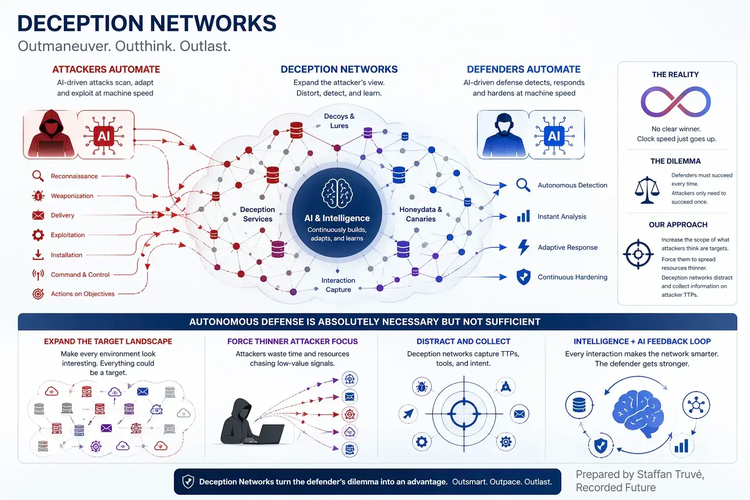
Deception technologies such as honeypots and honeytokens have existed for decades, but they have always been constrained by how static and labour-intensive they are to deploy convincingly. A skilled attacker can often identify a honeypot by its lack of realistic activity, stale data, or inconsistencies with the surrounding environment. AI removes these constraints. AI-generated deception environments can include realistic-looking decoy infrastructure — fake services, plausible file shares, synthetic credentials, even simulated user activity patterns — that adapts dynamically in response to attacker behaviour. Rather than a static trap that a competent adversary recognises and avoids, the defender can maintain a deception layer that evolves to stay convincing.
Intelligence-Informed Decoy Placement
This capability ties directly into the threat intelligence fusion described above. If you know which TTPs a likely adversary uses, which attack paths they favour, and where your real weaknesses are, AI can place decoys precisely along the routes those adversaries are most likely to take. The deception is no longer generic; it is tailored to the specific threat. A decoy credential can mimic the type of service account the adversary’s tooling is known to target. A fake file share can contain documents plausible enough to absorb attacker time and attention, and simultaneously provide new intelligence about the adversary. The threat intelligence that informs your defensive posture simultaneously informs your deception strategy. This is “Machine Counter Intelligence”!
Imposing Costs and Eroding Attacker Confidence
AI-generated deception at scale inverts a piece of the traditional asymmetry. Attackers who encounter a pervasive deception layer must spend significant time and effort distinguishing real assets from fake ones. Every interaction with a decoy wastes their resources, degrades their confidence in the intelligence they have gathered, and increases the risk that they will trigger an alert. In effect, the attacker now faces a version of the defender’s dilemma: they must verify everything, while the defender only needs one decoy to succeed.
Active Intelligence Collection Through Engagement
Perhaps most significantly, AI can interact with attackers inside deception environments in ways that feel plausible, drawing out more of their tooling, techniques, and objectives. This turns deception from a passive tripwire into an active intelligence-gathering operation. The tradecraft revealed through these engagements feeds back into the threat intelligence cycle, improving the defender’s understanding of the adversary and refining future defensive and deceptive measures. The result is a virtuous loop: intelligence informs deception, deception generates new intelligence.
There is an inherent tension in active deception engagement: traditional incident response doctrine prioritises minimising dwell time, while deception-based intelligence collection deliberately extends it. The risks are real — containment failure if the deception boundary isn't airtight, resource cost of sustained monitoring, potential legal and regulatory questions about why an attacker was permitted to remain active, and the possibility that a sophisticated adversary recognises the deception and feeds false signals back to poison your intelligence. These risks do not invalidate the approach, but they define the conditions under which it works. Active engagement requires genuinely isolated deception infrastructure, and clear decision frameworks for when to engage.
Democratising Access to Intelligence-Driven Defense
A less obvious but structurally significant change is that AI lowers the barrier to performing intelligence-driven defense. When an analyst can query in plain language — “which of our externally-facing systems are vulnerable to techniques used by a certain threat group in the last 90 days?” — and receive an accurate, contextualised answer, the skill requirement for effective threat-informed defense drops substantially. This is not doing an old thing faster; it is enabling a different operating model in which threat intelligence becomes a working tool for the entire security team, not just the analysts who specialise in it.
Strategic Implications
The most profound implication is that defenders have historically been reactive because they lacked the cognitive bandwidth to continuously fuse offensive intelligence with their own exposure data. AI makes this fusion not only possible but economically viable for organisations that could never previously afford dedicated threat intelligence teams, red teams, and continuous assessment programmes.
This changes the nature of the defender’s dilemma. The traditional framing — “defenders must protect everything; attackers only need one way in” — assumed that defenders could not know, in real time, which parts of their attack surface are most likely to be targeted. AI-enabled threat intelligence fusion challenges that assumption. If defenders can continuously identify the most probable attack paths based on current adversary behaviour and their own specific weaknesses, they can concentrate resources where they matter most. The dilemma does not disappear, but the defender is no longer operating blindly, but can take control.
The key asymmetry is therefore shifting from “attacker versus defender” to “AI-augmented versus non-augmented.” Organisations that integrate AI with robust threat intelligence programmes may find themselves closer to parity with attackers than at any point in the history of the field. Those that do not will face an even steeper version of the traditional dilemma, as AI-empowered adversaries exploit the widening gap.
Final Words
The emergence of fully autonomous AI agents on both sides raises unresolved questions. If attackers deploy autonomous offensive agents that can chain exploits and adapt to defenses without human guidance, defenders will need equally autonomous systems — systems that consume threat intelligence, assess exposure, and act on the results without waiting for human approval. The governance, trust, and control challenges this creates are substantial, but the journey towards this goal must begin now.
There is also a risk that the intelligence-AI feedback loop becomes adversarial in new ways. Sophisticated attackers who understand that defenders are using AI to map TTPs against exposure may deliberately vary their tradecraft to evade predictive models, or generate false signals to misdirect AI-driven defense. The quality and provenance of threat intelligence will become even more critical as AI amplifies both its value and the consequences of acting on flawed data — we need automation-grade intelligence!
We have not changed the basic equation: defenders must still know and mitigate every weakness, while the attacker needs only one. AI does not abolish that asymmetry, and claiming otherwise would be dishonest. What AI fused with threat intelligence does is change the terms of the contest. Instead of defending blind — treating every weakness as equally likely to be exploited — defenders can now continuously map attacker capabilities against their own specific exposure, concentrate resources on the paths adversaries actually use, and impose real friction through deception that degrades the attacker's speed advantage. The attacker still only needs one weakness, but they are now searching for it in an environment that fights back: one that predicts where they will look, places convincing traps along those paths, and learns from every encounter.
The defender may never achieve dominance, but the era of structural helplessness — of knowing that the asymmetry is permanent and unmanageable — is ending for organisations willing to invest in these capabilities. Parity in an adversarial contest is not a consolation prize; it is the condition under which skill, preparation, and operational discipline start to matter more than structural advantage.
There’s a certain energy you can only find at Recorded Future. Take that energy and bring it to London’s “Silicon Roundabout” and you get the perfect spot for Futurists to build and innovate.
Across the globe, Recorded Future is 1000+ employees working towards the same mission: Securing Our World With Intelligence.
Our London office – one of our most storied hubs – hosts a range of departments supporting both local, regional, and global operations. The office brings together 100+ cross-functional professionals from People & Talent Acquisition, Finance, Sales, Marketing, Global Services, Research, and more!
Looking back: From the Attic to The Bower
Our story in London didn’t start in the high-rise, but in a converted attic with just a handful of people and a big mission.
When I first joined, we were in the attic of a 3-story building.It was full of great people and energy; the immediate feeling I got was that everyone was building something great together.”
Joe Rooke
Director Risk Insights, Insikt Group
This passion for building something great fueled incredible growth. Sam Pullen, Director of Intelligence Services, remembers when the entire EMEA team was just about 20 people. Since 2018, we’ve gone from service a few dozen customers in the region to ~700 now.
On the left: First Recorded Future office in London. On the right: Recorded Future's newest office
On the left: First Recorded Future office in London. On the right: Recorded Future's newest office
Inside the Office
This modern high-rise building’s open-plan layout offers quite a few collaboration spaces across our office, where the team likes to have small team meetings, breaks, or even lunch.
Like all Recorded Future offices, our meeting rooms follow a unique naming convention. While Boston uses countries, and Sweden volcanoes - London chose islands. Rumors say we picked islands following a 95-day rain streak – we can neither confirm nor deny. So, in our London office, you’ll find Futurists collaborating in rooms like Bora Bora, Crete, and even San Andres.
Our Culture
What truly defines our London office is the sense of camaraderie – whether that’s competing in a friendly team padel game, testing your dartboard skills, or truly memorable summer & end of year celebrations.
The culture at the London office has always been welcoming and inclusive. The BDRs are the soul of the office, and you can always rely on them for a good conversation over a cup of tea.
Sam Pullen
Whether over summer picnics and pedalos in Hyde Park years, playing 5-a-side football in the pouring rain, or at the most recent Christmas party at the Savoy - our Futurists celebrate wins together.
Friendly Team Padel Game at Canary Wharf
Onwards & Upwards: Why Recorded Future
We asked Sam and Joe what has been the highlight of their long tenure at Recorded Future: the opportunity to build. For Sam, it has been the opportunity to build great relationships with clients over nearly a decade. For Joe, it has been the opportunity to build new solutions and new ways to work towards our mission.
The company offers opportunities to builders. If you are willing to take the initiative to make something better, you are not stopped. That is rare.
Cybersecurity is a cornerstone of our modern world, but its roots stretch back long before the internet. Far from a recent phenomenon, the field began in university labs and evolved through decades of innovation and conflict. For professionals and everyday users alike, tracing this history reveals why today's defenses exist and why vigilance remains our most critical tool.
The 1940s: Theoretical Seeds and Massive Machines
Long before the first hack, pioneers were already contemplating the risks of digital intelligence. In 1945, the Electronic Numerical Integrator and Computer (ENIAC) - the first general-purpose electronic computer - showcased the power of computing, though it was a room-sized giant reserved for military use. While the idea of a "cybercriminal" was still science fiction, the theoretical groundwork for future threats was being laid.
Mathematician John von Neumann began developing his "Theory of Self-Reproducing Automata" during this era. He proposed that a machine-based organism could replicate itself across systems - the conceptual birth of the computer virus.
Key Characteristics of This Era:
Physical Isolation: Security meant locking the door to a room-sized machine.
Government Monopoly: Computers were exclusive to the military and the academic elite.
Conceptual Threats: Risks were purely mathematical theories rather than practical realities.
The Virus Blueprint: The foundational logic for self-replicating code was established.
By understanding these early foundations, we can appreciate how a field born in the realm of theory has become the frontline of global stability.
The 1950s: Mainframes, Physical Security, and Phone Phreaking
Governments, universities, and major businesses started using large, centralized machines known as mainframes. As these computers grew more powerful, the definition of "security" still remained grounded in the physical world. During this era, data protection simply meant controlling access to the room where the hardware sat. However, a new kind of technical subculture was beginning to emerge on the fringes of the telecommunications industry.
The 1950s saw the rise of phone phreaking, where enthusiasts exploited telephone signaling frequencies to make unauthorized long-distance calls. While not yet digital hacking, this movement introduced the concept of manipulating infrastructure for unintended purposes. This culture of curiosity and boundary-pushing would eventually produce industry titans; notably, both Steve Jobs and Steve Wozniak experimented with phreaking technology before the birth of Apple.
Key Characteristics of This Era:
Physical Perimeter: Security was defined by locks and restricted personnel access.
Phone Phreaking: The first widespread exploitation of a technological network.
Nascent Authentication: Password-based systems began to appear in informal, non-standardized forms.
Fragmented Protocols: Without a connected internet, every institution developed its own isolated security rules.
These early exploits proved that even the most robust physical defenses could be bypassed by those who understood the hidden language of the systems within.
The 1960s: The First Hackers and Growing Vulnerabilities
While known primarily for its social shifts, the 1960s also marked the birth of "hacking" as a technical practice. As computers became more prevalent in universities and large institutions, a new generation of users began exploring the limits of these systems. This era shifted the focus from purely physical security to the inherent vulnerabilities within the software itself.
In 1967, IBM invited students to test a new system, only to be surprised that their probing caused system crashes and revealed weaknesses. This informal "penetration test" proved that any system accessible to users was inherently open to exploitation. It was a wake-up call that sparked the transition of cybersecurity from a passive state to an active, intellectual discipline.
Key Characteristics of This Era:
Intentional Probing: The birth of deliberate vulnerability testing and "white hat" exploration.
Curiosity-Driven Hacking: Hacking emerged as a way to explore system boundaries, generally motivated by academic interest rather than malice.
Access vs. Security: Institutions realized that providing user access created inevitable security risks.
Beyond the Lock: The realization that cybersecurity required ongoing digital strategy, not just physical barriers.
This decade transformed the computer from a mysterious black box into a challenge to be solved, proving that human ingenuity would always be the greatest threat - and defense - to any system.
The 1970s transformed cybersecurity from a localized concern into a networked reality. The launch of ARPANET, the precursor to the modern internet, enabled researchers to share resources across distances but also opened a doorway for autonomous software to travel between systems.
In 1971, this potential was realized with Creeper, the world's first self-replicating network program. While harmless, its ability to move across the network and display messages was a revolutionary proof of concept. In response, programmer Ray Tomlinson created Reaper - the first antivirus program - specifically designed to hunt and delete Creeper. This decade also saw the rise of Kevin Mitnick, whose exploits in the 1980s showed that psychological manipulation, or social engineering, could bypass even the strongest technical barriers.
Key Characteristics of This Era:
Network Connectivity: ARPANET's birth created the first interconnected digital landscape.
The First Worm: Creeper demonstrated that programs could self-propagate autonomously.
The First Antivirus: Reaper established the "detect and delete" model of digital defense.
Social Engineering: Early hacks highlighted that human error is often the weakest link in the security chain.
This era proved that once computers started talking to each other, the "locked door" was no longer enough to keep an intruder out.
The 1980s: Personal Computers and the Birth of an Industry
The 1980s shifted computing from sterile labs to homes and offices. This explosion of connectivity via modems and floppy disks turned theoretical threats into a global reality, giving rise to the first commercial antivirus software and formal incident response teams like CERT.
Key Characteristics of This Era:
Wild Malware: Viruses like Elk Cloner and the Brain Virus moved beyond labs to infect personal computers worldwide.
The Morris Worm (1988): The first major network-wide disruption, leading to the first conviction under the Computer Fraud and Abuse Act (Robert Tappan Morris).
Cyber Espionage: Marcus Hess's breach of military systems for Soviet intelligence proved that digital networks had massive geopolitical stakes.
Ransomware Roots: The AIDS Trojan introduced the world to the concept of holding digital files hostage for payment.
The 1980s proved that as computers became personal, the threats against them became universal.
The 1990s: The Public Internet and Exploding Threats
As the World Wide Web went mainstream, the attack surface grew exponentially. This was the era of the "Macro Virus," where malicious code hid in everyday documents, and the dominance of Windows made it a universal target for hackers.
Key Characteristics of This Era:
Mass-Mailers: The Melissa virus demonstrated how email could be weaponized to clog global servers in hours.
The Encryption Standard: Netscape's SSL (1995) laid the foundation for secure online commerce and HTTPS.
Network Fortification: Firewalls became standard equipment as businesses scrambled to block external intrusions.
Legal Frameworks: Organizations like the EFF began fighting for digital privacy and standardized cybercrime laws.
This decade transformed cybersecurity services from a technical niche into a vital pillar of global commerce and law.
The 2000s: Professionalized Crime and Mature Defenses
The 2000s saw cybercrime scale into a high-profit industry. High-speed broadband and the rise of e-commerce meant that a single breach could compromise tens of millions of records, forcing the industry to develop more sophisticated authentication and monitoring tools.
Key Characteristics of This Era:
Massive DDoS Attacks: "Mafiaboy" proved that even giants like Amazon and eBay could be paralyzed by flooded traffic.
Social Engineering at Scale: The ILOVEYOU virus infected millions by exploiting human curiosity and trust.
Data Breach Epidemics: The TJX breach accelerated the adoption of strict data security standards like PCI DSS.
Encrypted Ransomware: In 2006, ransomware began using RSA encryption, making it nearly impossible to recover files without a key.
As attacks became more lucrative, the defensive industry responded with the first generation of modern security standards and behavioral analysis.
The 2010s shifted the focus from criminal profit to national security. Cybersecurity became a theater of war, with governments deploying digital weapons to destroy physical infrastructure and influence global politics.
Key Characteristics of This Era:
The Stuxnet Worm: The first acknowledged cyberweapon designed to cause physical destruction to industrial equipment.
The Snowden Leaks: Exposed the massive scale of global surveillance, sparking a decade-long debate on privacy.
Automation and AI: Machine learning began appearing on both sides - defenders used it for detection, while attackers used it to find flaws.
Global Ransomware: WannaCry and NotPetya showed how automated exploits could cripple hospitals and shipping lines across 150 countries.
By the end of the decade, it was clear that a line of code could be just as impactful as a physical weapon.
The 2020s: AI Threats and Modern Threat Intelligence
Today, the line between the physical and digital worlds has vanished. With remote work and cloud-native businesses, security is now a proactive game of "Threat Intelligence", which involves predicting and neutralizing an adversary's move before they even make it.
Key Characteristics of This Era:
Targeting Infrastructure: Attacks on power grids and water systems have raised the stakes from financial loss to public safety.
AI-Powered Attacks: Adversaries use AI to create deepfakes and hyper-personalized phishing at speeds humans can't match.
Predictive Defense: Modern strategy relies on Threat Intelligence, using AI to analyze patterns and stop attacks in their tracks.
Cloud & Remote Security: The shift away from traditional offices has forced a move toward "Zero Trust" security models.
The ongoing battle between human ingenuity and artificial intelligence now defines the frontlines of our digital existence.
Payment fraud is growing in scale and sophistication, affecting businesses across every industry, and as digital payments expand, so do the opportunities for bad actors to exploit vulnerabilities. Understanding how fraud works and how to prevent it is essential for protecting revenue, maintaining trust, and staying resilient in an increasingly complex threat landscape.
What Is Payment Fraud?
Payment fraud refers to the theft of money from businesses or individuals through unauthorized transactions or deceptive purchases. Fraudsters may act using their own accounts or by gaining unauthorized access to someone else's account.
While payment fraud can happen in person, online transactions are especially vulnerable. According to Juniper Research, global business losses from online payment fraud are projected to surpass $362 billion between 2023 and 2028. A business's fraud risk depends largely on its industry, the sensitivity of the data it handles, and the payment methods it accepts. The more ways customers can interact with accounts and complete purchases, the more entry points exist for bad actors to exploit.
Different Types of Payment Fraud
Fraudsters use many tactics, and below we list 14 of the most common. Given the large number of threats, businesses must prepare their teams to recognize a variety of warning signs. Strong internal communication policies, clear escalation procedures, and knowledge of the landscape are foundational to any fraud prevention strategy.
1. Phishing
Phishing is a social engineering tactic in which criminals attempt to trick people into revealing sensitive information such as account credentials or payment details. These attacks often come in the form of malicious links sent via email or text, but they can also occur over the phone. Attackers may pose as trusted figures - a friend, a bank representative, or a government official - to manipulate victims.
Prevention tips:
Let customers know exactly how your business will contact them, including phone numbers and email addresses.
Be transparent about what information your staff will and will not ask for.
Alert customers to any known phishing attempts targeting your brand.
Train employees on information security protocols and how to identify suspicious communications.
2. Credit and Debit Card Fraud
This type of fraud involves obtaining card information - either physically or digitally - and using it to make unauthorized purchases. Cards may be stolen directly, or details may be harvested through card skimming devices installed on ATMs or point-of-sale terminals. Attackers also acquire card data through phishing schemes or by purchasing stolen credentials on the dark web.
Prevention tips:
Restrict POS system access to authorized personnel and regularly inspect payment hardware for tampering.
Build secure, encrypted payment pages that comply with data protection standards.
Offer customers multiple notification options for purchases and account activity.
Warn customers never to share account or confirmation numbers with unverified sources.
3. Wire Transfer Fraud
In wire transfer fraud, criminals convince victims to send money directly to them. Because wire transfers are difficult to reverse, they are a preferred method among scammers. Attackers commonly impersonate someone the victim trusts - a family member, a company executive, or a business vendor. The use of a convincing back-story is often referred to as "social engineering." For example, an attacker may text employees pretending to be their CEO, claiming an emergency and requesting an urgent fund transfer.
Prevention tips:
Train employees to spot the signs of social engineering and impersonation.
Establish official communication channels and avoid conducting financial business over easily spoofed channels like text messages.
Report and share all phishing attempts with the entire team.
4. Check Fraud
Check fraud involves using counterfeit or altered checks to make payments or writing checks from accounts that lack sufficient funds. Fake checks may be digitally printed or modified versions of real checks. In some cases, the check is genuine but drawn from a closed account.
Prevention tips:
Implement software that verifies the authenticity of checks.
Train staff to recognize the visual and physical signs of fraudulent checks.
5. Chargeback and Refund Fraud
Also known as "friendly fraud," chargeback fraud occurs when a customer makes a legitimate purchase and then falsely claims a refund - either directly from the business or through their credit card company. This type of fraud is particularly tricky because it can be hard to distinguish from genuine disputes, especially when delivery or service quality is involved.
Prevention tips:
Validate customer information, including billing addresses and card security codes.
Use payment platforms that include fraud protection and dispute automation tools.
Respond to refund and chargeback requests quickly.
Minimize legitimate chargebacks by fulfilling orders accurately and on time.
6. Identity Theft
Identity theft happens when a criminal obtains someone's personal information and uses it for financial gain or to make purchases in someone else's name. For businesses, a common result is having to deal with chargebacks after customers discover fraudulent charges on their accounts. Although the primary victim is the customer, businesses have a responsibility to prevent data breaches that expose customer information in the first place.
Prevention tips:
Train employees to recognize phishing and follow secure information handling practices.
Ensure your payment systems comply with PCI DSS (Payment Card Industry Data Security Standard) requirements.
7. Account Takeover Fraud
Account takeover (ATO) fraud typically follows identity theft. Once attackers obtain a user's credentials, they change the password and contact information to lock the real owner out. From there, they may use the account for fraudulent purchases or sell it to other bad actors.
Prevention tips:
Enforce strong password requirements for all accounts.
Require two-factor authentication (2FA) and send confirmation alerts for any significant account changes.
Notify customers of purchases and account modifications in real time.
8. New Account Fraud
New account fraud (NAF) occurs when someone uses stolen or fabricated identities to open new lines of credit or accounts. These fraudulent accounts can then be used to make purchases or commit further fraud down the line.
Prevention tips:
Require multi-factor authentication (MFA) - not just email verification - during account creation.
Verify address details and card security information during transactions.
Use fraud protection tools that leverage machine learning to detect unusual account creation patterns.
9. Gift Card Fraud
Gift card fraud is a social engineering scam where criminals pressure victims into purchasing gift cards and handing over the card numbers. Once the numbers are given, the funds are essentially unrecoverable, making this a popular method among scammers.
Prevention tips:
Display warnings about gift card scams during the checkout process.
Remind customers never to share gift card numbers with people they don't personally know.
Educate in-store staff to recognize signs of gift card fraud and when to escalate the situation.
10. Merchant Identity Theft
In merchant identity theft, attackers impersonate legitimate businesses or vendors to defraud customers or partner organizations. They may use phishing to extract employee credentials and gain access to business systems, or they may pose as a trusted vendor and redirect payments to themselves.
Prevention tips:
Train staff to identify phishing attempts and follow secure communication practices.
Establish verification procedures when communicating with vendors and business partners.
Report phishing attempts to employees and partners promptly.
11. Pagejacking and Domain Spoofing
Pagejacking involves cloning an existing webpage and redirecting users to the fake version to steal login credentials or payment information. Domain spoofing follows a similar concept - attackers build an identical-looking site under a slightly different URL. Users are typically directed to these fraudulent pages through malicious emails or texts.
Prevention tips:
Run plagiarism detection tools to identify duplicate versions of your pages online.
Pay attention to unusual customer service complaints that might signal a spoofed site.
Submit takedown requests to search engines if you discover a duplicate site, and notify affected customers.
12. Mobile Payment Fraud
As mobile payments become more prevalent, they've also become a target for fraud. Attackers can exploit mobile apps through malware installation, stolen app credentials, or interception of 2FA codes. For example, a scammer may call a customer pretending to represent a business and ask them to read back a verification code - which is actually a 2FA code the attacker has triggered on the victim's account.
Prevention tips:
Authenticate customers over the phone carefully to reduce the risk of impersonation-based fraud.
Monitor for unusual spending or refund activity in mobile transactions.
Educate customers about the risks of clicking on unknown links, QR codes, or visiting unfamiliar websites.
13. Push Payment Fraud
Unlike unauthorized transaction fraud, push payment fraud involves tricking the victim into willingly sending money to a fraudster. This can take many forms, including phishing, blackmail, or deceptive scenarios like fake emergencies. The key distinction is that the victim actively initiates the transfer.
Prevention tips:
Clearly communicate to customers what your staff can and cannot ask them to do or pay.
Make it easy for customers to report anyone impersonating your business.
Issue proactive alerts about ongoing scam attempts tied to your brand.
14. ACH Payment Fraud
ACH (Automated Clearing House) payment fraud involves criminals gaining unauthorized access to a victim's bank account details and using them to initiate fraudulent transfers. For businesses, this risk can come from both outside attackers and malicious insiders.
Prevention tips:
Strictly limit and monitor employee access to business bank accounts.
Educate all staff with account access about phishing tactics and establish firm security policies.
Which Businesses Have the Highest Fraud Risk?
Not all businesses face the same level of exposure. Fraud risk is generally highest in sectors that process online payments, handle sensitive personal data, or still accept paper checks.
E-Commerce Businesses
E-Commerce businesses are particularly vulnerable. Online retail involves accepting payments from a wide range of locations, often with multiple payment methods. Features like peer-to-peer payment integrations or international checkout add more potential points of failure. The more accounts and payment methods a customer has linked, the more attractive a target they become for data breaches.
Healthcare, Banking, and Data-Sensitive Industries
These sectors are at elevated risk because of the high value of the information they store. A breach in these sectors doesn't just expose financial data - it can compromise identity information used to commit fraud across many platforms simultaneously.
Businesses Still Accepting Checks
These kinds of businesses face unique challenges. As check usage declines, employees may become less experienced at identifying fakes, which makes training and verification systems all the more important. According to the Association for Financial Professionals, check fraud remains one of the most common forms of payment fraud.
How to Mitigate Risk
A variety of tools and strategies are available to help businesses identify and reduce fraud exposure. Conducting a security risk assessment is a strong starting point, helping teams understand which vulnerabilities are most critical and where to prioritize investment.
From there, organizations should focus on establishing a solid operational and security foundation before layering in more advanced fraud detection capabilities.
Foundational Controls
These measures create a baseline level of protection by securing systems, safeguarding data, and reducing avoidable losses:
Strong network and password security: Establish internal policies governing account access, password requirements, and physical access to devices and systems.
Network tokenization: Ensure payment systems encrypt and tokenize customer data to protect sensitive information.
PCI standards compliance: Build payment workflows that meet Payment Card Industry (PCI) standards to safeguard cardholder data.
3D Secure (3DS) authentication: Use the latest 3DS protocols to validate transactions and verify user identity before completing purchases.
Chargeback protection: Work with your payment processor to implement tools that help minimize financial losses from disputed transactions.
Once these core protections are in place, businesses can enhance their fraud prevention strategies with more dynamic, data-driven approaches.
Advanced Detection & Optimization
These techniques improve visibility, adaptability, and long-term resilience against evolving fraud tactics:
Fraud KPI tracking: Monitor key metrics such as dispute rates, authorization rates, and approval/decline ratios to identify trends and respond proactively.
Rules-based systems: Implement rule-based detection as a reliable operational backbone. While rules require ongoing maintenance, they are especially useful in early stages and can be refined over time.
Machine learning algorithms: Leverage ML-powered systems to analyze large, complex datasets and uncover patterns that are difficult to detect manually. These models continuously improve as they adapt to new fraud behaviors.
Staying Ahead of Payment Fraud
Payment fraud is an ongoing challenge, but a proactive, layered approach can significantly reduce risk. By combining strong foundational controls with data-driven detection and continuous monitoring, businesses can stay ahead of evolving threats.
Ultimately, effective fraud prevention requires regular review, employee awareness, and a commitment to adapting as tactics change.
The internet is basically a giant digital city, and you need to be just as streetwise here as outside your front door. Most people go online every day - scrolling through TikTok, finishing a research paper, or making purchases - but they don't always know the "rules of the road" or the vocabulary that tech experts use to describe our digital lives. Here's a breakdown of essential digital citizenship terms to help you navigate the web and mobile apps like a pro:
Authority - Authority refers to how trustworthy a source is based on who created it. If information comes from a qualified expert or a well-known organization, it's more likely to be reliable than something posted by an unknown user.
Bystander - A bystander is someone who sees harmful behavior online, like cyberbullying, but chooses not to get involved or take action.
Cookies - Cookies are small files that websites store on your device to remember information about you, like login details or browsing habits. They make websites easier to use, but they also allow service providers to track your activity.
Cyberbullying - Cyberbullying is when someone uses digital platforms to repeatedly harass, threaten, or embarrass another person. Unlike trolling, it usually targets a specific individual.
Data Breach - A data breach happens when private or sensitive information is accessed or stolen without permission, often from companies or large platforms.
Digital Citizen - A digital citizen is anyone who uses technology to interact with others online. Being a good digital citizen means using the internet responsibly, respectfully, and safely.
Digital Footprint - A digital footprint is the trail of information you leave behind online through posts, searches, and interactions. The more you share, the greater your exposure to privacy issues or misuse of personal information. Also, once something is online, it can be very difficult to remove.
Digital Identity Theft - Digital identity theft occurs when someone steals your personal information, like passwords or account details, to pretend to be you or access your accounts.
Digital Divide - The digital divide refers to the gap between people who have access to modern technology and the internet and those who do not.
Encryption - Encryption is a method of protecting data by turning it into a coded format that only authorized users can read. It helps keep sensitive information secure.
Firewall - A firewall is a security system that monitors and controls incoming and outgoing network traffic, blocking anything that looks suspicious or harmful.
Imaginary Audience - The imaginary audience is the feeling that people are constantly watching and judging you. Social media can make this feeling stronger by showing likes, views, and comments.
Invisible Audience - The invisible audience refers to the unknown people who may see your online content, including strangers, future employers, or others outside your immediate circle. It pays to assess your security blind spots because you may not realize who is viewing your posts.
Malware - Malware is any type of harmful software designed to damage devices, steal information, or disrupt normal operations. It is often installed as part of a package or application that otherwise appears innocent.
Password Hygiene - Password hygiene refers to the practice of creating strong, unique passwords and keeping them secure instead of reusing the same one across multiple accounts.
Phishing - Phishing is a scam where attackers pretend to be a trusted source to trick you into giving away personal information, often through fake emails, texts, or websites.
Public Wi-Fi Risk - Public Wi-Fi risk refers to the potential dangers of using unsecured networks, where hackers may be able to intercept your data.
Reliability - Reliability refers to whether information is accurate and dependable. Just because something looks professional online doesn't mean it's true.
Social Comparison - Social comparison is the act of comparing your life to what you see online. Since people often share only their best moments, it can create unrealistic expectations.
Targeted Advertising - Targeted advertising uses your online behavior, location, and personal data to show ads that are specifically tailored to you.
Trolling - Trolling is when someone posts deliberately annoying or provocative content online to get attention or start arguments.
Two-Factor Authentication (2FA) - Two-factor authentication is a security feature that requires a second form of verification, like a code sent to your phone, in addition to your password.
Upstander - An upstander is someone who takes action when they see harmful behavior online, such as supporting the victim or reporting the issue.
VPN (Virtual Private Network) - A VPN is a tool that creates a secure, encrypted connection to the internet, helping protect your data and privacy, especially on public networks.
Quantum computing is moving from theory toward early practical use, with direct implications for encryption, authentication, and long-term data confidentiality.
The primary risk is the eventual emergence of cryptographically relevant quantum computers (CRQCs), which would break today’s public-key cryptography and undermine encryption, digital identity, and software trust at scale.
Quantum risk is already present: “harvest now, decrypt later” activity exposes long-lived sensitive data today, regardless of when CRQCs ultimately arrive.
Regulatory mandates and procurement standards are accelerating post-quantum cryptography (PQC) adoption, making quantum readiness a multi-year compliance and resilience priority.
Organizations that delay preparation beyond 2026 are likely to face compressed migration timelines, higher transition costs, and increased operational disruption.
Quantum Computing Explained
Quantum computing applies principles of physics to solve certain complex problems far more efficiently than classical computers. Its security relevance lies primarily in cryptanalysis and optimization: A sufficiently powerful quantum computer will reduce the calculations required to protect today's public-key encryption from thousands of years to hours or less. Researchers have used the term “Q-Day” to refer to the hypothetical point at which quantum computers will be powerful enough to break encryption.
Quantum computing is now moving from theory toward early practical use, bringing “Q-Day” closer to reality. Industry estimates suggest quantum computing alone could generate up to $1.3 trillion in value by 2035. Major cloud providers, including IBM, Google, and Microsoft, are expanding their quantum services, while specialised firms such as Quantinuum and PsiQuantum continue to improve system stability and error correction. While these advances are not yet transformative, they are consistent with the early stages of commercial adoption.
Figure 1:Key risks of quantum computing (Source: Recorded Future)
Alongside its potential benefits across finance, pharmaceuticals, defense, and other sectors, quantum computing introduces four key security risks.
Risk 1: Breaking Public-Key Encryption
Figure 2:Potential impacts of breaking public-key encryption (Source: Recorded Future)
The most critical risk is the eventual arrival of cryptographically relevant quantum computers (CRQCs), systems capable of breaking widely used public-key algorithms such as RSA, Elliptic Curve Cryptography (ECC), and Diffie-Hellman. These algorithms underpin internet communications (Transport Layer Security [TLS], virtual private networks [VPNs], Secure Shell [SSH]), identity and access management, industrial and internet-of-things (IoT) systems, and the integrity of software supply chains.
If broken, threat actors could decrypt sensitive data, impersonate trusted systems, and undermine digital authentication. This could enable:
Forged digital signatures
Compromised code-signing pipelines
Spoofed websites, identities, and certificates
Manipulated financial transactions and legal documents
Risk 2: Harvest Now, Decrypt Later (HNDL)
Figure 3: “Harvest now, decrypt later” workflow (Source: Recorded Future)
Although cryptographically relevant quantum computers (CRQCs) may still be years away, the risk is already materializing through “harvest now, decrypt later” (HNDL) activity. State-sponsored threat actors are likely collecting and storing encrypted data today with the intent to decrypt it once quantum capabilities mature. A 2021 Booz Allen Hamilton assessment found that Chinese economic espionage operations are likely targeting encrypted data with long-term intelligence value, including biometric identifiers, covert source identities, and weapons designs.
Large-scale routing manipulation offers one method for intercepting such data. Researchers at the US Naval War College and Tel Aviv University documented systematic Border Gateway Protocol (BGP) hijacking by China Telecom between 2016 and 2019, which redirected traffic from US, Canadian, and Scandinavian networks through Chinese infrastructure. These types of operations align with a long-term HNDL collection strategy.
Under the HNDL model, exposure occurs at the moment data is transmitted or stored, not when it is eventually decrypted. The primary risk, therefore, centers on long-lived data: information that must remain confidential for a decade or more, or whose sensitivity does not diminish over time, such as government and national security records, intellectual property and trade secrets, personal identifiers, financial data, biometric templates, healthcare records, and legal archives. For these data classes, compromise may not be immediately visible, but once decrypted, the consequences are irreversible. As a result, organizations holding long-lived sensitive data face near-term strategic risk regardless of when CRQCs become operational.
Large-scale routing manipulation offers one method for intercepting such data. Researchers at the US Naval War College and Tel Aviv University documented systematic Border Gateway Protocol (BGP) hijacking by China Telecom between 2016 and 2019, which redirected traffic from US, Canadian, and Scandinavian networks through Chinese infrastructure. These types of operations align with a long-term HNDL collection strategy.
Under the HNDL model, exposure occurs at the moment data is transmitted or stored, not when it is eventually decrypted. The primary risk, therefore, centers on long-lived data: information that must remain confidential for a decade or more, or whose sensitivity does not diminish over time, such as government and national security records, intellectual property and trade secrets, personal identifiers, financial data, biometric templates, healthcare records, and legal archives. For these data classes, compromise may not be immediately visible, but once decrypted, the consequences are irreversible. As a result, organizations holding long-lived sensitive data face near-term strategic risk regardless of when CRQCs become operational.
Quantum computing does not break modern symmetric encryption outright, but it can accelerate search-intensive tasks through techniques such as Grover’s algorithm. This reduces defender reaction time and increases the effectiveness of weak or legacy cryptographic implementations. In practice, this could enable faster brute-force attempts against outdated encryption, quicker identification of exposed secrets or misconfigurations, and more efficient malware tuning and exploit development.
Recent demonstrations, such as Silicon Quantum Computing’s high-accuracy implementation on a four-qubit processor, remain limited in scale but reflect steady progress toward these capabilities. However, Grover’s algorithm is constrained by high hardware requirements and limited parallelization. As a result, modern symmetric algorithms such as AES-128/192/256 are expected to remain secure for the foreseeable future, while environments with poor cryptographic hygiene will be affected first.
Risk 4: Quantum- and AI-Enhanced Vulnerability Discovery
Quantum capability will not develop in isolation. As quantum systems improve optimization and search performance, and AI automates reconnaissance, exploit development, and lateral movement, adversaries are likely to operate at unprecedented speed and scale. Rather than identifying isolated weaknesses, attackers could rapidly map entire attack surfaces, chain misconfigurations, and deploy optimized malware variants in near real time. Research from 2024 demonstrates that machine-learning classifiers can already recover full cryptographic keys from PQC implementations using only a few hundred power traces, underscoring that even post-quantum algorithms will require hardened deployment.
This convergence of AI and quantum technologies could significantly increase an attacker's operational tempo and amplify the impact of individual security lapses. The risk is compounded by the fact that a rising number of organizations carry substantial security debt, with many reporting slow remediation cycles that leave vulnerabilities exposed for extended periods.
When Will CRQCs Arrive?
There is no definitive timeline for CRQCs. Most projections place their arrival in the mid-to-late 2030s, with credible breakthroughs possible earlier in the decade. These estimates should be treated with caution: forecasting is inherently uncertain because progress in quantum error correction and qubit scaling occurs in uneven advances rather than linear progression.
For security leaders, the precise date of “Q-Day” is less important than the lifecycle of deployed systems. Infrastructure implemented today may remain operational when CRQCs emerge. Current cryptographic decisions are therefore future-binding.
Under the HNDL model, quantum risk is already material for long-lived data. Preparedness, visibility, and cryptographic agility matter more than timeline prediction.
Figure 4:No definitive timeline for CRQCs (Source: Recorded Future)
How Should Organizations Prepare?
The transition to post-quantum cryptography (PQC) is no longer a theoretical exercise. It is increasingly driven by regulation, procurement requirements, and emerging industry norms. These developments should be interpreted as operational signals necessitating forward planning.
In the US, the Quantum Computing Cybersecurity Preparedness Act requires federal agencies to inventory quantum-vulnerable cryptography and develop migration plans. NIST’s 2024 PQC standards now set the baseline for federal procurement and are rapidly becoming global reference points. In parallel, Commercial National Security Algorithm (CNSA) 2.0 defines approved algorithms and transition timelines for national security systems, with full migration targeted by 2035. Similar momentum is building in Europe. The EU Cybersecurity Act and national quantum-preparedness strategies are accelerating early adoption, particularly across critical infrastructure sectors such as energy and transportation.
Although many of these mandates formally apply to public-sector systems, their practical impact extends well beyond government. Procurement requirements and supply-chain expectations are translating policy into commercial pressure. As a result, cryptographic inventory, structured migration planning, vendor alignment, and crypto-agility are likely to become baseline governance expectations rather than optional best practices. Boards are beginning to treat quantum risk as a strategic planning issue, not a distant technical concern, with some sectors allocating dedicated quantum-security budgets approaching 5% of total cybersecurity spend to support preparation.
Industry coordination further reinforces this direction of travel. Financial institutions, payment networks, and telecommunications providers are forming quantum-readiness working groups to align migration timelines and manage shared dependencies. SWIFT is developing PQC migration guidance for its global messaging network, and Mastercard has released a PQC migration white paper outlining practical transition steps.
Figure 5:Planning for the uncertain arrival of CRQCs (Source: Recorded Future)
As the HNDL risk window narrows, organizations that begin structured preparation now are likely to manage transition risk deliberately and cost-effectively. Security leaders should ensure they understand where quantum-vulnerable cryptography resides, how regulatory obligations may cascade through customers and partners, and whether critical suppliers have credible PQC transition roadmaps. Those that delay risk compressed timelines, regulatory pressure, and materially higher transition costs later in the decade. Specific technical and governance steps are detailed in the Mitigations section.
Outlook
HNDL activity will continue to expand. State-sponsored threat actors are highly likely to increase long-term interception and storage of encrypted data, particularly from sectors handling information with long confidentiality lifetimes. Even as storage economics fluctuate, scalable interception infrastructure and economically sustainable long-term storage models enable continued accumulation of high-value encrypted material. Demonstrated routing manipulation capabilities further support persistent collection at scale, ensuring exposure continues to build regardless of when CRQCs ultimately arrive.
Attacker operational tempo will increase. The convergence of AI-enabled automation with quantum-accelerated search and optimization is likely to compress defender response windows and amplify the impact of existing security debt. Organizations reliant on legacy cryptography and slow remediation cycles will feel this pressure first.
Regulatory and procurement pressure will intensify. Post-quantum readiness is increasingly likely to become a baseline requirement for regulated markets, government contracts, and high-trust supply chains. US and European initiatives are formalizing transition timelines, and these mandates will propagate through vendor ecosystems, reframing quantum preparedness as a competitive requirement rather than a discretionary control.
Migration risk will become a primary enterprise challenge. Organizations that delay cryptographic inventories and crypto-agility investments are likely to face compressed transition timelines, higher costs, and greater operational disruption as standards mature and vendor dependencies shift.
Mitigations
Organizations should treat quantum resilience as a phased program aligned to visibility, flexibility, and systemic risk reduction, with leaders actively testing assumptions at each stage.
Short-term (2026): Establish visibility and prioritization
Security teams should maintain a comprehensive cryptographic inventory, identifying quantum-vulnerable algorithms across applications, infrastructure, and third-party dependencies, as well as public key infrastructure (PKI), operational technology, and IoT environments, and mapping them to data sensitivity and confidentiality requirements.
Leaders should be asking:
Do we have an enterprise-wide inventory of where quantum-vulnerable cryptography is embedded, including in legacy and third-party systems?
Which data assets must remain confidential for a decade or more, and are they currently protected by algorithms likely to be broken by CRQCs?
Medium-term (2026–2028): Enable flexibility
Organizations should design for cryptographic agility, ensuring that new systems and major upgrades allow algorithm replacement without architectural redesign. Vendors supporting long-lived products should provide credible PQC transition roadmaps aligned to emerging standards.
Leaders should be asking:
Are we continuing to deploy systems that hard-code cryptographic algorithms, thereby increasing future migration risk?
Do our critical suppliers have credible, time-bound PQC transition plans, and how exposed would we be if they fell behind?
Migration should prioritize long-lived data and high-trust functions, including identity infrastructure, code signing, certificate management, secure build pipelines, and critical third-party software. Strengthening software and supply-chain integrity will be essential to minimizing cascading risk during transition.
CISOs should be asking:
Which enterprise trust anchors (for example, certificate authorities, signing keys, or hardware security modules) would create systemic impact if rendered vulnerable in a post-quantum scenario?
Can we rotate and replace cryptographic components at scale without operational disruption if migration timelines compress unexpectedly?
Recorded Future intelligence can support these efforts by tracking emerging cryptographic risks through our Threat Intelligence Module, identifying exposed dependencies through our Attack Surface Intelligence, and assessing third-party quantum readiness as standards and vendor capabilities evolve through our Third-Party Intelligence Module.
Risk Scenario
GridCore Systems is a US-based provider of industrial control systems (ICS) and grid-management software for electric utilities nationwide. The firm relies on quantum-vulnerable public-key cryptography (RSA/ECC) for remote access, software signing, and secure data exchange with utilities and regulators, and has not yet completed a post-quantum cryptographic transition.
First-Order Implications
Threat
Risk
Adversaries intercept GridCore’s encrypted communications and software-update traffic for long-term storage under a harvest-now, decrypt-later (HNDL) model, while exploiting an exposed support system to map cryptographic dependencies.
Legal or compliance failure: Exposure of regulated energy-sector data triggers scrutiny under North American Electric Reliability Corporation Critical Infrastructure Protection (NERC CIP) and federal cybersecurity requirements.
Operational disruption: Incident response and emergency access restrictions delay maintenance and update cycles for utility customers.
Brand impairment: Disclosure of quantum-readiness gaps undermines customer and regulator confidence.
Second-Order Implications
Threat
Risk
Attackers leverage harvested metadata and mapped trust relationships to position for future cryptographic compromise, focusing on software-signing infrastructure and authentication mechanisms.
Operational disruption: Utilities delay deployments and require additional validation of software integrity and access controls.
Brand impairment: Public concerns over update authenticity erode GridCore’s reputation as a trusted infrastructure provider.
Competitive disadvantage: Customers begin to favor vendors with demonstrable post-quantum migration progress.
Third-Order Implications
Threat
Risk
Following the emergence of cryptographically relevant quantum computers, previously harvested data is decrypted, exposing historical grid telemetry, credentials, and engineering documentation.
Operational disruption: Adversaries plan targeted intrusions or disrupt contingencies during periods of geopolitical tension.
Legal or compliance failure: Retroactive exposure of protected data leads to long-term regulatory action and contractual liability.
Competitive disadvantage: GridCore loses preferred-vendor status and future contracts to quantum-ready competitors.
For security professionals evaluating threat intelligence vendors, the Gartner Magic Quadrant offers an indispensable perspective. Gartner analysts’ thorough and nuanced analysis cuts through the noise, making it easier for teams to understand each platform’s approach, strengths, and considerations—and helping them determine whether a particular vendor fits their organization’s unique needs.
That’s why we’re honored to share that Gartner has named Recorded Future a Leader in the first-ever Magic Quadrant™ for Cyberthreat Intelligence Technologies. This new report evaluated 17 vendors in the space, providing a comprehensive look at the competitive landscape.
“In our view, being recognized as a Leader means something specific to us: we feel it reflects our ability to help our customers with the outcomes they depend on. These include stopping threats pre-attack, running intelligence autonomously at a scale no human team can match, and making every security control they own more effective," said Colin Mahony, CEO, Recorded Future. “We believe this recognition reflects both the trust our customers place in us and the strength of the outcomes we help them achieve.”
A research methodology that prioritizes customer voice
A Gartner Magic Quadrant is a culmination of research in a specific market, giving you a wide-angle view of the relative positions of the market’s competitors. By applying a graphical treatment and a uniform set of evaluation criteria, a Magic Quadrant helps you quickly ascertain how well technology providers are executing their stated visions and how well they are performing against Gartner’s market view.
For Recorded Future, this meant that Gartner analysts spoke directly with our customers about their real-world experiences—the challenges they face, how they use our Platform, and the outcomes they've realized. We feel their voices shaped our position in the Magic Quadrant, just as they’ve always shaped our product offerings and roadmap.
The new Gartner report offers a snapshot of what the analysts heard from customers. We haven’t stopped working since then and there’s much to talk about.
There’s more… the next phase of threat intelligence
In conversations throughout 2025, our customers gave us their thoughts about product complexity, pricing models, and the challenges of scaling intelligence across their teams. As a result of their input, we’ve fundamentally changed how they can access and make the most of Recorded Future threat intelligence.
Here are the highlights of our continued commitment to simplicity and innovation to provide better experiences for our customers in 2026:
1. Goodbye, modules. Hello, simplicity. Meet our four new solutions. Our four new solution areas cover the four major attack surfaces—an organization’s systems, brand, supply chain, and payment methods:
Cyber Operations—This foundational solution empowers security teams with the intelligence to monitor and prioritize threats and vulnerabilities, get in-depth malware insights, triage alerts and detect threats, and stand up an intelligence-driven defense.
Digital Risk Protection—Also foundational, this solution allows teams to monitor malicious sites, code repositories, and the dark web to detect brand abuse, employee credential compromise, and other threats to digital trust.
Third-Party Risk—This solution enables teams to continuously assess supplier security posture with real-time intelligence, accurate risk ratings, vendor action plans, and more.
Payment Fraud—With this solution, teams can detect and prevent card-not-present fraud with intelligence that identifies compromised payment data before it's used.
The solutions are built on a unified intelligence foundation to provide consistency, accuracy, and alignment around shared security outcomes. And they integrate with other security solutions like CrowdStrike Falcon and Google SecOps, bringing the benefits of Recorded Future intelligence and rich context directly into common SIEM and EDR workflows.
2. New pricing packages for less friction, more intelligence We’re offering the four solutions in new pricing packages designed to fit customer needs:
Simplicity—Customers can purchase one package instead of juggling multiple modules
End-to-end workflows—Packages cover full use cases, complete with the key capabilities to get the job done
Wider access—Higher tiers offer unlimited seats, so everyone now can be intelligence-led.
In addition, integrations are included. Now your tools in the security stack—SIEM, SOAR, firewall, endpoint protection, ticketing system, and more—can leverage Recorded Future intelligence without integration fees or limitations.
3. Expansion into Latin America The threat landscape knows no geographical borders, and neither do we. We’ve expanded Recorded Future’s operations into Latin America, giving security teams in the region better access to the expertise and support they need to mount a successful proactive defense.
4. Autonomous Threat Operations for autonomous defense In February, we launched Autonomous Threat Operations to help customers move from isolated threat intelligence insights and manual workflows to automated and continuous defensive actions across the entire security ecosystem. Complete with AI-powered, 24/7 autonomous threat hunting and multi-source correlation in the Intelligence Graph®.
As we continue to build on our vision of moving from automated to autonomous operations, we’re developing Recorded Future AI and agentic experiences to help our customers reduce alert fatigue, save time on research, and run threat hunts faster so they can detect and defend at scale.
Explore the Gartner Magic Quadrant report today
We’re proud to be recognized by Gartner as a Leader in Cyberthreat Intelligence Technology, and we’ll continue innovating for our customers to help them mitigate risk and stay ahead of evolving threats.
Get the report to review Gartner analysis and see how Recorded Future fits your CTI program needs.
Gartner and Magic Quadrant are trademarks of Gartner, Inc. and/or its affiliates.
Gartner does not endorse any company, vendor, product or service depicted in its publications, and does not advise technology users to select only those vendors with the highest ratings or other designation. Gartner publications consist of the opinions of Gartner’s business and technology insights organization and should not be construed as statements of fact. Gartner disclaims all warranties, expressed or implied, with respect to this publication, including any warranties of merchantability or fitness for a particular purpose.
This article introduces threat activity enablers (TAEs), the infrastructure providers and networks that underpin modern cyber threats across both criminal and state-sponsored activity. These entities sustain operations by enabling resilient, high-risk infrastructure that persists despite sanctions, takedowns, and public exposure.
Behind every ransomware demand, botnet, or threat activity group is a server sitting in a data center. While most legitimate hosting providers evict threat actors once identified, a specific class of providers does the opposite. Recorded Future® calls these providers threat activity enablers(TAEs).
What Is a Threat Activity Enabler?
Figure 1: Overview of threat activity enablers’ patterns, ecosystem, and impact
A threat activity enabler (TAE) is an individual, organization, or service provider that supports malicious cyber activity by providing infrastructure or services leveraged by threat actors. More commonly, this includes providers that lack a formal physical or virtual storefront, conduct business only via email or messaging platforms, and do not enforce know-your-customer (KYC) policies. It also includes hosting providers that selectively respond to abuse reports or law enforcement inquiries to maintain plausible deniability, as well as more traditional self-proclaimed “bulletproof” providers that openly ignore oversight or advertise non-cooperation.
TAE networks serve as the backbone for ransomware groups, infostealer campaigns, botnets, and even state-sponsored threat actor operations. What distinguishes TAE networks is the sustained concentration of malicious infrastructure within their networks.
How TAEs Operate
TAEs are masters of obfuscation and are highly resilient, hiding behind layers of decoy companies to evade accountability. They use several core tactics:
Corporate Shell Games: They establish front companies across multiple jurisdictions to create legal distance between the infrastructure and the operators.
Strategic Resource Control: They often operate as local internet registries (LIRs). This gives them direct control over IP resources and autonomous systems (ASNs), allowing them to manipulate network resources at will.
Rapid Rebranding: When a network becomes too "hot" due to scrutiny, TAEs rapidly transfer IP address prefixes to a newly registered, clean-looking entity.
Identifying High-Risk TAE Networks
Recorded Future actively identifies high-risk TAE networks through its Network Threat Density List. These networks are ranked by their Threat Density Score, calculated from the concentration of validated malicious activity relative to the total number of IP address prefixes a network announces.
This approach cuts through the noise to quickly expose infrastructure that is disproportionately associated with threat activity, a core characteristic of TAEs, allowing network defenders to prioritize the infrastructure most likely to pose material risk.
Figure 2: High-risk suspected or confirmed TAE networks in 2025, ranked by Threat Density Score
From Insight to Action
Tracking TAE networks allows security teams to move from reacting to individual threats to proactively managing infrastructure risk. In practice, this means applying TAE intelligence across three core areas: prevention, detection, and exposure.
Figure 3: Three steps for operationalizing TAE intelligence
TAEs are persistent and continuously evolving, adapting quickly in response to sanctions, enforcement actions, and exposure. While their identities may change, their underlying infrastructure patterns often remain consistent.
The "metaspinner" Case Study
In April 2025, a TAE tracked by Recorded Future, Virtualine Technologies, shifted its IPv4 resources to a newly registered network that fraudulently impersonated a legitimate German software firm, metaspinner net GmbH. Because this provider’s historical infrastructure patterns were already being tracked, the newly created network was immediately identified as a front. Within weeks, this network became a primary distribution hub for malware families such as Latrodectus and AsyncRAT. When the operation was eventually exposed, Virtualine Technologies simply pivoted the infrastructure to a new identity within one of its existing autonomous systems to maintain its operations.
Figure 4: Validated malicious activity associated with Virtualine Technologies in 2025
This case underscores the reality of TAE networks: while identities, ownership records, and corporate fronts may change, the underlying infrastructure and its associated risk persist, making continuous tracking essential to identifying and prioritizing the networks that will drive future threat activity, as demonstrated by Virtualine subsequently emerging as the highest-risk TAE network in 2025.
The Stark Industries Case Study
In May 2025, the European Union sanctioned UK-registered hosting provider Stark Industries Solutions and its executives for enabling Russian state-sponsored cyber operations. However, enforcement did not halt Stark Industries’ operations. In the weeks leading up to the sanctions announcement, Stark Industries began transferring IP resources, modifying RIPE registrations, and shifting infrastructure to affiliated entities.
Figure 5: Timeline of Stark Industries-related events in 2025
Despite the sanctions, the underlying infrastructure, routing relationships, and operational patterns remained traceable across these new fronts. Continuous monitoring of TAE ecosystems enables defenders to detect these pivots in near real time, revealing continuity beneath corporate rebrands and legal restructurings. This case underscores a broader reality: sanctions may change names and ownership records, but without infrastructure-level visibility, the enabling networks behind malicious activity often persist.
What This Means for Security Leaders
TAEs represent an ongoing challenge. While individual campaigns and threat actors may come and go, the infrastructure that supports them remains adaptive and deliberately resilient.
For security leaders, this requires an additional shift from solely reacting to individual indicators to understanding and prioritizing the infrastructure that enables threat activity at scale. By identifying and tracking high-risk networks, organizations can reduce investigative noise, focus resources on the most impactful threats, and take proactive steps to limit exposure before attacks materialize.
Ultimately, addressing TAEs is not just about detection; it’s also about disrupting the conditions that enable modern cyber threats to operate.
Questions You Should Be Asking
How much of your network communicates with high-risk infrastructure?
Are you prioritizing alerts involving high-risk networks?
Is TAE or ASN risk intelligence integrated into your detection and triage workflows to ensure the highest-risk activity is addressed first?
Do any of your third-party providers rely on TAE-linked infrastructure?
Do you have hidden exposure to TAE networks?
Are your controls dynamically adjusting to infrastructure risk?
Can you proactively restrict or challenge traffic to and from high-risk networks?
Embodied AI has arrived.. Humanoid and quadruped robots are moving off factory floors and into everyday operations, military deployments, and critical infrastructure. Technological advances in large language models LLMs and robotics are enabling robots to perform complex tasks autonomously.
Security has not kept pace. Researchers have demonstrated that commercially available robots can be hijacked over Bluetooth, covertly exfiltrate audio, video, and spatial data to servers in China, and even infect neighboring robots wirelessly, forming physical botnets. If unaddressed, these security weaknesses are set to scale massively once humanoid robots are fully integrated into critical workflows.
The risks need to be taken extremely seriously. A robot should be treated less like a machine on the balance sheet and more like a cyber-physical endpoint with cameras, microphones, radios, cloud dependencies, and motors. That means tougher procurement, tighter network controls, continuous vulnerability monitoring, and a credible plan for operational continuity if a fleet has to be pulled offline.
Figure 1:Summary of Unitree G1 vulnerabilities, associated business risks, mapped CVEs, and observed network activity (IPs and data exfiltration rates) (Source: Recorded Future)
Analysis
Market Drivers of Embodied AI Adoption
Embodied AI, intelligent systems in physical forms such as humanoid and quadruped robots, is moving from spectacle to staffing plans.
The shift is being driven as much by demographics as by technological progress. There are growing reports that the working-age population worldwide has begun to decline. China, an economic success story, has seen its population also decline again in 2025 as births hit a record low. These trends do not make large-scale automation inevitable, but they seriously strengthen the economic case for it in both corporate and government decision-making.
The International Federation of Robotics identifies labor shortages, real-world testing of humanoid robots, and increasing attention to safety and cybersecurity as defining trends for 2026. Some early deployments of embodied AI reinforce this trajectory. BMW reports that the Figure 02 humanoid robot has assisted in the production of more than 30,000 X3 vehicles, while GXO and Agility Robotics describe their partnership (established in 2024) as “the first formal commercial deployment of humanoid robots.” In high-risk environments, Sellafield is deploying quadruped robots to reduce human exposure in nuclear decommissioning.
Capital markets are also responding. Unitree filed for a reported $610 million initial public offering (IPO) in Shanghai in March 2026. Taken together, these signals suggest that robots are leaving pilot programs and becoming operational.
That transition makes the security question immediate rather than theoretical.
Expanding Attack Surface in Embodied AI Systems
Unlike traditional IT assets, embodied AI systems combine multiple high-risk components in a single platform: cameras, microphones, sensors, wireless radios, cloud connectivity, and physical actuation. This convergence creates a broad and under-secured attack surface.
A compromised robot can exfiltrate sensitive environmental and operational data, provide persistent remote access to internal networks, and interact physically with its environment, potentially causing unintended physical effects. This elevates robots from conventional endpoints to cyber-physical systems with both digital and real-world consequences.
The risk is compounded by architectural choices. Many platforms rely on cloud-dependent telemetry, wireless provisioning interfaces, and centralized control mechanisms. These design decisions create multiple entry points for attackers and increase the likelihood of compromise across entire fleets of embodied AI systems.
Demonstrated Vulnerabilities and Exploits
The risks are no longer theoretical. Documented vulnerabilities show that commercially available robots can be compromised with relative ease. Unlike traditional cyber threats, which mostly affect the digital world, exploiting robots enables attackers to manipulate the physical world, maximizing the potential for harm.
In 2025, researchers discovered an undocumented backdoor in Unitree’s Go1 quadruped robot that enabled remote access via the CloudSail service. Axios reported that an exposed web application programming interface (API) could allow attackers to locate devices globally and, if a robot was online, view live camera feeds without authentication. Where default credentials remained unchanged, full device control was possible. Whether described as a backdoor or a design failure, the implication is the same: robots may be reachable in ways operators do not anticipate, just like any other Internet of Things (IoT) device.
Figure 2:Summary of vulnerabilities affecting the Unitree Go1 robot, with Intelligence Card insights from the Recorded Future Intelligence Operations Platform (Source: Recorded Future)
Further research disclosed a critical vulnerability in the Bluetooth Low Energy and Wi-Fi provisioning interface used by multiple Unitree models, including the Go2, B2, G1, R1, and H1 robots. According to both the UniPwn research and IEEE Spectrum, the flaw combined hard-coded cryptographic keys, trivial authentication bypass, and command injection in the Wi-Fi setup process. An attacker within radio range could obtain root-level access without physical contact, giving them control over the robot.
Because the exploit propagates wirelessly, a single compromised device can enable lateral movement across nearby robots. This creates a fleet-level compromise scenario in which multiple units can be controlled simultaneously. The result resembles a physical botnet capable of both digital and physical actions.
Surveillance risks are equally significant. Researchers wrote that the Unitree G1 robot continuously exfiltrated multimodal sensor and service-state telemetry every 300 seconds without the operator’s knowledge. This included streaming data to external servers, potentially including audio, video, and spatial mapping. A robot operating inside a plant or laboratory may therefore be mapping the environment in real time.
Figure 3:ResearchersfoundUnitree’s G1 quietly transmitting audio, video, and sensor data to the IP address (43[.]175[.]229[.]18) without user awareness (Source: Recorded Future)
The attack surface extends beyond firmware and networking layers. Researchers showed they could take control of a Unitree humanoid in about a minute, bypass its normal controller, and trigger physical actions. Demonstrations at GEEKCon in Shanghai indicated that both voice commands and short-range wireless exploits could hijack robots and propagate attacks to nearby units, including those not actively in use.
At the software layer, embodied AI systems introduce additional risks due to their reliance on large vision-language models. Researchers demonstrated that physical-world text can influence system behavior, as injected visual prompts were shown to steer autonomous driving, drone landing, and tracking tasks without compromising the underlying software. This would enable threat actors to take control of a self-driving car or turn a drone into their own surveillance feed by embedding a visual prompt in the environment, such as hiding a message on a stop sign.
Figure 4:Chinese robotic systems demonstrated during military training exercises (left) (Source:ABC YouTube); Concept rendering of the Atlas 2.0 robot operating in a next-generation factory environment (right) (Source:Boston Dynamics YouTube)
Systemic and Operational Risk Implications
The implications extend beyond individual devices to organizational and systemic risk. Embodied AI systems are already being deployed in environments where compromise has consequences beyond data loss. Manipulation or malfunction of robots during critical operations would have outsized economic or public safety consequences. Militaries are also experimenting with robotic systems (see Figure 4).
Figure 5:Droid TW 12.7 machine gun drone, deployed by Ukrainian forces to capture Russian positions without ground troops (Source:The Telegraph)
In 2024, the Golden Dragon exercise between Cambodia and China featured robot dogs among the systems on display. Meanwhile, in the US, politicians have begun pushing for Unitree to be designated as a federal supply-chain risk, reflecting national security concerns about commercial robotics platforms. This is a very similar move to Poland’s ban on sensor-rich vehicles accessing military sites to limit surveillance risk. Ukraine has successfully deployed ground-based robots and drones in combat operations, marking a significant shift in modern warfare. In a landmark operation in April 2026, Ukrainian forces captured a Russian position using only unmanned systems — the first recorded instance of a robot-only assault in the conflict.
Figure 6:A single vulnerability can simultaneously produce operational, data, safety, and strategic risks (Source: Recorded Future)
As adoption scales, these risks become interconnected. A vulnerability affecting one platform or vendor could propagate across fleets, sites, or sectors, creating systemic exposure.
At the same time, the pace of commercial development is outstripping regulatory oversight. Bank of America estimates that as many as three billion humanoid robots could be in operation by 2060. This convergence of demographic pressure, advancing AI capabilities, and falling production costs suggests that large-scale human-machine coexistence is highly probable.
Figure 7:Summary of the factors fueling growth in robotics production, illustrated byBank of America data
(Source: Recorded Future)
Securing embodied AI systems is therefore not a peripheral technical issue. It is a strategic requirement that must be addressed before widespread deployment locks in insecure architectures at scale.
The United States (US) is shifting toward a more force-driven security strategy primarily relying on military operations and economic pressure to counter transnational criminal organizations and limit Chinese, Russian, and Iranian influence in the Western Hemisphere.
Regional outcomes diverge across three core scenarios:
US-aligned authoritarian cooperation with fragile stability
Political fragmentation enabling criminal expansion and governance breakdown
A strategic realignment toward BRICS that reduces US influence and increases great power competition
Each scenario increases the risks of political instability, regulatory fragmentation, and cyber threats, including increased surveillance, cybercrime, and targeting of critical infrastructure and multinational businesses.
Figure 1:Overview of possible scenarios resulting from the US’s strategic pivot to Western Hemisphere security
(Source: Recorded Future)
Analysis
The US 2025 National Security Strategy formalized a shift toward hemispheric priorities and narrower strategic objectives. This shift had been building throughout President Donald Trump’s first term:
January 2025: An executive order formally designates cartels as foreign terrorist organizations.
August 2025: The president signed a classified order directing military action against cartels beyond traditional law-enforcement frameworks.
September 2025: US forces carried out the first strike on alleged drug-trafficking vessels. Since then, more than two dozen kinetic strikes in the Caribbean and Eastern Pacific have resulted in over 100 fatalities.
December 2025: The US begins seizing oil tankers accused of sanctions evasion.
January 2026: The US launches a special operation to capture and extract Venezuelan President Nicolás Maduro to face drug trafficking charges in court.
March 2026: The US launches the “Shield of the Americas” initiative, intended to counter drug trafficking, transnational criminal networks, and illegal migration in the Western Hemisphere. In an address to Congress two weeks later, the commander of US Southern Command reinforced a greater military role in countering foreign terrorist organizations (FTOs) and managing other security priorities in the region.
Taken together, these moves suggest a shift from a law-enforcement-led regional security model toward more overt coercion driven by military intervention.
Figure 2:US military activity in Latin America has increased significantly since the August 2025 order directing action against cartels (Source: Recorded Future)
At a strategic level, US objectives remain centered on limiting transnational criminal activity and countering external competitors. Transnational criminal organizations are framed as a primary threat vector due to their role in narcotics trafficking and financial crime. China’s growing economic presence, anchored in trade and Belt and Road Initiative (BRI) infrastructure, is also seen as a threat to US interests. Russia and Iran maintain more targeted but persistent footholds, particularly through surveillance coordination in Nicaragua, Cuba, and Venezuela. US policy is oriented toward constraining adversary influence while reinforcing its own economic and security partnerships. The US is pursuing these objectives through a combination of expanded military operations, law enforcement activity, and coercive economic measures, including tariffs and sanctions tied to political alignment.
Figure 3:US naval and air assets have been deployed to the Caribbean to counter drug trafficking (Source:Newsweek)
Scenarios
The shift toward prioritizing US influence in the Western Hemisphere over other national security objectives will likely reshape the regional risk landscape. To assess the potential medium-term outcomes, Recorded Future identified key drivers and established baseline assumptions that underpin scenario development.
Drivers
Assumptions
● Increased US military interventions against alleged transnational criminal organizations TCOs and enablers
● Expanding role of TCOs and armed groups in regional instability
● Existing security cooperation between the US and Latin America LATAM governments
● Growing Chinese economic and infrastructure investment in LATAM
● Historical and ongoing relationships between Russia, Iran, and LATAM (notably Venezuela, Cuba, and Nicaragua)
● Increased adoption of commercial spyware and surveillance tools by LATAM governments
● US policy will prioritize countering malign influence and security threats within the Western Hemisphere over other regions
● Policy direction will remain sensitive to domestic political cycles in both the US and Latin America, creating potential for shifts following elections
● The US will favor limited-duration, high-impact interventions over prolonged military or large-scale nation-building efforts
● China will continue to expand its economic and diplomatic engagement in Latin America, positioning itself as an alternative partner (instead of the US
● Russia and Iran will seek to exploit opportunities to challenge US influence in the region, particularly through relationships with anti-US governments
● Regional governments will continue to leverage emerging surveillance and cyber capabilities to address internal security challenges
The following scenarios explore potential outcomes as the US reorients its security strategy toward the Western Hemisphere:
Scenario 1: Initial Authoritarian Stability
In this scenario, the US successfully asserts influence over historically adversarial authoritarian regimes, notably Venezuela and Cuba. These governments pivot toward cooperation with the US on trade, energy, and security, while maintaining repressive political systems domestically. US intervention has already reshaped Venezuela’s leadership and opened pathways for Western energy investment, while Cuba has responded to continued pressure by showing openness to economic reforms. Meanwhile, democracies like Colombia and Ecuador may adopt more coercive internal security postures, particularly in states facing cartel violence, in response to US pressure.
The US takes more aggressive measures to deter and counter non-Western infrastructure investments, leading to a relative diminishment in the influence of China and Russia as US engagement deepens. However, both powers will likely retain significant hemispheric influence and may pursue limited, asymmetric responses rather than direct confrontation.
Figure 4:US President Trump has praised interim Venezuelan president Delcy Rodriguez (Image source:Le Monde)
Organizational Risks
Cyber Risks
● Operational disruption: This outcome may appear stable in the short term but is likely structurally fragile, as it depends on sustained coercive pressure and political alignment. Electoral changes will almost certainly bring in a new set of priorities and approaches to the region. This will create an operating environment at high risk of disruption.
● Reputational damage: Companies seen as being too close to one political bloc or regime may face reputational damage as policies reverse.
● Chinese and Russian state-sponsored actors will likely increase cyber operations against expanding US assets in the region, particularly in telecommunications and energy, to gather information or conduct strategic, limited disruption.
● Surveillance, including the use of commercial spyware, will almost certainly increase as states escalate law enforcement operations against cartels and non-state armed groups.
Scenario 2: Fragmentation and Criminal Expansion
US intervention produces a political backlash, weakening democracies and fueling the collapse of transitional regimes. Inconsistent or heavy-handed military actions against alleged criminals increase public outrage, leading to electoral turnover and instability. As governments escalate repression to maintain control, resistance movements and localized violence intensify, further eroding state authority. This dynamic creates governance vacuums that strengthen TCOs, particularly in border regions. In this environment, cartels and armed groups re-emerge as dominant power brokers, reversing gains in regional security and leading to a resurgence in criminal activity and violence.
Organizational Risks
Cyber Risks
● Operational disruption: Violence and corruption will likely increase instability. Further, regime collapse in Cuba or Venezuela would provide a haven for criminal groups.
● Financial fraud: Expanding criminal influence increases the likelihood of cyber or violent crimes, such as fraud or extortion.
● Industrial-scale cybercrime operations, similar to the scam call centers in under-governed regions of Myanmar, may increase under cartel control. This would scale up fraud, cryptocurrency theft, and money laundering operations, likely targeting Spanish-, Portuguese-, and English-speaking populations.
● Internet blackouts are used as a weapon by governments struggling to maintain control, causing instability in communications and other infrastructure.
Figure 5:Chancay “megaport” in Chancay, Peru, is funded under China’s Belt and Road Initiative
The US’s overreliance on military solutions at the expense of soft power enables China to position itself as an appealing alternative partner by offering positive incentives and stable, long-term policy-making. As a result, LATAM governments across the ideological spectrum quietly accelerate their pivot toward China, building on existing trade and investment ties. As this trend continues, LATAM governments feel emboldened to adopt more overt mechanisms to resist US influence, including legal challenges to military operations and regulations targeting US companies. Both China and Russia are able to increase their economic footprint and political influence in the region, especially if the US becomes less willing to maintain a consistent security presence.
Organizational Risks
Cyber Risks
● Competitive disadvantage: Expanding Chinese and Russian economic influence may displace US companies in key sectors such as energy, agriculture, telecommunications, and infrastructure, reducing market access and long-term competitiveness
● Legal and compliance failure: A more hostile regulatory environment could limit operations or force costly restructuring
● China and Russia gain a greater surveillance foothold, taking advantage of LATAM countriesʼ construction of telecommunications and “Smart Citiesˮ infrastructure using companies like Huawei, as well as the use of Russian digital surveillance technology, to ensure visibility.
● Increased data sovereignty and related technology regulations can disrupt regional and global business operations, particularly for cloud services, financial systems, and multinational supply chains.
Outlook
The scenarios are not mutually exclusive: multiple outcomes can play out in different countries or regions across Latin America. Below are key indicators to monitor to anticipate which outcome is more likely to emerge:
Election Outcomes: Colombia, Peru, and Brazil all have elections in the next year; a change in leadership may reflect popular dissatisfaction with the current government’s foreign policy, precipitating a policy shift. Furthermore, a decisive Republican defeat in the US midterms may reduce appetite for foreign intervention, leading to inconsistent policy.
US Intervention in Cuba: The US government is strongly signaling its intention to replace or significantly reform Cuba’s long-standing Communist regime. The success of the operation and the willingness of the US to back a transitional or reform government will determine which scenario described above plays out.
LATAM Security Cooperations: Criminal groups and militias thrive in contested or under-governed regions, such as along borders. Look for signed agreements and joint operations as signs of cooperation — or the lack thereof signalling potential breakdown in security coordination and a greater likelihood of criminal expansion.
The China Alternative: While China is likely to want to avoid direct confrontation over influence in the Western Hemisphere, the CCP may seek to offer more positive incentives to increase its economic footprint in the region, such as continued investments in ports, telecommunications, and other critical infrastructure.
The War in Iran: Even though it’s happening on the other side of the world, the Iran war is likely to shape how the US pursues military operations in the Western Hemisphere. Battlefield setbacks could decrease appetite for military intervention, or energy security pressures could increase the imperative to ensure influence.
Mitigations
Strengthen cyber resilience and third-party risk management: Enhance monitoring and defenses for critical infrastructure, telecommunications, and cloud environments. Use Recorded Future’s Geopolitical Intelligence module to understand the surveillance risk in countries where you operate. Conduct regular assessments of vendors and partners to reduce exposure to espionage, surveillance, and cybercrime.
Prepare for regulatory fragmentation and data localization requirements: Develop flexible compliance frameworks that can adapt to diverging data sovereignty laws, sanctions regimes, and trade restrictions. This includes establishing localized data storage where necessary and maintaining legal contingency plans for rapid policy changes.
Enhance crisis response and continuity planning: Build scenario-based contingency plans for political instability, violence, or infrastructure disruption (such as internet outages or supply-chain interruptions), which are routinely monitored in the Geopolitical Intelligence module. Contingency planning should include evacuation preparation, alternative logistics routes, and redundant communications systems to ensure operational continuity across volatile environments.
Executives making AI decisions without hands-on building experience have a comprehension gap that no briefing can close.
AI is rapidly eroding most traditional competitive moats, and proprietary data's real value now comes down to how long it would take a competitor to reconstruct it.
As AI equalizes development speed, the most valuable engineers are those with sharp judgment and companies need to actively protect the foundational skills that make that judgment possible

 Login
Login