Recorded Future's Insikt Group® is actively monitoring the rapidly evolving situation following coordinated US-Israeli strikes against Iran, the death of Supreme Leader Ali Khamenei and the widening regional war. This analysis serves as a continuously updated compilation on the geopolitical, cyber and influence operation aspects of the war, including key indicators to watch in the coming days, weeks and months.
This report will be of greatest interest to organizations in the US, Israel, and Gulf states concerned about targeting by Iranian state-sponsored or state-aligned threat actors, as well as those with exposure to energy markets, maritime shipping, and critical infrastructure potentially impacted by regional escalation.
The Latest Areas to Watch
Three things to watch right now:
Mojtaba Khamenei's first address to the nation. This is the single most important near-term signal. Whether his tone is defiant, pragmatic, or obliquely conciliatory will reveal whether any room for negotiation exists — and substantially change the picture for regional stability.
The Internet blackout lifting and the cyber re-operationalization window. When connectivity is restored, expect scanning, brute forcing, password spraying, and probing against previously untargeted networks as early signals of Iranian cyber forces returning to operational tempo.
Three scenarios remain in play — and are not mutually exclusive. A swift US military exit, a negotiated Venezuela-style deal, or internal revolution and fragmentation each carry distinct risk profiles.
Iran's Leadership Situation
Mojtaba Khamenei, son of the late Ali Khamenei, has been elected as Supreme Leader. His election is expected to preserve hardliner continuity and underscores the IRGC's political power — they were able to shape the outcome in favor of their preferred candidate despite reported objections from some clerics. Mojtaba himself appears to have been wounded in US-Israeli strikes that killed his father, mother, wife, and one son.
What this means strategically: Mojtaba is neither a credible Islamic scholar nor an experienced administrator — the two traditional prerequisites for the position. He lacks the authority his father spent two decades consolidating. For now, Iran is effectively being run by committee. Key power brokers include IRGC chief Vahidi, parliamentary speaker Ghalibaf, and overall security head Larijani. These individuals are realists, even if labeled hardliners, and have a broader range of options before them than Khamenei Senior ever permitted.
There is also visible tension between political leadership and the IRGC. President Pezeshkian's public apology over the weekend for strikes on Iran's neighbors drew immediate backlash from hardliners and military leaders — a reflection of the weakness of the elected government, not a sign of internal fracturing. The IRGC is driving wartime strategy.
Iran faces two paths: pursue a deal with the US that normalizes economic engagement and offers a path to regime survival — or endure the bombing, crack down domestically, export enough oil to China and India to sustain the patronage system, and wait for the geopolitical environment to shift. Mojtaba's first address to the nation will be the most significant near-term signal of which direction Iran is leaning.
Cyber Threat Landscape
Insikt Group continues to observe a near-term reduction in Iran's more advanced cyber activity since March 1. The Internet blackout across much of Iran has likely impeded operational tempo and coordination among state-sponsored groups. However, treat this period as a window in which Iran-aligned operators are regrouping, prioritizing recovery and defense, and setting conditions for future operations — not as a sign of diminished threat.
It is worth separating espionage-grade operations from the broader pro-Iran ecosystem. Some groups have gone quiet; others remain active. Critically, not all groups need to operate from within Iran's borders.
Recent confirmed activity:
A pro-Iranian cyberattack was launched against Jordanian public silos and supply infrastructure around March 1
A malicious Android application mimicking a missile warning system was disseminated to Israeli civilians via SMS — currently under investigation and validation by Insikt Group
These are considered outliers in what is likely to become a far more robust retaliation once Iran emerges from the Internet blackout
Groups to Track
State-sponsored: Insikt Group is actively monitoring Green Bravo (APT42), Green Golf, Cotton Sandstorm, and Cyber Avengers. These groups are capable of advanced network and vulnerability scanning, opportunistic exploitation of known vulnerabilities, deployment of disruptive and destructive malware, and satellite or television broadcast hijacks — the latter particularly likely given their psychological impact.
Hacktivist fronts: The Handala Hack Team and the Conquerors Electronic Army operate in a hybrid space blending hacktivism, cyber intrusions, and influence operations. Typical TTPs include web defacements, DDoS targeting government and critical infrastructure, hack-and-leak operations, and doxing of officials and political figures. These groups are likely to be the first to resume traditional operational tempo as the blackout lifts.
Also watch: Peach Sandstorm, APT34, MuddyWater, and Moses Staff each have established patterns for initial access and lateral movement. Watch for new hacktivist fronts emerging — this is typically a signal of where Iran is directing its efforts, as seen with Homeland Justice in Albania and Moses Staff targeting Israel.
Three Areas to Monitor
Intent to Recalibrate. After this round of hostilities, cyber operations will likely expand to include new regional targets, mirroring what we've seen on the kinetic front. Iranian cyber groups will likely be active across new targeted networks and operationalized for disruptive use.
Proliferation. In line with that recalibration, Iranian cyber groups will likely be tasked to acquire and deploy more disruptive capabilities.
Time. Iran is currently experiencing a digital blackout, and cyber operations are likely impacted as a result. There are already reports suggesting aerial bombardments have hit at least one facility used by a major group. If cyber centers remain intact, Iran will still require time to re-operationalize — and if more physical centers have been targeted, that timeline extends further. For historical context: after the Qasem Soleimani killing in January 2020, Iran took approximately two months before launching what became multi-year, highly targeted campaigns against Israeli government, private sector, and academic institutions.
Targeted Industries
Critical infrastructure, government, defense, and the defense industrial base will be at the top of the targeting list. US critical infrastructure is absolutely part of that target set — Iranian APT groups are known to be opportunistic, acquiring exploits and collaborating with ransomware groups to gain network access, and the threshold for retaliation following Khamenei's death will be very high. Pro-Iran hacktivist groups — including Handala Hack Team, Cyber Islamic Resistance, RipperSec, APT IRAN, and Cyber Fattah — have announced coordinated cyber operations against Israeli and regional targets. While large-scale independently verified intrusions had not been confirmed as of March 9, organizations should not mistake this for low risk.
Watch for each major group's distinct TTPs: Peach Sandstorm, APT34, MuddyWater, Cotton Sandstorm, and APT42 each have established patterns for initial access and lateral movement. Also watch for new hacktivist fronts emerging — this is typically a signal of where Iran is directing its efforts, as seen previously with Homeland Justice in Albania and Moses Staff targeting Israel.
What to Watch
When the digital blackout lifts, look for scanning, brute forcing, password spraying, and probing against your networks as early signals of Iranian cyber forces re-operationalizing. A temporal overlap between the blackout lifting and increased probing against previously untargeted networks would be a significant indicator. DDoS campaigns may also be an early signal. Ensure all public-facing technologies are patched — you can't control geopolitics, but you can control your exposure.
Additionally, watch for infrastructure repurposing: groups known for traditional espionage may suddenly shift to IO-driven domains, as seen after June 2025 when espionage infrastructure pivoted to hybrid theft-and-influence operations.
Expert Assessment: What Happens Next
Based on analysis from Dr. Christopher Ahlberg’s conversation with former MI6 Director Sir Alex Younger.
Three scenarios are in play — not mutually exclusive, and each with distinct implications for organizations managing risk.
Scenario 1 — Bomb, Declare Victory, and Leave
The US achieves air supremacy, conducts a sustained campaign of precision strikes against remaining target banks, forces the Strait of Hormuz open using naval power, and exits. The suppressive effect on Iranian will and capacity — particularly once B-52s can operate over Iran with impunity — should not be underestimated. This scenario has a faster resolution timeline but risks leaving unresolved instability.
Resilience question: What is the operational and financial impact of a 30- to 60-day Strait closure across our critical dependencies?
Scenario 2 — A “Venezuela-Style” Deal
This is assessed as the scenario Trump is most actively angling for. Iran's new leadership — cornered economically, facing military degradation, and aware that 80% of government revenue derives from hydrocarbons now at risk — has strong incentives to negotiate. Pezeshkian's public apology, the IRGC's repudiation of it, and Trump's calls for unconditional surrender may be the opening moves of a negotiation rather than signs of irreconcilable positions. Any deal would almost certainly require zero enrichment and the transfer of Iran's 400-plus kilograms of highly enriched uranium.
Resilience question: If a deal emerges within weeks, how does your organization's risk posture need to shift — and are your stakeholders prepared for rapid de-escalation as well as escalation?
Scenario 3 — Revolution or Fragmentation
Revolutions always appear unthinkable before they happen and inevitable afterward. No obvious opposition leader has emerged, but fragmentation doesn't always begin at the center. Given Iran's profound ethnic diversity, insurgencies could take hold in the periphery. This is the highest-uncertainty, highest-consequence scenario. The street-level infrastructure for suppressing domestic unrest remains stubbornly intact — but the Iranian population knows this regime ordered mass killings of unarmed protesters, and something is permanently broken in that relationship.
Resilience question: Are we prepared for high-impact, low-probability incidents such as sudden infrastructure disruption, terrorist violence, or regional fragmentation affecting operations across Iraq, the Gulf, and beyond?
Latin America faces a distinct and evolving cyber threat landscape, from PIX payment fraud to ransomware hitting critical infrastructure.
Most LATAM security teams are still reactive by necessity, and that posture is costing organizations in downtime, data, and trust.
Recorded Future offers LATAM-specific threat intelligence, automation, and 100+ integrations to help stretched teams get ahead of attacks before they land.
Meet us at RSA Booth N-6090 to see how intelligence-led security can transform your team's posture, from response to prevention.
Join our upcoming webinar to learn what proactive intelligence looks like for your region. Understanding the Dark Covenant, Its Evolution, and Impact
Recorded Future is expanding its payment fraud prevention capabilities through a partnership with CYBERA, the industry leader in detecting and verifying data on scam-linked bank accounts.
Available for purchase now via the Recorded Future Platform, Money Mule Intelligence helps fraud teams identify the accounts criminals use to extract and move stolen funds—addressing a critical gap as scams increasingly become banks' most pressing fraud challenge.
The Growing Threat of Authorized Push Payment Fraud
Authorized Push Payment (APP) fraud is accelerating. In the U.S., APP fraud losses are projected to reach nearly $15B by 2028, up from $8.3B in 2024, according to Deloitte. While traditional card fraud continues to decline, APP fraud is climbing, fueled by AI-generated deepfakes, personalized scam scripts, and instant payment systems like FedNow and Zelle that move money faster than conventional fraud controls can intercept it.
Mule accounts, or money mules, are part of the critical infrastructure that makes these scams possible. They provide the bridge that converts stolen payments into untraceable cash or cryptocurrency. Without them, most APP fraud would collapse because criminals cannot risk receiving funds directly into their own accounts. By the time victims realize they've been scammed, mule accounts have already moved the money through multiple layers, typically ending in cash withdrawals or crypto conversions.
Additionally, the sophistication of mule operations is increasing. Criminal organizations now employ "mule herders" who manage hundreds of accounts at once, using AI to simulate normal transaction behavior (grocery purchases, streaming subscriptions, etc.) so accounts don't appear dormant or suspicious. This makes detection through traditional pattern analysis increasingly difficult.
Regulators are responding by shifting liability to banks, often viewing those allowing mule accounts to operate as part of the criminal infrastructure itself. For example, the UK now requires banks to reimburse scam victims and allows them to delay suspicious payments for investigation, while U.S. regulators are signaling that banks may be held liable for failing to detect mule accounts.
Detecting mule accounts is fundamentally difficult. They’re designed to blend in with legitimate activity, and traditional fraud controls can struggle to distinguish between a genuine customer payment and a scam transfer until it's too late.
CYBERA's Approach to Mule Intelligence
The challenge of detecting and disrupting mule account networks is what led CYBERA's founders to build their solution. Coming from legal practice and law enforcement, CYBERA's leadership team worked scam cases where they witnessed how recovery becomes impossible once funds move through the financial system. They realized that money mule networks represent a central vulnerability in the scam economy, one that banks had limited visibility into.
Today, CYBERA helps banks and payment networks disrupt scams at the point where funds are extracted. CYBERA's AI-powered Scam Engagement System generates intelligence on bank accounts and payment endpoints actively used by scam networks.
Unlike probabilistic risk scoring, CYBERA verifies each account, providing evidence and contextual metadata to enable proactive prevention across both internal accounts and outbound payments while minimizing false positives.
CYBERA supports two core use cases:
On-Us Mule Detection, which helps identify mule accounts held at your institution that are already linked to confirmed scam activity. This enables early detection and disruption of high-risk accounts, reducing downstream fraud, repeat victimization, and regulatory exposure within a bank’s accountholders.
Off-Us Screening, which screens outbound payments to external beneficiary accounts before execution, helping to prevent customers from sending funds to scammer-controlled accounts. This is particularly valuable for high-value transfers, social engineering attacks, and customer-initiated payments where traditional controls are limited.
Large financial institutions have already prevented multiple six-figure losses by embedding CYBERA’s intelligence into their transaction monitoring workflows. CYBERA has also been accepted as a member of the Mastercard Start Path program, making it the first Recorded Future partner to achieve this distinction and further validating its role in the payments ecosystem.
How Money Mule Intelligence Expands Payment Fraud Intelligence
Payment Fraud Intelligence (PFI) correlates the widest set of disparate, pre-monetization indicators of fraud to help teams act before their customers are impacted. Money Mule Intelligence extends that capability, giving fraud teams the verified intelligence needed to make high-confidence decisions that disrupt scams by flagging accounts that have been confirmed as mule infrastructure through direct investigation. Together, they provide coverage from initial compromise through attempted cash-out, helping fraud teams prevent losses at multiple intervention points.
“Securing payments requires more than reacting to fraud — it requires anticipating it. Integrating Money Mule Intelligence strengthens our ability to illuminate the infrastructure behind financial crime, which is fully aligned with our strategy of securing payments with intelligence.”
Jamie Zajac
Chief Product Officer at Recorded Future
As regulators increasingly expect banks to prevent scam-enabled transfers, Money Mule Intelligence provides the verified data needed to comply with emerging reimbursement requirements while reducing the operational burden of post-incident investigation and remediation.
PFI users that purchase this capability, can now act on both sides of the transaction—compromised payment instruments and scam-linked receiving accounts—with evidence-backed intelligence that minimizes false positives and aligns with the industry's shift toward proactive fraud prevention.
January 2026 saw a modest 5% increase in high-impact vulnerabilities, with Recorded Future's Insikt Group® identifying 23 vulnerabilities requiring immediate remediation, up from 22 in December 2025. Noteworthy trends last month included Russian state-sponsored exploitation of a Microsoft Office zero-day and critical authentication bypass flaws affecting enterprise infrastructure.
Microsoft and SmarterTools lead concerns: These vendors accounted for 30% of January's vulnerabilities, with multiple critical authentication bypass and RCE flaws
Public exploits proliferate: Fourteen of the 23 vulnerabilities reported have public proof-of-concept exploit code available
Code Injection dominates: CWE-94 (Code Injection) was the most common weakness type, followed by CWE-288 (Authentication Bypass Using an Alternate Path or Channel) and CWE-200 (Exposure of Sensitive Information to an Unauthorized Actor)
Bottom line: The slight increase masks significant threats. APT28's zero-day exploitation and multiple critical authentication bypass flaws demonstrate that threat actors continue targeting enterprise communication and management platforms for initial access and persistence.
Quick Reference Table
All 23 vulnerabilities below were actively exploited in January 2026.
CWE-288 – Authentication Bypass Using an Alternate Path or Channel
CWE-200 – Exposure of Sensitive Information to an Unauthorized Actor
Threat Actor Activity
APT28's Operation Neusploitmarked January's most sophisticated campaign:
Exploited CVE-2026-21509 (Microsoft Office) via weaponized RTF files
Deployed MiniDoor, a malicious Outlook VBA project designed to collect and forward victim emails to hardcoded addresses
Deployed PixyNetLoader, which staged additional components and culminated in a Covenant Grunt implant
Abused Filen API as a C2 bridge between the implant and actor-controlled Covenant listener
Priority Alert: Active Exploitation
These vulnerabilities demand immediate attention due to confirmed exploitation in the wild.
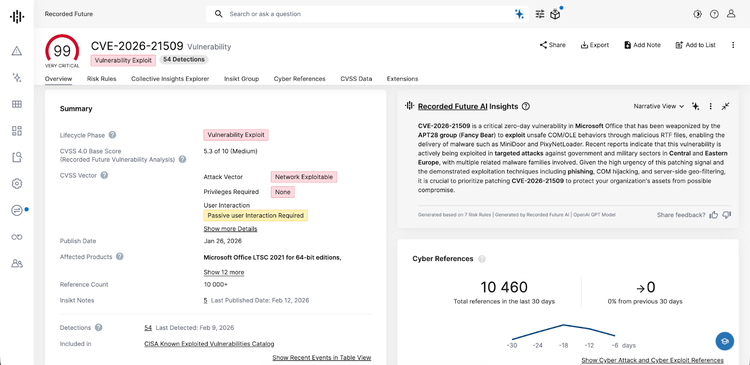
CVE-2026-21509 | Microsoft Office
Risk Score: 99 (Very Critical) | Active exploitation by APT28
Why this matters: Zero-day exploitation by Russian state-sponsored actors bypasses Office security features, enabling delivery of email collection implants and backdoors. The vulnerability stems from reliance on untrusted inputs in security decisions, allowing unauthorized attackers to bypass OLE mitigations.
Affected versions: Microsoft 365 and Microsoft Office (versions not specified in advisory)
Immediate actions:
Install Microsoft's out-of-band update released January 26, 2026
Search email systems for RTF attachments with embedded malicious droppers
Check for modifications to %appdata%\Microsoft\Outlook\VbaProject.OTM
Review registry keys: HKCU\Software\Microsoft\Office\16.0\Outlook\Security\Level, Software\Microsoft\Office\16.0\Outlook\Options\General\PONT_STRING, and Software\Microsoft\Office\16.0\Outlook\LoadMacroProviderOnBoot
Monitor for connections to 213[.]155[.]157[.]123:443 and remote connectivity to Microsoft Office CDN endpoints
Hunt for scheduled tasks named "OneDriveHealth" and suspicious files in %programdata%\Microsoft\OneDrive\setup\Cache\SplashScreen.png
Block email addresses: ahmeclaw2002@outlook[.]com and ahmeclaw@proton[.]me
Figure 1:Vulnerability IntelligenceCard® for CVE-2026-21509 in Recorded Future (Source: Recorded Future)
Why this matters: Unauthenticated attackers can reset system administrator passwords without any credentials or prior access, enabling complete administrative takeover and potential RCE through volume mount command injection.
Affected versions: SmarterTools SmarterMail prior to build 9511
Immediate actions:
Upgrade to build 9511 or later immediately
Review administrator account activity logs for unauthorized password resets
Check Volume Mounts configuration for suspicious command entries (this one IS correct for SmarterMail)
Review administrator access patterns and session logs
Audit system for unauthorized changes made with compromised admin access
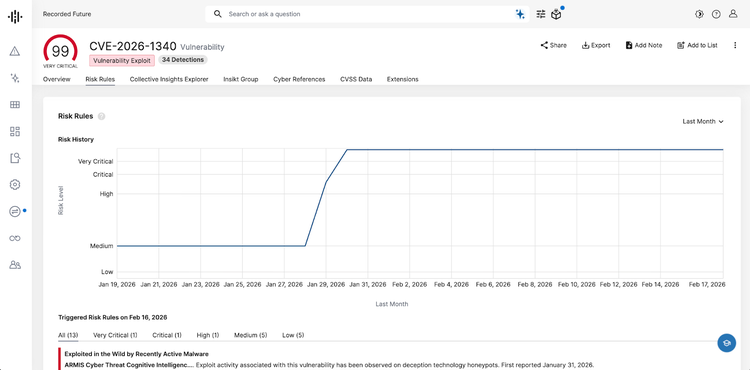
CVE-2026-1281 & CVE-2026-1340 | Ivanti Endpoint Manager Mobile
Why this matters: Pre-authentication RCE vulnerabilities in EPMM enable unauthenticated attackers to execute arbitrary code by exploiting Apache RewriteMap helper scripts that pass attacker-controlled strings to Bash.
Affected versions: Ivanti EPMM 12.5.0.0 and earlier, 12.5.1.0 and earlier, 12.6.0.0 and earlier, 12.6.1.0 and earlier, and 12.7.0.0 and earlier
Immediate actions:
Install temporary fixes via RPM packages: EPMM_RPM_12.x.0 - Security Update - 1761642-1.0.0S-5.noarch.rpm and EPMM_RPM_12.x.1 - Security Update - 1761642-1.0.0L-5.noarch.rpm
Plan migration to EPMM 12.8.0.0 (scheduled for Q1 2026 release)
Monitor for unusual Apache RewriteMap activity
Review logs for crafted HTTP parameters to app store retrieval routes
Check for unauthorized code execution attempts via RewriteRule handling
Exposure: EPMM instances accessible over corporate networks or VPN connections
Figure 2:Risk Rules History fromVulnerability IntelligenceCard® for CVE-2026-1340 in Recorded Future (Source: Recorded Future)
Technical Deep Dive: Exploitation Analysis
APT28's Operation Neusploit (CVE-2026-21509)
The multi-stage attack chain: CVE-2026-21509 enables bypass of Office OLE mitigations through weaponized RTF files:
Server-side evasion– Malicious DLL returned only for requests from targeted geographies with an expected HTTP User-Agent
Dropper variants– Two distinct infection paths deployed based on targeting:
Variant 1 (MiniDoor): Writes VBA project to Outlook, modifies registry settings to enable macro execution, forwards emails to hardcoded recipient addresses
Variant 2 (PixyNetLoader): Creates mutex asagdugughi41, decrypts embedded payloads using rolling XOR key, establishes persistence via COM hijacking
Why this matters: APT28 demonstrates sophisticated exploitation combining zero-day vulnerabilities with anti-analysis techniques, targeting government and business users for email collection and persistent access.
The authentication bypass chain: CVE-2026-23550 enables administrator-level access without authentication:
Plugin treats requests as trusted based on request-supplied indicators rather than cryptographic verification
/api/modular-connector/login flow grants access based on site connector enrollment state
If no user identifier is supplied, the code selects an existing administrative user and establishes a privileged session
CVE-2026-23800 represents the second exploitation path via REST API user creation: /?rest_route=/wp/v2/users&origin=mo&type=x
Known IoCs associated with CVE-2026-23550:
45[.]11[.]89[.]19
185[.]196[.]0[.]11
64[.]188[.]91[.]37
Known IoCs associated with CVE-2026-23800:
62[.]60[.]131[.]161
185[.]102[.]115[.]27
backup[@]wordpress[.]com
backup1[@]wordpress[.]com
Why this matters: WordPress plugin vulnerabilities enable threat actors to compromise multiple sites from a single centralized management platform, amplifying attack impact.
Backend ForcePasswordReset routine branches on client-supplied IsSysAdmin boolean rather than deriving account type from server-side context
System administrator branch performs basic checks, then sets Password directly from the supplied NewPassword
Logic fails to validate OldPassword, lacks an authenticated session requirement, and omits authorization controls
Why this matters: Complete administrative takeover without credentials enables threat actors to deploy web shells, modify configurations, and establish persistent access to mail server infrastructure.
Detection & Remediation Resources
Nuclei Templates from Insikt Group®
Recorded Future customers can access Nuclei templates for:
CVE-2025-8110 (Gogs) - Version detection and fingerprinting check
State-sponsored zero-days return. APT28's exploitation of CVE-2026-21509 demonstrates continued Russian interest in email collection and persistent access through Office vulnerabilities.
Authentication bypass dominates enterprise risk. Multiple critical flaws in SmarterMail, Modular DS, and Cisco products enable complete administrative takeover without credentials.
Legacy vulnerabilities persist. CVE-2009-0556 (Microsoft Office) highlights how threat actors continue targeting unretired systems where patching has lagged for over a decade.
Take Action
Ready to see how Recorded Future can help your team detect state-sponsored exploitation, prioritize authentication bypass fixes, and reduce enterprise attack surface? Explore our demo center for live examples, or dive deeper with Insikt Group research for technical threat intelligence.
About Insikt Group®:
Recorded Future's Insikt Group® is a team of elite analysts, linguists, and security researchers providing actionable intelligence to protect organizations worldwide. Our research combines human expertise with AI-powered analytics to deliver timely, relevant threat intelligence on emerging vulnerabilities and threat actor campaigns.
Since its full-scale invasion of Ukraine in February 2022, Russia has waged what we assess is largely opportunistic, though increasingly aggressive, hybrid warfare in NATO territory. Moscow has very likely not yet leveraged its full capability to integrate cyber, political, and sabotage tools into a full-scale campaign.
Over the next two years, Russian President Vladimir Putin will likely escalate Russia’s hybrid warfare campaign against NATO members into a full-fledged campaign likely consistent with a Russian military doctrine called New Generation Warfare (NGW). Putin will likely use this campaign to degrade NATO political unity and defense capabilities, reinforce Russia’s network of overt and covert assets across NATO, and optimize the physical and political environment, should Putin decide to launch a military incursion into NATO territory.
In a full-scale NGW campaign in NATO territory, Russia would likely move from its current pattern of influence operations efforts combined with largely opportunistic cyber and sabotage targeting to a Europe-wide campaign that is more intentionally planned and aims to project Russian power and weaken European defenses on a systemic level. An NGW campaign would very likely involve Russia using the same tactics it is currently using, including sabotage operations, influence operations, territorial waters and airspace violations, and exploitation of some NATO states’ dependence on Russian oil and gas. The primary differences between Russia’s current operations in Europe and an NGW campaign would include greater geographic breadth of those operations; greater frequency of operations; and Russia likely using tactics simultaneously and in coordinated ways. For example, likely Russia-directed threat actors might use a drone to violate the airspace over a NATO state’s airport, forcing the temporary closure of that airport, coupled with a distributed denial-of-service attack on the airport’s internal communications system. Russia might then post a video of the incidents through one of its overt or covert propaganda outlets, arguing that they show NATO cannot adequately protect its aviation network.
An NGW campaign in NATO territory would very likely have significant implications for private and public sector entities, including degradation of critical infrastructure, reputational risk for individuals and companies named in Russian influence operation campaigns, and reduced public confidence in the government’s ability to ensure their safety.
Over the next three to five years, Putin will likely evaluate the feasibility of moving from an NGW-like campaign in Europe to a kinetic military incursion. Factors Putin would likely weigh when making such a decision include NATO military capabilities, the likelihood that the US would defend a NATO state if it were attacked, and Russian military capabilities. However, even if the necessary conditions for such an operation emerge, the probability of a proactive Russian military operation into NATO territory very likely remains low.
Key Findings
Russia’s hybrid warfare campaign in NATO territory between February 2022 and January 2026 has been increasingly aggressive, but likely opportunistic and not reflective of Russia’s full cyber, influence operations, and sabotage capabilities.
Putin likely views the next two years as an opportunity to test NATO’s defensive capabilities and prepare the physical and psychological environment, should he decide to launch a military incursion. Putin likely assesses that the 2028 US presidential election could lead to a US president more willing to commit US resources to NATO. As such, Putin likely views the next two years as an opportunity to exploit existing US-NATO tensions to weaken NATO’s unity and ability to defend itself.
Russia’s escalated aggression against NATO over the next two years is likely to have the hallmarks of a Russian military doctrine called New Generation Warfare (NGW), which combines sabotage operations, cyberattacks, influence operations, and other non-military actions to undermine the enemy’s confidence and prepare the physical and psychological environment, should Russia elect to escalate into a kinetic military campaign.
A full-scale NGW campaign would likely involve an intensified campaign of tactics Russia has used against NATO in the last few years, including sabotage operations, influence operations, violations of NATO airspace with drones and jets, violations of NATO states’ territorial waters, targeting of undersea cables, and exploitation of some NATO states’ dependence on Russian gas and oil. Russia would likely deploy these tactics more frequently, across more states simultaneously, and would likely use tactics simultaneously in an attempt to strain NATO resources.
A full-scale NGW campaign would have significant implications for private and public sector entities operating in NATO territory, including disruption to critical services, reputational risk for individuals and firms named in influence campaigns, supply chain disruptions, and reduced public trust in the government’s ability to safeguard critical infrastructure. The fact that most of the critical infrastructure in NATO territory is privately owned means public-private partnerships will be essential in mitigating the impact of escalated Russian aggression.
Russia Likely to Escalate into New Generation Warfare Campaign in Europe Over Next Two Years
Since Russia’s full-scale invasion of Ukraine in February 2022, it has waged what Insikt Group assesses is largely opportunistic, though increasingly aggressive, hybrid warfare in Europe. These actions, though destructive, have very likely not leveraged Russia’s full capability to integrate cyber, political, and sabotage tools into a full-scale campaign.
Nonetheless, Russian president Vladimir Putin very likely still prioritizes weakening European unity and defensive capabilities in service to his overarching foreign policy goal of replacing the US-led international system with a multipolar world in which Russia, the US, and China are relatively equal in terms of geopolitical influence. Putin very likely judges that uneven US assistance to European defensive efforts creates a window of opportunity for Russia to weaken Europe’s ability to resist Russian aggression. Putin likely views recent US-NATO tensions, such as the US’s articulated intention to control Greenland, as an opportunity to exacerbate the strategic distance between the US and NATO, thereby weakening the transatlantic partnership that has formed the core of the US-led, post-World War II security architecture. Putin also likely views the next two years as an opportunity to optimize the physical and informational environment in Europe, should he decide to launch a kinetic military attack against Europe.
Putin very likely views this window of opportunity as finite. He likely recognizes that the 2028 US presidential election could result in a US president more willing to commit US military and political resources to amplifying Europe’s defensive capabilities. As such, over the next two years, Putin will likely escalate Russia’s hybrid warfare against Europe into an expanded campaign that is likely consistent with the principles of Russian New Generation Warfare (NGW) –– a warfare doctrine espoused by senior Russian military officials emphasizing control of the information and psychological spaces, as well as the use of undeclared special forces, to weaken an enemy prior to using traditional military forces.
Europe’s efforts to bolster its defenses against current levels of Russian hybrid warfare likely reinforce Putin’s perception that Europe is motivated to weaken Russia, thereby likely making him more motivated to target Europe. Putin’s perception that Europe’s defensive efforts are actually a threat to Russia is likely rooted in his calculus that NATO is fundamentally an anti-Russia bloc. Putin has substantiated this assessment by pointing to actions such as NATO’s expansion to include former Warsaw Pact countries and its decision to install missile defense systems in Poland.1
New Generation Warfare Origins and Principles
Insikt Group assesses that much of Russia’s aggressive foreign policy actions since the annexation of Crimea in March 2014 –– which marked the beginning of Putin’s more assertive efforts to push back against perceived Western efforts to weaken Russia –– have been consistent with NGW, a Russian doctrine in which the state aims to bring about political change in another country primarily by using overt and covert influence tools, as opposed to conventional military force. These tools can include influence operations, sabotage operations, and exploiting economic leverage.
New Generation Warfare is typically associated with Chief of the General Staff Valery Gerasimov’s 2013 article in the Russian journal Military-Industrial Kurier, though NGW is essentially a modern version of Soviet active measures. “Active measures” (aktivnye meropriyatiya) was a term used by the Soviet Union from the 1950s onwards to describe covert influence and subversion operations, including establishing front organizations, backing pro-Soviet political movements abroad, and attempting to orchestrate regime change in foreign countries. Active measures declined during the 1980s and 1990s, but Putin revived its use in the early 2000s. Indeed, in 2007, retired major-general Alexander Vladimirov alluded to that revival when he stated that “modern wars are waged on the level of consciousness and ideas” and that “modern humanity exists in a state of permanent war” in which it is “eternally oscillating between phases of actual armed struggle and constant preparation for it.”2
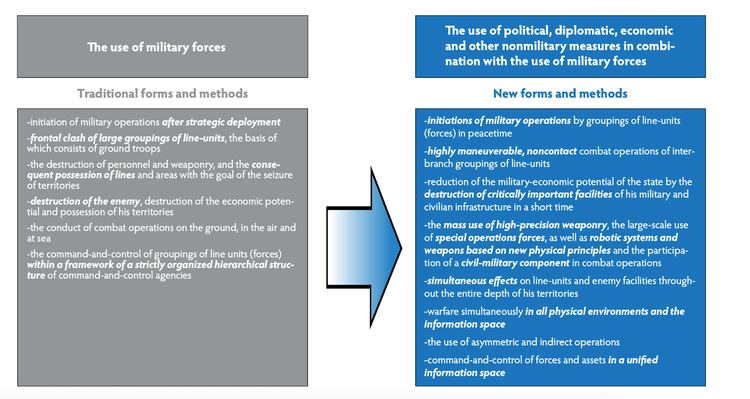
Despite the long history of Russia using active measures, Gerasimov’s 2013 article provides the most comprehensive account of how current Russian military leaders likely view this doctrine. Gerasimov’s article suggests that he views NGW both as the reality of modern warfare and as a preferred way of weakening enemies. Gerasimov argued that the Arab Spring demonstrated that modern wars are not declared conflicts between traditional militaries, but instead depend more on a combination of declared military force and tactics such as domination of the information space, targeting of critical enemy facilities, “asymmetric and indirect operations,” and the use of unofficial special forces. He argued that “the very ‘rules of war’ have changed. The role of nonmilitary means of achieving political and strategic goals has grown and, in many cases, they have exceeded the power of force of weapons in their effectiveness.”
The following table, taken from a translation of the article, shows Gerasimov’s view of traditional warfare as opposed to New Generation Warfare:
Figure 1:New Generation Warfare and traditional warfare forms and methods (Source:Military Review)
We assess that Russia’s campaign in Ukraine, starting with the annexation of Crimea in March 2014 and extending to its ongoing full-scale military operation, bears many of the hallmarks of NGW. Russia’s military operations more closely aligned with NGW principles from 2014 through 2021; after Russia’s full-scale invasion of Ukraine in February 2022, the Russian military transitioned to more traditional operations. Russia’s exploitation of influence operations and asymmetric warfare has been a feature of its operations since 2014, and since 2022, Russia has expanded asymmetric and sabotage operations in Europe likely as part of a multi-faceted strategy to use power exertion in Ukraine and Europe to weaken the Western geopolitical system.
This does not mean that Russian military leadership have consciously used NGW as their guiding principle in Ukraine at all times; indeed, we lack the insight into Russian military leadership thinking to assess with high confidence the principles they are employing. Rather, the combination of Gerasimov’s writings and observation of Russian operations in Ukraine means we can assess with medium confidence that Russia’s Ukraine operations prior to 2022 often reflected NGW principles. As such, we assess that NGW is a useful framework for understanding Russian military operations.
NGW Principle
Example of How the Ukraine Operation Exemplifies Principle
Initiation of military operations by groupings of line units in peacetime
March 2014–February 2022: Russian regular line units (Russian Airborne Forces [VDV], Naval Infantry, and Main Intelligence Directorate [GRU]-controlled unit formations) entered Ukrainian territory, annexed Crimea, and operated in eastern Ukraine without a declared state of war. In eastern Ukraine, troops operated under attempted deniability, with Moscow claiming the operations were being conducted by sympathetic Ukrainian separatist forces.
February 2022–January 2026: Though Russia acknowledged its presence throughout Ukraine, it still operates3 without a full declaration of war, instead casting its campaign as a “special military operation.”
Highly maneuverable, noncontact combat operations of interbranch groupings of line units
March 2014–February 2022: Russian battalion tactical groups (BTGs) generally demonstrated high operational mobility, integrating ground forces, artillery, electronic warfare, and intelligence, surveillance, and reconnaissance (ISR) assets.
February 2022–January 2026: As Russia has attempted to take more territory, it has transitioned to a greater emphasis on attritional, contact-heavy warfare.
Reduction of the military-economic potential of the enemy state via the destruction of critically important military and civilian infrastructure
March 2014–January 2026: Russia has consistently attempted to degrade Ukraine’s critical infrastructure, including through long-range strikes and cyberattacks targeting power plants, transportation and logistics hubs, and defense-industrial facilities.
Mass use of precision weaponry, special operations forces, and robotics systems
March 2014–January 2026: Russia has increasingly used precision weapons (for example, Iskander-M ballistic missiles, Kalibr cruise missiles, Kh-101/555 air-launched cruise missiles), GRU special operations units (including the 3rd Separate Spetsnaz Brigade and the 346th Independent Spetsnaz Brigade); and unmanned systems (such as Orlan-10, Lancet, Shahid-136 drones, and ground robots for logistics and mine-clearing operations).
Simultaneous effects on line-units and enemy facilities throughout the enemy state’s territory
March 2014–January 2026: Russia has conducted strikes across Ukraine, using frontline units, operational rear units, missile and ground attacks, and cyber operations.
Warfare simultaneously in physical and information space
March 2014–January 2026: Russia has consistently used covert and overt means to propagate narratives meant to justify intervention and regime change in Ukraine. These include allegations of Nazism in the Ukrainian military and government writ large; discrimination against Russians in Ukraine; and Western government efforts to foment revolution in Ukraine.
Use of asymmetric and indirect operations
March 2014–February 2022: Russia’s operations were indirect because they included non-acknowledged units, private military companies, and proxy forces such as Donetsk People’s Republic (DPR) and Luhansk People’s Republic (LPR) militias.
February 2022–January 2026: Russia escalated its use of asymmetric and indirect operations against Europe, including targeting undersea cables and critical infrastructure, likely to pressure Europe and Kyiv to abandon efforts to resist Russia’s Ukraine campaign.
Command and control of forces and assets in a unified information space
March 2014–January 2026: Russia has attempted to integrate its C2 structures, including shared ISR, targeting data, and operational planning, across services, and has centralized strike coordination for long-range fires.
However, limitations have been apparent in Russia’s ability to accomplish this, especially since February 2022, likely stemming from deficiencies such as poor inter-service coordination, rigid command structures, and underestimation of Ukrainian capabilities and willingness to fight.
Table 1:New Generation Warfare principles (Source: Recorded Future)
New Generation Warfare Toolkit
In a full-scale New Generation Warfare campaign in Europe, Russia would likely move from its current pattern of influence operations efforts combined with largely opportunistic cyber and sabotage targeting to a Europe-wide campaign that is both proactive and reactive. It would likely involve the same tactics Russia has used against NATO states for the past few years. The difference would likely be that Russia would deploy these tactics more frequently and across a greater number of states at once. A full NGW campaign would likely also involve using some operational methods simultaneously and in ways that amplify one another.
Even in a full-scale NGW campaign, Russia would very likely aim to keep destruction below the threshold that risks NATO invoking Article 5. NATO officials have not specified precisely what the Article 5 threshold is; indeed, former NATO Secretary General Jens Stoltenberg stated that the grounds for invoking Article 5 “must remain purposefully vague.” However, it is likely that it would include a mass casualty event or the use of a chemical or biological weapon. The text of Article 5 specifies that the threshold involves “an armed attack.” NATO officials said in 2022 that a cyberattack could constitute grounds for invoking Article 5, though they did not specify what kind of cyberattack would qualify.
Russia is likely to face few downsides during an NGW campaign, due to minimal risk of Russian casualties and the campaign’s tactical flexibility. Unlike a conventional military campaign, which risks a high level of casualties that can cause domestic public dissatisfaction, an NGW campaign very likely would involve minimal risk to Russian citizens. In addition, an NGW campaign inherently offers significant tactical flexibility, as it is not a declared campaign in which Russia needs to articulate goals to justify the campaign to the Russian public and elites. As such, Putin would likely have the option to draw down tactics that are proving less effective and increase the use of more effective tactics, without needing to justify tactical failures. This flexibility would likely allow Putin to continue at least aspects of an NGW campaign in the likely event that Europe responds to an NGW campaign with escalated efforts to counter Moscow.
Influence Operations and Propaganda
Russian “active measures” serve as a force multiplier for Moscow’s broader political warfare, integrating influence operations, propaganda, and sabotage. In Europe, these efforts aim to weaken transatlantic cohesion, erode public and political support for Ukrainian sovereignty and assistance to Kyiv, and exacerbate internal societal divisions, economic uncertainty, and other challenges. By cultivating sanctions fatigue and encouraging selective bilateral re-engagement with Russia through active measures, Moscow seeks to mitigate its international isolation and undermine the rules-based international order, thereby advancing a Russia-favored multipolar system characterized by exclusive spheres of influence. Notably, these activities also include angles of domestic preservation by portraying the West as chaotic, corrupt, and immoral, and thereby discouraging the expansion of liberal democracies elsewhere, particularly from within.
Since Russia’s full-scale invasion of Ukraine in 2022, Insikt Group has observed concentrated Russian influence operations targeting the domestic audiences of what Moscow likely views as Kyiv’s core European supporters: the UK, France, Germany, and Poland. Insikt Group investigations, in addition to public reporting, have previously identified multiple influence operations targeting the above-mentioned major European allies, including Doppelgänger, Operation Overload, Operation Undercut, and CopyCop. These influence operations have commonly impersonated national and pan-European media outlets to disseminate messages aligned with Kremlin propaganda, including anti-Ukraine themes and content that denigrates pro-European political figures. Elsewhere, Russian influence operations have sought to use fear and physical demonstrations to manipulate public opinion. In France, for example, Russia-linked physical intimidation very likely intended to provoke public anxiety and societal unrest included the Star of David and red hand graffiti, as well as the placement of caskets near the Eiffel Tower ahead of the 2024 Paris Olympic Games. Similar efforts have also appeared elsewhere in Europe, including the emergence of pro-Russian billboards in Italy and the "Children of War, Alley of Angels" exhibit in Germany.
Russian influence efforts have also leveraged illicit financing and alleged bribery to attempt to favorably reshape European politics. For example, in spring 2024, Czech authorities attributed the Voice of Europe, an organization linked to Viktor Medvedchuk, to paying politicians in several EU countries to spread anti-Ukraine messages. In September and October 2024, Moldovan police reported that a Russia-linked network, allegedly run by fugitive oligarch Ilan Shor, channeled tens of millions of dollars to buy votes ahead of Moldova’s October 20, 2024, presidential election and EU referendum. In December 2024, Romanian prosecutors conducted raids and opened probes into alleged illegal campaign financing and payments to TikTok users and influencers associated with the then-annulled presidential vote. More recently, former UK Member of the European Parliament (MEP) Nathan Gill was sentenced on November 21, 2025, after pleading guilty for accepting bribes to make pro-Russian statements.
Insikt Group assesses Russia’s NGW against Europe will likely consist of aggressive influence operations targeting Europe that aim to erode European unity and advance Russia’s quest for a multipolar world order. NGW will very likely continue supporting Moscow’s core objectives of eroding political and public support for Ukrainian sovereignty and assistance to Kyiv, accelerate sanctions fatigue, and exploit domestic political crises and election cycles to fracture European cohesiveness and transatlantic cooperation. Moscow will likely expand its reliance on access to third parties and intermediaries, including sympathetic socio-political organizations and fringe movements, to launder Kremlin-aligned messages into the European information environment.
Across Europe, Russia will almost certainly continue to attempt to delegitimize existing democratic institutions and Europe’s information ecosystem by continuing to foster distrust in elections, mainstream media, the EU, and pro-European government figures. In a post-war environment, assuming European sanctions on Russian media enterprises are lifted, Russia will very likely attempt to reestablish its state media presence while also hardening itself to withstand future disruptions, legal restrictions, and platform or government takedowns in the event of a kinetic conflict with Europe.
New Generation Warfare operations against Europe will very likely incorporate much of Russia’s current-era influence tradecraft, including social media influence via human and automated networks, media impersonation and covert media outlet brands, illicit financing and bribery, and cyber-enabled influence such as hack-and-leak narratives. Further, Insikt Group assesses Moscow will very likely continue attempting to cultivate sympathetic allies through covertly funded fringe socio-political organizations, using these entities to astroturf “grassroots” support, amplify Kremlin-aligned narratives, and catalyze or intensify domestic unrest across Europe. We assess that Russia will also adapt emerging technologies, particularly AI, to scale the production, localization, and quality of influence content, increase dissemination efficiency, and optimize targeting. Continued advances in generative AI will almost certainly improve the realism of propaganda images and fabricated reporting, forged documents and correspondence, and synthetic impersonations of public figures, including audio and video deepfakes.
Airspace Incursions by Drones and Jets
Beginning in September 2025, suspected violations of NATO airspace by Russia-directed drone operators or Russian jets increased to unprecedented levels, as Russia likely sought to project power across NATO territory and test NATO resolve while maintaining plausible deniability. Insikt Group tracked 30 suspected or confirmed violations between September 2025 and January 2026, compared to 23 suspected or confirmed violations between March 2022 and August 2025. The most commonly targeted countries since March 2022 have been Poland and Romania; however, suspected Russian violations of NATO airspace have occurred outside of Russia’s historic sphere of influence, including in Germany, UK, Denmark and Norway. Violations have most frequently targeted critical infrastructure, such as military bases and airports.
In a full-scale New Generation Warfare-like campaign in Europe, Russia likely would escalate the frequency and level of aggressiveness of these violations. Russia’s targeting would likely continue to focus on critical infrastructure, but violations would very likely significantly increase in frequency. Russia would also likely use drones to fly closer to targets and perhaps hover over them for extended periods of time, in a likely effort to test NATO’s willingness to shoot down drones and perhaps collect intelligence on critical infrastructure facilities. Indeed, in September 2025, Polish authorities said they shot down Russian drones that violated Poland’s airspace.
Other ways Russia would likely escalate the aggressiveness of its airspace violations include timing those violations with major NATO events, such as military exercises and summits. Russia could escalate its use of drones as electronic warfare mechanisms, perhaps to disrupt NATO military exercises or the functioning of critical infrastructure facilities.
Russia would likely also use its drones to amplify its psychological warfare as a way of projecting power and demonstrating to the public that Moscow can disrupt everyday life in NATO countries. Russia could do this via tactics such as hovering drones over civilian transportation infrastructure, like railways or airports, which have already been forced to temporarily close. Russia could also launch drones over facilities hosting political summits, such as the annual NATO Summit, or over polling places during elections to stoke public fear. In a full-scale NGW campaign that involves coordination of multiple tactics, Russian propaganda outlets might release footage of these incidents to propagate a narrative that NATO states cannot protect their infrastructure. Russia could also combine drone or jet violations with sabotage operations to further sow public panic and force NATO governments into a defensive posture.
Russia would very likely seek to maintain some level of deniability and would avoid airstrikes and mass casualty events, which would almost certainly guarantee an Article 5 declaration.
Territorial Waters Violations and Targeting of Undersea Cables
Insikt Group assesses that, since February 2022, Russia has increasingly used violations of NATO states’ territorial waters4 and targeting of undersea cables to test the alliance’s resilience, collect intelligence, keep NATO in a reactive, defensive posture, and attempt to deter NATO from undermining Russian strategic interests. In June 2023, Deputy Chairman of the Security Council Dmitriy Medvedev stated that, “if we proceed from the proven complicity of Western countries in blowing up the Nord Streams, then we have no constraints — even moral — left to prevent us from destroying the ocean-floor cable communications of our enemies.” Medvedev’s comments were likely purposefully hyperbolic; however, they likely reflect a Kremlin perception that NATO is targeting Russian strategic interests, thereby justifying retaliatory action.
Examples of Russia likely targeting undersea cables and maritime assets include an April 2025 incident in which the UK identified Russian sensors attempting to collect intelligence on UK nuclear submarines and other underwater critical infrastructure; the Russian Yantar surveillance ship sailing near cables carrying data for Google and Microsoft under the Irish Sea in November 2024; and reports suggesting that the Russian Eagle S ship accused of damaging multiple undersea cables in December 2024 carried spy equipment to monitor naval activity.
Russian ships have also violated NATO states’ territorial waters, likely to test NATO resilience, force NATO into a defensive posture, and project power. Examples include a July 2025 incident in which a Russian border guard vessel entered Estonian territorial waters without permission; a July 2024 incident in which a Russian naval vessel entered Finnish territorial waters without authorization; and frequent encounters between NATO states and Russia-linked “shadow fleet” vessels. These vessels are tankers sailing under other flags, which often refuse inspection or orders from local navies.
During a full-scale New Generation Warfare campaign against NATO, Russia likely would escalate its targeting of undersea cables and violations of territorial waters. This could include more frequent cable targeting, likely to cause minor but persistent damage to undersea critical infrastructure that tests NATO resilience and Russian destructive capabilities without provoking an Article 5 declaration. Russia could also conduct electronic jamming operations during cable repairs to inhibit communications and use Russian ships to harass those conducting repairs.
Russia would also likely attempt longer and more provocative territorial waters violations, including placing Russian ships near NATO vessels and expanding these activities into areas such as the Mediterranean; conducting concurrent hybrid activity such as GPS jamming and automatic identification system (AIS) spoofing; refusing escort out of territorial waters; and combining territorial waters violations with airspace violations by Russian aircraft or targeting of undersea infrastructure.
Russia would likely aim to overwhelm NATO’s existing efforts to prevent sabotage of undersea infrastructure. In January 2025, Allied Joint Force Command Brunssum (JFCBS) launched Baltic Sentry — a campaign that uses tools such as frigates, maritime patrol assets, and naval drones to deter sabotage of undersea infrastructure. Since the launch of Baltic Sentry, the Baltic Sea has experienced very few undersea sabotage efforts; however, it is not clear whether this is the result of Baltic Sentry or a lack of planned operations.
Sabotage Operations
We assess Russia has escalated its use of sabotage operations in NATO territory since its full-scale invasion of Ukraine in 2022, likely to test the resilience particularly of NATO states’ critical infrastructure; propagate a narrative that Western states cannot protect their populations from threats; harm NATO’s ability to collectively respond to Russian aggression by forcing NATO into a reactive, defensive posture; and degrade NATO states’ ability to provide material support to Ukraine. Sabotage operations are loosely defined, but typically consist of targeting civilian or dual-use infrastructure with physical security attacks by deniable entities.
Particularly since 2022, Russia-linked entities have focused sabotage operations on critical infrastructure in NATO states, exploiting vulnerabilities wrought from deferred maintenance and lack of sufficient public or private investment in upkeep. Within critical infrastructure, the most frequently targeted sectors include undersea telecommunication and power cables; water supply and distribution; transportation; military; healthcare; and telecommunications. The number of Russian sabotage operations has quadrupled from 2023 to 2024, and in 2025, it was likely at levels consistent with 2024. Operations have occurred across NATO, as opposed to being focused in Russia’s historic sphere of influence. That said, the most commonly targeted states between January 2018 and June 2025 were Germany, Estonia, Latvia, Lithuania, and Poland.
In a New Generation Warfare-like campaign targeting NATO territory, Moscow would likely move from what we assess has thus far been largely opportunistic sabotage to operations with more consistency and geographic breadth, and that complement other tactics.
Russia would likely still focus its sabotage operations on critical infrastructure, but would likely place a premium on damaging the critical infrastructure of NATO states that either would be probable targets of a Russian military incursion — such as Poland or the Baltic states — or would lend significant assistance to those states, such as the UK, Germany, or France. This is because in an NGW campaign, Russia would likely view sabotage operations as, in part, a way to test the resilience of potential victim states and their allies. Russia’s sabotage operations against those targets would likely be more frequent and could coincide with significant events such as elections or military exercises. Russia would likely pair sabotage operations with other tactics, such as offensive cyber operations or airspace violations, to augment the destructive impact of the operations and try to strain NATO states’ capacity by forcing them to respond to multiple disruptions at once, while still staying below the threshold that would risk an Article 5 declaration.
Offensive Cyber Operations for Disruption and Counterintelligence
Russian cyber activity directed at European targets has consistently emphasized access-oriented operations, including attacks on internet-facing firewalls, virtual private networks (VPNs), email services, and web portals. This activity aligns with documented Russian cyber practices focused on enabling intelligence collection, operational reach, and long-term flexibility rather than immediate disruptive effects. Recent Insikt Group reporting highlights BlueEcho activity targeting perimeter infrastructure to establish footholds and enable follow-on credential capture and lateral movement, while BlueDelta campaigns demonstrate sustained credential harvesting at scale using impersonated Microsoft Outlook Web App (OWA), Sophos VPN, and Google login workflows. This tradecraft is low-cost, repeatable, and consistent with long-term counterintelligence targeting of government, defense, and research entities.
Russian cyber activity affecting Europe has been broad in scope, with targeting observed across multiple regions and sectors. If cyber operations were used for more overtly disruptive purposes, effects would likely be more pronounced in states with weaker cybersecurity maturity or slower coordinated response mechanisms, such as fragmented local-government IT environments or limited national incident response surge capacity. This does not preclude activity against major NATO states, where Russian cyber operations have historically focused more heavily on intelligence collection and access. BlueDelta’s targeting of NATO-aligned and defense-related organizations reflects continued Russian interest in strategically valuable European targets aligned with GRU intelligence requirements.
Observed Russian cyber activity also provides insight into how operations could escalate if strategic conditions were to change and Russia were to launch a full-scale NGW campaign. Russian threat actors have demonstrated the ability to establish and maintain access over time, including through persistent connections and tunneling, which could be repurposed to degrade remote access services, manipulate edge-device configurations, or cause temporary service disruption. In Ukraine, cyber activity has been observed alongside influence operations and physical sabotage, including Recorded Future–tracked influence campaigns such as CopyCop, which leveraged automated content replication and spoofed media infrastructure to amplify pro-Russian narratives in parallel with other forms of hybrid activity. If applied elsewhere, similar coordination could increase pressure on incident response capabilities and undermine public confidence in the reliability of essential services. Credential-harvesting operations further provide pathways beyond inbox access, including potential compromise of identity providers, VPN portals, and privileged administrative portals.
Russian cyber operations have historically involved establishing and maintaining access to targeted networks over extended periods, a pattern also documented in prior campaigns in Ukraine. However, there is no public evidence demonstrating that the access currently observed in European networks is intended for future disruptive operations. If a kinetic conflict were to escalate in Europe, Russia would likely seek to expand or prioritize access within relevant networks to support intelligence collection, operational coordination, or potential disruption. Russia also has a documented history of tolerating or leveraging cybercriminal activity alongside state-directed operations, including overlap with criminal infrastructure and access brokers, which may allow operators to expand scale, complicate attribution, and generate disruptive effects without overtly exposing state-linked capabilities. Collectively, activity associated with BlueAlpha, BlueDelta, BlueEcho, Sandworm, and Dragonfly illustrates Russia’s ability to scale cyber operations from access and intelligence collection toward disruption if strategic conditions were to change, consistent with broader hybrid and New Generation Warfare practices.
Exploitation of European Dependence on Russian Oil and Natural Gas
Russia has long exploited other states’ dependence on its natural gas and oil to exercise leverage over them, typically by strategically decreasing supply flows, particularly during high-demand periods, such as winter. For example, in 2006, Georgia accused Russia of intentionally cutting gas supplies during an unusually cold period to increase political pressure on Tbilisi. In the run-up to Russia’s full-scale invasion of Ukraine in February 2022, Russian state gas company Gazprom reduced natural gas deliveries to Europe, likely in an effort to pressure Europe into abandoning a unified stance on supporting Ukraine.
Since 2022, many NATO states have sought to reduce their dependence on Russian natural gas and oil; however, several states remain dependent, including Slovakia, Hungary, and Türkiye. In a full-scale New Generation Warfare campaign in Europe, Russia would very likely escalate its exploitation of those states’ dependence on Russian energy imports to demonstrate Moscow’s ability to degrade European critical infrastructure, undermine NATO unity, gauge the resilience of these states’ critical infrastructure, and test Russia’s ability to handicap critical infrastructure, should Putin decide to launch a military incursion into NATO territory.
Moscow’s willingness to exploit these states’ dependence on Russian energy likely varies by state. Moscow is less likely to exploit Hungary’s dependence on Russian oil and gas, given Budapest’s strong relations with Russia. Slovakia is a more likely target, as it seeks a positive relationship with Moscow, but is likely of less strategic importance to Russia than Hungary. Moscow’s relations with Türkiye have fluctuated between positive and adversarial; the likelihood of exploiting Türkiye’s dependence on Russian energy imports would likely depend, in part, on how positive the overall Russia-Türkiye relationship is at that time.
Escalation of economic critical infrastructure targeting would likely take the form of both more frequent and more geographically broad operations, particularly during high-demand periods such as the winter and perhaps during NATO military exercises or elections. Russia could also escalate its use of pricing manipulation to punish states that work against Russia’s strategic priorities in Ukraine, and reward pro-Russia states such as Hungary.
Russia would also likely combine supply cuts with sabotage operations. For example, in 2006, Moscow cut gas supplies in Georgia at the same time it sabotaged an electricity line. Following a successful operation, pro-Russia propaganda outlets would likely amplify narratives that claim European critical infrastructure is weak and vulnerable, and that this demonstrates the inadequacy of democracy and the Western political system writ large at fulfilling basic public needs.
In a New Generation Warfare campaign against Europe, Russia would be unlikely to seek permanent damage to European critical infrastructure or mass civilian harm from disruption of energy flows. Russia would also likely avoid long-term disruption of oil and gas deliveries to limit the financial impact, since oil and gas revenues comprise roughly 25% of Russia’s annual federal revenue.
Indicators of NGW Campaign in Europe, Implications for Public and Private Sectors, and Recommended Mitigations
Tactic: Influence Operations
Indicators of NGW Campaign
Increased convergence of narratives across propaganda outlets, including state media, inauthentic social media accounts, and so on
Parallel narratives tailored to each country or region
Implications for Public and Private Sectors
Public Sector: more pronounced political polarization; reduced public trust in government competence
Private Sector: brand damage if firms are targeted in influence operation (IO) campaigns; employee or executive harassment or doxxing
Recommended Mitigations
Ensure communication response protocols are in place, such as rapid rebuttal measures
Ensure information environment monitoring is attuned to Russia-nexus narratives so inauthentic behavior can be detected quickly
Tactic: Airspace Incursions by Drones and Jets
Indicators of an NGW Campaign
More frequent incursions that last longer and target strategic sites such as military training grounds, critical infrastructure nodes, and so on
Incursions are conducted at lower altitudes, with transponders turned off
Violations are clustered around NATO decisions or major military exercises
Implications for Public and Private Sectors
Public: forced closures of critical infrastructure sites during airspace violations, thereby disrupting operations, as well as likely escalation of public alarm and potential decrease in public confidence in the government’s ability to keep critical infrastructure safe
Private: business operation disruptions due to critical infrastructure closures
Recommended Mitigations
Strengthen counter-measures against unmanned aircraft systems (UASs) around critical sites
Ensure joint civil-military air incident protocols are in place, including aviation alerts and Notice to Airmen (NOTAM) coordination
Improve GPS resilience
Tactic: Territorial Waters Violations and Targeting of Undersea Cables
Indicators of an NGW Campaign
More frequent territorial waters violations
Violations by state-linked vessels
Non-compliance with escort or hails; risky maneuvering around NATO state vessels, perhaps to provoke potential collisions
Increased loitering of suspicious vessels near cable routes and landing areas
Repeated “anchor drag” incidents
Interference with repair ships
Simultaneous cyber activity against telecommunications and energy operators
Implications for Public and Private Sectors
Public: intermittent communications degradation; potential harm to energy infrastructure
Private: major potential operational losses for telecommunications, finance, and other key sectors; potential increases in insurance costs for shipping companies, should territorial waters violations at ports become common
Recommended Mitigations
Consider mapping alternative sea routes in case primary routes are disrupted; consider rapid reroute contracts
Ensure sufficient port and state coordination
Ensure physical hardening at cable landing sites
Expand Baltic Sentry efforts to other locations
Tactic: Sabotage Operations
Indicators of an NGW Campaign
More frequent operations, including arson, vandalism, explosions, and rail disruptions
Targeting of high-priority sites, such as military logistics hubs, defense suppliers, and so on
Targeting of civilian sites, such as shopping malls or residential neighborhoods
Concurrent operations in multiple geographic regions, suggesting intentional planning
Combined sabotage operations and airspace or territorial waters violations
Implications for Public and Private Sectors
Public: potential reduction in public confidence in government’s ability to protect critical infrastructure and residential areas; in the event of significant escalation in sabotage operations, emergency services could be strained
Private: facility damage or loss; threat to worker safety; supply chain interruption; business interruption; reputational liability
Recommended Mitigations
Expand insider threat and contractor vetting at critical infrastructure sites
Ensure physical security measures are in place, including perimeter detection, anti-drone measures, camera coverage, and access control
Enhance public-private partnerships, as most of the critical infrastructure NATO relies upon is commercially owned
Ensure rapid liaison channels with law enforcement and intelligence services
Tactic: Offensive Cyber Operations
Indicators of an NGW Campaign
Campaigns that target strategic pressure points, such as logistics and transportation hubs, defense supply chains, and local government entities
Intrusion and distributed denial-of-service (DDoS) activity spikes at politically significant moments, including elections, military exercises, or geopolitical summits
Campaigns that blend state and proxy activity, such as hacktivist DDoS campaigns that amplify Kremlin-aligned narratives
Coupling of multiple tactics, such as cyber and influence operation hybrid campaigns
Implications for Public and Private Sectors
Public: DDoS and ransomware campaigns can undermine public confidence in the reliability of institutions; compromise of government narratives can result in less public confidence in the truth of government messaging; even attempted election manipulation can reduce confidence in voting systems
Private: elevated risk of disruption of key logistics, transport, rail, and aviation systems; hack and leak operations pose risk to reputation, personally identifiable information, and intellectual property rights; targeting of critical infrastructure can result in operational disruption
Implement conditional network access based on geopolitical and risk factors
Patch for commonly exploited software
Reduce exposure (lock down admin portals; restrict by IP address; remove unused services)
Use DDoS protection, autoscaling
Coordinate with the national computer emergency response team (CERT) and National Counterintelligence and Security Center (NCSC), as well as upstream providers; rehearse continuity plans
Require multi-factor authentication (MFA) and logging parity from third-party providers; segment privileged access; monitor for abnormal remote management activity
Tactic: Leveraging Economic Dependence
Indicators of an NGW Campaign
Supply manipulation, including threats or actions to raise price volatility
Exploitation of legal measures, including sudden contract disputes or claims of force majeure
More frequent cessation of oil and gas supplies, especially during high-demand periods such as winter
Implications for Public and Private Sectors
Public: higher energy bills and supply disruption, potentially leading to public dissatisfaction
Private: price shocks, supply uncertainty, costs related to resolving alleged contract disputes
Insikt Group has observed continued trends of growth and increased activity of threat actors leveraging and exploiting cloud infrastructure to broaden the number of victims they target and infect. Recent reporting across the observed incidents shows that cloud-focused threats are converging on a few consistent patterns, which serve as the main sections of this report:
Exploitation and Misconfiguration
Cloud Abuse
Cloud Ransomware
Credential Abuse, Account Takeover, and Unauthorized Access
Third-Party Compromise
Across cases, initial access frequently comes from vulnerable or misconfigured services exposed to the internet — including application delivery controllers, monitoring dashboards, email security gateways, and enterprise resource planning (ERP) platforms — as well as stolen or weakly governed credentials sourced from public leaks, compromised developer workstations, and socially engineered helpdesk workflows. Once inside a targeted environment, threat actors systematically pivot through hybrid identity and virtual private network (VPN) infrastructure, targeting directory-synchronized accounts, non-human and executive identities, and privileged cloud roles to gain tenant-wide administrative control.
Post-compromise activity is characterized by heavy use of built-in cloud and SaaS functionality: enumerating and exfiltrating data via native storage and backup services, destroying or encrypting cloud backups and snapshots for impact, manipulating static frontends and continuous integration/continuous deployment (CI/CD) pipelines to subvert trust in applications and repositories, and using mainstream platforms such as calendar services as covert command-and-control (C2) channels.
In comparison to its previous iteration, the majority of the events discussed in this report indicate that threat actors are engaging in similar threat behaviors; however, there are three specific trends that appear to have emerged since the most recent iteration:
Cloud threat actors are registering their own legitimate cloud resources for use in attack chains.
DDOS attacks are becoming less effective when targeting cloud environments, even in instances of record-breaking throughput, due to increased cloud-native capabilities for mitigating these threats.
Cloud threat actors are increasingly diversifying the types of services that they target in victim environments during an attack chain, with a notable focus on LLM and other AI-powered services hosted in cloud environments.
The trends associated with abuse indicate a shift in threat actor perception, demonstrating that threat actors are exploring the broader benefits that compromised cloud services can provide.
Insikt Group has been monitoring GrayCharlie, a threat actor overlapping with SmartApeSG and active since mid-2023, for some time, and is now publishing its first report on the group. GrayCharlie compromises WordPress sites and injects them with links to externally hosted JavaScript that redirects visitors to NetSupport RAT payloads delivered via fake browser update pages or ClickFix mechanisms. These infections often progress to the deployment of Stealc and SectopRAT. Insikt Group identified a large amount of infrastructure linked to GrayCharlie, primarily tied to MivoCloud and HZ Hosting Ltd. This includes NetSupport RAT command-and-control (C2) servers, both actor-controlled and compromised staging infrastructure, and higher-tier infrastructure used to administer operations. While most compromised websites appear to be opportunistic and span numerous industries, Insikt Group identified a cluster of United States (US) law firm sites that were likely compromised around November 2025, possibly through a supply-chain compromise involving a shared IT provider.
To protect against GrayCharlie, security defenders should block IP addresses and domains tied to associated remote access trojans (RATs) and infostealers, flag and potentially block connections to compromised websites, and deploy updated detection rules (YARA, Snort, Sigma) for current and historical infections. Other controls include implementing email filtering and data exfiltration monitoring. See the Mitigations section of this report for implementation guidance and Appendix A for a complete list of indicators of compromise (IoCs).
Key Findings
GrayCharlie, which overlaps with SmartApeSG and first emerged in mid-2023, is a threat actor that injects links to externally hosted JavaScript into compromised WordPress sites. These links redirect victims to NetSupport RAT infections delivered via fake browser update pages or ClickFix techniques, ultimately resulting in Stealc and SectopRAT infections.
Insikt Group identified a wide range of GrayCharlie infrastructure, largely associated with MivoCloud and HZ Hosting Ltd. This includes NetSupport RAT command-and-control (C2) servers, staging infrastructure made up of both actor-controlled and compromised infrastructure, as well as components of GrayCharlie’s higher-tier infrastructure used to manage its operations.
Insikt Group identified two primary attack chains associated with GrayCharlie: one in which victims encounter fake browser update pages after visiting compromised websites, and another in which they are presented with a ClickFix pop-up, a technique that has become increasingly common in 2025.
Background
GrayCharlie is Insikt Group’s designation for a threat activity group that first appeared in mid-2023 and is behind SmartApeSG, also referred to as ZPHP or HANEYMANEY. The group’s operations typically involve injecting malicious JavaScript into legitimate but compromised WordPress sites. Visitors to these sites are shown convincing, browser-specific fake update prompts (such as for Chrome, Edge, or Firefox) that encourage them to download what appears to be an update but is actually malware.
In late March or early April 2025, SmartApeSG shifted from using fake browser updates to deploying ClickFix lures, mirroring a broader trend among threat actors of increasingly adopting ClickFix.
GrayCharlie predominantly delivers NetSupport RAT; however, deployments of Stealc and, more recently, SectopRAT, have been observed in rare instances. The group’s ultimate objectives remain uncertain. Current evidence suggests a focus on data theft and financial gain, with a theoretical, but unsubstantiated, possibility that it may sell or transfer access to other threat actors.
Threat Analysis
Insikt Group has been tracking GrayCharlie for an extended period and has observed the actor’s persistent behavior since its emergence in 2023. GrayCharlie continues to conduct the same types of operations, regularly deploying large volumes of new infrastructure and adhering to consistent tactics, techniques, and procedures (TTPs), including continued use of the same infection chains and NetSupport RAT payloads. The group targets organizations worldwide, with a particular focus on the US. The following sections provide a detailed examination of GrayCharlie’s operational infrastructure and its two primary attack chains.
Infrastructure Analysis
NetSupport RAT Clusters
Insikt Group identified two main NetSupport RAT clusters linked to GrayCharlie based on factors such as TLS certificates, NetSupport serial numbers and license keys, and the timing of the activity (see Figure 1). In addition, Insikt Group identified a range of other NetSupport RAT C2 servers linked to GrayCharlie activity, but which are not currently attributed to either of the two main clusters. Insikt Group assesses that these clusters may correspond either to different individuals associated with GrayCharlie or to distinct GrayCharlie campaigns. The clusters are further described below.
Figure 1:Overview of GrayCharlie clusters observed in 2025 (Source: Recorded Future)
Cluster 1
Cluster 1 comprises NetSupport RAT C2 servers whose TLS certificates display a recurring monthly naming pattern. All servers in this cluster are hosted by MivoCloud and were deployed between March and August 2025. Notably, NetSupport RAT samples associated with the cluster’s March and April infrastructure used the license key DCVTTTUUEEW23 and serial number NSM896597, before shifting to the license key EVALUSION and serial number NSM165348 in subsequent deployments. The C2 servers associated with this cluster are listed in Table 1.
IP Address
TLS Common Name
License Key
Serial Number
194[.]180[.]191[.]51
mar5
DCVTTTUUEEW23
NSM896597
194[.]180[.]191[.]168
mar4
DCVTTTUUEEW23
NSM896597
194[.]180[.]191[.]171
mar3
DCVTTTUUEEW23
NSM896597
5[.]181[.]159[.]60
mar1
DCVTTTUUEEW23
NSM896597
194[.]180[.]191[.]17
mar2
DCVTTTUUEEW23
NSM896597
94[.]158[.]245[.]66
apr2
DCVTTTUUEEW23
NSM896597
94[.]158[.]245[.]81
apr3
DCVTTTUUEEW23
NSM896597
185[.]225[.]17[.]74
apr4
DCVTTTUUEEW23
NSM896597
194[.]180[.]191[.]189
apr1
DCVTTTUUEEW23
NSM896597
5[.]252[.]178[.]123
may5
EVALUSION
NSM165348
94[.]158[.]245[.]104
may1
EVALUSION
NSM165348
94[.]158[.]245[.]115
may2
EVALUSION
NSM165348
94[.]158[.]245[.]118
may3
EVALUSION
NSM165348
94[.]158[.]245[.]131
may4
EVALUSION
NSM165348
94[.]158[.]245[.]137
may53
EVALUSION
NSM165348
94[.]158[.]245[.]13
june2
EVALUSION
NSM165348
94[.]158[.]245[.]174
june6
EVALUSION
NSM165348
94[.]158[.]245[.]140
june1
EVALUSION
NSM165348
185[.]163[.]45[.]30
june7
EVALUSION
NSM165348
94[.]158[.]245[.]63
june3
EVALUSION
NSM165348
94[.]158[.]245[.]111
june7
EVALUSION
NSM165348
94[.]158[.]245[.]135
june5ebatquot
EVALUSION
NSM165348
5[.]252[.]178[.]23
july9
EVALUSION
NSM165348
185[.]163[.]45[.]41
july1
EVALUSION
NSM165348
185[.]163[.]45[.]61
july3
EVALUSION
NSM165348
185[.]163[.]45[.]73
july4
EVALUSION
NSM165348
185[.]163[.]45[.]87
july6
EVALUSION
NSM165348
185[.]163[.]45[.]97
july8
EVALUSION
NSM165348
185[.]163[.]45[.]130
july9
EVALUSION
NSM165348
Table 1:NetSupport RAT C2 servers linked to Cluster 1 (Source: Recorded Future)
Notably, the NetSupport RAT C2 servers in Cluster 1 are connected not only through the characteristics previously described, but also by the near-simultaneous creation of their TLS certificates. For example, the TLS certificate with the common name june5ebatquot associated with IP address 94[.]158[.]245[.]135 was generated on June 30, 2025 at 4:55:20 PM, while the certificate with the common name june6 linked to 94[.]158[.]245[.]174 was created only 20 seconds later.
Cluster 2
Cluster 2 comprises NetSupport RAT command-and-control servers whose TLS certificates typically start with two or more repetitions of “s”, followed by an “i” and a number (so “sssi3”, for example). NetSupport RAT samples linked to Cluster 2 used the license key XMLCTL and serial number NSM303008. The NetSupport RAT C2 servers typically also host an instance of the vulnerability scanner Acunetix. The C2 servers associated with this cluster are listed in Table 2. Notably, all TLS certificates associated with this cluster were created in a single batch on June 17, 2025.
IP Address
TLS Common Name
License Key
Serial Number
5[.]181[.]159[.]112
sssi3
XMLCTL
NSM303008
5[.]181[.]159[.]9
ssi1
XMLCTL
NSM303008
5[.]181[.]159[.]38
sssi2
XMLCTL
NSM303008
5[.]181[.]159[.]140
ssssi6
XMLCTL
NSM303008
5[.]181[.]159[.]143
ssssi8
XMLCTL
NSM303008
5[.]181[.]159[.]142
sssssi7
XMLCTL
NSM303008
5[.]181[.]159[.]139
ssssi5
XMLCTL
NSM303008
Table 2:NetSupport RAT C2 servers linked to Cluster 2 (Source: Recorded Future)
Of note, one NetSupport RAT C2 server (94[.]158[.]245[.]56) used a TLS certificate with the common name 23sss, created in May 2025, and was linked to a NetSupport RAT sample that carried the same license key (EVALUSION) and serial number (NSM165348) previously observed in Cluster 1.
Other NetSupport RAT C2 Servers
Insikt Group identified an additional set of NetSupport RAT C2 servers linked to GrayCharlie that did not form a distinct cluster (see Table 3). However, all the servers were hosted by MivoCloud and were associated with NetSupport RAT samples using license key and serial number combinations observed in Clusters 1 and 2.
IP Address
TLS Common Name
License Key
Serial Number
5[.]181[.]159[.]29
ssdecservicsdes
N/A
N/A
194[.]180[.]191[.]18
papichssd2
DCVTTTUUEEW2
NSM896597
94[.]158[.]245[.]153
kosmo2
XMLCTL
NSM303008
94[.]158[.]245[.]170
normvork
XMLCTL
NSM303008
5[.]181[.]159[.]62
ffdds
DCVTTTUUEEW23
NSM896597
5[.]181[.]156[.]234
wedn1
XMLCTL
NSM303008
5[.]252[.]178[.]35
scgs234123
XMLCTL
NSM303008
194[.]180[.]191[.]209
novemsdf
XMLCTL
NSM303008
5[.]181[.]156[.]244
wends4
XMLCTL
NSM303008
194[.]180[.]191[.]121
novaksuur
EVALUSION
NSM165348
5[.]252[.]177[.]120
lohsd
XMLCTL
NSM303008
5[.]252[.]177[.]15
bounce
XMLCTL
NSM303008
185[.]163[.]45[.]16
update1
XMLCTL
NSM303008
Table 3:Additional NetSupport RAT C2 servers linked to GrayBravo (Source: Recorded Future)
Staging Infrastructure
Once GrayCharlie victims land on the compromised WordPress sites, thereby satisfying the conditional logic, the payload is typically fetched from the attacker-controlled infrastructure and injected into the compromised WordPress sites. Insikt Group has identified two distinct types of staging infrastructure, each characterized by different website templates. Type 1 is modeled after “Wiser University,” and Type 2 is modeled after “Activitar.”
Type 1: “Wiser University”
The IP addresses associated with the Type 1 staging infrastructure are linked to websites impersonating “Wiser University” (see Figure 2), a fictional entity used to demonstrate Wiser, a free Bootstrap HTML5 education website template for school, college, and university websites. (As a sidenote, Oreshnik is the name of a Russian intermediate-range ballistic missile reportedly capable of speeds exceeding Mach 10.) Appendix B lists the IP addresses associated with the Type 1 staging infrastructure. All IP addresses, except for one, are announced by AS202015 (HZ Hosting Ltd).
Figure 2:Website impersonating “Wiser University” (Source: Recorded Future)
Suspected Testing Infrastructure
Although most IP addresses associated with the Type 1 staging infrastructure are announced by AS202015, as shown in Appendix B, Insikt Group also identified a small subset announced by other ASNs that host the same websites (see Table 4). On average, approximately one such IP address appears to be established each month. Notably, most of these IP addresses appear to geolocate to Russia, and the same ASNs are consistently reused within the same timeframe.
IP Address
ASN
Country
Date of Emergence
89[.]253[.]222[.]25
AS41535
RU
2025-08-29
89[.]253[.]222[.]156
AS41535
RU
2025-08-26
89[.]169[.]12[.]48
AS207957
GB
2025-07-08
185[.]231[.]245[.]158
AS202984
RU
2025-06-27
95[.]182[.]123[.]86
AS202984
RU
2025-05-19
23[.]140[.]40[.]66
AS61400
RU
2025-04-11
217[.]114[.]15[.]253
AS198610
RU
2025-04-09
45[.]153[.]191[.]245
AS198610
RU
2025-03-21
46[.]29[.]163[.]28
AS51659
RU
2025-02-06
Table 4:Additional infrastructure possibly linked to GrayCharlie (Source: Recorded Future)
Type 2: “Activitar”
Insikt Group identified an additional set of staging infrastructure, referred to as “Type 2.” The IP addresses in this cluster commonly host specific websites (see Figure 3). Insikt Group assesses that this template was sourced elsewhere and is not unique to GrayCharlie.
Figure 3:Website impersonating “Activitar” (Source: Recorded Future)
A subset of domains and IP addresses associated with Type 2 is presented in Table 5. Notably, most of the IP addresses are also announced by AS202015 (HZ Hosting Ltd), and one domain in Table 5, filmlerzltyazilimsx[.]shop, is linked to the email address oreshnik[@]mailum[.]com through its WHOIS record.
Domain
IP Address
ASN
filmlerzltyazilimsx[.]shop
79[.]141[.]163[.]169
AS202015
foolowme[.]com
144[.]172[.]115[.]211
AS14956
joiner[.]best
79[.]141[.]162[.]135
AS202015
lowi1[.]com
185[.]33[.]86[.]11
AS202015
morniksell[.]com
172[.]86[.]90[.]84
AS14956
persistancejs[.]store
185[.]80[.]53[.]79
AS59711
pomofight[.]com
45[.]61[.]134[.]76
AS14956
port4loms[.]com
194[.]15[.]216[.]118
AS197155
signaturepl[.]com
77[.]83[.]199[.]162
AS202015
yungask[.]com
91[.]193[.]19[.]220
AS202015
Table 5:Domains and IP addresses linked to Type 2 staging infrastructure (Source: Recorded Future)
Compromised Infrastructure
GrayCharlie commonly injects malicious scripts into the Document Object Model (DOM) of compromised WordPress sites using script tags. Insikt Group has identified several recurring URL patterns tied to this activity: some URLs load externally hosted JavaScript files (such as hxxps://joiner[.]best/work/original[.]js), while others call a PHP file on specific endpoints using an ID parameter (such as hxxps://signaturepl[.]com/work/index[.]php?abje2LAw). Notably, these URLs are updated over time by the threat actor, complicating detection and indicating the threat actor maintains ongoing access to a large pool of compromised WordPress installations. Appendix A lists a subset of WordPress websites infected by GrayCharlie.
Although the exact initial access vector is unknown, it is likely that the actors either purchase access, such as via malware logs containing WordPress admin credentials, or exploit vulnerable WordPress plugins. The latter remains the most frequent cause of all WordPress compromises.
Suspected Compromise of “Law Firm Acceleration Company” SMB Team
While the GrayCharlie-linked compromised WordPress sites span a wide range of industry verticals, in a few rare instances, the threat actors appear to have obtained, either through their own intrusions or via a third party, a more targeted set of WordPress domains. Specifically, at least fifteen websites belonging to US law firms were observed loading the external JavaScript hosted at hxxps://persistancejs[.]store/work/original[.]js (see Table 6).
Insikt Group assesses that GrayCharlie (or the third party GrayCharlie works with) likely compromised these websites through a supply-chain vector. One potential avenue is SMB Team, the self-described “fastest-growing law firm acceleration company,” which has supported thousands of firms across North America, according to its website, as its logo and other references appear across many of the websites listed in Table 6 (see Figure 4). Notably, credentials associated with an SMB Team email address used for a WordPress hosting platform surfaced around the same time that the domain persistancejs[.]store first began resolving. This temporal overlap suggests that the threat actors may have gained access to SMB Team-related infrastructure through the use of legitimate, compromised credentials.
Domain
Company
Country
SMB Team
bianchilawgroup[.]com
Bianchi Law Group
US
Yes
brattonlawgroup[.]com
Bratton Law Group
US
Yes
brighterdaylaw[.]com
Brighter Day Law
US
N/A
defensegroup[.]com
The Defense Group
US
Yes
dwicriminallawcenter[.]com
Benjamin Law Firm LLC
US
Yes
fisherstonelaw[.]com
Fisher Stone, P.C.
US
Yes
jarrettfirm[.]com
Jarrett & Price LLC
US
Yes
raineyandrainey[.]com
Rainey & Rainey Attorneys At Law PLLC
US
Yes
rbbfirm[.]com
Buchanan Law Group
US
Yes
rmvlawyer[.]com
The Law Office of Brian Simoneau, P.C.
US
Yes
www[.]brentadams[.]com
Brent Adams & Associates
US
Yes
www[.]cfblaw[.]com
Cohen Forman Barone, PC
US
Yes
www[.]gerlinglaw[.]com
Gerling Law Injury Attorneys
US
Yes
www[.]immigration-defense[.]com
Law Offices of Daniel Shanfield
US
Yes
www[.]schwartzandschwartz[.]com
Schwartz & Schwartz Attorneys at Law, P.A.
US
N/A
Table 6:Compromised law firm websites linked to GrayCharlie (Source: Recorded Future)
Figure 4:Website of Gerling Law Injury Attorneys (top) and SMBTeam logo (bottom) (Source:URLScan)
Notably, while an SMB Team compromise is possible, Insikt Group also assesses that the actors may have exploited a specific version of WordPress or its plugins used by SMB Team, which could explain the simultaneous compromise of all affected websites.
In some instances, the same compromised WordPress sites are compromised by multiple threat actors simultaneously. For example, bianchilawgroup[.]com was also breached by TAG-124 (also known as LandUpdate808 or Kongtuke) since at least December 2025, which used the domain vimsltd[.]com.
Higher-Tier Analysis
GrayCharlie administers its staging infrastructure primarily over SSH, though other ports are used intermittently. The group manages its NetSupport RAT C2 servers over TCP port 443. Overall, Insikt Group assesses that GrayCharlie relies extensively on proxy services to administer its infrastructure. Additionally, based on presumed browsing activity from higher-tier servers, at least some individuals linked to GrayCharlie are assessed to be Russian-speaking.
Attack-Chain Analysis
GrayCharlie has been observed using two different attack chains to deliver NetSupport RAT. The first chain uses compromised websites to distribute a fake browser update that triggers the retrieval and installation of a script-based payload; the second chain uses compromised WordPress sites and a ClickFix-style lure that copies a command to fetch and install the RAT. Both culminate in NetSupport execution from %AppData%, Registry Run key persistence, and C2 connectivity; the technical details are expanded below.
Attack Chain 1: Fake Browser Update Leading to NetSupport RAT
According to public reporting, when GrayCharlie first became active in mid-2023, it relied on fake browser updates to deliver the NetSupport RAT. Although the group later shifted to the ClickFix technique, Insikt Group observed a return to fake browser updates as early as October 12, 2025. Figure 5 provides an overview of Attack Chain 1.
Figure 5:Attack Chain 1 (Source: Recorded Future)
Website compromise and lure delivery. Threat actors modify legitimate sites to load malicious scripts that render a browser-specific “update” prompt. Selecting the prompt initiates download of a ZIP “update” package containing a primary JavaScript file alongside decoy .dat files.
User-executed JavaScript loader. The victim manually runs the .js script. The script mimics a benign browser component to reduce suspicion while silently initiating the next stage of the attack.
PowerShell staging via WScript. The JavaScript launches wscript.exe, which spawns powershell.exe. PowerShell reaches out to a remote host to fetch an obfuscated JavaScript containing encoded tasking.
Secondary payload retrieval. PowerShell decodes instructions and downloads the actual payload ZIP archive. This archive contains a complete NetSupport RAT client set, including client32.exe and required DLLs.
File deployment and execution. The archive is extracted under the user profile (for example, %AppData%\Roaming\...). client32.exe is started in the background to minimize visible indicators to the user.
Persistence establishment. A Windows Run registry key is created to automatically launch client32.exe at logon, ensuring the NetSupport RAT remains active after reboots without requiring further user interaction.
C2 readiness. With the NetSupport RAT client running on the infected host, the endpoint is prepared to establish command-and-control connectivity with the attacker's infrastructure.
Attack Chain 2: WordPress Redirects and ClickFix Leading to NetSupport RAT
As early as April 2025, GrayCharlie began using ClickFix as a secondary attack chain, consistent with industry reporting that many threat actors have adopted ClickFix techniques due to their effectiveness. Figure 6 provides an overview of Attack Chain 2.
Figure 6:Attack Chain 2 (Source: Recorded Future)
Initial delivery and redirection. Phishing emails, malicious PDFs, or links on gaming sites direct users to compromised WordPress pages that embed attacker JavaScript.
Background script and profiling. A background script loads when the site is visited, injects an iframe, and profiles the environment (such as the operating system and browser) to deliver the next stage.
ClickFix fake CAPTCHA. The page presents a fake CAPTCHA that quietly copies a malicious command to the user’s clipboard and instructs them to paste it into the Windows Run dialog (Win+R), turning social engineering into user-assisted execution (see Figure 7).
Command-driven staging. The pasted command retrieves a batch file that downloads a ZIP containing NetSupport RAT and uses PowerShell to extract it into %AppData%\Roaming\ (see Figure 8).
NetSupport RAT launch and persistence. The batch file starts client32.exe and sets a Run registry key to automatically relaunch the NetSupport RAT client at startup, establishing persistence on the endpoint.
Remote access and follow-on actions. Once connected to C2, operators can interact with the system, perform reconnaissance (for example, domain group membership queries), transfer files, execute additional commands, and potentially move laterally using access acquired from the host.
Observed Operator Activity
In October 2025, Insikt Group detonated a NetSupport RAT sample (SHA256: 31804c48f9294c9fa7c165c89e487bfbebeda6daf3244ad30b93122bf933c79c) with the C2 server 5[.]181[.]156[.]234[:]443 linked to GrayCharlie within a controlled environment. Later that day, approximately three hours later, the threat actor connected using NetSupport RAT, compressed and moved two files, and then executed group and account reconnaissance commands. The same actor returned three days later and repeated the previously observed reconnaissance commands (see Figure 9).
net group /domain "Domain COmputers"
C:\Windows\system32\net1 group /domain "Domain COmputers"
Figure 9:Reconnaissance commands (Source: Recorded Future)
When both files were compressed into a single ZIP archive and the executable was detonated, the process sideloaded a DLL identified as Sectop RAT (SHA256: 59e7e7698d77531bfbfea4739d29c14e188b5d3109f63881b9bcc87c72e9de78) with the C2 server 85[.]158[.]110[.]179[:]15847. The executable (SHA256: 5f1bd92ad6edea67762c7101cb810dc28fd861f7b8c62e6459226b7ea54e1428) was identified as “Merge XML Files”, version 1.2.0.0, developed by Vovsoft, and was signed with a digital certificate that expired on October 31, 2025.
Mitigations
Leverage the IoCs in Appendix A and Appendix B to investigate potential past or ongoing infections, both successful and attempted; Recorded Future customers can use the Recorded Future Intelligence Operations Platform to monitor for future IoCs associated with GrayCharlie.
Monitor for validated infrastructure associated with the malware families discussed in this report, including NetSupport RAT and Stealc, as well as numerous others identified and validated by Insikt Group, and integrate these indicators into relevant detection and monitoring systems.
Leverage the Sigma, YARA, and Snort rules provided in Appendices D, E, and F in your security information and event management (SIEM) or endpoint detection and response (EDR) tools to detect the presence or execution of NetSupport RAT. Customers can use additional detection rules available in the Recorded Future Intelligence Operations Platform.
Use Recorded Future Network Intelligence to detect instances of data exfiltration from your corporate infrastructure to known malicious infrastructure.
Use the Recorded Future Intelligence Operations Platform to monitor GrayCharlie, other threat actors, and the broader cybercriminal ecosystem, ensuring visibility into the latest tactics, techniques, and procedures (TTPs), preferred tools and services (for example, specific threat activity enablers [TAEs] used by threat actors), and emerging developments.
Use Recorded Future AI’s reporting feature to generate tailored reports on topics that matter to your company. For example, if you want to stay informed about activities related to GrayCharlie, you can receive regular AI-generated updates on this threat actor.
Outlook
GrayCharlie has been operating for more than two years, and despite shifts in its tactics, such as alternating between fake updates and ClickFix techniques or transitioning from SmartApe to other hosting providers like MivoCloud, the group’s core behaviors have remained consistent. Given its sustained activity, GrayCharlie is highly likely to remain active and continue targeting organizations worldwide, with a current emphasis on US entities, as indicated by Recorded Future Network Intelligence.
Insikt Group will continue to closely monitor GrayCharlie to detect emerging threats and evaluate the group’s strategic direction within the broader cybercriminal ecosystem.
China’s observed use of zero-days has declined since 2023. However, it has expanded its capacity to discover and manage vulnerabilities, signaling a continued effort toward stockpiling exploits for strategic or military advantage.
The Data Security Law (DSL) and Provisions on the Management of Network Product Security Vulnerabilities (RMSV) give the Chinese state first access and control over zero-days. Combined with government-backed competitions, incentives, and private contractors, this framework likely sustains one of the world’s largest reserves of exploitable vulnerabilities.
The creation of the Information Support Force (ISF) and Cyberspace Force (CSF) signals China’s consolidation of cyber capabilities, likely enabling more effective offensive and defensive cyber operations, with vulnerabilities likely serving as a central resource.
Defenders should adopt an “assume breach” posture and build for containment, implementing zero trust and layered defenses to limit attacker movement and impact after an exploit.
Figure 1:How China stockpiles vulnerabilities(Source: Recorded Future)
Analysis
Zero-Days as Strategic Weapons
A zero-day is a previously unknown software flaw for which no patch exists at the time it is discovered or exploited. Once weaponized, it allows adversaries to gain access, escalate privileges, or execute remote commands. These capabilities are especially effective against perimeter and enterprise systems, where a successful compromise can provide initial access and allow attackers to maintain persistence and carry out further cyber actions.
Choosing whether to disclose or keep a zero-day vulnerability is a strategic decision. Governments must balance public safety with the potential intelligence or military value of keeping the flaw secret. In the US, this process is guided by the Vulnerabilities Equities Process (VEP), which is designed to be transparent and generally favors disclosure to help maintain internet security.
China’s Vulnerability Management Regime
China’s vulnerability management system is centralized and led by the state. Its laws, incentives, and institutions work together to feed new exploits and technical capabilities directly to the government, turning software vulnerabilities into strategic assets under state control.
Mandatory Reporting
The RMSV (2021) requires that all discovered vulnerabilities be reported to the Ministry of Industry and Information Technology (MIIT) within two days and prohibits disclosure to foreign entities. The Data Security Law (DSL) and National Intelligence Law (NIL) further compel all individuals and organizations to support state security objectives, with strict penalties for non-compliance. Together, these laws grant Beijing first access and complete control over all newly discovered flaws.
Incentivizing Compliance
This legal framework is reinforced through financial and professional incentives. The China National Vulnerability Database of Information Security (CNNVD), managed by the Ministry of State Security (MSS), offers researchers and firms monetary rewards, certificates, honorary titles, and preferential access to government contracts. This system encourages compliance by making vulnerability disclosure both mandatory and materially rewarding.
Talent Development and Recruitment Pipelines
China combines strict regulations with a well-organized system for developing cybersecurity talent. Competitions such as the Tianfu Cup, Matrix Cup, and QiangWang Cup serve as key recruitment and training platforms for the state’s cyber programs. The 2024 Matrix Cup’s $2.75 million USD prize pool, nearly twice that of Canada’s Pwn2Own, highlights the size of this investment.
Private Sector Relationships
China’s private sector also plays a pivotal role. Major firms such as Qi An Xin, Huawei, Qihoo 360, and NSFocus contribute vulnerabilities and technical expertise directly to the government. Large technology companies also fund or subcontract offensive work to smaller firms, creating a dense ecosystem of start-ups engaged in exploit research and hacking services. The i-SOON leaks (2023) revealed the scale and interconnectedness of this ecosystem: The company sold hack-for-hire services and targeting platforms to government customers while subcontracting work for Qi An Xin and Chengdu 404.
From Discovery to Deployment: Operationalizing China’s Vulnerability Pipeline
This centralized vulnerability ecosystem is producing measurable results, enabling Chinese state-sponsored groups to convert vulnerability discovery into operational access at a speed and scale far beyond that seen in other national programs. A clear manifestation of this is their sustained focus on enterprise and edge technologies, including Fortinet, VMware/ESXi, and Ivanti, where access is durable and often high-privileged, and detection is limited. In 2025, China-linked groups exploited Ivanti VPN and Trimble Cityworks (1, 2) flaws as part of a long-term strategy to remain undetected within networks, expand access, and position themselves for potential critical infrastructure disruption.
China continues to expand its network of CNNVD technical support units (TSUs) and related programs, increasing its overall research base. TSUs are specialized organizations, often universities, state-linked labs, and cybersecurity firms that directly feed vulnerability research and intelligence into the national system. Since 2021, the number of TSUs has increased significantly, broadening the state’s research capacity and deepening its ability to identify and operationalize software flaws at scale.
Figure 2:Number of new CNNVD TSUs by month, June 2021 to July 2025(Source:Natto Thoughts)
Most vulnerability disclosures to affected vendors and the broader security community still originate from universities, labs, and cybersecurity firms associated with CNNVD, CNVD, and the expanding TSU network. However, even as the ecosystem grows, the overall volume of these disclosures continues to decline, indicating that a larger share of discoveries is now being routed internally rather than published. This suggests that more vulnerabilities are being withheld for state-directed use. Secrecy surrounding hacking competitions is also growing: The Tianfu Cup was not held publicly in 2024, and the 2024 Matrix Cup shared little to no details about discovered exploits. These competitions have historically been major sources of high-quality vulnerabilities, and reduced transparency further aligns with the shift away from open disclosure.
Together, these trends — the rapid expansion of TSUs, the decline in public vulnerability reporting, and the tightening secrecy around exploit-generation events — likely point to a deliberate state strategy that emphasizes centralized stockpiling and selective operational use of vulnerabilities rather than public disclosure.
Strategic Stockpiling and Selective Use
China’s reported use of zero-days declined from twelve in 2023 to five in 2024, and it is responsible for only ten of the 104 zero-day exploits identified globally so far in 2025. While this may partly reflect limited visibility into zero-day deployment and attribution, the trend may also suggest a more selective, strategic approach to when and how its zero-day capabilities are used.
Figure 3:Of the 104 zero-days identified in 2025, ten were attributed to Chinese state-sponsored threat actors (Source: Recorded Future)
Beijing’s control mechanisms under the RMSV and DSL enable it to selectively weaponize or withhold zero-days, preserving its most impactful capabilities for crises or strategic objectives. At the same time, n-day vulnerabilities — older but still unpatched flaws — remain highly effective due to inconsistent global patching.
Using these known flaws allows Chinese operators to gain access to networks and gather intelligence without revealing their zero-day exploits. Overall, this reflects a system designed for long-term preparedness rather than immediate gain.
Military Integration and Strategic Significance
China’s April 2024 military reforms introduced three new divisions within the People’s Liberation Army (PLA), including two centered on cyber and information security:
The Information Support Force (ISF), which is responsible for the security and continuity of China’s military networks, data systems, and command infrastructure
The Cyberspace Force (CSF), which is dedicated to both offensive and defensive cyber operations
Together, the two units consolidate China’s cyber and information capabilities, which were previously primarily nested under the PLA Strategic Support Force. These units form the backbone of its digital warfighting structure. The restructuring is likely to enhance Beijing’s ability to coordinate kinetic and cyber operations, with zero-days serving as key enablers and potential first-strike tools.
The future use of zero-days will depend on how China decides to pursue its geostrategic goals, such as future unification with Taiwan. However, by compromising critical networks in advance, China can secure persistent access and deploy disruptive cyber effects alongside kinetic operations, as seen in Russia’s coordinated cyber-military campaigns in Ukraine. Chinese state-sponsored Volt Typhoon activity has been widely assessed as fulfilling such a purpose.
Outlook
Increased Willingness to Use Zero-Days: As China reduces its reliance on US technology through its “Delete America” campaign, the cost of exploiting Western software will decrease, making zero-day use more attractive in future conflicts over the long term.
Expanded Pre-Positioning: Expect continued infiltration of critical infrastructure and enterprise systems through both n-day and zero-day exploits to ensure durable wartime access.
Increased N-day Use: The rapid adoption of AI-assisted coding and automation is accelerating the accumulation of software vulnerabilities. This expanding security debt — the accumulation of unpatched and unreviewed vulnerabilities — will give adversaries, including China, a broader and more persistent pool of n-day exploits to weaponize.
Evolving Contractor Ecosystem: State-aligned private firms are likely to accelerate automation and AI-assisted vulnerability discovery, thereby expanding the Chinese state’s operational stockpile of viable exploits.
Mitigations
Adopt an “Assume Breach” Posture: Implement zero-trust architectures that enforce identity and device verification at every access point. Use Recorded Future® Threat Intelligence to monitor for China-nexus infrastructure and malicious activity, feeding enriched indicators directly into security information and event management (SIEM) and security orchestration, automation, and response (SOAR) workflows.
Prioritize Edge and Enterprise Patching: Focus remediation efforts on virtual private networks (VPNs), firewalls, hypervisors, and identity platforms most commonly targeted by China-nexus threat actors. Use Recorded Future Vulnerability Intelligence to track emerging zero-day and n-day threats, prioritize patching by exploitation risk, and validate remediation across critical systems.
Detect Post-Exploitation Behavior: Use D3FEND mappings such as Process Access Pattern Analysis (D3-PAPA) and Remote Access Detection (D3-RAD) to identify stealthy follow-on actions. Combine these controls with Recorded Future Attack Surface Intelligence to identify exposed assets and verify that detection coverage extends to externally facing environments.
Secure Identities and Access: Leverage Recorded Future Identity Intelligence to detect compromised credentials that may complement exploit-based intrusions.
Risk Scenario
EnerTech Global, a European energy technology firm providing control systems and smart grid software to multiple NATO-aligned countries, becomes the target of a Chinese state-sponsored cyber campaign. Using undisclosed zero-day vulnerabilities, Chinese operators infiltrate EnerTech’s production and customer environments to gather intelligence, manipulate software updates, and pre-position for potential disruption.
First-Order Implications
Chinese threat actors exploit a zero-day in a network management or VPN appliance to gain initial access to EnerTech’s internal systems and engineering networks.
A zero-day in industrial control or software build pipelines is used to insert malicious code into firmware updates distributed to downstream customers.
Organizational Risks:
Operational: Compromise of development and production networks halts manufacturing and disrupts customer support operations.
Legal: Breach of export-control and cybersecurity regulations triggers EU and US compliance investigations.
Brand: Public confirmation of a “state-backed breach” undermines trust with government and defense customers dependent on EnerTech’s technology.
Second-Order Implications
Attackers use stolen code-signing certificates to distribute trojanized software updates to energy utilities across Europe. Collected intelligence on grid infrastructure is used to map potential disruption points for future contingency operations.
Organizational Risks:
Operational: Some utilities begin to see irregularities in their operational technology (OT) environments, including unexpected behavior in grid-monitoring tools, delayed telemetry updates, and unexplained authentication failures on systems that rely on EnerTech software.
Brand: EnerTech’s reputation deteriorates as customers and regulators question its software assurance and supply chain controls.
Legal: Disclosure of tampered software triggers international incident response coordination and potential export-license suspension.
Third-Order Implications
Persistent access enables China to remotely sabotage or disable systems during a geopolitical crisis, thereby amplifying disruption across allied power grids. Stolen intellectual property is used by Chinese competitors to replicate EnerTech’s industrial software, undercutting global market bids.
Organizational Risks:
Competitive: Loss of proprietary code and technology enables China-based competitors to dominate regional procurement markets.
Brand: Association with a high-profile critical infrastructure breach erodes long-term credibility in both commercial and government sectors.
Legal: Multinational investigations and sanctions create enduring compliance exposure and financial penalties.
Regional conflicts and weakened international institutions are driving the use of offensive cyber operations beyond the “Big Four” (China, Russia, Iran, and North Korea). Monitoring these threat actors requires organizations to proactively assess their geopolitical risk to understand where future threats are most likely to emerge.
In 2025, Recorded Future identified at least twenty actors across thirteen “non-Big Four” countries conducting cyber operations, primarily linked to regional conflicts, domestic surveillance, or foreign espionage.
Companies should closely monitor regional geopolitics and maintain strong continuity and resilience plans to protect against cyber espionage or disruptive cyberattacks.
Figure 1:Trends influencing how and why state-sponsored actors beyond China, Russia, Iran, and North Korea carry out cyber operations (Source: Recorded Future)
Analysis
Overview of Other State Sponsors of Cyber Operations
While the “Big Four” account for the majority of reported cyber threat activity, many other countries use cyber operations to advance their strategic interests. Recorded Future data shows that most observed activity outside of the “Big Four” stems from regional conflicts. Patriotic hacktivist groups, which advance state interests alongside state-sponsored espionage operations, represent the highest volume of reported activity. The degree of coordination between hacktivists and the government remains unclear and likely varies. However, their actions are included in this assessment because of their close alignment with state objectives, which means their activity correlates with interstate conflict risk.
Outside of active conflict, espionage against foreign and domestic targets continues to be a major driver of cyber operations. The most cyber-capable states invest heavily in avoiding detection and attribution, given the significant negative political consequences of exposure.
Tracking threat actors beyond the Big Four requires organizations to understand their geopolitical risk in order to anticipate where threats are most likely to emerge. Operating in certain regions or conflict zones likely increases the risk of cyber espionage or destructive attacks.
Regional Cyber Conflicts
Territorial disputes drove nearly two-thirds of observed cyber activity in 2025, according to Recorded Future data. Cyber operations focused on intelligence collection against government, defense, and other critical infrastructure. Hacktivists escalated their activity during conflicts, carrying out nuisance-level attacks amplified through influence operations. Like hacktivists, influence operations align closely with state interests during conflict, but have varying degrees of connection to the state. These activities rarely affect battlefield outcomes but are designed to signal technical sophistication or moral superiority over the adversary.
India and Pakistan
Between May 7 and 10, 2025, India and Pakistan exchanged a series of missile strikes — the most serious escalation between the two nuclear-armed countries in decades. Throughout the crisis, large volunteer hacktivist communities on both sides conducted disruptive attacks, primarily DDoS and website defacements. Pakistan-linked APT36 conducted espionage operations targeting the Indian government and other politically motivated targets, while threat actors linked to the Indian government, such as SideWinder, pursued Pakistani military targets.
Figure 2:Cyber activity between India and Pakistan spiked alongside the outbreak of armed conflict in May 2025 (Source:Recorded Future)
Influence operations intended to shape perceptions of the conflict also intensified. Influence networks amplified hacktivist claims, often overstating their impact, such as widespread reporting on Pakistani social media that hackers had shut down 70% of India’s electric grid. These operations are intended to portray their own side as more capable and their adversary as vulnerable, underscoring the importance of narrative control in conjunction with military operations.
Thailand and Cambodia
Similar to cyber engagements observed between India and Pakistan, hacktivist operations bolstered by influence campaigns significantly escalated between Thai hackers and Cambodian hackers following the May 2025 conflict. These were largely carried out by self-proclaimed patriotic hacktivist groups. Operations included DDoS attacks, website defacements, and data leak operations. More targeted hack-and-leak operations were also intended to reveal politically damaging information about the other country’s leadership. Influence operation narratives emphasized that the opposing side was the aggressor in the conflict, likely in order to garner both domestic and international support.
Morocco and Algeria
While tensions between Morocco and Algeria have not escalated into armed conflict, cyber hostilities increased significantly in 2025. In the context of these tensions, pro-Algerian hacktivists have allegedly carried out a series of high-profile attacks on Moroccan institutions, striking the National Social Security Fund, the National Agency for Land Conservation, and the Ministry of Justice. The hackers, going by JabaROOT, leaked personal and financial data of millions of Moroccan citizens, potentially exacerbating existing domestic tensions over income disparity. The cyberattacks may have been intended to demonstrate Moroccan vulnerability while maintaining a level of deniability for the Algerian government. Moroccan hacktivists responded with retaliatory data breaches against the Algerian government and education institutions.
Espionage Operations Outside of Armed Conflict
While many more countries almost certainly engage in cyber espionage, the following threat actors have been tracked attempting to collect information on targets of political significance:
While India-linked threat actors such as SideWinder and Bitter have traditionally targeted neighbors like Pakistan, Sri Lanka, and Bangladesh, espionage against European diplomatic entities increased significantly in 2024, demonstrating a broader targeting scope.
Vietnam has accelerated its development of cyber capabilities. APT32, likely linked to the Vietnamese government, has carried out operations against Chinese cybersecurity researchers as well as against internal dissidents. In the past, this group has also targeted car manufacturers, foreign governments, and others, driven by geopolitical and economic priorities.
At least two threat actor groups observed conducting espionage operations have been linked to Türkiye: Marbled Dust and StrongPity, who prioritize regional and domestic targets. In addition, a robust online community of patriotic hacktivists targets regional and international adversaries, whether historical (such as Armenia and Greece) or in modern disputes (France and Germany).
Stealth Falcon, linked to the United Arab Emirates, has been observed exploiting a zero-day vulnerability to target a Turkish defense organization. The group has been active since at least 2016, targeting government and defense organizations primarily in the Middle East and Africa.
Political and diplomatic priorities make intelligence targets predictable. Organizations should assess not only their regional exposure but also whether their industry aligns with strategic priorities, as sectors tied to national strategy are the most likely targets for espionage.
Domestic Surveillance Activity
Many states use their cyber capabilities to monitor domestic security concerns, which can include law enforcement or national security priorities, monitoring political opposition, or conducting economic espionage on behalf of a key national industry. Domestic surveillance capabilities are often supplemented with commercial off-the-shelf spyware, such as Intellexa’s Predator or Candiru’s DevilsTongue. Similar to understanding political priorities for cross-border espionage, companies should assess whether they possess data that may be of political significance to the government of a country in which they operate. States that lack sufficient oversight or legal privacy protections pose an increased risk of intrusive cyber monitoring and surveillance.
Figure 3:(Left) Graphical representation from the Insikt Group report titled Dark Covenant of the direct and indirect links between Russian Intelligence Services and individuals in the Russian cybercriminal underground; (Right) Infographic of reported cyberattack by Russian state-backed ransomware operators against German military contractors
(Source: Recorded Future)
Outlook
Cyberattacks are likely to increase as international alliances weaken: The Thailand-Cambodia and India-Pakistan conflicts demonstrate an increased willingness to use force to pursue regional goals. Deployments in multilateral peacekeeping operations decreased by 40% over the last decade, likely due to challenges in generating the necessary support for intervention. This makes it more likely that states will turn to violence to resolve disputes, as opposed to non-violent negotiations. Cyber and influence operations are becoming increasingly common features in these conflicts, serving as a low-cost means of signaling strength, shaping narratives, and imposing limited disruption.
Cyber capability build-up may follow conventional military build-up: NATO countries in Europe, as well as South Korea and Japan, are increasing their military spending. While many of these countries already have advanced cyber capabilities, they may seek to invest in more sophisticated offensive capabilities to augment conventional forces. Legal and doctrinal changes, such as in Japan and South Korea, are also laying the groundwork for a shift from a defensive cyber policy to an offensive posture.
Commercial cyber capabilities may be sought for interstate conflict: Countries seeking to gain a cyber advantage in advance of a regional conflict may turn to commercial offensive tools, similar to the growing reliance on these tools for internal law enforcement or counterterrorism operations. This reduces the barrier to entry for smaller or less technically mature states, enabling more actors to conduct sophisticated intrusions, targeted espionage, and high-impact disruption.
Mitigations
Use Recorded Future’s Geopolitical Intelligence to monitor regional conflicts and geopolitical developments for risks to international and outsourced operations.
Use Recorded Future’s Threat Intelligence to track threat actor groups and detect TTPs associated with non-Big Four countries.
Understand the risk of surveillance for personnel traveling to high-risk countries and take mitigating actions such as using alternative devices. Use Recorded Future’s Country Risk Data in the Geopolitical Intelligence module to assess surveillance and other travel risks.
Ensure continuity-of-operations plans are in place to mitigate the impacts of disruptive or destructive attacks. Use Recorded Future Analyst-on-Demand for bespoke research on how your organization might be targeted.
Figure 4:Starting with these four questions can help you understand threat actors’ motivations for targeting your organization (Source: Recorded Future)
Risk Scenario
A longstanding territorial dispute between Country A and Country B erupts into a military skirmish at the border, with risks of further escalation. Country A is home to a robust business process outsourcing industry serving some of the world’s largest international corporations.
First-Order Implications
Groups claiming to be patriotic hacktivists from both countries conduct hack-and-leak operations and website defacements. These are amplified by partisans on social media who often exaggerate the impact of these attacks.
Competitive disadvantage: Hack-and-leak operations expose sensitive internal documents, including proprietary trade secrets and embarrassing communications.
Increased surveillance risk: The conflict increases domestic surveillance activity in Country B to monitor for internal threats. International employees traveling to Country B are subject to enhanced surveillance.
Second-Order Implications
Actors claiming to be hacktivists supporting Country A escalate cyber operations, carrying out persistent cyberattacks against Country B’s electrical grid. As a result, Country B experiences rolling blackouts in the capital city.
Operational disruption: The blackouts prevent call centers from performing essential business functions, resulting in significant service delays and revenue losses for corporations worldwide.
Physical security risk: Anger over blackouts increases public support for escalating operations against Country A. The escalation of conflict increases the risk of harm to employees or the destruction of facilities.
Third-Order Implications
The United States and China become increasingly involved in the conflict between Country A and Country B, providing military, logistical, and cyber capabilities to their preferred country. The external support prolongs the conflict and increases the risk of involving neighboring countries.
Conflict escalation: With more weapons and logistical support from great power backers, fighting between Country A and Country B expands from the border to strikes further in the interior. Both military and civilian casualties increase as violence escalates.
Regional economic impact: Extended disruptions may cause international corporations to move operations to more stable regions, leading to a negative economic impact in the region.
Security teams are drowning in threat intelligence feeds. Hundreds of vendors promise comprehensive coverage, real-time alerts, and actionable insights. Yet sophisticated adversaries continue to operate undetected, incidents take weeks to scope, and attribution remains elusive.
The fundamental issue isn't quality but control. Traditional network visibility solutions force passive consumption: their alerts, their priorities, their timeline. This one-size-fits-all approach assumes threats targeting financial services match those facing critical infrastructure, or that yesterday's patterns predict tomorrow's campaigns.
Network intelligence flips this model. With global visibility spanning billions of connections across 150+ sensors in 35+ countries, you can investigate what matters to your organization using your own selectors, questions, and mission requirements.
What Network Intelligence Actually Means
Effective network intelligence requires global visibility at scale: distributed sensors across dozens of countries processing billions of packets daily, generating tens of millions of network flow records. But collection methodology matters equally. Metadata-only approaches capture source and destination IPs, ports, protocols, flow counts, and timestamps without payloads or deep packet inspection. This enables operation at internet scale while better maintaining ethical boundaries and data minimization standards.
At Recorded Future, our network intelligence capabilities provide this access to such global network traffic observations for specific IP addresses of interest. Our Insikt Group uses this same infrastructure to research 500+ malware families and threat actors. Government CERTs use these capabilities to analyze adversary infrastructure at national scale.
What This Means in Practice
Consider what changes when your security operations can query global network intelligence.
Faster SOC Triage
Your team flags a suspicious IP at 2 AM. Instead of guessing whether it's noise or the start of something worse, query the network intelligence platform. See its global communication patterns instantly. Understand whether you're looking at commodity scanning or infrastructure that's been quietly staging against targets for weeks. Internet scanner detection capabilities automatically classify the behavior and reveal specific ports targeted, web requests made, and geographic distribution. Triage in minutes, not hours.
Targeted or Opportunistic? Now You'll Know
When threats hit your industry, the first question is always: are we specifically in the crosshairs, or is this spray-and-pray? Network intelligence lets you track adversary infrastructure across your sector before it reaches your perimeter. See the pattern. Understand the targeting. Brief leadership with confidence because you're no longer guessing. You're showing them the actual traffic patterns that prove whether your organization is in the crosshairs or caught in the spray.
Fraud Infrastructure Exposed
Fraud campaigns depend on infrastructure that moves fast but leaves traces. Your selectors, run against global network intelligence, can reveal the networks behind credential stuffing, account takeover, and payment fraud before the campaign fully scales.
Attribution That Actually Holds Up
Mapping adversary infrastructure is hard. Connecting it to broader campaigns and ultimate operators is harder. Network intelligence gives you the longitudinal visibility to trace how infrastructure evolves, clusters, and connects. Administrative traffic analysis reveals patterns operators use to manage C2 infrastructure. When you identify admin flows from a common source connecting to multiple C2 servers, you're mapping the operator's pattern based on observed behavior across hundreds of global vantage points. You're turning indicators into intelligence.
Integration Into Security Workflows
Network intelligence integrates directly into existing security workflows through API access to SIEMs, SOAR platforms, and custom analysis tools. When your SIEM flags suspicious traffic, automated queries reveal global context: Is this IP conducting C2 communications? Scanning your sector specifically? Connected to infrastructure from last month's campaign? Curated threat lists reduce noise from legitimate security research while enabling early blocking of targeted reconnaissance, turning your existing tools into instruments for active investigation rather than passive alerting.
When Expertise Becomes Essential
For organizations facing persistent, sophisticated adversaries, network intelligence capabilities alone aren't sufficient. The difference between having access to global network visibility and operationalizing it effectively comes down to tradecraft.
Recorded Future's Global Network Intelligence Advisory program addresses this by pairing technical capabilities with forward-deployed analysts and embedded engineers who work directly inside your SOC or intelligence fusion center. This becomes especially critical when nation-states are mapping your critical infrastructure, when advanced persistent threats are staging for long-term access, or when attribution could influence strategic decision-making. You need the ability to investigate specific questions with global visibility and the expertise to interpret what you find.
The Compliance Framework That Enables Trust
Network intelligence operates under strict ethical and legal guidelines. All use is subject to our Acceptable Use Policy and surveillance, profiling of individuals, or political targeting is prohibited. Access is invitation-only, requiring vetting and agreement to specific terms of use.
These aren't just policies but foundational to how this capability operates. The metadata-only collection model, the data minimization approach, and the geographic distribution that prevents any single point of visibility into user communications are design choices. These constraints aren't obstacles to effectiveness but enablers of trust. They allow powerful intelligence capabilities to exist while promoting appropriate boundaries.
Moving Forward
The gap between what most security programs need and what traditional threat intelligence provides continues to widen. Adversaries operate at scale, evolving infrastructure faster than feeds can update. Internal telemetry shows only what touches your perimeter. Point-in-time observations lack the context to distinguish targeted attacks from noise.
Network intelligence addresses this gap with the ability to query global visibility using your own selectors. At Recorded Future, we've developed capabilities that operate at this scale, with the compliance framework and operational expertise to make them effective. For organizations ready to move beyond pre-packaged feeds, we're offering these capabilities to select customers through an invitation-only program.
What matters now is recognizing that your questions matter more than their answers and building security programs that reflect that reality.
The global threat landscape didn't simplify in 2025—it shattered. Geopolitical alliances strained. Criminal enterprises splintered and regrouped. State-sponsored actors shifted from dramatic disruptions to quiet pre-positioning. And as long-established norms unwound, convergence across once-distinct domains created unprecedented uncertainty.
The 2026 State of Security report delivers Insikt Group's most comprehensive annual analysis of the forces shaping global security—helping leaders reduce surprise, prioritize effectively, and act with confidence.
Uncertainty has become the operating environment for business. And this year, fragmentation is driving it.
The global threat landscape didn't simplify in 2025; it shattered. Geopolitical alliances strained. Criminal enterprises splintered under law enforcement pressure, then regrouped into smaller, faster, and harder-to-track operations. State-sponsored cyber actors shifted from dramatic disruptions to quiet pre-positioning, embedding themselves in networks and waiting. Hacktivist groups and influence networks amplified conflicts, blurring the line between genuine intrusions and perception warfare.
But here's what makes this moment dangerous: as long-established norms unwind, fragmentation is paradoxically enabling greater interoperability across domains that were once distinct. State objectives, criminal capability, and private-sector technology increasingly reinforce one another. That convergence creates uncertainty, compresses warning time, and expands plausible deniability.
Today, Recorded Future's Insikt Group releases the 2026 State of Security report, our most comprehensive annual analysis of the forces shaping global security.
Drawing on proprietary intelligence, network telemetry, and deep geopolitical analysis, this report examines how 2025's fractures are reshaping the threat environment — and what security leaders must prepare for in the year ahead.
The End of Stability as a Baseline Assumption
Figure 1:2025 redefined international relations (Source: Recorded Future)
Insikt Group has identified a major cybercriminal operation specializing in large-scale cryptocurrency theft, operating under the moniker “Rublevka Team”. Since its inception in 2023, the threat group has generated over $10 million through affiliate-driven wallet draining campaigns. Rublevka Team is an example of a “traffer team,” composed of a network of thousands of social engineering specialists tasked with directing victim traffic to malicious pages. Unlike traditional malware-based approaches such as those used by the traffer teams Marko Polo and CrazyEvil (previously identified by Insikt Group, both of which distributed infostealer malware), Rublevka Team deploys custom JavaScript scripts via spoofed landing pages that impersonate legitimate crypto services, tricking victims into connecting their wallets and authorizing fraudulent transactions. Their infrastructure is fully automated and scalable, offering affiliates access to Telegram bots, landing page generators, evasion features, and support for over 90 wallet types. By lowering the technical barrier to entry, Rublevka Team has built an extensive ecosystem of global affiliates capable of launching high-volume scams with minimal oversight.
This structure poses a growing threat to cryptocurrency platforms, fintech providers, and brands whose identities are being impersonated. Organizations that facilitate blockchain transactions, particularly fintech firms, exchanges, or wallet providers, face elevated reputational and legal risks if customers fall victim to these scams. Even if the victim’s compromise occurs outside a firm’s platform, failure to detect spoofed landing pages or fraudulent referrals can trigger consumer backlash, loss of trust, or regulatory scrutiny around customer protections and Know Your Customer (KYC) enforcement. The threat group’s agility — evidenced by its use of frequently rotating domains, targeting lower-cost chains like Solana (SOL), and exploiting Remote Procedure Call (RPC) APIs — undermines traditional fraud detection and domain takedown efforts. Their model mirrors ransomware-as-a-service (RaaS) operations, signaling a continuation of the broader shift toward scalable, service-based cybercrime that organizations must proactively monitor, disrupt, and defend against to protect customers and maintain trust.
Key Findings
The objective of a Rublevka Team scam is to create an attractive SOL-based offer, such as a promotion or an airdrop event, generate traffic to the lure via social media or advertisements, and trick a user into connecting their wallet to the website and signing a transaction that drains their wallet.
As of writing, Rublevka Team’s primary Telegram channel has approximately 7,000 members. Over 240,000 messages have been posted to Rublevka Team’s automated “profits” channel, indicating at least 240,000 successful wallet drains, with transactions ranging from $0.16 to over $20,000.
Rublevka Team offers a custom JavaScript drainer embedded into their landing pages, which exfiltrates victims’ SOL assets by draining held tokens. The drainer is compatible with over 90 SOL wallet types.
The threat group’s infrastructure is fully automated via Telegram bots, offering affiliates tools for landing page creation, campaign tracking, cloaking, and distributed denial-of-service (DDoS) protection.
The drainer campaign, active since 2023, leverages spoofed versions of legitimate services such as Phantom, Bitget, and Jito to maximize user trust and conversion
Recorded Future deployed Autonomous Threat Operations within its own SOC before customer release, ensuring real-world effectiveness and identifying critical capabilities.
Autonomous Threat Operations reduced analyst-dependent, inconsistent processes, creating standardized hunts that deliver the same input, output, and expectations every time.
Team members now run 15-20 threat hunts weekly—work that previously required days or weeks of manual research, coordination, and planning.
During the Salt Typhoon campaign, Recorded Future's CISO launched a comprehensive network-wide threat hunt in five minutes between meetings, enabling immediate risk mitigation.
A single pane of glass eliminates context-switching across multiple tools, allowing analysts to hunt threats and research IOCs within one platform.
Autonomous Threat Operations in action: Real results from Recorded Future’s own SOC team
The ultimate test of any cybersecurity solution Recorded Future builds? Using it to defend our own network.
That's exactly what we did with Autonomous Threat Operations. Before rolling it out to customers, we became Customer Zero, deploying the technology within our security operations organization to see if it could truly transform the way security teams hunt for threats.
The results exceeded our expectations. What we discovered wasn't just incremental improvement; it was a fundamental shift in what our security team could accomplish.
The challenge: Inconsistent and analyst-dependent threat hunting
Prior to implementing Autonomous Threat Operations, we faced the same threat hunting challenges many security teams struggle with today. As Josh Gallion, Recorded Future's Incident Response Manager, explains: "Before using Autonomous Threat Operations, our approach to threat hunting was more piecemeal and unique to each analyst. It varied based on whatever they were comfortable with and however they were trained on the tooling."
c4yy0f6y1p
This inconsistency meant that the quality and thoroughness of our threat hunts varied significantly by analyst. And since each team member had different strengths, different levels of experience, and different comfort levels with our security tools, we struggled to standardize the process.
The transformation: Unified, repeatable threat hunting
Autonomous Threat Operations leveled the playing field immediately. "It unifies the hunting capability and makes it so that every time analysts run a hunt, it's the same," says Gallion. "We get the same input, we get the same output, and we know what to expect."
The implementation was remarkably straightforward. "When we turned it on, it just was a simple connection to our Splunk environment," he says. "And once the team started using it, we could see an increase in the number of threat hunts each user would do."
Perhaps most importantly, Autonomous Threat Operations enabled our team to shift from reactive, manual hunting to proactive, automated operations. "Now we can schedule hunts that will continuously run over time, update with the threat actor TTPs, and give us a more holistic view," Gallion says. "Before, we had to have an analyst get back into the product and look for new IOCs to run. Now it just runs it automatically and we know that that's taken care of."
Real-world impact: Upskilling junior analysts and enabling rapid response
According to Recorded Future's CISO, Jason Steer, the true value of Autonomous Threat Operations became clear through two significant outcomes.
First, the technology dramatically upskilled our junior staff. In traditional manual workflows, preparing to run a single threat hunt could take days or even weeks—requiring extensive research, coordination, and planning.
Today, our junior analysts are running 15–20 threat hunts each week to identify high-priority threats. This isn't just about quantity; it's about empowering less experienced team members to contribute meaningfully to our defense posture while accelerating their professional development.
sn9crhxmaj
Gallion sees this impact firsthand. "We have newer analysts who can do more advanced hunting based on IOCs, and it does it for them automatically in the background,” he says. “We get our results, and then they can do research in the app to shore up the findings."
Second, the speed and accessibility of automated threat hunting has proven invaluable during critical moments. When Steer read about Salt Typhoon making its way into corporate networks, he didn't need to schedule a meeting, assemble a team, or wait for the next sprint cycle. In the five minutes between meetings, he was able to launch a comprehensive threat hunt across Recorded Future's entire network to identify and mitigate associated risks to our systems.
That kind of rapid response would have been impossible with manual processes—and in today's threat landscape, that speed can mean the difference between containment and catastrophe.
The advantage of a single pane of glass
Another key benefit emerged around workflow efficiency. "Having a single pane of glass makes it a lot easier for an analyst to do not just the threat hunt, but also to see the meaning behind the IOCs that they're pulling back into the app," says Gallion. "Analysts don't like to have to get into a whole bunch of different applications. If we don't have to, it speeds things up and we can add context from inside the app."
This unified approach has eliminated the context-switching and tool-juggling that had often slowed down our security team and led to missed findings.
Why the Customer Zero experience matters
Serving as Customer Zero validated what we believed Autonomous Threat Operations could deliver to every customer: consistent, repeatable threat hunting that empowers analysts of all skill levels to defend their organizations more effectively. By testing the new solution within our own security operations first, we were able to identify what works, refine the capabilities that matter most, and prove that Autonomous Threat Operations isn't just a theoretical improvement—it's a practical solution that transforms daily security operations.
Gallion sums it up this way: "Some of the aspects of Autonomous Threat Operations that'll have the biggest impact are the repeatability, the scheduling of threat hunts to happen over time, and the single pane of glass that allows analysts to research IOCs in the app without having to go into multiple tools."
We saw a need for Autonomous Threat Operations, so we built it. Being Customer Zero enabled us to test it, refine it, and ensure that it’s the best possible solution to help our customers enter the era of the autonomous SOC.
Learn more about Autonomous Threat Operations by clickinghere, or start operationalizing your threat intelligence now by booking acustom demo.
PurpleBravo is a North Korean state-sponsored threat group that overlaps with the “Contagious Interview” campaign first documented in November 2023. It targets software developers, especially in the software development and cryptocurrency verticals, via fake recruiter outreach, interview coding tests, and ClickFix prompts. Activity throughout 2025 has linked multiple fraudulent LinkedIn personas to PurpleBravo through malicious GitHub repositories and fictitious lure brands. The group’s tool set includes BeaverTail (a JavaScript infostealer and loader) and multi-platform remote access trojans (RATs), specifically, PyLangGhost and GolangGhost, optimized for stealing browser credentials and cryptocurrency wallet information.
Based on Recorded Future® Network Intelligence, Insikt Group identified 3,136 individual IP addresses concentrated in South Asia and North America linked to likely targets of PurpleBravo activity from August 2024 to September 2025. Twenty potential victim organizations were observed across the AI, cryptocurrency, financial services, IT services, marketing, and software development verticals in Europe, South Asia, the Middle East, and Central America. In several cases, it is likely that job-seeking candidates executed malicious code on corporate devices, creating organizational exposure beyond the individual target. Insikt Group observed PurpleBravo administering command-and-control (C2) servers via Astrill VPN and from IP ranges in China, with BeaverTail and GolangGhost C2 servers hosted across seventeen distinct providers.
Insikt Group distinguishes PurpleBravo (Contagious Interview) from PurpleDelta (North Korean IT workers) but has documented meaningful intersections. This includes a likely PurpleBravo operator displaying activity consistent with North Korean IT worker behavior, IP addresses in Russia linked to North Korean IT workers communicating with PurpleBravo C2 servers, and administration traffic from the same Astrill VPN IP address associated with PurpleDelta activity.
PurpleBravo presents an overlooked threat to the IT software supply chain. Because many targets are in the IT services and staff-augmentation industries with large public customer bases, compromises can propagate downstream to their customers. This campaign poses an acute software supply-chain risk to organizations that outsource development, particularly in regions where PurpleBravo concentrates its fictitious recruitment efforts.
Key Findings
PurpleBravo employs a combination of fictitious personas, organizations, and websites to distribute malware to unsuspecting job seekers in the software development industry. Candidates sometimes use their corporate devices, thereby compromising their employers' security.
PurpleBravo uses a variety of custom and open-source malware and tools in its operations, including BeaverTail, InvisibleFerret, GolangGhost, and PylangGhost.
Using Recorded Future Network Intelligence, Insikt Group identified 3,136 individual IP addresses linked to likely targets of PurpleBravo activity and twenty potential victim organizations in the AI, cryptocurrency, financial services, IT services, marketing, and software development industries.
Insikt Group has observed multiple points of overlap between PurpleBravo and PurpleDelta, Recorded Future’s designation for North Korean IT workers, indicating that some individuals may be active in both operations.
PurpleBravo’s heavy targeting of the IT and software development industries in South Asia presents an overlooked and acute supply-chain risk to organizations that contract or outsource their IT services work.
Traditional vulnerability management tools can no longer keep up with the speed of modern exploitation—threat context is now mandatory.
Threat and Vulnerability Management (TVM) systems unify asset discovery, vulnerability data, and real-time external threat intelligence to prioritize real risk.
Static CVSS scores fail to reflect exploitation likelihood; intelligence-driven, dynamic risk scoring is essential in 2026.
Organizations that integrate vulnerability intelligence and attack surface intelligence reduce remediation time and security waste, enhancing detection and remediation while reducing alert fatigue.
Why Threat and Vulnerability Management Must Evolve in 2026
Security teams currently find themselves at a crossroads. Year over year, CVE volumes continue to surge higher and higher. Exploitation is faster, more automated, and more targeted, meaning attacks are growing in volume, velocity, and sophistication alike. As a result, security teams are expected to “patch faster” with fewer resources and can no longer realistically keep up with this ever-rising tide of threats.
Thanks to these forces, security teams have found themselves in a state of affairs in which vulnerability management has become an exercise in sheer volume, not risk. Day in and day out, teams are overwhelmed by alerts that lack real-world context, making it all but impossible to assess the actual degree of risk.
Thankfully, there is a solution. Threat-informed vulnerability management (TVM) has emerged to counteract this trend, enabling security teams to intelligently address weaponized vulnerabilities, zero-day exploits, and supply chain and cloud-native risk. All this comes along with much-needed relief from creeping alert-fatigue.
In 2026, effective cybersecurity programs will be defined not by how many vulnerabilities they detect but by how precisely they understand, prioritize, and neutralize real threats using intelligence-driven TVM systems.
The Core Problem: Alert Fatigue and Prioritization Failure
As it stands today, the explosion in disclosed vulnerabilities (CVEs) has outpaced humans’ abilities to triage and manage patching effectively. Today, the vast majority of organizations are incapable of remediating more than a fraction of the total identified issues affecting the ecosystem.
Traditionally, using a standard CVSS (Common Vulnerability Scoring System) was enough to overcome these challenges of prioritization. CVSS is an open, standardized framework used to assess the severity of security vulnerabilities by assigning a numerical score based on factors like exploitability, impact, and scope. Organizations use CVSS scores to prioritize remediation and compare vulnerabilities consistently across systems and vendors.
However, CVSS only measures theoretical severity, not exploitation likelihood. It misses critical pieces of context for prioritization decisions such as:
Is exploit code available?
Is the vulnerability actively exploited?
Are threat actors discussing or operationalizing it?
As a result, high-severity CVEs that pose little real-world risk continue to consume time and resources, leading us back once again to the issue of alert fatigue and the inability to effectively triage and patch the most pressing vulnerabilities.
At the same time, we are seeing modern organizations struggle with a “silo problem,” in which security, IT, and CTI (cyber threat intelligence) teams operate independently and with limited visibility and collaboration between one another. In many organizations, each of these teams ends up using different tools, establishing different priorities, sharing findings infrequently if at all, and adopting entirely different “risk languages” through which they understand, prioritize, and address threats.
Taken broadly, this leaves organizations woefully lacking a unified, intelligence-driven view of risk. Without this, many adopt a de facto policy of “patch everything”. And it comes with significant costs, including:
Operational drag and burnout
Delayed remediation of truly dangerous vulnerabilities
Increased business risk despite increased effort
Fractured security operations
Both individually, and in the aggregate, these side-effects come at a significant detriment to organizational security. And as the number and diversity of CVEs continues to expand, the greater that cost becomes. Moving forward, organizations must find a better way.
The Evolving Threat Landscape Demands a New Approach
Today’s ever-changing landscape means that organizations must evolve along with it or risk falling dangerously behind. The rise of rapidly weaponized vulnerabilities (i.e., known software weaknesses that have moved beyond disclosure and into active attacker use) reflects a fundamental shift in how quickly and deliberately adversaries turn CVEs into operational threats. Today, the gap between disclosure, proof-of-concept release, and active exploitation has collapsed from months to days (or even hours), driven largely by exploit marketplaces, automated scanning, and widely shared tooling.
Attackers increasingly prioritize vulnerabilities that are easy to exploit, broadly applicable across cloud services, edge devices, and common dependencies, and capable of delivering fast returns. Once weaponized, these vulnerabilities manifest not as theoretical risk but as active intrusion campaigns, ransomware operations, and opportunistic internet-wide exploitation, making threat context essential for distinguishing true danger from background noise.
At the same time that weaponization is accelerating, attack surfaces are expanding. The average attack surface today is expanding and fragmenting across hybrid and multi-cloud environments, all of which is worsened by SaaS sprawl, shadow IT, and third-party and supply chain exposure. In this environment, it is absolutely critical that security teams have a clear understanding of vulnerabilities vs. threats, and work to establish an integrated approach between the two.
In short, a vulnerability is a technical weakness, while a threat is an actor, campaign or event at work exploiting that weakness. In order to be truly effective, modern threat vulnerability management (TVM) systems must merge both concepts to reflect real risk and separate signal from noise.
What Is Threat and Vulnerability Management (TVM)?
Threat and Vulnerability Management (TVM) — also called Threat-Informed Vulnerability Management — is a continuous, intelligence-driven process that prioritizes remediation based on three core variables:
Active exploitation
Threat actor behavior
Asset criticality
TVM differs from traditional vulnerability management (VM) in a number of critical ways. Traditional VM relies on periodic scans, static severity scoring, and a largely reactive patching process. TVM, on the other hand, employs continuous monitoring, external threat intelligence enrichment, and close-loop remediation and validation.
This continuous, context-rich approach is foundational for modern security programs. Rather than inundating security teams with decontextualized CVEs and indiscriminate patching, modern TVM systems align security efforts with attacker reality. Reactive patching is replaced with proactive, risk-based decision-making, and as a result, organizations are able to reduce noise while simultaneously increasing the impact of their security operations.
The Five Core Pillars of Modern TVM Systems
As the speed and breadth of today’s threats continue to grow, traditional VM, being fundamentally reactive in nature, is no longer enough to keep up. In a world where vulnerabilities are exposed by the day, TVM offers much-needed efficiency, intelligence, and proactiveness. However, not all TVM systems are created equally. Here are five core pillars of effective modern TVM systems to help you evaluate and assess solutions on the market.
1. Continuous Asset Discovery & Inventory
Modern TVM systems are invaluable in that they provide full visibility across the entirety of an organization’s growing and fragmented attack surface. This includes external-facing assets, shadow IT, and cloud and SaaS environments alike. By providing continuous asset discovery and a timely, up-to-date inventory of one’s assets, TVM systems allow for real-time, comprehensive, attack-surface management.
Remember, you can’t defend what you can’t see. That’s why attack surface management (ASM) is a prerequisite for effective TVM. Without accurate, up-to-date asset inventories, vulnerability data is incomplete and misleading. Continuous discovery ensures defenders see their environment the way attackers do.
2. Vulnerability Assessment & Scoring
TVM goes beyond internal scanning tools to identify vulnerabilities exposed to the internet and reassess them continuously as environments change. This includes tracking misconfigurations, outdated services, and newly introduced exposure, not just known CVEs.
3. External Threat Context Enrichment
This is where TVM fundamentally diverges from legacy approaches. External threat intelligence enriches vulnerability data with insight from dark web and criminal forums, exploit marketplaces, malware telemetry, and active attack campaigns.
Vulnerabilities are mapped to known threat actors, active exploitation, and MITRE ATT&CK® techniques, ultimately transforming raw findings into actionable intelligence.
4. Risk-Based Prioritization (RBVM)
Risk-based vulnerability management prioritizes issues based on the probability of exploitation, asset importance, and threat actor interest. This shifts the focus from “most severe” to “most dangerous,” enabling teams to address the vulnerabilities that pose the greatest immediate risk to their organizations.
5. Automated Remediation & Verification
Modern TVM integrates directly with IT and SecOps workflows, pushing prioritized findings into ticketing and automation platforms. Just as importantly, it verifies remediation to confirm that patches were applied and exposure was actually reduced, creating a continuous feedback loop.
These five pillars of effective TVM systems come together to create a whole that is greater than the sum of its parts. These systems, unlike their predecessors, are designed to continuously monitor and triage real threats and vulnerabilities in context and ensure awareness and proactive mitigation without the risk of burn-out and alert fatigue.
Stop Patching Everything — Use Intelligence to Prioritize Real Risk
The scale of the CVE problem is overwhelming. Tens of thousands of vulnerabilities are disclosed each year, yet only a small fraction are ever exploited in the wild. Treating them all as equally urgent is not just inefficient — it’s dangerous.
Vulnerability intelligence changes the equation by tracking a CVE across its full lifecycle, from initial disclosure to weaponization, exploitation, and criminal adoption. This enables dynamic risk scoring that reflects real-world conditions rather than static assumptions.
Dynamic risk scoring incorporates evidence of active exploitation, availability of exploit code, dark web chatter, and threat actor interest. As conditions change, so does the risk score, ensuring prioritization remains aligned with attacker behavior.
The operational impact is significant. Security teams can focus remediation on the top 1% of vulnerabilities that pose immediate risk, respond faster, reduce operational cost, and strengthen overall security posture.
See Your Risk Like an Attacker: The Full Attack Surface View
In today’s threat landscape, security teams must recast the way they envision their roles. Rather than operating in a reactive, defensive manner at all times, security teams should think more like their adversaries, taking a complete view of their attack surface and leveraging modern tools and technologies to ensure intelligent, prioritized defenses. The following three key concepts will help you take on that mentality.
The Visibility Gap: Unknown assets create unknown risk. Traditional scanners often miss orphaned domains, misconfigured cloud services, and forgotten infrastructure — precisely the assets attackers look for first.
Attack Surface Intelligence Explained: Attack surface intelligence provides continuous mapping of domains, IPs, cloud assets, and external services. It identifies exposures attackers see before defenders do, enabling proactive remediation rather than reactive cleanup.
Connecting the Dots with Vulnerability Tools: When integrated with vulnerability scanners like Qualys and Tenable, attack surface intelligence provides a unified, prioritized view of exposure. Intelligence-driven platforms serve as a single source of truth for risk decisions, enabling teams to connect vulnerabilities to real-world exposure and threat activity.
Three Strategic Recommendations for Security Leaders
Most organizations remain behind the curve in threat and vulnerability management. Knowing what we know now, there are three strategic steps security leaders can take to reclaim control.
1. Bridge the Gap Between Security and IT
Establish a shared, intelligence-driven risk language. Align SLAs with real-world risk rather than raw severity scores, ensuring remediation efforts focus on what matters most.
2. Embrace Automation and Workflow Integration
Push prioritized findings directly into platforms like ServiceNow and SOAR tools. Reducing manual handoffs accelerates remediation and minimizes delays.
3. Measure What Matters — Time-to-Remediate (TTR)
Shift KPIs toward time-to-remediate actively exploited vulnerabilities and reduction in exposure windows. These metrics demonstrate real ROI and security impact.
The Path Forward Is Threat-Informed: Strengthen Your Threat and Vulnerability Strategy
Volume-based vulnerability management is no longer viable. As we progress through 2026, threat context is not optional. It is foundational.
Future-ready security programs are intelligence-led, automation-enabled, and attacker-aware. Recorded Future sits at the center of this shift, providing the intelligence backbone required to move from reactive patching to proactive risk reduction.
Explore how Recorded Future Vulnerability Intelligence and Attack Surface Intelligence can help your organization transition from alert-driven vulnerability management to intelligence-driven risk reduction.
By unifying threat intelligence, vulnerability data, and attack surface visibility, organizations can reduce alert fatigue, prioritize what truly matters, and proactively harden defenses against real-world threats before attackers exploit them.
Frequently Asked Questions
What is the primary difference between a Vulnerability and a Threat?
A Vulnerability is a weakness or flaw in an asset (e.g., unpatched software, misconfiguration) that could be exploited. A Threat is a person, group, or event (e.g., a threat actor, a piece of malware) that has the potential to exploit that vulnerability to cause harm.
What is the biggest challenge facing traditional vulnerability management programs today?
The biggest challenge is alert fatigue and prioritization noise. Traditional programs generate an overwhelming number of vulnerabilities, often relying only on the technical severity score (like CVSS). This leads security teams to waste time patching low-risk flaws while critical, actively exploited vulnerabilities remain unaddressed.
Why is integrating external threat intelligence mandatory for TVM in 2026?
External threat intelligence provides real-time context on the threat landscape. These days, it’s mandatory because it allows security teams to identify which vulnerabilities are being actively exploited in the wild, have associated proof-of-concept (PoC) code, or are being discussed on the dark web, enabling true risk-based prioritization.
How does Recorded Future Vulnerability Intelligence help with prioritization?
Recorded Future Vulnerability Intelligence automatically assigns a dynamic Risk Score to every CVE by correlating it with real-time threat intelligence from across the internet, including evidence of active exploitation, malware associations, and dark web chatter. This lets teams instantly know if a vulnerability is a theoretical risk or an immediate, active threat requiring urgent attention.
What is Attack Surface Intelligence, and what role does it play in TVM?
Attack Surface Intelligence is the continuous process of identifying and monitoring all external-facing assets of an organization (like public IPs, domains, and cloud services). In TVM, it is crucial to ensure that vulnerabilities are not just identified on known assets, but also on shadow IT and unknown exposed systems that are most likely to be targeted by adversaries.
How does the TVM lifecycle differ from the traditional vulnerability management lifecycle?
While both involve Discovery, Assessment, and Remediation, the TVM lifecycle adds an explicit Threat Analysis step before prioritization. The modern TVM cycle is typically:
Effective ransomware detection requires three complementary layers: endpoint and extended detection and response (EDR/XDR) to monitor device-level activity, network detection and response (NDR) to catch lateral movement, and threat intelligence tools to provide context that enables efficient prioritization.
The most valuable detection happens before ransomware encryption begins. Tools must identify precursor behaviors like reconnaissance, credential theft, and data staging rather than waiting for known indicators of compromise.
Intelligence quality determines detection quality: even sophisticated security tools require real-time threat data about active ransomware campaigns, attacker infrastructure, and current tactics, techniques, and procedures (TTPs) to distinguish genuine threats from noise.
Recorded Future strengthens the entire detection stack by providing organization-specific threat intelligence, early detection capabilities (in some cases, identifying victims up to 30 days before public extortion), and vulnerability intelligence focused on what ransomware groups are actively exploiting.
Introduction
The ransomware playbook has fundamentally changed. Instead of casting wide nets with opportunistic phishing campaigns, attackers now focus on big-game hunting: targeting high-value enterprises with data theft and double or triple extortion tactics. Threat actors purchase pre-compromised access from brokers, exploit newly disclosed vulnerabilities within hours, and use automation to compress weeks-long campaigns into days.
The results are stark. Ransomware now appears in 44% of breaches, up from 32% the prior year, according to the 2025 Verizon Data Breach Investigations Report. Traditional signature-based detection tools often can't keep pace because ransomware groups continuously rotate their infrastructure, modify malware variants, and adopt new tactics faster than defenses can update. By the time a signature is written, the threat has already evolved.
This gap has created demand for a different approach: intelligence-driven ransomware detection. Rather than waiting for known indicators of compromise, these tools identify the precursor behaviors that happen before encryption (e.g. reconnaissance, credential theft, lateral movement, privilege escalation, and data staging).
The key is continuous external intelligence that maps what's happening in your environment to active campaigns and specific ransomware families operating in the wild.
The most effective defense combines three layers: endpoint and extended detection and response (EDR/XDR) to catch suspicious behaviors on devices, network detection and response (NDR) with deception technology to spot lateral movement, and threat intelligence tools that provide the real-time context tying it all together. When these tools share a common intelligence foundation, they can reveal malicious intent well before encryption begins.
The Ransomware Detection Tool Landscape: Three Pillars of Defense
Effective ransomware detection generally requires three complementary tool categories, each targeting different stages of an attack.
1. Endpoint and Extended Detection and Response (EDR/XDR) Tools
EDR and XDR platforms form the first line of defense, monitoring individual devices and user activity for signs of compromise.
Core Functionality
EDR and XDR solutions monitor endpoints for suspicious behaviors like privilege escalation, credential dumping, unusual process creation, and bulk file modifications. When they detect threats, these tools automatically isolate devices, roll back changes, and contain threats, cutting response time from hours to seconds.
How Threat Intelligence Enhances EDR/XDR
Threat intelligence connects endpoint activity to active campaigns in the wild. When an EDR tool flags suspicious activity, intelligence context reveals whether it matches known campaigns from groups like LockBit, ALPHV/BlackCat, or BlackBasta. This can dramatically reduce false positives by distinguishing unusual-but-legitimate administrative work from activity aligned with active ransomware operations.
Example Tools
CrowdStrike Falcon delivers strong behavioral detection capabilities tied to comprehensive actor profiling. The platform's threat graph continuously correlates endpoint telemetry with global threat intelligence, enabling rapid identification of ransomware precursors.
Microsoft Defender XDR integrates telemetry across identity systems, endpoints, email, and cloud applications. This unified visibility helps security teams identify cross-domain attack patterns that indicate ransomware preparation, such as credential theft followed by lateral movement.
SentinelOne employs behavioral AI to detect malicious activity and offers automated rollback features that can reverse ransomware encryption and file modifications, effectively restoring systems to their pre-attack state.
2. Network Detection and Response (NDR) Tools
While EDR focuses on individual endpoints, NDR tools monitor the network layer to catch attackers as they move between systems.
Core Functionality
NDR platforms watch internal network traffic to catch attackers moving laterally, scanning for targets, or accessing resources they shouldn't. The more advanced versions include deception technology like honeypots, fake credentials, and decoy systems that look like attractive targets. When attackers interact with these decoys during reconnaissance, security teams get early warnings before any real damage occurs.
How Threat Intelligence Improves NDR and Deception
Threat intelligence helps organizations customize deception environments based on active ransomware groups in their industry. When NDR tools spot anomalies such as unusual file sharing, unexpected queries, or abnormal transfers, intelligence matches these to current attack techniques, distinguishing administrative work from reconnaissance patterns before data staging begins.
Example Tools
Vectra AI specializes in detecting lateral movement and privilege misuse by correlating network behaviors with active attacker tradecraft. The platform's AI-driven detection identifies subtle deviations from normal network patterns that indicate ransomware reconnaissance.
ExtraHop Reveal(x) provides real-time network visibility that identifies reconnaissance activity and command-and-control (C2) communications. The platform's deep packet inspection capabilities reveal malicious traffic even when encrypted or obfuscated.
Illusive (now part of Zscaler) deploys deception technology specifically tuned to adversary behaviors. The platform's decoys and fake credentials create a minefield for attackers, triggering high-confidence alerts when threat actors interact with deception assets.
3. Threat Intelligence Tools
The third pillar provides the context that makes endpoint and network detection tools more accurate and actionable.
Core Functionality
Threat intelligence tools pull together global threat data from sources like dark web forums, malware repositories, scanning activity, and criminal infrastructure. They enrich alerts from your other security tools with context about who's behind an attack, which campaign it's part of, and what techniques the attackers are likely to use next.
How Threat Intelligence Strengthens Ransomware Detection
These tools deliver several critical capabilities that transform how security teams identify and respond to ransomware threats:
Threat Mapping: Identifies whether your organization matches the targeting profile of active ransomware groups based on your industry, size, region, and technology stack. Specific operators are mapped using their TTPs to determine the intent and opportunity of carrying out a successful attack against your business.
Infrastructure Tracking: Monitors ransomware operators' continuous infrastructure shifts in real-time, identifying new C2 servers, drop sites, and payment infrastructure as they emerge.
Variant Identification: Rapidly analyzes and disseminates indicators when ransomware groups release new malware variants, enabling detection before signature-based systems receive updates.
Exploitation Intelligence: Identifies specific CVEs and misconfigurations that attackers are actively weaponizing, moving vulnerability management from severity-score-driven to threat-driven prioritization.
Recorded Future delivers organization-specific threat intelligence powered by The Intelligence Graph and proprietary AI. The platform provides end-to-end visibility into exposures, while research from its Insikt Group enables early detection of ransomware activity, identifying potential victims up to 30 days before public extortion.
Flashpoint specializes in deep and dark web intelligence, monitoring criminal forums, marketplaces, and chat channels where ransomware operators communicate, recruit, and trade access. This visibility into adversary communities provides early warnings about emerging threats and campaigns.
Google Threat Intelligence (formerly Mandiant) combines frontline incident response insights with global threat tracking. The platform leverages intelligence from breach investigations to identify ransomware group behaviors and attack patterns as they emerge.
Choosing the Right Ransomware Detection Tools
Security leaders must distinguish between tools that reduce ransomware risk and those that add noise. The most effective tools share several characteristics.
Security leaders should prioritize:
Pre-encryption visibility: Detect credential misuse, suspicious access, and lateral movement during reconnaissance and preparation phases when interventions are most effective.
Context-rich alerts: Alerts should include TTPs, infrastructure associations, and known actor activity and explain not just what triggered an alert but why it matters.
Integration maturity: Smooth data flow into SIEM, SOAR, and existing investigation workflows without creating siloed intelligence or blind spots.
Operational efficiency: Tools should reduce alert noise, not add to it, decreasing time-to-detection and time-to-response.
Relevance: Intelligence must map to current campaigns. Generic or stale indicators waste analyst time and create false confidence.
Scalability: Handle hybrid environments spanning on-premises infrastructure, multiple cloud providers, and remote endpoints without performance degradation.
How Recorded Future Enables Early Ransomware Detection
The quality of threat intelligence directly determines detection effectiveness. Even sophisticated endpoint and network tools require high-fidelity, current threat data to generate value. Security teams have plenty of options for tools; the real challenge is addressing alert fatigue draining analyst time on false positives instead of credible threats.
Recorded Future functions as the continuous intelligence layer strengthening the entire detection stack. Rather than adding another alert-generating tool, it feeds existing security ecosystems with real-time context about ransomware operator behavior.
Every alert that hits your SIEM or endpoint platform gets automatically enriched with real-time risk scores, associated malware and infrastructure, and links to known attacker techniques and campaigns. Security tools can immediately recognize whether an indicator matches an active ransomware operation, cutting triage time from hours to minutes.
Proactive Mitigation Through Vulnerability Intelligence
Recorded Future identifies which vulnerabilities ransomware groups are actually exploiting right now, not just which ones have the highest theoretical severity ratings. This distinction matters because most high-severity vulnerabilities never get exploited in the wild, while some medium-severity vulnerabilities become critical the moment ransomware operators weaponize them.
The platform shows you which vulnerabilities specific ransomware groups are targeting, where exploit code is available, and which vulnerabilities are generating buzz in criminal forums. This lets security teams prioritize patching based on what attackers are actually doing, focusing on the access vectors most likely to result in ransomware incidents.
Victimology and Anticipation
Intelligence about dark web chatter, leak site activity, and victimology patterns reveals which industries, geographies, and technologies are being targeted. When Recorded Future detects increased targeting of specific sectors, SOC analysts can anticipate attack paths, tighten access controls, and implement protective measures before campaigns reach their network.
This closes the gap between reconnaissance and encryption. Most traditional tools don't trigger alerts until ransomware starts encrypting systems, by which point attackers have already stolen data. Intelligence-driven detection can catch the reconnaissance, credential theft, and lateral movement phases that happen first, shifting your response window from reactive damage control to proactive early containment.
Shifting From Reactive Response to Intelligence-Led Prevention
No single tool stops ransomware. The strongest defense is an integrated ecosystem where endpoint detection, network monitoring, and threat analysis platforms work from the same intelligence foundation.
Intelligence elevates these tools from reactive detection to early recognition of adversary behavior during preparation and reconnaissance phases, enabling intervention before ransomware reaches its destructive phase. Organizations that build detection architecture on real-time threat intelligence will adapt as quickly as their adversaries, maintaining effective defenses as the threat landscape evolves.
Frequently Asked Questions
Can behavioral analytics alone stop zero-day ransomware variants?
While powerful, behavioral analytics alone cannot guarantee a stop to a true zero-day ransomware variant. It excels at detecting malicious behavior (like mass file encryption or privilege escalation), even from unknown malware. The most effective defense is a combination of behavioral analytics, up-to-the-minute threat intelligence on emerging TTPs, and controlled execution (sandboxing).
What is the most common weakness of signature-based ransomware detection methods today?
The primary weakness is their reactive nature. Signature-based tools only detect known threats—they require a threat to be analyzed and its signature created before they can flag it. They are easily bypassed by polymorphic ransomware or customized, novel variants that threat actors create to evade detection.
How can Recorded Future's SecOps Intelligence Module help my existing EDR/XDR tool detect ransomware faster?
Recorded Future's SecOps Intelligence Module ingests and correlates massive amounts of external threat data. It directly integrates with your existing EDR/XDR tools, enriching alerts with real-time context (Risk Scores, actor TTPs, associated malware). This helps your existing tools move beyond basic indicators, prioritize critical alerts, and automatically initiate responses before a potential ransomware event escalates.
How does Recorded Future provide victimology data to anticipate ransomware attacks targeting my industry?
Recorded Future's Threat Intelligence Module provides crucial victimology and actor insights. It monitors real-time chatter on the dark web and forums to identify specific ransomware groups, their infrastructure, and the industries or regions they are planning to target next. This allows you to prioritize defenses based on pre-attack relevance.
Is a dedicated deception technology platform considered a primary ransomware detection tool?
Deception technology is not a primary prevention tool, but it is an extremely effective early detection tool. It places fake assets (honeypots, fake credentials) within the network. When an attacker, particularly ransomware moving laterally, interacts with a decoy, it immediately triggers a high-fidelity alert, providing security teams with crucial seconds to isolate the endpoint and stop the attack before encryption begins.
December 2025 witnessed a dramatic 120% increase in high-impact vulnerabilities, with Recorded Future's Insikt Group® identifying 22 vulnerabilities requiring immediate remediation, up from 10 in November. The month was dominated by widespread exploitation of Meta's React Server Components flaw.
What security teams need to know:
React2Shell pandemonium: CVE-2025-55182 triggered a global exploitation wave with multiple threat actors deploying diverse malware families
China-nexus exploitation intensifies: Earth Lamia, Jackpot Panda, and UAT-9686 leveraged critical flaws for espionage operations
Public exploits proliferate: Eleven of 22 vulnerabilities have proof-of-concept code available, accelerating exploitation timelines
Legacy vulnerabilities resurface: CISA added 2018-2022 era flaws to its Known Exploited Vulnerabilities (KEV) catalog, highlighting persistent patch gaps
Bottom line: December's surge reflects both new zero-days and renewed interest in legacy vulnerabilities. React2Shell alone demonstrates how quickly modern web frameworks can become global attack vectors.
Quick Reference Table
All 22 vulnerabilities below were actively exploited in December 2025.
Why this matters: Unauthenticated RCE affects React and Next.js, among the world's most popular web frameworks. Multiple threat actors are actively exploiting vulnerable instances with diverse malware payloads.
Affected versions:
React packages: react-server-dom-webpack, react-server-dom-parcel, react-server-dom-turbopack (19.0.0, 19.1.0, 19.1.1, and 19.2.0)
Next.js: 15.x, 16.x, and Canary builds from 14.3.0-canary.77
Also affects: React Router, Waku, RedwoodSDK, Parcel, Vite RSC plugin
Immediate actions:
Upgrade React to 19.0.3, 19.1.4, or 19.2.3 immediately
Update Next.js to 16.0.7, 15.5.7, 15.4.8, 15.3.6, 15.2.6, 15.1.9, or 15.0.5
Monitor for unusual multipart/form-data POST requests consistent with Next.js Server Actions / RSC endpoints
Check logs for E{"digest" error patterns indicating exploitation attempts
Review server processes for unexpected Node.js child processes
Exposure: ~310,500 Next.js instances on Shodan (US, India, Germany, Japan, Australia)
Figure 1:Vulnerability IntelligenceCard® for CVE-2025-55182 (React2Shell) in Recorded Future (Source: Recorded Future)
CVE-2025-20393 | Cisco Secure Email Gateway
Risk Score: 99 (Very Critical) | Active exploitation by UAT-9686
Why this matters: Chinese threat actors are actively compromising email security infrastructure to establish persistent access and pivot into internal networks.
Affected products: Cisco Secure Email Gateway and Secure Email and Web Manager running AsyncOS
Immediate actions:
Apply Cisco's security updates immediately
Monitor Spam Quarantine web interface access logs
Check for modifications to /data/web/euq_webui/htdocs/index.py
Hunt for AquaShell, AquaPurge, and AquaTunnel indicators
Review outbound connections to suspicious IPs
Known C2 infrastructure: 172.233.67.176, 172.237.29.147, 38.54.56.95 (inactive)
Intelligence drives better decisions. High-performing teams use threat intelligence not just for detection, but to inform strategic business decisions and communicate risk to leadership.
Maturity means efficiency. Advanced programs focus on automation, high-fidelity indicators, and cross-functional collaboration—freeing analysts to concentrate on strategic initiatives.
Information overload is the top challenge. Teams need better integrations and AI-powered tools to transform massive data volumes into actionable insights.
AI will reshape the analyst role. While junior analysts won't be replaced, their workflows will evolve significantly as AI augments their capabilities.
Recorded Future recently hosted two webinars to unpack key insights from the 2025 State of Threat Intelligence Report and hear directly from customers who are putting these findings into practice.
Based on survey responses from 615 cybersecurity executives and practitioners, the report showed clear industry trends. Threat intelligence spending is up, with 76% of organizations spending over $250,000 annually and 91% planning to increase spending in 2026. Even more critically, 87% said they expect to advance the maturity of their threat intelligence programs over the next two years.
But what does maturity actually look like in practice? Our customers offered candid perspectives on how they're turning intelligence into impact.
Intelligence as a strategic asset
Our webinar panelists noted that the availability of rich threat intelligence has transformed how their organizations approach decision-making. According to Jack Watson, Senior Threat Intelligence Analyst at Global Payments, “Understanding that one alert opened and one alert closed does not necessarily equate to one single adversary being stopped” has led his team to take “a much more holistic approach to looking at problems.”
Omkar Nimbalkar, Senior Manager of Cyber Threat Research and Intelligence at Adobe, said, “Once you start doing this work day in and day out, you uncover patterns in your environment. You uncover what your posture looks like, where your true risk resides, and you can use that as a means to inform the business on the changing threat landscape for better decision-making.”
Ryan Boyero, Recorded Future’s Senior Customer Success Manager, said context and storytelling are key benefits of threat intelligence. “You can have a precursor or malicious activity that has occurred,” he said, “but without threat intelligence, you can’t really tell the story or paint the picture to deliver to senior leadership in order to help make the best and informed decisions possible.”
How threat intelligence delivers organization-wide value
Nimbalkar said his team provides tailored threat intelligence to business units and product teams across Adobe so they can monitor for specific behavioral activities and block specific threats in their environments.
Boyero shared that Recorded Future customers in EMEA use threat intelligence to educate leadership. “We're able to inform leaders,” he said. “We're able to speak with executives, get them in the room, not so much scare them that a situation could happen or has happened, but ultimately just educate and let them know that this is what Recorded Future is able to do and how we can bring success to the table.”
Erich Harbowy, Security Intelligence Engineer at Superhuman, said that in addition to educating leaders about risk, his team also uses threat intelligence to show the value of their work. “Not only am I using this very current news, I am also using the statistics that come along with that,” he said. “How much damage occurred during the first attack that was similar to this? And are [my adversaries] done? Are they coming back?”
Harbowy appreciates Recorded Future for providing those insights for postmortems and follow-ups with executives. “How do I prove my worth?” he said. “Give me the intel.”
The anatomy of a mature threat intelligence program
According to Nimbalkar, maturity comes when the foundational tactical and operational work is complete. He said that advancing a threat intelligence program is all about efficiency and optimization, including making sure you have high-fidelity indicators so your noise-to-signal ratio is reduced and you have higher-quality detections, understanding who your adversaries are and how they’re targeting you, getting in front of stakeholders and engaging with cross-functional teams, and collecting metrics on everything you do.
“Once you have figured out all these workflows, automated as much as you can, optimized and made it efficient, and then you focus more on risk reduction across the environment and more on strategic initiatives, that’s a very good maturation,” he said.
Jack Watson of Global Payments described threat intelligence maturity as the ability to ingest and action intelligence. “It’s never been easier to ingest data, but it’s also never been harder to sift through [that data]. So we’re seeing more mature organizations developing automated workflows, developing custom capabilities to do collection and action, and using AI in unique ways.”
Pathways to advancing maturity
Nick Rainho, Senior Intelligence Consultant at Recorded Future, said that the key to advancing maturity is having solid intelligence requirements. “Especially if you’re working with limited resources, go for the low-hanging fruit and ensure that the intelligence you’re pulling in is relevant to senior leadership’s priorities.”
Ryan Boyero agreed that maturity success is predicated on understanding leadership’s key requirements. “And then, how are we able to work towards that greater good and define success together?”
Top challenges for CTI teams
The panelists agreed that information overload is a critical challenge for today’s CTI teams. “More data is better than less,” said Watson, “but you have to be able to whittle it down or it’s useless.”
Nimbalkar said that with new tools in the market, advancements in AI, and the exponential growth in the volume of data, teams need vendors that can provide better integration to make data more actionable. And Rainho agreed, calling for better out-of-the-box integrations between intelligence tools so security teams can consume intelligence in the location and manner that works best for them.
Looking to the future of threat intelligence
When asked how they think the threat landscape will evolve and how technology will evolve with it, the panelists shared a number of predictions. They believe AI will enable CTI teams to fight AI-powered threats at scale. Third-party risk management will become an even more critical discipline for proactive defense. Digital threats will continue to outpace physical threats. And while junior analysts won’t be replaced by AI, their jobs will look very different as they use AI to augment their workflows.

 Login
Login