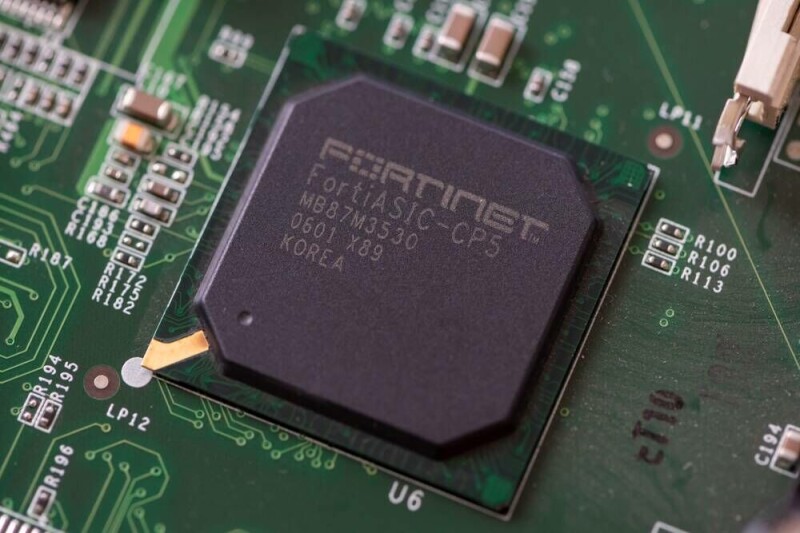
Fortinet on Tuesday revealed it will use Intel Foundry to fab its sixth-gen Security Processor (SP6), a nice win for Chipzilla's sputtering chipmaking biz. The chips feature dedicated accelerators designed specifically for the security and cryptographic operations required by modern hardware firewalls. The custom chips are one of Fortinet's defining features. Many cybersecurity hardware players build appliances around commodity hardware like x86 and Arm CPUs, but Fortinet prefers custom application-specific integrated circuits (ASICs). The two companies haven't said when the chips will enter production, much less what the SP6's speeds and feeds will entail, though we imagine it'll have a bit more pep than Fortinet's SP5 chips. The SP5 launched in 2023 and boasted support for layer 7 firewalling and IPsec VPN connectivity at speeds exceeding 30 Gbps. Throughput fell when advanced threat protection or SSL inspection was enabled, but Fortinet still claimed a speedy 4.3 Gbps and 3.3 Gbps, respectively. As you might have already figured out, Fortinet's SP line is designed primarily for smaller appliances like SD-WAN gateways, rather than larger datacenter-centric appliances built around its beefier NP and CP-series parts. While Intel couldn't offer much detail on the chip itself, we're told it will use the older Intel 4 process node rather than the leading-edge 18A process tech. Chipzilla also suggested Fortinet will draw on its experience in disaggregated semiconductor design and advanced packaging, which could mean a chiplet architecture with greater scalability. With so little detail, we can only speculate. Intel declined to say which technologies beyond Intel 4 the chip will use. The x86 giant also declined to comment on the availability of the product, noting only that "details regarding the Fortinet Security Processor 6 availability will be announced at a later date." While SP6 won't use the latest chipmaking tech, it will be built in an American fab by an American company, offering a level of supply chain security that remains difficult to find. If you want even remotely leading-edge silicon, Intel, Samsung, and TSMC are your only options. US-based production can still mean settling for a less advanced process, although TSMC's first Arizona fab has already begun churning out 4 nm silicon and Samsung aims to bring its new Texas plant online this year. Fortinet would not be the first to enlist Intel's manufacturing might for sensitive workloads. Under DARPA's HIVE program, the chipmaker built an eight-core, 528-thread processor with 1 TB/s silicon-photonics interconnects specifically to accelerate graph analytics workloads. But it doesn't stop at the DoD. Supply chain security is something Intel has leaned into as it has sought to reinvent itself from an integrated device manufacturer serving mainly itself, and occasionally the US government, into a full-fledged foundry ready to compete with Samsung and, ultimately, TSMC. In mid-2024, Uncle Sam awarded Intel $3 billion to establish a secure enclave for manufacturing chips for government agencies. Since then, the US government has taken a 9.9 percent stake in the American chip biz. ®
Windows Server 2016 might be long in the tooth but that isn't about to stop Microsoft breaking stuff. The May 12 security update introduced another bug for administrators to worry about. According to Microsoft, if the server hostname is exactly 15 characters long (like, for example, THEY-NEVER-TEST), domain controller discovery might fail. In the notes for the glitch, Microsoft wrote: "When the hostname is 15 characters long, DCLocator calls (for example, using nltest /dsgetdc: /pdc) will return ERROR_INVALID_PARAMETER, preventing applications and administrative tools from locating a domain controller." In other words, anything that depends on a domain controller lookup might stop working. As an example, Microsoft gave Distributed File System (DFS) Namespace management, which would certainly be inconvenient. DFS Namespaces is a Windows Server role that allows admins to group shared folders across different servers into a single namespace. A single path can lead to files located on multiple servers. Unless, of course, the domain controller lookup is broken. Microsoft lists no workaround for affected users, though changing the server hostname to something other than 15 characters would presumably avoid the trigger. "The issue is under investigation, and additional information will be shared as soon as it becomes available," it said. Microsoft still officially supports Windows Server 2016. Mainstream support ended in 2022, but extended support will continue until January 12, 2027. Microsoft is offering up to three more years of support via the Extended Security Updates (ESU) program after that. Earlier this year, Esben Dochy of Lansweeper told The Register that the operating system accounted for just 2.2 percent of all Windows devices it tracks, but 20.3 percent of all servers. That figure is unlikely to have dropped dramatically in the months since, so there is a fair chance that an administrator with a 15-character hostname could be affected. In addition to the Windows Server 2016 problems, the May 2026 security update has failed during installation on some Windows 11 devices when the EFI System Partition is insufficient in size. It is reassuring to know Microsoft's talent for breakage shows no bias toward any particular vintage. ®

 Login
Login