America wants its allies to come together and help it lead the way in defining 6G communications standards, with security and resilience seen as key goals for next-generation networks. The latest effort to corral international work on 6G comes from the US National Telecommunications and Information Administration (NTIA), which says it is pursuing the objectives of a December 2025 memo from President Trump on "Winning the 6G Race." That memo didn't identify who America is racing against, but it is a fair bet that it is China, which gained a lead during the development of 5G technology. Huawei in particular is understood to hold more declared 5G standard-essential patent families than any other company. The NTIA says it is launching this initiative alongside more than 20 governments, including several European nations like the UK and the Nordic countries, Japan, South Korea, and Australia. The Nordics are significant as they are home to telecoms equipment suppliers Nokia and Ericsson. These governments have all pledged to strengthen cooperation on 6G over the next 12 months and beyond in support of greater security, interoperability, and resilience for next-generation networks, the NTIA claims. "The Call to Action for 6G Leadership and Security reflects an unprecedented level of international coordination on the future of communications technology," stated NTIA administrator Arielle Roth. "By working now with trusted partners, we will ensure that next generation networks reflect our shared security interests, strengthen our competitiveness, and drive innovation." So after President Trump has spent 18 months since inauguration disparaging and threatening America's "trusted partners," the US has decided it would really like their help in becoming the world leader in 6G technology. Isn't that nice? The initiative lays out specific milestones on strategic coordination over the next year or so, as 6G moves toward commercialization. These include engaging with the telecoms industry to understand the "political and economic landscape" for 6G networks and meetings to identify the potential for more coordinated approaches. It also calls for a big meeting in 2027 to review joint progress, where the partners are expected to evaluate funding strategies, share information on 6G research and development, assess 5G and 6G technical and cybersecurity risks, and promote common 6G policies. All of this seems aimed at coordinating positions on the spectrum needed for 6G ahead of the next World Radiocommunication Conference (WRC-27). Scheduled for October 18 to November 12 in Shanghai next year, the conference will consider which frequency bands are made available for next-generation mobile networks. But it isn't the first attempt at international collaboration over the next-gen wireless standard. The US-UK Tech Prosperity Deal, agreed last year, proposed greater cooperation in a range of science and technology areas including 6G, but this was put on ice by President Trump after just a few months over trade disagreements. Earlier this year, the Global Coalition on Telecommunications (GCOT) unveiled a set of security and resilience principles it wanted to see baked into 6G from the start. The organization includes many of the same nations as the latest US scheme. "This is a clear attempt by the US and its allies to shape the 6G landscape before commercial networks arrive," PP Foresight founder and analyst Paolo Pescatore told The Register. "The priority is to embed security, resilience, interoperability, and supply-chain diversity from the outset, rather than repeat the costly mistakes and geopolitical tensions that defined the 5G era. "Although China is not explicitly mentioned, the strategic intent is obvious: to reduce dependence on high-risk suppliers and to ensure that trusted nations have greater influence over standards, investment, and innovation. However, this remains a political framework rather than a binding agreement." The first 6G deployments could arrive as soon as 2029, with the US and South Korea likely to lead in early adoption, according to a report from Juniper Research earlier this year. Despite this, the exact characteristics that will define 6G networks have yet to be thrashed out. Bodies representing the mobile networks want to see a smooth and cost-effective migration path for their members, avoiding the mistakes made with 5G, while the GSMA has already put it out there that 6G networks may need up to three times the spectrum currently allocated to meet the anticipated demands for data. ®
Users are always seeking more control over their social networking experience to make it better, whether to improve privacy or enhance flexibility. Interoperability between social networking platforms like Facebook and TikTok has so many benefits that solve those issues.
Say you’re on multiple platforms because you have friends you follow on different networks, but you’ve decided to choose one platform with better privacy practices. With interoperability, you could switch and still interact with friends who remain on larger platforms. It could also enable independent apps with better privacy controls and more user choice. These are the untapped possibilities that could benefit users in the European Union under the 2022 Digital Markets Act (DMA).
Yet, the European Commission, in its first review of the DMA, announced in April it had decided not to extend the DMA’s interoperability mandate to social networking and didn’t give a deadline or a timeline for enforcing that part of the Act. The Commission said “there is no clear demand” from users and businesses for social networking interoperability and, in any case, it’s too technically complex at the moment. Meanwhile, the Big Tech platforms that have been slow-walking interoperability over the last two years, erecting a myriad of hurdles for users seeking more freedom to choose other platforms, get a pass.
This is a huge disappointment and a missed opportunity by the Commission. Interoperability dismantles one of the biggest barriers faced by users who want to leave the tech giants’ platforms: the choice between changing to a platform you prefer or staying behind on a platform where all your friends, communities, and customers are.
The DMA, which went into force in 2024, aims to foster more choices for European Union users and encourage competition and innovation by forcing so-called gatekeeper platforms like Meta, Apple, and Google, to open their ecosystems to competitors. The regulation does a great deal to foster the integration of competing services and devices with the ecosystems of very large online platforms that act as gatekeepers. It even requires interoperability for messaging services, despite the significant technical and privacy challenges involved.
So, it’s odd that the Commission is using complexity as a shield against taking on social networking interoperability. The internet already runs on complex interoperable systems. Approaches like ActivityPub, the decentralized networking protocol behind the “Fediverse,” which gave rise to decentralized networks like Mastodon, already exist. The DMA shouldn’t mandate a specific protocol, but it can require meaningful interoperability outcomes.
The argument that there’s no real demand for social networking interoperability also falls flat. Users want the ability to move across platforms, choose the content they’d like to see from platforms, and not be tied down to a single platform. But there’s no way to get there—the platforms are doing little to open their social networking ecosystems. And now you have the DMA’s enforcer saying it’s not going to make them change. Demand for alternatives won’t materialize at scale until users see real progress towards interoperability, something the Commission has the power to do.
Having decided there’s little demand and too much complexity to proceed with mandating social networking interoperability, the Commission said it “will continue to monitor and assess how these services evolve.” This wait-and-see-posture only hurts users and strengthens and further entrenches Big Tech incumbents.
The DMA is supposed to center on the rights of technology users and be the pathway to an internet experience where you decide which software runs on your devices, where it’s easy to find the best products and services, and where you can leave a platform for a better one without forfeiting your social relationships.
Meanwhile, Big Tech is also resisting the DMA’s openness requirements. For example, Apple is supposed to be opening up iOS devices to rival app stores. Yet, the smartphone giant’s plan for opening its App Store levies junk fees and onerous conditions on app makers and is effectively impossible for any competitor to use.
It’s not just Apple pushing back against DMA enforcement. Meta's response is a “pay for privacy “system, in which users who do not consent to Meta’s surveillance will have to pay to use the service, or be blocked from it. Whether their plan complies with the DMA remains under review.
Nowhere in the DMA does it say social networking companies get to install a toll booth for users seeking to benefit from privacy rights the regulation grants them. The future EU Digital Fairness Act is another opportunity to protect users from such practices by declaring them unfair.
The Commission has responded to these developments with investigations, preliminary rulings, and fines. Meanwhile, users are missing out on greater choice and flexibility in how they communicate and connect online.
Poke your head into just about any online social network—or any general conversations about internet culture—and you’ll likely find a boogieman: the algorithm. Since at least the moment Facebook introduced (and apologized for) its News Feed, “the algorithm” has been shorthand for the ways the tech giants control what we see and when we see it. In the age of enshittification, there is a push to reclaim our feeds and networks. Good news: there’s a tool that’s been around for decades that can help wrangle many of your feeds into something manageable: Really Simple Syndication, more commonly known as RSS.
RSS may seem complicated, but it boils down to one general concept: when websites publish new content, like news articles, blog entries, webcomics, videos, or podcasts, that content gets added to an RSS feed, where your RSS reader (aka newsreader, feed reader, or aggregator) will show you that content in chronological order. If you’ve ever used a podcast player like Apple Podcasts or Spotify to follow different podcasts, you’ve used RSS. You can think of it like an internet-wide “follow” button, where you can track the contents of websites, users, and more.
People talk about RSS like it’s a power user’s secret trick to making the internet more usable, but the real secret is that it’s not that hard to set up and use. Here’s what you need to do:
Find an RSS reader: RSS readers come in many forms. Feedly, NewsBlur, or The Old Reader, are web-based, but have their own apps (though they also support third-party apps). Others, like NetNewsWire, are app-based, and support either using a web-based RSS reader like Feedly, or a local file. Some live in browsers or web extensions. There’s an abundance of choice in RSS readers, and part of the fun is finding one that best accomplishes what you want to do. But don’t worry about finding the right RSS reader right away. One of the many magic tricks of RSS is that it is platform agnostic, and nearly every RSS reader—whether it's a website or an app, supports importing and exporting a list of the sites you subscribe to. This means you can change RSS readers in a couple minutes. If you need some help finding an RSS reader, Wired, The Verge, and Privacy Guides all have useful roundups.
Collect your feeds: As for adding websites to your feeds, the process is straightforward. Most RSS readers are designed to help find the feed for a site for you, so you don’t need to go hunting down a special link. Just drop the URL of what you want to follow in your reader, and if an RSS feed exists, it should be able to find it. If not, some sites, including ours (and our current podcast, EFFector as well as our last series, How to Fix the Internet), provide direct links to our RSS feeds.
Sort, filter, and build your feed: Adding a bunch of new feeds can be overwhelming, particularly for news sites. RSS readers typically include folders, which let you group similar feeds together and can be great for lifting up low-traffic updates you don’t want to miss. Your reader may also have different filters, like the option to block any article that contains “sponsored post.”
RSS Is the Best Way to Follow the News
It can be very difficult to follow the news, whether that means politics, tech policy, or your hobbies. Solutions like Google News or Apple News have tried to make this simpler, but many find that their algorithmic feeds are as often a source of frustration and annoyance as they are genuinely useful. And no matter how often you tap on news stories that matter to you from publications you respect, there may always be stories that refuse to bubble up.
RSS can make reading the news much easier, reliable, and more private. The vast majority of news sites have RSS feeds you can subscribe to, and many, including CNN, The New York Times, BBC, Wired, Politico, and many others, offer RSS for specific sections or special feeds that include the full text of articles for subscribers, so you aren’t just pummeled with a firehose of news all day long (we’ll get to a tip below in the next section that tackles this problem if they don’t have separate feeds, though). In many cases, you can read articles right in your RSS reader, never being forced to engage with wonky comments sections or poor design choices on websites.
Of course, the news isn’t just general news sites, it also includes hobbyist or more niche sites, local news offerings, and blogs. Most of these sorts of websites also offer RSS feeds, as do newsletter platforms like Substack or Ghost.
RSS Offers One Way to Fix Some Social Feeds
Decentralized social media like Mastodon, Bluesky, and Threads, use RSS for user feeds, so you can follow your friend’s posts on Bluesky or Mastodon without actually having an account on either. This can be especially helpful for news sources, too—where you likely wouldn’t want to subscribe to a feed of everything a national news organization publishes because that would include dozens if not hundreds of stories a day, you can instead subscribe to their social media posts, which often get you the most breaking or important news.
The internet is more than just Facebook.
Some legacy social media works with RSS, too, including YouTube, Reddit (though that is currently at risk), and Tumblr. But others, like Facebook, LinkedIn, and Instagram, wall off posts behind account requirements that seem to pop up if you simply look at an account page for too long, let alone come in from an RSS feed. These walled gardens prevent information from getting out there, which ranges from annoying, like when your favorite local brewery only posts their food truck schedule on Instagram, to dangerous, like when local public services only post to a Facebook page.
The internet is more than just Facebook. It’s more than Mastodon or Bluesky, too. It’s a decentralized smorgasbord of websites, tools, feeds, newsletters, social profiles, and more, and treating it as such will help us wrangle the information we want and trust.
Other Surprising Places You’ll Find RSS Feeds
When in doubt, try copying and pasting the URL for a site into your RSS reader of choice, you might be surprised to find a feed that proves useful to you. Many places on the internet may offer RSS feeds without you even realizing it. For example, if you want to keep an eye on an artist’s prints that you like, but you don’t have Instagram where they usually post, you might be able to subscribe to their webstore, as some shopping platforms, like Big Cartel, create XML feeds that some RSS readers can read. And for something even more tweakable, even Google Alerts can be turned into RSS feeds.
RSS is one of the best examples we have of the open web, where we can design and customize how we experience the internet, not the other way around.
If you prefer to track policy over products, then you’ll be happy to know that government sites often support RSS, including most U.S. government sites, many of which break them into different sections like the U.S. Department of State’s various feeds. Many local governments or other public services, like fire departments may offer the same. Some universities (and university newspapers) also sometimes offer some RSS feeds.
And even if a website doesn’t have an RSS feed, there are workarounds from tools like RSSHub, RSS-Bridge, and RSS.app that require varying levels of technical expertise or a willingness to pay subscription fees.
RSS is one of the best examples we have of the open web, where we can design and customize how we experience the internet, not the other way around. RSS has come in and out of fashion, been declared dead, and has come back, every time. Open systems are the best way forward to a free, equitable internet, and the resilience and continued reinvention of RSS has shown just how creative the web community can be with open protocols.
Correction: clarified that Big Cartel creates an XML file, not an RSS feed.
Meta has deployed facial recognition code to millions of their always-on surveillance glasses, according to new reporting by Wired. EFF’s Threat Lab was able to confirm that the facial recognition code is present through static analysis of the application.
This dangerous new Meta functionality stores faceprints as a series of 2,048 numbers uniquely representing the positioning of a person’s facial features. When this feature is activated, it will convert every new face in the sightlines of the surveillance glasses into a series of numbers, and compare it to all the existing faceprints in the user’s database.
Wired and EFF confirmed that the code is present and active, though not yet exposed to consumers. Another researcher confirmed that when they manually added a face to the app database by connecting the phone to a computer in debug mode and issuing a few commands, the glasses would subsequently detect that face when it came into view.
Meta has already paid $650 million to settle a BIPA lawsuit challenging mass facial recognition of every photo posted to its platform, a feature which it has since shut down.
Despite the billions of reasons not to, Meta seems to have created the capacity to turn their customers into a distributed surveillance machine. This is just one more reason to think twice before buying or using Meta’s surveillance glasses.
Considering that Meta previously wrote in an internal document that they want to launch facial recognition “during a dynamic political environment where many civil society groups that we would expect to attack us would have their resources focused on other concerns," this invasive new feature doesn't come as a surprise. But Meta's surveillance plans won't escape public scrutiny that easily, and we'll be watching if this feature is rolled out to the public.
Wireless jamming attacks are on the rise. Rice University researchers have shown how self-curving radio beams can make a jammer appear to be somewhere it isn't, potentially undermining some anti-jamming defenses. Jamming relies on flooding a wireless receiver with noise that denies service. Some modern receivers identify and block jamming attempts using direction-of-arrival (DoA) estimation technology that pinpoints the jammer's direction and directs an array null that blocks signals emanating in the jammer’s direction. Were a jammer to transmit a self-curving beam, however, it could fool DoA-based anti-jamming defenses by appearing to come from somewhere else entirely, and that's exactly what the Rice researchers demonstrated. Rice electrical and computer engineering professor Edward Knightly and doctoral student Caroline Spindel presented a paper [PDF] last month in which they demonstrated a curving-beam jamming attack that caused "catastrophic bit-error-rate degradation" while also "fool[ing] the receiver's DoA estimator," preventing conventional DoA-based defenses from stopping the interference. Knightly and Spindel have done prior research developing wireless technology that could bend beams around objects to increase signal strength - particularly useful for short-range millimeter wave signals - and found that the same technology could be used to deploy jammers that are far harder to locate. Spindel gave the perfect analogy in a recent Rice press release about the research for understanding how curved beams confuse DoA estimators by considering a soccer ball kick to the head. “Imagine being hit on the right side of your head by a soccer ball - you would naturally look to the right,” Spindel said. “If the ball actually curved through the air, like a David Beckham free kick, then it was kicked from somewhere else entirely.” Were Sir David to keep moving and kicking curveballs at your head you’d probably spot him eventually, but it might take a minute, and a few more smacks, to stop him. A signal jammer at radio-wave distances will probably be far harder to spot, and it won’t even have to move: Knightly and Spindel were able to create the illusion that the jammer was mobile by modulating the beam parameters from a stationary position, making it even more difficult to locate the jamming signal and negating the point of blindly searching for the best spot to point an array null. Conventional recovery methods used to block jamming completely failed in laboratory tests, Spindel said. “This is the first demonstration of a jammer that cannot be reliably localized and the first time self-curving wireless beams have been used as an attack,” Knightly added. The pair sees their research not just as a way to point out a serious threat to wireless signals - GPS jamming of aircraft is on the rise, for example - but also something that can inform the direction of future wireless technologies as we move toward the 6G era. Until then, however, there’s the potential for even more devastating jamming attacks to come. ®
The British government wants stronger protection for subsea internet cables following a surge in Russian activity near UK waters, but its latest proposals lean heavily on fines and prison sentences rather than direct defensive action. Plans - outlined in a speech by Baroness Liz Lloyd, Minister for Digital Economy ahead of a consultation - include tougher penalties for recklessly damaging undersea cables, operator security obligations and emergency powers allowing government to compel businesses to better protect their infrastructure. In April, the Royal Navy and Royal Air Force tracked Russian submarines on a covert reconnaissance near critical undersea infrastructure. According to reports, Russia deployed an Akula-class attack submarine as a decoy while two specialist vessels from Directorate of Deep Sea Research - known as Glavnoye Upravlenie Glubokovodnikh Issledovanii (GUGI) - surveyed the UK's cable routes. “Their mission was to survey our cables in peacetime, so they could more easily sabotage them in a conflict,” Lloyd said in a speech delivered at the Royal United Services Institute (RUSI). “They wanted this operation to be secret, but they failed." In light of this, the government is reviewing whether the UK’s security and resilience arrangements are strong enough, the Defence, Science and Technology Laboratory said. UK Parliament's Joint Committee on National Security Strategy (JCNSS) last year told the government it is "too timid" in its approach to protecting Britain’s cable connections, and must do a better job. Measures proposed include tightening the law so ship owners and operators that recklessly damage subsea internet cables face tougher penalties. Cable operators could be landed with extra obligations to ensure they take steps to prevent, detect and respond to security incidents in a consistent and timely manner. “The UK already has strong protections in place for our subsea cables, but in a more uncertain world we cannot stand still,” said Lloyd. "As hostile activity by Russia and others grows, protecting these cables matters more than ever for our economy, security and daily lives.” Some 64 cables connect Britain to the global internet, and when one breaks, repair vessels are typically on scene within eight days. Historically, most cable faults have stemmed from fishing activity or dragging anchors, not sabotage. The Royal Navy unveiled its Atlantic Bastion program last year to supplement its sub-hunting ships with a force of uncrewed, autonomous vessels. The aim is that enemy submarines in the North Atlantic have nowhere to hide. This is in its early stages, with £14 million committed so far for testing and development. The latest proposals will be outlined a white paper published later this year. Separately, the UK, US, and Australia announced this weekend that their AUKUS partnership will jointly develop sensor and weapons payloads for uncrewed underwater vehicles, which is another building block for protecting seabed infrastructure. ®
Cisco will make around five percent of staff redundant and has generously offered them free Cisco training for a year once they’re gone. CEO Chuck Robbins broke the news in a Wednesday blog post titled “Our Path Forward” that opens “Today we announced our Q3 FY26 earnings with record revenue of $15.8 billion, up 12 percent year over year, and double-digit top and bottom-line growth. The ELT [executive leadership team] and I could not be prouder of the growth you have all delivered for Cisco.” That growth included net income growing 35 percent to $3.4 billion. Yet Robbins’ pride was not sufficient for all Cisco staff to keep their jobs. The CEO said the layoffs are necessary because “The companies that will win in the AI era will be those with focus, urgency, and the discipline to continuously shift investment toward the areas where demand and long-term value creation are strongest.” For Cisco that means “reducing roles in some areas” and also “making clear, strategic investments – particularly in silicon, optics, security, and in our employees’ use of AI across the company.” On Thursday, US time, close to 4,000 unlucky Cisco staff will be shown the door. Robbins said Cisco will help its soon-to-be-former workers find their next gig, and that the company’s efforts to do so have a 75 percent success rate. “We are also committed to continued personalized learning and will provide one year of access to all Cisco U courses and certifications, covering AI, Security, Networking, and more,” he added. Cisco made two big rounds of layoffs in 2024, one of which ejected seven percent of staff and the other resulted in Cisco firing five percent of employees. The restructures appear not to have slowed the company down: Robbins said product orders in Q3 rose 35 percent year over year – a figure that encapsulates a 105 percent year-over-year surge in revenue from hyperscalers and more modest 18 percent growth from other buyers. Robbins said Cisco has already scored $5.3 billion of AI infrastructure sales this year, and forecast full-year sales of $9 billion – 4.5 times its haul from last year. More prosaic products, like Wi-Fi kit, also grew fast as sales rose 40 percent. The company hopes to keep that cash flowing by building wireless kit that uses less memory. “You’ll see products that’ll become orderable in Q4 that’ll actually require 50 percent less memory,” Robbins said, with the design work to make that possible an example of the “20-plus programs that we’ve put into place that are active to reduce the memory utilization across the portfolio.” Cisco’s doing that despite the rising price of memory and storage not putting a dent in its margins, an outcome that execs attributed to supply chain management efforts. Glasswing to lift security sales Later in the earnings call, Robbins revealed that Cisco is participating in Anthropic’s Project Glasswing and using the Mythos model to test its code. The CEO said another impact of Anthropic’s bug-finding AI will be to accelerate plans to replace security appliances once other vendor’s use of Mythos finds flaw that are hard to fix. “I actually think while there will be a security opportunity, there’s going to most likely be a lot of focus from our customers on modernizing their infrastructure so that they don’t have this risk from technology that just can’t be patched,” Robbins said. Robbins said Cisco may have won an order or two from customers who were already close to replacing old security kit “and Mythos pushed them over the edge.” But he said Cisco didn’t receive “any meaningful orders in Q3 as a result of Mythos, but that could change in the future as we continue to work with customers.” ®
One of the central promises of open social media services is interoperability—the idea that wherever you personally decide to post doesn’t require others to be there just to follow what you have to say. Think of it like a radio broadcast: you want to reach people and don't care where they are or what device they're using. For example, in theory, a Bluesky user can follow someone on Mastodon or Threads without having to create a Mastodon or Threads account. But these systems are still a work in progress, and you might need to tweak a few things to get it working correctly.
Right now, broadcasting your message across social platforms can be a funky experience at best, deliberately broken up by oligopolists. The idea of the open web was baked into the internet via protocols like HTML and RSS that made it easy for anyone to visit a website or follow most blogs. The fact social media isn’t similarly open reflects an intentional choice to privatize the internet.
Bridging and managing your posts so they’re viewable outside a singular source is part of the broader philosophy of POSSE, short for Post Own Site Syndicate Elsewhere (sometimes its Post Own Site, Share Everywhere). Instead of managing several accounts across different services, you post once to one primary site (which might be your personal website, or just one social media account), then set it up so it automatically publishes everywhere else. This way, it doesn’t matter where you or your audience is, and they're not walled off by account registration requirements.
We’ll come back around to POSSE at the end of this post, but for now, let’s assume you just want your current main open social media account to actually have a chance to reach the most people it can.
Why Post to the Open Social Web
Because the Fediverse and ATmosphere use different protocols, we need to use a third-party tool so accounts can communicate with each other. For that, we’ll need a bridge. As the name suggests, a bridge can connect one social media account to another, so you can post once and spread your message across several places. This isn’t just some niche concept: major blogging platforms like Wordpress and Ghost integrate posting to the Fediverse.
Bridging is an important facet of POSSE, but also something more people should consider, even if they don’t run their own websites. For example, if you don’t want to create a Threads account just to interact with your one friend who uses that platform, you shouldn’t have to. The good news is, you don’t. There are several bridging services, like Fedisky, RSS Parrot, and pinhole, but Bridgy Fed is currently the simplest to use, so we’ll focus on that.
How to Post to Bluesky from Mastodon
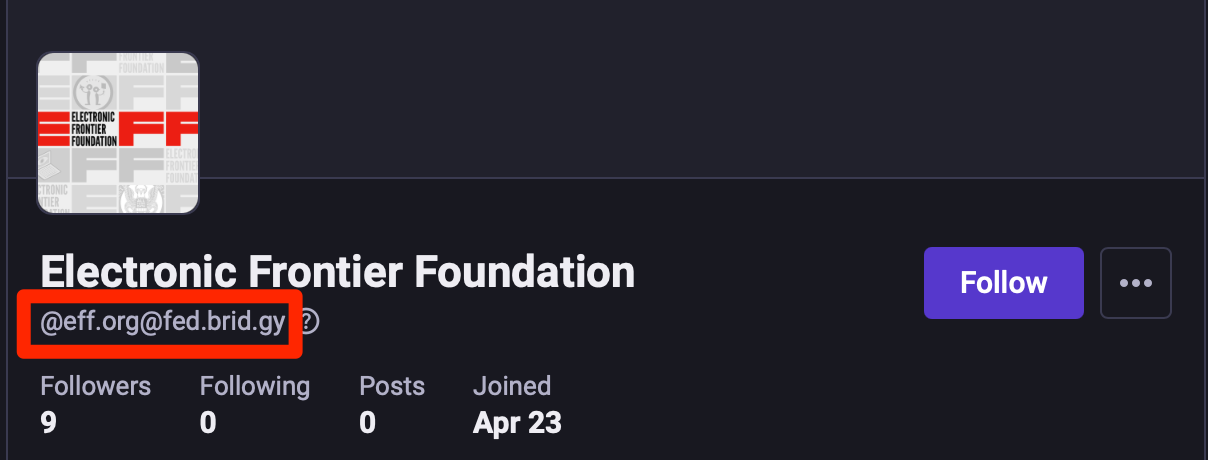
From your Mastodon account (or other Fediverse account, for simplicity’s sake we’ll stick to Mastodon throughout), search for the username @bsky.brid.gy@bsky.brid.gy and follow that account. Once you do, the account will follow you back and you’ll be bridged and people can find you from their Bluesky account. You should also get a DM with your bridged username. If you don’t see the @bsky.brid.gy@bsky.brid.gy user when you search, your Mastodon instance may be blocking the bridging tool.
Threads users who have enabled Fediverse sharing will be able to find you with your standard Mastodon username (ie, @your_user_name@mastodon.social), but if they haven’t enabled sharing, they will not be able to see your account. While this search is still a beta feature, you might find it easier to share the full URL, which would look like this: https://www.threads.net/fediverse_profile/@your_user_name@mastodon.social
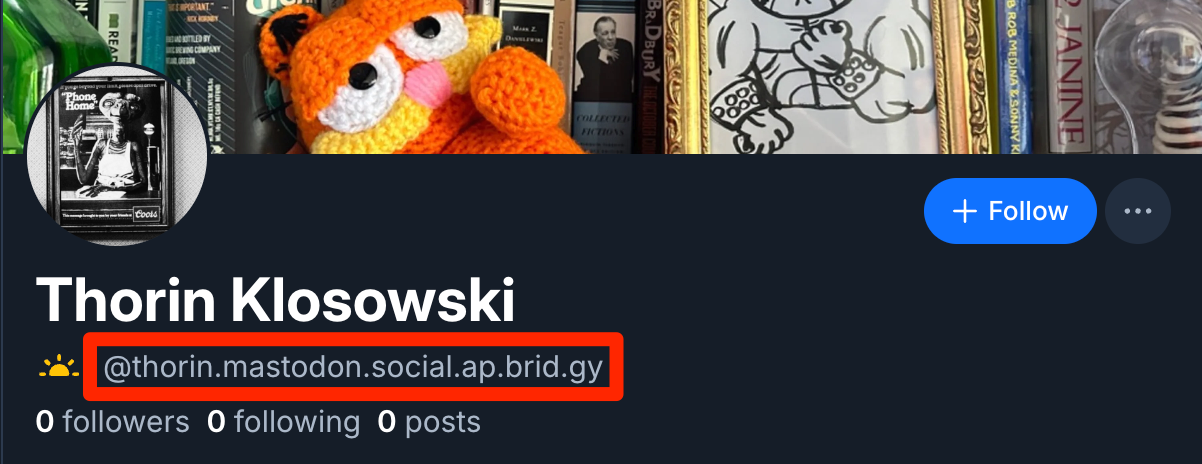
People on Bluesky can find you by: Either searching for your Mastodon username, or if that doesn’t work, @your_user_name.instance.ap.brid.gy. For example, if your username is @eff@mastodon.social, it would appear as @eff.mastodon.social.ap.brid.gy.
An example of a Mastodon username from the Bluesky web client.
How to Post to Mastodon and Bluesky from Threads
Yes, Threads is technically on the Fediverse, and you can bridge your Threads account to Mastodon or Bluesky (unless you’re in Europe, where the feature is disabled), but it’s a different process than on Bluesky and Mastodon.
Open Settings > Account > Fediverse Sharing and set the option to “On.” This will make your posts visible to Mastodon (or other Fediverse) users, and vice versa.
Once the Fediverse sharing is enabled, you’ll likely need to wait a week, then you can bridge to Bluesky. Search for and follow the @bsky.brid.gy@bsky.brid.gy account (it may take some digging to find it, but if that doesn’t work you can try visiting the profile page directly.
People on Mastodon (or other Fediverse accounts) and Bluesky can find you by: Mastodon users can find you at, @your_threads_username@threads.net while Bluesky users will find you at, @your_threads_username.threads.net.ap.brid.gy (seriously, that will be the username). Note that some Mastodon instances may block Threads users entirely.
An example of a Threads username from the Mastodon web client.
An example of a Threads username from the Bluesky web client.
How to Post to Mastodon and Threads from Bluesky
From your Bluesky (or other ATProto) account, search for the username, “@ap.brid.gy” and follow that account. Once you do, the account will follow you back and you’ll be bridged, so people can follow you from Mastodon or other Fediverse accounts. You should also get a DM with your bridged username.
People on Mastodon (or other Fediverse account) and Threads can find you by: Your username will appear as @your_bluesky_username@bsky.brid.gy. For example, if your Bluesky username is @eff@bsky.social, it would appear as @eff.bksy.social@bsky.brid.gy.
An example of a Bluesky username from the Mastodon web client.
How to Post Everywhere from Your Own Website
You can bridge more than social media accounts. If you have your own website, you can bridge that too (as long as it supports microformats and webmention, or an Atom or RSS feed. If you have a blog, there’s a good chance you’re already good to go). When you do so, the bridged account will either post the full text (or image) of whatever you post to your personal site, or a link to that content, depending on how your website is set up. You’ll also probably want to log into your Bridgy user page so you can manage the account.
Where people can find your bridged account: Usually, a user can just search for your website’s URL on their decentralized social network of choice, or enter it on the Bridgy Fed page. But if that doesn’t work, they can try @yourdomain.com@web.brid.gy from Mastodon or @yourdomain.com.web.brid.gy from Bluesky.
An example of a bridged website username in the Mastodon web client.
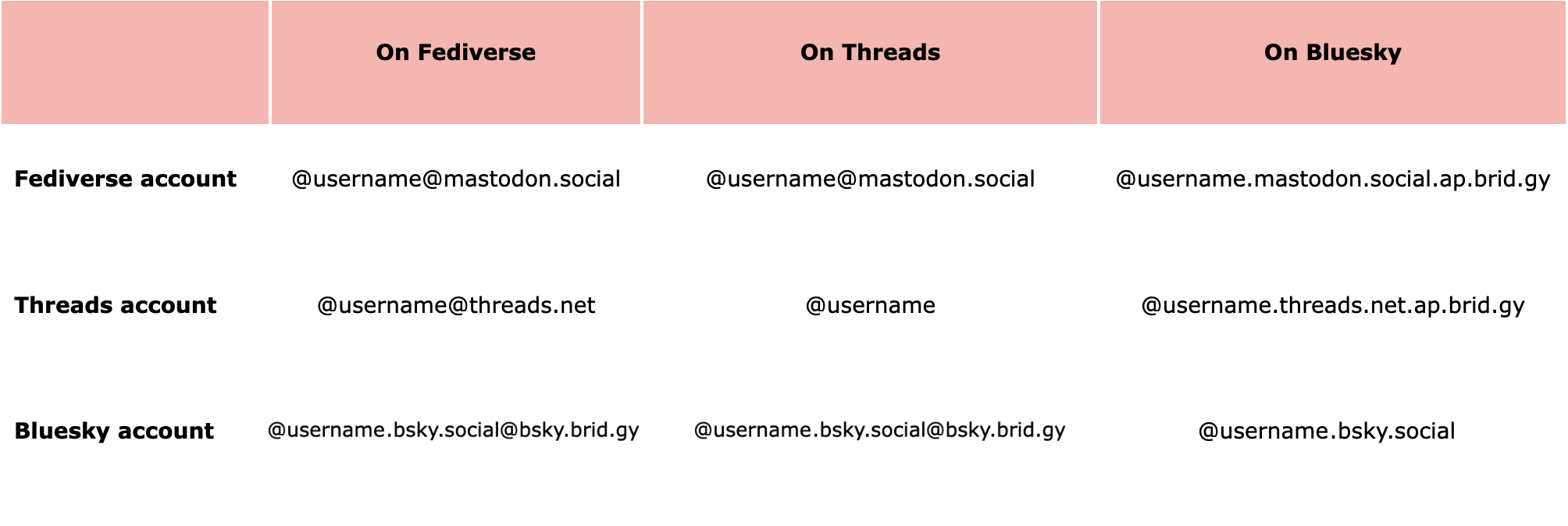
How Your Account Username Looks on Each Platform
You’re Bound to Run Into Some Quirks
Sometimes messages take a little while to crossover between networks, and sometimes they don't crossover at all.
You can’t log into a bridged account like a regular account, but Bridgy Fed does provide some tools to see incoming notifications and recent activity in case they’re not coming through properly.
ActivityPub and ATProto don’t have the same feature set, so you will have certain capabilities for one account you might not have in another. For example, you can edit posts on Mastodon, but not on Bluesky. If you edit a post that’s bridged from Mastodon to Bluesky, the Bluesky post will not be updated.
Replies can sometimes get lost, especially if the person (or people) replying to you doesn’t have sharing turned on.
Ownership of accounts can get weird. For example, if you post to your own website and use a tool like Wordpress or Ghost for federation (more info below), you don’t necessarily get access to a “normal” social media account, with a standard login and password.
And more! This is still a work in progress that has some technical quirks, but it’s improving all the time, and it’s best to keep telling yourself that troubleshooting is part of the fun.
Other Cool Stuff You Can Do
As mentioned up top, there’s a lot more you can do, and an increasing number of tools are making this process simpler. Bridgy Fed is one way to post to more places from a single account, but it’s far from the only way to do so. Here are just a few examples.
Micro.blog is a paid service where you can blog from your own domain name, then post automatically to Mastodon, Bluesky, Threads, Tumblr, Nostr, LinkedIn, Medium, Pixelfed, and Flickr.
Ghost is a blogging and newsletter platform that offers direct integration with the Fediverse, as well as support for Bluesky. Wordpress offers the option to join the Fediverse through a community plugin. Other newsletter platforms, like Buttondown, also have plans for federation.
Surf.social is a landing page and social media utility where you can show off all your various accounts (Federated or not). From the reader point of view, you can follow one publications numerous types of posts in one place. For example, 404 Media’s Surf.social feed includes its YouTube feed, podcast feed, and its journalist’s social media posts.
If you think these new handles are a bit ugly, you can use a custom domain for Bluesky or fediverse account from your website.
Of course, there are plenty of other tools, blogging platforms, and other utilities out there to help facilitate posting and bridging accounts, with new ones coming along every day.
With proper support, time, and effort, eventually we will all be able to seamlessly interact across platforms, take our follows and followers to other services when a platform no longer suits our needs, and interact with a variety of web content regardless of what platform hosts it. Until then, we still need to do some DIY work, support the services we want to succeed, and push for more platforms and services to support federated protocols.
Correction: an earlier version of this blog was missing the full Bluesky username in the account username chart.
A Brazilian tech firm that specializes in protecting networks from distributed denial-of-service (DDoS) attacks has been enabling a botnet responsible for an extended campaign of massive DDoS attacks against other network operators in Brazil, KrebsOnSecurity has learned. The firm’s chief executive says the malicious activity resulted from a security breach and was likely the work of a competitor trying to tarnish his company’s public image.
An Archer AX21 router from TP-Link. Image: tp-link.com.
For the past several years, security experts have tracked a series of massive DDoS attacks originating from Brazil and solely targeting Brazilian ISPs. Until recently, it was less than clear who or what was behind these digital sieges. That changed earlier this month when a trusted source who asked to remain anonymous shared a curious file archive that was exposed in an open directory online.
The exposed archive contained several Portuguese-language malicious programs written in Python. It also included the private SSH authentication keys belonging to the CEO of Huge Networks, a Brazilian ISP that primarily offers DDoS protection to other Brazilian network operators.
Founded in Miami, Fla. in 2014, Huge Networks’s operations are centered in Brazil. The company originated from protecting game servers against DDoS attacks and evolved into an ISP-focused DDoS mitigation provider. It does not appear in any public abuse complaints and is not associated with any known DDoS-for-hire services.
Nevertheless, the exposed archive shows that a Brazil-based threat actor maintained root access to Huge Networks infrastructure and built a powerful DDoS botnet by routinely mass-scanning the Internet for insecure Internet routers and unmanaged domain name system (DNS) servers on the Web that could be enlisted in attacks.
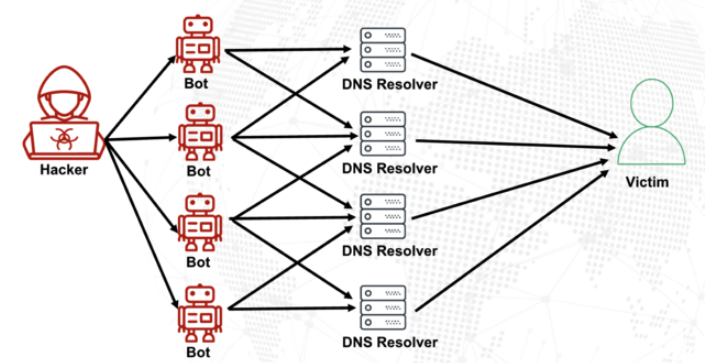
DNS is what allows Internet users to reach websites by typing familiar domain names instead of the associated IP addresses. Ideally, DNS servers only provide answers to machines within a trusted domain. But so-called “DNS reflection” attacks rely on DNS servers that are (mis)configured to accept queries from anywhere on the Web. Attackers can send spoofed DNS queries to these servers so that the request appears to come from the target’s network. That way, when the DNS servers respond, they reply to the spoofed (targeted) address.
By taking advantage of an extension to the DNS protocol that enables large DNS messages, botmasters can dramatically boost the size and impact of a reflection attack — crafting DNS queries so that the responses are much bigger than the requests. For example, an attacker could compose a DNS request of less than 100 bytes, prompting a response that is 60-70 times as large. This amplification effect is especially pronounced when the perpetrators can query many DNS servers with these spoofed requests from tens of thousands of compromised devices simultaneously.
A DNS amplification and reflection attack, illustrated. Image: veracara.digicert.com.
The exposed file archive includes a command-line history showing exactly how this attacker built and maintained a powerful botnet by scouring the Internet for TP-Link Archer AX21 routers. Specifically, the botnet seeks out TP-Link devices that remain vulnerable to CVE-2023-1389, an unauthenticated command injection vulnerability that was patched back in April 2023.
Malicious domains in the exposed Python attack scripts included DNS lookups for hikylover[.]st, and c.loyaltyservices[.]lol, both domains that have been flagged in the past year as control servers for an Internet of Things (IoT) botnet powered by a Mirai malware variant.
The leaked archive shows the botmaster coordinated their scanning from a Digital Ocean server that has been flagged for abusive activity hundreds of times in the past year. The Python scripts invoke multiple Internet addresses assigned to Huge Networks that were used to identify targets and execute DDoS campaigns. The attacks were strictly limited to Brazilian IP address ranges, and the scripts show that each selected IP address prefix was attacked for 10-60 seconds with four parallel processes per host before the botnet moved on to the next target.
The archive also shows these malicious Python scripts relied on private SSH keys belonging to Huge Networks’s CEO, Erick Nascimento. Reached for comment about the files, Mr. Nascimento said he did not write the attack programs and that he didn’t realize the extent of the DDoS campaigns until contacted by KrebsOnSecurity.
“We received and notified many Tier 1 upstreams regarding very very large DDoS attacks against small ISPs,” Nascimento said. “We didn’t dig deep enough at the time, and what you sent makes that clear.”
Nascimento said the unauthorized activity is likely related to a digital intrusion first detected in January 2026 that compromised two of the company’s development servers, as well as his personal SSH keys. But he said there’s no evidence those keys were used after January.
“We notified the team in writing the same day, wiped the boxes, and rotated keys,” Nascimento said, sharing a screenshot of a January 11 notification from Digital Ocean. “All documented internally.”
Mr. Nascimento said Huge Networks has since engaged a third-party network forensics firm to investigate further.
“Our working assessment so far is that this all started with a single internal compromise — one pivot point that gave the attacker downstream access to some resources, including a legacy personal droplet of mine,” he wrote.
“The compromise happened through a bastion/jump server that several people had access to,” Nascimento continued. “Digital Ocean flagged the droplet on January 11 — compromised due to a leaked SSH key, in their wording — I was traveling at the time and addressed it on return. That droplet was deprecated and destroyed, and it was never part of Huge Networks infrastructure.”
The malicious software that powers the botnet of TP-Link devices used in the DDoS attacks on Brazilian ISPs is based on Mirai, a malware strain that made its public debut in September 2016 by launching a then record-smashing DDoS attack that kept this website offline for four days. In January 2017, KrebsOnSecurity identified the Mirai authors as the co-owners of a DDoS mitigation firm that was using the botnet to attack gaming servers and scare up new clients.
In May 2025, KrebsOnSecurity was hit by another Mirai-based DDoS that Google called the largest attack it had ever mitigated. That report implicated a 20-something Brazilian man who was running a DDoS mitigation company as well as several DDoS-for-hire services that have since been seized by the FBI.
Nascimento flatly denied being involved in DDoS attacks against Brazilian operators to generate business for his company’s services.
“We don’t run DDoS attacks against Brazilian operators to sell protection,” Nascimento wrote in response to questions. “Our sales model is mostly inbound and through channel integrator, distributors, partners — not active prospecting based on market incidents. The targets in the scripts you received are small regional providers, the vast majority of which are neither in our customer base nor in our commercial pipeline — a fact verifiable through public sources like QRator.”
Nascimento maintains he has “strong evidence stored on the blockchain” that this was all done by a competitor. As for who that competitor might be, the CEO wouldn’t say.
“I would love to share this with you, but it could not be published as it would lose the surprise factor against my dishonest competitor,” he explained. “Coincidentally or not, your contact happened a week before an important event – one that this competitor has NEVER participated in (and it’s a traditional event in the sector). And this year, they will be participating. Strange, isn’t it?”
A hacktivist group with links to Iran’s intelligence agencies is claiming responsibility for a data-wiping attack against Stryker, a global medical technology company based in Michigan. News reports out of Ireland, Stryker’s largest hub outside of the United States, said the company sent home more than 5,000 workers there today. Meanwhile, a voicemail message at Stryker’s main U.S. headquarters says the company is currently experiencing a building emergency.
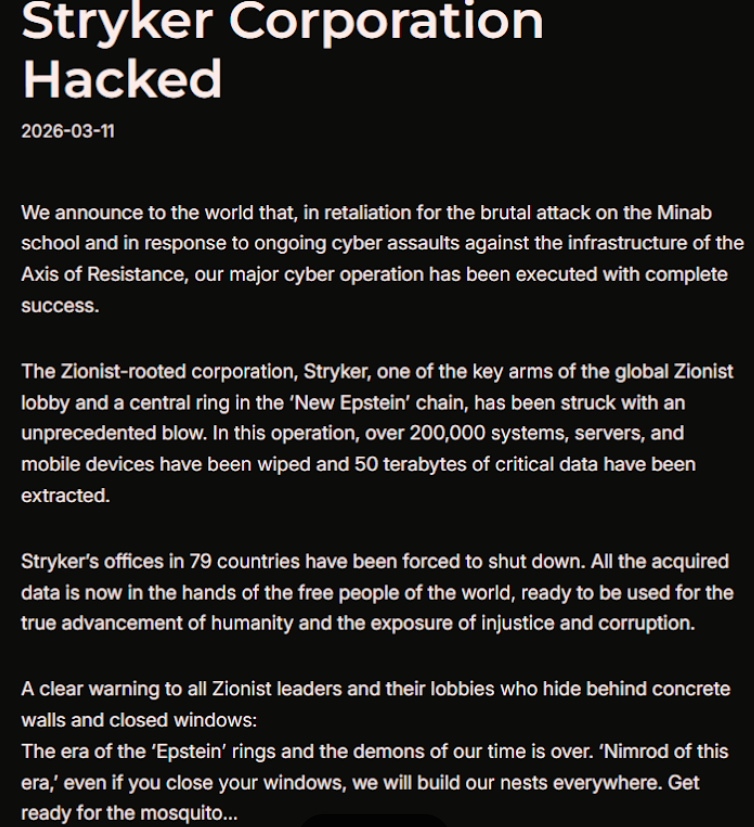
Based in Kalamazoo, Michigan, Stryker [NYSE:SYK] is a medical and surgical equipment maker that reported $25 billion in global sales last year. In a lengthy statement posted to Telegram, a hacktivist group known as Handala (a.k.a. Handala Hack Team) claimed that Stryker’s offices in 79 countries have been forced to shut down after the group erased data from more than 200,000 systems, servers and mobile devices.
A manifesto posted by the Iran-backed hacktivist group Handala, claiming a mass data-wiping attack against medical technology maker Stryker.
“All the acquired data is now in the hands of the free people of the world, ready to be used for the true advancement of humanity and the exposure of injustice and corruption,” a portion of the Handala statement reads.
The group said the wiper attack was in retaliation for a Feb. 28 missile strike that hit an Iranian school and killed at least 175 people, most of them children. The New York Timesreports today that an ongoing military investigation has determined the United States is responsible for the deadly Tomahawk missile strike.
Handala was one of several hacker groups recently profiled by Palo Alto Networks, which links it to Iran’s Ministry of Intelligence and Security (MOIS). Palo Alto says Handala surfaced in late 2023 and is assessed as one of several online personas maintained by Void Manticore, a MOIS-affiliated actor.
Stryker’s website says the company has 56,000 employees in 61 countries. A phone call placed Wednesday morning to the media line at Stryker’s Michigan headquarters sent this author to a voicemail message that stated, “We are currently experiencing a building emergency. Please try your call again later.”
A report Wednesday morning from the Irish Examiner said Stryker staff are now communicating via WhatsApp for any updates on when they can return to work. The story quoted an unnamed employee saying anything connected to the network is down, and that “anyone with Microsoft Outlook on their personal phones had their devices wiped.”
“Multiple sources have said that systems in the Cork headquarters have been ‘shut down’ and that Stryker devices held by employees have been wiped out,” the Examiner reported. “The login pages coming up on these devices have been defaced with the Handala logo.”
Wiper attacks usually involve malicious software designed to overwrite any existing data on infected devices. But a trusted source with knowledge of the attack who spoke on condition of anonymity told KrebsOnSecurity the perpetrators in this case appear to have used a Microsoft service called Microsoft Intune to issue a ‘remote wipe’ command against all connected devices.
Intune is a cloud-based solution built for IT teams to enforce security and data compliance policies, and it provides a single, web-based administrative console to monitor and control devices regardless of location. The Intune connection is supported by this Reddit discussion on the Stryker outage, where several users who claimed to be Stryker employees said they were told to uninstall Intune urgently.
Palo Alto says Handala’s hack-and-leak activity is primarily focused on Israel, with occasional targeting outside that scope when it serves a specific agenda. The security firm said Handala also has taken credit for recent attacks against fuel systems in Jordan and an Israeli energy exploration company.
“Recent observed activities are opportunistic and ‘quick and dirty,’ with a noticeable focus on supply-chain footholds (e.g., IT/service providers) to reach downstream victims, followed by ‘proof’ posts to amplify credibility and intimidate targets,” Palo Alto researchers wrote.
The Handala manifesto posted to Telegram referred to Stryker as a “Zionist-rooted corporation,” which may be a reference to the company’s 2019 acquisition of the Israeli company OrthoSpace.
Stryker is a major supplier of medical devices, and the ongoing attack is already affecting healthcare providers. One healthcare professional at a major university medical system in the United States told KrebsOnSecurity they are currently unable to order surgical supplies that they normally source through Stryker.
“This is a real-world supply chain attack,” the expert said, who asked to remain anonymous because they were not authorized to speak to the press. “Pretty much every hospital in the U.S. that performs surgeries uses their supplies.”
John Riggi, national advisor for the American Hospital Association (AHA), said the AHA is not aware of any supply-chain disruptions as of yet.
“We are aware of reports of the cyber attack against Stryker and are actively exchanging information with the hospital field and the federal government to understand the nature of the threat and assess any impact to hospital operations,” Riggi said in an email. “As of this time, we are not aware of any direct impacts or disruptions to U.S. hospitals as a result of this attack. That may change as hospitals evaluate services, technology and supply chain related to Stryker and if the duration of the attack extends.”
According to a March 11 memo from the state of Maryland’s Institute for Emergency Medical Services Systems, Stryker indicated that some of their computer systems have been impacted by a “global network disruption.” The memo indicates that in response to the attack, a number of hospitals have opted to disconnect from Stryker’s various online services, including LifeNet, which allows paramedics to transmit EKGs to emergency physicians so that heart attack patients can expedite their treatment when they arrive at the hospital.
“As a precaution, some hospitals have temporarily suspended their connection to Stryker systems, including LIFENET, while others have maintained the connection,” wrote Timothy Chizmar, the state’s EMS medical director. “The Maryland Medical Protocols for EMS requires ECG transmission for patients with acute coronary syndrome (or STEMI). However, if you are unable to transmit a 12 Lead ECG to a receiving hospital, you should initiate radio consultation and describe the findings on the ECG.”
This is a developing story. Updates will be noted with a timestamp.
Update, 2:54 p.m. ET: Added comment from Riggi and perspectives on this attack’s potential to turn into a supply-chain problem for the healthcare system.
Update, Mar. 12, 7:59 a.m. ET: Added information about the outage affecting Stryker’s online services.

 Login
Login