 Login
Login
[webapps] WordPress Backup Migration 1.3.7 - Remote Command Execution
WordPress Backup Migration 1.3.7 - Remote Command Execution

This is my completely informal, uncertified, unreviewed and otherwise completely unofficial blog inspired by my reading of our next Cloud Threat Horizons Report, #13 (full version, no info to enter!) that we just released (the official blog for #1 report, my unofficial blogs for #2, #3, #4, #5, #6, #7, #8, #9, #10, #11 and #12).
My favorite quotes from the report follow below:
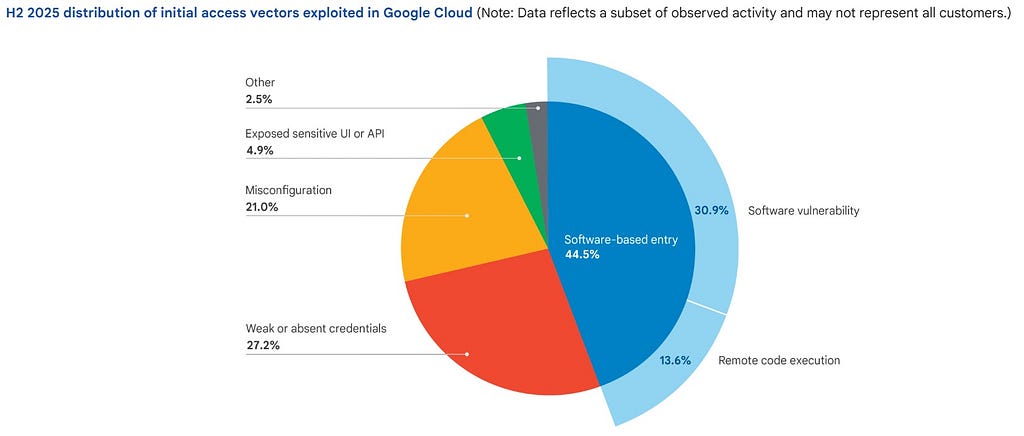

Now, go and read the CTHR 13 report!
Related posts:
Google Cloud Security Threat Horizons Report #13 (H1 2026) Is Out! was originally published in Anton on Security on Medium, where people are continuing the conversation by highlighting and responding to this story.
This blog is perhaps a little bit more like an ad, so if you don’t want to check the ads, consider not reading it.

But this year at RSA 2026, I’m speaking on three topics: securing AI, using AI for SOC, and sharing lessons about how Google applies AI and other technologies to D&R.
Here are these 3 fun things!
First, I’m doing a presentation on governing shadow AI agents. Believe it or not, this presentation was created mostly before OpenClaw became a thing (but updated for it!). So you may be surprised how well the content aged (think wine!) Attend this if you are struggling with shadow AI, specifically shadow agents at work.
Shadow Agents: A Pragmatist’s Guide to Governing Unsanctioned AI — [STR-W08]
It is not the APT! The new threat is the “shadow AI agents” employees already use for work, leaking data and making decisions. Banning them is a losing game. This session will offer a better way: turn this organic behavior into a catalyst for secure progress. Learn to discover, assess, and channel unsanctioned agents into a formal strategy that empowers a team rather than force it underground.
The second is probably the most detailed discussion about how we use AI for detection and response at Google. You probably read our blogs and listen to our talks (especially this), but this time we are revealing a lot more interesting details about the machinery and also how we arrived at the state we’re in. I promise you this will be fun! And detailed too.
This Is How We Do It: Building AI Agents for Cybersecurity and Defense — [PART3-M07]
Presenters will share the playbook for building and scaling AI agents in cybersecurity. Attendees will learn four core lessons: Building trust with the team, prioritizing real problems, measuring value, and establishing solid governance foundations for the agentic SOC.
Finally, the third isn’t a presentation but a discussion that would help you understand the real state of AI in security operations / SOC. This would not be about the slides, but about sharing lessons on what works and what doesn’t.
AI in SecOps: Sharing Lessons Learned for Adoption Maturity — [CXN-R05]
Attendees in this peer-led discussion will share stories from the AI-powered SOC trenches. Explore real adoption journeys from manual processes to autonomous agents. Share practical use cases on analyst retraining, workflow auditing, malware analysis, remediation automation, RAG pipelines and more. Trade notes on what’s working, what’s breaking, trust gaps, AI hallucinations, and career redesign.
All in all, join me for securing AI and Shadow Agents, learning from Google about detection and response, and comparing the state of practice of AI in the SOC.
See you there!
P.S. Yes, we will also be podcasting from the show.
Related:
RSA 2025: AI’s Promise vs. Security’s Past — A Reality Check”
My Really Fun RSA 2026 Presentations! was originally published in Anton on Security on Medium, where people are continuing the conversation by highlighting and responding to this story.
Name : CPT Cybersecurity Conference
Website: https://www.cycomhackingconference.com/
Date: March 4-5, 2026
Location: Allianz Arena, Munich, Germany
CPT 2026: Connect. Protect. Transform.Join Germany’s top voices for Cybersecurity at Munich’s Allianz Arena from March 4–5. Master NIS-2 compliance, AI resilience, and BSI standards through high-level networking and expert keynotes. Secure your strategy for the digital future.
CPT 2026: Strategic Resilience & Digital SovereigntyWho determines our digital future?Technological dependencies, data sovereignty, and AI-driven transformation are no longer abstract concepts—they are the decisive factors for Europe’s future. At CPT 2026, we bring together the leading voices of the Munich cybersecurity ecosystem to move from reactive implementation to active sovereignty.The Key QuestionsIn the heart of Munich’s tech hub, we address the core challenges of our industry:
Who sets the rules — governments, global corporations, or the specialized expertise within our network?
Why You Should AttendCPT 2026 acts as a high-level summit for 400 selected decision-makers and experts, creating a space for perspectives that rarely meet directly.
Secure your place at the centre of the dialogue and establish your lead in the 2026 transformation.Get your ticket: https://www.cpt.events/
The post CPT Cybersecurity Conference appeared first on CISO MAG | Cyber Security Magazine.
Hard disks and magnetic tape have a limited lifespan, but glass storage developed by Microsoft could last millennia
Some cultures used stone, others used parchment. Some even, for a time, used floppy disks. Now scientists have come up with a new way to keep archived data safe that, they say, could endure for millennia: laser-writing in glass.
From personal photos that are kept for a lifetime to business documents, medical information, data for scientific research, national records and heritage data, there is no shortage of information that needs to be preserved for very long periods of time.
Continue reading...
© Photograph: Tetra Images/Erik Isakson/Getty Images

© Photograph: Tetra Images/Erik Isakson/Getty Images

© Photograph: Tetra Images/Erik Isakson/Getty Images
