
 Login
Login
The other half of the AI SOC: Intezer, now inside your AI workspace
Two kinds of work you want AI to do in a SOC
- Work you want off your plate. Alert triage is the obvious example: every alert deserves a real investigation, most of them turn out to be noise, and they arrive at 3am as happily as at noon. Nobody wants help with this work. They want it gone. That’s the half Intezer has spent years building. Autonomous triage that investigates every alert at forensic depth, around the clock, and only interrupts a human when something actually needs human judgment.
- Work you want to keep, but accelerate. Deciding what to do with an escalation. Writing the incident report. Picking apart the weird binary someone found on a build server. Chasing a hunch across five systems. For this work you don’t want a replacement. You want to be a 10x version of yourself.
Today we’re shipping the second half.
We rebuilt the Intezer MCP server from the ground up, and it turns the AI platform your team already lives in, Claude, Codex, Cursor, or any MCP client, into a full security workspace: your cases, your alerts, file and URL verdicts, live SIEM and EDR telemetry, tuning rules, all of it. We had an MCP server before, and it was a fine way to ask Intezer questions from a chat window. This one is built around a bigger idea: your AI workspace should be able to do everything you can do in Intezer, then combine it with everything else you have access to.
If you read our piece on making sense of the 2026 SOC stack, this release is the missing connection between the top two layers. Detection tools are the hardware. The AI SOC is the operating system that turns raw signals into investigated verdicts and institutional memory. AI platforms like Claude are the applications where people actually work. This release plugs the operating system into the applications.
Watch one investigation, end to end
The video walks through one escalated case, but the pattern behind it is the real story. Intezer’s autonomous triage investigates every alert to forensic depth and resolves what it can on its own. What lands in front of a human is the residue. Cases where the technical facts are settled but the decision still needs judgment, usually because it turns on business context no security tool can see. Was this data share authorized? Is this vendor one we actually work with? Escalating those isn’t a triage failure, rather it’s the line where execution ends and judgment begins.
Putting Intezer inside your AI workspace is what makes that handoff productive. Pick up a case in Claude, Codex, or Cursor and you inherit the full investigation Intezer already ran, plus its recommendation, with a partner that can reach the context security tools never had: your email, Slack, the ticket queue. You keep the decision; it does the legwork around you at machine speed, pulling the case, cross-referencing your systems, documenting the verdict, writing a tuning rule. What used to be an afternoon of pivoting between consoles becomes a short, supervised exchange.
That’s the point of the combination: the autonomous half absorbs the scale, the assistive half carries the judgment, and every call you make feeds back as logic that makes the autonomous half smarter. You’re not handing off your work; you’re making judgment calls with the context, evidence, and follow-through already assembled around you.
The same question, with and without Intezer
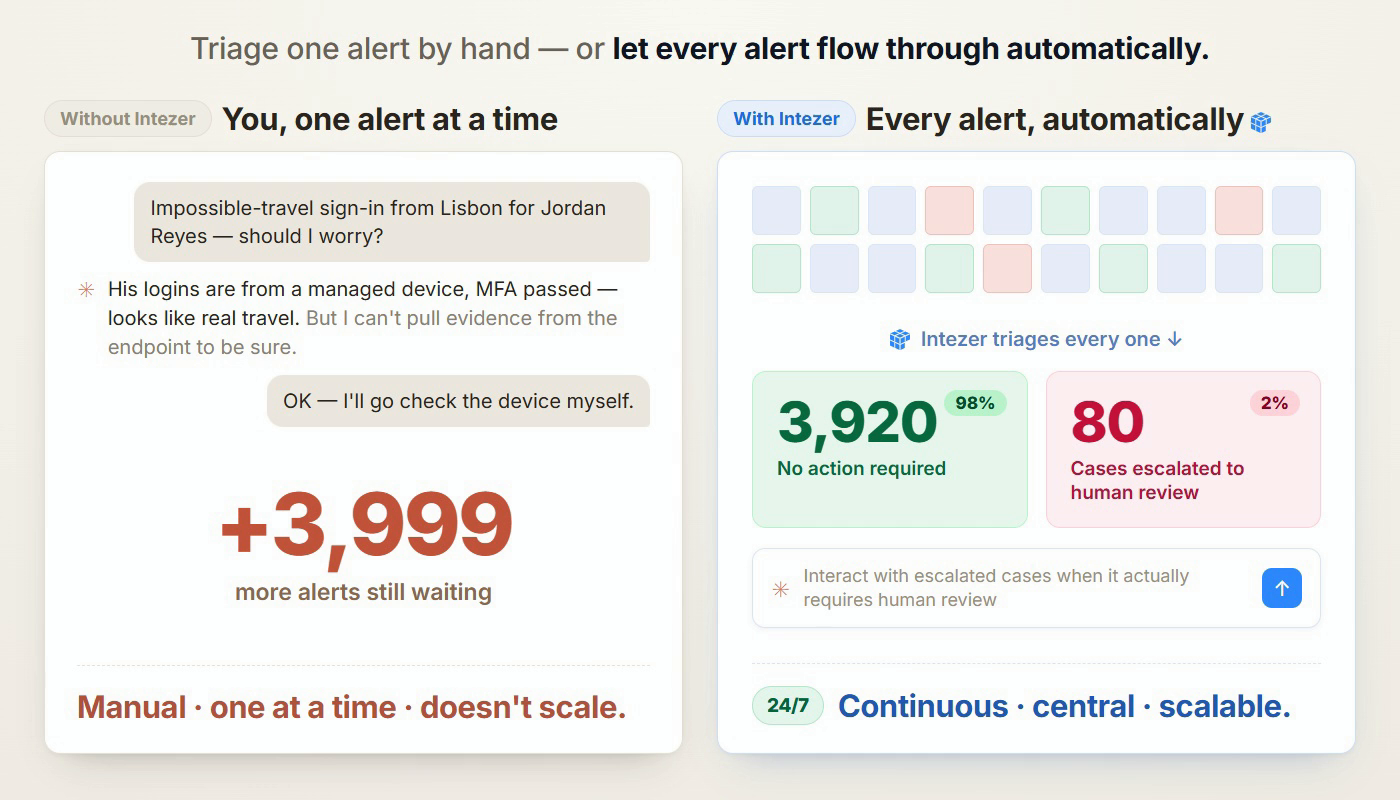
Same alert, two ways to handle it. On the left, Claude on its own takes the impossible-travel sign-in and works it by hand. It reasons well and gets close — managed device, MFA passed, probably real travel — but it can’t collect evidence from the endpoint to confirm, so the last step falls back to a human checking the laptop. And that’s one alert; almost 4,000 more are still waiting behind it. One analyst, one alert at a time, with no way to run it across the whole team. On the right, the same alert inside the AI SOC: Intezer triages every alert around the clock, closes the ~98% that need no action, and escalates only the ~2% that genuinely need a person. Claude is where you pick those up so you can stop grinding the queue and start supervising the few cases that actually need you.
Most of the org knowledge an investigation needs is already centralized in Intezer. That’s the whole point of the platform. But some context only ever lives with you: a procurement thread in someone’s inbox, a Slack message from three weeks ago, a calendar invite. With Intezer connected on one side and your IT and communication stack on the other, your AI workspace can cross-reference both in a single investigation.
Why not plug Claude into all security tools directly?
You could also wire your AI client straight into each security tool yourself. Most of them ship an MCP these days. Two things make that a worse deal than it looks. First, the integration work is now yours: stitching a dozen connectors together, learning each product’s query quirks, and getting back a pile of disconnected results instead of one correlated picture. Second, raw tool access still isn’t investigation. With every EDR, SIEM, and intel feed wired in, the model can read your data, but it can’t collect evidence off an endpoint, run memory forensics, or weigh conflicting signals into a verdict it will actually stand behind, which is exactly where Claude stalls on the left in above image.
Intezer already did both jobs. One connector hands the model a SOC’s worth of normalized cases, verdicts backed by real forensic evidence, and cross-tool correlation. An AI platform does its best work standing on a real foundation of security knowledge, not on a dozen raw feeds it has to assemble itself.
Investigate and close the cases Intezer escalates to you
This is where analyst hours should go, so it’s where the MCP goes deepest. Whatever the alert type, the shape is the same: pull the case, build on everything the autonomous triage already found, cross-reference your other systems, decide interactively with you, and close with evidence.
And “pull the case” carries real weight here. A case from Intezer is not a bare ticket. It arrives with everything triage already did: the evidence it collected, the SIEM and EDR queries it ran, the forensic analysis of each artifact, the verdicts it reached. You’re not starting from a blank page; you’re picking up a deep investigation and taking it the last mile.
“Pick up the oldest escalated open case and let’s investigate it together.”
The clip above takes an impossible-travel alert. The MCP brings the full login history including every IP and geo, and who else touched the same address as well as your AI workspace cross-references calendar and Slack for travel context. When the evidence still isn’t conclusive, it can ask the user directly and close on their answer, so the one human check that actually mattered takes seconds instead of becoming a follow-up ticket.
Make tomorrow’s autonomous triage smarter
If a case should never have reached you, closing it is half the job. The other half is making sure it never reaches you again.
“We keep getting this exact false positive. Write a tuning rule so it never escalates again, then retriage the case.”
Claude inspects the alert’s triage indicators, drafts a narrowly scoped tuning rule, and tests the pattern against the real alert object before proposing anything. It checks whether an existing rule should be extended instead of creating a near-duplicate. It asks the question every detection engineer should ask: could an attacker hide inside this rule? Then it pushes the rule to Intezer for your approval and retriages the affected alerts so the fix applies immediately.
Tuning runs both directions, too. The same mechanism can tell the autonomous triage to always escalate a pattern it can’t yet call malicious with confidence, so the genuinely ambiguous cases land in front of a human by design, not by luck.
This is where the two halves of the AI SOC meet. Every rule your AI workspace writes makes the autonomous half smarter, which means fewer escalations next month, which means the time you spend supervising keeps shrinking. The system compounds.
From case to incident report in one prompt
When a case turns into a real incident, the hours after containment go to reconstruction: which alerts were related, which machines were touched, what happened first, and what to tell leadership.
“Write an incident report for the latest case we worked on — timeline, affected assets, and an exec summary I can send to the CISO.”
Your AI workspace pulls the case and its full activity trail from Intezer, expands across the users, devices, and IPs involved, and rebuilds the timeline from the forensic evidence already on file. Then it writes the report with an executive summary up top, technical detail below, in your template if you have one, and finally exports it to a clean, brand-styled PDF you can send as-is. The data was always in Intezer; the report was just assembly. Now assembly is one prompt.
Threat hunting: start from a lead, not an alert
Not every investigation starts in the queue. Sometimes it starts with your CISO forwarding an article about a campaign that’s hitting your industry.
“Here’s a writeup of a new campaign [link]. Check whether any of these IOCs appear anywhere in our environment, and analyze anything you find.”
Your AI workspace extracts the indicators and techniques from the writeup, sweeps your environment through Intezer’s SIEM and EDR query tools, and returns the matching assets, alerts, and artifacts for analysis. When you find something worth a closer look, you can fire deep forensics to go one step further with your hunt.
How it works
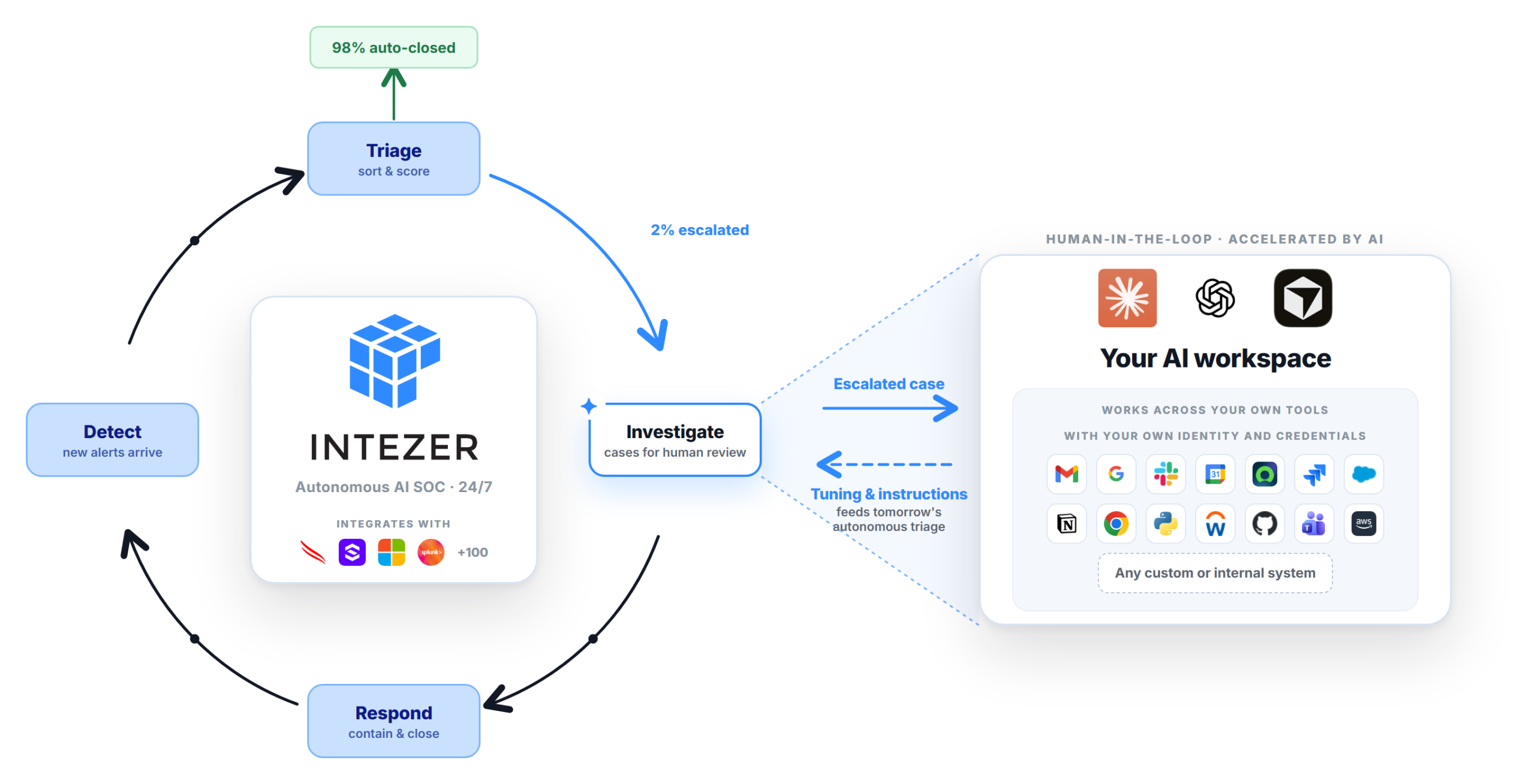
The Intezer MCP server is hosted by us. You authorize over OAuth from any MCP client: Claude (Desktop, Code, or claude.ai), ChatGPT, Codex, Cursor, or anything else that speaks the protocol.
Under the hood it exposes 66 tools covering the full case lifecycle: search and fetch cases and alerts, file and URL analysis, live queries against more than a dozen SIEM and EDR products in their native query languages (KQL, SPL, XQL, SDL, and the rest, with per-vendor syntax guides built in so the model gets them right), tuning rules and AI instructions, retriage, and case editing.
This architecture is what makes the two halves described above work as one system: the autonomous half clears work off your plate, while the assistive half accelerates the tasks where you still want to stay in the loop.
Getting started
- If you’re already an Intezer customer, an Intezer admin creates an MCP OAuth application under Account Settings → MCP OAuth Applications.
- Add Intezer as a custom connector in your AI client such as Claude, ChatGPT, or any MCP client. Point it at the hosted server, and authorize with your own Intezer login over OAuth.
- Open with one prompt: ask it to pick up your oldest open escalation.
The autonomous half investigates everything, around the clock, so your team only sees what matters. The assistive half makes the time you spend on what matters dramatically shorter. One system of record and detection logic underneath both: your cases, your verdicts, your tuning rules, your institutional memory, working for you whether the investigation runs inside Intezer or inside your AI workspace.
AI executes. Humans supervise. And now the supervising got a lot faster too.
If you’re not an Intezer customer yet, book a demo and we’ll show you both halves at once: autonomous triage working every alert around the clock, and a co-pilot that helps your analysts close the escalations that do reach them 10x faster.
The post The other half of the AI SOC: Intezer, now inside your AI workspace appeared first on Intezer.
