❌

Normal view

Social Engineering in the Age of Synthetic Media

29 September 2026 at 02:00

Most AI-enabled social engineering can still be addressed through existing defenses, but synthetic media attacks require organizations to adapt those defenses and stop treating a familiar face or voice as proof of identity.

Many uses of AI in social engineering, including personalizing phishing messages, building fraudulent websites, and automating responses, make established techniques faster, cheaper, and easier to scale. Although organizations must adapt their defenses to address the volume and sophistication of these threats, current evidence indicates that established security controls, such as filtering, verification procedures, and repeated training, still reduce the success of these attacks.

That said, synthetic media such as deepfakes and voice alteration present an exception. Synthetic media weakens the audiovisual and biometric signals that people and identity systems previously treated as evidence of legitimate identity. Research has found that both people and detection systems struggle to reliably identify deepfakes, especially those presented outside of controlled settings. As a result, defenses that rely on recognizing a familiar voice, face, or identity document are often insufficient on their own.

This distinction matters. Treating all AI-enabled threats as equivalent risks gives organizations a false sense of security while leaving them vulnerable to attacks that existing controls fail to prevent.

AWS European Sovereign Cloud: Demonstrating an independent operation

28 September 2026 at 19:05

On Saturday, October 24, 2026, we will conduct an exercise demonstrating that the AWS European Sovereign Cloud can operate without depending on any infrastructure outside of the European Union (EU).

For several hours, the AWS European Sovereign Cloud will operate without a connection to the AWS Global Network backbone. The backbone is the private network that moves authorized AWS operational data between AWS locations without using the public internet. During the exercise, this traffic will securely reroute over the public internet.

The exercise will not affect service availability within the AWS European Sovereign Cloud, other AWS Regions, or private connectivity through AWS Direct Connect. Customers may experience brief connectivity disruptions as traffic moves onto a separate network route at the beginning or the end of the exercise, after which normal connectivity resumes.

The operational team, composed entirely of EU residents within the EU, will execute the exercise using only the hardware and software resources of the AWS European Sovereign Cloud. The AWS European Sovereign Cloud Managing Directors called for this exercise to showcase its operational independence.

An independent cloud for Europe

The AWS European Sovereign Cloud is a new, independent cloud for Europe. Located in Brandenburg, Germany, its data centers are physically and logically separate from other AWS Regions, with a local in-EU copy of the source code. All customer content and customer-created metadata stay in the EU. It has no critical dependencies on non-EU infrastructure and is operated exclusively by EU residents.

In standard operations, the AWS European Sovereign Cloud uses two global systems. The first is the AWS Global Network backbone. The second is a dedicated system that the local EU team controls and supervises to securely manage limited, controlled transfers of operational AWS data.

Neither is operation-critical, and neither affects the sovereignty assurance of the AWS European Sovereign Cloud. The AWS European Sovereign Cloud can operate independently at any time without a connection to these global systems, and on October 24 that’s what the team will demonstrate.

Built to meet regulatory standards

This exercise will produce verifiable technical and operational evidence that the AWS European Sovereign Cloud can operate independently within the EU. The exercise is designed to be consistent with the objectives of the European Commission’s EU Cloud Sovereignty Framework (CSF) and the criteria of the C3A framework from Germany’s Federal Office for Information Security (BSI). These frameworks set out objectives and criteria for assessing whether cloud services can be provided independently and autonomously.

We designed the AWS European Sovereign Cloud for regulated customers and the public sector across the EU. The AWS European Sovereign Cloud: Sovereign Reference Framework (ESC-SRF) gives our customers and partners a comprehensive set of evidence points, maps to controls, artifacts, and other elements regulators and compliance authorities need to accelerate their adoption of the AWS European Sovereign Cloud. The results of this exercise will provide additional evidence for their compliance and assurance packages.

Standalone and fully secure

The AWS European Sovereign Cloud runs connected to the AWS Global Network backbone because it delivers superior performance, capacity, reliability, security, and cost savings to customers. That includes always-on encryption and distributed denial of service (DDoS) defenses; and the backbone can’t decrypt or see the encrypted data that AWS European Sovereign Cloud customers send and receive. While the backbone delivers these benefits day-to-day, the AWS European Sovereign Cloud can continue to operate independently, with the appropriate security controls in place.

During the exercise, instead of using the AWS Global Network backbone, the AWS European Sovereign Cloud will exclusively use its dedicated internet connectivity from European internet service providers. This will provide connectivity to the worldwide internet.

Whenever traffic moves between internet links, there’s a small window of limited disruption called convergence, a short time when other non-AWS networks change their routing information to reflect the change. This could happen at the beginning of the exercise, when traffic moves to dedicated AWS European Sovereign Cloud internet providers, and at the end of the exercise, when traffic moves back to the AWS Global Network backbone.

Customer data stays in the EU

AWS has committed to not moving AWS European Sovereign Cloud customer content and customer-created metadata outside of the EU. Only certain data, which is neither customer content nor customer-created metadata, such as AWS operational data, leaves the EU. We use a dedicated system to securely manage these limited, controlled transfers under the control and supervision of the local EU team. We’re rigorous about what the system transfers. It accepts vetted source code mirroring and software updates, and transfers out very limited and approved routine information. During the exercise, the AWS European Sovereign Cloud team will disable the system entirely, confirming that the AWS European Sovereign Cloud continues to operate independently without it.

Learn more

AWS will share an update after the exercise with regulators and customers. To learn more about the AWS European Sovereign Cloud’s design and digital sovereignty controls, visit aws.eu. If you have questions about this exercise or would like to discuss how it may impact your workloads, reach out to AWS Support or contact your AWS Account team.

Stephane Israel

Stéphane Israël

Stéphane is the leader and Managing Director of the AWS European Sovereign Cloud. He is responsible for the management and operations of the AWS European Sovereign Cloud, including infrastructure, technology, and services, in addition to broader digital sovereignty efforts at AWS. Prior to AWS, he was the CEO of Arianespace, where he oversaw numerous successful space missions, including the launch of the James Webb Space Telescope.

Using Threat Intelligence to Stop Ransomware Attacks

25 September 2026 at 02:00

Ransomware does not start when files are encrypted. By then, an attacker may already have obtained valid credentials, entered the network, moved between systems and established a command-and-control (C2) channel.

That gives defenders an earlier window to act. Ransomware threat intelligence helps security teams identify the actors, infrastructure and access methods connected to ransomware activity before an attack reaches its final stage. Instead of waiting for an endpoint alert or ransom note, teams can look for exposed credentials, malicious infrastructure and known attacker behavior, then act on the threats most relevant to their organization.

The need for that earlier view is growing. Modern ransomware operations may use Ransomware-as-a-Service (RaaS) models and double- or triple-extortion tactics, giving defenders more reason to identify warning signs before encryption.

Key takeaways

  • Ransomware threat intelligence can expose signs of an attack before encryption, including compromised access and attacker infrastructure.
  • IOCs remain useful, but TTPs provide longer-lasting context because attacker behavior changes less quickly than individual IP addresses or file hashes.
  • Early disruption can focus on closing initial access paths or cutting communication between compromised systems and known C2 infrastructure.
  • Recorded Future assists in connecting ransomware intelligence with organizational exposure, threat actor context and existing security workflows so teams can better prioritize action.

Why reactive ransomware defense is not enough

Reactive controls remain important, but they often cannot provide the external context security teams need to identify which ransomware threats are most likely to reach their environment.

Endpoint detection and response (EDR), network monitoring, and backups all have a role in ransomware defense. The problem is timing. If a team only acts after malicious behavior appears inside its environment, the attacker may already have gained access or started moving toward systems that matter.

This is where modern ransomware detection benefits from external intelligence. Security teams can compare what they see internally with information about active ransomware groups, infrastructure and exploitation activity outside their network.

IOCs show what happened. TTPs help anticipate what comes next.

Indicators of compromise (IOCs), such as malicious IP addresses, domains, and file hashes, can help security controls identify known threats. They also typically have a short shelf life when attackers rotate infrastructure or alter malware.

Tactics, techniques, and procedures (TTPs) describe how an adversary operates. MITRE ATT&CK organizes those behaviors across stages such as initial access, lateral movement and command and control.

A ransomware actor can quickly replace an IP address. Changing a working attack method takes more effort. Tracking both IOCs and TTPs gives defenders a stronger basis for deciding what to block now and what behavior to watch for next.

The goal is not to replace IOC-based detection. It is to add enough context to understand who may be behind an indicator, how it fits into an attack, and what the adversary is likely to attempt next.

How does Threat Intelligence help prevent ransomware attacks?

The best time to disrupt ransomware is before the attacker reaches the impact stage. Threat intelligence creates opportunities to act during initial access and C2 activity rather than relying on recovery after encryption.

External intelligence can reveal parts of the ransomware operation that are difficult to see from internal telemetry alone. That includes activity in criminal marketplaces as well as infrastructure connected to known threat actors.

Phase 1: Track the adversary outside your network

Initial access is often a business in its own right. Initial access brokers (IABs) obtain access to compromised organizations and advertise it to other criminals. Threat intelligence can surface compromised credentials and exposed Remote Desktop Protocol (RDP) access associated with an organization. It can also monitor IAB listings, actor chatter, and target discussions for warning signs before that access is used.

Monitoring those sources can give security teams a warning that credentials or access associated with their organization are exposed. A credential discovered for sale does not prove that a ransomware attack will follow, but it creates a specific risk that defenders can investigate before someone uses that access.

Threat intelligence can also connect ransomware groups with domains, IP addresses, and other infrastructure associated with their operations. Malware analysis and controlled sandbox testing can add newly observed indicators and behavioral information.

C2 intelligence is especially useful because command-and-control gives attackers a way to communicate with systems they have compromised. If defenders know the infrastructure associated with an active threat actor, they can look for related connections within their own network rather than waiting for the ransomware payload to execute.

Phase 2: Act at the point of disruption

Tracking only matters if the intelligence changes what the security team does.

At initial access, one priority is removing the opportunity before an attacker can use it. If exposed corporate credentials appear in criminal sources, the organization can investigate the affected account, reset credentials where needed, and review authentication activity for signs of misuse.

The same principle applies to vulnerabilities. A large vulnerability backlog does not indicate which flaw an attacker is likely to exploit first. Vulnerability intelligence adds evidence of exploitation activity, enabling teams to respond faster to weaknesses associated with active threats rather than relying on severity scores alone.

C2 creates another intervention point. High-confidence indicators associated with malicious infrastructure can be supplied to security controls so connections are blocked or detected earlier. If an endpoint begins communicating with known C2 infrastructure, the security team can investigate and isolate the affected system before the attacker progresses further.

Disruption does not always require taking criminal infrastructure offline. For an individual organization, breaking the attacker's access to its environment can be enough to stop that attack path.

These controls should sit alongside broader guidance on how to prevent ransomware, including identity protection, patching, and recovery planning. Threat intelligence makes those efforts more targeted by showing teams where an active threat is most likely to intersect with their environment.

Recorded Future turns ransomware intelligence into action

Recorded Future helps security teams connect external ransomware activity with their own exposure so they can spend less time sorting through threat data and more time acting on relevant risks.

Recorded Future’s ransomware mitigation capabilities bring together threat research, dark web intelligence and information about an organization's attack surface. Threat actor, industry and TTP context helps teams narrow their attention to ransomware threats that warrant attention.

Reduce research time with the Intelligence GraphⓇ

A large feed of indicators can contribute to alert fatigue if analysts must investigate each item manually. Recorded Future's Intelligence GraphⓇ connects information about threat actors with associated malware, infrastructure, and vulnerabilities.

That context helps analysts move from an isolated indicator to the relationships around it. Rather than treating every IOC as equally important, teams can assess how an indicator relates to an active threat and whether that threat is relevant to their organization.

Recorded Future uses AI to collect, process, and correlate threat data within the Intelligence Graph. This helps reduce repetitive research and enables teams to prioritize relevant findings.

Focus on the ransomware actors most relevant to your organization

Not every ransomware group has the same targets. Industry, geography and previous victim patterns can help analysts understand where a threat actor tends to focus.

Recorded Future's Ransomware Risk Profile provides a view of an organization's ransomware exposure. Victimology insights help teams understand which ransomware groups and TTPs are most relevant based on targeting patterns such as industry and geography.

This allows SOC and threat intelligence teams to tune detection and hunting around ransomware groups whose past activity makes them more relevant to the business rather than treating the entire ransomware landscape as equally urgent.

Put intelligence into existing security workflows

Threat intelligence loses value when an analyst has to move findings manually from one tool to another.

Recorded Future can deliver intelligence through APIs and integrations with security information and event management (SIEM), security orchestration, automation, and response (SOAR), and endpoint detection and response (EDR) tools. Depending on the configured workflow, intelligence can add context to alerts and support automated blocking of malicious infrastructure.

Build an intelligence-driven ransomware defense

Ransomware threat intelligence changes the point at which defenders can respond. Instead of treating encryption as the first clear sign of an attack, teams can look for the access, infrastructure and behavior that come earlier.

This does not replace EDR, access controls or backups. It gives those defenses external context. A vulnerability becomes more urgent when a ransomware actor is actively exploiting it. An exposed credential becomes an immediate investigation point when criminals are offering access to the organization. A C2 indicator becomes more useful when analysts can connect it to the actor and TTPs behind it.

That earlier context can reduce both the likelihood of a successful attack and the damage an attacker can cause. Given how ransomware affects businesses, moving the disruption point earlier in the attack lifecycle can protect far more than encrypted files.

Ready to stop ransomware before a breach occurs? Explore our product tours to get a feel for how Recorded Future automates the tracking and disruption of the most relevant threat actors targeting your industry.

Ransomware Threat Intelligence FAQs

What is the primary difference between a reactive and a threat intelligence-led disruption strategy for ransomware?

A reactive strategy focuses on detecting and recovering from ransomware after malicious activity reaches the environment. A threat intelligence-led strategy looks for earlier warning signs, such as exposed access, known threat actor behavior and malicious infrastructure, so teams can intervene before encryption occurs.

Is paying a ransom ever considered an effective disruption strategy?

Paying a ransom occurs after an organization has already been compromised, so it is generally not a preemptive disruption strategy. Threat intelligence-led disruption focuses on stopping the attacker earlier in the ransomware lifecycle.

Which stages of the ransomware attack lifecycle offer the best opportunities for external disruption via threat intelligence?

Reconnaissance and command and control (C2) provide valuable opportunities for disruption. Threat intelligence can identify exposed credentials, access being advertised by initial access brokers and infrastructure associated with known ransomware actors before those resources are used against the organization.

How does Recorded Future use AI to accelerate ransomware disruption?

Recorded Future uses AI to collect, process and correlate threat data within the Intelligence Graph. This helps analysts connect indicators with threat actors, infrastructure and TTPs, reducing manual research and helping teams identify ransomware threats that require attention faster.

Can Recorded Future help our organization identify and mitigate our most critical ransomware exposure points?

Recorded Future combines vulnerability and attack surface intelligence with external threat context to help teams identify exposures associated with active ransomware threats. This can help security teams prioritize remediation based on evidence of exploitation and organizational risk rather than severity scores alone.

What is victimology in the context of ransomware intelligence, and how is it used to protect an organization?

Victimology examines the types of organizations ransomware groups have targeted, including patterns related to industry and geography. Security teams can use those patterns alongside threat actor TTPs to identify ransomware groups that may be more relevant to their organization and adjust detection and hunting accordingly.

How is the rise of Ransomware-as-a-Service impacting the way organizations use threat intelligence for tracking?

Ransomware-as-a-Service can separate ransomware operators from the affiliates carrying out attacks. Threat intelligence teams therefore need to track more than a single malware family, including affiliate behavior, initial access activity and criminal-market sources that may reveal how attacks are being prepared.

Russia Escalating Hybrid Attacks Across Europe

24 September 2026 at 02:00
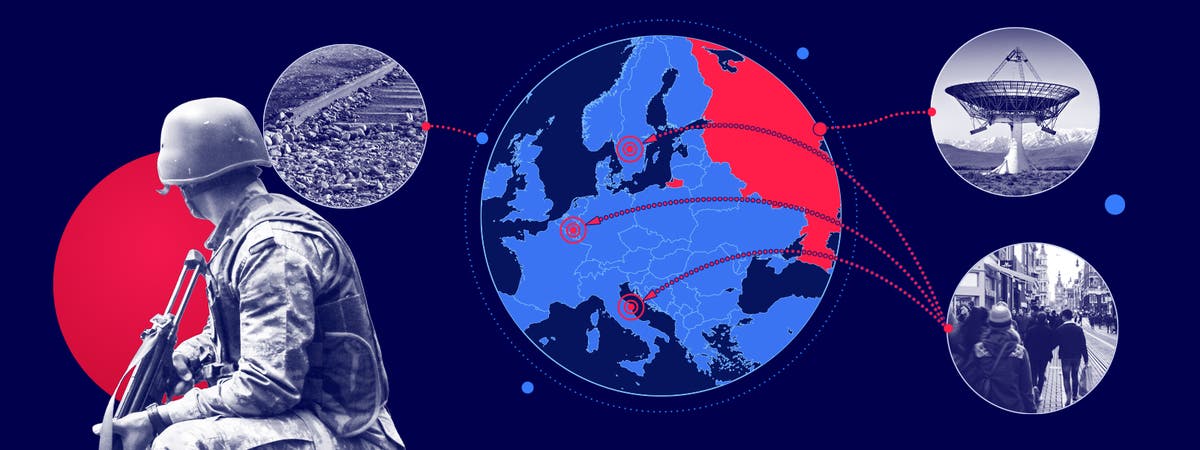
Since Russia’s full-scale invasion of Ukraine in February 2022, Russia has escalated its use of hybrid, asymmetric warfare across Europe, far beyond the former Soviet Union, where Russia historically focused its aggression. These tactics fall under a Russian military strategy known as New Generation Warfare (NGW). Insikt Group assesses that Russia is likely to escalate NGW tactics over the next two years, potentially culminating in a full-scale NGW campaign. Europe-based private and public sector entities are very likely at risk of physical and cyber sabotage as Russia deploys NGW tactics. Critical infrastructure entities in Europe are at high risk of being targeted, potentially resulting in data loss, physical damage to facilities, or injury or death of personnel.

ICYMI: August 2026 @AWS Security

24 September 2026 at 01:07

Read all about the latest AWS security features, compliance updates, and hands-on resources in our monthly digest posts. You’ll find expert blog posts, new service capabilities, code samples, and workshops.

AWS Security Blog posts

August brought 20 AWS Security Blog posts organized across seven categories. Identity and access management led the month with five posts covering self-service rate limits for Amazon Cognito, a decade of AWS Managed Microsoft AD, a redesigned sign-in experience, console Private Access for isolated VPCs, and automated IAM Identity Center governance. Data protection followed with four posts on AWS KMS data key caching, ACME protocol support in AWS Certificate Manager, Amazon S3 over-permissioned access remediation, and the upcoming deprecation of email-based domain validation. AI security continued to grow with four posts on custom authentication in Amazon Bedrock AgentCore Gateway, user authorization propagation in AI agents, and extending Bedrock Guardrails to tool interactions. Threat detection, governance and networking.

Identity

From 2 weeks to 2 minutes: Amazon Cognito launches provisioned limits for self-service rate limit management
Authors: Kiran Dongara, Howie Li | Published: August 5, 2026
Learn to use Amazon Cognito provisioned limits for on-demand authentication rate limit adjustments, replacing the previous 10–14 day support ticket process with self-service capacity scaling in minutes.

A decade of enterprise identity in the cloud with AWS Managed Microsoft AD
Authors: Vladimir Provorov, Tekena Orugbani, Rodney Underkoffler | Published: August 7, 2026
AWS Managed Microsoft AD celebrates 10 years of fully managed Active Directory in the cloud, now offering Standard, Enterprise, and Hybrid editions with multi-Region replication and 20+ AWS service integrations.

Updates to your AWS sign-in experience
Authors: Vaibhav Chowla, Ella Segura | Published: August 17, 2026
AWS is gradually rolling out a redesigned sign-in page with a unified email entry point, social identity provider options, and an updated session selection experience for managing multiple active sessions.

Extend your data perimeter to the AWS Management Console with Private Access
Authors: Madhur Kulkarni, Abhijit Barde, Sujay Ghosh, Mateusz Jaworski | Published: August 28, 2026
AWS Management Console Private Access now supports VPCs without internet connectivity, routing all console traffic – authentication, static assets, and service API calls – through AWS PrivateLink endpoints to strengthen your data perimeter.

Automate IAM Identity Center governance with continuous discovery and reporting
Author: Jonathan Nguyen | Published: August 31, 2026
Learn to deploy automated discovery and reporting for AWS IAM Identity Center applications and assignments across your organization, with event-driven monitoring that validates naming conventions and enables near real-time enforcement of governance policies.

Data Protection

Caching KMS data keys in multi-thread environments: per-tenant encryption for event-driven systems at scale
Authors: Maria Gutovsky, Hemmy Yona | Published: August 6, 2026
Learn to solve the cache stampede problem in multi-tenant envelope encryption using the AWS-recommended hierarchical keyring pattern or a custom Caffeine-based caching approach to reduce AWS KMS costs.

Automate certificates with ACME support in AWS Certificate Manager
Authors: Anthony Harvey, Chandan Kundapur | Published: August 6, 2026
Learn to use ACME protocol support in AWS Certificate Manager to automate public certificate issuance and renewal using standard clients like Certbot and cert-manager, with enterprise controls for domain scoping and centralized visibility.

Securing your Amazon S3 buckets: identifying and remediating over-permissioned access
Authors: Hetal Kolekar, Fernando Chiera di Vasco Freitas, Manonmayi Vedam | Published: August 7, 2026
Learn to detect and fix over-permissioned Amazon S3 buckets across multi-account environments using AWS Lambda, AWS Config, and AWS Security Hub, with automation for continuous monitoring.

AWS Certificate Manager will discontinue email validation to prove domain validation for certificates
Authors: Adam Aboudi, Poojil Tripathi | Published: August 13, 2026
ACM will discontinue email-validated public certificates by September 30, 2027, aligning with CA/B Forum standards – learn the timeline and how to migrate to DNS validation in place.

AI Security

Implement custom authentication for tools integration using request Lambda interceptor in AgentCore Gateway
Authors: Nishant Mainro, Ram Ramani | Published: August 18, 2026
Learn to use a request Lambda interceptor in Amazon Bedrock AgentCore Gateway to bridge legacy authentication mechanisms like Basic Auth, isolating credentials from AI agents using AWS Secrets Manager.

Propagate user authorization context in AI agents with Amazon Bedrock AgentCore
Authors: Anshu Bathla, Prafful Gupta, Rohit Verma | Published: August 19, 2026
Learn to enforce least-privilege access in AI agents by propagating user identity through Amazon Bedrock AgentCore to Amazon DynamoDB, Knowledge Bases, and Salesforce, without embedding authorization logic in agent code.

Extend Amazon Bedrock Guardrails to tool interactions using the Strands Agents SDK
Authors: Stephan Traub | Published: August 27, 2026
Learn to extend Amazon Bedrock Guardrails beyond the model boundary to tool calls, external data, and MCP server interactions using three validation checkpoints built with Strands Agents SDK lifecycle hooks.

Threat detection and incident response

Security Hub Extended adds supply chain security as its tenth category
Author: Michael Fuller | Published: August 18, 2026
AWS Security Hub Extended now includes supply chain security with Chainguard and Socket as curated partners, helping you verify open source dependencies and block malicious packages through a single AWS billing relationship.

Detecting multi-stage attacks on AWS: a guide to cross-service signal correlation
Authors: Nisha Kashyap | Published: August 26, 2026
Learn to correlate signals across AWS CloudTrail, VPC Flow Logs, and Route 53 Resolver logs to detect multi-stage attacks by layering your business context, data classification, access norms, and change windows – on top of Amazon GuardDuty Extended Threat Detection.

AWS partners with Anthropic and OpenAI to bring AWS Continuum into developer workflows
Author: Chet Kapoor | Published: August 5, 2026
AWS Continuum for code vulnerabilities now integrates with Anthropic Claude Code, OpenAI Codex, and Kiro, enabling developers to discover, prioritize, validate, and remediate vulnerabilities within their coding environments.

We invited a direct competitor into Security Hub Extended. Here’s why.
Authors: Michael Fuller | Published: August 31, 2026
AWS Security Hub Extended now includes Upwind, a runtime-first cloud security company, offering eBPF-based workload protection with pay-as-you-go pricing through a single AWS bill, reinforcing customer choice even where capabilities overlap with AWS offerings.

Infrastructure security

AWS Network Firewall now supports rule hit count
Authors: Preetkumar Shah, Amit Gaur, Cheriyan Mundapuzha, Santosh Shanbhag, Srivalsan Mannoor Sudhagar | Published: August 20, 2026
AWS Network Firewall now tracks how often stateful rules match traffic, helping you identify unused rules, validate security controls for compliance, and accelerate incident response at no additional cost.

Governance and compliance

Landing Zone Accelerator independent assessment report for C5:2020 now available on AWS Artifact
Authors: Kevin Donohue, Michael Wahlers | Published: August 11, 2026
An independent assessment by Schellman evaluates how Landing Zone Accelerator on AWS aligns to C5:2020 requirements, implementing 325 security controls to accelerate your compliance journey.

Fast track ISM-ready cloud environments and IRAP assessments with Landing Zone Accelerator on AWS
Authors: Kevin Donohue, Dave Connell, Dan Friebe | Published: August 25, 2026
A new independent assessment by gwi.digital evaluates Landing Zone Accelerator against 1,081 ISM controls, achieving 91% coverage of addressable scope to help Australian customers accelerate IRAP assessment readiness.

How Moeve scales AWS governance with automated AWS Organization Service Control Policies
Authors: Gonzalo Guerrero, Jonatan De Martín, Rayco Martinez | Published: August 26, 2026
Learn how Moeve manages 150 SCPs across 300+ accounts in three AWS Organizations using a governance-as-code model; policies live in Git, deploy through GitHub Actions pipelines, and attach dynamically based on account metadata during onboarding, with Amazon EventBridge and AWS Lambda providing real-time observability of every organizational change.

August Security Bulletins

In August 2026, AWS published 23 security bulletins addressing vulnerabilities across open-source SDKs, MCP servers, developer tools, and the OpenSearch ecosystem. A dominant theme was the AI agent tool surface: prompt-injection consent bypasses in Strands Agents Tools enabled command and code execution, an insecure direct object reference exposed cross-tenant agent memory, and credential disclosure and authorization flaws affected the Amazon MQ, DocumentDB, and AWS Transform MCP servers and the Bedrock AgentCore harness. Remote code execution recurred throughout, from prototype pollution and Java deserialization in OpenSearch to path-traversal-to-root in amazon-ssm-agent, Zip Slip in awsdac, and an uncontrolled search path in the Kiro IDE and CLI on Windows.

Other notable issues include disabled SSH host key verification in the AWS CLI, memory-safety flaws in the AWS SDK for C++, privilege escalation in the FreeRTOS-Kernel, and memory-amplification denial of service in Amazon ion-java. OpenSearch accounted for a large share of the month, spanning authorization, input validation, SSRF, stored XSS, and denial of service, while Athena Federated Query connectors exposed Secrets Manager secrets. A common thread: insufficient authorization and input validation at the boundary between AI agents and the systems they reach. All patches are available, upgrade promptly. For more information, see AWS Security Bulletins.

AWS Samples

In August 2026, we published 17 new code samples organized into five categories: governance and compliance (7), AI security (3), data protection and privacy (3), identity and access management (2), and infrastructure security (2). This month’s collection reflects the rapid growth of agentic AI workloads: most samples focus on governing, auditing, and securing AI agents built on Amazon Bedrock AgentCore, from platform-level governance and telemetry to fraud investigation and biosecurity screening.

Governance and compliance

Agentic Governance Platform

Learn to deploy an AWS-native control plane for governing AI agents across your enterprise with centralized registry, Microsoft Entra ID single sign-on, Cedar tool policies, multi-vendor agent inventory, and Langfuse observability, all self-hosted on Amazon Bedrock AgentCore.

Enterprise Agentic AI Platform Accelerator

Learn to deploy a secure, governed foundation for production AI agents on Amazon Bedrock AgentCore with modular CDK stacks covering identity, gateway, memory, runtime, and observability; supporting Strands Agents, LangGraph, and Claude Agent SDK with opt-in security controls.

Video Compliance Agent

Learn to deploy an end-to-end pipeline that automatically verifies video content against broadcast compliance guidelines such as Ofcom; extracting frames, audio transcripts, and OCR text shot by shot, then using Amazon Bedrock to flag potential violations and produce a structured per-shot compliance report.

Intelligent Security for Healthcare APIs

Learn to add behavioral anomaly detection, automated data sensitivity classification, and HIPAA compliance reporting to your FHIR API using Amazon Bedrock; running asynchronously so clinical workflows are never blocked, with Amazon Comprehend Medical and Bedrock Guardrails anonymizing PHI throughout the monitoring path.

Governed Agentic Companion

Learn to deploy a governed, orchestrator-driven multi-agent builder companion on Amazon Bedrock AgentCore, reachable from Kiro, Claude Code, or any MCP client; the kit enforces 13 codified tenets through an always-on governance gate with no off switch, routing each request to a specialist while blocking deploys, secret leaks, and ungrounded answers by construction.

Audit the Agent

Learn to deploy a serverless daily executive audit pipeline for AWS AI agents (AWS DevOps Agent, AWS Security Agent) using AWS Step Functions and AWS Lambda; the report answers five questions: what the agent accessed, who authorized it, what it cost, its risk posture across five trust dimensions, and whether you should be concerned, all sourced deterministically from AWS CloudTrail, CUR, and IAM with AI-generated summaries bounded by layered guardrails.

AI Security

Telemetry Enablement for AgentCore CloudFormation

Learn to deploy a single AWS CloudFormation stack that enables Amazon CloudWatch logs and X-Ray traces for every Amazon Bedrock AgentCore resource type – Runtime, Gateway, Memory, Browser, CodeInterpreter, and WorkloadIdentity – using native and custom telemetry rules.

Bedrock Guardrails to OCSF on CloudWatch

Learn to transform Amazon Bedrock Guardrails intervention events into OCSF Detection Finding records and land them in the Amazon CloudWatch unified data store; enabling you to query guardrail violations alongside AWS CloudTrail, Amazon VPC Flow Logs, and other sources with Amazon Athena or CloudWatch Logs Insights.

Bedrock Readiness Agent

Learn to deploy a read-only assessment agent built with the Strands Agents SDK that evaluates your Amazon Bedrock environment across six dimensions: IAM governance, data retention, quota headroom, model selection fitness, cost projection, and operational observability; generating severity-rated findings with AWS CloudFormation and Terraform remediation templates you can apply directly.

Infrastructure security

DDoS Guardian

Learn to install an agent skill that reviews an AWS WAF web ACL as a system: evaluation order, rule interactions, and L7 DDoS posture; then delivers a severity-ranked HTML report with ready-to-apply remediation. Offline, read-only, no AWS resources modified.

Biosecurity Screening Policy on Amazon Bedrock AgentCore Gateway

Learn to use Policy in Amazon Bedrock AgentCore to deterministically screen AI agent tool requests for biosecurity risks, combining Cedar policies with three independent screening layers: MMseqs2 sequence alignment, ESMC-600M embedding similarity, and Foldseek structural homology; enabling defense-in-depth controls that block high-risk protein sequences before they reach downstream tools.

MCP Fraud Investigation Agent

Learn to deploy an end-to-end AI-powered e-commerce fraud investigation agent built with the Strands SDK on Amazon Bedrock AgentCore, connecting through an AgentCore Gateway over MCP to query transaction history, customer profiles, login activity, support cases, and fraud playbooks; a React dashboard on AWS Amplifystreams the agent’s reasoning token by token as it works each case.

Identity

IAM Account Access Manager with ABAC

Learn to implement workforce access using IAM account access manager and attribute-based access control, where one IAM role per project shares a single policy document and access decisions are made by comparing role tags against resource tags at request time; onboarding a new project requires only tagging and entitlement configuration with no policy authoring.

Operationalizing Least Privilege: Automate IAM Remediation through Your CI/CD Pipeline

Learn to automate remediation of unused IAM permissions using AWS IAM Access Analyzer, AWS CloudTrail, and Amazon Bedrock for AI-generated AWS CDK code; the solution attributes each role to its origin (IaC or manual), then creates pull requests for IaC-managed roles or issues for manually created roles in GitLab or GitHub, with configurable exclusion rules and policy diffs for human review.

Data Protection

Data Residency Chatbot with Amazon Bedrock AgentCore

Learn to deploy a data-residency-compliant natural-language chatbot on Amazon Bedrock AgentCore where all data and AI inference stay within a single AWS Region; the solution uses a Strands agent that answers plain-English questions from Aurora PostgreSQL through governed, whitelist-validated read-only tools exposed via an AgentCore Gateway, with a residency guard that rejects any cross-region inference profile, demonstrated with a rooftop-solar subsidy program and adaptable to any sector or geography.

LLM-based PII Detection

Learn to detect personally identifiable information in conversational text using Amazon Bedrock; the solution prompts any Converse-compatible model to return PII spans with category, value, and character offsets, handles long inputs via word-boundary chunking, recovers near-miss labels, and supports custom categories, few-shot examples, and pluggable backends beyond Bedrock.

Agentic Data Classification and Redaction

Learn to build a conversational AI research assistant that automatically classifies documents for MNPI, PII, and security sensitivity, then enforces per-user redaction at query time using Amazon Bedrock AgentCore, Guardrails, and Amazon OpenSearch Serverless vector search.

Conclusion

August 2026 provides comprehensive guidance and runnable code for governing agentic AI workloads at enterprise scale, from orchestrator-driven governance gates and biosecurity screening policies to daily executive audit pipelines and OCSF-normalized guardrail telemetry. The posts and samples provide patterns for console Private Access in isolated VPCs, attribute-based access control with IAM account access manager, automated least-privilege remediation through CI/CD, and cross-service signal correlation for multi-stage threat detection. Each resource includes deployment steps or runnable code so you can validate in your own environment before adopting. Subscribe to the AWS Security Blog RSS feed to receive updates as they publish, and revisit this digest monthly for a consolidated view of what changed and what to act on.

If you have feedback about this post, submit comments in the Comments section below.


Rodolfo Brenes

Rodolfo Brenes

Rodolfo is a Principal Solutions Architect focused on Cloud Governance and Compliance. With over 18 years of experience, he currently leads a technical field community in AWS helping customers scale and improve their security and governance frameworks. Besides work, Rodolfo enjoys video games, playing with his four cats, and won’t say no to a good outdoor adventure.

Anna Brinkmann

Anna has 18 years of experience in the technical content space and has spent the last 6 years managing the AWS Security Blog. Outside of work, she enjoys spending time with her family.

Supporting ASD’s multi-factor authentication campaign: Why MFA matters more than ever

23 September 2026 at 16:45

The Australian Signals Directorate (ASD) has this month issued a clear call to action through its Multi-factor authentication: Switch it on campaign, urging businesses, organisations, and individuals to enable multi-factor authentication (MFA) across their online accounts. At AWS, we strongly support this message.

As threat actors continue to target credentials through phishing, credential stuffing, and social engineering, passwords alone are no longer enough. MFA is one of the most effective security controls available. It’s a cornerstone of ASD’s Essential Eight maturity model and a recognized component of major cybersecurity frameworks worldwide. ASD’s campaign reinforces what the security community has long advocated: switching on MFA is one of the simplest and most impactful steps any organization or individual can take to protect themselves online, and we encourage all to heed ASD’s call.

How AWS enforces MFA across every account type

At AWS, we’ve put this principle into practice at scale. In June 2025, AWS Identity and Access Management (IAM) achieved comprehensive MFA enforcement for root users across all account types, a significant milestone and the first of its kind among major cloud providers. This was the culmination of a deliberate, phased security journey: beginning with requiring MFA for AWS Organizations management account root users in May 2024, expanding to standalone account root users in June 2024, introducing centralized root access management in November 2024, and completing enforcement across all account types including member accounts. MFA prevents over 99 percent of password-related attacks and is available to all AWS customers at no additional cost, with support for FIDO2 passkeys and FIDO-certified security keys for phishing-resistant authentication. This milestone reflects our ongoing commitment to secure-by-design principles, setting a high bar for our customers’ default security posture and demonstrating that organizations of any scale can, and should, make MFA the standard rather than the exception.

ASD’s Multi-factor authentication: Switch it on campaign banner

Extending MFA beyond your AWS environment

A compromised email account can be used to reset AWS passwords. A breached source control system can expose infrastructure-as-code secrets. Enable MFA on your email, collaboration tools, source control, and other services that support it. Visit the ASD Multi-factor authentication campaign page for broader guidance.

Getting started with MFA on AWS

AWS enforces MFA automatically for root users. To extend that same protection to your IAM users—the identities your team members and applications use daily—you can configure MFA individually through the AWS Management Console for IAM. To learn more, see Security best practices in IAM. For phishing-resistant authentication with FIDO2 passkeys, see Passkeys and security keys in IAM.

If you have questions or feedback about MFA on AWS, leave a comment below or reach out on AWS re:Post. If you haven’t already, heed ASD’s call and switch on MFA across every account you own.

This post was written in support of ASD’s Multi-factor authentication: Switch it on campaign. For more AWS security content, visit the AWS Security Blog.

If you have feedback about this post, submit comments in the Comments section below.


Grace Zhang

Grace Zhang

Grace is the Regulatory and Security Compliance Lead for Australia and New Zealand (ANZ), based in Sydney. She supports security assurance and compliance initiatives across the ANZ region, helping customers navigate regulatory requirements and build confidence in the security of the AWS Cloud.

The Lure Isn't The Malware. It's Your Logo.

23 September 2026 at 02:00
Recorded Future's Insikt GroupⓇ has been tracking ClickFix, a social engineering technique that turns a familiar logo or verification prompt into the entry point for an attack. Here's what that research reveals about catching it, and why it's now running inside Malicious Site Monitoring, part of our newly launched Digital Risk Protection solution.

Recorded Future's Insikt GroupⓇ, our team of threat intelligence analysts and security researchers, has been tracking a technique called ClickFix as it works its way into a growing number of brand impersonation campaigns. We recently hosted a webinar digging into that research, and what stood out wasn't just the technique itself. There's no malware automatically installed, no exploit, just a page convincing enough that the victim ends up doing the damage themselves. It is also a strong example of the detection capabilities built into Malicious Site Monitoring, a new use case included in Digital Risk Protection, and a good way to show what those capabilities are actually built to catch.

How ClickFix actually works

ClickFix works by mimicking the visual language people already trust, a CAPTCHA prompt, a familiar logo, a "verify you're human" screen, and using that trust to get someone to run a command on their own machine. There's no code being smuggled past a firewall. The victim is the delivery mechanism.

That's also what makes it hard to catch with traditional tools. A page built to look exactly like a real verification screen doesn't behave like malware, and it doesn't trip the same alarms as a page trying to exploit a browser. It succeeds because the person on the other end believes they're completing something routine.

It's not static, either. The instructions can change depending on the operating system a victim is running, one path for Windows, a different one for macOS, which means the "fix" itself adapts to the target. A single signature or a one-off takedown was never going to keep up with that. Catching this at scale means watching for the pattern, not waiting to recognize a specific file.

Malicious Site Monitoring

This kind of research and the product built to act on it aren't two separate things. Digital Risk Protection's Malicious Site Monitoring is built to catch this exact category of infrastructure, phishing domains, lookalike sites, brand impersonation, fast enough to matter. Disposable infrastructure like this is designed to do its damage and disappear before anyone gets around to reporting it, so speed isn't just a nice-to-have here, it's a necessity.

Underneath that speed is a detection process built in layers. Analyst-built signatures catch known patterns with precision. Content similarity analysis can catch campaigns that move in clusters. Attackers often reuse the same page template across dozens of disposable domains, so even though each domain name looks unrelated, the pages themselves share the same structure underneath. A separate component flags a familiar logo or brand mark through screenshot analysis and Optical Character Recognition (OCR). Machine learning is often able to catch what the other methods might miss, sites that don't resemble any known signature or template, by predicting risk from the page's characteristics rather than requiring a direct match. That layered approach is what makes it possible to evaluate a massive volume of candidate domains and URLs every single day without generating excessive false positives.

From detection to takedown

Finding a threat fast doesn't help much if the next steps are still manual. The real shift in how Digital Risk Protection operates is this: detection, triage, and action now live in the same workflow.

Not every detection needs a human to look at it immediately, and that distinction matters. A multi-stage detection funnel helps filter raw monitoring volume down to those that could need a response, and for malicious sites specifically, an AI Triage Agent reviews flagged detections and delivers a verdict before anything reaches an analyst's queue. Instead of triaging a wall of alerts, teams are looking at a shortlist of things that already have context attached, what was found, why it matters, and what to do about it.

And when something does need action, takedown doesn't require a separate process. Coordination happens directly from the alert, one click, instead of manually chasing down registrars and hosting providers one by one.

What this means going forward

ClickFix is one campaign type. It won't be the last one built this way, and it almost certainly won't be the most sophisticated one we see this year. The interesting story isn't any single technique, it's that the same detection engine tracking it in a research report is the one running in production, watching for the next one before it has a name.

If you want to see that detection-to-action workflow in practice, not just malicious sites, but the full picture across dark web monitoring, code repository exposure, impersonation, and identity monitoring, take a self-guided click-through of Digital Risk Protection or request a demo. If you're already a customer, your account team can walk you through what this looks like against your own brand.

Frequently asked questions

Is ClickFix something Digital Risk Protection can actually detect, or just something Insikt Group writes about?

Both. The detection methodology behind the ClickFix research, layered signature, similarity, and machine learning analysis, is the same engine running inside Malicious Site Monitoring today. The research isn't separate from the product; it's built on it.

Is the AI Triage Agent available for this use case?

Yes. Malicious Site Monitoring is one of two use cases, alongside Dark Web Brand Monitoring, where the AI Triage Agent is live today. It reviews flagged detections and delivers a verdict before anything reaches an analyst's queue.

How do I get access to Digital Risk Protection?

It's available as a standalone solution or as part of Recorded Future's Core, Professional, and Elite platform packages. If you already use Recorded Future for brand monitoring, it's available to activate directly in the platform. If you're new to Recorded Future, request a demo to see it in action.

Agent Running in the Age of AI

22 September 2026 at 02:00

The intelligence community has always done things the same way: Identify a potential source (a target); make a recruitment (an agent); train, brief, and run the agent in place to collect intelligence of value to decision makers.

A great agent gives the decision maker insight into intent, and a reasoning and decision advantage over his or her adversaries. In some circumstances, this advantage shapes destiny. Control over destiny is commonly called sovereignty.

AI has rapidly made reasoning ubiquitous; a commodity accessible to all at ever-decreasing marginal cost. In the age of AI, advantage accrues to those who use reason most effectively, make good decisions most quickly, and take actions most confidently. And who will do the bulk of this reasoning, make these decisions, and take these actions? Agents.

Agent Running in the Age of AI

Historically, agents were sources of intelligence but, in the age of AI, the new consumer of intelligence is an agent. Agents will be dependent on the quality and timeliness of the intelligence they receive to give them context, shape their priorities, drive their behavior, and ensure the quality of their actions. Every agent will need an intelligence layer it can trust. Recorded Future is that layer.

Recruiting and running human agents is hard and expensive, and very few have the resources and the expertise to do it well. One experienced MI6 officer might run a handful of agents at any one time. But the human-to-agent ratio is about to change dramatically as decision-making shifts from carbon to silicon, driving down the costs of agent running, but dramatically increasing our reliance on agent decisions and actions.

The best military and political outcomes often result from the seamless integration of different sources and types of intelligence to produce a true understanding of the threat or the objective to be met, enabling good decision-making and decisive actions. The Cuban Missile Crisis combined geospatial, human, and signals intelligence; the D-Day Landings combined signals, human, and meteorological intelligence. As frontier AI capabilities diffuse, and as agentic systems incorporate these capabilities into multi-agent workflows, the performance of these systems relative to others, and thus their ability to deliver advantage, will be determined by ongoing access to high-fidelity, multi-source intelligence.

This is already the case in the domain of cyber security. Intelligence-enriched systems and workflows learn more quickly, adapt more nimbly, and operate more efficiently and effectively than those they are competing with. The adoption rate of Recorded Future’s AI triage capabilities proves this hands down.

Intelligence platforms like Recorded Future, which shed light on threat actor tactics, techniques, and procedures (TTPs) in real time, and which scale with AI and agent capabilities, are the foundation for effective agentic systems. Intelligence-driven agent running will ensure better agentic decisions and actions, delivering an enduring advantage over adversaries.

As former CIA Director Bill Burns put it, “The foundation for good policy choices is good intelligence wisely used.” In the age of AI, agents will make those choices, and the value of good intelligence will be greater than ever.

Transforming Bedrock Guardrails events into OCSF with CloudWatch

21 September 2026 at 17:33

Security teams investigating possible AI-related security events need guardrail intervention data alongside their existing security telemetry. When a guardrail identifies or blocks a prompt injection attempt or redacts sensitive data, that intervention carries additional investigative value comparable to a failed sign-in or a network intrusion alert. AWS Bedrock publishes this telemetry to AWS CloudWatch metrics and model invocation logs for operational monitoring.

In this post, I show you how to transform AWS Bedrock Guardrails intervention events into structured Open Cybersecurity Schema Framework (OCSF) Detection Finding records and land them in the CloudWatch unified data store. Launched in December 2025, the unified data store consolidates operational, security, and compliance data from AWS services and third-party sources into a single platform. Security operations center (SOC) and threat analysts can query guardrail events alongside identity, network, and endpoint data, including AWS CloudTrail and AWS Virtual Private Cloud (AWS VPC) Flow Logs, using AWS Athena or CloudWatch Logs Insights.

Use case

Consider an organization deploying AWS Bedrock across many applications, with guardrails applied as a governance control. The guardrails detect and block several categories of activity: harmful content, off-topic queries, sensitive information such as personally identifiable information (PII), and prompt injection attempts. Each time a guardrail intervenes, it produces a signal the security team wants to investigate alongside the rest of its telemetry.

Without a consolidation layer, guardrail interventions stay siloed as per-AWS Region CloudWatch metrics and entries in raw model invocation logs, separate from the identity, network, and audit data the security team already relies on. The CloudWatch unified data store is built to remove this kind of silo: it consolidates operational and security data across accounts and Regions into one store. Routing normalized guardrail records into it is what makes them correlatable with the rest of your security telemetry. To investigate effectively, the team needs to answer questions that span multiple data sources:

  • Identify which user accounts trigger the most guardrail interventions, and whether those same accounts also show unusual AWS Identity and Access Management (IAM) activity such as failed API calls or privilege changes. A spike in prompt injection blocks from a role that’s also generating access-denied events is a stronger signal than either on its own.
  • Determine whether prompt injection attempts correlate with specific source IP addresses that also appear in VPC Flow Logs, which helps distinguish a single misbehaving client from a coordinated pattern across the environment.
  • Track the trend of guardrail violations across the organization and compare it against a baseline from 30 days ago, so the team can tell routine policy noise apart from an emerging change in attacker behavior or a misconfigured application.

AWS GuardDuty already helps here: its AI Protection feature analyzes CloudTrail data events from AWS Bedrock and produces managed threat findings, including a direct prompt injection finding and anomalous model invocation findings. GuardDuty AI Protection is a complementary managed detection layer for AWS Bedrock activity. The pipeline in this post works alongside it: it captures the raw guardrail intervention records themselves, normalizes them to OCSF, and lands them in the unified data store so you can run your own cross-source correlation and long-term trend analysis alongside GuardDuty findings, CloudTrail, and VPC Flow Logs.

Guardrail traces arrive as JSON embedded in the AWS Bedrock model invocation logs, in an AWS Bedrock-specific shape rather than a normalized security schema. After the pipeline transforms them to OCSF and ingests them into the CloudWatch unified data store, a single Athena query answers all three questions, because guardrail findings then share the same field structure as other security sources and sit in the same catalog as AWS CloudTrail events and VPC Flow Logs.

Solution overview

At a high level, the solution captures guardrail intervention events from AWS Bedrock model invocation logs, transforms them into OCSF Detection Finding records with an AWS Lambda function, and lands them in the CloudWatch unified data store, where SOC analysts query them with Athena or CloudWatch Logs Insights. The CloudWatch unified data store provides Apache Iceberg-compatible access through AWS S3 Tables, CloudWatch Logs Insights queries, and, for supported sources, built-in OCSF normalization at ingestion.

Why a custom transform step

CloudWatch offers native OCSF conversion through the ParseToOCSF log transformation processor for specific AWS log sources. As of this writing, that processor supports five AWS log sources: CloudTrail, AWS Route 53 Resolver, VPC Flow Logs, AWS EKS audit logs, and AWS WAF. AWS Bedrock Guardrails isn’t one of the sources that ParseToOCSF supports, so guardrail traces aren’t converted to OCSF automatically.

Guardrail traces also need transformation logic that ingestion-time processors don’t provide. A single model invocation log can contain multiple guardrail assessments (for example, a content policy filter and a sensitive information policy match in one request), and the transform step splits that one log entry into one OCSF Detection Finding per assessment rather than a single combined record. This one-to-many expansion, combined with conditional severity assignment based on policy type, is application logic rather than field normalization. For these two reasons, this solution uses a dedicated transform step to produce OCSF records, then uses built-in CloudWatch mechanisms for enrichment, storage, centralization, and query.

This solution captures AWS Bedrock model invocation logs containing guardrail trace data, filters for intervention events, transforms them into OCSF Detection Finding records (class_uid 2004), and writes the structured records to a CloudWatch Logs log group that is associated with AWS S3 Tables through the CloudWatch unified data store managed integration. Guardrail interventions are detection events: the guardrail detected and blocked prohibited content, so OCSF class 2004 (Detection Finding) under the Findings category is the appropriate classification.

How a source’s records are stored depends on whether it’s a vended source or a custom source. For the five vended sources that ParseToOCSF supports, the unified data store produces individual typed OCSF columns. For any custom source, including AWS Bedrock Guardrails in this solution, records land in the associated S3 Tables table as OCSF JSON in a single managed cwl__message column rather than as typed columns. This is a property of custom sources in general, not specific to AWS Bedrock. You read the OCSF fields at query time with Athena json_extract functions, and you can correlate them with the vended sources that share the same catalog. This post shows that query pattern.

The pipeline supports multiple AWS Bedrock event types by changing the filter pattern and OCSF mapping. This post demonstrates the guardrail interventions row:

Bedrock event source OCSF event class class_uid
Guardrail interventions (this post) DETECTION_FINDING 2004
Model invocation API calls API_ACTIVITY 6003
Agent guardrail traces DETECTION_FINDING 2004
Token consumption anomalies DETECTION_FINDING 2004

Architecture

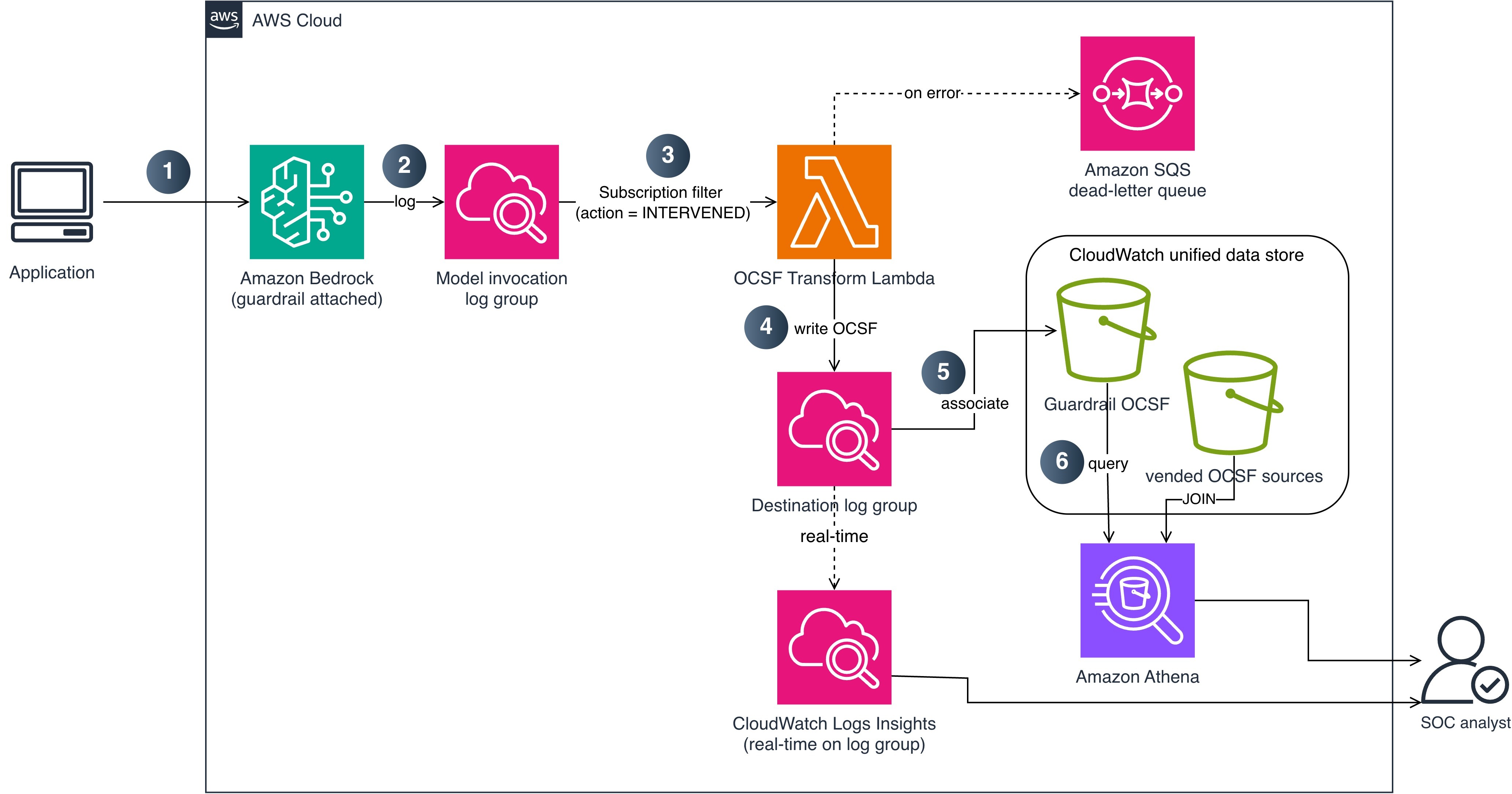
The following diagram shows the end-to-end pipeline from guardrail intervention to CloudWatch unified data store ingestion. It shows the flow within a single account for clarity. In an organization, you deploy this transform pipeline in each workload account and use CloudWatch Logs centralization to bring the OCSF output into one central account, so you query organization-wide without standing up the query layer per account or per Region. The Multi-account deployment section later in this post covers this pattern.

Figure 1: End-to-end pipeline from guardrail intervention to CloudWatch unified data store ingestion

Figure 1: End-to-end pipeline from guardrail intervention to CloudWatch unified data store ingestion

The data flow consists of the following steps:

  1. An application calls AWS Bedrock (InvokeModel or Converse API) with a guardrail attached.
  2. AWS Bedrock evaluates the guardrail and logs the invocation, including guardrail trace data, to a CloudWatch Logs log group using model invocation logging. A subscription filter matches log entries where the guardrail action is INTERVENED (blocked or masked content).
  3. The subscription filter delivers matching records to a Lambda function (OCSF Transform). This step performs the custom transformation that native OCSF conversion doesn’t cover for AWS Bedrock, expanding each guardrail assessment into its own OCSF Detection Finding.
  4. The Lambda function writes the OCSF JSON records to a dedicated CloudWatch Logs log group and sets contextual fields (account ID and Region) on each record during transformation. If the Lambda function fails to process a record, the message routes to an AWS Simple Queue Service (AWS SQS) dead-letter queue for later analysis and redrive.
  5. The destination log group is associated with AWS S3 Tables through the CloudWatch unified data store managed integration, so the unified data store stores the OCSF records as an Apache Iceberg table. Because AWS Bedrock Guardrails is a custom source, each record is stored as OCSF JSON in a managed cwl__message column.
  6. SOC analysts query guardrail intervention data with Athena, using json_extract to read the OCSF fields, and correlate it with vended security sources (CloudTrail, VPC Flow Logs) that share the same catalog. For real-time operational queries, analysts can also query the destination log group directly with CloudWatch Logs Insights.

OCSF mapping

The following table shows how AWS Bedrock Guardrails intervention fields map to OCSF Detection Finding (class_uid 2004) attributes.

OCSF field Source Example value
class_uid Static 2004 (Detection Finding)
category_uid Static 2 (Findings)
severity_id Derived from policy type 3 (Medium) for content/topic; 4 (High) for prompt injection
activity_id Static 1 (Create)
time Invocation log timestamp 1721001600000
cloud.provider Static AWS
cloud.region Set by the transform function us-east-1
cloud.account.uid Set by the transform function 123456789012
actor.user.uid Invocation log identity.arn arn:aws:sts::123456789012:assumed-role/AppRole/session
finding_info.title Derived from policy type ContentPolicy Intervention
finding_info.desc Guardrail trace action/topic Blocked: HATE content detected on INPUT
resource.uid Model ARN arn:aws:bedrock:us-east-1::foundation-model/anthropic.claude-sonnet-4-20250514-v1:0
resource.type Static AwsBedrock:Model
metadata.product.name Static Amazon Bedrock Guardrails
metadata.product.vendor_name Static AWS
metadata.version Static 1.3.0
unmapped.guardrail_id Guardrail trace guardrailId my-content-guardrail
unmapped.guardrail_arn Guardrail trace guardrailArn arn:aws:bedrock:us-east-1:123456789012:guardrail/abc123
unmapped.guardrail_version Guardrail trace guardrailVersion 3
unmapped.guardrail_content_source Guardrail trace INPUT or OUTPUT
unmapped.guardrail_policy_type Guardrail trace ContentPolicy, TopicPolicy, SensitiveInformationPolicy, WordPolicy, ContextualGroundingPolicy, PromptAttack

Prerequisites

The following prerequisites are needed to deploy the reference implementation. Before you begin, clone the repository:

git clone https://github.com/aws-samples/sample-bedrock-guardrails-cloudwatch.git
cd sample-bedrock-guardrails-cloudwatch

Verify you have the following:

Implementation

The reference implementation deploys two CloudFormation stacks: TransformPipelineStack and MonitoringStack. The following commands deploy the stacks in dependency order:

cdk deploy TransformPipelineStack \
  -c destination_log_group=/aws/cloudwatch-uds/bedrock-guardrails-ocsf

cdk deploy MonitoringStack \
  -c alarm_email=your-team@example.com

Or deploy both stacks at once:

cdk deploy --all \
  -c destination_log_group=/aws/cloudwatch-uds/bedrock-guardrails-ocsf \
  -c alarm_email=your-team@example.com

Enable model invocation logging

Model invocation logging captures the guardrail trace data you need. Turn on full request and response logging to a CloudWatch Logs log group and configure textDataDeliveryEnabled to capture the text bodies that include the guardrail trace output when a guardrail is attached to the invocation. The following AWS Command Line Interface (AWS CLI) command enables it:

aws bedrock put-model-invocation-logging-configuration \
  --logging-config '{
    "cloudWatchConfig": {
      "logGroupName": "/aws/bedrock/model-invocation-logs",
      "roleArn": "arn:aws:iam::123456789012:role/BedrockLoggingRole"
    },
    "textDataDeliveryEnabled": true
  }'

Because logging is an account-level prerequisite rather than part of the pipeline, the CDK stacks don’t manage it. Enable it once for each account before deploying.

Deploying the transform pipeline

The TransformPipelineStack deploys the Lambda function, subscription filter, destination log group, and dead-letter queue.

  • Create the subscription filter: The stack creates a CloudWatch Logs subscription filter on your model invocation log group with a filter pattern that matches guardrail interventions. This captures only the events where a guardrail blocked or modified content, not the successful pass-through events, which reduces Lambda invocations and cost.
  • Transform to OCSF: The Lambda function parses each CloudWatch Logs event and produces one OCSF Detection Finding record (class_uid 2004) per guardrail assessment in the trace. The transformation maps guardrail trace fields to OCSF attributes as described in the OCSF mapping table and sets contextual fields such as account ID and Region. Severity is set to High for prompt injection interventions and Medium for content, topic, or sensitive information interventions. The records contain structural metadata only; no prompt or response content is included.
  • Dead-letter queue: If the Lambda function fails to process a record, the message routes to an AWS SQS dead-letter queue with error metadata (error type, message, timestamp) for investigation and redrive.

Configure S3 Tables integration

To make the OCSF records queryable through Athena, associate the destination log group with AWS S3 Tables. This is a two-step managed setup: create an S3 Tables integration, then associate the log group as a data source. The integration delivers to the managed aws-cloudwatch table bucket at no additional storage charge.

  1. Tag the destination log group so the unified data store recognizes it as a data source. Use the tags cw:datasource:name (for example, bedrock_guardrails) and cw:datasource:type (for example, ocsf). The generated table name joins the two tag values with a double underscore, so these example tags produce a table named bedrock_guardrails__ocsf.
  2. Create the integration with CreateS3TableIntegration (CloudWatch Observability Admin), supplying an encryption configuration and an IAM role. This returns an integration AWS Resource Name (ARN).
  3. Associate the data source with AssociateSourceToS3TableIntegration (CloudWatch Logs), passing the integration ARN and the dataSource name and type from step 1.

The reference implementation performs steps 2 and 3 with the CloudFormation resource AWS::ObservabilityAdmin::S3TableIntegration and a custom resource that calls AssociateSourceToS3TableIntegration, so cdk deploy sets up the association for you.

After association, the OCSF records become available as an Apache Iceberg table in the managed catalog, at the path "s3tablescatalog/aws-cloudwatch"."logs"."bedrock_guardrails__ocsf". You can query it with Athena, AWS Redshift, or any Iceberg-compatible tool.

As noted in the solution overview, AWS Bedrock Guardrails is a custom source, so each record is stored as OCSF JSON in a managed cwl__message column. You read the fields at query time with the Athena json_extract_scalar function, as shown in the next section, and correlate against vended sources such as CloudTrail in the same catalog.

Enable analytics access

The association delivers records to the managed table, but analytics engines can’t read them until you enable the AWS S3 Tables analytics integration and grant read permissions. Complete these steps once in each Region:

  1. In the AWS S3 console, choose Table buckets, then choose Enable integration. The first time you do this in a Region, AWS S3 creates a service role that lets AWS Lake Formation federate access to your tables in the AWS Glue Data Catalog. This is what makes the s3tablescatalog catalog visible to Athena.
  2. In the Lake Formation console, under Data lake permissions, choose Grant, and grant Select and Describe on the aws-cloudwatch table bucket (and the bedrock_guardrails__ocsf table) to each IAM principal that runs queries, such as your SOC analyst roles. Without this grant, Athena queries return an access denied error even when the IAM policy allows Athena.
  3. In the Athena query editor, choose the AWS S3 Tables catalog from the data source list, and select the logs database.

Deploy the monitoring stack

The MonitoringStack creates a CloudWatch dashboard and alarms for pipeline health. The dashboard includes widgets for intervention count by policy type, transform errors, Lambda duration, and dead-letter queue depth. Alarms notify your team when the error rate exceeds 5 percent, the dead-letter queue depth exceeds 0, or p99 Lambda duration exceeds 10 seconds. Notifications are sent through AWS Simple Notification Service (AWS SNS).

Query interventions

After deployment, guardrail interventions are available through two query paths. Use the one that matches your investigation:

  • Athena (through AWS S3 Tables) for cross-source correlation and historical analysis. Athena joins the OCSF guardrail records with vended OCSF sources in the unified data store (such as CloudTrail and VPC Flow Logs) over long time ranges. Because AWS Bedrock Guardrails is a custom source, its OCSF fields live inside the cwl__message column, so you read them with json_extract_scalar. Use Athena when you need to join guardrail findings against other security data or run trend analysis across weeks or months.
  • CloudWatch Logs Insights for real-time, operational queries against the destination log group. Use Logs Insights when you need results in seconds on recent data, without a table join, such as during an active investigation.

The Athena queries in this section run against the managed table "s3tablescatalog/aws-cloudwatch"."logs"."bedrock_guardrails__ocsf". For readability, the examples reference it as bedrock_guardrails_ocsf after selecting the s3tablescatalog/aws-cloudwatch catalog and logs database in the Athena query editor.

Correlate with IAM activity in Athena

The following example identifies users who trigger both prompt injection interventions and failed CloudTrail activity. The guardrail side extracts fields from cwl__message; the CloudTrail side is a vended source with typed OCSF columns.

WITH guardrail_violators AS (
    SELECT json_extract_scalar(cwl__message, '$.actor.user.uid') AS user_arn,
           COUNT(*) AS violation_count
    FROM bedrock_guardrails_ocsf
    WHERE json_extract_scalar(cwl__message, '$.unmapped.guardrail_policy_type') = 'PromptAttack'
    GROUP BY json_extract_scalar(cwl__message, '$.actor.user.uid')
),
iam_failures AS (
    SELECT "actor.user.uid" AS user_arn, COUNT(*) AS failure_count
    FROM aws_cloudtrail__management
    WHERE "status_id" = 2
    GROUP BY "actor.user.uid"
)
SELECT g.user_arn, g.violation_count, i.failure_count
FROM guardrail_violators g
JOIN iam_failures i ON g.user_arn = i.user_arn
ORDER BY g.violation_count DESC;

You can also track violation trends by policy type over time to establish baselines and detect spikes:

SELECT date_trunc('day', from_unixtime(
         cast(json_extract_scalar(cwl__message, '$.time') as bigint) / 1000)) AS event_day,
       json_extract_scalar(cwl__message, '$.unmapped.guardrail_policy_type') AS policy_type,
       COUNT(*) AS violation_count
FROM bedrock_guardrails_ocsf
GROUP BY 1, 2
ORDER BY event_day, violation_count DESC;

If you run these correlation queries frequently, you can materialize the extracted OCSF fields into a typed table with CREATE TABLE AS SELECT (CTAS) and refresh it on a schedule. Queries against the materialized table use plain column names instead of json_extract_scalar, which keeps recurring dashboards and joins concise.

Real-time queries in CloudWatch Logs Insights

For operational queries on recent data without a table join, query the destination log group directly in CloudWatch Logs Insights:

fields @timestamp, severity, finding_info.title, actor.user.uid, unmapped.guardrail_policy_type
| filter class_uid = 2004
| filter unmapped.guardrail_policy_type = "PromptAttack"
| stats count() as attack_count by actor.user.uid
| sort attack_count desc
| limit 10

This query returns results in seconds on recently ingested records.

Multi-account deployment

For organizations running AWS Bedrock across multiple accounts, the recommended pattern is to transform locally and centralize the OCSF output, rather than replicating raw invocation logs and transforming centrally.

Deploy the subscription filter and transform pipeline in each workload account where model invocation logging is enabled. Each account produces OCSF records in its own destination log group. Then use CloudWatch Logs centralization to replicate those OCSF records into a central logging account automatically. Centralization integrates with AWS Organizations and picks up new accounts as they join, and you create the AWS S3 Tables integration one time in the central account (rather than in every workload account) for organization-wide querying.

Transforming in each workload account keeps the guardrail trace parsing close to the source, avoids moving raw invocation logs (which might contain prompt and response text) across account boundaries, and centralizes only the sanitized OCSF findings. If your organization prefers to keep transformation logic in one place, an alternative is to centralize the raw invocation logs first and run a single transform pipeline in the logging account; this concentrates the parsing logic but moves more data, including request and response content, between accounts.

Clean up

To avoid ongoing charges, destroy the stacks in reverse dependency order:

cdk destroy MonitoringStack --force
cdk destroy TransformPipelineStack --force

Conclusion

In this post, you learned how to transform AWS Bedrock Guardrails intervention events into OCSF Detection Finding records and ingest them into the CloudWatch unified data store. This integration gives SOC teams structured guardrail telemetry that correlates with CloudTrail, VPC Flow Logs, and the other security sources already available in CloudWatch. Because guardrail interventions are a custom source, their OCSF fields are stored as JSON and read with Athena json_extract functions, so you can join them with the vended OCSF sources that share the same catalog.

The pipeline filters for intervention events only, which keeps costs low while capturing the security-relevant signals. Athena over AWS S3 Tables provides cross-source correlation and historical analysis, and CloudWatch Logs Insights provides real-time operational queries.

Clone the reference implementation and adapt the OCSF mapping and subscription filter to your guardrail configuration. To extend the pipeline, apply the same transform pattern to agent guardrail traces, which map to the same OCSF Detection Finding class.

References

If you have feedback about this post, submit comments in the Comments section below.


Dhananjay Karanjkar

Dhananjay Karanjkar

Dhananjay is a Senior Lead Consultant at AWS Professional Services, specializing in agentic AI systems, multi-agent orchestration, and generative AI security. He holds two US patents and serves as a Responsible AI Champion, with a background spanning financial services, enterprise consulting, and enterprise-scale AI delivery. When not architecting AI solutions, he trains for triathlons, paints oil portraits, and is an avid reader.

Our View on What It Takes To Be Named an Industry-Recognized Threat Intelligence Leader

17 September 2026 at 02:00

Recorded Future was just named a Leader in The Forrester Wave™: External Threat Intelligence Service Providers, Q3 2026.

We’re incredibly proud of this acknowledgment, just as we are of every recognition we’ve received over the years. Behind every one of these industry evaluations is a lot of work that readers never see — including product demonstrations, customer reference calls, briefing presentations, and formal questionnaire submissions — all of it condensed into a single final report. But the most interesting part of any industry recognition is all the details and information that resides in the demos, decks, and responses, so we wanted to share some additional context on the factors that we believe contributed to our ranking this year.

Use this blog post as a companion guide when reading your complimentary copy of the Forrester Wave™ report, which you’ll find in the link below.

Get the report.

Superior support for Priority Intelligence Requirements

Priority Intelligence Requirements (PIRs) are foundational in helping security teams achieve meaningful outcomes, because they help shape data collection strategy and support the effective decision-making that enables machine-speed defense.

Recorded Future received the highest possible score in the PIR criterion. Forrester’s evaluation describes this score as for vendors that offer “superior support for features such as mechanisms to translate external PIRs meaningfully, advanced querying for building/optimizing PIRs, and structured management of General Intelligence Requirements.”

We’ve made PIRs a particular focus in the Recorded Future Platform, adding prebuilt PIRs and enabling customers to use them or define their own in our Impact and Metrics Dashboard. The dashboard surfaces metrics based on those requirements, so teams can more easily measure and better report on how successfully their programs are answering the key questions business leadership wants answered.

Extensive intelligence collection sources and deep and dark web monitoring

Intelligence is at the core of the modern security stack, and good intelligence is often what separates reactive security teams from proactive ones that can defend themselves pre-attack, at the first sign of threat.

To us, Forrester’s evaluation criteria show how important comprehensive intelligence collection is in providing security teams with full visibility across the threat landscape. Here are the different types of data sources we primarily index and analyze and how these data sources can be used for a multitude of use cases:

  1. Technical intelligence — network traffic analysis across billions of daily data points from over 200 points of presence, internet-wide scanning and infrastructure monitoring, malware detonation and behavioral analysis, and vulnerability exploitation tracking
  2. Underground intelligence — data gathered from criminal forums, marketplaces, and adversaries that can help identify stolen data and credentials, emerging attack techniques, threat actor intent, and ransomware victimology
  3. Community intelligence — aggregated detections across customers that reveal patterns and campaign-level activity no single organization would usually catch on its own
  4. Open-source intelligence — broader context from data leakage detection, code repository monitoring, social media monitoring, and web/HTML/DOM analysis to help catch brand abuse, impersonation, and exposed data

Threat hunting, vulnerability intelligence, third-party risk management, and more
We believe that receiving the highest possible scores in the Forrester Wave in criteria around multiple cybersecurity disciplines — including brand protection, third-party and supply chain intelligence, fraud intelligence, and threat hunting and vulnerability intelligence — demonstrate our commitment to providing powerful threat intelligence and defensive capabilities across the entire attack surface.

Figure 1: Unified threat intelligence visibility across the critical attack surfaces

The New Rules of Machine Speed Defense

17 September 2026 at 02:00
  • Global security frameworks are evolving: Security organizations are increasingly leveraging global frameworks to navigate the complexities of AI-enabled threats, balancing the need for standardized best practices with the necessity of business-specific risk decisions.
  • Intelligence-led defense is essential: Modern, intelligence-led defense generally requires operationalizing security at machine speed by integrating enriched, contextual threat data, which better enables strategic, risk-based vulnerability prioritization rather than reacting to every threat.
  • Effective security requires data quality and relevance: Organizations must prioritize the quality and "fit for purpose" of the intelligence feeding into their threat intelligence solutions so they can make quick, accurate decisions and avoid the risks of moving fast with bad information.

As both human-directed and autonomous AI-powered attacks accelerate, security organizations, policymakers, and industry groups around the world are rethinking traditional approaches to defense.

Recorded Future CISO Jason Steer and Mastercard VP of Government Affairs and Policy Christian Ohanian recently sat down with Recorded Future’s Jon Miller to discuss how to build threat intelligence programs that can defend at machine speed, how emerging policy frameworks can help, and why high-quality intelligence is increasingly essential in this new era.

This blog offers highlights from the discussion. Watch the full event.

Evolving security standards and frameworks
Globally, security frameworks like the National Institute of Standards and Technology (NIST) Cyber AI Profile and Singapore’s cybersecurity guidelines are evolving to help organizations keep pace with new threats. According to Christian Ohanian, the goal is to encourage the adoption of AI to bolster resilience while also providing guidance on the kinds of AI-enabled threats organizations now face.

However, Ohanian pointed out that creating these standards involves debate. While some argue that frameworks should provide a clear, prioritized checklist to help resource-strapped teams improve their security programs, others believe that a "one-size-fits-all" approach fails to account for the unique risk profiles of different industries and organizations.

Jason Steer noted that while standards create a helpful taxonomy, the burden remains on CISOs to translate that language into business-specific risk decisions. “This is why intelligence is important,” he noted. “Every industry, every geography, has its own subtleties of attack, so leaning into ‘What are the real risks to my business?’ becomes the hardest part.”

The role of high-quality, purpose-fit intelligence
Ohanian noted that global security standards increasingly recognize that threat intelligence is a foundational component of modern defense. They’re also beginning to acknowledge that security organizations need to use AI and other autonomous solutions to improve the way they operationalize their intelligence. Framework discussions, he said, are now focused on “the importance of organizations looking really closely at how they can increase the speed of the way they’re using threat intelligence, how they can increase the accuracy of the prioritization of the alerts and warnings they’re getting.”

Ohanian emphasized that organizations must move beyond the simple acquisition of data and evaluate the intelligence sources feeding into their threat intelligence solutions. They need to look at "fit for purpose," ensuring that the intelligence aligns with the organization’s specific risk profile and governance requirements.

Steer agreed. “Coverage and collection at fast speed enable information to be brought together for people to assess the impact to their business,” he said. “But then it's only good if that information gets to the right people in the right tools.”

When it does, he said, high-quality intelligence can better fulfill its ultimate goal of providing “decision advantage”—enabling even less experienced SOC analysts to make quick, effective decisions.

Operationalizing security at machine speed
To begin operationalizing intelligence, organizations need to first know what they’re defending. Do they run software on-premise, in the cloud, or a combination of the two? Once they have a complete picture of the mission-critical systems they need to defend, Steer said, they’ll better understand the threats that might be targeting them.

Then, in order to achieve machine-speed defense against AI-driven attacks, organizations need the right API integrations. That way, they can send enriched, contextual threat data to their vulnerability tools and use AI to identify the clusters of high-risk activity where vulnerabilities intersect with active exploitation.

Steer noted that this shift will eventually allow security leaders to move away from trying to patch every single vulnerability—an impossible task—and toward a strategic, risk-based prioritization model. “Vulnerability prioritization is absolutely primed for AI to streamline and accelerate contextual decision-making at executive levels,” he said.

Driving toward an intelligence-led defense future
The consensus from the panel was clear: The future of cybersecurity lies in the convergence of AI, intelligence-led defense, and robust governance. While the X-factor of new threats—the ones that disrupt even the best-laid plans—will always exist, the goal is to reduce reactive panic and focus on strategic risk reduction.

For security practitioners, the takeaway is two-fold. First, they need to keep a close watch on the evolution of global security frameworks, as these documents will define industry expectations and communication standards, and they’ll give organizations a better understanding of where modern security is going in light of AI.

Second, practitioners need to focus on the quality of intelligence over quantity. By ensuring that their tools are enriched with actionable context, they can empower their teams to move from a state of constant, reactive chaos to one of calculated, proactive defense.

As Jon Miller noted, intelligence-led defense is the best way to ensure that when you move at machine speed, you’re moving in the right direction. “Speed without intelligence just means you're wrong, faster,” he said.

To get a customized walkthrough of Recorded Future’s machine-speed defense in action, take our interactive tour.

What is Proactive Threat Intelligence? | Recorded Future

14 September 2026 at 02:00

An alert may be the first sign a security team sees, but it rarely marks the beginning of an attack.

Before an intrusion reaches the network, threat actors may research targets, prepare infrastructure, trade stolen credentials, or discuss vulnerabilities they plan to exploit. Security teams that rely solely on internal alerts may miss earlier activity.

Proactive threat intelligence helps security teams identify and assess threats earlier by adding external context about adversaries, infrastructure, vulnerabilities, and emerging activity. That context can help teams decide what deserves attention first and act before a threat develops into a larger incident.

Reactive security still matters: organizations need detection, incident response, and recovery capabilities when attacks occur. But proactive intelligence adds visibility earlier in the process, so security teams are not forced to make every decision after an alert fires.

Key takeaways

  • Proactive threat intelligence can reveal adversary activity, infrastructure, and exposure before suspicious behavior appears inside the organization
  • Intelligence can show which vulnerabilities, threat actors, and external exposures are most relevant to an organization's environment
  • A proactive security mindset informs decisions about patching, threat hunting, security controls, and risk remediation
  • Automated collection and analysis can reduce manual intelligence work, so analysts can spend more time investigating relevant threats

How to shift to a proactive security mindset

Reactive security begins when something has already happened. An alert fires, suspicious activity appears, or an incident is confirmed. The security team then investigates what happened and decides how to contain the threat.

Proactive threat intelligence shifts part of that work earlier by helping teams understand which adversaries may target them, which vulnerabilities attackers are exploiting, and what infrastructure or techniques are associated with current campaigns. Instead of waiting for those threats to surface internally, teams can use threat intelligence to prepare and prioritize their response.

The goal is not to predict every attack. It is to reduce uncertainty early enough to make better security decisions.

That distinction matters when teams face more alerts, vulnerabilities, and threat information than they can address at once. Proactive intelligence provides context to determine which risks are most closely connected to the organization's assets, technology, industry, and exposure.

For security leadership, that context can also support risk management. Security leaders can compare threat likelihood, asset importance, and potential business impact rather than treating alert volume as a measure of risk. This helps connect intelligence priorities with CISO-level decisions about people, budget, and remediation.

Steps in a proactive intelligence program

A proactive intelligence program follows four interconnected steps: define intelligence requirements, collect relevant information, analyze it within an organizational context, and turn the findings into security actions.

  1. Requirements: Define the security and business questions the intelligence program needs to answer. These may include which adversaries pose the greatest risk, which vulnerabilities need faster action, or where the organization has external exposure.
  2. Collection: Gather information that can answer those questions. Internal telemetry remains useful, but proactive intelligence also depends on external visibility. Sources may include open-source intelligence (OSINT), technical forums, dark web sources, and illicit marketplaces where threat activity can appear before an internal alert.
  3. Analysis: Connect those signals with organizational context. Analysts assess whether an adversary, vulnerability, or piece of infrastructure is relevant to the organization's assets and current threat profile.
  4. Action: Use that context to make a security decision. Teams may change a patching priority, block malicious infrastructure, investigate exposed credentials, or begin a targeted threat hunt.

The cycle continues as threats and business priorities change. For operational cyber threat intelligence to support security operations, the process cannot stop at collection and analysis. Intelligence needs to reach the people and controls that can act on it, then feed new findings back into the next cycle.

Examples of proactive intelligence in action

Proactive intelligence creates value when it changes a security decision. Three use cases show how external context can move action earlier.

Use case 1: Prioritize vulnerabilities using real-world threat activity

Security teams generally cannot treat every published Common Vulnerabilities and Exposures (CVE) record as equally urgent. Severity scores describe the potential technical impact of a vulnerability, but severity alone does not show whether threat actors are exploiting it or how relevant it is to a specific organization.

Proactive threat intelligence adds exploitation context to the decision.

Recorded Future Vulnerability Prioritization provides information about current exploitation and threat activity that can help teams identify which vulnerabilities warrant faster attention. A vulnerability associated with active exploitation may require a different response from another vulnerability with a similar severity score but less evidence of current attacker activity.

This gives teams another factor for deciding what to address first. It also connects threat intelligence and vulnerability management, allowing patching decisions to reflect internal exposure alongside activity in the external threat environment.

Use case 2: Identify external risk before it becomes an internal incident

Not every meaningful security signal appears within systems an organization controls.

Threat actors may register domains that imitate a company, expose employee credentials, or discuss potential targets in criminal communities. Command-and-control infrastructure and other malicious assets can also be prepared outside the organization's environment before they are used in an attack.

Digital risk monitoring gives security teams visibility into that external activity.

Recorded Future Digital Risk Protection monitors external threats including malicious domains, credential exposure, brand impersonation, and dark web activity. Finding those signals earlier gives teams an opportunity to investigate and remediate exposure before it contributes to a larger security problem.

This expands the security team's view from what has already happened internally to what is developing outside the organization.

Use case 3: Give threat hunters a more focused starting point

Threat hunting is proactive, but analysts still need a useful hypothesis about what they are looking for.

Without external context, analysts may spend too much time selecting relevant threat actors, gathering intelligence from multiple sources, validating anomalies, and assembling findings for stakeholders. Proactive intelligence can reduce some of that manual work by giving hunters a clearer starting point.

If intelligence shows that a threat actor is targeting organizations in the same industry, analysts can review that actor's known techniques, malware, and infrastructure and determine which signals are relevant to search for in internal telemetry.

The intelligence does not replace threat hunting. It helps shape the hypothesis and narrow the investigation.

Recorded Future Cyber Operations connects external intelligence with investigation, hunting, detection, and response workflows, helping analysts reach relevant threat context faster. Intelligence can also add context to alerts in SIEM, SOAR, and EDR/XDR tools, helping teams determine whether internal activity relates to known external threats.

How a proactive security mindset reduces business risk

A proactive security mindset can reduce business risk by giving teams more time and context to address relevant threats before they cause greater disruption.

Security teams can direct limited resources toward vulnerabilities being actively exploited, external exposures that require remediation, or adversaries that present a stronger risk to the organization. Earlier context can also improve preparation if a threat later develops into an incident.

For security leaders, this creates a clearer link between intelligence work and business priorities. Instead of measuring value by the number of alerts or reports produced, teams can focus on whether intelligence changed a decision, reduced exposure, or helped security teams act sooner.

Recorded Future: The engine for proactive threat intelligence

External visibility creates its own challenge: scale.

Threat information can appear across public sources, technical data, criminal communities, and internal telemetry. Manually collecting and connecting that information can leave analysts spending more time finding data than deciding what it means.

Recorded Future's Intelligence GraphⓇ addresses that problem by indexing information from more than one million sources and connecting data about threat actors, infrastructure, vulnerabilities, and organizations. The value is not simply in collecting more information, but in connecting signals and adding context so teams can better determine which threats relate to their organization and what response those threats may require. Recorded Future applies that intelligence across security and risk workflows, as the examples below show.

Precision intelligence for different security teams

  • Vulnerability Prioritization adds exploitation context to help vulnerability teams prioritize remediation beyond severity scores alone.
  • Cyber Operations supports investigation, threat hunting, detection, and response. External intelligence can enrich existing security tools and help teams identify and act on relevant threats with less manual research.
  • Digital Risk Protection monitors external exposure such as compromised credentials, malicious domains, and brand impersonation so teams can investigate risks outside infrastructure they directly control.

Recorded Future also extends proactive intelligence into other areas of business risk.

  • Third-Party Risk provides external context about vendors and other organizations in the supply chain, helping teams assess changes in third-party exposure.
  • Payment Fraud monitors external fraud signals such as compromised payment data and criminal activity so fraud teams can act earlier in the fraud lifecycle.

Together, these capabilities allow teams to apply external intelligence to the decisions they already make rather than treating threat intelligence as a separate research function.

Proactive threat intelligence FAQs

What is proactive threat intelligence?

Proactive threat intelligence is the continuous collection and analysis of external threat information to identify risks before they develop into attacks or breaches. It draws on sources such as the open web, technical data, dark web activity, and adversary infrastructure to give security teams earlier context about threats relevant to their organization.

How is proactive intelligence different from traditional threat hunting?

Traditional threat hunting searches internal telemetry for signs of malicious activity that existing controls may have missed. Proactive intelligence focuses on the external threat environment, including adversaries, their capabilities, infrastructure, and targeting. External intelligence can then give threat hunters a more specific hypothesis to test against internal data.

Why is adopting a proactive security mindset critical for modern businesses?

A proactive security mindset gives organizations more opportunity to address risk before an incident creates greater business impact. Earlier intelligence can help teams prioritize remediation, prepare for relevant adversaries, and focus security resources where they can have the greatest effect.

How does Recorded Future support proactive threat intelligence?

Recorded Future collects and analyzes information from open, technical, deep, and dark web sources and connects that information through its Intelligence Graph. Security teams can use this context across workflows including vulnerability prioritization, cyber operations, digital risk, third-party risk, and fraud prevention.

Can Recorded Future help my team prioritize vulnerability patching?

Yes. Recorded Future Vulnerability Prioritization adds current exploitation context to vulnerability data so teams can evaluate risk beyond CVSS severity alone. This helps teams identify vulnerabilities associated with active threat activity and make more informed remediation decisions.

What are the top three benefits of shifting to proactive threat intelligence?

The three primary benefits are:

1. Prevention: Identify opportunities to act on threats before they cause greater impact.

2. Prioritization: Focus limited security resources on risks that are most relevant to the organization.

3. Preparation: Give security teams earlier information about adversaries and activity that may affect their environment.

Get ahead of the next threat

Moving beyond a reactive security cycle does not mean trying to predict every attack. It means giving security teams the external visibility and context to identify relevant threats earlier, prioritize them more accurately, and act before the available window closes.

Ready to move beyond the reactive cycle and adopt a proactive security mindset? See the Intelligence Graph in action and learn how proactive threat intelligence can help your team identify and address threats before they develop into major breaches targeting your organization. Schedule a personalized demo today.

❌