Normal view

Don’t Repeat NY’s 3D Printing Blunder

14 July 2026 at 21:52

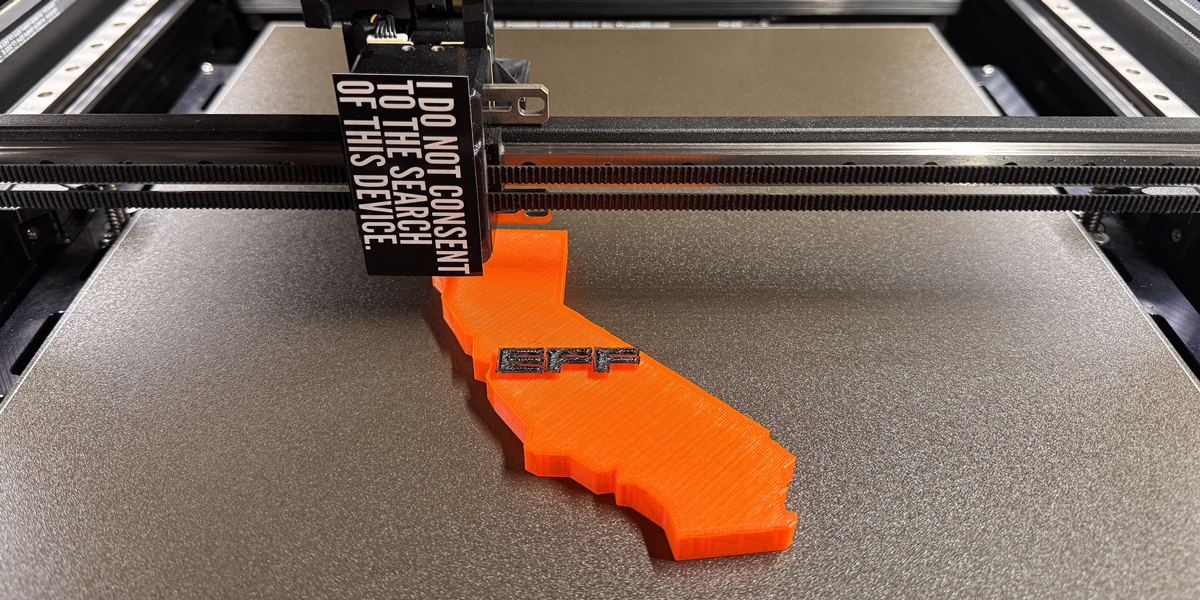
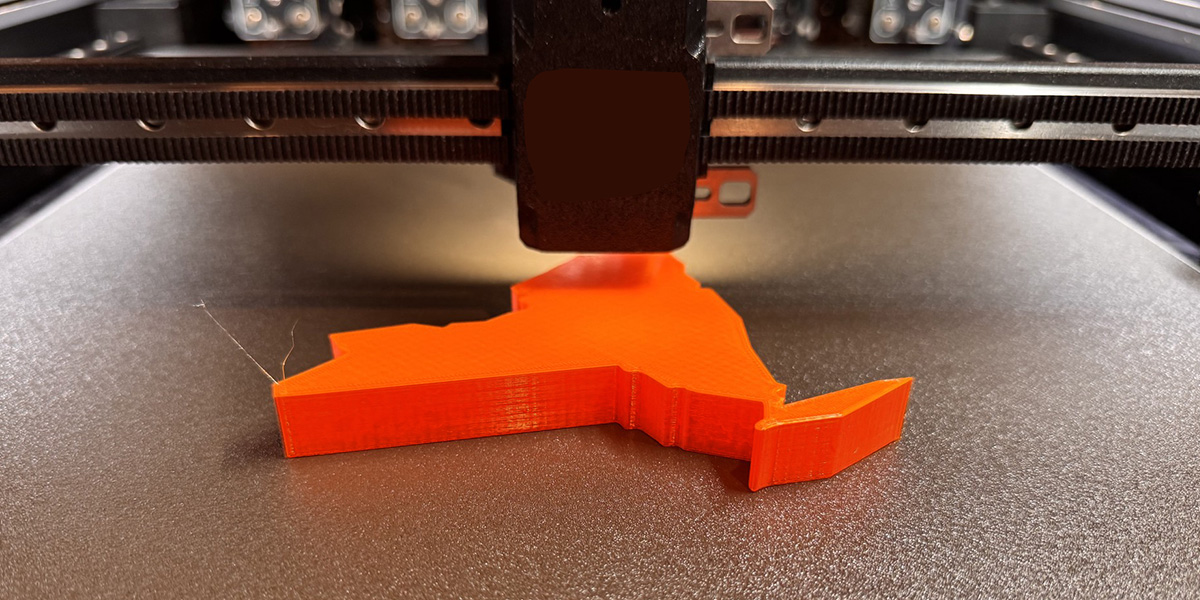
This year the state of New York had the dubious honor of being the first to pass a controversial provision to mandate all 3D printers come with surveillance and censorship. That means not only is there a ticking clock to protect every artist, researcher, engineer, and hobbyist in the state, but there is a real risk of other states thoughtlessly following suit—prior to the New York rules even taking effect.

We, along with many other experts, already warned about this bill buried in the state’s crowded budget process. Hundreds of our supporters and 3D printing enthusiasts in New York reached out to their representatives hoping to kill this farcical bill. While there were some welcome amendments in response to the outcry, Albany passed it anyway.

It might be well-intentioned, but bills like these sell a fantasy that can only have an untold negative impact on the privacy, free expression, and consumer rights of anyone using these general purpose devices. Behind the banner of reducing gun violence, which is nearly always committed with commercial firearms, New York lawmakers have passed draconian legislation that will let manufacturers lock in users and collect their data.

Now that the bill has passed and been signed by Governor Hochul, let’s look at two important ways the final legislation changed since we last wrote about it, and why states like California shouldn’t make the same mistake.

Reduced Risk for Lawful File Sharing 

The New York bill includes language that criminalizes access to firearm print files, a proposal correctly dropped by states like Colorado due to First Amendment concerns. While this made it through to the passed legislation, a few wins were still gained.

Originally the legislation threatened felony charges for the storing and sharing of files, potentially impacting researchers, artists, and journalists with no intention of printing a firearm component. These charges were downgraded to a Class A misdemeanor.

Two provisions criminalized file sharing. The first of the two provisions criminalizing this file sharing, which pertains to the sale or distribution of files in the state, gained an important exception for when a sender has a reasonable belief that the recipient won’t illegally print these components. However the second provision, pertaining to criminalizing file possession, complicates this. Under 2.12 of the subpart, people who possess the file with intent to share the files do not clearly get this same reasonable belief exception.

In other words, if you share one of these files the actual sharing is covered by the exception, but the law makes it ambiguous whether possessing those same files is covered when you intend to share them.

While this exception could have created some breathing room for researchers and journalists operating in good faith, this slapdash bill language leaves plenty of ambiguity and potential speech-chilling effects. However, these changes do offer a modicum of harm reduction in this unconstitutional law.

Saving Face by Preserving Online Sale

Originally the bill had a strange requirement for all 3D printers and Computer Numerical Control, or CNC, machines to be sold and delivered face-to-face, with no exception. That would have meant a major barrier to access, particularly for people in agricultural and rural areas of the state who uniquely benefit from in-home fabrication and repair. It also would have meant a major inconvenience for businesses using these devices. For everyone though, it meant fewer retailers to choose from and facing more stigma for using these devices. 

Fortunately this was dropped from the bill entirely. 

Next Step: We Find Out What Was Actually Passed

In addition to being buried in the complicated legislative process of the NY budget and avoiding proper scrutiny, this bill also kicked the can down the road in determining what exactly is being mandated. In many respects, legislators passed a vibe. We’ll see how the actual law be developed over the next year by a working group with no mandated transparency to the public. Further, they have no obligation to ensure consumer safeguards in developing this state-mandated censorware.

We are still concerned by the possibility of a biased working group acting in the interest of manufacturers or facing pressure to accept consumer harms in the standards they produce. Our remaining hope is this working group convened by the Department of State and the state university system is composed of actual experts who are aware of how unfeasible and harmful this mandate is, and prevent it from being realized.

The Fight Continues

New York is the first to go down this path of state-mandated censorship and surveillance software on 3D printers, but it’s far from the only one to entertain it. It is now more urgent that we fiercely oppose this trend in other states, like California,  as they attempt to join the bandwagon—before even seeing the real-world impacts. 

Take action

Don’t Let California Repeat NY’s Mistake

We cannot allow this to be the foundation for future restrictions on speech and design, or serve as a playbook for the state and corporations to wrest control over our tools.

Google's New Remote Attestation Scheme is As Bad As Its Old One

9 July 2026 at 11:15

Google owes its existence to the open web, but today, its technological “innovations” have much to do with locking users into a “walled garden.” The latest of these is “reCAPTCHA Mobile Verification,” an experimental initiative that will let companies block users if they are running independent, "de-googled" versions of Android. These “indie Android” versions are favored by people who want to protect their privacy and their attention by blocking trackers and ads. Worse, this is just the latest in a line of similarly user-hostile measures. 

Long before “agentic AI,” we had the idea that software would act as your agent on the internet. That's why the old-fashioned technical term for a browser is a “user agent.” Your browser acts on your behalf to retrieve information and then show it to you, in the format you choose. It's your agent. 

This is a powerful and profound idea. It is because browsers are our “agents” that we expect them to accept our directives, say, by blocking pop-ups, or by turning off autoplay sound, or by blocking commercial surveillance trackers. 

Your browser does all that because your browser works for you. The reason your browser can work for you is that the web is an open, standardized technology. In theory, anyone who follows the standards published by the World Wide Web Consortium (W3C) can make a browser, and that web browser can connect to any web server. Browsers and servers are interoperable. It's the same force that means you can put anyone's gas in your gas-tank, or anyone's shoelaces in your shoes, or anyone's milk on your cereal. 

But what if manufacturers could dictate those choices to you? What if your light socket refused to use a lightbulb unless it was officially blessed by the socket's manufacturer? What if your dishwasher refused to wash your dishes unless you bought them from one of the manufacturer's “dish partners?” What if your toaster refused to toast “unauthorized bread?” 

It's hard to see how a company could win its market with this strategy. After all, if the dishes are really better than the competition's, you'd buy them voluntarily, without any need for law or technology to force the matter. The only reason to make a dishwasher that refuses a rival's dishes is if the manufacturer's own dishes are ugly, expensive, and/or badly made. 

But once a company owns the marketonce they've achieved dominance by buying out their rivals; by bribing potential competitors to stay out of their lane; and by engaging in deceptive conduct to trap key suppliers and customersthey can cement their dominance by blocking interoperability, keeping out rival dishes, milk, gas, lightbulbs, shoelaces and bread, capturing their whole market and squeezing it. 

Once a company owns the market, they can cement their dominance by blocking interoperability.

That's what Google has done, and that's what Google wants to do more of Google's commercial behavior has been so unethical, deceptive and abusive that the company just lost three federal antitrust cases. This thrice-convicted monopolist paid Applemore than $20b/year to stay out of the search market: It cheated app vendors, ripping them off with sky-high junk fees and onerous conditions that raised prices while lowering the share of your spending that went to the companies whose products you were paying for. It cheated advertisers, rigging the ad market to gouge businesses on ad prices and underinvesting to fight rampant ad-fraud, sucking hundreds of billions out of the productive economy for overpriced ads that no one saw. 

Google wasn't always this way. The “don't be evil” company owes its very existence to the open web ecosystem. When the company started to index the web in 1998, it was playing on an open field, where any web server could talk to any “user agent,” even one whose user was a startup like Google, that was making a copy of every page on the server. 

For years, Google thrived on the open web, and built open technologies. Androidthe mobile operating system that Google bought in 2005 was presented as an “open” alternative to existing mobile offerings, and as the mobile market collapsed into two companiesGoogle and AppleGoogle always presented Android as the open alternative to Apple's “walled garden.” But there were always ways in which Google's “open” Android wasn't exactly open. The company engaged in illegal “tying” arrangements that forced hardware vendors and carriers to lock out versions of Android that were created by Google's competitors. 

In other words, even though Google offered a mobile platform that was (mostly) technically open, it found other ways to try to choke off the market oxygen for alternative Android versions that tried to capitalize on that technical openness. 

But life finds a way. The existence of an open, modifiable, tinkerer-friendly mobile operating system meant Android hackers could create alternatives to Google's (de facto) walled garden, which thrived in the cracks in that garden wall. Operating systems like CalyxOS, PureOS and Graphene offered a more private, more secure Android experience, one that was largely “de-Googled,” blocking Google's relentless acquisition of your private data. 

And Google's data-hunger is relentless. Android exfiltrates a chunk of your personal and behavioral data every five minutes. The “resting heartbeat” of Android surveillance pulses and pulses, irrespective of whether you're using your device, and the instant you unlock your screen, that heartbeat quickens, sending even more data to the company. All that data has proven irresistible to authoritarian governments. Donald Trump's enforcers have seized on Google data as a vital source of information about the identity of protesters and the location of migrants hunted by ICE. 

So there are plenty of reasons why users would seek out these de-Googled alternatives to Android, finding them in spite of Google's efforts to block access to competing technologies. The worse it got, the better those alternatives looked. 

Perhaps this explains Google's years-long effort to increase the technical barriers to using modified versions of Android, beefing these up to match the commercial restrictions that stand in the way of a de-Googled existence. 

Back in 2023, Google floated the idea of “Web Environment Integrity” (WEI), a set of modifications to web standards that would force your computer to disclose its operating environment to the web servers it connected to, even if you objected to this disclosure. 

WEI was a form of “remote attestation.” That's when your device uses a sub-processor (sometimes called a “Technical Protection Module” or “TPM”) or a walled off part of its main processor (sometimes called a “secure enclave”) to produce a cryptographically signed description of your device and its configuration: which hardware, software, plug-ins, and settings you're running. 

Take away our ability to block obnoxious digital content and you guarantee that we will be flooded with it.

When you connect to a server, it demands that your device send this “attestation” before it handles your request. If your device won't provide this data, or if the server doesn't like (or recognize) your device and its details, it can refuse to deal with you. And because the attestation is prepared by a TPM or a secure enclave that you can't modify or override, you don't get to decide which facts about your device it's allowed to see. 

Practically speaking, this means that remote attestation lets a server refuse to deal with you until you turn off your ad-blocker and your tracker-blocker. It means that the server can discriminate against users who block auto-play sound and video, who block pop-ups, who put the tab in the background when it's playing a mandatory pre-roll ad. 

WEI was especially disturbing in light of Google's plan to kill ad-blockers and privacy blockers through updates to Chrome, an effort that continues to this day. 

These blockers are an important part of the dynamic between web publishers and their users. In the real world, when you get an offer, you can make a counter-offer. That's all an ad-blocker is: a way for users to respond to a server whose opening bid is, “How about you give me all your data and let me take over your computer in exchange for showing you this page?” with “How about 'Nah?'

We didn't get rid of pop-up ads by making them illegal, or by boycotting advertisers who used them. We got rid of pop-up ads when web users installed pop-up blockers, which made pop-up ads pointless. Take away our ability to block obnoxious digital content and you guarantee that we will be flooded with it. 

These kinds of modifications aren't just used to block adsthey're also key to accessibility. People who have photosensitive epilepsy or suffer from low-contrast vision problems use add-ons to reformat pages so they can safely and legibly access them. 

WEI's creators said they were only trying to put the web on a level playing field with apps, which routinely disclose facts about your device to the companies whose servers you connect to, without asking you, and even if you don’t want them to. Apps are a source of bottomless enshittification, not least because (unlike the web), they enjoy special, dangerous legal protections that make it very legally risky to modify them. WEI wasn't an effort to level the playing field between apps and the webit was a race to the bottom, an attempt to make the web as enshittification-friendly as apps. 

Public outrage to WEI killed the project, but Google's commitment to augmenting its illegal commercial lockdown efforts with technical lockdowns never ended. Now, Google has rolled out an experimental “reCAPTCHA Mobile Verification” that uses an app, your camera, and your device's TPM or secure enclave to produce an attestation about your Android device. 

This will make it much easier for the apps and other services you interact with to block your device if you run an Android alternative, or if you install a mod that overrides the actions of Google's stock Android. 

This is a terrible ideait's every bit as bad as WEI was. In an age in which Big Tech is ever-more tied to authoritarian governments, redesigning our devices to tell strangers things we don't want them to know isn't just shortsighted, it's inexcusable. 


We Can Still Stop California’s 3D Printer Surveillance Scheme

26 June 2026 at 17:05

Ignoring EFF’s warnings about the dangers and impossibility of implementing a new mandate for 3D print surveillance software, the California State Assembly has signed off on legislation to do just that. In the process, legislators amended the bill to make it even more confusing, while failing to address the risks to privacy, speech, and consumer rights. We must renew our call on legislators to drop this bill as it heads to the state senate, and protect the tools of creators in the state.

Take action

Tell CA Senators to stand with creators

What’s changed about the bill?

Since we first wrote about AB  2047, a bill targeting 3D printers for the rare, impractical, and already outlawed practice of manufacturing firearms without a license, it has picked up several amendments. Some are welcome changes, but most have only highlighted the technocratic absurdity of the proposed scheme. Our core concernsthat this mandate censors lawful speech, builds out corporate surveillance, and criminalizes open source experimentationhave not been remedied. 

Removes criminalization of resale

Starting with one silver lining, the current bill includes a carveout for the private resale of devices. The original bill would have made it a criminal offense for an individual to resell 3D printers purchased before this mandated censorship and surveillance software. This is a clear win for the 3D-printing community, but it is unfortunately not enough.

Ineffective carveouts for open source

One of the most dangerous aspects of the bill is that it criminalizes individual users for common practices, like creating and using alternative open source programs with their 3D printer. New amendments provide a carveout for the use of an open source tool, but only if it includes compliant censorship software. The bill burdens open source developers with ambiguous and unrealistic standards for print blocking, and continues to create a chilling effect for open source users.

Removes any actual requirement to work

To reiteratethere is no world where the mandated technology actually works as intended. It will both block lawful use of 3D printers, and allow firearms to be printed by anyone determined to do so. There is no amendment that can change this reality.

Instead, the current bill simply drops the pretense that this mandate is expected to work. The performance standard of algorithms changed from “effectively prevent[ing] a technically skilled user from evading [the algorithm]” to “substantially reduce the likelihood of foreseeable circumvention attempts…” The bill will still require all prints to be surveilled, but instead of testing efficacy against a skilled user, it just plays whack-a-mole with the (literally) infinite number of circumventions that any user can employ. 

Further, the bill now leaves us with an unclear process that relies on non-governmental third parties to define standards, and now relies on manufacturers and resellers to self-police.

Hollywood gets a cut

The bill includes yet another carve out for commercial users. This time for the entertainment industry, which makes extensive use of 3D printers for props and costumes. 

That’s fine for big studios, but it leaves out indie filmmakers, cosplayers, and many other small creators. 

This is simply a defensive edit to limit corporate opposition. There isn’t a clear division in 3D-printing between consumer and commercial tools. These are general purpose tools which might be picked up by a prop department of a big studio, or an artist getting ready for Comic Con. Indeed consumer level products are not only used by amateur artists and engineers developing their skills. Commercial 3D printers, like their traditional 2D equivalents, are frequently used in workplaces, as well as by professionals honing their skills or just trying to get some work done at home. 

Commercial carveouts hands printer manufacturers the ability to sell a more expensive tier of printers, locking-in and up-charging their commercial customers. Some of those customers will choose to buy general retail versions, but that carries its own price: increased risk of IP theft as all printed files are surveilled the same way they are for hobbyists. That means a real risk of businesses leaking any prototypes or new designs to not only the printer manufacturer, but potentially snooping governments and/or the general public through data breaches.

Demand  your senator oppose AB 2047

This updated version of AB 2047 downgrades performance standards and removes oversight while still threatening privacy and choice for users of 3D printers. A printer surveillance system won’t work for its intended purpose, and will only harm law abiding users. 

Act now to demand your senators to vote no on this ineffective and invasive bill.

Take action

Tell CA Senators to stand with creators

❌