
Normal view

"We Want Texans to Know Their Rights": Q&A with Mayday Health on the Impact of Surveillance on Abortion Care

9 July 2026 at 23:12

Last May, EFF reported that a sheriff’s office in Texas searched data from more than 83,000 automated license plate reader (ALPR) cameras to track down a woman suspected of self-managing an abortion. ALPRs are promoted as tools for keeping communities safe by finding missing persons and locating stolen vehicles, but this case showed how ALPRS can be weaponized to investigate people’s private healthcare decisions. And these aren’t the only tools in the surveillance arsenal: others include location tracking tools like Locate X, which can show a person’s visit to an abortion clinic, or search histories which might be used as evidence of a person’s interest in obtaining abortion pills. Taken together, these tools create a dangerous surveillance pipeline that threatens everyone’s health privacy. 

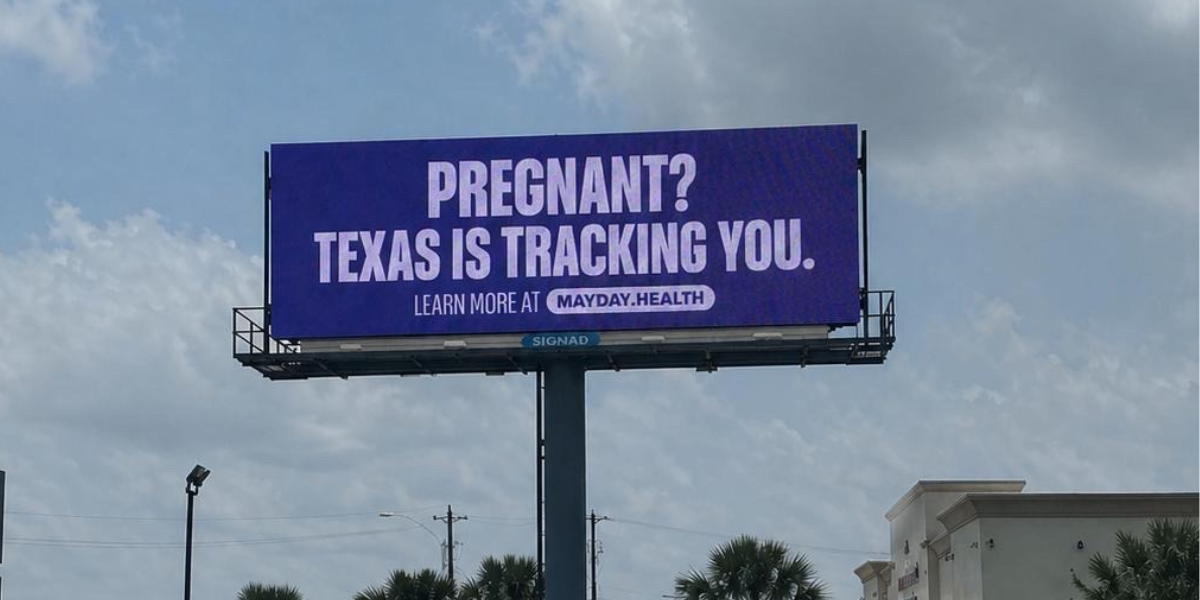
Too often, though, the public is unaware of the threat, and one nonprofit is working to change that. Following EFF and 404 Media’s report on Texas’s use of Flock cameras, eye-catching billboards popped up in Houston, warning drivers that if they’re pregnant, the state of Texas could be tracking them.  


Photo provided by Mayday Health

These billboards came from Mayday Health, a nonprofit dedicated to sharing information about abortion pills, birth control, and gender-affirming care. We spoke with Leo Raisner, Executive Director of Mayday Health, about the billboards to learn more about the campaign and organization and to discuss how surveillance affects reproductive freedom. 

***

THOMAS: Why did Mayday Health start this campaign in Texas?  

RAISNER: Well, we read the incredible reporting coming from EFF about Texas's surveillance. We want Texans to know their rights, to know their options, and to know that there are organizations and people who have their back. So we decided to put up a few billboards around the Houston area to remind people that they still have options.  

Digital advertising in the space, as I know you're well aware of, faces enormous platform restrictions from Meta and Google, whereas billboards reach people in the physical world without algorithmic gatekeeping and without requiring anyone to search for information. So at the very least, if a driver's passing by the billboard, we’re spreading information that they should be careful that they might be surveilled, and also there are different options. There's a website where they can come learn more about those options. 

THOMAS: And how have the billboards been received so far? Have you heard anything from folks in the Houston area yet?    

RAISNER: Yeah, we've heard some messages of support on social media DMs. We're just thrilled about how many drivers these messages are going to reach. They'll be up for 4 weeks, and are expected to hit over 1,000,000 drivers during that 4-week campaign period.    

THOMAS: Are there other ways that Mayday Health has seen surveillance systems impact people seeking healthcare?  

RAISNER: You know, we go all over the country and talk to folks who are seeking reproductive healthcare options in states where clinics are banned, and we direct folks to our website where they can learn more about abortion pills. We make privacy very central to how we operate. Privacy is not just an afterthought for us. When people arrive at our website, we direct them to the Digital Defense Fund, which offers people privacy and security resources as they're navigating reproductive healthcare in states where they might be being surveilled. We don't collect cookies, we don't collect identifying information from visitors to our site. We want people to know their options, and we don't have any interest in knowing who they are.  

THOMAS: Why do you think the work of the digital rights movement is so important to the work of the reproductive health rights and justice movement?  

RAISNER: I mean, those two movements are inextricably linked. The anti-abortion movement is using every tool in their toolbox to prevent people from getting the healthcare access they need, whether that's surveilling people online or closing down brick-and-mortar clinics, but we encourage people to visit Mayday Health and learn that they still have options no matter where they live.  

THOMAS: Is there anything else that you would like the readers of our blog to know about Mayday Health?    

RAISNER: I'd love for people to know that abortion pills are FDA approved. They're safe, they're effective, and they're available through the mail. 

*** 

EFF has said it time and time again – surveillance and reproductive freedom cannot coexist. Whether the tracking occurs over the internet or through license plate reader systems with over 83,000 cameras, it is an invasion of privacy. Protecting our digital privacy is more critical now than ever. Help EFF fight back against this digital dragnet and protect reproductive freedom for all by making a donation. 
Four Years After Dobbs, Anti-Abortion Lawmakers Keep Coming for Online Speech

25 June 2026 at 22:49

This week marks four years since Dobbs v. Jackson Women’s Health Organization overturned Roe v. Wade’s constitutional protections for people seeking abortion care. Anniversaries are a moment to take stock, and over the last four years, EFF has seen firsthand how digital rights and reproductive rights have become increasingly intertwined. One major way this has happened: the fight over abortion has also become a fight over online speech and government censorship as a steady stream of proposed laws, cease-and-desist letters, lawsuits, and government investigations have targeted the websites and online resources that help people find and learn about reproductive healthcare.

This is an effort by anti-abortion government officials to mold the information ecosystem, restrict what people can read, and cut off the ways people communicate with one another. We’ve watched this build for years, and the encouraging news is that many of these efforts have failed. The worrying news is that they keep coming. And if they’re allowed to succeed, this could have repercussions for freedom of expression online beyond reproductive rights.

Targeting Sites That Just Share Information

The clearest tell that this is also a war on speech is that officials have aimed their efforts not just at abortion providers or the entities that prescribe and sell medication abortion, but also at websites that do nothing more than tell people what their options are, how to find a doctor, and where abortion remains legal.

Cease-and-Desists & Takedown Demands

State attorneys general have been hitting these online information hubs with cease-and-desist letters and takedown demands. Just this month, for example, Alabama Attorney General Steve Marshall sent cease-and-desist letters to multiple groups with abortion-related websites, including Plan C, a public health campaign that provides educational resources and research on abortion access. Plan C doesn’t sell or ship abortion pills. It simply provides information. Marshall’s office nonetheless claimed Plan C’s website “facilitates, aids, and abets” illegal abortion. The Arkansas attorney general similarly sent out cease-and-desists to several organizations regarding their websites, including Mayday Health, which, like Plan C, provides only information and does not directly prescribe or mail pills.

What’s especially concerning is that the state doesn’t have to win, or even file, a lawsuit to get what it wants.

In another example from earlier this year, North Dakota Attorney General Drew Wrigley threatened legal action and ordered the Prairie Abortion Fund to scrub information off of its website, not because the fund sold pills, but because its site linked to several outside informational resources. The Attorney General primarily focused on the fund’s link to Plan C, meaning the biggest alleged issue was a link to a website that links to other websites where pills can be accessed.

What’s especially concerning is that the state doesn’t have to win, or even file, a lawsuit to get what it wants. Especially for smaller organizations and funds, a letter threatening legal action can be enough to chill their speech, causing them to remove important content and go quiet.

Censorship Mandates

Legislators in multiple states have also attempted to make it illegal to share resources on how to obtain an abortion, including on purely informational websites with a national or global audience. South Dakota recently passed a law making it a felony to “advertise” anything “described in a manner calculated to lead another to use or apply it for producing an abortion.” Language this broad can easily apply to websites that simply engage in First Amendment-protected advocacy or provide educational resources. Mayday Health, which operates one such website, has since sued the state in federal court to block the law. The lawsuit argues the law could reach something as small as wearing a sweatshirt that carries Mayday’s web address.

Other state legislatures have made similar efforts. Last year, for example, Texas introduced a bill that would have made it illegal to “provide information” on how to obtain an abortion-inducing drug. If you exchanged emails, had an online chat, or created a website that shared information about legal abortion services in other states, you could have violated this bill. Luckily this particular bill did not pass, but Texas has attempted to pass similar laws for several years now.

Dressing Censorship Up as Consumer Protection

A major way anti-abortion officials are targeting online speech is by weaponizing consumer protection and deceptive advertising laws, claiming that providing information about abortion violates them. This tactic is a threat to free speech rights. The First Amendment protects publishing truthful information on a public issue, and the Supreme Court has expressly said that includes providing information about legal abortion in a state where it is illegal.

Yet states like South Dakota have continued to use deceptive advertising claims to go after abortion speech. Last year, South Dakota sent a cease-and-desist and then filed a lawsuit against Mayday Health for running ads that simply read: “Pregnant? Don’t want to be?” with a link to Mayday’s website. The state claimed the ads were “deceptive.” Mayday then counter-sued in federal court, challenging South Dakota’s actions under the First Amendment. Though the federal judge ultimately declined to step in while the parallel state case was pending, she made a point of saying she believed Mayday’s website constitutes “speech subject to protection under the First Amendment.”

Other states have attempted to run the same play. Missouri sued Planned Parenthood in 2025 under its consumer-protection statute, calling a webpage that says abortion pills are safe an “unfair and deceptive” trade practice. Florida went even further, invoking its RICO law—a law typically used for organized crime—over the same kind of statement. Florida leaned heavily on a single study funded by an anti-abortion think tank, even as major medical organizations and decades of research put the serious-complication rate below half a percent. States should not be able to cherry-pick studies in order to erase online speech.

Going After Intermediaries & Erasing Whole Websites

Some officials aren’t content to restrict only certain abortion-related content—they want the websites gone entirely.

Take, for example, the cease-and-desist letters sent by the Arkansas attorney general last year. Letters were sent directly to internet intermediaries (entities that facilitate use of the internet, such as internet service providers, web-hosting providers, or things like search engines and social media platforms). The letters demanded that both a domain registry company and a web host stop supporting a site that discusses abortion drugs. But as we know, if we cut off the host or the domain, the speech disappears for everyone—not just for people in Arkansas.

Likewise, Texas’s 2025 bill would have required intermediaries to take down abortion-related content. It’s worth remembering that the imposition of civil and criminal liability on intermediaries also conflicts with a federal law that protects online intermediaries’ ability to host user-generated speech, 47 U.S.C. § 230 (“Section 230”), including speech about abortion medication.

The push has gone federal, too. In March 2026, Senator Bill Cassidy and colleagues on the Senate Health, Education, Labor and Pensions Committee pressed the FDA to use every tool it has against online sellers, including leaning on the domain registrars that keep these sites online.

Why This Should Worry Everyone

It’s tempting to see this as limited to the fight over reproductive rights. That would be a mistake. For people seeking care, the immediate harm is obvious: the internet is often the only place to find accurate, potentially life-saving information, and every letter, lawsuit, and takedown threat makes that information harder to find and riskier to share.

But the damage doesn’t stop there. We’re witnessing a live experiment in how to use consumer-protection laws, criminal statutes, and pressure on intermediaries to suppress a disfavored viewpoint, pull information offline, and make websites disappear. To think these tactics can only be used against abortion speech would be naïve. 

We hope courts and legislatures will continue to protect free speech online. But the continued drumbeat of threatening letters, lawsuits, and investigations is its own kind of harm. Here at EFF, we’ll keep defending the right to share and read information online—about abortion, and about everything else.

❌