The shift to remote and hybrid work since the pandemic expanded global hiring and accelerated digital onboarding, increasing reliance on online identity verification and remote access. Threat actors such as Jasper Sleet, a North Korea-aligned threat actor, exploit this model by posing as legitimate hires using stolen or fabricated identities and AI-assisted deception to gain trusted access, generate revenue, and in some cases enable data theft, extortion, or follow-on compromise.
In the initial job-discovery phase, these fraudulent applicants posing as remote IT workers systematically survey organization career sites and external hiring portals to identify active technical roles and recruitment workflows. A previously published Microsoft Threat Intelligence blog highlights how these actors use generative AI at scale to analyze job postings and extract role‑specific language, required skills, certifications, and tooling expectations. They then use those insights to construct tailored fake digital personas and submit highly convincing job applications, increasing their likelihood of passing screening and entering legitimate hiring pipelines, and even onboarding once hired into the targeted roles successfully.
Organizations using common and widely adopted human resources (HR) software as a service (SaaS) platforms like Workday often expose their job postings through external career sites for applicants to submit job applications. These job listing sites are often targeted by this threat actor to find open job roles. While this activity might be hard to detect from usual job hunting behavior, knowing the threat actor’s interests and objectives to infiltrate into the target organization might present an opportunity for defenders to look for anomalous patterns in a hiring candidate’s behaviors by leveraging the access to the right telemetry and available threat actor intelligence being published.
While these activities could happen on any HR SaaS platform, this blog focuses on Workday as an example due to its widespread adoption and rich event logs, which are useful for hunting and detection, that are available to customers. The discussion highlights how customers using Microsoft Defender for Cloud Apps can monitor and detect fraudulent remote IT worker activity in pre-recruitment and post-recruitment phases, offering guidance on threat hunting and relevant threat detection strategies to help security and HR teams surface suspicious candidates early and detect risky onboarding activity after hire.
Attack chain overview
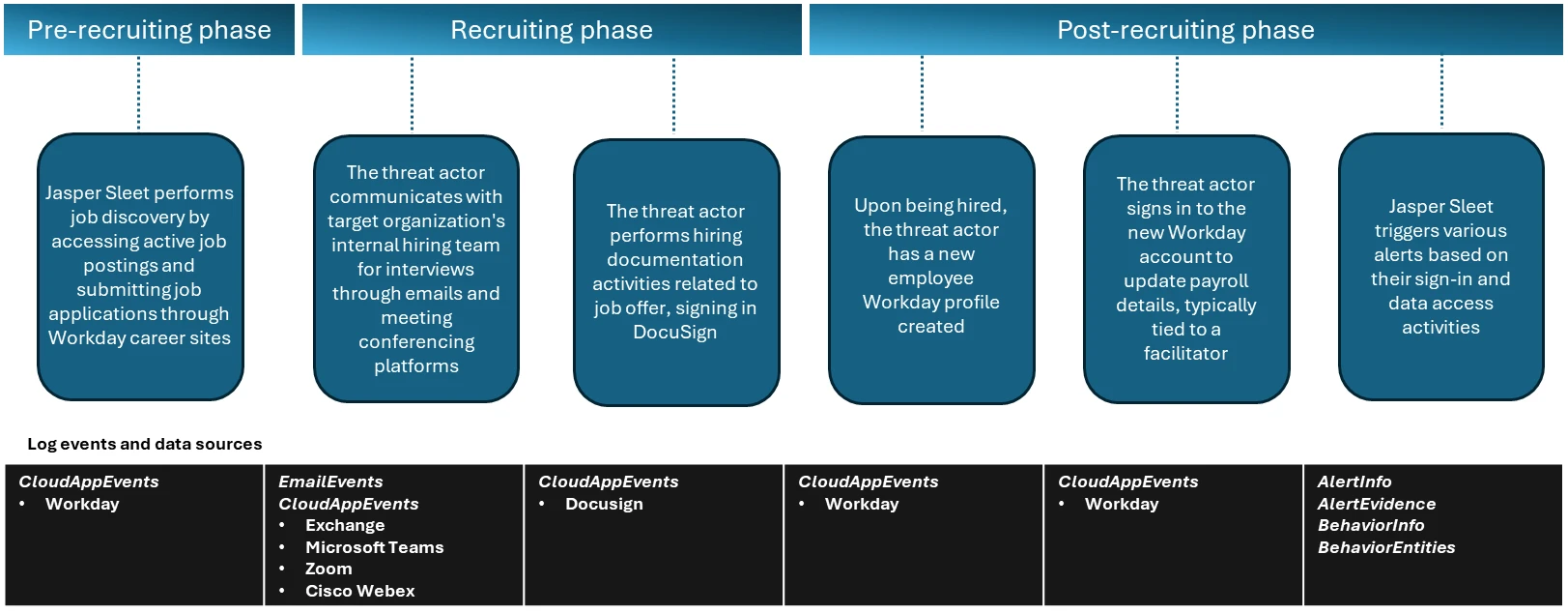
In the observed campaigns, the threat actors leverage routine HR workflows like external-facing career sites with open job postings to help with their job search and application process. Once they’re successfully contacted, interviewed, and hired, they complete typical new-hire onboarding formalities like setting up payroll accounts, which are also through the HR SaaS platform like Workday.
Figure 1. Timeline of events through the recruitment phases.
Activities in pre-recruitment phase
In the pre-recruitment phase, Microsoft has observed Jasper Sleet accessing Workday Recruiting Web Service endpoints exposed through external career sites from known actor infrastructure and email accounts, indicating a discovery phase of open roles and recruitment workflows.
Workday lets organizations use internal, non-public APIs such as Recruiting Web Service to allow programmatic access to apply for jobs in these organizations. These APIs are used to connect to external career sites involved in talent management and applicant tracking systems and allow applicants to browse and apply for open job roles. To access these APIs, an organization has to allow setting up of OAuth clients and associated OAuth tokens, and expose the APIs so that the organization’s external career sites can use them.
Microsoft has observed API call events coming from known Jasper Sleet infrastructure in Workday telemetry to hrrecruiting/* API endpoints. These events access information about job postings, applications, and related questionnaires, and to submit job applications and questionnaires.
Some common API calls being made by the threat actor’s activity when using the Workday portal include the following:
hrrecruiting/accounts/*
hrrecruiting/jobApplicationPackages/*
hrrecruiting/validateJobApplication/*
hrrecruiting/resumes/*
Figure 2. Sample view of API call events indicating access to hrrecruiting API endpoints on an organization’s Workday instance from an external account.
It’s important to note here that these API calls could also be made by legitimate job applicants. However, Microsoft has observed the Jasper Sleet threat actor using multiple external accounts suspiciously to access the same set of API calls in a consistent, repeating pattern, as shown in Figure 2, indicating a possible job discovery phase activity on open job roles and following up on job applications submitted. This anomaly sets the threat actor behavior apart from legitimate job applicants.
Defender for Cloud Apps’ Workday connector enables organizations to view and track API activity to their /hrrecruiting endpoints. The connector also lets them identify external accounts and their corresponding infrastructure metadata. Organizations can match this information against any available threat intelligence feeds on Jasper Sleet so they can identify fraudulent applications early in the recruiting process.
Activities in recruiting phase
In the recruiting phase, signals outside of Workday could help with investigation of threat actor behavior. The threat actor communicates with the target organization’s hiring team using emails and meeting conferencing platforms like Microsoft Teams, Zoom, or Cisco Webex for scheduling interviews. Using advanced hunting tables in Microsoft Defender, organizations can track suspicious communications (for example, email and Teams messages with external accounts originating from suspicious IP addresses or email addresses that could possibly be associated with the threat actor) and raise a red flag early in the hiring process. Additionally, organizations that use Zoom or Cisco Webex must leverage Defender for Cloud Apps’ Zoom or Cisco Webex connectors to detect malicious external accounts in the interviewing process.
Organizations can also leverage Defender for Cloud Apps’ DocuSign connector, which enables them to monitor activity related to hiring documentation, like offer letter signing from suspicious external sources.
Activities in post-recruitment phase
When Jasper Sleet is hired for a role in the organization, a legitimate account is created and assigned to them as part of the onboarding process. In organizations that use HR workflows in Workday for onboarding new hires, we’ve observed sign-ins to the newly created Workday profile and setting up of payroll details originating from known Jasper Sleet infrastructure.
Figure 3. A sample event indicating a payroll account change operation by a new hire.
The threat actor now has legitimate access to organization data, and they can access internal SaaS applications like Teams, SharePoint, OneDrive, and Exchange Online. Hence, it’s important to investigate any alerts associated with new hire accounts, especially alerts that are related to access to organization data from different locations and anonymous proxies performing search and downloads on Microsoft 365 suite or other third-party SaaS applications. Microsoft has observed a spike in impossible travel alerts for such new hires, indicating suspicious remote IT worker behavior in the initial months of onboarding.
Figure 4. Frequent impossible travel alerts on a new hire in the first two months since joining.
Mitigation and protection guidance
Microsoft recommends leveraging access to telemetry coming from multiple data sources and monitoring behavioral anomalies in hiring candidates as part of background verification in HR recruitment processes. Organizations can also leverage threat intelligence as an aid, when available, to strengthen confidence in these anomalies.
These recommendations draw from established Defender blog guidance patterns and align with protections offered across Microsoft Defender XDR.
Organizations can follow these recommendations to mitigate threats associated with this threat actor:
Enable connectors in Microsoft Defender for Cloud Apps to gain visibility and track activity from external user accounts associated with fraudulent candidates. Investigate events of both external users and newly hired internal users originating from malicious infrastructure. For more information, see the following articles in Microsoft Learn:
Microsoft Defender XDR customers can refer to the list of applicable detections below. Microsoft Defender XDR coordinates detection, prevention, investigation, and response across endpoints, identities, email, and apps to provide integrated protection against attacks like the threat discussed in this blog.
Customers with provisioned access can also use Microsoft Security Copilot in Microsoft Defender to investigate and respond to incidents, hunt for threats, and protect their organization with relevant threat intelligence.
Tactic
Observed activity
Microsoft Defender coverage
Resource Development
Threat actors accessing external facing Workday sites to research job postings and submit job applications.
Microsoft Defender for Cloud Apps – Possible Jasper Sleet threat actor activity in Workday Recruiting Web Service
Resource Development
Once hired and onboarded, the threat actor signs in to the newly created Workday account to update payroll details from known Jasper Sleet infrastructure
Microsoft Defender for Cloud Apps – Suspicious Payroll and Finance related activity in Workday
Initial Access
Anomalous sign-ins and access to internal resources by newly hired threat actor
Microsoft Defender XDR – Impossible travel – Sign-in activity by suspected North Korean entity Jasper Sleet
Threat intelligence reports
Microsoft Defender XDR customers can use the following threat analytics reports in the Defender portal (requires license for at least one Defender XDR product) to get the most up-to-date information about the threat actor, malicious activity, and techniques discussed in this blog. These reports provide the intelligence, protection information, and recommended actions to prevent, mitigate, or respond to associated threats found in customer environments.
Microsoft Security Copilot customers can also use the Microsoft Security Copilot integration in Microsoft Defender Threat Intelligence, either in the Security Copilot standalone portal or in the embedded experience in the Microsoft Defender portal to get more information about this threat actor.
Hunting queries
Microsoft Defender XDR customers can run the following queries to find related activity to any suspicious indicators in their networks:
Access to Workday Recruiting Web Service API by external users
let api_endpoint_regex = 'hrrecruiting/*';
CloudAppEvents
| where Application == 'Workday'
| where IsExternalUser
| where ActionType matches regex api_endpoint_regex
| where IPAddress in () or AccountId in ();
| summarize make_set(ActionType) by AccountId, IPAddress, bin(Timestamp, 1d)
Emails and Teams communications related to interviews
//Email communications

EmailEvents
| where SenderMailFromAddress == "" or RecipientEmailAddress == ""
| where Subject has "Interview"
| project Timestamp, SenderMailFromAddress, SenderDisplayName, SenderIPv4, SenderIPv6, RecipientEmailAddress, Subject, DeliveryAction, DeliveryLocation

EmailEvents
| where SenderIPv4 == "" or SenderIPv6 == ""
| where Subject has "Interview"
| project Timestamp, SenderMailFromAddress, SenderDisplayName, SenderIPv4, SenderIPv6, RecipientEmailAddress, Subject, DeliveryAction, DeliveryLocation

//Microsoft Teams communications

CloudAppEvents
| where Application == "Microsoft Teams"
| where IsExternalUser
| where AccountId == "" or AccountDisplayName == ""
| summarize make_set(ActionType) by IPAddress, AccountId, bin(Timestamp, 1d)

CloudAppEvents
| where Application == "Microsoft Teams"
| where IsExternalUser
| where IPAddress == ""
| summarize make_set(ActionType) by IPAddress, AccountId, bin(Timestamp, 1d)

//Zoom or Cisco Webex communication events after enabling the Microsoft Defender for Cloud apps connectors

CloudAppEvents
| where Application == "Zoom"
| where IsExternalUser
| where IPAddress == ""
| summarize make_set(ActionType) by IPAddress, AccountId, bin(Timestamp, 1d)

CloudAppEvents
| where Application == "Cisco Webex"
| where IsExternalUser
| where IPAddress == ""
| summarize make_set(ActionType) by IPAddress, AccountId, bin(Timestamp, 1d)
Hiring phase involving accessing and signing of agreements through DocuSign
CloudAppEvents
| where Application == "DocuSign"
| where IsExternalUser
| where ActionType == "ENVELOPE SIGNED"
| where IPAddress in ("") or AccountId == ""
New hire onboarding and payroll activities originating from known Jasper Sleet infrastructure
CloudAppEvents
| where Application == "Workday"
| where AccountId == ""
| where ActionType has_any ("Add", "Change", "Assign", "Create", "Modify") and ActionType has_any ("Account", "Bank", "Payment", "Tax")
| where IPAddress in ("")
| summarize make_set(ActionType) by IPAddress, bin(Timestamp, 1d)
To hear stories and insights from the Microsoft Threat Intelligence community about the ever-evolving threat landscape, listen to the Microsoft Threat Intelligence podcast.
Review our documentation to learn more about our real-time protection capabilities and see how to enable them within your organization.
Threat actors are initiating cross-tenant Microsoft Teams communications while impersonating IT or helpdesk personnel to socially engineer users into granting remote desktop access. After access is established through Quick Assist or similar remote support tools, attackers often execute trusted vendor-signed applications alongside attacker-supplied modules to enable malicious code execution.
This access pathway might be used to perform credential-backed lateral movement using native administrative protocols such as Windows Remote Management (WinRM), allowing threat actors to pivot toward high-value assets including domain controllers. In observed intrusions, follow-on commercial remote management software and data transfer utilities such as Rclone were used to expand access across the enterprise environment and stage business-relevant information for transfer to external cloud storage. This intrusion chain relies heavily on legitimate applications and administrative protocols, allowing threat actors to blend into expected enterprise activity during multiple intrusion phases.
Threat actors are increasingly abusing external Microsoft Teams collaboration to impersonate IT or helpdesk personnel and convince users to grant remote assistance access. From this initial foothold, attackers can leverage trusted tools and native administrative protocols to move laterally across the enterprise and stage sensitive data for exfiltration—often blending into routine IT support activity throughout the intrusion lifecycle. Microsoft Defender provides correlated visibility across identity, endpoint, and collaboration telemetry to help detect and disrupt this user‑initiated access pathway before it escalates into broader compromise.
Risk to enterprise environments
By abusing enterprise collaboration workflows instead of traditional email based phishing channels, attackers may initiate contact through applications such as Microsoft Teams in a way that appears consistent with routine IT support interactions.
Microsoft Teams applies multiple security controls at the point of first external contact – before any chat, call, or file exchange occurs – including external tenant labeling, Accept/Block prompts, message previews, and phishing indicators designed to help users assess risk prior to engagement. However, this attack chain relies on convincing users to bypass those warnings and voluntarily grant remote access through legitimate support tools. In observed intrusions, risk is introduced not by external messaging alone, but when a user approves follow on actions — such as launching a remote assistance session — that result in interactive system access.
In observed intrusions, risk is introduced not by external messaging alone, but when a user approves follow‑on actions — such as launching a remote assistance session — that result in interactive system access.
An approved external Teams interaction might enable threat actors to:
Establish credential-backed interactive system access
Deploy trusted applications to execute attacker-controlled code
Pivot toward identity and domain infrastructure using WinRM
Deploy commercially available remote management tooling
Stage sensitive business-relevant data for transfer to external cloud infrastructure
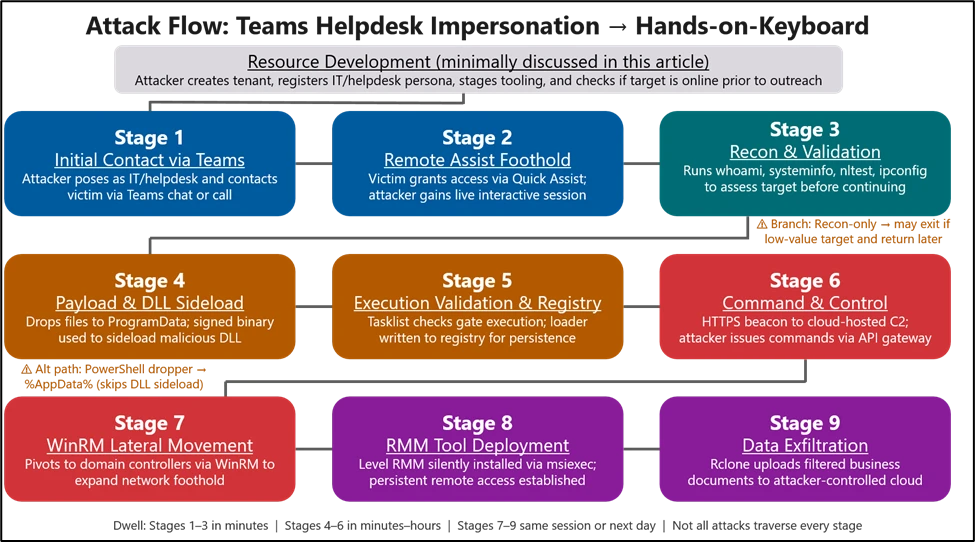
In the campaign, lateral movement and follow-on tooling installation occurred shortly after initial access, increasing the risk of enterprise-wide persistence and targeted data exfiltration. As each environment is different and with potential handoff to different threat actors, stages might differ if not outright bypassed.
Figure 1: Attack chain.
Attack chain overview
Stage 1: Initial contact via Teams (T1566.003 Spearphishing via Service)
The intrusion begins with abuse of external collaboration features in Microsoft Teams, where an attacker operating from a separate tenant initiates contact while impersonating internal support personnel as a means to social engineer the user. This activity does not stem from a weakness in Microsoft Teams or its built‑in security protections. Instead, attackers abuse legitimate collaboration features by persuading users to override multiple, clearly presented security warnings, highlighting the broader challenge of defending against attacks driven by social engineering rather than technical exploitation.
Because interaction occurs within an enterprise collaboration platform rather than through traditional email‑based phishing vectors, it might bypass initial user skepticism associated with unsolicited external communication. Security features protecting Teams users are detailed here, for reference. It’s important to note that this attack relies on users willfully ignoring or overlooking security notices and other protection features. The lure varies and might include “Microsoft Security Update”, “Spam Filter Update”, “Account Verification” but the objective is constant: convince the user to ignore warnings and external contact flags, launch a remote management session, and accept elevation. Voice phishing (vishing) is sometimes layered to increase trust or compliance if voice interactions don’t replace the messaging altogether.
Timing matters. We regularly see a “ChatCreated” event to indicate a first contact situation, followed by suspicious chats or vishing, remote management, and other events that commonly produce alerts to include mailbombing or URL click alerts. All of these can be correlated by account and chat thread information in your Defender hunting environment.
Teams security warnings:
External Accept/Block screens provide notice to users about First Contact events, which prompt the user to inspect the sender’s identity before accepting:
Figure 2: External Accept/Block screens.
Higher confidence warnings alert the user of spam or phishing attempts on first contact:
Figure 3: spam or phishing alert.
External warnings notify users that they are communicating with a tenant/organization other than their own and should be treated with scrutiny:
Figure 4: External warnings.
Message warnings alert the user on the risk in clicking the URL:
Figure 5: URL click warning.
Safe Links for time-of-click protection warns users when URLs from Teams chat messages are malicious:
Figure 6: time-of-click protection warning.
Zero-hour Auto Purge (ZAP) can remove messages that were flagged as malicious after they have been sent:
Figure 7: Removed malicious from ZAP.
It’s important to note that the attacker often does not send the URL over a Teams message. Instead, they will navigate to it while on the endpoint during a remote management session. Therefore, the best security is user education on understanding the importance of not ignoring external flags for new helpdesk contacts. See “User education” in the “Defend, harden, and educate (Controls to deploy now)” section for further advice.
Stage 2: Remote assistance foothold
With user consent obtained through social engineering, the attacker gains interactive control of the device using remote support tools such as Quick Assist. This access typically results in the launch of QuickAssist.exe, followed by the display of standard Windows elevation prompts through Consent.exe as the attacker is guided through approval steps.
Figure 8: Quick Assist Key Logs.
From the user’s perspective, the attacker convinces them to open Quick Assist, enter a short key, the follow all prompts and approvals to grant access.
Figure 9 – Quick Assist Launch.
This step is often completed in under a minute. The urgency and interactivity are the signal: a remote‑assist process tree followed immediately by “cmd.exe” or PowerShell on the same desktop.
Stage 3: Interactive reconnaissance and access validation
Immediately after establishing control through Quick Assist, the attacker typically spends the first 30–120 seconds assessing their level of access and understanding the compromised environment. This is often reflected by a brief surge of cmd.exe activity, used to verify user context and privilege levels, gather basic system information such as host identity and operating system details, and confirm domain affiliation. In parallel, the attacker might query registry values to determine OS build and edition, while also performing quick network reconnaissance to evaluate connectivity, reachability, and potential opportunities for lateral movement.
Figure 10: Enumeration.
On systems with limited privileges—such as kiosks, VDI, or non-corp-joined devices—actors might pause without deploying payloads, leaving only brief reconnaissance activity. They often return later when access improves or pivot to other targets within the same tenant.
Stage 4: Payload placement and trusted application invocation
Once remote access is established, the intrusion transitions from user‑assisted interaction to preparing the environment for persistent execution. At this point, attackers introduce a small staging bundle onto disk using either archive‑based deployment or short‑lived scripting activity. As activity moves beyond initial social engineering, Microsoft security protections shift from user‑facing warnings to behavior‑based detection, correlation, and automated response across identity, endpoint, and network layers.
After access is established, attackers stage payloads in locations such as ProgramData and execute them using DLL side‑loading through trusted signed applications. This includes:
AcroServicesUpdater2_x64.exe loading a staged msi.dll
Allowing attacker‑supplied modules to run under a trusted execution context from non‑standard paths.
Figure 11: Sample Payload.
Stage 5: Execution context validation and registry backed loader state
Following payload delivery, the attacker performs runtime checks to validate host conditions before execution. A large encoded value is then written to a user‑context registry location, serving as a staging container for encrypted configuration data to be retrieved later at runtime.
In this stage, a sideloaded module acting as an intermediary loader decrypts staged registry data in memory to reconstruct execution and C2 configuration without writing files to disk. This behavior aligns with intrusion frameworks such as Havoc, which externalize encrypted configuration to registry storage, allowing trusted sideloaded components to dynamically recover execution context and maintain operational continuity across restarts or remediation events.
Microsoft Defender for Endpoint may detect this activity as:
Execution from user‑writable directories such as ProgramData
Attack surface reduction rules and Windows Defender Application Control policies can be used to restrict execution pathways commonly leveraged for sideloaded module activation.
Stage 6: Command and control
Following successful execution of the sideloaded component, the updater‑themed process AcroServicesUpdater2_x64.exe began initiating outbound HTTPS connections over TCP port 443 to externally hosted infrastructure.
Unlike expected application update workflows which are typically restricted to known vendor services these connections were directed toward dynamically hosted cloud‑backed endpoints and unknown external domains. This behavior indicates remote attacker‑controlled infrastructure rather than legitimate update mechanisms.
Establishing outbound encrypted communications in this manner enables compromised processes to operate as beaconing implants, allowing adversaries to remotely retrieve instructions and maintain control within the affected environment while blending command traffic into routine HTTPS activity. The use of cloud‑hosted hosting layers further reduces infrastructure visibility and improves the attacker’s ability to modify or rotate communication endpoints without altering the deployed payload.
This activity marks the transition from local execution to externally directed command‑and‑control — enabling subsequent stages of discovery and movement inside the enterprise network.
Stage 7: Internal discovery and lateral movement toward high value assets
Shortly after external communications were established, the compromised process began initiating internal remote management connections over WinRM (TCP 5985) toward additional domain‑joined systems within the enterprise environment.
Microsoft Defender may surface these activities as multi‑device incidents reflecting credential‑backed lateral movement initiated from a user‑context remote session.
Analysis of WinRM activity indicates that the threat actor used native Windows remote execution to pivot from the initially compromised endpoint toward high‑value infrastructure assets, including identity and domain management systems such as domain controllers. Use of WinRM from a non‑administrative application suggests credential‑backed lateral movement directed by an external operator, enabling remote command execution, interaction with domain infrastructure, and deployment of additional tooling onto targeted hosts.
Targeting identity‑centric infrastructure at this stage reflects a shift from initial foothold to broader enterprise control and persistence. Notably, this internal pivot preceded the remote deployment of additional access tooling in later stages, indicating that attacker‑controlled WinRM sessions were subsequently leveraged to extend sustained access across
Stage 8: Remote deployment of auxiliary access tooling (Level RMM)
Subsequent activity revealed the remote installation of an additional management platform across compromised hosts using Windows Installer (msiexec.exe). This introduced an alternate control channel independent of the original intrusion components, reducing reliance on the initial implant and enabling sustained access through standard administrative mechanisms. As a result, attackers could maintain persistent remote control even if earlier payloads were disrupted or removed.
Stage 9: Data exfiltration
Actors used the file‑synchronization tool Rclone to transfer data from internal network locations to an external cloud storage service. File‑type exclusions in the transfer parameters suggest a targeted effort to exfiltrate business‑relevant documents while minimizing transfer size and detection risk.
Microsoft Defender might detect this activity as possible data exfiltration involving uncommon synchronization tooling.
Mitigation and protection guidance
Family / Product
Protection
Reference documents
Microsoft Teams
Review external collaboration policies and ensure users receive clear external sender notifications when interacting with cross‑tenant contacts. Consider device‑ or identity‑based access requirements prior to granting remote support sessions.
Enable Safe Links for Teams conversations with time-of-click verification, and ensure zero-hour auto purge (ZAP) is active to retroactively quarantine weaponized messages.
Disable or restrict remote management tools to authorized roles, enable standard ASR rules in block mode, and apply WDAC to prevent DLL sideloading from ProgramData and AppData paths used by these actors.
Enforce Conditional Access requiring MFA and compliant devices for administrative roles, restrict WinRM to authorized management workstations, and monitor for Rclone or similar synchronization utilities used for data exfiltration via hunting or custom alerts tuned to your environment.
Enable network protection to block implant C2 beaconing to poor-reputation and newly registered domains, and alert on registry modifications to ASEP locations by non-installer processes. Hunting and custom detections tuned to your environment will assist in detecting network threats.
The attackers will often initiate Teams calls with their targets to talk them through completing actions that result in machine compromise. It may be useful to establish a verbal authentication code between IT Helpdesk and employees: a key phrase that an attacker is unlikely to know. Inform employees how IT Helpdesk would normally reach out to them: which medium(s) of communication? Email, Teams, Phone calls, etc. What identifiers would those IT Helpdesk contacts have? Domain names, aliases, phone numbers, etc. Show example images of your Helpdesk vs. an attacker impersonating them over your communication medium. Show examples of how to identify external versus internal Teams communications, block screens, message and call reporting, as well as how to identify a display name vs. the real caller’s name and domain. Inform employees that URLs shared by an external Helpdesk account leading to Safe Links warnings about malicious websites are extremely suspicious. They should report the message as phish and contact your security team. If they receive any URLs from IT Helpdesk that involve going to a webpage for security updates or spam mailbox cleanings, then they should report that to your security team. Treat unsolicited and unexpected external contact from IT Helpdesk as inherently suspicious.
When Defender detects credential‑backed WinRM lateral movement following a Quick Assist session, Automatic Attack Disruption can suspend the originating user session and contain the users prior to domain‑controller interaction — limiting lateral movement before your SOC engages. Look for incidents tagged “Attack Disruption” in your queue.
Teams/MDO, Entra ID, and MDE signals are automatically correlated into unified incidents. This entire attack chain surfaces as one multi-stage incident — not dozens of disconnected alerts. Review “Multi-stage” incidents for the full story.
Threat analytics reports for these TTPs include exposure assessments and mitigations for your environment. Detection logic is continuously updated to reflect evolving tradecraft. Check your Threat Analytics dashboard for reports tagged to these Storm actors.
When an external user initiates contact, Teams presents the recipient with a message preview and an explicit Accept or Block prompt before any conversation begins. Blocking prevents future messages and hides your presence status from that sender.
Following security recommendations can help in improving the security posture of the org. Apply UAC restrictions to local accounts on network logonsSafe DLL Search ModeEnable Network ProtectionDisable ‘Allow Basic authentication’ for WinRM Client/Service
Microsoft Defender provides pre-breach and post-breach coverage for this campaign, supported by the generic and specific alerts listed below.
Tactic
Observed activity
Microsoft Defender coverage
Initial Access
The actor initiates a cross‑tenant Teams chat or call from an often newly created tenant using an IT/Help‑Desk persona
Microsoft Defender for Office 365 – Microsoft Teams chat initiated by a suspicious external user – IT Support Teams Voice phishing following mail bombing activity – A user clicked through to a potentially malicious URL. – A potentially malicious URL click was detected.
Microsoft Defender for Endpoint – Possible initial access from an emerging threat
Execution
The attacker gains interactive control via remote management tools to include Quick Assist.
Microsoft Defender for Endpoint – Suspicious activity using Quick Assist – Uncommon remote access software – Remote monitoring and management software suspicious activity
The implant or sideloaded host typically beacons over HTTPS
Microsoft Defender for Endpoint – Connection to a custom network indicator – A file or network connection related to a ransomware-linked emerging threat activity group detected
Data Exfiltration
Widely available file‑synchronization utility Rclone to systematically transfer data
Microsoft Defender for Endpoint – Possible data exfiltration
Multi-tactic
Many alerts span across multiple tactics or stages of an attack and cover many platforms.
Microsoft Defender (All) – Multi-stage incident involving Execution – Remote management event after suspected Microsoft Teams IT support phishing – An Office application ran suspicious commands
Hunting queries
Security teams can use the advanced hunting capabilities in Microsoft Defender XDR to proactively look for indicators of exploitation.
A. Teams → RMM correlation
let _timeFrame = 30m;
// Teams message signal
let _teams =
    MessageEvents
    | where Timestamp > ago(14d)
    //| where SenderDisplayName contains "add keyword"
    //          or SenderDisplayName contains "add keyword"
    | extend Recipient = parse_json(RecipientDetails)
    | mv-expand Recipient
    | extend VictimAccountObjectId = tostring(Recipient.RecipientObjectId),
             VictimRecipientDisplayName = tostring(Recipient.RecipientDisplayName)
    | project
        TTime = Timestamp,
        SenderEmailAddress,
        SenderDisplayName,
        VictimRecipientDisplayName,
        VictimAccountObjectId;
// RMM launches on endpoint side
let _rmm =
    DeviceProcessEvents
    | where Timestamp > ago(14d)
    | where FileName in~ ("QuickAssist.exe", "AnyDesk.exe", "TeamViewer.exe")
    | extend VictimAccountObjectId = tostring(InitiatingProcessAccountObjectId)
    | project
        DeviceName,
        QTime = Timestamp,
        RmmTool = FileName,
        VictimAccountObjectId;
_teams
| where isnotempty(VictimAccountObjectId)
| join kind=inner _rmm on VictimAccountObjectId
| where isnotempty(DeviceName)
| where QTime between ((TTime) .. (TTime +(_timeFrame)))
| project DeviceName, SenderEmailAddress, SenderDisplayName, VictimRecipientDisplayName, VictimAccountObjectId, TTime, QTime, RmmTool
| order by QTime desc
B. Execution
DeviceProcessEvents
| where Timestamp > ago(7d)
| where InitiatingProcessFileName =~ "cmd.exe"
| where FileName =~ "cmd.exe"
| where ProcessCommandLine has_all ("/S /D /c", "\" set /p=\"PK\"", "1>")
C. ZIP → ProgramData service path → signed host sideload
let _timeFrame = 10m;
let _armOrDevice =
    DeviceFileEvents
    | where Timestamp > ago(14d)
    | where FolderPath has_any (
        "C:\\ProgramData\\Adobe\\ARM\\",
        "C:\\ProgramData\\Microsoft\\DeviceSync\\",
        "D:\\ProgramData\\Adobe\\ARM\\",
        "D:\\ProgramData\\Microsoft\\DeviceSync\\")
      and ActionType in ("FileCreated","FileRenamed")
    | project DeviceName, First=Timestamp, FileName;
let _hostRun =
    DeviceProcessEvents
    | where Timestamp > ago(14d)
    | where FileName in~ ("AcroServicesUpdater2_x64.exe","DlpUserAgent.exe","ADNotificationManager.exe")
    | project DeviceName, Run=Timestamp, Host=FileName;
_armOrDevice
| join kind=inner _hostRun on DeviceName
| where Run between (First .. (First+(_timeFrame)))
| summarize First=min(First), Run=min(Run), Files=make_set(FileName, 10) by DeviceName, Host
| order by Run desc
D. PowerShell → high‑risk TLD → writes %AppData%/Roaming EXE
let _timeFrame = 5m;
let _psNet = DeviceNetworkEvents
| where Timestamp > ago(14d)
| where InitiatingProcessFileName in~ ("powershell.exe","pwsh.exe")
| where RemoteUrl matches regex @"(?i)\.(top|xyz|zip|click)$"
| project DeviceName, NetTime=Timestamp, RemoteUrl, RemoteIP;
let _exeWrite = DeviceFileEvents
| where Timestamp > ago(14d)
| where FolderPath has @"\AppData\Roaming\" and FileName endswith ".exe"
| project DeviceName, WTime=Timestamp, FileName, FolderPath, SHA256;
_psNet
| join kind=inner _exeWrite on DeviceName
| where WTime between (NetTime .. (NetTime+(_timeFrame)))
| project DeviceName, NetTime, RemoteUrl, RemoteIP, WTime, FileName, FolderPath, SHA256
| order by WTime desc
E. Registry breadcrumbs / ASEP anomalies
DeviceRegistryEvents
| where Timestamp > ago(30d)
| where RegistryKey has @"\SOFTWARE\Classes\Local Settings\Software\Microsoft"
| where RegistryValueName in~ ("UCID","UFID","XJ01","XJ02","UXMP")
| project Timestamp, DeviceName, ActionType, RegistryKey, RegistryValueName, PreviousRegistryValueData, InitiatingProcessFileName
| order by Timestamp desc
F. Non‑browser process → API‑Gateway → internal AD protocols
let _timeFrame = 10m;
let _net1 =
    DeviceNetworkEvents
    | where Timestamp > ago(14d)
    | where RemoteUrl has ".execute-api."
    | where InitiatingProcessFileName !in~ ("chrome.exe","msedge.exe","firefox.exe")
    | project DeviceName,
              Proc=InitiatingProcessFileName,
              OutTime=Timestamp,
              RemoteUrl,
              RemoteIP;
let _net2 =
    DeviceNetworkEvents
    | where Timestamp > ago(14d)
    | where RemotePort in (135,389,445,636)
    | project DeviceName,
              Proc=InitiatingProcessFileName,
              InTime=Timestamp,
              RemoteIP,
              RemotePort;
_net1
| join kind=inner _net2 on DeviceName, Proc
| where InTime between (OutTime .. (OutTime+(_timeFrame)))
| project DeviceName, Proc, OutTime, RemoteUrl, InTime, RemotePort
| order by InTime desc
G. PowerShell history deletion
DeviceFileEvents
| where Timestamp > ago(14d)
| where FileName =~ "ConsoleHost_history.txt" and ActionType == "FileDeleted"
| project Timestamp, DeviceName, InitiatingProcessFileName, InitiatingProcessCommandLine, FolderPath
| order by Timestamp desc
DeviceProcessEvents
| where Timestamp > ago(2d)
| where FileName =~ "rclone.exe" or ProcessVersionInfoOriginalFileName =~ "rclone.exe"
| where ProcessCommandLine has_all ("copy ", "--config rclone_uploader.conf", "--transfers 16", "--checkers 16", "--buffer-size 64M", "--max-age=3y", "--exclude *.mdf")
J. Quick Assist–anchored recon (no staging writes within 10 minutes)
let _reconWindow = 10m; // common within 1-5 minutes
let _stageWindow = 15m; // common 1-2 minutes after recon, or less
// Anchor on RMM
let _rmm =
    DeviceProcessEvents
    | where Timestamp > ago(14d)
    | where FileName in~ ("QuickAssist.exe", "AnyDesk.exe", "TeamViewer.exe")
    | project DeviceName, RMMTime=Timestamp;
// Recon commands within X minutes of RMM start (targeted list)
let _recon =
    DeviceProcessEvents
    | where Timestamp > ago(14d)
    | where FileName in~ ("cmd.exe","powershell.exe","pwsh.exe")
    | where ProcessCommandLine has_any (
        "whoami", "hostname", "systeminfo", "ver", "wmic os get",
        "reg query HKLM\\SOFTWARE\\Microsoft\\Windows NT\\CurrentVersion",
        "query user", "net user", "nltest", "ipconfig /all", "arp -a", "route print",
        "dir", "icacls"
    )
    | project DeviceName, ReconTime=Timestamp, ReconCmd=ProcessCommandLine, ReconProc=FileName;
// Suspect staging writes (ZIP/EXE/DLL)
let _staging =
    DeviceFileEvents
    | where Timestamp > ago(14d)
    | where ActionType in ("FileCreated","FileRenamed")
    | where FileName matches regex @"(?i).*\\.(zip|exe|dll)$"
    | project DeviceName, STime=Timestamp, StageFile=FileName, StagePath=FolderPath;
// Correlate RMM + recon, then exclude cases with staging writes in the next X minutes
let _rmmRecon =
    _rmm
    | join kind=inner _recon on DeviceName
    | where ReconTime between (RMMTime .. (RMMTime+(_reconWindow)))
    | project DeviceName, RMMTime, ReconTime, ReconProc, ReconCmd;
_rmmRecon
| join kind=leftouter _staging on DeviceName
| extend HasStagingInWindow = iff(STime between (RMMTime .. (RMMTime+(_stageWindow))), 1, 0)
| summarize HasStagingInWindow=max(HasStagingInWindow) by DeviceName, RMMTime, ReconTime, ReconProc, ReconCmd
| where HasStagingInWindow == 0
| project DeviceName, RMMTime, ReconTime, ReconProc, ReconCmd
K. Sample Correlation Query Between Chat, First Contact, and Alerts
Note. Please modify or tune for your specific environment.

let _timeFrame = 30m;      // Tune: how long after the Teams event to look for matching alerts
let _huntingWindow = 4d;   // Tune: broader lookback increases coverage but also cost
// Seed Teams message activity and normalize the victim/join fields you want to carry forward
let _teams = materialize (
    MessageEvents
    | where Timestamp > ago(_huntingWindow)
    | extend Recipient = parse_json(RecipientDetails)
    // Optional tuning: add sender/name/content filters here first to reduce volume early
    //| where SenderDisplayName contains "add keyword"
    //          or SenderDisplayName contains "add keyword"
    // add other hunting terms
    | mv-expand Recipient
    | extend VictimAccountObjectId = tostring(Recipient.RecipientObjectId),
             VictimUPN = tostring(Recipient.RecipientSmtpAddress)
    | project
        TTime = Timestamp,
        SenderUPN = SenderEmailAddress,
        SenderDisplayName,
        VictimUPN,
        VictimAccountObjectId,
        ChatThreadId = ThreadId
);
// Distinct key sets used to prefilter downstream tables before joining
let _VictimAccountObjectId = materialize(
    _teams
    | where isnotempty(VictimAccountObjectId)
    | distinct VictimAccountObjectId
);
let _VictimUPN = materialize(
    _teams
    | where isnotempty(VictimUPN)
    | distinct VictimUPN
);
let _ChatThreadId = materialize(
    _teams
    | where isnotempty(ChatThreadId)
    | distinct ChatThreadId
);
// Find first-seen chat creation events for the chat threads already present in _teams
// Tune: add more CloudAppEvents filters here if you want to narrow to external / one-on-one / specific chat types
let _firstContact = materialize(
    CloudAppEvents
    | where Timestamp > ago(_huntingWindow)
    | where Application has "Teams"
    | where ActionType == "ChatCreated"
    | extend Raw = todynamic(RawEventData)
    | extend ChatThreadId = tostring(Raw.ChatThreadId)
    | where isnotempty(ChatThreadId)
    | join kind=innerunique (_ChatThreadId) on ChatThreadId
    | summarize FCTime = min(Timestamp) by ChatThreadId
);
// Alert branch 1: match by victim object ID
// Usually the cleanest identity join if the field is populated consistently
let _alerts_by_oid = materialize(
    AlertEvidence
    | where Timestamp > ago(_huntingWindow)
    | where AccountObjectId in (_VictimAccountObjectId)
    | project
        ATime = Timestamp,
        AlertId,
        Title,
        AccountName,
        AccountObjectId,
        AccountUpn = "",
        SourceId = "",
        ChatThreadId = ""
);
// Alert branch 2: match by victim UPN
// Useful when ObjectId is missing or alert evidence is only populated with UPN
let _alerts_by_upn = materialize(
    AlertEvidence
    | where Timestamp > ago(_huntingWindow)
    | where AccountUpn in (_VictimUPN)
    | project
        ATime = Timestamp,
        AlertId,
        Title,
        AccountName,
        AccountObjectId,
        AccountUpn,
        SourceId = "",
        ChatThreadId = ""
);
// Alert branch 3: match by chat thread ID
// Tune: this is typically the most expensive branch because it inspects AdditionalFields
let _alerts_by_thread = materialize(
    AlertEvidence
    | where Timestamp > ago(_huntingWindow)
    | where AdditionalFields has_any (_ChatThreadId)
    | extend AdditionalFields = todynamic(AdditionalFields)
    | extend
        SourceId = tostring(AdditionalFields.SourceId),
        ChatThreadIdRaw = tostring(AdditionalFields.ChatThreadId)
    | extend ChatThreadId = coalesce(
        ChatThreadIdRaw,
        extract(@"/(?:chats|channels|conversations|spaces)/([^/]+)/", 1, SourceId)
    )
    | where isnotempty(ChatThreadId)
    | join kind=innerunique (_ChatThreadId) on ChatThreadId
    | project
        ATime = Timestamp,
        AlertId,
        Title,
        AccountName,
        AccountObjectId,
        AccountUpn = "",
        SourceId,
        ChatThreadId
);
//
// add branch 4 to corrilate with host events
//
// Add first-contact context back onto the Teams seed set
let _teams_fc = materialize(
    _teams
    | join kind=leftouter _firstContact on ChatThreadId
    | extend FirstContact = isnotnull(FCTime)
);
// Join path 1: Teams victim object ID -> alert AccountObjectId
let _matches_oid =
    _teams_fc
    | where isnotempty(VictimAccountObjectId)
    | join hint.strategy=broadcast kind=leftouter (
        _alerts_by_oid
    ) on $left.VictimAccountObjectId == $right.AccountObjectId
    // Time bound keeps only alerts near the Teams activity; widen/narrow _timeFrame to tune sensitivity
    | where isnull(ATime) or ATime between (TTime .. TTime + _timeFrame)
    | extend MatchType = "ObjectId";
// Join path 2: Teams victim UPN -> alert AccountUpn
let _matches_upn =
    _teams_fc
    | where isnotempty(VictimUPN)
    | join hint.strategy=broadcast kind=leftouter (
        _alerts_by_upn
    ) on $left.VictimUPN == $right.AccountUpn
    | where isnull(ATime) or ATime between (TTime .. TTime + _timeFrame)
    | extend MatchType = "VictimUPN";
// Join path 3: Teams chat thread -> alert chat thread
let _matches_thread =
    _teams_fc
    | where isnotempty(ChatThreadId)
    | join hint.strategy=broadcast kind=leftouter (
        _alerts_by_thread
    ) on ChatThreadId
    | where isnull(ATime) or ATime between (TTime .. TTime + _timeFrame)
    | extend MatchType = "ChatThreadId";
//
// add branch 4 for host events
//
// Merge all match paths and collapse multiple alert hits per Teams event into one row
union _matches_oid, _matches_upn, _matches_thread
| summarize
    AlertTitles = make_set(Title, 50),
    AlertIds = make_set(AlertId, 50),
    MatchTypes = make_set(MatchType, 10),
    FirstAlertTime = min(ATime)
    by
        TTime,
        SenderUPN,
        SenderDisplayName,
        VictimUPN,
        VictimAccountObjectId,
        ChatThreadId
Protecting your organization from collaboration‑based impersonation attacks as demonstrated throughout this intrusion chain, cross‑tenant helpdesk impersonation campaigns rely less on platform exploitation and more on persuading users to initiate trusted remote access workflows within legitimate enterprise collaboration tools such as Microsoft Teams.
Organizations should treat any unsolicited external support contact as inherently suspicious and implement layered defenses that limit credential‑backed remote sessions, enforce Conditional Access with MFA and compliant device requirements, and restrict the use of administrative protocols such as WinRM to authorized management workstations. At the endpoint and identity layers, enabling Attack Surface Reduction (ASR) rules, Zero‑hour Auto Purge (ZAP), Safe Links for Teams messages, and network protection can reduce opportunities for sideloaded execution and outbound command‑and‑control activity that blend into routine HTTPS traffic.
Finally, organizations should reinforce user education—such as establishing internal helpdesk authentication phrases and training employees to verify external tenant indicators—to prevent adversaries from converting legitimate collaboration workflows into attacker‑guided remote access and staged data exfiltration pathways. As attackers adapt their impersonation tactics, Microsoft Defender Experts continues to strengthen protections across Teams, identity, and endpoint security to help reduce risk as threats shift.
This research is provided by Microsoft Defender Security Research with contributions from Jesse Birch, Sagar Patil, Balaji Venkatesh S (DEX), Eric Hopper, Charu Puhazholi, and other members of Microsoft Threat Intelligence.
Learn More
Review our documentation to learn more about our real-time protection capabilities and see how to enable them within your organization.
In identity-based attack campaigns, any initial access activity can turn an already serious intrusion into a critical incident once it allows a threat actor to obtain domain-administration rights. At that point, the attacker effectively controls the Active Directory domain: they can change group memberships and Access Control Lists (ACLs), mint Kerberos tickets, replicate directory secrets, and push policy through mechanisms like Group Policy Objects (GPOs), among others.
What makes domain compromise especially challenging is how quickly it could happen: in many real-world cases, domain-level credentials are compromised immediately following the very first access, and once these credentials are exposed, they’re often abused immediately, well before defenders can fully scope what happened. Apart from this speed gap, responding to this type of compromise could also prove difficult. For one, incident responders can’t just simply “turn off” domain controllers, service accounts, or identity infrastructure and core services without risking business continuity. In addition, because compromised credential artifacts can spread fast and be replayed to expand access, restoring the identity infrastructure back to a trusted state usually means taking steps (for example, krbtgt rotation, GPO cleanup, and ACL validation) that could take additional time and effort in an already high-pressure situation.
These challenges highlight the need for a more proactive approach in disrupting and containing credential-based attacks as they happen. Microsoft Defender’s predictive shielding capability in automatic attack disruption helps address this need. Its ability to predict where attacks will pivot next and apply just in time hardening actions to block credential abuse—including those targeting high-privilege accounts like domain admins—and lateral movement at near-real-time speed, shifting the advantageto the defenders.
Previously, we discussed how predictive shielding was able to disrupt a human-operated ransomware incident. In this blog post, we take a look at a real-world Active Directory domain compromise that illustrates the critical inflection point when a threat actor achieves domain -level control. We walk through the technical details of the incident to highlight attacker tradecraft, the operational challenges defenders face after domain compromise, and the value of proactive, exposure-based containment that predictive shielding provides.
Predictive shielding overview
Predictive shielding is a capability in Microsoft Defender’s automatic attack disruption that helps stop the spread of identity-based attacks, before an attacker fully operationalizes stolen credentials. Instead of waiting for an account to be observed doing something malicious, predictive shielding focuses on moments when credentials are likely exposed: when Defender sees high-confidence signals of credential theft activity on a device, it can proactively restrict the accounts that might have been exposed there.
Essentially, predictive shielding works as follows:
Defender detects post-breach activity strongly associated with credential exposure on a device.
It evaluates which high-privilege identities were likely exposed in that context.
It applies containment to those identities to reduce the attacker’s ability to pivot, limiting lateral movement paths and high-impact identity operations while the incident is being investigated and remediated. The intent is to close the “speed gap” where attackers can reuse newly exposed credentials faster than responders can scope, reset, and clean up.
This capability is available as an out-of-the-box enhancement for Microsoft Defender for Endpoint P2 customers who meet the Microsoft Defender prerequisites.
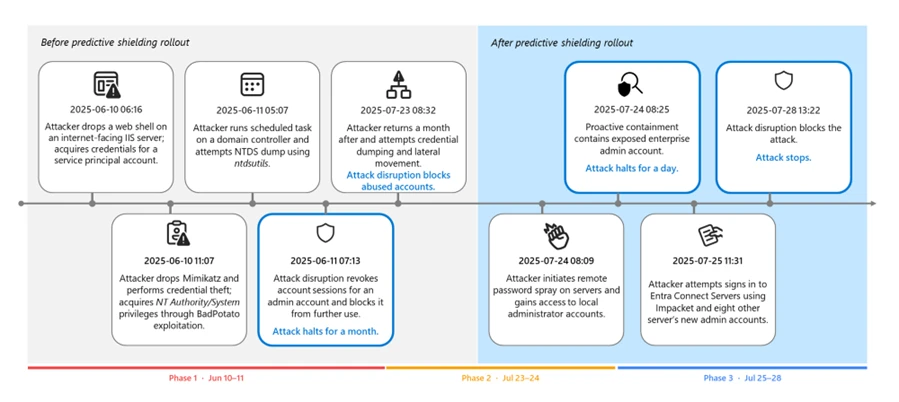
The following section revisits a real-world domain compromise that showcases how attack disruption and predictive shielding changed the outcome by acting on exposure, rather than just observed abuse. Interestingly, this case happened just as we’re rolling out the predictive shielding, so you can see the changes in both attacker tradecraft and the detection and response actions before and after this capability was deployed.
Attack chain overview
In June 2025, a public sector organization was targeted by a threat actor. This threat actor progressed methodically: initial exploitation, local escalation, directory reconnaissance, credential access, and expansion into Microsoft Exchange and identity infrastructure.
Figure 1. Attack diagram of the domain compromise.
Initial entry: Pre-domain compromise
The campaign began at the edge: a file-upload flaw in an internet-facing Internet Information Services (IIS) server was abused to plant and launch a web shell. The attacker then simultaneously performed various reconnaissance activities using the compromised account through the web shell and escalated their privileges to NT AUTHORITY\SYSTEM by abusing a Potato-class token impersonation primitive (for example, BadPotato).
The discovery commands observed in the attack include the following example:
Using the compromised IIS service account, the attacker attempted to reset the passwords of high-impact identities, a common technique used to gain control over accounts without performing credential dumping. The attacker also deployed Mimikatz to dump logon secrets (for example, MSV, LSASS, and SAM), harvesting credentials that are exposed on the device.
Had predictive shielding been released at this point, automated restrictions on exposed accounts could have stopped the intrusion before it expanded beyond the single-host foothold. However, at the time of the incident, this capability hasn’t been deployed to customers yet.
Key takeaway: At this stage of an attack, it’s important to keep the containment host‑scoped. Defenders should prioritize blocking credential theft and stopping escalation before it reaches the identity infrastructure.
First pivot: Directory credential materialization and Exchange delegation
Within 24 hours, the attacker abused privileged accounts and remotely created a scheduled task on a domain controller. The task initiated NTDS snapshot activity and packaged the output using makecab.exe, enabling offline access to directory credential material that’s suitable for abusing credentials at scale:
Because the first malicious action by the abused account already surfaced the entire Active Directory credentials, stopping its path for total domain compromise was no longer feasible.
The threat actor then planted a Godzilla web shell on Exchange Server, used a privileged context to enumerate accounts with ApplicationImpersonation role assignments, and granted full access to a delegated principal across mailboxes using Add‑MailboxPermission. This access allowed the threat actor to read and manipulate all mailbox contents.
The attack also used Impacket’s atexec.py to enumerate the role assignments remotely. Its use triggered the attack disruption capability in Defender, revoking the account sessions of an admin account and blocking it from further use.
Following the abused account’s disruption, the attacker attempted several additional actions, such as resetting the disrupted account’s and other accounts’ passwords. They also attempted to dump credentials of a Veeam backup device.
Key takeaway: This pivot is a turning point. Once directory credentials and privileged delegation are in play, the scope and impact of an incident expand fast. Defenders should prioritize protecting domain controllers, privileged identities, and authentication paths.
Scale and speed: Tool return, spraying, and lateral movement
Weeks later, the threat actor returned with an Impacket tooling (for example, secretsdump and PsExec) that resulted in repeated disruptions by Defender against the abused accounts that they used. These disruptions forced the attacker to pivot to other compromised accounts and exhaust their resources.
Following Defender’s disruptions, the threat actor then launched a broad password spray from the initially compromised IIS server, unlocking access to at least 14 servers through password reuse. They also attempted remote credential dumping against a couple of domain controllers and an additional IIS server using multiple domain and service principals.
Key takeaway: Even though automatic attack disruption acted right away, the attacker already possessed multiple credentials due to the previous large-scale credential dumping. This scenario showcases the race to detect and disrupt credential abuse and is the reason we’re introducing predictive shielding to preemptively disrupt exposed accounts at risk.
Predictive shielding breaks the chain: Exposure-centric containment
In the second phase of the attack, we activated predictive shielding. When exposure signals surfaced (for example, credential dumping attempts and replay from compromised hosts), automated containment blocked new sign-in attempts and interactive pivots not only for the abused accounts, but also for context-linked identities that are active on the same compromised surfaces.
Attack disruption contained high-privileged principals to prevent these accounts from being abused. Crucially, when a high-tier Enterprise or Schema Admin credential was exposed, predictive shielding contained it pre-abuse, preventing what would normally become a catastrophic escalation.
Second pivot: Alternative paths to new credentials
With high-value identities pre-contained, the threat actor pivoted to exploiting Apache Tomcat servers. They compromised three Tomcat servers, dropped the Godzilla web shell, and launched the PowerShell-based Invoke-Mimikatz command to harvest additional credentials. At one point, the attacker operated under Schema Admin:
They then used Impacket WmiExec to access Microsoft Entra Connect servers and attempt to extract Entra Connect synchronization credentials. The account used for this pivot was later contained, limiting further lateral movement.
Last attempts and shutdown
In the final phase of the attack, the threat actor attempted a full LSASS dump on a file sharing server using comsvcs.dll MiniDump under a domain user account, followed by additional NTDS activity:
Attack disruption in Defender repeatedly severed sessions and blocked new sign-ins made by the threat actor. On July 28, 2025, the attack campaign lost momentum and stopped.
How predictive shielding changed the outcome
Before compromising a domain, attackers are mostly constrained by the hosts they control. However, even a small set of exposed credentials could remove their constraints and give them broad access through privileged authentication and delegated pathways. The blast radius spreads fast, time pressure spikes, and containment decisions become riskier because identity infrastructure and high-privilege accounts are production dependencies.
The incident we revisited earlier almost followed a similar pattern. It unfolded while predictive shielding was still being launched, so the automated predictive containment capability only became active at the midway of the attack campaign. During the attack’s first stages, the threat actor had room to scale—they returned with new tooling, launched a broad password spray attack, and expanded access across multiple servers. They also attempted remote credential dumping against domain controllers and servers.
When predictive shielding went live, it helped shift the story and we then saw the change of pace—instead of reacting to each newly abused account, the capability allowed Defender to act preemptively and turn credential theft attempts into blocked pivots. Defender was able to block new sign-ins and interactive pivots, not just for the single abused account, but also for context-linked identities that were active on the same compromised surfaces.
With high-value identities pre-contained, the adversary shifted tradecraft and chased other credential sources, but each of their subsequent attempts triggered targeted containment that limited their lateral reach until they lost momentum and stopped. How this incident concluded is the operational “tell” that containment is working, in that once privileged pivots get blocked, threat actors often hunt for alternate credential sources, and defenses must continue following the moving blast radius.
As predictive shielding matures, it will continue to expand its prediction logic and context-linked identities.
MITRE ATT&CK® techniques observed
The following table maps observed behaviors to ATT&CK®.
Tactics shown are per technique definition.
Tactic(s)
Technique ID
Technique name
Observed details
Initial Access
T1190
Exploit Public-Facing Application
Exploited a file-upload vulnerability in an IIS server to drop a web shell.
Persistence
T1505.003
Server Software Component: Web Shell
Deployed web shells for persistent access.
Execution
T1059.001
Command and Scripting Interpreter: PowerShell
Used PowerShell for Exchange role queries, mailbox permission changes, and Invoke-Mimikatz.
Privilege Escalation
T1068
Exploitation for Privilege Escalation
Used BadPotato to escalate to SYSTEM on an IIS server.
Credential Access
T1003.001
OS Credential Dumping: LSASS Memory
Dumped LSASS using Mimikatz and comsvcs.dll MiniDump.
Credential Access
T1003.003
OS Credential Dumping: NTDS
Performed NTDS-related activity using ntdsutil snapshot/IFM workflows on a domain controller.
Execution; Persistence; Privilege Escalation
T1053.005
Scheduled Task/Job: Scheduled Task
Created remote scheduled tasks to execute under SYSTEM on a domain controller.
Discovery
T1087.002
Account Discovery: Domain Account
Enumerated domain groups and accounts using net group and AD Explorer.
Lateral Movement
T1021.002
Remote Services: SMB/Windows Admin Shares
Used admin shares/SMB-backed tooling (for example, PsExec) for lateral movement.
Lateral Movement
T1021.003
Remote Services: Windows Remote Management
Used WmiExec against Microsoft Entra Connect servers.
Credential Access
T1110.003
Brute Force: Password Spraying
Performed password spraying leading to access across at least 14 servers.
Collection
T1114.002
Email Collection: Remote Email Collection
Expanded mailbox access broadly through impersonation or permission changes.
Command and Control
T1071.001
Application Layer Protocol: Web Protocols
Web shells communicated over HTTP/S.
Defense Evasion
T1070.004
Indicator Removal on Host: File Deletion
Used cleanup scripts (for example, del.bat) to remove dump artifacts.
Persistence; Privilege Escalation
T1098
Account Manipulation
Manipulated permissions and roles to expand access and sustain control.
Credential Access
T1078
Valid Accounts
Reused compromised service and domain accounts for access and lateral movement.
Learn more
For more information about automatic attack disruption and predictive shielding, see the following Microsoft Learn articles:
Check out our latest Ninja show showcasing how predictive shielding expands to identity centric attacks
Microsoft Threat Intelligence uncovered a macOS‑focused cyber campaign by the North Korean threat actor Sapphire Sleet that relies on social engineering rather than software vulnerabilities. By impersonating a legitimate software update, threat actors tricked users into manually running malicious files, allowing them to steal passwords, cryptocurrency assets, and personal data while avoiding built‑in macOS security checks. This activity highlights how convincing user prompts and trusted system tools can be abused, and why awareness and layered security defenses remain critical.
Microsoft Threat Intelligence identified a campaign by North Korean state actor Sapphire Sleet demonstrating new combinations of macOS-focused execution patterns and techniques, enabling the threat actor to compromise systems through social engineering rather than software exploitation. In this campaign, Sapphire Sleet takes advantage of user‑initiated execution to establish persistence, harvest credentials, and exfiltrate sensitive data while operating outside traditional macOS security enforcement boundaries. While the techniques themselves are not novel, this analysis highlights execution patterns and combinations that Microsoft has not previously observed for this threat actor, including how Sapphire Sleet orchestrates these techniques together and uses AppleScript as a dedicated, late‑stage credential‑harvesting component integrated with decoy update workflows.
After discovering the threat, Microsoft shared details of this activity with Apple as part of our responsible disclosure process. Apple has since implemented updates to help detect and block infrastructure and malware associated with this campaign. We thank the Apple security team for their collaboration in addressing this activity and encourage macOS users to keep their devices up to date with the latest security protections.
This activity demonstrates how threat actors continue to rely on user interaction and trusted system utilities to bypass macOS platform security protections, rather than exploiting traditional software vulnerabilities. By persuading users to manually execute AppleScript or Terminal‑based commands, Sapphire Sleet shifts execution into a user‑initiated context, allowing the activity to proceed outside of macOS protections such as Transparency, Consent, and Control (TCC), Gatekeeper, quarantine enforcement, and notarization checks. Sapphire Sleet achieves a highly reliable infection chain that lowers operational friction and increases the likelihood of successful compromise—posing an elevated risk to organizations and individuals involved in cryptocurrency, digital assets, finance, and similar high‑value targets that Sapphire Sleet is known to target.
In this blog, we examine the macOS‑specific attack chain observed in recent Sapphire Sleet intrusions, from initial access using malicious .scpt files through multi-stage payload delivery, credential harvesting using fake system dialogs, manipulation of the macOS TCC database, persistence using launch daemons, and large-scale data exfiltration. We also provide actionable guidance, Microsoft Defender detections, hunting queries, and indicators of compromise (IOCs) to help defenders identify similar threats and strengthen macOS security posture.
Sapphire Sleet’s campaign lifecycle
Initial access and social engineering
Sapphire Sleet is a North Korean state actor active since at least March 2020 that primarily targets the finance sector, including cryptocurrency, venture capital, and blockchain organizations. The primary motivation of this actor is to steal cryptocurrency wallets to generate revenue, and target technology or intellectual property related to cryptocurrency trading and blockchain platforms.
Recent campaigns demonstrate expanded execution mechanisms across operating systems like macOS, enabling Sapphire Sleet to target a broader set of users through parallel social engineering workflows.
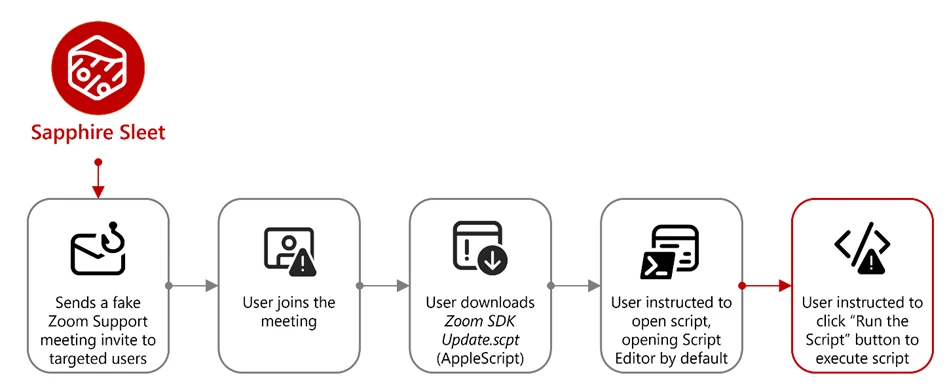
Sapphire Sleet operates a well‑documented social engineering playbook in which the threat actor creates fake recruiter profiles on social media and professional networking platforms, engages targets in conversations about job opportunities, schedules a technical interview, and directs targets to install malicious software, which is typically disguised as a video conferencing tool or software developer kit (SDK) update.
In this observed activity, the target was directed to download a file called Zoom SDK Update.scpt—a compiled AppleScript that opens in macOS Script Editor by default. Script Editor is a trusted first-party Apple application capable of executing arbitrary shell commands using the do shell script AppleScript command.
Lure file and Script Editor execution
Figure 1. Initial access: The .scpt lure file as seen in macOS Script Editor
The malicious Zoom SDK Update.scpt file is crafted to appear as a legitimate Zoom SDK update when opened in the macOS Script Editor app, beginning with a large decoy comment block that mimics benign upgrade instructions and gives the impression of a routine software update. To conceal its true behavior, the script inserts thousands of blank lines immediately after this visible content, pushing the malicious logic far below the scrollable view of the Script Editor window and reducing the likelihood that a user will notice it.
Hidden beneath this decoy, the script first launches a harmless looking command that invokes the legitimate macOS softwareupdate binary with an invalid parameter, an action that performs no real update but launches a trusted Apple‑signed process to reinforce the appearance of legitimacy. Following this, the script executes its malicious payload by using curl to retrieve threat actor‑controlled content and immediately passes the returned data to osascript for execution using the run script result instruction. Because the content fetched by curl is itself a new AppleScript, it is launched directly within the Script Editor context, initiating a payload delivery in which additional stages are dynamically downloaded and executed.
Figure 2. The AppleScript lure with decoy content and payload execution
Execution and payload delivery
Cascading curl-to-osascript execution
When the user opens the Zoom SDK Update.scpt file, macOS launches the file in Script Editor, allowing Sapphire Sleet to transition from a single lure file to a multi-stage, dynamically fetched payload chain. From this single process, the entire attack unfolds through a cascading chain of curl commands, each fetching and executing progressively more complex AppleScript payloads. Each stage uses a distinct user-agent string as a campaign tracking identifier.
Figure 3. Process tree showing cascading execution from Script Editor
The main payload fetched by the mac-cur1 user agent is the attack orchestrator. Once executed within the Script Editor, it performs immediate reconnaissance, then kicks off parallel operations using additional curl commands with different user-agent strings.
Note the URL path difference: mac-cur1 through mac-cur3 fetch from /version/ (AppleScript payloads piped directly to osascript for execution), while mac-cur4 and mac-cur5 fetch from /status/ (ZIP archives containing compiled macOS .app bundles).
The following table summarizes the curl chain used in this campaign.
User agent
URL path
Purpose
mac-cur1
/fix/mac/update/version/
Main orchestrator (piped to osascript) beacon. Downloads com.apple.cli host monitoringcomponent and services backdoor
mac-cur2
/fix/mac/update/version/
Invokes curl with mac-cur4 which downloads credential harvester systemupdate.app
mac-cur3
/fix/mac/update/version/
TCC bypass + data collection + exfiltration (wallets, browser, keychains, history, Apple Notes, Telegram)
Figure 4. The curl chain showing user-agent strings and payload routing
Reconnaissance and C2 registration
After execution, the malware next identifies and registers the compromised device with Sapphire Sleet infrastructure. The malware starts by collecting basic system details such as the current user, host name, system time, and operating system install date. This information is used to uniquely identify the compromised device and track subsequent activity.
The malware then registers the compromised system with its command‑and‑control (C2) infrastructure. The mid value represents the device’s universally unique identifier (UUID), the did serves as a campaign‑level tracking identifier, and the user field combines the system host name with the device serial number to uniquely label the targeted user.
Figure 5. C2 registration with device UUID and campaign identifier
Host monitoring component: com.apple.cli
The first binary deployed is a host monitoring component called com.apple.cli—a ~5 MB Mach-O binary disguised with an Apple-style naming convention.
The mac-cur1 payload spawns an osascript that downloads and launches com.apple.cli:
Figure 6. com.apple.cli deployment using osascript
The host monitoring component repeatedly executes a series of system commands to collect environment and runtime information, including the macOS version (sw_vers), the current system time (date -u), and the underlying hardware model (sysctl hw.model). It then runs ps aux in a tight loop to capture a full, real‑time list of running processes.
During execution, com.apple.cli performs host reconnaissance while maintaining repeated outbound connectivity to the threat actor‑controlled C2 endpoint 83.136.208[.]246:6783. The observed sequencing of reconnaissance activity and network communication is consistent with staging for later operational activity, including privilege escalation, and exfiltration.
In parallel with deploying com.apple.cli, the mac-cur1 orchestrator also deploys a second component, the services backdoor, as part of the same execution flow; its role in persistence and follow‑on activity is described later in this blog.
Credential access
Credential harvester: systemupdate.app
After performing reconnaissance, the mac-cur1 orchestrator begins parallel operations. During the mac‑cur2 stage of execution (independent from the mac-cur1 stage), Sapphire Sleet delivers an AppleScript payload that is executed through osascript. This stage is responsible for deploying the credential harvesting component of the attack.
Before proceeding, the script checks for the presence of a file named .zoom.log on the system. This file acts as an infection marker, allowing Sapphire Sleet to determine whether the device has already been compromised. If the marker exists, deployment is skipped to avoid redundant execution across sessions.
If the infection marker is not found, the script downloads a compressed archive through the mac-cur4 user agent that contains a malicious macOS application named (systemupdate.app), which masquerades as the legitimate system update utility by the same name. The archive is extracted to a temporary location, and the application is launched immediately.
When systemupdate.app launches, the user is presented with a native macOS password dialog that is visually indistinguishable from a legitimate system prompt. The dialog claims that the user’s password is required to complete a software update, prompting the user to enter their credentials.
After the user enters their password, the malware performs two sequential actions to ensure the credential is usable and immediately captured. First, the binary validates the entered password against the local macOS authentication database using directory services, confirming that the credential is correct and not mistyped. Once validation succeeds, the verified password is immediately exfiltrated to threat actor‑controlled infrastructure using the Telegram Bot API, delivering the stolen credential directly to Sapphire Sleet.
Figure 7. Password popup given by fake systemupdate.app
Decoy completion prompt: softwareupdate.app
After credential harvesting is completed using systemupdate.app, Sapphire Sleet deploys a second malicious application named softwareupdate.app, whose sole purpose is to reinforce the illusion of a legitimate update workflow. This application is delivered during a later stage of the attack using the mac‑cur5 user‑agent. Unlike systemupdate.app, softwareupdate.app does not attempt to collect credentials. Instead, it displays a convincing “system update complete” dialog to the user, signaling that the supposed Zoom SDK update has finished successfully. This final step closes the social engineering loop: the user initiated a Zoom‑themed update, was prompted to enter their password, and is now reassured that the process completed as expected, reducing the likelihood of suspicion or further investigation.
Persistence
Primary backdoor and persistence installer: services binary
The services backdoor is a key operational component in this attack, acting as the primary backdoor and persistence installer. It provides an interactive command execution channel, establishes persistence using a launch daemon, and deploys two additional backdoors. The services backdoor is deployed through a dedicated AppleScript executed as part of the initial mac‑cur1 payload that also deployed com.apple.cli, although the additional backdoors deployed by services are executed at a later stage.
During deployment, the services backdoor binary is first downloaded using a hidden file name (.services) to reduce visibility, then copied to its final location before the temporary file is removed. As part of installation, the malware creates a file named auth.db under ~/Library/Application Support/Authorization/, which stores the path to the deployed services backdoor and serves as a persistent installation marker. Any execution or runtime errors encountered during this process are written to /tmp/lg4err, leaving behind an additional forensic artifact that can aid post‑compromise investigation.
Figure 8. Services backdoor deployment using osascript
Unlike com.apple.cli, the services backdoor uses interactive zsh shells (/bin/zsh -i) to execute privileged operations. The -i flag creates an interactive terminal context, which is required for sudo commands that expect interactive input.
Figure 9. Interactive zsh shell execution by the services backdoor
Additional backdoors: icloudz and com.google.chromes.updaters
Of the additional backdoors deployed by services, the icloudz backdoor is a renamed copy of the previously deployed services backdoor and shares the same SHA‑256 hash, indicating identical underlying code. Despite this, it is executed using a different and more evasive technique. Although icloudz shares the same binary as .services, it operates as a reflective code loader—it uses the macOS NSCreateObjectFileImageFromMemory API to load additional payloads received from its C2 infrastructure directly into memory, rather than writing them to disk and executing them conventionally.
The icloudz backdoor is stored at ~/Library/Application Support/iCloud/icloudz, a location and naming choice intended to resemble legitimate iCloud‑related artifacts. Once loaded into memory, two distinct execution waves are observed. Each wave independently initializes a consistent sequence of system commands: existing caffeinate processes are stopped, caffeinate is relaunched using nohup to prevent the system from sleeping, basic system information is collected using sw_vers and sysctl -n hw.model, and an interactive /bin/zsh -i shell is spawned. This repeated initialization suggests that the component is designed to re‑establish execution context reliably across runs.
From within the interactive zsh shell, icloudz deploys an additional (tertiary) backdoor, com.google.chromes.updaters, to disk at ~/Library/Google/com.google.chromes.updaters. The selected directory and file name closely resemble legitimate Google application data, helping the file blend into the user’s Home directory and reducing the likelihood of casual inspection. File permissions are adjusted; ownership is set to allow execution with elevated privileges, and the com.google.chromes.updaters binary is launched using sudo.
To ensure continued execution across reboots, a launch daemon configuration file named com.google.webkit.service.plist is installed under /Library/LaunchDaemons. This configuration causes icloudz to launch automatically at system startup, even if no user is signed in. The naming convention deliberately mimics legitimate Apple and Google system services, further reducing the chance of detection.
The com.google.chromes.updaters backdoor is the final and largest component deployed in this attack chain, with a size of approximately 7.2 MB. Once running, it establishes outbound communication with threat actor‑controlled infrastructure, connecting to the domain check02id[.]com over port 5202. The process then enters a precise 60‑second beaconing loop. During each cycle, it executes minimal commands such as whoami to confirm the execution context and sw_vers -productVersion to report the operating system version. This lightweight heartbeat confirms the process remains active, is running with elevated privileges, and is ready to receive further instructions.
Privilege escalation
TCC bypass: Granting AppleEvents permissions
Before large‑scale data access and exfiltration can proceed, Sapphire Sleet must bypass macOS TCC protections. TCC enforces user consent for sensitive inter‑process interactions, including AppleEvents, the mechanism required for osascript to communicate with Finder and perform file-level operations. The mac-cur3 stage silently grants itself these permissions by directly manipulating the user-level TCC database through the following sequence.
The user-level TCC database (~/Library/Application Support/com.apple.TCC/TCC.db) is itself TCC-protected—processes without Full Disk Access (FDA) cannot read or modify it. Sapphire Sleet circumvents this by directing Finder, which holds FDA by default on macOS, to rename the com.apple.TCC folder. Once renamed, the TCC database file can be copied to a staging location by a process without FDA.
Sapphire Sleet then uses sqlite3 to inject a new entry into the database’s access table. This entry grants /usr/bin/osascript permission to send AppleEvents to com.apple.finder and includes valid code-signing requirement (csreq) blobs for both binaries, binding the grant to Apple-signed executables. The authorization value is set to allowed (auth_value=2) with a user-set reason (auth_reason=3), ensuring no user prompt is triggered. The modified database is then copied back into the renamed folder, and Finder restores the folder to its original name. Staging files are deleted to reduce forensic traces.
Figure 10. Overwriting original TCC database with modified version
Collection and exfiltration
With TCC bypassed, credentials stolen, and backdoors deployed, Sapphire Sleet launches the next phase of attack: a 575-line AppleScript payload that systematically collects, stages, compresses, and exfiltrates seven categories of data.
Exfiltration architecture
Every upload follows a consistent pattern and is executed using nohup, which allows the command to continue running in the background even if the initiating process or Terminal session exits. This ensures that data exfiltration can complete reliably without requiring the threat actor to maintain an active session on the system.
The auth header provides the upload authorization token, and the mid header ties the upload to the compromised device’s UUID.
Figure 11. Exfiltration upload pattern with nohup
Data collected during exfiltration
Host and system reconnaissance: Before bulk data collection begins, the script records basic system identity and hardware information. This includes the current username, system host name, macOS version, and CPU model. These values are appended to a per‑host log file and provide Sapphire Sleet with environmental context, hardware fingerprinting, and confirmation of the target system’s characteristics. This reconnaissance data is later uploaded to track progress and correlate subsequent exfiltration stages to a specific device.
Installed applications and runtime verification: The script enumerates installed applications and shared directories to build an inventory of the system’s software environment. It also captures a live process listing filtered for threat actor‑deployed components, allowing Sapphire Sleet to verify that earlier payloads are still running as expected. These checks help confirm successful execution and persistence before proceeding further.
Messaging session data (Telegram): Telegram Desktop session data is collected by copying the application’s data directories, including cryptographic key material and session mapping files. These artifacts are sufficient to recreate the user’s Telegram session on another system without requiring reauthentication. A second collection pass targets the Telegram App Group container to capture the complete local data set associated with the application.
Browser data and extension storage: For Chromium‑based browsers, including Chrome, Brave, and Arc, the script copies browser profiles and associated databases. This includes saved credentials, cookies, autofill data, browsing history, bookmarks, and extension‑specific storage. Particular focus is placed on IndexedDB entries associated with cryptocurrency wallet extensions, where wallet keys and transaction data are stored. Only IndexedDB entries matching a targeted set of wallet extension identifiers are collected, reflecting a deliberate and selective approach.
macOS keychain: The user’s sign-in keychain database is bundled alongside browser data. Although the keychain is encrypted, Sapphire Sleet has already captured the user’s password earlier in the attack chain, enabling offline decryption of stored secrets once exfiltrated.
Cryptocurrency desktop wallets: The script copies the full application support directories for popular cryptocurrency desktop wallets, including Ledger Live and Exodus. These directories contain wallet configuration files and key material required to access stored cryptocurrency assets, making them high‑value targets for exfiltration.
SSH keys and shell history: SSH key directories and shell history files are collected to enable potential lateral movement and intelligence gathering. SSH keys may provide access to additional systems, while shell history can reveal infrastructure details, previously accessed hosts, and operational habits of the targeted user.
Apple Notes: The Apple Notes database is copied from its application container and staged for upload. Notes frequently contain sensitive information such as passwords, internal documentation, infrastructure details, or meeting notes, making them a valuable secondary data source.
System logs and failed access attempts: System log files are uploaded directly without compression. These logs provide additional hardware and execution context and include progress markers that indicate which exfiltration stages have completed. Failed collection attempts—such as access to password manager containers that are not present on the system—are also recorded and uploaded, allowing Sapphire Sleet to understand which targets were unavailable on the compromised host.
Exfiltration summary
#
Data category
ZIP name
Upload port
Estimated sensitivity
1
Telegram session
tapp_<user>.zip
8443
Critical — session hijack
2
Browser data + Keychain
ext_<user>.zip
8443
Critical — all passwords
3
Ledger wallet
ldg_<user>.zip
8443
Critical — crypto keys
4
Exodus wallet
exds_<user>.zip
8443
Critical — crypto keys
5
SSH + shell history
hs_<user>.zip
8443
High — lateral movement
6
Apple Notes
nt_<user>.zip
8443
Medium-High
7
System log
lg_<user> (no zip)
8443
Low — fingerprinting
8
Recon log
flog (no zip)
8443
Low — inventory
9
Credentials
Telegram message
443 (Telegram API)
Critical — sign-in password
All uploads use the upload authorization token fwyan48umt1vimwqcqvhdd9u72a7qysi and the machine identifier 82cf5d92-87b5-4144-9a4e-6b58b714d599.
Defending against Sapphire Sleet intrusion activity
As part of a coordinated response to this activity, Apple has implemented platform-level protections to help detect and block infrastructure and malware associated with this campaign. Apple has deployed Apple Safe Browsing protections in Safari to detect and block malicious infrastructure associated with this campaign. Users browsing with Safari benefit from these protections by default. Apple has also deployed XProtect signatures to detect and block the malware families associated with this campaign—macOS devices receive these signature updates automatically.
Microsoft recommends the following mitigation steps to defend against this activity and reduce the impact of this threat:
Educate users about social engineering threats originating from social media and external platforms, particularly unsolicited outreach requesting software downloads, virtual meeting tool installations, or execution of terminal commands. Users should never run scripts or commands shared through messages, calls, or chats without prior approval from their IT or security teams.
Block or restrict the execution of .scpt (compiled AppleScript) files and unsigned Mach-O binaries downloaded from the internet. Where feasible, enforce policies that prevent osascript from executing scripts sourced from external locations.
Always inspect and verify files downloaded from external sources, including compiled AppleScript (.scpt) files. These files can execute arbitrary shell commands via macOS Script Editor—a trusted first-party Apple application—making them an effective and stealthy initial access vector.
Limit or audit the use of curl piped to interpreters (such as curl | osascript, curl | sh, curl | bash). Social engineering campaigns by Sapphire Sleet rely on cascading curl-to-interpreter chains to avoid writing payloads to disk. Organizations should monitor for and restrict piped execution patterns originating from non-standard user-agent strings.
Exercise caution when copying and pasting sensitive data such as wallet addresses or credentials from the clipboard. Always verify that the pasted content matches the intended source to avoid falling victim to clipboard hijacking or data tampering attacks.
Monitor for unauthorized modifications to the macOS TCC database. This campaign manipulates TCC.db to grant AppleEvents permissions to osascript without user consent—a prerequisite for the large-scale data exfiltration phase. Look for processes copying, modifying, or overwriting ~/Library/Application Support/com.apple.TCC/TCC.db.
Audit LaunchDaemon and LaunchAgent installations. This campaign installs a persistent launch daemon (com.google.webkit.service.plist) that masquerades as a legitimate Google or Apple service. Monitor /Library/LaunchDaemons/ and ~/Library/LaunchAgents/ for unexpected plist files, particularly those with com.google.* or com.apple.* naming conventions not belonging to genuine vendor software.
Protect cryptocurrency wallets and browser credential stores. This campaign targets nine specific crypto wallet extensions (Sui, Phantom, TronLink, Coinbase, OKX, Solflare, Rabby, Backpack) plus Bitwarden, and exfiltrates browser sign-in data, cookies, and keychain databases. Organizations handling digital assets should enforce hardware wallet policies and rotate browser-stored credentials regularly.
Encourage users to use web browsers that support Microsoft Defender SmartScreen like Microsoft Edge—available on macOS and various platforms—which identifies and blocks malicious websites, including phishing sites, scam sites, and sites that contain exploits and host malware.
Microsoft Defender for Endpoint customers can also apply the following mitigations to reduce the environmental attack surface and mitigate the impact of this threat and its payloads:
Turn on cloud-delivered protection and automatic sample submission on Microsoft Defender Antivirus. These capabilities use artificial intelligence and machine learning to quickly identify and stop new and unknown threats.
Enable potentially unwanted application (PUA) protection in block mode to automatically quarantine PUAs like adware. PUA blocking takes effect on endpoint clients after the next signature update or computer restart.
Turn on network protection to block connections to malicious domains and IP addresses.
Microsoft Defender detection and hunting guidance
Microsoft Defender customers can refer to the list of applicable detections below. Microsoft Defender coordinates detection, prevention, investigation, and response across endpoints, identities, email, apps to provide integrated protection against attacks like the threat discussed in this blog.
Microsoft Defender for Endpoint – Enumeration of files with sensitive data – Suspicious File Copy Operations Using CoreUtil – Suspicious archive creation – Remote exfiltration activity – Possible exfiltration of archived data
Command and control
– Mach-O backdoors beaconing to C2 (com.apple.cli, services, com.google.chromes.updaters)
Microsoft Defender Antivirus – Trojan:MacOS/NukeSped.D – Backdoor:MacOS/FlowOffset.B!dha – Backdoor:MacOS/FlowOffset.C!dha
Microsoft Security Copilot is embedded in Microsoft Defender and provides security teams with AI-powered capabilities to summarize incidents, analyze files and scripts, summarize identities, use guided responses, and generate device summaries, hunting queries, and incident reports.
Security Copilot is also available as a standalone experience where customers can perform specific security-related tasks, such as incident investigation, user analysis, and vulnerability impact assessment. In addition, Security Copilot offers developer scenarios that allow customers to build, test, publish, and integrate AI agents and plugins to meet unique security needs.
Threat intelligence reports
Microsoft Defender XDR customers can use the following threat analytics reports in the Defender portal (requires license for at least one Defender XDR product) to get the most up-to-date information about the threat actor, malicious activity, and techniques discussed in this blog. These reports provide the intelligence, protection information, and recommended actions to prevent, mitigate, or respond to associated threats found in customer environments.
Microsoft Security Copilot customers can also use the Microsoft Security Copilot integration in Microsoft Defender Threat Intelligence, either in the Security Copilot standalone portal or in the embedded experience in the Microsoft Defender portal to get more information about this threat actor.
Hunting queries
Microsoft Defender XDR
Microsoft Defender XDR customers can run the following advanced hunting queries to find related activity in their networks:
Suspicious osascript execution with curl piping
Search for curl commands piping output directly to osascript, a core technique in this Sapphire Sleet campaign’s cascading payload delivery chain.
DeviceProcessEvents
 | where Timestamp > ago(30d)
 | where FileName == "osascript" or InitiatingProcessFileName == "osascript"
 | where ProcessCommandLine has "curl" and ProcessCommandLine has_any ("osascript", "| sh", "| bash")
 | project Timestamp, DeviceId, DeviceName, AccountName, ProcessCommandLine, InitiatingProcessCommandLine, InitiatingProcessFileName
Suspicious curl activity with campaign user-agent strings
Search for curl commands using user-agent strings matching the Sapphire Sleet campaign tracking identifiers (mac-cur1 through mac-cur5, audio, beacon).
DeviceProcessEvents
 | where Timestamp > ago(30d)
 | where FileName == "curl" or ProcessCommandLine has "curl"
 | where ProcessCommandLine has_any ("mac-cur1", "mac-cur2", "mac-cur3", "mac-cur4", "mac-cur5", "-A audio", "-A beacon")
 | project Timestamp, DeviceId, DeviceName, AccountName, ProcessCommandLine, InitiatingProcessFileName, InitiatingProcessCommandLine
Detect connectivity with known C2 infrastructure
Search for network connections to the Sapphire Sleet C2 domains and IP addresses used in this campaign.
let c2_domains = dynamic(["uw04webzoom.us", "uw05webzoom.us", "uw03webzoom.us", "ur01webzoom.us", "uv01webzoom.us", "uv03webzoom.us", "uv04webzoom.us", "ux06webzoom.us", "check02id.com"]);
 let c2_ips = dynamic(["188.227.196.252", "83.136.208.246", "83.136.209.22", "83.136.208.48", "83.136.210.180", "104.145.210.107"]);
 DeviceNetworkEvents
 | where Timestamp > ago(30d)
 | where RemoteUrl has_any (c2_domains) or RemoteIP in (c2_ips)
 | project Timestamp, DeviceId, DeviceName, RemoteUrl, RemoteIP, RemotePort, InitiatingProcessFileName, InitiatingProcessCommandLine
TCC database manipulation detection
Search for processes that copy, modify, or overwrite the macOS TCC database, a key defense evasion technique used by this campaign to grant unauthorized AppleEvents permissions.
DeviceFileEvents
 | where Timestamp > ago(30d)
 | where FolderPath has "com.apple.TCC" and FileName == "TCC.db"
 | where ActionType in ("FileCreated", "FileModified", "FileRenamed")
 | project Timestamp, DeviceId, DeviceName, ActionType, FolderPath, InitiatingProcessFileName, InitiatingProcessCommandLine
Suspicious LaunchDaemon creation masquerading as legitimate services
Search for LaunchDaemon plist files created in /Library/LaunchDaemons that masquerade as Google or Apple services, matching the persistence technique used by the services/icloudz backdoor.
DeviceFileEvents
 | where Timestamp > ago(30d)
 | where FolderPath startswith "/Library/LaunchDaemons/"
 | where FileName startswith "com.google." or FileName startswith "com.apple."
 | where ActionType == "FileCreated"
 | project Timestamp, DeviceId, DeviceName, FileName, FolderPath, InitiatingProcessFileName, InitiatingProcessCommandLine, SHA256
Malicious binary execution from suspicious paths
Search for execution of binaries from paths commonly used by Sapphire Sleet, including hidden Library directories, /private/tmp/, and user-specific Application Support folders.
Credential harvesting using dscl authentication check
Search for dscl -authonly commands used by the fake password dialog (systemupdate.app) to validate stolen credentials before exfiltration.
DeviceProcessEvents
 | where Timestamp > ago(30d)
 | where FileName == "dscl" or ProcessCommandLine has "dscl"
 | where ProcessCommandLine has "-authonly"
 | project Timestamp, DeviceId, DeviceName, AccountName, ProcessCommandLine, InitiatingProcessFileName, InitiatingProcessCommandLine
Telegram Bot API exfiltration detection
Search for network connections to Telegram Bot API endpoints, used by this campaign to exfiltrate stolen credentials.
DeviceNetworkEvents
 | where Timestamp > ago(30d)
 | where RemoteUrl has "api.telegram.org" and RemoteUrl has "/bot"
 | project Timestamp, DeviceId, DeviceName, RemoteUrl, RemoteIP, RemotePort, InitiatingProcessFileName, InitiatingProcessCommandLine
Reflective code loading using NSCreateObjectFileImageFromMemory
Search for evidence of reflective Mach-O loading, the technique used by the icloudz backdoor to execute code in memory.
DeviceEvents
 | where Timestamp > ago(30d)
 | where ActionType has "NSCreateObjectFileImageFromMemory"
     or AdditionalFields has "NSCreateObjectFileImageFromMemory"
 | project Timestamp, DeviceId, DeviceName, ActionType, FileName, FolderPath, InitiatingProcessFileName, AdditionalFields
Suspicious caffeinate and sleep prevention activity
Search for caffeinate process stop-and-restart patterns used by the services and icloudz backdoors to prevent the system from sleeping during backdoor operations.
DeviceProcessEvents
 | where Timestamp > ago(30d)
 | where ProcessCommandLine has "caffeinate"
 | where InitiatingProcessCommandLine has_any ("icloudz", "services", "chromes.updaters", "zsh -i")
 | project Timestamp, DeviceId, DeviceName, ProcessCommandLine, InitiatingProcessFileName, InitiatingProcessCommandLine
Detect known malicious file hashes
Search for the specific malicious file hashes associated with this Sapphire Sleet campaign across file events.
let malicious_hashes = dynamic([
     "2075fd1a1362d188290910a8c55cf30c11ed5955c04af410c481410f538da419",
     "05e1761b535537287e7b72d103a29c4453742725600f59a34a4831eafc0b8e53",
     "5fbbca2d72840feb86b6ef8a1abb4fe2f225d84228a714391673be2719c73ac7",
     "5e581f22f56883ee13358f73fabab00fcf9313a053210eb12ac18e66098346e5",
     "95e893e7cdde19d7d16ff5a5074d0b369abd31c1a30962656133caa8153e8d63",
     "8fd5b8db10458ace7e4ed335eb0c66527e1928ad87a3c688595804f72b205e8c",
     "a05400000843fbad6b28d2b76fc201c3d415a72d88d8dc548fafd8bae073c640"
 ]);
 DeviceFileEvents
 | where Timestamp > ago(30d)
 | where SHA256 in (malicious_hashes)
 | project Timestamp, DeviceId, DeviceName, FileName, FolderPath, SHA256, ActionType, InitiatingProcessFileName, InitiatingProcessCommandLine
Data staging and exfiltration activity
Search for ZIP archive creation in /tmp/ directories followed by curl uploads matching the staging-and-exfiltration pattern used for browser data, crypto wallets, Telegram sessions, SSH keys, and Apple Notes.
DeviceProcessEvents
 | where Timestamp > ago(30d)
 | where (ProcessCommandLine has "zip" and ProcessCommandLine has "/tmp/")
     or (ProcessCommandLine has "curl" and ProcessCommandLine has_any ("tapp_", "ext_", "ldg_", "exds_", "hs_", "nt_", "lg_"))
 | project Timestamp, DeviceId, DeviceName, ProcessCommandLine, InitiatingProcessFileName, InitiatingProcessCommandLine
Search for Script Editor (the default handler for .scpt files) spawning curl, osascript, or shell commands—the initial execution vector in this campaign.
DeviceProcessEvents
 | where Timestamp > ago(30d)
 | where InitiatingProcessFileName == "Script Editor" or InitiatingProcessCommandLine has "Script Editor"
 | where FileName has_any ("curl", "osascript", "sh", "bash", "zsh")
 | project Timestamp, DeviceId, DeviceName, FileName, ProcessCommandLine, InitiatingProcessFileName, InitiatingProcessCommandLine
Microsoft Sentinel
Microsoft Sentinel customers can use the TI Mapping analytics (a series of analytics all prefixed with ‘TI map’) to automatically match the malicious domain indicators mentioned in this blog post with data in their workspace. If the TI Map analytics are not currently deployed, customers can install the Threat Intelligence solution from the Microsoft Sentinel Content Hub to have the analytics rule deployed in their Sentinel workspace.
Detect network indicators of compromise
The following query checks for connections to the Sapphire Sleet C2 domains and IP addresses across network session data:
let lookback = 30d;
 let ioc_domains = dynamic(["uw04webzoom.us", "uw05webzoom.us", "uw03webzoom.us", "ur01webzoom.us", "uv01webzoom.us", "uv03webzoom.us", "uv04webzoom.us", "ux06webzoom.us", "check02id.com"]);
 let ioc_ips = dynamic(["188.227.196.252", "83.136.208.246", "83.136.209.22", "83.136.208.48", "83.136.210.180", "104.145.210.107"]);
 DeviceNetworkEvents
 | where TimeGenerated > ago(lookback)
 | where RemoteUrl has_any (ioc_domains) or RemoteIP in (ioc_ips)
 | summarize EventCount=count() by DeviceName, RemoteUrl, RemoteIP, RemotePort, InitiatingProcessFileName
Detect file hash indicators of compromise
The following query searches for the known malicious file hashes associated with this campaign across file, process, and security event data:
let selectedTimestamp = datetime(2026-01-01T00:00:00.0000000Z);
 let FileSHA256 = dynamic([
     "2075fd1a1362d188290910a8c55cf30c11ed5955c04af410c481410f538da419",
     "05e1761b535537287e7b72d103a29c4453742725600f59a34a4831eafc0b8e53",
     "5fbbca2d72840feb86b6ef8a1abb4fe2f225d84228a714391673be2719c73ac7",
     "5e581f22f56883ee13358f73fabab00fcf9313a053210eb12ac18e66098346e5",
     "95e893e7cdde19d7d16ff5a5074d0b369abd31c1a30962656133caa8153e8d63",
     "8fd5b8db10458ace7e4ed335eb0c66527e1928ad87a3c688595804f72b205e8c",
     "a05400000843fbad6b28d2b76fc201c3d415a72d88d8dc548fafd8bae073c640"
 ]);
 search in (AlertEvidence, DeviceEvents, DeviceFileEvents, DeviceImageLoadEvents, DeviceProcessEvents, DeviceNetworkEvents, SecurityEvent, ThreatIntelligenceIndicator)
 TimeGenerated between ((selectedTimestamp - 1m) .. (selectedTimestamp + 90d))
 and (SHA256 in (FileSHA256) or InitiatingProcessSHA256 in (FileSHA256))
Detect Microsoft Defender Antivirus detections related to Sapphire Sleet
The following query searches for Defender Antivirus alerts for the specific malware families used in this campaign and joins with device information for enriched context:
To hear stories and insights from the Microsoft Threat Intelligence community about the ever-evolving threat landscape, listen to the Microsoft Threat Intelligence podcast.

 Login
Login