
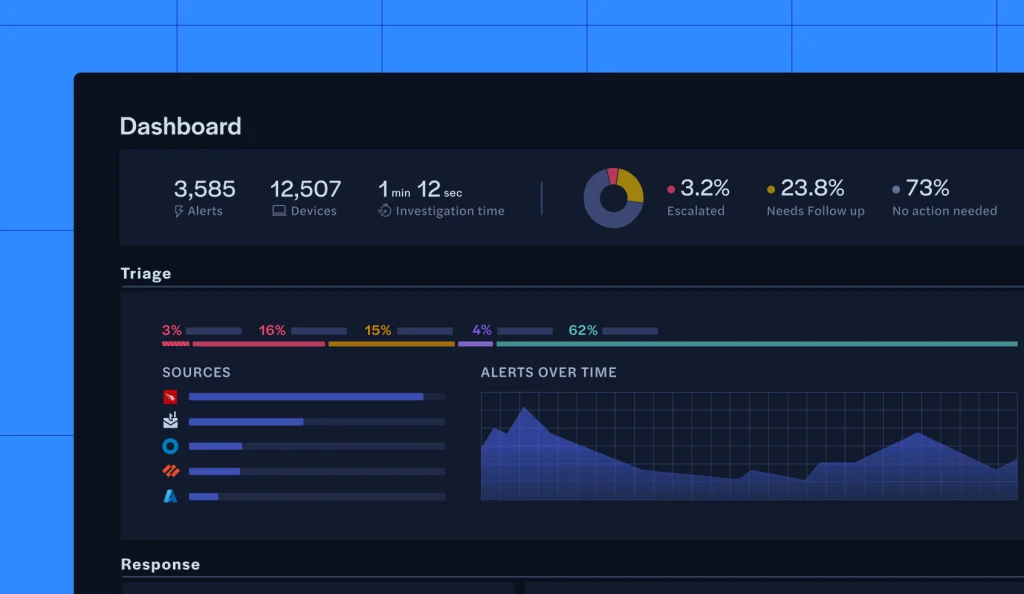
Normal view

Top 15 AI SOC Tools for 2026: SOC Automation Compared

2 December 2025 at 13:01

The Security Operations Center (SOC) has always been the heart of enterprise defense, but in 2026, it’s evolving faster than ever.

The rise of AI-driven SOC platforms, often referred to as Agentic AI SOCs, is redefining how enterprises detect, investigate, and respond to threats.

For years, security teams relied on a mix of SIEM, EDR, and MDR vendors to stay ahead of attacks. But these stacks often created their own problems: endless alert noise, long investigation times, and an overworked analyst team stuck in repetitive triage.

The new generation of AI SOC platforms changes that. They leverage large language models (LLMs), enabling SOCs to automatically triage and investigate every alert in minutes, not hours.

In this guide, we’ll break down the Top 15 AI SOC platforms to watch in 2026, ranked by how they balance speed, accuracy, explainability, and coverage across modern enterprise environments.

What is an Agentic AI SOC?

“Agentic” AI refers to systems that don’t just respond, they act. In cybersecurity, an Agentic AI SOC is capable of performing end-to-end investigations, drawing conclusions, and recommending (or executing) responses based on forensic evidence and reasoning.

These platforms are trained not only to summarize alerts but to understand their context, correlating data across endpoints, identities, networks, and cloud systems.

The best AI SOCs of 2026 are explainable, autonomous, and fast, providing the confidence enterprises need to trust machine-led decision-making.

Top AI SOC platforms in 2026 comparison table

PlatformBest forKey strength
Intezer (Forensic AI SOC)Large EnterprisesForensic-level, explainable investigations
7AIEnterprises exploring multi-agent automationMulti-agent orchestration
AiStrikeMid-market SOCsAffordable automated triage
SentinelOne (Purple AI)Enterprises using SentinelOne EDRIntegrated SOC automation
CrowdStrike (Charlotte AI)Falcon ecosystem usersGenerative AI for summaries
BlinkOpsSecurity automation teamsPlaybook-based automation
Bricklayer AIStartupsLightweight triage and reporting
Conifers.aiCloud-native companiesCloud-first visibility
Vectra AIMature SOCsNetwork threat detection
Dropzone AISOC automation innovatorsHuman-in-the-loop design
ExaforceMinimizing SIEM CostAlert routing and prioritization
Legion SecuritySOCs with expert analystsWorkflow management
Prophet.aiPredictive threat modelingProactive threat detection
Qevlar AILLM-driven SOCsAI triage experiments
Radiant SecurityMid-market enterprisesResponse recommendations

1. Intezer: Best AI SOC platform for enterprise SOCs

Best for: Large enterprises that prioritize speed, accuracy, and complete alert coverage.

Intezer Forensic AI SOC is built for enterprise and MSSPs, trusted by global brands including NVIDIA, Salesforce, MGM Resorts, Equifax, and Ferguson.
Intezer investigates 100% of alerts in under two minutes with 98% accuracy.

Unlike other platforms that rely solely on LLM-generated heuristics, Intezer fuses human-like reasoning with multiple AI models and deterministic forensic methods,  including code analysis, sandboxing, reverse engineering, and memory forensics.
The result is evidence-backed, explainable verdicts that eliminate the guesswork for SOC analysts.

For enterprises managing millions of alerts across SIEM, EDR, cloud, and identity systems, Intezer delivers full alert coverage and eliminates the low-severity blind spots that MDRs often ignore.

With endpoint-based pricing, Intezer removes the “alert tax” of data-ingest models and helps SOC leaders prove ROI to their boards, without expanding headcount.

Why enterprises choose Intezer

  • 100% alert investigation coverage across SIEM, EDR, phishing, identity, and cloud
  • Sub-2-minute investigations with 98% accuracy
  • Transparent, explainable verdicts
  • Trusted by Fortune 500 enterprises
  • Predictable ROI and cost efficiency

Experience Intezer in action with a custom demo.

Hear what CTO of MGM has to say about Intezer.

2. 7AI: Best for multi-agent SOC automation

7AI is one of the most experimental platforms in the 2026 AI SOC space. It focuses on multi-agent orchestration, where separate AI agents collaborate to triage, enrich, and investigate alerts across different domains.

Screenshot of 7AI product

While its architecture is impressive, 7AI is best suited for innovation-driven security teams that have strong engineering capacity and want to customize workflows. It performs well in large-scale EDR and cloud environments but requires fine-tuning for reliability.

Best for: Enterprises exploring multi-agent SOC architectures.

3. AiStrike: Best for mid-market SOCs

AiStrike targets the mid-market segment with a focus on cost-effective AI triage. It offers a simple, clean dashboard that connects with EDR and SIEM tools to automatically prioritize alerts. While its forensic depth is limited compared to enterprise-grade solutions, AiStrike delivers solid speed and automation for smaller SOCs.

Aistrike dashboard

Best for: Mid-market SOCs that want affordable, plug-and-play AI investigations.

4. SentinelOne (Purple AI): Best for endpoint-centric SOCs

SentinelOne’s Purple AI brings native AI investigation and response into the SentinelOne platform. It’s tightly integrated with SentinelOne’s EDR and XDR stack, which makes it a strong option for organizations already using the SentinelOne’s stack.

SentinelOne Purple AI product image

While Purple AI provides quick, summarized threat analysis and remediation recommendations, it focuses heavily on endpoints rather than full enterprise coverage.

Best for: Enterprises deeply invested in SentinelOne’s ecosystem that want integrated AI triage.

5. CrowdStrike (Charlotte AI): Best for AI-driven summarization

CrowdStrike’s Charlotte AI is the generative assistant within the Falcon platform, built to help analysts ask natural-language questions and interpret alerts faster.

Crowdstrike Charlotte AI product image

While not a fully autonomous SOC, Charlotte AI improves analyst experience and productivity by summarizing incidents and surfacing relevant insights. It’s ideal for teams that want to augment analysts rather than automate full investigations.

Best for: Enterprises using the CrowdStrike Falcon suite that want faster analyst assistance.

6. BlinkOps: Best for automation engineers

BlinkOps focuses on workflow automation, not investigations per se. It enables security teams to build playbooks and automation pipelines that connect multiple tools (SIEM, EDR, IAM, etc.).

BlinkOps prod image

While it doesn’t deliver forensic-level verdicts, BlinkOps is popular among DevSecOps teams that want custom automation flexibility.

Best for: Security engineers looking to automate existing SOC workflows.

7. Bricklayer AI: Best for startups and lean SOCs

Bricklayer AI provides lightweight alert triage and reporting capabilities. It’s built for smaller organizations that want to reduce alert fatigue without complex integrations. Its simplicity and affordability make it a solid entry point for teams without mature SOC processes.

Best for: Startups building early SOC capabilities on a budget.

8. Conifers.ai: Best for cloud-native companies

Conifers.ai specializes in cloud-first security visibility across AWS, Azure, and Google Cloud. Its AI models excel at correlating identity, network, and workload activity to flag potential breaches.

conifer.ai dashboard

It’s not a full SOC replacement, but it significantly enhances cloud investigation and response.

Best for: Cloud-first organizations seeking AI-enhanced detection and context.

9. Vectra AI: Best for network and identity threat detection

Vectra AI has long been a leader in AI-driven network detection and response (NDR). Its platform now extends into AI SOC territory, combining real-time detection with contextual identity analysis.

Vectra AI product image

Vectra is strong in hybrid environments but remains specialized in network telemetry rather than full-stack coverage.

Best for: Enterprises prioritizing network and identity visibility.

10. Dropzone AI: Best for SOC automation innovators

Dropzone AI represents the new wave of human-in-the-loop SOC automation. It allows analysts to supervise and approve actions initiated by AI, blending human expertise with autonomous investigation.

Dropzone.ai product image

While not as proven in large enterprises as Intezer, Dropzone’s agentic architecture makes it an intriguing option for forward-thinking SOCs.

Best for: SOCs experimenting with supervised AI autonomy.

Read about what CISOs are looking for in an AI SOC platform

11. Exaforce: Best for minimizing SIEM cost

Exaforce uses a multi-model AI engine to reduce alert overload, accelerate investigations, and expand detection coverage without relying on a traditional SIEM. Its AI stack, combining data-ingestion models, behavioral machine learning, and large language models, analyzes real-time telemetry while cutting SIEM-related storage and licensing costs.

Exaforce product image

The platform adapts quickly through feedback loops and natural-language business context, continuously refining accuracy and reducing false positives. With investigative graph visualizations and flexible deployment options, Exaforce helps streamline complex investigations.

Best for: Companies struggling with excessive SIEM spend.

12. Legion Security: Best for companies with expert human analysts

Legion automates SOC investigations by capturing and operationalizing real analyst decision-making. Its browser-based agent records every step of an analyst’s workflow such as data reviewed, actions taken, judgments made and then creating reusable investigative logic.

Legion Security product image

These recordings evolve into living agents that can be replayed, tested, refined, and re-executed across new alerts. Legion offers flexible deployment options including cloud, hybrid, or customer-hosted to support diverse security and compliance requirements. 

Best for: Organizations with expert human analysts, looking to create custom AI agents that can mirror their in-house best practices and knowledge. 

13. Prophet Security: Best for predictive SOCs

Prophet focuses on automated alert resolution using agentic reasoning that mirrors how experienced analysts assess user behavior, asset context, and threat indicators. It enriches alerts with data from endpoints, cloud systems, identity platforms, and threat intelligence to deliver high-confidence dispositions without relying on static rules. The platform supports flexible automation, from fully automated closure of benign alerts to analyst-in-the-loop escalation, and includes a copilot-style natural language interface for deeper investigation and threat hunting. 

Best for: Enterprises investing in predictive threat modeling and trend forecasting.

14. Qevlar AI: Best for experimental SOCs

Qevlar is an AI-powered investigation co-pilot that enhances analyst workflows by replicating the reasoning and research steps of human investigators. It ingests alerts from various tools and produces structured, evidence-backed reports with clear verdicts, confidence levels, and referenced data sources. Instead of suppressing or prioritizing alerts, Qevlar enriches and interprets them while preserving full analyst oversight. It also offers an automated documentation engine and support for on-prem deployment.

Best for: SOCs experimenting with AI-based triage prototypes.

15. Radiant Security: Best for mid-market enterprises

Radiant Security positions itself as an AI SOC for the mid-market and differentiates itself with claims of adaptive AI that can learn how to handle never-seen-before alerts as well as a built-in, affordable logging solution leveraging customers’ own archive storage. 

Radiant Security log management

Best for: Mid-market companies looking to eliminate expensive SIEM costs. 

The future of Agentic AI SOCs

The next evolution of SOC automation goes beyond alert management. In 2026 and beyond, Agentic AI SOCs will not only investigate but also take verified actions, quarantining hosts, isolating sessions, and orchestrating containment based on evidence and policy.

This shift demands trust, explainability, and speed. Enterprises can no longer afford “black-box” AI that delivers vague suggestions. They need platforms capable of forensic reasoning, auditability, and full coverage, exactly what Intezer Forensic AI SOC delivers.

SOC leaders who adopt these systems early will gain measurable efficiency, lower operational risk, and stronger security posture, without expanding headcount.

Final thoughts

AI SOC platforms are transforming how enterprises defend against modern threats.
While each platform on this list has unique strengths, Intezer stands out as the clear enterprise choice for those who demand accuracy, speed, and complete visibility.

See how Fortune 500 SOCs cut through the noise, reduce risk, and reclaim their time with Intezer. 

Book a demo to experience Intezer in action.

The post Top 15 AI SOC Tools for 2026: SOC Automation Compared appeared first on Intezer.

Why the “AI SOC Agent” narrative misses the point: The future is about security outcomes, not workflow augmentation

16 November 2025 at 17:50

tl;dr Greater productivity ≠ greater security outcomes. Kinda like why being able to accelerate from 0-60 MPH doesn’t help when the ice is cracking under your wheels.

And now, the full version.

AI SOC shouldn’t just “augment workflows”, that’s a productivity-locked perspective. The goal and the delivery capability that exists right now is to deliver full-scale enterprise triage of 100% of alerts with forensicly-accurate verdicts. That looks like streamlined triage, explainable verdicts, measurable accuracy, and operational resilience. There’s already an AI SOC platform that has operationalized what Gartner calls “emerging”.

While recent Gartner reports on “AI SOC Agents” and “SecOps Workflow Augmentation” succeed in elevating the conversation, they also reveal how incomplete that conversation still is. Both documents frame AI in the SOC as a promising but premature experiment, a toolset meant to make analysts more productive, not organizations more secure. That framing misses the point. AI isn’t about automation for automation’s sake; it’s about turning expert knowledge, data, context, and expertise into repeatable, scalable decision-making that covers every alert with confidence and context.

The bias in today’s AI SOC conversation

Gartner’s reports argue that AI SOC agents should be treated as “workflow augmentation tools” to reduce analyst fatigue and improve response efficiency. They recommend cautious adoption, structured pilots, and human-in-the-loop validation. Pragmatic? When LLMs are relied upon solely, sure. But the underlying assumption that enterprise-proven AI is not yet mature enough to deliver reliable outcomes is outdated.

In practice, this mindset anchors the market in productivity metrics, not security performance. It evaluates how efficiently teams work, not how effectively they defend. The focus stays on “mean time to detect” and “mean time to respond,” rather than the more critical questions:

  • Are ALL alerts being triaged?
  • Are verdicts, not just investigations, consistently accurate?
  • Are we actually reducing risk, not just improving the process?
  • Are alerts triaged in seconds & minutes for true containment & response?

That’s where the emerging class of true AI SOC platforms breaks away from the Gartner lens.

Workflow augmentation isn’t security

The distinction matters. Augmentation is an operational improvement; outcomes are a security transformation. Most vendors today build tools that accelerate investigation but still depend on human oversight for every meaningful decision. Those are SOAR 2.0 platforms: automation-centric, workflow-obsessed, and still fundamentally enrichment, not triage.

A true AI SOC, by contrast, triages every alert across the stack autonomously, determines a verdict with auditable reasoning, and escalates only when necessary, typically less than four percent of the time. This isn’t a co-pilot; it’s a teammate that already performs at the level of a seasoned analyst and identifies the needles without the haystack. This is incredible for the SOC analysts that are focused on looking at real alerts.

Security outcome execution is the critical requirement any true AI SOC should provide:

  • Resolve millions of alerts monthly across distributed environments with <4% escalation rates.
  • Deliver verdict accuracy above 97.7% through hybrid deterministic and AI reasoning.
  • Provide explainable decisions, validated by periodic human review and forensic evidence.
  • Uncover real threats in seconds & minutes, not hours.

This isn’t augmentation; it’s execution.

Read more about properly framing the AI SOC conversation.

The “emerging” technology that’s already operational

Gartner describes AI SOC agents as an “emerging technology” that promises to evolve beyond playbook-driven automation. The irony is that enterprise SOCs are already running on these systems today. Fortune 10 environments and thousands of organizations worldwide are triaging every single alert, not just the critical and high-severity ones, through AI that emulates human reasoning at scale.

These systems don’t “pilot” AI; they operationalize it. They deliver 24/7 SOC capability, instant triage, and consistent decision-making grounded in explainable logic, not black-box inference. They prove that an AI SOC is no longer a future-state concept. It’s production-grade infrastructure that’s rewriting what operational maturity means, and has been for years now.

The difference between Gartner’s caution and what’s happening in practice is simple: proof.

Measuring what actually matters

The reports fixate on efficiency → MTTD, MTTR, analyst satisfaction, but those metrics only tell half the story especially for antiquated SOCs. The next generation of AI SOCs defines success through security outcome metrics, including:

  1. Total alert coverage – Every alert analyzed, across all severities and sources.
  2. Verdict accuracy – The supermajority of decisions must be right, consistently and explainably.
  3. Escalation rate – Only the rarest cases should reach human review.
  4. Explainability – Every verdict is clearly backed by evidence: memory scans, forensic traces, and contextual reasoning.
  5. Feedback velocity – Every corrected verdict feeds back into the detection logic, closing the learning loop.

When you measure what truly matters, accuracy, coverage, trust, the difference between AI that “helps” and AI that defends becomes obvious.

Why “AI SOC Agent” ≠ “AI SOC Platform”

The reports conflate two very different things. An “AI SOC agent” is a single use case, an assistant. An “AI SOC platform” is a full operating model: triage, investigation, and response fused into a continuous feedback loop back to detection engineering. One optimizes efficiency; the other drives security transformation.

That’s the real inflection point the industry is standing at. SOCs that treat AI as a productivity booster will get marginal gains, which is a great thing for the industry. SOCs that rebuild around AI as a core operating principle will experience exponential gains with real risk reduction.

In other words: this isn’t about speeding up analysts, it’s about scaling their expertise across the entire alert surface.

From AI promise to proof

The challenge now isn’t technology, it’s perception. The AI SOC has already proven it can outperform legacy models built on manual triage and brittle playbooks. It has shown that full alert coverage, explainable verdicts, and continuous learning can coexist with human oversight and compliance.

The industry doesn’t need another year of pilots to “validate the promise.” It needs a new standard of performance.

The next evolution of the SOC will be measured not by how well it augments workflows, but by how confidently it can:

  • Detect and triage every signal.
  • Deliver verdicts with explainable evidence.
  • Quantify accuracy in measurable, repeatable terms.
  • Strengthen analyst trust through transparency.

That’s the AI SOC outcome model, here today.

Final thoughts

Gartner’s perspective is valuable for shaping the taxonomy of an emerging market. But the reality on the ground has already overtaken the research. The world doesn’t need another whitepaper on “potential.” It needs proof of performance, and it exists.

The future SOC isn’t augmented.

It’s autonomous, accurate, and accountable for strategic security outcomes that CISOs and leaders require, either now or in the next few months with the executive leadership push to operationalize AI.

The world’s largest enterprises today already benefit from the real market-defining traits of a forensic AI SOC.

To learn more about Intezer’s Forensic AI SOC platform, schedule a demo today!

The post Why the “AI SOC Agent” narrative misses the point: The future is about security outcomes, not workflow augmentation appeared first on Intezer.

Making sense of the AI SOC market

23 October 2025 at 18:23

There’s been an explosion of buzz around the AI SOC market. More than 40 vendors are now claiming to do something in this space, but as with many emerging technology categories, the result is a lot of excitement and a lot of confusion.

In this video and in the article below it, I want to provide some clarity. What exactly is “AI SOC”? Where did this category come from? And how can security teams cut through the noise to find real value?

The origins of the AI SOC: An old problem meets new tech

The rise of the AI SOC stems from two converging forces. A very old problem and a very new technology.

The old problem is the persistent talent shortage in cybersecurity combined with the overwhelming volume of security alerts. Security teams have been drowning in these alerts for years, struggling to keep up with investigation and response.

The new technology is AI, especially large language models (LLMs) and adjacent innovations, which open up an opportunity to finally address that shortage by automating some of the human decision-making process.

The 3 layers of security operations

To understand where AI fits in and how it can help, let’s zoom out and look at the broader security operations stack. 

There are three main layers:

Detection (SIEM, XDR) is the first level which handles converting raw logs and other telemetry data into actionable alerts.

Triage and investigation (SOC) is the middle layer where human analysts determine which alerts are real incidents worth escalating.

Response and case management (SOAR) is the final layer that manages incident remediation with case assignment, and workflow automation.

Each layer presents opportunities for AI. For example, in SIEM/XDR, AI can improve detection logic and reduce false positives. For SOC, AI can simulate the investigative reasoning of human analysts. And when applied to SOAR, AI can accelerate workflow creation and automate routine case handling.

In each of these areas, vendors are loosely using the term AI SOC to describe what they are doing. And that is why it’s important to know what problem you are trying to solve and which ‘AI SOC” solution is appropriate for you.

Read about how AI is redefining detection engineering.

What AI SOC usually means

All that said, when people refer to AI SOC, they’re usually talking about that middle layer. The part focused on automated alert triage, investigation, and escalation.

That’s where Intezer focuses: providing 24/7 managed alert triage, investigation, and response powered by a decade of deep forensic analysis tooling combined with flexible and adaptable LLMs.

Our system automatically investigates alerts, surfaces only what truly requires attention, and escalates only up to 4% of alerts to human analysts.

This is where the market’s energy, and customer need, are currently concentrated. Teams want to scale their response capabilities without adding headcount, and AI SOCs make that possible.

How to evaluate AI SOC vendors

With so many vendors entering the field, it’s important to evaluate them based on clear, measurable criteria. Some of the key metrics that I’m hearing from our customers and prospect that they consider, include:

  • Accuracy: How precise are the AI-driven investigations?
  • Speed: How quickly can alerts be triaged?
  • Scale and coverage: Can the system handle all your alerts in a timely fashion?
  • Noise reduction: What percentage of alerts still require human review?
  • Context and transparency: Can you understand how the AI reached its conclusions, or is it a black box?

For more on this, see our guide to evaluate AI SOC tools (with questions to ask vendors).

The road ahead

AI SOC is one of the most exciting and fast-evolving categories in cybersecurity. It’s also one of the messiest, but that’s often a sign of real innovation happening.

For years, the industry has been searching for a way to truly solve the alert overload and talent shortage problem. With the arrival of AI-driven investigation technology, we’re finally seeing that vision come to life.

A recent SACR market analysis report examined these metrics across leading AI SOC vendors which can be very helpful for evaluating which solution is right for you. And I definitely recommend reading about Intezer in the report 🙂. 

At Intezer, we’re proud to help security teams reduce noise, focus on real threats, and scale their operations intelligently.

If you’re exploring this space, we’d love to be your partner in building a smarter SOC.

The post Making sense of the AI SOC market appeared first on Intezer.

❌