Normal view

EFFecting Change: The Human Cost of Online Age Verification

7 January 2026 at 00:00

Age verification mandates are spreading fast, and they’re ushering in a new age of online surveillance, censorship, and exclusion for everyone—not just young people. Age-gating laws generally require websites and apps to collect sensitive data from every user, often through invasive tools like ID checks, biometric scans, or other dubious “estimation” methods, before granting them access to certain content or services. Lawmakers tout these laws as the silver-bullet solution to “kids’ online safety,” but in reality, age-verification mandates wall off large swaths of the web, build sweeping new surveillance infrastructure, increase the risk of data breaches and real-life privacy harms, and threaten the anonymity that has long allowed people to seek support, explore new ideas, and organize and build community online.

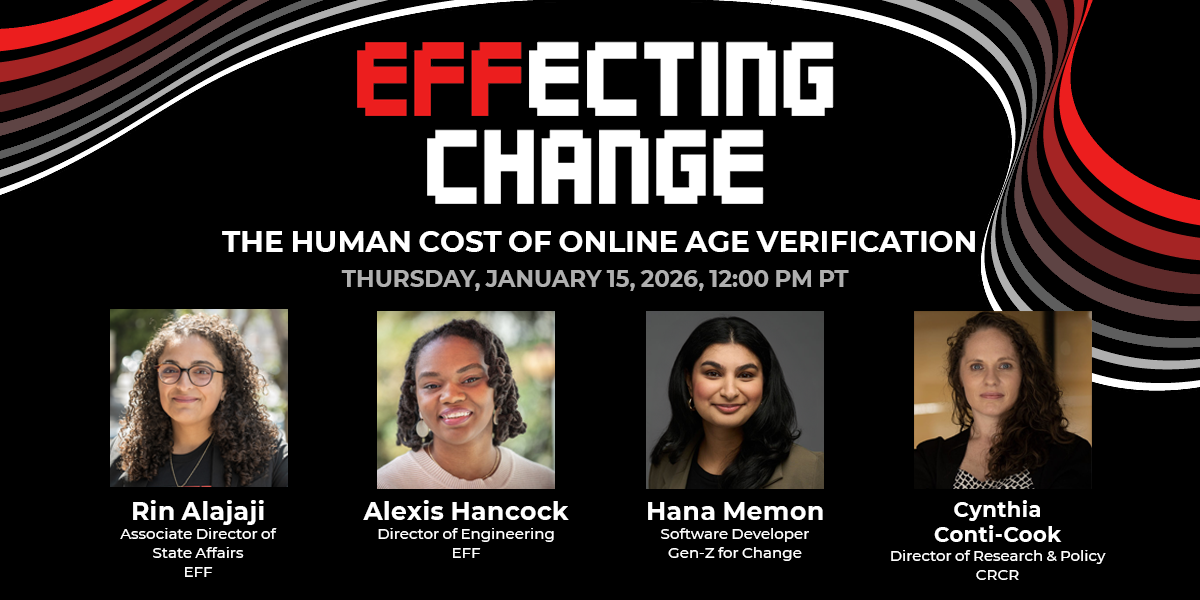
Join EFF's Rindala Alajaji and Alexis Hancock along with Hana Memon from Gen-Z for Change and Cynthia Conti-Cook from Collaborative Research Center for Resilience for a conversation about what we stand to lose as more and more governments push to age-gate the web. We’ll break down how these laws work, who they exclude, and how these mandates threaten privacy and free expression for people of all ages. The conversation will be followed by a live Q&A. 

EFFecting Change Livestream Series:
The Human Cost of Online Age Verification
Thursday, January 15th
12:00 PM - 1:00 PM Pacific
This event is LIVE and FREE!


RSVP Today


Accessibility

This event will be live-captioned and recorded. EFF is committed to improving accessibility for our events. If you have any accessibility questions regarding the event, please contact events@eff.org.

Event Expectations

EFF is dedicated to a harassment-free experience for everyone, and all participants are encouraged to view our full Event Expectations.

Upcoming Events

Want to make sure you don’t miss our next livestream? Here’s a link to sign up for updates about this series: eff.org/ECUpdates. If you have a friend or colleague that might be interested, please join the fight for your digital rights by forwarding this link: eff.org/EFFectingChange. Thank you for helping EFF spread the word about privacy and free expression online. 

Recording

We hope you and your friends can join us live! If you can't make it, we’ll post the recording afterward on YouTube and the Internet Archive!

Congress's Crusade to Age Gate the Internet: 2025 in Review

31 December 2025 at 18:35

In the name of 'protecting kids online,' Congress pushed forward legislation this year that could have severely undermined our privacy and stifled free speech. These bills would have mandated invasive age-verification checks for everyone online—adults and kids alike—handing unprecedented control to tech companies and government authorities.

Lawmakers from both sides of the aisle introduced bill after bill, each one somehow more problematic than the last, and each one a gateway for massive surveillance, internet censorship, and government overreach. In all, Congress considered nearly twenty federal proposals.

For us, this meant a year of playing legislative whack-a-mole, fighting off one bad bill after another. But more importantly, it meant building sustained opposition, strengthening coalitions, and empowering our supporters—that's you!—with the tools you need to understand what's at stake and take action.

Luckily, thanks to this strong opposition, these federal efforts all stalled… for now.

So, before we hang our hats and prepare for the new year, let’s review some of our major wins against federal age-verification legislation in 2025.

The Kids Online Safety Act (KOSA)

Of the dozens of federal proposals relating to kids online, the Kids Online Safety Act remains the biggest threat. We, along with a coalition of civil liberties groups, LGBTQ+ advocates, youth organizations, human rights advocates, and privacy experts, have been sounding the alarm on KOSA for years now.

First introduced in 2022, KOSA would allow the Federal Trade Commission to sue apps and websites that don’t take measures to restrict young people’s access to certain content. There have been numerous versions introduced, though all of them share a common core: KOSA is an unconstitutional censorship bill that threatens the speech and privacy rights of all internet users. It would impose a requirement that platforms “exercise reasonable care” to prevent and mitigate a sweeping list of harms to minors, including depression, anxiety, eating disorders, substance use, bullying, and “compulsive usage.” Those prohibitions are so broad that they will sweep up online speech about the topics, including efforts to provide resources to adults and minors experiencing them. The bill claims prohibit censorship based on “the viewpoint of users,” but that’s simply a smokescreen. Its core function is to let the federal government sue platforms, big or small, that don’t block or restrict content that someone later claims contributed to one of these harms. 

In addition to stifling online speech, KOSA would strongly incentivize age-verification systems—forcing all users, adults and minors, to prove who they are before they can speak or read online. Because KOSA requires online services to separate and censor aspects of their services accessed by children, services are highly likely to demand to know every user’s age to avoid showing minors any of the content KOSA deems harmful. There are a variety of age determination options, but all have serious privacy, accuracy, or security problems. Even worse, age-verification schemes lead everyone to provide even more personal data to the very online services that have invaded our privacy before. And all age verification systems, at their core, burden the rights of adults to read, get information, and speak and browse online anonymously.

Despite what lawmakers claim, KOSA won’t bother big tech—in fact, they endorse it! The bill is written so that big tech companies, like Apple and X, will be able to handle the regulatory burden that KOSA will demand, while smaller platforms will struggle to comply. Under KOSA, a small platform hosting mental health discussion boards will be just as vulnerable as Meta or TikTok—but much less able to defend itself. 

The good news is that KOSA’s momentum this Congress was waning at best. There was a lot of talk about the bill from lawmakers, but little action. The Senate version of the bill, which passed overwhelmingly last summer, did not even make it out of committee this Congress.

In the House, lawmakers could not get on the same page about the bill—so much so that one of the original sponsors of KOSA actually voted against the bill in committee in December.

The bad news is that lawmakers are determined to keep raising this issue, as soon as the beginning of next year. So let’s keep the momentum going by showing them that users do not want age verification mandates—we want privacy.

TAKE ACTION

Don't let congress censor the internet

Threats Beyond KOSA

KOSA wasn’t the only federal bill in 2025 that used “kids’ safety” as a cover for sweeping surveillance and censorship mandates. Concern about possible harms of AI chatbots dominated policy discussion this year in Congress.

One of the most alarming proposals on the issue was the GUARD Act, which would require AI chatbots to verify all users’ ages, prohibit minors from using AI tools, and implement steep criminal penalties for chatbots that promote or solicit certain harms. As we wrote in November, though the GUARD Act may look like a child-safety bill, in practice it’s an age-gating mandate that could be imposed on nearly every public-facing AI chatbot—from customer-service bots to search-engine assistants. The GUARD Act could force countless AI companies to collect sensitive identity data, chill online speech, and block teens from using some of the digital tools that they rely on every day.

Like KOSA, the GUARD Act would make the internet less free, less private, and less safe for everyone. It would further consolidate power and resources in the hands of the bigger AI companies, crush smaller developers, and chill innovation under the threat of massive fines. And it would cut off vulnerable groups’ ability to use helpful everyday AI tools, further fracturing the internet we know and love.

With your help, we urged lawmakers to reject the GUARD Act and focus instead on policies that provide more transparency, options, and comprehensive privacy for all users.

Beating Age Verification for Good

Together, these bills reveal a troubling pattern in Congress this year. Rather than actually protecting young people’s privacy and safety online, Congress continues to push a legislative framework that’s based on some deeply flawed assumptions:

  1. That the internet must be age-gated, with young people either heavily monitored or kicked off entirely, in order to be safe;
  2. That the value of our expressive content to each individual should be determined by the state, not individuals or even families; and
  3. That these censorship and surveillance regimes are worth the loss of all users’ privacy, anonymity, and free expression online.

We’ve written over and over about the many communities who are immeasurably harmed by online age verification mandates. It is also worth remembering who these bills serve—big tech companies, private age verification vendors, AI companies, and legislators vying for the credit of “solving” online safety while undermining users at every turn.

We fought these bills all through 2025, and we’ll continue to do so until we beat age verification for good. So rest up, read up (starting with our all-new resource hub, EFF.org/Age!), and get ready to join us in this fight in 2026. Thank you for your support this year.

This article is part of our Year in Review series. Read other articles about the fight for digital rights in 2025.

Lawmakers Must Listen to Young People Before Regulating Their Internet Access: 2025 in Review

27 December 2025 at 23:25

State and federal lawmakers have introduced multiple proposals in 2025 to curtail or outright block children and teenagers from accessing legal content on the internet. These lawmakers argue that internet and social media platforms have an obligation to censor or suppress speech that they consider “harmful” to young people. Unfortunately, in many of these legislative debates, lawmakers are not listening to kids, whose experiences online are overwhelmingly more positive than what lawmakers claim. 

Fortunately, EFF has spent the past year trying to make sure that lawmakers hear young people’s voices. We have also been reminding lawmakers that minors, like everyone else, have First Amendment rights to express themselves online. 

These rights extend to a young person’s ability to use social media both to speak for themselves and access the speech of others online. Young people also have the right to control how they access this speech, including a personalized feed and other digestible and organized ways. Preventing teenagers from accessing the same internet and social media channels that adults use is a clear violation of their right to free expression. 

On top of violating minors’ First Amendment rights, these laws also actively harm minors who rely on the internet to find community, find resources to end abuse, or access information about their health. Cutting off internet access acutely harms LGBTQ+ youth and others who lack familial or community support where they live. These laws also empower the state to decide what information is acceptable for all young people, overriding parents’ choices. 

Additionally, all of the laws that would attempt to create a “kid friendly” internet and an “adults-only” internet are a threat to everyone, adults included. These mandates encourage an adoption of invasive and dangerous age-verification technology. Beyond creepy, these systems incentivize more data collection, and increase the risk of data breaches and other harms. Requiring everyone online to provide their ID or other proof of their age could block legal adults from accessing lawful speech if they don’t have the right form of ID. Furthermore, this trend infringes on people’s right to be anonymous online, and creates a chilling effect which may deter people from joining certain services or speaking on certain topics

EFF has lobbied against these bills at both the state and federal level, and we have also filed briefs in support of several lawsuits to protect the First Amendment Rights of minors. We will continue to advocate for the rights of everyone online – including minors – in the future.

This article is part of our Year in Review series. Read other articles about the fight for digital rights in 2025.

Age Verification Threats Across the Globe: 2025 in Review

25 December 2025 at 19:17

Age verification mandates won't magically keep young people safer online, but that has not stopped governments around the world spending this year implementing or attempting to introduce legislation requiring all online users to verify their ages before accessing the digital space. 

The UK’s misguided approach to protecting young people online took many headlines due to the reckless and chaotic rollout of the country’s Online Safety Act, but they were not alone: courts in France ruled that porn websites can check users’ ages; the European Commission pushed forward with plans to test its age-verification app; and Australia’s ban on under-16s accessing social media was recently implemented. 

Through this wave of age verification bills, politicians are burdening internet users and forcing them to sacrifice their anonymity, privacy, and security simply to access lawful speech. For adults, this is true even if that speech constitutes sexual or explicit content. These laws are censorship laws, and rules banning sexual content usually hurt marginalized communities and groups that serve them the most.

In response, we’ve spent this year urging governments to pause these legislative initiatives and instead protect everyone’s right to speak and access information online. Here are three ways we pushed back [against these bills] in 2025:

Social Media Bans for Young People

Banning a certain user group changes nothing about a platform’s problematic privacy practices, insufficient content moderation, or business models based on the exploitation of people’s attention and data. And assuming that young people will always find ways to circumvent age restrictions, the ones that do will be left without any protections or age-appropriate experiences.

Yet Australia’s government recently decided to ignore these dangers by rolling out a sweeping regime built around age verification that bans users under 16 from having social media accounts. In this world-first ban, platforms are required to introduce age assurance tools to block under-16s, demonstrate that they have taken “reasonable steps” to deactivate accounts used by under-16s, and prevent any new accounts being created or face fines of up to 49.5 million Australian dollars ($32 million USD). The 10 banned platforms—Instagram, Facebook, Threads, Snapchat, YouTube, TikTok, Kick, Reddit, Twitch and X—have each said they’ll comply with the legislation, leading to young people losing access to their accounts overnight

Similarly, the European Commission this year took a first step towards mandatory age verification that could undermine privacy, expression, and participation rights for young people—rights that have been fully enshrined in international human rights law through its guidelines under Article 28 of the Digital Services Act. EFF submitted feedback to the Commission’s consultation on the guidelines, emphasizing a critical point: Mandatory age verification measures are not the right way to protect minors, and any online safety measure for young people must also safeguard their privacy and security. Unfortunately, the EU Parliament already went a step further, proposing an EU digital minimum age of 16 for access to social media, a move that aligns with EU Commission’s president Ursula von der Leyen’s recent public support for measures inspired by Australia’s model.

Push for Age Assurance on All Users 

This year, the UK had a moment—and not a good one. In late July, new rules took effect under the Online Safety Act that now require all online services available in the UK to assess whether they host content considered harmful to children, and if so, these services must introduce age checks to prevent children from accessing such content. Online services are also required to change their algorithms and moderation systems to ensure that content defined as harmful, like violent imagery, is not shown to young people.

The UK’s scramble to find an effective age verification method shows us that there isn't one, and it’s high time for politicians to take that seriously. As we argued throughout this year, and during the passage of the Online Safety Act, any attempt to protect young people online should not include measures that require platforms to collect data or remove privacy protections around users’ identities. The approach that UK politicians have taken with the Online Safety Act is reckless, short-sighted, and will introduce more harm to the very young people that it is trying to protect.

We’re seeing these narratives and regulatory initiatives replicated from the UK to U.S. states and other global jurisdictions, and we’ll continue urging politicians not to follow the UK’s lead in passing similar legislation—and to instead explore more holistic approaches to protecting all users online.

Rushed Age Assurance through the EU Digital Wallet

There is not yet a legal obligation to verify users’ ages at the EU level, but policymakers and regulators are already embracing harmful age verification and age assessment measures in the name of reducing online harms.

These demands steer the debate toward identity-based solutions, such as the EU Digital Identity Wallet, which will become available in 2026. This has come with its own realm of privacy and security concerns, such as long-term identifiers (which could result in tracking) and over-exposure of personal information. Even more concerning is, instead of waiting for the full launch of the EU DID Wallet, the Commission rushed a “mini AV” app out this year ahead of schedule, citing an urgent need to address concerns about children and the harms that may come to them online. 

However, this proposed solution directly tied national ID to an age verification method. This also comes with potential mission creep of what other types of verification could be done in EU member states once this is fully deployed—while the focus of the “mini AV” app is for now on verifying age, its release to the public means that the infrastructure to expand ID checks to other purposes is in place, should the government mandate that expansion in the future.  

Without the proper safeguards, this infrastructure could be leveraged inappropriately—all the more reason why lawmakers should explore more holistic approaches to children's safety

Ways Forward

The internet is an essential resource for young people and adults to access information, explore community, and find themselves. The issue of online safety is not solved through technology alone, and young people deserve a more intentional approach to protecting their safety and privacy online—not this lazy strategy that causes more harm that it solves. 

Rather than weakening rights for already vulnerable communities online, politicians must acknowledge these shortcomings and explore less invasive approaches to protect all people from online harms. We encourage politicians to look into what is best, and not what is easy; and in the meantime, we’ll continue fighting for the rights of all users on the internet in 2026.

This article is part of our Year in Review series. Read other articles about the fight for digital rights in 2025.

Why Isn’t Online Age Verification Just Like Showing Your ID In Person?

11 December 2025 at 09:00

This blog also appears in our Age Verification Resource Hub: our one-stop shop for users seeking to understand what age-gating laws actually do, what’s at stake, how to protect yourself, and why EFF opposes all forms of age verification mandates. Head to EFF.org/Age to explore our resources and join us in the fight for a free, open, private, and yes—safe—internet.

One of the most common refrains we hear from age verification proponents is that online ID checks are nothing new. After all, you show your ID at bars and liquor stores all the time, right? And it’s true that many places age-restrict access in-person to various goods and services, such as tobacco, alcohol, firearms, lottery tickets, and even tattoos and body piercings.

But this comparison falls apart under scrutiny. There are fundamental differences between flashing your ID to a bartender and uploading government documents or biometric data to websites and third-party verification companies. Online age-gating is more invasive, affects far more people, and poses serious risks to privacy, security, and free speech that simply don't exist when you buy a six-pack at the corner store.

Online age verification burdens many more people.

Online age restrictions are imposed on many, many more users than in-person ID checks. Because of the sheer scale of the internet, regulations affecting online content sweep in an enormous number of adults and youth alike, forcing them to disclose sensitive personal data just to access lawful speech, information, and services. 

Additionally, age restrictions in the physical world affect only a limited number of transactions: those involving a narrow set of age-restricted products or services. Typically this entails a bounded interaction about one specific purchase.

Online age verification laws, on the other hand, target a broad range of internet activities and general purpose platforms and services, including social media sites and app stores. And these laws don’t just wall off specific content deemed harmful to minors (like a bookstore would); they age-gate access to websites wholesale. This is akin to requiring ID every time a customer walks into a convenience store, regardless of whether they want to buy candy or alcohol.

There are significant privacy and security risks that don’t exist offline.

In offline, in-person scenarios, a customer typically provides their physical ID to a cashier or clerk directly. Oftentimes, customers need only flash their ID for a quick visual check, and no personal information is uploaded to the internet, transferred to a third-party vendor, or stored. Online age-gating, on the other hand, forces users to upload—not just momentarily display—sensitive personal information to a website in order to gain access to age-restricted content. 

This creates a cascade of privacy and security problems that don’t exist in the physical world. Once sensitive information like a government-issued ID is uploaded to a website or third-party service, there is no guarantee it will be handled securely. You have no direct control over who receives and stores your personal data, where it is sent, or how it may be accessed, used, or leaked outside the immediate verification process. 

Data submitted online rarely just stays between you and one other party. All online data is transmitted through a host of third-party intermediaries, and almost all websites and services also host a network of dozens of private, third-party trackers managed by data brokers, advertisers, and other companies that are constantly collecting data about your browsing activity. The data is shared with or sold to additional third parties and used to target behavioral advertisements. Age verification tools also often rely on third parties just to complete a transaction: a single instance of ID verification might involve two or three different third-party partners, and age estimation services often work directly with data brokers to offer a complete product. Users’ personal identifying data then circulates among these partners. 

All of this increases the likelihood that your data will leak or be misused. Unfortunately, data breaches are an endemic part of modern life, and the sensitive, often immutable, personal data required for age verification is just as susceptible to being breached as any other online data. Age verification companies can be—and already have been—hacked. Once that personal data gets into the wrong hands, victims are vulnerable to targeted attacks both online and off, including fraud and identity theft.

Troublingly, many age verification laws don’t even protect user security by providing a private right of action to sue a company if personal data is breached or misused. This leaves you without a direct remedy should something bad happen. 

Some proponents claim that age estimation is a privacy-preserving alternative to ID-based verification. But age estimation tools still require biometric data collection, often demanding users submit a photo or video of their face to access a site. And again, once submitted, there’s no way for you to verify how that data is processed or stored. Requiring face scans also normalizes pervasive biometric surveillance and creates infrastructure that could easily be repurposed for more invasive tracking. Once we’ve accepted that accessing lawful speech requires submitting our faces for scanning, we’ve crossed a threshold that’s difficult to walk back.

Online age verification creates even bigger barriers to access.

Online age gates create more substantial access barriers than in-person ID checks do. For those concerned about privacy and security, there is no online analog to a quick visual check of your physical ID. Users may be justifiably discouraged from accessing age-gated websites if doing so means uploading personal data and creating a potentially lasting record of their visit to that site.

Given these risks, age verification also imposes barriers to remaining anonymous that don't typically exist in-person. Anonymity can be essential for those wishing to access sensitive, personal, or stigmatized content online. And users have a right to anonymity, which is “an aspect of the freedom of speech protected by the First Amendment.” Even if a law requires data deletion, users must still be confident that every website and online service with access to their data will, in fact, delete it—something that is in no way guaranteed.

In-person ID checks are additionally less likely to wrongfully exclude people due to errors. Online systems that rely on facial scans are often incorrect, especially when applied to users near the legal age of adulthood. These tools are also less accurate for people with Black, Asian, Indigenous, and Southeast Asian backgrounds, for users with disabilities, and for transgender individuals. This leads to discriminatory outcomes and exacerbates harm to already marginalized communities. And while in-person shoppers can speak with a store clerk if issues arise, these online systems often rely on AI models, leaving users who are incorrectly flagged as minors with little recourse to challenge the decision.

In-person interactions may also be less burdensome for adults who don’t have up-to-date ID. An older adult who forgets their ID at home or lacks current identification is not likely to face the same difficulty accessing material in a physical store, since there are usually distinguishing physical differences between young adults and those older than 35. A visual check is often enough. This matters, as a significant portion of the U.S. population does not have access to up-to-date government-issued IDs. This disproportionately affects Black Americans, Hispanic Americans, immigrants, and individuals with disabilities, who are less likely to possess the necessary identification.

We’re talking about First Amendment-protected speech.

It's important not to lose sight of what’s at stake here. The good or service age gated by these laws isn’t alcohol or cigarettes—it’s First Amendment-protected speech. Whether the target is social media platforms or any other online forum for expression, age verification blocks access to constitutionally-protected content. 

Access to many of these online services is also necessary to participate in the modern economy. While those without ID may function just fine without being able to purchase luxury products like alcohol or tobacco, requiring ID to participate in basic communication technology significantly hinders people’s ability to engage in economic and social life.

This is why it’s wrong to claim online age verification is equivalent to showing ID at a bar or store. This argument handwaves away genuine harms to privacy and security, dismisses barriers to access that will lock millions out of online spaces, and ignores how these systems threaten free expression. Ignoring these threats won’t protect children, but it will compromise our rights and safety.

Age Verification Is Coming For the Internet. We Built You a Resource Hub to Fight Back.

11 December 2025 at 00:48

Age verification laws are proliferating fast across the United States and around the world, creating a dangerous and confusing tangle of rules about what we’re all allowed to see and do online. Though these mandates claim to protect children, in practice they create harmful censorship and surveillance regimes that put everyone—adults and young people alike—at risk.

The term “age verification” is colloquially used to describe a wide range of age assurance technologies, from age verification systems that force you to upload government ID, to age estimation tools that scan your face, to systems that infer your age by making you share personal data. While different laws call for different methods, one thing remains constant: every method out there collects your sensitive, personal information and creates barriers to accessing the internet. We refer to all of these requirements as age verification, age assurance, or age-gating.

If you’re feeling overwhelmed by this onslaught of laws and the invasive technologies behind them, you’re not alone. It’s a lot. But understanding how these mandates work and who they harm is critical to keeping yourself and your loved ones safe online. Age verification is lurking around every corner these days, so we must fight back to protect the internet that we know and love. 

That’s why today, we’re launching EFF’s Age Verification Resource Hub (EFF.org/Age): a one-stop shop to understand what these laws actually do, what’s at stake, why EFF opposes all forms of age verification, how to protect yourself, and how to join the fight for a free, open, private, and yes—safe—internet. 

Why Age Verification Mandates Are a Problem

In the U.S., more than half of all states have now passed laws imposing age-verification requirements on online platforms. Congress is considering even more at the federal level, with a recent House hearing weighing nineteen distinct proposals relating to young people’s online safety—some sweeping, some contradictory, and each one more drastic and draconian than the last.

We all want young people to be safe online. However, age verification is not the silver bullet that lawmakers want you to think it is.

The rest of the world is moving in the same direction. We saw the UK’s Online Safety Act go into effect this summer, Australia’s new law barring access to social media for anyone under 16 goes live today, and a slew of other countries are currently considering similar restrictions.

We all want young people to be safe online. However, age verification is not the silver bullet that lawmakers want you to think it is. In fact, age-gating mandates will do more harm than goodespecially for the young people they claim to protect. They undermine the fundamental speech rights of adults and young people alike; create new barriers to accessing vibrant, lawful, even life-saving content; and needlessly jeopardize all internet users’ privacy, anonymity, and security.

If legislators want to meaningfully improve online safety, they should pass a strong, comprehensive federal privacy law instead of building new systems of surveillance, censorship, and exclusion.  

What’s Inside the Resource Hub

Our new hub is built to answer the questions we hear from users every day, such as:

  • How do age verification laws actually work?
  • What’s the difference between age verification, age estimation, age assurance, and all the other confusing technical terms I’m hearing?
  • What’s at stake for me, and who else is harmed by these systems?
  • How can I keep myself, my family, and my community safe as these laws continue to roll out?
  • What can I do to fight back?
  • And if not age verification, what else can we do to protect the online safety of our young people?

Head over to EFF.org/Age to explore our explainers, user-friendly guides, technical breakdowns, and advocacy tools—all indexed in the sidebar for easy browsing. And today is just the start, so keep checking back over the next several weeks as we continue to build out the site with new resources and answers to more of your questions on all things age verification.

Join Us: Reddit AMA & EFFecting Change Livestream Events

To celebrate the launch of EFF.org/Age, and to hear directly from you how we can be most helpful in this fight, we’re hosting two exciting events:

1. Reddit AMA on r/privacy

Next week, our team of EFF activists, technologists, and lawyers will be hanging out over on Reddit’s r/privacy subreddit to directly answer your questions on all things age verification. We’re looking forward to connecting with you and hearing how we can help you navigate these changing tides, so come on over to r/privacy on Monday (12/15), Tuesday (12/16), and Wednesday (12/17), and ask us anything!

2. EFFecting Change Livestream Panel: “The Human Cost of Online Age Verification

Then, on January 15th at 12pm PT, we’re hosting a livestream panel featuring Cynthia Conti-Cook, Director of Research and Policy at the Collaborative Research Center for Resilience; Hana Memon, Software Developer at Gen Z for Change; EFF Director of Engineering Alexis Hancock; and EFF Associate Director of State Affairs Rindala Alajaji. We’ll break down how these laws work, who they exclude, and how these mandates threaten privacy and free expression for people of all ages. Join us by RSVPing at https://livestream.eff.org/.

A Resource to Empower Users

Age-verification mandates are reshaping the internet in ways that are invasive, dangerous, and deeply unnecessary. But users are not powerless! We can challenge these laws, protect our digital rights, and build a safer digital world for all internet users, no matter their ages. Our new resource hub is here to help—so explore, share, and join us in the fight for a better internet.

Age Assurance Methods Explained

10 December 2025 at 03:19

This blog also appears in our Age Verification Resource Hub: our one-stop shop for users seeking to understand what age-gating laws actually do, what’s at stake, how to protect yourself, and why EFF opposes all forms of age verification mandates. Head to EFF.org/Age to explore our resources and join us in the fight for a free, open, private, and yes—safe—internet.

EFF is against all mandatory age verification. Not only does it turn the internet into an age-gated cul-de-sac, but it also leaves behind many people who can’t get or don’t have proper and up-to-date documentation. While populations like undocumented immigrants and people experiencing homelessness are more obviously vulnerable groups, these restrictions also impact people with more mundane reasons for not having valid documentation on hand. Perhaps they’ve undergone life changes that impact their status or other information—such as a move, name change, or gender marker change—or perhaps they simply haven’t gotten around to updating their documents. Inconvenient events like these should not be a barrier to going online. People should also reserve the right to opt-out of unreliable technology and shady practices that could endanger their personal information.

But age restriction mandates threaten all of that. Not only do age-gating laws block adults and youth alike from freely accessing services on the web, they also force users to trade their anonymity—a pillar of online expression—for a system in which they are bound to their real-life identities. And this surveillance regime stretches beyond just age restrictions on certain content; much of this infrastructure is also connected to government plans for creating a digital system of proof of identity.

So how does age gating actually work? The age and identity verification industry has devised countless different methods platforms can purchase to—in theory—figure out the ages and/or identities of their users.  But in practice, there is no technology available that is entirely privacy-protective, fully accurate, and that guarantees complete coverage of the population. Full stop.

Every system of age verification or age estimation demands that users hand over sensitive and oftentimes immutable personal information that links their offline identity to their online activity, risking their safety and security in the process.

But in practice, there is no technology available that is entirely privacy-protective, fully accurate, and that guarantees complete coverage of the population. Full stop.

With that said, as we see more of these laws roll out across the U.S. and the rest of the world, it’s important to understand the differences between these technologies so you can better identify the specific risks of each method, and make smart decisions about how you share your own data.

Age Assurance Methods

There are many different technologies that are being developed, attempted, and deployed to establish user age. In many cases, a single platform will have implemented a mixture of methods. For example, a user may need to submit both a physical government ID and a face scan as part of a liveliness check to establish that they are the person pictured on the physical ID. 

Age assurance methods generally fall into three categories:

  1. Age Attestation
  2. Age Estimation
  3. ID-bound Proof

Age Attestation

Self-attestation 

Sometimes, you’ll be asked to declare your age, without requiring any form of verification. One way this might happen is through one-off self-attestation. This type of age attestation has been around for a while; you may have seen it when an alcohol website asks if you’re over 21, or when Steam asks you to input your age to view game content that may not be appropriate for all ages. It’s usually implemented as a pop-up on a website, and they might ask you for your age every time you enter, or remember it between site accesses. This sort of attestation provides an indication that the site may not be appropriate for all viewers, but gives users the autonomy and respect to make that decision for themselves.

An alternative proposed approach to declaring your own age, called device-bound age attestation, is to have you set your age on your operating system or on App Stores before you can make purchases or browse the web. This age or age range might then be shared with websites or apps. On an Apple device, that age can be modified after creation, as long as an adult age is chosen. It’s important to separate device-bound age attestation from methods that require age verification or estimation at the device or app store level (common to digital ID solutions and some proposed laws). It’s only attestation if you’re permitted to set your age to whatever you choose without needing to prove anything to your provider or another party—providing flexibility for age declaration outside of mandatory age verification.

Attestation through parental controls

The sort of parental controls found on Apple and Android devices, Windows computers, and video game consoles provide the most flexible way for parents to manage what content their minor children can access. These settings can be applied through the device operating system, third-party applications, or by establishing a child account. Decisions about what content a young person can access are made via consent-driven mechanisms. As the manager, the parent or guardian will see requests and activity from their child depending on how strict or lax the settings are set. This could include requests to install an app, make a purchase on an app store, communicate with a new contact, or browse a particular website. The parent or guardian can then choose whether or not to accept the request and allow the activity. 

One survey that collected answers from 1,000 parents found that parental controls are underutilized. Adoption of parental controls varied widely, from 51% on tablets to 35% on video game consoles. To help encourage more parents to make use of these settings, companies should continue to make them clearer and easier to use and manage. Parental controls are better suited to accommodating diverse cultural contexts and individual family concerns than a one-size-fits-all government mandate. It’s also safer to use native settings–or settings provided by the operating system itself–than it is to rely on third-party parental control applications. These applications have experienced data breaches and often effectively function as spyware.

Age Estimation

Instead of asking you directly, the system guesses your age based on data it collects about you.

Age estimation through photo and facial estimation

Age estimation by photo or live facial age analysis is when a system uses an image of a face to guess a person’s age.

A poorly designed system might improperly store these facial images or retain them for significant periods, creating a risk of data leakage. Our faces are unique, immutable, and constantly on display. In the hands of an adversary, and cross-referenced to other readily available information about us, this information can expose intimate details about us or lead to biometric tracking.

This technology has also proven fickle and often inaccurate, causing false negatives and positives, exacerbation of racial biases, and unprotected usage of biometric data to complete the analysis. And because it’s usually conducted with AI models, there often isn’t a way for a user to challenge a decision directly without falling back on more intrusive methods like submitting a government ID. 

Age inference based on user data and third party services

Age inference systems are normally conducted through estimating how old someone is based on their account information or querying other databases, where the account may have done age verification already, to cross reference with the existing information they have on that account.

Age inference includes but not limited to:

In order to view how old someone is via account information associated with their email, services often use data brokers to provide this information. This incentivizes even more collection of our data for the sake of age estimation and rewards data brokers for collecting a mass of data on people. Also, regulation of these age inference services varies based on a country’s privacy laws.

ID-bound Proof

ID-bound proofs, methods that use your government issued ID, are often used as a fallback for failed age estimation. Consequently, any government-issued ID backed verification disproportionately excludes certain demographics from accessing online services. A significant portion of the U.S. population does not have access to government-issued IDs, with millions of adults lacking a valid driver’s license or state-issued ID. This disproportionately affects Black Americans, Hispanic Americans, immigrants, and individuals with disabilities, who are less likely to possess the necessary identification. In addition, non-U.S. citizens, including undocumented immigrants, face barriers to acquiring government-issued IDs. The exclusionary nature of document-based verification systems is a major concern, as it could prevent entire communities from accessing essential services or engaging in online spaces.

Physical ID uploaded and stored as an image 

When an image of a physical ID is required, users are forced to upload—not just momentarily display—sensitive personal information, such as government-issued ID or biometric identifiers, to third-party services in order to gain access to age-restricted content. This creates significant privacy and security concerns, as users have no direct control over who receives and stores their personal data, where it is sent, and how it may be accessed, used, or leaked outside the immediate verification process.

Requiring users to digitally hand over government-issued identification to verify their age introduces substantial privacy risks. Once sensitive information like a government-issued ID is uploaded to a website or third-party service, there is no guarantee that it will be handled securely. The verification process typically involves transmitting this data across multiple intermediaries, which means the risk of a data breach is heightened. The misuse of sensitive personal data, such as government IDs, has been demonstrated in numerous high-profile cases, including the breach of the age verification company AU10TIX, which exposed login credentials for over a year, and the hack of the messaging application Discord. Justifiable privacy and security concerns may chill users from accessing platforms they are lawfully entitled to access.

Device-bound digital ID

Device-bound digital ID is a credential that is locally stored on your device. This comes in the form of government or privately-run wallet applications, like those offered by Apple and Google. Digital IDs are subject to a higher level of security within the Google and Apple wallets (as they should be). This means they are not synced to your account or across services. If you lose the device, you will need to reissue a new credential to the new one. Websites and services can directly query your digital ID to reveal only certain information from your ID, like age range, instead of sharing all of your information. This is called “selective disclosure."

There are many reasons someone may not be able to acquire a digital ID, preventing them from relying on this option. This includes lack of access to a smartphone, sharing devices with another person, or inability to get a physical ID. No universal standards exist governing how ID expiration, name changes, or address updates affect the validity of digital identity credentials. How to handle status changes is left up to the credential issuer.

Asynchronous and Offline Tokens

This is an issued token of some kind that doesn’t necessarily need network access to an external party or service every time you use it to establish your age with a verifier when they ask. A common danger in age verification services is the proliferation of multiple third-parties and custom solutions, which vary widely in their implementation and security. One proposal to avoid this is to centralize age checks with a trusted service that provides tokens that can be used to pass age checks in other places. Although this method requires a user to still submit to age verification or estimation once, after passing the initial facial age estimation or ID check, a user is issued a digital token they can present later to to show that they've previously passed an age check. The most popular proposal, AgeKeys, is similar to passkeys in that the tokens will be saved to a device or third-party password store, and can then be easily accessed after unlocking with your preferred on-device biometric verification or pin code.

Lessons Learned

With lessons pulled from the problems with the age verification rollout in the UK and various U.S. states, age verification widens risk for everyone by presenting scope creep and blocking web information access. Privacy-preserving methods to determine age exist such as presenting an age threshold instead of your exact birth date, but have not been mass deployed or stress tested yet. Which is why policy safeguards around the deployed technology matter just as much, if not more. 

Much of the infrastructure around age verification is entangled with other mandates, like deployment of digital ID. Which is why so many digital offerings get coupled with age verification as a “benefit” to the holder. In reality it’s more of a plus for the governments that want to deploy mandatory age verification and the vendors that present their implementation that often contains multiple methods. Instead of working on a singular path to age-gate the entire web, there should be a diversity of privacy-preserving ways to attest age without locking everyone into a singular platform or method. Ultimately, offering multiple options rather than focusing on a single method that would further restrict those who can’t use that particular path.

10 (Not So) Hidden Dangers of Age Verification

8 December 2025 at 17:24

It’s nearly the end of 2025, and half of the US and the UK now require you to upload your ID or scan your face to watch “sexual content.” A handful of states and Australia now have various requirements to verify your age before you can create a social media account.

Age-verification laws may sound straightforward to some: protect young people online by making everyone prove their age. But in reality, these mandates force users into one of two flawed systems—mandatory ID checks or biometric scans—and both are deeply discriminatory. These proposals burden everyone’s right to speak and access information online, and structurally excludes the very people who rely on the internet most. In short, although these laws are often passed with the intention to protect children from harm, the reality is that these laws harm both adults and children. 

Here’s who gets hurt, and how: 

   1.  Adults Without IDs Get Locked Out

Document-based verification assumes everyone has the right ID, in the right name, at the right address. About 15 million adult U.S. citizens don’t have a driver’s license, and 2.6 million lack any government-issued photo ID at all. Another 34.5 million adults don't have a driver's license or state ID with their current name and address.

Specifically:

  • 18% of Black adults don't have a driver's license at all.
  • Black and Hispanic Americans are disproportionately less likely to have current licenses.
  • Undocumented immigrants often cannot obtain state IDs or driver's licenses.
  • People with disabilities are less likely to have current identification.
  • Lower-income Americans face greater barriers to maintaining valid IDs.

Some laws allow platforms to ask for financial documents like credit cards or mortgage records instead. But they still overlook the fact that nearly 35% of U.S. adults also don't own homes, and close to 20% of households don't have credit cards. Immigrants, regardless of legal status, may also be unable to obtain credit cards or other financial documentation.

   2.  Communities of Color Face Higher Error Rates

Platforms that rely on AI-based age-estimation systems often use a webcam selfie to guess users’ ages. But these algorithms don’t work equally well for everyone. Research has consistently shown that they are less accurate for people with Black, Asian, Indigenous, and Southeast Asian backgrounds; that they often misclassify those adults as being under 18; and sometimes take longer to process, creating unequal access to online spaces. This mirrors the well-documented racial bias in facial recognition technologies. The result is that technology’s inherent biases can block people from speaking online or accessing others’ speech.

   3.  People with Disabilities Face More Barriers

Age-verification mandates most harshly affect people with disabilities. Facial recognition systems routinely fail to recognize faces with physical differences, affecting an estimated 100 million people worldwide who live with facial differences, and “liveness detection” can exclude folks with limited mobility. As these technologies become gatekeepers to online spaces, people with disabilities find themselves increasingly blocked from essential services and platforms with no specified appeals processes that account for disability.

Document-based systems also don't solve this problem—as mentioned earlier, people with disabilities are also less likely to possess current driver's licenses, so document-based age-gating technologies are equally exclusionary.

   4.  Transgender and Non-Binary People Are Put At Risk

Age-estimation technologies perform worse on transgender individuals and cannot classify non-binary genders at all. For the 43% of transgender Americans who lack identity documents that correctly reflect their name or gender, age verification creates an impossible choice: provide documents with dead names and incorrect gender markers, potentially outing themselves in the process, or lose access to online platforms entirely—a risk that no one should be forced to take just to use social media or access legal content.

   5.  Anonymity Becomes a Casualty

Age-verification systems are, at their core, surveillance systems. By requiring identity verification to access basic online services, we risk creating an internet where anonymity is a thing of the past. For people who rely on anonymity for safety, this is a serious issue. Domestic abuse survivors need to stay anonymous to hide from abusers who could track them through their online activities. Journalists, activists, and whistleblowers regularly use anonymity to protect sources and organize without facing retaliation or government surveillance. And in countries under authoritarian rule, anonymity is often the only way to access banned resources or share information without being silenced. Age-verification systems that demand government IDs or biometric data would strip away these protections, leaving the most vulnerable exposed.

   6.  Young People Lose Access to Essential Information 

Because state-imposed age-verification rules either block young people from social media or require them to get parental permission before logging on, they can deprive minors of access to important information about their health, sexuality, and gender. Many U.S. states mandate “abstinence only” sexual health education, making the internet a key resource for education and self-discovery. But age-verification laws can end up blocking young people from accessing that critical information. And this isn't just about porn, it’s about sex education, mental health resources, and even important literature. Some states and countries may start going after content they deem “harmful to minors,” which could include anything from books on sexual health to art, history, and even award-winning novels. And let’s be clear: these laws often get used to target anything that challenges certain political or cultural narratives, from diverse educational materials to media that simply includes themes of sexuality or gender diversity. What begins as a “protection” for kids could easily turn into a full-on censorship movement, blocking content that’s actually vital for minors’ development, education, and well-being. 

This is also especially harmful to homeschoolers, who rely on the internet for research, online courses, and exams. For many, the internet is central to their education and social lives. The internet is also crucial for homeschoolers' mental health, as many already struggle with isolation. Age-verification laws would restrict access to resources that are essential for their education and well-being.

   7.  LGBTQ+ Youth Are Denied Vital Lifelines

For many LGBTQ+ young people, especially those with unsupportive or abusive families, the internet can be a lifeline. For young people facing family rejection or violence due to their sexuality or gender identity, social media platforms often provide crucial access to support networks, mental health resources, and communities that affirm their identities. Age verification systems that require parental consent threaten to cut them from these crucial supports. 

When parents must consent to or monitor their children's social media accounts, LGBTQ+ youth who lack family support lose these vital connections. LGBTQ+ youth are also disproportionately likely to be unhoused and lack access to identification or parental consent, further marginalizing them. 

   8.  Youth in Foster Care Systems Are Completely Left Out

Age verification bills that require parental consent fail to account for young people in foster care, particularly those in group homes without legal guardians who can provide consent, or with temporary foster parents who cannot prove guardianship. These systems effectively exclude some of the most vulnerable young people from accessing online platforms and resources they may desperately need.

   9.  All of Our Personal Data is Put at Risk

An age-verification system also creates acute privacy risks for adults and young people. Requiring users to upload sensitive personal information (like government-issued IDs or biometric data) to verify their age creates serious privacy and security risks. Under these laws, users would not just momentarily display their ID like one does when accessing a liquor store, for example. Instead, they’d submit their ID to third-party companies, raising major concerns over who receives, stores, and controls that data. Once uploaded, this personal information could be exposed, mishandled, or even breached, as we've seen with past data hacks. Age-verification systems are no strangers to being compromised—companies like AU10TIX and platforms like Discord have faced high-profile data breaches, exposing users’ most sensitive information for months or even years. 

The more places personal data passes through, the higher the chances of it being misused or stolen. Users are left with little control over their own privacy once they hand over these immutable details, making this approach to age verification a serious risk for identity theft, blackmail, and other privacy violations. Children are already a major target for identity theft, and these mandates perversely increase the risk that they will be harmed.

   10.  All of Our Free Speech Rights Are Trampled

The internet is today’s public square—the main place where people come together to share ideas, organize, learn, and build community. Even the Supreme Court has recognized that social media platforms are among the most powerful tools ordinary people have to be heard.

Age-verification systems inevitably block some adults from accessing lawful speech and allow some young people under 18 users to slip through anyway. Because the systems are both over-inclusive (blocking adults) and under-inclusive (failing to block people under 18), they restrict lawful speech in ways that violate the First Amendment. 

The Bottom Line

Age-verification mandates create barriers along lines of race, disability, gender identity, sexual orientation, immigration status, and socioeconomic class. While these requirements threaten everyone’s privacy and free-speech rights, they fall heaviest on communities already facing systemic obstacles.

The internet is essential to how people speak, learn, and participate in public life. When access depends on flawed technology or hard-to-obtain documents, we don’t just inconvenience users, we deepen existing inequalities and silence the people who most need these platforms. As outlined, every available method—facial age estimation, document checks, financial records, or parental consent—systematically excludes or harms marginalized people. The real question isn’t whether these systems discriminate, but how extensively.

❌